Who keeps the profit when healthcare billing is outsourced?
Healthcare BPOs are the machinery that turns a medical encounter into a paid claim: the codes, eligibility checks, authorizations, payment networks, denials, collections and patient support that sit between a doctor's work and the money that pays for it. The theme brings together worlds that grew up separately: hospital finance, government payment rules, electronic health records, electronic data exchange, offshore labor, private-equity consolidation and, most recently, artificial intelligence. It matters now because healthcare spending and administrative complexity are rising faster than providers can staff the work, while new data standards and AI could either widen outsourcing or remove much of the labor it sells. The short answer to the question is that providers and payers keep most of the money in healthcare, but the highest profit margins tend to go to whoever owns the data, the payment rails and the workflow; the companies that sell mostly human labor keep their fees only while they deliver results that software alone cannot.
Chapter 1 — A bill is a relay race
A patient walks out of a hospital after a successful knee operation. The surgery is over. The money has not yet moved at all.
Before the patient ever arrived, someone checked that the insurance was active and that the plan covered the procedure. Someone else may have asked the insurer for permission in advance. After the operation, a coder reads the surgeon's notes and translates them into a string of standardized codes. A billing team assembles a claim. A network carries it to the insurer. The insurer's systems decide what to pay. If the answer is no, or not quite, a denial specialist reads the reason, gathers documentation and appeals. Months later, a collections team asks the patient for the deductible they still owe.
This chain has a name: revenue cycle management, or RCM. The easiest way to picture it is as a relay race. Each runner carries the baton a short distance and hands it on, and the race is won only when cash lands in the hospital's bank account. The analogy breaks in one important place. In a real relay the baton only moves forward. In healthcare billing, the baton regularly moves backward: an insurer rejects a claim, and the hospital must return to an earlier leg, fix the coding or the paperwork, and run it again. Every backward step costs staff time and delays cash.
A "healthcare BPO", short for business process outsourcing, is a company that runs some of those legs for someone else. Some run a single leg, such as coding. Some run the whole race. Some build the track itself: the software and networks that carry claims and payments. Others do similar back-office work for insurers and government health programs, processing claims, enrolling members and answering calls.
Seven threads that became one industry
This story follows seven threads that began far apart. The first is hospital finance, and the payment incentives that decide how a hospital is paid. The second is medical coding and documentation, the language that describes care in a form a payer can price. The third is electronic claims and payment networks. The fourth is electronic health records and the effort to make them talk to each other. The fifth is outsourced and offshore labor. The sixth is insurer and government-program administration. The seventh is software, AI and the data that workflows generate.
These threads met in one place above all: the United States. American healthcare has many commercial insurers, each with its own rules, alongside Medicare, Medicaid and a large number of private hospital systems and physician practices. That fragmentation creates enormous administrative work, and much of that work is bought from outside. India, the Philippines and other countries matter mainly as the places where much of the work is done.
The pressure today
The pressure on this system is rising. The federal Centers for Medicare & Medicaid Services (CMS) projects that US national health spending will grow 5.4% a year from 2025 to 2034, faster than the economy's projected 4.1%, taking healthcare to 20.6% of GDP by 2034.1 More spending means more encounters, more claims and more payment events, each carrying its own paperwork.
The burden shows up inside the clinic. In a 2025 survey by the Medical Group Management Association, 92% of medical practices said they had hired or reassigned staff solely to handle prior authorization, the insurer's advance approval for a treatment, and 60% said a single request typically involved at least three employees.2 Hospitals feel it too: the American Hospital Association reports that hospitals employed an average of roughly 64 administrative and billing staff in 2024, about 6.5% of hospital employment.3
And the job is not finished. CAQH, an industry body that tracks how much administrative work has moved to electronic form, estimates that about $18.3 billion a year could still be saved in medical and dental administration if the remaining manual transactions became fully electronic.4 That is a large pool of waste, and waste is what outsourcers sell against.
The question underneath
Here is the catch that shapes everything that follows. Outsourcing moves work. It does not necessarily move the money that the work is about. When a hospital hires a coding company, the hospital still owns the patient revenue. The vendor earns a fee, and the size and durability of that fee depend on how hard the vendor is to replace.
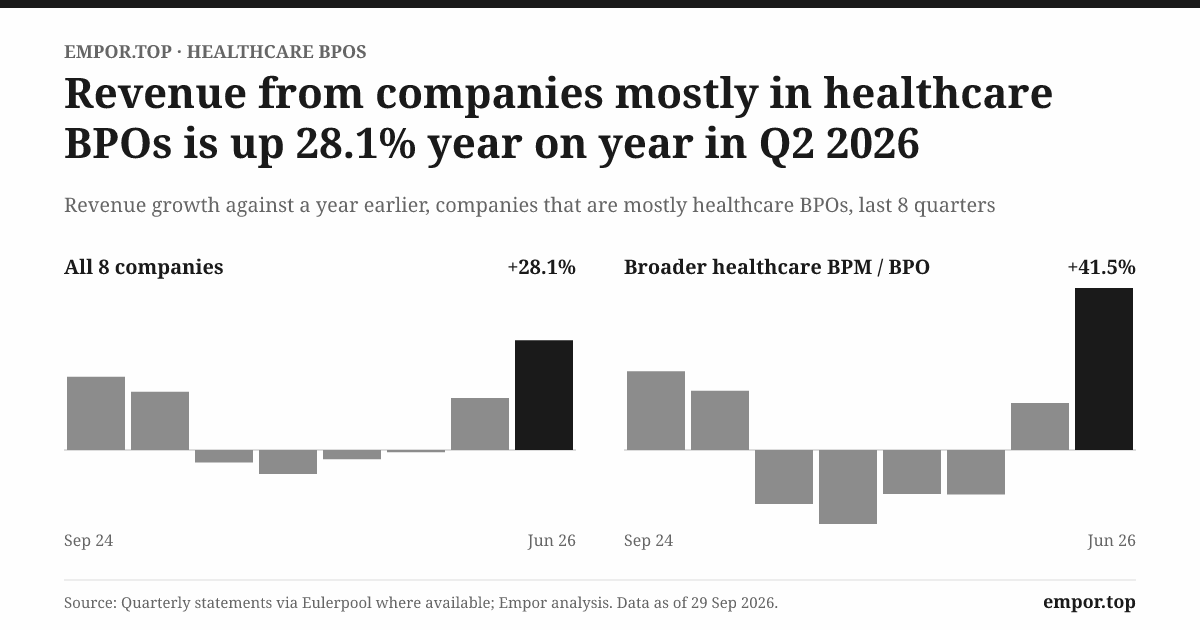
That is why rising healthcare spending does not automatically mean rising vendor profit. A hospital can bring the work back in-house. A large buyer can run a tender and push prices down. Software can shrink the number of hours a vendor bills for. The listed companies in this theme show the tension: their combined revenue grew 25.3% in the quarter to June 2026 from a year earlier, yet their shares fell 22.1% in US dollar terms over the past year.5 Demand and profit are not the same thing, and the market is plainly unsure which layer will keep the gains.
To see why, the story has to go back to a time before anyone sold "RCM" at all. Before a company could run the billing relay, hospitals had to learn to describe care in a language that accountants, insurers and governments could price.
 Subscribe on LinkedIn
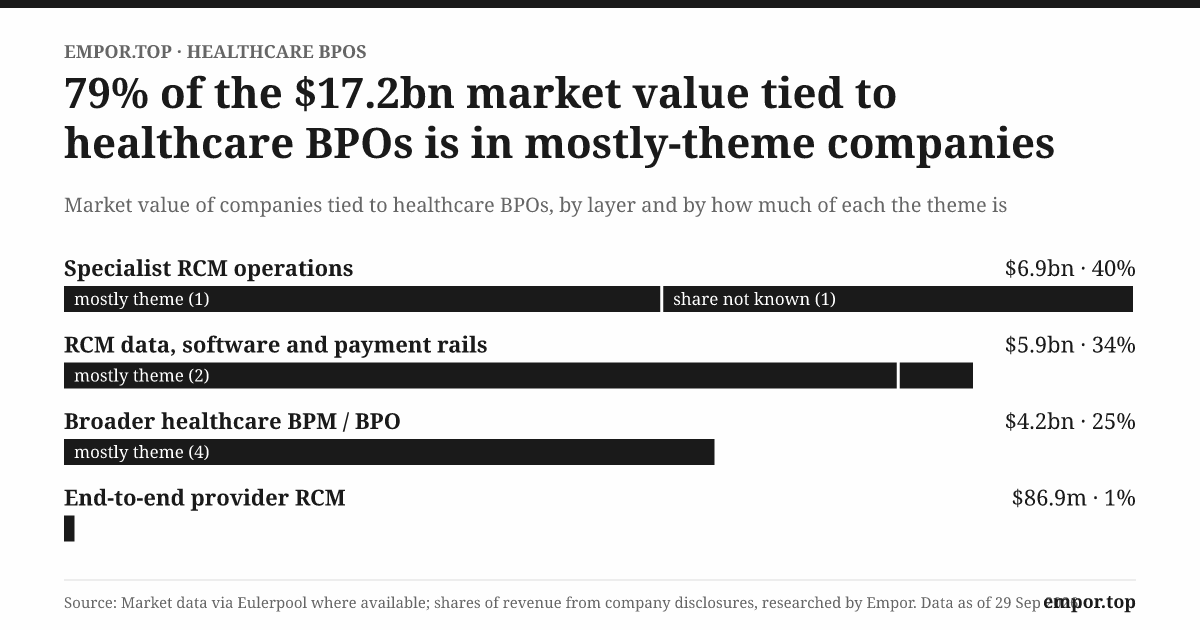
79% of the $17.2bn market value tied to healthcare BPOs is in mostly-theme companies
Market value of companies tied to healthcare BPOs, by layer and by how much of each the theme is
Specialist RCM operations $6.9bn · 40%
mostly theme (1) $3.9bn · share not known (1) $3.1bn
RCM data, software and payment rails $5.9bn · 34%
mostly theme (2) $5.4bn · share not known (1) $493m
Broader healthcare BPM / BPO $4.2bn · 25%
mostly theme (4) $4.2bn
End-to-end provider RCM $86.9m · 1%
mostly theme (1) $86.9m
Market value of the listed companies in each layer, in US dollars, on 29 Sep 2026, split by how much of each company's revenue comes from the theme: mostly theme (75% or more), core (20–75%), meaningful (5–20%) and small part (under 5%).
This is the value of companies associated with healthcare BPOs, not the value of the theme: too little of the theme's revenue is disclosed company by company to show that.
Who is left out · 69
- UnitedHealth Group (Optum Insight) (RCM data, software and payment rails): Not a listed company, or market value not available
- Experian Health (RCM data, software and payment rails): Not a listed company, or market value not available
- Oracle Health (RCM data, software and payment rails): Not a listed company, or market value not available
- SS&C Technologies – SS&C Health (RCM data, software and payment rails): Not a listed company, or market value not available
- TELUS Corporation – TELUS Health (RCM data, software and payment rails): Not a listed company, or market value not available
- Mastek Limited – Healthcare (RCM data, software and payment rails): Not a listed company, or market value not available
- HandsOn Global Management (HGM) Limited – Healthcare platform / Aidéo Technologies (RCM data, software and payment rails): Not a listed company, or market value not available
- Solventum – Health Information Systems (RCM data, software and payment rails): Not a listed company, or market value not available
- Omega Healthcare (Specialist RCM operations): Not a listed company, or market value not available
- AGS Health (Specialist RCM operations): Not a listed company, or market value not available
- GeBBS Healthcare Solutions (Specialist RCM operations): Not a listed company, or market value not available
- Access Healthcare (Specialist RCM operations): Not a listed company, or market value not available
- CorroHealth (Specialist RCM operations): Not a listed company, or market value not available
- Infinx Healthcare (Specialist RCM operations): Not a listed company, or market value not available
- Vee Healthtek (Specialist RCM operations): Not a listed company, or market value not available
- Medusind (Specialist RCM operations): Not a listed company, or market value not available
- Coronis Health (Specialist RCM operations): Not a listed company, or market value not available
- AllDigi Tech – Healthcare BPM (Specialist RCM operations): Not a listed company, or market value not available
- Tech Mahindra – Healthcare and Life Sciences (Specialist RCM operations): Not a listed company, or market value not available
- R1 RCM (End-to-end provider RCM): Not a listed company, or market value not available
- Ensemble Health Partners (End-to-end provider RCM): Not a listed company, or market value not available
- Conifer Health Solutions (End-to-end provider RCM): Not a listed company, or market value not available
- FinThrive (End-to-end provider RCM): Not a listed company, or market value not available
- Tenet Healthcare – Conifer Health Solutions (End-to-end provider RCM): Not a listed company, or market value not available
- Privia Health – Provider Enablement (End-to-end provider RCM): Not a listed company, or market value not available
- XBP Global Holdings, Inc. – Healthcare Industry Solutions and Services (End-to-end provider RCM): Not a listed company, or market value not available
- Firstsource Solutions – Healthcare (Broader healthcare BPM / BPO): Not a listed company, or market value not available
- EXL – Healthcare and Life Sciences (Broader healthcare BPM / BPO): Not a listed company, or market value not available
- Genpact – Healthcare and Life Sciences (Broader healthcare BPM / BPO): Not a listed company, or market value not available
- Cognizant – Health Sciences (Broader healthcare BPM / BPO): Not a listed company, or market value not available
- Accenture – Health (Broader healthcare BPM / BPO): Not a listed company, or market value not available
- Wipro – Health (Broader healthcare BPM / BPO): Not a listed company, or market value not available
- Capgemini – Healthcare and WNS operations (Broader healthcare BPM / BPO): Not a listed company, or market value not available
- Gainwell Technologies (Broader healthcare BPM / BPO): Not a listed company, or market value not available
- Sutherland – Healthcare (Broader healthcare BPM / BPO): Not a listed company, or market value not available
- Acentra Health (Broader healthcare BPM / BPO): Not a listed company, or market value not available
- Conduent – Healthcare (Broader healthcare BPM / BPO): Not a listed company, or market value not available
- Concentrix – Healthcare (Broader healthcare BPM / BPO): Not a listed company, or market value not available
- Teleperformance – Healthcare (Broader healthcare BPM / BPO): Not a listed company, or market value not available
- Infosys – Healthcare (Broader healthcare BPM / BPO): Not a listed company, or market value not available
- Tata Consultancy Services – Healthcare and Life Sciences (Broader healthcare BPM / BPO): Not a listed company, or market value not available
- HCLTech – Healthcare and Life Sciences (Broader healthcare BPM / BPO): Not a listed company, or market value not available
- WNS – Healthcare operations (Broader healthcare BPM / BPO): Not a listed company, or market value not available
- Datamatics Global Services – Healthcare Solutions (Broader healthcare BPM / BPO): Not a listed company, or market value not available
- Mphasis – Healthcare (Broader healthcare BPM / BPO): Not a listed company, or market value not available
- Coforge – Healthcare and Life Sciences / Business Process Solutions (Broader healthcare BPM / BPO): Not a listed company, or market value not available
- LTM Limited – Healthcare and Life Sciences (Broader healthcare BPM / BPO): Not a listed company, or market value not available
- DXC Technology – Insurance Software & Services (Broader healthcare BPM / BPO): Not a listed company, or market value not available
- Maximus – Health Services / Program Operations (Broader healthcare BPM / BPO): Not a listed company, or market value not available
- CGI – Healthcare (Broader healthcare BPM / BPO): Not a listed company, or market value not available
- TTEC – Healthcare (Broader healthcare BPM / BPO): Not a listed company, or market value not available
- TaskUs – Healthcare (Broader healthcare BPM / BPO): Not a listed company, or market value not available
- IBEX – HealthTech (Broader healthcare BPM / BPO): Not a listed company, or market value not available
- Capita – Public Service (Broader healthcare BPM / BPO): Not a listed company, or market value not available
- Sopra Steria – NHS Shared Business Services / Healthcare (Broader healthcare BPM / BPO): Not a listed company, or market value not available
- Serco – Citizen Services / Healthcare (Broader healthcare BPM / BPO): Not a listed company, or market value not available
- ICF – Health and Social Programs (Broader healthcare BPM / BPO): Not a listed company, or market value not available
- Leidos – Health & Civil (Broader healthcare BPM / BPO): Not a listed company, or market value not available
- Alight, Inc. – Health and Benefits Administration (Broader healthcare BPM / BPO): Not a listed company, or market value not available
- Willis Towers Watson plc – Health & Benefits / Benefits Delivery & Outsourcing (Broader healthcare BPM / BPO): Not a listed company, or market value not available
- Hexaware Technologies – Life Sciences & Healthcare (Broader healthcare BPM / BPO): Not a listed company, or market value not available
- NTT DATA Group – Healthcare Business Process Services (Broader healthcare BPM / BPO): Not a listed company, or market value not available
- HCA Healthcare – Shared Services / Revenue Cycle Management (Healthcare providers and payers): Not a listed company, or market value not available
- Elevance Health – Carelon Services / Health Benefits (Healthcare providers and payers): Not a listed company, or market value not available
- The Cigna Group – Evernorth Health Services (Healthcare providers and payers): Not a listed company, or market value not available
- CVS Health – Aetna / Health Care Benefits (Healthcare providers and payers): Not a listed company, or market value not available
- Humana – Medicare Advantage and Medicaid (Healthcare providers and payers): Not a listed company, or market value not available
- Centene – Medicaid, Medicare and Marketplace (Healthcare providers and payers): Not a listed company, or market value not available
- Molina Healthcare – Medicaid, Medicare and Marketplace (Healthcare providers and payers): Not a listed company, or market value not available
Source: Market data via Eulerpool where available; shares of revenue from company disclosures, researched by Empor. Data as of 29 Sep 2026.
The figures, and the other charts, in the research dossier →
Chapter 2 — The code came before the company
Start with a surgeon in the early 1960s. She has performed an operation and writes a description of it in her own words. Another surgeon in another city, doing the same operation, describes it differently. To the insurer paying both bills, these are two different things. Nobody can compare them, total them or set a fair price.
A shared language for procedures
The first fix came from organized medicine. In 1966 the American Medical Association published the first edition of Current Procedural Terminology, or CPT, a standard list of codes for procedures.6 In 1970 the list moved to five-digit codes and expanded beyond surgery into other kinds of medical services, which made it far more useful for systematic claims processing.6 In 1983, the federal government adopted CPT as part of its own coding system for Medicare, called HCPCS, which tied the AMA's procedure descriptions directly to how Medicare paid doctors.6
Think of CPT as a price list's product numbers. A code does not tell you whether an operation was necessary or done well; it tells the payer what kind of thing was done, so it can be matched to a price. That limit matters, because the whole later history of billing disputes lives in the gap between what a code says and what actually happened to the patient.
Turning a hospital stay into a product
Procedure codes described what doctors did. They did not describe what a hospital stay was. That problem was taken up at Yale, where Robert Fetter and John Thompson led a group that developed diagnosis-related groups, or DRGs, during the 1970s.7 A DRG sorts inpatient cases into groups of patients whose clinical condition and use of hospital resources are broadly similar. A heart-attack patient without complications lands in one group; one with serious complications lands in another.
The idea borrowed from manufacturing. A factory knows what each product costs to make; the Yale group wanted hospitals and payers to be able to say what each kind of case costs to treat. The analogy has an obvious limit. Patients are not interchangeable units, and two people with the same diagnosis can need very different care. DRGs accept that variation inside each group and pay an average. Some cases lose money; others make it.
The 1983 turn: coding becomes money
The decisive moment came in 1983, when Congress created Medicare's prospective payment system for inpatient hospital care.8 Before, Medicare had largely reimbursed hospitals for their reported costs. Afterward, it paid a predetermined amount per case, set by the patient's DRG.8
That single change made coding a financial act. Under cost reimbursement, the paperwork recorded what had been spent. Under prospective payment, the paperwork decided what would be paid. A diagnosis left out of the record could move a case into a cheaper group. Incomplete documentation could invite a denial or an audit. A careless code could underpay the hospital; an aggressive one could overpay it and draw scrutiny.
The same rule that simplified payment for the government created a new professional class. Hospitals needed coders who understood both medicine and the rules, auditors who checked their work, clinical documentation specialists who helped doctors write notes that supported the codes, and what the industry now calls revenue integrity: the controls that make sure services are documented, coded and billed correctly. These were the first specialists in the revenue cycle, and the first pool of fees that someone other than a doctor or a hospital could earn.
Hospital finance becomes a profession
The people who managed this money had been organizing for decades. In 1945 and 1946, William Follmer and Frederick Muncie helped organize the American Association of Hospital Accountants, turning hospital accounting from back-office bookkeeping into a management discipline.9 That group later became the Healthcare Financial Management Association, HFMA, which still sets much of the vocabulary hospital finance teams use.9 By the time prospective payment arrived, hospitals had finance leaders ready to treat billing as strategy rather than clerical work.
What standardization did not settle
The promise of CPT and DRGs was simplicity: common labels, comparable prices, less argument. The record is more mixed. By putting a price on classification, the new system also created a reason to argue about classification. Critics coined the phrase "DRG creep" for the drift toward coding cases into better-paying groups, and every payer response, whether an audit, a documentation demand or a medical-necessity review, added a new task to the revenue cycle. Standard codes did not reduce the amount of administrative work. They changed what the work was about: less recording of cost, more proving of classification.
That is the first lesson of this theme, and it recurs. Each attempt to simplify healthcare payment standardizes one layer and creates contested work in the next. Once care had codes, the next problem was moving those codes between thousands of providers and hundreds of payers.
Chapter 3 — When the government taught claims to travel
Picture a paper claim in the early 1990s leaving a doctor's office. It is one of many forms, each insurer wanting its own layout, its own fields, its own mailing address. Multiply that by every practice and every payer in the country and you get a maze.
Into that maze stepped the clearinghouse. A clearinghouse takes one electronic message from a provider, checks and reformats it, and sends it on in whatever form each payer requires. The easiest picture is an airport hub: many flights in, many flights out, one place where the routes connect. The analogy stops in two places. The hub does not provide care, and it does not decide whether a claim deserves payment; that is the payer's job. But it does control the route, and anyone who controls the route learns a great deal about the traffic.
Washington writes the envelope
The United States government made the hub model possible by standardizing the messages. On 21 August 1996, the Health Insurance Portability and Accountability Act, HIPAA, became law. Its Administrative Simplification provisions required national standards for electronic transactions, code sets and identifiers.10 In August 2000, the Department of Health and Human Services adopted the first national transaction standards and code sets, including CPT, ICD-9 and HCPCS, alongside electronic formats maintained by the standards bodies X12 and NCPDP.10 X12 writes the formats for claims, eligibility checks and remittances; NCPDP does the same for pharmacy.
The push continued. The Administrative Simplification Compliance Act of 2001 required Medicare claims to be submitted electronically, with the requirement taking effect in October 2003.10 Every provider received a single National Provider Identifier by 2007. An upgraded set of transaction standards, known as version 5010, and operating rules for eligibility, claim status, electronic remittance advice and electronic funds transfer took effect in stages from 2012.11 Remittance advice is the payer's explanation of what it paid and why; electronic funds transfer is the payment itself. Linking the two by computer is what lets a hospital match cash to claims without a room full of clerks.
The people who made these rules sit in several institutions. CMS and HHS adopt the standards. X12 and NCPDP write the technical formats. CAQH and its CORE operating-rules arm set the business rules for how the transactions should actually behave and measure how far adoption has gone.12
From rules to a software business
Each rule created a product. A provider that must send claims electronically needs a certified connection. A claim that must pass payer edits needs software that catches errors before it leaves. Eligibility checks need a real-time link to insurers. Electronic remittances need matching software. Payments need routing. Together these form the layer this story calls data, software and payment rails, the layer where Waystar $WAY, Experian Health, Change Healthcare and others built their businesses.
The standards did not remove complexity, and the reason is worth understanding. National formats standardized the envelope. They did not standardize what went inside. Each payer kept its own coverage policies, its own authorization rules and its own reasons for denying a claim. A clean electronic claim can still be rejected for a policy reason that only a human who knows that payer would anticipate. So the rails grew, and so did the exception-handling work around them.
A toll road with a risk attached
The hub model has economics that grow stronger with size. More connections attract more providers, more providers attract more payers, and more traffic produces better data for spotting errors and predicting denials. A dense clearinghouse starts to look like a toll road.
Those same economics carry a public risk, and two arms of the US government described it in opposite spirits. CMS presents standardization as a public good that lowers cost for everyone.12 The Department of Justice, when it later sued to block UnitedHealth Group's purchase of Change Healthcare, described the same infrastructure as a critical highway for claims data whose owner could see and use rivals' information.13 Both are true. The more of the country's claims pass through one hub, the more useful it is and the more damage it can do, whether through competitive advantage or through failure.
The unfinished job
The official timeline is itself evidence that simplification was harder than promised. It records repeated delays, amended rules and standards, such as claims attachments, that took years to adopt.10 The remaining manual work is still substantial, as CAQH's estimate makes clear.4 The claim that electronic standards would make billing simple has been narrowed by the record: they made billing faster and cheaper at the core, and left a stubborn edge of manual work.
Standardized transactions made scale possible. The work that remained still needed people who understood the exceptions, and the next question was where those people would sit.
Chapter 4 — The work moved offshore
In the 1990s, a hospital billing office was still largely a room of paper: charge slips, explanation-of-benefit letters, folders of unpaid claims. By the 2000s, some of that same work, from payment posting and charge entry to coding and chasing unpaid accounts, was being done overnight in India or the Philippines, with the results waiting in the system when American staff arrived in the morning.
A job broken into tasks
Early revenue-cycle outsourcing did not sell a service called "RCM". It sold tasks. The Healthcare Business Management Association, founded in 1993 by billing professionals as the field became a recognizable industry,14 describes the progression in its own history: from paper-based billing, to billing supported by software, to outsourced demographics entry, charge entry, payment posting and accounts-receivable follow-up.15 Accounts receivable, or A/R, is simply money owed to the provider that has not yet arrived; working A/R means calling payers, checking claim status and pushing stuck claims toward payment.
Why the arbitrage worked
Four conditions made it possible to move this work thousands of miles. Standard codes meant the work could be taught from a manual rather than learned only inside one hospital. Electronic claims and remote access meant the work could be done from anywhere. American hospitals faced wage pressure and staffing shortages in clerical and coding roles. And time zones turned into an advantage: a team in India could work the backlog while the US slept.
That is labor arbitrage, the business of doing the same work where labor costs less. It is the oldest economic engine in this theme.
The specialists arrive
A set of healthcare-only operators grew on that engine. Omega Healthcare was founded in 2003 and built its business around coding, billing and related operations for US providers.16 Others, including AGS Health, GeBBS Healthcare Solutions and Access Healthcare, followed with similar offshore models, later drawing private-equity money.
IKS Health $IKS, formally Inventurus Knowledge Solutions, began in 2006–2007 under its founder Sachin Gupta.17 Its pitch was that healthcare back-office work was not generic; it required clinical as well as financial knowledge. IKS combined offshore teams with work that touched the medical record itself, including documentation support alongside coding and billing, and positioned itself as a partner to physician groups and health systems rather than a pure labor supplier.1718
A larger model emerged from the payer side. Sagility $SAGILITY, which describes itself as a healthcare-focused business-process company, grew out of large-scale operations serving US health insurers as well as providers: claims, member services, clinical support and back-office processing.19 It later listed in India as one of the few public companies whose revenue comes entirely from healthcare.
Why healthcare is not a call center
It is tempting to see all of this as call-center outsourcing with medical vocabulary. The differences are real. Each payer's rules differ and change. Every file contains protected health information, which US law requires to be secured, logged and audited. Coding errors carry legal risk as well as financial loss. And the output directly affects a provider's cash and, sometimes, whether a patient receives care on time. A company that gets these things wrong does not just lose a contract; it can create compliance liability for its client. That raises the bar to entry, and it is the main reason healthcare specialists have held their ground against generic outsourcers.
Electronic records change the raw material
Then the raw material changed. The HITECH Act of February 2009 paid providers to adopt certified electronic health records and strengthened HIPAA enforcement.10 Adoption rose steeply over the following years among hospitals and office-based physicians.20 Electronic records produced more structured data, which made remote work easier and automation possible. They also produced more documentation, more templates and more places for records and claims to disagree.
The limits of cheap labor
The arbitrage case has a weakness that the industry learned the hard way: a cheap coder is not necessarily a cheap claim. Wage savings can be eaten by staff turnover, by months of training, by quality checks and by rework when a claim comes back denied. Sagility, for example, reported healthcare delivery attrition of 29.4% in its latest fiscal year, meaning a large share of its workforce must be replaced and trained each year.5 Data-localization rules and client security demands add cost. The record narrows the arbitrage claim: offshore labor is a durable cost advantage, but only for operators who can keep quality high while churning through staff.
Once more of the clinical record became digital, a new kind of company stopped selling labor by the hour and started selling accountability for the whole cash cycle.
Chapter 5 — The hospital cash cycle became a product
Imagine a hospital chief financial officer in the late 2000s looking at the balance sheet. Accounts receivable are swelling. Denials are up. Patients owe more of their bills directly, and hospitals collect those payments slowly. The billing department is doing its job, and the numbers are still getting worse. At some point the realization lands: the problem is no longer "billing". It is the entire path from the moment a patient is scheduled to the moment the last dollar arrives.
What end-to-end means
End-to-end RCM treats that path as one system. It starts with registration and eligibility at the front desk, runs through prior authorization, then coding and clinical documentation in the middle, then claim submission, payment posting, denial prevention and appeals, and finally patient collections. A mistake at the front, such as a wrong insurance ID, becomes a denial at the back. An end-to-end partner promises to fix the chain, not a link.
More information for every dollar
Several changes in the 2010s raised the amount of information needed to get paid. The Affordable Care Act of March 2010 expanded coverage and also extended Administrative Simplification, adding operating rules, electronic funds transfer and claims-attachment requirements.10 High-deductible health plans shifted more of each bill onto patients, turning hospitals into consumer lenders and collectors. Value-based care arrangements tied some payments to quality measures, which meant more data had to be captured and reported.
The largest single jolt was ICD-10, the new diagnosis coding system. It replaced ICD-9 with far more detailed codes. CMS set an earlier compliance date, then moved it; Congress in April 2014 delayed mandatory compliance until 1 October 2015.1021 The switch finally happened on that date.22 Every coder had to retrain, every system had to be updated, and documentation had to become specific enough to support more precise codes. For outsourcers, it was a burst of implementation and training demand, and a lasting increase in coding complexity.
Accretive Health's bet
The company that turned end-to-end RCM into a business model came from outside the billing world. Accretive Health was incorporated in 2003 as Healthcare Services, Inc., founded by Mary Tolan and Michael Cline.23 Its model was distinctive: rather than sell isolated tasks, Accretive took operating responsibility for a hospital's revenue cycle, often placing its own managers and staff inside the client, and was paid in part by improvements in the hospital's cash results.
The idea was powerful. A hospital did not have to know which link was broken; it could buy the outcome. It also created an accounting problem that the company's investors did not see clearly enough. Accretive's revenue depended on long-term contracts in which the value of its work appeared over years, and in 2013 and 2014 the company restated its results, stating that revenue under its RCM agreements should have been recognized substantially later than it had been.24 The New York Stock Exchange suspended trading and began delisting proceedings in 2014.25
This episode is the most important warning in the theme's history. A business can solve a real customer problem, promise long-term cash recovery, and still report numbers on a timetable that outsiders cannot check. The customer problem was genuine; the financial story outran the cash.
From Accretive to R1
The company survived. It renamed itself R1 RCM, rebuilt its reporting and kept growing, eventually describing its offer as a "revenue operating system" that sits between the electronic health record and payment, covering front-end, mid-cycle and back-end work.26 R1 says it has partnerships with 95 of the 100 largest US health systems and claims about $82 billion of managed net patient revenue.26 Those are company statements; its definitions are not audited industry measures. In November 2024, the private-equity firms TowerBrook and Clayton, Dubilier & Rice completed a take-private of R1 valued at approximately $8.9 billion.27 The operator that had defined the model left the stock market.
Ensemble's playbook
A second approach came from someone who had lived inside the problem. Judson Ivy held revenue-cycle roles at hospitals before founding Ensemble Health Partners in 2014.28 Ensemble built its pitch around standardized operating playbooks, staff trained and certified on those playbooks, data gathered across clients, and long relationships with health systems. By 2026 it said it managed revenue cycles for more than 200 hospitals.29 Ensemble is private and has no listed shares, so its financial results are not public.
Ensemble's recent deals show how the model is changing. In June 2026 it announced a collaboration with IU Health that combines internal health-system accountability with Ensemble's external operating expertise, rather than a full handover.29 That hybrid form is a signal: large systems want the benefits of an expert operator without giving up all control.
What the record says about end-to-end
The end-to-end model rests on the claim that one accountable partner produces better cash results than a patchwork. That claim stands, but with conditions. Transitions are disruptive: staff move, systems change, cash can dip before it rises. Customers are few and large, so each one has bargaining power, and losing one hurts. Revenue tied to collections is variable. And Accretive's history shows that scale plus a compelling customer problem do not remove accounting or execution risk. The one listed end-to-end company with full current data, CareCloud, is small and has an operating margin of 6.0% in its latest quarter, far below the software and specialist layers.5 That is one company and not an industry average, but it suggests that running the whole relay is not automatically the most profitable place to stand.
As more companies built these systems, the industry moved from individual billing vendors toward platforms assembled through mergers and sponsor capital.
Chapter 6 — The highway became a platform
In November 2017, two companies merged whose product was neither a hospital, an insurer nor a team of coders. Navicure and ZirMed sold connective tissue: claims connectivity, payment tools and revenue-cycle software that sat between providers and payers.30 In February 2018 the combined company took a new name, Waystar.31
Why mergers matter on a network
Those network effects are why the rails layer has consolidated so aggressively.
Waystar by the numbers
Waystar is the clearest public example of the rails layer. In 2025 it processed 7.5 billion healthcare payment transactions representing more than $2.4 trillion in gross claims, for about 30,000 provider organizations.32 Those are measures of traffic, not revenue: gross claims are what providers asked to be paid, not what Waystar earned. What Waystar earned was $1.1 billion in revenue in 2025, up 16.5%, at an operating margin of 22.7% and a free-cash-flow margin of 25.8%.325 Its revenue comes entirely from this theme.
What do those numbers mean? A company whose traffic is measured in trillions keeps a tiny slice of each dollar, but keeps it at software-like margins. Waystar's operating margin was about 12.7% in 2022 and has risen since, so its lead in profitability among the listed rails companies has widened, not narrowed.5
Two different niches
Phreesia $PHR controls a different stretch of the track: the front end. Its software handles patient intake, check-in, eligibility and payments in physicians' offices. It reported $480 million of revenue in its latest fiscal year and $4.9 billion of patient payment volume, and it has only just reached break-even on net profit after years of losses.5 Its cash generation has run ahead of its accounting profit.
Craneware, listed in London, sells revenue-integrity software to US hospitals: tools that check charges and pricing so services are billed correctly. It is profitable, with a 13.5% operating margin, but its revenue barely grew in its latest year and fell in the most recent half.5 A profitable niche is not the same as a growing one.
The giants beside them
The largest players in this layer sit inside much bigger parents, which makes their contribution hard to isolate. UnitedHealth Group $UNH owns Optum Insight, which reported $19.4 billion of revenue in 2025 and includes the former Change Healthcare assets, but that figure also covers data, analytics and other businesses beyond billing.5 Oracle $ORCL owns Oracle Health, whose electronic-record systems feed data into revenue cycles and could bundle competing features. Solventum $SOLV sells coding, documentation and revenue-integrity tools through its Health Information Systems segment, which had $1.4 billion of revenue in 2025.5 Experian $EXPN.L runs Experian Health, which supplies patient identity, eligibility and claims tools, and TELUS Health does similar work in Canada. For all of these, the parent's disclosures do not show how much profit comes from healthcare billing specifically.
The fight over Change Healthcare
The most revealing moment in this layer's history was a legal fight. Change Healthcare was one of the largest clearinghouses in the country. On 24 February 2022, the Justice Department sued to block UnitedHealth Group, the country's largest health insurer and owner of Optum, from buying it.13 The government's argument was that Change was a critical highway for claims data, and that an insurer owning the highway could see competitors' data and disadvantage rivals.13 A federal judge disagreed and on 19 September 2022 permitted the deal.33 Optum completed the combination on 3 October 2022.34
The case matters because it made explicit what the rails layer is worth. The payer, the provider and the regulator all understood that whoever sits at the payment chokepoint holds unusual power. Software and networks can capture higher margins than labor. They become more valuable, and more politically sensitive, the closer they sit to that chokepoint.
What could unseat a platform
The network effects described earlier give the rails layer durability, but they do not guarantee it will last. Electronic-record vendors can bundle billing features into systems hospitals already own. Payers can build their own connections. New government-mandated data interfaces, discussed later, could lower the cost of connecting. And a catastrophic cyber event could make customers flee a network overnight. After UnitedHealth closed the Change deal, the industry found out what it means when the highway is suddenly closed.
Chapter 7 — When the highway went dark
On 21 February 2024, Change Healthcare went offline after a ransomware attack.35 Pharmacies struggled to process prescriptions. Providers could not submit claims or receive payments through the network. Hospitals and physician practices that depended on it began to run short of cash, even though they were still treating patients every day.
Bigger than an outage
A normal technology outage stops one company. This one stopped a share of the entire payment system, because one intermediary connected so many providers, payers and pharmacies. It was the clearest demonstration yet that the rails layer is not a convenience; it is how care becomes cash.
The government stepped in. CMS offered accelerated and advance payments to affected providers, HHS issued flexibilities to states, and the HHS Office for Civil Rights opened an investigation into whether HIPAA's privacy and security rules had been followed.3635
The value chain, suddenly visible
For anyone trying to understand this industry, the crisis was a lesson in plain sight. A doctor could see patients, write notes, code them correctly and still be unable to get paid, because the relay had no track. Providers scrambled to connect to alternative clearinghouses. Some shifted to alternatives.
That movement shaped the next two years. Waystar's revenue growth accelerated, reaching about 24% in the quarter to December 2025 before easing to about 18% by June 2026.5 Some of that growth plausibly came from providers adding or switching rails after the attack, though the precise contribution is not disclosed. That matters for how long the growth can last.
Scale as moat and scale as liability
The attack changed the investment story in three ways. Scale is still a moat, because customers need connectivity to payers and cannot build it themselves. Scale is also a liability, because a failure at scale affects the whole system and invites regulatory, legal and reputational cost onto the network's owner. And resilience became part of the product: providers now ask about backup routes, multiple rails and cybersecurity with the same seriousness as price.
The popular assumption that the biggest network is the safest one has therefore been rejected, or at least narrowed, by the record. The biggest network may be the most indispensable, but indispensability and safety are different properties.
The public market reshuffles
The same year produced two moves in opposite directions. In June 2024, Waystar completed its initial public offering, giving public investors access to a listed payment-rails business.37 Five months later, R1's take-private removed the largest listed end-to-end operator from the stock market.27 Public investors gained a clearer view of the rails and lost a view of the end-to-end model.
Private capital kept consolidating the rest. EQT agreed to acquire GeBBS Healthcare Solutions, a coding and RCM specialist.38 In September 2024, CorroHealth completed the purchase of Navient's healthcare revenue-cycle business, Xtend, bringing CorroHealth's workforce to about 11,000 employees.39 KPMG's reviews of healthcare business services describe a market in which sponsors assemble platforms through repeated acquisitions.40 The effect is that much of the industry's economics now sit in private hands and do not appear in any listed company's results.
The crisis showed what the rails do. The next question is who actually receives money at each handoff.
Chapter 8 — Follow the dollar from encounter to cash
Follow one hypothetical patient through the full stack, from the moment she books an appointment for an outpatient procedure to the moment the last payment clears.
The walk down the chain
Her booking triggers an eligibility check. Software sends an electronic query to her insurer and gets back a coverage answer in seconds. This is the first layer: data, software and payment rails. The provider pays the software company a subscription or a per-transaction fee. The rails company keeps a thin slice of each transaction and, because software costs little to run once built, keeps a large share of that slice as profit.
Her plan requires prior authorization. Somewhere, perhaps in Chennai or Manila, a trained authorization specialist gathers the clinical information and submits the request, then follows up when the insurer asks for more. After the procedure, a coder translates the notes into codes. If the claim is denied, a denial specialist appeals. This is the second layer: specialist operations. The provider pays per account, per hour, per claim or sometimes a share of what is recovered. The specialist keeps a margin that depends on how productive its staff are and how well it avoids rework.
If her hospital has handed the whole revenue cycle to one partner, the same tasks happen under one roof. This is the third layer: end-to-end provider RCM. The partner is usually paid a fixed fee, a percentage of collections, or a mix, sometimes with a share of the extra cash it recovers. Outcome-based fees can move upside toward the operator, but they also make its revenue more variable, as Accretive's history showed.
Meanwhile, on the insurer's side, her claim is received, checked and adjudicated, and she may call the plan to ask why she owes a deductible. That work is often outsourced too: to a company like Sagility, EXL or Firstsource, or for government programs to firms like Maximus or Gainwell. This is the fourth layer: broader healthcare BPM/BPO. Insurers and governments pay under long contracts, usually for large volumes at lower unit margins.
At the end sits the fifth layer, providers and payers themselves: hospitals, physician groups and insurers such as Elevance Health $ELV, Cigna $CI, CVS Health's Aetna $CVS, Humana $HUM, Centene $CNC and Molina $MOH. They own the patient revenue, the premiums and the risk. Hospital systems such as HCA Healthcare $HCA run much of their revenue cycle internally, and Tenet Healthcare $THC owns its own RCM operator, Conifer. These organizations are at once customers, competitors and the source of all the volume.
Who keeps what
Answering the story's question in stages:
Providers and payers keep by far the largest pool. Aetna's health-benefits business alone reported $143 billion of revenue in 2025.5 All the vendors in this theme combined earn a small fraction of that.
Software and rails usually keep the highest percentage margin on what they earn. Specialist operators keep moderate-to-high margins where they combine labor with hard-to-copy workflow knowledge. End-to-end partners earn recurring fees plus a share of recovered cash, but carry transition and concentration risk. Broader BPOs trade unit margin for volume, long contracts and labor scale.
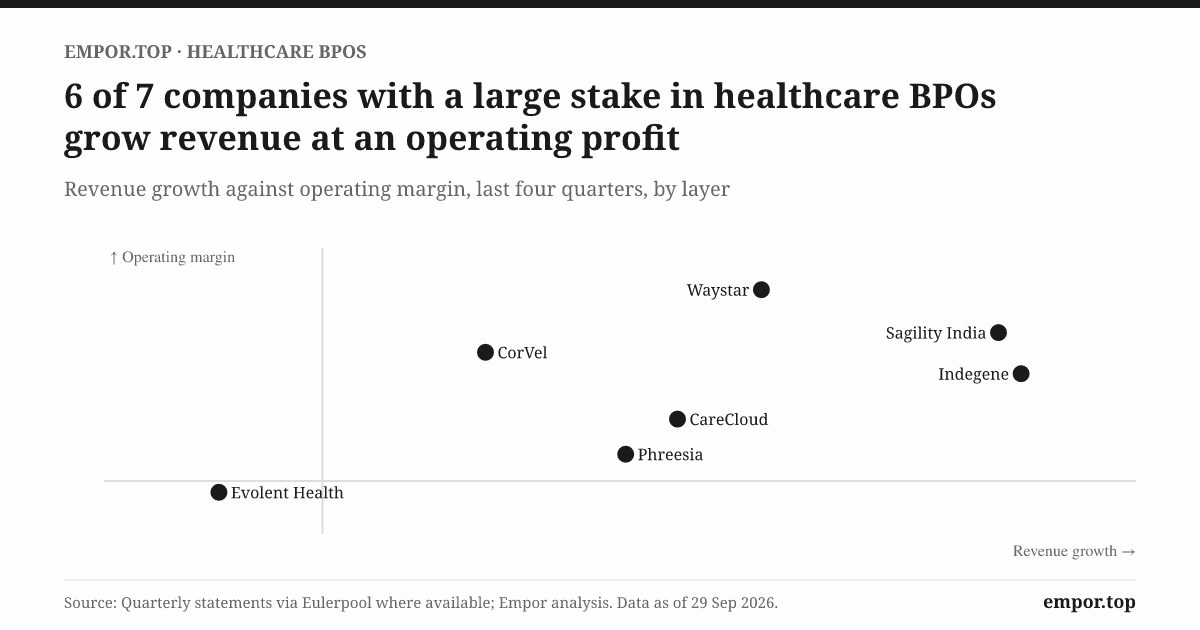
The listed companies roughly bear that out. In the quarter to June 2026, the combined operating margin was 18.3% for the three listed rails companies, 20.1% for the two listed specialist operators, 6.0% for the single listed end-to-end company and 4.0% for the four listed broader BPOs.5
Those figures need careful handling. They cover a small, selected group of listed companies, not the industry; the specialist figure is two companies, one of which, CorVel, does much of its work in workers' compensation claims rather than hospital billing. The broader-BPO figure is dragged down by Evolent Health, whose business includes risk-bearing specialty-care management rather than pure outsourcing. Acquisitions and currency swings move all of them. They are evidence of a pattern, not a measured industry average.
The migration test
The pattern suggests a rule of thumb about where profit moves. When work becomes standardized and generates rich data, profit tends to migrate from labor toward software, because software can do the standardized part more cheaply and learn from the data. When customers hold bargaining power, or when a large platform bundles the function into something the customer already owns, the savings flow back to providers and payers instead of staying with any vendor.
That rule has exceptions, and the evidence contradicts a simple hierarchy. The highest operating margin among all listed companies in the theme belongs not to a software company but to IKS Health, a services company, at 32.2% in its latest fiscal year, ahead of Waystar's 22.7%.5 A specialist with rare clinical and coding expertise can out-earn a generic platform, and a software company with weak growth can lose pricing power. Margin depends less on the label a company wears than on how much of the workflow it controls and how hard it is to replace.
The contests are not between all companies at once. Each layer is fighting over a different scarce asset.
Chapter 9 — Software, specialists and the fight over the last dollar
Three companies can look at the same claim and see three different businesses. Waystar wants to route it. IKS wants to work it. Ensemble wants to own the whole result. Each is betting that its piece is the one customers cannot do without.
Contest one: rails and data
Among the direct listed rails companies, Waystar leads on scale and profitability: its revenue is more than twice Phreesia's and five times Craneware's, and its operating margin is the highest of the three.5 Its closest comparator in scale is Optum's Change network, which does not disclose comparable figures separately. Waystar says customers choose it for its payer connections, fast implementation and the data accumulated from billions of transactions.32
The strongest point against its lead is timing. Waystar's growth has been helped by a rare event: a competitor's collapse. As those gains normalize, growth could slow toward the layer's longer-run rate. Its shares, down sharply over the past year, suggest the market is already asking that question; its market value fell by roughly half over the year to June 2026.5 Phreesia's growth has slowed from about 32% to about 15%, and Craneware's has almost stopped.5 The deciding fact in this contest is not the number of AI features announced. It is transaction density, how deeply the software is woven into provider workflows, and resilience after 2024.
Contest two: specialist execution
Among listed specialist operators, IKS Health leads on growth and profitability. It reported $362 million of revenue in its fiscal year to March 2026, up 19.9%, with a 32.2% operating margin and a 33.4% return on capital employed.5 It says it serves about 600 active provider clients.41 CorVel, the closest listed comparator, grew 7.0% at a 14.9% operating margin, but earns a return on capital just as high, 34.5%, and runs a steadier business.5
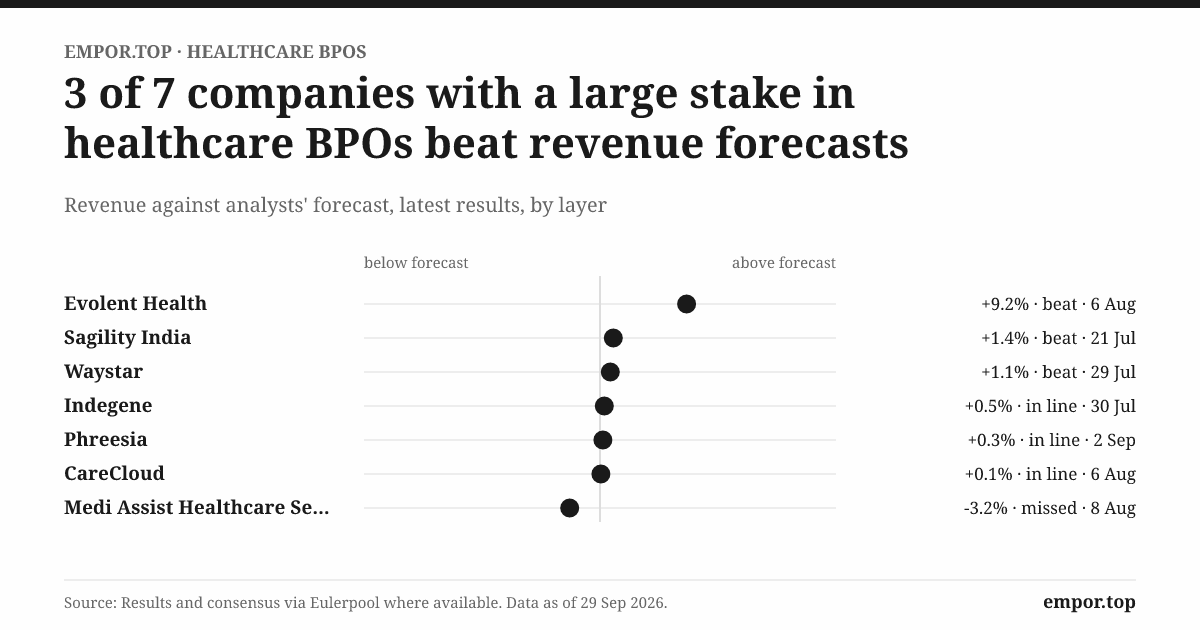
IKS's lead needs two caveats. First, part of its growth came from acquisitions, including a US RCM business bought from TruBridge, so organic growth is lower than the headline and the company's own disclosures must be reconciled with acquisition effects. Its growth rate has already fallen from 76.2% two years earlier.5 Second, the market prices it richly, at 8.9 times sales, far above any other service company in the group.5 Its latest quarterly revenue missed analysts' forecasts by 3.3%.5 A company can execute well and still disappoint shareholders if the price assumed even better.
Private operators compete hard in the same space. AGS Health says it processes about $64 billion of accounts receivable a year.42 Omega, GeBBS, Access Healthcare, CorroHealth and Infinx compete through scale, acquisitions, offshore staff and automation. Their financial results are not disclosed, so the lead among specialists as a whole is contested; IKS leads only among companies that report financial results. The deciding fact is whether managed volume can grow faster than staffing, while quality and cash conversion hold.
Contest three: end-to-end provider RCM
This layer's leaders are mostly private. Ensemble says it manages more than $55 billion of net patient revenue, meaning the hospital revenue it handles, not its own sales.43 R1 claims a larger base, but the two companies define their figures differently, so the lead is contested.26 Ensemble's claims rest partly on survey-based rankings such as KLAS, which reflect customer perception rather than audited share.44
Conifer Health Solutions operates inside Tenet Healthcare, running revenue cycles both for Tenet's own hospitals and for outside clients. In November 2025 it announced a collaboration with Google Cloud to apply AI across patient access, eligibility, revenue integrity and accounts receivable.45 Tenet's filings do not isolate how much of its profit comes from that business.
The listed options are small or indirect. CareCloud combines practice software with outsourced services; it grew 9.1% in 2025 and trades at about one times sales, reflecting small scale and a history of volatile results.5 Privia Health embeds coding, collections and practice administration in a wider physician-enablement model; its revenue grew 22.3% in 2025, but its net margin was only about 1.1%, and billing is only one part of what it sells.5
The deciding fact is trust: whether a partner can prove measurable cash improvement through a difficult transition, and keep the client afterward.
Contest four: broader healthcare BPO
Sagility is the purest listed healthcare BPO: all its revenue is from healthcare. It grew 29.1% to $816 million in the fiscal year to March 2026, at a 17.7% operating margin, up from 9.4% three years earlier, so its margin lead over the layer is widening.5 Its closest comparator, Firstsource Solutions $FSL, has a larger diversified business in which healthcare made up 33.4% of fiscal 2026 income from services.46
Large diversified firms compete for the same insurer contracts. EXL's healthcare and life-sciences segment reported $532 million of revenue in 2025, and the company says six of the ten largest US payers are its clients.47 Cognizant $CTSH's Health Sciences segment reported $6.3 billion in 2025, though much of that is technology services rather than process work.5 Accenture $ACN, Wipro $WIPRO.NS, Tata Consultancy Services $TCS, Infosys $INFY and Teleperformance $TEP.PA all have healthcare practices; for most, the healthcare share is between 6% and 30% of revenue and healthcare profit is not disclosed.5 Capgemini $CAP.PA completed its acquisition of WNS on 17 October 2025, absorbing a significant healthcare BPM operator and removing it as a separately listed peer.48 Buying Wipro or Cognizant is mostly a bet on technology services in general, not on healthcare billing.
Evolent Health tests the claim that growth equals profit. Its revenue fell 26.5% in 2025, then rebounded 46.8% in the June 2026 quarter, yet its operating margin remains slightly negative, because its model includes taking financial risk on specialty-care costs for insurers.5 Indegene $INDGN is growing quickly, 23.6% last year, but much of its work serves drug companies' commercial operations rather than provider billing.5 Medi Assist $MEDIASSIST.NS, an Indian third-party administrator that processes health-insurance claims for insurers, grew 25.1% and shows how claims administration works in a market where insurers, not hospitals, outsource the work.5
The deciding fact here is whether automation can raise revenue per employee and protect margins through wage and attrition cycles.
How a boom reaches each layer
In principle, the chain should transmit like this. When providers and payers see more activity, rails and specialists feel it within about a quarter, because more encounters mean more transactions and more coding immediately. End-to-end operators follow after new contracts go live. Broader BPOs follow after two to four quarters, because insurer and government contracts are procured slowly.
The pattern is not yet supported by comparable data: for every layer, there is too little comparable history to measure a relationship between provider and payer revenue and vendor results; acquisitions, reporting changes and the newness of several listings dominate.5 The expected lags are a reasonable hypothesis to monitor, not an established fact. Even when a few years of data line up, that is evidence, not proof of cause.
The case against today's leaders
Each lead has a specific weakness. Waystar's growth may normalize after migration gains. IKS's growth includes acquisitions and its price assumes a lot. Sagility's margins face labor and pricing pressure. Ensemble's leadership rests partly on company-sponsored or survey-based evidence. And private volume measures such as A/R processed and net patient revenue managed cannot be compared as market shares. None of these weaknesses refutes the leads; each is a reason to watch them.
The decisive battle is not whether healthcare administration grows. It is whether automation leaves the profit with the operator, the platform or the customer.
Chapter 10 — The work that AI does not yet understand
A coding model reads a surgeon's note and produces codes in seconds. That part is easy to demonstrate. The difficult part comes later, when the insurer says the documentation does not support the code. Who is accountable for the answer? Who writes the appeal? Who carries the compliance risk if the model was wrong a thousand times in the same way?
Three myths tested
The first belief is that AI will eliminate healthcare administration. The fair version is persuasive: much of the work is reading documents, matching rules and filling forms, which AI does well. The evidence narrows it. Routine coding, payment posting and status checks are indeed being automated. Exceptions are not. Payer-policy interpretation, clinical judgment on medical necessity, audit trails and escalation still need people, and they become more valuable as a share of the remaining work. Independent research published in Nature Medicine found that current large language models were not ready for autonomous clinical decision-making, making errors a human expert would catch.49 Company announcements about autonomous coding are running ahead of independent evidence on production results.
The second belief is that more healthcare spending guarantees BPO profits. Chapter 1 showed why it does not.
The third belief is that the biggest network is automatically the safest. Change Healthcare showed otherwise.
Two chains, one fork
The optimistic chain runs like this. Denials and prior authorizations remain stubborn: HFMA cites initial denial rates near 12% in 2024.50 More workflows become digital. Human-in-the-loop automation, in which software handles routine cases and people handle the rest, lets each employee manage more volume. Margins rise for companies that own the data and are paid for outcomes.
The pessimistic chain runs the other way. CMS's interoperability and prior-authorization rule requires affected payers to build standard FHIR data interfaces, which let systems exchange information directly, with major compliance dates running into 2027.5152 Electronic-record vendors add their own automation. Manual transactions fall. Providers and payers bring more work in-house, service prices fall, and software vendors capture what value remains.
Both chains are plausible, and the record includes a reminder about stories that outrun cash: Accretive's collapse showed that a financial narrative about future recovery can look compelling for years before the numbers catch up.
Numbers to watch
Four signals should move before reported revenue does.
Managed financial volume. This measures the economic base a vendor handles: Waystar's more than $2.4 trillion of gross claims in 2025, AGS Health's roughly $64 billion of A/R processed and Ensemble's $55 billion of net patient revenue managed as of 2026.324243 It moves early because fees follow volume. It settles whether automation produces operating leverage: if volume grows faster than staffing, it does. Waystar publishes annually in its 10-K; AGS and Ensemble update company disclosures irregularly. These three figures measure different things and must never be read as market shares. The story weakens if volume stalls without a customer-loss explanation.
Customer adoption. New clients lead revenue. IKS reports about 600 active provider clients; Firstsource reported just one healthcare new logo in the quarter to March 2026, a weak reading for a large company.4146 Both publish quarterly. Sustained net additions would support the case that buyers are outsourcing more; four weak quarters would challenge it.
Administrative pain. Denial rates near 12% and MGMA's finding that 92% of practices added or reassigned staff for prior authorization measure the friction that makes outsourcing necessary.502 HFMA and MGMA publish periodic surveys, roughly annually. The story breaks if friction falls sharply, for example as the new authorization interfaces take hold, without vendors gaining volume.
Automation in production. Ensemble says it automates about 65 million transactions a year while about 35 million encounters are still managed manually, and invests about $70 million a year in technology.44 Comparable industry-wide figures do not exist. The test is whether automation rises alongside client cash results, revenue per employee and margins. If vendors report headcount cuts without revenue or cash-flow growth, the gains are going to customers.
Where the profit ends up
Outsourcing, by itself, does not decide who keeps the profit. The answer is conditional, and it points to one test: the profit stays with whichever layer makes the billing process harder to replace than the labor used to perform it.
Glossary
- Revenue cycle management (RCM): The process of turning a patient encounter into a coded, submitted, adjudicated and paid claim.
- Business process outsourcing (BPO): Hiring an outside company to perform repeatable administrative work.
- Clearinghouse: A network that receives claims or payment messages and routes them between providers and payers.
- EDI: Electronic data interchange, the electronic exchange of structured healthcare transactions.
- CPT: AMA-maintained procedure codes describing physician and other professional services.
- HCPCS: The broader coding system used by CMS for procedures, supplies and services.
- ICD-10: Diagnosis and inpatient-procedure coding used to classify the patient's condition and treatment.
- DRG: A diagnosis-related group used to classify inpatient cases for prospective payment.
- Prior authorization: Payer approval required before certain services, procedures or medicines.
- Denial: A payer refusal to pay a claim as submitted.
- Accounts receivable: Amounts owed to a provider but not yet collected.
- Revenue integrity: Processes that ensure documented services are coded, billed and reimbursed correctly.
- FHIR: An API-oriented standard for exchanging healthcare information.
- Human-in-the-loop: Automation in which people review exceptions, ambiguity and high-risk decisions.
- Net patient revenue managed: The provider revenue base for which an RCM partner operates the cash cycle.
References
-
National Health Expenditure Projections 2025–2034, Forecast Summary — CMS ↩
-
Healthcare BPOs computed tables: pulse, scorecard, trends, links and results — Empor, 29 Sep 2026 ↩↩↩↩↩↩↩↩↩↩↩↩↩↩↩↩↩↩↩↩↩↩↩↩↩↩↩↩↩↩
-
Purpose of the CPT coding system and CPT Editorial Panel — American Medical Association ↩↩↩
-
YSPH collaborating with China to develop new medical payment models — Yale School of Public Health ↩
-
Timeline of Key Statutes and Regulations, HIPAA Administrative Simplification — CMS, 2018 ↩↩↩↩↩↩↩
-
Justice Department Sues to Block UnitedHealth Group's Acquisition of Change Healthcare — US Department of Justice, Feb 2022 ↩↩↩
-
Omega Healthcare celebrates 20 years in healthcare outsourcing — Omega Healthcare, 2023 ↩
-
Inventurus Knowledge Solutions Draft Red Herring Prospectus — BSE, 2024 ↩
-
Sagility India AGM Notice and Annual Report — NSE, Jul 2025 ↩
-
National Trends in Hospital and Physician Adoption of Electronic Health Records — ONC ↩
-
Deadline for ICD-10 allows health care industry ample time to prepare for change — CMS ↩
-
Accretive Health restatement announcement, Exhibit 99.1 — SEC, 2014 ↩
-
NYSE to Suspend Trading in Accretive Health and Commence Delisting Proceedings — NYSE, 2014 ↩
-
The Revenue Operating System: A New Architecture for Healthcare Revenue Cycle — R1 RCM ↩↩↩
-
TowerBrook and CD&R Complete Acquisition of R1 RCM — R1 RCM, Nov 2024 ↩↩
-
Ensemble and IU Health announce strategic collaboration — Ensemble Health Partners, Jun 2026 ↩↩
-
Navicure and ZirMed announce naming of merged company to Waystar — Waystar, 2018 ↩
-
US et al. v. UnitedHealth Group Inc. and Change Healthcare Inc., case record — US Department of Justice ↩
-
Optum and Change Healthcare complete combination — Optum, Oct 2022 ↩
-
Change Healthcare Cybersecurity Incident Frequently Asked Questions — HHS ↩↩
-
Change Healthcare cybersecurity incident: CMS response and state flexibilities — HHS, 2024 ↩
-
CorroHealth finalizes acquisition of healthcare revenue cycle management business from Navient — CorroHealth, Sep 2024 ↩
-
Healthcare Business Services Year in Review — KPMG Corporate Finance, 2025 ↩
-
Ensemble and Penelope Health announce strategic partnership — Ensemble Health Partners, Sep 2026 ↩↩
-
2026 Best in KLAS Overview — Ensemble Health Partners, 2026 ↩↩
-
Conifer redefines the future of AI-driven revenue cycle management using Google Cloud — Conifer Health Solutions, Nov 2025 ↩
-
Firstsource Solutions reports fourth quarter and fiscal 2026 results — Firstsource, 2026 ↩↩
-
Capgemini completes the acquisition of WNS — Capgemini, Oct 2025 ↩
-
Evaluation of large language models for clinical decision-making — Nature Medicine, 2024 ↩
-
CMS Interoperability and Prior Authorization Final Rule (CMS-0057-F) fact sheet — CMS, 2024 ↩
 LinkedIn
 WhatsApp
 Reddit
 Hacker News
 Email
Email Kindle
 RSS Feed
 Spotify
 Apple Podcasts
 Amazon Music
 Audible
 YouTube