Experian plc: The Invisible Infrastructure of Global Credit
I. Introduction & The Data Engine of Modern Capitalism
Somewhere right now, a twenty-six-year-old in Chicago is tapping "Apply" on a credit card offer during her lunch break. Eight hundred miles south, a family in São Paulo is signing the paperwork to finance a used hatchback. In a flat in Manchester, a man opens an app to check whether his credit score ticked up after he paid off a phone bill. Three people, three continents of consumer finance, three entirely different moments — and behind all of them, in the space of a few hundred milliseconds, the same thing happens. A lender's computer reaches out across the wire, asks a question about a stranger, and gets an answer good enough to lend real money against. In a very large share of those handshakes, the company answering the question is Experian plc, headquartered in Dublin, listed in London, and run mostly out of the United States.
Most people have never thought about who sits in the middle of that transaction. That is precisely the point. Experian is plumbing. It is the kind of business you only notice when it breaks — the way you never think about the water utility until the tap runs brown. In the year ended March 2026, that plumbing carried roughly US$8.4 billion of revenue and produced US$2.4 billion of Benchmark EBIT, a margin of 28.6% — the sort of profitability most industrial companies can only dream about.1
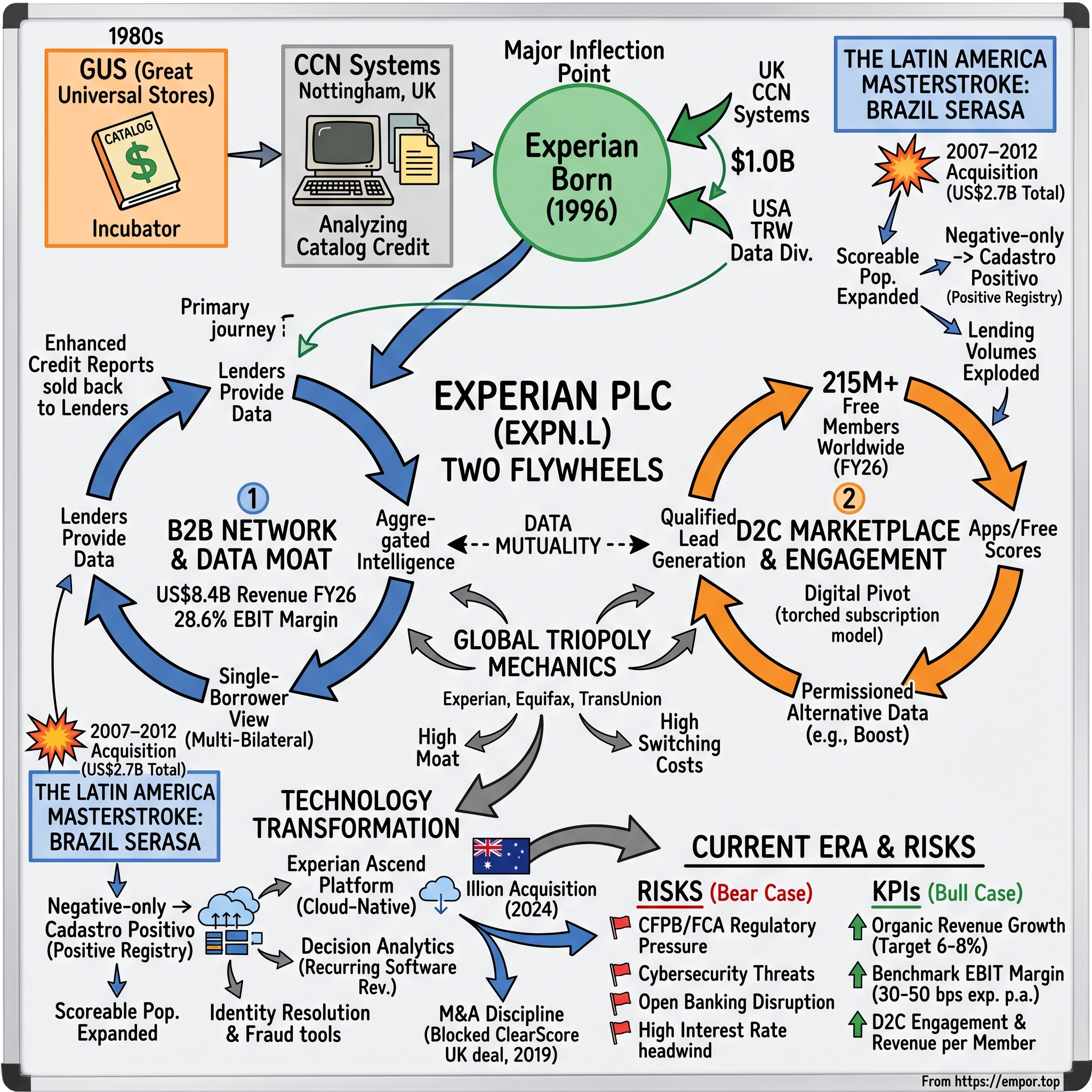
The core thesis of this story is that Experian is not "a credit bureau" in the way most people imagine — a dusty filing cabinet of who paid whom. It is a scaled data-and-analytics utility that runs on two reinforcing flywheels. The first is a multi-bilateral B2B network: thousands of lenders hand Experian their borrowers' payment histories, largely for free, in exchange for the aggregated intelligence that only a company holding everyone's data can produce. No single bank can see the whole borrower; Experian can. The second is a direct-to-consumer marketplace — more than 215 million people worldwide who use Experian's free credit apps1 — that quietly converts a regulatory obligation (you have a legal right to see your file) into one of the most efficient financial-product lead-generation machines ever built.
Here is the tension worth holding onto as we go. Experian just posted a record year, and yet as this is written in July 2026 its shares trade around 2,655 pence, near their 52-week low of about 2,200p and down sharply from a high above 4,000p, valuing the company at roughly £23–24 billion.4 The market, in other words, is not celebrating. Somewhere between "best fundamentals in the sector's history" and "stock cut by a third," there is an argument to be had — about interest rates, about regulators, about whether artificial intelligence and open banking eventually route around the toll booth. That argument is what makes this a story and not a press release.
It is worth being precise, right at the outset, about what makes these two flywheels different from ordinary competitive advantages, because the distinction runs through everything that follows. Most companies compete on being better — a cheaper product, a slicker app, a stronger brand. Being better is fragile; someone can always be better still. Experian's advantages are of a different kind: they are advantages of position, not of quality. It sits at a chokepoint through which the information has to flow, and it got there by accreting data over decades that no amount of present-day cleverness or capital can reconstruct. A rival with a superior algorithm does not threaten Experian, because the algorithm is not the scarce thing; the data is, and the data only comes to those who already have data. That is why, when you strip the story down, the interesting questions about Experian are almost never "is a competitor building something better?" They are "will a regulator change the rules?" and "will technology reroute the flow around the chokepoint?" Hold those two questions in mind; they are the load-bearing walls of the entire bear case.
To get there, we will trace five threads. How a British mail-order-and-retail conglomerate called Great Universal Stores accidentally incubated a global data champion and then set it free in 2006. How a single Brazilian acquisition became one of the great emerging-market bets in corporate history. How the physics of data moats produced a global triopoly that regulators tolerate but do not love. How Experian torched its own profitable subscription business to build a free-membership empire. And how the cloud, and then AI, forced the whole industry to reinvent its technology or die. Let us start where the money came from — a catalog company.
 Subscribe on LinkedIn
II. Conglomerate Origins & The 2006 GUS Spin-Off
If you had told a shareholder of Great Universal Stores in 1990 that the crown jewel buried inside their sprawling company was not the retail empire but an obscure computing unit in Nottingham, they would have laughed. GUS was, for most of the twentieth century, a British institution of catalogs and credit — a mail-order house that sold clothing and household goods to families who paid in weekly instalments. And there is the seed of the whole story: a catalog company that extends instalment credit to millions of households has, by necessity, to answer one question over and over. Will this customer pay us back? To answer it at scale, GUS had built a data-processing arm, CCN Systems, in Nottingham in the 1980s.
CCN was in the business of remembering. It kept records of who had borrowed, who had repaid, who had defaulted — and it discovered that other lenders would pay handsomely for the same intelligence. The unit that started as a cost of running a catalog quietly became a product. The decisive move came in 1996, when GUS bought TRW's information-services division in the United States — the American credit bureau descended from the sprawl of the defense-and-electronics group TRW — for about US$1 billion, and merged it with CCN. The combined entity got a new name: Experian. In one stroke, a British instalment-credit ledger acquired a continental-scale American database, and the center of gravity of the business crossed the Atlantic, where it has remained ever since.
There is a delicious irony buried in that 1996 deal worth pausing on, because it explains something about how these businesses come to exist. TRW — the company whose credit-data arm became the American half of Experian — was an aerospace-and-electronics contractor that built spacecraft and missile systems. It had wandered into consumer credit reporting decades earlier almost by accident, because it was good at running large computer systems and someone realized that keeping ledgers on millions of consumers was, at bottom, a computing problem. By the mid-1990s TRW wanted to refocus on defense and shed the data business. GUS, wanting to go the other way, bought it. Two companies passing in the night, each convinced it was doing the smart thing — and both, arguably, were. The credit bureau is one of those businesses that no one sets out to build from scratch; it accretes inside a company that already has the data and the machines, and then one day someone notices it is the most valuable thing in the building.
For a decade, though, Experian lived inside a holding company that made no strategic sense. By the early 2000s GUS was a textbook conglomerate: it owned Burberry, the resurgent British luxury house; it owned Argos and Homebase, the catalog-and-DIY retail chains folded into what would become Home Retail Group; and it owned Experian, an asset-light data network with margins that looked nothing like a hardware store's. Public markets are ruthless about this kind of patchwork. Investors could not decide whether GUS was a retailer, a luxury brand, or a technology company, so they valued it as a muddle — the "conglomerate discount" in its purest form. A pound of Experian's earnings, wrapped inside GUS, was worth less than a pound of the same earnings standing alone.
In March 2006, GUS management resolved the contradiction the way the era demanded: it broke the company apart.3 Burberry had already been progressively floated; now the plan was to demerge the retail assets into Home Retail Group and to list Experian in its own right. In October 2006, Experian began trading on the London Stock Exchange as an independent company, with a market capitalization in the region of US$10 billion.3 From that day, its split personality was fixed in place and remains so twenty years later: a UK-domiciled, London-listed corporate umbrella sitting atop an operational engine that earns most of its money in dollars and reais.
The mechanics of the 2006 demerger are worth understanding, because they set the template for how Experian would think about corporate structure ever after. GUS did not simply sell Experian to a buyer; it distributed the pieces to its own shareholders, handing them shares in the newly independent companies rather than cash. The bet behind that choice is subtle: management believed the market was mispricing the assets as a bundle, and that the cleanest way to fix the mispricing was to let each business be valued on its own terms by investors who actually wanted that specific thing. A pension fund that wanted exposure to data analytics could now own Experian without also being forced to own a garden-center chain; a value investor who wanted the retail cash flows could own those without paying a technology multiple. The conglomerate discount is, at bottom, a tax that the market levies on management teams who insist on making the allocation decisions that investors would rather make themselves. Demerging is the act of handing that decision back.
The lesson here is not merely "spin-offs create value," though this one plainly did. It is about what independence allows. A retail conglomerate allocates capital toward inventory, stores, and working capital — physical things that depreciate and go out of fashion. A pure-play data business allocates capital toward databases, software, and acquisitions of other data — assets that compound. Freed from GUS, Experian could stop competing internally for capital against a garden-furniture chain and start reinvesting in the one thing that made it special: proprietary information that grows more valuable the more of it you hold. The first place management chose to prove that thesis was not London or Chicago. It was Brazil.
III. The Latin America Masterstroke: Buying Serasa (2007–2012)
Imagine standing in front of your board barely a year after your IPO and proposing to spend US$1.2 billion — an enormous fraction of your value — on a majority stake in a company most of your London shareholders have never heard of, in a country many of them file under "risk." That was the pitch Experian's leadership made in mid-2007, and the target was Serasa, the dominant credit bureau of Brazil.5
Serasa was not a startup. It had been built decades earlier by a consortium of Brazilian banks as a shared utility to track defaults — a cooperative that had grown into the country's default memory. In June 2007, Experian agreed to acquire a controlling stake of roughly 65% for about US$1.2 billion, later nudged higher.5 Then, patiently, it waited and consolidated. In October 2012, Experian moved to buy out the remaining minority — an additional 29.6% interest for approximately US$1.5 billion — lifting its ownership to nearly complete control and bringing total invested capital to somewhere near US$2.7 billion.6 For a company Experian's size at the time, this was not a bolt-on. It was a bet-the-decade wager on a single emerging market.
Why did it work so spectacularly? To understand that, you have to understand what kind of credit market Brazil was in 2007. It was a "negative-only" market. By law and by custom, the bureaus recorded the bad news and only the bad news: your missed payments, your defaults, your protested debts. What they could not legally aggregate was the good news — your long history of paying every bill on time. Picture a world where the only thing on your permanent record is your speeding tickets, and every clean year of driving is invisible. In that world, lenders are flying half-blind. They cannot distinguish the reliable borrower with a thin file from the genuinely risky one, so they price for the worst case, ration credit, and leave tens of millions of creditworthy Brazilians locked out of the formal financial system.
The catalyst Experian was positioning for was regulatory. Brazil spent years moving toward Cadastro Positivo — "positive registry" — the legal framework that would finally let bureaus compile positive repayment histories. When positive data switches on in a market like that, the addressable opportunity does not grow by a few percent; it re-founds the entire industry. Suddenly the bureau can build genuine risk scores, lenders can extend credit confidently to the previously invisible, and the volume of scored decisions explodes. Experian, in effect, bought the toll booth on the main road before the government announced it was about to build a motorway through the countryside.
The financial evidence bore the thesis out. Latin America — overwhelmingly Serasa in Brazil — grew from a minor regional line into one of Experian's fastest-growing and highest-margin engines, contributing well over a billion dollars of revenue and posting organic growth of around 8% even in the most recent year, FY26.1 Crucially, it did so at segment margins that have run north of 30% and a return on capital comfortably above the group average — the hallmark of a business that owns its market rather than renting a share of it.
It helps to sit with what "positive data switching on" actually did to the economics, because the multiplier is not intuitive. In a negative-only market, a bureau's product is thin: it can tell a lender who is definitely bad, but it cannot rank the enormous middle of the population who have simply never defaulted. The scoreable universe is small and the scores are crude, so the number of decisions a lender is willing to pay the bureau to inform is correspondingly small. Turn on positive data and three things happen at once. The scoreable population expands to include tens of millions of previously invisible good payers. The scores themselves become far more accurate, because the model now sees the full behavior rather than only the failures. And — most importantly for revenue — lenders, newly confident, dramatically increase the volume of credit they extend, and every one of those decisions is a query the bureau gets paid for. Revenue does not rise in proportion to the data; it rises in proportion to the lending the data unlocks, which is a much steeper curve. Experian owned the meter through which all of that new traffic had to pass.
There is also a governance dimension that a skeptic would rightly probe, because Serasa was not a clean, wholly-owned subsidiary for its first five years. From 2007 to 2012 Experian ran Brazil with a large minority of Brazilian bank shareholders still on the register — the very institutions that were also its biggest data suppliers and customers. That is a related-party thicket, and it is precisely the kind of structure that can quietly leak value or create conflicts. Experian's decision in 2012 to pay up and buy out that minority, taking ownership to near-total, simplified the picture and captured the full economics of a market it now understood was going to compound for years.6 Paying US$1.5 billion for the second tranche when the first 65% had cost US$1.2 billion means Experian paid a materially higher price per point of ownership the second time — a fact bears sometimes cite as overpayment. The counter is that by 2012 the Cadastro Positivo trajectory was far clearer and the asset demonstrably more valuable; buying certainty is rarely cheap.
Now, the neutral point. It is tempting to narrate Serasa as pure genius, and the returns invite that. But part of what made it a masterstroke was luck of timing that no spreadsheet could have guaranteed: the pace of Brazilian legislation, the health of the Brazilian consumer, the direction of the real. Cross-border M&A is littered with acquirers who paid up for "structural growth" that never showed up, or who bought the right asset in a currency that then collapsed. What distinguishes Serasa is that Experian bought a near-monopoly distribution asset — the incumbent everyone already reported to — rather than a growth story that depended on winning share. When the regulatory tailwind arrived, it flowed through an asset that was already dominant. That is the difference between betting on a horse and buying the racetrack. To see why owning the racetrack matters so much, we need to look under the hood at how a credit bureau actually makes money — and why almost no one can build a new one.
IV. The Core Engine: Credit Bureau Mechanics & The Global Triopoly
Here is a puzzle that gets at the heart of the entire industry. Suppose you had a billion dollars and a mandate to destroy Experian. You could hire the best engineers in the world, rent limitless cloud computing, and buy every piece of software on the market. You still could not build a competing credit bureau in the United States, and the reason has nothing to do with technology. It is that you would have no data — and the only people who could give you data have no reason to.
That is the strange, self-reinforcing machine at the center of Experian. Lenders — banks, card issuers, auto financiers, telecoms — send Experian a continuous feed of how their customers are behaving: who is current, who is late, who defaulted, what balances they carry. They hand this over for little or no cash, under industry reciprocity arrangements often described simply as give data to get data. Experian cleans it, standardizes it, matches it to the right person across hundreds of millions of confusingly similar names and addresses, and sells enriched reports and scores back to those same lenders when they need to make a decision. A new entrant faces a cold-start problem that is close to unsolvable: no lender will contribute its precious data to a bureau that has no data to give back, and no bureau can have data without contributors. You cannot bootstrap thirty years of everyone's repayment history. It has to accrue, and it only accrues to the incumbents.
Layer regulation on top and the moat deepens. In the United States, credit reporting operates under the Fair Credit Reporting Act, a dense regime governing accuracy, dispute resolution, permissible use, and consumer rights; in the United Kingdom and Europe, the equivalent obligations run through the FCA regime and GDPR.11 For an incumbent with armies of compliance staff and decades of case law absorbed, these rules are a manageable cost of doing business. For a would-be challenger, they are a moat filled with lawyers. And then there are switching costs at the customer end: Experian's decisioning software is wired directly into the automated underwriting engines of major banks. Ripping it out means re-validating risk models that regulators must bless — an exercise so operationally hazardous that most lenders would sooner change auditors than change bureaus.
There is one more piece of the mechanism that is easy to miss and matters enormously: the single-borrower view. Any individual lender sees only its own relationship with you — your balance and payment history on that one card, that one loan. What it cannot see is the six other cards you have quietly maxed out at other banks in the last three months, the classic warning sign of a borrower heading for trouble. The bureau is the only party that sees all of it, because everyone reports to it. That aggregated, cross-lender view is the actual product, and it is why no bank, however large, can simply use its own data instead. JPMorgan Chase has vast data on its own customers and still buys bureau reports, because its own data is blind to what those customers do everywhere else. The value Experian sells is not information the lender lacks the technology to store; it is information the lender structurally cannot obtain on its own, at any price, because it requires the cooperation of its competitors. That is the deepest reason the moat holds.
The result of all this is not a monopoly but something almost as comfortable: a tight oligopoly, effectively a triopoly in the two markets that matter most, North America and the UK. Experian is the largest of the three, with roughly US$8.4 billion of revenue in FY26.1 Equifax, the Atlanta-based number two, reported just over US$6 billion for 2025, anchored by a genuinely differentiated asset — Workforce Solutions and its "The Work Number" database of payroll records, which verifies income and employment directly from employers, a moat Experian openly covets.15 TransUnion, the Chicago-based third player, reported about US$4.6 billion for 2025, strong in fraud, media, and emerging international markets.16 Sitting slightly apart is Fair Isaac — FICO — which owns the scoring algorithm that lenders and regulators treat as the industry standard. The bureaus are, in a sense, both FICO's distributors and its rivals: they push FICO scores to customers while jointly promoting VantageScore, the competing score the three bureaus co-own to reduce their dependence on a single supplier.
The FICO relationship deserves a moment, because it is one of the more elegant standoffs in finance. FICO invented the modern credit score and licenses it; for decades a "FICO score" and "creditworthiness" were near-synonyms in American lending, and Fannie Mae and Freddie Mac's underwriting rules effectively hard-wired FICO into the US mortgage market. That gave FICO enormous pricing power over the very bureaus that distribute its scores — in recent years FICO has repeatedly raised the per-score royalty it charges, and the bureaus have largely had to pass it through. So the three bureaus did what any set of distributors squeezed by a dominant supplier eventually does: they built their own. VantageScore, jointly owned by Experian, Equifax, and TransUnion, is their attempt to offer lenders a credible alternative score and to claw back some of the economics FICO extracts. The tension is permanent and instructive — Experian is simultaneously FICO's channel, FICO's hostage, and FICO's competitor, and it manages all three relationships at once. It is a reminder that even inside a fortress moat, there is a supplier with leverage of its own.
It is worth being concrete about where Experian's money actually comes from, because "credit bureau" undersells the mix. North America is the cash engine, generating on the order of two-thirds of group revenue, split between B2B data and decisioning on one side and Consumer Services on the other; in FY26 it grew organic revenue by roughly 10%, an unusually strong number for a mature market.1 Latin America contributes its high-margin billion-plus. The UK and Ireland — around a tenth of the business — is the mature, contested, slow-growing member of the family, managing just 2% organic growth in FY26 as it wrestled with a competitive market and rate-sensitive mortgage demand.1 EMEA and Asia-Pacific, long a fragmented also-ran, is finally being consolidated into something coherent, a project we will come back to when we discuss the illion deal in Australia.
The analytical read on all this is straightforward but important. Experian's advantage is not that it is cleverer than Equifax or TransUnion — on any given product, the three leapfrog each other. Its advantage is structural: it owns an irreplaceable dataset, sells it into workflows that are painful to rewire, and operates inside a regulatory perimeter that keeps newcomers out. Those are durable properties. But they are also the properties that attract regulators and self-styled disruptors, because a business that cannot be competed with head-on invites attempts to compete with it sideways — by changing the rules or by routing around the data monopoly entirely. Before we get to those threats, though, we need to understand the second flywheel, the one pointed not at banks but at ordinary people. And it began with Experian deliberately blowing up one of its own most profitable businesses.
V. The Digital & Consumer Pivot: Experian Boost & The Marketplace
For years, the consumer credit-monitoring business ran on a slightly grubby trick. You would see an ad promising a "free credit report," enter your card details for "identity verification," and discover a month later that you had been silently enrolled in a monitoring subscription at, say, $19.99 a month. Millions of people paid it, many without quite realizing why. It was enormously profitable, and it was a reputational time bomb. Regulators circled, the Federal Trade Commission brought pressure across the sector, and a new generation of venture-funded entrants — Credit Karma the most prominent — offered genuinely free scores and monetized through advertising instead. The message to the incumbents was blunt: your best consumer cash cow is a sitting duck.
Experian's response, over roughly 2015 to 2019, was to shoot the duck itself. Rather than defend the subscription model until a startup or a regulator killed it, management chose to give the core product away — free credit scores, free monitoring, delivered directly through the Experian app — and rebuild the economics around something else entirely. This is the textbook move of counter-positioning: deliberately adopting a model the incumbent (in this case, Experian's own legacy division) cannot follow without cannibalizing itself. Except here the incumbent being disrupted was Experian, and it chose to do the disrupting rather than wait.
The scale that resulted is genuinely hard to replicate. By FY26 Experian counted more than 215 million free members globally1 — tens of millions in the United States, a very large base in Brazil through Serasa, and millions more in the UK. That is not a customer list; it is a standing distribution channel into the financial lives of a meaningful slice of the credit-active populations of three large economies. And distribution, in financial services, is the scarcest resource of all.
The cleverest piece of the pivot arrived in 2019 with Experian Boost. The idea is elegant enough to explain at a dinner party. Your credit file traditionally records only "credit" — loans and cards. It ignores the fact that you have paid your phone, electricity, and streaming bills like clockwork for years. Boost lets a consumer opt in and connect those alternative payment streams directly to their Experian file, instantly adding positive history and, for many thin-file consumers, nudging their score up. The consumer gets a better score for free. Experian gets something it cannot buy at any price: permissioned, first-party alternative data that its competitors, who lack the direct consumer relationship, simply do not have. It is a rare product where the giveaway to the user and the strategic gain to the company are the same act.
So how does giving everything away make money? Through the marketplace. Experian sits on both a detailed picture of each member's credit profile and a catalog of lenders' pre-approval criteria, and it matches them. When a member is shown — and accepts — a credit card, personal loan, car-finance deal, or insurance product they are genuinely likely to be approved for, Experian collects a lead-generation or affiliate fee from the lender. Note what is not happening: Experian is not selling the consumer's data to the highest bidder. It is selling qualified intent — the far more valuable and far more defensible act of introducing a pre-screened borrower to a willing lender at the moment of demand. Consumer Services has grown into a business worth well over a billion and a half dollars a year, on the order of a fifth or more of the group,1 and it converts what was once a compliance headache — the legal duty to show people their own files — into a two-sided network asset.
It is worth dwelling on why the marketplace model is so much more defensible than the subscription model it replaced, because the difference is the whole game. A subscription is a leaky bucket: consumers sign up, forget, resent the charge, and churn, and every regulator in the world is looking for reasons to make cancellation easier. A marketplace is a flywheel: the more members Experian has, the more attractive it is as a distribution channel for lenders, so the better the offers on the shelf, so the more valuable membership becomes to consumers, so more of them join and engage. And unlike the subscription, the marketplace is aligned with the consumer — Experian only earns when it introduces someone to a product they actually want and get approved for. The regulator that wanted to kill the old model has little to object to in the new one. That realignment, as much as the raw member count, is what makes the pivot durable. The comparison worth keeping in mind is Credit Karma, the freemium pioneer that proved the model and was ultimately acquired by Intuit for approximately US$7.1 billion, a deal completed in December 2020[^19] — a price that told the market exactly how much a large, engaged base of credit-active consumers with monetizable intent was worth. Experian built a comparable asset on three continents, largely with its own balance sheet.
The independent caveat is worth stating plainly, because management rarely dwells on it. Marketplace revenue is a lending-volume business dressed in consumer-tech clothing. When lenders tighten — as they did through the 2022–2024 rate-hiking cycle — the shelves of pre-approved offers thin out, and revenue per member softens regardless of how many members you have. Two hundred and fifteen million members is a magnificent moat and a real cyclical exposure at the same time; both things are true. The engagement is genuine, but the monetization rides the same credit cycle as the rest of the business. To smooth that cyclicality — and to sell the banks something they cannot get from a rival's raw data — Experian spent the last decade building a very different kind of product on top of the bureau. That is the technology story.
VI. Technology Transformation: Ascend, Decision Analytics & M&A Strategy
For most of its life, a credit bureau was, technologically, a spectacularly sophisticated card catalog — mainframes and regional databases, each a fortress, optimized to answer one narrow question fast: pull this person's file, return a score. That architecture was a liability in a world where a bank wants to train a machine-learning model on years of its own lending data blended with the bureau's, test it against a decade of history, and deploy it into production in weeks rather than years. You cannot do modern data science inside a 1980s file-lookup system.
The strategic response is Experian Ascend, the platform onto which the company has been migrating its business over the past several years, running on a cloud-native hybrid architecture atop the major public clouds. The plain-English version is this: Ascend gives a lender a secure sandbox in which it can combine its own internal data with Experian's bureau data and decades of "depersonalized" credit history, then build, test, and run risk models without ever moving the sensitive data out of a governed environment. If the legacy bureau sold answers, Ascend sells the workshop where the customer builds its own answers — and, having built its underwriting inside that workshop, the customer is far more thoroughly wired in than a buyer of one-off reports ever was. It deepens exactly the switching costs described earlier, but one layer up the stack, at the level of the customer's models rather than its data feeds.
Why does the "workshop" framing matter so much to the investment case? Because it changes the quality of the revenue. A bureau that sells one-off report pulls earns transactional money that rises and falls with query volume — pure exposure to the credit cycle. A platform that hosts a lender's models earns something closer to software revenue: sticky, recurring, contracted, and priced for the value of the analytics rather than the cost of a lookup. Every point of revenue mix that shifts from transactional pulls toward platform and software is a point that deserves a higher multiple and expands margins, because the incremental cost of serving it approaches zero while the price reflects embedded workflow. This is the quiet engine behind management's promise of steady annual margin expansion — not heroic cost-cutting, but a mix that keeps drifting toward higher-value software. The risk, which an honest analysis must name, is that migrating a decades-old bureau onto a cloud platform is expensive and slow, and the elevated capital spending it requires is a real drag while it is underway. Ascend is a bet that the destination is worth the journey; the market will judge it on whether margin expansion actually keeps compounding or stalls.
Around this core, Experian has cultivated a set of adjacent verticals that most casual observers miss entirely. In health, it runs a revenue-cycle-management and patient-identity business — helping hospitals verify who a patient is and what their insurance will actually cover — a several-hundred-million-dollar line that is really identity verification pointed at a different industry. In employer and verification services, it is building a direct challenge to Equifax's Work Number, betting that employers will welcome a lower-cost alternative for payroll and income verification. And its software and decision-analytics products — PowerCurve for decisioning, a suite of fraud and identity tools — generate the recurring, SaaS-like, high-switching-cost revenue that investors prize far more than transactional bureau pulls. The through-line across all of it is the same asset — identity resolution, the unglamorous but genuinely hard problem of knowing that the "John A. Smith" in one database is or is not the "J. Smith" in another without generating false matches that ruin lives and breach the law. This is worth dwelling on because it is the capability that lets Experian credibly claim to be more than a credit bureau. The skill of matching messy, inconsistent, partial records to a single real human being — and doing it billions of times with regulatory-grade accuracy — is transferable to any industry that needs to know who someone is: a hospital verifying a patient, a marketer suppressing duplicate contacts, a fraud team spotting a synthetic identity stitched together from stolen fragments. Each of those is a different customer buying the same underlying muscle. It is why the fraud-and-identity business has become one of the more strategically important lines in the group: as commerce moved online and generative AI made convincing fake identities cheap to manufacture, the ability to answer "is this a real person, and are they who they claim to be?" turned from a back-office chore into a front-line necessity. Experian is, in an under-appreciated sense, as much an identity company as a credit company — and identity is a bigger and faster-growing market than credit reporting alone.
Experian's M&A record tells you how management thinks about buying versus building — and it is more disciplined, and more interesting, than a simple deal count suggests. Serasa remains the reference point: a regional near-monopoly bought ahead of a regulatory catalyst, delivering returns that reset the whole company's growth profile. Against that, the mid-sized deals look sensible rather than spectacular. The 2016 acquisition of CSIdentity for about US$360 million bought identity-theft-protection capability that Experian folded into Consumer Services and sold on to partners10 — a competent capability purchase, not a franchise.
The most instructive episode, though, is a deal that never happened. In 2018 Experian agreed to buy ClearScore, a fast-growing free-credit-score challenger in the UK, for a reported £275 million. In early 2019 Britain's Competition and Markets Authority blocked it, concluding the deal would remove a disruptive competitor and harm consumers, and the parties abandoned it.9 At the time it looked like a defeat. In hindsight it was a gift. Forced to compete rather than acquire, Experian built its own UK freemium product organically — and it worked, cheaply, without regulatory strings. The blocked deal is a small monument to a recurring truth about this company: its market position is strong enough that regulators will not always let it buy the thing it wants, which sometimes saves it from itself.
Most recently, in 2024, Experian returned to the Serasa playbook at smaller scale, agreeing in April to acquire illion, a leading consumer and commercial credit bureau across Australia and New Zealand, for A$820 million,8 and completing the deal on 1 October 2024 after clearance from Australia's competition regulator, absorbing illion's roughly 500-person team.7 The logic is pure regional consolidation: combine the second and third players to build genuine scale in a market where Experian had been sub-scale, at a price in the mid-teens as a multiple of earnings that looks fair rather than cheap. It is the same instinct that bought Serasa — own the infrastructure of a whole country's credit system — executed in a developed market where the upside is efficiency and share rather than a regulatory windfall. The question of whether that discipline holds is ultimately a question about the people allocating the capital, so let us meet them.
VII. Current Management, Financial Architecture, & Capital Allocation
Brian Cassin is not the founder-visionary archetype that business stories are usually built around, and that is rather the point of him. He arrived at Experian in 2012 not as a data scientist or a lifelong credit man but as an investment banker — a former managing director at Greenhill & Co., the advisory boutique — brought in as Chief Financial Officer. Two years later, in July 2014, he stepped up to succeed Don Robert as Chief Executive, a role he still holds today.12 A dealmaker running a data utility might sound like a recipe for empire-building acquisitions; the reality has been closer to the opposite. Cassin's tenure has been defined by a calm, unshowy prioritization of organic growth — the cloud migration, the consumer pivot, the patient reinvestment in product — over the transformational megadeal his résumé might have predicted.
It is worth crediting the man Cassin succeeded, because the culture he inherited shaped everything after. Don Robert ran Experian from before the demerger through 2014 and was the executive who championed the Serasa bet and set the tone of patient, data-first reinvestment; he stayed on as chairman for years afterward, providing exactly the continuity that let the strategy compound rather than lurch with each new leader. The handover from Robert to Cassin was the rare CEO transition that changed the personnel without changing the plan — an underrated marker of institutional health, and the opposite of the strategy-reversing turnover that so often destroys value at large companies.
Alongside him sits Lloyd Pitchford, Chief Financial Officer since October 2014, previously CFO of the testing-and-inspection group Intertek.13 The Cassin–Pitchford pairing has now run Experian together for more than a decade, an unusual continuity in an era of revolving C-suites, and their public personas are almost aggressively undramatic: disciplined, consistent, allergic to hype. On the FY26 results call in May 2026, the language was the same measured cadence investors have heard for years — steady margin expansion, cash conversion, capital discipline — rather than grand pronouncements.1 For a company handling the most sensitive personal data on earth, a certain boringness at the top is arguably a feature, not a bug.
Governance is refreshing at the moment, incidentally: after the July 2026 AGM, Adam Crozier — the veteran chair known from ITV, Whitbread, and elsewhere — took over as chair from Mike Rogers, having joined the board as chair-designate in May.14 Board renewal at the top of a long-tenured management team is exactly the kind of thing an independent observer should want to see, if only as a check on executives who have grown comfortable.
How management is paid tells you what it is actually optimizing for, and Experian's incentive design points at the right things. Long-term incentives have been tied to a familiar quartet: organic revenue growth, Benchmark EPS growth, return on capital employed, and a slice for ESG-type measures including data security and financial inclusion. The presence of ROCE matters more than it looks. It is the discipline that stops a data company from doing what data companies are perpetually tempted to do — buy revenue at any price. In FY26 the group reported ROCE of 17.2%, up from 16.6% the prior year and comfortably ahead of the mid-teens level management has long targeted,12 which is the single cleanest piece of evidence that the acquisitions have not been value-destructive on the whole.
The capital-allocation framework is coherent and, importantly, has been followed rather than merely announced. Experian invests heavily in itself — capital expenditure running at high single digits as a share of revenue, funneled into cloud and analytics platforms. It runs a progressive dividend; the FY26 full-year payout rose 11% to 69.25 US cents.1 It keeps leverage modest, ending FY26 at net debt of 1.7 times EBITDA, below its own 2.0–2.5x comfort range1 — a conservative balance sheet that leaves room for bolt-on M&A or buybacks without stress. And its guidance track record is genuinely strong: for FY26 it delivered 8% organic revenue growth and 28.6% margins, at the upper end of its framework, and set FY27 guidance for total revenue growth of 8–11%, organic growth of 6–8%, and double-digit Benchmark EPS growth.1
One number in that framework rewards a second look: cash conversion, which ran at 93% in FY26 and 97% the year before.12 For a data business this is the tell that the accounting profits are real. A company can manufacture reported earnings through aggressive assumptions, but cash conversion — the share of Benchmark profit that actually shows up as cash the company can spend — is much harder to fake. Experian consistently turning the overwhelming majority of its profit into cash is the quiet evidence that the margins are genuine and the capital spending, heavy as it is, is not secretly consuming the returns. It is also what funds the whole capital-allocation flywheel: high-conversion cash pays the progressive dividend, services the modest debt, and leaves enough over for bolt-ons and buybacks without the company ever having to choose between them.
The most revealing test of management, though, was how it handled the thing it could not control. Through 2022–2024, as central banks raised rates, US mortgage origination volumes collapsed — down by well over half from their pandemic-era peak in the worst stretches. Mortgage is a high-margin bureau product, and a shock like that could have wrecked the numbers. Instead management had spent years deliberately reducing the group's dependence on it, so that mortgage sat in the low-to-mid single digits of North American revenue rather than dominating it, and the shortfall was absorbed by growth in cards, auto, fraud, health, Consumer Services, and Latin America. Group organic growth stayed positive and even robust throughout. On the calls, management named the headwind plainly rather than hiding it, and pointed to a specific offset. That combination — diversifying before the storm, then explaining the storm honestly during it — is the behavioral evidence of a credible team, and it is worth weighing against the market's current skepticism about the stock. To judge the durability of the whole thing, though, we should stop narrating and start war-gaming.
VIII. Strategic Frameworks: Helmer's 7 Powers & Porter's 5 Forces
Strip away the narrative and ask the cold question a strategist would ask: why can this company earn 28% margins without a horde of competitors showing up to compete them away? Two frameworks — Hamilton Helmer's 7 Powers and Michael Porter's Five Forces — are useful precisely because they force you to name the mechanism rather than gesture at "it's a great business."
Run Experian through Helmer's 7 Powers and it lights up on most of them. Scale economies are real: the fixed costs of running planet-spanning databases and a small nation's worth of compliance staff are spread across billions of transactions, so the marginal cost of answering one more credit query rounds to zero. Switching costs are high and, as we saw with Ascend, getting higher — a bank's automated underwriting is built around Experian's data schemas and decisioning software, and re-validating a replacement is a regulated ordeal. Network economies are the heart of it: more contributed lender data improves predictive accuracy, which attracts more lenders, which contributes more data — the flywheel described earlier, running for thirty years. The cornered resource is the dataset itself, decades of repayment history across more than a billion consumers and hundreds of millions of businesses, legally fenced off by FCRA, GDPR, and their equivalents; you cannot buy it, and you are not allowed to scrape it. Process power shows up in the deeply unglamorous art of identity resolution done at scale without regulatory-grade error. And there are weaker but real strands of counter-positioning (free consumer scores against a paywalled legacy model) and branding (Boost and consumer marketing building trust in a category most people find intimidating).
That is an unusually full house — most companies possess one or two of these powers, and Experian can credibly claim five. But intellectual honesty requires flagging where the powers are softening at the edges rather than strengthening. Counter-positioning is largely spent: everyone gives away free scores now, so it is table stakes, not an edge. Branding in a bureau is inherently capped — no consumer feels warmly about the company that decides their creditworthiness, and the same institution's name is, for millions, associated primarily with anxiety or with a competitor's 2017 breach. And the cornered resource, mighty as it is, is exactly what regulators and open-banking advocates are trying to pry open. Powers are not permanent; they are contested every year.
Porter's Five Forces sharpens the same picture from the angle of who can squeeze Experian's profits. The threat of new entrants is about as low as it gets in any industry on earth, for all the cold-start and regulatory reasons already covered. Supplier power — the lenders who provide the raw data — is low-to-moderate, held in check by the reciprocal give-to-get arrangement that makes suppliers and customers the same parties. Buyer power is genuinely moderate and worth respecting: the tier-one banks are giants, and they deliberately split their volume across all three bureaus to keep vendor tension alive and prices honest. They cannot eliminate any bureau, but they can and do play them off, which caps pricing power more than the "monopoly" caricature suggests. Competitive rivalry among the three is best described as a rational oligopoly — competition runs on data quality, analytics, uptime, and ease of integration rather than on suicidal price wars.
A useful way to pressure-test the rivalry point is to compare the three bureaus' recent behavior head to head, because their divergent strategies reveal what each believes its edge is. Equifax has bet its future on Workforce Solutions — income and employment verification — and that bet has, for stretches, made it the fastest-growing and most richly valued of the three, precisely because verified payroll data is a dataset the other two cannot easily replicate. TransUnion has leaned into international emerging markets and fraud analytics, accepting a smaller base in exchange for higher growth optionality. Experian's distinctive move has been the consumer flywheel and the Latin American engine — a broader, more diversified footprint than either peer. None of the three is trying to win by underpricing the others into oblivion, because all three understand that the value of the industry rests on its data being scarce and its pricing being rational; a price war would be collective suicide. That shared understanding is what makes the oligopoly stable, and it is also what makes it a target: regulators look at three firms that all decline to compete on price and see something that needs watching. The rivalry is real but bounded, which is exactly the condition that produces both fat margins and regulatory scrutiny.
That leaves the force that matters most for the next decade: the threat of substitutes. This is the one an honest analysis cannot wave away. Open banking — the regulatory push, strongest in the UK and Europe, to let consumers share their raw bank-account data directly with whomever they choose — creates, for the first time, a plausible alternative pipe for the information the bureaus have monopolized. If a lender can get a real-time feed of your actual transactions straight from your bank, does it still need the bureau's historical file? Experian's answer is to absorb the threat rather than fight it, buying and building open-banking capabilities into its own stack so that it becomes the aggregator of the new data rather than its victim. Whether that co-option succeeds is arguably the central open question in the entire investment case. Which brings us to the stress test.
IX. Stress Test, Material Risk Radar, & Bull vs. Bear Case
Put a sharp short-seller across the table and the opening line writes itself: "Isn't Experian just a leveraged bet on bank lending volumes, wearing a technology multiple it hasn't earned?" It is the right question, and the honest answer is nuanced rather than reassuring. Credit-bureau revenue does breathe with the credit cycle — the mortgage collapse of 2022–2024 proved it. But the premise that Experian is primarily a mortgage or origination play does not survive contact with the segment mix. Mortgage shrank to a low share of North American revenue, and the great majority of group revenue now comes from products that are counter-cyclical, secular, or simply diversified: cards, auto, fraud and identity, health, the consumer marketplace, and the Latin American growth engine. The company is cyclical at the margin and structural at the core. A skeptic is right that the multiple embeds cyclical optimism; a bull is right that the base is far sturdier than "bank lending" implies. The market's current de-rating of the shares suggests investors are, for now, siding more with the skeptic.
The risk radar has three genuinely material blips, and they are worth taking seriously rather than reciting. The first is regulatory and political. In the United States, the Consumer Financial Protection Bureau has spent years pressing on the industry's soft spots — moving to strip medical debt from credit files, scrutinizing credit-repair practices, probing data brokers and the fees that ride on credit information.11 In the UK, the FCA's long-running Credit Information Market Study has pointed toward more data transparency, easier consumer access, and structural remedies that could clip the bureaus' pricing power. Neither regime threatens Experian's existence, but both can quietly compress the economics — a percentage point of margin here, a lost data field there — and regulatory drift is rarely a tailwind for an incumbent.
There is a subtler regulatory point that an activist would press, and it cuts against the company. The bureaus' core reciprocity model — lenders handing over data for little cash — depends on the data being theirs to share and on consumers having limited ability to opt out. Every regulatory move that strengthens individual data rights, from GDPR-style consent regimes to open-banking mandates that put the consumer in control of their own bank data, chips fractionally at that foundation. None of these is a knockout blow. But the direction of travel across every major jurisdiction over the past decade has been toward more consumer data control and more transparency, and that is a slow structural headwind for any business whose economics rest on aggregating information about people who never explicitly agreed to be aggregated. Management's answer — become the trusted steward and the open-banking aggregator rather than the adversary — is plausible, but it is a strategy, not a settled outcome.
The second is cybersecurity, and here the analogy is unavoidable. Experian holds some of the most sensitive personal data in existence, which makes it a permanent target. Equifax's 2017 breach — which exposed the personal information of nearly 150 million Americans and cost that company a fortune in fines, remediation, and reputational damage — is the ghost that haunts the entire sector. An Experian-scale breach would inflict not just financial penalties but the one thing a trust-based data utility cannot easily rebuild: the trust. It is a low-probability, catastrophic-severity risk, the kind that never shows up in a quarterly model until the quarter it shows up in every headline.
The third is the long-horizon AI-and-open-banking disruption already flagged. The bearish version runs like this: cheap, powerful models lower the cost of building alternative underwriting from raw data, open banking hands lenders a direct pipe to that raw data, and over ten to fifteen years the bureau's role as indispensable intermediary erodes at the edges. The bullish rejoinder is that models are only as good as the historical data they train on — and Experian owns the history — and that it is buying its way into the open-banking layer. Both can be partly right. The likeliest outcome is not disintermediation but margin pressure and a slow contest over who controls the new data rails, which is a very different thing from an existential threat but not nothing.
An activist looking for a governance or capital-allocation angle would find less to attack here than at most companies of this size, which is itself worth noting. The portfolio is coherent — there is no sprawling collection of unrelated divisions crying out to be broken up, no obvious "diworsification" into businesses management does not understand. Leverage is conservative. The dividend is progressive but not reckless, and buybacks have been used opportunistically rather than to flatter earnings per share. The one genuine line of attack is the domicile-and-listing structure itself: a company that earns most of its money in US dollars, is legally domiciled in Ireland, and lists its shares in London is a slightly awkward creature, and there have long been periodic murmurs — never acted upon — about whether Experian would command a higher multiple with a primary US listing alongside its American peers. That the stock now trades at a visible discount to its own history, even as the fundamentals hit records, gives that argument fresh air. It is the kind of structural question that tends to stay dormant until an activist or a persistent valuation gap forces it onto the agenda.
So, the spine of the whole story — why Experian wins from here, and what breaks the case. The bull case rests on three legs that are each backed by evidence rather than rhetoric: an irreplaceable, multi-country data position anchored by the high-margin Brazilian engine and now extended across Latin America and Australasia; a 215-million-member consumer distribution channel that no competitor can quickly copy and that lowers customer-acquisition costs for the lenders it serves; and the Ascend-led shift from selling data to embedding software, which structurally deepens switching costs and supports the steady 30–50 basis points of annual margin expansion management keeps delivering. The bear case is equally concrete: a prolonged high-rate world that keeps loan origination and marketplace revenue subdued; a wave of regulatory intervention — CFPB, FCA, or their successors — that caps bureau fees or restricts the alternative-data collection that powers Boost; and the structural reality that Equifax's Work Number gives it a genuine income-verification moat that Experian must spend real money to match. The stock trading near its lows tells you the bear case currently has the floor. Whether that is an opportunity or a warning is exactly the judgment a long-term investor is paid to make — and to make it well, you need to watch the right handful of numbers.
X. The Playbook & Essential Investor KPIs
Zoom out from the ticker and Experian offers a small set of durable lessons that outlast any single quarter. The first is that conglomerates hide their best assets in plain sight. For a decade, one of the finest data businesses on the planet sat inside a catalog-and-DIY holding company, valued as an afterthought, until a demerger let it stand up straight and reinvest on its own terms. When a high-return business is trapped inside a low-return parent, independence is not a financial trick; it is a change in what the business is allowed to become.
The second lesson is that regulatory change is the most underpriced form of M&A optionality there is. Buying Serasa was not clever because Brazil was growing; it was clever because Experian bought the country's incumbent credit infrastructure before the law changed to multiply what that infrastructure could sell. The returns came not from paying up for visible growth but from owning the toll booth ahead of the traffic. The third lesson is the hardest to live by: disrupt yourself before someone else does. Experian chose to give away a profitable subscription product and rebuild the economics around a free-membership marketplace, trading certain near-term revenue for an irreplaceable distribution moat. Most incumbents cannot bring themselves to make that trade until it is made for them.
None of it guarantees the future, and the current share price is a standing reminder that a wonderful business and a wonderful investment are not the same sentence. So what should a long-term owner actually watch? Ignore the noise and track three things.
First, organic revenue growth. This is the truest single read on whether the flywheels are still turning, stripped of the flattering optics of acquisitions and currency. Management's through-the-cycle ambition is 6–8%,1 and the informative question is not whether any one year lands in the band but whether it holds up when the credit cycle is against it — as it did, impressively, through the mortgage collapse. Growth that stays healthy in a hostile environment is evidence of the moat; growth that only appears when lending is booming is evidence of a cyclical in disguise.
Second, Benchmark EBIT margin. Experian's implicit promise to shareholders is steady margin expansion — the 30–50 basis points a year that signal the mix is shifting toward higher-value software and analytics and that scale economies are still compounding. FY26's 28.6%, up 50 basis points, kept the promise.1 Watch this line for the first sign that regulation, competition, or the cost of the AI-and-cloud arms race is starting to bite; margins are where those pressures show up before anything else does.
Third, consumer members and what each one is worth. The 215-million-member base is the headline, but the number that matters is engagement and monetization — marketplace revenue per active member — because that is where the free-membership strategy either proves it can convert scale into profit or reveals itself as a vanity metric that swells in good times and empties out when lenders retreat. Membership growth with flat or falling revenue per member would be the tell that the second flywheel is spinning without gripping.
Watch those three, read them against management's own targets and the live commentary on each results call, and you will understand this company better than any single valuation snapshot can tell you. Experian is the invisible infrastructure of global credit — a toll booth on one of the most important roads in modern capitalism. The enduring question, the one every earnings call and every regulatory ruling and every advance in AI quietly re-asks, is not whether the road still matters. It is whether the booth still gets to charge for it.
References
-
Full-year results FY26 — Experian plc, 2026-05-20 ↩↩↩↩↩↩↩↩↩↩↩↩↩↩↩↩
-
GUS Announces Demerger of Experian and Home Retail Group — Financial Times, 2006-03-28 ↩↩
-
London Stock Exchange Company Summary EXPN — London Stock Exchange ↩
-
Experian Buys Serasa Stake for $1.2 Billion — Reuters, 2007-06-25 ↩↩
-
Experian Acquires Remaining Stake in Brazil's Serasa — Reuters, 2012-10-24 ↩↩
-
Experian completes A$820m acquisition of illion — Experian plc, 2024-10-01 ↩
-
Experian to acquire illion in Australia and New Zealand — Experian plc, 2024-04-17 ↩
-
CMA Blocks Proposed Acquisition of ClearScore by Experian — UK Competition & Markets Authority, 2019-02-27 ↩
-
Experian Acquires CSIdentity Corporation for $360 Million — Reuters, 2016-02-23 ↩
-
Credit Reports and Scores — Consumer Financial Protection Bureau ↩↩
-
Equifax Delivers Fourth Quarter 2025 Revenue Growth of 9% — PR Newswire / Equifax Inc., 2026-02 ↩
-
TransUnion Announces Strong Fourth Quarter and Full-Year 2025 Results — TransUnion, 2026-02 ↩
 LinkedIn
 WhatsApp
 Reddit
 Hacker News
 Email
Email Kindle
 RSS Feed
 Spotify
 Apple Podcasts
 Amazon Music
 Audible
 YouTube