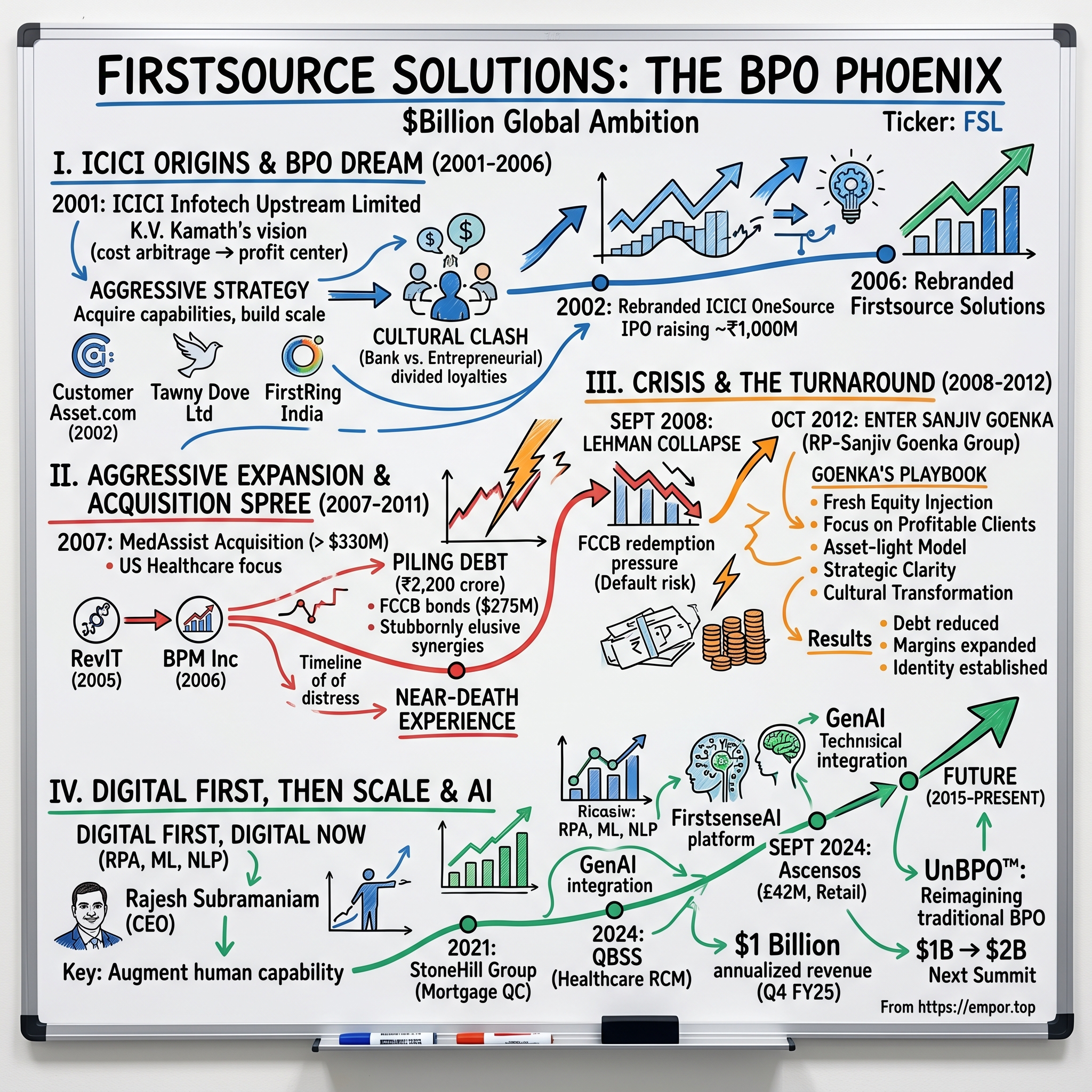
Firstsource Solutions: The Second Life of a BPO Survivor
I. Introduction & Episode Roadmap
There is a particular kind of corporate story that does not get told often enough, because it does not fit neatly into either of the two narratives business media prefers. It is not the founder-genius arc, where a visionary builds something from nothing. And it is not the collapse arc, where hubris meets gravity and everyone learns a lesson. It is the third thing: the company that actually died, was bought for parts by someone with no obvious business owning it, and then — slowly, unglamorously, over more than a decade — came back.
Firstsource Solutions is that company.
Today it is an India-headquartered business process management firm that crossed roughly a billion dollars in annual revenue in fiscal 2026, employing tens of thousands of people across India, the United States, the United Kingdom, the Philippines, Mexico, South Africa, Romania, and Trinidad. Its customers are American healthcare payers and hospital systems, British retail banks, US mortgage lenders, telecom and media companies, and retailers. It is majority-owned — 53.66% — by RPSG Ventures, the holding vehicle of the RP-Sanjiv Goenka Group, a Kolkata conglomerate whose other interests run to power utilities, carbon black, packaged snacks, and an IPL cricket franchise.3
None of that was inevitable. In 2012, this company was a default candidate. It had borrowed $275 million in foreign currency convertible bonds at the very top of the pre-crisis credit cycle, and when the bonds came due, the money to repay them did not exist. Its founding promoter, ICICI Bank — the institution that had created it — declined to put in fresh equity. What saved Firstsource was not a turnaround plan. It was a cheque from a power utility.
That history matters for reasons beyond color, and this episode will keep returning to it. It explains the ownership structure. It explains why questions about capital allocation at this company carry a sharper edge than they would elsewhere. And it establishes the central pattern worth testing: this is a business that has now faced one existential threat and survived it, and is currently being asked whether it can survive a second.
The second threat is generative AI. The foundational economic logic of Indian business process outsourcing — take a repetitive white-collar workflow performed by someone in Chicago or Manchester, move it to Bengaluru or Manila, charge the client less than they were paying, keep the spread — is the single clearest target for large language models anywhere in the enterprise economy. If a model can adjudicate a healthcare claim, extract data from a mortgage file, or answer a customer service query, the arbitrage that built this industry does not merely shrink. It inverts.
Firstsource's management has a response to this, and it is a genuinely interesting one: that AI expands their market rather than destroying it, because the largest pool of work they can now compete for is not the work their BPM rivals hold but the work clients still do in-house. Sell an outcome, deliver it with a mix of software and people, and the addressable market gets bigger, not smaller. On the Q1 FY27 earnings call in August 2026, management pointed to production-grade AI deployments live in mortgage processing, healthcare intake, and collections, and to an operating margin that has climbed from roughly 11% eight quarters earlier to 12.4%.5
And here is where the tension this episode is built around becomes visible. In that same August 2026 quarter, revenue grew 19.7% year on year in constant currency — the ninth consecutive quarter of double-digit growth — and the stock fell roughly 16% over two sessions.17 The trigger was a single disclosure: a healthcare client had terminated its contract, and management attributed the loss to a change in leadership on the client's side.4 One decision, by one executive the company does not employ, erased a meaningful chunk of market value in forty-eight hours.
Growth and investor confidence are pulling in opposite directions at this company, and the gap between them is the spine of everything that follows. To understand why the market reacts this way — why a billion-dollar revenue run rate with expanding margins trades at a de-rated multiple — you have to start with what happened in 2012, because the market has a long memory for companies that once went to the brink.
 Subscribe on LinkedIn
II. Origins and Near-Death: The ICICI Experiment to the FCCB Crisis (2001-2012)
Picture the Indian outsourcing industry at the turn of the millennium. The Y2K remediation boom had just proven to the world that Indian firms could handle mission-critical Western workflows at a fraction of Western cost. Every large Indian institution suddenly wanted an outsourcing arm, and Indian banks — flush, ambitious, and watching GE build a captive services empire in Gurgaon — wanted one most of all.
ICICI Bank founded what was then called ICICI OneSource in 2001. The template was the standard one: start as a captive unit processing the parent's own back-office work, learn the discipline, then open the doors to third-party clients and turn a cost center into a revenue line. It worked. By 2006 the business had enough independent identity to shed the parent's name entirely, rebranding as Firstsource Solutions.
What happened next defined the company for the following twenty years, in both directions. Firstsource went shopping. It bought Pipal Research for analytics. It bought ASG for collections. And in 2007 it made the deal that still matters: MedAssist, an American healthcare revenue-cycle-management business. That acquisition gave Firstsource something genuinely rare for an Indian BPO of the era — an onshore US healthcare franchise with direct relationships at hospitals and payers, embedded in the plumbing of how American medical bills get processed and paid. Nearly two decades later, healthcare remains the largest and most valuable part of this company. Whatever else the pre-crisis era produced, it produced that.
It also produced the balance sheet that nearly killed the firm. In December 2007 — with hindsight, an almost perfectly chosen moment to be wrong — Firstsource raised $275 million in foreign currency convertible bonds to fund its expansion.
FCCBs deserve a moment of explanation, because the instrument is the whole story. A convertible bond is a loan that the lender can swap for equity if the share price rises above a set conversion level. For the issuer it looks like cheap money: you pay a low coupon because the lender is being compensated with equity upside. The catch is that the equity upside is not a promise, it is a hope. If the share price never reaches the conversion level, nobody converts, and the "cheap" bond reverts to being exactly what it always was — a large, dated, hard-currency repayment obligation. And because these were foreign currency bonds, the obligation was denominated in dollars while the company's earnings were substantially in rupees, adding a currency mismatch on top of the refinancing risk.
Nine months after the raise, Lehman Brothers failed. Global credit markets closed. Indian mid-cap share prices collapsed and stayed collapsed. The conversion option went deep out of the money and never recovered. By the time the redemption date approached, Firstsource faced a $237 million cash repayment with no conversion, no obvious refinancing, and a rating agency losing patience — CRISIL downgraded the company as the deadline neared.
The moment that reveals the most about Indian corporate governance is what ICICI did next, which was essentially nothing. The founding promoter, one of the largest and best-capitalized banks in the country, did not inject fresh equity to save its own creation. It is worth sitting with that. A promoter's implicit support is the invisible collateral behind a great many Indian corporate balance sheets, and here was a demonstration that the collateral could be withdrawn.
Enter Sanjiv Goenka. In October 2012, CESC — the Kolkata electricity utility at the heart of the RP-Sanjiv Goenka Group — acquired a 49.5% stake in Firstsource through a subsidiary, SpenLiq, for roughly ₹650 crore, with the explicit purpose of retiring the FCCBs in full.15 The market's immediate verdict was unkind: CESC shares fell sharply on the announcement as investors asked the obvious question about why a regulated power utility was buying a distressed business process outsourcer.16
They were right to ask. This was a distressed-asset purchase, not a strategic combination. There were no synergies between electricity distribution and healthcare claims adjudication. What there was, was a functioning global services business with real client relationships, available at a price set by the urgency of a bond redemption rather than by the value of the franchise. Goenka bought a going concern at a liquidation-adjacent price and took on the job of fixing it.
Why this matters now, in 2026, rather than as period detail: everything about the current ownership structure descends from that transaction. The RPSG Group's 53.66% stake — and the governance dynamics that come with a controlling promoter — is the direct legacy of the rescue.3 More subtly, so is the analytical frame investors bring to this company. Every acquisition Firstsource announces, every leverage decision, every use of the balance sheet gets read against the knowledge that this management lineage inherited a firm that once nearly went to zero on a financing structure that looked clever until it didn't. Capital discipline is not an abstract virtue here. It is the specific thing the company failed at once, in public, expensively.
That inheritance — a US healthcare franchise bought in the boom, and a balance sheet discipline learned in the bust — is precisely the combination that defines Firstsource today. Start with the franchise.
III. The Core Business Today: US Healthcare BPM — Where the Value Lives
An American hospital discharges a patient. Somewhere in that moment, a financial process begins that is almost comically more complicated than the medicine that preceded it. A clinical encounter must be translated into standardized codes. Those codes must be assembled into a claim. The claim must be submitted to an insurer, which will check it against the patient's coverage, the provider's contract, prior authorization records, and its own adjudication rules. A meaningful fraction of claims get denied — sometimes for genuine coverage reasons, frequently for a missing field, a coding mismatch, or a documentation gap. Denials must be worked, appealed, resubmitted. Whatever the insurer does not pay, the patient owes, which starts a second process of billing and collection against a person who is probably confused about what they are being charged for and why.
This is revenue cycle management. It is the single largest administrative cost pool in American healthcare, and it exists because the US built a payment system with thousands of payers, tens of thousands of provider organizations, and no common set of rules. It is not a technology problem that somebody forgot to solve. It is structural friction, manufactured continuously by the design of the system itself.
Roughly half of Firstsource's revenue comes from standing inside that friction. The company works both sides of the transaction — payer-side services like claims adjudication support, prior authorization processing, and member services, and provider-side RCM including medical coding, denial management, patient billing, and collections.[^3] Historically this was billed the way BPM has always been billed: per full-time equivalent, or per transaction. You need forty people to work denials; we will supply forty people, at a rate below what forty Americans would cost you.
That pricing model is being deliberately dismantled, and understanding why is central to understanding the current investment debate. The FTE model has a structural ceiling built into it: the vendor's revenue is a function of headcount, so any productivity gain the vendor achieves is a revenue reduction unless the client agrees to share it. Outcome-based pricing — charge for claims resolved, dollars recovered, authorizations cleared, rather than for bodies — breaks that link. If the vendor can do the same work with fewer people and more software, the margin accrues to the vendor rather than being handed back at the next contract renegotiation. Management has been explicit that this shift is the strategic core of the AI thesis.5
The competitive field
Firstsource does not compete in an empty market. The diversified Indian-heritage BPM peers — Genpact, spun out of GE, with deep finance-and-accounting and analytics scope, and EXL Service, particularly strong in insurance and healthcare analytics — are both substantially larger by market value and both run credible healthcare practices. Against them, Firstsource is the smaller, more concentrated player.
The more analytically interesting comparison is Sagility India, a pure-play healthcare BPM business carved out of Hinduja Global Solutions, backed by EQT, which listed on Indian markets in November 2024. Sagility does one thing: healthcare operations, predominantly payer-side. It is narrower than Firstsource and has been growing faster. And the market has been willing to assign it a valuation broadly in the same neighborhood as Firstsource's despite Firstsource being the larger and more diversified business.
That read-through is worth stating plainly, because it cuts against a comfortable assumption. If the market prices a smaller healthcare-only operator at a comparable level to a larger diversified one, then investors are not paying much, if anything, for diversification. They are paying for growth rate and for perceived AI positioning. Firstsource's multi-vertical structure — healthcare plus banking plus communications — is defensible as risk management, but it is not currently being rewarded as a valuation asset. Anyone underwriting this stock on the theory that the market will eventually recognize the value of a balanced portfolio should notice that a live comparable suggests otherwise.
How Firstsource tries to win
The company's answer to competitive pressure has two parts. The first is domain platforms — software layers built specifically for claims, prior authorization, and patient intake, sold as part of an outcome engagement rather than licensed separately. The pitch is that a vendor who has processed millions of denials for dozens of payers knows things about denial patterns that a generic automation tool does not, and that this accumulated process knowledge is what makes the outcome pricing safe to offer.
The second is bolt-on acquisition. In 2024 Firstsource bought QBSS, a Chennai-based medical billing and RCM business, for approximately ₹327.8 crore — roughly $39-40 million.11 Strategically the logic was specific rather than grand: QBSS added offshore RCM delivery capacity and, importantly, relationships with individual practitioners and smaller physician groups, a customer segment Firstsource's large-payer-oriented business had not served. It filled a capability gap and extended the customer pyramid downward. It was not a bet-the-company transaction.
Stress-testing the moat, with the freshest evidence available
The standard bull argument for healthcare BPM runs on stickiness. Once a vendor is processing your claims, sitting inside your workflow, holding institutional knowledge about your denial patterns and your payer contracts, switching is genuinely painful — it means re-papering, re-training, and accepting an operational risk window on the part of your business that generates cash. Retention should therefore be high and pricing defensible.
August 2026 provided the sharpest available test of that claim. Alongside its Q1 FY27 results, Firstsource disclosed that a healthcare client had terminated its contract, and management characterized the cause as a change in leadership at the client's end.4 The stock fell about 16% across two sessions, with brokerages splitting on the outlook.17
It is worth being precise about what this evidence does and does not establish, because the distinction is where the analysis lives.
This was not a competitive loss. Firstsource was not undercut on price or displaced on quality by Genpact, EXL, or Sagility. On the evidence available, a new executive arrived at the client, reviewed the vendor landscape they had inherited, and made a different call than their predecessor had. That is a materially different failure mode than losing a bake-off.
But it is not a reassuring distinction, and management's framing should not be allowed to make it one. The stickiness argument holds that workflow embedding makes the relationship hard to unwind. What this episode demonstrates is that the friction is real but finite — real enough that competitors rarely pry these accounts loose, finite enough that a single incoming executive with a mandate to restructure operations can decide the switching cost is worth paying. The moat protects better against competitive displacement than against client-side reorganization.
So the honest verdict is not that the moat claim is rejected. It is that the claim needs to be narrowed: Firstsource's healthcare relationships appear durable against rivals and vulnerable to client governance change. And the second half of that sentence is not a small caveat, because it is a risk the company cannot manage through better execution. You can outwork a competitor. You cannot outwork a new chief operating officer's reorganization plan.
The forward test is specific and checkable. Watch net-new large-deal annual contract value intake and healthcare logo retention over the next two to three quarters. If ACV keeps building and no further healthcare logos depart, the August event was idiosyncratic and the narrowed moat claim survives intact. If a second healthcare account leaves, the pattern reading takes over, and the question shifts from "was this one client unlucky" to "has something changed in how large US payers evaluate offshore vendors."
Concentration is what makes this dynamic financially consequential rather than merely annoying. Per CARE Ratings' assessment, Firstsource's top ten clients accounted for roughly 48% of total company revenue.13 That concentration sits disproportionately inside healthcare, where a relatively small number of large US payers and health systems anchor the segment. When half your revenue rests on ten relationships, the departure of one is not a rounding error, and the market's willingness to mark the stock down by double digits on a single disclosure is not an overreaction — it is an accurate read of the mathematics.
Healthcare is where the value and the volatility both live. The second-largest segment has a different profile entirely: less client-specific risk, far more exposure to something nobody at Firstsource controls.
IV. Banking & Financial Services: UK Retail Banking and the US Mortgage Cycle
In March 2022, the US Federal Reserve began raising interest rates. Over the following eighteen months, the thirty-year American mortgage rate roughly doubled. The consequence for anyone whose revenue depended on mortgage origination volumes was not a slowdown. It was closer to a stoppage — refinancing activity, which had been the dominant driver of volume during the pandemic-era rate trough, essentially ceased, because nobody refinances a 3% mortgage into a 7% one.
Firstsource's banking and financial services segment, roughly a quarter to a third of company revenue, sat directly in the path of that.[^3]
The segment has two distinct halves. The first is UK retail banking servicing: customer onboarding, dispute handling, complaints processing, and collections for British high street banks. This is comparatively steady work — regulated, volume-driven, tied to the number of accounts a bank services rather than to the direction of rates. It is also the part of Firstsource with the deepest tenure, built over years of UK market presence, and it carries its own regulatory texture, since UK financial services outsourcing is supervised with a seriousness that makes vendor compliance failures a board-level matter for the bank, not just the vendor.
The second half is US mortgage, operated through Sourcepoint. Firstsource acquired the business that became Sourcepoint — ISGN's operations — in 2016 for roughly $13 million, a price that reflected how unloved mortgage services assets were at the time. It expanded the platform in December 2021 by acquiring The StoneHill Group, which added mortgage quality control, due diligence, and audit capability along with relationships among mid-market lenders.
The timing of the StoneHill deal is where an honest analysis has to slow down. December 2021 was, in retrospect, within a few months of the absolute peak of the US mortgage origination cycle. The deal closed into a boom that was about to end. That is not evidence of bad judgment — nobody at Firstsource was uniquely positioned to forecast the fastest Fed tightening cycle in four decades — but it is evidence about the nature of the asset. Mortgage BPO revenue is cyclical in a way that healthcare claims processing is not, and acquisitions into cyclical businesses at cycle peaks are a recognizable category of capital allocation risk.
The guidance-consistency question that follows is worth making explicit, because it is the kind of test that separates management narrative from management record. A business that is described as valuable diversification during a housing boom, and then quietly reframed as a temporary headwind during a rate-driven bust, has told two different stories about the same asset. The fair reading of Firstsource's mortgage exposure is neither of those framings: it is a genuinely cyclical business whose revenue rides US rate policy, acquired cheaply, expanded at a peak, and which will look like a growth engine again whenever origination volumes recover. Investors should size it as a cyclical, not as a structural growth vector, regardless of how any particular quarter's commentary frames it.
The competitive dynamic here also differs from healthcare in an instructive way. In mortgage services, Firstsource's principal competition is not Genpact or EXL. It is the lender's own operations department, plus specialist mortgage servicers and technology vendors who have built origination and servicing platforms. That changes the sales conversation fundamentally. In healthcare, the question a client asks is "which vendor." In mortgage, it is frequently "vendor or not," and the answer depends heavily on whether the lender expects volumes to be high enough next year to justify carrying fixed internal capacity. Outsourcing wins when volume volatility is high and lenders want to convert fixed cost to variable — which is, conveniently, most of the time in that industry.
This is also, notably, where management says its AI deployments are furthest along. Mortgage documentation — income verification, asset statements, title records, appraisals — is a document-extraction problem, and document extraction is precisely the task at which current AI models are most obviously and least controversially competent. If the AI-led outcome model works anywhere first, it should work here.
Which is the natural bridge to the rest of the portfolio, and then to the question the whole industry is currently being asked.
V. Communications, Media & Technology, and Diverse Industries — Sized to Their Weight
Every BPM company has a segment that exists because the work was there and the capability transferred. For Firstsource, that is communications, media and technology, sitting alongside a "diverse industries" bucket covering retail, e-commerce, energy and utilities. Together these form the smaller remainder of the revenue base after healthcare and banking take their shares.[^3]
The work is customer care and collections for telecom and media companies — the call that gets made when a broadband connection fails, the billing dispute over a streaming subscription, the outbound contact when an account goes past due. It is high-volume, price-competitive, and structurally the part of the portfolio most exposed to conversational AI substitution, because tier-one customer contact is the workload that voice and chat models are being aimed at most directly across the entire enterprise software industry.
The notable recent development here was the 2024 acquisition of Ascensos, a UK-based customer experience business serving retail and e-commerce clients, for £42 million — roughly $56 million at the time.10 The strategic content was partly client access and partly geography: Ascensos brought delivery operations in Scotland, South Africa, Romania, and Trinidad. That footprint is less exotic than it sounds. It is a deliberate answer to a specific client demand — nearshore and onshore delivery for work that cannot go to India, whether for language reasons, data residency rules, regulatory constraint, or simple brand preference for domestic-accented customer service. A BPM firm that can only deliver from India and the Philippines is locked out of a growing category of contracts.
The pricing on Ascensos is the more revealing detail, and it returns in the management section: the business had 2023 revenue of £64.1 million, meaning Firstsource paid roughly 0.65 times trailing revenue.10 For a services business with an established client roster and a multi-country delivery network, that is a disciplined number rather than an aspirational one.
For investors, this part of the portfolio deserves attention proportional to its size, which is to say: watch it, don't build a thesis on it. The signal to look for in the segmental disclosures is whether CMT and diverse industries are growing faster or slower than the company average. Faster, and the AI-augmented CX proposition is winning share in the most contested part of the market, which would be meaningful evidence for the broader thesis. Slower, and it is the portfolio's ballast — revenue that funds the delivery network without driving the equity story.
Which brings us to the thing that hangs over all three segments at once.
VI. The AI Reckoning: Threat, Opportunity, or Both?
On October 17, 2025, Capgemini completed its acquisition of WNS for approximately $3.3 billion, announcing the combination as the creation of a global leader in what it called agentic AI-powered intelligent operations.12
Strip away the phrasing and consider what that transaction actually signals. Capgemini is a European IT consulting and systems integration firm with deep enterprise relationships, hyperscaler partnerships, and the ability to sit in a boardroom and sell a transformation program. WNS was a pure-play Indian-heritage BPM company of respectable scale. Capgemini paid a substantial premium to own operations delivery capacity.
Why would a consultancy want to own the back office? Because in an AI-mediated services market, the person who runs the process owns the data, and the data is what makes the AI work. A consultant who advises on automation captures a project fee. An operator who runs the automated process captures the recurring economics and the proprietary training signal. Capgemini bought its way from the first position to the second.
For standalone BPM firms, this is a competitive event, not merely an industry data point. It means the firms Firstsource competes against for large outcome-based deals now potentially include entities with consulting-grade C-suite access, hyperscaler co-sell relationships, and balance sheets an order of magnitude larger. Genpact, EXL, and Firstsource all face the same structural question: in a market where the winning pitch is "we will redesign this process and run it with AI," does the operator win, or does the consultant who bought an operator win?
Management's counter-narrative
Firstsource's answer, articulated on the Q1 FY27 call in August 2026, is that this framing asks the wrong question, because the competition that matters is not other vendors at all.5
The argument runs like this. Historically, BPM firms competed for the slice of a client's process work that the client had already decided to outsource — a market bounded by the client's prior make-or-buy decision. The much larger pool has always been the work clients kept in-house, which stayed in-house because the labor arbitrage was not large enough to justify the disruption of moving it. AI changes that calculation. If a vendor can deliver the same outcome at materially lower cost through a combination of software and people, the arbitrage is no longer just wage differential — it is technology differential — and suddenly work that was never economical to outsource becomes economical. The addressable market expands.
Management has supported this with claims of production-grade AI delivery live in mortgage processing, healthcare intake, and collections, and has attached a margin thesis to it: EBIT margin up from roughly 11% eight quarters prior to 12.4% in Q1 FY27, with a stated expansion path of 50 to 75 basis points per year.5[^9]
Separating the technical claim from the commercial one
This is where disciplined analysis has to do some work, because AI claims from services companies are currently the least reliable category of corporate disclosure in the market. Nearly every firm in the sector describes itself as AI-led. Most of what is described consists of pilots, partnerships, model certifications, and internal productivity tools that have not touched a client contract.
Firstsource's evidence is better than that baseline, and it should be credited accordingly. Named workflows in production for paying clients are a different class of evidence than a lab demonstration. More persuasively, there is margin movement: a multi-quarter, non-trivial expansion in operating margin during a period of rapid revenue growth is at least consistent with a genuine change in delivery economics, because a pure headcount-scaling business typically expands margin slowly, if at all, when it is hiring aggressively into new contracts.
Consistent with, though — not proof of. Margin expansion in BPM can also come from pyramid management, utilization improvement, offshore mix shift, currency movement, or simply lapping a weak comparison period. The margin data supports the AI narrative; it does not isolate it.
And the same quarter that showcased AI-led large deal wins also disclosed a client departure and a profit miss.417 Management itself supplied the most important qualifier, noting that the shift toward more complex outcome-based AI-led deals introduces execution risk, because these engagements ramp more slowly than traditional staffing contracts.5 That statement belongs directly beside the growth claim, not filed away in a risk factor, because it defines the specific mechanism by which the strategy could disappoint: revenue that is signed but slow to convert looks identical to revenue that is not coming, right up until it either arrives or doesn't.
The forward test is therefore clean. Does large-deal ACV convert to recognized revenue on the timeline management has now publicly committed to, or does "outcome-based deals take longer to ramp" become the standing explanation for the next guidance shortfall? The same sentence can be an honest disclosure or a pre-positioned excuse, and only the next few quarters of revenue conversion distinguish the two.
Where the advantage actually sits
Run this through Hamilton Helmer's 7 Powers framework and the picture is less comfortable than the narrative suggests.
Scale economies: Firstsource is meaningfully smaller than Genpact, EXL, and the combined Capgemini-WNS entity. Scale is not the power here.
Switching costs: real in healthcare, as discussed, but demonstrably bounded by client-side governance change.
Network economies: essentially absent. A BPM firm's value to one client does not increase because another client uses it, except indirectly through accumulated process knowledge.
Cornered resource: no. There is no proprietary asset, patent estate, or exclusive contract that rivals cannot replicate. The AI models themselves are commercially available to everyone, including to clients.
Branding: modest. Firstsource does not command a price premium on reputation the way a top-tier consultancy does.
Process power and counter-positioning: this is where the credible claim sits, and it is counter-positioning-adjacent rather than pure. Firstsource is willing to sell outcomes at prices that assume AI-driven productivity — accepting delivery risk that a pure headcount business would find uneconomic to accept, because taking that risk cannibalizes the headcount model. A legacy FTE-billing competitor faces a genuine incentive conflict in matching that offer. But this is not classic counter-positioning, because the incumbent cannot simply decline to follow forever; they can and will convert, and the larger ones have more capital to fund the transition.
The honest conclusion: Firstsource's AI position is a real commercial capability with early revenue and margin evidence behind it, not a slide-deck claim. But it is not yet a durable structural advantage, because nothing about it is hard for a well-funded competitor — or a determined client with a capable systems integrator — to replicate within a couple of years. The advantage is a head start and an organizational willingness to cannibalize, which is worth something, and is worth less than a moat.
Whether that head start gets converted is a question about the people running the company.
VII. Management: The Idnani Era and What It's Proven So Far
When Ritesh Idnani took over as managing director and chief executive officer on September 1, 2023, he inherited a company in a peculiar position: financially stable, strategically unresolved.9 The balance sheet crisis was eleven years behind it. The healthcare franchise was solid. But the core question — what is this company for, in a world where labor arbitrage is a depreciating asset — had not been answered.
Idnani's background is directly relevant to that question, and unusually so. He spent years at Infosys during the period when the firm scaled from roughly $100 million to $8 billion in revenue, and later ran a $1.4 billion portfolio at Tech Mahindra.9 What that record represents is not entrepreneurial vision but operating scale — the specific discipline of running large, complex, multi-geography services delivery and growing it without breaking it. For a company whose central challenge is executing a business model transition across tens of thousands of employees in a dozen countries, that is arguably the more relevant qualification.
He is, as of this writing, roughly two years into the job. That is a genuinely thin record, and any assessment of management credibility here has to say so up front rather than assembling two years of results into a verdict they cannot support. Five years is the minimum span over which a services CEO's decisions fully reveal themselves, because the contracts signed in year one are the revenue of year three and the renewals of year five.
Within that limitation, there are four things worth examining.
Incentives
Compensation runs through the ESOP 2019 Plan, which combines tenure-based and performance-based vesting — the standard structure for aligning an Indian services executive to multi-year value creation.3 Reported total compensation has trailed size-matched Indian-market peers. That cuts in two directions and both are worth naming. Below-market cash compensation means a smaller near-term claim on shareholders and, if weighted toward equity, tighter alignment with the share price. It also means retention risk: an executive with an Infosys-and-Tech-Mahindra résumé has options, and a company two years into a transformation cannot easily absorb a CEO departure.
Capital allocation
This is where the record is thinnest but most legible. Two acquisitions in 2024 — QBSS at roughly $39-40 million and Ascensos at £42 million — rather than one large transformational deal.1110 Both filled identifiable capability gaps: offshore RCM delivery and small-practitioner access in the first case, nearshore CX delivery geography in the second. Ascensos was purchased at roughly 0.65 times trailing revenue, which is disciplined relative to typical pricing for BPM and CX assets.
The comparison that gives this meaning is internal. The pre-2008 Firstsource bought aggressively into a boom and financed it with convertible debt that nearly destroyed the company. The post-2023 Firstsource has bought small, filled specific gaps, and paid below one times revenue. That is a real and deliberate contrast, and it deserves to be stated.
It also deserves two qualifications. First, two deals across two years is a small sample; discipline is proven by what a management team does when a large, exciting, expensive asset becomes available, and that test has not yet occurred. Second, the integration outcomes are not yet visible. Paying a low multiple is only discipline if the asset performs; a cheap acquisition that underdelivers is still destroyed capital, merely less of it. The honest position is that the current M&A approach looks more prudent than the historical one and has not yet been tested by either a large opportunity or a visible integration failure.
Guidance discipline
The most informative single behavioral data point available came in August 2026. Having just disclosed a healthcare contract termination and missed on profit, management reaffirmed full-year FY27 guidance of 10-13% constant-currency revenue growth and 12.25-12.75% EBIT margin, rather than trimming it.45
There are exactly two readings of that decision and no way to adjudicate between them today. The first: management has genuine visibility into its deal pipeline, knows the lost contract is absorbable within the existing plan, and declined to use a bad quarter as cover for lowering the bar. That is the behavior of a team confident in its numbers. The second: management was unwilling to compound a share price decline with a guidance cut and chose optimism over arithmetic, deferring the reckoning to a later quarter.
The distinguishing evidence arrives on a known schedule. If FY27 lands inside the guided range, the reaffirmation was discipline and the credibility account is meaningfully funded — the most valuable thing a two-year CEO can build is a record of numbers that hold. If FY27 comes in below, the reaffirmation was optimism, and the cost is not merely the miss but the discount applied to every subsequent forecast this management team issues. Few decisions carry that asymmetry so cleanly, and investors should treat the FY27 outcome as a genuine test rather than a routine data point.
Governance and the activist lens
The ownership backdrop is straightforward: RPSG Ventures holds 53.66% with zero share pledging.3 The absence of pledging matters more in Indian markets than it might elsewhere, because promoter share pledging — borrowing against control stakes — has been the proximate cause of several spectacular Indian corporate unravellings, creating forced-selling dynamics precisely when a company can least withstand them. Firstsource does not have that vulnerability.
The flip side is structural and permanent. A 53.66% holder decides everything. Minority shareholders at this company have voice but no leverage. There is no realistic activist campaign, no proxy contest, no hostile approach, and no scenario in which an outside investor forces a strategic change over the controlling shareholder's objection. Whatever governance quality exists here exists because the promoter chooses it.
The August 2026 annual general meeting illustrated the texture of that arrangement. All resolutions passed with support above 99%, including a special resolution permitting Pradip Kumar Khaitan, a non-independent director, to continue serving past the statutory retirement age of 75.18 Taken alone, that is unremarkable — retirement-age waivers for long-serving directors are routine across Indian conglomerate-controlled companies, and Khaitan is an eminent corporate lawyer whose counsel a board may reasonably value.
What a skeptical investor would note is not the individual resolution but the aggregate pattern: near-unanimous approval on every item, including one extending the tenure of a promoter-aligned director beyond the standard limit. Near-unanimity in a company with a majority promoter is not evidence of broad shareholder enthusiasm; it is arithmetic. It means the voting record carries very little information about what minority holders actually think. This is a sentence-long flag rather than an alarm — but the flag is that governance signals at this company are structurally low-information, and investors who rely on voting outcomes as a check will not get one.
The balance sheet, by contrast, tells you something quite specific.
VIII. Capital Structure and Shareholder Returns
For a company whose defining crisis was a financing structure, the most interesting thing about Firstsource's balance sheet in 2026 is how uninteresting it is.
CARE Ratings has assigned the company A+ with a Stable outlook on long-term bank facilities and A1+ on short-term facilities, and CRISIL has maintained its own investment-grade rationale on the credit.1314 Net debt to EBITDA stood around 1.8 times as of FY26.1 That is leverage consistent with a services business that has made acquisitions and is comfortably servicing them, not leverage that constrains strategic choices.
The contrast with 2012 needs no elaboration and should be stated without hedging: a company that once faced a $237 million hard-currency redemption it could not fund now carries moderate, rupee-and-dollar-diversified, rated debt at a multiple that gives it room to act. That is a genuine transformation in financial character, accomplished over more than a decade, and it is the clearest evidence available that the post-rescue ownership actually changed how this company is run rather than merely who owns it.
Returning capital
Firstsource's capital return profile is dividend-weighted. The payout ratio has run around 60%, with FY25 total dividends of ₹9.50 per share, while buyback activity has been minimal — a buyback yield in the vicinity of 0.2%.[^3]1
This is a deliberate structural choice and it follows directly from the ownership. A controlling shareholder holding 53.66% receives 53.66% of every rupee distributed as dividend. Buybacks, by contrast, return cash to the holders who choose to sell and mechanically increase the percentage ownership of those who don't — useful for a management team that believes its shares are undervalued, less immediately useful to a promoter who already has control and may prefer cash upstream to the holding company.
Neither approach is inherently superior, but the profile it produces for a minority investor is specific: this is an income-plus-moderate-growth holding, not a compounding-through-share-count-reduction story. If the thesis you are underwriting requires management to aggressively repurchase stock during a de-rating, the historical pattern does not support that expectation.
The valuation puzzle
Which brings us to the most striking number in this entire story. Market capitalization has ranged roughly between ₹186 billion and ₹235 billion depending on the quarter.1 More significantly, EV/EBITDA compressed from approximately 21 times in FY25 to roughly 11 times in FY26 — while earnings were growing.1[^9]
A multiple halving during a period of earnings growth is not noise. It is a repricing, and it means the market changed its mind about something fundamental rather than reacting to results. Mechanically, the share price fell while EBITDA rose, which requires investors to have materially lowered either their expectation of future growth, their assessment of the durability of current earnings, or both.
The most plausible explanation is AI disruption risk being priced in — the market applying a structural discount to any business whose revenue is substantially a function of billable human hours, regardless of that specific company's operating performance. That is not a Firstsource-specific judgment; it is a sector-wide de-rating that has touched the listed BPM complex broadly.
The analytical implication cuts both ways, and this matters for how Section X is read. If the de-rating is an indiscriminate sector move and Firstsource's AI transition genuinely works, the compression is an opportunity created by correlation rather than analysis. If the de-rating is the market correctly anticipating that outcome-based AI-mediated services will carry structurally lower margins and shorter contract durations than the FTE model did, then the multiple is not cheap — it is simply the new correct multiple for a changed business, and today's earnings are the peak rather than the base.
A compressed multiple is a question, not an answer. The evidence that resolves it is operational: margin trajectory and large-deal conversion over the coming year. That is the same evidence that resolves almost everything else about this company, which is a useful clue about where to focus.
IX. Playbook: What This Company's History Actually Teaches
Strip Firstsource's twenty-five years down to transferable lessons, and three survive scrutiny.
Rescue capital carries a permanent price, and the price is the same thing that makes the rescue possible. The reason CESC could save Firstsource in 2012 was that Sanjiv Goenka could write a cheque without needing a committee's permission, hold the asset through a decade of unglamorous rebuilding, and refuse to lever it again. Concentrated, patient, unpledged promoter capital is genuinely effective crisis capital — it does not panic, does not demand quarterly proof, and does not face redemptions. But the identical structure that made the rescue possible is the structure that leaves minority shareholders without leverage today. You cannot have the crisis-resilience without the control concentration; they are the same fact viewed at different points in the cycle. Investors who value the first should not be surprised by the second.
The same corporate action can be prudent or reckless depending entirely on how it is financed. The pre-2008 Firstsource acquired MedAssist, which is still the most valuable thing the company owns nearly twenty years later. The strategic logic was correct. What nearly killed the company was not buying a US healthcare business — it was funding an expansion program with hard-currency convertible debt whose repayment depended on a share price recovery nobody controlled. The current M&A approach — sub-1x revenue multiples, specific capability gaps, funded from a balance sheet at moderate leverage — looks meaningfully more durable. But the contrast should be named for what it is: a difference in financing discipline more than a difference in strategic ambition. And it remains a two-deal sample under a two-year CEO, which is not yet a track record.
Diversification across verticals reduces idiosyncratic risk, not cyclical risk. Firstsource's three-segment structure genuinely protects against any single client or vertical failing — the August 2026 healthcare loss hurt the stock but did not threaten the company. What it does not do is protect against the macro cycles each segment rides. Banking services ride US mortgage rates. Healthcare rides US payer economics and, increasingly, the pace at which American health plans redirect administrative budget toward their own AI spending. Communications rides consumer telecom competition and is the most directly substitutable by conversational AI. These are three different cycles, and diversification means the company is exposed to all of them rather than immune to any. A portfolio of cyclicals is still cyclical.
With those lessons on the table, the investment argument can be stated properly — and tested.
X. Bull vs. Bear: The Investment Case, Tested
The bull case, and what supports it
The growth record is the strongest available evidence and it should not be dismissed as a story. Nine consecutive quarters of double-digit revenue growth, culminating in the company crossing the $1 billion annual revenue threshold in FY26 with 19.7% constant-currency growth in the most recent quarter, is not a narrative — it is sustained commercial performance in a sector where most peers have grown in mid-single digits.4[^9] Companies losing relevance do not compound at that rate for over two years.
The margin trend is the second pillar, and it is more meaningful than the growth number because it is harder to fake. EBIT margin rising from roughly 11% to 12.4% over eight quarters, during a period of aggressive revenue expansion and two acquisition integrations, is consistent with delivery economics genuinely improving rather than with revenue simply being bought.5
The AI positioning is the third, and it should be credited at its actual weight: named production deployments in mortgage, healthcare intake, and collections, sold into an expanded market of client in-house operations rather than merely fought over with BPM rivals.5 Whether or not this becomes a moat, it is a live commercial motion generating real revenue today.
And the balance sheet is the fourth: rated investment grade, moderately levered, no promoter pledging, with recent acquisitions priced below one times revenue.1310
The bear case, and what supports it
The client loss is the bear case's best evidence and it is recent, specific, and financially quantified.417 Its analytical force is not the revenue lost but what it revealed about the mechanism: the durability of these relationships is partly a function of personnel the company does not employ and cannot influence. No amount of operational excellence immunizes against an incoming executive's reorganization.
The structural industry threat is the second and larger argument. The Capgemini-WNS combination demonstrated that the consulting and hyperscaler tier is willing to pay billions to own BPM delivery capacity and wrap it in agentic AI positioning.12 Against that, Firstsource's answer to "why do you win" rests on execution quality and domain depth — both real, neither hard to replicate given sufficient capital and time. The company does not own a cornered resource, a regulatory licence, a network effect, or a proprietary dataset that a determined competitor cannot assemble.
The valuation argument is the third and it is genuinely double-edged. EV/EBITDA roughly halving year over year while earnings grew means the market has already substantially repriced this business.1 A bear would say that is the market correctly anticipating disruption, and that anyone treating the compressed multiple as a bargain is assuming they see something the marginal seller doesn't.
The fourth is management tenure. Two years is not a cycle. The one genuine stress event so far produced an ambiguous signal — a guidance reaffirmation that is either conviction or optimism — and the resolution is quarters away.
Porter's five forces
Rivalry: intense and intensifying. Genpact and EXL are larger and equally credentialed; Sagility is a faster-growing healthcare-focused alternative; Capgemini-WNS brings consulting-tier access. Services contracts are competitively re-bid, and there is no structural reason rivalry abates.
Buyer power: high, and this is the dominant force. Top ten clients at roughly 48% of revenue means the largest customers negotiate from strength, and they know it.13 Large US payers and UK banks have professional procurement functions whose job is extracting vendor concessions at every renewal. The August 2026 termination was buyer power exercised at its most absolute.
Supplier power: low but not zero. The primary input is skilled labor in India, the Philippines, and increasingly nearshore locations, where supply is deep. The emerging supplier question is model access: if AI delivery depends on frontier models from a handful of providers, those providers acquire pricing leverage over the services firms building on them. That is a new supplier relationship the industry has not previously had.
Threat of substitutes: high and rising. This is the force that explains the multiple compression. The substitute is not a rival BPM firm — it is software that removes the need for the process to be performed by people at all, whether sold by an enterprise vendor or built by the client. Firstsource's strategy is an attempt to be the delivery vehicle for the substitute rather than its victim, which is the right response and not a guarantee.
Threat of new entrants: moderate, and changing character. Building a traditional BPM business at scale is hard — delivery centers, compliance, certifications, client trust. But an AI-native startup attacking one narrow workflow, prior authorization say, does not need any of that. It needs a model, domain expertise, and a few reference customers. The barrier protected against generalist entrants; it protects less well against vertical specialists.
The calibrated verdict
Weighing these against each other rather than stacking them:
The growth and margin evidence is strong, recent, and multi-period, and it meaningfully supports the claim that Firstsource is executing well. It does not establish that the execution is protected.
The moat claim, tested against the company's own freshest disconfirming evidence, survives in narrowed form: durable against competitive displacement, vulnerable to client governance change, and quantitatively fragile because of concentration.
The AI claim sits above the industry baseline on evidence and below the bar for a structural advantage. It is a head start with revenue attached, not a defensible position, and management's own acknowledgment of slower ramp times bounds how fast it converts.
The management claim is unproven rather than either validated or rejected — a favorable early capital allocation pattern on a small sample, and one pending credibility test with a known resolution date.
What would change these conclusions is narrow and observable, which is the most useful thing about this situation. That brings us to the risks that could break it, and then to what to actually watch.
XI. Risk Radar
AI and technology disruption. The mechanism is direct and industry-wide. Firstsource's revenue is substantially a function of work volume priced against a labor baseline. If clients or enterprise software vendors can deliver equivalent outcomes without a BPM intermediary, per-transaction economics compress across the entire sector — not as a competitive loss to a rival, but as deflation in the price of the underlying service. Note that Firstsource's own strategy accelerates this: selling outcome-based deals priced on AI productivity means bidding down the price of the work it performs, betting that volume expansion and margin capture more than offset it. That bet is the business, and it can be right on direction and wrong on magnitude.
Client concentration. With the top ten at roughly 48% of revenue, a small number of relationship or leadership changes can move the stock double digits in a session — a proposition that stopped being theoretical in August 2026.1317 The concentration is worst where the value is highest, in healthcare, because large payer and provider contracts are individually large by construction.
Geographic, currency, and rate exposure. More than 65% of revenue comes from North America, with the UK the next-largest market.[^3] Three separate exposures follow. US interest rate policy drives mortgage origination volumes and therefore Sourcepoint's revenue. Dollar-rupee moves affect both reported revenue and delivery cost, though partially offsetting. Sterling-dollar-rupee moves affect the UK banking and CX book. None of these are hedgeable beyond short horizons, and all flow into reported growth and margin.
Execution risk in the AI transition. Management's own framing is the source here: outcome-based deals take longer to ramp.5 The consequence is that the revenue mix is shifting toward contracts that are harder to forecast quarter to quarter, at precisely the moment when the market is least inclined to extend the benefit of the doubt. A company whose credibility depends on hitting guidance is taking on revenue that is structurally more difficult to guide.
Data privacy and cybersecurity. Understated but material. Firstsource processes protected health information under HIPAA, UK and EU personal financial data under GDPR, and US mortgage borrower data. A significant breach would carry regulatory penalty, remediation cost, and — most damagingly — client trust loss in a business where trust is a precondition for even being invited to bid. Deploying AI on this data multiplies the surface area: every model that touches regulated data creates new questions about data residency, retention, and training use that clients' compliance functions will scrutinize. No material incident has been disclosed in the company's recent public filings, and that is the correct scope of that statement — it is not an assurance about what is undetected.
Regulatory and policy risk. US political attention to offshore outsourcing recurs episodically, and visa or procurement policy changes can alter onshore-offshore delivery mix economics. UK financial services outsourcing supervision imposes operational resilience requirements that raise the cost of serving regulated clients. Neither is an acute overhang today; both are structural features of operating where this company operates.
XII. Epilogue: What to Watch From Here
The useful thing about Firstsource's situation in September 2026 is that the questions are not philosophical. They resolve into a small number of observable outcomes, on a known timetable.
The first KPI: large-deal ACV conversion into revenue. This is the single most important number to track, because it is the point where every strategic claim this company makes either becomes true or doesn't. Management has argued that AI-led outcome-based deals expand the addressable market and win business that traditional BPM never could. It has also said those deals ramp more slowly. Both statements can be accommodated by the same reported numbers for a while — signed ACV builds, revenue lags, management explains the lag as structural. The distinguishing evidence is whether bookings actually convert on the stated timeline, quarter after quarter. Watch signed ACV, then watch it arrive.
The second KPI: healthcare logo retention. The August 2026 termination narrowed the moat claim from "sticky relationships" to "sticky against competitors, exposed to client reorganization." Over the next two to three quarters, healthcare client retention determines which version of that claim is operative. No further departures, and the narrowed claim holds and the event was idiosyncratic. A second healthcare logo leaving changes the analysis from a bounded caveat to a pattern, and would suggest something has shifted in how large US payers evaluate offshore vendors in an AI era.
The third: whether FY27 guidance holds. The 10-13% constant-currency growth and 12.25-12.75% EBIT margin range, reaffirmed in the immediate aftermath of a bad quarter, is the most concrete test of Idnani-era credibility available.45 Landing inside it converts a reaffirmation into a track record. Missing it costs more than the miss, because it establishes that this management team's guidance carries a discount.
Beyond those three, one thing is worth monitoring not as a metric but as a tell: the size of the next acquisition. The historical failure mode at this company was precisely the opposite of what has happened since 2023 — large ambition financed aggressively at the top of a cycle. If future M&A stays in the sub-1x-revenue, capability-filling, balance-sheet-funded category, the discipline thesis strengthens with each additional data point. If a large transformational deal appears — particularly one financed with structured instruments or acquired at a premium multiple to buy growth or AI capability — that is the moment to re-underwrite the capital allocation claim from scratch, regardless of how compelling the strategic rationale sounds. The 2007 rationale sounded compelling too.
The deeper question underneath all of it is whether Firstsource is a company that survives disruptions or one that merely survived one. In 2012 the answer came from outside — a buyer with capital and patience who happened to be willing. There is no equivalent rescue available for the second threat, because the second threat is not a financing problem that a cheque can solve. It is a question about whether the work this company does will still be worth paying a person to do, and if not, whether Firstsource can be the one selling the machine that replaces them.
Management has given its answer, and has attached real deployments and real margin improvement to it. The market has given a different one, halving the multiple while earnings grew. Both cannot be right, and the evidence that settles it is already scheduled to arrive.
XIII. Recent News
August 2026 — Q1 FY27 results and the market's reaction. Firstsource reported 19.7% year-on-year constant-currency revenue growth, its ninth consecutive quarter of double-digit growth, alongside an EBIT margin of 12.4%.4 The results also disclosed the termination of a healthcare client contract, attributed to a change in leadership at the client, and a profit figure below consensus expectations.4 The stock fell approximately 16% over the two sessions following the announcement, with brokerage opinion splitting on the outlook.17 Management reaffirmed FY27 guidance of 10-13% constant-currency revenue growth and 12.25-12.75% EBIT margin, and used the earnings call to emphasize production-grade AI deployments across mortgage, healthcare intake, and collections, while acknowledging that the shift toward outcome-based AI-led engagements introduces execution risk because such deals ramp more slowly.57
August 2026 — Annual general meeting. Shareholders approved all resolutions with support above 99%, including adoption of FY26 accounts and a special resolution permitting Pradip Kumar Khaitan, a non-independent director, to continue in office beyond the statutory retirement age of 75.18
October 2025 — Capgemini completed its acquisition of WNS. The approximately $3.3 billion transaction closed on October 17, 2025, with Capgemini positioning the combination as a global leader in agentic AI-powered intelligent operations — a structural development for the competitive landscape in which Firstsource, Genpact, and EXL all operate.12
FY26 full-year results. Firstsource crossed the $1 billion annual revenue mark, reporting the year's results in May 2026 with the accompanying investor presentation detailing segmental performance and the margin expansion trajectory management has since reiterated.[^9]
2024 acquisitions, now integrated. QBSS, the Chennai-based medical billing and RCM business acquired for approximately ₹327.8 crore, and Ascensos, the UK-based retail and e-commerce customer experience firm acquired for £42 million, both closed during 2024 and now sit inside the healthcare and CMT/diverse industries segments respectively.1110
References
-
Firstsource Investor Relations — Financial Information ↩↩↩↩↩
-
Firstsource Reports First Quarter Fiscal 2027 Results — Firstsource press release, 2026-08 ↩↩↩↩↩↩↩↩↩
-
Firstsource Solutions Ltd (FSL) Q1 2027 Earnings Call Transcript — AlphaStreet, 2026-08 ↩↩↩↩↩↩↩↩↩↩↩
-
Firstsource Q1 FY26-27 Earnings Call Transcript & Audio — StockAnalysis ↩
-
Earnings call transcript: Firstsource posts strong Q1 2027 growth, stock flat — Investing.com, 2026-08 ↩
-
Firstsource Solutions Reports Fourth Quarter and Fiscal 2025 Results — Firstsource press release ↩
-
Firstsource Solutions Announces Ritesh Mohan Idnani as MD & CEO — Firstsource press release, 2023 ↩↩
-
Firstsource Acquires Ascensos — Firstsource press release, 2024 ↩↩↩↩↩
-
Firstsource acquires medical billing firm QBSS for $40Mn — Outsource Accelerator, 2024 ↩↩↩
-
Capgemini completes the acquisition of WNS and creates a global leader in agentic AI-powered intelligent operations — Capgemini press release, 2025-10-17 ↩↩↩
-
CARE Ratings press release — Firstsource Solutions Limited, 2024-12-15 (PDF) ↩↩↩↩↩
-
CRISIL Rating Rationale — Firstsource Solutions Limited, 2024-09-25 ↩
-
CESC tanks after acquisition of BPO firm Firstsource Solutions — Business Standard, 2012-10-26 ↩
-
Firstsource tanks 16% in 2 days after Q1 show; brokerages mixed on outlook — Business Standard, 2026-08-07 ↩↩↩↩↩↩
-
Firstsource Solutions shareholders approve FY26 results and director reappointment — ScanX ↩↩
 LinkedIn
 WhatsApp
 Reddit
 Hacker News
 Email
Email Kindle
 RSS Feed
 Spotify
 Apple Podcasts
 Amazon Music
 Audible
 YouTube