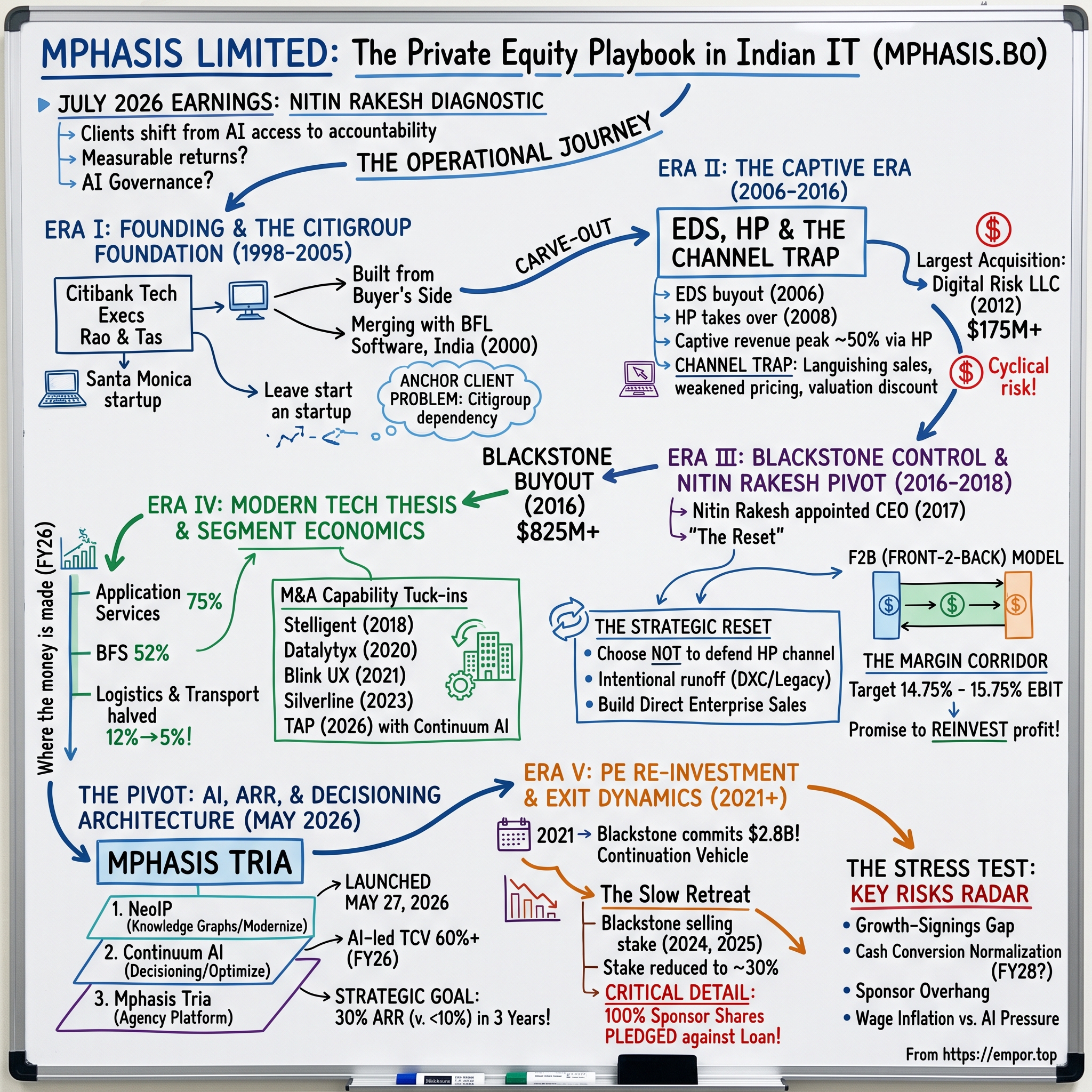
Mphasis Limited: The Private Equity Playbook in Indian IT
I. Introduction & Episode Roadmap [00:00 - 08:30]
On the morning of July 24, 2026, Chief Executive Nitin Rakesh dialed into an earnings call from Bengaluru and opened not with quarterly metrics but with a diagnostic assessment. Twelve months earlier, he told analysts, enterprise client conversations centered on model access and experimentation. By mid-2026, the focus shifted to accountability. Corporate leaders were asking harder questions: where is the measurable return on AI investment, how can AI decisions be governed in regulated environments, and how does any of it survive board scrutiny?1
That opening statement captured the complex operational position Mphasis occupied in August 2026. The company had just reported its fifth consecutive quarter of new deal wins exceeding $400 million.1 It had closed the prior fiscal year with record contract wins and operating margins aligned with management's public targets.2 Yet its stock traded at approximately ₹2,342 on the BSE in early August 2026 — down more than 20% from a 52-week high of ₹3,035. That drop occurred amid a broader sectoral decline in which Indian IT stocks fell by as much as 34% during 2026, driven by investor concerns over whether generative AI would disrupt the traditional IT outsourcing model.34
The gap between steady operational execution and a valuation reflecting structural caution defines the central tension of the Mphasis story.
The hook
Mphasis has operated under parent-company balance sheets throughout most of its corporate history. Founded by former Citibank executives in California, it later became the offshore delivery unit for Electronic Data Systems, subsequently operated as "Mphasis, an HP company," and in 2016 became Blackstone's largest Indian buyout up to that point.5 Each owner applied a distinct strategic priority to the asset.
The company's defining operational transition occurred after Blackstone's takeover. Rather than shrinking as the former parent relationship waned — a common pattern among captive IT carve-outs — Mphasis intentionally allowed its inherited channel to taper while building a direct enterprise sales operation. By fiscal year 2026, ended March 31, 2026, the legacy channel managed through DXC Technology contributed ₹3,186 million, or 2.0% of gross revenue, representing a 14.8% year-on-year decline.2 Direct enterprise business grew to 98% of total revenue.2 The legacy channel has effectively dissolved, completing the company's shift toward an independent client model.
The core paradox
Mphasis presents a dual profile as both a successfully transformed mid-cap IT service provider and a structurally concentrated business. Gross revenue reached ₹160,101 million in fiscal year 2026, representing reported growth of 12.6% and constant-currency growth of 6.7% after accounting for a 5.3% depreciation in the rupee.2 Operating margin stood at 15.3%, flat year-on-year and within management's target band.2 Return on equity reached 18.3%.2
However, revenue metrics show significant business concentration. Banking, Financial Services, and Insurance (BFSI) together account for 67.0% of total revenue.2 The Americas region generates 84% of sales.2 Furthermore, the Logistics and Transportation vertical declined from 12% to 5% of revenue within a single year, contracting by more than half.2 Additionally, the controlling shareholder has pledged its entire shareholding against a term loan.6 While domain concentration provides specialization, it leaves the business exposed to sector-specific downturns.
Episode themes
Four primary themes emerge from this operating structure:
First is the application of private equity governance to mid-cap IT services: examining operational changes under sponsor control and distinguishing structural improvements from broader macroeconomic tailwinds.
Second is vertical specialization as a competitive strategy. Mphasis has concentrated capabilities in banking, mortgage, wealth management, and insurance workflows, claiming this depth provides a distinct market advantage. The analysis evaluates whether this focus yields durable client retention or simply concentrates cyclical risk.
Third is capital allocation strategy, characterized by targeted acquisitions — including Digital Risk, Stelligent, Datalytyx, Blink UX, Silverline, and Theory and Practice — alongside the direct acquisition of client service contracts during vendor consolidation programs.
Fourth is the strategic impact of artificial intelligence on human-capital IT billing models. Management launched the Mphasis Tria platform in May 2026 with the stated goal of shifting service workflows toward recurring platform revenue.7 As of August 2026, this strategic pivot remains early in implementation and requires ongoing evaluation.
Roadmap
The analysis traces the company's trajectory from its origin as a Santa Monica startup founded by Citibank technologists, through its corporate ownership under EDS and HP, to Blackstone's 2016 carve-out and the execution strategy under Chief Executive Nitin Rakesh. It examines current operational economics, acquisition history, shareholder structure, AI initiatives, and potential operational risks.
The story begins with two technology executives departing a global banking institution.
 Subscribe on LinkedIn
II. Founding Context & The Citigroup Foundation (1998–2005) [08:30 - 18:00]
Jaithirth Rao — universally "Jerry" — had spent more than two decades inside Citibank and its parent Citicorp, working across Asia, Europe, South America, and North America, eventually running Citicorp's development division and chairing Transaction Technologies Inc. in California.8 That last detail matters more than the title suggests. Transaction Technologies was Citibank's in-house technology arm, the place where the bank built the software that ran its own operations. Rao did not emerge from the Indian software industry; he came from the client side.
That was an unusual origin for an Indian IT company, and it shaped its trajectory.
A company built from the buyer's side of the table
In 1998, Rao left banking and started Mphasis Corporation in Santa Monica, California, alongside Jeroen Tas, another Citibank technology executive, with the intent of building software that would let banks deliver services online.8 The founders were not pitching low-cost labor arbitrage. They were pitching an operational understanding of banking infrastructure — where reconciliation breaks, why card authorization files arrive late, and what regulators require in compliance reporting.
Two years later, in June 2000, Mphasis Corporation merged with BFL Software Limited, an Indian services firm, and the combined entity moved its center of gravity to Bengaluru.2 BFL had been incorporated in Karnataka in 1992 and brought what the American entity lacked: engineering scale, delivery discipline, and a competitive cost structure.2 The merged company listed on the Bombay Stock Exchange under scrip code 526299, where it trades to this day.3
The strategic logic of that merger established the operational model the company continues to run. The US entity owned client relationships and architectural design, while the Indian entity managed execution — what the company later termed the front end and the back end. Two decades later, Mphasis still describes its approach as "Front2Back," booking roughly 60% of revenue from onsite delivery and 40% offshore.2 For a company headquartered in Bengaluru, that onsite-heavy mix is unusual — most large Indian peers push significantly more work offshore — reflecting its origin as a California firm that acquired an Indian delivery engine.
The anchor client problem, version one
Citigroup became the foundational relationship, providing the primary source of revenue during the company's early years. A financial institution of that scale generates a continuous volume of application maintenance, card processing, and mortgage back-office work, and a founder who previously managed the bank's technology division understood its operational entry points.
That deep domain exposure compounded over time. Managing core banking, credit card, and mortgage workflows provided operational capabilities difficult to replicate through generalist services: tracking a US mortgage from origination to securitization, identifying compliance retention rules, and troubleshooting core ledger migrations. That specialized domain knowledge enabled a mid-sized provider to secure business alongside much larger competitors.
However, a recurring pattern was establishing itself — one that repeated three more times in the company's history. Mphasis proved effective at building deep relationships with a small number of large institutions, while becoming structurally dependent on them. The Citigroup relationship provided initial scale, but it also meant early Mphasis operated essentially as a specialized provider attached to a single primary account.
What the early era actually proves
While early vertical specialization is sometimes framed as a deliberate long-term masterstroke, a more balanced assessment indicates Mphasis specialized in banking because its founders had deep banking expertise and limited access to other sectors. Strategic positioning and operational constraint often overlap in retrospect.
What the period did establish was a defining operational posture: Mphasis sold on domain fluency rather than sheer scale or price competition. Lacking the scale of Tier-1 Indian peers, it declined to compete purely on price — a stance Chief Executive Nitin Rakesh reaffirmed on the July 2026 earnings call, noting that competing on price during renewal cycles "is a game that we really don't want to play."1
That position set the stage for the next phase in the company's evolution, when Mphasis transitioned from an independent domain specialist into a captive delivery unit for a global technology enterprise.
III. The Captive Era: EDS, HP, and the Channel Trap (2006–2016) [18:00 - 30:00]
In June 2006, Electronic Data Systems — the outsourcing corporation founded by Ross Perot in 1962 — purchased a controlling stake in Mphasis.92 For the founders and early shareholders, the sale provided validation and an exit. For the company, it marked the start of a decade in which major commercial decisions were directed from Plano, Texas.
The logic that made sense on paper
EDS faced a challenge common among Western outsourcers in 2006: multi-year contracts priced on cost assumptions that had become unsustainable, coupled with an onshore-heavy labor structure. Acquiring an Indian delivery platform offered an immediate lower-cost execution engine. Mphasis, with its domain expertise in banking and mid-sized delivery footprint, represented an attractive acquisition target.
For Mphasis, the relationship delivered guaranteed commercial volume. Work arrived without a standard sales cycle, eliminating the need to compete in open tenders, fund a dedicated US enterprise sales team, or market an independent brand. Contract revenue was routed directly from the parent company.
Ownership shifted again two years later. Hewlett-Packard acquired EDS in August 2008, inheriting the controlling stake in Mphasis.2 Operating under the moniker "Mphasis, an HP company," the business crossed $1 billion in annual revenue by 2010, driven primarily by HP enterprise contracts.
The trap
Captive channel revenue introduces structural vulnerabilities for an IT services firm.
When a subsidiary relies on a parent company's sales pipeline, three critical operational functions deteriorate. First, enterprise sales capabilities languish because there is little incentive to build direct relationship coverage with prospective clients. Second, pricing discipline weakens, as internal transfer prices are negotiated administratively rather than tested against market competition. Third, market positioning degrades: corporate buyers view the business as a resource pool rather than an independent strategic partner.
At its peak, roughly half of Mphasis's revenue flowed through the HP channel. This concentration created a direct dependency on HP's commercial trajectory. When HP's enterprise services division lost market share and initiated restructuring, the contract volume routed to Mphasis contracted alongside it. Lacking a mature direct enterprise sales engine, Mphasis had no immediate mechanism to replace lost demand, leading to declining revenue.
Public markets reflected this structural vulnerability. Throughout the early 2010s, Mphasis traded at a persistent valuation discount relative to independent Indian IT peers. Investors recognized that the company's primary client could reduce contract volumes unilaterally, capping growth and constraining management's strategic autonomy.
The one thing the era did produce
The captive period also established durable operational capabilities. Managing global banking contracts for EDS and HP required Mphasis to comply with rigorous corporate governance standards, including audit regimes, security protocols, and delivery frameworks mandated by major Western outsourcers.
The era also yielded the largest acquisition in the company's history. In December 2012, Mphasis reached a definitive agreement to acquire Orlando-based Digital Risk LLC for $175 million in cash plus an earn-out, completing the transaction in February 2013.1011 Digital Risk was among the largest independent providers of risk, compliance, and transaction management in the US mortgage market—a specialized asset that became a central element in Mphasis's subsequent operational strategy.
The imperative
By the mid-2010s, the company's operating arithmetic was clear: a contracting parent channel, combined with an underdeveloped direct sales force and a persistent valuation discount, pointed toward a gradual reduction in business scale. Reversing this trajectory required building an independent enterprise sales organization—an effort demanding substantial capital investment and a shareholder willing to support a multi-year repositioning.
Hewlett-Packard Enterprise, amidst its own corporate restructuring, chose to sell its stake.
IV. The Blackstone Buyout & Nitin Rakesh's Strategic Reset (2016–2018) [30:00 - 45:00]
In April 2016, Hewlett-Packard Enterprise entered a definitive agreement to sell its shares in Mphasis to private equity funds managed by Blackstone.25 The transaction priced the equity at ₹430 per share, valuing HPE's roughly 60.5% holding at about $825 million — at the time, Blackstone's largest acquisition in India.12 The transaction completed in September 2016 through a Blackstone vehicle, turning Mphasis into a Blackstone group company.2
The deal structure made Blackstone's underlying thesis clear. Under the terms of the agreement, HPE agreed to continue receiving services under an existing customer agreement that it planned to extend for a further five years.12 In effect, Blackstone acquired a business whose channel revenue was contractually supported for a defined period — long enough to fund the construction of a replacement direct sales engine before the legacy channel ran out.
The thesis, stated plainly
Blackstone's bet rested on three pillars. First, a controlling stake in a competent delivery organization could be acquired at a discount precisely because it was captive — the valuation penalty that public markets imposed on Mphasis served as an attractive entry point for private equity. Second, the HP channel was a waning asset that should be harvested rather than defended. Third, the gap between Mphasis's operating capability and its commercial organization could be closed by installing management with the mandate and financial incentives to execute a pivot.
This framework reflected a standard carve-out playbook. What made the execution distinct was the operational challenge unique to IT services: unlike physical manufacturing assets, a service provider cannot restructure physical plant when its primary assets leave the building every evening.
Enter Nitin Rakesh
In January 2017, Blackstone appointed Nitin Rakesh as Chief Executive Officer and Managing Director. Rakesh arrived from Syntel, where he had run a US-listed, financial-services-heavy IT provider with a reputation for margin discipline and a similarly concentrated client portfolio. Rather than an industry outsider brought in for short-term cost cutting, Rakesh brought direct experience operating the exact commercial model Mphasis needed to build.
Rakesh's operating style exhibits three consistent characteristics. First, he frames strategy around proprietary terminology — such as Front2Back, X2C2, NeoIP, and Enterprise Agency — combining operational structure with commercial positioning. Second, he commits management to narrow, checkable numerical bands rather than open-ended goals. Third, he engages extensively with analysts on earnings calls, addressing operational details at length.
His first structural decision was the most consequential: he chose to stop defending the legacy channel. Rather than fighting to preserve HP-routed contract volumes, Mphasis allowed that business to run off while directing investment into a direct enterprise sales force across the United States and Europe. This choice required accepting voluntary revenue declines in a large portion of the business while the replacement channel was still building scale — a transition public markets often penalize, but which a controlling shareholder enabled Mphasis to navigate.
This governance umbrella highlighted the principal contribution of private equity ownership: rather than aggressive cost cutting or financial engineering at the operating level, Blackstone provided the structural backing to absorb several years of headline revenue contraction in exchange for building a direct enterprise business.
The margin corridor and the incentive architecture
Rakesh's second key decision was binding the company to a public margin band of 14.75% to 15.75% operating EBIT. Nearly a decade later, that corridor remains the stated commitment, reiterated in the FY26 results and again for FY27.2131
Targeting a strict margin ceiling alongside a floor is uncommon in IT services, where companies typically guide toward margin expansion. Management has explicitly outlined the rationale behind this corridor: on the July 2026 call, Rakesh described margins as targeted within the band "not because we are defending a floor, but because we are making deliberate platform investments while holding financial discipline."1 The corridor functions as an explicit promise to reinvest profitability above the top of the range back into the business rather than letting it flow to the bottom line.
The empirical record demonstrates management's discipline in maintaining this range. Operating margin landed at 15.3% in FY26 and 15.3% in FY25, while quarterly prints through FY26 sat between roughly 15.2% and 15.4%.214 Maintaining profitability within a narrow one-percentage-point band over nearly a decade represents a consistent execution track record.
At the same time, this strict cap presents a clear trade-off. Capping operating EBIT at 15.75% signals to investors that the company will not deliver strong operating leverage, whereas Tier-1 Indian peers operate materially above that level. A permanent margin ceiling reflects a commitment to reinvestment, but it also acknowledges that the business cannot out-earn its own cost of delivery by a wide margin.
Executive incentives were aligned with direct contract value won rather than reported gross revenue — a structure tailored for a company building a client pipeline from scratch. That focus persists in how the company reports today, with total contract value given headline billing in every quarterly release.
The Blackstone ecosystem angle
A frequently cited potential synergy was selling Mphasis services into Blackstone's broader portfolio, which spans healthcare, real estate, and financial services. Mphasis was subsequently recognized by Everest Group as a Major Contender in private equity services.13 However, Mphasis does not separately disclose revenue derived from Blackstone portfolio companies, nor are there public metrics quantifying this contribution. Without disclosure, the commercial impact of portfolio cross-selling remains an unverified thesis.
What is measurable, however, is the structural transformation of the business — setting the stage for its modern operational profile.
V. Core Business & Segment Economics: Where the Money is Made [45:00 - 01:05:00]
Strip away the platform vocabulary and Mphasis in fiscal 2026 was a roughly ₹160 billion revenue business — call it $1.7 billion at the year's exchange rates — that earns its living doing three things for large Western enterprises: building and maintaining their applications, running their business processes, and managing their infrastructure.2
The proportions tell you where the company actually lives. Application Services was 75% of revenue and grew 17.5% on a reported basis. Business Process Services was 14%, growing 2.5%. Infrastructure Services was 11%, and declined 3.1%.2 One engine is pulling the train.
The vertical map, and the thing that broke
Banking and Financial Services generated ₹83,786 million in FY26, 52% of the total, growing 21.3% reported.2 Insurance contributed ₹23,444 million, 15%, growing 44.5% — the fastest-growing vertical in the portfolio by a wide margin.2 Technology, Media and Telecom was ₹28,696 million, 18%, up around 20%.2 "Others," which includes healthcare and retail, was 10%.2
And then there is Logistics and Transportation, which fell from ₹17,718 million to ₹8,719 million — from 12% of revenue to 5%, a decline of roughly half in twelve months.2
That is not a rounding error, and how management has handled it is analytically interesting. On the Q4 call, the EMEA softness was attributed to "revenue structuring for a large global client in the Logistics vertical."14 On the July 2026 call, asked directly about the drag, Rakesh said the vertical "is a little bit more headwinded given the macro and the geopolitical environment," that it "has become a smaller unit for us," and that "small number changes drive high percentage variations."1
The last point is circular — the unit became small because it halved. Neither explanation identifies what specifically happened, and no client was named. An investor is entitled to treat a 51% single-year decline in a reporting vertical as an unexplained event rather than a satisfactorily explained one. To management's credit, Rakesh did not claim it was fixed; he said "more work to be done, both in Logistics as well as in Airlines and Railroads, and we'll continue to report on that as we go forward."1 That is at least a commitment to keep the disclosure visible.
Geography and the dollar problem
The Americas produced 84% of FY26 revenue, up from 81%, growing 15.6% reported.2 EMEA was 9%, India 5%, and rest of world 2%.2 This is a US company that happens to be listed in Mumbai and staffed largely from India.
That concentration has a well-understood upside: US enterprise buyers pay the highest rates in the industry, and being the incumbent in a US money-centre bank is among the most durable positions in services. It has an equally well-understood downside, which is that a slowdown in US corporate technology budgets arrives undiluted.
There is a subtler currency dynamic worth explaining, because it materially distorts the reported numbers. Roughly half of FY26's reported growth was rupee depreciation, not underlying demand — 12.6% reported gross revenue growth versus 6.7% in constant currency.2 Meanwhile the company hedges its dollar receipts forward. When the rupee weakens past the strike price on those hedges, the hedges lose money, and those losses flow through revenue. FY26 included a ₹1,305 million loss on cash flow hedges reclassified to revenue, against a small gain the prior year.2 On the July 2026 call, the CFO, Aravind Viswanathan, said the cumulative hedge position in other comprehensive income had improved by about ₹50 crore between March and June, but cautioned it "will take a couple of quarters for it to substantially start reflecting from an operating margin standpoint" and that it "will improve but not go away fully."1 Hedging is not a sideshow here; it is a real and continuing drag.
The pricing model shift nobody is talking about
Buried in the FY26 annual report is the most structurally significant number in the whole document, and it has nothing to do with AI branding.
Time-and-materials contracts — bill by the hour, the traditional IT services model — fell from 58% of revenue to 48%. Fixed-price contracts rose from 32% to 44%, growing 56.1% in a single year.2
That is a fundamental change in who carries delivery risk. Under time and materials, if a project takes longer, the client pays more. Under fixed price, if a project takes longer, the vendor eats it. Mphasis has, in one year, moved roughly a tenth of its entire revenue base from the safe side of that trade to the risky side.
Management frames this as strategy, and there is a coherent argument: if AI genuinely makes your engineers more productive, fixed-price contracts let you keep the gain instead of handing it to the client as fewer billable hours. Rakesh made this point explicitly, distinguishing outcome-based pricing from output-based pricing and arguing that "price discounting game only works when you're doing effort-based pricing."1
The argument is sound. It is also a bet. Fixed-price work at 44% of revenue means margin now depends on estimation accuracy across a very large book of business. If the productivity gains underdeliver, the losses do not show up as slower growth — they show up as margin compression, all at once.
Client concentration, measured the way the company measures it
Mphasis does not publish top-5 or top-10 client revenue percentages. It publishes a client pyramid — how many accounts sit in each revenue band — which is a different and in some ways more useful disclosure.
At the end of FY26 the company had one client above $200 million annually, two above $150 million, four above $100 million, six above $75 million, fifteen above $50 million, and twenty-nine above $20 million.13 Over the year it added one client each in the $100 million and $75 million bands, two in the $50 million band and four in the $20 million band.13 The top ten accounts grew 13.7% year on year and accounts eleven through thirty grew 15.2%.13
That last pair of numbers is the one to watch, because it is the company's own stated diversification strategy made measurable: the FY26 annual report lists business concentration as a principal risk and names "accelerated growth across accounts ranked 11–30" as the mitigation.2 In FY26 the mitigation worked — the next tier grew faster than the top tier.
In the June 2026 quarter it worked harder still: accounts eleven through thirty grew 21.0% year on year against 11.1% for the top ten.1 But the same disclosure carried a caution: one client dropped out of the $150 million-plus band, which management attributed to "normal TTM ranking dynamics" as the account moved "marginally below the threshold" while remaining healthy.1 Both things are true — a single account crossing a reporting line is not a crisis, and it is also exactly the kind of movement that matters when four accounts generate over $100 million each.
The competitive position, honestly assessed
Scale comparison is unflattering and unavoidable. Tata Consultancy Services generated over $30 billion in FY26.15 Infosys crossed $20.2 billion.16 LTIMindtree reached roughly $4.76 billion.17 Persistent Systems, growing fast, reported $1.65 billion.18 Mphasis sits at roughly $1.7 billion — larger than Persistent, roughly a third of LTIMindtree, and a rounding error against TCS.
So where does a company this size actually win?
The answer is the middle of the deal-size distribution. In the $20 million to $100 million modernisation deal, a Tier-1 vendor is often structurally disadvantaged: the deal is too small to attract its best delivery leadership, and its standardised methodologies are built for larger engagements. A sub-billion-dollar specialist, meanwhile, may lack the balance sheet to fund the upfront investment these deals increasingly require. Mphasis occupies the band in between.
The evidence that this positioning is real rather than rhetorical is reasonable but not conclusive. FY26 new total contract value reached $2.1 billion, up 68% year on year, with four large deals in the March quarter alone.1914 The June 2026 quarter added $461 million including three large deals, one above $100 million, against a trailing-twelve-month TCV above $1.8 billion.1 Rakesh has claimed BFS compound quarterly growth above 3.5% across eight quarters as "the strongest among our peers."1 That specific comparative claim is management's, not independently verified here, but the underlying growth rate is consistent with the reported segment numbers.
What the evidence supports: Mphasis is winning deals at a rate that has accelerated meaningfully, and the wins are broad-based across verticals and deal sizes rather than concentrated in one lucky renewal. What it does not yet support: that this converts to sustained double-digit revenue growth. Constant-currency revenue growth in FY26 was 6.7%, and 8.3% year on year in the June quarter — respectable in a weak market, but well below the TCV growth rate.21 The gap between contract signings and reported revenue is the single most important thing to reconcile in this business, and we will return to it.
Some of that gap is being closed with cash rather than salesmanship, which brings us to how Mphasis deploys capital.
VI. M&A Strategy & Capital Deployment Benchmarking [01:05:00 - 01:20:00]
Mphasis has never attempted a transformative merger. Its acquisition history reads like a series of deliberate, narrow capability purchases, each one designed to plug a specific hole in what the sales force could credibly offer inside accounts it already served. That is a defensible strategy, and it has mostly worked. It has also produced one large, cyclical, and awkward legacy asset.
The scorecard
Digital Risk (2012, $175 million plus earn-out). The mortgage risk and compliance business remains a wholly-owned part of the group.210 The strategic logic was sound — US mortgage processing is regulated, complex, and sticky. The timing was not. Digital Risk was acquired near the top of a refinancing cycle, when American mortgage origination volumes were enormous. When rates rose, originations collapsed, and the acquired business's earnings collapsed with them. The lesson generalises: buying a cyclical business at peak volumes means paying for earnings that were never sustainable, however good the underlying franchise. The FY26 annual report still lists elevated interest rates and inflation as a risk specifically because they "may affect demand in mortgage-related services."2
Stelligent Systems (2018, $25 million). A DevOps automation specialist in the Amazon Web Services ecosystem, bought all-cash.20 Small, cheap, and strategically precise: it gave Mphasis credible cloud-automation credentials at a moment when every enterprise was starting a cloud migration. This is the template tuck-in.
Datalytyx (2020, up to £13.3 million). A UK data engineering consultancy specialising in the Snowflake and Talend ecosystems, acquired through Mphasis Consulting.21 Again small, again capability-shaped, aimed at the data-modernisation work that necessarily precedes any AI programme.
Blink Interactive / Blink UX (2021, $94 million). A Seattle user experience research, strategy and design firm.22 The most expensive per unit of revenue of the tuck-ins, and the most debatable. Design agencies are people businesses with thin defensibility, and the premium paid reflected a 2021 market in which digital experience capabilities commanded high multiples. The offsetting argument is that Blink let Mphasis bid on the front end of transformation programmes rather than arriving after the strategy was set — and the subsidiary disclosures show Blink Interactive turning a profit in FY26.2
Silverline (2023, $132.5 million). A New York Salesforce consultancy focused on financial services, with reported revenue of $75.8 million in calendar 2022.23 That implies a purchase price under two times revenue — a reasonable multiple for a specialist services firm and notably more disciplined than the Blink transaction. Salesforce implementation inside banks is exactly the adjacent budget pool Mphasis wanted access to.
Theory and Practice (2026). Announced in the third week of April 2026 and folded into the Q4 results narrative, TAP brought a decision intelligence platform called Continuum AI along with a team of AI practitioners and tier-one enterprise clients in consumer packaged goods and retail.241314 Terms were structured unusually: the CFO disclosed that roughly two-thirds of the potential consideration was in earn-out, with the entire earn-out flowing through the profit and loss statement rather than purchase accounting, producing a margin impact of about 0.35% in the June quarter and continuing "over the next couple of years."1
That structure deserves a note. Routing an earn-out through the P&L rather than capitalising it is conservative accounting — it depresses reported margin now rather than parking the cost on the balance sheet. It also means the reported operating margin for the next several quarters carries a drag that has nothing to do with underlying delivery efficiency, which investors reading the margin band need to hold in mind.
The new model: buying the contract, not the company
The more novel development in FY26 and FY27 is not classic M&A at all. Mphasis has begun acquiring customer contracts directly during client vendor-consolidation exercises — a bank or insurer decides to cut its vendor list from twelve suppliers to four, and Mphasis pays to take over the displaced vendors' contracts and staff.
Viswanathan described the economics on the July 2026 call: consideration typically runs between one times and 1.25 times the acquired revenue.1 Two transactions surfaced in disclosures — one branded OKIN, which contributed close to $4 million of revenue in the June quarter against a total contract value including contingent consideration of $5.5 million, and a pending one branded Red Oak, expected to begin around late August or early September 2026.1
The accounting is worth understanding because it affects reported margins. These are not entity purchases — the CFO noted that in none of these cases has Mphasis taken over an entity — but the accounting follows acquisition accounting, with the purchase price allocation "almost entirely customer relationship and customer intangibles," which then amortise.1 The upfront payment is largely expensed. Rakesh's framing was that "we are not trying to buy low-margin businesses that we need to transform," and that qualification requires "robust profitability."1
Analytically, this is a clever mechanism and a mild disclosure concern simultaneously. Clever, because it converts a client's cost-cutting exercise into a share-gain event for the incumbent, and because paying roughly one times revenue for a contract is cheap if the contract has multi-year longevity. A disclosure concern, because inorganic revenue acquired at one times sales looks identical to organic wallet-share expansion in the reported growth line. When an analyst asked directly what Red Oak would contribute to full-year growth, the answer was that it was "not that large a number" and "well within the range that is already kind of baked in" — which is not a quantification.1 Management has said it will disclose each transaction in the notes to accounts, and has done so. The onus is on the reader to net it out.
The accounting judgement worth flagging
One change in FY26 deserves explicit attention because it is the kind of thing that passes unnoticed and matters later.
Effective July 1, 2025, Mphasis revised the cash-generating units to which goodwill is allocated for impairment testing — moving from individual acquired businesses to customer verticals.2 Previously, goodwill sat in units named for the acquisitions themselves: Mortgage including Digital Risk at ₹10,398 million, Sonnick at ₹7,653 million, Blink at ₹5,969 million, Insurance PAS including Wyde, Artificial Intelligence including KORE, Cloud including Stelligent, Data including Datalytyx, and others.2 Now it sits in five vertical buckets: BFS at ₹21,766 million, TMT at ₹11,553 million, Insurance at ₹7,924 million, Logistics and Transportation at ₹1,943 million, and Others.2 Total goodwill stood at ₹47,677 million.2
The company's stated rationale is genuinely plausible: deals are increasingly sold as integrated bundles rather than as discrete acquired capabilities, so the acquired businesses no longer generate independent cash flows.2 Under accounting standards, that is a legitimate trigger for redefining CGUs.
The consequence, however, is that an individual underperforming acquisition can no longer trigger an impairment on its own. Digital Risk's mortgage goodwill is now pooled inside a BFS unit that grew 21.3% last year. Whatever the intent, the practical effect is that impairment becomes materially less likely.
Two supporting assumptions compound this. The post-tax discount rates applied in the FY26 test ranged from 11.50% to 13.50%, against 19.00% to 19.50% in the prior year's test.2 Lower discount rates mechanically increase the calculated recoverable amount. And the Logistics and Transportation unit — the vertical that just halved — carries a 15.81% assumed revenue growth rate and a 5.15% assumed operating margin.2 Management concluded no reasonably possible change in assumptions would cause any carrying amount to exceed its recoverable amount, and recognised no impairment.2 The statutory auditors, B S R & Co. LLP, issued an unmodified opinion.2
None of this is improper. All of it is a judgement call that a sceptical investor should keep on the watch list, particularly for the Logistics unit.
Capital returned to shareholders, meanwhile, has been steady and rising: final dividends of ₹55 per share for FY24, ₹57 for FY25, and ₹62 recommended for FY26 — roughly 62% of earnings per share before exceptional items.219 No buybacks have been undertaken in the current or preceding five years.2 For a company with a debt-to-equity ratio of 0.2, that is a conventional and unaggressive capital allocation posture.2
Which raises the question of what the controlling shareholder is doing with all that cash flowing back.
VII. The $2.8 Billion Blackstone Re-Investment & PE Exit Dynamics [01:20:00 - 01:32:00]
Private equity funds operate on finite lifecycles. Roughly five years after its initial 2016 carve-out, Blackstone faced a standard choice: sell Mphasis or find a structure to maintain control.
In April 2021, it chose a third option. Blackstone committed up to $2.8 billion to acquire a controlling stake in Mphasis, moving the position into a longer-duration vehicle alongside co-investors including the Abu Dhabi Investment Authority and UC Investments, the office of the chief investment officer of the Regents of the University of California.252
What the transaction actually signalled
Strip out the deal structure and the underlying valuation jump is stark. Blackstone had acquired its controlling stake in 2016 at a valuation of roughly $825 million. Five years later, it transacted at a headline valuation more than three times higher — while standing on both sides of the trade. Selling funds realized the investment gain, while the new vehicle and its co-investors took the position at the higher valuation mark.
Sponsor-to-sponsor continuation transactions carry inherent structural conflicts, as the same manager sets the price at which one group of fund investors sells to another. The primary mitigating factor was the participation of third-party co-investors. Institutions like the Abu Dhabi Investment Authority and UC Investments operate as sophisticated, price-sensitive investors under no mandate to participate. Their willingness to underwrite the new valuation provided external validation for the transaction price.
For public shareholders, the signal was straightforward: the controlling sponsor believed the operational transformation was mid-course rather than complete, warranting an extended investment horizon. Whether that valuation remains justified in hindsight is a more complex question.
The slow retreat
Since 2021, Blackstone has been a persistent net seller, establishing a clear supply overhang for the stock.
In June 2024, Blackstone sold a 15.1% stake — 28.5 million shares at ₹2,363 per share — raising ₹6,736 crore. The stock fell roughly 5% on the day as nearly 30 million shares traded.2627
On November 18, 2025, Blackstone affiliate BCP Topco IX Pte. Ltd. sold an additional 1.80 crore shares — representing a 9.46% stake — at ₹2,625.59 per share, raising ₹4,726 crore and reducing its holding from 40.10% to 30.64%. Domestic institutional buyers, including HDFC Mutual Fund, ICICI Prudential, and Kotak Mahindra, collectively absorbed 3.71%.28
As of June 30, 2026, BCP Topco IX held 5,82,99,642 shares, representing 30.54% of the company.6
This pattern reflects a sponsor methodically scaling back its exposure while maintaining effective working control. Domestic institutional buyers have steadily absorbed these tranches, broadening the shareholder base. Nevertheless, with nearly 30% of total equity remaining in the hands of a single private equity seller, market participants continue to price in the ongoing secondary supply.
The detail most investors have not registered
Beyond the headline share count, a specific disclosure in the June 2026 shareholding pattern warrants close inspection.
One hundred percent of BCP Topco IX's Mphasis shares are pledged.6
The underlying mechanics evolved over time. In August 2021, the holding entity above BCP Topco IX pledged its equity in Topco to a security agent as collateral for a holding-company loan. Following a refinancing on May 12, 2026, that upper-tier encumbrance was released. In its place, BCP Topco IX created a direct pledge over its entire shareholding in Mphasis itself in favor of Catalyst Trusteeship Limited as onshore security agent, with covenants supporting Deutsche Bank AG Singapore Branch as agent and DB International Trust Singapore as offshore security agent, securing a term loan facility dated May 12, 2026. Required regulatory disclosures under SEBI takeover rules were filed on May 19 and May 26, 2026.6
This structural shift altered the location of the collateral. Rather than holding security over an unlisted holding company, lenders now hold direct security over the listed operating equity. This change ties the sponsor's debt facility directly to the public market price of Mphasis stock.
To be precise regarding the operational implications: the pledge does not alter sponsor voting rights or change underlying ownership percentages, and asset-level margin financing against controlling stakes is a common private equity practice. However, it confirms that the controlling shareholder maintains leverage directly against this security, that the facility was refinanced rather than retired in May 2026, and that a severe stock price decline could trigger facility covenants that remain opaque to public investors, as specific loan-to-value thresholds and maturity dates are undisclosed.
Governance in transition
Concurrently, the board composition has undergone notable changes. Jan Kathleen Hier completed her second and final term as independent director and chairperson, stepping down from the board on December 10, 2025.2 Courtney Karlan Della Cava resigned as a non-executive, non-independent director effective February 27, 2026, citing other commitments.2 Blackstone-affiliated non-executive directors Amit Dalmia, Kabir Mathur, and Pankaj Sood remain on the board.2
Against this backdrop of sponsor divestment and board turnover, the board voted on April 29, 2026, to re-appoint Nitin Rakesh as CEO and Managing Director for a five-year term effective October 1, 2026, subject to shareholder approval at the thirty-fifth annual general meeting.2 Analysts on the July earnings call congratulated him on the extension before turning to operational questions.1 Securing executive continuity through 2031 provides organizational stability as the primary shareholder reduces its ownership stake.
The strategic mandate Rakesh carries into this next term addresses a fundamental shift reshaping the broader IT services industry.
VIII. Modern Tech Thesis: AI Deflation, X2C2, and Future Architecture [01:32:00 - 01:45:00]
Understanding why Indian IT stocks fell by as much as a third during 2026 requires examining the arithmetic of the traditional business model: these companies sell engineer-hours at a markup.4
If a bank requires a hundred engineers to maintain its lending application, it pays for a hundred engineers plus margin. If artificial intelligence tools allow forty engineers to complete the same work, the client's rational response is to pay for forty. Revenue falls by 60%, and the vendor's operating margin contracts alongside it — unless the vendor can decouple pricing from headcount.
That revenue deflation threat is not speculative. Chief Executive Nitin Rakesh acknowledged the mechanism directly, noting that traditional long-term annuity run deals "are highly susceptible to disruption because that's where you will have the narrative of productivity and what the client is asking for a passback."1 Management is not disputing the underlying risk.
What Mphasis is actually building
The counter-strategy relies on a three-layered platform architecture, structured to shift client engagements from labor-based billing to platform-based recurring delivery:
NeoIP and the Ontosphere. The foundational layer builds a knowledge graph — a machine-readable map of an enterprise's legacy technology estate detailing system interactions, embedded business rules, and historical operational exceptions. Global banks frequently rely on COBOL mainframe applications developed decades ago by retired programmers, leaving incomplete documentation where operational knowledge remains confined to long-tenured staff. Extracting this implicit knowledge into machine-readable structures represents the primary operational bottleneck in legacy modernization. NeoIP aims to industrialize this extraction, with the FY26 annual report describing the Ontosphere as constructing enterprise intelligence through "dynamic knowledge graphs grounded in enterprise domain context."2 This architecture represents the modern iteration of the company's earlier X2C2 framework.
Continuum AI, acquired with Theory and Practice. Where NeoIP maps legacy infrastructure, Continuum operates on top of it — functioning as a decision intelligence platform that applies causal modeling, optimization, and behavioral economics to automate operational choices in demand forecasting, pricing, marketing, and supply chain management.14 The strategic distinction is central to the model: legacy modernization represents a one-off project, whereas automated decisioning operates as an ongoing service.
Mphasis Tria, launched May 27, 2026. The company packaged these capabilities into a three-layer platform commercialized through two primary offerings: Mphasis Modernize and Mphasis Optimize.7 On the July 2026 earnings call, Rakesh explained that Modernize "builds enterprise memory" while Optimize "uses that memory to continuously improve the decision loops," thereby converting "a one-time transformation engagement into a repeatable, expanding motion."1
Rakesh framed this positioning around what he termed the "Agency Gap" — the divide between experimental AI tool adoption and enterprise-scale, governed deployment. "Every large enterprise now has AI tools," he noted on the call. "Very few have enterprise agency."1
The evidence, weighed
Evaluating the commercial traction of this platform strategy requires separating leading indicators from reported financial performance.
On the positive side, commercial pipeline metrics show clear expansion. Total deal pipeline expanded 2.8 times after the launch of the Mphasis.ai business unit, reaching a record level at the end of the June 2026 quarter.1 Deals categorized as AI-led rose from 12% of the deal pipeline to 70%, a level management indicated has stabilized.1 The banking and financial services pipeline doubled year-on-year, while total pipeline grew 28%.1 Out of $2.1 billion in FY26 total contract value, 60% was classified as AI-led, while 63% of the $461 million won in the June 2026 quarter met that definition.191 Operationally, Mphasis obtained ISO/IEC 42001:2023 certification for AI management systems from TÜV SÜD South Asia during FY26.2 Seven weeks after Tria's launch, Rakesh reported that several platform opportunities had advanced from initial discussions to signed contracts.1
However, whether these deal metrics translate into improved underlying profitability remains unverified. Deal pipelines do not constitute realized revenue, and "AI-led" remains a proprietary internal classification without standardized industry auditing. Furthermore, reported results for the June 2026 quarter showed margin pressure: gross margin declined 140 basis points sequentially and 200 basis points year-on-year to 26.9%, operating margin fell 60 basis points to 14.8% — near the floor of management's target band — and net margin contracted to 11.2%.29 Management attributed these margin compressions to initial contract ramp-up expenses, ongoing earn-out charges from the Theory and Practice acquisition, and a deliberate reduction in staff utilization to prepare for anticipated growth in subsequent quarters.291 When asked directly on the earnings call whether management was accepting lower near-term margins to secure deal volume, Rakesh responded, "at some level, yes."1
The disclosure change that reveals the real ambition
Beyond immediate quarterly performance, the FY26 annual report discloses a fundamental planned shift in commercial reporting metrics.
Management established a target to increase annual recurring revenue (ARR) from below 10% of sales to 30% within three years.2 Annual report disclosures state that platform subscriptions across deployed Tria components are "perpetual and renewal-weighted," allowing the recurring revenue base to expand with each platform deployment rather than relying strictly on new client acquisition — asserting that ARR "creates a structural revenue floor that compounds independent of new business activity," whereas total contract value expands primarily through new client wins.2
Beginning in fiscal year 2028, Mphasis plans to formally adopt software-style metrics — specifically reporting ARR, platform attach rates, and net retention rates — stating that these metrics will "replace blended billing rates and services utilization as true measures of business health."2
This planned transition represents a deliberate commitment to reframe how public markets evaluate the business.
A constructive interpretation suggests disclosure metrics are adjusting to reflect an evolving operating model, as subscription-style reporting aligns with software-led delivery. A more cautious interpretation notes that pre-announcing a metric transition two years in advance provides narrative cover while traditional services metrics experience pressure. Evaluating this pivot will depend on two observable metrics over subsequent quarters: whether the ARR contribution progresses toward the 30% target, and whether gross margins expand accordingly. Management maintains that platform-led engagements carry structurally higher gross margins.2 However, gross margin compression in the June 2026 quarter ran counter to that trajectory.
The ecosystem question
Addressing long-term technology risk on the July 2026 earnings call, Rakesh contested the view that enterprise clients will standardize on a single foundational artificial intelligence model. He argued that large corporate buyers will avoid locking themselves into specific frontier models due to compute token costs and rapid technology obsolescence, noting that "what seemed to be a great strategy 2 years ago suddenly seemed obsolete when the next model came out."1 Under this framework, underlying model capabilities will commoditize, while durable commercial value accrues to the enterprise orchestration layer that allows organizations to integrate and swap models flexibly.
This orchestration thesis forms the core logic of Mphasis's technical positioning. However, it is also the identical positioning advanced by competing IT service providers, global consultancies, and cloud hyperscalers. Establishing architectural validity does not automatically guarantee commercial monetization or pricing power in a crowded market.
Which is where the sceptics get their turn.
IX. Activist / Skeptical-Investor Stress Test & Risk Radar [01:45:00 - 01:58:00]
Imagine an activist investor building a position and preparing a letter. What would they attack?
One: the growth-to-signings gap
The first line of attack writes itself. In fiscal 2026, total contract value grew 68% to $2.1 billion, while constant-currency revenue grew 6.7%.192 Those two numbers cannot both be describing the same business trajectory.
Management has an explanation, which surfaced when an analyst noted that the correlation coefficient Mphasis publishes between trailing total contract value and trailing revenue had fallen from above 0.9 to 0.74. Rakesh attributed this to "short burst deals that you can consume very quickly," which compress into a quarter or two rather than spreading over years.1
That explanation is internally coherent — a $50 million deal consumed in two quarters produces the same revenue as a $50 million deal consumed over five years, but a very different ratio of contract value to revenue. It is also, conveniently, an explanation that turns a deteriorating conversion metric into an asset. An activist would argue the simpler reading: total contract value includes renewals and re-signings of existing work at flat or lower pricing, and headline growth in signings can mask flat underlying volume. Mphasis does not disaggregate net-new bookings from renewals within its reported contract value.
Two: the margin ceiling as an admission
Management's discipline in holding operating margin within the 14.75% to 15.75% band is real. But an activist would reframe it: a nine-year commitment never to exceed 15.75% is a commitment to structurally lower profitability than Tier-1 peers, and the June 2026 quarter's 14.8% operating margin shows the band is being defended from below rather than managed from above.29
Two structural pressures make the ceiling harder to hold. Onsite delivery rose from 58% to 60% of revenue.2 Onsite work carries higher costs per hour, drifting the delivery mix against margins. Meanwhile, the forward-deployed engineer model described by management — small pods of three to five elite engineers placed directly with clients — is heavily onsite-weighted in early engagements, carrying "high billing rates" alongside high costs.1
Three: cash conversion
This is the strongest single line of attack, because management has already conceded the point.
Mphasis targets operating cash flow at approximately 80% of net income for fiscal 2027.131 An analyst at Axis Capital observed on the July 2026 earnings call that this translates to roughly 50% of EBITDA — "roughly like half the industry norm" — and asked how long that gap would persist.1
Viswanathan's response was candid. Large deals won over the prior two years required capital investments paid out over 12 to 18 months, with normalization expected in fiscal 2028.1 Elsewhere he confirmed about $14 million in contract acquisition costs paid directly to clients in the June 2026 quarter alone.1 Days sales outstanding stood at 95 days.1 Debtors turnover deteriorated from 4.9 times to 4.2 times over fiscal 2026.2 Interest expense rose 23.4% to ₹2,040 million.2
In practical terms, Mphasis is paying clients upfront cash to win large multi-year contracts, then recovering it over the life of the agreement. While this structure is increasingly common in outcome-based deals, it means reported profit converts to cash at a materially lower rate than peers, working capital absorbs the shortfall, and promised normalization has slipped to fiscal 2028 — a year further out than the current fiscal year.
An activist would emphasize that "normalization next year" is a timeline with a history of shifting, and that fiscal 2028 coincides with the planned introduction of software-style recurring revenue metrics.
Four: concentration, both kinds
The client concentration case is well understood but worth stating precisely. When four accounts each generate over $100 million annually and one generates over $200 million, a single vendor-consolidation decision, budget cut, or insourcing move at any one institution creates immediate earnings drag.13 The fiscal 2026 annual report explicitly names Global Capability Centers — banks' in-house offshore technology hubs in India — as a competitive risk that "may shift certain technology capabilities in-house."2 Mphasis positions itself as a partner to those offshore centers rather than a competitor.2 That is a pragmatic adaptation, but it adapts to a structural threat rather than eliminating it.
Sector concentration presents a parallel exposure in mortgage services. The annual report maintains interest rates and mortgage demand on its principal risk register.2 On the July earnings call, Rakesh noted that "the interest rate cycle seems to be reversing" while describing the upcoming Federal Reserve meeting as "the most uncertain outcome meeting."1 Rate cuts could revive mortgage originations, but the pace and timing remain uncertain.
Five: the sponsor overhang, now leveraged
An activist would press hard on equity supply dynamics. Roughly 30% of the company remains with a controlling shareholder that has demonstrated a consistent pattern of secondary sales, whose remaining position is fully pledged against a term loan refinanced in May 2026, and whose loan covenants remain undisclosed.6 Every subsequent block sale serves as both a liquidity event and a market signal.
Six: the unexplained vertical
Finally, the contraction in Logistics and Transportation demands scrutiny. An activist would focus on the core operational question: what transpired at the specific client, and can that revenue be recovered? Paired with an impairment test model that assumes 15.81% forward compound growth for that vertical, this unit represents the clearest point to demand expanded disclosure.2
The material risk radar
Beyond the activist thesis, three operational exposures warrant monitoring.
US banking discretionary spend. With 84% of revenue originating in the Americas and two-thirds in financial services, any freeze in US bank spending impacts Mphasis directly.2 Rakesh acknowledged this reality, stating that discretionary spending "will not come back in a way that it used to be 3/4/5 years ago" and pointing to business budgets outside IT — acknowledging that the legacy demand pool has permanently altered.1
Wage inflation against AI pricing pressure. Attrition is listed as an operational risk in fiscal 2026 filings, though the company reported that attrition stabilized following earlier volatility.2 The structural tension is clear: corporate clients demand that AI productivity gains be passed along as fee reductions, while specialized engineering talent capable of building AI architectures commands premium compensation.
Currency volatility and hedging losses. Realized losses on forward contracts directly reduce reported revenue, making currency management an active operational factor rather than a passive backdrop.
Mphasis is not a fragile enterprise. Rather, the company operates with several interconnected exposures — heavily weighted toward North America, financial services, a handful of major clients, and an expanding fixed-price contract book — while cash conversion remains the most vulnerable element of its financial model.
Against those vulnerabilities, the broader corporate arc provides instructive lessons in how the enterprise reached its current position.
X. Playbook: Business & Investing Lessons [01:58:00 - 02:10:00]
Four transferable lessons emerge from three decades of Mphasis history, and each carries clear operational limits.
One: private equity's real contribution is time, not cost
The conventional caricature of a sponsor-owned business involves aggressive cost-cutting and heavy financial leverage. Neither describes what occurred at Mphasis. Operating margins did not expand under Blackstone ownership — they settled into a defined band and remained there, while debt at the operating company level remained modest.2
What private equity ownership actually provided was the latitude to execute an uncomfortable strategic choice: deliberately allowing nearly half the revenue base to run off while funding a direct sales operation that required years to achieve scale. Public markets routinely penalize short-term revenue contraction. A controlling shareholder operating on a multi-year horizon can absorb that interim pressure.
The limitation is twofold: the replacement business must generate superior underlying economics, and the sponsor's investment horizon must extend far enough to complete the transformation. Blackstone maintained its controlling position through two fund vehicles across a decade, whereas most private equity sponsors operate on significantly shorter exit timelines.
Two: vertical depth creates stickiness, not immunity
The vertical specialization thesis holds up better than standard industry marketing. Mphasis has expanded within its largest accounts, added clients in higher revenue tiers, and secured differentiated engagements — including a global bank's judgmental lending operations in fiscal year 2026, work the company noted is "traditionally retained in-house by banks."19 Securing workflows that financial institutions historically keep internal provides clear evidence of domain credibility.
However, domain depth does not offer total protection. It cannot insulate a vendor from a client's broader budget cuts, nor does it prevent global capability centers from insourcing technology operations. Furthermore, specialization concentrates risk: the same domain expertise that makes Mphasis valuable to mortgage originators leaves the business exposed to rising interest rates. Vertical depth creates a moat around a specific capability, but that capability remains bound to sector-specific economic cycles.
Three: small acquisitions integrate; large ones don't get the chance
The company's tuck-in acquisition discipline has proven effective. Since 2018, acquisitions have remained small enough to integrate directly into existing accounts without requiring disruptive organizational overhauls. Each transaction targeted specific capabilities that the sales team could market immediately to incumbent clients: Stelligent added cloud automation in the Amazon Web Services ecosystem, Datalytyx brought data engineering, Silverline expanded Salesforce capabilities, and Theory and Practice added decision intelligence.
The limitation, illustrated by the earlier Digital Risk transaction, is that even a strategically aligned acquisition can prove costly if completed at a cyclical peak. Meanwhile, the newer contract-acquisition model — paying roughly one to 1.25 times revenue to take over displaced vendors' client contracts — represents a mechanism whose long-term returns can only be evaluated in future years once contract renewal rates become visible.
Four: channel migration is survivable, but only with a funded runway
The central operational achievement of the Mphasis carve-out was unwinding a captive parent channel that generated roughly half of total revenue without reporting an operating loss or breaching its target margin corridor. Executing that pivot required direct enterprise sales to expand at least as fast as legacy channel revenue contracted over multiple years.
Two structural conditions enabled that transition. First, the services agreement with Hewlett Packard Enterprise provided contracted revenue continuity for a defined period following the buyout, giving management time to build a direct sales operation.12 Second, the controlling private equity sponsor provided governance backing to absorb top-line revenue headwinds while the direct business scaled. IT service providers attempting a similar channel migration without contractual revenue floors or sponsor backing face much higher failure risks.
However, having completed its transition to a direct sales model, Mphasis initiated a second strategic shift: moving from headcount billing to platform-based recurring revenue. Unlike the earlier carve-out, this transition lacks a contractually guaranteed revenue floor, and the controlling shareholder is actively reducing its stake. Consequently, this second transformation must be executed in full view of public markets, under standard quarterly reporting scrutiny, and against a backdrop of ongoing sponsor equity supply.
Whether that strategy succeeds depends on key operational questions that determine the company's future trajectory.
XI. Strategic Analysis: 7 Powers, Porter's 5 Forces, & Bull vs. Bear [02:10:00 - 02:22:00]
Hamilton Helmer's 7 Powers, applied honestly
Helmer's test is strict: a competitive power must produce a benefit to the firm that competitors cannot arbitrage away. Most claimed business moats fail this standard.
Switching costs — present, and the strongest of the three. When Mphasis maintains the core application that determines whether a bank approves a business credit line, replacing that vendor requires transferring undocumented institutional knowledge under strict regulatory supervision, where operational failures carry heavy financial and compliance penalties. The evidence appears in client behavior rather than marketing claims: enterprise accounts steadily migrate upward through higher revenue bands year after year, expanding incumbency into adjacent workflows like payments, fraud, claims, and retail core processing.1319 The important qualification is that switching costs protect the installed account base rather than pricing power. Corporate buyers still extract annual productivity discounts; they simply do so without changing service providers.
Cornered resource — partial, and eroding at the edges. Decades of accumulated U.S. banking regulatory expertise represent a genuinely scarce asset. Proprietary intellectual property — including the Wyde insurance platform, NeoIP, and the newly launched Tria and Continuum AI frameworks — provides tangible capabilities. However, domain expertise resides in human capital that can walk out the door, while the artificial intelligence platform layer is contested simultaneously by every IT peer and cloud hyperscaler. Whether Tria matures into a true cornered resource or remains a well-packaged marketing framework is a central question for the coming years.
Process power — modest. The company's offshore-onshore delivery engine, fine-tuned to banking and financial services governance standards, is a tested operational capability built during its captive years. Yet it remains broadly replicable by any competitor serving the same institutional client base, and the operational drift toward 60% onsite delivery indicates that any cost advantage embedded in that delivery mix is narrowing rather than widening.2
What Mphasis does not have. The business possesses no economies of scale, operating at a fraction of the size of market leaders like Tata Consultancy Services. It lacks network effects, possesses no brand power that commands premium pricing, and has no structural counter-positioning that larger peers cannot choose to emulate. Possessing roughly two and a half of Helmer's seven powers reflects a real but tightly bounded competitive position.
Porter's Five Forces
Threat of new entrants: low in the core, high at the edges. Becoming an approved primary vendor to a global bank requires passing rigorous security audits, regulatory reviews, insurance checks, and reference verifications — a multi-year onboarding gauntlet that deters new entrants. In generic digital experience design or standard cloud consulting, however, entry barriers are minimal, and specialized AI-native startups can assemble delivery capabilities with lean headcounts.
Buyer power: high, and rising. Large financial institutions rank among the most sophisticated procurement organizations globally, running formal vendor-consolidation programs and demanding mandatory annual productivity concessions. Chief Executive Nitin Rakesh acknowledged that contract renewal cycles have grown increasingly fierce.1 The company's principal counter-strategy is a refusal to compete strictly on price — preserving operating margins, though at the cost of forfeiting contract volume when a client runs a purely price-driven vendor selection.
Threat of substitutes: moderate to high. Global Capability Centers — global banks' in-house offshore technology hubs — represent the primary structural substitute, explicitly identified on the company's risk register.2 The secondary substitute is internal AI productivity: if a client's internal engineering teams become substantially more productive using automated tools, their requirement for external billable hours shrinks accordingly.
Supplier power: moderate. The primary suppliers are skilled software engineers, and talent capable of building artificial intelligence architectures commands strong pricing power. The company's forward-deployed engineering model relies heavily on elite technical talent, which represents the scarcer and more expensive segment of the labor pool.1
Rivalry: intense. Virtually every Indian mid-cap IT firm is targeting the same banking modernization budgets, while Tier-1 leaders move down-market and global consultancies press from above. The broader tech sector de-rating in 2026 reflects investor recognition that this competitive rivalry is playing out under deflationary technology conditions.4
The investment spine: bull case
The bull thesis rests on four testable propositions.
First, that total contract value converts into reported revenue. Five consecutive quarters of deal wins exceeding $400 million, alongside a trailing-twelve-month total contract value above $1.8 billion, should eventually manifest in top-line growth.1 Management guided toward high single-digit to low double-digit constant-currency revenue growth for fiscal year 2027, projecting that the September 2026 quarter would deliver its strongest sequential constant-currency growth in three years.1 That represents a specific, near-term claim that public financial reporting will quickly validate or refute.
Second, that the strategic platform shift generates higher quality earnings. If annual recurring revenue expands toward the target of 30% of sales and platform-led engagements carry superior gross margins as management asserts, the business valuation could re-rate upward from traditional services multiples.2
Third, that artificial intelligence expands rather than contracts the total addressable market. Management contends that client spending is shifting outside traditional CIO technology budgets toward business unit leaders willing to fund AI deployments that deliver measurable revenue uplift or improved underwriting capabilities — budget pools Mphasis previously could not access.1 If validated, AI adoption expands the addressable demand pool.
Fourth, that core domain specialization continues to drive growth. A 44.5% surge in insurance revenue and 21.3% growth in banking and financial services during fiscal 2026 demonstrate that domain depth currently yields market share gains.2
Underpinning these growth drivers is capital return discipline: a rising dividend payout ratio of roughly 62% of earnings, with the stock trading near ₹2,342, offers an investor dividend yield above 2.5%.23
The investment spine: bear case
The bear thesis highlights equal structural risks.
First, that revenue deflation from artificial intelligence productivity outpaces platform monetization. Legacy application maintenance contracts may reprice downward at renewal faster than subscription platform revenues can scale. The structural shift of fixed-price contracts to 44% of revenue heightens this risk: if delivery productivity assumptions fall short, project cost overruns hit operating margins directly.2
Second, that client concentration creates sharp downside risk. With four top accounts each contributing over $100 million annually, a single major bank consolidating vendors, reducing IT budgets, or insourcing work to its offshore capability center would eliminate a material portion of revenue.
Third, that cash flow conversion fails to normalize as promised. Management targets operating cash flow at approximately 80% of net income for fiscal 2027, but if cash conversion normalization slips beyond the projected fiscal 2028 timeline, investors may conclude that upfront contract acquisition payments represent an ongoing cost of securing outcome-based deals — implying reported accounting profits overstate underlying cash generation.1
Fourth, that sponsor overhang limits equity upside. The controlling shareholder's remaining 30% stake is fully pledged against a term loan refinanced in May 2026, creating potential liquidity pressure or block-sale supply overhang in a weak market.6
Fifth, that the planned shift to software-style metrics in fiscal 2028 precedes actual business model transformation, obscuring underlying operational performance during a critical transition window.2
Regarding valuation context: earning ₹99.2 per share before exceptional items in fiscal 2026 with its stock trading around ₹2,342, Mphasis trades above the broader Nifty IT index multiple of roughly 20.6 times earnings, though below the company's three-year average multiple near 28.5 times.234 Public markets are not pricing Mphasis as a distressed asset; rather, investors view the broader IT services sector with structural caution while according Mphasis a modest premium for its domain focus. Whether that valuation premium remains justified will depend directly on operational execution over the next four quarters.
XII. Epilogue & Key KPIs to Watch [02:22:00 - 02:30:00]
On the April 2026 earnings call, Chief Executive Nitin Rakesh opened by noting it marked his tenth year leading Mphasis and calling it "a privilege to lead the organization."14 By July, the board had extended his tenure for another five years,2 and Rakesh was describing the newly launched Tria platform as validating "faster than the timeline we had projected."1
That is the operational standing in August 2026: a leadership team with a decade-long execution record making its boldest strategic claim yet, precisely when public markets have stopped granting IT service providers the benefit of the doubt.
The broader assessment is that Mphasis has proven one difficult thesis while leaving a second unproven. It established that a captive subsidiary can be rebuilt into an independent enterprise sales operation without breaking the business: the legacy channel has shrunk to 2% of revenue, direct business accounts for 98%, and operating margins remained inside the target band throughout the transition.2 What it has yet to prove is whether a services vendor can successfully transform into a platform-led business—a shift few legacy IT providers have accomplished.
Three key metrics will determine whether that platform strategy succeeds.
KPI one: quarterly net new total contract value, and its conversion to revenue
Total contract value is the primary leading metric management highlights to investors, demonstrating consistent strength with five consecutive quarters of deal wins exceeding $400 million.1 However, contract value is only meaningful alongside subsequent constant-currency revenue growth. Resolving the gap between contract signings and realized revenue stood out as a central challenge in fiscal year 2026, as management's published correlation between trailing contract value and revenue declined from above 0.9 to 0.74.1 If constant-currency revenue growth accelerates and aligns with contract win rates over subsequent quarters, the deal pipeline reflects genuine expansion. If the gap persists, reported contract value is capturing renewals or shorter-duration deals rather than durable incremental demand.
KPI two: operating margin against the 14.75%–15.75% band, read together with cash conversion
Maintaining operating profitability within management's 14.75% to 15.75% corridor is an established track record, making the exact position within the range the key detail to track. The June 2026 quarter landed at 14.8%—near the floor—reflecting initial contract ramp-up expenses and earn-out charges from the Theory and Practice acquisition,29 alongside a deliberate reduction in staff utilization.1 Management frames these headwinds as temporary operational investments.
However, operating margins must be evaluated alongside cash flow conversion. Management targets operating cash flow at approximately 80% of net income for fiscal year 2027, with full cash flow normalization projected for fiscal year 2028.1 A service provider that maintains reported margins while funding upfront contract acquisition costs is effectively tying up accounting profits in working capital. Sustaining margins alongside normalizing cash conversion indicates operational strength; holding margins while cash conversion remains depressed suggests profitability is being subsidized by upfront capital outlays.
KPI three: the client pyramid, specifically accounts eleven through thirty versus the top ten
Because Mphasis does not disclose specific top-five or top-ten client revenue percentages, its client pyramid provides the primary benchmark for tracking account concentration—a vulnerability explicitly acknowledged in company filings. The fiscal year 2026 annual report identifies customer concentration as a principal risk and highlights accelerated revenue growth across accounts ranked eleven through thirty as the primary mitigation strategy.2
In fiscal year 2026, revenue from accounts ranked eleven through thirty grew 15.2% year-on-year, outpacing the 13.7% growth recorded by the top ten accounts.13 That growth differential widened in the June 2026 quarter, with the eleven-to-thirty tier expanding 21.0% compared to 11.1% for the top ten.1 If accounts outside the top ten continue to outpace primary clients and systematically move into higher revenue tiers, client concentration risk will meaningfully diminish. Conversely, if top-tier accounts resume driving the bulk of expansion, revenue will re-concentrate among a small cluster of institutions—mirroring the structural reliance seen during both the Citigroup and HP eras.
That structural concentration remains the critical vulnerability in the company's historical profile. Having twice experienced the risks of relying on a narrow set of dominant clients, the central test for Mphasis in its next phase is whether its diversification strategy achieves lasting operational scale.
References
-
Mphasis Limited Q1 FY 2027 Earnings Conference Call Transcript — Mphasis Limited, 2026-07-24 ↩↩↩↩↩↩↩↩↩↩↩↩↩↩↩↩↩↩↩↩↩↩↩↩↩↩↩↩↩↩↩↩↩↩↩↩↩↩↩↩↩↩↩↩↩↩↩↩↩↩↩↩↩
-
Mphasis Annual Report 2025-26 — Mphasis Limited, 2026 ↩↩↩↩↩↩↩↩↩↩↩↩↩↩↩↩↩↩↩↩↩↩↩↩↩↩↩↩↩↩↩↩↩↩↩↩↩↩↩↩↩↩↩↩↩↩↩↩↩↩↩↩↩↩↩↩↩↩↩↩↩↩↩↩↩↩↩↩↩↩↩↩↩↩↩↩↩↩↩↩
-
Mphasis Limited Stock Price & Corporate Disclosures (Scrip Code 526299) — BSE Limited ↩↩↩↩
-
AI deals are rising, but earnings lag: What lies ahead for Indian IT stocks — Business Standard, 2026-05-25 ↩↩↩↩
-
Blackstone to Acquire a Majority Stake in Mphasis — Blackstone, 2016-04-04 ↩↩
-
Shareholding Pattern as on 30 June 2026 — Mphasis Limited, 2026-07 ↩↩↩↩↩↩
-
Mphasis Launches Mphasis Tria, a First-of-its-Kind Enterprise Agency Platform — PR Newswire, 2026-05-27 ↩↩
-
Jaithirth (Jerry) Rao — Creating Emerging Markets, Harvard Business School ↩↩
-
EDS acquires majority of outsourcer MphasiS — Network World, 2006-06-07 ↩
-
MphasiS to Acquire Digital Risk LLC for USD $175 Million — Business Wire, 2012-12-03 ↩↩
-
MphasiS completes acquisition of Digital Risk — Business Standard, 2013-02-12 ↩
-
Blackstone Will Buy HPE's Stake in Mphasis for $825 Million — Bloomberg, 2016-04-04 ↩↩↩
-
Investor/Analyst Presentation, Q4 and FY26 Results — Mphasis Limited, 2026-04-29 ↩↩↩↩↩↩↩↩↩↩
-
Mphasis Limited Q4 FY 2026 Earnings Conference Call Transcript — Mphasis Limited, 2026-04-30 ↩↩↩↩↩↩
-
TCS closes FY26 with Improving Sequential Growth Momentum and Strong Deal Wins — Tata Consultancy Services, 2026-04 ↩
-
Infosys Limited Form 6-K, FY2026 results — U.S. Securities and Exchange Commission, 2026 ↩
-
LTM Q4 2026 slides: revenue climbs 8%, stock falls on margin concerns — Investing.com, 2026 ↩
-
Persistent Reports $1,654.4M FY26 Revenue with 17.4% Y-o-Y Growth and 15.6% EBIT Margin — Persistent Systems, 2026-04 ↩
-
Mphasis Revenue grew 6.0% QoQ and 14.4% YoY in Q4 FY26 — Mphasis Limited, 2026-04-29 ↩↩↩↩↩↩
-
Mphasis Acquires Stelligent, the DevOps Automation Services Specialist in the Amazon Web Services (AWS) Ecosystem — PR Newswire, 2018-11-08 ↩
-
Mphasis Acquires Datalytyx, a DataOps specialist in the Snowflake and Talend ecosystem — PR Newswire, 2020-11-19 ↩
-
Mphasis Acquires Blink UX — A User Experience Research, Strategy and Design Firm — PR Newswire, 2021-09-22 ↩
-
Mphasis acquires Salesforce service partner Silverline for over $132 mn — Business Standard, 2023-10-13 ↩
-
Mphasis acquires Theory and Practice (Business Intelligence) Inc, strengthening its decisioning intelligence capabilities — Mphasis Limited, 2026-04 ↩
-
Blackstone commits up to $2.8 billion to acquire controlling stake in Mphasis; ADIA, UC Investments and other long-term investors to co-invest — Blackstone, 2021-04-26 ↩
-
Blackstone mops up Rs 6,736 crore from 15.1% stake sale in Mphasis — Business Standard, 2024-06-10 ↩
-
Mphasis block deal: Stock slips 5% after nearly 30 mn shares change hands — Business Standard, 2024-06-10 ↩
-
Global Investment Firm Blackstone Sells 9.5% Stake In IT & Consulting Company Mphasis For ₹4,726 Crore — The Free Press Journal, 2025-11-19 ↩
-
Mphasis Revenue grew 3.3% QoQ and 17.5% YoY in Q1 FY27 — Mphasis Limited, 2026-07-23 ↩↩↩↩
 LinkedIn
 WhatsApp
 Reddit
 Hacker News
 Email
Email Kindle
 RSS Feed
 Spotify
 Apple Podcasts
 Amazon Music
 Audible
 YouTube