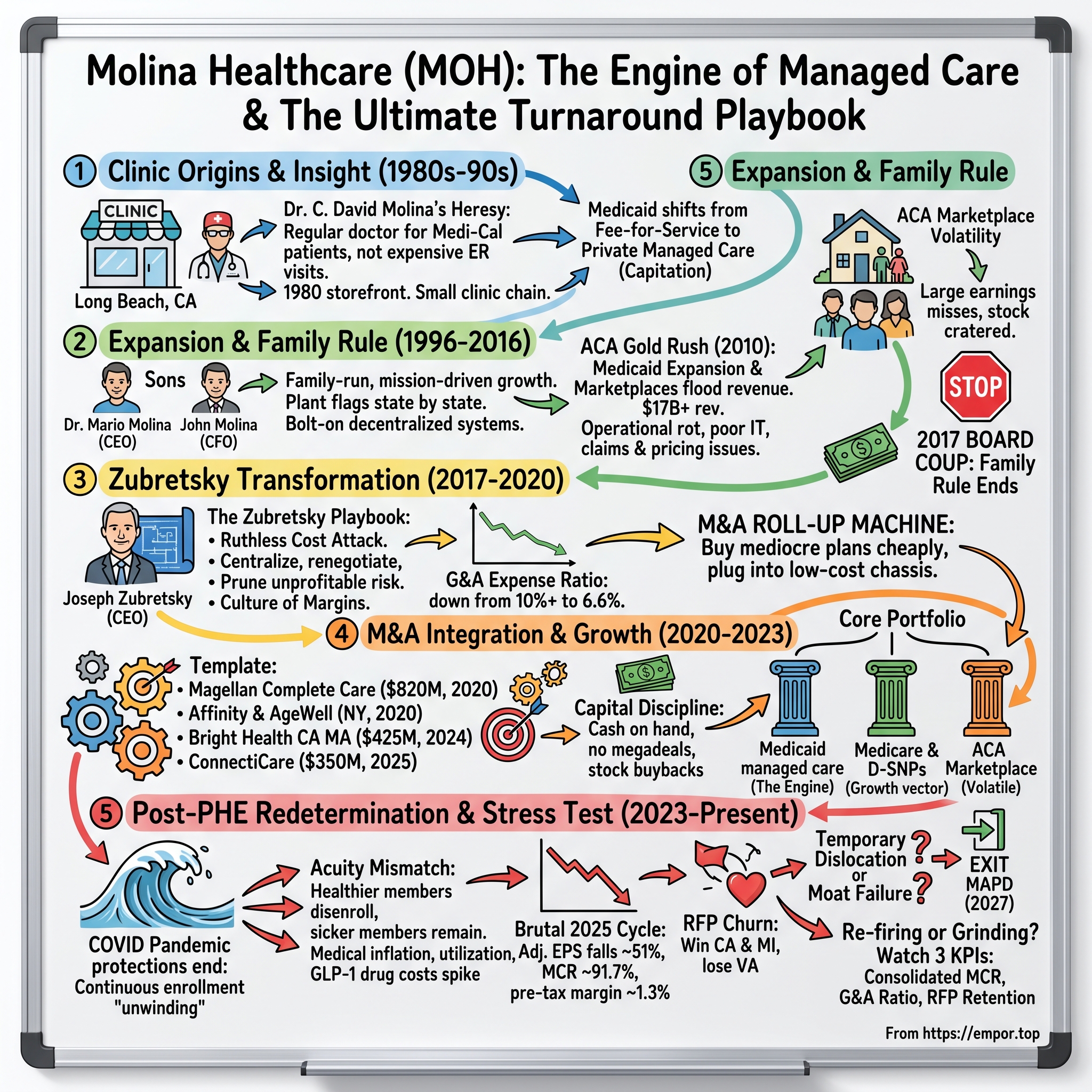
Molina Healthcare: The Engine of Managed Care & The Ultimate Turnaround Playbook
I. Introduction & Episode Roadmap
Picture a rented storefront in Long Beach, California, in 1980. An emergency room physician named C. David Molina keeps seeing the same thing on his shifts: patients arriving at the ER not because they are having heart attacks, but because they have a cough, a fever, a child with an earache — and nobody else will see them. They are poor. They are on Medi-Cal, California's Medicaid program, and most doctors will not take Medi-Cal because it pays too little and too late. So the sickest, least-wanted patients in the county funnel into the most expensive room in the building. Dr. Molina looks at that and has a heretical thought for the era: what if you gave these people a regular doctor instead? He opens a clinic to do exactly that.1
That storefront grew into a company that, at the end of 2025, arranged health coverage for roughly 5.5 million low-income and vulnerable Americans across 21 states, generating $45.4 billion in annual revenue.2 Molina Healthcare, Inc. (NYSE: MOH) is today one of the largest pure-play players in government-sponsored managed care in the United States. But calling it a triumphant success story would be, in mid-2026, a serious mischaracterization — and that tension is exactly what makes it interesting.
Here is the central paradox this article will unpack. Molina spent the years from 2017 to 2021 executing one of the most admired operational turnarounds in the health-insurance industry: a family-run business that nearly ran itself into the ground was rebuilt into the leanest-cost operator among the Medicaid payors. And then, in 2024 and 2025, the very medical-cost forces the company claimed to have mastered blew a hole straight through its earnings. Full-year 2025 adjusted earnings per share fell about 51% year over year, the stock lost roughly half its value from its early-2025 highs, and management announced it would exit its Medicare prescription-drug business entirely for 2027.23 The disciplined machine hit a wall. The question for investors is whether that wall is a temporary dislocation, as management insists, or a sign that the moat was always thinner than the story suggested.
To answer it, you have to understand how the money actually works. Molina is not one business but three, stacked on the same low-cost administrative chassis:
- Medicaid managed care is the engine — the large majority of premium revenue and the core of the franchise. States pay Molina a fixed monthly fee per member to take on the medical risk for their poorest residents.
- Medicare, and specifically Dual-Eligible Special Needs Plans (D-SNPs) for people who qualify for both Medicaid and Medicare, is the higher-revenue-per-member growth vector — and, as of 2025, also the source of an embarrassing self-inflicted wound.
- The ACA Marketplace — individual coverage sold on the Affordable Care Act exchanges — is the opportunistic, most volatile leg, the one that has repeatedly whipsawed the company's earnings.2
To size those segments in human terms: at the end of 2025 Molina's roughly 5.5 million members broke down into about 4.57 million in Medicaid, roughly 655,000 in the Marketplace, and about 262,000 in Medicare — a mix that makes plain where the franchise really lives.2 Medicaid is not merely the largest segment; it is the identity of the company, the business every other line either feeds off of or orbits around. The Marketplace book is far larger by headcount than Medicare but far more volatile in profit. And Medicare, though smallest in members, punches above its weight in both revenue-per-member and, lately, in trouble. Keeping that proportionality in mind guards against a common analytical error with Molina: obsessing over the dramatic Medicare and exchange swings while forgetting that the Medicaid engine is what actually determines whether the company thrives.
Our roadmap runs chronologically and then analytically: the clinic origins and the structural shift that made Medicaid a business; the ACA growth wave that papered over deep operational rot; the 2017 boardroom coup that ended 37 years of family rule; Joseph Zubretsky's cost-cutting playbook; the disciplined M&A roll-up; how managed Medicaid economics actually function; the brutal post-pandemic redetermination and medical-cost cycle that is defining the company right now; and finally a neutral bull-versus-bear reckoning using Helmer's and Porter's frameworks. The goal is not to cheer or to bury Molina, but to figure out what is genuinely durable here and what is just the residue of a very good decade. It starts with a doctor who thought the emergency room was the most expensive front door in American medicine.
 Subscribe on LinkedIn
II. Clinic Origins & The Managed Medicaid Opportunity (1980–2009)
C. David Molina's insight was almost boringly simple, and that was its power. If uninsured and Medicaid patients used emergency rooms as primary care because no primary-care doctor would take them, then the cheapest intervention in the entire system was to give them a primary-care doctor. Proactive, unglamorous, continuous care — a blood-pressure check, a refilled prescription, a managed diabetic — prevents the catastrophic, expensive event downstream. Molina opened his first clinic in Long Beach to serve precisely the patients everyone else turned away, and he kept opening them.1 By the time he died in 1996, the family business was a small chain of Southern California clinics, and control passed to his children — most prominently his son Dr. J. Mario Molina, who became chief executive, and later his son John C. Molina, who ran the finances.4
While the Molinas were building clinics, the ground underneath the American safety net was shifting in a way that would turn their little company into something much larger. Through the 1980s, states paid for Medicaid on a fee-for-service basis: a doctor did a thing, sent the state a bill, and the state paid it. For a state budget office this is a nightmare, because costs are unpredictable and open-ended — you find out what you owe after the fact. Beginning in the 1990s, states started outsourcing the problem. Instead of paying per service, a state would pay a private managed-care organization a fixed amount per member per month — a capitation payment — and hand that company the risk. If members cost more than the payment, the company ate the loss; if less, it kept the difference. The state converted a volatile liability into a predictable line item, and a new industry was born on the other side of that trade.5
This is the structural tailwind that made Molina a company rather than a charity. The family had spent 15 years building exactly the asset states now wanted to buy: networks and know-how for managing the care of low-income populations. Molina moved from delivering care in its own clinics to administering it as a health plan, and the addressable market was no longer a few Long Beach neighborhoods — it was every state deciding to privatize its Medicaid program.
It is worth pausing on why this transition was so unusually well-suited to the Molina family, because it explains a cultural inheritance that would matter enormously decades later. Most Medicaid managed-care companies were built by insurance people who learned about poor patients second-hand, through actuarial tables. Molina was built by a physician who had personally treated these patients on ER night shifts, and the founding generation genuinely understood the clinical reality of the safety-net population — the untreated diabetes, the missed prenatal care, the mental-health crises that spiral into hospitalizations. That clinical DNA was a real asset in managing care. But it came bundled with a liability: a company run by clinicians and family members, expanding on the strength of mission and relationships, was not a company obsessed with the unglamorous industrial discipline of processing claims cheaply and pricing risk precisely. The very origin story that made Molina good at caring for members made it, structurally, less naturally good at the financial engineering the business would eventually demand. Both halves of that inheritance are essential to understanding what came later.
In 2003, Molina Healthcare went public on the New York Stock Exchange under the ticker MOH, using the listing to fund expansion beyond California into states such as Washington and Michigan.1 The logic of the IPO was straightforward: this was a land-grab business. Every state ran its own Medicaid program with its own rules, its own procurement cycle, and its own licenses, so growth meant planting flags state by state, contract by contract. A publicly traded balance sheet let Molina chase those contracts faster than retained clinic profits ever could.
What the family era did brilliantly was grow the top line. What it did poorly — and this is the seed of everything that follows — was build the boring administrative machinery underneath. Each new state tended to arrive with its own systems, its own overhead, its own way of doing things, bolted onto a decentralized structure that nobody was ruthlessly standardizing. For a while, in a rising market, that did not matter. Revenue climbed, the Molina name carried genuine mission and goodwill in the communities it served, and the company looked like a heartwarming story of a physician's vision scaling into the billions. The problem with heartwarming stories is that they can hide a cost structure quietly going soft — and the next decade would deliver a flood of new members that made the softness both invisible and, eventually, fatal.
III. The ACA Expansion Trap & The 2017 Activist Coup (2010–2017)
When President Obama signed the Affordable Care Act in 2010, it was, for a company like Molina, the equivalent of a gold rush arriving on your doorstep. The law did two enormous things for the Medicaid managed-care industry. It let states expand Medicaid eligibility to millions of previously uninsured adults, with the federal government initially footing nearly the entire bill — and Molina was already licensed and operating in many of those states. And it created the individual insurance exchanges, a brand-new marketplace where Molina could sell coverage directly to individuals, many of them subsidized. The result was a revenue explosion. Molina's top line rocketed from roughly $4 billion in the early 2010s to over $17 billion by mid-decade as members poured in almost faster than the company could enroll them.
This is where the story turns, because that torrent of growth did something dangerous: it made the underlying business look far healthier than it was. When revenue is compounding at that pace, almost any operational sin gets buried. And Molina had accumulated several. Its administrative cost ratio — the share of premium eaten by corporate overhead, IT, and general expenses rather than actual medical care — sat above 10%, several hundred basis points fatter than the leanest competitors. Its IT was a patchwork stitched together from years of state-by-state expansion. Most damagingly, its pricing discipline on the new ACA exchange plans was poor: the company set premiums that failed to cover the medical costs of the people who signed up.
The barometer for that failure is the medical care ratio, or MCR — the percentage of premium revenue spent on members' medical claims. (The industry also calls it the medical loss ratio, or MLR.) A managed-care plan's entire profit lives in the thin sliver between the MCR and 100%, minus administrative costs. When your MCR drifts above 90%, and your admin costs are above 10%, the arithmetic simply stops working: you are paying out more than you take in. That is what began happening at Molina as the mispriced exchange business and rising medical costs collided.
The ACA exchanges deserve a moment of explanation, because they were the most acute source of the pain and they teach something durable about Molina's risk appetite. Unlike Medicaid, where the state sets the price, on the individual exchanges the insurer sets its own premiums a year in advance — and then lives with whoever shows up. In the early years the federal government softened the risk with temporary "risk corridor" backstops that shared insurers' gains and losses, but those programs were underfunded and phased out, leaving carriers fully exposed to their own pricing mistakes. Molina, chasing membership, priced aggressively to win share, and then discovered that exchange enrollees — who can sign up when they are already sick and drop coverage when they are well — cost far more than its premiums assumed. This is adverse selection in its rawest form, and it is a recurring character in the Molina story: the exchange business would go on to whipsaw the company's earnings for the next decade, generating windfall profits in good years and gaping holes in bad ones. The 2016–2017 version was simply the first time it nearly sank the ship.
By the depths of the crisis, Molina's shares had fallen precipitously from their mid-decade highs, and the market that had once celebrated the family's growth story now questioned whether the company could even stabilize. For a founding family that had spent 37 years building the enterprise, the situation carried obvious personal weight — this was not an abstract underperforming asset but the institution their late father had founded, now publicly faltering. That emotional dimension is precisely why boards so rarely remove founders, and why the fact that Molina's board did so anyway signals how severe the operational reality had become.
In 2016 and into 2017, the reckoning arrived. Molina posted large, ugly earnings misses driven by unexpected spikes in medical costs — the company was, in effect, discovering after the fact that it had sold coverage too cheaply to people who used more care than its models assumed. Capital eroded, the stock cratered, and the credibility gap between the family's growth narrative and the operational reality became impossible to ignore. Shareholder frustration mounted, and the board — which the founding family did not fully control — concluded that the people who had built the company were not the people who could fix it.
Then came one of the most memorable governance shake-ups in the sector's history. On May 2, 2017, Molina's board terminated Dr. J. Mario Molina as chief executive and John C. Molina as chief financial officer, both without cause, ending 37 years of family leadership in a single announcement.6[^7] The board installed interim leadership and a new non-executive chairman and made the rationale unusually blunt for a corporate press release: the company's financial performance had been disappointing, and the change was meant to drive profitability through operational improvement.7 (The move came amid intense pressure from outside shareholders demanding accountability; the popular framing casts it as a classic activist coup, though the decisive act was the board's own.) John Molina departed the board the following year, closing the family chapter entirely.[^7]
For investors, the lesson embedded in this section is uncomfortable but important: rapid revenue growth is not the same as a healthy business, and a founder's mission does not exempt a company from operational discipline. Molina's ACA-era surge had disguised a cost structure and a pricing culture that could not survive contact with a normal medical-cost cycle. The board's willingness to fire the founding family — to treat sentiment as separable from performance — was the precondition for everything that came next. The question was who would run the turnaround, and whether the fix would be real or cosmetic.
IV. The Zubretsky Transformation: Building the Low-Cost Operating Engine (2017–2020)
The man the board hired was not a Medicaid lifer or a mission-driven clinician. Joseph Zubretsky was a career insurance operator and financial engineer — a former partner at accounting firm Coopers & Lybrand who had spent more than three decades in senior strategy and finance roles, most notably running Aetna's largest business unit, a roughly $10-billion-revenue flagship, and later serving as president and CEO of The Hanover Insurance Group.8 When he was named Molina's president and CEO effective October 2017, the signal was clear: this was not going to be about the mission's poetry; it was going to be about the P&L's arithmetic.9
Zubretsky's approach became known internally and among analysts as the "Molina playbook," and its opening act was a brutal, systematic attack on cost. The company centralized functions that had been scattered across state plans, consolidated its pharmacy-benefit arrangements to claw back pricing, and renegotiated vendor and provider contracts from a position of scale it had never bothered to use. The most-cited metric of the turnaround was the general-and-administrative expense ratio — corporate overhead as a share of revenue. Molina drove it down from above 10% toward the mid-single digits, ultimately establishing itself as the lowest-administrative-cost operator among the Medicaid-focused payors. By 2025 the G&A ratio ran around 6.6%.2 That is not a rounding-error improvement; in a business where net margins are thin by design, several hundred basis points of admin savings is the difference between losing money and printing it.
One underappreciated piece of the cost attack was pharmacy. Prescription drugs are one of the largest and fastest-growing line items in any health plan's medical spend, and Molina was managing nearly $3 billion of annual pharmacy expense — a figure large enough that even small improvements in unit pricing translated into real money. In early 2019 Molina restructured and renewed its pharmacy-benefit-management arrangement with CVS Caremark, redividing which functions Molina kept in-house and which it subcontracted, and management described the reworked deal as immediately accretive to earnings.27 The episode captured the whole philosophy in miniature: rather than build a pharmacy empire, Molina used its scale as a buyer to renegotiate a better deal with an existing vendor and pocket the savings. It was cost engineering, not empire-building.
The second move was to stop the bleeding at the source. Zubretsky pruned the risk itself — exiting unprofitable ACA exchange counties, walking away from or restructuring Medicaid contracts that could not be made to work, and re-underwriting the book so that Molina was insuring populations it could actually price. The philosophy inverted the family era's instincts: growth for its own sake was out; profitable growth, or no growth, was in.
Zubretsky did not do it alone, and the supporting cast tells you something about the kind of company Molina became. He recruited a finance and strategy lieutenant, Mark Keim, who joined in January 2018 — like Zubretsky, a veteran of Aetna and The Hanover Insurance Group, with earlier stints at GE Capital and a Tuck School MBA — and elevated him to chief financial officer in February 2021.28 The pedigree matters: this was a leadership team drawn from the disciplined, capital-markets-fluent side of the insurance industry, not from the mission-driven clinic tradition Molina had grown up in. Keim's later expansion in September 2024 to also run the Medicaid and Marketplace businesses concentrated even more operational authority in the finance function — a structure that tells you what the company prizes, and one that a governance skeptic might note leaves fewer independent checks on the numbers the CFO's own team produces.28
Just as important, and harder to measure, was the cultural rewiring. The old Molina told a story about members served and states entered. The new Molina told a story about margins, medical-cost forecasting, and return on invested capital. Zubretsky made a point of setting conservative guidance and then beating it — building, quarter by quarter, the one asset a turnaround CEO needs most: credibility with the market that when management said a number, the number was real. For several years, that credibility compounded alongside the earnings, and the stock re-rated dramatically upward as investors came to believe Molina had permanently changed its character.
A neutral observer should flag two things here rather than simply applaud. First, some of the early margin gains were partly the good fortune of timing: Medicaid economics in the late 2010s were relatively benign, and a rising tide flattered the restructuring. Second, the board rewarded Zubretsky lavishly for the turnaround — his total compensation in a single year, 2022, reached roughly $180.8 million, driven overwhelmingly by a special performance-based stock-option grant tied to the share-price recovery.10 Pay-for-performance purists could cheer that alignment; skeptics could note that a package that large creates enormous incentive to keep the stock narrative aloft, which is worth remembering when the same management later insists that a painful cost cycle is merely "temporary." Either way, by 2020 the operating engine was genuinely rebuilt and lean — and Zubretsky turned it toward its next purpose: buying other people's problems cheaply.
V. The M&A Roll-Up Machine & Capital Deployment (2020–2023)
Here is the elegant idea at the center of Molina's acquisition strategy, and it is worth slowing down on because it is genuinely clever. Once you have built the lowest-cost administrative platform in your industry, every high-cost competitor becomes a potential acquisition target — not for their brand or their technology, but for their members. You buy a mediocre regional health plan running, say, 9% or 10% administrative costs, you plug its members into your 6.6% platform, you fire the redundant overhead, and the arithmetic does the rest. A plan that was barely breaking even for its previous owner can throw off real margin the day it joins Molina, without adding a single new member. Management describes this as taking plans running EBITDA margins of 1–2% up toward the company's 4–5% target range by overlaying its operating system.
Walk through the arithmetic once, because it makes the strategy tangible. Suppose a target plan collects $1 billion in premium and, like its previous owner, spends 90% on medical care and 9% on administration, leaving a 1% pre-tax margin — about $10 million. Now move those same members onto Molina's chassis. If Molina's superior scale and vendor contracts shave the administrative burden from 9% to 6.5%, that 2.5-point improvement drops almost entirely to the bottom line: pre-tax profit on the same $1 billion of premium jumps from roughly $10 million toward $35 million, more than tripling, without enrolling one additional person or touching a single premium rate. That is the whole trick. And critically, the improvement comes from a lever Molina actually controls — its own cost structure — rather than from the fragile hope that two sales forces will somehow sell more together. It is why Molina could pay what looked like full prices on a revenue basis while still buying cheaply on a post-synergy earnings basis.
The template deal was Magellan Complete Care. Molina agreed in April 2020 to buy this specialty-focused managed-care business — serving members across six states with heavy exposure to behavioral health and complex, high-needs populations — for approximately $820 million, and closed it on the final day of 2020.1112 The strategic logic was textbook: Magellan Complete Care carried roughly 155,000 members and over $2.7 billion of annual revenue, meaning Molina was paying a small fraction of one year's revenue for the franchise, then extracting synergies on top.12 It also handed Molina real capabilities in behavioral health and long-term services and supports — the expensive, complicated care that safety-net populations disproportionately need and that plans able to manage it can be paid well to handle.
The New York expansion followed the same discipline but through a different door. Molina agreed in September 2020 to acquire Affinity Health Plan, a New York City-area Medicaid plan with roughly 284,000 members, for $380 million.13 It paired that with the roughly $110 million purchase of AgeWell New York's Medicaid managed long-term-care business, deepening its position in the high-density, high-acuity New York market and in the lucrative long-term-care niche.14 Neither deal was a headline-grabbing megamerger; both were tuck-ins bought at prices that made the synergy math forgiving.
By 2023 and 2024, Molina was hunting distressed sellers. When the venture-backed insurer Bright Health imploded, Molina moved on its California Medicare Advantage operations — the Brand New Day and Central Health Plan businesses. Tellingly, Molina initially agreed in mid-2023 to pay about $510 million, then used the seller's deteriorating position to renegotiate the price down to roughly $425 million before closing the deal effective January 1, 2024, picking up more than 109,000 Medicare members.1516 That willingness to cut the price rather than honor the original number is a small but revealing data point about capital discipline — Molina behaved like a buyer, not a strategic romantic. A later tuck-in, the roughly $350 million purchase of Connecticut's ConnectiCare, closed in February 2025 and added about 140,000 Marketplace, Medicare, and commercial members.17
Underneath the deals ran a capital-allocation philosophy that a value investor would recognize approvingly. Molina refused to issue much stock to fund its acquisitions, funding deals largely with cash on hand, and it repurchased its own shares when they traded at what management judged to be a discount to intrinsic value — using the balance sheet to shrink the share count rather than to chase a trophy. Just as revealing was what Molina did not do. Through a period when several rivals pursued sprawling vertical-integration ambitions — buying physician groups, building pharmacy empires, stapling together commercial and Medicare and care-delivery assets into conglomerates — Molina stayed resolutely in its lane, buying only Medicaid, dual-eligible, and marketplace books it knew how to run. The restraint was itself a strategy: the surest way to destroy the low-cost advantage would have been to bolt on a complicated, unrelated business that reintroduced the very overhead Zubretsky had spent years cutting. Whether that discipline survives the current earnings pressure is a fair question, but through 2023 it held.
The analytical read on this era is that Molina's edge was real but narrow. It was not paying for hoped-for revenue synergies — the mirage that wrecks most acquirers — it was paying for cost synergies it could actually control, at multiples cheap enough that it did not need everything to go right. Management complemented the deals by repurchasing shares when the stock looked cheap and, crucially, by not chasing a transformational megadeal that would have bet the company. For a few years this looked like a durable compounding formula. But a roll-up that depends on stripping cost assumes the underlying business is stable enough to plug members into. The events of 2024 and 2025 would test whether the platform those members were being plugged into was as sturdy as the multiples implied — which requires understanding, precisely, how managed Medicaid makes money.
VI. Core Business Deep-Dive: Managed Medicaid Economics & Industry Structure
Strip away the acquisitions and the personalities and Molina is, at its core, a very specific kind of financial machine, and it is worth building it up from first principles. Imagine a state hands you a list of 100,000 of its poorest residents and says: "We will pay you a fixed amount each month for each of these people. In exchange, you are now responsible for their medical care — all of it. Whatever it costs, that's your problem." That fixed monthly payment is the capitation rate, quoted as a per-member-per-month, or PMPM, figure. It is the entire top line. Everything Molina does flows from the gap between that fixed revenue and the variable, unpredictable cost of actually keeping those 100,000 people healthy.5
The genius and the danger of this model are the same thing: the revenue is fixed in advance, but the cost is not. If Molina manages care well — steering members to primary care instead of ERs, catching disease early, negotiating hard with hospitals, managing expensive specialty drugs — its medical costs come in below the capitation payment and it keeps the difference. If medical costs run hot, Molina absorbs the overrun. This is why the medical care ratio is the single most important number in the entire enterprise. There is also a regulatory floor working in the opposite direction: states and federal rules generally require plans to spend a high share of premium — commonly around 85% or more — on actual medical care rather than pocketing it, which caps the upside and means profit has to be manufactured out of administrative efficiency and genuine medical management, not out of simply denying care and keeping the premium.5
Make it concrete. Suppose a state pays Molina $400 per member per month to cover a working-age Medicaid adult. Across a year that member generates $4,800 of revenue. If that person's actual medical claims — doctor visits, prescriptions, the occasional ER trip — total $3,700, Molina's MCR on that member is about 77%, and the plan is comfortably profitable. But the average masks enormous variance: most members cost almost nothing, while a small fraction with cancer, a premature birth, or a serious mental-health crisis can each cost tens or hundreds of thousands of dollars in a single year. The entire discipline of managed care is about that tail — identifying the highest-risk members early, wrapping them in care management, and preventing the $150,000 hospitalization that a little $500 intervention could have avoided. Some states share this tail risk through "risk corridors" or reinsurance arrangements that cap a plan's losses on catastrophic cases; where they exist, they soften the volatility, but the core exposure remains the plan's to manage. This is the actual product Molina sells the states: not insurance paperwork, but the operational capability to bend the cost curve on populations that are, by definition, difficult and expensive to keep healthy.
The Medicare and dual-eligible layer works on the same capitation logic but with much larger numbers and higher stakes. A dual-eligible member — someone poor enough for Medicaid and old or disabled enough for Medicare — is among the most expensive patients in the entire system, often carrying several chronic conditions at once. A D-SNP plan is paid substantially more per member per month to coordinate all of that care across both programs, which is why management prizes the segment: the revenue per member can be several times a standard Medicaid rate, and once these frail, complex members are enrolled and their care is being actively coordinated, they rarely switch plans. That stickiness and higher revenue density is the strategic prize. It is also, as 2025 demonstrated, a double-edged sword — when you are paid a lot to manage very sick people, getting the medical-cost math even slightly wrong produces losses proportionally larger than in the low-cost Medicaid book.
Now layer on how the revenue itself gets awarded, because this is the part that keeps management awake at night. States do not hand out Medicaid contracts permanently. They run competitive procurements — requests for proposal, or RFPs — typically every three to six years, in which incumbent and challenger plans bid for the right to serve a region's members. States score bids on quality metrics, network adequacy, care-management capabilities, and administrative reliability, then parcel out market share among a handful of winners. Win a big-state RFP and hundreds of thousands of members and billions in premium land on your books; lose one you already hold and that revenue can evaporate on a state-dictated timeline, no matter how well you have run the plan. This procurement risk is structural and unavoidable — it is the price of admission to a business where your customer is a government.
The competitive field is a mix of specialists and giants, and the distinction matters more than it first appears. Molina's closest analog is Centene (CNC), the other large pure-play in Medicaid and ACA marketplace coverage; the two companies are structurally similar, chase the same state contracts, and — tellingly — have tended to stumble on the same medical-cost cycles at the same time, because they are both concentrated in exactly the populations where the cost shocks hit. When Molina cut its 2025 guidance, Centene and even the diversified giants were flagging the very same ACA and Medicaid cost pressures, which is a clue that the problem was more an industry-wide repricing than a Molina-specific failure of competence.18 Above the pure-plays loom the diversified conglomerates — UnitedHealth Group (UNH), Elevance Health (ELV), CVS Health's Aetna (CVS), and Humana (HUM) — whose Medicaid arms sit inside vastly larger commercial and Medicare empires, and several of which also own the pharmacy-benefit managers and care-delivery assets that touch Molina's own cost structure. Those giants can absorb a bad Medicaid cycle by leaning on other segments; Molina, concentrated in government programs, has nowhere to hide when the safety-net business turns. That focus is simultaneously Molina's greatest strength — it is not distracted, and every dollar of management attention goes to government programs — and its greatest vulnerability, because it owns no diversifying business to cushion a downturn in its one market.
That concentration is exactly why Molina's cost position matters so much, and it is the closest thing the company has to a genuine moat. If Molina runs several hundred basis points leaner on administration than rivals, it can bid more aggressively on price in an RFP and still clear its margin target, or it can survive a stretch of state rate-tightening or elevated medical costs that would push a fatter competitor into losses. That structural advantage is real. But — and the next section makes this painfully concrete — a low-cost chassis protects you against a normal-sized storm, not necessarily against a hundred-year flood in medical costs arriving at the same moment states are squeezing rates. The efficiency moat is a cushion, not a force field, and in 2024 and 2025 the flood tested exactly where its edges were.
VII. The Post-PHE Redetermination Era & Operating Reality (2023–Present)
For three years during the COVID-19 pandemic, the federal government told states they could not kick anyone off Medicaid. In exchange for extra funding under the public health emergency, states agreed to "continuous enrollment" — nobody lost coverage regardless of whether their income changed. The Medicaid rolls swelled to record highs, and for managed-care plans like Molina it was an unusually placid period: membership only went up, and the members who stayed enrolled skewed relatively healthy because nobody was being re-screened. When that protection ended in 2023, states began the "unwinding" — re-verifying eligibility for tens of millions of people and disenrolling those who no longer qualified or failed to complete the paperwork. Industry-wide, millions of members fell off Medicaid.
For Molina specifically, the unwinding was a body blow to membership before it became a margin problem. Over the course of 2023 the company disclosed that redetermination-related disenrollments had climbed toward roughly half a million members as states worked through their eligibility backlogs — a large chunk of the Medicaid book simply falling away.26 Management's task was to replace those lost members with new organic wins and acquisitions faster than the losses piled up, which sent Molina into an intense period of RFP competition with mixed results. It defended and expanded in some states and lost in others, and the scoreboard is the truest measure of the franchise. On the win side, Molina's new California Medi-Cal contract took effect at the start of 2024 and let it expand into Los Angeles County, the single largest Medicaid market in the country; a fresh Nebraska contract added roughly 111,000 members; it launched in Iowa; it defended its position in Texas; and in April 2024 it won a Michigan comprehensive Medicaid contract across six regions plus a statewide dual-eligible award.24 On the loss side, and more soberingly, Molina lost a Medicaid contract in Virginia — a concrete reminder that even a well-run incumbent can be displaced when a state reshuffles its awards.25 This churn is the permanent background hum of the business: revenue is always simultaneously being won and lost on state timetables, and net membership is the running scoreline.
The mechanical problem this created for Molina is subtle and worth explaining carefully, because it is the crux of the current earnings story. When members leave, they do not leave randomly. Healthier, lower-cost people — who use little care and are easy to drop or who move to a job with commercial coverage — tend to disenroll faster. Sicker, higher-cost members hang on, because they need the coverage and are more likely to navigate the re-verification. So the population that remains on the plan is, on average, sicker and more expensive per person than the population the state's capitation rate was originally set to cover. Management calls this an acuity mismatch, and it is a timing problem: the members get more expensive immediately, but the state does not raise the PMPM rate to reflect that until its next actuarial cycle, months or quarters later. In the gap, the medical care ratio blows out.
That is the theory. The reality in 2024 and 2025 was worse than the theory, because a second force hit at the same time: an outright acceleration in medical-cost trend. Outpatient utilization rose, behavioral-health costs climbed, and the penetration of expensive GLP-1 weight-loss and diabetes drugs added a new cost layer across exactly the populations Molina serves. The result was a cascade of bad news. In 2025 Molina cut its earnings guidance repeatedly — lowering its full-year adjusted EPS outlook to roughly $14, then cutting again to well below that as costs kept rising across all three segments.1819 CEO Zubretsky framed it on the calls in careful language: "The short-term earnings pressure we are experiencing results from what we believe to be a temporary dislocation between premium rates and medical cost trend which has recently accelerated."18 The word doing the heavy lifting in that sentence is "temporary."
It is worth naming the specific cost drivers, because they are not going away on their own. Across the safety-net population, outpatient and behavioral-health utilization ran hotter than pre-pandemic norms. And a genuinely new variable entered the equation: GLP-1 drugs — the class of weight-loss and diabetes medications such as semaglutide that exploded in demand across exactly the low-income, high-obesity, high-diabetes populations Molina covers. These drugs can cost thousands of dollars per member per year, and when a state's capitation rate was set before the demand surge, every prescription is a cost the premium never anticipated. Multiply that across millions of members and it becomes a structural drag, not a rounding error. Whether states fold GLP-1 costs into future rates, or restrict coverage, is one of the genuine open questions hanging over the entire Medicaid managed-care sector.
When the full year closed, the damage was stark. Full-year 2025 adjusted EPS came in at $11.03, down about 51% from the prior year; the consolidated medical care ratio rose to 91.7% from 89.1% in 2024; and pre-tax margin compressed to 1.3% from 3.9%.2 Revenue still grew 16% to $45.4 billion — the roll-up kept adding members and premium — but the profitability of each dollar collapsed.2 A company that had built its reputation on forecasting medical costs conservatively had, for two years running, forecast them wrong. The bitter irony is not lost on close observers: the entire post-2017 thesis rested on Molina being the disciplined forecaster in a business defined by forecasting, and it was medical-cost forecasting — not administration, where the company remained best-in-class — that failed.
The Medicare leg produced the most pointed admission of the cycle. In early 2026 management announced that Molina would exit its Medicare Advantage Prescription Drug (MAPD) business for 2027 — walking away from a product line carrying roughly $1 billion in annual premium that management said was costing about $1.00 per diluted share in 2026 — while keeping its larger, roughly $5-billion dual-eligible D-SNP franchise.2021 The company recorded a $93 million impairment charge in the first quarter of 2026 tied to the planned exit, and its Q1 2026 consolidated MCR sat at 91.1%, still elevated versus a year earlier.22 Molina reaffirmed a 2026 outlook of roughly $42 billion in premium revenue and at least $5 in adjusted EPS — a bar dramatically lower than the near-$20 the business was once expected to earn.22
The earnings calls of 2025 and early 2026 are worth listening to as a study in management credibility under pressure, because the words are all investors have until the medical-cost data confirms or refutes them. The consistent theme in Zubretsky's prepared remarks was that the pain was a "temporary dislocation between premium rates and medical cost trend" — a framing he returned to as the guidance cuts stacked up.18 There is a real tension in that repetition. On one hand, the explanation is mechanically coherent and matches what rivals were saying, which lends it credibility; on the other, the same reassuring language deployed across successive downward revisions is exactly the pattern a skeptic watches for, because "temporary" that keeps needing to be re-explained starts to sound like hope dressed as analysis. What distinguishes a credible management team in this situation is not the reassurance but the specificity of the plan: on the calls, Molina paired the optimism with concrete actions — filing for higher rates in state after state, repricing its 2026 exchange and Medicare bids for margin over membership, and ultimately taking the hard, unambiguous step of exiting the MAPD product rather than pretending it could be fixed. That willingness to amputate a losing business is, on balance, a point in management's favor; it is the behavior of operators reacting to reality, not denying it. The open question the Q&A kept circling — and that analysts pressed CFO Mark Keim and Zubretsky on repeatedly — was one of timing: how many quarters until state rates actually catch up to member acuity, and how much of the 2026 guidance was genuine visibility versus a placeholder. Management's answers were confident in direction and vaguer on the calendar, which is the honest tell that even they do not fully know.
For investors, the honest read is that this section is where the bull narrative meets its stress test in real time. Management's story is that rates will catch up to acuity, the ACA and Medicare messes are being cleaned up, and the low-cost engine will re-emerge intact — a repeat, essentially, of the 2017 turnaround. The skeptic's story is that mispricing medical risk two years running, in the one competency the company claims as its edge, is not obviously "temporary," and that exiting a product line you entered with confidence is evidence the underwriting discipline was less bulletproof than advertised. The Q&A on recent calls has centered precisely on that tension: analysts pressing on how long the rate lag persists, on RFP retention in big states, and on how much of guidance is genuine visibility versus hope. Both readings are legitimate. Which one is right will be settled by the medical-cost data over the next several quarters, not by rhetoric.
VIII. Strategic Frameworks: Helmer's 7 Powers & Porter's 5 Forces
Step back from the quarter-to-quarter drama and ask the structural question: does Molina possess durable competitive advantage, or is it simply a well-run operator in a hard business? Two frameworks help discipline the answer.
Start with Hamilton Helmer's 7 Powers, which asks what specifically prevents a competitor from replicating your returns. Molina's strongest candidate is scale economies — but of an unusual kind. Its advantage is not that it is the biggest payor; UnitedHealth and Elevance dwarf it. Its advantage is that it spreads a genuinely low fixed administrative base across millions of government-program members, producing an admin-cost ratio in the mid-6% range that pure-play rivals struggle to match.2 In a business where the state caps your medical margin, being the low-cost administrator is close to the only sustainable edge there is, and Molina has it. The second candidate is process power — the repeatable M&A integration engine that reliably strips cost out of acquired plans. There is real evidence this exists; deal after deal has followed the same playbook. But process power is only as valuable as the stability of the process's inputs, and 2025 showed that when the underlying medical-cost environment lurches, the machine's output is not immune. The weakest claim is cornered resource: state Medicaid licenses, regulatory relationships, and D-SNP networks are valuable and slow to build, but they are not truly cornered — competitors hold them too, and RFPs periodically put them back in play. It is worth checking the powers Molina conspicuously lacks, because their absence defines the ceiling on its returns. It has essentially no branding power: a Medicaid member does not choose Molina because of an emotional preference the way a shopper reaches for a favorite consumer brand; they are auto-assigned or they pick from a state menu largely on the basis of network and convenience, and they would switch for no reason if the state moved them. It has limited switching-cost power at the member level — though the D-SNP book, where care coordination for frail dual-eligibles is genuinely sticky, is the notable exception. And it has no counter-positioning advantage, because its low-cost model is not a strategy incumbents refuse to copy; it is simply a standard every serious competitor is trying to reach. Netting it out: Molina has one strong power (scale economies in administration), one contingent power (process capability in M&A integration), and a portfolio of the softer powers that is thin. That is not a knock — it is a precise description of a good operator in a hard industry, which is different from a company with a structural fortress.
Now run Porter's Five Forces, which maps the pressure on industry profitability, and the picture explains why this business is structurally low-margin no matter who runs it. The bargaining power of buyers is high, verging on absolute — the buyer is a state government that unilaterally sets the capitation rate and controls market access through the RFP. You cannot raise prices on your customer; your customer sets your prices. The bargaining power of suppliers is high to moderate — consolidated hospital systems and pharmaceutical companies selling high-cost specialty and GLP-1 drugs can push medical costs up faster than rates rise, which is precisely the squeeze of the current cycle. Rivalry is high — Centene, Elevance, UnitedHealth, and others contest every major bid, competing away excess returns. On the other side of the ledger, the news is better: the threat of new entrants is low, because the regulatory complexity, capital requirements, and state-by-state licensing are formidable barriers that took Molina decades to clear; and the threat of substitutes is low, because for eligible low-income populations there is no commercial alternative to government safety-net coverage — the demand is as non-discretionary as demand gets.
Put the two frameworks together and a coherent, neutral verdict emerges. Molina operates in an industry that is structurally hard to enter but also structurally hard to earn high margins in, because the most powerful actor in the value chain — the state — captures most of the surplus. Within that industry, Molina has carved out one legitimate, defensible edge: it is the low-cost operator. That edge is real and it is worth something, but it is a cushion against adversity rather than a moat that guarantees fat returns. It lets Molina survive rate pressure and utilization spikes better than a bloated rival would; it does not let Molina escape them. That is the frame in which the actual investment debate should be conducted.
IX. Investment Case: Bull vs. Bear & Stress Tests
So, why does Molina win from here — and what would break the case? Take the bull argument on its own terms first, because it is not naive. The core of it is that Molina's cost discipline is a genuine structural advantage that matters most in exactly the kind of down-cycle the company is living through: when rates lag and costs spike, the leanest operator is the last one standing and the first to recover, and it can keep winning RFPs on price while fatter rivals retrench. Layered on top is a long M&A runway — the Medicaid and D-SNP landscape remains fragmented with underperforming non-profit and regional plans that Molina can keep acquiring cheaply and fixing, and a downturn that pressures weaker rivals arguably widens the pool of distressed sellers Molina is uniquely positioned to buy. And there is a real demographic tailwind in the dual-eligible population: aging, high-need, low-income Americans are growing in number, they carry much higher revenue per member than standard Medicaid, and once enrolled they tend to stay. States are also increasingly moving to integrate Medicaid and Medicare benefits for these members through D-SNP structures, a policy direction that plays to Molina's positioning — the company has been actively winning dual-eligible awards, including a statewide Michigan program, precisely to ride that shift.24 If you believe the 2025 cost dislocation is genuinely temporary, today's depressed earnings are a trough, not a new normal, and the franchise's earning power is intact — and a lean operator buying growth cheaply into a demographic tailwind is an attractive proposition at a de-rated multiple.
The bear case attacks each pillar. The most concrete risk is RFP concentration: because a handful of large states — the Californias, Texases, and Floridas — represent enormous slices of premium, losing a single major reprocurement can vaporize hundreds of millions in revenue on a timeline Molina does not control, and no amount of operational excellence prevents a state from choosing someone else. The second is that the acuity-and-rate mismatch may not be as temporary as management claims — if states, facing their own budget pressures, are slow or unwilling to raise capitation rates to match post-redetermination medical inflation, the margin compression persists and "transitory" quietly becomes "structural." The third is regulatory and reimbursement risk in Medicare, where CMS rate decisions and Star-rating dynamics can pressure the D-SNP business that the bull case leans on — and the 2027 MAPD exit is a live reminder that Molina's Medicare execution has already faltered once. The Star-rating system is worth a quick plain-English translation because it is a hidden lever on Medicare profitability: CMS grades every Medicare Advantage plan from one to five stars on quality and member-experience measures, and plans that hit four stars or above earn bonus payments and can reinvest them in richer benefits that attract more members. Fall below the threshold and you lose the bonus, which can quietly erode a plan's economics and its competitiveness in a single rating cycle. For a company still building Medicare scale, an adverse swing in Star ratings — or a tightening of how CMS calculates them — is a real and somewhat unpredictable headwind that sits largely outside management's control. Behind all of it sits political risk to Medicaid funding itself: any federal move to tighten Medicaid budgets or eligibility strikes at the demand base.
Here is where an activist or short-seller would press hardest, and a neutral analysis should give them the floor. The sharpest challenge is to management's core competency claim. Molina's entire premium rests on being the disciplined operator that prices medical risk conservatively — yet it missed on medical costs badly enough to cut guidance repeatedly across two years and to abandon a product line it had recently expanded. A skeptic would ask: if forecasting medical trend is the moat, what does two years of forecasting it wrong say about the moat? They would also revisit the roughly $180.8 million single-year CEO pay package and ask whether an incentive structure that large, tied to the share price, colors management's insistence that every problem is temporary.10 And they would note that a roll-up strategy is only as good as the platform it bolts members onto — bolting more members onto a chassis that is itself absorbing outsized medical losses compounds risk rather than diluting it. None of these points proves the bear thesis, but they are the right questions, and management's answers so far have been assertions of confidence more than demonstrations of a fixed problem.
There is also a political overhang that sits above the entire debate and deserves explicit mention, because it is the kind of risk no operational excellence can offset. Medicaid is a government program funded jointly by federal and state budgets, and it is perennially a target in Washington's fiscal fights. Any federal legislation that tightens Medicaid eligibility, imposes work requirements, caps federal matching payments, or trims exchange subsidies would shrink the very population Molina is paid to cover — not because Molina did anything wrong, but because the customer decided to buy less of the product. Zubretsky has repeatedly told investors that policy changes have not altered his long-term view of the business, but a neutral observer should treat legislative risk to Medicaid funding as a live, unhedgeable exposure rather than a footnote, particularly for a company with no commercial book to fall back on.18
The stress test, then, is this: how resilient is Molina if state Medicaid budgets tighten sharply and medical inflation stays elevated for longer than a couple of quarters? The honest answer is that the low-cost position genuinely helps — Molina would bleed less than a higher-cost peer in the same storm and could stay solvent and even opportunistic while others retreat — but "bleeds less" is not "thrives," and a prolonged squeeze would keep returns depressed well below the levels the 2018–2023 narrative implied. The market has already voted with real money: the stock trades far below its early-2025 peak, with a market capitalization in the roughly $9–11 billion range in mid-2026, versus the mid-teens billions it once commanded — a re-rating that says investors have downgraded their confidence in the durability of the earnings, not just their level.23 The debate now is essentially a wager on mean reversion: bulls buy a proven operator at a depressed multiple of trough earnings, betting the cycle turns; bears argue that "trough earnings" assume a recovery that a structurally squeezed, politically exposed, single-market business may not reliably deliver. Both sides are looking at the same three numbers to settle it.
Which brings us to what actually matters to watch. Three KPIs carry most of the signal, and no others come close:
- The consolidated medical care ratio (MCR). This is the whole game. Recent readings above 91% are the symptom of the current crisis; a sustained move back down toward the high-80s would be the single clearest proof that management's "temporary dislocation" thesis is correct — and continued elevation would be the clearest proof it is not.222
- The G&A expense ratio. This is the moat made visible. As long as it stays in the mid-6% range, Molina's structural cost advantage is intact; any drift upward would signal the one durable edge is eroding.2
- Premium revenue growth alongside RFP win/retention. Track whether Molina is holding and winning its major state contracts and integrating acquisitions, versus merely growing the top line while margins deteriorate — growth that dilutes profitability is the roll-up in reverse.
Watch those three, in that order, and you will know whether the turnaround engine is re-firing or grinding.
X. Epilogue & Playbook Lessons
Return, at the end, to that Long Beach clinic and the distance traveled. A physician who thought the emergency room was the most expensive front door in American medicine built an institution that now sits, indispensably, in the safety-net infrastructure of 21 states, arranging care for millions of people the rest of the system was built to turn away.2 Whatever one concludes about the stock, that is a genuine achievement, and it is worth naming plainly.
But the investing lessons in Molina's arc are more double-edged than the triumphant "turnaround playbook" framing suggests, and holding both halves at once is the whole point. The first lesson is that in an industry where a powerful buyer caps your pricing — government-set Medicaid rates, statutory medical-loss floors — the lowest-cost operator does win the war of attrition, and cost structure can be a real and durable moat. Molina proved that on the way up. The second lesson is that corporate governance can unlock enormous value: the board's willingness to fire a founding family whose growth had masked operational rot was the hinge on which the entire recovery turned, and it is a reminder that sentiment and performance must be evaluated separately. The third is that disciplined M&A arbitrage — buying cheap assets and applying a superior operating system, rather than overpaying for hypothetical synergies — is one of the more repeatable value-creation formulas in business, and Molina executed it with unusual rigor.
There is a subtler governance lesson braided through the story, too, and it cuts against the tidy hero narrative. The same board decisiveness that fired a founding family and hired a turnaround operator also signed off on a compensation package that paid that operator roughly $180.8 million in a single year, overwhelmingly through options that paid off because the stock rose.10 When the stock later halved, that structure looked less like perfect alignment and more like a reminder that boards tend to reward the up-cycle handsomely and rarely claw much back in the down-cycle. Sophisticated investors should hold both truths at once: the governance intervention of 2017 created enormous value, and the incentive architecture built afterward is exactly the sort of thing an activist would scrutinize when management insists, through a two-year earnings slump, that everything is temporary. Good governance is not a one-time act; it is an ongoing posture, and the jury on Molina's is still out.
The final lesson, though, is the one the outline's optimistic title underplays and the 2024–2026 reality insists upon: an efficiency moat is a cushion, not a force field. The same company that mastered its cost structure still mispriced medical risk two years running, cratered its earnings, halved its market value, and retreated from a Medicare product line it had confidently entered. A low-cost chassis lets you survive a storm better than your rivals; it does not exempt you from the storm, and it does not make the storm temporary just because management says so. Molina's transformation from a local clinic into a pillar of American safety-net healthcare is real. Whether its transformation into a consistently high-returning compounder is equally real remains, as of mid-2026, genuinely unresolved — and that unresolved tension, not a tidy verdict, is the honest place to leave the story.
References
-
From Humble Beginnings To Health Care Giant: The Story Of Molina Healthcare's Corporate Presence In Long Beach And Beyond — Long Beach Business Journal ↩↩↩
-
Molina Healthcare, Inc. Form 10-K for Fiscal Year 2025 — SEC EDGAR, 2026-02-10 ↩↩↩↩↩↩↩↩↩↩↩
-
Molina Healthcare Reports Fourth Quarter and Year-End 2025 Financial Results — Molina Healthcare, Inc. ↩
-
Molina Healthcare — company history and leadership overview ↩
-
10 Things to Know About Medicaid Managed Care — Kaiser Family Foundation (KFF), 2024-03-01 ↩↩↩
-
Molina Healthcare Ousts CEO and CFO Mario and John Molina — Healthcare Dive, 2017-05-02 ↩
-
Molina Healthcare Announces Leadership Changes — Molina Healthcare, Inc., 2017-05-02 ↩
-
Joseph Zubretsky — Management Biography, Molina Healthcare, Inc. ↩
-
Molina Healthcare Names Joseph Zubretsky as President and CEO (Form 8-K exhibit) — SEC EDGAR, 2017-10-09 ↩
-
Molina Healthcare, Inc. Form DEF 14A (2023 Proxy Statement, executive compensation) — SEC EDGAR, 2023-03-20 ↩↩↩
-
Molina to buy Magellan Complete Care in $820M deal — Fierce Healthcare, 2020-04-30 ↩
-
Molina Healthcare to Acquire Magellan Complete Care — Molina Healthcare, Inc., 2020-04-30 ↩↩
-
Molina To Buy Affinity Health Plan For $380 Million In Medicaid Deal — Forbes, 2020-09-29 ↩
-
Molina Healthcare drops $110M on AgeWell's managed long-term care in New York — Fierce Healthcare, 2020-10-08 ↩
-
Molina Healthcare Acquires Bright HealthCare's California Medicare Business for $425M — HIT Consultant, 2023-12-20 ↩
-
Molina lowers price of Bright Health's California MA plans — Healthcare Dive, 2023-12-18 ↩
-
Molina closes $350M ConnectiCare acquisition — Becker's Payer Issues, 2025-02-03 ↩
-
Molina cuts 2025 earnings outlook again on ACA, Medicaid pressures — Healthcare Dive, 2025-10-23 ↩↩↩↩↩
-
Molina cuts earnings guidance as costs rise in government programs — Healthcare Dive, 2025-07-09 ↩
-
Molina to drop Medicare Advantage prescription drug plans in 2027 — Becker's Payer Issues, 2026-02 ↩
-
Molina Healthcare's stocks fall as company plans exit from Medicare Advantage — Fierce Healthcare, 2026-02 ↩
-
Molina Healthcare, Inc. Form 10-Q for Q1 2026 — SEC EDGAR, 2026-04 ↩↩↩
-
Molina Healthcare (MOH) Market Cap & Net Worth — StockAnalysis.com ↩
-
Molina Healthcare Wins Michigan Medicaid Contract — Molina Healthcare, Inc., 2024-04-11 ↩↩
-
Molina loses Medicaid contract in Virginia — Healthcare Dive, 2023-08-16 ↩
-
Molina's redeterminations losses reach 500K members — Healthcare Dive, 2023-07-27 ↩
-
Amid PBM Battles, Molina Renews With CVS Caremark — Forbes, 2019-01-03 ↩
-
Molina puts CFO Mark Keim in charge of Medicaid, ACA marketplace businesses — Healthcare Dive, 2024-09-04 ↩↩
 LinkedIn
 WhatsApp
 Reddit
 Hacker News
 Email
Email Kindle
 RSS Feed
 Spotify
 Apple Podcasts
 Amazon Music
 Audible
 YouTube