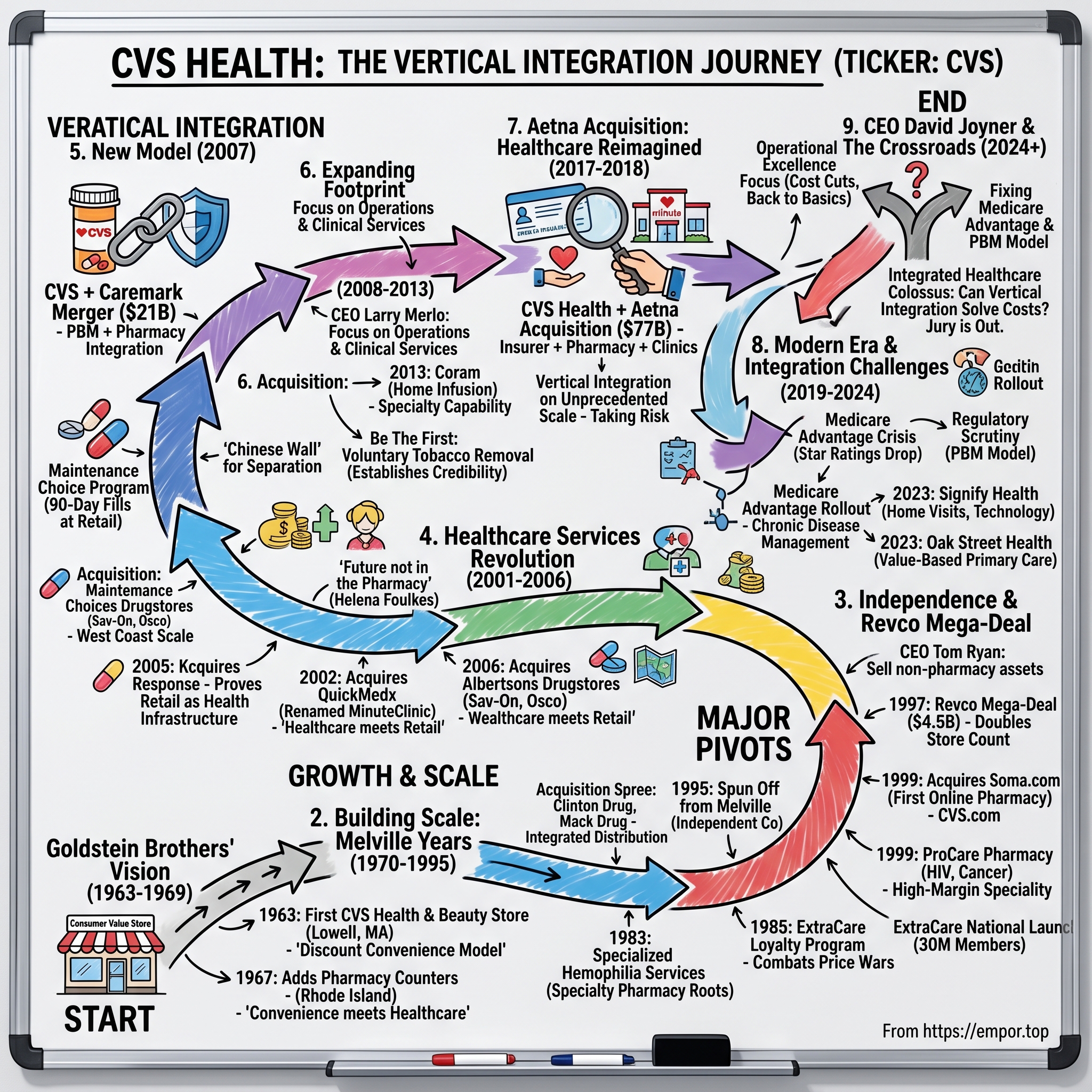
CVS Health: From Corner Drugstore to Healthcare Colossus
I. Introduction & Episode Roadmap
On the morning of February 10, 2026, CVS Health reported full-year 2025 financial results that highlighted a striking divergence between top-line scale and bottom-line profit. Full-year revenue reached $402.1 billion, up 7.8% to mark the largest annual revenue figure in corporate history. Yet net income attributable to shareholders stood at $1.7 billion, yielding GAAP diluted earnings per share of $1.39.1
Read together, the arithmetic is stark. For every hundred dollars flowing through CVS Health in 2025 across premiums, drug claims, prescriptions, and front-store merchandise, roughly forty cents reached the bottom line. The enterprise sitting between Americans and their medicine cabinets converted one of the largest revenue bases in the S&P 500 into a narrow profit margin. That gap stemmed not from macroeconomic collapse, but from a $5.7 billion goodwill impairment on a primary care business acquired two years earlier, alongside roughly $1.2 billion in legal charges tied to conduct dating back to the prior decade.12
That contrast — massive top-line scale paired with minimal reported net profit and self-inflicted write-downs — captures the central operating dynamic of modern CVS Health.
The business began as a regional health and beauty shop. In 1963, brothers Stanley and Sidney Goldstein and their partner Ralph Hoagland opened the first Consumer Value Store in Lowell, Massachusetts, selling discounted shampoo, cosmetics, and sundries.3 Sixty-three years later, the enterprise stands as the largest U.S. healthcare company by revenue, outsizing hospital systems, pharmaceutical manufacturers, and traditional industrial conglomerates.
The three-headed architecture. CVS Health operates a distinct structure: not a traditional retailer that added healthcare services, but three separate divisions occupying different, and often adversarial, positions within the healthcare value chain, united under a single corporate entity.
The first division is Health Services, centered on CVS Caremark, the nation's largest pharmacy benefit manager. Serving as the intermediary, Caremark determines formulary coverage, sets pharmacy reimbursement rates, and negotiates manufacturer rebates on behalf of employers and health plans. In 2025, the segment generated $190.4 billion in gross revenue and $7.2 billion in adjusted operating income while processing 1.9 billion pharmacy claims.1
The second division is Health Care Benefits, anchored by Aetna, which CVS acquired in 2018. The unit collects premiums and manages medical risk for roughly 26.6 million members across Medicare Advantage, commercial employer plans, and Medicaid. In 2025, it produced $143.4 billion in revenue but only $2.9 billion in adjusted operating income — a thin margin reflecting underlying medical underwriting dynamics rather than typical corporate profitability.1
The third division is Pharmacy & Consumer Wellness, comprising roughly 9,000 retail pharmacies, the MinuteClinic footprint, and front-store retail merchandise. It filled 1.8 billion prescriptions in 2025 on $139.4 billion in revenue, delivering $6.0 billion in adjusted operating income.12 Counter to common investor assumptions, this division generated the highest operating income among the company's three operating units.
Segment revenues totaled $473.2 billion against consolidated revenue of $402.1 billion. The $71 billion difference represents intersegment eliminations — effectively CVS purchasing pharmaceuticals through its own benefit manager on behalf of its own insured members. That elimination figure offers a direct measure of the company's vertical integration.
The thesis under examination. CVS Health represents a major test of vertical integration in healthcare: whether unifying the payer, the intermediary, and the pharmacy allows a company to extract cost efficiencies from the system and retain a portion as profit. UnitedHealth Group pursued a similar strategy with consistently stronger financial outcomes. Cigna executed a narrower variant, while Walgreens chose not to integrate vertically before being taken private in 2025 at a fraction of its peak valuation.4
The counter-thesis is equally compelling: combining an insurer, a PBM, and a retail drugstore network may not yield seamless synergies, but rather a complex conglomerate facing three distinct regulatory environments, separate cost structures, and demanding operational focus. The performance challenges of 2024 and 2025 provided substantial evidence for this view.
What follows. This analysis examines thirty years of major acquisitions — including Revco, Caremark, Target's pharmacy business, Omnicare, Aetna, Signify Health, and Oak Street Health — and evaluates their actual returns. It breaks down the mechanics of PBM economics, the legal pressures on the rebate model, and CVS's launch of a dedicated biosimilar entity. It details the 2024 downturn, when Aetna's medical benefit ratio exceeded 90%, leading to four consecutive guidance reductions, the eventual withdrawal of formal guidance, a chief executive transition, and the addition of four activist-nominated board members. Finally, it evaluates the turnaround under Chief Executive Officer David Joyner, which showed numerical momentum by mid-2026 while leaving open whether the integrated model has been validated or whether 2024 was an acute disruption in a volatile industry.
The story begins where the capital originated: a discount store in a Massachusetts mill town.
 Subscribe on LinkedIn
II. Origins & The Melville Years: The Corner Store Roots (1963–1995)
Lowell, Massachusetts, in 1963 was a city past its industrial prime. The textile mills that had made it an early American manufacturing hub had been closing for decades. It was the ideal environment for a discount format: a customer base with limited disposable income that prioritized low prices on everyday goods.
Brothers Stanley and Sidney Goldstein ran a health and beauty distribution business. Together with Ralph Hoagland, they opened a retail store to sell those products directly to consumers at discounted prices under the name Consumer Value Store.3 The founding featured no grand epiphany or garage legend. It was simply a wholesaler deciding to capture the retail margin alongside wholesale distribution — a straightforward commercial expansion executed effectively.
The pivotal operational shift occurred four years later. In 1967, CVS added pharmacy departments to its stores in Rhode Island.3 While commonplace today, combining discount retail with a pharmacy counter was a strategic choice that paired two retail formats with opposing economics and complementary mechanics.
Why a pharmacy counter changes a retailer. In isolation, prescription sales present difficult retail economics: thin gross margins, reimbursement rates dictated by third parties, and non-discretionary demand. Yet maintenance prescriptions — for hypertension, cholesterol, or diabetes — bring customers back to the physical store every 30 or 90 days with structural reliability. Health and beauty products operate on inverse economics: high gross margins, fully discretionary demand, and no natural repeat-visit cadence. Combined, the pharmacy counter at the back of the store serves as a recurring traffic engine, subsidizing customer visits through the higher-margin retail aisles.
That operational model — low-margin clinical foot traffic subsidizing high-margin front-store merchandise — served as CVS's foundational formula. It also embedded a vulnerability visible decades later: if front-store conversion weakens due to e-commerce competition, retail shrink, or declining foot traffic, the underlying cross-subsidization arithmetic breaks down.
The Melville conglomerate. In 1969, the Goldstein brothers sold CVS to Melville Corporation, a New York shoe retailer expanding into diversified specialty retail.5 The chain expanded from 17 stores at acquisition to more than 100 by 1070. Melville's balance sheet funded regional acquisitions across the next two decades, including Clinton Drug in 1972, Mack Drug in 1977, and multiple Northeastern drug chains during the 1980s.5 Melville also permitted CVS to experiment at the edges of healthcare services, including home hemophilia care in the 1980s, long before healthcare services emerged as a distinct corporate asset class.
The historical record also clarifies an important point about capital structure during this era: early CVS growth was achieved despite, rather than because of, its corporate parent.
The falsification: the conglomerate starved the winner. By the late 1980s, Melville operated drugstores, shoe outlets, apparel chains, toy stores, and furniture retailers under one corporate umbrella. Capital allocation across such a structure reflected internal corporate competing priorities as much as return metrics, forcing CVS — the highest-return asset in the portfolio — to compete for growth capital against units like Kay-Bee Toys and Thom McAn. Meanwhile, standalone pharmacy operators like Walgreens reallocated all retained earnings into pharmacy expansion, scaling nationally at a pace CVS could not match, a strategy mirrored by Rite Aid.
The resolution came from Melville itself. Beginning in 1995, Melville dismantled the conglomerate: selling Kay-Bee Toys, Wilsons, and This End Up; spinning off Footstar; and closing Thom McAn. In September 1996, corporate headquarters relocated from Rye, New York, to CVS's offices in Woonsocket, Rhode Island, and two months later Melville Corporation renamed itself CVS Corporation.5 The restructuring was not a routine rebranding; Melville liquidated its other divisions because their valuations lagged behind the drugstore chain, and maximizing pharmacy performance required operational independence.
For investors, the episode offers a durable historical parallel to contemporary corporate governance debates. CVS's corporate history began with a conglomerate discount resolved through a corporate breakup, after which the core pharmacy asset surged. Thirty years later, a structurally identical argument is advanced against CVS Health: that Caremark, Aetna, and the retail network would yield greater aggregate value as standalone entities. The company's origin story thus provides historical precedent for modern breakup arguments.
Freed from non-core retail divisions, CVS gained the ability to direct its full capital allocation toward pharmacy expansion — a strategy management deployed immediately.
III. Independence & The Revco Mega-Deal: Building Scale (1996–2006)
The newly independent CVS Corporation was, by national standards, still a regional chain. It operated roughly 1,400 stores concentrated in the Northeast — a limited footprint in an industry where purchasing power with drug wholesalers and negotiating leverage with health plans scaled directly with store count and prescription volume. Industry leader Walgreens was far larger. The strategic question in the Woonsocket boardroom in early 1997 was not whether to consolidate, but how much of the country to buy at once.
The answer, announced in February 1997, was 2,500 stores.
Revco. CVS agreed to acquire Revco D.S., a Twinsburg, Ohio-based chain with a dominant footprint across the Midwest and Southeast, in a stock swap valued at roughly $2.8 billion, or about $40.64 per Revco share.6 The combined enterprise operated approximately 4,000 stores across 24 states with about $13 billion in annual revenue, ranking second nationally behind Walgreens. In a single transaction, a New England drugstore operator became a national player.
What makes the Revco deal instructive is not merely its price tag, but the direct historical comparison available at that moment. Rite Aid pursued an identical consolidation strategy, closing on its acquisition of Thrifty PayLess during the same period. Both companies shared the same thesis on scale, yet their execution diverged sharply.
The integration divergence. CVS systematically absorbed Revco's stores, converted the storefront banners, consolidated distribution networks, and moved forward. Rite Aid's acquisition spree produced an accounting scandal, earnings restatements, criminal charges against senior executives, and a heavy debt burden it never escaped. Rite Aid struggled over the subsequent two decades, filed for bankruptcy twice, and entered final liquidation in May 2025 — with CVS ultimately purchasing prescription files from hundreds of its closed locations.78 Facing the same structural imperative, the two rivals demonstrated that acquiring 4,000 stores matters far less than the operational capability to run them after the deal closes.
This outcome stands as a key historical benchmark of CVS's execution capability. Yet it occurred nearly three decades ago under a management team that has since departed, leaving open whether that operational discipline persisted as the company took on far more complex acquisitions.
Corner locations and drive-thrus. In 1998, CVS acquired roughly 200 Arbor Drugs stores in Michigan. However, the period's most consequential operational shift was architectural rather than financial: moving away from inline strip-mall storefronts toward standalone corner locations equipped with drive-through pharmacy windows. What appeared to be routine real estate selection reflected a fundamental premise about retail health: convenience, rather than price, dictated prescription market share. Because third-party insurance set customer co-pays, patients chose pharmacies based on ease of access. That strategy proved correct and established the physical footprint CVS monetizes today. Simultaneously, it created a massive, fixed-cost real estate portfolio that has since turned into a long-term liability the company is actively trimming.
Early digital and loyalty. CVS acquired Soma.com in 1999 to establish CVS.com and launched its ExtraCare loyalty program in 2001. While neither initiative was immediately transformative, ExtraCare proved far more significant over time. It enabled CVS to compile a longitudinal record of purchasing habits across tens of millions of households linked directly to customer identity. Twenty-five years later, that historical data asset forms the foundation of the company's AI-driven consumer platform.
2006: two acquisitions, two different bets. In 2006, CVS executed two distinct transactions: purchasing MinuteClinic, a pioneer in retail walk-in medical clinics, and acquiring more than 700 Sav-On and Osco drugstores from Albertsons to expand into California and the Sunbelt.
The Albertsons transaction followed a conventional retail playbook: expanding store count, prescription volume, and wholesale purchasing power. MinuteClinic represented a fundamental shift. For the first time, CVS placed clinicians — primary care nurse practitioners — inside retail stores to bill insurance for clinical care rather than product sales. The underlying logic posited that while pharmacy counters generated routine retail visits, in-store clinics attracted patients actively seeking medical treatment — establishing a deeper relationship for an enterprise aiming to manage health care rather than simply dispense medications.
MinuteClinic established an early template for a recurring pattern in CVS's corporate evolution. As a strategic concept, it anticipated the broader shift toward retail healthcare. Yet as a business unit, it struggled to generate meaningful standalone operating profit, prompting repeated restructurings and footprint reductions. The enterprise demonstrated an early grasp of structural trends in American healthcare, paired with inconsistent execution when translating those insights into sustained operating income — a dynamic that resurfaced when the analysis reaches Oak Street Health.
By 2006, CVS possessed a national retail pharmacy network and an emerging clinical footprint. However, it exercised no control over the intermediaries dictating drug pricing, formulary placement, and patient access. That role belonged to pharmacy benefit managers, and CVS was preparing to acquire the second-largest PBM in the nation.
IV. The Caremark Merger: Inventing the Integrated PBM Model (2007–2016)
Understanding why CVS spent $21 billion on an enterprise with virtually no physical assets requires examining the core mechanics of a pharmacy benefit manager. A PBM operates across four distinct roles: three serving essential administrative and negotiating functions, and a fourth that ultimately sparked nationwide regulatory scrutiny.
The PBM, explained without jargon. When an employer or health plan provides prescription coverage, an intermediary must determine formulary eligibility, set plan reimbursement levels, establish member copays, and process pharmacy payments. The PBM manages those tasks through four primary functions:
It adjudicates claims. When a pharmacist scans a prescription, the transaction routes to the PBM's processing system, which verifies coverage, enforces plan rules, calculates the copay, and returns approval — in under a second, roughly two billion times a year at Caremark's scale. This provides mission-critical infrastructure that proves difficult to displace once integrated.
It negotiates with manufacturers. Drug manufacturers seek preferred formulary placement across health plans covering tens of millions of lives. The PBM grants that access in exchange for rebates — retroactive discounts off the drug's list price. A larger covered population grants the PBM greater leverage to extract higher rebates.
It builds and manages pharmacy networks, deciding which retail locations participate in plan coverage and setting their reimbursement rates.
And it retains a portion of the transaction flow. Historically, this occurred through spread pricing (charging plan sponsors more than the amount reimbursed to retail pharmacies), retained manufacturer rebates, and administrative fees calculated as a percentage of a drug's list price.
That final mechanism created structural perversities across the industry. Because rebates scale with list prices, both manufacturers and intermediaries faced financial incentives for list prices to rise even as net realized prices fell. Patients paying costs tied directly to list prices — including the uninsured and those in deductible phases — absorbed the inflated figures. That dynamic prompted legal action by the Federal Trade Commission against the three major PBMs and motivated CVS to construct specialized business units to bypass the traditional model.
The deal. CVS and Caremark Rx signed a merger agreement on November 1, 2006, structured as a merger of equals valued at roughly $21 billion.9 On December 18, 2006, Express Scripts launched a hostile counter-bid offering $29.25 in cash plus 0.426 Express Scripts shares per Caremark share — a higher nominal figure that would have combined the nation's second- and third-largest PBMs while introducing what Caremark's board identified as severe antitrust risk.9 Caremark's board maintained its recommendation, and in March 2007 shareholders approved the CVS transaction.10
The strategic rationale CVS presented to win shareholder support remains central to ongoing debates surrounding the company's structure. While Express Scripts offered a larger standalone PBM, CVS proposed an integrated architecture: uniting a pharmacy benefit manager with a physical retail store network. The primary operational vehicle was Maintenance Choice — a benefit structure allowing plan members to fill 90-day maintenance prescriptions at CVS retail stores for the same copay as mail-order delivery. For plan sponsors, the arrangement captured mail-order cost structures without restricting member access to physical stores. For CVS, it converted Caremark benefit contracts directly into retail prescription volume that non-integrated competitors could not capture.
Management initially projected roughly $400 million in annual synergies. The combination eventually exceeded those targets through purchasing scale and administrative consolidation, establishing the integrated PBM-plus-retail model that competitors later sought to replicate.
The adjacent acquisitions, and the one that went wrong. In 2015, CVS executed two major transactions within ten weeks. In June, it agreed to acquire Target's pharmacy and clinic operations — comprising roughly 1,660 store-in-store pharmacies — for $1.887 billion, expanding CVS's footprint into higher-income suburban demographics.11 In August, it closed the acquisition of Omnicare, the primary pharmacy services provider to long-term care facilities, for $98.00 per share, representing an enterprise value of approximately $12.7 billion including assumed debt.1112
While the Target transaction integrated smoothly, Omnicare failed to meet expectations, representing the primary operational misstep in CVS's pre-Aetna expansion history.
The tobacco decision. Between those acquisitions, CVS made its most prominent public operational shift. On February 5, 2014, the company announced it would eliminate cigarettes and tobacco products across its more than 7,600 retail locations by October 1 of that year, relinquishing approximately $2 billion in annual revenue — equivalent to about 17 cents per share in annual earnings.1314 Simultaneously, the enterprise rebranded as CVS Health.
Beyond its public health framing, the decision reflected strategic positioning. An enterprise seeking to sell clinical management services to employers and health plans — and eventually acquire a healthcare insurer — faced credibility conflicts by continuing to sell tobacco products at its front registers. Forgoing the front-store revenue served as an entry cost for a broader healthcare repositioning four years prior to bidding for Aetna.
Historical falsification: did Caremark and Omnicare build an unassailable moat?
Evaluating whether these acquisitions created defensible, permanent control over drug distribution yields distinct conclusions for each transaction.
Omnicare: rejected. CVS acquired Omnicare for $12.7 billion but failed to generate sustained returns on the asset. The reporting unit absorbed substantial goodwill impairment charges in subsequent years as skilled nursing occupancy rates and reimbursement levels declined. Concurrently, legal liabilities inherited in the transaction expanded post-closing. In April 2025, a federal jury found Omnicare and CVS Health liable under the False Claims Act for improper dispensing practices spanning 2010 through 2018 — covering three years following CVS's acquisition. The district court entered a judgment of approximately $948.8 million, comprising $406.8 million in trebled damages and $542 million in statutory penalties, holding CVS directly liable for $164.8 million of the penalties for failing to halt the conduct post-acquisition.152 CVS recorded a $542 million charge in the second quarter of 2025 and initiated an appeal, ultimately reaching a settlement with the Department of Justice on July 1, 2026.216
The sequence demonstrated that CVS acquired an asset at a premium valuation, failed to remediate internal compliance practices for three years post-closing, incurred substantial goodwill write-downs, and paid significant legal penalties for ongoing operational conduct.
Caremark: narrowed, not rejected. Caremark's core operational scale remains substantial. Processing claims at national scale creates high entry barriers, and switching PBM providers imposes significant operational friction on large employers. However, the business model faces two documented structural challenges.
First, operating a PBM alongside an affiliated insurer introduces competitive friction with external health plan clients. Anthem — now Elevance Health — historically represented one of Caremark's largest accounts before electing to establish its internal PBM, IngenioRx (now CarelonRx), and transition its member volume in-house. That loss demonstrated that vertical integration can alienate third-party insurer clients who view the parent company as a direct competitor.
Second, regulatory and judicial actions have altered traditional PBM revenue models. On September 20, 2024, the FTC filed suit against Caremark, Express Scripts, and OptumRx, alleging that manufacturer rebate structures artificially inflated insulin list prices.[^17] Caremark resolved the litigation on July 14, 2026, without admitting liability, agreeing to eliminate formulary disadvantages for low-list-price medications, offer point-of-sale rebate pass-through options for plan sponsors, uncouple administrative fees from drug list prices, and increase pricing disclosure transparency — structural remedies the FTC estimated could yield up to $8.5 billion in consumer savings over a decade.17
Consequently, Caremark's processing scale and administrative infrastructure remain operational strengths, whereas its legacy spread-pricing and rebate-retention models face ongoing regulatory restriction. Evaluating the segment's future performance depends on Health Services adjusted operating income per claim and client retention metrics rather than aggregate top-line expansion.
Having acquired the PBM intermediary, CVS still faced an operational boundary: it did not control the underlying insurance premium. In 2017, management moved to acquire that layer as well.
V. The $77 Billion Aetna Mega-Acquisition: The Vertical Integration Bet (2017–2021)
In 2017, market anxiety surged over the prospect of Amazon entering retail pharmacy and disrupting drug distribution. Drugstore equities de-rated sharply. Concurrently, UnitedHealth Group's Optum division was demonstrating that the highest-margin position in healthcare lay in the services layer between insurance and pharmacy dispensing, while Anthem was preparing to transition its pharmacy benefit management volume away from Express Scripts.
Faced with potential commoditization in retail drug distribution, CVS Chief Executive Officer Larry Merlo pursued a clear strategic pivot: transforming CVS from a standalone retailer into an integrated healthcare delivery system anchored by an in-house health insurer.
The transaction. On December 3, 2017, CVS Health signed a definitive merger agreement to acquire Aetna. Under the terms, Aetna shareholders received $145.00 in cash and 0.8378 CVS shares for each Aetna share, valuing Aetna's equity at approximately $69 billion and creating an enterprise value of roughly $77 billion including assumed debt.1819 The combination stood as the largest healthcare transaction in corporate history.
Management's strategic thesis rested on aligning incentives across insurance, pharmacy benefit management, and retail store locations. By assuming underwriting risk, the parent company aimed to profit by keeping members healthy rather than relying strictly on prescription dispensing volume. CVS's footprint of roughly 9,900 retail stores would serve as low-cost clinical access points to intercept medical issues before they escalated to emergency room visits. Caremark's formulary scale would reduce Aetna's drug spend, while in-store management of chronic conditions — such as diabetes, hypertension, and heart failure — would lower overall hospitalization costs.
While theoretically coherent, the model produced uneven financial evidence over the following decade, failing to deliver synergies at the scale required to justify the acquisition price.
The regulatory marathon. To secure antitrust clearance, the Department of Justice required Aetna to divest its standalone Medicare Part D prescription drug plan business — encompassing approximately 2.2 million members — to WellCare Health Plans, a condition announced on October 10, 2018.[^21] CVS completed the acquisition on November 28, 2018.18
However, antitrust scrutiny persisted post-closing. Judge Richard Leon of the U.S. District Court for the District of Columbia, reviewing the consent decree under the Tunney Act, declined to issue standard approval. Instead, he conducted live hearings with outside witnesses, effectively scrutinizing the transaction's competitive impact while integration was already underway. Although Judge Leon approved the settlement in September 2019, the review signaled ongoing regulatory and judicial scrutiny regarding CVS's vertical structure.
COVID-19 and the proof of physical scale. The onset of the COVID-19 pandemic highlighted the operational utility of CVS's physical footprint. The retail network administered tens of millions of diagnostic tests and vaccinations, while specialized pharmacy teams inoculated residents at long-term care facilities through a federal partnership. During the crisis, physical store infrastructure served as vital public health access points.
However, the associated financial gains proved temporary. High-margin revenue from testing and vaccinations eventually subsided, forcing the Pharmacy & Consumer Wellness segment to face difficult year-over-year earnings comparisons for two consecutive years. Furthermore, pandemic-related sheltering deferred elective medical procedures among senior populations — creating a backlog of surgical demand that subsequently emerged as elevated medical costs for Aetna.
Capital deployment benchmarking: what the Aetna price actually bought. At announcement, CVS paid approximately 11.5 times enterprise value to EBITDA for Aetna — a valuation multiple consistent with prevailing managed care transactions in 2017. The primary financial challenge lay in capital structure and opportunity cost.
Net debt rose above $70 billion at closing.19 To service and reduce this obligation, CVS suspended share buybacks and froze its annual dividend at $2.00 per share from 2017 through 2021 — ending a long track record of annual dividend increases. Reaching its deleveraging target of low-3 times net debt to EBITDA absorbed virtually all discretionary cash flow for four years.
This financial commitment created significant strategic friction. While competitors acquired digital health, primary care, and home health assets during a period of lower valuations, CVS lacked capital flexibility. By the time CVS restored balance sheet flexibility in 2022, valuations across clinical and primary care services had reached peak levels, forcing the company to execute subsequent acquisitions at elevated multiples.
VI. Primary Care Gold Rush & Peak Valuation Bets: Oak Street & Signify (2022–2023)
By 2022, a specific consensus had taken hold among healthcare investors, strategists, and bankers: whoever controlled the primary care physician controlled the Medicare Advantage margin.
The logic follows the underlying payment mechanics of Medicare Advantage. The federal government pays a health plan a fixed monthly fee per member, adjusted upward based on the severity of the member's documented health conditions — the risk score. The plan retains whatever portion of that payment it does not spend on medical care. Consequently, two primary levers dictate profitability: how comprehensively a plan documents member conditions to establish the risk score, and how effectively it prevents unnecessary medical utilization to curb costs. Both levers are pulled inside the primary care office. Under this framework, an insurer that does not own or tightly align with its primary care physicians functions merely as a passive payer of third-party clinical decisions.
UnitedHealth Group had recognized this dynamic a decade earlier, systematically acquiring physician practices until its Optum unit employed or affiliated with tens of thousands of doctors. Humana built out its CenterWell division, while Walgreens acquired a controlling stake in VillageMD. CVS, having completed the deleveraging required for the Aetna transaction, entered the primary care market in 2022 — late, capital-rich, and intent on securing market position.
Signify Health. In September 2022, CVS agreed to acquire Signify Health for $30.50 per share in cash, representing an equity value of roughly $8 billion, following a competitive bidding process that reportedly included Amazon and UnitedHealth Group. The transaction closed on March 29, 2023.20 Signify operated a network of thousands of clinicians conducting in-home health evaluations for Medicare Advantage members to assess conditions and record diagnoses.
That operational model carried distinct strategic implications. While in-home evaluations offer clinical utility by uncovering untreated conditions and home safety hazards, the business model functions structurally as a risk-score documentation engine. A significant share of its economic value to an acquirer depends on federal reimbursement rules for documented diagnoses — a regulatory dependency that presented clear policy exposure at the time of purchase.
Oak Street Health. Five months later, on May 2, 2023, CVS completed the acquisition of Oak Street Health for $39.00 per share in cash, representing an enterprise value of approximately $10.6 billion.2122 Oak Street operated primary care clinics tailored for low-income Medicare Advantage beneficiaries under full-risk, value-based contracts across multiple health plans, utilizing a clinical model designed to lower hospitalization rates.
However, Oak Street was operating at a substantial net loss. Rather than acquiring immediate cash flows, CVS purchased a growth platform priced at roughly six times revenue during an era when value-based care enterprises were evaluated on clinic expansion rather than operating profit. In acquiring the platform, CVS committed to expanding the network to 300 centers by 2026.
Cordavis: the one bet that has worked. In August 2023, CVS launched Cordavis, a wholly owned subsidiary created to contract directly with pharmaceutical manufacturers to commercialize biosimilar medications under its own label.23 The unit introduced its initial product, Hyrimoz — a biosimilar of AbbVie's Humira produced by Sandoz — in the first quarter of 2024 at a list price more than 80% below Humira's.23
The launch addressed a structural barrier in specialty drug pricing. Although biosimilars serve as clinically equivalent alternatives to biologic drugs, adoption had stalled because legacy manufacturer rebates made brand-name drugs cheaper on a net basis for PBM clients than lower-list-price competitors, preserving brand market share.
Cordavis bypassed this barrier by positioning the PBM's affiliate as the distributor. In April 2024, CVS Caremark removed Humira from its major commercial formularies. By August 2024, approximately 97% of commercial adalimumab volume across Caremark's client base had transitioned to biosimilars, predominantly Cordavis-labeled product.2425 By mid-2026, management reported that the program had generated more than $1.8 billion in cumulative savings on adalimumab for Caremark clients.26
The initiative represented strategic counter-positioning: CVS surrendered a portion of its legacy rebate pool in exchange for private-label margins and a defensive response to regulatory challenges against traditional PBM rebate structures. However, Cordavis remains reliant on formulary control. Its commercial success depends on Caremark's ability to steer prescription volume — the precise structural capability targeted by Federal Trade Commission enforcement and state legislative reforms. Cordavis functions as a hedge against PBM reform that is itself exposed to PBM reform.
Historical falsification: did Oak Street and Signify establish leadership in value-based care?
The strategic assertion that these acquisitions established CVS as a leader in value-based care delivery has been undermined by the company's subsequent financial disclosures.
The primary disruption stemmed from predictable regulatory changes. Beginning in 2024, the Centers for Medicare & Medicaid Services began phasing in the V28 risk-adjustment model, which eliminated or reduced weights for thousands of diagnosis codes previously used to raise member risk scores. The policy change reduced Medicare Advantage revenue per documented condition. For Signify, whose valuation depended on documentation services, and Oak Street, whose clinic economics assumed specific per-patient revenue levels, the adjustment compressed margins precisely as underlying medical utilization and care costs accelerated.
On October 29, 2025, CVS recorded a $5.7 billion goodwill impairment charge against the Health Care Delivery reporting unit within Health Services, resulting in a quarterly GAAP net loss of roughly $4 billion.2728 Management subsequently curtailed new clinic openings and initiated closures of underperforming Oak Street locations where, as Chief Financial Officer Brian Newman noted, there was no viable path to sustainable margins.27 The company's annual report acknowledged that the Health Care Delivery unit "continued to experience challenges which have impacted its ability to grow the business at the rate previously estimated."2
The evidence indicates that the original thesis of acquiring immediate leadership in scalable value-based care was not realized. What remains is a narrower operational objective: demonstrating that Oak Street's care model can deliver cost efficiencies for high-acuity senior populations while bringing a smaller network of mature centers to financial breakeven. Management has aligned guidance with this scaled-back model, focusing on reaching breakeven and establishing a path toward sustained profitability in Health Care Delivery.29 The shift from 2023 expansion targets to 2026 margin targets marks a substantial reduction in projected asset returns.
The key metric for evaluating the unit going forward is whether Health Care Delivery can generate operating income alongside revenue growth. In the second quarter of 2026, the unit reported 23% year-over-year top-line revenue growth, which shows top-line expansion but says nothing yet about whether it earns anything.26
This sequence underscores a recurring vulnerability in CVS's M&A strategy: acquiring assets whose business models depend heavily on fixed federal reimbursement formulas, at valuations that assume regulatory stability. When Medicare Advantage risk-adjustment rules changed, the financial assumptions underpinning both acquisitions weakened — setting the stage for broader operational challenges across the enterprise.
VII. The 2024–2025 Reckoning: MCR Crises, Star Rating Collapse & Leadership Shakeup
On November 6, 2024, David Joyner sat for his first earnings call as chief executive officer of CVS Health, three weeks into the job, and delivered an admission rare for a Fortune 10 leadership team: the company would not provide a formal financial outlook for the year ahead.
"Establishing credibility and earning the trust of our investors is one of my top priorities as the new leader of CVS Health," he told analysts, adding that any guidance the company provided "should be achievable, with clear opportunities for outperformance."30
The statement acknowledged a harsh reality: previous forecasts had lacked grounding. To understand how an enterprise generating $370 billion in annual revenue reached the point of abandoning financial guidance, three distinct operational breakdowns must be analyzed together, as they arrived simultaneously and compounded one another.
Failure one: the star ratings. Medicare Advantage plans receive performance grades from CMS on a five-star scale across roughly forty quality measures. These ratings carry major financial weight: plans rated four stars and above qualify for quality bonus payments that flow directly into annual revenue and subsidize member benefits. In the Star Ratings published in October 2022, Aetna's flagship national individual PPO — covering more than 1.9 million members, or nearly 60% of Aetna's Medicare Advantage enrollment — fell from 4.5 stars to 3.5.31 Overnight, the share of Aetna Medicare Advantage members in four-star-or-better plans collapsed from 87% to 21%.31 CVS disclosed to investors that the downgrade represented an estimated revenue hit of $800 million to $1 billion.31
Aetna resolved the operational shortfalls promptly, restoring the national PPO to four stars for 2024 and to 4.5 stars for 2025, with 88% of members back in four-star-or-better plans.3233 However, administrative payment lags meant the actual financial penalty landed squarely in 2024, precisely when broader operational headwinds hit.
Failure two: utilization. Throughout 2023 and into 2024, senior health utilization surged at levels the broader managed care sector failed to anticipate. Elective hip and knee replacements postponed during the pandemic resumed, alongside elevated volumes of outpatient procedures, cardiac interventions, and supplemental benefit usage. Because Medicare Advantage plan bids are submitted in the first half of a calendar year for the following plan year, an insurer that misjudges medical cost trends remains locked into fixed pricing for twelve full months with no ability to reprice.
Aetna misjudged the cost trend severely. The medical benefit ratio — the share of premium revenue spent covering clinical care — escalated from the mid-80% range required for sustainable margins into loss-making territory. In the third quarter of 2024, the segment's MBR surged to 95.2%, against 85.7% a year earlier, inflated in part by $670 million of premium deficiency reserves recorded as health care costs. The Health Care Benefits division swung to an adjusted operating loss of $924 million, compared with operating income of $1.536 billion in the prior-year quarter — marking a $2.46 billion year-over-year deterioration in a single quarter.34
Failure three: risk adjustment. The implementation of the federal V28 risk-adjustment model hit simultaneously, compressing Aetna's premium yield while squeezing Oak Street's clinic economics.
The chronology of lost credibility. The company's 2024 guidance revisions revealed structural gaps in management's visibility into its underwriting exposure. On February 7, 2024, CVS cut full-year adjusted EPS guidance to at least $8.30 from at least $8.50.35 On May 1 it cut again, to at least $7.00.36 On August 7 it cut a third time, to a range of $6.40 to $6.65, and announced a $2 billion cost reduction program alongside the departure of Aetna president Brian Kane after roughly a year in the role.37 On November 6, it stopped forecasting.3430 Full-year 2024 adjusted EPS came in at $5.42 — thirty-six percent below the number guided ten months earlier.1
Four consecutive guidance reductions in four quarters signaled that internal visibility into medical cost trends inside its largest risk pool was structurally inadequate, with each successive estimate assuming the deterioration had stopped when it had not. On the first- and second-quarter 2024 earnings calls, sell-side analysts pressed repeatedly on the same question — why the 2024 Medicare Advantage bids had not been priced more conservatively given what the company was already seeing in its own claims data — and management's answers described the trend rather than explaining the pricing decision.
The activist. Larry Robbins is a healthcare specialist by background, and Glenview Capital Management has a long history of taking concentrated positions in managed care. Glenview accumulated a stake reported at roughly $700 million and pressed for change on governance, segment accountability and capital allocation.
The resolution came fast and was, by activist standards, unusually cooperative. On November 17, 2024, CVS appointed four new directors — Leslie Norwalk, Larry Robbins, Guy Sansone and Doug Shulman — expanding the board from twelve to sixteen members, with Norwalk joining the Health Services and Technology Committee, Sansone the Audit Committee, and Shulman the Management Planning and Development Committee.3839
An important sequencing note that is frequently reported backwards: the CEO change came first. Karen Lynch ceased to serve as president and chief executive and resigned from the board on October 17, 2024, with David Joyner appointed the same day and then-chairman Roger Farah becoming executive chairman.4041 Glenview's board seats followed a month later. The board acted on its own before the settlement, which is a marginally better governance signal than the reverse, though the pressure was already public.
The Joyner playbook. Joyner's background is the most important fact about the turnaround. He spent three decades in the pharmacy benefit business and ran CVS Caremark — meaning the new chief executive was a PBM operator, not an insurance executive, handed a company whose acute problem was insurance underwriting. He responded by hiring underwriting discipline rather than pretending to supply it: Steven Nelson, a managed care veteran, took over Aetna, and Brian Newman arrived as chief financial officer.
The strategy itself was unsentimental: reprice Medicare Advantage aggressively and accept the membership loss. For the 2026 plan year, Aetna closed nearly 90 individual Medicare Advantage plans across 34 states, exited one state entirely, and reduced its county footprint by around 100 counties.42 It exited the Affordable Care Act individual exchange business altogether — announced on May 1, 2025, affecting roughly one million members across 17 states, after establishing a $448 million premium deficiency reserve and projecting losses of $350 million to $400 million for the year. Joyner told investors he was "disappointed by the continued underperformance" and that Aetna saw no short- or long-term path to improving its position in that market.4344
That exit deserves a footnote of its own for credibility purposes: Aetna had already withdrawn from the ACA exchanges once, in 2017 and 2018, before re-entering in 2021 and losing money again. The 2025 decision was not a new insight. It was the second identical conclusion reached from the same starting point in under a decade, which says something about the underwriting discipline that governed the re-entry.
Did it work? On the numbers, materially. Full-year 2025 adjusted EPS of $6.75 came in roughly 15% above the guidance set at the start of the year, with the MBR improving to 91.2% from 92.5% and operating cash flow of $10.6 billion.145 Through 2026 the recovery accelerated: second-quarter MBR of 87.4% against 89.9% a year earlier, Health Care Benefits adjusted operating income up 85.5% to $2.43 billion, and full-year adjusted EPS guidance raised by $0.60 to $7.90–$8.10 with cash flow guidance lifted by $2 billion to at least $11.5 billion.46
Two disciplines are worth applying to that recovery before accepting it. First, the comparison base is a catastrophe; recovering from a 95.2% quarterly MBR to 87.4% is real progress, and 87.4% is still above the mid-80s level at which this business historically earned its cost of capital. Second, the improvement has been delivered substantially by shrinking — exiting markets, cutting plans, repricing members away — which is the correct first move but is not the same as competing successfully. Aetna's medical membership fell from 26.6 million at the end of 2025 to 26.0 million by mid-2026.146
And the next headwind is already visible. In the Star Ratings published on October 9, 2025, Aetna's share of members in four-star-or-better plans fell to just over 81% from 88%, with just over 63% in 4.5-star plans — still the best result among its large peers, in a year when the industry average fell to 3.65 from 3.92, but a decline nonetheless, and one that flows into 2027 revenue.4748
The turnaround, in other words, is real and incomplete, and it is being run on a machine whose three parts earn money in completely different ways. Understanding those parts is the difference between reading CVS as a cheap insurer and reading it as what it actually is.
VIII. Anatomy of the Core Business: Three-Segment Economics & Financial Deep Dive
Evaluating CVS Health requires viewing the enterprise not as a single retailer operating across three margins, but as one corporate entity managing three distinct business models — where headline revenue reveals remarkably little about which segment generates actual economic value.
Health Services operates as a high-volume processing intermediary. Caremark's top-line revenue is massive because when a plan member fills a prescription, the gross drug cost flows across its accounting books. Yet that pass-through drug volume represents inventory in transit rather than core profitability. The underlying business rests on the narrow margin retained per claim: administrative fees, retained rebate structures, and margins on specialty drugs dispensed through CVS's owned pharmacies. In the second quarter of 2026, the segment generated $1.73 billion in adjusted operating income on $51.8 billion in revenue, yielding an operating margin of approximately 3.3%.46
That narrow margin is often misconstrued as operational weakness, when in practice it functions as a competitive barrier. An intermediary earning three cents on every handled dollar offers competitors little pricing room to undercut, while the capital required to replicate national claims processing infrastructure and manufacturer relationships is substantial. However, that thin margin also highlights why legislative and regulatory PBM reforms pose structural risks: at a 3% operating margin, any regulatory mandate that curtails retained economics removes a disproportionate share of segment profits.
Growth within Health Services is driven not by routine prescription processing, but by specialty pharmacy — complex, high-cost injectables and infused biologics for oncology, autoimmune, and rare diseases. In this sub-segment, CVS dispenses medications directly while earning service fees for distribution, patient adherence support, and clinical oversight. Specialty pharmacy represents the expanding profit pool in drug distribution, driving an 11.5% increase in segment revenue during the second quarter of 2026 even as traditional claim volumes grew at a far slower pace.46
Health Care Benefits operates as an insurance underwriting portfolio. Aetna's revenue consists of collected premiums, and its operating profit represents the residue after fulfilling medical claims — making the medical benefit ratio the primary indicator of segment health. In 2025, an MBR of 91.2% left roughly nine cents of every premium dollar to cover administrative expenses, marketing, sales commissions, and operating profit.1 By contrast, the second-quarter 2026 MBR of 87.4% left nearly three times as much operating profit from equivalent premium volume.46 This operational leverage explains why a 250-basis-point improvement in the medical benefit ratio generated an 85% surge in segment operating income, demonstrating how small shifts in care utilization magnify bottom-line results.
This leverage also illuminates Aetna's structural role within the enterprise. In 2025, Health Care Benefits generated higher total revenue than Pharmacy & Consumer Wellness yet delivered less than half its operating income.1 For an asset acquired for $77 billion, that return profile highlights the ongoing challenge of vertical integration and forms the core of investor arguments calling for a corporate separation.
Pharmacy & Consumer Wellness functions as a fixed-cost retail network navigating reimbursement headwinds. The retail segment's revenue growth of 0.7% in the second quarter of 2026 reflects diverging underlying forces: rising prescription volume offset by declining reimbursement per prescription.46 Pharmacy reimbursement rates set by PBMs and Medicare Part D plans have compressed for over a decade, exacerbated by the restructuring of direct and indirect remuneration fees. Meanwhile, fixed operating expenses — commercial leases across thousands of freestanding corner locations, pharmacist compensation in a competitive labor market, and store security — remain rigid.
Management responded through a two-part operational strategy. First, CVS reduced physical store density, closing roughly 900 locations between 2022 and 2024 under its strategic review, alongside an additional 271 closures in 2025, leaving the chain at approximately 9,000 locations after opening 87 stores and closing 243 during the year.2 Second, the company launched CVS CostVantage, a transparent pricing model that calculates prescription pricing based on acquisition cost, a defined markup, and a flat dispensing fee, replacing traditional benchmark discounts. Whether commercial health plans and PBMs accept this cost-plus model at scale remains a pivotal operational test.
The retail division also gained market share from industry consolidation in 2025. Following Rite Aid's bankruptcy liquidation, court approval allowed CVS to acquire prescription files from more than 600 pharmacies across 15 states while assuming operations at 63 former Rite Aid and Bartell Drugs locations in Idaho, Oregon, and Washington.78 Combined with Walgreens' retrenchment under Sycamore Partners ownership, the liquidation altered regional market dynamics in CVS's favor.4
During the second-quarter 2026 earnings call, analysts at Wolfe Research questioned whether prescription volume growth would remain sustainable once the initial Rite Aid customer transfers annualized. Management asserted that CVS expects above-market prescription growth independent of Rite Aid volume, citing service quality and the transition to CostVantage — an assertion that requires operational verification over subsequent quarters.26
Where enterprise value resides. Evaluating the three divisions by operational contribution rather than top-line revenue clarifies the underlying financial structure:
Revenue is dominated by Health Services pass-through volume, providing little insight into underlying profitability.
Operating profit during stable operational periods is distributed more evenly than headline figures suggest. Health Services and Pharmacy & Consumer Wellness generate the steady baseline of operating income, while Health Care Benefits introduces earnings volatility. In 2025, the retail pharmacy segment generated more than double the adjusted operating income of Aetna.1
Cash flow generation remains the enterprise's central financial anchor. CVS generated $10.6 billion in operating cash flow in 2025 and matched that figure with $10.6 billion in the first half of 2026 alone, against full-year guidance of at least $11.5 billion.146 This substantial cash flow provides capital resilience: even during a year marked by a $5.7 billion goodwill impairment, substantial litigation penalties, and elevated insurance claims, core cash generation remained resilient.
The balance sheet and capital allocation priorities. CVS concluded 2025 with a debt-to-EBITDA leverage ratio of approximately 4.0x, improved to 3.5x by the end of the second quarter of 2026, and distributed more than $3 billion in shareholder dividends during 2025.4526 Management explicitly stated that current-year financial guidance assumes no share repurchases, concentrating capital deployment on debt reduction.26
While debt reduction remains an operational priority, it also reflects structural constraints. A leverage ratio of 3.5x paired with a credit rating near the Baa3/BBB border leaves little financial headroom to absorb unexpected underwriting miscalculations, major legal settlements, or adverse Medicare Advantage reimbursement changes without risking a credit rating downgrade. Continued deleveraging marks tangible progress toward balance sheet stability, yet the enterprise remains vulnerable to operational disruptions in a volatile healthcare environment.
IX. Management & Governance: David Joyner Era & The Glenview Stress Test
David Joyner spent more than thirty years in the pharmacy benefit management industry before taking the helm at CVS Health. Having joined Caremark long before its acquisition by CVS, he later returned in 2023 to lead the pharmacy services segment before the board appointed him chief executive officer in October 2024. On January 1, 2026, he assumed the additional role of board chairman.
Both dimensions of that background carry distinct strategic implications.
The constructive perspective highlights Joyner's deep operational grasp of the drug supply chain — including formulary design, manufacturer negotiations, and plan sponsor retention dynamics. This expertise anchors the business segment that produces CVS's largest and most consistent profits, addressing an operational gap left by his predecessor's managed-care background. Rather than improvising insurance strategy, Joyner promptly recruited experienced health-plan leadership to manage underwriting discipline.
The counter-perspective points to a structural risk: Joyner's primary background is in PBM operations rather than insurance underwriting, yet Medicare Advantage risk management represents the enterprise's most acute operational challenge. Furthermore, combining the chief executive and chairman roles just fourteen months after an activist-driven governance settlement re-establishes centralized corporate authority. While the four activist-nominated directors — alongside Glenview Capital's significant equity position — provide ongoing board oversight, the governance framework in 2026 reflects less structural independence than in 2025 for a company with a documented history of oversight lapses.
Guidance behavior as evidence. Evaluating management's operational credibility relies less on forward-looking statements than on the historical pattern of its financial forecasting.
Under Joyner, forecasting has followed a deliberate sequence: establish conservative initial targets, outperform, and raise guidance. Full-year 2025 adjusted earnings per share exceeded initial management guidance by roughly 15%.45 For 2026, full-year guidance was set at $7.00 to $7.20 per share at the December 2025 investor day, reaffirmed in February, and subsequently raised by 60 cents in August following two consecutive quarterly beats.294546 Compared to the four consecutive guidance reductions recorded in 2024, this shift marks a disciplined reset in financial communication.
Skeptically examined, this pattern also reflects a standard corporate recovery playbook designed to mitigate forecasting risk. Setting low initial targets during a turnaround year allows management to build credibility through repeated beats. The true test of this forecasting framework will occur when the company encounters an unexpected operational headwind and must disclose it promptly.
A minor forecasting discrepancy has already emerged. Operating cash flow guidance for 2026 was initially projected at "at least $10 billion" during the December investor day, lowered to "at least $9 billion" in February due to late-2025 payment timing shifts, and then raised to "at least $11.5 billion" in August.294546 While Chief Financial Officer Brian Newman's explanation regarding timing differences remains plausible — and cumulative two-year cash flow expanded by more than $1.5 billion — a metric that fluctuated downward by 10% and upward by 28% within seven months indicates lingering volatility in short-term cash forecasting.
Where management has been vague. During the February 2026 earnings call, Wall Street analysts questioned management directly regarding ongoing Federal Trade Commission scrutiny and long-term PBM margins. Joyner declined to elaborate on active FTC discussions, offering only general assertions that fair margins for administrative value would persist.45 Management similarly declined to disaggregate medical benefit ratio trends across specific product lines when pressed by analysts.45 Later, during the August 2026 call, management deferred detailed quantification of 340B drug-pricing pressures to subsequent reporting periods after introducing the topic for the first time since 2024.26
While such responses align with standard corporate disclosure practices, key reporting gaps remain across the two variables that govern future earnings: post-reform PBM take rates and detailed product-line medical cost performance.
The activist stress test: break it up? A central thesis among activist investors posits that CVS Health trades at a persistent conglomerate discount because public markets struggle to value three distinct businesses — operating under different regulatory regimes, risk profiles, and capital needs — within a single corporate entity. Under a corporate breakup model, a standalone Caremark would trade as a high-return, capital-light services provider; Aetna would be evaluated alongside peer managed-care organizations like Elevance and Humana; and the retail network would be priced as a retail pharmacy chain. Proponents argue that a separation would eliminate the conglomerate discount and force each unit to operate without internal cross-subsidization.
Management counters that vertical integration produces tangible operational synergies: Caremark's purchasing scale reduces drug costs for Aetna; retail stores and MinuteClinics provide low-cost clinical access points for insured members; Cordavis relies on Caremark's formulary control for distribution; and the consumer health platform requires integration across benefits, pharmacy, and clinical care.
Evaluating these opposing positions reveals unequal support across the enterprise. The Cordavis initiative presents the clearest evidence of integration, producing a private-label biosimilar business that neither division could construct independently. Conversely, the claim that retail stores reduce overall medical spend lacks empirical confirmation; eight years after acquiring Aetna, CVS has not disclosed segment-level data demonstrating that member utilization of in-store clinics generates measurable savings on medical claims.
Beyond investor arguments, state legislatures are introducing external structural pressure. In 2025, Arkansas enacted legislation prohibiting PBMs from owning retail pharmacies within the state. In response, CVS announced the closure of more than 20 locations and filed a lawsuit alongside Express Scripts, securing a preliminary injunction in July 2025.495051 As similar measures surface in other state legislatures, CVS faces the prospect that the structural unbundling corporate governance resisted could ultimately be mandated piecemeal by state regulators.
Strip away the executive transitions and decades of corporate consolidation, and the enterprise yields a clear set of strategic lessons regarding value creation and operational friction in integrated healthcare.
X. Playbook: Strategic & Investing Lessons
1. Vertical integration is a leveraged bet on the regulatory weather. When policy is permissive, owning the insurer, the intermediary, and the pharmacy network compounds returns: every internal transaction captures a margin that would otherwise leak to a third party, a structural capture reflected in the $71 billion of intersegment eliminations on CVS's income statement. When policy turns hostile, however, that same structure concentrates exposure. CVS faces FTC scrutiny over rebate practices, state legislative bans on pharmacy ownership, CMS adjustments to risk models and star ratings, and Department of Justice enforcement over legacy dispensing conduct — four distinct regulatory fronts that a standalone drugstore chain would avoid. Vertical integration does not diversify regulatory risk; it correlates it.
2. The timing of a deal matters more than the valuation multiple. CVS did not overpay for Oak Street Health and Signify Health merely because it misjudged the underlying businesses; it overpaid because it acquired them when every healthcare suitor sought primary care assets — and it was buying at peak valuations because four years of deleveraging after the Aetna transaction had kept it on the sidelines. The $5.7 billion impairment charge recorded in late 2025 was effectively the deferred bill for strategic inaction enforced since 2018. When evaluating a heavily leveraged acquirer, the primary risk is not just the immediate price tag, but what several years of balance-sheet lockup will cost — and what asset valuations will look like when capital deployment finally resumes.
3. In government-funded healthcare, the payer can rewrite unit economics between the bid and the delivery. Medicare Advantage functions less like open-market insurance and more like a tightly regulated concession. CMS sets the benchmark rate, defines the risk-adjustment model, evaluates quality metrics, and awards performance bonuses. A health plan submits its forward bid based on imperfect assumptions, then remains bound to that pricing for twelve months. CVS's 2024 earnings collapse resulted from the compounding impact of a star rating downgrade set two years earlier, a federal risk model revised one year earlier, and a medical utilization surge that could not be repriced mid-year. In government healthcare, volume expansion yields no economic value independent of underwriting discipline — a lesson the broader managed care sector relearned simultaneously.
4. The best defense against disintermediation is to disintermediate yourself. Cordavis stands out as CVS's most effective strategic initiative of the past decade precisely because it cannibalized legacy profit streams. By surrendering high-margin rebate revenue on brand-name Humira to commercialize private-label biosimilars, the company transformed a political vulnerability in Washington — that PBMs profit from inflated list prices — into a transparent product offering for plan sponsors. The broader principle is clear: when a legacy profit mechanism becomes politically or regulatory indefensible, the durable move is to build its replacement while retaining control over customer distribution.
5. Read the write-downs, not the deal announcements. Across six decades, CVS's operational record divides cleanly by transaction type. Acquisitions of core retail pharmacy operations — including Revco, Arbor Drugs, Target's pharmacy counters, and Rite Aid's prescription files — expanded the footprint CVS already knew how to run, integrated into existing distribution networks, and generated solid returns. Conversely, acquisitions of adjacent enterprises with distinct clinical models, separate regulatory frameworks, and unfamiliar unit economics — Omnicare, Oak Street Health, and Signify Health — culminated in massive impairments or legal liabilities. That pattern defines the boundaries of the organization's core competence, providing a clear benchmark for assessing any future corporate acquisition.
XI. Competitive Analysis, 7 Powers & Porter's 5 Forces
CVS Health does not compete within a single market. It operates across three distinct arenas against a different set of adversaries in each, maintaining a materially different competitive standing in every one.
Against UnitedHealth Group. UnitedHealth Group remains the industry benchmark and has consistently demonstrated superior operational execution over the past decade. It established an integrated vertical architecture — uniting UnitedHealthcare, OptumRx, and OptumHealth — years ahead of CVS, translating that early-mover position into higher profit margins and stronger Medicare Advantage star ratings than Aetna achieved. However, performance dynamics through 2026 highlight an instructive shift: UnitedHealth spent 2024 and 2025 navigating its own period of elevated medical utilization, risk-adjustment pressures, guidance reductions, and leadership changes. This sector-wide disruption indicates that CVS's 2024 operational crisis was largely an industry phenomenon rather than an isolated execution failure, while simultaneously demonstrating that even the market leader was vulnerable to systemic underwriting shocks. Ultimately, the performance gap between the two enterprise models narrowed because the market leader encountered headwinds, not simply because CVS executed a turnaround.
Against Cigna and Evernorth. Cigna operates a combined insurer and pharmacy benefit manager without an attached retail storefront network. That configuration provides a cleaner balance sheet unburdened by thousands of long-term commercial leases, retail wage inflation, or store inventory shrink, allowing Cigna's services unit to command higher market valuation multiples. Conversely, that model lacks physical clinical touchpoints: Cigna cannot deploy nurse practitioners directly into consumer neighborhoods, capture front-store retail margins, or build a physical health relationship with patients. The comparison provides a clear test of whether CVS's physical retail footprint functions as a strategic asset or a legacy cost structure — and capital markets over the five years leading into 2026 have consistently treated it as a legacy cost.
Against Walgreens Boots Alliance. Walgreens Boots Alliance pursued the opposite path: expanding retail pharmacy scale without acquiring a PBM or an insurer, paired with a late, capital-intensive attempt at primary care through VillageMD. That strategy culminated in dividend cuts, extensive store closures, and a 2025 take-private transaction by Sycamore Partners at a valuation of $23.7 billion — roughly one-quarter of its peak market capitalization a decade prior.4 Rite Aid pursued a similar pure-play drugstore strategy with higher debt loads and ended in liquidation.7 The market has twice invalidated the standalone retail pharmacy model in the United States, validating CVS's initial thesis of vertical diversification. Yet surviving bankrupt competitors represents a low bar for success, and outlasting distressed peers is not equivalent to generating an adequate return on invested capital.
Against the disruptors. Digital entrants such as Amazon Pharmacy and Mark Cuban Cost Plus Drugs have not captured material market share from Caremark's covered member base. Structurally, these platforms compete primarily on transparent cash pricing, whereas the vast majority of U.S. prescription volume is processed through employer-sponsored insurance. Their primary impact has been informational rather than transactional. By publishing simple, cost-plus pricing structures, these entrants exposed the opacity of legacy PBM models to plan sponsors and lawmakers, escalating the political and regulatory costs of defending traditional spread pricing. That external pressure directly accelerated CVS's adoption of the CostVantage retail pricing model and the launch of its Cordavis biosimilar subsidiary.
Hamilton Helmer's 7 Powers, applied honestly.
Scale economies — strong, and the most durable power CVS has. Processing roughly 1.9 billion pharmacy claims and dispensing 1.8 billion prescriptions annually grants Caremark unmatched purchasing leverage over drug manufacturers alongside industry-leading cost-per-claim efficiency.1 This cost advantage remains structural and resilient.
Process power — strong. Executing real-time claims adjudication at national scale under strict HIPAA and CMS regulatory standards represents an accumulated operational capability built over decades rather than a technology that can be purchased off the shelf, creating a steep hurdle for potential entrants.
Switching costs — moderate to strong, but weaker than usually claimed. Replacing a large employer's PBM causes operational disruption, resulting in high account retention. However, Elevance Health demonstrated that large plan sponsors can transition their volume in-house when incentives align, while FTC transparency mandates have reduced the informational advantages that historically constrained client mobility.17
Cornered resource — moderate, and declining. Owning a physical retail footprint located within minutes of most U.S. households is difficult to replicate. However, maintaining 9,000 retail leases — a footprint CVS has actively reduced for four consecutive years — converts a physical advantage into a long-term real estate commitment with ongoing cost pressures.
Counter-positioning — emerging, and confined to Cordavis. Incumbent pharmaceutical manufacturers cannot easily counter a PBM-owned private-label biosimilar without eroding their own high-margin brand rebate economics. While this represents a genuine counter-positioning strategy, its current profit contribution remains modest relative to the broader enterprise.
Branding — weak. CVS benefits from consumer recognition as a convenient retail pharmacy, but it commands no pricing power or brand preference that allows it to charge a premium over competitors.
Network economies — largely absent. Expanding Aetna's insured membership does not inherently increase the value of the network for existing members in the compounding manner of a digital platform or marketplace network.
Porter's five forces.
Buyer power is high and rising. The Centers for Medicare & Medicaid Services functions as an unyielding counterparty that unilaterally sets reimbursement rates, assigns Star Ratings, and modifies risk-adjustment methodologies — directly impacting Aetna's primary profit engine. Simultaneously, corporate plan sponsors, guided by benefits consultants and regulatory transparency rules, negotiate aggressively for fee concessions at renewal.
Supplier power is high in the segments that matter. Patent-protected pharmaceutical manufacturers of specialty oncology treatments and GLP-1 therapies dictate wholesale pricing, forcing CVS to dispense high-cost medications at thin unit margins. GLP-1 medications in particular generate substantial top-line revenue but deliver minimal percentage margins while driving up client plan spend.
Threat of substitutes is moderate and specific. Telehealth providers, mail-order pharmacies, and cash-pay platforms offer alternatives to physical retail visits, though they do not substitute for core health plan administration or PBM claims processing.
Threat of new entrants is low. Capital requirements, state insurance licensing, ERISA regulatory compliance, CMS contracting rules, and network scale present insurmountable barriers to new national PBM or managed-care entrants.
Rivalry is severe. UnitedHealth Group, Cigna, Elevance, and Humana compete aggressively for the same Medicare Advantage enrollees, employer group contracts, and physician networks. Because core products are largely commoditized, competition centers on pricing, formulary access, and benefit design.
The net structural read: CVS Health maintains a defensible competitive position against traditional private rivals, yet remains highly exposed to federal regulators and its largest customer, the U.S. government. That structural asymmetry defines the central risk profile of the enterprise.
XII. Bear vs. Bull Case & Investor Thesis
The bull case, stated at its strongest.
Aetna's margin recovery is real and is not finished. The second-quarter 2026 medical benefit ratio of 87.4%, down from 89.9% a year earlier, drove an 85.5% increase in segment operating income.46 This shift represents the mechanical outcome of repricing underwritten plans and exiting unprofitable member accounts. Management's full-year 2026 medical benefit ratio guidance of 89.75% implies further operational gains, while historical mid-80s ratios remain well below current levels.26 If Aetna simply restores its historical underwriting efficiency, several billion dollars in operating income could materialize without requiring additional structural change.
The cash generation is the thesis. Generating $10.6 billion in operating cash flow during the first half of 2026 alone, with full-year guidance set at at least $11.5 billion, provides significant balance-sheet liquidity.4645 This cash flow enables the company to service debt, maintain more than $3 billion in annual dividend distributions, absorb legal settlements, and reduce leverage simultaneously. Net debt to EBITDA declining from 4.0x to 3.5x within six months demonstrates rapid deleveraging for an enterprise of this scale.
Specialty and Cordavis provide growth that is not dependent on the insurance cycle. Specialty pharmacy represents the primary growth engine in prescription distribution, allowing CVS to dispense high-margin medications directly. Meanwhile, Cordavis demonstrated rapid market capture by converting 97% of commercial adalimumab volume within its first year, generating verifiable savings for client plan sponsors.2426
The competitive field has thinned. Following Rite Aid's bankruptcy liquidation and Walgreens' retrenchment under private ownership, CVS acquired prescription files and market share at low capital cost.74
Management is now setting numbers it beats. Following the guidance reductions of 2024, executive leadership established a pattern of beating and raising quarterly forecasts, while publicly committing to a mid-teens compound growth rate in adjusted earnings per share through 2028 with a preliminary 2027 earnings floor of $8.44 per share assuming no share buybacks.2926
The bear case, stated at its strongest.
The PBM profit model is being redefined by consent order and statute, not by competition. The FTC settlement requires Caremark to stop disadvantaging low-list-price drugs, offer point-of-sale rebate pass-through options, delink administrative fees from drug list prices, and increase pricing disclosures across all product lines.17 Each provision eliminates a legacy mechanism used to generate margin. Operating on a narrow 3% margin leaves little room for income erosion, and management has not yet quantified steady-state earnings under the post-reform model.
Aetna is recovering by shrinking, and the star ratings just moved the wrong way. Medical membership contracted from 26.6 million to 26.0 million over six months as Aetna withdrew nearly 90 individual Medicare Advantage plans for 2026 and exited the Affordable Care Act individual exchanges for the second time in a decade.1464243 Concurrently, the share of Aetna members in four-star-or-better plans declined from 88% to just over 81% in the October 2025 CMS ratings release, lowering quality bonus payments in 2027 just as multi-year earnings targets require expanded margins.4732
The retail segment is structurally challenged even after competitive consolidation. Prescription reimbursement rates face continued compression, pharmacist compensation remains elevated, retail shrink persists, and front-store sales contend with e-commerce competition. The CostVantage model represents an unproven pricing structure rather than a demonstrated remedy.
Legal and regulatory overhang is persistent rather than episodic. The 2022 national opioid settlement requires roughly $5 billion in payments spread over ten years starting in 2023.52 The False Claims Act litigation against Omnicare produced a $948.8 million judgment prior to a proposed 2026 settlement.1516 In addition, a direct and indirect remuneration reporting dispute resulted in a $291 million charge in 2025.2 Meanwhile, state measures, such as Arkansas legislation banning PBM ownership of retail pharmacies, signal ongoing regulatory risk.4950 Resolving historical legal and compliance liabilities consumed approximately $1.2 billion of 2025 operating income.1
2027 headwinds are already disclosed. Executive leadership noted during the August 2026 earnings call that manufacturer restrictions on 340B drug pricing and generic drug conversions will press margins, while Caremark membership is expected to decline in 2027 due to client exits and underwriting discipline.26 These factors present immediate obstacles to management's mid-teens earnings growth targets.
The technology bet is unproven and expensive. CVS committed more than $20 billion to technology investments over ten years, partnering with Google Cloud in March 2026 and launching its Health100 platform with an artificial intelligence assistant named Haio.265354 While establishing an AI-driven digital platform is strategically sound, the company's historical difficulty in monetizing clinical acquisitions suggests these outlays should be evaluated as operational expenses until they demonstrate measurable revenue contribution.
The three KPIs that decide this.
1. Aetna's medical benefit ratio. Every element of the equity thesis depends on this metric. Reported quarterly and guided annually, each 100-basis-point movement represents over $1 billion in underwriting profit across Aetna's premium base. Investors must monitor whether margin recovery stems from structural cost management or continued membership reduction.
2. The share of Aetna Medicare Advantage members in four-star-or-better plans. Published by CMS each October, this metric determines federal quality bonus payments roughly two years in advance, serving as a leading indicator of segment earnings.[^57] The drop from 88% to 81% represents the primary forward risk in current disclosures.
3. Health Services adjusted operating income, watched against claim volume. Segment revenue offers limited analytical value. The critical metric is whether Caremark maintains operating income while regulatory reforms restructure fee models and overall claim volume contracts. Expanding operating income alongside declining claim volume would validate the specialty pharmacy and Cordavis expansion; falling operating income alongside lower volume would confirm the PBM reform bear case.
Consolidated free cash flow remains an important secondary indicator, though it functions as a consequence of underwriting, claims processing, and retail performance rather than an independent variable.
XIII. Epilogue & "If We Were CEOs"
Sixty-three years after opening a discount health and beauty store in a Massachusetts mill town, CVS processes roughly one in every four American prescriptions, insures 26 million people, and generates more revenue than any other healthcare enterprise in the United States. Yet over the past two years, the company has written off nearly $6 billion on a primary care business acquired at peak valuation, replaced its chief executive, surrendered four board seats to an activist investor, settled Federal Trade Commission enforcement actions over its pharmacy benefit pricing model, and exited a million-member insurance market for the second time in a decade.
Both realities exist simultaneously. That contrast makes CVS Health a compelling corporate case study rather than an entity defined merely by scale.
If strategic priorities were set for the enterprise, four imperatives take precedence.
Finish the underwriting job, and publish the proof. Aetna's recovery represents the core of the near-term investment thesis, and that recovery is currently being driven as much by market exits as by operational execution. A durable turnaround requires the medical benefit ratio to continue improving while membership stabilizes — achieving margin expansion without further shrinking the core risk pool. Furthermore, management must arrest the decline in Medicare Advantage Star Ratings in the October 2026 publication, as 2027 revenue targets depend directly on those quality bonus payments.
Push Cordavis as far and fast as formulary control permits. Cordavis is the single initiative in the portfolio where vertical integration creates a capability standalone competitors cannot easily replicate. It also provides a defensive answer to regulators seeking to dismantle legacy PBM rebate structures. The primary strategic risk is not moving too aggressively, but moving slowly enough that pharmaceutical manufacturers and rival benefit managers copy the private-label model first.
Define the purpose of the physical store network. CVS has spent four years closing hundreds of locations while simultaneously describing its retail footprint as an irreplaceable healthcare asset. Both claims can be valid, but only with a clear, stated operating target: defining the precise store count, format mix, clinical services, and return per square foot. Without that explicit blueprint, the retail segment appears to be a business being managed down rather than repositioned, and public markets will value it accordingly.
Sustain capital discipline until it becomes routine. The company's financial history demonstrates what occurs when a deleveraged CVS pursues large acquisitions in adjacent markets. Debt reduction, organic technology integration, and eventual share repurchases — once balance sheet leverage genuinely permits — represent unglamorous uses for more than $11 billion in annual operating cash flow. Historically, however, those disciplined capital allocation choices have yielded the highest returns for the enterprise.
The broader question CVS Health exists to answer remains unresolved. American healthcare incurs high costs while delivering inconsistent outcomes, and CVS's founding proposition is that structural integration offers the solution — that uniting an insurer, a benefit manager, and a physical point of care can eliminate systemic waste while retaining a portion as profit. Eight years after acquiring Aetna, the enterprise has demonstrated it can assemble that structure. It has yet to produce definitive evidence that the combination achieves the intended financial and clinical outcome. Until that proof is established, CVS Health is best evaluated not as a validated integrated model, but as the industry's largest ongoing experiment — operating a recovering insurance book, a regulated cash-generating PBM, a contracting retail store network, and a leadership team tasked with proving the whole is worth more than the sum of its parts.
References
-
CVS Health Corporation Reports Fourth Quarter and Full-Year 2025 Results — CVS Health / PR Newswire, 2026-02-10 ↩↩↩↩↩↩↩↩↩↩↩↩↩↩↩
-
CVS Health Corp Annual Report on Form 10-K for fiscal year 2025 — U.S. Securities and Exchange Commission, 2026-02-10 ↩↩↩↩↩↩↩
-
Walgreens shareholders approve $10 billion private equity buyout — Yahoo Finance, 2025 ↩↩↩↩
-
CVS Corporation — Company history profile, International Directory of Company Histories ↩↩↩
-
Revco D.S., Inc. Current Report on Form 8-K regarding the CVS merger agreement — U.S. Securities and Exchange Commission, 1997 ↩
-
Judge approves Rite Aid pharmacy sales to CVS, Walgreens, others — Healthcare Dive, 2025 ↩↩↩↩
-
CVS polishes off deal to buy former Rite Aid stores, prescription files — The Philadelphia Inquirer, 2025-10-16 ↩↩
-
CVS Corporation Registration Statement on Form S-4/A relating to the Caremark Rx merger — U.S. Securities and Exchange Commission, 2007 ↩↩
-
CVS Health to Acquire Omnicare — press release filed with the U.S. Securities and Exchange Commission, 2015-05-21 ↩↩
-
CVS Health Completes Omnicare Acquisition — CVS Health / PR Newswire, 2015-08-18 ↩
-
CVS Caremark Corporation Current Report on Form 8-K announcing the end of tobacco sales — U.S. Securities and Exchange Commission, 2014-02-05 ↩
-
Kicking The Habit: CVS To Stop Selling Tobacco, Sacrificing $2 Billion In Sales For Public Health And Future Growth — Forbes, 2014-02-05 ↩
-
CVS Omnicare ordered to pay $949 million in government fraud case — Healthcare Dive, 2025-07 ↩↩
-
DOJ, Omnicare, and CVS Reach Settlement Over Decade-Long False Claims Act Dispute — Goodwin, 2026-07 ↩↩
-
FTC Secures Major Settlement with Caremark, Resolving Antitrust Case Against Second Drug Middleman — Federal Trade Commission, 2026-07-14 ↩↩↩
-
CVS Health Completes Acquisition of Aetna, Marking the Start of Transforming the Consumer Health Experience — CVS Health, 2018-11-28 ↩↩
-
CVS Health Corp Annual Report on Form 10-K for fiscal year 2018 — U.S. Securities and Exchange Commission ↩↩
-
CVS Health Completes Acquisition of Signify Health — Signify Health, 2023-03-29 ↩
-
CVS Health completes acquisition of Oak Street Health — CVS Health, 2023-05-02 ↩
-
CVS closes $10.6B acquisition of Oak Street Health to expand primary care footprint — Fierce Healthcare, 2023-05-02 ↩
-
Thanks to CVS, a biosimilar version of AbbVie's Humira is grabbing huge market share — STAT News, 2024-04-15 ↩↩
-
Humira Biosimilar Price War Update: Should We Be Glad that CVS Health and Express Scripts Are Using Private Label Products to Pop the Gross-to-Net Bubble? — Drug Channels, 2024-09 ↩
-
CVS Health (CVS) Q2 2026 Earnings Call Transcript — The Motley Fool, 2026-08-12 ↩↩↩↩↩↩↩↩↩↩↩
-
CVS hikes adjusted earnings guidance despite goodwill impairment charge on healthcare delivery — Healthcare Dive, 2025-10-29 ↩↩
-
CVS Health Corporation Reports Third Quarter 2025 Results and Updates Full-Year 2025 Guidance — CVS Health, 2025-10-29 ↩
-
CVS Health updates financial guidance, highlights strength of businesses, and announces strategy to uniquely reimagine health care at Investor Day event — CVS Health, 2025-12-09 ↩↩↩↩
-
CVS posts mixed results, holds off on guidance in Joyner's first earnings report as CEO — CNBC, 2024-11-06 ↩↩
-
CVS could lose up to $1B next year from MA star ratings drop — Healthcare Dive ↩↩↩
-
88% of 2025 Aetna Medicare Advantage members in 4-star plans or higher — CVS Health, 2024-10-10 ↩↩
-
JPM24: How Aetna charted a comeback in the 2024 MA star ratings — Fierce Healthcare, 2024-01 ↩
-
CVS Health Corporation Reports Third Quarter 2024 Results — CVS Health, 2024-11-06 ↩↩
-
CVS beats estimates, but cuts full-year profit outlook on higher medical costs — CNBC, 2024-02-07 ↩
-
CVS shares plummet as health company slashes profit outlook on higher medical costs — CNBC, 2024-05-01 ↩
-
CVS slashes profit guidance, will cut $2 billion in expenses as insurance costs climb — CNBC, 2024-08-07 ↩
-
CVS strikes deal with activist Glenview Capital for four board seats — CNBC, 2024-11-18 ↩
-
CVS Health Corp Current Report on Form 8-K regarding board appointments — U.S. Securities and Exchange Commission, 2024-11-18 ↩
-
CVS Health Appoints David Joyner President and Chief Executive Officer — CVS Health, 2024-10-18 ↩
-
CVS Health Corp Current Report on Form 8-K regarding leadership changes — U.S. Securities and Exchange Commission, 2024-10-17 ↩
-
UnitedHealthcare, Humana, Aetna scale back Medicare Advantage plans for 2026 — Healthcare Dive, 2025 ↩↩
-
CVS Plans To Exit Obamacare In 2026, Affecting 1 Million Aetna Members — Forbes, 2025-05-01 ↩↩
-
Aetna to exit the ACA exchanges in 2026 — Fierce Healthcare, 2025-05-01 ↩
-
CVS Health (CVS) Q4 2025 Earnings Call Transcript — The Motley Fool, 2026-02-11 ↩↩↩↩↩↩↩↩
-
CVS Health Corporation Reports Strong Second Quarter 2026 Results and Raises Full-Year 2026 Guidance — CVS Health, 2026-08-05 ↩↩↩↩↩↩↩↩↩↩↩↩
-
Aetna achieves over 81% of Medicare Advantage members in 4-Star plans and over 63% in 4.5-Star plans for 2026 — CVS Health, 2025-10-09 ↩↩
-
CMS posts 2026 Medicare Advantage star ratings: 8 notes — Becker's Payer Issues, 2025-10-09 ↩
-
Arkansas passes law banning PBMs from owning pharmacies — Healthcare Dive, 2025-04 ↩↩
-
PCMA, alternative PBM file lawsuit against new Arkansas law — Fierce Healthcare, 2025 ↩↩
-
As a Result of PBM Reform, CVS Will Close Over 20 Pharmacies in Arkansas — Drug Topics, 2025 ↩
-
CVS agrees to pay $5B to resolve opioid-related lawsuits — Healthcare Dive, 2022-11-02 ↩
-
CVS Health and Google Cloud announce new strategic partnership to reimagine healthcare consumer engagement and experiences — CVS Health, 2026-03-05 ↩
-
CVS wants to become the AI front door to health care — Axios, 2026-07-16 ↩
 LinkedIn
 WhatsApp
 Reddit
 Hacker News
 Email
Email Kindle
 RSS Feed
 Spotify
 Apple Podcasts
 Amazon Music
 Audible
 YouTube