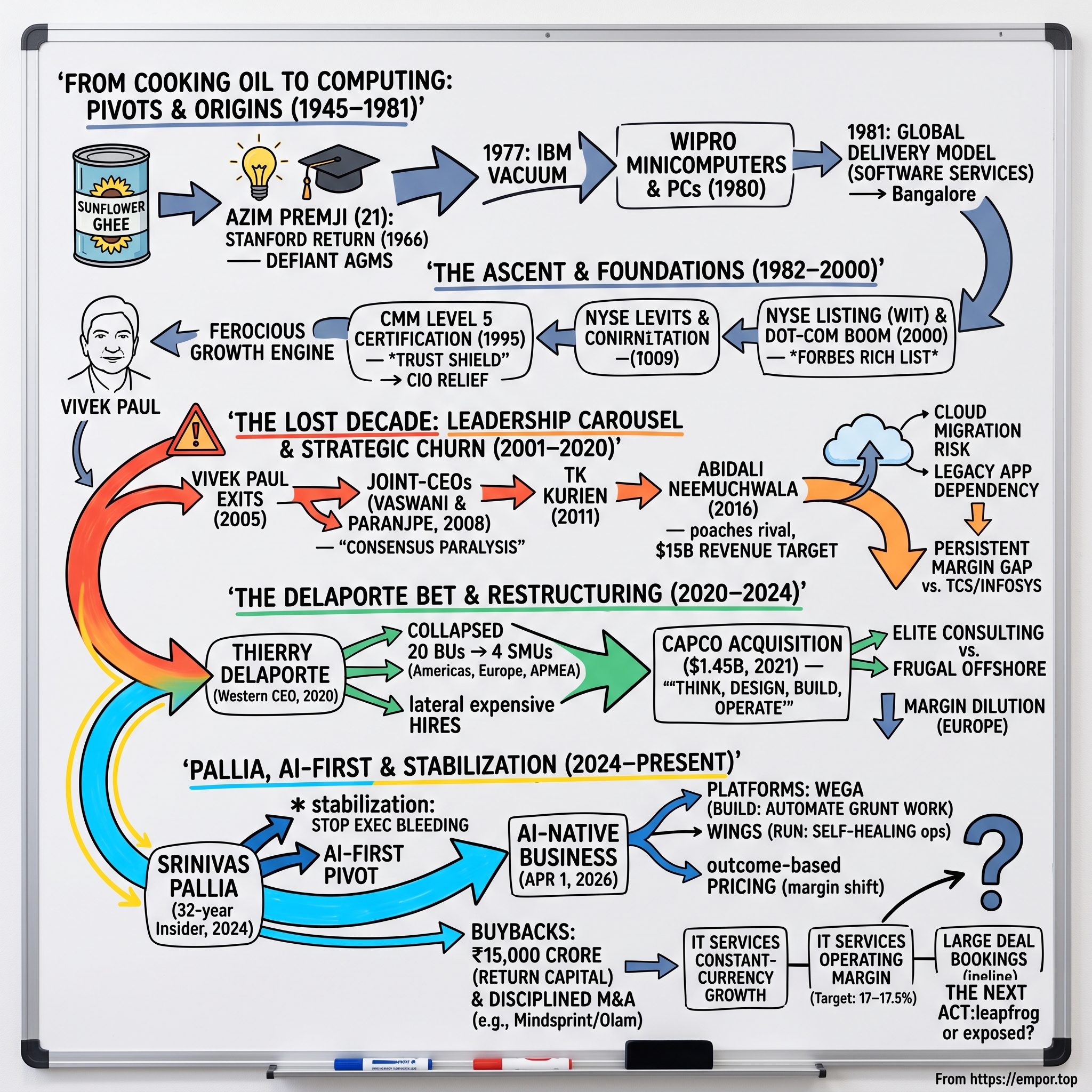
Wipro: The Leadership Carousel & The AI-First Pivot
I. Introduction & Episode Roadmap
Picture a boardroom in Bengaluru in April 2026. A 32-year company veteran, Srinivas Pallia, is two years into the top job at a firm that has cycled through five distinct leadership regimes in fifteen years. Behind him sits a balance sheet flush with cash, and in front of him sit analysts who want to know one thing: after all the restructuring, the celebrity foreign CEO, the billion-dollar acquisitions, and the endless promises of a turnaround — is Wipro finally going to grow? On that day the company answered not with a growth number but with a check. The board approved the largest share buyback in Wipro's history, ₹15,000 crore, at a premium to the market price.1 It was, in a sense, a very Wipro answer: when you cannot yet convince the market that you can compound revenue, you return the cash instead.
This is the paradox at the heart of Wipro Limited (WIPRO.NS on the National Stock Exchange of India, with American Depositary Receipts trading on the NYSE as WIT). By fiscal year 2026 — the year ended March 31, 2026 — the company reported gross revenue of ₹926.2 billion, roughly $9.9 billion, a business large enough to sit among the pillars of India's IT services export engine.2 And yet the number that defines Wipro is not its revenue; it is its relative revenue. It is one of the founding members of the club that includes Tata Consultancy Services and Infosys, and for the better part of two decades it has trailed both of them — in growth, in margin, and in the multiple investors are willing to pay for its earnings.
How does that happen? How does a company with the same founding decade, the same delivery model, the same enormous domestic talent pool, and a founder who was once the richest man in India end up as the perennial third or fourth wheel? That is the story we are going to tell, and it turns out to be one of the great case studies in corporate governance, leadership continuity, and the quiet cost of never quite deciding who you are.
Here is the truly strange part. This global technology consulting powerhouse began life as a maker of cooking oil. Not metaphorically — literally hydrogenated vegetable fat, pressed and tinned in a dusty town in Maharashtra in the years after the Second World War. The journey from vanaspati ghee to agentic artificial intelligence is not a straight line. It is a series of improbable pivots, each forced by circumstance as much as by vision, and each stamped with the fingerprints of one extraordinary and famously frugal family.
There is a second layer to the paradox, and it concerns ownership. Wipro is not a widely held public company in the way an American investor would recognize. The Premji family and its associated trusts control roughly three-quarters of the equity, and a majority of the economic interest has been irrevocably signed over to a philanthropic foundation that funds schools and rural education across India. That means the dominant shareholder of a NYSE-listed technology company is, functionally, a charity with a hundred-year time horizon. It is one of the most unusual capital structures in global large-cap equities, and — as we will argue — it cuts both ways. It grants Wipro a patience that quarterly-driven rivals can only envy. It also removes almost every external mechanism that normally forces an underperforming company to change.
So the investment question is not really "is Wipro a good business?" Its business is fine: it generates cash reliably, its clients are sticky, and its balance sheet is unencumbered. The question is whether a company with structurally weaker pricing power, a scale deficit against its two largest rivals, a decade of leadership discontinuity, and an expensive consulting acquisition still working through the system can find a second act — and whether artificial intelligence, which is simultaneously the biggest threat and the biggest opportunity its industry has faced since the internet, will be the thing that finally lets it leapfrog or the thing that finally exposes it.
Here is our roadmap. We will start in Amalner in 1945, with a cooking-oil business and a 21-year-old Stanford student summoned home by a death in the family. We will watch IBM march out of India in 1977 and Wipro march into the vacuum. We will trace the global delivery model boom that minted India's software fortunes. Then we will confront the uncomfortable middle: the leadership carousel of joint CEOs, TK Kurien, Abidali Neemuchwala, and the audacious foreign bet on Thierry Delaporte. We will dissect the Capco gamble — the acquisition that was supposed to change everything and instead diluted margins for years. And we will land in the present, with Pallia's stabilization campaign, the "AI-first" pivot, and that ₹15,000 crore return of capital. Throughout, we will keep one question in front of us: what would actually have to change for Wipro to close the gap — and what evidence is there that it can?
 Subscribe on LinkedIn
II. Sunflower Ghee and a 21-Year-Old Stanford Dropout (1945–1977)
The town of Amalner sits in the Khandesh region of Maharashtra, far from any coastline and farther still from any imagined technology future. It is here, in 1945, in the twilight of British India, that a businessman named Mohamed Hasham Premji incorporated Western India Vegetable Products Limited. The name was so literal it barely qualified as a name. The company made vanaspati — hydrogenated vegetable oil, the shelf-stable cooking fat that stood in for expensive clarified butter in millions of Indian kitchens. It sold under homely brand names like "Sunflower" and "Camel." This was a business of ledgers and tin cans, of oilseed procurement and distribution logistics, about as far from Silicon Valley as commerce got.
For two decades that is exactly what Western India Vegetable Products was: a solid, unglamorous, regional manufacturer of cooking fat. And then, in 1966, the story pivots on a personal tragedy. Mohamed Premji died suddenly. His son, Azim Hasham Premji, was 21 years old and studying electrical engineering at Stanford University in California. He did not finish the degree — he came home to run a cooking-oil company he had never intended to run. (He would eventually complete that Stanford degree by correspondence, decades later, a small detail that says a great deal about the man's stubbornness.)
There is a scene that Wipro's own mythology returns to again and again, and it deserves retelling because it explains the culture that followed. At one of his first annual general meetings as chairman, a shareholder — older, skeptical, unimpressed by the boy in the chairman's seat — reportedly stood up and advised young Azim to sell his shares and hand the business over to seasoned professional managers who actually understood vegetable oil. Premji declined. He took it, by his own later account, as a challenge rather than an insult. Whether the exchange happened exactly as legend records it almost doesn't matter; what matters is that Premji spent the next fifty years proving the shareholder wrong.
To understand why cost discipline became Wipro's religion, you have to understand the economic prison the company was born into. Independent India ran a command economy known colloquially as the License Raj — a system in which nearly every business decision of consequence required a government permit. How much you could produce, what you could import, how much foreign currency you could touch, which industries you could even enter: all of it was rationed by bureaucrats. Protectionist tariffs walled off foreign competition, but the same walls trapped domestic firms in a world of scarcity. In that environment, you did not win by spending; you won by not wasting. Wipro learned to squeeze every rupee, to obsess over ledger margins, to treat frugality as a competitive weapon. Those habits — sometimes admirable, sometimes, critics would later argue, a straitjacket — became the company's DNA.
It is worth dwelling on what the License Raj actually did to a manager's mind, because the imprint outlasted the system by decades. In a licensed economy, growth is not something you generate — it is something you are granted. If you want to expand capacity, you apply. If you want to import a machine, you apply. If you want foreign currency to pay for it, you apply again. The skill that gets rewarded is not bold capital deployment but meticulous conservation: making the permitted capacity produce more than it should, shaving input costs, extracting a few extra basis points from a fixed hand of cards. An entire generation of Indian industrialists was trained in this school, and Wipro was one of its star pupils. Premji became legendary for personally scrutinizing expenses that most chief executives would never see, for a near-allergic reaction to waste, and for a suspicion of extravagance that some found inspiring and others found stifling.
The upside of that training was enormous and directly enabled what came later. When Indian firms eventually began selling software services to the West, their entire competitive proposition rested on cost — delivering the same quality of engineering work at a fraction of the price. A management culture that had spent thirty years learning to operate on nothing was extraordinarily well-suited to running high-volume, low-cost, tightly-controlled delivery operations. The frugality that was forced on Wipro by a socialist bureaucracy became, by pure historical accident, the exact skill the global outsourcing boom demanded.
The downside took longer to show up. A culture optimized for cost control is not naturally a culture optimized for paying up — for premium talent, for expensive brand-building, for the kind of high-priced consulting capability that lets you sit at a client's strategy table rather than in its data center. Decades later, when Wipro finally tried to buy its way into the premium tier, the collision between an acquired culture of expensive Western consultants and an inherited culture of extreme thrift would prove to be one of the central dramas of the company's modern era.
Premji did not sit still inside the cooking-oil box. Through the late 1960s and 1970s he pushed Wipro into soaps, into baby-care products, into hydraulic cylinders for industrial machinery. On paper this looked like the classic Indian conglomerate sprawl. In practice it did something more important: it established Wipro's identity as an agile, opportunistic, family-controlled group willing to move into whatever adjacency looked profitable, all under the umbrella of a single trust-anchored ownership structure. That willingness to reinvent — to walk away from the thing that founded you when a better thing appears — was about to be tested by an event no one in Amalner could have engineered. The multinational that dominated Indian computing was about to walk out the door, and Wipro would be waiting.
III. The IBM Vacuum and the Birth of Indian IT (1977–2000)
In 1977, the government of India did something that in hindsight looks like an act of accidental industrial policy. Enforcing the Foreign Exchange Regulation Act, or FERA, New Delhi demanded that foreign multinationals dilute their equity in Indian operations down to 40 percent — effectively handing majority control to Indian shareholders. IBM, then the undisputed colossus of global computing and the dominant supplier of mainframes and support to Indian enterprises, refused. Rather than surrender control of its Indian arm, IBM packed up and left the country.
Think about what that meant on the ground. Overnight, an entire nation's installed base of computing hardware lost its manufacturer, its service provider, and its upgrade path. Banks, government departments, and large enterprises that ran on IBM iron suddenly had no one to call. It was one of the great supply vacuums in the history of a major economy — and vacuums, in business, get filled.
Wipro, the maker of cooking oil and hydraulic cylinders, saw the opening. Drawing on its industrial-engineering muscle, the company pivoted into computer manufacturing. By around 1980 Wipro was assembling and selling some of India's first commercially available minicomputers and, later, personal computers. This was not a natural extension of vanaspati; it was a bet that the technical talent existed domestically and that demand, freshly abandoned by IBM, was desperate. The bet paid off.
But the truly consequential move came in 1981, when Wipro established a software services operation, eventually anchored in Bangalore — the city now synonymous with Indian tech. Initially the software team existed to write code for Wipro's own hardware customers. Then came the realization that would define the next forty years: exporting human intellectual capital was vastly more profitable than shipping low-margin boxes. A minicomputer is a thing you build once and sell for a fixed, competitive, deflating price. An engineer's time, billed by the hour to a wealthy Western client, could be sold over and over, and the raw input — brilliant Indian graduates — was abundant and, by global standards, astonishingly inexpensive.
Alongside Infosys and TCS, Wipro helped pioneer what became known as the Global Delivery Model, and it is worth explaining the mechanism simply, because it is the engine that powered an entire national industry. A client in New York or London had software that needed building, maintaining, or fixing. Client-facing managers, stationed onshore near the customer, gathered the requirements and translated business problems into technical specifications. Those specs were then handed — often across a twelve-hour time difference — to large teams of skilled, lower-cost engineers in Bangalore who wrote and tested the code overnight, so that the client woke to progress made while they slept. Labor arbitrage plus a follow-the-sun clock: it was a genuinely new way to organize knowledge work, and it scaled almost without limit.
There was a problem, though, and it was one of trust. Why would a Fortune 500 bank hand mission-critical systems to a company halfway around the world, in a country better known for cooking oil than software? Wipro's answer was process certification, and here it scored a genuine first. In 1995, Wipro became the first software services company in the world to achieve the Software Engineering Institute's Capability Maturity Model (CMM) Level 5 rating — the highest tier of a globally recognized standard for disciplined, repeatable, defect-controlled software development. In plain terms, CMM Level 5 was a badge that told a nervous CIO: these people will not lose your data or blow your deadline. For an offshore vendor fighting the perception that "cheap" meant "risky," process maturity was the shield that made the whole model bankable.
It is easy, thirty years on, to underrate how radical this business was. Consider the economics from the client's side. A large American insurer needed a hundred engineers to maintain its claims systems. Hiring them in New Jersey cost a fortune, and the talent market was tight. Wipro could field the same hundred engineers, certified to the world's most rigorous process standard, at a fraction of the fully-loaded cost — and the insurer's CFO booked the difference as savings. From Wipro's side, the arithmetic was equally attractive: the gap between what a Western client paid per engineer-hour and what an Indian engineer cost was wide enough to fund healthy margins, aggressive hiring, and continuous expansion. That spread — call it the arbitrage — was the fuel of the entire Indian IT industry for roughly two decades.
But note what kind of business this created, because it explains everything that followed. It was a business where revenue scaled almost perfectly with headcount. To double revenue, you roughly doubled the number of engineers. That made growth conceptually simple — hire, train, deploy, repeat — and it made India, with its enormous annual output of engineering graduates, the natural home. It also planted a time bomb. A business whose revenue is a linear function of people has no operating leverage worth the name, no obvious path to software-like margins, and a permanent vulnerability to anything that reduces the number of hours a task requires. In 1995, no one worried about that. In 2026, it is the only thing anyone worries about.
The boom needed a face, and Azim Premji found one in Vivek Paul. Premji recruited Paul, a charismatic and globally fluent executive, to run the IT business as vice chairman and chief executive of what became Wipro Technologies. Under Paul the growth was ferocious: he took the technology business from roughly $150 million in revenue in 1999 to well over $1 billion in the early 2000s, and by the peak the IT arm generated the bulk of the corporation's income.3 Paul spearheaded Wipro's listing on the New York Stock Exchange in 2000, under the ticker WIT, timed almost precisely to the crest of the dot-com bubble. As Wipro's share price soared on the mania for anything internet-adjacent, Azim Premji's paper wealth exploded, and Forbes briefly ranked him among the very richest people on the planet.
It was a spectacular ascent — and, as with most bubble-era peaks, the descent taught the more durable lessons. The dot-com crash was coming, and so was a far more Wipro-specific problem: what happens when the charismatic executive who built the growth engine no longer wants to work for a founder who cannot stop looking over his shoulder.
IV. The Lost Decade & The Leadership "Churn" (2001–2020)
Every great compounding machine has a hidden variable, and for Wipro that variable was the relationship between the professional executive and the promoter. Vivek Paul had built something extraordinary, but in 2005 he resigned. The departure exposed a structural fault line that would crack open again and again over the next two decades: the tension between ambitious, autonomy-seeking professional CEOs and Azim Premji's intensely hands-on, cost-obsessed, detail-driven management style. When one person owns most of the company and has strong opinions about everything from strategy to stationery, "CEO" can become a job with responsibility but limited room to run. That is a hard thing for a talented executive to accept for long.
What followed was less a strategy than an experiment. In 2008, on the eve of the global financial crisis, Wipro installed not one chief executive but two — Suresh Vaswani and Girish Paranjpe as Joint CEOs. The rationale sounded reasonable in a PowerPoint: the business had grown too large and too global for one person; split it, and each leader could go deep on distinct client segments and geographies. The reality was the failure mode that anyone who has worked in a large organization could have predicted. Two CEOs meant two power centers, competing fiefdoms, blurred accountability, and decisions that required consensus where speed was needed. During the financial crisis — precisely the moment when aggressive, decisive action on large accounts mattered most — Wipro hesitated. Rivals did not. TCS and the US-listed, India-heavy Cognizant moved hard, took share, and built scale advantages that Wipro would never fully claw back. The joint-CEO era is now taught, fairly or not, as a cautionary tale about consensus paralysis.
By 2011 the experiment was dead. TK Kurien took sole command and set about doing the unglamorous work of dismantling the dual structure, reimposing operational discipline, and refocusing the organization. Kurien brought order. What he could not fully deliver was reinvention. Through the early-to-mid 2010s, the ground under IT services was shifting: enterprises were beginning the long migration to cloud computing, which threatened the very foundation of the old model. The bread-and-butter business — running and maintaining sprawling legacy applications, billed by the head — was exactly the kind of commoditized, price-deflating work that cloud and automation would eventually erode. Wipro remained heavily tethered to it.
It is worth being precise about why the cloud transition was so dangerous to a firm like Wipro, because the mechanism is not obvious to a non-technical reader. For decades, large enterprises ran their own data centers — rooms full of servers that they owned, powered, cooled, patched, and staffed. Maintaining that sprawl required armies of people, and those armies were exactly what Indian IT firms rented out. When Amazon, Microsoft, and Google began offering computing as a metered utility, the entire physical layer that generated all those billable hours started migrating to someone else's building. The client no longer needed a hundred people to keep the lights on; it needed a smaller, more specialized team to architect and govern a cloud estate. The work did not vanish, but it changed shape: less volume, more skill, different tools. Vendors who moved early — retraining staff, building cloud practices, buying capability — captured the new work. Vendors anchored to the old application-maintenance annuity watched a profitable base slowly deflate. Wipro was, more than its top rivals, in the second camp.
In 2016 came another outside bet. Wipro hired Abidali Neemuchwala, a star executive poached from arch-rival TCS, and handed him the mandate to restart the growth engine. Neemuchwala set an ambition that would haunt the company: $15 billion in revenue, a target dangled publicly as a rallying cry. It never came close. Growth persistently lagged the industry average, dragged down by Wipro's unlucky and concentrated exposure to sectors in structural distress — energy, hammered by the oil-price collapse, and retail, gutted by the Amazon-era reckoning. Neemuchwala resigned in early 2020, citing personal reasons, with the $15 billion goalpost still sitting far over the horizon.
The $15 billion target deserves a moment of analytical attention, because target-setting is one of the clearest windows into management credibility, and Wipro's record here is instructive. A public revenue goal is a promise with a number attached. When a company sets one and misses it badly — not by a rounding error but by a wide margin, and without a subsequent, specific, public accounting of what went wrong and what would be done differently — it teaches the market something. It teaches investors to discount the next ambitious number by default. Part of Wipro's persistent valuation gap is not about margins or growth at all; it is the accumulated interest on a series of promises that did not land. Rebuilding that credit is slow work, and it is done with delivered quarters rather than delivered speeches.
Step back and look at the scoreboard, because the contrast is the whole point. Over roughly the same period, TCS enjoyed almost boringly stable leadership — a smooth relay from S. Ramadorai to N. Chandrasekaran to Rajesh Gopinathan, each handoff orderly. Infosys endured a genuine crisis when founder-appointed outsider Vishal Sikka clashed with the founding board and resigned, but it then stabilized decisively under Salil Parekh, who restored growth and investor confidence. Wipro, by comparison, spent the decade in a state of near-permanent reorganization — new leaders, new structures, new strategic pivots, each partially unwinding the last. The cost was not a single catastrophe. It was something more corrosive: the slow, compounding penalty of never building sustained momentum. Investors noticed, and they expressed their verdict in the one language that matters, assigning Wipro a persistently lower valuation multiple than its more stable peers.
That was the situation Wipro's board confronted in the spring of 2020. The obvious playbook — promote another respected insider, hire another Indian-IT veteran — had been tried. So the board reached for something no major Indian-heritage IT firm had ever done, and hired a Frenchman.
V. The Thierry Delaporte Bet: Aggressive M&A and Restructuring (2020–2024)
In July 2020, in the depths of a global pandemic, Wipro announced that its next chief executive would be Thierry Delaporte, the former chief operating officer of the French IT giant Capgemini. The symbolism was enormous. Delaporte was the first non-Indian, Western-heritage CEO to run a marquee Indian-origin IT services company — a company still majority-owned by the Premji family and steeped in the frugal, process-heavy culture of the License Raj generation. Here was a Parisian consulting executive, polished and cosmopolitan, parachuted in to shake awake a company that many felt had been asleep for a decade. It was either an inspired break from the past or a cultural collision waiting to happen, and for a while it looked like both.
Delaporte moved fast, and he moved structurally. Wipro's organization had bloated into more than twenty business units — a tangle of overlapping ownership and diffused accountability. He collapsed it. In its place he built four Strategic Market Units, or SMUs, organized cleanly by geography: Americas 1, Americas 2, Europe, and APMEA (Asia Pacific, Middle East, Africa). Cutting across them he created two Global Business Lines: iDEAS, covering digital and engineering services, and iCORE, covering cloud, infrastructure, and security. The logic was to give each market a single owner accountable for the full profit-and-loss, while the global lines drove capability and consistency. He trimmed layers of middle management and — this is the part that would generate the most heat internally — went shopping for expensive senior talent, recruiting lateral hires from Capgemini, Accenture, and Cognizant to fill the new structure.
Then came the swing for the fences. On March 4, 2021, Wipro announced it would acquire Capco, a London-based management and technology consultancy focused entirely on the banking and financial services industry, for $1.45 billion in cash — the largest acquisition in the company's history.4 Capco brought more than 5,000 consultants and generated over $700 million in revenue in 2020, weighted toward North America and Europe.4 The strategic thesis was elegant on a whiteboard. Wipro was strong at the back end — the low-cost, offshore, high-volume execution of building and running systems. What it lacked was the front end: the high-margin, C-suite-facing consultants who sit with a bank's leadership and decide what to build in the first place. Marry Capco's "think and design" to Wipro's "build and operate," and you could own the entire lifecycle of a client engagement, capturing value from the boardroom conversation all the way down to the maintenance ticket.
The whiteboard, as ever, left out the friction. Start with price. Wipro paid roughly two times revenue for Capco, a rich multiple, and it paid it at what turned out to be a cyclical peak for global consulting demand — the flush, stimulus-soaked, digital-transformation boom of 2021. Buying a cyclical business at the top is a recipe for disappointment, and disappointment arrived on schedule. Then there was culture. Elite Western consultants — well-paid, autonomous, allergic to bureaucracy — do not slot neatly into a structured, metrics-driven, offshore delivery machine. The two organizations measured success differently, paid people differently, and, at a human level, often simply did not understand one another. And finally there was the math of the business model itself. Capco is asset-light but headcount-heavy, with senior partners who command large payouts. That structure is inherently lower-margin than Wipro's offshore work, so consolidating Capco diluted the group's operating margin — the very metric on which Wipro was already losing to its peers.
There is a subtlety in the Capco deal worth flagging for anyone evaluating similar transactions, and it concerns the direction of the intended synergy. Wipro's stated logic was that Capco's front-end consulting relationships would pull through large volumes of Wipro's cheaper offshore delivery work — Capco wins the strategy engagement at a global bank, then hands the implementation to Wipro. That is the "think, design, build, operate" lifecycle in a sentence. The catch is that this pull-through only works if Capco's consultants are willing and incentivized to steer their clients toward their new corporate parent, and if the clients themselves accept the handoff. Elite consultants guard their client relationships jealously and are wary of anything that risks their credibility as independent advisors. Meanwhile Capco was deliberately kept as a distinct brand, "Capco — A Wipro Company," precisely to preserve its premium positioning.4 That decision protected the asset's value but also, by design, limited the integration. You cannot simultaneously keep a business separate to preserve its brand and fuse it to your delivery machine to extract synergies. Wipro chose the former, and the pull-through has never been disclosed at a level that would let an outsider verify the thesis.
Wipro doubled down on the consulting-and-capability buildout in 2022 with the acquisition of Rizing, an elite SAP consultancy, for $540 million, aimed at deepening its enterprise-software reach.5 The pattern was clear: buy premium capability, buy it in the West, and bet that integration would eventually justify the premium.
Internally, the pressure was building toward a rupture. Delaporte's aggressive imports of expensive lateral executives — often placed above long-serving Wipro veterans — bred resentment. A steady stream of company lifers headed for the exits, unhappy at watching outsiders collect richer packages and bigger titles. For a while, buoyant pandemic-era demand papered over the tension; when everyone is growing, cultural grievances stay quiet. But in 2023 the macro turned. Interest rates rose, corporate budgets tightened, and discretionary consulting spend — the fuel for the entire Capco thesis — cratered. Utilization at the consulting units sagged, growth underperformed peers, and the investor patience that had greeted Delaporte's arrival curdled into skepticism. In April 2024, Thierry Delaporte resigned.
The verdict on the Delaporte era is genuinely mixed, and honesty requires holding both halves. He did real, necessary work: the organizational simplification was overdue, and the SMU structure survives to this day. But he also acquired an expensive consulting business at a cyclical top, absorbed years of margin dilution, and presided over a talent exodus that hollowed out institutional memory. When the board looked for his successor, it did not reach abroad again. It reached back inside — to the most Wipro person it could find.
VI. Srinivas Pallia, Stabilization, and the "AI-First" Pivot (2024–Today)
Srinivas Pallia's résumé reads like a rebuttal to the entire preceding chapter. Where Delaporte was the glamorous outsider, Pallia was the ultimate insider: a 32-year Wipro veteran who joined as a graduate trainee and worked his way up, most recently running Americas 1 — the company's single most profitable and important unit. When the board named him chief executive and managing director in April 2024, the message to a bruised, exodus-weary organization was unmistakable: the adults who understand this company from the inside are back in charge, and the era of importing expensive strangers is over.
Pallia's initial mandate was not visionary; it was triage. Stop the executive bleeding. Rebuild internal morale. Steady the biggest client relationships, several of which had wobbled during the turbulence. And, above all, execute — deliver the boring operational consistency that had eluded Wipro for a decade. Stabilization is unglamorous work, and it does not by itself close a valuation gap. But it is the precondition for everything else, and by his own framing on earnings calls Pallia has treated it as job number one.
The strategic bet layered on top of the stabilization is artificial intelligence. Wipro had actually planted its flag early: in July 2023 it announced ai360, a program committing $1 billion over three years to embed AI across its offerings and train its workforce.6 Under Pallia this went from a line item to the organizing principle. The clearest structural expression came on April 1, 2026, when Wipro announced a dedicated AI-Native Business and Platforms unit — a standalone business, led by longtime executive Nagendra Bandaru, designed to build enterprise-grade "agentic" AI products and incubate AI-led revenue streams under an "invest-build-partner" model.7 It consolidated a grab-bag of proprietary platforms — NetOxygen in lending, CROAMIS in aviation cargo, healthcare systems, telecom AI — under the Wipro Intelligence banner, with Pallia framing it as a "dual engine" model pairing traditional services with AI-native platforms.7
Two of those platforms deserve unpacking, because they represent the two ways AI threatens and reshapes an IT services business. The first is WINGS, Wipro's operations AI platform. The traditional way to keep a client's IT systems running is with armies of people — help-desk staff, monitoring teams, engineers who wake at 3 a.m. when a server fails. WINGS is designed to replace much of that reactive human labor with predictive, self-healing software: think of it as swapping a large night-shift crew for an intelligent autopilot that spots trouble before it happens and fixes routine problems on its own. The second is WEGA, described as an agent-native delivery platform. Where WINGS is about running systems, WEGA is about building them — deploying AI "agents" to automate the grunt work of software testing, code migration, and modernization, the labor that used to consume thousands of junior engineer-hours.
Here is why this matters strategically, and it is genuinely existential rather than promotional. The old IT services model was linear: revenue was, in effect, headcount multiplied by billing rate. More work meant more people; more people meant more revenue. Generative AI detonates that equation. If a large language model can write, test, and document code — automating, by many industry estimates, something like 30 to 50 percent of junior-level coding and testing tasks — then the linear headcount business is staring at structural deflation. Every efficiency gain a client discovers becomes a reason to pay you for fewer hours. The threat is not that AI kills IT services; it is that AI turns the traditional pricing model against the vendor.
Pallia's Wipro has also returned to acquisitions, but with a noticeably different character than the Delaporte-era deals — and the contrast is analytically useful. In December 2025, Wipro completed the purchase of HARMAN's Digital Transformation Solutions business, a Samsung-owned engineering unit, for up to $375 million in cash, bringing over 5,600 engineers into Wipro's Engineering Global Business Line along with a multi-year commercial relationship with HARMAN and Samsung.15 Then, in the spring of 2026, Wipro agreed to acquire Mindsprint, the captive technology arm of the Singapore-based food and agribusiness group Olam, for $375 million — completing the deal ahead of schedule on May 15, 2026, and adding more than 3,200 employees.1617 The Mindsprint transaction is the more revealing of the two, because it came bundled with an eight-year strategic engagement with Olam whose total contract value is expected to exceed $1 billion, including roughly $800 million of committed spend.16
Note what is different here. Capco was a bet on a market — that consulting demand would keep rising and that Wipro could sell the capability broadly. The HARMAN and Mindsprint deals are bets on contracted revenue: each brings a specific, named anchor client with committed, multi-year spending attached. Buying a captive IT arm alongside a long-term outsourcing contract with the former parent is a well-worn, comparatively low-risk structure in this industry, because you know on day one who is paying and roughly how much. That is a more disciplined form of M&A than paying two times revenue for a cyclical consultancy at the top of a cycle. It also, notably, is part of why Wipro's reported revenue grew in FY26 while its organic constant-currency revenue shrank — a distinction we will return to, and one investors should hold onto tightly.
Wipro's defense — and it is a defense the entire industry is scrambling to build — is to change what it sells and how it charges. Instead of billing for time and materials, the ambition is to shift clients toward outcome-based and transaction-based pricing: charge for the business result delivered or the transaction processed, not the hours worked. Do that, and the productivity that AI unlocks accrues to Wipro as margin, rather than leaking out to the client as a discount. It is a coherent strategy. Whether Wipro can actually execute the pricing transition faster than AI erodes the legacy base is, at this writing, an open and unproven question — and it is precisely the question a skeptical investor should keep asking. Management describes the pivot with conviction; the financials do not yet show a business that has crossed to the other side. To see how far there is to go, we have to look at the numbers.
VII. Current State, Segments, and Financial Reality
Strip away the strategy decks and the AI branding, and what does Wipro actually look like as a business in fiscal 2026? The headline is a study in contradiction. Reported gross revenue rose 4.0 percent to ₹926.2 billion, roughly $9.9 billion — a number that, taken alone, suggests a growing company.2 But peel back the currency effects and the picture inverts: IT Services segment revenue, measured in constant currency to strip out foreign-exchange noise, actually declined 1.6 percent for the year.2 That gap between "growing" in rupees and "shrinking" in real business terms is the single most important fact about Wipro today. The reported growth is partly an accounting mirage created by a weaker rupee and a couple of bolt-on acquisitions; the underlying organic business contracted, weighed down by legacy contracts rolling off faster than new work replaced them and by clients who kept their wallets firmly shut.
The composition of the business is now essentially pure services. IT Services accounts for roughly 99.5 percent of revenue; the old hardware and IT Products business — the direct descendant of those first minicomputers built in the IBM vacuum — has dwindled to financial irrelevance at well under half a percent, generating only a few billion rupees in FY26.2 The company that was born assembling computers now barely sells a thing you can touch.
Underneath the IT Services line, the four SMUs tell four different stories, and reading them is the key to understanding where Wipro makes its money and where it bleeds. Americas 1 — anchored in retail, consumer goods, healthcare, and life sciences — is the crown jewel, generating about a third of IT Services revenue at a healthy operating margin north of 20 percent, per the segment disclosures.8 It is no accident that this is the unit Pallia himself once ran; it is the model of what a well-run Wipro vertical looks like. Americas 2 — covering banking, financial services, insurance, and energy — is comparably large but visibly strained. Its profitability contracted versus the prior year, squeezed by exactly the forces we traced earlier: the Capco-linked consulting slowdown in financial services and clients consolidating their spending onto fewer vendors.8
Then there is Europe, and Europe is where the strategic bill comes due. It contributes roughly a quarter of IT Services revenue but at an operating margin in the low teens — dramatically below the Americas units.8 This is the Capco hangover made visible: a heavy concentration of lower-margin consulting, high labor-restructuring costs, and the structural rigidities of continental European labor markets, all dragging on the same geography where the premium acquisitions landed. APMEA, the smallest unit at around a tenth of revenue, sits in the middle on margin, constrained mostly by its lack of scale.8 The takeaway for an investor is uncomfortable but clear: Wipro's profit engine is concentrated in the Americas, and its most-hyped acquisition sits inside its weakest-margin region.
Which brings us to the number that has defined Wipro's investment case for a decade: the margin gap. Wipro's FY26 IT Services operating margin was 17.2 percent — a genuine improvement from the roughly 16 percent trough of FY24, and credit is due for clawing it back.2 But hold it against the peer set and the problem leaps out. In the same fiscal year, TCS delivered an operating margin around 25 percent, a multi-year high; Infosys came in around 21 percent; and even HCLTech, the closest comparable, sat above Wipro at roughly 17 to 18 percent.91011 A margin gap of several hundred basis points against the leaders is not a rounding error — it is a structural verdict. It reflects Wipro's weaker pricing power (a less premium brand commands less premium pricing), its scale disadvantage, and the concentrated overhead of low-margin consulting acquisitions bought at the wrong time. Closing even half that gap would transform the earnings profile. The market's skepticism is, in effect, a bet that Wipro won't.
There is a genuine bright spot in the FY26 numbers, and it belongs in the ledger alongside the disappointments: bookings. Total bookings for the year reached $16.4 billion, up 14 percent, and large-deal bookings surged more than 45 percent to $7.8 billion.2 Bookings are the pipeline — the contracted future work that eventually converts to revenue — and a 45 percent jump in large deals is a real signal that Wipro is winning bigger, more strategic engagements even as current revenue softens. The bull would say this is tomorrow's growth being planted today; the bear would counter that bookings have run ahead of revenue before without the revenue ever showing up, and that large AI-and-cost-optimization deals often carry thinner margins on the way in. Both are looking at the same true number and drawing opposite conclusions, which is exactly what makes Wipro an interesting security rather than an obvious one.
The most recent quarter available as of this writing — the three months to June 30, 2026, Wipro's first quarter of fiscal 2027 — sharpened both the hope and the worry. IT Services revenue came in at $2.61 billion, growing 0.9 percent year over year in constant currency but declining 1.2 percent sequentially; consolidated net profit was essentially flat at roughly ₹3,356 crore.1418 The genuinely uncomfortable number was margin: IT Services operating margin fell to 16 percent, down more than a full percentage point year over year, as annual salary increases, the costs of ramping up newly won large deals, and continued AI investment all hit in the same quarter.14 Management guided the September quarter to a range of roughly negative 1.5 percent to positive 0.5 percent sequential constant-currency growth — a band whose midpoint is, essentially, flat.14
The regional splits in that quarter map neatly onto the structural story. Americas 2 — the BFSI and energy unit, the home of Capco's client base — declined 7.3 percent year over year on weak discretionary spending. Europe, by contrast, grew 6 percent, and APMEA grew 13.5 percent on banking momentum.14 So the drag is now concentrated in the large, high-margin financial services franchise in the Americas, which is a different problem from the one Wipro had two years ago and arguably a more serious one, because Americas 2 is too big to grow around.
The earnings call itself is worth listening to for tone as much as content, because it reveals how management handles pressure. Analysts pressed on the durability of margins and on whether large AI-led deals carry structurally worse economics. Management's answer drew a distinction: AI-native work, they argued, commands premium pricing, while traditional cost-optimization deals — the ones where the client's entire premise is "do this cheaper" — carry margin headwinds.14 CFO Aparna Iyer reiterated the ambition to return to the 17 to 17.5 percent band but pointedly declined to commit to a timeline, citing revenue volatility.14 That is a more honest answer than a confident date would have been, and there is something to be said for a CFO who refuses to promise what she cannot control. It is also, unavoidably, an admission that the margin recovery is not yet in management's hands. On the prior quarter's call, in April, Iyer had framed the objective as maintaining margins "in a narrow band in the medium term" — language that has stayed consistent across calls, which is itself a modest credibility point in a company whose history includes rather less consistent messaging.119
The story of the family that controls all of this deserves its own paragraph, because Wipro's governance is genuinely unusual. The Premji promoter group holds roughly 72.7 percent of the equity — an enormous, controlling stake that makes a hostile takeover impossible and gives management the luxury of a very long time horizon.12 Whatever else you say about Wipro, no activist can storm the gates. The alignment shows up in unexpected places. Executive Chairman Rishad Premji — Azim's son — has his pay tightly geared to profit growth, entitled to a commission on the incremental consolidated net profit over the prior year. When FY26 profit grew only modestly, his total remuneration fell 47 percent, to ₹7.2 crore from ₹13.7 crore.13 A chairman whose pay drops by nearly half when profits stall is, at minimum, feeling the same pain as minority shareholders — a refreshing bit of alignment in a market where founder pay often floats free of performance.
And then, the capital return. On April 16, 2026, alongside the FY26 results, the board approved a ₹15,000 crore (about $1.6 billion) buyback — a tender offer to repurchase up to 60 crore shares, about 5.7 percent of the equity, at ₹250 per share, a meaningful premium to the prevailing market price.1 Shareholders ratified it by postal ballot in May, and the offer opened in June.1 Read against everything that came before, the buyback is a statement of intent. After a decade defined by restructuring and dilutive, margin-sapping M&A, management is signaling a pivot back to disciplined shareholder returns — capital returned rather than capital gambled. The skeptic's rejoinder is worth stating too: buying back stock is also what companies do when they cannot find enough profitable growth to reinvest in, and a buyback does nothing to fix the underlying revenue problem. It is capital allocation, not a business turnaround. Which of those two readings is right will be settled not by the buyback but by whether the bookings finally convert.
VIII. Playbook: Business & Investing Lessons
Wipro's forty-year arc offers a set of lessons that travel far beyond one Indian IT company, and the first is about the hidden hazard of founder-dominated structures. Call it the professional-promoter churn trap. A controlling founder brings priceless advantages — patient capital, long horizons, immunity from short-term market panic. But when that founder cannot resist shadowing every major decision, professional CEOs suffocate. The best external executives demand real operating autonomy; a promoter holding 70-plus percent of the stock inevitably casts a long shadow over the corner office, whatever the org chart says. Wipro's serial CEO turnover — Vivek Paul's departure, the joint-CEO fiasco, the veteran-versus-outsider friction under Delaporte — is not a series of unlucky personnel accidents. It is the predictable output of a governance structure where ultimate authority and formal authority never quite align. The investing lesson is not that founder control is bad; it is that founder control raises the stakes on leadership fit, and you should price in the risk of churn.
The second lesson is the M&A integration dilemma, and Capco is the textbook. The temptation to bolt a premium, front-end, C-suite consulting brand onto a high-volume delivery machine is perennial and seductive — own the whole value chain, capture the boardroom conversation, lift the blended margin. But premium consulting and industrial delivery are different businesses with different cultures, different compensation structures, and different utilization economics, and they resist fusion. Buy the consulting firm at a cyclical peak, as Wipro did, and you compound a cultural problem with a valuation problem. The result is chronic margin drag, exactly the Europe story in the FY26 segments. The lesson for investors evaluating any "capabilities" acquisition: interrogate the cyclicality of what's being bought and the compatibility of the two operating models, and treat "synergy" as a claim to be proven, not a fact to be assumed.
The third lesson is the one the entire industry is now living through: the non-linear pricing battle. For its whole history, IT services sold time — billable hours, headcount, effort. Generative AI is a solvent for that model, because it compresses the hours any given task requires. A vendor that charges per hour in a world of collapsing hours faces built-in deflation; every tool that makes an engineer faster makes the vendor poorer. Survival requires abandoning the hourly meter for outcome-based or platform-license pricing, so that productivity gains become the vendor's margin rather than the client's discount. This is not a Wipro-specific insight — it is the central strategic problem of the decade for TCS, Infosys, Accenture, and everyone else. But Wipro, with the weakest pricing power of the major players, arguably has the least room for error.
The fourth lesson is the most idiosyncratic and, in its way, the most admirable: the philanthropy-anchored capital structure. Azim Premji has irrevocably transferred a majority of Wipro's economic interest — reported at roughly 67 percent of the ownership economics — to the Azim Premji Foundation, one of the largest philanthropic endowments in the world.12 This is not window dressing. It changes the character of the company's capital. A large, permanent, mission-driven owner that funds education across rural India is not going to panic-sell on a weak quarter or agitate for a leveraged recapitalization. That patience lowers the effective cost of capital and grants a long horizon. It also functions as a genuine recruiting and reputational asset in India, where working for "Premji's company" carries a moral cachet few employers can match. The trade-off — and there is always a trade-off — is that a company insulated from market pressure can also be insulated from market discipline, which is arguably part of how a decade of underperformance was tolerated in the first place. The same anchor that provides stability can dull urgency. That tension sits at the very center of the Wipro question, and it is where the bull and bear cases finally collide.
IX. Analytical Stress Test & Bear vs. Bull Case
To pressure-test Wipro's competitive position, start with Hamilton Helmer's 7 Powers framework — a discipline for asking not "is this a good company?" but "what, specifically, prevents a competitor from taking its business?" Wipro's strongest power is switching costs, and they are real. Once a vendor is woven into a client's core systems — its ERP backbone, its cloud architecture, its security stack, the tacit knowledge of how the business actually runs — ripping that vendor out is expensive, risky, and operationally terrifying. Nobody re-platforms a global bank's back office to save a few percent on a support contract. That stickiness is why IT services revenue, even when it stagnates, rarely collapses; it erodes slowly. This is the single best thing about the Wipro investment case, and it is what makes the slow-decline scenario a floor rather than a trapdoor.
Wipro's other powers are weaker, and honesty requires saying so. Scale economies are a power Wipro possesses in absolute terms but lacks relative to TCS and Infosys. In a business where the largest multi-billion-dollar, single-vendor outsourcing deals go to the players who can credibly staff and de-risk them, being the third or fourth largest is a structural disadvantage — you get invited to fewer of the biggest tables, and you have less fixed cost to spread. Process power — the accumulated institutional muscle of distributed delivery, structured client transitions, and training systems, the discipline that produced that world-first CMM Level 5 badge back in 1995 — is genuine and durable, but it is also increasingly table stakes rather than a differentiator, because every major Indian competitor has built the same muscle. Wipro has powers; it simply does not have powers that its direct rivals lack. That is the analytical core of the valuation discount.
Run it through Porter's Five Forces and the pressure points sharpen. Bargaining power of buyers is high: large enterprise clients are sophisticated, they consolidate vendors deliberately, and they lean on providers relentlessly for cost reductions — a buyer's market that caps pricing power across the industry. Threat of substitutes is high and rising: generative AI, low-code, and no-code tools directly automate the commoditized testing and maintenance work that still forms a meaningful slice of Wipro's revenue base. Rivalry among the incumbents is intense and largely price-competitive. Only the threat of new entrants is genuinely low, protected by exactly those switching costs and scale requirements. The composite picture is an industry with a defensible perimeter but chronic internal margin pressure — which is precisely what the financials show.
Now the activist stress test — the argument a skeptical long/short investor would press. Wipro generated roughly ₹149 billion in operating cash flow in FY26, converting well over 100 percent of net income to cash — a genuinely strong, high-quality cash engine.2 The activist's needle-point question is: given that cash generation and those persistently lagging margins, is the board being aggressive enough? Why has the structural margin drag in Europe been tolerated for years rather than surgically restructured? Should the premium paid for Capco be revisited, even partially written down, to reflect a consulting market that never returned to its 2021 froth? Is a ₹15,000 crore buyback the boldest available use of capital, or the safest — a way to flatter per-share metrics without confronting the operating problem? These are fair, uncomfortable questions, and the promoter's 72.7 percent grip means no activist can ever force the issue. Whether that protection is a feature or a bug depends entirely on whether you trust the family to hold itself to account.
So, the bull case, stated at its strongest. Pallia's stabilization is real: the exodus has slowed, morale is recovering, and margins have climbed off the FY24 floor back toward the 17 percent-plus band, with management explicitly targeting the 17 to 17.5 percent range.14 The record large-deal bookings represent tomorrow's revenue being signed today. If the ai360 platforms — WINGS and WEGA — genuinely convert into non-linear, higher-margin revenue, Wipro could break the headcount-to-revenue tyranny that has capped the whole sector. And if organic growth simply stabilizes and turns positive, the valuation discount to Infosys could compress meaningfully, because so much bad news is already in the price. The bull is buying stabilization plus optionality at a discounted multiple.
The bear case is equally coherent, and it is essentially the last decade extrapolated forward. Structural organic underperformance simply continues; Wipro keeps growing slower than the industry, quarter after quarter, as it has for years. Capco's margins stay depressed and Europe remains a drag. The company keeps losing the very largest transformation deals to its larger, higher-margin rivals. And most dangerously, GenAI-driven headcount deflation shrinks the legacy revenue base faster than the shiny new AI-native business can scale to replace it — the classic innovator's trap, where the old business dies before the new one is ready. In the bear's telling, the buyback is a tell: a company returning cash because it cannot find growth.
Myth vs. Reality
Three consensus narratives about Wipro deserve testing, because each contains a half-truth that misleads.
Myth: "Wipro is a cheap way to own the Indian IT growth story." Reality: Wipro is cheap relative to TCS and Infosys for identifiable, persistent reasons — a lower margin structure, a scale deficit in the largest deals, and a decade of organic underperformance. A discount that has held for ten years is not obviously a mispricing; it may simply be an accurate assessment. The value case requires a specific catalyst that changes the operating trajectory, not merely the observation that the multiple is lower.
Myth: "The AI pivot is Wipro's chance to leapfrog its bigger rivals." Reality: every major competitor is running an essentially identical playbook — proprietary agentic platforms, large announced AI investments, retrained workforces, outcome-based pricing ambitions. Nothing in Wipro's disclosed AI strategy is structurally unavailable to TCS, Infosys, Accenture, or HCLTech, most of whom have more capital and more scale to deploy behind it. AI may well be transformative for the industry; there is no evidence yet that it is differentially advantageous to Wipro. The company has not disclosed AI-native revenue as a separate, auditable line, which means the outside world currently has no way to size the pivot at all.
Myth: "The promoter's 72.7 percent stake and philanthropic anchor are unambiguously good for minority shareholders." Reality: the alignment is genuine — the family's wealth rises and falls with the same shares everyone else owns, and the chairman's pay demonstrably fell when profits stalled. But concentrated control also means no external actor can ever force a strategic reckoning. The market's normal disciplining mechanisms simply do not apply here. Investors are, in the most literal sense, trusting the family's judgment, because they have no alternative.
The Risk Radar
Beyond the growth-and-margin debate, a few specific exposures are material enough to name. Client concentration and vertical concentration matter: Americas 2's dependence on banking and energy means a downturn in either sector transmits directly into a third of the business, as the June 2026 quarter's 7.3 percent decline demonstrated.14 Currency is a persistent and underappreciated distorter — Wipro earns in dollars, euros, and pounds while reporting in rupees, which means a depreciating rupee can make a shrinking business look like a growing one, exactly as it did in FY26. Any investor reading only the rupee headline will be systematically misled; constant-currency is the only honest lens. Wage inflation and talent competition in India compress margins from below whenever demand for AI-capable engineers spikes. Geopolitical and immigration policy risk — visa regimes governing the movement of Indian engineers to onshore client sites — remains a standing structural exposure for the entire sector. And execution risk on integration is live and current: two acquisitions closed within six months of each other, adding nearly 9,000 employees, and Wipro's own history offers ample warning about how integration can go.
One more comparison sharpens the competitive picture. The relevant peer set for Wipro is not only its Indian rivals but also Accenture, the global consulting-and-technology leader that occupies the position Wipro spent $1.45 billion trying to reach. Accenture combines genuine C-suite strategic authority with global delivery scale, and it earns premium pricing because clients believe its advice is worth paying for independently of its execution. That is the destination the Capco thesis pointed toward. The distance between the destination and Wipro's current position — a firm whose European consulting concentration is a margin drag rather than a margin lift — is the honest measure of how much of the strategy remains unproven. Meanwhile at the other end, TCS and Infosys compete on exactly the dimensions where Wipro is weakest: scale in mega-deals and operating efficiency. Being squeezed between a premium competitor you cannot out-advise and volume competitors you cannot out-cost is a genuinely difficult strategic position, and it is the position Wipro occupies today.
Which case is right will reveal itself in a small number of metrics, and an investor should watch these three above all else. First, IT Services constant-currency revenue growth, year over year — the single cleanest measure of whether the organic business has actually turned, stripped of the currency effects that flatter the rupee headline. It went negative in FY26 and inched to only about 0.9 percent in the June 2026 quarter; sustained positive momentum here is the whole ballgame.214 Second, IT Services operating margin, and specifically whether management can hold and expand it toward that 17 to 17.5 percent target — the June 2026 quarter's slide to 16 percent, driven by wage hikes, deal ramp costs, and AI investment, is a live reminder of how fragile the margin recovery remains.14 Third, large-deal bookings, the pipeline of engagements above $100 million, which is the leading indicator of whether the strong FY26 booking momentum is durable or was a one-year spike. Watch those three numbers, and you will know whether Wipro is finally closing the gap or simply narrating another turnaround that never quite arrives.
References
-
Wipro Announces Financial Results for Q4 and Full Year FY26 — Wipro, 2026-04-16 ↩↩↩↩
-
Wipro FY26 Earnings Results: Revenue at ₹926.2 Billion, Net Profit at ₹132 Billion — Angel One, 2026-04-16 ↩↩↩↩↩↩↩↩
-
Wipro: Leadership in the Midst of Rapid Growth — Knowledge at Wharton ↩
-
Wipro to acquire Capco, a global management and technology consultancy to banking and financial services industry, for $1.45 billion — Wipro, 2021-03-04 ↩↩↩
-
Wipro to acquire Capco for $1.45 billion — Wipro Investors ↩
-
Wipro to invest $1 billion in artificial intelligence over 3 years — Reuters, 2023-07-12 ↩
-
Wipro Announces AI-Native Business & Platforms Unit to Complement Core Services and Drive Next Phase of Growth — Wipro, 2026-04-01 ↩↩
-
Wipro Q4 FY26 Results & Segment Detail — Wipro, 2026-04-16 ↩↩↩↩
-
TCS Q4 FY26 Results & Earnings Analysis — StockMirror, 2026 ↩
-
Infosys FY26 results: $20.2B revenue, 21% margin — StockTitan, 2026-04 ↩
-
HCLTech FY26 revenue up 3.9%, led by increasing demand for Advanced AI — HCLTech, 2026-04-21 ↩
-
Wipro Promoter Entities Reshuffle Shareholding; Azim Premji's Equity Stake Rises — Moneycontrol / TradingView, 2025-06 ↩↩
-
Wipro Chairman Rishad Premji's pay falls 47% in FY26, CEO Srinivas Pallia takes home Rs 49.6 crore — Storyboard18, 2026 ↩
-
Wipro (WIT) Q1 2027 Earnings Call Transcript — The Motley Fool, 2026-07-16 ↩↩↩↩↩↩↩↩↩↩
-
Wipro Completes Acquisition of HARMAN's Digital Transformation Solutions (DTS) Business Unit — Wipro, 2025-12-02 ↩
-
Wipro Wins One of Its Largest Strategic Transformation Engagements from Olam Group — Wipro, 2026-04 ↩↩
-
Wipro Completes Acquisition of Olam Group's IT and Digital Services Business, Mindsprint — Wipro, 2026-05-15 ↩
-
Wipro Q1 FY27 profit stays flat at Rs 3,352 crore, revenue rises 10.6% — Communications Today, 2026-07-16 ↩
-
Wipro Limited (NYSE:WIT) Q4 2026 Earnings Call Transcript — Insider Monkey, 2026-04-16 ↩
 LinkedIn
 WhatsApp
 Reddit
 Hacker News
 Email
Email Kindle
 RSS Feed
 Spotify
 Apple Podcasts
 Amazon Music
 Audible
 YouTube