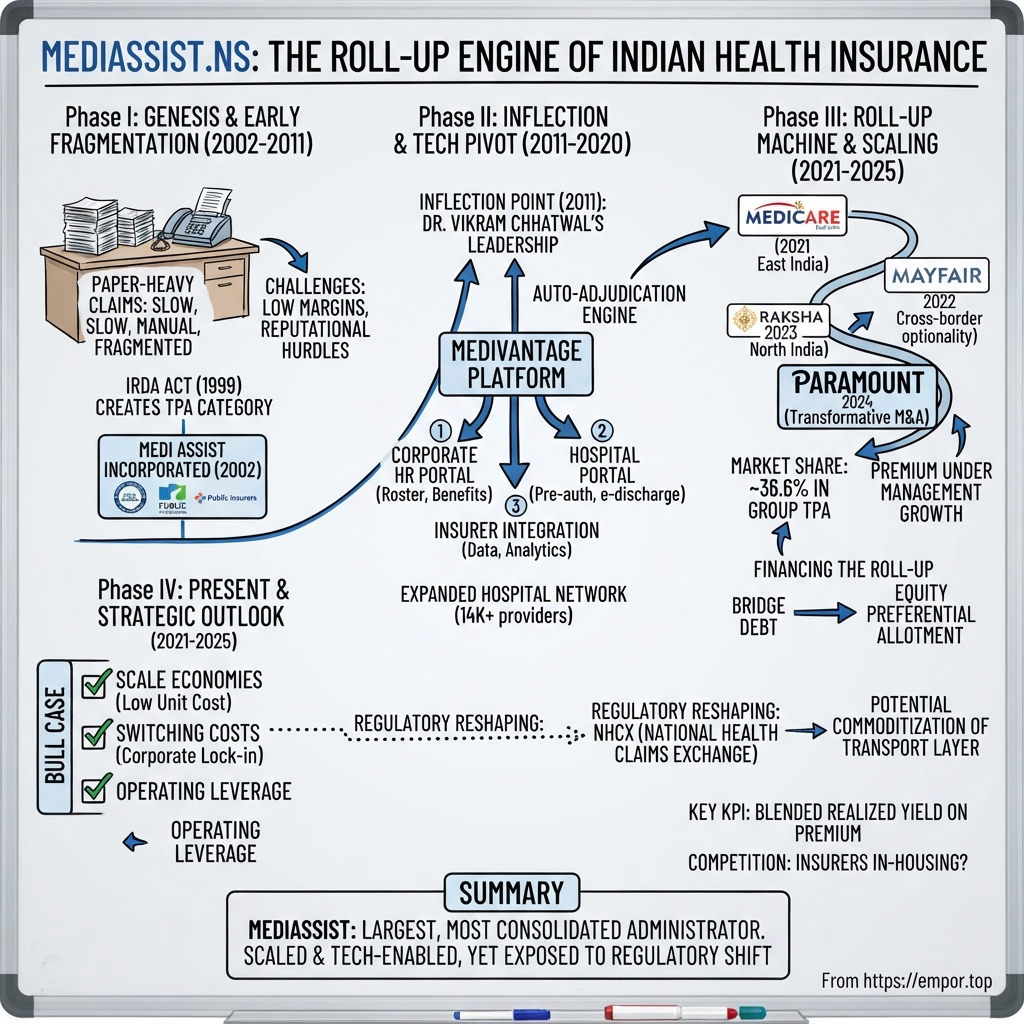
Medi Assist Healthcare Services: The Roll-Up Engine of Indian Health Insurance
I. Introduction & Episode Roadmap
A distinct anxiety exists in the corridor outside an Indian hospital billing counter. A family has been told their relative is medically fit for discharge. The doctor has signed off. The bed is needed. Yet no one can leave, because somewhere in a data centre several hundred kilometres away, a document called a "final authorisation" has not yet been approved. The family does not know who approves it. They know the name of their insurer — printed on the card in their wallet — and they know the name of the hospital. But the entity actually deciding whether they leave in twenty minutes or four hours is a third name, usually printed in smaller type on the same card, that most Indian policyholders have never considered.
Quite often, that third name is Medi Assist.
Medi Assist Healthcare Services Limited is India's largest third-party administrator of health insurance — the intermediary that sits between insurers who take the underwriting risk, corporate HR departments who buy the policies, and hospitals who deliver care and send the bill.1 It owns no hospital beds. It underwrites no risk. It does not decide what a policy covers; it decides, at industrial scale and in near real time, whether a given claim matches what the policy already specifies. For this service, it collects a fee measured in single-digit percentage points of the premium flowing through its systems — a premium pool that runs into tens of thousands of crores of rupees annually.5
That is the central paradox worth considering. Indian health insurance has been a steady compounding story in the country's financial sector, expanding at mid-to-high teens rates for most of the last decade as hospitalisation costs inflated and corporate benefit budgets widened. Medi Assist captures a slice of that flow without carrying claims risk, without capital-intensive infrastructure, and without a consumer brand that policyholders recognize. It functions as a tollbooth business in a market where traffic keeps rising. Historically, tollbooths are lucrative places to stand — until someone builds a bypass road.
The central question is therefore not whether Medi Assist has been a successful business. The reported figures, market share, and returns on capital make a clear case for its historical performance. The harder question is how a fragmented, fee-capped, low-status regulatory middleman — a category treated by insurers in its first decade as a commodity vendor and by patients as an obstacle — consolidated into the dominant administrator of India's corporate health benefits, and whether the advantages it built can survive a regulator actively attempting to standardise the industry's digital infrastructure.
That potential bypass road is the National Health Claims Exchange, or NHCX, a government-sponsored protocol designed to standardise claims data flow among hospitals, insurers, and administrators on common rails.7 India followed a similar trajectory in payments, where the Unified Payments Interface (UPI) converted proprietary networks into an open utility within a decade. Whether NHCX flattens claims administration as UPI did to payments remains the most consequential open question in the company's trajectory, and one that management's confidence alone cannot resolve.
The narrative unfolds in distinct phases. It begins in the aftermath of India's insurance deregulation, when a 1999 act of Parliament established private insurers and created the third-party administrator category — an industry born of regulation rather than market demand, which behaved accordingly during its first decade. The story turns in 2011, when physician-turned-operator Dr. Vikram Jit Singh Chhatwal took control and gambled that software was the only exit from commodity purgatory. It accelerated from 2021 onward into a deliberate roll-up — acquiring Medicare, Mayfair, Raksha, and Paramount — that bought market share the company could not generate organically. It reached public markets in January 2024 with an offer for sale subscribed over sixteen times.[^6] Finally, it arrives at the present with a company larger and more consolidated than ever, yet distinctly exposed to regulatory reshaping.
Along the way, this analysis tests each load-bearing claim in the bull case — the technology moat, the roll-up arithmetic, the pricing power, and the management record — against the strongest disconfirming evidence in the company's history. Some claims survive intact. Some survive only in narrower form. At least one, on the available evidence, fails to hold up.
 Subscribe on LinkedIn
II. The Genesis: Deregulation, the TPA Mandate, & Early Industry Fragmentation (2002–2011)
Picture a claims processing floor in Bangalore in 2004. There were no screens worth mentioning — only physical trays stacked with photocopied discharge summaries, handwritten doctors' notes, pharmacy bills fading on thermal paper, and pre-authorisation forms faxed from hospital administrative offices hundreds of kilometres away. A clerk read the handwriting, cross-referenced a printed policy schedule, and either stamped the file or sent it back. In those early years, the promise of Indian cashless healthcare — that a patient could enter a hospital without paying upfront — rested on the legibility of a junior doctor's handwriting and the speed of the postal system.
This paper-heavy system existed because of regulatory history. Before 1999, Indian general insurance was effectively a state monopoly operated through four public-sector giants: New India Assurance, Oriental Insurance, National Insurance, and United India Insurance. Health cover was a minor, neglected line of business within these firms — sold thinly, priced crudely, and settled almost entirely on a reimbursement basis. The patient paid the hospital in full, collected paper receipts, submitted them, and waited. Fraud was endemic because verification was impossible at scale, leaving both insurers and policyholders dissatisfied.
The Insurance Regulatory and Development Authority Act of 1999 restructured the industry. It opened general insurance to private and foreign-partnered entrants and established the regulator — IRDA, later IRDAI — that would write the rules for what followed.6 Among those rules was a licensing regime for a new intermediary category: the third-party administrator (TPA). TPAs were licensed to handle the operational tasks that insurers preferred not to build internally: empanelling hospitals into a cashless network, running pre-authorisation desks, verifying and processing claims, and settling accounts with healthcare providers. The regulator had, in effect, created an entire industry by writing it into the regulatory framework.
Medi Assist was incorporated into that opening in 2002, as one of the earliest movers in a category that barely existed.1 Its initial business was purely operational: administering group health policies for corporate employers and taking on portfolios from public-sector insurers who needed external support to handle the operational burden of a rapidly growing product line.
The early TPA era is instructive because of its challenging unit economics. Roughly thirty licensed operators competed, most of them regional, family-owned firms differentiated primarily by relationships with specific regional insurance offices. Fee ceilings were set by regulation at around 5.5% of premium, but market competition drove actual negotiated rates down into the low single digits as insurers used competitive tendering to squeeze the category.6 The cost base, meanwhile, consisted almost entirely of headcount. More claims required more clerks, leaving no room for operating leverage.
That structure created difficult business dynamics. A company facing regulated maximum pricing, minimal differentiation, sophisticated institutional buyers who tendered annually, and a cost structure scaling linearly with volume faced severe operational headwinds. Every incremental rupee of premium administered added roughly proportional operational costs. Scale often created a negotiating disadvantage rather than an edge, as larger insurers wielded greater leverage in fee negotiations.
The industry's reputational standing was equally challenging. Insurers viewed TPAs as interchangeable vendors and an expense line item to be minimised. Hospitals blamed them for delayed receivables, as every day a claim sat unapproved tied up working capital in a discharged patient's file. Policyholders, when aware of the TPA's role, associated the intermediary with claim denials. The structure of the role dictated this dynamic: the insurer established the policy exclusions, but the TPA delivered the rejection.
The most significant operational bottleneck was turnaround time. A hospital unable to receive a discharge authorisation could not free up a bed, while a patient awaiting discharge occupied capacity without generating additional revenue. In a healthcare system with a chronic shortage of tertiary beds, slow manual adjudication constrained overall hospital throughput. Every participant in the ecosystem paid a heavy tax measured in delayed hours.
That operational friction represented the primary market opportunity. Any administrator capable of reducing turnaround times from days to minutes would deliver clear value to hospitals, lower administrative costs for insurers, and improve the experience for patients — all while competing against incumbents relying primarily on paper workflows. However, capitalizing on that opportunity required substantial capital, strategic focus, and operational capability. By 2011, Medi Assist had operated for nine years and remained essentially one of thirty companies processing paper. Its trajectory shifted when leadership changed.
III. The Inflection: Tech Pivot & Dr. Vikram Chhatwal's Playbook (2011–2020)
Dr. Vikram Jit Singh Chhatwal came to Medi Assist from a vantage point that made the company's operational problems legible in a way that pure financiers might have missed. A physician by training who transitioned into healthcare operations and technology, Chhatwal had previously run Apollo Health Street before taking management control of Medi Assist in 2011 — overseeing a healthcare business process and revenue-cycle management company built around medicine's back office of coding, billing, claims, and settlement.1 That background provided the operational skill set that most third-party administrators lacked, as traditional TPA founders typically emerged from insurance distribution or general administrative services rather than hospital billing desks.
The strategic realization he arrived at was straightforward: a third-party administrator competing purely on labor arbitrage would face continuous margin pressure because manual processing offered no defensible moat. The operational escape route lay in software — building a platform deeply embedded enough that corporate HR departments depended on it operationally, hospital front desks used it daily, and insurer underwriting engines relied on its data feeds. By shifting from a manual clearinghouse to digital infrastructure, the company aimed to move beyond being a replaceable commodity vendor.
Medivantage: making claims processing a software problem
The platform Medi Assist built around this thesis, Medivantage, functions as a set of digital integrations pointing in three directions simultaneously.1
Facing the employer, Medivantage connects directly into corporate HR platforms where enterprises manage employee rosters, dependents, joiners, leavers, and benefit elections. An enterprise with fifty thousand employees experiences constant administrative churn as staff join, leave, marry, or update family cover. Every event must propagate accurately into the insurer's master record to prevent an eligible employee from being turned away at a hospital desk. Automating that synchronization removes a persistent administrative burden from corporate HR teams.
Facing the hospital, Medivantage provides a dedicated portal for pre-authorization requests and approvals. This replaced legacy fax and telephone communication with structured digital submissions, encouraging standardized data exchange over unstructured text.
Facing the insurer, the platform delivers claims data, reserving inputs, fraud indicators, and loss analytics essential for pricing annual policy renewals. Insurers that can analyze granular loss ratios across specific employee cohorts and hospital networks can price risk more accurately, creating an informational advantage that proved valuable to carrier partners.
Overlaying these integrations was auto-adjudication: rules engines designed to process routine, low-complexity claims algorithmically against policy terms without manual intervention. Much like automated credit card processing — where transactions are checked against credit limits, fraud rules, and merchant categories in milliseconds — auto-adjudication applies automated logic to standardized admissions such as routine cataract surgeries or short hospital stays. If the procedure code, tariff schedule, policy terms, and member eligibility match, the system approves the claim immediately, reserving human adjusters for complex, expensive, or suspicious cases.
The financial implication is operating leverage. Auto-adjudication allows a claims administration business to disconnect volume growth from proportional headcount expansion, as each incremental automated claim incurs negligible processing cost. The long-term moat argument relies less on software uniqueness than on scale: Medi Assist can amortize its technology investments across a significantly larger volume of claims than smaller competitors.
The group health wedge
A second strategic decision during this era involved choosing where not to compete.
During the 2010s, standalone health insurers such as Star Health, Care Health, and Niva Bupa expanded rapidly in India, selling individual and family floater policies directly to retail consumers. These monoline insurers established internal claims processing teams from inception. For a standalone health insurer, claims adjudication represents core underwriting control rather than back-office administration, making outsourcing unappealing. As a result, the expanding retail health segment remained largely closed to independent administrators.
Medi Assist responded by concentrating on group health policies purchased by corporate employers for staff and dependents. Group health features structural dynamics that favor an independent administrator.
Large enterprises select health coverage through periodic tenders where insurers bid competitively, often resulting in carrier changes based on pricing shifts. From the employer's perspective, underwriters are swappable counterparties. The administrative interface, however, represents a higher switching barrier: HR teams train employees on a specific application, integrate systems, and establish operational workflows around a single administrator's infrastructure.
By retaining the administrator while permitting the underwriter to change, corporate clients inverted the power dynamic that burdened early TPAs. Rather than functioning as a vendor dependent on an insurer's contract, an embedded administrator becomes an operational constant that incoming underwriters must accommodate.
This switching-cost advantage applies primarily to large enterprises with sophisticated HR functions. Mid-sized employers purchasing off-the-shelf group policies typically accept whichever administrator the carrier bundles, making the addressable pool of high-retention corporate accounts narrower than headline premium figures suggest.
Building the hospital side
The third element of the strategy focused on network expansion. Medi Assist grew its empanelled cashless provider network from a few thousand hospitals in its early years to more than fourteen thousand.1 The value proposition offered to healthcare providers combined pre-negotiated tariff discounts with steady patient volume and standardized settlement timelines.
This network expansion created operational scale, though empanelment remains non-exclusive. Hospitals routinely empanel with multiple administrators and direct carrier networks simultaneously. The operational advantage stems not from exclusive provider access, but from negotiated tariff discounts driven by transaction volume and established billing desk workflows.
By the end of the 2010s, Medi Assist had transitioned from a manual claims processor into a software-enabled administrator focused on corporate group health. However, organic expansion faced natural boundaries as retail health remained in-housed by monoline carriers and corporate group penetration matured, setting the stage for the company's subsequent acquisition strategy.
IV. The Roll-Up Machine: M&A, Scaling, & The PE Exit (2021–2025)
Every roll-up begins with the same uncomfortable meeting. Management looks at the organic growth plan, looks at the addressable market, and concludes that the compounding needed cannot be achieved simply by winning new accounts at the existing rate. So leadership goes shopping.
Medi Assist reached that inflection point around 2020. The logic on the whiteboard was, on its own terms, sound. The Indian third-party administrator (TPA) industry remained populated by sub-scale operators — regional, family-controlled firms running on legacy systems, lacking both the capital to modernise and the claim volume to justify the investment. Each target carried something genuinely valuable: an administered premium book tied to established corporate and insurer relationships. Each target also carried obvious redundancies: duplicate head offices, duplicate technology spend, and duplicate compliance functions.
The arithmetic of a services roll-up is mechanical when execution holds. Acquire the book, migrate the claims volume onto an existing platform, and retire the target company's overhead. Because the incoming revenue incurs minimal incremental processing cost, profit margins expand even without raising prices. In a fee-squeezed industry, it represents the primary mechanism for generating operating leverage.
It is also, historically, a reliable way for a business to destroy capital when two critical assumptions fail: that the acquired revenue stays after acquisition, and that system integration proceeds without disruption.
The sequence
Medicare TPA (2021) came first — an eastern India expansion that added corporate and public sector accounts and served as the template for what followed.1 Beyond modest scale, it provided a practical test of whether Medi Assist could migrate another administrator's portfolio onto Medivantage without losing clients during the transition.
Mayfair (2022) represented a strategic diversification rather than pure consolidation. Acquiring Mayfair India and Mayfair UK brought cross-border health benefits administration, international patient management, and expatriate cover into the group.1 Yields per claim in that segment run higher than domestic TPA fees because underlying premiums are denominated in hard currencies and service intensity is greater. Given its small size relative to the core business, Mayfair acts primarily as strategic optionality, requiring ongoing discipline to verify whether that optionality yields durable returns.
Raksha TPA (2023) marked the first major domestic consolidation deal, concentrating market share in northern India and adding marquee corporate accounts.1 By this point, the playbook was established, establishing Medi Assist as the primary consolidator in the TPA sector.
Paramount (2024–2026) was the transformative transaction. Medi Assist agreed to acquire Paramount Health Services & Insurance TPA from Fairfax Asia and the Nayan Shah family, with the subsidiary completing the 100% acquisition in March 2024 at an enterprise value of approximately ₹311.8 crore and total deal consideration near ₹412 crore.4 Paramount brought roughly ₹4,000 crore of premium under management into the group.
The transaction substantially expanded market share. Medi Assist's position in the group health TPA segment rose from roughly 30% to approximately 36.6%, lifting its share of the overall health TPA industry to around 23.6%.3 In a market with over a dozen licensed competitors, a single company came to administer more than a third of all corporate health premium handled by Indian TPAs, establishing a structural lead over peers.
The financing sequence highlights how the expansion was funded. Medi Assist initially backed the transaction with roughly ₹150 crore of bridge debt alongside internal cash flows — a notable shift for an asset-light business that had historically operated with minimal leverage.3 Management subsequently retired that debt by January 2026 through a ₹198 crore preferential allotment.3 Operational integration followed in February 2026 when the TPA business was consolidated into Medi Assist Insurance TPA Private Limited via a slump sale, merging two licensed entities into a single operating platform.3
Reading the financing honestly
This capital sequence can be evaluated through two distinct lenses.
The favorable interpretation holds that management deployed short-term debt to secure a scarce asset quickly, then repaired the balance sheet from a position of operational strength, returning to a debt-free structure within two years of closing.
The more cautious interpretation notes that cash flow alone could not cover the transaction. The company borrowed to bridge the purchase price and subsequently issued equity to extinguish the debt, meaning existing shareholders funded part of the purchase through dilution. A preferential allotment represents equity capital raised at a specific valuation; its ultimate value creation per share depends on whether Paramount's post-integration earnings exceed the cost of that issued equity.
Both perspectives rest on verifiable facts, and the full financial result remains open. The ultimate outcome depends on client retention over multiple annual renewal cycles. With the slump sale completing in February 2026, a substantial portion of the acquired corporate book has experienced only one or two renewals under new ownership.
This uncertainty reflects a core operational risk in services roll-ups. Acquiring a TPA does not mean acquiring fixed contracts; it means acquiring client relationships that expire annually and are subject to competitive re-tendering by corporate insurance brokers. The 36.6% market share figure captures a specific post-acquisition metric. The durable market position will depend on retention levels after the portfolio undergoes full repricing and competitive bidding. Until multi-year retention metrics are fully disclosed, the transaction represents a clear strategic expansion whose long-term equity returns remain unproven.
Dalal Street
The company's public listing in January 2024 structured the business's capital access in specific ways.
Medi Assist listed on the NSE and BSE following an offer for sale of approximately ₹1,171 crore that was subscribed 16.25 times on its final day.[^6] Because the transaction was structured entirely as an offer for sale, no primary capital entered the company's balance sheet. All proceeds flowed to selling shareholders — primarily private equity and promoter holders, including Bessemer Venture Partners monetising a long-held position.[^6]2
A pure offer-for-sale structure aligns with an asset-light business model that generates sufficient operating cash without requiring primary equity for organic operations. However, it also functioned primarily as a liquidity event for existing investors rather than a growth funding event for the company. High investor demand reflected scarcity value: Medi Assist entered public markets as India's only listed pure-play health claims administrator, offering exposure to healthcare expansion without carrying underwriting risk.
Scarcity value influences market valuation rather than operational advantage. Notably, while the company raised no primary capital at IPO, it returned to equity markets roughly two years later to issue shares via preferential allotment to clear acquisition debt. This sequence does not indicate poor capital allocation, but it clarifies that corporate growth has required external equity financing during major consolidation phases.
Public market listing fundamentally altered the company's M&A capabilities. Having a public equity valuation, access to preferential share issuance, and audited financial disclosure gives an acquirer structural advantages when buying private, family-owned TPAs. Lenders and sellers can evaluate transaction terms against a visible market price, providing an acquisition currency that matters more than IPO proceeds alone.
Which brings the focus to what the operational engine actually processes, and how the business generates its fee income.
V. Core Business Deep Dive: Mechanics, Economics, & Segment Breakdown
Following a single claim through the platform clarifies how the underlying business model generates value.
An employee of a large Indian technology firm is admitted to a hospital in Pune late at night. At the admissions counter, hospital personnel access the administrator's portal, enter the employee's member identification, and submit a pre-authorisation request containing a provisional diagnosis and cost estimate. The system evaluates four variables almost simultaneously: active member eligibility based on real-time HR roster updates, policy coverage for the diagnosed condition, hospital network empanelment alongside negotiated tariff rates, and anomaly detection markers. If all four checks pass, an automated pre-authorisation approval is returned within minutes without manual intervention. Cases triggering exception rules are routed to a medical reviewer.
Upon discharge three days later, a final authorisation reconciles the itemised hospital bill against negotiated tariffs, isolates non-payable items, and settles the approved balance directly with the healthcare provider. The patient pays out-of-pocket deductions, the insurer receives the consolidated claim file, and Medi Assist collects its administrative fee.
That administrative fee represents the core revenue stream, though its structure varies. In corporate group health, compensation is calculated either as a percentage of premium under management — typically in the low single digits — or as a fixed fee per covered life or per processed claim.5 The percentage-of-premium structure provides automatic indexation to medical inflation: as hospital costs elevate premiums, administrative fee yields expand without requiring contract renegotiation. Conversely, per-life or per-claim fixed fees insulate buyers from premium inflation and are preferred by cost-conscious institutional clients.
Consequently, the critical analytical metric for the business is yield — the realized administrative fee as a percentage of premium under management. Top-line revenue can expand even while yield compresses if premium volume grows faster than fee rates decay. Distinguishing between volume-driven revenue expansion and underlying yield compression is essential to assessing long-term earnings quality.
Group health: the engine
Group health administration accounts for roughly three-quarters of total revenue and generates nearly all of the business's strategic value. This corporate segment encompasses cashless hospital admissions, claim settlement, outpatient benefits management, wellness programs, and corporate HR helpdesk support.
The segment's unit economics benefit from high client retention among large enterprise accounts and diminishing incremental processing costs as auto-adjudication rates rise. Operating leverage in this structure is asymmetrical: because core software platform costs are fixed, acquiring a corporate account generates high marginal profitability, whereas losing an account erodes earnings significantly while leaving the cost base largely intact. This asymmetry underscores why client retention across acquired books serves as the primary determinant of success in a roll-up strategy.
The core competitive dynamic in group health centers on whether enterprise clients continue to demand an independent administrator rather than adopting an insurer's in-house claims team. Large corporations have historically preferred independent administrators to preserve flexibility when switching insurance carriers. This preference remains contingent on major private general insurers finding third-party administration more cost-effective than maintaining internal operations. Should major carriers shift toward in-housing group health administration, the addressable market for independent administrators would contract accordingly.
Retail health: the defended margin
Retail health administration — handling claims for individual policyholders on behalf of general insurers — generates a mid-teens percentage share of revenue, representing a structurally constrained market segment rather than a primary growth driver.
Because standalone health insurers process individual claims in-house to maintain underwriting control, the addressable retail TPA market is restricted to general insurers who choose to outsource claims handling. Medi Assist maintains a leading position in this specific category — holding approximately 14.8% of the overall retail health TPA market based on disclosures accompanying the Paramount transaction — yet a dominant position within a slow-growing market segment functions primarily as a defensive cash generator.3
Accordingly, the retail segment is best evaluated as a cash-generative legacy book to be managed for margin efficiency rather than an expandable growth engine, consistent with empirical market trends over the past decade.
Government schemes: volume without margin
Government health schemes — encompassing central and state initiatives such as Ayushman Bharat (PM-JAY) and regional public health programs — contribute roughly 5% of revenue and operate under distinct economic parameters.
Direct economics in government schemes remain challenging: administrative fees are capped at low fixed rates per family or claim, contract tendering is intensely price-competitive, and extended government payment cycles absorb working capital. On a standalone margin basis, the segment offers limited financial returns.
Management maintains that high scheme volumes provide indirect strategic value by expanding the company's network footprint and enhancing bargaining power when negotiating hospital tariffs across its broader portfolio. However, because segment-level profitability is not disclosed at a granular level, whether these network advantages offset direct margin dilution remains unverified. Investors should monitor this segment for margin drag if low-yielding public scheme volumes outpace core corporate growth.
International and specialty: real optionality, unproven
The Mayfair business units manage cross-border health benefits, expatriate policy administration, and medical travel assistance, generating a small single-digit percentage of overall group revenue.
This segment offers structurally higher administrative yields, as cross-border and expatriate claims denominated in foreign currencies yield higher revenue per transaction than domestic corporate claims. Additionally, India's cost advantages in complex medical procedures provide long-term exposure to inbound medical travel.
However, medical value travel in India has historically proven difficult to monetize at scale. While higher-yield specialty services represent attractive optionality, their financial contribution remains modest relative to the core business. Evaluating this segment requires tracking whether international and specialty revenues compound faster than the domestic group health business over multiple fiscal cycles or remain a secondary revenue line.
Taken together, the segment breakdown reveals a company driven primarily by a single core engine rather than a diversified portfolio. Group health generates the operational returns, retail health defends a mature fee pool, government schemes trade margin for volume, and international specialty operations provide early-stage optionality. Ultimately, evaluating Medi Assist requires assessing the durability of its corporate group health franchise and the competitive dynamics governing enterprise benefits administration.
VI. Industry Structure, Competition, & The 7 Powers Framework
A strategic analysis of the Indian health insurance administration sector reveals that Medi Assist's primary threat comes not from competing administrators, but from the insurers themselves.
The named rivals are real enough. Vidal Health, Family Health Plan Limited, Heritage Health, MDIndia, and Genins India occupy the licensed third-party administrator landscape alongside a handful of smaller regional operators.1 Yet the market structure remains strikingly lopsided: Medi Assist's group health market share of roughly 36.6% exceeds the next two competitors combined,3 while much of the remaining field consists of family-controlled, thinly capitalised firms unable to fund the technology investments or acquisitions required to close the gap. In a business where fixed technology costs demand high processing volumes, operating as a sub-scale administrator is not a durable long-term strategy—it is a prelude to consolidation.
This dynamic explains why the roll-up strategy proved effective. Medi Assist was less focused on outmanoeuvring peers than on offering sub-scale operators an exit from an unviable model. However, that acquisition engine faces structural limits. Each deal consumes a potential target from a finite pipeline, and following the Paramount transaction, the remaining pool of target administrators is smaller and less attractive than the field available in 2021. Consolidators inevitably run out of acquisition targets, forcing equity markets to re-evaluate the business on organic growth performance—often demanding higher proof of efficiency once deal synergies are fully absorbed.
The real competitor is the insurer
The principal competitive threat facing Medi Assist is vertical rather than horizontal. Standalone health insurers already process the vast majority of their claims in-house, effectively closing the retail health pool to external administrators. The open question is whether large private general insurers and public-sector carriers will follow suit.
The rationale for in-housing claims administration is compelling. Claims data forms the core of underwriting precision; an insurer that outsources adjudication surrenders direct visibility into its loss experience. Regulatory mandates on service standards place ultimate accountability on the carrier regardless of operational delegation. Furthermore, as claims processing transitions from manual clerical work to software automation, internal execution becomes far more achievable—removing the primary historic justification for outsourcing, which was managing a massive, distributed workforce.
Conversely, the structural counterarguments remain substantive. Corporate group health administration requires dedicated client management, HR system integration, and multi-carrier portability that single insurers cannot easily replicate. An insurer's internal claims team cannot offer an enterprise client carrier-agnostic continuity during periodic underwriting tenders. This requirement for neutrality is the primary reason the corporate group segment has resisted in-housing while retail health transitioned internal, representing a fundamental structural distinction rather than a temporary delay.
Porter's five forces, honestly applied
Buyer power: high, and rising. Institutional clients—both corporate employers and insurance carriers—are advised by sophisticated risk brokers such as Marsh, Aon, and Willis Towers Watson, which manage major account tenders. Brokers operate competitive bidding processes to compress vendor costs and maximize client benefit packages. Consequently, any assertion that Medi Assist holds significant pricing power must account for institutional buyers using professional intermediaries explicitly hired to limit administrative fee margins.
Supplier power: moderate. Healthcare providers supply the underlying hospital network. While small regional clinics possess limited individual negotiating leverage, major corporate hospital chains retain substantial power during tariff negotiations, as a provider network lacking prominent metropolitan hospital groups lacks market credibility.
Threat of substitutes: high and structurally rising. The primary substitute remains an insurer's internal claims department. The historical shift within the retail health segment demonstrates that carriers will bring administration in-house when strategic alignment permits.
Threat of new entrants: low to moderate. Regulatory licensing, hospital network empanelment, and enterprise software integration impose high entry barriers for traditional startups. However, a well-capitalised insurtech leveraging standardized public data infrastructure faces lower technical entry barriers than predecessors required to build proprietary provider integrations from scratch.
Rivalry: moderate, and asymmetric. Price competition among independent administrators remains intense, but capability-based rivalry is muted because most competitors lack the capital necessary for sustained technology investment.
The 7 Powers, with the grades justified
Scale economies — strong, representing the most defensible economic advantage. The baseline technology platform incurs fixed costs, which amortize across a premium volume larger than any competitor in the sector. Administrators handling smaller premium volumes face higher operating costs per claim. This structural advantage depends not on proprietary software uniqueness, but on maintaining an unmatched claim processing volume.
Switching costs — strong in corporate group health, negligible in other segments. Deep integration with enterprise HR platforms, established employee workflows, and multi-carrier continuity create operational switching barriers for large corporate clients. However, this protection applies primarily to major enterprises; switching barriers remain weak among mid-market employers and virtually non-existent in retail and government scheme segments, where carriers or state authorities can easily reassign administrative contracts.
Network effects — moderate, and frequently overstated. A two-sided network dynamic links empanelled hospitals with corporate client bases. However, because hospital empanelment is non-exclusive, competing administrators can contract with the same healthcare providers, making the network contestable rather than proprietary.
Cornered resource — weak. Regulatory TPA licenses remain accessible, hospital network agreements are non-exclusive, and key operational inputs are widely available. While the company's historical claims dataset offers analytical utility, insurers maintain parallel records on the same policyholders, preventing the data from functioning as a proprietary asset.
Counter-positioning — weak. Medi Assist operates a traditional TPA model at superior scale rather than a disruptive business model that incumbents cannot adopt without damaging existing revenue streams. The absence of counter-positioning leaves the company exposed to insurers expanding internal administration.
Process power — moderate. Over two decades of refined adjudication algorithms, fraud detection rules, tariff reconciliation protocols, and pre-authorisation workflows provide substantive operational efficiency. However, this process advantage gradually diminishes as data protocols standardize across the industry.
Brand — weak among end-consumers, moderate among institutional buyers. Policyholders do not select their claims administrator, and consumer brand awareness remains low. Conversely, institutional reputation carries weight among corporate HR directors and insurance brokers, though this brand equity functions primarily as a reflection of operational reliability and scale.
In summary, Medi Assist's durable economic advantages rest on scale economies and corporate switching costs, while other competitive powers remain limited or contingent. Although narrower than market narratives suggest, a business combining lower processing costs with deeply embedded client workflows retains strong compounding potential. The core operational task facing management is allocating capital effectively to preserve these twin competitive advantages.
VII. Management, Capital Allocation, & Governance Transition
Companies built around a single founder-operator eventually face a moment when the founder's continued centrality becomes a question rather than an asset. Medi Assist reached that moment in 2026.
Satish V.N. Gidugu serves as Chief Executive Officer and Whole-Time Director, and by any reading of the company's operational history he is the architect of the machinery described in this analysis.1 His background is technology and operations rather than insurance distribution, and those priorities are reflected in the company's execution: automated adjudication workflows, loss analytics delivered to insurers as a core product, and the systematic migration of acquired portfolios onto a single platform. That last capability is the least glamorous and the most critical. A roll-up strategy succeeds or fails on its integration function, which requires operational discipline rather than strategic vision alone.
Dr. Vikram Jit Singh Chhatwal — the promoter who took control in 2011 and led both the technology pivot and the acquisition program — transitioned from Executive Chairman to a Non-Executive Director role in August 2026, separating the board's oversight function from executive management.1
That transition carries two potential interpretations. The favorable view points to governance maturation aligned with Indian institutional expectations and SEBI guidelines: a founder stepping back from executive authority so an independent board can supervise management, at a time when the company operates under an established CEO. The alternative view notes that founder-promoters who transition to non-executive board roles while retaining significant equity stakes can sometimes maintain informal influence, achieving structural separation in form more than substance.
The available evidence does not confirm either interpretation conclusively. The timing is defensible, as the transition followed the operational consolidation of the company's largest acquisition rather than preceding a period of disruption, and the corporate structure matches governance best practices. The practical test will be behavioral over subsequent fiscal cycles: whether the board demonstrates independent challenge on future capital allocation and whether executive authority visibly resides with the CEO.
The capital allocation record, assessed rather than asserted
The company's return profile has been strong, driven primarily by structural asset-light economics. An administrator carries no hospital facilities, diagnostic equipment, or underwriting reserves on its balance sheet. Its asset base consists mainly of software platforms, working capital, personnel, and acquired goodwill. Operating with modest capital employed and steady margins generates elevated returns on equity, which remained in the high teens to low twenties range through the recent period.5
However, that return metric requires a standard analytical caveat. For a roll-up carrying substantial acquired goodwill, return on equity flatters the underlying business because the accounting equity base understates total cash historically deployed. The more rigorous metric is return on total invested capital, incorporating all capital spent across Medicare, Mayfair, Raksha, and Paramount relative to post-integration cash flows. Evaluating that true return requires granular acquired-book retention data that management does not publicly disclose, representing the single most valuable disclosure improvement the company could provide to investors.
Evaluating the acquisition strategy requires separating strategic logic from multi-year financial returns. The strategic rationale has remained consistent across four transactions: acquiring under-automated claims volume and migrating it onto a central platform to capture operating leverage. Mechanical integration has been demonstrated through operational consolidation, including the Paramount slump sale completed in February 2026 to collapse operations into a single licensed vehicle.3
What remains unproven is multi-year client retention at acceptable fee yields across acquired books. Because corporate health contracts undergo periodic competitive re-tendering, the long-term return on acquired goodwill depends on whether client relationships persist after full portfolio repricing. Balance-sheet execution also reflects trade-offs: while bridge debt was retired promptly, it was cleared through equity issuance rather than operating cash flow, meaning the deal carried a dilution cost that a purely self-funded acquisition would not have.3 Describing the acquisition record as operationally disciplined is supported by integration timelines, but confirming long-term shareholder value creation requires multi-year retention evidence.
Executive compensation structures reflect similar nuances. Management incentives are explicitly linked to growth in premium under management, EBITDA margin, and automation metrics.1 While aligning leadership with operational scale and efficiency, tying incentives to total premium volume creates a structural incentive to expand book size even if realized administrative yields compress. Providing public disclosures of realized yields alongside volume metrics would offer investors a clearer view of underlying pricing power.
This balance of operational execution and structural vulnerability leads directly to the central external variable facing the business: how the platform adapts as regulators redesign the industry's broader digital infrastructure.
VIII. Historical Falsification Layer & The Skeptical Investor Stress Test
Every investment case rests on a set of core assumptions. The most useful analytical exercise is not merely listing those claims, but systematically testing each against the precise mechanism that could break it, using the strongest available evidence from the company's operational record and regulatory environment. Three central claims carry the weight of the Medi Assist bull case, and they do not survive this stress test equally.
Claim 1: The technology platform creates durable lock-in
What the claim asserts. Medivantage's deep integrations into corporate HR systems, hospital portals, and insurer core engines make Medi Assist operationally difficult to replace, establishing a durable competitive moat.
The disconfirming force. The National Health Authority and IRDAI have been deploying the National Health Claims Exchange—a standardized digital protocol designed to exchange claims data among hospitals, insurers, and administrators on common rails.7 Alongside this initiative, IRDAI's master circular on health insurance tightened service obligations across the industry, mandating accelerated timelines for cashless authorization and discharge approval.6 The regulator's explicit objective is to reduce administrative friction, standardize data exchange, and create a fast, uniform claims journey regardless of which intermediary handles the file.
The mechanism by which the claim breaks. The structural parallel is India's digital payments transformation. Prior to the Unified Payments Interface (UPI), moving funds between banks required proprietary integrations, rewarding institutions that had built dedicated rails. UPI converted that underlying infrastructure into a public utility, shifting strategic value from proprietary connection networks to the application layer. Institutions that had built proprietary connectivity saw their technical moat converted into a shared commons.
If NHCX achieves comparable scale across health claims, a similar reallocation follows. A hospital capable of submitting structured claims to any underwriter or administrator through a single standard interface no longer depends on training staff on Medi Assist's specific portal. An insurer considering in-house adjudication no longer faces the daunting barrier of building national provider connectivity from scratch, as that network becomes a public resource. Similarly, an entering administrator no longer requires a decade of integration efforts to connect with fourteen thousand healthcare providers.
The verdict: this claim does not survive in its stated form. It survives in a narrower one. What NHCX commoditizes is the transport layer—the physical movement of structured claims data from sender to receiver. It does not commoditize the analytical layer sitting above it: the automated adjudication rules, the proprietary fraud models trained on years of claims histories, the corporate HR integrations managing complex employee benefit updates, the operational service quality driving discharge speed, or the negotiated tariff rates derived from processing volume. Standardizing the transport layer may actually increase returns for the most efficient adjudicator, as connectivity ceases to be a point of differentiation, leaving execution as the primary battleground.
Consequently, Medi Assist's true advantage rests on scale-driven cost efficiency and embedded employer workflows rather than proprietary data rails. That remains a meaningful advantage, albeit a narrower one. The falsification KPI is blended realized yield on premium under management. If NHCX commoditizes administration, fee compression will appear before any other operational metric. A sustained decline in realized yield will signal structural margin erosion, whereas yield stability throughout the national NHCX rollout would confirm that this narrower competitive edge holds.
Claim 2: The roll-up strategy creates permanent margin accretion
What the claim asserts. Acquiring sub-scale administrators, eliminating redundant administrative overhead, and migrating claims volume onto a centralized software platform creates structural, long-term margin expansion.
The disconfirming force. This thesis must be tested directly against the company's acquisition record. The Paramount transaction—at an enterprise value of ₹311.8 crore and total consideration near ₹412 crore—required ₹150 crore in bridge debt from a business that had long positioned itself as conservatively capitalized, followed by a ₹198 crore preferential allotment that diluted existing equity holders.43 Furthermore, full operational consolidation via slump sale was completed only in February 2026.3 Having executed four acquisitions within five years, Medi Assist has accumulated significant goodwill on a balance sheet whose asset-light structure forms a central element of its market positioning.
The mechanism by which the claim breaks. Services roll-ups rarely fail on cost synergies, as redundant head offices and redundant IT systems are straightforward to eliminate. They fail through revenue leakage. Because corporate group health policies renew annually through broker-managed tenders, an ownership transition provides brokers an ideal opportunity to test market pricing on behalf of corporate clients. If a meaningful share of an acquired portfolio non-renews across subsequent renewal cycles, the acquirer is left carrying goodwill for premium volume it no longer administers, risking balance-sheet impairments down the line.
Furthermore, describing margin accretion as "permanent" misinterprets the mechanics of cost elimination. Removing redundant overhead yields a single step-change in profitability rather than a continuously compounding force. Ongoing value creation requires that expanded scale yield durable operational edges, bringing the analysis back to the narrowed form of Claim 1.
The verdict: narrowed, and unproven for the transaction that matters most. While the strategic rationale is coherent and technical integration capability has been demonstrated, the largest transaction completed operational consolidation only months ago. The ultimate metric of success—multi-year client retention—cannot yet be confirmed across multiple renewal cycles. The falsification test is a sustained EBITDA margin below the low-twenties range across more than four consecutive quarters following the slump-sale consolidation, which would indicate that cost synergies failed to materialize or that acquired revenue leaked faster than overhead was removed. A secondary signal would be any goodwill impairment against acquired administrator portfolios.
The capital sequence also reframes a common market narrative. Medi Assist did not fund its major consolidation entirely from internal operating cash flow; it deployed short-term debt and subsequently issued equity to retire that debt. While returning to an unlevered balance sheet remains positive, that outcome was achieved via shareholder capital rather than organic cash generation alone.
Claim 3: Scale confers pricing power
What the claim asserts. Dominant market share enables Medi Assist to preserve or expand the administrative fee percentages it charges on premium under management.
The disconfirming force. This claim lacks structural support, as fee realizations across the third-party administration sector have faced continuous downward pressure since the industry's inception. Regulatory fee caps were rarely reached in practice, while negotiated yields compressed toward the low single digits under relentless competitive tendering by insurers and corporate brokers.6 Buyers consist of institutional insurers operating under strict expense-of-management mandates, guided by global risk brokers whose primary mandate is price discovery. Meanwhile, the fastest-growing health insurance segment—standalone health carriers—continues to bypass independent administrators entirely by handling claims in-house.
The mechanism. True pricing power requires a lack of buyer alternatives. Institutional clients face three clear options: contract with a competing administrator, bring claims processing in-house, or utilize standardized technical protocols that reduce switching friction. In this operating environment, scale provides unit cost advantages that protect profit margins, rather than pricing power that inflates top-line fee rates. Conflating cost efficiency with pricing leverage misinterprets the underlying economics.
The verdict: rejected as stated. Empirical evidence supports scale as a driver of low unit costs, not pricing power. Medi Assist can maintain viable operating margins at fee levels that would render smaller competitors unprofitable—a distinct and valuable cost advantage. However, assuming the firm can raise administrative fee rates is unsupportable. The falsification threshold is explicit: a blended realization falling below roughly 2.0% of administered premium would indicate that fee compression is outrunning unit cost savings, fundamentally altering the earnings trajectory regardless of growth in total premium volume.
Claim 4: Growth will come from both group and retail
Briefly, the empirical evidence is clear. Expansion in retail health insurance has accrued predominantly to standalone health insurers that do not utilize third-party administrators.3 A decade-long structural trend cannot be dismissed as a temporary business cycle. Rejected. Medi Assist operates fundamentally as a corporate group health administrator featuring a secondary retail portfolio. Analyzing retail as a core growth engine assumes market share expansion within a shrinking addressable pool.
What an activist would say
Synthesizing these disconfirming factors produces a clear skeptical thesis: a serial acquirer navigating a fee-compressed industry, accumulating balance-sheet goodwill, operating under executive incentives linked to gross volume rather than yield metrics, offering limited disclosure on acquired client retention, undergoing a founder transition that changes board titles more visibly than operational authority, and facing a regulatory push to standardize its core technical infrastructure. While management has counterarguments for each point, these key vulnerabilities highlight where diligent investors must concentrate analysis—and define the specific reporting disclosures required to resolve the debate.
IX. Material Risk Radar & Earnings Call Intelligence
Evaluating operational risks requires tracing their direct transmission mechanisms to future earnings. Four main risk factors warrant close monitoring.
Regulatory reshaping. Regulatory changes operate along two distinct channels. The first is service-standard enforcement: IRDAI's master circular on health insurance established demanding expectations for cashless authorisation and discharge timelines, elevating operational requirements across the sector.6 This dynamic operates as a double-edged sword. While compressed turnaround mandates raise compliance costs for smaller third-party administrators and accelerate market consolidation, they also benefit scaled players capable of meeting higher service thresholds. The second channel involves protocol standardisation through NHCX, which lowers technical barriers to entry and connectivity.7 Additionally, direct fee intervention remains a persistent tail risk; because the regulator previously capped administrator fees, any renewed fee restrictions would directly impact top-line revenue without providing an operational cost offset.
Broker and distribution concentration. Although corporate client bases appear diversified on paper, group health policies reach administrators through a concentrated network of major insurance brokers. This creates an uncontracted distribution dependency. If a leading broker shifts its preferred administrator recommendations due to commercial terms, service benchmarks, or competitive pricing, substantial premium volumes could migrate within one or two renewal seasons.
Insurer in-housing. As established, vertical integration by general insurance carriers represents the primary substitution threat. The critical milestone to monitor is not general market sentiment, but a strategic decision by a major private general insurer to bring corporate group health administration in-house. Such a shift would demonstrate that corporate group administration can be internalized, challenging the structural independence that has historically protected the corporate segment.
Goodwill and portfolio integration. Sequentially acquiring four administrators has left significant intangible assets on the balance sheet. Goodwill creates balance-sheet risk primarily when acquired client portfolios fail to renew. An impairment charge would serve as the accounting realization of client attrition, arriving after operational deterioration has already occurred. Investors should carefully inspect auditor commentary regarding cash-generating unit recoverability assumptions in annual disclosures.
Data protection and cybersecurity. Managing health records and claims histories for millions of policyholders exposes the business to strict compliance requirements under India's digital personal data protection framework. Given that the corporate value proposition centers on reliable employee data handling, a major data breach would trigger regulatory penalties, reputational damage, and client attrition.
What to listen for on the calls
Evaluating management commentary on earnings calls requires testing strategic claims against reported operational metrics. Four key analytical threads warrant ongoing tracking.
The first is the decomposition of organic versus inorganic growth. Following the public listing, a central analytical question has been distinguishing premium volume generated by organic corporate account wins from volume added via acquisitions. Clear, consistent quarterly reporting of this breakdown provides a reliable indicator of underlying organic performance, whereas aggregated growth figures can mask core volume softness.
The second is the Paramount acquisition performance. Analysts focused initial inquiries on transaction valuation, bridge debt structuring, and projected cost synergy timelines.4 The critical multi-year metric remains client retention across the acquired book through subsequent renewal cycles. Detailed management commentary on corporate account retention serves as an essential indicator of deal value creation.
The third is the response to NHCX protocol adoption. Sell-side inquiries frequently address potential disintermediation risks stemming from standardized claims routing. Credible management commentary will acknowledge the commoditisation of the data transport layer while emphasizing value creation in auto-adjudication, employer workflow integration, and service execution. Conversely, claims that proprietary transport connectivity remains indispensable indicate a potential misalignment with evolving market infrastructure.
The fourth is realized administrative fee yield. Analysts should track whether blended fee realization as a percentage of premium under management remains stable over time. Management commentary that highlights gross premium expansion while omitting yield trends may signal underlying fee compression within the core portfolio.
Throughout the post-listing period, management has consistently framed the business as a technology-enabled market consolidator. Maintaining a coherent strategic narrative across public filings and investor communications remains constructive, provided investors continuously evaluate that narrative against empirical retention and yield performance.
X. Playbook: Business & Investing Lessons
Build for the person with the headache, not the person with the wallet. In business-to-business-to-consumer markets, the end user frequently has no visibility into the intermediary and no capacity to choose one. Medi Assist's response was to shift focus away from consumer branding and become indispensable to corporate HR leaders—a constituency that experiences employee benefits administration as a heavy operational burden and values administrative relief over vendor choice. The broader lesson generalises: when end consumers cannot choose the service provider, identify the institutional decision-maker whose workflow can be measurably streamlined and design the product directly for their operational needs.
In fragmented, fee-capped services industries, scale is often the primary available moat—and consolidation is how to achieve it. Where pricing power is structurally constrained by competitive buyer tendering, operating margins can still be generated by acquiring volume and routing it across a fixed technology platform. However, this strategy carries a key caveat that Medi Assist's trajectory has yet to resolve fully: overhead elimination represents a single step-change, whereas revenue retention determines long-term compounding. Financial markets often credit a roll-up with permanent advantage before multi-year retention data emerges to justify it, making client retention metrics essential to evaluating durable value.
Public protocols can turn private infrastructure into a shared utility. India has demonstrated—first in digital payments and increasingly in health claims administration—that a government-backed open standard can convert years of proprietary integration into shared public infrastructure. Any business whose competitive moat relies primarily on connectivity must treat proprietary connection rails as depreciating assets in an environment with an active digital public infrastructure policy. Durable strategic positioning resides one layer higher: in automated decision rules and analytical workflows built on top of the data, rather than the channels that transport it.
A public listing functions as an acquisition currency, not merely a liquidity event. The primary strategic benefit of Medi Assist's public offering was not the ₹1,171 crore in proceeds, which accrued entirely to selling shareholders.[^6] Instead, public listing provided the structural flexibility to finance a major acquisition with short-term bridge debt and subsequently retire that debt through a preferential equity issuance—a balance-sheet manoeuvre available primarily to listed entities with visible public pricing.3 While offering a distinct advantage in a consolidation race against unlisted peers, this flexibility carries a real cost in equity dilution borne by existing shareholders.
XI. Bull vs. Bear Case & Key Forward KPIs
The bull case
The bull case begins with a structural observation: Indian health insurance premiums are growing, medical inflation is persistent, and corporate benefit budgets expand alongside formal employment. An administrator earning a fee tied to administered premium participates in that expansion mechanically, without underwriting claims risk.
Layered on top, the consolidation thesis retains room to run. Regulatory service standards are tightening in a way that disproportionately burdens sub-scale operators.6 An administrator that cannot meet compressed authorization timelines becomes an operational liability to its insurer partners, pushing volume toward scaled operators capable of meeting higher service thresholds. If that dynamic continues, corporate market share could expand beyond current levels even without additional acquisitions.
The Paramount integration provides a second, more immediate lever. If legacy manual workflows across the acquired portfolio migrate onto automated adjudication, the margin benefit is arithmetic rather than speculative — the revenue is already locked in, and operational overhead comes out. This represents the highest-confidence element of the forward bull case because it depends on internal execution rather than market behavior.
Optionality resides in international administration and outpatient benefits administration. Cashless outpatient care represents a distinct frontier: it involves high transaction volumes at low ticket sizes, creating an operating profile that only automated adjudication can process economically. If outpatient cover becomes a standard corporate benefit, volume advantages compound.
The bear case
The bear case is simpler and centers almost entirely on administrative fee yield.
If the National Health Claims Exchange achieves widespread adoption and institutional buyers conclude that claims administration has become a standardized utility, fee repricing will not be gradual.7 Corporate insurance brokers exist to identify structural shifts and extract savings for clients. A category perceived as commoditized gets tendered aggressively, allowing fee yields measured in basis points to compress faster than underlying premium volume grows. The bear case does not require insurers to abandon administrators; it only requires them to pay lower fees.
Alongside yield compression, the in-housing threat requires only a single major private general insurer to demonstrate that corporate group administration can be effectively managed internally. The retail health precedent established that carriers will bring administration in-house once economic incentives align, and automation lowers the technical barrier to entry every year.
Finally, the roll-up strategy carries reflexive risk. If acquired corporate accounts non-renew at annual tenders faster than cost synergies are realized, growth decelerates, public markets re-rate the business on organic performance, and balance-sheet goodwill faces impairment testing in a less favorable environment. The acquisition currency — a premium public valuation — depends on the growth it financed, introducing structural vulnerability if revenue leaks.
Weighing it
The competitive analysis leads to a specific conclusion. Medi Assist's two durable economic advantages — scale-driven unit cost efficiency and embedded corporate HR workflows — are supported by empirical evidence. Conversely, assertions regarding proprietary data rails and pricing power lack structural support, with technical rails facing active regulatory erosion. That combination describes a firm likely to remain the largest and lowest-cost administrator in its category, accompanied by structural uncertainty regarding what claims administration will yield per rupee of premium over the long term.
The framing comes down to this: volume growth appears robust, while fee pricing remains exposed. An investment thesis therefore reduces to a judgment on fee durability under standardization — rather than market share, which is consolidated, or operational execution, which is demonstrated.
The three KPIs that matter
Blended realized yield on premium under management. This is the critical financial metric that tests the impact of standardized protocols empirically rather than rhetorically. Volume growth paired with stable fee realization generates compounding cash flow; volume growth alongside eroding yields creates an operational treadmill. Investors should track realized yield rather than gross top-line expansion.
Group health TPA market share. The roll-up thesis depends on whether the post-Paramount market share holds through multi-year renewal cycles. A declining share figure after an acquisition provides early evidence of portfolio leakage, surfacing well before accounting impairments appear on the balance sheet.
Automation rate — the share of pre-authorisations and claims processed algorithmically without manual intervention. This operational metric measures whether the company's cost advantage is widening or narrowing. As an execution metric directly under management's control, rising automation alongside stable yields would validate a scale-based moat. Conversely, rising automation alongside declining yields would indicate that operational savings are being surrendered to institutional buyers — the structural outcome expected when cost advantages exist without pricing power.
References
-
Medi Assist Healthcare Services Investor Relations Portal — Medi Assist Official Website ↩↩↩↩↩↩↩↩↩↩↩↩
-
Medi Assist Healthcare Services Draft Red Herring Prospectus (DRHP) — SEBI / Medi Assist IR, 2023-08-10 ↩
-
Medi Assist Insurance TPA Pvt Ltd Rating Rationale — CARE Ratings (CareEdge), 2026-01-15 ↩↩↩↩↩↩↩↩↩↩↩↩
-
Medi Assist Subsidiary Completes 100% Acquisition of Paramount TPA — Business Standard, 2024-03-20 ↩↩↩
-
Medi Assist Healthcare Financials & Key Ratios — Screener.in ↩↩↩
-
Insurance Regulatory and Development Authority of India (IRDAI) Master Circular on Health Insurance — IRDAI Official Portal, 2024-05-29 ↩↩↩↩↩↩
-
National Health Claims Exchange (NHCX) Operational Guidelines — National Health Authority (NHA), 2023-11-15 ↩↩↩↩
 LinkedIn
 WhatsApp
 Reddit
 Hacker News
 Email
Email Kindle
 RSS Feed
 Spotify
 Apple Podcasts
 Amazon Music
 Audible
 YouTube