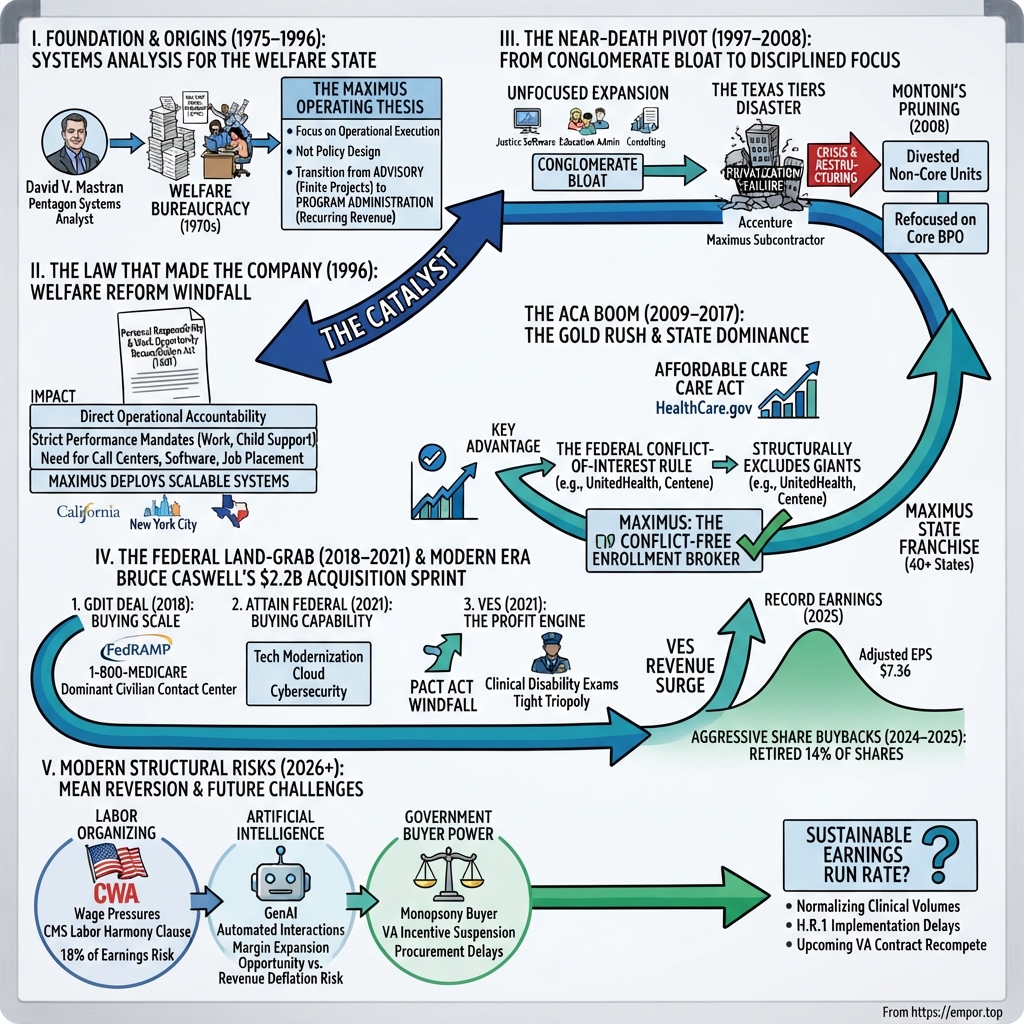
Maximus, Inc. (NYSE: MMS): The Invisible Machinery of the Welfare State
I. Introduction & The $5.4B Outsourcing Monopoly Nobody Talks About
A woman in Ohio turns sixty-four and starts thinking about Medicare. She does what the government tells her to do: she dials 1-800-MEDICARE. A voice answers, identifies itself as Medicare, and walks her through Part B enrollment. She hangs up believing she has spoken to the United States federal government.
She has not. She has spoken to an employee of a publicly traded company headquartered in Tysons, Virginia, that most Americans have never heard of.
The same is true of the veteran in Texas who drives to a strip-mall clinic for the medical examination that will determine his disability rating. It is true of the mother in New York who calls a number on a Medicaid letter to figure out which managed-care plan covers her child's pediatrician. It is true, across dozens of states and three continents, of tens of millions of interactions each year between citizens and the administrative state. The letterhead says government; the payroll says Maximus.
Maximus, Inc. reported revenue of $5.43 billion in fiscal 2025—its fiscal year ends September 30—with roughly 40,000 employees.12 It operates the largest private medical disability examination network serving American veterans, and it is the dominant contractor for civilian federal contact centers. Functionally, it serves as the outsourced customer-service and eligibility-determination layer of the Western welfare state.
On paper, such a business model displays the hallmarks of an enduring public franchise: non-discretionary demand, multi-decade client relationships, regulatory barriers that legally exclude major potential competitors, and high free cash flow conversion. Management routinely emphasizes these advantages, and disclosed contract dynamics support several of them.
Yet as of September 19, 2026, Maximus shares traded near $56, down from a 52-week high of $100 and leaving the company with a market capitalization of roughly $2.9 billion.3 Measured against the $8.05 midpoint of management's fiscal 2026 adjusted earnings-per-share guidance, that valuation represents a single-digit multiple of roughly seven times earnings.4 The market is not pricing an entrenched utility; it is discounting a business whose earnings investors suspect are neither durable nor easily repeated.
Evaluating which side has the better case requires examining several structural developments in sequence.
First is the company's origin: a Pentagon systems analyst who surveyed American welfare bureaucracy in the 1970s and saw an operations-research problem. Next is a near-death experience—the Texas eligibility privatization disaster that nearly destroyed the company's reputation across state capitols and prompted a forced restructuring. Then came the Affordable Care Act, which transformed a mid-cap state contractor into a national utility, aided by an obscure federal conflict-of-interest rule that quietly handed Maximus a franchise its largest commercial rivals are legally barred from touching.
Then comes the modern transformation: a $2.2 billion acquisition sprint executed by Chief Executive Officer Bruce Caswell between 2018 and 2021, which converted a state-government contractor into a federal powerhouse; the temporary earnings windfall that followed two acts of Congress and the COVID-19 pandemic; and the subsequent mean reversion.
Finally, the company faces two immediate structural risks. One is labor: an organizing campaign targeting its most lucrative federal franchise, coupled with procurement rules that could force higher wage floors. The other is artificial intelligence, which represents either a historic margin-expansion opportunity in government business process outsourcing or the catalyst that reprices its revenue base downward. Management presents a confident narrative, but the disclosed operational evidence remains far more ambiguous.
The story begins in 1975, with a founder who spent the early part of his career calculating problems the Air Force preferred not to contemplate.
 Subscribe on LinkedIn
II. Origins & The Welfare Reform Windfall (1975–1996)
David V. Mastran graduated from West Point, served in the Air Force, and entered a profession that defined an era of postwar American technocracy: operations research analyst. The discipline emerged during World War II—calculating bomber formations, flight patterns, and payload distributions to maximize target destruction—and by the 1960s it had migrated into civilian administration. Robert McNamara's Department of Defense exported systems analysis across Washington. If analysts could model a strategic bombing campaign, the thinking went, they could model a social safety net.
When Mastran moved to the Department of Health, Education, and Welfare, he found an administrative environment dominated not by complex intellectual puzzles, but by basic filing breakdowns. In the 1970s, American public assistance relied entirely on paper records. Eligibility for Aid to Families with Dependent Children was determined by caseworkers manually reviewing handwritten forms. Child-support enforcement often came down to a local clerk trying to track an absent parent across county lines. Program administrators could rarely say with certainty how many people were enrolled in a given program, whether those recipients qualified, or what it cost to serve them.
The operating thesis Mastran developed at HEW, and upon which he founded Maximus in 1975, was straightforward: public agencies did not struggle with policy design; they struggled with operational execution. Civil-service bureaucracies lacked specialized software, workflow measurement tools, and the managerial latitude to hire and staff flexibly against volume targets. An independent contractor faced none of those institutional limits.
For its first two decades, Maximus monetized that capability primarily through advisory work: conducting program evaluations, designing child-support enforcement systems, and preparing cost-allocation studies—the unglamorous but lucrative practice of identifying which state administrative expenses qualified for federal reimbursement. It was a stable business, but a modest one.
The decisive inflection occurred when Maximus shifted from advising agencies to running their programs. When state clients began asking whether the firm could manage the workflows it recommended, Maximus agreed. That transition marked the emergence of government business process outsourcing as a distinct market sector and established the foundation for the company's long-term enterprise value: advisory engagements represent finite projects, whereas program administration generates recurring revenue.
The Law That Made the Company
The decisive catalyst arrived in 1996.
The Personal Responsibility and Work Opportunity Reconciliation Act, signed into law by President Bill Clinton in August 1996, fundamentally altered state welfare administration by attaching direct operational accountability to federal funds. The statute replaced Aid to Families with Dependent Children—a long-standing, open-ended federal entitlement—with Temporary Assistance for Needy Families, a block-grant structure with strict performance mandates. The law introduced lifetime benefit caps, mandatory work-participation thresholds, child-support cooperation rules, and explicit financial penalties for states that failed to meet federal employment benchmarks.
To social policy scholars, the legislation fundamentally rewrote the American social safety net. To David Mastran, it represented an unprecedented commercial opportunity.
The statute expanded not just who received assistance, but what state welfare agencies were required to do on a daily basis. Under AFDC, an agency's mandate centered on determining baseline eligibility and disbursing benefits. Under TANF, agencies were required to determine eligibility, issue payments, and continuously track, counsel, train, place, and verify the daily activities of hundreds of thousands of recipients—documenting every step to withstand rigorous federal audits. Satisfying those statutory rules required dedicated call centers, integrated case-management software, and active job-placement networks. In 1996, virtually no state agency had those operational systems in place.
Maximus did—or could deploy them far more rapidly than state legislatures could appropriate funds and hire civil-service personnel to build them in-house. The company secured major welfare-to-work and child-support administration contracts across large jurisdictions, including California, New York City, and Texas. With those awards, the firm's revenue model completed its pivot from one-off consulting studies to high-volume operational staffing.
Going Public
In June 1997, Maximus completed an initial public offering on the New York Stock Exchange at $16 per share, raising roughly $80 million to finance the nationwide operational expansion created by federal welfare reform.
The investment thesis presented to public markets was compelling, and it established the framework management still invokes: Maximus was positioned as a counter-cyclical asset. During economic downturns, rising welfare caseloads would expand the company's core eligibility and enrollment business; during economic expansions, falling caseloads would be offset by higher demand for its workforce development and job-placement services. In management's framing, the company was structured to prosper across all phases of the macroeconomic cycle.
While directionally plausible, that narrative has always masked a more complicated operational reality. The company's corporate history has not unfolded as a smooth counter-cyclical annuity. Instead, revenue has moved in sharp step-changes triggered by major federal statutes, each creating an initial surge of implementation activity that eventually normalizes. Welfare reform in 1996 was the first such catalyst; the Affordable Care Act would become the second; and the PACT Act alongside post-pandemic Medicaid eligibility redeterminations would follow years later. Each legislative milestone delivered an initial earnings windfall followed by an eventual operational air pocket.
For investors, that dynamic underscores the central structural reality of Maximus: beneath its reputation as an insulated public utility, the company functions as a legislative-cycle contractor. Its underlying administrative baseline is resilient, but its growth remains lumpy, policy-dependent, and vulnerable to execution risk. And as the company would soon discover through costly operational missteps, winning an unprecedented public-sector award does not guarantee executing it at a profit.
III. The Near-Death Pivot: Texas TIERS, Conglomerate Bloat, and the Montoni Reset (1997–2008)
Newly public companies with cash and a compelling narrative often stumble into the same trap, and Maximus fell into it completely.
The corporate logic appeared straightforward. If Maximus was already embedded inside state agencies managing welfare programs, there seemed little reason to stop there. State and municipal agencies regularly bought justice software, school district administrative tools, fleet management services, municipal consulting, and enterprise resource planning implementations. Maximus possessed established public-sector relationships and attempted to cross-sell across all of them.
For roughly seven years following its initial public offering, the company assembled an assortment of niche government vendors. What management billed as an end-to-end government solutions platform was, in operating reality, a fragmented collection of disparate businesses with conflicting customer bases, incompatible delivery models, and—most hazardously—a heavy exposure to fixed-price software implementations.
That structural distinction proved critical to the company's trajectory. Managing an outsourced contact center is fundamentally a labor business: operators can model the cost per interaction, align staffing to volume projections, and adjust headcount as caseloads fluctuate. Custom software engineering for a state agency under a fixed-price contract, by contrast, carries unbounded financial risk. When administrative rules change—as they routinely do across state legislatures—the contractor absorbs the resulting cost overruns. Maximus was running dozens of these bespoke software projects simultaneously across non-standardized platforms, managed with internal controls originally built for a small consulting practice.
Texas
In 2005, the Texas Health and Human Services Commission launched an ambitious privatization initiative. The state sought to outsource the front-end intake and eligibility determination for Medicaid, the Supplemental Nutrition Assistance Program, and TANF—the frontline administrative process that determines whether low-income applicants receive benefits. The award went to the Texas Access Alliance, a consortium led by Accenture as the prime contractor with Maximus serving as a major subcontractor, under an $899 million contract built around a state software platform known as TIERS.
The project faltered almost immediately, producing the exact administrative breakdown that public-sector labor unions and anti-privatization critics had predicted.
Contact centers faced persistent understaffing. Verification documents sent by fax were routinely lost. Routine eligibility reviews that should have taken weeks extended into months, and eligible beneficiaries were erroneously disenrolled when supporting paperwork disappeared between local county offices and outsourced scanning facilities. Children lost health insurance, and local news outlets highlighted families who had satisfied every statutory requirement but were cut off from food assistance regardless. As backlogs accumulated, the processing pipeline seized up and the state's administrative throughput collapsed.
In March 2007, Texas terminated the contract.5
The direct financial fallout was immediate: asset write-downs, a bitter arbitration dispute with Accenture over contractual liabilities, and a December 2008 settlement that required pre-tax charges and in-kind remedial services.6 Yet the reputational damage proved far more severe. The TIERS disaster provided state legislators nationwide with an enduring cautionary tale regarding the outsourcing of core welfare eligibility decisions. In a market where the ultimate buyer is an elected official sensitive to public backlash, an operational catastrophe of that visibility threatened the company's standing across every state capitol.
Montoni's Pruning
Richard Montoni took over as chief executive officer in 2006, stepping into the fallout with a corporate finance background and a straightforward mandate: streamline operations and stop speculative expansion.
What followed in 2008 was a decisive corporate retrenchment. Montoni divested the justice software unit, sold off the education administration assets, and exited municipal consulting and enterprise software integration. He systematically dismantled the conglomerate structure assembled over the previous decade, accepting discounted valuations as a motivated seller offloading non-core divisions during the global financial crisis.
The strategic rationale extended beyond simple cost-cutting. Montoni made a specific determination about where durable operating margins exist in public-sector services: Maximus would cease trying to design and build government IT infrastructure and instead focus exclusively on operating government programs. The company pivoted toward selling operational capacity rather than software licenses. It concentrated on engagements where the unit of delivery was an interaction, a processed application, or a clinical disability evaluation—discrete transactions that could be measured, staffed against, and priced for predictable margins—while refusing fixed-price obligations to build complex software by a date certain.
That operational focus became the strategic foundation of modern Maximus, guiding its procurement posture for nearly twenty years. It also created the structural vulnerability that shapes its modern valuation: by anchoring its revenue model to interaction and case volume, the company tied its long-term earnings power directly to human labor in workflows increasingly exposed to automation.
For investors, the era highlights two essential considerations. First, the company's capital allocation track record is not unblemished; it includes a full cycle of unfocused diversification, value destruction, and distressed divestiture that provides important context whenever current management highlights its capital discipline. Second, the crisis forced a genuine structural realignment rather than an incremental restructuring, instilling an operating discipline that insulated the core business for two decades.
The timing of that restructuring proved critical. Roughly eighteen months after Montoni completed the divestitures, Congress passed the Patient Protection and Affordable Care Act, initiating the largest expansion of public health coverage in the United States since 1965.
IV. The Gold Rush: The Affordable Care Act & State Dominance (2009–2017)
While the Affordable Care Act is largely remembered for restructuring private health insurance markets, its impact on administrative plumbing was equally profound—and, for Maximus, far more consequential.
Making the statute work required unprecedented operational capacity. Millions of Americans who had never navigated health coverage had to be screened for eligibility—whether for subsidized exchange policies, expanded Medicaid, or the Children's Health Insurance Program—against complex income data that required independent verification. Enrollees needed help choosing among competing plans, filing appeals when determinations were disputed, and navigating the system by phone in dozens of languages. Crucially, that call volume surged dramatically during annual open-enrollment windows before dropping steeply months later.
No state health agency in America was staffed for that operational whiplash. Most had never operated a large consumer-facing contact center. The ACA created virtually overnight nationwide demand for a specialized capability: deploying and running high-volume, compliance-heavy, multilingual citizen intake systems at scale.
Maximus capitalized on that vacuum, securing contracts to run customer service and enrollment operations for state-based exchanges and Medicaid programs nationwide. Those awards included New York's newly created health exchange and operational support for Covered California, alongside expanded administrative roles across long-standing state accounts in Texas, Michigan, and dozens of other jurisdictions.
The Rule That Excludes the Giants
Yet the most enduring competitive advantage Maximus secured during the ACA era stemmed not simply from surge volume, but from a specific regulatory firewall.
Federal Medicaid regulations mandate that when a state operates a mandatory managed-care program, the enrollment broker—the entity assisting beneficiaries in evaluating and selecting among competing health plans—must be independent, operating free of financial conflicts of interest with the managed-care organizations participating in the program.7 The policy rationale is straightforward: an insurer cannot be permitted to manage the intake counter where citizens choose their coverage.
That regulatory restriction structurally disqualifies the corporate entities best equipped to compete. It legally excludes Centene, the country's largest Medicaid managed-care contractor, as well as Elevance Health and UnitedHealth Group's Medicaid business. In effect, it bars every major healthcare enterprise possessing the balance sheet, the call-center footprint, and the member-service infrastructure to contest the market at scale. Because their core business models rely on underwriting risk and administering health plans, their primary revenue source represents the precise conflict of interest prohibited by federal rule.
The market that remains is restricted to a small cohort of conflict-free service providers unencumbered by underwriting or clinical care delivery. Maximus stands as the largest player in that group.
In competitive strategy, this dynamic represents classic counter-positioning. The durability of the Maximus franchise does not rest on operational superiority over commercial healthcare conglomerates. Rather, commercial giants like UnitedHealth cannot enter the enrollment-broker market regardless of intent, because doing so would require divesting their primary underwriting businesses. When potential rivals are legally barred by their own core revenue models from competing, incumbent pricing power is uniquely protected.
That protection, however, has clear structural boundaries. The federal conflict-of-interest rule insulates enrollment brokerage for state managed-care programs; it does not protect the broader U.S. Services segment, nor does it apply to federal civilian or defense contracting. Within that specific brokerage niche, Maximus continues to face direct competition from unconflicted peers: Conduent, the business process services company spun off from Xerox; private-equity-backed Gainwell Technologies; and IT systems integrators such as Accenture and Deloitte. Contracts remain subject to competitive rebids where state agencies demand aggressive pricing. The regulation does not eliminate competitive bidding; it merely ensures that the commercial healthcare sector's best-capitalized operators never enter the room.
The Overseas Detour
While expanding its domestic footprint during the post-ACA boom, management under Montoni pursued an international diversification strategy across the United Kingdom, Australia, Canada, and Saudi Arabia. The British market served as the centerpiece, where Maximus secured major contracts under the Department for Work and Pensions, including the Work Programme and the Health Assessment Advisory Service.
The strategic thesis was conceptually consistent with the company's domestic model: governments in Westminster and Canberra were outsourcing welfare administration under the same fiscal pressures facing American states, and operational expertise developed across U.S. jurisdictions appeared readily exportable.
In practice, the contract economics proved far more volatile. British welfare-to-work frameworks relied heavily on payment-by-results structures, where contractor compensation was contingent on long-term employment placement and sustained job retention. That mechanism shifted macroeconomic employment risk directly onto the contractor's operating ledger. When British economic conditions softened or civil-service policy priorities shifted, contract revenue contracted while fixed facility and staffing costs remained rigid; physical job-training centers cannot be scaled down as nimbly as call-center queues. Compounded by foreign exchange fluctuations and recurring policy shifts across successive British governments, the international segment developed into a persistent drag on consolidated return on capital.
Maximus spent more than a decade rationalizing that international exposure, executing targeted divestitures of multiple underperforming employment-services units that brought the segment's revenue down to roughly $600 million by fiscal 2025.1 Operational performance showed modest recovery, with international operating margins rising to 3.7% in fiscal 2025 from 1.2% the prior year, alongside a management target of 3% to 7%.1 Yet after fifteen years of restructuring, the segment accounts for roughly 11% of corporate revenue while generating low-single-digit operating margins. Rather than serving as an engine of compounding growth, the international operation remains a subdued portfolio commitment that management has chosen to stabilize rather than fully exit.
By 2017, however, the primary growth vector for Maximus was shifting. Across corporate headquarters in Tysons, incoming executive leadership had concluded that the state-level marketplace—despite its defensible regulatory moats—could no longer deliver the scale and margin profile required to drive the enterprise forward.
V. The Federal Land-Grab: Bruce Caswell's $2.2B Capital Allocation Sprint (2018–2022)
When Bruce Caswell succeeded Richard Montoni as chief executive officer in April 2018, having spent years running the company's health business, he possessed a direct understanding of the state franchise—and its structural ceiling.
The diagnosis was unsentimental. State-level health and human services business process outsourcing had matured. Organic growth arrived on the timetable of federal legislation rather than corporate strategy. Every contract was an inherently political instrument, vulnerable to state legislative appropriations and gubernatorial election cycles. While margins were stable, addressable scale remained capped.
The federal government presented an entirely different opportunity. Federal civilian agencies procured operational capacity at a scale no state could match, operated with an entrenched commitment to contracting out citizen-facing administration, and funded substantial categories of work—notably clinical evaluations and defense IT modernization—where Maximus had minimal presence.
Caswell acted quickly, deploying approximately $2.2 billion across three acquisitions over roughly thirty months.
The GDIT Deal: Buying Scale at a Discount
In November 2018, Maximus announced an agreement to acquire General Dynamics Information Technology's large-scale federal citizen engagement center business for $400 million in cash.[^8]
The transaction metrics were striking. The acquired business generated roughly $670 million in annualized revenue, meaning Maximus acquired it for approximately 0.6 times annual sales.
The discounted valuation reflected divergent corporate priorities. GDIT operated primarily as a defense systems integrator, and managing citizen phone centers was a labor-intensive, low-margin activity that sat awkwardly alongside classified technical engineering. For General Dynamics, the division was non-core; for Maximus, it offered immediate federal scale.
The acquisition made Maximus the prime contractor on the Centers for Medicare & Medicaid Services Contact Center Operations program—the administrative engine running 1-800-MEDICARE and Healthcare.gov call centers—and secured the 2020 Census Questionnaire Assistance contract. In a single transaction, the state-focused vendor became the dominant civilian customer-service contractor for the federal government.
Judged by strategic expansion and purchase price, the transaction was the most consequential capital allocation decision in the company's modern history. In terms of operating durability, however, the crown-jewel asset acquired in the deal is also the one that would later attract the most persistent labor challenges.
Attain Federal: Buying Capability
In March 2021, Maximus acquired the federal division of Attain LLC for $430 million in cash.8
Where the GDIT transaction purchased volume, Attain was acquired for technical capability. The unit brought digital modernization, cloud infrastructure, cybersecurity, and data analytics competencies—qualifications necessary to compete when federal agencies tendered IT overhauls rather than staffing agreements.
The strategic rationale relied on cross-selling: Maximus planned to leverage its agency relationships and contract performance credentials while deploying Attain's technical staff to bid on higher-value modernization awards. In practice, the division has proved the least distinguished of the three acquisitions. Federal civilian IT remains intensely contested by established defense integrators and IT consultancies, and technical modernization has not matched the operating margins achieved in clinical services. While the purchase secured a presence in procurement competitions Maximus could not previously enter, company disclosures provide little evidence that the unit has earned its cost of capital.
VES: The Big One
In June 2021, Maximus completed the largest acquisition in its history: Veterans Evaluation Services, for $1.4 billion in cash, funded entirely with debt.910
Veterans Evaluation Services operated under a model distinct from the rest of the corporate portfolio. When a military veteran files a disability claim with the Department of Veterans Affairs, the claim requires clinical verification—such as audiology tests for hearing loss, medical exams for physical injuries, or psychiatric evaluations for post-traumatic stress disorder. Lacking the internal medical staff to process claim volumes, the VA relies on contracted provider networks. VES coordinates a nationwide roster of thousands of credentialed clinicians who administer standardized examinations designed to withstand legal scrutiny and appeal.
The business operates not as a call center, but as a specialized clinical logistics network requiring provider credentialing, geographic coverage, scheduling, and quality assurance. Work is compensated on a fixed-fee-per-examination basis, meaning operational efficiency and throughput drop directly to operating income. Furthermore, the addressable market is an effective triopoly comprising Maximus via VES, Leidos via QTC, and UnitedHealth Group's Optum Serve.
Maximus paid a reported multiple in the low-to-mid teens on trailing EBITDA, raising its net leverage from under one turn to roughly three times EBITDA. At the time, the transaction represented an aggressive balance-sheet expansion: a debt-funded purchase of a single-customer contractor at a full valuation by a company whose earlier conglomerate era had ended in write-downs.
Fourteen months later, Congress passed the PACT Act.
The PACT Act Windfall
The Honoring our PACT Act, signed in August 2022, extended VA disability eligibility to millions of veterans exposed to burn pits and other toxic substances—creating presumptive service connection for a long list of conditions and, with it, an enormous wave of new claims.[^12]
Every one of those claims required a clinical examination.
VES quickly transformed from an unproven debt burden into the growth engine of the entire enterprise. U.S. Federal Services revenue climbed from roughly $2.26 billion in fiscal 2022 to $3.07 billion in fiscal 2025, and the segment's operating margin expanded from 12.2% in fiscal 2024 to 15.3% in fiscal 2025 as incremental clinical volume dropped through a largely fixed cost base.111 Adjusted EPS went from $6.11 in fiscal 2024 to $7.36 in fiscal 2025.1
Evaluating that trajectory requires distinguishing between management execution and legislative circumstance. Caswell correctly identified clinical disability evaluation as a structurally superior business before the surge arrived. Yet the catalyst that made the transaction exceptionally lucrative—the PACT Act—was an exogenous statutory mandate that Maximus did not cause and could not have reliably forecasted. The strategic logic was sound, but the accelerated financial return was an unexpected legislative windfall. Management's own forward guidance, which explicitly framed the volume surge as non-recurring, conceded as much.1
The normalization of that volume introduces the central valuation dilemma confronting the company: establishing what Maximus sustainably earns once statutory windfalls recede.
VI. Segment Deep-Dive: Economics, Moats, & Operating Reality
Strip away the overarching corporate narrative, and Maximus is effectively three distinct businesses sharing little beyond a public-sector customer base.
U.S. Federal Services: The Profit Engine
The federal segment generated $3.07 billion of revenue in fiscal 2025—just over half of the consolidated total—at a 15.3% operating margin, accounting for roughly two-thirds of total operating profit.1
Beneath that headline figure operate two fundamentally divergent economic engines.
The clinical business—administering medical disability examinations for the Department of Veterans Affairs—is structured on a fixed-price-per-unit model. Maximus receives a predetermined fee for each completed evaluation regardless of direct service costs. Consequently, every operational gain in clinician scheduling density, appointment utilization, or missed-appointment reduction flows straight to the bottom line. That genuine operating leverage explains why segment margins climbed past 18% across several quarters of fiscal 2026 before an updated contract structure took effect.4
The federal contact center business operates on entirely different economics. Major civilian programs are typically billed against dedicated staffing headcounts and negotiated service-level benchmarks. That structure shields the company from sharp volume contractions, but it also caps the upside achievable through operational efficiency. It represents a lower-margin, more predictable line of business—and because procurement officers face ongoing institutional pressure to reduce administrative overhead, contract renewals face persistent price scrutiny.
The competitive landscapes are equally distinct. While clinical disability evaluations are split among a tight triopoly, federal citizen engagement is heavily contested. Established federal contractors including Serco, Peraton, and General Dynamics bid routinely on civilian contact centers, unhindered by any regulatory conflict-of-interest prohibitions.
U.S. Services: The Cash Cow Under Pressure
The state-level segment generated $1.76 billion in fiscal 2025 at a 9.7% operating margin, contracting from $1.91 billion and a 12.9% margin the prior year.111
That margin contraction was not primarily an operational misstep. Instead, it reflected the mechanical unwinding of temporary pandemic-era volumes—a normalization addressed directly in Section VII. The core state franchise—administering Medicaid and Children's Health Insurance Program enrollment brokerage, running state health exchange customer service, managing child-support enforcement, and conducting long-term care clinical assessments—remains the most insulated business Maximus operates due to the federal independence rule.
Its commercial foundation rests on multi-year engagements, typically spanning three to five years with subsequent option periods, renewed at consistently high rates. In government contracting, however, renewal metrics require careful interpretation. While they reflect genuine institutional switching costs, they also stem from procurement inertia. Public agencies routinely delay, extend, or bridge existing awards rather than conduct full re-procurements. As management disclosed in August 2026, agencies have increasingly turned to "awarding more bridge contracts and short-term extensions" as formal procurement timetables slip.4 An incumbent retention resulting from administrative delay does not provide the same evidence of a competitive moat as an award defended in an active rebid.
Outside the U.S.: The Unfinished Decision
The international business generated roughly $600 million in fiscal 2025 at an operating margin of 3.7%—contributing about 11% of corporate revenue but only a negligible share of profit.1 After exiting several geographic markets and shedding underperforming employment-services units, management has guided long-term segment margins to a range of 3% to 7%, with a stated goal of eventually aligning performance with domestic profitability.
From an investor's perspective, that track record invites scrutiny. After fifteen years of ownership, repeated operational restructurings, and selective country exits, the division still generates a fraction of group-level margins. Management's justification is that British health and disability assessment operations align closely with the domestic clinical franchise and offer an entry point for higher-value services. That rationale is strategically plausible, but it is the same continuity argument executives have advanced for more than a decade.
What the Consolidated Numbers Say
For fiscal 2025, consolidated performance closed with revenue of $5.43 billion, GAAP net income of $319 million, diluted earnings per share of $5.51, adjusted earnings per share of $7.36, an adjusted EBITDA margin of 12.9%, and free cash flow of $366 million.12
Two operational factors warrant close inspection.
First, the $1.85 spread between GAAP and adjusted EPS primarily reflects the amortization of intangible assets stemming from the recent acquisition sprint. While amortization is a non-cash accounting charge, acquired contract values inevitably amortize and decay over time, making it an ongoing economic factor rather than pure accounting noise.
Second, the company's capital allocation has pivoted aggressively toward its own equity. Weighted average diluted shares declined from 61.5 million in fiscal 2024 to 57.9 million in fiscal 2025, with management guiding fiscal 2026 to roughly 55.5 million.21 Between the beginning of fiscal 2025 and June 2026, Maximus repurchased approximately 8.3 million shares—retiring roughly 14% of its outstanding share count at the start of that window.4
This aggressive buyback program effectively converts a depressed valuation multiple into per-share earnings growth, serving as the primary catalyst separating stagnant top-line revenue from rising earnings per share. Yet it also reflects a lack of alternative high-return reinvestment opportunities. As management acknowledged when reviewing capital deployment between acquisitions and repurchases, the company has "deployed capital exclusively on share repurchasing" across recent quarters.4
Whether that capital deployment represents disciplined stewardship or an absence of organic growth opportunities depends on whether the underlying earnings power being concentrated is built to last. Testing that durability requires examining the legislative and operational drivers that generated those profits.
VII. The Historical Falsification Layer & The Peak Earnings Cliff
The bullish investment thesis for Maximus rests on three core propositions. Yet when tested against the company's own operating history and recent contract disclosures, each claim breaks down—not uniformly, and not completely, but each in ways that matter directly to valuation.
Claim 1: "VES and the PACT Act created a permanently higher earnings plateau."
The test is straightforward: does a legislative backlog-clearing event establish a permanent revenue baseline or a temporary windfall?
The company's own history provides the answer before recent financial data does. Federal welfare reform in 1996 produced an initial implementation surge that normalized; the Affordable Care Act delivered an enrollment wave that did the same. The pattern is structural rather than coincidental. A statute expanding public eligibility creates an immediate, one-time backlog of previously unserved beneficiaries who must be processed, alongside a permanently higher baseline flow of ongoing applicants. The initial backlog is massive and temporary; the subsequent flow is smaller and recurring. Revenue steps up, overshoots, and eventually settles above the prior base but well below the peak.
Management has acknowledged this dynamic directly. On the November 2025 year-end earnings call, Chief Financial Officer David Mutryn attributed an anticipated 3% year-over-year revenue headwind for fiscal 2026 to non-recurring clinical volumes and disaster-support contracts, offset by only about 1% underlying organic growth.1 By the third quarter of fiscal 2026, he described fiscal 2025 as having benefited from "temporary clinical volume surges" that had not recurred.4
In its strongest form, therefore, the permanent-plateau thesis fails. While the federal revenue plateau is real—holding near $3 billion, well above the pre-PACT Act baseline—it has settled below the peak rather than at it.
An even more consequential operational risk emerged in the third quarter of fiscal 2026, carrying immediate implications for how public markets value the business.
In the June 2026 quarter, the Department of Veterans Affairs notified all medical disability examination contractors of a temporary pause in the program's performance incentive and disincentive mechanism, effective July 1, 2026.4 These incentive payments are awarded for hitting strict timeliness, accuracy, and quality thresholds, and Maximus had earned positive incentives in every preceding quarter of fiscal 2026. Their sudden suspension reduced fiscal 2026 adjusted earnings guidance by roughly $0.35 per share for a single quarter—lowering the guidance midpoint from $8.40 to $8.05.4
The arithmetic behind that adjustment is striking. An incentive mechanism on a single contract—representing roughly $0.35 per share each quarter, or about $1.40 annualized against an $8 earnings base—accounted for nearly 18% of company earnings. And a single monopsony customer suspended it unilaterally, for internal administrative reasons, with immediate effect.
Management emphasized that such administrative pauses are not unprecedented, that the agency relationship remains sound, and that adapting to customer needs is an ordinary facet of government contracting.4 While that perspective reflects operational reality, the structural takeaway is inescapable: a material share of peak earnings rested on a discretionary payment from a sole-source customer that was halted with a single administrative letter. Management assumed the pause would run through December 31, 2026, and advised investors to treat the fourth quarter of fiscal 2026—which implies an adjusted EBITDA margin near 13% and adjusted earnings of roughly $1.91 per share—as "a reasonable run rate" entering fiscal 2027.4
Meanwhile, the underlying VA medical disability examination contract is up for recompete. A draft Performance Work Statement released in mid-2026 encompassed all six regions Maximus currently serves, which management viewed as an encouraging sign that the company will retain the work.4 However, the draft provided no clarity regarding pricing or the future incentive structure—the precise mechanism that had just demonstrated its power to move 18% of earnings.4
The calibrated conclusion: The claim that PACT Act economics established a permanent earnings plateau fails. The narrower proposition that survives—that federal clinical evaluations remain a structurally larger and more profitable business than before 2021, settling below the fiscal 2025 peak and vulnerable to buyer-dictated incentive terms—remains valid but unproven at a sustainable baseline. The critical metric that will determine that run rate is the award and pricing structure of the successor VA contract, specifically whether performance incentives are restored, modified, or permanently eliminated.
Claim 2: "U.S. Services possesses an unassailable Medicaid moat."
The clearest evidence testing this claim is already reflected in recent operating results.
During the COVID-19 public health emergency, federal continuous-enrollment rules prohibited states from disenrolling Medicaid recipients. When that continuous coverage requirement expired, every state had to conduct eligibility redeterminations across a national Medicaid population exceeding 90 million people. It was the largest eligibility review in the program's history, and Maximus stood at the center of the processing pipeline, lifting the U.S. Services segment's operating margin to 12.9% in fiscal 2024.11
Once that surge subsided, the financial contraction was immediate: segment revenue dropped from $1.91 billion to $1.76 billion in fiscal 2025, while the operating margin retreated to 9.7%.1 Mutryn characterized this unwinding as "essentially the last of the pandemic-related impacts to the segment."1
What that contraction demonstrates is not that the regulatory moat is illusory. Maximus retained its state contracts; it was the volume that disappeared. The more precise insight is that the regulatory barrier insulates the company's position, not its transaction volume. Commercial competitors are legally barred from seizing the enrollment-broker role, but the economics of that role swing with policy-driven transaction volumes that Maximus neither controls nor can reliably forecast. When processing volumes recede, fixed facilities and core overhead do not shrink as quickly. An exclusive concession stand is valuable only so long as patrons keep entering the stadium.
The next test of this dynamic is already unfolding. Federal tax and spending legislation known as H.R. 1—referred to by management as the One Big Beautiful Bill Act and formally titled the Working Families Tax Cut Act—mandates Medicaid community engagement rules beginning in January 2027, twice-yearly redeterminations for roughly 21 million expansion beneficiaries, and significant SNAP payment-error-rate penalties that shift costs to state budgets beginning in October 2027.14 Caswell described it as "the most significant expansion opportunity for our U.S. Services business that we've seen since the Affordable Care Act."1
That opportunity may materialize, but management's commentary across consecutive quarters highlights familiar implementation friction. In November 2025, executives excluded the anticipated work from the reported pipeline because revenue would not begin until fiscal 2027.1 Yet by August 2026—less than six months ahead of the January 1, 2027 statutory launch date—Caswell reported that customer discussions had "progressed in many cases, more slowly than expected." He noted that a complex Centers for Medicare & Medicaid Services interim final rule "has created additional uncertainty for states," and disclosed that beneficiaries will be permitted to self-attest to medical frailty through at least 2027, materially reducing state verification work in the near term.4
This disclosure does not invalidate the thesis, and management acknowledged the delays candidly. Yet it mirrors the historical cadence of every prior legislative cycle: the statute passes, implementation schedules slip, and operational revenue arrives later and more modestly than initial addressable-market projections suggested. The SNAP opportunity appears more immediate than Medicaid, supported by a national payment error rate that barely improved—registering roughly 10.6% for federal fiscal 2025 compared to 10.9% the prior year—leaving most states facing tangible budget exposure unless case-processing accuracy improves.4
The calibrated conclusion: The Medicaid moat thesis holds structurally but fails financially. The company's competitive position is legally defended, but its segment earnings remain volatile. The key metric to watch is U.S. Services organic revenue growth, where management guided to a return to mid-single-digit expansion in the fourth quarter of fiscal 2026 that would carry into fiscal 2027.4 If that inflection does not materialize as projected, the growth catalyst from H.R. 1 is being deferred rather than realized.
Claim 3: "The federal contact center business has insurmountable switching costs."
In the federal contact center franchise, competitive pressure arrives not from commercial rivals, but from the workforce and the government procurement agency simultaneously.
In November 2023, the Communications Workers of America organized what it described as the largest strike of federal contract call-center workers, spanning facilities across Mississippi, Louisiana, Kentucky, Virginia, Arizona, and Florida, with demands centered on a $25 hourly living wage, affordable healthcare, and lower production quotas.[^14]
The economic mechanics underlying that labor friction are central to the business model. Operating expenses for an outsourced contact center consist predominantly of front-line agent wages and benefits. If labor organizing succeeds across the regional network and raises hourly compensation without an identical upward adjustment in agency billing rates, the resulting margin compression is straightforward arithmetic. In the near term, there is no technological or operational productivity gain large enough to absorb that cost increase.
Procurement authorities subsequently escalated the pressure. In the procurement solicitation for the Contact Center Operations recompete, CMS introduced a requirement that prospective contractors sign labor harmony agreements—arrangements structured to prevent service interruptions during labor disputes. Maximus formally challenged the mandate before the Government Accountability Office and the U.S. Court of Federal Claims, arguing that the clause exceeded statutory procurement authority and compromised contractor neutrality during union organizing.12
Stripped of legal formalities, the requirement functions as an operational vise. If the labor harmony clause is upheld and Maximus complies, it enters a framework that significantly facilitates collective bargaining across its largest federal civilian franchise, accepting the margin pressure that follows. If it refuses to sign, the company risks disqualification from a multi-billion-dollar contract that a competing bidder would accept.
That dynamic does not describe an insurmountable switching moat. It depicts an incumbent contractor operating where the government buyer, elected officials, and organized labor are aligned against its existing labor cost structure.
The calibrated conclusion: The switching-costs defense requires substantial qualification. The operational frictions of re-procurement remain formidable—migrating massive federal citizen contact centers is administratively risky, technically complex, and politically sensitive. Yet those switching costs offer little protection against a customer willing to alter contract terms while retaining the vendor. The VA incentive suspension demonstrated that vulnerability on one flagship contract in 2026; the upcoming award of the CMS Contact Center Operations successor contract, along with whatever labor provisions it enforces, represents the ultimate test on another.
Three claims examined, and three structural downgrades established. None is fatal to the enterprise, but each alters the margin profile and terminal valuation. Binding them together is an operational reality: Maximus sells directly to monopsony buyers wielding decisive bargaining power, and recent contract disputes have demonstrated what happens when those buyers exercise that leverage.
Which raises the question of whether technology changes that balance—or makes it worse.
VIII. The GenAI Paradox: Disruption Threat or Operating Margin Miracle?
Consider the most common interaction Maximus handles: a citizen calls about an agency notice, a customer-service representative retrieves the record, reviews the applicable policy manual, explains the requirement, logs the encounter, and moves to the next queue. Average handle time runs roughly six minutes. Multiply that sequence across tens of millions of annual inquiries.
Presented to anyone familiar with enterprise language models, the operational question is immediate: why does this workflow require a human representative?
The Bear Case, Stated Honestly
The bear case is not that artificial intelligence will make Maximus less efficient. It is that automation will make the underlying workflow less valuable.
Government service contracts are ultimately priced against the labor required to deliver them—dedicated agent seats, staffing ratios, and average handle times. When the labor required to resolve an inquiry drops precipitously, public procurement officers inevitably adjust. Initial solicitations introduce automation-first pricing benchmarks; subsequent procurements question why an agency should pay an outsourced vendor for administrative tasks that commercial software platforms can resolve automatically.
The resulting dynamic is revenue deflation, which does not require Maximus to lose a single competitive rebid. It requires only that the billable value of a citizen interaction contracts faster than aggregate inquiry volumes grow. For an enterprise that has defined its strategic identity since 2008 around selling human throughput rather than software licenses, technology that collapses the unit cost of that throughput targets its core economic model.
Management's Answer
Caswell's response rests on three distinct arguments, and they carry unequal analytical weight.
The first relies on regulatory and political risk aversion. Public agencies remain deeply reluctant to let autonomous systems make consequential determinations regarding welfare eligibility, Medicaid coverage, or crisis intervention, where the immediate failure mode is an erroneous denial of benefits followed by legislative scrutiny and public backlash. Human oversight remains a statutory or administrative requirement across numerous programs. This argument reflects documented procurement reality: Maximus reported that roughly 75% to 80% of new bids and rebids in its pipeline include explicit artificial intelligence requirements or evaluation criteria, with agencies prioritizing governance, data security, transparency, and human oversight.4 Public buyers are not seeking software in place of a contractor; they are requiring contractors to deploy governed, supervised automation.
The second argument points to the underlying population being served. Beneficiaries navigating Medicaid, SNAP, or VA disability frequently have complex personal circumstances, limited digital literacy, language barriers, or acute personal distress. These represent the most difficult interactions to automate and the most politically costly to mismanage. While substantively sound, this dynamic implies an eventual transition toward a smaller cadre of caseworkers handling complex escalations—a shift that contracts aggregate billing hours even if it supports operating margins.
The third defense centers on contract pricing mechanics, which forms the foundation of management's near-term investment thesis: under fixed-price and per-transaction contract structures, operational efficiency gains accrue directly to the contractor until an agreement is formally recompeted and repriced. Management has quantified this effect. Caswell disclosed in August 2026 that deploying artificial intelligence across core workflows—including interactive voice response optimization, enhanced conversational chatbots, and automated outreach via text and email—yielded a 3.5% operating margin expansion across a cohort of five contracts.4
That disclosure provides a concrete, verified data point supporting management's efficiency narrative. Yet its scope remains narrow: five self-selected contracts, with no visibility into how procurement officers will adjust baseline pricing during the next formal recompete.
Where This Actually Lands
The realistic assessment is that both perspectives are valid, unfolding in sequential phases.
In the near term, artificial intelligence is margin-accretive. Maximus operates under multi-year contracts priced against historical labor costs, meaning productivity gains captured prior to re-procurement flow directly to the bottom line. The company's margin expansion through fiscal 2026—achieved, as Mutryn characterized it, through "strong execution and selective deployment of efficiency-enhancing technology" rather than temporary volume surges—provides tangible evidence of that near-term capture.4
Over the long term, the critical question is whether Maximus can harvest enough margin surplus during this intermediate window to finance a transition toward proprietary software and technology platforms. The company has directed capital toward that objective: it developed a FedRAMP-authorized citizen engagement platform marketed as a cloud solution, reported roughly thirty artificial intelligence deployments active or underway, and took minority equity stakes in infrastructure providers such as Spectro Cloud through its Maximus Ventures arm.14
Yet the company's operating history counsels caution. Maximus previously attempted to position itself as a diversified government software vendor, an initiative that culminated in asset write-downs and distressed divestitures under Montoni. Proprietary platform ambitions and corporate venture investments do not generate enterprise stability until billable procurement dollars materialize. A FedRAMP certification represents a compliance credential rather than an executed task order. Maximus has yet to demonstrate that it can shift its consolidated revenue mix meaningfully away from labor, and Attain Federal—the acquisition explicitly completed to provide advanced technical modernization capabilities—has delivered the least measurable financial contribution of its recent major transactions.
Ultimately, the bull and bear theses do not describe conflicting realities; they describe the same structural progression across different points on the procurement calendar. The variable that determines the outcome for equity investors is the speed at which public procurement agencies reprice operational efficiency. Government procurement moves notoriously slowly, and that administrative inertia provides Maximus a durable operational cushion—yet it remains a buffer measured in years rather than decades.
IX. Management, Governance, & Capital Allocation Autopsy
Caswell
Bruce Caswell does not cultivate the public persona of a corporate visionary. He presents instead as a technical contract operator, speaking fluently about performance work statements, interim final rules, other transaction authorities, and the technical distinction between semimonthly and biweekly income calculations on a Supplemental Nutrition Assistance Program application. On investor calls, he addresses administrative policy arcana at length.
That operating profile suits the sector. In government services, an executive's primary task is anticipating statutory and administrative mandates before civil-service procurement officers formulate their solicitations.
Caswell's strategic record rests on three tangible achievements: he correctly identified federal civilian and clinical contracting as the company's primary growth vector, acquired the necessary operating assets, and systematically rebuilt the balance sheet after levering it. Net leverage retreated from roughly three turns of EBITDA following the VES acquisition to 1.5 times by September 2025, and stood at 2.0 times in June 2026 after a working-capital-driven increase.14
Yet his tenure also faces a substantive analytical challenge: the two most consequential earnings catalysts under his leadership—the PACT Act and post-pandemic Medicaid eligibility redeterminations—were exogenous legislative mandates rather than organic commercial victories. Excluding both events, the company's disclosed compound organic growth from fiscal 2023 through the midpoint of fiscal 2026 guidance was roughly 4%.1 While that rate represents a respectable performance for a mature government services contractor, it falls well short of the compounding growth profile implied by the peak-earnings narrative.
Mutryn and Guidance Discipline
The stewardship of Chief Financial Officer David Mutryn through fiscal 2025 and fiscal 2026 provides the more reassuring chapter of the management narrative, particularly in his handling of operating headwinds and guidance revisions.
Three episodes illustrate that discipline. First, he advised public markets in advance that elevated operating margins from the Medicaid redetermination surge would not persist, a forecast that proved accurate.1 Second, he disclosed an elevated days sales outstanding metric—which climbed to 98 days in the June 2026 quarter due to administrative payment delays from a major federal agency—before the issue normalized, quantifying subsequent cash collections at approximately $245 million after June 30 while maintaining a year-end target below 70 days.4 Third, when the Department of Veterans Affairs suspended performance incentives, Mutryn immediately lowered full-year earnings guidance by the entire financial impact rather than positing speculative operational offsets, advising investors to treat the curtailed fourth quarter as a realistic forward baseline.4
For equity analysts evaluating management credibility, that pattern provides a meaningful signal: executives pre-announced the reversal of temporary tailwinds while those benefits were still actively accruing.
The counterweight to that disclosure discipline is a persistent lack of contract-level granularity. While Maximus is among the few government contractors to disclose its performance-based contract mix—which reached 54.4% in fiscal 2025—it does not disaggregate revenue for Veterans Evaluation Services or the CMS Contact Center Operations franchise.1 For an enterprise where two contract relationships account for a decisive share of consolidated operating profit, and where both face immediate rebid or labor-organizing scrutiny, that omission represents a material analytical blind spot. Outside investors cannot independently quantify the specific financial exposure that recently erased nearly 18% of quarterly earnings.
Compensation and Ownership
According to the company's fiscal 2025 proxy filing, the vast majority of executive compensation is variable and tied to annual performance benchmarks—principally adjusted net operating income, top-line revenue, adjusted operating margin, and adjusted earnings per share—yielding total reported compensation for Caswell of roughly $11 million.13 The executive incentive structure also incorporates explicit weightings for employee engagement and workforce retention, reflecting board-level attention to call-center turnover and organized labor scrutiny.13 Furthermore, Caswell's direct equity ownership substantially exceeds the corporate requirement of six times base salary.13
From a governance perspective, however, compensation structures tied heavily to adjusted operating income and adjusted per-share earnings introduce clear incentives: they directly reward the temporary volume surges that management has since had to characterize as non-recurring, while per-share calculations are mechanically elevated by accelerated share buybacks. While such structural designs are common across public corporations, they warrant scrutiny when evaluating performance benchmarks achieved during peak-earnings years.
The Capital Allocation Scorecard
Across the past decade and a half, the company's capital allocation history presents a sharply bifurcated record.
The General Dynamics IT citizen-engagement acquisition was executed at an attractive entry multiple and fundamentally scaled the enterprise. Veterans Evaluation Services was acquired at a full valuation, financed entirely with debt, at what proved an exceptionally fortuitous moment: the strategic rationale was sound, but its rapid payback was accelerated by statutory intervention that management could not have anticipated. Attain Federal has delivered the weakest return, acquiring technical competencies whose financial benefits have yet to visibly register in segment profitability. Meanwhile, the international portfolio has functioned as a persistent drag on returns on capital, addressed through incremental divestitures rather than a decisive operational exit.
Shareholder distributions have balanced recurring dividends with accelerated repurchases. Maximus has maintained a quarterly dividend of $0.30 per share, which management intends to expand alongside earnings growth.1 Share repurchases were suspended during the balance-sheet deleveraging that followed the VES transaction, then resumed aggressively, deploying $457 million in fiscal 2025 alone and retiring roughly 14% of outstanding shares between the beginning of that fiscal year and mid-2026.14
The ultimate economic return of that buyback program depends entirely on earnings durability. Repurchasing nearly a seventh of a company's equity base at a single-digit multiple of adjusted earnings represents compelling capital deployment if those cash flows persist. It destroys shareholder value if those earnings reflect an unrepeatable statutory windfall. The unilateral suspension of VA performance incentives in 2026 served as a sharp reminder of that exposure. As of June 30, 2026, the entire $400 million repurchase authorization approved in May remained available, leaving Maximus with substantial capacity to continue buying back shares while management projected net leverage near one turn of EBITDA by the close of fiscal 2026 in the absence of further acquisitions.41
Management has consistently stated that future acquisitions must accelerate organic growth, signaling a strategic interest in the defense and national security market, which the company estimated at nearly $50 billion in addressable spending expanding at more than 9% annually.1 Yet Maximus has refrained from completing a major defense transaction. Given that the company's prior foray into diversified public-sector IT required a painful restructuring and a decade of divestitures to correct, management's strategic restraint represents disciplined capital stewardship—provided that discipline holds if and when a multi-billion-dollar defense asset becomes available.
X. Strategic Playbook: 7 Powers & Porter's Five Forces
Helmer's 7 Powers
Counter-positioning — strong, but narrow. The Medicaid independent-broker requirement remains the company's most defensible structural asset: it disqualifies the largest potential entrants by virtue of what they are, not what they do.7 Its boundary, however, is strictly defined. It protects a single line of business within one operating segment, offering no protection in VA clinical evaluations, federal contact centers, or international operations.
Switching costs — real, but overstated. Migrating a public program that touches millions of beneficiaries is administratively fraught and politically hazardous, which explains why incumbents routinely win recompetes. Yet 2026 revealed a critical vulnerability: a government buyer that cannot easily replace an incumbent can still dictate contract economics. The VA suspended performance incentives unilaterally, while CMS sought to mandate labor terms directly through the procurement solicitation. Switching costs protect the award itself, not the profitability of that award.
Process power — substantial, but confined to clinical services. Coordinating a national network of credentialed clinicians to deliver standardized, legally defensible disability evaluations is not a capability a generalist IT services firm can assemble during a procurement cycle. It requires provider-credentialing infrastructure, geographic coverage density, specialized scheduling platforms, and years of clinical quality control. That complexity explains why the VA medical disability examination market supports only three primary providers rather than a dozen competitors. It also underscores why the successor contract is so critical: process power protects a contractor against rival bidders, not against a monopsony customer restructuring its compensation model.
Scale economies — moderate. Shared telephony infrastructure, centralized compliance systems, and distributed corporate overhead lower unit operating costs relative to sub-scale regional vendors. Yet against defense integrators and management consultancies such as Leidos, Accenture, or Deloitte, Maximus enjoys no structural scale advantage.
Cornered resource, brand, and network effects — weak to absent. Public procurement statutes and federal acquisition regulations are deliberately engineered to neutralize these advantages. There is no brand premium in a sealed competitive bid.
Porter's Five Forces
Buyer power — extreme, and the defining characteristic of the business model. The company's customer base consists of a small cohort of public agencies that formulate administrative rules, establish reimbursement rates, conduct procurement competitions, and retain the authority to modify contract terms mid-performance. The two most consequential operational disruptions confronting the business—the suspension of VA performance incentives and the mandate for labor harmony agreements—stemmed directly from buyer intervention rather than competitive displacement. Any structural assessment of Maximus that fails to place monopsony buyer power at its center misreads the enterprise.
Supplier and labor power — high and rising. Frontline contact-center representatives are actively organizing under a national labor union targeting the company's largest federal sites. At the same time, licensed clinical providers remain scarce and geographically mobile, and a fixed-price-per-evaluation model suffers immediate margin compression whenever clinician compensation increases.
Threat of new entrants — low. Rigorous past-performance qualifications, demanding security mandates including FedRAMP authorizations and Cybersecurity Maturity Model Certification standards, personnel clearances, and substantial bonding capacity establish high barriers to entry. A venture-backed startup cannot tender a credible bid to operate Medicare's contact centers.
Threat of substitutes — moderate and expanding. The primary substitute is not a commercial competitor, but an agency electing to insource operations using commercial software platforms. Enterprise workflow tools paired with generative artificial intelligence make administrative insourcing far more feasible for public agencies than it was five years earlier. In operating reality, this is the generative AI bear case under an administrative guise.
Competitive rivalry — high. Maximus faces entrenched peers across every operating division: Leidos and UnitedHealth Group in clinical evaluations; Serco, Peraton, and General Dynamics in federal contact centers; and Conduent, Gainwell Technologies, Accenture, and Deloitte in state-level health and human services. Moreover, competitive rivalry increasingly manifests as administrative litigation. As Caswell observed, in an environment characterized by thin award pipelines, losing bidders routinely file formal procurement protests because contractors face negligible penalties for doing so.4
The overarching strategic synthesis is clear: Maximus maintains a defensible operational posture against commercial competitors, but operates from a position of profound vulnerability against its public-sector customers. Traditional moat analysis focuses almost exclusively on competitive barriers. For Maximus, it is buyer leverage that ultimately governs earnings power.
XI. The Bull vs. Bear Case & What to Watch
The Bull Case
The clinical franchise is a structurally superior business. Administering fixed-fee-per-evaluation medical examinations through a specialized network that only three contractors possess is fundamentally different from call-center staffing. It delivers higher operating margins, poses formidable barriers to entry, and can expand beyond the Department of Veterans Affairs into broader federal clinical assessment programs. Segment margins in U.S. Federal Services holding in the mid-to-high teens through fiscal 2026 demonstrate that this operational leverage is an established reality rather than speculative guidance.4
Artificial intelligence is delivering measurable margin expansion. A disclosed 3.5% operating margin expansion across a cohort of five contracts using process automation demonstrates that productivity gains accrue directly to the contractor under current fixed-price agreements, while procurement pipeline data showing that three-quarters of new bids carry explicit artificial intelligence requirements indicates that public agencies seek governed contractors to manage technology rather than standalone commercial software to replace them.4
Capital allocation enables substantial per-share value creation. With net leverage at two turns of EBITDA and projected near one turn absent acquisitions, guided fiscal 2026 free cash flow of $425 million to $475 million, and a full $400 million buyback authorization in reserve, management possesses the balance-sheet flexibility to retire a meaningful portion of outstanding equity each year at a single-digit earnings multiple.4
Statutory mandates provide a tangible multi-year catalyst for state services. The administrative mandates under H.R. 1—including Medicaid community engagement rules, twice-yearly redeterminations for roughly 21 million expansion beneficiaries, and financial penalties tied to state Supplemental Nutrition Assistance Program payment errors—impose heavy operational burdens on state agencies lacking in-house capacity. A national SNAP payment error rate remaining above 10% creates tangible budget exposure for states by October 2027, generating the administrative pressure that has historically driven demand for outsourced enrollment and verification infrastructure.4
Core program demand remains non-discretionary. Demographic growth expands the Medicare-eligible population, while veterans' healthcare and disability benefits remain among the most insulated budget priorities in Washington. Management reported that virtually all company programs were designated essential during a federal government shutdown, with fewer than a dozen of its nearly 40,000 employees affected by funding lapses.1
The Bear Case
Peak earnings relied on temporary statutory windfalls that have receded. The post-pandemic Medicaid redetermination surge has concluded, the initial PACT Act claims backlog has normalized, emergency disaster-relief volumes have dropped, and VA performance incentives remain suspended. Full-year fiscal 2026 revenue guidance of $5.2 billion to $5.35 billion, tracking toward the lower end, falls below fiscal 2025 actuals.4 Top-line revenue is contracting, leaving per-share earnings growth dependent on internal margin expansion and aggressive share repurchases.
Customer concentration risk has proved immediate rather than theoretical. A unilateral administrative pause by a single customer removed roughly 18% of annualized earnings in a single quarter.4 While management expressed confidence in retaining the work across all six regions, the draft solicitation provided no visibility into future pricing terms or performance incentive structures.4
The federal contact center franchise faces an operational squeeze. The recompete for the Centers for Medicare & Medicaid Services Contact Center Operations program forces an acute tradeoff: accepting mandated labor harmony terms that could accelerate collective bargaining and raise wage costs, or challenging procurement requirements and risking disqualification from the flagship civilian award that scaled the business in 2018.[^14]12
Automation introduces long-term revenue deflation. While artificial intelligence expands operating margins under existing fixed-price agreements, that intermediate harvesting window lasts only until contracts come up for competitive rebid. If procurement officers adjust solicitations to reflect lower labor requirements, billable interaction value will contract. Furthermore, management's ambition to transition toward proprietary software platforms remains unproven, particularly given the company's historical misadventures in commercial technology.
Government procurement cycles have become increasingly erratic. The trailing twelve-month book-to-bill ratio dropped to roughly 0.5 times by June 2026, compared to 0.9 times in fiscal 2025, with management citing procurement delays, scope adjustments, and outright solicitations being canceled across federal civilian agencies.41 While an awarded-but-unsigned pipeline of $1.35 billion offered support—primarily reflecting long-term rebid victories that cleared formal bid protests—backlog conversion remains vulnerable to administrative inertia and client procurement delays.4
The international portfolio remains an unresolved drag on capital returns. After fifteen years of operation, repeated restructurings, and selective country exits, the division still generates low-single-digit operating margins and accounts for a negligible share of total operating profit.
The 3 KPIs That Matter Most
1. U.S. Federal Services operating margin. This metric serves as the definitive test of whether the clinical business's elevated profitability represents a permanent structural gain or an artifact of temporary surge volume and discretionary incentive fees. The benchmarks are clear: 12.2% in fiscal 2024, 15.3% in fiscal 2025, full-year fiscal 2026 guidance between 16.5% and 17.0%, and a guided fourth-quarter baseline between 14.5% and 15.0% following the incentive suspension.1114 Where this margin settles under the successor VA contract will define the company's sustainable earnings power.
2. The VA medical disability examination recompete structure. The key issue is not simply whether Maximus retains the work—management anticipates doing so, and a draft scope encompassing all six operational regions supports that expectation—but what unit pricing and incentive frameworks the Department of Veterans Affairs ultimately establishes.4 This single award represents the definitive test of whether the company's largest earnings stream remains intact.
3. U.S. Services organic revenue growth. Management guided to a return to mid-single-digit organic growth beginning in the fourth quarter of fiscal 2026 and extending into fiscal 2027, anticipating initial implementation task orders under H.R. 1.4 If that operational ramp materializes on schedule, the state-level business will have entered its next legislative growth cycle. If customer onboarding continues to slip, the segment risks settling into a stagnant revenue base bounded by regulatory barriers.
There is a version of Maximus that appears fundamentally undervalued: an indispensable administrative utility protected by statutory conflicts of interest, generating mid-teens federal margins, producing robust free cash flow, and retiring 14% of its outstanding shares at a trough valuation multiple.
There is an alternative reading in which the market's skepticism is entirely justified: a mature contractor whose peak earnings were inflated by a global pandemic, two statutes, and a discretionary client incentive that has been turned off, confronting an organized labor campaign targeting its primary call centers and automation technology that could prompt customers to reprice its core service.
The company's operating record does not fully validate either extreme. What it reveals is more grounded: the regulatory moats are real but defend contract tenure rather than billable volume; executive leadership has been transparent in acknowledging receding tailwinds; and the decisive drivers of shareholder value are contractual rather than competitive. Those inflection points will arrive on timetables established by the Department of Veterans Affairs, the Centers for Medicare & Medicaid Services, and state agencies implementing federal welfare mandates. Those contractual outcomes will ultimately determine what this business sustainably earns.
References
-
Maximus Fourth Quarter and Full Year Fiscal 2025 Earnings Call — Maximus, Inc., 2025-11-20 ↩↩↩↩↩↩↩↩↩↩↩↩↩↩↩↩↩↩↩↩↩↩↩↩↩↩↩↩↩
-
Maximus, Inc. Annual Report on Form 10-K for the Fiscal Year Ended September 30, 2024 — U.S. Securities and Exchange Commission, 2024-11-26 ↩↩↩
-
Maximus Third Quarter Fiscal 2026 Earnings Call — Maximus, Inc., 2026-08-06 ↩↩↩↩↩↩↩↩↩↩↩↩↩↩↩↩↩↩↩↩↩↩↩↩↩↩↩↩↩↩↩↩↩↩↩↩↩↩
-
Texas Cancels Contract With Company Over Social Services Enrollment — The New York Times, 2007-03-14 ↩
-
Maximus, Inc. Current Report on Form 8-K (Texas TIERS Arbitration Settlement) — U.S. Securities and Exchange Commission, 2008-12-16 ↩
-
42 CFR § 438.810 — Expenditures for Enrollment Broker Services — Electronic Code of Federal Regulations ↩↩
-
Maximus Acquires Attain's Federal Business for $430 Million — Washington Technology, 2021-03-01 ↩
-
Maximus to Acquire Veterans Evaluation Services (VES) for $1.4 Billion — Maximus, Inc., 2021-04-21 ↩
-
Maximus, Inc. Annual Report on Form 10-K for the Fiscal Year Ended September 30, 2021 — U.S. Securities and Exchange Commission, 2021-11-23 ↩
-
Maximus Reports Fourth Quarter and Full Year Fiscal 2024 Results — Business Wire, 2024-11-20 ↩↩↩↩
-
CMS Faces Bid Protests Over Labor Rules in Contact Center Solicitation — Washington Technology, 2024-05-15 ↩↩
-
Maximus, Inc. Definitive Proxy Statement on Schedule 14A — U.S. Securities and Exchange Commission, 2025-01-24 ↩↩↩
 LinkedIn
 WhatsApp
 Reddit
 Hacker News
 Email
Email Kindle
 RSS Feed
 Spotify
 Apple Podcasts
 Amazon Music
 Audible
 YouTube