Which banks turn deposits and financial relationships into the most durable profits?
Banks sit where money, credit, regulation, payment networks and customer relationships meet. The basic deal is simple. People and businesses give a bank their balances and their daily transactions. The bank uses that funding, what it learns about its customers and its licence to lend and to sell services. The deal has survived centuries of panics and every new technology since the telegraph. The profits have never gone equally, or automatically, to the banks that handle the most activity, and that matters now because accounts, payments and lending are moving onto phones while nonbank lenders and platforms grow faster than banks. The best candidates for durable profits are banks that keep low-cost deposits and trusted relationships while pricing credit carefully. Scale and digital reach help, but neither one proves that advantage.
A pawnshop, a city bank and a war loan
In 1472, Siena was going through hard times. Its magistrates set up a public pawn agency where poorer residents could borrow against their belongings instead of going to private moneylenders. That agency, the Monte di Pietà, was the forerunner of what became Banca Monte dei Paschi di Siena, often described as the oldest bank still operating.1 It was not yet a deposit bank in the modern sense. It was credit run for a community's needs, backed by a public body, and secured by something the lender could hold.
Two of banking's oldest features were already in place in Siena. Lending depended on knowing the borrower, or at least holding the borrower's collateral. And it depended on public authority: the magistrates gave the institution a legitimacy that a private pawnbroker could not claim.
The third feature, money that works reliably for payments, came from a city with a coin problem. Early seventeenth-century Amsterdam was among the busiest trading ports in Europe, and its merchants were paid in a mess of coins from many mints, of uncertain weight and purity. In 1609 the city founded the Wisselbank, the Exchange Bank of Amsterdam. It valued the coins merchants brought in, credited them with balances in its books, and let them settle debts by transferring those balances to one another.2 A merchant no longer had to count and weigh silver to pay a supplier. They could instruct the bank to move a book entry.
This is the moment banking becomes a payment system as well as a lender. The Wisselbank's balances were trusted because the city stood behind the bank and because the bank was supposed to hold enough metal to honour them.
A loan to a king
Eighty-five years later, London combined the threads in a new way. England was at war with France and King William III and Queen Mary needed money. A Scottish promoter, William Paterson, proposed a company that would lend to the government in exchange for a charter. The Bank of England was founded in 1694 to raise that war loan, and its first governor was a merchant, John Houblon.3 Its original shareholders were a broad group of private investors whose subscriptions made up the loan. The Bank stayed privately owned until it was nationalised in 1946.4 From early on it also took deposits from the public and issued notes.3
So the Bank of England began as public finance and became payment infrastructure and a deposit-taker too. Siena's community credit, Amsterdam's payment ledger and London's war loan shared one basic fact: a financial institution became useful when people trusted its promises to pay.
What a deposit actually is
The word "deposit" is misleading. It suggests money placed in a box, locked away and returned on demand. A modern bank deposit is a promise. The bank owes you the amount and agrees to pay it when you ask, or when you tell it to pay someone else. In the meantime it uses most of the funds to lend or to buy securities.
A cloakroom ticket is the closest everyday comparison: the ticket stands for something you can reclaim. The comparison breaks down quickly, though. The cloakroom keeps your coat. The bank keeps only a fraction of your money as cash or central-bank balances, and the rest is lent out. Whether it can always pay depends on its liquidity (cash and assets it can sell quickly), its capital (the owners' money that absorbs losses first), and the rules regulators place on both.
The early lesson
The Wisselbank shows where that promise can fail. For more than a century its balances were highly trusted; a De Nederlandsche Bank working paper calls it "an early stablecoin", money whose value rested on the quality of the assets and governance behind it.5 The same paper describes how the bank later lent heavily, notably to the Dutch East India Company and to the city, without enough capital or public backing. When economic shocks hit at the end of the eighteenth century, confidence collapsed and the bank was eventually wound up.5
So the lesson is centuries old. Confidence and public backing can turn a bank's liabilities into something people treat as money, but neither is unlimited. When the assets behind the promise go bad and nobody steps in, the money stops being money.
Once deposits and lending were supporting both commerce and government, a harder question followed: who holds the system together when trust breaks?
 Subscribe on LinkedIn
When private rescue stopped being enough
In 1720 shares in the South Sea Company, a British trading company that had taken on a large part of the government's debt, rose in a burst of speculation and then collapsed, ruining many investors.3 The South Sea Bubble was not a bank failure, but it showed how closely finance was already tied together. Government debt, company shares, lending against those shares and the credit of the institutions holding them all moved together. When the price of one financial claim fell, it pulled others down with it.
The pattern repeated for two centuries. Markets overpriced a financial asset, lenders lent against the inflated price, the price fell, and depositors ran for the exits. Every run raised the same question: who could stop it?
A water company with a bank inside it
In the young United States, the answer was mostly no one. In 1799 Alexander Hamilton and Aaron Burr, political rivals who would later fight a fatal duel, both helped set up the Manhattan Company. It was chartered to supply New York with clean water, and its charter also allowed it to use surplus capital for banking.6 The bank side outlasted the water business. That company is one of the many ancestors of today's JPMorgan Chase $JPM, which reached its present size through a long series of later mergers.6
The episode says something about early American banking. Charters were political favours, banks were local, and there was no national institution to hold reserves or lend to banks in distress.
1907: one banker and a library full of bankers
That gap became impossible to ignore in October 1907. A failed attempt to corner the shares of a copper company set off doubts about the banks and trust companies tied to the people behind it. The Knickerbocker Trust Company, one of New York's largest trust companies, became the focus of withdrawals and suspended payments.7 Trust companies took deposits but sat outside the clearing-house arrangements that let commercial banks support one another, so the panic spread quickly.
J.P. Morgan, then seventy, the most powerful private financier in the United States, organised the rescue. He gathered bankers, pushed them to commit money and credit lines to institutions they judged sound, and worked with the clearing houses and the Treasury to stop the withdrawals.7 It worked, just barely. It also exposed the flaw. The country's financial stability depended on the judgement and willingness of one elderly banker and a few colleagues persuaded to pool their money.
Building the backstop
Congress acted in stages. In May 1908 the Aldrich-Vreeland Act allowed emergency currency and created a National Monetary Commission to study reform.8 Its chair, Senator Nelson Aldrich of Rhode Island, was a powerful Republican with close ties to New York finance. One of the most influential thinkers in the debate was Paul Warburg, a German-born banker who had seen European central banks at work and argued that America needed something like them, adapted to its federal politics.8
The politics were bitter. Many Americans distrusted any institution that might put Wall Street in charge of the nation's money. After years of argument, President Woodrow Wilson signed the Federal Reserve Act on 23 December 1913. It created a system of regional Reserve Banks under a board in Washington, a structure that balanced public oversight against private bankers and Washington against the regions.8
The Fed then built the system's plumbing. In 1915 it began operating a wire transfer system so member banks could move balances held at Reserve Banks.9 In 1918 the Reserve Banks were connected by a dedicated Morse-code telegraph network, which made transfers of central-bank balances fast.10 That network is the ancestor of Fedwire, which still settles payments between banks in the United States.
The water main and its limits
A central bank works something like an emergency water main for a city's fire hydrants. In normal times banks settle with each other using balances held at the central bank. When markets seize up and every bank wants cash at once, the central bank can lend reserves against good collateral so that solvent banks are not forced into fire sales.11
The comparison has a clear limit. A water main can put out a fire, but it cannot rebuild a house that has already burned. A central bank can supply liquidity, but it cannot make a bad loan good or rescue a bank whose assets are worth less than its debts. Creating the Fed reduced the reliance on improvised private rescues. It did not end crises. The next one, the banking collapse of the early 1930s, was far worse than 1907.
The episodes from 1720 to 1907 share a pattern. Markets can overprice financial claims, and runs spread faster than private actors can coordinate. A central backstop steadied the system, but ordinary depositors still needed a reason to believe their money would be there tomorrow.
The promise that a bank deposit will still be there
By March 1933 the American banking system had come close to collapse. Thousands of banks had failed since 1930 and depositors were pulling out cash wherever they could. President Franklin D. Roosevelt, inaugurated that month, closed the nation's banks, then went on the radio to explain to the public how they would reopen, and why money put back into reopened banks would be safer than money kept under a mattress.11 For the first time, the federal government had openly taken on responsibility for whether ordinary people believed in their banks.
Glass, Steagall and two different fixes
Two men from the South shaped the law that followed, and they wanted different things. Senator Carter Glass of Virginia, a former Treasury Secretary and one of the authors of the Federal Reserve Act, believed commercial banks had been damaged by speculating in securities. He wanted to separate deposit-taking from underwriting and dealing in stocks and bonds. Representative Henry Steagall of Alabama, chair of the House Banking Committee, represented a region full of small banks. His priority was federal insurance of deposits, so that a country bank's customers would not run at the first rumour.12
Their compromise was the Banking Act of 1933, signed on 16 June. It created the Federal Deposit Insurance Corporation and limited the combinations of commercial banking and securities business.12 Steagall's deposit insurance was the more lasting change. A small depositor whose balance was guaranteed had little reason to run.
Insurance changes behaviour, not risk
Deposit insurance works by removing the incentive to be first in line. If every insured depositor will be paid whatever happens, rumours about a bank lose much of their power. That is a real improvement, and it is a big reason bank runs became far rarer in the decades that followed.
Insurance does not make bad loans disappear, though, and it brings a problem of its own. Insured depositors stop watching how their bank is run, so somebody else has to. That job falls to supervisors, capital rules and procedures for winding up failed banks. Insurance also covers balances only up to a limit. Large uninsured balances keep every incentive to run, as a California bank showed ninety years later.
The American model is also not universal. Deposit insurance schemes, their limits and the bodies that run them vary from country to country, and in some systems state ownership of the largest banks does much of the work that insurance does in the United States.
Banking leaves the counter
A separate thread ran through technology. On 27 June 1967, Barclays opened a cash machine at its branch in Enfield, north London, one of the earliest of its kind. Customers could get cash outside teller hours.13 The engineer most associated with the idea was John Shepherd-Barron, who led the team at the printing firm De La Rue that built it.13 The first machines used paper vouchers, not cards. The principle was the one that mattered: a bank service no longer needed a person behind a counter.
Behind the scenes, the Fed's wire network and the electronic payment systems that followed made remote transfer and settlement routine. Over the next half-century, from the ATM to online banking to the phone, the part of the bank a customer actually touched kept moving away from the branch.
Access is not the same as a relationship
That long trend supports a popular belief: get an account into more people's hands and banks will profit. The modern evidence is more mixed. The World Bank's Global Findex survey, based on about 148,000 adults in 141 economies surveyed in 2024, finds that nearly 80% of adults worldwide now have a financial account, up from about half in 2011.14 That is a large change in a short time.
The measure counts mobile-money accounts and other nonbank accounts as well as bank accounts.15 It records ownership, not use. It does not say whether the account is someone's main account or one they opened once and forgot, and it does not say which bank, if any, holds the money. A rising share of people with accounts shows that formal finance is spreading. It does not show that any listed bank is gaining a profitable relationship. That distinction runs through the rest of this story.
As technology took banking beyond the counter, international markets and new rules drew banks into a wider contest over which services belonged inside a bank at all.
One bank for deposits, markets and the world
On 26 June 1974, West German regulators closed Bankhaus Herstatt, a mid-sized Cologne bank that had lost heavily betting on currencies. The timing exposed a gap no one had planned for. Herstatt had already received Deutsche marks from counterparties during the European business day. Because of the time difference, the US dollars it owed them in New York had not yet been paid when it shut its doors. Banks in one country took losses from a bank that had failed in another, mid-transaction.16
That same year Franklin National Bank in New York also failed. Together the two failures showed that banks now operated across borders while their supervisors did not.16 At the end of 1974 the central-bank governors of the Group of Ten countries set up a committee at the Bank for International Settlements in Basel to close those gaps. It became the Basel Committee on Banking Supervision.17
A common cushion
The committee's most consequential early work was the Basel Capital Accord of 1988. It set a minimum ratio of capital to risk-weighted assets of 8%, to be in place by the end of 1992 for internationally active banks.17
Capital is often misunderstood. It is not a reserve of cash a bank keeps aside; it is the loss-absorbing stake already described. Think of a bank's balance sheet as a building, with deposits and debt as the upper floors and capital as the foundation. The deeper the foundation, the bigger the shock the building can take before the upper floors are hit.
"Risk-weighted" is where the comparison gets complicated. Regulators count a government bond as safer than a business loan and require less capital for it. How risky each asset is assumed to be, and how local regulators apply the weights, changes how much cushion a bank appears to hold. The 1988 accord gave banks and supervisors a common language. It did not make risk measurement the same everywhere, and later rounds of Basel rules were largely attempts to fix the ways the first one could be gamed.
Citicorp, Travelers and the debate over size
The other big development of the late twentieth century was a fight over boundaries. Glass's separation of commercial and investment banking had been worn down for years by regulatory interpretation. In 1998 Citicorp, a giant commercial bank, announced a merger with Travelers, an insurance and brokerage group, to form Citigroup.18 Under the law at the time, the combined firm could not have kept all its businesses indefinitely. The merger was in effect a bet that the law would change.
It did. On 12 November 1999, the Gramm-Leach-Bliley Act removed key barriers to affiliations among banks, securities firms and insurers.18 Supporters said diversified groups would earn steadier profits and serve customers better. Critics warned of conflicts of interest, complexity and institutions too large to fail.
No single law created the modern universal bank. Europe had long allowed banks to combine lending and securities business, and many American restrictions had already weakened. What changed was that rule changes, cross-border business and a wave of mergers together made broad financial groups easier to build and easier to justify.
Did repeal cause the crash?
A widely held view says repealing Glass-Steagall caused the 2008 financial crisis. It deserves a fair test. The Federal Reserve's own account puts the roots of the crisis in mortgage-related losses: years of loose lending, falling house prices, and securities built on those mortgages spread through the financial system.19 Many of the institutions at the centre of the crisis were standalone investment banks, mortgage lenders or an insurer, none of which needed the 1999 law to do what they did. On the other hand, the law did make larger, more connected groups possible, and Citigroup itself needed large government support in 2008.19
The record does not support repeal as the single cause. It also does not clear it entirely. Complexity and interconnection played a part. The more careful answer matters because it moves attention from one law to the underlying risks of leverage, liquidity and bad credit, which can build up in any structure.
Broad financial groups promised more diversified earnings. The next crisis tested whether diversification and capital rules had made banking any safer.
The crisis that rewrote the rules—and the phone that changed the front door
On 15 September 2008, Lehman Brothers, a 158-year-old investment bank, filed for bankruptcy. The next day the Federal Reserve lent to AIG, an insurer whose derivative contracts tied it to banks around the world.19 Funding markets froze. Banks that had lent to one another overnight for decades stopped trusting each other. Central banks around the world lent on a vast scale and governments injected capital into financial institutions.19
The crisis showed how fast losses in one part of finance, American mortgages, could threaten the whole system. Many banks had met their capital requirements on paper and still lacked the loss-absorbing capacity and the liquidity to survive a run on their wholesale funding.
Rewriting the rules
The response was the largest overhaul of bank regulation in generations. The Basel Committee's Basel III framework raised the quality and quantity of capital banks must hold and added liquidity requirements, so that banks keep enough easily sold assets to survive a period of stress.20 In the United States, the Dodd-Frank Act of 2010 created the Financial Stability Oversight Council and gave authorities stronger tools to wind down failing firms.21 The Financial Stability Board now designates global systemically important banks each year and holds them to extra capital and resolution requirements. Its 2025 list named 29 banks, and its next list is due in November 2026.28
Putting these rules into effect has been uneven. The Basel Committee's own monitoring shows most member jurisdictions have published final rules for the last part of Basel III, but adoption dates differ from country to country.37 For a global bank investor that makes capital requirements a local matter, not a single global constant.
The bank with no branches
While regulators rebuilt the foundation, technology was changing the front door. In 1999, a decade before Lehman, David Becker launched First Internet Bank in Indiana. It was a state-chartered, FDIC-insured bank that operated entirely online.22 It showed early that a regulated bank could gather deposits without branches.
The early internet banks did not empty the branches, though. Customers were slow to move their main accounts, and the cost savings of going branchless were partly offset by marketing costs and by higher deposit rates needed to attract strangers. One early entrant shows the model was possible. It does not show that online-only banking took the profits of incumbents.
The smartphone changed the economics. In 2013, in São Paulo, David Vélez, a Colombian former venture investor, founded Nubank with Cristina Junqueira, a Brazilian who had worked in consumer finance at a large local bank, and Edward Wible, an American software engineer.23 Their starting point was frustration: Brazilian banking was concentrated, expensive and bureaucratic, and a credit card controlled from an app could be cheaper and easier. Nubank grew into Nu Holdings $NU, a digital-first financial-services group with operations across Latin America.23
Nu's rise is impressive, and it is easy to read too much into it. Fast customer growth shows that the phone can reach millions of people at low cost. It does not by itself prove that those customers bring stable, low-cost deposits, or that the loans made to them will hold up through a downturn. Those are separate questions, and they get answered later in the cycle.
The run that moved at app speed
Then, in March 2023, an old vulnerability came back in a new form. Silicon Valley Bank, a lender to start-ups and venture firms, failed after depositors withdrew money at a speed regulators had never seen. The Federal Reserve's review identified the causes. The bank's deposits were highly concentrated among related customers and largely uninsured. It had invested heavily in long-dated securities that lost value as interest rates rose. Its management did not handle the interest-rate risk, and its supervisors did not push hard enough or fast enough.24
The digital part of the story is speed. Customers who could move money from a phone, and who talked to one another through the same investor networks, could empty a bank in hours, not days.24
SVB narrows two popular claims at once. Against the idea that post-crisis rules made banks safe, it shows regulation cannot replace sound management of assets and liabilities, a diverse funding base and timely supervision. Against the idea that digital banking is inherently safer because it is cheaper and more efficient, it shows the same convenience that lowers service costs also speeds up deposit flight. Digital access is a tool, and it works in both directions.
All this history leaves a present-day question. When a customer uses a bank, which institution earns the lasting economics?
Follow the money from the depositor to the borrower—and back
Start with a paycheck. On a Friday morning a nurse's salary lands in her current account. Within hours some of it moves on: rent to a landlord, a card payment at a supermarket, a transfer to a savings pot. Across town, a small furniture maker pays a timber supplier for a large order and draws on a credit line to cover the gap until a client pays.
Each of those balances passes through a bank, through a payment system and, eventually, to a borrower or a merchant. Following them shows where banks make money and where they don't.
The balance as raw material
The nurse's salary is funding for her bank. The bank pays her little or no interest on the current account. In return she gets convenience: a card, an app, bill payments, access to her money at any hour. For the bank, her balance is unusually valuable because it is cheap and, if she stays, stable. A large pool of such balances is what bankers call a deposit franchise.
The bank's treasury team manages that pool alongside other funding, such as bonds and wholesale borrowing. Its job is to make sure the bank can meet withdrawals and to match the timing and interest rates of what it owes against what it owns. SVB is the warning about getting this wrong.
The loan as the bet
The bank's credit teams decide whom to lend to: the furniture maker, a family buying a house, a company building a factory. Lending earns interest, but each loan carries the risk of default and uses up capital. A bank that lends carelessly can turn years of interest income into a single year of losses.
The gap between what the bank earns on loans and securities and what it pays on deposits and other funding is its net interest income. Measured against interest-earning assets, it becomes the net interest margin, which in practice is each bank's own definition of how wide that spread is.
The payment as the pipe
When the furniture maker pays the timber supplier, the money moves through a payment system. If both firms use the same bank, the transfer is just a ledger entry. If they use different banks, the payment goes through a domestic clearing system, then to final settlement between the banks. In the United States large payments between banks settle through the Fed's wire network, described above, now called Fedwire.9 Fedwire is not a consumer app. It moves central-bank money between banks, and its transfers are final.
Card payments go through card networks and processors. A payment abroad usually passes through correspondent banks, which hold accounts for one another so money can cross currencies and borders, adding cost and compliance checks along the way. Telecom companies, cloud providers and software firms supply much of the technology underneath.
The services on top
Above deposits, loans and payments sit fee businesses with different rhythms. Custody banks hold and administer securities for pension funds and asset managers. Investment banks underwrite share and bond issues, advise on mergers and make markets in securities. Wealth managers advise wealthy clients and charge fees on the assets they look after. These businesses add different profit pools: some steady, like custody fees; some very cyclical, like merger advice and trading.
Where the money ends up
Follow the nurse's balance to the end. The bank lends it to the furniture maker at a higher rate. From the interest it earns, it subtracts what it pays depositors and other funders. Then come operating costs (staff, branches, technology, compliance), credit losses on loans that go bad, and taxes. What remains is profit, but not all of it can be paid out. Regulators require the bank to keep enough capital against its growing loans, so part of every year's profit must be retained.
Two consequences follow. First, a deposit balance is raw material, not profit. It becomes profitable only if the bank lends or invests it well and keeps its costs down. Second, a payment is activity, not proof of profit. A bank can process millions of payments while a card network, a wallet or a merchant processor takes most of the fee.
The rate the depositor doesn't see
One idea explains much of the recent swing in bank profits: deposit beta. It measures how much a bank's deposit rates move when market rates move. When central banks raise rates, banks earn more on loans quickly. If they can raise deposit rates slowly, the gap widens and profits rise. A low deposit beta means loyal or inattentive depositors. A high one means customers who move money to wherever pays more.
Picture a rubber band between the rate a bank earns and the rate it pays. A bank with a loyal customer base can let the band stretch for a long time. The comparison stops working if you assume every depositor behaves alike. A pensioner with a modest current account rarely shops around. A corporate treasurer with millions in deposits watches every basis point, and so, now, does anyone with a high-yield savings app.
Who else wants the balance
The bank is not the only possible home for the paycheck. In many developing economies, mobile-money accounts run by telecom companies hold everyday balances. The World Bank reports that in low- and middle-income economies, 42% of adults made a digital merchant payment in 2024, up from 35% in 2021, and that 900 million adults without an account own a mobile phone.25 Some of those payments run on bank rails. Many do not.
Wallets such as PayPal $PYPL hold balances and offer credit, but they do so through partner banks and are not deposit-taking banks themselves. Money-market funds compete for savings. Private-credit funds compete for loans to mid-sized companies.
The Financial Stability Board, the international body that monitors financial stability for the G20, measures this wider world as nonbank financial intermediation. In 2024 nonbank financial assets grew 9.4%, twice the 4.7% growth of bank assets, and reached $256.8 trillion, 51% of global financial assets.26 That figure includes pension funds, insurers and investment funds as well as direct competitors, so it is not a measure of lost bank customers. But it shows plainly that the growth in recorded financial activity is not landing automatically inside banks.
The picture is two-sided, though. Banks lend to many of those nonbanks, hold their cash and settle their payments. The International Monetary Fund has noted that banks fund nonbank financial institutions and can pass on their stress.27 Some of what looks like lost business comes back as financing, custody and payment fees.
So the evidence narrows the easy story that more recorded financial activity means more bank profit. It does not show that banks are losing every relationship. Different banks occupy different places in this chain, and their economics need comparing without pretending a single global ranking can settle the question.
The contest is for the relationship that stays
Consider two kinds of advantage. One belongs to the retail bank funded by millions of ordinary balances, like the nurse's paycheck: each small, together vast, and inclined to stay where they are. The other belongs to the global bank built into a multinational's daily operations, handling its payroll in thirty countries, its foreign-exchange needs and its supplier payments. Both are selling trust, but they win it in different ways and lose it for different reasons.
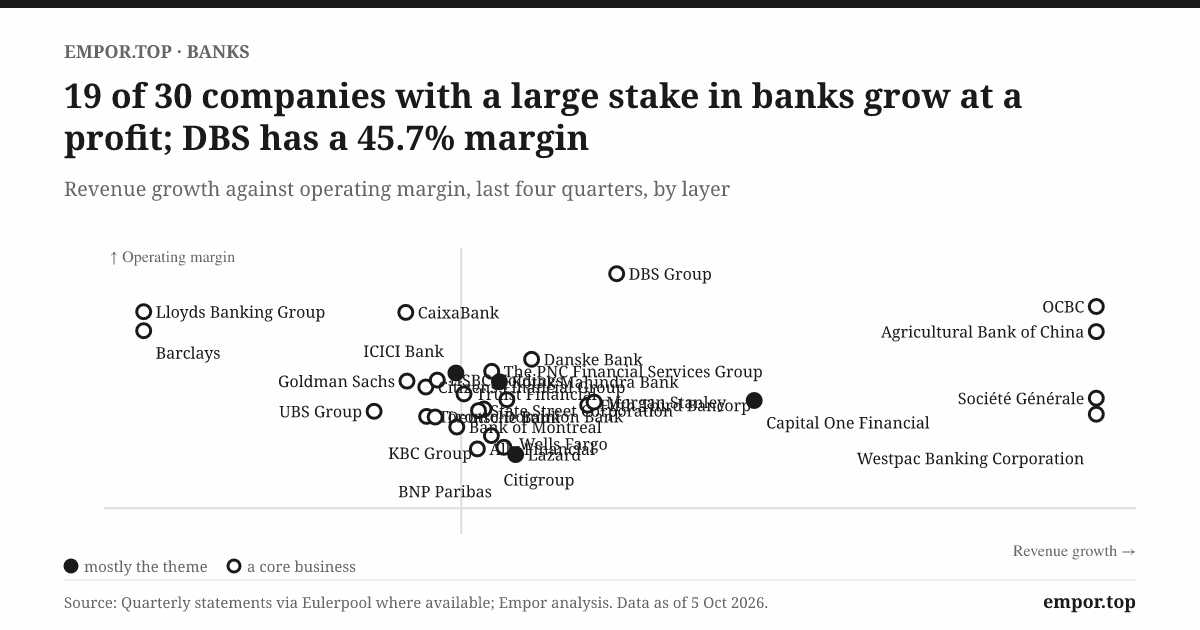
Empor's scorecard covers 79 listed banking companies. A word of caution first: the figures cover whole companies unless a specific theme revenue is stated, and fiscal years, currencies and accounting rules differ. Several 2025 revenue-growth figures in the dataset jump by more than 100% for big Chinese, Canadian and Taiwanese groups, which almost certainly reflects changes in how revenue is reported rather than real change. These are not a clean league table. The more reliable measures for comparison are return on equity (profit as a share of shareholders' capital) and return on assets (profit as a share of the whole balance sheet), and even those depend on how much capital each regulator demands.
Deposits and everyday banking
The biggest deposit-gatherers are Chinese. Industrial and Commercial Bank of China, 中国工商银行 $601398.SS, China Construction Bank, 中国建设银行 $601939.SS, and Agricultural Bank of China, 中国农业银行 $601288.SS, reach households and companies across the country through national branch networks. China Construction Bank alone reported customer deposits of about $4.7 trillion at June 2026.
Scale has not produced high returns. All three earned a return on equity of about 9% in 2025, and ICBC's has drifted down from just over 10% in 2022. Their shares trade at around 0.7 to 0.8 times book value, meaning investors value them below the accounting value of their capital. The reason lies largely outside the banks. Their state owners and regulators, including the National Financial Regulatory Administration created under the State Council in 2023, shape their lending, pricing and dividends.29 Market share is not the same as freedom to price, and the Chinese giants show that clearly.
Postal Savings Bank of China $601658.SS, which gathers household deposits through the postal network, and Ping An Bank $000001.SZ, a consumer- and business-focused lender inside a larger insurance group, show the same pattern of low returns and low valuations. China Merchants Bank $600036.SS, known for its retail and private-banking customers, earns a little more, about 12%.
Japan Post Bank $7182.T is an even more extreme case of deposits without profit. It holds about $1.2 trillion of deposits gathered through post offices, yet lends only about 3% of them, investing the rest in securities. Its return on equity was 5.7% in its latest fiscal year. Rising Japanese interest rates are lifting it: its ROE has climbed in each of the last three years, and its share price and price-to-book have risen too. A cheap deposit pool is worth little until there is something profitable to do with it. Resona Holdings $8308.T, a Japanese retail and commercial bank, shows the same improvement from a low base.
In the United States, Bank of America $BAC and Wells Fargo $WFC hold enormous consumer and business deposit bases. Bank of America's ratio of loans to deposits is only about 60%, so a large share of its deposits sits in securities and cash, and its return on equity of 9.6% in 2025 trails JPMorgan's. Wells Fargo's has risen from 7.6% in 2022 to nearly 12% in 2025, and to 12.6% over the four quarters to June 2026, a steady recovery from its own operating problems. US regional banks such as PNC $PNC, Truist $TFC, Fifth Third $FITB and Citizens Financial $CFG mostly earn returns in the high single digits to low teens. Capital One $COF, a card, auto-loan and deposit bank, earned only 2.2% in 2025 before its quarterly returns recovered in 2026, a reminder that credit cards earn high yields and take heavy losses.
India looks more profitable. HDFC Bank $HDFCBANK, ICICI Bank $ICICIBANK and Kotak Mahindra Bank $KOTAKBANK, the leading private-sector lenders, earn returns on assets of 1.5% to 1.9%, about double the global median of 0.8%. State Bank of India $SBIN, the state-controlled giant with a huge branch network, earns 14% on equity with lower asset returns. HDFC Bank's ROE dropped from about 16% to 9% after its 2023 merger with its former parent mortgage lender and has since recovered to 13%. That is merger arithmetic, not a change in the franchise.
Europe has staged a comeback. In 2022 UniCredit $UCG.MI, a multi-country lender, earned around 10% on equity and traded at 0.4 times book. By 2025 its ROE was over 16% and its price-to-book 1.7. BBVA $BBVA.MC, with large operations in Spain, Mexico and Turkey, reached 18.3%. Santander $SAN.MC, CaixaBank $CABK.MC, ING $INGA.AS, KBC $KBC.BR, Nordea $NDA-FI.HE and Danske Bank $DANSKE.CO all earn in the low to mid teens. Higher interest rates after a decade of negative ones drove most of this: a deposit franchise earns little when rates are zero and a lot when they are not. That makes much of the European recovery a rate story that remains to be tested as a franchise story. If rates fall, the test comes. Crédit Agricole $ACA.PA, a large French cooperative-owned group, and the UK's Lloyds $LLOY.L and NatWest $NWG.L are part of the same European story, with NatWest's ROE rising to 15.3%.
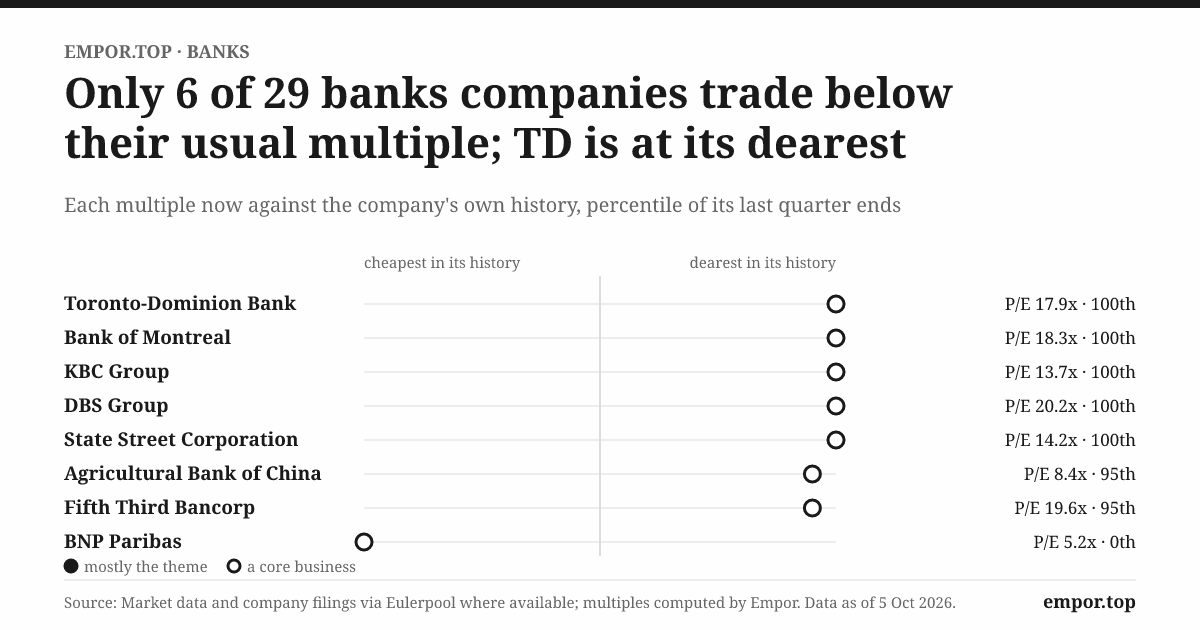
Elsewhere the pattern is varied. Canada's big banks, Royal Bank of Canada, Toronto-Dominion, Bank of Montreal, Scotiabank and CIBC, trade at 15 to 18 times earnings after strong share gains. Commonwealth Bank of Australia trades at 23 times earnings and 3.2 times book on a 13.8% return on equity, a valuation that implies investors expect its Australian deposit and mortgage franchise to hold up exceptionally well. Westpac, its domestic rival, trades lower. Korea's KB Financial $105560.KS, Shinhan $055550.KS, Hana $086790.KS and Woori $316140.KS earn around 9% to 10% and trade near or below book value, though their valuations have roughly doubled since 2023. In Southeast Asia, Singapore's OCBC $O39.SI and UOB, and Malaysia's Maybank, earn steady returns, and Taiwan's Cathay $2882.TW, Fubon $2881.TW and E.Sun $2884.TW combine banking with large insurance or diversified financial businesses. For these groups the headline figures mix several businesses together.
Bank Central Asia: the profitability standout, with caveats
One bank stands out in the deposit layer on profitability. Bank Central Asia, Indonesia's largest private bank, reported a 2025 return on equity of 20.4% and a return on assets of 3.6%, roughly four times the layer median. It has been above 18% every year since 2022. It is known at home for its transaction accounts. Millions of Indonesians and businesses use it to pay and get paid, and that supplies cheap funding. On these measures it is the clearest example in the dataset of a deposit franchise turning into profit.
The evidence against overstating it matters. Indonesian interest rates and loan margins are structurally higher than in Europe or Japan, so a 3.6% return on assets is not directly comparable with HSBC's 0.7%. The bank's ROE has eased from 20.9% in 2024. The market has also cooled: its price-to-book has fallen from 4.8 in 2022 to 2.8, its price-to-earnings from about 26 to 13, and its market value has declined. Investors are paying less per unit of profit, perhaps on concerns about the Indonesian economy, currency or competition, though the data cannot say which. The verdict: a durable lead within its own market, demonstrated over several years, with no evidence that it would carry over to another country.
Business lending and transaction banking
The second kind of advantage belongs to banks built into corporate operations. Here JPMorgan Chase is the scale leader in the dataset. In 2025 it had $280 billion of revenue and a 15.7% return on equity, and its ROE rose to 17.4% over the four quarters to June 2026. It combines a huge US consumer bank, corporate lending, global payments, markets and asset management. The breadth matters to corporate clients: a treasurer who keeps cash, makes payments and raises money in one place has many reasons not to leave. The market agrees, valuing JPMorgan at about $914 billion, 2.5 times book.
The evidence against crowning it is mainly about attribution. The dataset does not break out JPMorgan's transaction-banking profits, so it is impossible to say whether payments or markets or consumer banking is driving the returns. The valuation also already assumes a lot. A high price-to-book means future execution and capital returns are part of the investment question, not just the bank's quality.
The closest competitor on profitability is DBS $D05.SI, Singapore's largest bank, built from a government-founded development bank of 1968 into a regional corporate, wealth and digital bank.30 DBS reported 15.9% return on equity in 2025, a cost-to-income ratio of 39% in the June 2026 quarter, meaning less than 40 cents of costs for each dollar of revenue, and a net interest margin of 1.9%. Its ROE has held between 15.9% and 16.3% for three years. On those measures its lead is real and steady. Investors have priced it accordingly, at 3.1 times book and 20 times earnings, the highest in its layer. DBS operates mainly in Singapore and Hong Kong, rich markets with high savings and sophisticated corporate clients, so its returns are partly a function of where it operates.
Elsewhere in the layer, HSBC $HSBA.L, focused on international cash, trade and cross-border banking, has lifted ROE from under 9% in 2022 to over 12%. Citigroup $C, which runs one of the largest global corporate payment and cash networks, still earned only 6.7% in 2025, though it has been rising. That gap between a valuable corporate franchise and weak group returns is the clearest sign in the dataset that one strong business line cannot carry a sprawling bank. Bank of China $601988.SS, the most internationally active Chinese giant, follows its domestic peers at about 8%. BNP Paribas $BNP.PA, the French universal bank, earns around 9% and trades at 5.2 times earnings. Japan's Mitsubishi UFJ, Sumitomo Mitsui and Mizuho have been among the biggest improvers, with ROE up from about 6% to 10%–11% as Japanese rates rose and the banks reduced their cross-shareholdings. Standard Chartered $STAN.L, focused on trade and cash in Asia, Africa and the Middle East, has nearly doubled its ROE since 2022.
BNY $BK and State Street $STT need separate treatment. They are mainly custody banks: they hold and administer trillions of dollars of securities for asset managers and pension funds, and they move cash for those clients. They lend relatively little. BNY's return on equity doubled from 6.3% in 2022 to 12.5% in 2025, and it trades at 2.2 times book, a sign investors value recurring custody and cash-management fees. Comparing them directly with commercial lenders would be misleading.
Investment banking and markets
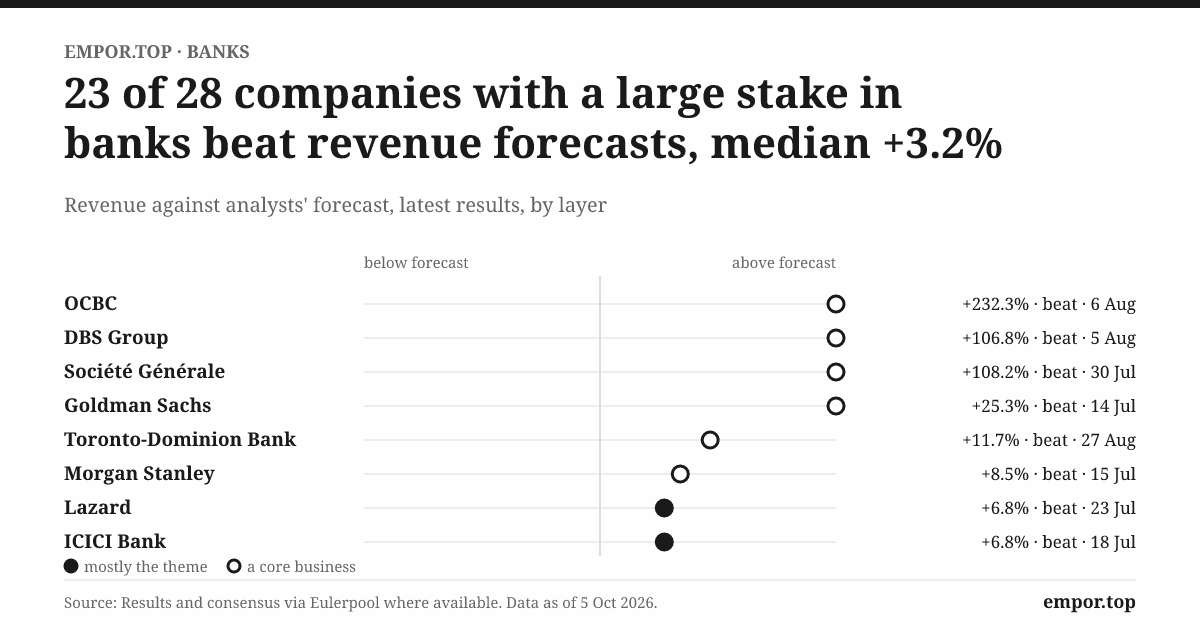
The investment banks compete for something different: access to the companies and investors that raise money, merge and trade. Goldman Sachs $GS is the scale leader in this group, with $125 billion of revenue in 2025 and a return on equity that rose from 7.3% in 2023 to 13.7% in 2025 and 17.1% over the four quarters to June 2026. Barclays $BARC.L, Deutsche Bank and Société Générale $GLE.PA combine markets businesses with corporate and, in some cases, retail banking. Jefferies $JEF is an independent adviser and trader, and Lazard $LAZ is an advisory and asset-management firm that is not a deposit-taking bank at all.
Recent growth in this layer is strong, but durability is the open question. Goldman's 2023 ROE was half its current level. Investment-banking fees and trading revenues depend on deal activity, share and bond issuance and market volatility, all of which can reverse sharply. Growth momentum in this layer has already slowed more than in any other, by more than 16 percentage points over the last two quarters compared with the two before. On the evidence, investment banking is a valuable franchise but the least suited of the five layers to the question of durable profit from relationships.
Wealth and private banking
Wealth managers compete for client assets and the advisers who look after them. Morgan Stanley $MS turned itself from a trading-led investment bank into a wealth manager after the financial crisis. It reported $148 billion of net new assets in the June 2026 quarter and its return on equity rose from 9% in 2023 to 15% in 2025. Charles Schwab $SCHW, a brokerage platform with bank subsidiaries that hold clients' uninvested cash, reported a 17.9% return on equity and $120 billion of net new assets. UBS $UBSG.SW, the Swiss private bank, still earns well under 10% as it absorbs Credit Suisse, which it took over in 2023.
Asset growth looks like durable income, but needs testing. Rising markets increase client assets without any new clients, and fees depend on how much clients pay per dollar managed, which the dataset does not provide. Schwab's 2023 experience, when clients moved cash out of low-paying accounts into higher-yielding funds and squeezed its earnings, shows that brokerage cash can be as rate-sensitive as any bank deposit. The lead in client flows is real as of mid-2026. Whether those flows earn steady fees through a falling market has not been tested in this cycle.
Digital-first and specialist banking
Finally, the challengers. Nu Holdings reported 43% revenue growth in 2025, a 25.4% return on equity and a 3.8% return on assets, the highest profitability figures in the digital group and among the highest in the whole dataset. Its customer acquisition through an app clearly works in Brazil, Mexico and Colombia.
The evidence against is equally clear. Nu's nonperforming loan ratio was 6.9% in the June 2026 quarter, much higher than incumbent banks. Its returns depend on lending profitably to borrowers with thin credit histories, a model that has not yet gone through a severe Brazilian credit downturn at its current size. Its shares have fallen this year even as profits grew, with the price-to-book down from 7.2 to 5.6.
SoFi $SOFI, an American digital bank and consumer lender, grew revenue by 83% in 2025 but earned only 4.6% on equity and trades at 31 times earnings. Its share count has been rising. Ally Financial $ALLY, an online deposit-gatherer whose main business is auto lending, earns 5.5% on equity. Among the private and newly public challengers, Chime, which listed on Nasdaq in June 2025 under CHYM, works through partner banks rather than as a chartered bank.31 Revolut and Monzo are large private challengers with their own banking licences or entities in some markets.3233 Faster growth is not yet evidence of better durable profits. Credit losses, funding costs and acquisition costs will decide it, and for most challengers those have not yet been through a full cycle.
What the scorecard can and cannot say
Across the theme, combined revenue grew 7.2% in the June 2026 quarter, and 62 of the 79 companies grew. The whole group's shares have more than doubled in dollar terms over three years, and the combined price-to-earnings stands at 11.6 times. Those are strong figures. They do not show which banks captured the most durable deposit economics, because the dataset lacks the measures that would: comparable deposit costs, customer retention and loss-adjusted returns through a full cycle.
On selected measures, Bank Central Asia, JPMorgan and DBS stand out. On deposit scale alone, the Chinese banks do. On recent turnaround, European and Japanese banks do. Each lead is specific, dated and limited by geography and business mix.
Whichever bank leads its layer, it is still exposed to the same rate, credit and confidence shocks as its rivals.
Rates, confidence and the businesses forming around banks
Follow what happens inside a bank when its central bank raises interest rates by a percentage point. Some loans reset within weeks: variable-rate mortgages, corporate credit lines, credit cards. Deposit rates usually follow more slowly, as the bank waits to see how many customers notice. Some customers do notice and move cash to a money-market fund or a higher-paying rival. Months or years later, some borrowers struggle with higher payments and start to miss them. Four effects, four separate timelines, and the profit at any moment depends on which has arrived.
What the data says about the link
The expected pattern is that rising rates widen bank margins for a while and then, as deposit costs catch up and borrowers struggle, squeeze them. Empor's links table tested that idea against up to seven years of results for each company, comparing changes in the US federal funds rate with changes in each bank's net margin.
Across the deposit-gathering banks and the business lenders, the data shows no consistent global relationship at the expected delay. That is not surprising. The US policy rate is not the rate that matters in Jakarta, Seoul or Frankfurt, and banks hedge, change their product mix and reprice loans on different schedules.
Some patterns do stand out. The Canadian banks show a fairly clear inverse link: their net margins tended to fall when US rates rose, which fits a funding base that reprices quickly and heavy exposure to markets and mortgages. State Street's margins also moved against US rates, with a lag. For investment banks the link runs the other way. Goldman Sachs and Deutsche Bank's revenue growth tended to rise a quarter or two after US rates rose, consistent with rate swings driving client trading. The G7 leading indicator, a gauge of where developed economies are heading, often moved in the opposite direction from bank revenue growth, which suggests bank revenues in recent years tracked rates and inflation more than economic momentum.
A few years of data showing two series moving together is evidence, not proof. Rates, currencies, credit quality and accounting rules all shifted at the same time. The plain conclusion is that no single global switch moves bank profits, and that each bank's own disclosures on deposit costs, loan repricing and credit quality matter more than any global indicator.
The optimists' case
The optimistic view rests on habit. If digital accounts become everyday tools and instant, interoperable payments remove friction, banks with trusted balance sheets and good apps could keep more customers as primary accounts, sell them more products, and serve each one more cheaply than any branch could. Data that customers allow banks to use could improve lending decisions. On this view, digital channels strengthen the old bargain by giving incumbents better tools to keep the relationships they already have.
It depends on several conditions. Cost savings must exceed technology spending. Better data must actually lower credit losses. Customers must stay loyal even when switching takes a few taps.
The pessimists' case
The pessimistic view rests on unbundling. Account ownership can rise while wallets, mobile-money services, card networks and nonbank lenders own the customer interface and take the economics. Customers who can compare rates on their phones may move cash to whoever pays most, raising every bank's deposit costs. Private credit may take the most profitable corporate loans. The savings from closing branches may go into technology budgets and higher deposit rates. Banks would keep the regulated balance sheet, with its capital costs and credit risk, while others keep the fees.
What history says to both
The record narrows both cases. Online-only banks have existed for more than a quarter of a century, from First Internet Bank onward, and branches have not disappeared. That is a caution against confident predictions of rapid disruption. The 2008 crisis showed how diversification and financial engineering could add complexity instead of safety, a caution against assuming broader platforms mean steadier profits. The 2023 run on SVB showed digital speed working against the bank. None of this says which bank today will keep its customers. It says broad claims, that digitisation will certainly help incumbents or that it will certainly make them obsolete, have failed before.
What could move the money next
Several developments could shift where the profits go. Instant payment systems, already running in many countries, lower friction for customers but can erode fees banks earned from slower, costlier transfers. The benefit tends to go to customers and to whoever runs the infrastructure.
Tokenised deposits, claims on a commercial bank deposit recorded on programmable infrastructure, and so-called unified ledgers are the subject of serious work by central banks. The Bank for International Settlements has described a system in which central-bank reserves, tokenised bank money and tokenised assets sit on a shared platform, which could make wholesale settlement faster and cheaper.34 Prototypes are not adoption, though. The test is live production systems, legal certainty that settlement is final, and repeated use at scale.
Stablecoins, private tokens backed by reserve assets, could pull some balances out of banks or, depending on regulation, send reserve deposits and custody fees to them. The BIS has argued that the next monetary system has to protect trust in money, and has set out the risks stablecoins pose.35 The Financial Stability Board found that by August 2025, countries were implementing crypto and stablecoin rules unevenly, with the biggest gaps in global stablecoin arrangements.36 For now, the effect on bank funding depends on policy choices still being made.
Artificial intelligence could lower the cost of serving customers and improve fraud detection and lending decisions. It could also bring new model, conduct and cyber risks. Comparable, audited savings across banks are not yet available, so for now this remains a hypothesis to watch.
These possibilities are best judged by a handful of measures that change before reported profits do.
What would prove that a relationship lasts?
Go back to the nurse's paycheck. The question that decides a bank's durable profits is not whether her account exists. It is whether the account becomes her main relationship and stays useful and profitable through a rate cut, a recession and the appearance of a shiny new payment app. A few signals can show that before it appears in earnings.
First: how many adults have a formal account
The World Bank's Global Findex survey measures the share of adults who own a financial account, as described above.14 It changes before bank revenues do. The survey is published every few years. It settles whether access to formal finance is still spreading or levelling off. Further progress in the next round, especially among those still excluded, would confirm the spread. A stall or reversal would undercut the claim that rising access is adding customers to the system. On its own, the number says nothing about bank profit.
Second: whether people pay digitally
The same survey tracks how many adults make digital payments to merchants, as described above.25 That is closer to everyday behaviour than ownership, because it measures use. It settles a different question: whether digital use is becoming habitual. The test for banks is to set it against their own disclosures. If digital payments keep rising and banks report more active transaction balances and payment fees, the bank capture story holds. If use rises while bank balances and fees stagnate, the value is going to wallets and networks.
Third: whether banks are keeping their share of finance
The Financial Stability Board's annual monitoring compares growth of bank and nonbank financial assets, as described above.26 The next report should arrive late in 2026. It settles the question of migration. If banks keep their funding, custody, payment and servicing income while nonbanks grow, the system is diversifying around banks rather than away from them. If the nonbank share keeps rising while bank margins and lending share weaken, banks are losing ground. Asset values swing with markets, so a single year means less than a trend.
Fourth: what banks report about deposits and losses
The most decisive signal comes from banks themselves, every quarter or half-year: the mix and cost of deposits, the growth of loans, the losses on them, and capital. No reliable comparable global reading exists today; definitions differ too much from bank to bank. The next round of results starts on 13 October 2026 with JPMorgan, Wells Fargo, Citigroup and Goldman Sachs, and runs through Asia, Europe and Canada into early December. A durable relationship shows up as deposits that stay, and stay cheap, while returns hold and credit quality does not worsen. It breaks when growing balances require sharply higher deposit rates, or when credit losses eat up the income.
The answer, for now
So which banks turn deposits and relationships into the most durable profits? The record across five centuries, from Siena's pawn office to SVB's app-speed run, points to a consistent profile: low-cost deposits that stay put, trusted payment or corporate relationships that are hard to unwind, and disciplined lending that does not give back in a downturn what it earned in a boom. Scale without pricing freedom, as at the Chinese giants, does not deliver it. Growth without proven credit performance, as at most challengers, has not yet delivered it.
On the selected measures available, Bank Central Asia, JPMorgan and DBS come closest to that profile: high, steady returns built on everyday transaction balances or deep corporate relationships. Differences in geography, accounting and business mix rule out a single global ranking, and their valuations already reflect much of their quality. The deciding evidence is whether they and their rivals keep those relationships, and earn risk-adjusted returns on them, through the next full cycle of interest rates and credit losses. In banking, a relationship proves its durability only after it has been tested by a downturn.
Glossary
Deposit franchise: A bank's pool of customer balances and the services that come with them. Its value depends on how cheap the balances are, how stable they are and how much customers use the account.
Deposit beta: How far a bank's deposit rates move when a benchmark interest rate moves. A low beta means the bank can keep funding cheap as rates rise.
Primary account: A customer's main account for income, bills and everyday balances, worth far more to a bank than a dormant one.
Net interest margin: Net interest income as a share of the interest-earning assets a bank chooses to measure it against: the spread between what it earns and what it pays.
Credit loss: Money a bank sets aside for, or loses on, loans that borrowers do not repay as expected.
Capital: The owners' money in a bank, which absorbs losses before depositors and creditors are hit. Regulators set minimum amounts against a bank's risks.
Liquidity: A bank's ability to pay withdrawals and other obligations on time, using cash or assets it can sell quickly.
Settlement: The final transfer of money between financial institutions that completes a payment.
Correspondent banking: An arrangement in which one bank provides payment or account services to another, often across borders and currencies.
Custody: Holding and administering securities for institutional investors and other clients.
Nonbank financial intermediation: Financial activity outside banks, including investment funds, insurers, pension funds and private-credit lenders.
Tokenised deposit: A digital, programmable representation of a claim on a commercial bank deposit.
Risk-weighted assets: A regulatory measure that weights a bank's assets by assessed riskiness to set how much capital the bank must hold.
Deposit insurance: A guarantee, public or industry-funded, that eligible deposits will be repaid up to a limit if a bank fails, under each country's rules.
References
-
An early stablecoin? The Bank of Amsterdam and the governance of money — De Nederlandsche Bank, 2020 ↩↩
-
Federal Reserve Act Signed into Law — Federal Reserve History ↩↩↩
-
Fedwire Funds Transfer System assessment — Board of Governors of the Federal Reserve System ↩
-
Banking Act of 1933 (Glass-Steagall) — Federal Reserve History ↩↩
-
London Bank – Home to the World's First Cash Machine – Listed — Historic England ↩↩
-
The Global Findex Database 2021, Chapter 1: Ownership of Accounts — World Bank ↩
-
History of the Basel Committee — Bank for International Settlements ↩↩
-
The Great Recession and Its Aftermath — Federal Reserve History ↩↩↩↩
-
Basel III standards — Basel Committee on Banking Supervision ↩
-
Review of the Federal Reserve's Supervision and Regulation of Silicon Valley Bank — Federal Reserve, 2023 ↩↩
-
Mobile phone technology powers saving surge in developing economies — World Bank, 16 July 2025 ↩↩
-
FSB reports continued growth in nonbank financial intermediation in 2024 to $256.8 trillion — Financial Stability Board, December 2025 ↩↩
-
Addressing Market Dysfunction and Liquidity Stresses in NBFIs — International Monetary Fund, September 2025 ↩
-
2025 list of global systemically important banks (G-SIBs) — Financial Stability Board, November 2025 ↩
-
National Financial Regulatory Administration established — State Council of the People's Republic of China, May 2023 ↩
-
Next-generation monetary and financial system, Annual Economic Report 2025 — Bank for International Settlements ↩
-
Path to next-generation monetary and financial system lies in safeguarding trust in money — Bank for International Settlements, June 2026 ↩
-
Thematic review on FSB global regulatory framework for crypto-asset activities — Financial Stability Board, October 2025 ↩
-
Basel III implementation dashboard — Basel Committee on Banking Supervision ↩
 LinkedIn
 WhatsApp
 Reddit
 Hacker News
 Email
Email Kindle
 RSS Feed
 Spotify
 Apple Podcasts
 Amazon Music
 Audible
 YouTube