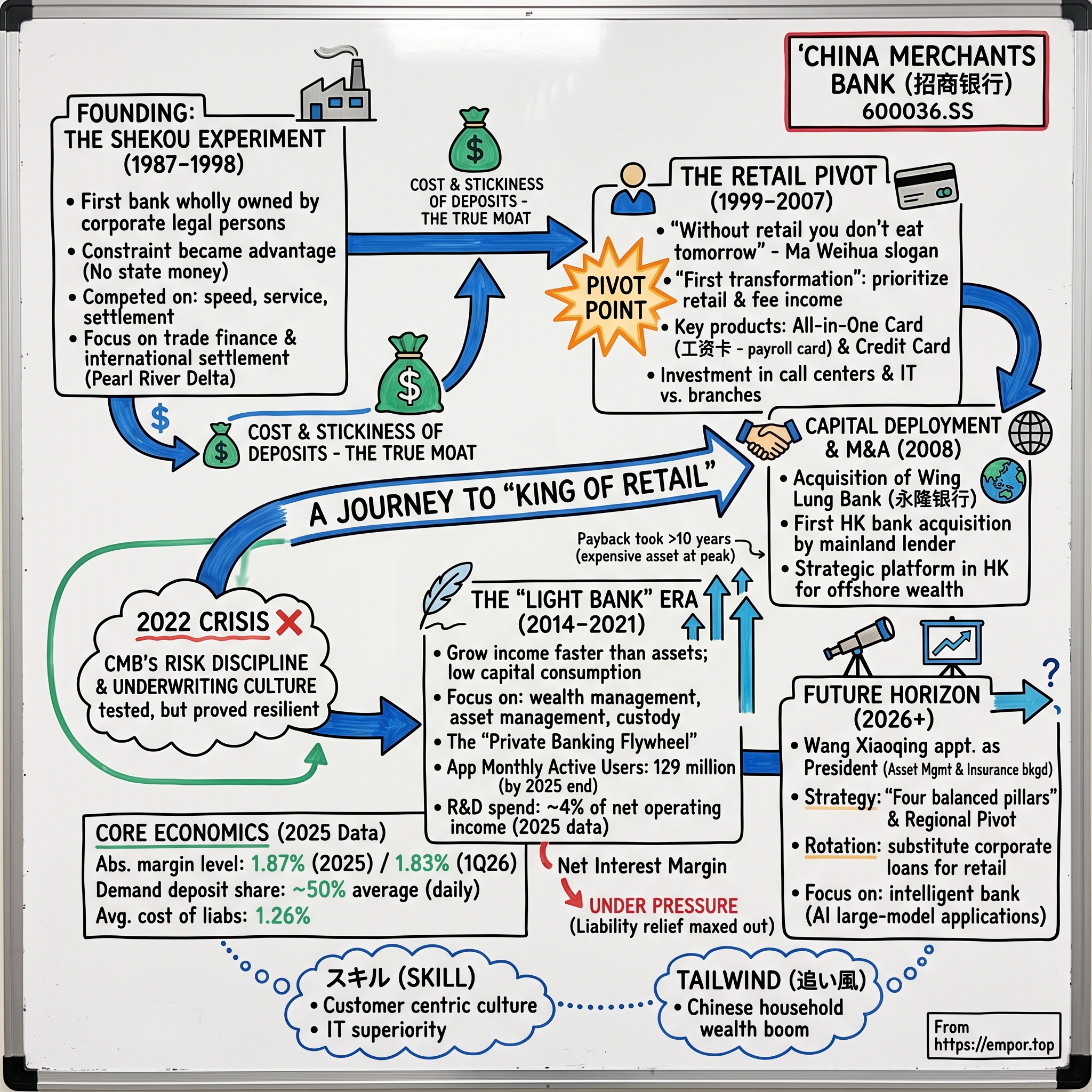
China Merchants Bank: The Story of China's "King of Retail"
I. Introduction & Episode Roadmap
On the morning of March 30, 2026, 4,413 investors, analysts and journalists dialed into a conference room in Shenzhen to hear a bank explain itself.1 That number alone tells you something. Most Chinese bank results calls are sparsely attended rituals where a deputy president reads ratios into a microphone. This one had Morgan Stanley opening the questioning, UBS asking whether return on equity would bottom at 10–11%, Goldman Sachs probing the quality of non-mortgage consumer loans, and HSBC asking whether one good quarter of margin actually meant anything.
The bank was 招商银行 China Merchants Bank — CMB — and the reason the room was full is that for roughly two decades it has been the one Chinese bank that global investors were willing to pay a premium for. Not the biggest. Not the most systemically important. The best.
By the end of 2025, CMB held RMB 13.07 trillion in total assets, up 7.56% on the year, and managed RMB 17.08 trillion of assets on behalf of its retail customers — a pool of household wealth substantially larger than its own balance sheet.2 It served 224 million retail customers, a number larger than the population of Brazil.2 Its net profit attributable to shareholders reached RMB 150.181 billion, its return on average equity 13.44% at a time when most listed Chinese banks were grinding along at 9–10%.2 Its non-performing loan ratio was 0.94%, backed by an allowance coverage ratio of 391.79% — nearly four yuan of reserves for every yuan of recognised bad debt.2
Here is the paradox worth 220 minutes of your attention. CMB was founded in April 1987 inside the Shekou Industrial Zone of Shenzhen, with 34 employees and RMB 100 million of capital, as an experiment in whether a commercial bank could exist in China without state treasury money behind it.3 It was, by design, a runt. The Big Four state banks — 工商银行 ICBC, 建设银行 CCB, 农业银行 ABC, 中国银行 BOC — owned the deposits of the nation and the lending relationships of every state enterprise that mattered. CMB had a shipping conglomerate for a parent and a industrial park for a market.
Four decades later, that runt earns a higher return on assets than any of the Big Four, generates a larger share of its income from fees, and has the deepest private banking franchise in the country. Chinese retail investors gave it a nickname that stuck: 零售之王, the King of Retail.
The spine of this story runs through five decisions and one disaster.
The first decision was the pivot. In 2004, a president named 马蔚华 Ma Weihua told a sceptical management team that corporate lending in China was a business with structurally bad economics — cyclical credit risk, no pricing power, and allocation decisions that were not entirely the bank's to make. His formulation became a slogan repeated inside Chinese banking for twenty years: without corporate business you don't eat today; without retail business you don't eat tomorrow.4
The second was the acquisition. In 2008, weeks before the global financial system seized, CMB paid HK$19.3 billion for control of Hong Kong's 永隆银行 Wing Lung Bank at 2.91 times book value — one of the most expensive bank deals in Hong Kong's history, executed at almost exactly the wrong moment.5
The third was the "light bank." Beginning in 2014, President 田惠宇 Tian Huiyu pushed CMB away from balance-sheet growth toward fee income — wealth management, asset management, custody — a strategy designed to earn money without consuming regulatory capital.
The fourth was survival. In April 2022, Tian was abruptly removed. Investors erased roughly US$35 billion of market value in two trading sessions.6 He was later expelled from the Party, tried, and in February 2024 sentenced to death with a two-year reprieve for taking more than RMB 210 million in bribes, alongside convictions for abuse of power and trading on undisclosed information.7 The bank did not break.
The fifth is happening now. On April 30, 2026, 王良 Wang Liang — the insider who stabilised CMB after the scandal — retired at 61 after nearly 31 years at the bank, handing the presidency to 王小青 Wang Xiaoqing, an asset-management and insurance executive who has spent only six years inside the CMB system.8
And the disaster in the background is arithmetic. CMB's net interest margin was 1.87% in 2025 and fell to 1.83% in the first quarter of 2026.29 Its credit card book is shrinking and its credit card NPL ratio has climbed to 1.90%.9 Chinese households are simultaneously borrowing less and hoarding cash, which squeezes the two engines — retail lending and wealth fees — that made CMB special.
This is a story about what happens when a company builds a genuinely superior business model and then the environment that model was optimised for goes away. The interesting question is not whether CMB is a good bank. On the evidence, it is. The question is whether "better than Chinese banking" is a durable investment proposition when Chinese banking itself is compressing — and how much of CMB's premium was skill versus the tailwind of a decade in which Chinese household wealth doubled.
Everything begins in a industrial park on the southern edge of the country, with a 70-year-old former intelligence officer who wanted to prove something.
 Subscribe on LinkedIn
II. Founding Context & The Shekou Experiment (1987–1998)
Shekou in the early 1980s was a peninsula of red dirt and construction dust on the western edge of what would become Shenzhen. It smelled of diesel and seawater. And it was, for a brief window, the most ideologically radical square kilometre in China.
The man responsible was 袁庚 Yuan Geng — a former Communist underground operative and intelligence officer who had spent five years in prison during the Cultural Revolution and emerged, improbably, as the reform era's most aggressive institutional entrepreneur. Sent to Hong Kong to run 招商局集团 China Merchants Group, the century-old state shipping conglomerate, Yuan Geng persuaded Beijing in 1979 to let him carve out an industrial zone at Shekou and run it on commercial rather than administrative logic. His slogan — time is money, efficiency is life — was so unfashionable when it went up on a billboard that it had to survive several rounds of political attack.10
Yuan Geng's insight about banking was simple and, at the time, almost heretical. The Shekou zone had an internal settlement centre handling payments between its tenant enterprises. Yuan proposed converting it into a real commercial bank: one that took no state investment, answered to corporate shareholders rather than a ministry, and competed for business on service. On April 8, 1987, that bank opened as China Merchants Bank — the first commercial bank in the People's Republic wholly owned by corporate legal persons, with 34 staff and RMB 100 million of capital.3
To understand how small that was, consider what it was competing against. The Big Four state banks were not really banks in the Western sense; they were fiscal transmission mechanisms. Their deposits came from state enterprises and urban households who had nowhere else to put money. Their loans went where the plan directed. Credit was allocated, not underwritten. Profit was an accounting residue.
CMB had none of that. It had no policy mandate to fund, which also meant no captive deposit base to fund it with. Every yuan of funding had to be won. Every corporate client had to be persuaded to move business away from a state bank that could not lose it.
So CMB competed on the only dimensions available: speed, service, and settlement. It went after trade finance and international settlement work for the export manufacturers filling up Shekou and, later, greater Shenzhen — business that was operationally demanding, fee-generating, and largely ignored by state banks whose staff had no incentive to hurry. It built a reputation for clearing payments faster than anyone else in the Pearl River Delta. It hired differently, promoted on performance, and imported risk-management practices from Hong Kong rather than from the planning apparatus.
The commercial logic here deserves emphasis, because it explains the next thirty years. A bank with no privileged access to deposits or borrowers is forced to become good at the customer relationship itself. That constraint, imposed by weakness in 1987, became the source of CMB's advantage by 2007. Institutions rarely develop capabilities they don't need.
The cultural blueprint hardened early. Internally, CMB describes its inheritance in three words — professional, market-oriented, customer-centred — and it is not merely marketing. On the 2025 annual results call, Chairman 缪建民 Miao Jianmin was asked point-blank by Morgan Stanley whether industry-wide pay reform and homogenised competition would erode CMB's market mechanisms. His answer was a direct appeal to founding culture: market orientation and professionalism are CMB's base colour, he said, and analysts who identify the bank's moat as low-cost deposits or the retail franchise are describing symptoms rather than the cause — the actual moat is that customer-centricity has been internalised as corporate culture.1
That is, of course, exactly what any chairman would say, and it is unfalsifiable as stated. The useful test is behavioural, and it is available: CMB's deposit cost is among the lowest in the industry and its demand-deposit share among the highest, which is a measurable consequence of customers choosing to keep transactional balances there rather than chasing rate.1 Culture claims deserve scepticism; revealed customer behaviour is evidence.
The 1990s gave CMB its first genuine product weapon. On July 3, 1995, it launched 一卡通 the All-in-One Card in Shenzhen — a single magnetic-stripe card consolidating multiple currencies, demand and time deposits, and multiple account types into one instrument.11 In an era when Chinese savers carried a passbook for each account and queued at a specific branch to use it, this was not a marginal convenience. It was the first time a Chinese bank had treated a retail customer as a portfolio rather than a set of unrelated ledger entries. The card became the foundation of everything that followed, because it made the customer relationship — not the account — the unit of measurement.
By 1998 CMB had branches beyond Shenzhen, a national ambition, and a still-modest balance sheet. What it did not yet have was a strategy for the fact that its corporate lending business was structurally mediocre. That realisation, and the man who acted on it, came next.
III. The Retail Pivot: Building the "King of Retail" (1999–2007)
马蔚华 Ma Weihua arrived at CMB in 1999 from the People's Bank of China, where he had run the Hainan branch and presided over the closure of Hainan Development Bank — the first commercial bank failure in the People's Republic. He had, in other words, personally watched what happens to a Chinese bank that funds itself expensively and lends badly. That experience shaped a career.12
Ma inherited a bank that was doing fine and was, on his analysis, walking toward a wall. Corporate lending in China around 2000 offered high nominal returns and fast asset growth, which is why the entire industry was doing it. But the underlying economics were poor: pricing was regulated, competition was on relationship rather than product, credit risk was concentrated in state enterprises and property, and the capital consumed per yuan of profit was enormous. Worse, as China's capital markets developed, the best corporate borrowers would eventually issue bonds instead — disintermediating exactly the clients who paid the most.
Retail banking looked awful by comparison. Chinese households in 2000 held modest savings, transaction volumes were tiny, and serving them required expensive branch and IT infrastructure with payback measured in years, not quarters. Every incentive in the industry pointed at corporate lending.
Ma's argument, delivered to a management team that did not want to hear it, was that the sequencing mattered more than the level: without corporate business you don't eat today, without retail business you don't eat tomorrow.4 The 2004 annual report formalised it — retail banking became the declared strategic priority, with a parallel commitment to build fee-based wealth and asset management income rather than living on spread alone.12 Internally this became known as the "first transformation."
It worked, and the numbers from that window are worth understanding for what they say about compounding rather than for their absolute size: between 2004 and 2008, CMB's net profit grew roughly sixfold as its balance sheet passed RMB 1.5 trillion.12 The mechanism was not heroic lending. It was funding.
Here is the engine, stripped of jargon. A bank makes money on the gap between what it earns on assets and what it pays for funding. Corporate deposits are mercenary: a treasurer moves RMB 500 million for five basis points. Retail transactional deposits are sticky and cheap, because an ordinary household leaves its salary in a current account not to earn interest but because that is where money lives before it is spent. If you can become the account where salary lands, you get a very large pool of nearly free money that does not run when rates move.
CMB attacked this directly. The All-in-One Card became the payroll card — 工资卡 — for a growing share of China's better-paying urban employers, particularly foreign-invested and private-sector firms that valued service over political connection. Once a household's salary, utility payments, and card autopay run through one bank, switching is genuinely painful in a way that has nothing to do with loyalty and everything to do with friction.
The second weapon was the credit card. CMB launched China's first dual-currency credit card in 2002 and built the business with a discipline that was unusual for the era: it targeted urban professionals rather than mass acquisition, invested early in a proper scoring and collections infrastructure, and reached profitability far faster than the industry expected.13 Cards did three things at once — they generated interchange and interest income, they produced behavioural data years before anyone used the word "big data" in Chinese banking, and they gave CMB a reason to talk to affluent customers monthly.
The third was channel economics. CMB could never win a branch-count war against banks with tens of thousands of outlets, so it deliberately did not fight one. It invested disproportionately in call centres, electronic banking, and core IT — spending like a technology company relative to peers — and used those channels to serve customers a state bank could only reach with concrete. This was a capital-allocation choice with compounding consequences: fixed technology cost spread across a growing customer base gets cheaper per customer every year, while a branch network does not.
Capital markets validated the strategy. CMB's A-shares listed on the Shanghai Stock Exchange on April 9, 2002.[^14] The H-share listing followed in Hong Kong in September 2006, raising over HK$20 billion.[^14] On the March 2026 call, Wang Liang used the twentieth anniversary of that listing to make a point about capital discipline: across twenty years CMB raised RMB 31.344 billion cumulatively in the Hong Kong market and paid out RMB 81.769 billion in cumulative cash dividends — 2.61 times what it took in — for a compound annualised return to H-shareholders of 15.07% including dividends.1
That statistic is management's own framing and should be read as such; twenty-year compound returns are sensitive to endpoints, and CMB's H-shares spent much of 2022 through 2024 well below their peak. But the underlying claim — that this bank has been a net returner rather than a net consumer of shareholder capital, in an industry notorious for serial equity raising — is verifiable and unusual.
By 2007 CMB had the funding advantage, the affluent customer base, and a rising stock. What it did not have was scale outside the mainland. In 2008 it went looking, and it went looking at the worst possible time.
IV. Capital Deployment & M&A Benchmark: The Wing Lung Gamble (2008)
In the spring of 2008, the 吴 Wu family — controlling shareholders of Hong Kong's 永隆银行 Wing Lung Bank since 1933 — decided to sell. Wing Lung was a classic old-Hong-Kong institution: conservative, deposit-rich, family-run, with a network of branches and a full Hong Kong banking licence. Every large mainland bank wanted a Hong Kong platform. The auction that followed was, in retrospect, a period piece.
CMB won. On June 2, 2008 it agreed to acquire the family's 53.12% stake for HK$19.3 billion in cash at HK$156.50 per share — 2.91 times Wing Lung's book value.5 Regulatory approvals came through over the following four months, after which CMB made a general offer for the remaining shares, taking total consideration to HK$36.33 billion, roughly US$4.7 billion.14 It was the first acquisition of a Hong Kong bank by a mainland lender.14
Then Lehman Brothers failed.
It is worth sitting with the multiple, because it is the cleanest available test of CMB's capital-allocation judgement. Nearly three times book for a mature Hong Kong retail bank was a full price even in a bull market. Within a year, Hong Kong bank valuations had reset violently, and comparable transactions in the following decade cleared at materially lower multiples. Purely as a financial trade, the 2008 timing was poor: CMB bought a cyclical asset at a cyclical peak, carried the goodwill, and absorbed integration cost into a global recession. Anyone arguing otherwise is arguing with arithmetic.
Two defences are usually offered. The first is that CMB was not buying earnings; it was buying a licence, a deposit franchise, and a permanent platform in the one jurisdiction where mainland wealth meets global markets. Scarce assets carry scarcity prices, and Hong Kong banking licences do not come up often. The second is that control mattered — a minority stake would not have allowed the integration that followed.
Both are reasonable. Both are also the arguments every acquirer makes. The honest verdict is that CMB overpaid on any near-term financial metric and that the strategic thesis required more than a decade to become visible.
The integration itself was patient rather than dramatic. Wing Lung retained its identity for a decade before being rebranded 招商永隆银行 CMB Wing Lung Bank in 2018 — a signal that the bank had been fully absorbed into CMB's franchise rather than run as a financial holding.15 Its role was redefined around three functions: offshore wealth management for mainland high-net-worth clients, cross-border trade and corporate finance, and a booking base for Hong Kong capital markets activity alongside CMB International.
By 2025, that thesis was finally producing numbers worth citing. CMB Wing Lung's retail assets under management reached HK$653.793 billion, up 22.14% year on year.2 The Group's Hong Kong institutions grew total assets 13.84% and net operating income 36.36% — the fastest-growing meaningful business inside the bank.2 CMB International ranked second in the Hong Kong market by number of IPOs underwritten and fourth by number sponsored during 2025.2 Group-wide, overseas institutions increased net operating income 33.78%.2 On the third-quarter 2025 call, Deputy President 彭家文 Peng Jiawen singled out Hong Kong as a genuinely new growth engine at a moment when the domestic business was flat.16
So what does an investor take from this? Two things, and they point in different directions.
The constructive reading is that a licensed offshore platform is a real and rare asset, and that its value is highest precisely when the domestic market is weakest. In 2025, with mainland margins compressing, the Hong Kong business was one of CMB's few sources of double-digit revenue growth. Cross-border capability also underpins the private banking franchise: a wealthy mainland family that wants offshore diversification can be served inside the group rather than lost to a foreign private bank.
The sceptical reading is that eighteen years is a very long payback, that the returns realised so far still have to be measured against RMB 36 billion of 2008 money and its opportunity cost, and that "it worked eventually" is a dangerous lesson for any management team to internalise. CMB itself appears to have drawn the cautious conclusion: it has made no comparable overseas acquisition since, expanding instead organically and through domestic joint ventures. That restraint is arguably the more important legacy of Wing Lung than the asset itself.
The next chapter is what CMB did with the domestic franchise while the Hong Kong bet slowly matured — and it produced the most profitable decade in the bank's history, under a president who would end up in a courtroom.
V. The "Light Bank" Era & Private Banking Flywheel (2014–2021)
田惠宇 Tian Huiyu took over as president in 2013, arriving from 建设银行 CCB with a reputation for analytical rigour and an appetite for reorganisation. What he identified was a problem hiding inside CMB's success.
CMB's retail machine was excellent at growing the balance sheet. But every yuan of loan growth consumed regulatory capital, and capital had to come from retained earnings or from shareholders. A bank that grows assets faster than it generates capital eventually returns to the market with a rights issue — the treadmill that has consumed Chinese bank shareholders for decades. Tian's answer, launched around 2014, was 轻型银行 the "light bank": grow income faster than assets by selling services rather than balance sheet.
The mechanics are worth explaining plainly, because "capital-light" is one of the most abused phrases in financial analysis. When a bank lends RMB 100, regulators require it to hold equity against the possibility of loss. When a bank instead sells someone else's mutual fund, distributes an insurance policy, or holds securities in custody, it earns a fee and holds almost no capital against it. The first business is constrained by equity; the second is constrained only by distribution reach and client trust. If you already own the relationship with tens of millions of affluent households, converting that relationship from a lending channel into a distribution channel is close to free money — and it was the single best idea in Chinese banking in the 2010s.
The wealth accumulation of the period made it work. As Chinese urban household net worth compounded, the pool of investible financial assets exploded, and CMB was positioned at the top of it.
The pinnacle of that positioning is private banking. CMB defines a private banking client as a retail customer with monthly average total RMB assets of RMB 10 million or above. That population reached 199,326 households at the end of 2025, and crossed 200,000 for the first time in the first quarter of 2026 at 207,492 — putting CMB in a "200,000-household club" alongside the four largest state banks, despite having a fraction of their branch networks.17 The tier below, 金葵花 Golden Sunflower clients and above, numbered 5.9315 million at end-2025, up 13.29%.2
Here is an important disclosure caveat, and it is the kind of thing worth noticing. CMB stopped publishing private banking AUM as a separate line item in its recent annual reports, and in the 2025 report also folded Golden Sunflower AUM into the consolidated retail AUM figure.18 Private banking AUM is therefore not disclosed for 2025. The state banks have made similar disclosure retreats.17 Reduced granularity in exactly the segment a bank promotes as its crown jewel is not proof of a problem, but it removes the reader's ability to verify a central claim, and it deserves to be logged rather than glossed over.
What is disclosed is instructive. CMB had 64.1225 million customers holding wealth management products at end-2025, up 10.15%.2 Retail wealth management product balances reached RMB 4.41 trillion, up 12.20%.2 Distribution of non-money-market mutual funds reached RMB 706.466 billion, up 18.13%; trust scheme distribution RMB 224.770 billion, up 155.65%; agency insurance premiums RMB 147.655 billion, up 25.96%.2 Assets under custody hit RMB 26.09 trillion.2 Aggregate "extensive wealth management" income — fees from wealth management, asset management and custody combined — reached RMB 44.013 billion, up 16.91%, the best level in three years and 52.23% of total fee and commission income.2
Read that last figure carefully, because it is the light-bank thesis in one number. More than half of CMB's fee income now comes from managing and distributing other people's money rather than from transacting or lending. No other large Chinese bank has that mix.
The distribution layer is the two apps. 招商银行App CMB App handles banking and wealth; 掌上生活App CMB Life App handles credit cards, payments, and lifestyle commerce. Combined monthly active users reached 129 million at end-2025.2 For context, CMB's information technology spend that year was RMB 12.901 billion — 4.31% of net operating income — with 11,051 R&D staff, 9.09% of the entire workforce.2 Those are software-company ratios inside a commercial bank, and they are the reason CMB can serve 224 million customers with a branch network smaller than any of the Big Four.
Three subsidiaries carry the strategy, and their 2025 results tell a more complicated story than the headline.
招银理财 CMB Wealth Management, established in 2019, ended 2025 as China's largest bank wealth management subsidiary with RMB 2.64 trillion under management.19 JPMorgan Asset Management bought a 10% strategic stake for roughly RMB 2.7 billion, announced in March 2021 and approved by regulators that December — external validation of the distribution platform's value from a firm with no shortage of alternatives.20[^22] But the unit's 2025 net profit was RMB 2.726 billion, down 0.47%, and it was overtaken as the industry's most profitable wealth subsidiary by 农银理财 ABC Wealth Management at RMB 3.754 billion.19 Largest is no longer most profitable. Fee compression is not a hypothetical.
招联消费金融 Merchants Union Consumer Finance, the 50/50 joint venture with 中国联通 China Unicom, became China's largest licensed consumer finance company by loan book. Its 2025 disclosures, surfaced through China Unicom's annual report, showed revenue of RMB 16.144 billion — down 6.8% — with net profit of RMB 3.054 billion, up only 1.26%, and that marginal gain came largely from an 8.81% reduction in credit impairment charges rather than from growth.21 Total assets edged up 2.1% to RMB 167.238 billion.21 The high-yield-covers-high-risk model that powered Chinese consumer finance for a decade is visibly running out of road.
招银金租 CMB Financial Leasing remains the asset-heavy exception — aviation, shipping, and equipment leasing that consumes balance sheet in service of corporate relationships.
Collectively, CMB's major subsidiaries held RMB 952.839 billion of assets at end-2025, up 11.43%, and contributed 12.26% of group net operating income, up 1.96 percentage points.2 Diversification is genuinely progressing.
The blunt investor conclusion on the light-bank era is this: the strategy was correct, the execution was strong, and the results were partly a gift from the environment. Fee income grows beautifully when household wealth is compounding and equity markets are rising. The test of whether CMB's wealth franchise is a moat or a beta play arrives when fee rates are cut by regulation and clients refuse to take risk — which is precisely the environment of the last four years.
Before we get there, the bank had to survive something more immediate.
VI. The 2022 Crisis: Downfall, Governance, & Leadership Transition
The rumour moved before the announcement. On April 18, 2022, CMB disclosed that Tian Huiyu had been removed as president, ending a nine-year tenure with no explanation that satisfied anyone. Over the next two trading sessions, CMB's Shanghai and Hong Kong shares suffered their worst sell-off in more than a decade, erasing roughly US$35 billion of market capitalisation.6
Four days later, on April 22, China's Central Commission for Discipline Inspection and National Supervisory Commission — 中央纪委国家监委 CCDI — confirmed Tian was under investigation for serious violations of Party discipline and law, the standard formulation for corruption.[^24]22 In October 2022 he was expelled from the Party.23 On February 5, 2024, the Changde Intermediate People's Court in Hunan sentenced him to death with a two-year reprieve for taking bribes exceeding RMB 210 million between 1997 and 2022, with additional convictions for abuse of power and for trading on undisclosed information — the latter carrying a fine of RMB 300 million.724 Death with reprieve in China is, in practice, commuted to life imprisonment after two years of compliance; the sentence signals severity rather than execution.
For investors, the interesting part is not the crime. It is what the episode revealed about the institution.
A bank is a leveraged confidence machine. Its assets are illiquid loans; its liabilities are deposits payable on demand. When the chief executive of a bank is removed for corruption, the rational fear is not that he stole money — RMB 210 million is immaterial against RMB 150 billion of annual profit — but that the underwriting culture he supervised was compromised, that credit decisions were sold, and that the reported asset quality is fiction.
CMB's response was structural rather than rhetorical. Chairman Miao Jianmin — simultaneously chairman of parent China Merchants Group, which he had led since July 2020 — fronted an emergency investor call and anchored the message on continuity of strategy and risk limits.25 Wang Liang, then chief financial officer and first executive vice president, took over as acting head and was confirmed as president in May 2022.[^29] He had joined CMB in June 1995 and spent his entire career inside it — a deliberate choice of the deepest available insider, signalling that the strategy was not on trial, only the man.
Miao Jianmin was a well-chosen face for that moment, and his background explains why. Before taking over China Merchants Group, he had run 中国人民保险集团 PICC, the state insurance giant — an institutional-investor career rather than a lending career.25 Put a career insurance investor in front of frightened bank shareholders and you get someone fluent in the language of long-duration liabilities and solvency buffers, which is exactly the register that reassures. That skill set also foreshadowed where CMB's strategic emphasis would drift over the following four years: away from loan growth, toward asset and wealth management.
The contrast with the man he replaced is instructive. Tian Huiyu had arrived from 建设银行 CCB in 2013 as an outsider with a mandate to remake the business model, and he largely did — the light-bank strategy was his, and it worked.6 That is the uncomfortable part of this chapter. The most commercially successful strategist in CMB's modern history was also, according to the court, taking bribes throughout it. Investors who like to believe that governance quality and operating performance move together should sit with that for a moment. They do not always. A bank can be well run and badly governed at the same time, and the second problem can stay invisible for nine years.
Judged on outcomes over the following four years, the institutional-resilience argument holds up reasonably well. CMB's NPL ratio has stayed below 1% throughout, ending 2025 at 0.94% with an NPL formation ratio of 1.03%.2 There was no restatement, no discovery of a hidden loan book, no strategic reversal. Customer acquisition never stalled: retail customers grew 6.67% in 2025 alone.2 If underwriting had been systematically corrupted, four years of subsequent credit performance is where it would have shown up.
Two caveats belong in the ledger. First, absence of evidence in Chinese banking disclosure is weaker evidence than in more litigious markets, and loan classification involves genuine judgement. On the March 2026 call, Deputy President 徐明杰 Xu Mingjie went out of his way to state that CMB applies stricter-than-standard criteria when classifying substandard and doubtful loans and provisions loan-by-loan under an expected-loss model — a claim that is credible given the coverage ratio but not independently verifiable from outside.1 Second, the scandal was one of dozens in a broader financial-sector crackdown, which cuts both ways: it lowers the odds that CMB was uniquely rotten, and it raises the baseline probability that political risk lands on any large Chinese financial institution.
The governance picture today is a hybrid, and it has a genuine soft spot. China Merchants Group holds roughly 29.97% of CMB through a cluster of state-owned entities, with 招商局轮船有限公司 China Merchants Steam Navigation directly holding about 13.04% as the single largest shareholder.26 That structure delivers sovereign-adjacent stability with more operating independence than a directly state-owned bank enjoys. But an activist would note that Miao Jianmin has now been absent from CMB's annual general meeting for four consecutive years, including the 2025 AGM held on June 25, 2026 — even as attendance at that meeting jumped 78.61%.[^31] A chairman who does not face shareholders in person, at a bank whose last president was convicted of corruption, is a legitimate governance criticism regardless of how well the numbers read.
Which brings the story to the handover now in progress, and the question of whether CMB's culture is strong enough to survive a president who did not grow up inside it.
VII. Segment Breakdown & Core Business Economics
Strip away the narrative and CMB is a machine with one dominant part.
In 2025, retail finance generated 56.63% of net operating income and 50.66% of profit before tax — RMB 90.676 billion of pre-tax profit.227 Wholesale finance, meaning corporate banking plus investment banking and financial markets, produced most of the remainder. Treasury and financial-markets activity functions as the balance-sheet shock absorber: liquidity management, bond investment, and yield optimisation, with a rising contribution from wealth and asset management subsidiaries.
Understanding why retail dominates profit despite generating only a modest majority of revenue requires looking at the liability side, which is where CMB's real advantage lives.
Total customer deposits reached RMB 9.836 trillion at end-2025, up 8.13%.2 The critical statistic is not the size but the composition: the daily average balance of demand deposits equalled 49.40% of total customer deposits.2 Roughly half of CMB's funding sits in current accounts. The average cost ratio of interest-bearing liabilities was 1.26%, down 38 basis points year on year.2 Retail deposits alone reached RMB 4.266 trillion, up 11.49%, and retail demand deposits ended the year around RMB 2.2 trillion at an average cost of roughly 0.07% — meaning CMB pays approximately RMB 1.4 billion a year for RMB 2.2 trillion of funding.27
That is the whole trick. It is not clever lending. It is the fact that millions of households and businesses use CMB as their transaction account and accept essentially no interest for the privilege. On the third-quarter 2025 call, Peng Jiawen framed CMB's margin position in three phrases that have since become the bank's standard language: absolute level leading, relative change under pressure, future trend controllable.16
Unpack the middle phrase, because it is the honest one. When your funding already costs 1.26% and your demand-deposit posted rate is 0.05%, further central bank rate cuts help you far less than they help a competitor paying 2.2% for wholesale funding. Peng said this explicitly: because CMB's demand deposit share is high, the benefit it receives from rate cuts is smaller than peers'.16 The low-cost advantage is real and it is measurable — and in a falling-rate environment it compresses in relative terms. This is a genuinely uncomfortable feature of CMB's model that management, to its credit, states plainly rather than hides.
The asset side has its own shift. Retail loans reached RMB 3.655 trillion at end-2025, up only 2.15%, while corporate loans grew 13.10% to RMB 2.930 trillion.2 Read those two numbers together and you can see the business quietly rotating. Chinese households have stopped borrowing — mortgages are being repaid early, credit card balances are falling, consumer loan demand is weak — so CMB has redeployed into corporate lending: technology enterprise loans of RMB 1.037 trillion, green loans of RMB 609.413 billion up 21.01%, inclusive small and micro loans of RMB 962.139 billion, manufacturing loans of RMB 733.612 billion up 14.36%.2
This rotation is defensible and also dilutive. Corporate loans carry lower yields and thinner spreads than credit cards and consumer loans. When Wang Liang described retail loan growth in recent years as having fallen off a cliff, and acknowledged that the credit card segment's contribution to revenue and profit has been declining, he was describing the mechanical source of margin compression.1 Substituting corporate volume for retail volume defends the balance sheet and hurts the margin. There is no version of this trade that does not.
Two disclosures give a sense of the sheer transactional throughput underneath the profit line. CMB counted 70.1065 million active credit card users at end-2025, processing RMB 4.08 trillion of card transactions and gaining market share even as the loan balance shrank — evidence that cardholders are still spending, just not revolving.2 On the corporate side, the aggregate financing products balance for corporate clients, which CMB reports as FPA, reached RMB 6.73 trillion, up 11.08%, against corporate deposits of RMB 5.195 trillion.2 FPA is a deliberately broad measure — it counts bonds underwritten and financing arranged as well as loans booked — and it exists because CMB wants to be measured on the total financing it originates rather than only what it keeps. That is the light-bank logic applied to the corporate franchise.
The financial markets business, long the least discussed part of CMB, has quietly become material. In 2025 the bank led underwriting of RMB 579.138 billion of debt financing instruments, arranged RMB 253.283 billion of M&A financing up 22.58%, served 88,823 wholesale clients in client-flow trading with volumes of US$340.024 billion up 20.20%, and turned over RMB 8.85 trillion of RMB bond investments — a 195.99% increase that speaks to how much of Chinese bank earnings now comes from trading rates rather than lending money.2 That last figure deserves a caution flag: bond trading gains are real income and they are also the least repeatable line in a bank's P&L. A meaningful part of the sector's recent earnings resilience, CMB's included, has come from a multi-year bond bull market that a rate reversal would end.
Income mix in 2025: net interest income RMB 215.593 billion, up 2.04%, against net non-interest income of RMB 121.680 billion, down 3.31% — the latter representing 36.08% of net operating income, down 1.25 percentage points but still the highest among large Chinese banks.2 Within non-interest income, net fee and commission income rose 4.39%, turning positive for the first time since 2022.2 Wealth management fee income specifically rose 21.39% to RMB 26.711 billion, with fund distribution revenue up 40.36% and trust plan agency revenue up 65.55%.27
The cost line is the underappreciated part of the story. CMB's cost-to-income ratio was 32.01%, up a mere 0.09 percentage points.2 Holding cost flat while absorbing RMB 12.9 billion of technology spend, 11,000 R&D staff, and a large-model deployment programme implies real operating leverage from automation. Credit cost was 0.60%, down five basis points.2
What all of this means for an investor is narrower than the bull case usually implies. CMB's superiority is concentrated in one specific, measurable, hard-to-replicate thing: the cost and stickiness of its deposits, which flow from owning the primary transactional relationship with affluent Chinese households. Everything else — wealth fees, private banking, app engagement, the credit card book — is downstream of that. The franchise is real. But it is one franchise, and the environment is currently testing it from both sides at once: fewer borrowers on the asset side, and more risk-averse savers on the liability side.
Whether that franchise is defensible depends on who is attacking it.
VIII. Competitive Landscape, Porter's 5 Forces & 7 Powers
Picture the Chinese banking market as a war-game board with four kinds of pieces.
The Big Four state banks are artillery: enormous, slow, politically indispensable. ICBC alone holds well over twice CMB's assets. Their advantage is scale, sovereign backing, and captive relationships with state enterprises and local governments. Their weakness is the same thing — a mandate that includes supporting policy objectives regardless of return, a branch network that is a fixed-cost anchor, and a product cycle measured in years. CMB's counterclaim is efficiency: a return on average equity of 13.44% against roughly 9–10% for most peers, and a return on average assets of 1.19%.21 Those gaps have persisted long enough to be structural rather than cyclical, though both compressed in 2025.
The joint-stock banks are cavalry: 平安银行 Ping An Bank, 兴业银行 Industrial Bank, 浦发银行 SPDB. These are CMB's true peers and the comparison is not close on funding. Ping An Bank's private banking franchise reached 108,200 clients with RMB 2.025 trillion of AUM by the first quarter of 2026 — respectable, and roughly half CMB's client count.17 The joint-stock cohort generally funds itself materially more expensively than CMB's 1.26% cost of interest-bearing liabilities, which is why their margins compress harder and their credit appetite runs hotter.
The city and regional commercial banks are irregulars: 宁波银行 Bank of Ningbo and its peers, sharp operators in wealthy provinces, capable of out-competing CMB locally on service and speed for small-business and affluent-mass clients.
And the fintech platforms — 支付宝 Alipay and Tencent's financial technology arm — are air power that was substantially grounded. The 2020–2021 regulatory crackdown ended the era in which internet platforms could aggregate savings and distribute credit at will. What remains is real: they dominate payments, and they distribute mass-market funds at scale, which is a persistent structural headwind to CMB's fund distribution fee rates. What they do not do is complex advisory for a family with RMB 30 million and a succession problem. That work requires trust, human relationships, licences, and a balance sheet — and it is where CMB has concentrated.
Now run the frameworks properly, testing each claim rather than asserting it.
Hamilton Helmer's 7 Powers.
Switching costs — strong, and evidenced. The mechanism is the payroll account plus autopay plus a multi-year wealth portfolio plus, at the top end, family trust structures. The evidence is not customer testimony; it is the 49.40% demand-deposit share sustained through a period of falling rates when a yield-maximising customer would have moved to term deposits.2 People do not leave RMB 2.2 trillion in near-zero-yield accounts by accident.
Branding — real but narrower than the nickname implies. The 零售之王 reputation delivers a trust premium in a market where retail investors have been burned by trust products, property developers, and peer-to-peer lending. The falsification test is whether CMB can hold clients without paying up on rate, and the deposit cost data says yes. But brand does not protect fee rates, only fee volumes, and rates are being set by regulators.
Scale economies — genuine and increasingly the differentiator. RMB 12.9 billion of annual technology spend across 224 million customers and 129 million app MAUs is a fixed cost that gets cheaper per customer every year and is out of reach for a city commercial bank.2 The AI programme sharpens this: 856 large-model scenario applications deployed in 2025, saving 15.56 million working hours; average daily token throughput up 10.1 times year on year, reaching around 26 billion tokens a day by late February 2026; large-model application iteration cycles compressed from 32 days in 2024 to 8 days.21
Cornered resource — weak, and often overstated. The Shekou founding story and China Merchants Group parentage are heritage, not a resource competitors are excluded from. Payroll mandates with premium employers are contestable at every renewal.
Counter-positioning, process power, network economies — largely absent. Deposits are not a network good; a second CMB customer does not make the first one's account more valuable. This matters because it means CMB's advantage must be continuously re-earned through service, not passively harvested.
Porter's Five Forces.
Buyer power — high and rising. Retail depositors can compare yields in an app in seconds. When equity markets disappoint, they rotate into term deposits and government bonds, which simultaneously raises CMB's funding cost and removes its wealth fee income. This is the single most damaging force on the board because it hits both sides of the income statement together.
Threat of substitutes — moderate and increasing. Government bonds, money market funds, insurance savings products, and gold all compete for the same household savings pool, and several of them pay CMB nothing.
Supplier power — low in the conventional sense but misleading. CMB's real "supplier" is monetary policy, and it has no leverage over it. Peng Jiawen laid out the mechanics in March 2026: after the May 2025 LPR cut, roughly 78% of remaining floating-rate loan repricing landed in the first quarter of 2026 with the rest in the second — a concentrated hit to asset yields with no offsetting lever on the liability side, because demand deposit rates cannot fall further.1
Threat of new entrants — very low. Chinese banking licences are not available.
Rivalry — intense and irrational. Peng Jiawen described loan pricing competition as particularly fierce, and CICC's analyst asked directly about peers pursuing short-term targets through volume-for-price and moving down the credit spectrum. His answer was unusually direct: moving down the risk curve is definitively not CMB's choice, and trading risk for price is not a goal the bank pursues.16
Whether that discipline holds is the most important behavioural question in this story. It is easy to refuse a bad loan in a good year. Retail loan volumes are falling and CMB has a market-share target it repeats on every call. The tension between "grow retail share" and "refuse to relax underwriting" is unresolved, and the first quarter of 2026 provided a data point that should make investors uncomfortable.
Myth versus reality
Four consensus statements about CMB deserve fact-checking, because each is repeated so often that it has stopped being examined.
Myth: CMB is China's retail bank, so retail drives everything. Reality: retail finance generated 56.63% of net operating income and 50.66% of pre-tax profit in 2025 — a majority, but a bare one, and the profit share has been drifting toward half rather than the two-thirds many investors assume.2 The growth in 2025 came disproportionately from corporate lending, up 13.10%, and from Hong Kong, up 36.36% in net operating income.2 The bank that gets valued as a retail franchise is, at the margin, becoming a more balanced institution — partly by design, mostly because retail demand disappeared.
Myth: the moat is the wealth management business. Reality: the moat is the current account. Wealth fees are the visible, glamorous output; the durable input is that roughly half of CMB's deposits sit in demand accounts at a posted rate of 0.05%.12 Fee income is regulated, cyclical, and already being compressed. Funding cost is structural. When management and analysts debate which one is the moat, the evidence favours the boring answer, and Miao Jianmin's own reformulation — that both are downstream of a customer-centric culture — is the least measurable version of the claim.
Myth: the 2021 fintech crackdown handed the wealth market back to banks. Reality: it stopped platforms from originating credit and aggregating deposits at scale, but 支付宝 Alipay and Tencent's financial technology arm still dominate payments and still distribute mass-market funds cheaply. What the crackdown protected was the top of CMB's pyramid — complex advisory for wealthy families — not the middle, where fee rates are set by competition and by the regulator. The 2025 evidence is that fee volumes grew strongly while fee economics deteriorated, which is precisely what a volume-safe, price-unsafe position looks like.219
Myth: the corruption scandal proved CMB's governance is unsound. Reality: the scandal proved the governance had a serious failure at the top, and the four years since suggest the operating processes did not depend on the person who failed. Both propositions are supported. What the episode did not resolve is the structural issue — a controlling state shareholder whose chairman has not attended a shareholder meeting in four years — which is a live criticism independent of the loan book.[^31]
Which is where the credibility assessment properly begins.
IX. Management, Governance, & Capital Allocation Record
There is a moment in the March 30, 2026 call worth quoting because of how rare it is. CICC's analyst, having read the annual report's extensive AI disclosures, asked how a bank should measure the return on its AI investment and how CMB would benchmark its claim to be building China's first intelligent bank. Chief Information Officer 周天虹 Zhou Tianhong answered the first half with case studies — and answered the second half by saying that management has been thinking about what the composite metric for an intelligent bank should be, and does not yet have an answer.1
Executives who say "we don't know yet" on a call with 4,413 attendees are telling you something about the institution's relationship with its own numbers. Zhou also volunteered that large models still hallucinate and still make mistakes, that banking regulators worldwide remain cautious, and that the realistic model is human-plus-agent rather than agent-replacing-human.1 That is a materially more honest framing of enterprise AI than most technology companies offer, let alone banks.
Assess management the way you would assess any operator: by what they said would happen, what happened, and how they explained the gap.
Target-setting and guidance discipline. CMB does not issue hard numerical guidance, which limits scoring but also limits overpromising. What it does offer is directional judgement, and the recent record is good. In mid-2025 management framed the margin outlook as absolute level leading, relative change under pressure, future trend controllable.16 The 2025 quarterly path bore that out: net interest margin of 1.91% in the first quarter, 1.86% in the second, 1.83% in the third, then a rebound to 1.86% in the fourth — the first sequential increase in three years, achieved partly by cutting low-yield bill assets in the fourth quarter and partly through subsidiary contribution.1 Full-year margin fell 11 basis points versus a 17 basis point decline in 2024, exactly the narrowing management had described.1
Willingness to explain misses. On the March 2026 call, Wang Liang answered UBS's question about accelerating profit growth to 3–5% by listing the things working against him: further central bank rate cuts, insufficient credit demand, ferocious loan pricing competition, liability costs that fell 38 basis points in 2025 and cannot repeat, the new public fund fee-reduction rules that will hit distribution revenue in 2026, and undiminished risk pressure in micro-small and consumer lending.1 He then declined to commit to the number. On ROE, he was blunter still: net asset growth is outrunning profit growth, so ROE has been declining and he judged it may continue to decline.1 A chief executive volunteering that his headline return metric will likely keep falling is not the behaviour of a promoter.
Consistency of narrative. The strategic language has evolved without reversing. 轻型银行 the light bank became 价值银行 the value creation bank, which has now been folded into 四化 the "four -isations" — internationalisation, integrated operations, differentiation, and digital-intelligence — with the board's 十五五 15th Five-Year Plan mandate framed by Miao Jianmin as upholding fundamentals while innovating, deepening transformation, and accelerating the four-isations.1 Wang Liang's structural answer is 四大板块, four balanced pillars: retail finance, corporate finance, investment banking and financial markets, and asset and wealth management.1 Alongside it runs a regional pivot from three core cities — Beijing, Shanghai, Shenzhen — to three core regions: the Yangtze River Delta, the Greater Bay Area, and the Bohai Rim.1
An activist would push here, and should. "Balanced development across four pillars" is what a company says when its best pillar has stopped growing. The retail franchise is not being de-emphasised because retail is less attractive; it is being supplemented because retail loan demand collapsed. That is adaptation under pressure, not strategic vision, and investors should price it as such. The genuinely positive datapoint is verifiable: Wang Liang stated that all domestic and overseas branches and all subsidiaries have been profitable for two consecutive years.1 For a bank with CMB's geographic spread, no loss-making units is a real operating achievement.
Capital allocation. The 2025 distribution was RMB 2.016 per share in total — RMB 1.013 paid at the interim stage, CMB's first ever interim dividend, and RMB 1.003 proposed as a final — totalling roughly RMB 50.843 billion across about 25.219 billion shares, a payout ratio of 35.34% of net profit attributable to ordinary shareholders.28 That continues a deliberate elevation from the roughly 30% level CMB maintained historically, and the introduction of interim distribution improves shareholder cash-flow timing.[^34]
The capital position supports it. Under the advanced measurement approach, core Tier 1 capital adequacy was 14.16%, Tier 1 16.51%, and total capital adequacy 18.24% at end-2025 — down 0.70, 0.97 and 0.81 percentage points respectively, primarily due to the interim dividend and a decline in other comprehensive income.2 Under the weighted approach, core Tier 1 was 11.92%.2 Note the honesty of that disclosure: management explicitly attributed the capital decline to paying shareholders, rather than presenting the ratio decline without cause.
An activist's sharpest capital question is the reverse of the usual one. With core Tier 1 above 14%, retail loan demand weak, and ROE declining because equity is compounding faster than earnings, why is the payout only 35%? A bank that cannot deploy capital at attractive returns and holds a fortress balance sheet has a mathematical case for returning more. Management's answer is implicitly conservatism — provision coverage, regulatory buffers, and the possibility that credit costs rise. That is a defensible answer in a property downturn. It is also the answer that maximises management's optionality rather than shareholders' returns, and the tension is real.
Incentives and accountability. Deferred compensation and clawback mechanisms for senior executives and lending officers are standard across regulated Chinese banks, and CMB's stated internal KPI orientation has moved away from asset-scale expansion toward economic value added and AUM retention. Specific structures are not disclosed in detail. Miao Jianmin's response to the pay-reform question — that compensation reform will not affect CMB's market orientation — is an assertion, not evidence, and the sector-wide compression of financial-industry pay in China is a genuine talent risk for an institution whose differentiation depends on attracting better people than state banks can.1
Which makes the current transition the highest-stakes personnel event in CMB's recent history.
X. Playbook: Durable Business & Investing Lessons
Wang Liang's last act as president was to hand over a bank in better shape than the one he received. His first act, in April 2022, was to stop a panic. Between them lie four years in which revenue fell 1.64% in 2023, fell 0.48% in 2024, and finally rose 0.01% in 2025 — a recovery so marginal that describing it as growth requires three decimal places.1 He called it hard-won and said it demonstrated resilience. Both readings are fair: flat revenue through the worst four years in Chinese retail banking is either an indictment of the model or evidence of its durability, depending on what you compare it to.
On April 30, 2026, Wang Liang resigned all positions due to age at 61, after nearly 31 years at CMB, and the board appointed 王小青 Wang Xiaoqing as president, effective on completion of internal procedures and regulatory approval.829 Wang Xiaoqing, born in 1971, holds a doctorate in economics from 复旦大学 Fudan University and an MBA from Oxford. Crucially, his background is not banking: he spent roughly fifteen years at PICC Asset Management, the investment arm of 中国人民保险集团 PICC, rising to vice president, before entering the CMB system in March 2020. Inside CMB he chaired 招商基金 China Merchants Fund, chaired the CIGNA & CMB life insurance joint venture, served concurrently as president of the Shenzhen branch, became a vice president of the bank in July 2023, and in August 2025 moved to China Merchants Financial Holdings as Party Secretary and general manager before returning.29
That résumé is the single most informative fact about CMB's next five years. For the first time, the bank will be led by an asset-management and insurance investor rather than a career commercial banker — at precisely the moment when the growth is supposed to come from asset and wealth management rather than from lending. Whether that is deliberate design or coincidence, the appointment is consistent with the strategy. It also means the leader has six years of CMB tenure against Wang Liang's thirty-one, and the culture Miao Jianmin identified as the true moat has never been stress-tested by an outsider at the top.
Five lessons generalise beyond this company.
1. Position early in a secular trend, because you cannot buy the position later. CMB committed to retail banking in 2004. Guotai Haitong's analyst put the number on it in March 2026: that choice put CMB roughly ten years ahead of peers, and produced the golden run of 2017–2021 in both fundamentals and valuation.1 Competitors have since spent enormous sums trying to buy retail deposits. They cannot, because you do not buy a payroll relationship; you accumulate it over a decade of being the account where money lives. Early positioning in a durable trend creates advantages that later capital cannot replicate — which is also why CMB's advantage will not vanish quickly even as its growth does.
2. In banking, funding is structural and asset quality is cyclical. Every credit cycle produces banks that look brilliant because they lent aggressively into a boom. Their advantage evaporates. CMB's advantage is that roughly half its funding sits in near-zero-cost current accounts, and that persists through cycles. When analysing any lender, the question that matters most is not what it earns on assets but what it pays for liabilities, and whether that funding stays when rates move.
3. Brand equity in wealth management is measured in decades. CMB's private banking client count grew from 122,064 in 2021 to over 207,000 by early 2026 — a compounding that came from referral, retention, and reputation rather than from promotion.17 Wealthy families do not select a private bank on rate; they select on the belief that the institution will still be there and still be competent in twenty years. That is why fintech platforms could take payments from banks but not private banking, and why the 2021 crackdown mattered less to CMB's top segment than headlines suggested.
4. Institutions outlast individuals — if the processes are real. The 2022 governance shock is the cleanest natural experiment in this story. The chief executive was removed for corruption, US$35 billion of market value vanished in two days, and four years later the loan book is performing, customer growth is intact, and the strategy is recognisably the same. Deep internal bench strength, a controlling shareholder that acted immediately, and underwriting processes that did not depend on one person's judgement are what made that possible. The inverse lesson is equally useful: when a scandal does break a bank, it is almost always because the processes were the person.
5. Overpaying for a strategic asset can work, and it is still overpaying. Wing Lung at 2.91 times book in mid-2008 was a bad price. Eighteen years later, CMB's Hong Kong operations were among its fastest-growing businesses and its offshore platform underpins the private banking franchise. Both statements are true. The correct lesson is not that price doesn't matter for strategic assets — it is that a genuinely scarce platform can survive a bad entry price if you own it long enough and integrate it properly, and that the cost of that patience is real and rarely counted. CMB itself seems to have learned this: no comparable acquisition has followed in eighteen years.
The lessons are the easy part. The harder question is what breaks from here.
XI. Risk Radar & Activist/Skeptical Investor Stress Test
Start with the number that ruins everything else if it keeps falling.
Structural margin compression. CMB's net interest margin was 1.87% in 2025 and 1.83% in the first quarter of 2026, with net interest spread down to 1.77%.29 Management's 2026 framing is that margin will continue narrowing but by less than in 2025, with three stated objectives: shrink the rate of decline, stabilise the margin in the second half absent major policy change, and keep the margin at market-leading levels.1 The mechanics are unforgiving. Roughly 78% of remaining floating-rate loan repricing from the May 2025 LPR cut hit in the first quarter of 2026.1 Demand deposits are about half the book and the posted demand rate is 0.05%, which Peng Jiawen described as having essentially no room left to fall; term deposit rates are also already very low.1 So the asset side keeps repricing down while the liability side has run out of relief. The 38 basis points of liability cost reduction achieved in 2025 was a one-time gift that cannot recur.1
The falsification test here is specific and dated: management has publicly committed to margin stabilisation in the second half of 2026. That is checkable.
Retail credit quality — the live problem. This is where the sceptic should focus, because it is deteriorating in real time. Xu Mingjie laid out the sequence on the March 2026 call with unusual precision: credit card risk began rising at the end of 2019; corporate real estate risk erupted in 2022 and is now converging; and in 2024 and 2025 non-card retail loans — mortgages, consumer loans, and micro-small business loans — began deteriorating, though at a moderating pace.1 At end-2025, micro-small loan NPL, special-mention, and overdue ratios were all higher; consumer loan NPL was slightly lower but special-mention was higher.1 Retail loan NPL ratio ended the year at 1.06%, up 10 basis points.27 Credit card NPL was 1.74%.27
The first quarter of 2026 was worse. Credit card NPL rose to 1.90%, retail loan NPL to 1.14%, and the credit card book itself shrank about 4% from year-end to RMB 900.4 billion.9 A shrinking book with a rising bad-debt ratio is the arithmetic of a portfolio in retreat. UBS called profitability slightly below expectations, Morgan Stanley noted revenue ahead of but profit behind its model, and the shares fell on release.9
Provision coverage fell 20.19 percentage points during 2025 to 391.79%, with allowance-to-loan at 3.68%.2 Xu Mingjie's explanation was mechanical and candid: NPLs rose RMB 2.596 billion, or 3.96%, while the allowance balance edged down, so the ratio fell on both numerator and denominator.1 He was explicit that provision coverage will only recover if non-card retail NPL balances can be controlled.1 That is a conditional, not a promise.
Real estate and local government financing. Corporate real estate remains CMB's worst-performing sector at a 4.78% NPL ratio, a legacy of exposure to developers that defaulted or restructured during the 2021–2023 collapse — 中国恒大 Evergrande, 佳兆业 Kaisa, 碧桂园 Country Garden and others.27 Management's position is that this risk is now converging while the property market itself is still adjusting.1 The counter-evidence to the bear case is that CMB recognised and provisioned aggressively and early, which is why real estate is a contained sector problem rather than an existential one. The remaining tail risks are off-balance-sheet exposures and local government financing vehicle restructurings, where transparency across the Chinese banking system is limited.
Regulatory fee suppression. This is the cleanest example of a moat that does not protect against policy. CMB can defend fee volumes through brand and distribution; it cannot defend fee rates when the regulator cuts them. Wang Liang flagged the new public fund fee-reduction rules taking effect in 2026 as a direct hit to fund distribution revenue and to non-interest income growth.1 The 报行合一 unification of bancassurance quoted and actual commission rates has already compressed insurance distribution economics. The evidence that this is biting is not speculative: CMB Wealth Management, the largest bank wealth subsidiary in China at RMB 2.64 trillion, saw net profit decline 0.47% in 2025 and lost the industry profit crown to a state bank subsidiary.19 Scale without pricing power is a weaker asset than the light-bank thesis assumes.
Household risk aversion — the pincer. The most damaging scenario for CMB is not a credit event. It is a permanently risk-averse Chinese household. If savers refuse equity funds and wealth products and pile into term deposits and government bonds, CMB loses high-margin fee income and its funding gets more expensive as demand deposits convert to term, both at once. Peng Jiawen's answer to this is the customer-perspective argument: if loan demand is weak but wealth management and retail AUM keep growing, revenue can still hold.16 The 2025 data supports him — retail AUM added over RMB 2 trillion in a single year, a record.2 But that growth coincided with a recovering domestic equity market. It has not been tested against a genuinely bad market year with the current fee structure.
The activist's list. A sceptical investor would press on five things. First, disclosure regression: private banking AUM is no longer published, which removes verification of the crown-jewel segment.18 Second, governance optics: a chairman absent from four consecutive AGMs at a bank with a corruption conviction in recent memory.[^31] Third, the credibility of the risk-discipline claim — CMB says it will not move down the credit spectrum while simultaneously targeting retail market share gains in a shrinking market, and the first quarter of 2026 credit card numbers deserve close monitoring against that promise.169 Fourth, capital efficiency: 14.16% core Tier 1, declining ROE, weak loan demand, and a 35% payout ratio is a combination that invites the question of whether capital is being hoarded. Fifth, the AI narrative — the disclosures are extensive and specific, but management itself concedes there is no composite metric for the return, and 15.56 million saved working hours has not visibly translated into a falling cost-to-income ratio, which rose slightly in 2025.21
None of these is fatal. Together they describe a very good bank facing a compressing industry, with a management team that is unusually candid about the compression and has not yet demonstrated a source of growth to replace what is being lost.
XII. Strategic Horizon & The "Why Win / Why Not" Investment Case
Miao Jianmin summarised CMB's next few years in nine Chinese characters on the March 2026 call: cycle aligned, margin improving, advantages intact.1 It is a carefully honest formulation. The first phrase concedes that CMB's operating cycle is now the industry's cycle — the days of decoupling are over. The second claims incremental improvement regardless of whether the industry downturn continues. The third insists the differentiation survives. Investors get to decide which of the three they believe.
Three metrics, and only three, will settle it. Do not calculate them; track them as they are reported.
One: retail AUM growth alongside the deposit cost ratio. These must be read together, because either alone can mislead. Retail AUM reached RMB 17.08 trillion at end-2025 and RMB 17.86 trillion by the end of the first quarter of 2026.29 The average cost ratio of interest-bearing liabilities was 1.26%.2 The bull case requires AUM to keep compounding at double digits while funding cost stays at the industry's low end. If AUM grows because clients are shifting into high-cost term deposits, the AUM number is rising while the business is deteriorating. Watch the demand-deposit share — 49.40% of daily average deposits at end-2025 — as the tell.2
Two: the net interest margin path against management's stated stabilisation commitment. CMB has publicly committed to a smaller decline in 2026 than 2025's 11 basis points, second-half stabilisation absent major policy change, and continued market leadership.1 From 1.87% for 2025 and 1.83% in the first quarter of 2026, this is a falsifiable promise with a deadline.29 Whether the premium over joint-stock peers holds is the entire quantitative case for CMB's superiority.
Three: retail asset quality — non-card retail NPL and provision coverage together. The NPL ratio was 0.94% at end-2025 with 391.79% coverage; retail loan NPL 1.06% and credit card NPL 1.74%, deteriorating to 1.14% and 1.90% respectively by the first quarter of 2026.2279 Management has stated plainly that coverage recovers only if non-card retail NPL balances are controlled.1 This is the metric that determines whether CMB's earnings are the reported number or the reported number minus future provisions.
Why it wins from here. The case rests on one mechanism with measurable evidence behind it, not on a story. CMB owns the primary transactional relationship with a disproportionate share of affluent Chinese households, and that relationship produces funding at roughly 1.26% with half of it in current accounts — a cost position no joint-stock peer matches and the Big Four cannot replicate without CMB's customer mix.2 That funding advantage converts into the industry's best returns on assets and equity, and it has survived a corruption scandal, a property crash, and four years of margin compression without breaking. Layered on top: the largest private banking client base among joint-stock banks and now a member of the 200,000-household club, a distribution platform reaching 129 million monthly active app users, more than half of fee income coming from managing rather than lending money, a Hong Kong platform growing net operating income above 36%, subsidiaries contributing 12.26% of group revenue and rising, and a payout ratio lifted to 35.34% with interim distribution now established.21728 If Chinese household wealth continues migrating out of property and into financial assets — a multi-decade reallocation that has barely begun — CMB is the default domestic gateway, and it is being led into that transition by an asset-management professional rather than a lender.
Why it may not. The bear case does not require CMB to be a bad bank. It requires only that being the best bank in a compressing industry is worth less than the market assumes. Chinese rates may stay structurally low, permanently flattening margins with no liability-side relief left — CMB's advantage is largest when rates are high and shrinks as they fall, a point management concedes.16 Retail credit is deteriorating now, not hypothetically, with credit card NPLs at 1.90% and the card book shrinking.9 Regulatory fee caps directly attack the light-bank engine, and the evidence is already visible in a wealth subsidiary that is largest in scale but no longer most profitable.19 Household risk aversion could permanently suppress the high-margin advisory business that justifies CMB's premium over peers. ROE has fallen from its peak and management expects further decline.1 Retail loan demand has fallen off a cliff and the substitute — corporate lending growing 13.10% — carries thinner spreads.21 Disclosure of the crown-jewel private banking segment has been reduced.18 And a new president with six years inside the institution now inherits a culture that his predecessors spent three decades building, at the moment it is under maximum strain.
The synthesis is this. CMB has a genuine, measurable, decades-accumulated advantage in the cost and stability of its funding, and a management team that discusses its own pressures with more candour than the sector norm. What it does not currently have is a demonstrated engine of growth to replace the two that stalled: retail lending and high-fee wealth distribution. The bank is executing a credible adaptation — four balanced pillars, four -isations, three core regions, AI at scale — but adaptation under pressure is not the same as a new secular thesis, and none of it has yet produced revenue growth above one percent.
Forty years ago this institution existed because 袁庚 Yuan Geng wanted to prove that a Chinese bank could survive without the state's help. It proved that, and then some. The next proof required is different and harder: that a bank built to capture a wealth boom can keep earning superior returns after the boom stops. The reporting calendar will answer it, quarter by quarter, in three numbers.
References
-
招商银行2025年度业绩发布会问答环节实录 — 招商银行, 2026-03-30 ↩↩↩↩↩↩↩↩↩↩↩↩↩↩↩↩↩↩↩↩↩↩↩↩↩↩↩↩↩↩↩↩↩↩↩↩↩↩↩
-
China Merchants Bank 2025 Annual Results Highlights — China Merchants Bank Co., Ltd., 2026-03-27 ↩↩↩↩↩↩↩↩↩↩↩↩↩↩↩↩↩↩↩↩↩↩↩↩↩↩↩↩↩↩↩↩↩↩↩↩↩↩↩↩↩↩↩↩↩↩↩↩↩↩↩↩↩↩↩
-
CMB confirms deal to acquire Wing Lung — South China Morning Post, 2008-06-02 ↩↩
-
China Merchants Bank relieves president Tian Huiyu of his job in surprise move after US$11 billion stock sell-off — South China Morning Post, 2022-04-19 ↩↩↩
-
China sentences former head of China Merchants Bank to death with reprieve — Reuters, 2024-02-05 ↩↩
-
招商银行第一季归母净利仅增1.5% 信用卡贷款减少386亿不良率达1.9% — 新浪财经, 2026-05-06 ↩↩↩↩↩↩↩↩↩↩
-
China Merchants Bank Official Corporate Website — China Merchants Bank Co., Ltd. ↩
-
China Merchants completes Wing Lung deal — South China Morning Post ↩↩
-
CMB purchase gives Wing Lung new lease of life — South China Morning Post ↩
-
2025银行年报观察:16家理财公司净赚270.59亿元,农银理财成黑马 — 腾讯新闻, 2026-04-09 ↩↩↩↩↩
-
JPMorgan to Take 10% Stake in China Merchants Bank's Wealth Management Arm — Caixin Global, 2021-03-22 ↩
-
招联2025年实现营收161.44亿下降约6.8%,净利润30.54亿增长1.3% — 腾讯新闻, 2026-03-20 ↩↩
-
Ex-President of China Merchants Bank Investigated for Suspected Corruption — Caixin Global, 2022-04-22 ↩
-
Former president of China Merchants Bank expelled from Party for violations of discipline, laws — Global Times, 2022-10 ↩
-
Ex-bank boss given death sentence with reprieve for graft — China Daily, 2024-02-05 ↩
-
China Merchants Bank Official Investor Relations Portal — China Merchants Bank Co., Ltd. ↩
-
China Merchants Bank CEO Transition: Wang Liang Retires, Wang Xiaoqing Set to Become Fifth President — BigGo Finance, 2026 ↩↩
 LinkedIn
 WhatsApp
 Reddit
 Hacker News
 Email
Email Kindle
 RSS Feed
 Spotify
 Apple Podcasts
 Amazon Music
 Audible
 YouTube