Which brokers can still make money after trading commissions fall to zero?
A broker is the regulated intermediary between an investor and a market. It opens accounts, verifies customers’ identities, safeguards cash and securities, routes orders and ensures trades settle. It may also lend against a portfolio. Brokerage combines businesses that developed separately: fixed-commission exchange agents, custodians and clearinghouses, banks, commodity hedgers, electronic market makers, retail apps and derivatives providers. Zero commissions did not eliminate the toll; they shifted it behind the trade, into client cash, margin lending, options, subscriptions, order routing and institutional liquidity. Firms are most likely to remain profitable when they control a trusted customer relationship, expensive infrastructure or services for complex client needs. Firms offering little beyond a free stock trade are more exposed.
Before the app: brokers sold trust, access and a quarter of a percent
On 17 May 1792, after a financial panic had shaken New York, twenty-four brokers signed a short agreement. Tradition places the signing beneath a buttonwood tree on Wall Street. They agreed to deal first with one another and not to charge customers less than a minimum commission.1 The agreement addressed both market access and its price. For the next two centuries, brokerage sold both.
The Buttonwood brokers did not create an exchange in the modern sense. They had no trading hall, electronic order book or clearinghouse. They formed a club of people willing to trade on credit with one another and to limit price competition. The exchange grew from that club; the broker came first.
The agent and the marketplace
Broker and exchange are easily confused, but they perform different jobs. The exchange is a marketplace where buyers and sellers meet under common rules. The broker is the customer’s licensed intermediary: it takes instructions, chooses where to route an order and ensures that the resulting assets are recorded in the customer’s name.
A travel agent offers a rough comparison: the customer chooses a destination, and the agent books a seat on another company’s aircraft. But a broker may also hold the customer’s cash and securities, lend money against the portfolio through margin, or sell securities from its own inventory and take the other side of a trade. Those roles, rather than order routing alone, became important sources of revenue.
Threads that grew separately
Several strands of the business developed separately before converging.
One was the broker as salesman and adviser, able to recommend bonds and find a counterparty. Another was the marketplace, which remains in the background here because exchanges are covered in a sibling theme. A third was custody: institutions needed to safeguard certificates, record ownership and hold cash between transactions. Banks and trust companies often filled that role. Commodities formed a fourth strand. Grain merchants and farmers used intermediaries to arrange forward contracts and later futures, allowing, for example, a miller to set a wheat price months ahead.
Law tied these functions more closely together after 1929. The Securities Exchange Act of 1934 created the Securities and Exchange Commission and gave it authority over brokers, dealers, exchanges and, through later amendments, clearing agencies.2 A broker licence, capital requirements and regulatory inspections became both barriers to entry and continuing operating costs. Regulation became part of the service a broker provided.
When the back office broke
The next lesson came from operations rather than market judgment. In the late 1960s, Wall Street trading volumes rose faster than firms could process the related paperwork. Certificates disappeared, trades failed to settle and several broker-dealers collapsed while holding customer property. Congress responded by creating the Securities Investor Protection Corporation in 1970 to protect customers when a brokerage firm fails.3
Custody and settlement are therefore part of the product. If a customer cannot recover securities, the trade has little value. The paper-work crunch showed that ledgers, records and safekeeping could endanger a brokerage firm as quickly as a poor market call.
Futures widen the job
The commodity business expanded in the mid-1970s. The Commodity Futures Trading Commission Act of 1974 created the CFTC with broad jurisdiction over futures, and the commission soon approved futures on financial instruments as well as agricultural goods.4 Brokers could arrange hedges on interest rates and currencies, not just corn and cattle. This helped establish institutional brokers that later matched banks, funds and companies in rates, foreign exchange, energy and metals. Their customers sought to transfer risk rather than buy shares.
Testing the romantic version
The Buttonwood story can suggest that brokers have always possessed an unbreakable toll booth. The historical record is less generous. The agreement protected a commission, but not any individual firm from panics, competition or operational failures. Many 1960s firms with exchange seats, licences and fixed-price schedules still failed. The history supports a narrower conclusion: licences and custody make brokerage necessary. They do not guarantee profitability, nor do they ensure that profits accrue to the firm facing the customer.
For almost two centuries, the price of access was visible, fixed and printed on the trade confirmation. The break came when regulators allowed that price to compete.
 Subscribe on LinkedIn
May Day makes price a weapon
On 1 May 1975, a day the industry came to call “May Day”, fixed commission schedules on US exchanges ended. The SEC had adopted Rule 19b-3, barring exchanges from setting the rates their members charged.5 Large institutions quickly negotiated lower commissions. Small investors largely continued to pay the old prices until firms began offering a different model.
Charles Schwab was among them. In 1971, he incorporated First Commander Corporation, the company that became Charles Schwab & Co.6 Rather than build a conventional full-service firm around research and brokers paid to recommend trades, Schwab pursued discount brokerage: executing customers’ decisions at low cost while leaving investment choices to them.
What unbundling meant
Fixed commissions resembled a regulated taxi fare: customers paid the same price for the same route whether they wanted advice or simply execution. The fee bundled research, advice, custody and execution. May Day did not make those services free; it allowed firms to separate them, letting customers choose and pay for different combinations.
Schwab’s bet was that many self-directed households wanted execution without a broker’s recommendation. For those clients, low prices and dependable service mattered more than advice. Brokerage increasingly separated into advice-led firms selling judgement and execution-led firms selling scale.
A different route to the household
Fidelity reached many of the same customers by another route. Edward Johnson II founded Fidelity Management & Research in 1946, building the company around mutual funds before it added retirement plans and brokerage.7 The distinction matters later in the story: Schwab’s customer relationship often began with a trade, while Fidelity’s often began with a fund or workplace retirement plan. Both came to hold substantial household assets, showing that price was only one way to acquire a customer relationship.
Client cash becomes the stock on the shelf
As commissions fell, the account relationship itself became more valuable. Client cash is uninvested money in a brokerage account, whether awaiting a purchase or following a sale. A broker can earn interest on that cash and pass only part of the return to the customer.
The analogy to shop inventory has limits. A shopkeeper owns its stock; a broker does not own client cash. The money belongs to the customer, is subject to segregation rules and can leave quickly if a better rate is available elsewhere. That vulnerability remains central to the current debate.
Machines and derivatives arrive
The late 1970s and 1980s brought automated back-office processing, telephone-based distribution and a broader futures market under the CFTC.4 Discount brokerage became a mass-market service. Computers reduced the cost of confirmations, statements and reconciliations once handled by clerks.
Did low prices create one winner?
The expectation was that the cheapest broker would dominate. That did not happen. Schwab became large, but Fidelity’s funds and workplace plans, along with bank-owned brokerages, retained substantial client bases without always competing on price. The durable advantage was lower service costs combined with reasons for customers to keep assets in place. Price attracted customers; custody, cash services and convenience helped retain them.
The other brokers, far from Main Street
Meanwhile, a separate wholesale business was expanding. Banks and funds trading large or complex positions in government bonds, swaps, currencies or energy contracts could not always rely on a quoted screen price. They needed intermediaries that knew which institutions might take the other side, at what size and how quickly. Interdealer brokers filled that role, often by telephone and in the voice market’s shorthand. The companies now known as TP ICAP, BGC Group $BGC and Compagnie Financière Tradition descend from this line. They earned revenue from information about counterparties willing to assume risk, rather than from a posted commission.
Deregulation made price competition possible. Computers were about to intensify it.
The screen replaces the phone—and squeezes the spread
On 9 April 2001, US securities markets completed their switch from fractional to decimal prices.8 For generations, stocks had been quoted in eighths and then sixteenths of a dollar. The minimum price increment fell from one-sixteenth, or about six cents, to one cent.
The change reshaped the economics of trading. The bid-ask spread is the difference between the price at which someone will buy and the price at which someone will sell, much as an airport currency booth buys euros for less than it sells them. A firm providing those prices can earn the difference. Reducing the smallest possible spread from roughly six cents to one compressed a major source of intermediary revenue. The comparison has limits: an airport booth can set its own prices, while a US broker handling a customer order must seek the best execution reasonably available and cannot simply quote from its own inventory.
From branch to browser
Schwab had already begun moving toward software. It launched Schwab.com in 1995, and in 1996 customers began trading listed and over-the-counter securities on the web.6 Online accounts shifted brokerage from branches and telephone representatives to software, data centres and scale. Serving an additional customer became cheaper, while customers could compare trading prices with rivals almost immediately.
Thomas Peterffy's automation
A quieter shift had begun two decades earlier. Thomas Peterffy, a Hungarian-born engineer who had worked as a programmer before becoming an options trader, began automating work that brokerage and trading firms had previously done by hand in 1977, according to his account in an interview published by his company.9 The firm that grew from that work became Interactive Brokers $IBKR.
The idea was to automate workflows, rather than merely build a trading app. Software could handle pricing, risk checks, margin calculations, account opening and reporting, allowing the firm to serve customers with relatively few staff. Interactive Brokers’ current model reflects that foundation: direct connections to markets in many countries, automated risk controls, low prices and a service aimed at sophisticated clients. A competitor may reproduce an interface quickly; building licences, exchange memberships and risk systems takes far longer.
Why electronic markets did not remove the broker
A screen can match a buyer and seller, but matching is only one step. Someone must still verify the customer’s identity, confirm available funds, set margin limits, route the order, support settlement and maintain regulated records. Electronic markets increased the importance of those functions by handling far greater volumes at greater speed. A retail app may appear simple, while a clearing firm carries the settlement obligation behind it.
The market maker and the hidden bridge
Decimalisation also changed who profited from retail orders. As spreads narrowed, floor intermediaries earned less from quoting prices. Electronic wholesalers found that small retail orders were often less exposed to informed trading, since an individual buying one hundred shares was less likely to possess market-moving information. These wholesalers began executing such orders internally, using their own inventory, and some paid brokers to send them the flow.
That payment is called payment for order flow, or PFOF. The SEC had already recognised the potential conflict: in 1994 it adopted rules requiring brokers to disclose these arrangements to customers.10 In 2005 it adopted Regulation NMS, which modernised rules for order routing and protection across US equity markets.11 Best execution was not a promise of a single perfect price. It is a duty to seek favourable terms for the customer, considering price, speed and likelihood of execution rather than the broker’s own revenue alone.
Testing the idea that automation destroys broker economics
Automation reduced several established sources of income: visible commissions, wide spreads and much of the voice-execution business for simple products. It also increased the value of scale, technology and in-house clearing. A small broker offering generic execution was squeezed between low-cost platforms and liquidity specialists. Global platforms and specialist liquidity providers could spread fixed costs across far more activity. Automation redistributed the profit pool rather than eliminating it.
By the 2010s, the pieces were in place for a new company to package these less visible sources of revenue into a simple consumer promise: free trading.
Free was never free
In 2015, Robinhood's co-founders, Vlad Tenev and Baiju Bhatt, publicly launched Robinhood Markets $HOOD with a message for a generation accustomed to banking by phone: invest without commissions.12 Rather than charge at the point of trade, Robinhood sought to earn from the broader customer relationship.
Where the money comes from when the ticket is free
Robinhood's filings identify several revenue streams that can replace a stock commission: interest on customers' uninvested cash and margin loans; transaction-based revenue from options, crypto and equities, much of it paid by market makers; subscriptions such as Gold; and securities lending, in which the broker lends customers' shares to borrowers for a fee.13
A supermarket offers a partial analogy. Free entry brings customers through the door; profit comes from purchases, credit and suppliers paying for prominent shelf space. But the comparison ends there. A broker owes customers best execution, segregation of their assets and sufficient capital to meet its obligations on every trade.
Moving upstream into clearing
In 2018, Robinhood announced its own clearing operation.14 Until then, another firm had settled customers' trades and held their assets. Bringing clearing in-house retained more of the economics and gave Robinhood greater control over the customer experience, but it also increased its settlement risk and regulatory-capital requirements. The app was becoming a balance-sheet business.
The industry gives in
In October 2019, the largest US retail brokers—including Schwab, Fidelity, E*TRADE and TD Ameritrade—cut online commissions on stocks and ETFs to zero. Robinhood told customers, as it passed ten million accounts, that it had helped prompt the change.15 The episode showed that no broker could rely indefinitely on a visible stock commission. Incumbents could absorb the cut because cash balances, advice and funds provided other revenue sources.
The first test of "free"
The weakness in the free-trading proposition appeared quickly. In December 2020, the SEC charged Robinhood with misleading customers about its payment-for-order-flow revenue and failing to seek best execution. The SEC found that some customers received prices that cost them more than they saved in commissions. Robinhood settled for a $65 million civil penalty without admitting or denying the findings.16
The case did not make PFOF unlawful; it remains legal in the United States subject to disclosure and best-execution rules. It did show that “commission-free” does not fully describe either a customer's cost or a broker's revenue. Part of the cost had moved from a visible line on the confirmation to the execution price.
The firm on the other side
The market maker is usually the firm on the other end of routed retail orders. Virtu Financial $VIRT is one listed example. Its business is not acquiring customers but pricing orders, taking the other side and managing the resulting risk. In the second quarter of 2026, Virtu reported $849 million of market-making revenue.17 A retail order can therefore support several businesses: the broker that owns the customer relationship, the market maker that executes the trade and the clearinghouse that guarantees settlement.
Europe's leveraged version
Europe's best-known retail trading firms took a different route. IG Group, Plus500, CMC Markets and XTB built much of their business around contracts for difference, or CFDs, and, in Britain, spread betting. A CFD gives a customer exposure to a price movement without ownership of the underlying share or commodity, usually with leverage; the broker often acts as counterparty. These products can be highly profitable in active markets. Plus500 reported a 50.5% return on equity for 2025, while IG Group reported 26.1%, well above most retail stock brokers.17 But they were not European versions of Robinhood: leverage was part of the product, and retail customers have historically lost money trading them.
Regulators responded in 2018, when the European Securities and Markets Authority used product-intervention powers to restrict retail CFDs. The measures capped leverage, required standardised risk warnings and banned some sales incentives.18 The intervention showed the regulatory limit to growth built on customer engagement: restrictions on leverage and marketing can materially alter the revenue model.
The pandemic would soon turn free trading from a pricing strategy into a mass social event and expose the plumbing meant to remain out of sight.
The day the plumbing became the story
On 28 January 2021, at the height of the GameStop frenzy, customers of Robinhood and several other brokers opened their apps to find they could no longer buy certain stocks. They could sell, but the buy button had disappeared for a handful of the most heavily traded names.19 To many users, it looked like a conspiracy. The explanation lay in a layer of the system most customers had never encountered.
What clearing actually does
When an investor buys a share, the trade does not finish at execution. At the time, US trades settled two business days later. In that gap, a central clearinghouse—the National Securities Clearing Corporation for US equities—steps between buyer and seller and guarantees completion if one side fails.
Escrow in a house sale offers a partial comparison: a neutral party holds matters in place until both sides deliver. But a clearinghouse also continuously measures risk across large portfolios and can demand additional collateral from its members when that risk rises. On that January morning, extreme volatility and concentrated buying sharply increased those demands. Brokers had to post cash with the clearinghouse before the market opened.
What is known and what is not
The SEC staff report and Robinhood’s filings set out the sequence: clearing-deposit requirements rose, Robinhood raised capital and restricted purchases of selected stocks to reduce what it owed.1920 The staff report also raised broader questions about digital engagement, payment for order flow and the settlement cycle. The public record does not support the popular claim that hedge funds directed the restrictions. It instead points to collateral rules—a less dramatic but more consequential constraint.
Why the episode changed the theme
The episode changed how investors should assess brokers. Customer trust depended on balance-sheet capacity: a broker unable to meet a margin call could not fully serve clients. Clearing membership was valuable because firms with more capital or more diversified flows had greater room to operate. The apparently asset-light app rested on regulated collateral. And the broker, market maker and clearinghouse emerged as distinct businesses with different incentives during a crisis.
Boom and hangover
The pandemic boom around the episode was real. Account openings, options trading, crypto buying and social investing all surged. The subsequent downturn was the more useful test. As asset prices fell and speculative attention faded in 2022, activity declined. Robinhood’s revenue fell 25.2% that year, while its operating loss equalled 71% of revenue, according to Empor’s data.17 Rising account numbers did not necessarily translate into durable client assets or profitable funded customers.
Challengers from elsewhere
The same period produced mobile-first rivals. Webull built an active-trading app with charts and tools aimed at frequent traders. eToro grew through social and copy trading across stocks and crypto. Futu Holdings, rooted in Hong Kong and mainland Chinese investor communities, built an active brokerage before expanding internationally. Their growth showed that consumer access to markets was global. Their constraints showed that a US playbook could not simply be copied elsewhere. Each market has its own licences and cross-border marketing rules, while Futu also faced political risk beyond the reach of product design.
Big balance sheets buy distribution
Consolidation followed zero commissions. In October 2020, Morgan Stanley $MS completed its acquisition of E*TRADE, adding a large self-directed customer base and its deposits to the bank’s wealth business.21 Days later, Charles Schwab $SCHW completed its acquisition of TD Ameritrade, combining two of the largest US retail brokers.22 Once trades generated little direct revenue, a brokerage’s value lay in deposits, client assets, trading technology and cross-selling—assets that could be especially valuable within a larger balance sheet.
Scale, however, made customer cash and funding costs more important, not less. Schwab’s client assets reached $13.4 trillion in August 2026, according to its monthly report, but those assets belonged to customers and were not themselves a fee pool.17 As rates rose sharply in 2022 and 2023, many clients moved idle cash into higher-yielding money-market funds. Schwab’s revenue growth slowed to 1.9% in 2024, according to Empor’s figures, while return on equity fell from 19.6% in 2022 to about 12% in 2023 and 2024.17 Size created a larger cash pool from which to earn, but also a larger pool that could move elsewhere.
A faster clock
Regulators drew their own lesson. On 28 May 2024, most US securities transactions moved from settlement two business days after a trade to one day after it, known as T+1.23 The shorter cycle reduced the period in which the system was exposed to a counterparty failure—the risk behind the January 2021 margin calls. It also required brokers to be operationally ready and to manage intraday liquidity more tightly. The visible app mattered less than the reliability of the machinery behind it.
To see where the money goes today, it helps to follow one order from start to finish.
Follow one order, then follow the money
A customer buying a few shares of a large US company through a mobile app may take 30 seconds. Behind that trade sits a chain of regulated firms, each performing a different function and, in many cases, earning from the relationship.
The journey
The process begins before the order. The broker verifies the customer’s identity and screens the account under anti-money-laundering rules. The customer’s deposit then sits in the account and may be swept into partner banks or a money-market fund until needed.
When the customer places an order, the broker checks buying power and risk limits, then routes it to an exchange, an alternative venue or often a wholesale market maker. Execution takes milliseconds. The trade then moves through clearing and settlement: a clearing firm processes it, the clearinghouse guarantees completion, and cash and shares change hands one business day later. Finally, the shares are recorded for the customer, generally through the broker’s account at a central depository, and appear on the statement.
Who does which job
Two types of broker are worth separating. An introducing broker deals with the customer, opens the account, takes orders and provides the app, but may outsource the operational work. A clearing broker completes settlement, holds customer property and issues confirmations. The SEC’s investor guidance describes this division.24
That distinction helps explain why a simple interface can be inexpensive to build while the infrastructure behind it remains costly. It also explains the strategic importance of Robinhood’s move into clearing and Interactive Brokers’ long-standing in-house clearing operation.
Where the retail money is made
The economics of this chain extend well beyond the order itself.
The largest pool is often client cash. Schwab’s 2025 income statement implies that interest income accounted for roughly 49% of revenue.2517 It earns this income largely by lending and investing deposits from clients who leave cash idle, including through its bank. Margin lending follows: customers borrow against securities and pay interest. Options trading, subscriptions, securities lending, payment for order flow and other execution economics add further revenue.
Client cash is not free funding. The SEC’s investor bulletin on cash sweeps notes that rates paid by bank-sweep programmes vary widely, are often below money-market alternatives and can prompt customers to move their money.26 The difference between what a broker earns on cash and what it pays customers is an important retail profit pool—and one exposed to competition, rates and regulation.
The American contest, as it stands
Schwab is the scale incumbent, combining self-directed brokerage, custody for independent advisers, advice and a bank balance sheet. It is not a pure broker, and its earnings depend heavily on net interest revenue, which was $11.8 billion in 2025 on the dossier’s reading of its annual report.25 Revenue in the June 2026 quarter was 25% above the previous year, while its operating margin was 43.1%.17
Robinhood is the mobile-first challenger. In August 2026, it reported 28.6 million funded accounts and $384 billion of platform assets.17 Its 2025 revenue was $4.5 billion, up 51.6% from the previous year, and its net margin was 42.1%.17 Those results show that zero stock commissions did not prevent profitability. But an income mix reliant on options, payment for order flow and interest remains exposed to conduct rules, regulation and interest rates.
Fidelity, which is privately held, is an important limit on Schwab’s reach. It reported 2025 revenue of $37.7 billion, though that figure covers its funds, retirement plans and brokerage and cannot be compared line by line.17 Its workplace plans and fund business create relationships before a customer places a trade. E*TRADE within Morgan Stanley and Merrill Edge within Bank of America $BAC are also strategically valuable distribution channels, but their parent companies do not disclose brokerage economics separately. The theme’s contribution to either bank is therefore unclear.
The global map
Outside the US, the model changes with local banking rules and investor habits.
Interactive Brokers offers low-cost access to markets and asset classes for active individuals, advisers and smaller institutions. It reported $903 billion of client equity in the second quarter of 2026, while customers averaged 4.3 million revenue-generating trades a day in August.17 Its 2025 annual report recorded $3.563 billion of net interest income, underscoring that global market access also creates a substantial cash-and-margin business.27 Denmark’s privately held Saxo Bank is a European counterpart, serving end clients and supplying white-label technology to banks.
Futu held $179 billion of client assets in mid-2026 and grew revenue 67.8% in 2025.17 Swissquote, a Swiss online bank and broker, generated about 30% of 2025 revenue from interest.17 In Europe, privately held Trade Republic competes through its app and cash products. flatexDEGIRO $FTK.DE earns about 31% of revenue from interest, while FinecoBank $FBK.MI, Nordnet $SAVE.ST and Avanza Bank $AZA.ST combine brokerage with fund distribution and bank-like deposits. In Brazil, XP Inc. combines brokerage, advice and credit. In India, Groww $GROWW and privately held Zerodha illustrate how quickly discount brokerage can scale as first-time investors enter the market.
The wholesale world
Institutional brokers operate differently. TP ICAP, BGC and Tradition arrange liquidity in rates, credit, currencies, energy and commodities for banks and funds. In fragmented, less transparent markets, knowing who can take risk may matter more than displaying a price.
Marex Group $MRX and StoneX Group $SNEX combine execution with clearing, financing and hedging for commercial clients, including producers and physical-commodity traders. Their customers include banks, funds and companies. The complexity of those services can protect their economics more effectively than a basic share trade.
The execution layer
Execution specialists include Virtu, Flow Traders, Baader Bank and Lang & Schwarz. Robinhood’s fourth-quarter 2025 Rule 606 routing report named firms receiving customers’ orders, including Citadel Securities, Virtu, Jane Street and others.28 These market makers can earn trading income from a broker’s customers without owning the customer relationship. The economics of a single trade are therefore divided among several firms.
Reading the current numbers carefully
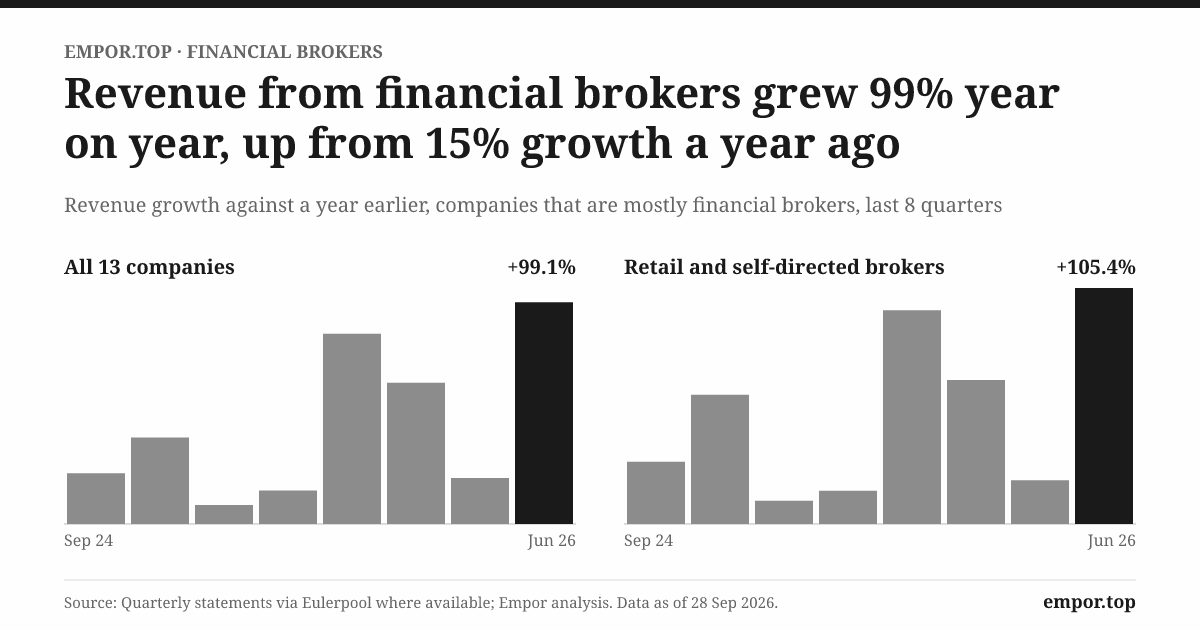
Empor’s data show broad growth: in their latest period, 57 of 62 companies in the theme reported higher revenue than a year earlier, while combined revenue growth in the June 2026 quarter was 72.8%.17 The aggregate requires caution.
Korean and some Chinese securities houses record trading income and gross product sales as revenue. Kiwoom Securities’ reported revenue rose 445% in 2025, while its net margin fell to 6.5%. StoneX reports $132 billion of revenue because it records physical commodity sales gross, yet its net margin is about 0.2%.17 Adding those figures to a retail broker’s net revenue compares unlike measures.
The more useful conclusion is that retail scale, global active access, clearing and specialist liquidity are distinct businesses with different sensitivities. Each needs to be assessed on its own measures. Once commissions reach zero, the strategic question is which adjacent source of revenue a broker can own.
Four contests decide who keeps the toll
Schwab's $13.4 trillion of client assets and Robinhood's 28.6 million funded accounts illustrate the central question. Both can charge zero for a stock trade. The difference is how effectively each turns an account into a durable, profitable relationship. Four contests will help determine the outcome.
Contest one: the household giant against the engagement app
Schwab's position rests on custody, advice, workplace services and bank infrastructure, all enlarged by TD Ameritrade. Robinhood's rests on mobile customer acquisition, options, crypto, cash products and newer offerings such as event contracts, which its 2025 filing lists among its products.13
Both were executing well in 2026. Schwab's revenue growth accelerated from single digits in 2025 to 25% in the June quarter. Robinhood's revenue grew 32.3%, and its operating margin was 43.9%.17 Neither figure establishes a winner. Their revenue bases differ by roughly sixfold, and their sensitivity to interest rates differs. Investors valued them accordingly: Robinhood traded at about 50 times trailing earnings, compared with about 18 times for Schwab.17 The gap implies expectations of more persistent growth at Robinhood; it does not establish that such growth will occur.
Each faces a distinct risk. Schwab is exposed to cash sorting, as clients move idle balances into higher-yielding funds and reduce the interest spread on which its earnings depend. Robinhood is exposed to the consequences of its own success: high revenue per active trader may draw regulatory attention, while much of its revenue depends on speculative activity that receded sharply in 2022. The evidence supports neither firm's durability as settled fact. The tests are whether Schwab retains cash balances as rates fall and whether Robinhood can sustain revenue per customer in quieter markets.
Contest two: the global machine against local ecosystems
Interactive Brokers' global connections, low prices and automation compete with Saxo, Swissquote, Futu and dozens of national direct brokers. Global access has an obvious appeal: one account can reach many exchanges, currencies and asset classes at institutional prices.
Local advantages can be equally durable. Fineco's operating margin was 71% in 2025, while Nordnet and Avanza reported returns on equity of about 40% and 33%.17 These firms do not compete primarily on global reach. They benefit from national tax-advantaged savings accounts, fund distribution, trusted local brands and bank-like deposit franchises. In Sweden, a savings-account wrapper may matter more to a customer than the cost of trading in Tokyo.
Interactive Brokers' figures require caution. Empor's data record an 86% operating margin in 2025 alongside a 9.6% net margin. The difference suggests inconsistent revenue definitions in the data, rather than unprofitability.17 Its filings more reliably show a business increasing client equity and trading activity with low headcount per customer.27
Global reach is not automatically a lasting advantage. Licences are held market by market. Futu's growth shows that cross-border access can scale rapidly; its dependence on Chinese-speaking investors also shows how quickly regulation can constrain it. The evidence therefore narrows the claim that global platforms will displace local ones. Global scale suits active, multi-market clients. Local ecosystems retain savers.
Contest three: the new investors of India and Asia
Some of the fastest-growing retail markets are in Asia, where the economics differ from those in the US and Europe.
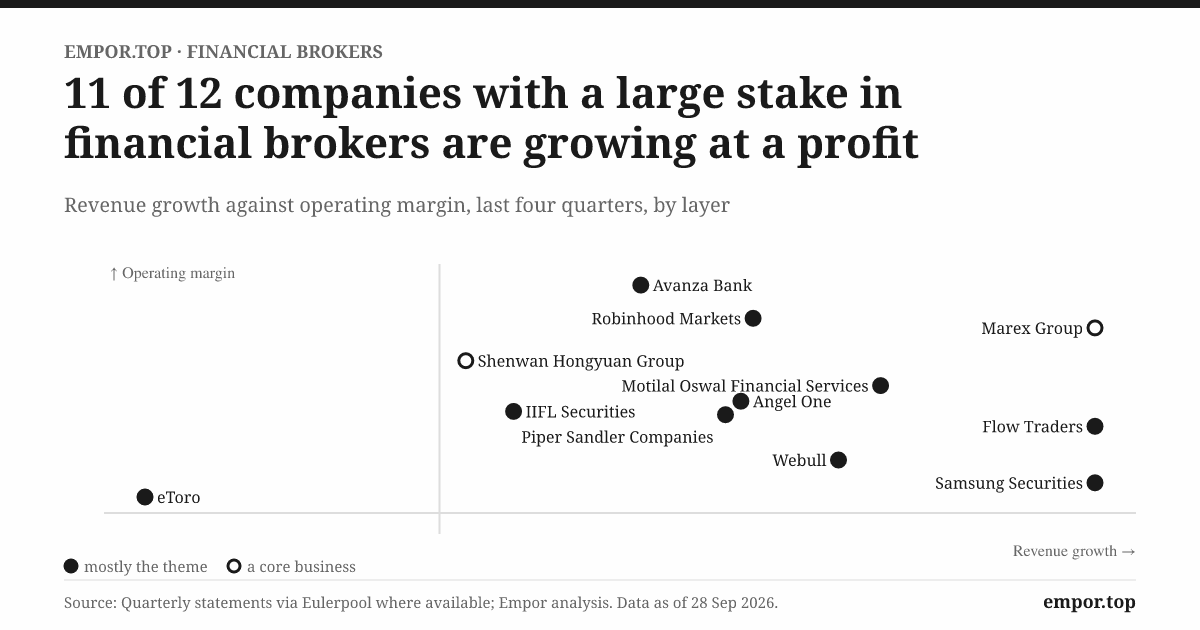
In India, Zerodha, Groww, Angel One $ANGELONE, Motilal Oswal $MOTILALOFS, IIFL Securities and 5paisa compete for new investors, many drawn to equity derivatives. The economics can be highly profitable: Groww reported a 48.8% net margin for the year to March 2026.17 They can also be vulnerable to regulatory change. Angel One's operating margin fell from about 40% in its 2023 fiscal year to less than 25% in 2026 after India's securities regulator, SEBI, tightened rules on derivatives trading and broker charges.17 Revenue still grew 21% in the latest year, but each rupee generated less profit. Regulation can reshape a discount broker's income as quickly as a competitor can.
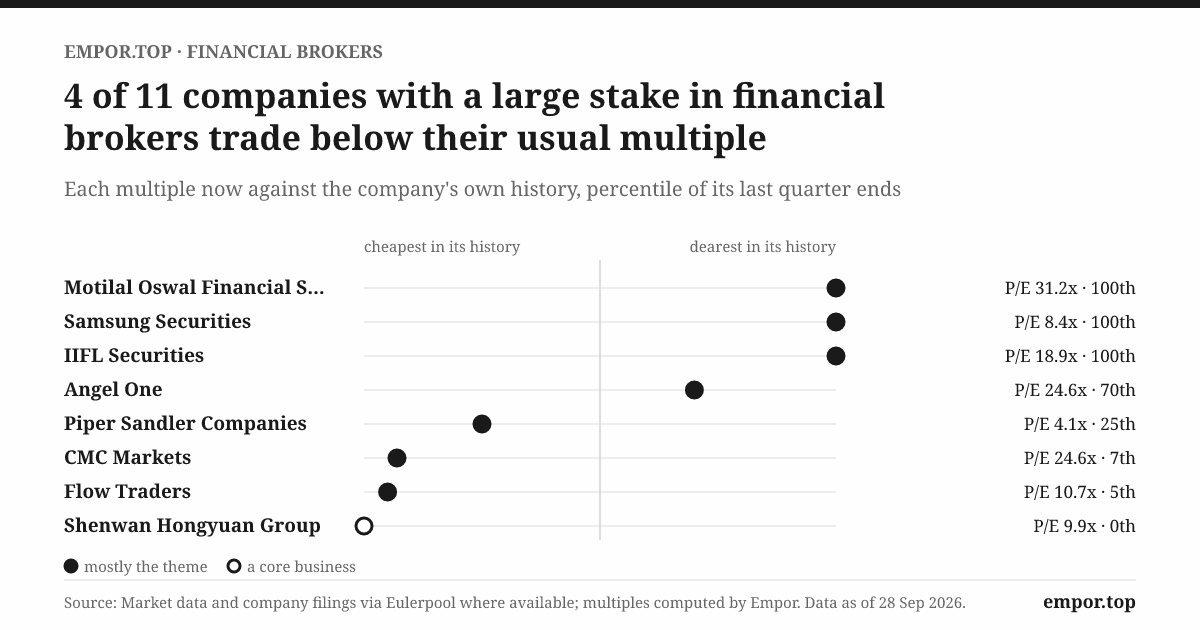
Japan, China, Korea, Taiwan and Hong Kong have large, established securities houses, including Huatai Securities $601688.SS, CITIC Securities $600030.SS, Kiwoom Securities $039490.KS and SBI Holdings $8473.T. Their revenue combines brokerage with margin finance, underwriting and proprietary trading. Many traded at price-to-earnings multiples below ten, while Groww traded at about 46.17 The gap is not a straightforward bargain signal. Chinese broker profits depend heavily on domestic market policy and turnover, often involve state-linked ownership, and include principal-trading gains that move with markets. Korean firms' reported revenue is inflated by gross booking of trading activity. Mechanical comparison with US platforms therefore mixes unlike businesses.
Contest four: humans, workflows and machines in wholesale markets
In institutional markets, TP ICAP, BGC and Tradition retain value where liquidity is fragmented and clients need a person or specialised workflow to locate the other side of a large or unusual trade. Tradition's return on equity was 27.4% in 2025. TP ICAP's operating margin was about 11%, steady rather than exceptional.17
Marex and StoneX add clearing, financing and commercial-risk management, making them part of clients' daily operations. Marex grew revenue 25.4% in 2025 and earned a 24.4% return on equity.17 Such rapid growth in clearing and commodities warrants scrutiny because credit, collateral and commodity-volatility risks can emerge abruptly and are not captured by the growth rate.
Electronic trading is both opportunity and threat. BGC has been moving flow to fully electronic platforms, which accounted for about a fifth of its 2025 brokerage revenue on Empor's estimate, while total revenue rose 36.4%.17 Electronic workflows can add volume. But history suggests that, as products become standardised, brokerage margins narrow and value shifts toward technology and venue-like platforms. Those businesses belong chiefly to the exchanges theme, not this one.
Is volatility a reliable windfall? Empor's tests suggest it is not. Across the wholesale layer, the relationship between the VIX—a measure of expected US stock-market volatility—and brokers' revenue growth was inconsistent. It held as expected for only four of fourteen companies.17 Wholesale activity also depends on rates, currencies and commodities, which a US equity-volatility index captures poorly.
Where the market makers fit
Execution specialists complete the picture. Virtu's return on equity rose to 36.6% over the four quarters to June 2026, but its operating margin in that quarter was 32%, well below the previous year.17 Flow Traders' revenue fell by about 40% in 2025 before recovering in 2026.17 Retail participation can benefit market makers as much as retail brokers, but their earnings remain tied to the trading environment. The decisive issue is not activity alone, but who controls order routing, customer cash and risk.
The rate cut is not the whole story
A Federal Reserve rate cut can appear uniformly negative for brokers: lower rates should reduce the interest earned on client cash. But Schwab's client cash, Robinhood's interest-earning assets and Interactive Brokers' margin loans generate revenue through different structures, so the effect is neither immediate nor uniform.
How the spread works
A broker earns a spread when the return on customer cash or margin loans exceeds what it pays customers and its own funders. The model resembles bank lending, but only partly. Customer cash may be segregated, swept to partner banks at negotiated rates or placed in money-market funds, where the broker earns a fee rather than a spread. Each arrangement reacts differently when rates change.
The US effective federal funds rate averaged 4% in the June 2026 quarter, about 16% below the prior-year level.29 The effect on profits depended on each broker's mix of cash, lending and funding.
How exposed are they?
Empor's rate-exposure data show differing reliance on interest income. It represented roughly 49% of Schwab's 2025 revenue, 34% of Robinhood's, and about 31% and 30% at flatexDEGIRO and Swissquote.17 These figures are not direct measures of rate sensitivity. Firms define interest income differently, and European brokers respond primarily to their own central banks rather than the Fed. They indicate where to examine cash balances, customer rates, funding costs and the durability of deposits.
What history does and does not show
Empor tested whether broker profit margins moved with US policy rates over as many as seven years of quarterly results. Among retail brokers, only one of 31 companies matched the simple expectation that higher rates raise margins. Several, including Schwab, moved in the opposite direction.17 Swissquote was the clearest example of margins rising with rates, while Webull and Hong Kong's Bright Smart Securities showed clear inverse links.
The results weaken the claim that higher rates automatically produce higher broker profits; they do not make rates irrelevant. In 2022, rising rates coincided with falling share prices, slower trading and customers shifting cash into better-paying funds. Reported margins reflected all of those forces. A limited history can reveal a complicated relationship, but not establish causation.
Volatility, the other force
Volatility is another driver, and it does not always help. Larger price swings can increase options activity, hedging and trading volumes. They can also reduce client assets, unsettle customers and increase losses for market makers trading against better-informed investors.
Empor's tests reflected that mixed effect. Revenue growth at leveraged-trading brokers IG, Plus500 and CMC Markets tended to rise in the same quarter as the VIX.3017 Robinhood and Webull showed stronger links after one or two quarters, consistent with periods of market excitement drawing in traders who remain active. Interactive Brokers and Freedom Holding moved the other way. Across retail brokers overall, no consistent relationship appeared at the expected timing. The patterns are suggestive, not conclusive.
The optimistic chain
In the favourable case, lower rates reduce brokers' funding costs while making money-market alternatives less attractive to clients. Margin borrowing becomes cheaper, trading rises alongside markets, and subscriptions or new products offset lower interest income. More activity spreads fixed technology costs across a larger base, helping margins hold.
The pessimistic chain
The adverse case is that yields on cash fall faster than expenses. Customers accustomed to seeking higher returns continue moving balances to better-paying alternatives. Lower participation weakens options and margin demand. With stock commissions already at zero, brokers have limited room to raise visible prices. Regulators could also tighten rules around payment for order flow or leverage.
A myth worth retiring
Zero commissions did not make brokerage a light, software-only business. Customer acquisition may be digital, but licences, capital, clearing membership, risk systems, cyber defences and trust remain costly. The January 2021 collateral calls and the shift to T+1 made that clear. Over time, low costs have more often reflected scale, established infrastructure and control of clearing than a newer app alone.
The question is therefore not simply whether rates fall, but which indicators will reveal the winning chain before reported revenue does.
The four numbers that reveal whether free trading pays
The next evidence will appear not in a share price, but in four quieter figures from activity reports and filings. Each can move before reported revenue and addresses a different part of the broker-profitability debate.
Signal one: Schwab's interest-earning client cash
This is the idle money on which Schwab can earn a spread. It stood at $453 billion in August 2026, according to Schwab’s monthly activity report.17 The balance is the raw material for net interest revenue, so changes in it can precede changes in income.
It tests whether rate cuts will weaken cash-rich incumbents. The case holds if balances remain stable or rise as rates fall without Schwab sharply increasing what it pays clients. It weakens if customers again shift cash steadily into money-market funds and other alternatives. The same report showed $64.8 billion of core net new assets in August, indicating whether the broader client relationship is growing alongside cash balances.
Signal two: Interactive Brokers' margin loans
This measures how much active customers borrow against their portfolios. Margin loans stood at $102 billion in August 2026 in Interactive Brokers’ monthly brokerage metrics.17 Borrowing generates financing income immediately and can indicate customers’ willingness to take risk.
The figure tests whether demand from active clients can remain resilient as short-term rates decline. The case strengthens if balances grow or hold steady. A sharp contraction, accompanied by weaker trading or signs of credit stress, would point the other way.
Signal three: Interactive Brokers' daily average revenue trades
This counts the daily trades from which the firm earns revenue: 4.3 million in August 2026, reported monthly alongside margin loans.17 It distinguishes a growing customer base from deeper engagement.
The measure tests whether broader market access is producing more activity per customer. It supports that argument if trading grows faster than accounts. It weakens if trading falls despite sustained volatility, suggesting that customers are reducing risk or taking activity elsewhere.
Signal four: Robinhood's revenue mix
This shows how Robinhood divides income among options, payment for order flow, net interest, subscriptions and other products. The company reports the mix quarterly in its filings, while its Rule 606 reports identify where orders are routed.1328 Empor could not obtain a reliable measure of options contracts per funded account, making the revenue mix the more useful indicator.
It tests whether customer growth under zero commissions is becoming a broader relationship or remains dependent on speculative trading. The case strengthens if revenue broadens across products without deteriorating evidence on execution quality, complaints or conduct. It weakens if revenue per active customer falls, restrictions tighten or a single product again dominates.
The next readings are near. Schwab and Interactive Brokers were scheduled to report on 15 October 2026, and Robinhood on 4 November, according to Empor’s results calendar, though companies can change reporting dates.17
A number to handle carefully
The Financial Industry Regulatory Authority publishes monthly margin-debt figures for its member firms, which totalled about $1.2 trillion at the end of 2025.31 The series provides useful context on US investors’ borrowing, but not a clean answer to the broker question. It covers only US member firms and combines very different client types. One macro measure should not be treated as proof of a turning point.
Together, the four signals return to the central question. The broker that can profit after commissions fall to zero is not necessarily the cheapest. It is the one that retains customer cash and assets, provides complex access or liquidity, and can bear the regulatory and clearing burden when markets become difficult.
The toll moved behind the gate
In 1792, twenty-four brokers agreed not to charge below a minimum commission. By 2026, an investor could buy a share without paying a stated commission. The charge had not disappeared; it had moved behind the trade. It could appear in the return paid on idle cash, interest on margin loans, market-making spreads, subscriptions and the collateral a clearing firm must post before the market opens.
Who keeps it
The evidence points to four business models with more durable economics.
First are scaled asset gatherers such as Schwab and Fidelity. Large household balances can make even a narrow interest spread meaningful, while custody, advice and workplace relationships can make accounts harder to move. Their limitation is fundamental: client assets and cash remain the customers’ property.
Second are global automated brokers, led by Interactive Brokers. Its licences, market connections and risk systems took decades to assemble and are difficult to replicate. Its exposure is to active clients’ willingness to trade and borrow.
Third are brokers that turn a trading account into a wider product relationship without losing customer trust. Robinhood is the test case. Its profits showed that this model could work, while its regulatory history showed the cost of weak execution or disclosure. Whether its broader product mix endures remained unresolved.
The fourth group operates where a simple price comparison is insufficient: wholesale brokers such as TP ICAP, BGC and Tradition; clearing and commodity specialists such as Marex and StoneX; and market makers executing retail orders. Their customers pay for information, capital and reliability rather than a single click.
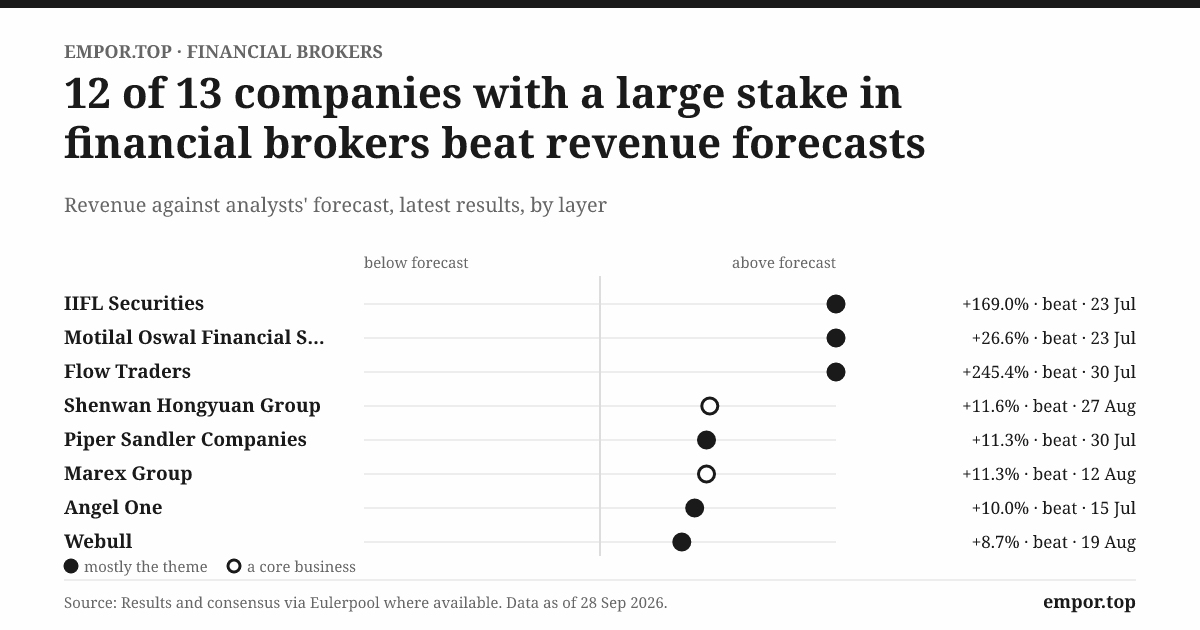
The shares are a separate question. Across Empor's universe, share prices rose about 91% over three years but fell about 6% in the year to 28 September 2026. The combined price-to-earnings multiple was below its recent range, while analysts expected revenue to fall sharply the following year.17 That forecast partly reflected inflated revenue figures at Asian securities houses and may have said little about the firms central to this story. A sound theme does not ensure a sound investment: returns depend on choosing the right layer, company and entry price.
Who may struggle
The most exposed firms depend on a brief surge in retail trading, provide undifferentiated execution, spend heavily to acquire customers who do not stay, rely on leverage a regulator can restrict, or depend on a practice that can be repriced or banned. eToro's latest figures illustrate how quickly reported economics can change. Its reported quarterly revenue fell by almost 90% in the June 2026 quarter while its operating margin rose, a pattern more consistent with a change in revenue booking than a straightforward collapse. Empor's data disclosures did not establish which explanation applied.17
The limit on every toll
A broker owns neither its customers’ cash nor the market’s liquidity. Customers can move balances, regulators can change the rules, as the SEC’s registration and conduct requirements for broker-dealers show.32 Market makers and clearing firms also retain part of the economics of each trade. Brokers that remained profitable after commissions reached zero were those harder to replace when customers needed more than cheap execution: a place to hold savings, credit against a portfolio, access to a distant market or a counterparty on a difficult day.
Glossary
- Best execution — A broker’s duty to seek favourable terms for a customer’s trade, rather than prioritising its own revenue.
- Broker-dealer — A firm that trades for customers as a broker, for its own account as a dealer, or both.
- Cash sweep — The automatic placement of idle brokerage cash into bank deposits or money-market products.
- CFD — Contract for difference; a leveraged product that provides price exposure without ownership of the underlying security.
- Clearing broker — The firm that completes settlement, safeguards customer assets and issues confirmations.
- Client cash — Uninvested money held in a brokerage account.
- Custody — Safekeeping and recordkeeping for customer cash and securities.
- Free-credit balance — Client cash at a broker that has not been invested or used for margin.
- Introducing broker — A customer-facing broker that may outsource clearing and custody.
- Margin loan — Credit extended against securities in a customer account.
- Market maker — A firm that quotes or executes trades using its own capital and manages the resulting risk.
- Payment for order flow — Compensation paid to a broker for routing eligible customer orders to a market maker or venue.
- T+1 settlement — Standard settlement one business day after a trade.
- Wholesale broker — A broker that arranges liquidity or execution for banks, funds and companies.
References
-
The Laws That Govern the Securities Industry — US Securities and Exchange Commission ↩
-
History of SIPC — Securities Investor Protection Corporation ↩
-
History of the CFTC: The 1970s — Commodity Futures Trading Commission ↩↩
-
Rule 19b-3, Federal Register, 20 February 1975 — US Government Publishing Office ↩
-
Testimony on the Effects of Decimalization on the Securities Markets — US Securities and Exchange Commission, May 2001 ↩
-
Payment for Order Flow, final rule — US Securities and Exchange Commission, October 1994 ↩
-
Regulation NMS — US Securities and Exchange Commission, June 2005 ↩
-
Robinhood Markets 2025 Form 10-K — US Securities and Exchange Commission ↩↩↩
-
SEC Charges Robinhood Financial With Misleading Customers About Revenue Sources and Failing to Satisfy Duty of Best Execution — US Securities and Exchange Commission, December 2020 ↩
-
Financial Brokers research dossier and data tables (scorecard, trends, links, rate exposure, numbers to watch, results calendar) — Empor, 28 September 2026 ↩↩↩↩↩↩↩↩↩↩↩↩↩↩↩↩↩↩↩↩↩↩↩↩↩↩↩↩↩↩↩↩↩↩↩↩↩
-
ESMA Decision (EU) 2018/1636 on contracts for differences — EUR-Lex, 2018 ↩
-
SEC Staff Releases Report on Equity and Options Market Structure Conditions in Early 2021 — US Securities and Exchange Commission, October 2021 ↩↩
-
Robinhood Markets 2021 Form 10-K — US Securities and Exchange Commission ↩
-
Morgan Stanley Closes Acquisition of E*TRADE — Morgan Stanley, October 2020 ↩
-
Charles Schwab Completes Acquisition of TD Ameritrade — Charles Schwab, October 2020 ↩
-
Shortening the Securities Transaction Settlement Cycle — US Securities and Exchange Commission ↩
-
Investor Bulletin: SIPC Protection Part 1, SIPC Basics — Investor.gov, US Securities and Exchange Commission ↩
-
Charles Schwab 2025 Form 10-K — US Securities and Exchange Commission ↩↩
-
Cash Sweep Programs: Uninvested Cash in Your Investment Accounts, Investor Bulletin — Investor.gov, US Securities and Exchange Commission ↩
-
Interactive Brokers Group 2025 Form 10-K — US Securities and Exchange Commission ↩↩
-
Robinhood Rule 606 Report, Q4 2025 — US Securities and Exchange Commission ↩↩
-
Federal Funds Effective Rate (FEDFUNDS) — Federal Reserve Bank of St. Louis ↩
-
CBOE Volatility Index: VIX (VIXCLS) — Federal Reserve Bank of St. Louis ↩
-
Guide to Broker-Dealer Registration — US Securities and Exchange Commission ↩
 LinkedIn
 WhatsApp
 Reddit
 Hacker News
 Email
Email Kindle
 RSS Feed
 Spotify
 Apple Podcasts
 Amazon Music
 Audible
 YouTube