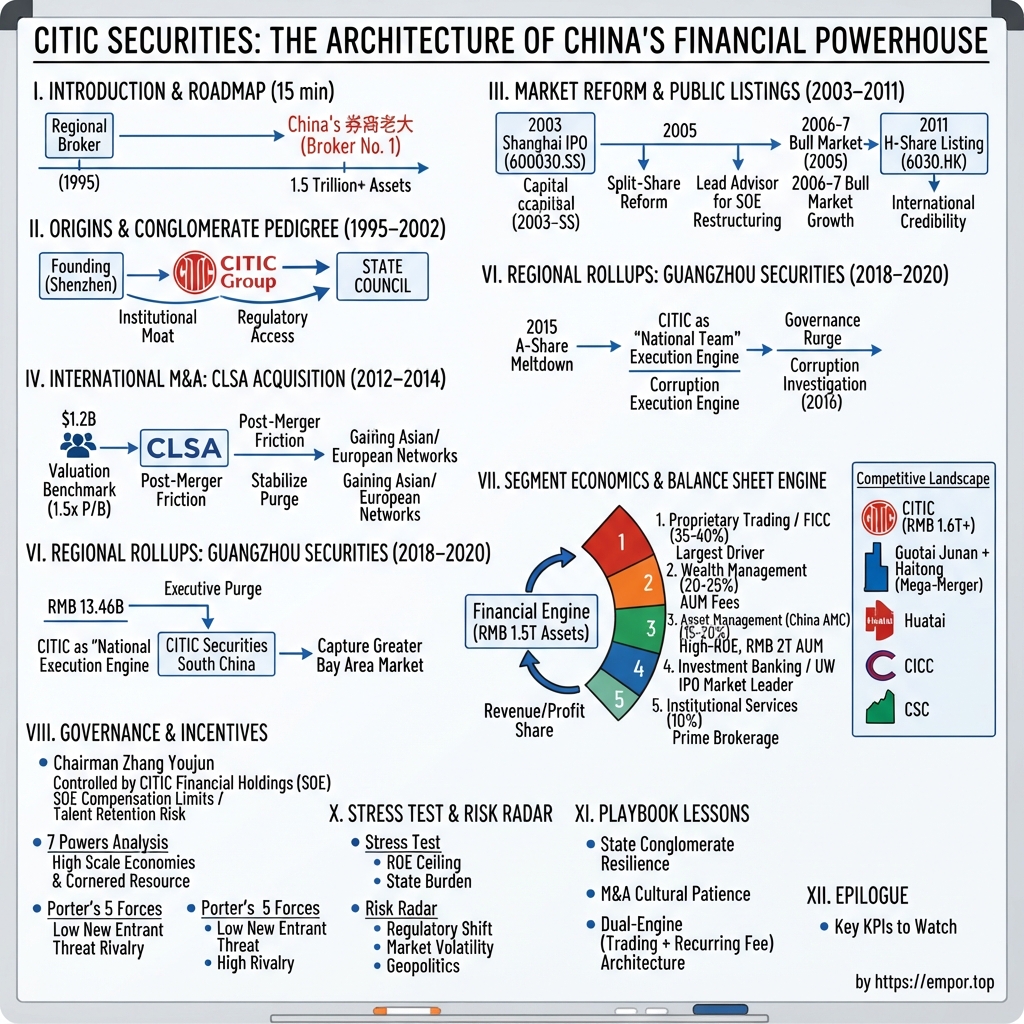
CITIC Securities: The Architecture of China's Financial Powerhouse
I. Introduction & Episode Roadmap
On 20 August 2026, 中信证券股份有限公司 CITIC Securities Company Limited published a set of numbers that would have been unimaginable to the handful of traders who staffed its first securities counter three decades earlier. Operating revenue for the six months to 30 June 2026 was RMB 67.18 billion on a total-revenue-and-other-income basis, net profit attributable to owners of the parent was RMB 23.34 billion — up 69.6% year on year — and total assets stood at RMB 2.47 trillion.1 It was the best half-year in the firm's history, and it came with an interim dividend of RMB 4.27 per ten shares, RMB 6.67 billion of cash out the door.1
Two weeks earlier, something less celebratory had happened. On 6 August 2026, the company issued 803,725,383 new H shares to its own controlling shareholder, 中国中信金融控股有限公司 CITIC Financial Holdings, at HK$23.13 per share.1 The closing price of those shares on the day the terms were fixed had been HK$25.14.1 The parent bought RMB 16 billion of new equity in the most profitable brokerage in China at roughly an 8% discount to market, and the money was earmarked almost entirely for the offshore subsidiary — RMB 10 billion of it injected into 中信证券国际有限公司 CITIC Securities International on 14 August.1
Hold those two facts next to each other, because they frame everything that follows. CITIC Securities is simultaneously the most profitable securities firm China has ever produced and a business that has spent thirty years going back to shareholders for more capital. Since its 2003 Shanghai listing it has distributed cumulative cash dividends of more than RMB 93 billion.2 Over roughly the same period it has raised — through an IPO, two A-share placements, an H-share IPO, an H-share private placement, an acquisition-funding issuance, a rights issue and now a second connected placement — on the order of RMB 120 billion equivalent of fresh equity.31 The firm has taken more money from the capital markets than it has returned to them.
That is not an accusation. It is the defining economic fact of the balance-sheet brokerage model, and it is the lens through which the standard bull case on CITIC Securities has to be tested.
The consensus story. CITIC Securities is 券商老大 — Broker No. 1. It underwrites more A-share equity than anyone, arranges more Chinese M&A than anyone, runs the largest brokerage balance sheet in the country, owns 62.2% of 华夏基金管理有限公司 China Asset Management Co., Ltd. (ChinaAMC), and enjoys a pedigree — direct descent from 中国中信集团有限公司 CITIC Group, the state conglomerate founded under 邓小平 Deng Xiaoping's reform program — that gives it access no private competitor can buy. In the language of Beijing's post-2023 policy framework, it is the designated national champion in the drive to build a 金融强国 financial powerhouse.
What this piece tests. Every element of that story is factually true. The question for a long-term investor is narrower: does any of it convert into durable returns on the equity that shareholders keep supplying? Between 2021 and 2025, CITIC Securities grew net profit attributable to the parent from RMB 23.10 billion to RMB 30.08 billion — up 30%. Over the same four years, equity attributable to the parent grew from RMB 209.17 billion to RMB 319.93 billion — up 53%.2 Return on weighted average equity fell from 12.07% in 2021 to 7.81% in 2023 before recovering to 10.59% in 2025.2 A record profit year produced a return on capital that a mid-tier regional bank would consider unexceptional.
That gap — between scale that unambiguously grew and returns that did not keep up — is the spine of this story. We will walk it through the founding under CITIC Group's shadow; the extraordinary capital-raising boom of 2006–2011; the CLSA acquisition, which looked like a strategic misfire for a decade and has recently started to look like the best deal the firm ever did; the 2015 crash that put the company's president in prison and reset its governance; the Guangzhou Securities rollup, which has not earned its cost of capital; the segment economics that actually generate the profit; and the leadership, incentive and regulatory structures that determine how much of that profit ever reaches a minority shareholder.
It starts in Beijing, in the autumn of 1995, with RMB 300 million and a licence.
 Subscribe on LinkedIn
II. Origins & The CITIC Conglomerate Pedigree (1995–2002)
China in 1995 had two stock exchanges that were barely five years old, a securities industry assembled largely out of the trading desks of provincial banks and trust companies, and no regulatory apparatus worth the name. Into that environment, CITIC Group assembled its scattered securities operations into a single entity: CITIC Securities Limited, incorporated in Beijing in October 1995 with registered capital of RMB 300 million, of which CITIC Group directly held 95%.3
The parent mattered more than the capital. CITIC Group had been founded in 1979 by 荣毅仁 Rong Yiren — the "red capitalist," scion of a Shanghai textile dynasty who stayed after 1949, was ruined in the Cultural Revolution, and was then personally rehabilitated by Deng Xiaoping to build the conduit through which foreign capital would enter China. CITIC was not a normal company. It reported effectively to the State Council, it issued bonds in Tokyo and Frankfurt when the People's Bank of China barely understood what a Eurobond was, and it carried a rank in the administrative hierarchy that gave its executives the standing of vice-ministers.
For a fledgling brokerage, that inheritance did three things that no amount of hustle could replicate. It conferred counterparty trust with state-owned enterprises at a moment when SOE finance directors had no way of assessing a private securities firm. It gave access to regulators who were writing the rules of the market in real time. And it provided balance-sheet backing — a parent that could recapitalise a subsidiary if the exchanges collapsed, which in the mid-1990s was not a theoretical concern.
The 1990s A-share market was, by any developed-market standard, closer to a casino than a capital market. Retail speculation dominated; disclosure was thin; the majority of listed-company shares were state-held and legally non-tradable. The dominant revenue line for a Chinese broker was retail commission, and commissions were fixed by regulation — meaning brokers competed on branch count and proximity to the trading floor rather than on price or service. It was a volume business masquerading as a financial services business.
It was also an industry that periodically blew itself up. Through the late 1990s and early 2000s a series of large Chinese brokerages failed outright, typically for the same reason: they had misappropriated client settlement funds to finance their own proprietary positions, and when the market fell, the money was not there. The eventual regulatory response — mandatory third-party custody of client deposits, hard net-capital rules, and a formal risk-control indicator regime — is the reason a modern Chinese broker's balance sheet segregates customer brokerage deposits from its own funds and why leverage ratios are calculated net of them.
That history matters for how to read the company today. CITIC Securities' comparatively enormous customer brokerage deposit balance — RMB 518.68 billion at end-2025, up from RMB 362.45 billion a year earlier — is client money held in trust, not firm capital, and the regulatory gearing ratio strips it out precisely because an earlier generation of brokers treated the distinction as optional.2
CITIC Securities spent those years doing something less glamorous and more consequential: building an institutional underwriting capability while its competitors chased retail flow. In December 1999 the firm converted into a joint-stock limited company and raised registered capital to RMB 2.08 billion, diluting CITIC Group's direct stake to 37.85%.3 In April 2000 it relocated its registered headquarters to Shenzhen — a nod to the reality that the securities industry's operational centre of gravity sat in the south, even as decision-making stayed in Beijing.3
The choice to build institutional capability first was not obviously correct at the time. Underwriting in a market where listings were allocated by quota and priced administratively was less about analytical skill than about relationships with the approving authorities. What it did establish was a corporate identity — CITIC Securities positioned itself as the firm that served issuers rather than the firm that served punters — and in an industry where the retail commission pool would eventually be competed to near zero, that positioning turned out to be the durable one.
The strategic logic of that period reads clearly in hindsight. China's entry into the World Trade Organization in December 2001 was going to force the restructuring and eventual listing of the country's largest state enterprises. Somebody was going to have to underwrite them. A brokerage owned by the most internationally fluent state conglomerate in China, staffed with people who understood both the CSRC and a prospectus, was the obvious candidate — provided it had enough regulatory capital to sit on the deals.
Getting that capital required going public. Which meant that the first great test of CITIC Securities' relationship with its own market was not a deal it underwrote for someone else. It was its own.
III. Market Reform, A-Share Explosion & Public Listings (2003–2011)
In December 2002 CITIC Securities sold 400 million A shares. The stock began trading on the Shanghai Stock Exchange in January 2003 under the code 600030, raising RMB 1.8 billion and making the firm the first domestic securities company listed on the mainland's senior exchange.3 CITIC Group's direct stake fell to 31.75%.
RMB 1.8 billion was not a large number even in 2003. What it bought was net capital — the regulatory measure that governs how much underwriting risk, proprietary inventory and margin lending a Chinese broker may carry. In a business where regulation converts equity directly into permitted activity, a listing is not primarily a liquidity event or a prestige signal. It is a licence expansion. This is the structural feature that would define the next two decades: CITIC Securities' growth has been gated by capital, and capital has repeatedly come from shareholders rather than from retained earnings.
The reform that changed everything. In August 2005 the firm completed its own 股权分置改革 split-share structure reform — the nationwide program that converted the enormous overhang of non-tradable state-held shares into ordinary tradable stock.3 Understanding why this mattered requires understanding what was broken. Before the reform, roughly two-thirds of the shares in a typical listed Chinese company could not be sold. The controlling state shareholder therefore had no economic interest in the share price whatsoever; its stake was valued at book, and market moves were somebody else's problem. Minority shareholders owned a claim on a company whose controller was structurally indifferent to their returns.
The reform required each listed company to negotiate a compensation package with its minority holders in exchange for making state shares tradable — typically bonus shares or warrants. It was, in effect, thousands of simultaneous bilateral restructurings, and every one of them needed a financial adviser. For a broker with SOE relationships and regulatory credibility, it was the single largest advisory opportunity in the history of the Chinese market. CITIC Securities was in the middle of it.
The 2006–2007 boom. What followed was the most violent bull market China had yet produced, and CITIC Securities monetised it in the most direct way available: by issuing its own stock into it. In June 2006 the firm completed a private A-share placement raising RMB 4.645 billion. In September 2007, at close to the market's peak, it completed a public A-share issuance raising RMB 25 billion — more than thirteen times the size of its own IPO four years earlier.3 Bonus issues in 2008 and 2010 doubled and then increased by half again the share count.3
This is worth pausing on, because it is a pattern rather than an episode. CITIC Securities has consistently raised equity when markets were strong and its own shares were expensive. That is textbook capital-markets timing, and it is precisely what a well-run investment bank should do. The uncomfortable corollary is that a business which must raise equity at peaks to fund growth is a business whose growth is not self-financing — and the returns generated on that new equity are the only thing that determines whether the exercise created value.
There is a second, subtler point in the 2007 raise. RMB 25 billion was roughly five times what the firm's entire equity base had been four years earlier. A brokerage that suddenly quintuples its capital has to find something to do with it, and the natural outlet in a Chinese securities firm is the proprietary and financing book — precisely the businesses that perform worst in the market conditions that follow a peak. The 2008 collapse duly arrived. The firm survived it comfortably, which is a genuine credit to its risk discipline, but the episode established the template that has repeated since: capital arrives when it is easiest to raise, and is deployed into a book whose returns are highest exactly when new capital is least needed.
Under chairman 王东明 Wang Dongming, who led the firm through this entire stretch, CITIC Securities also began doing something few Chinese brokers attempted — building a genuine research and institutional sales operation for domestic and foreign institutional clients rather than treating research as a marketing cost. That capability is the direct ancestor of the institutional stock brokerage business that today holds a 7.65% share of A- and H-share trading volume by public funds and ranks first in the market in public fund commission allocation.2
Hong Kong, 2011. In October 2011 CITIC Securities sold 1,071,207,000 H shares, listing in Hong Kong under 6030.HK with net proceeds of approximately HK$13.82 billion — the first Chinese securities firm to list offshore.3 The IPO priced close to the bottom of its range, raising roughly US$1.7 billion in a difficult post-crisis window.4
The strategic purpose was not the cash. It was the currency. A Hong Kong listing gave CITIC Securities a dual-listed equity that could be used offshore, a foreign-currency capital base, and — critically — a corporate structure that international counterparties and regulators could actually transact with. CITIC Group's direct stake fell to 20.30%.3
What the 2003–2011 stretch demonstrated is that CITIC Securities was genuinely excellent at one thing: reading the Chinese policy cycle early and positioning capital ahead of it. It listed before the reform wave, raised into the boom, and went offshore before the outbound M&A wave. That is a real capability, and it is the strongest single piece of affirmative evidence in the bull case. What it had not yet demonstrated was any ability to earn a superior return on the capital those manoeuvres accumulated.
The next chapter would test that directly, with a cheque written in Hong Kong dollars.
IV. International M&A: The CLSA Acquisition Benchmark (2012–2014)
CLSA was, for a generation of Asian institutional investors, the most distinctive research house in the region. Founded in Hong Kong in 1986 and later owned by Crédit Agricole, it was famous for analysts who wrote in prose rather than bullet points, for an annual investors' forum that combined blue-chip conference programming with performances by rock musicians, and for a house culture that treated intellectual independence as the product itself. It was also, by 2012, an orphan — Crédit Agricole was shrinking its balance sheet under European post-crisis pressure and wanted out of Asian equities.
Wang Dongming wanted to build what he openly described as China's Goldman Sachs. Organic offshore expansion would have taken twenty years: licences in a dozen jurisdictions, a sales force with relationships, a research franchise with credibility. CLSA offered all of it, assembled, immediately. It was also, in the strategic logic of the moment, defensive as much as offensive — Chinese corporates were beginning to buy assets abroad, and if their domestic house could not follow them across the border, a global bank would take the relationship.
The deal. In July 2012 CITIC Securities agreed to acquire CLSA for US$1.25 billion, structured in two tranches: 19.9% for US$310.32 million, closing immediately, with the remaining 80.1% for US$941.68 million to follow.5 The second tranche closed on 31 July 2013 — at a reduced net consideration of US$841.68 million, because Taiwanese regulatory restrictions forced CLSA's Taiwan business to be carved out and retained by Crédit Agricole, with a two-year repurchase right attached.6 Total consideration actually paid was therefore closer to US$1.15 billion than the headline US$1.25 billion.
At roughly 1.5 times book, against Asian brokerage comparables trading nearer 1.0 to 1.2 times at the time, CITIC Securities paid a premium. Buyers of asset-light, human-capital businesses always do, because what they are buying walks out of the building every evening.
And a lot of it walked out permanently. The integration was difficult in the way that culturally mismatched acquisitions in people businesses are always difficult. CLSA's identity was built on the freedom of its analysts to publish views that embarrassed powerful people — including, frequently, Chinese state enterprises. Its new owner was a Beijing-headquartered state financial institution with a Party Committee embedded in its governance structure. There is no clever integration plan that dissolves that tension. Senior departures followed, including long-serving chief executive Jonathan Slone and a succession of research leadership.
For most of the decade after 2013, the honest verdict on CLSA was that CITIC Securities had overpaid for a franchise it was steadily degrading. In November 2016 the group folded CITIC Securities International and CLSA Limited under the single CLSA brand, repositioning the unit from an agency equities house into a full-service platform.[^7] That was a rational response to the erosion of the original asset — if you cannot preserve the research franchise, at least use the licences and the distribution to sell balance-sheet products.
It is worth being concrete about what "distribution" means, because the word does a lot of undeserved work in acquisition announcements. In practice CITIC Securities bought a legal-entity network: broker-dealer registrations, exchange memberships, clearing arrangements and local regulatory approvals across Australia, the Netherlands, the United States, Hong Kong, Singapore, Japan and beyond. The corporate structure disclosed in the 2025 accounts still carries CLSA Europe B.V. in the Netherlands, CLSA Australia Holdings, CLSA Americas Holdings and CLSA Fund Services among the wholly-owned subsidiaries, alongside CLSA B.V., the Dutch holding company through which the whole thing is owned.2
Those entities are the reason the group can today underwrite an IPO in Malaysia, place shares in Indonesia and India, run offshore renminbi bond books for foreign issuers, and lend against a Bitcoin ETF position in one jurisdiction while arranging yen-denominated acquisition finance in another.2 Every one of those permissions takes years and a local balance sheet to obtain from scratch, and several would be effectively unavailable to a Chinese state institution applying cold in the current geopolitical climate. What looked in 2013 like paying a premium for a research brand was, functionally, paying a premium for a regulatory passport that has since become harder to buy at any price.
What the evidence says now. The 2025 and 2026 disclosures force a revision, and it is worth being precise about it rather than splitting the difference. CITIC Securities International — the offshore holding company that contains the former CLSA businesses — reported 2025 operating revenue of US$3.34 billion, operating profit of US$1.13 billion and net profit of US$913 million on net assets of US$4.09 billion.2 In the first half of 2026 it produced revenue of US$2.32 billion and net profit of US$829 million, on net assets of US$4.84 billion.1 That is a return on equity of roughly 22% in 2025 and, annualised, considerably higher in 2026 — against a group ROE of 10.59% and 7.81% respectively.21
Group revenue generated outside the Chinese Mainland was RMB 23.67 billion in 2025, against RMB 81.01 billion domestically — 22.6% of the total.2 The RMB 16 billion of new equity raised in 2026 went almost entirely to this business.1
So the historical record splits cleanly. The claim that CITIC Securities bought a research culture and preserved it is rejected — that asset was substantially lost. The claim that it bought a global licence, clearing and distribution footprint that it could not have built organically, and that this footprint is now the highest-returning capital in the group, survives. The goodwill carried against CITIC Securities International on the balance sheet is only RMB 600 million out of RMB 8.44 billion total group goodwill; the vast majority — RMB 7.42 billion — sits against ChinaAMC.2 Twelve years on, the offshore platform is carried close to tangible book and earning more than 20% on it.
That is an unusual outcome for a deal widely written off as a failure, and it is the correct precedent to hold in mind for the next acquisition. But before the group could get there, it had to survive the worst year in its history.
V. The 2015 Crash, National Team Interventions & Governance Reset
The Shanghai Composite peaked on 12 June 2015. Within three weeks roughly a third of the market's capitalisation had evaporated. The mechanism was not exotic: an enormous, largely unregulated over-the-counter margin financing industry — structured products, umbrella trusts, peer-to-peer lending platforms funnelling household savings into leveraged equity positions — had inflated the rally, and when prices turned, the forced liquidations fed on themselves.
Beijing's response was unprecedented in scale and directness. On 4 July 2015 the country's 21 largest brokerages jointly pledged at least RMB 120 billion to buy blue-chip exchange-traded funds. Four days later, 中国证券金融股份有限公司 China Securities Finance Corporation announced it would lend RMB 260 billion to those same 21 brokers to buy shares.7 CSF and 中央汇金投资有限责任公司 Central Huijin Investment together formed what the market immediately named the 国家队 National Team, directly purchasing more than a thousand stocks from 6 July onward. Total direct state purchases have been estimated at around US$200 billion.7
It is worth pausing on what that arrangement actually asked of a listed company. A brokerage told to commit its own capital to buying a falling market is not making an investment decision; it is performing a public function with private shareholders' money. If the intervention works, the firm books a gain and the state takes the credit. If it fails, the losses sit on the brokerage's balance sheet. There is no mechanism by which the minority shareholders of a firm in that position are compensated for the option they have written.
The timing compounded the irony. CITIC Securities had completed an H-share private placement in June 2015 raising approximately HK$27.06 billion — the largest single capital raise in its history to that point, closing within days of the market's peak.3 The firm went into the crisis freshly capitalised, which is precisely why it could be asked to deploy.
CITIC Securities, as the largest firm in the industry, was necessarily central to the execution. And this is where the episode becomes genuinely instructive about the nature of the business. A firm that is simultaneously a proprietary trader with its own book, an agency broker executing client orders, and the operational arm of a state stabilisation programme has an information position that no compliance framework can fully neutralise. It knows what the state is about to buy, it knows which of its clients are being liquidated, and it has a book that benefits from both.
The purge. In September 2015, Chinese police announced investigations into senior CITIC Securities executives for suspected insider dealing and leaking inside information.8 Eleven executives were ultimately caught up in the sweep. President 程博明 Cheng Boming was detained and, in December 2016, sentenced to three and a half years in prison for bribery — accepting several hundred thousand yuan in exchange for business favours.9[^11]
It is worth being careful about what this proves and what it does not. Cheng's conviction was for bribery, not for trading ahead of the National Team. The broader insider-dealing allegations against the firm's executives were made publicly by state media and police at a moment when the government urgently needed an explanation for the crash that was not "policy error." Both things can be true: the conduct was real, and the prosecution was also politically convenient. What is not ambiguous is the outcome — the entire senior leadership of China's largest brokerage was removed within twelve months.
The reset. On 19 January 2016, 张佑君 Zhang Youjun was appointed executive director and chairman.2 He was an insider in the most literal sense — he had joined CITIC Securities at its establishment in 1995, rising through associate manager, deputy president and president, with a detour to run 中信建投证券 CSC Financial as general manager and chairman before returning.2 He held a bachelor's degree in economics from Renmin University and a master's from the Central University of Finance and Economics.2
Zhang's mandate was not growth. It was survival and alignment. The decade that followed was characterised by centralised risk control, a globally integrated risk management architecture, and unambiguous political positioning — the 2025 annual report opens its chairman's statement by noting that the company "has consistently upheld the Party's comprehensive leadership."2 In August 2023 the controlling stake was transferred to CITIC Financial Holdings, consolidating the group's financial subsidiaries under a single licensed financial holding company.3
What the reset did and did not fix. The strong version of the governance-reset claim — that CITIC Securities emerged from 2015 with control systems that prevent misconduct — does not survive contact with the record. In April 2024 the CSRC fined the group over a scheme involving the non-public share issuance of CNNC Huayuan Titanium Dioxide. The regulator's findings were specific: CITIC Securities Capital Management "formulated the arbitrage scheme, set up the transaction structures and provided leveraged capital support" enabling the issuer's de facto controller to circumvent lock-up restrictions, while CITIC Securities itself "provided securities lending services to its clients despite knowing that the purpose of the securities lending by its clients was to obtain arbitrage."10 CITIC Securities Capital was fined RMB 36 million and CITIC Securities RMB 18 million, with a further RMB 1.91 million of the parent's revenue disgorged.10
That is not a control failure at a branch. It is a scheme designed at the group's own capital-markets subsidiary, run through the parent's securities lending desk, and — as the CSRC decision records — submitted to and approved by the risk management department and risk management committee of CITIC Securities.10 The risk architecture built after 2015 reviewed this transaction and cleared it.
Nor were 2025's issues confined to history. In that single year the group and its subsidiaries received five separate regulatory warning letters or correction orders: to the parent in January over inadequate controls on margin clients circumventing cash-out rules; to two Zhejiang branches in June over investor-suitability failures including supplying clients with answers to knowledge tests and returning performance bonuses; to a Shandong branch in September over unlicensed fund sales; to ChinaAMC in November over investment research, internal control, sales and compensation management; and to a CITIC Futures branch in December over personnel management.2
Reading this fairly: the governance reset changed the nature of the failures, from criminal conduct by the executive committee to recurring conduct-level control breaches across a 26,823-person organisation.2 That is a meaningful improvement and it is not the same as a clean bill of health. For an investor, the practical implication is that compliance is a permanent operating cost and a permanent tail risk at this firm, not a solved problem.
Having stabilised the house, management turned to buying somebody else's.
VI. Regional Rollups: The Guangzhou Securities Acquisition (2018–2020)
There is a peculiar constraint in Chinese securities regulation known informally as 一参一控 — "one stake, one control." A single shareholder may control only one securities firm and hold a significant minority stake in at most one other. It exists to prevent conflicts of interest, and it has an unintended consequence: it makes brokerage consolidation slow, negotiated and political, because every deal has to resolve which entity survives and which shareholder gives ground. Buying a Chinese broker is never simply a matter of agreeing a price.
That is the backdrop against which CITIC Securities went shopping in the winter of 2018 — a year when the A-share market fell sharply, brokerage profits across the industry collapsed, and municipal governments that had built securities firms as prestige assets started looking for the exit.
The pitch made sense on paper. CITIC Securities was the national leader in institutional business but structurally underweight in South China, one of the wealthiest regions in the country. 广州证券 Guangzhou Securities, owned by the Guangzhou municipal state investment vehicle Yuexiu Financial Holdings, had 42 branches across five southern provinces against CITIC's 21.11 Buying it would triple the group's physical retail footprint in the 粤港澳大湾区 Guangdong-Hong Kong-Macao Greater Bay Area overnight.
Announced on 24 December 2018, the deal valued Guangzhou Securities at up to RMB 13.46 billion, paid entirely in newly issued CITIC Securities A shares priced at RMB 16.97.1112 Non-core and problematic assets were carved out before closing. The CSRC approved it, and the transaction completed in March 2020 via A-share private placement, taking the share count to 12,926,776,029 and installing the Yuexiu entities as substantial shareholders with an aggregate 6.26% stake.[^15]3
The structure was elegant. CITIC Securities used its own paper — trading at a premium to peers — as acquisition currency, converting a seller who wanted out into a long-term shareholder aligned with the buyer's performance. The acquired entity was renamed 中信证券华南股份有限公司 CITIC Securities South China Co., Ltd. The Yuexiu group remains on the register today, holding an aggregate 8.54% of the company as of end-2025 — a larger position than it took at closing.2
That last detail deserves a moment. The seller of the asset has spent six years buying more of the buyer. A cynical reading is that Yuexiu simply liked the stock; a more careful one is that Guangzhou's municipal financial holding company concluded it would rather own a slice of the national champion than run a subscale regional broker. That judgement — that in Chinese securities, scale is worth more than local autonomy — is precisely the judgement Beijing has since encoded into policy.
It is also worth noting how the price was struck. The goodwill the group still carries against CITIC Securities South China is only RMB 92 million — a rounding error next to the consideration.2 In plain terms, essentially the entire RMB 13.46 billion was allocated to identifiable net assets rather than to intangible expectations. That is the accounting signature of a deal priced close to adjusted book value, and it is genuinely conservative — a buyer paying a large premium for projected synergies books the difference as goodwill and carries the impairment risk. CITIC Securities did not do that here.
Now the test. Six years on, what did that consideration actually buy?
In 2025 — the best year for A-share brokerage activity in a decade, with average daily equity and fund turnover up 69.77% and the Shanghai Composite up 18.41% — CITIC Securities South China generated operating revenue of RMB 1.54 billion and net profit of RMB 390 million on net assets of RMB 7.85 billion.2 That is a return on the subsidiary's own equity of roughly 5%, and a return of under 3% on the consideration paid. In the first half of 2026, with turnover doubling again year on year, the subsidiary earned RMB 305 million on net assets of RMB 8.15 billion.1 Annualised, that is around 7.5% — still below the group's own reported ROE and far below what the offshore platform earns.
The residual litigation is small but instructive. In April 2025 CITIC Securities South China was named among 37 defendants in a securities false-statement suit relating to Dongxu Optoelectronics, with a claimed amount of RMB 1.83 million; the Hebei High Court ruled in December 2025 that the case proceed under ordinary representative proceedings. The company notes the matter arises from projects underwritten by Guangzhou Securities before the acquisition and that potential losses were considered before closing.2 The amount is immaterial; the signal — that a carve-out cannot fully sanitise an acquired underwriting book — is not.
The verdict, stated plainly. The claim that CITIC Securities possesses a repeatable domestic consolidation playbook that creates value is not supported by this transaction. Six years in, across two of the strongest market years in a decade, the acquired business has not earned a return on the capital committed to it that a shareholder would consider adequate. The deal did what it said it would do strategically — the branches exist, the licences exist, the Greater Bay Area presence exists — and it has not converted that into economics.
There is a defensible narrower claim: that using equity as currency at a premium valuation, in a transaction that converts the seller into a long-term aligned shareholder, is a low-risk way to buy regional distribution. That version survives. It is a much smaller claim than "industry consolidator." And it matters directly, because the entire policy logic of Chinese financial reform after 2024 points toward more brokerage consolidation — meaning CITIC Securities will likely be asked to do this again.
To understand whether the group can absorb that, we have to look at where the money actually comes from.
VII. Segment Economics, Balance Sheet Engine & The Hidden Cash Machine
Look at the organisation chart CITIC Securities publishes as an appendix to its annual report and a hierarchy emerges that the press releases do not. Reporting into the operating management committee are the Investment Banking Management Committee, the Wealth Management Committee, the Asset Management Department — and then a cluster that gets far less attention: the FICC Department, the Equity Derivatives Business Line, the Prime Services Business Line, the Alternative Investment Business Line, the Equity Investment Department, the Institutional Equity Department, the Treasury Department and the Custody Department.2
That second cluster is the company. The first cluster is the brand.
Strip away the marketing and CITIC Securities is four businesses of very different quality bolted to one balance sheet. The 2025 segment disclosures make the hierarchy unambiguous, and it is not the hierarchy an outside observer would guess.
Where the profit is. Of RMB 39.31 billion of 2025 operating profit, the Trading segment produced RMB 18.69 billion — 48% of the total. Brokerage produced RMB 7.78 billion. Asset Management produced RMB 5.99 billion. Investment Banking, the business the firm is most famous for and which anchors its reputation, produced RMB 2.21 billion — under 6%.2 On revenue, Trading contributed RMB 44.88 billion of RMB 104.68 billion in total revenue and other income; Brokerage RMB 32.81 billion; Asset Management RMB 14.48 billion; Investment Banking RMB 6.27 billion.2
The first-half 2026 figures tilt further in the same direction: Trading operating profit of RMB 15.90 billion out of RMB 29.97 billion group operating profit, Brokerage RMB 5.45 billion, Asset Management RMB 3.41 billion, Investment Banking RMB 999 million.1
Let us be direct about what this means. CITIC Securities is, in economic substance, a leveraged trading and financing institution with an outstanding investment bank attached for reputational and origination purposes. The investment bank is a lead-generation and franchise asset; it is not where the earnings live. Any thesis that leans on "highest-margin, prestige investment banking" as an earnings driver is arguing from a segment that supplies roughly one-twentieth of profit.
An accounting note that matters for comparisons. Anyone pulling multi-year revenue series for CITIC Securities should be aware that the 2025 accounts restated the prior years. Following regulatory guidance, transactions involving frequent trading of warehouse receipts to earn price differentials — without physical delivery of the underlying commodities — moved from gross revenue-and-cost recognition to net recognition of the difference as investment income, with the change applied from 1 January 2025 and comparatives retrospectively adjusted.2 The company states this had no material impact on the reported financial position or profit for the comparative periods, and the auditors KPMG Huazhen and KPMG issued standard unqualified opinions.2
The point is not that anything is amiss; it is that headline "operating revenue" at a Chinese securities firm is a presentation convention rather than an economic quantity, and figures for 2024 and earlier published before this change are not directly comparable with those published after it. Profit, equity and the segment operating profit lines are the durable series.
How the trading engine actually works. For non-specialists, it is worth explaining what "Trading" contains, because it is not a room full of people betting on stock direction. It is three distinct activities stacked on cheap funding.
The first is market-making and client facilitation. When an insurance company wants to hedge a large equity position, or a corporate treasurer needs a bespoke interest-rate structure, CITIC Securities writes the other side and then hedges its own exposure in liquid markets. It earns the spread. Think of it as a currency exchange booth at an airport — the operator is not betting on the euro, it is collecting the difference between the buy and sell price, thousands of times a day. Scale matters enormously here, because a larger book means more offsetting client flows and less residual risk to hedge externally.
The second is financing: margin lending to investors, stock pledge lending to corporate shareholders, and securities lending. This is a spread business — borrow at the wholesale rate, lend against collateral at a higher rate. CITIC Securities' Trading segment generated RMB 13.25 billion of interest income in 2025 against RMB 16.72 billion of finance costs allocated to the segment, with investment income of RMB 32.93 billion doing the heavy lifting.2
The third is proprietary investment: the firm's own capital deployed in equities, bonds, commodities and derivatives. As at 30 June 2026, the parent held proprietary equity securities and derivatives worth 39.96% of net capital, and proprietary non-equity securities and derivatives worth 303.70% of net capital.1 That second number is the one to watch. The firm's own balance sheet is overwhelmingly a fixed-income and derivatives book, roughly three times its net capital.
That structure explains both the 2025–2026 earnings surge and the risk. A-share indices rose sharply in both periods; the CSI 300 gained 17.66% in 2025 and 8% in the first half of 2026, with the CSI 500 up 30.39% and 21% respectively.21 Trading turnover roughly doubled. In that environment a large, leveraged, multi-strategy book prints money. In the reverse environment it does not, and the 2023 result — ROE of 7.81% — is the recent evidence for what a mediocre market does to this earnings stream.2
The ChinaAMC question. The most common bull argument for CITIC Securities is that ChinaAMC provides an asset-light, high-margin, recurring fee stream that cushions the trading cycle. ChinaAMC is genuinely a fine business: as at end-2025 it managed RMB 3.014 trillion, comprising RMB 2.283 trillion of mutual fund assets and RMB 731.3 billion of institutional and international mandates, and it holds a leading position in equity ETFs and REITs.2 In 2025 it generated operating revenue of RMB 9.63 billion and net profit of RMB 2.40 billion on net assets of RMB 15.09 billion — a return on equity around 16%, comfortably above the group's.2
Now the arithmetic that the cushion argument requires. CITIC Securities owns 62.20%.2 Its share of ChinaAMC's 2025 net profit is therefore approximately RMB 1.49 billion — about 5% of the group's RMB 30.08 billion attributable net profit. A 5% earnings contribution cannot buffer a segment that swings by tens of billions. The cushion is real in direction and immaterial in magnitude.
It is also not currently growing. ChinaAMC's total AUM fell from RMB 3.014 trillion at end-2025 to RMB 2.908 trillion at 30 June 2026, with mutual fund AUM declining from RMB 2.283 trillion to RMB 2.125 trillion.21 First-half 2026 net profit was RMB 1.41 billion.1 And the regulatory direction is squarely against fee income: the third phase of China's mutual fund fee reform, drafted by the CSRC in September 2025, cut caps on equity fund subscription and purchase fees from 1.2% and 1.5% to 0.8% and the annual service fee cap from 0.6% to 0.4%, with estimated annual investor savings of about RMB 30 billion on top of more than RMB 20 billion from the first two phases.1314 Fee income for the industry is being administratively compressed, and ChinaAMC received a CSRC warning letter in November 2025 covering investment research, internal control, sales and compensation management.2
The honest revision: ChinaAMC is a good asset carried at RMB 7.42 billion of goodwill that earns a better return than its parent and contributes roughly a twentieth of group profit into a shrinking fee pool.2 Describing it as a hidden cash machine overstates it by roughly an order of magnitude. The KPI that would change this assessment is not headline AUM — money-market and low-fee index assets inflate that number — but non-money-market AUM and, more directly, ChinaAMC's absolute fee revenue and net profit.
The in-house asset management business, by contrast, is growing. The parent and CITIC Securities AM managed RMB 1.976 trillion at 30 June 2026, up from RMB 1.762 trillion at end-2025, with management fee income of RMB 1.64 billion in the half against RMB 1.25 billion a year earlier and a 14.37% share of the private asset management market, ranking first.12 Total group AUM including ChinaAMC was approximately RMB 4.88 trillion, with client assets under custody above RMB 17 trillion.1
Investment banking: dominant and saturated. In 2025 CITIC Securities completed 72 A-share lead underwriting projects worth RMB 270.65 billion, a 24.36% market share and first in the market; underwrote 6,221 domestic bonds worth RMB 2.21 trillion, 14.11% of all securities-firm underwriting; and completed 45 domestic M&A transactions worth RMB 282.90 billion.2 In the first half of 2026 the A-share underwriting share rose to 30.56% and its share of material A-share asset restructurings reached 54.80%.1
Those are extraordinary numbers, and they contain a warning. A franchise underwriting three in ten A-share offerings and arranging more than half of all major restructurings does not have a share-gain runway. Its revenue is now a pure function of market issuance volume — which in 2025 was flattered by an exceptional item: A-share equity financing rose 245.42% to RMB 1.11 trillion, of which RMB 520 billion came from the first batch of targeted issuances by four major state-owned banks recapitalising themselves.2 Strip that recapitalisation and the underlying market was far smaller. Investment banking at CITIC Securities is a share-maximised, policy-dependent, cyclically-geared business contributing under 6% of profit.
Wealth management: scale without evident pricing power. The firm had over 18 million cumulative clients at 30 June 2026, up 7% from year-end, with client assets under custody above RMB 17 trillion, up 14%.1 Financial product AUM surpassed RMB 1 trillion.1 Brokerage segment operating profit of RMB 5.45 billion on RMB 22.07 billion of segment revenue in the half implies a business that is large, competitive and margin-constrained.1 The stated strategy — shifting from transaction commissions to advisory and product fees — is the correct one and is the same strategy every Chinese broker is pursuing simultaneously.
The quiet businesses that are actually compounding. Two lines get almost no narrative attention and deserve some. The first is custody and fund administration — the deeply unglamorous work of holding assets, calculating net asset values and handling settlement for other people's funds. At end-2025 CITIC Securities provided custody for 13,848 asset management products and outsourcing services for 16,082, with newly added public fund custody volume ranking first among securities firms for the year.2 Custody revenue per mandate is small; the mandates almost never move; and the business consumes very little capital. It is the closest thing in the group to a genuine annuity.
The second is equity investment — the group's proprietary venture and private equity arm, CITIC Securities Investment, alongside the third-party fund manager CITIC Goldstone. In 2025 CITIC Securities Investment generated net profit of RMB 1.99 billion on net assets of RMB 20.15 billion, and in the first half of 2026 RMB 1.98 billion on net assets of RMB 22.13 billion.21 The stated focus is hard technology — semiconductor equipment, domestic GPUs, embodied intelligence, domestic servers.2
That last point requires a caution rather than applause. Investing in a domestic GPU designer is not the same as earning a return from one, and China's technology investment cycle since 2023 has produced far more marquee first-listings than realised exits at attractive multiples. CITIC Securities was sole sponsor for the IPO of Moore Threads, the first Chinese listed company producing a full-featured domestic GPU, and for the largest STAR Market IPO of 2025.2 Those are underwriting mandates, which convert to fees on completion. Its own balance-sheet positions in similar companies convert to cash only when they are sold, and the disclosed half-year profit of a principal investment vehicle in a rising market tells you about mark-to-market revaluation, not about realisations. The relevant test over the next several years is whether CITIC Securities Investment's cumulative cash exits justify the roughly RMB 22 billion of the group's equity now parked there.
The competitive frame. The industry structure changed materially on 11 April 2025, when 国泰海通证券 Guotai Haitong Securities began trading following the merger of 国泰君安证券 Guotai Junan and 海通证券 Haitong Securities — the largest brokerage merger in Chinese history.1516 By end-2025 the merged entity reported total assets of RMB 2.11 trillion and net assets attributable to the parent of RMB 330.4 billion, both ranking first in the industry, on net profit of RMB 27.81 billion.1718 CITIC Securities ended 2025 with total assets of RMB 2.08 trillion, equity attributable to the parent of RMB 319.93 billion and net profit of RMB 30.08 billion.2
Read that carefully. CITIC Securities is no longer the largest Chinese brokerage by assets or by book equity. It is the most profitable, and by 2025 it was the only firm above RMB 30 billion of net profit, in an industry where eight firms cleared RMB 10 billion and the top eight took 72.6% of listed-broker profits — the highest concentration in four years.18 In the first half of 2026 Guotai Haitong reported net profit of RMB 20.26 billion on revenue of RMB 47.16 billion, against CITIC's RMB 23.34 billion on RMB 49.69 billion.191
The balance-sheet monopoly is gone. What remains is a profit lead of about 8% over the number two in 2025, widening to roughly 15% in the first half of 2026, in a market where scale is now matched. Whether that gap is durable or simply reflects the disruption of a very large merger still being digested is the live question — Guotai Haitong itself has said its subsidiary integration plans were to be finalised by year-end, which is a polite way of noting that combining two full-service brokerages takes several years.17
Around them sit three specialists with genuinely different weapons. 华泰证券 Huatai Securities built its position on technology-led retail distribution and its 涨乐财富通 ZhangLe Fortune app, competing for the same wealth management clients at a structurally lower cost to serve. 中金公司 CICC remains the reference house for complex cross-border transactions and mega-listings, with an institutional brand among foreign investors that CITIC has spent a decade and US$1.15 billion trying to buy. And 中信建投证券 CSC Financial — a sibling of the same lineage, once run by Zhang Youjun himself — competes directly in domestic underwriting, which is a reminder that "CITIC pedigree" is not an exclusive asset even within the CITIC universe.
For investors, the implication is that the case for CITIC Securities can no longer rest on being the biggest. It has to rest on earning more per unit of capital than peers who are now equally large and, in several niches, better specialised. That points directly at the people setting the capital allocation policy.
VIII. Management, Governance & Incentives Under SOE Caps
Zhang Youjun turned sixty in July 2025 — the customary retirement age for a senior state enterprise executive. On 23 September 2025, Caixin reported that CITIC Group had decided he would move to Hong Kong to lead CITIC Securities International, with president 邹迎光 Zou Yingguang, then 54, slated as his successor.20
Nearly a year later, the succession has not formally occurred. Zhang signed the 2025 annual report as chairman on 26 March 2026 and remains chairman and legal representative in the interim report published in August 2026.21 Whether that reflects a deliberate extension, a phased handover in which Zhang carries both the chair and the offshore business he has been asked to grow, or something else, is not disclosed. For a firm that has just committed RMB 16 billion of new equity to that offshore business, the ambiguity at the top of the organisation chart is a live governance question rather than a trivia item.
Zou Yingguang is an unusual profile for the role. He holds a bachelor's degree in medicine from Capital Medical University, a master's in economics from the Central University of Finance and Economics and an MBA from CEIBS. He joined CITIC Securities in 2017 from CSC Financial, where he had run the bonds business and served as chief financial officer, and at CITIC he headed the FICC department before becoming an executive director in December 2024 and president. He also chairs ChinaAMC.2 A fixed-income and derivatives specialist running an institution whose profit is roughly half trading and whose proprietary book is three times net capital in non-equity securities is a coherent appointment. It is also, plainly, a signal about which business the parent believes matters most.
The pay problem, quantified. Zhang Youjun's 2025 remuneration was RMB 2.30 million. Zou Yingguang's was RMB 1.46 million.2 Zhang personally owns 430 A shares — 0.000003% of the company.2 The company has no share option programme, and has run no new share incentive scheme since 2006.2 Employee remuneration comprises fixed salary, annual performance bonus, special rewards including a "Chairman's Incentive Fund," and insurance benefits.2
These figures reflect the compensation ceilings applied across China's state financial sector, tightened further under the 共同富裕 common prosperity framework. The chairman of a RMB 2.47 trillion institution is paid less than a second-year associate at a bulge-bracket bank in New York.12
There are two ways to read this, and both are analytically valid. The benign reading is that state ownership substitutes career advancement, institutional prestige and political standing for cash, and that the model has demonstrably retained a leadership cadre — Zhang joined in 1995 and is still there thirty-one years later. The adverse reading is that the individuals allocating RMB 2.47 trillion of assets have essentially no personal economic exposure to the outcome. A chairman holding 430 shares is not economically a shareholder. Whatever the incentive structure is producing, alignment with minority equity holders is not the mechanism.
The talent question underneath it. The pay ceiling binds hardest not at the top but one or two layers down, in exactly the businesses that now generate the profit. A senior equity derivatives trader, a quantitative strategist or a rainmaking bond originator can move to a private fund or an international platform that faces no such constraint. CITIC Securities' workforce composition offers a partial read on how it manages this: of 26,823 staff at end-2025, 21,102 were classified as business staff and 2,017 as IT staff; 11,112 were under thirty and 12,242 held master's degrees.2 That is an organisation weighted toward young, credentialed, systematised professionals rather than toward expensive individual stars.
Whether that is a bug or the design is genuinely ambiguous. A firm that industrialises its processes — the annual report describes a proprietary "AI+" platform, a "digital employee" system and a global data management centre certified at the top level of China's national data maturity model — is deliberately reducing its dependence on any individual.21 That is the rational institutional response to a binding pay cap. It also caps the upside: platforms staffed by systematised professionals rarely generate the outsized, idiosyncratic returns that individual stars occasionally do, which is one plausible structural explanation for why a firm of this scale earns a return on equity in the low double digits.
Ownership and the connected placement. CITIC Financial Holdings held 2,939,832,712 shares at end-2025 — 19.84% of the company, split between A and H shares including a Southbound Stock Connect holding.2 The Yuexiu entities held an aggregate 8.54%.2 Central Huijin Asset Management appeared among the top ten tradable-share holders with 205,146,964 shares, and index funds tracking the CSI All Share Securities Company index and the SSE 50 occupied several further slots.2 There were 658,437 shareholders of record.2
The August 2026 H-share issuance to CITIC Financial Holdings is a related-party transaction, and the company says so explicitly, noting that the subscriber is a connected person and that independent non-executive directors and the Related Party Transactions Control Committee reviewed the terms and considered them fair.1 The mechanics deserve attention regardless. The issue price of HK$23.13 compares with a HK$25.14 closing price on the pricing date; net proceeds were approximately HK$18.413 billion at a net issue price of about HK$22.91 per share.1 The controlling shareholder increased its stake by roughly 800 million shares at a discount to the traded price, and minority holders were diluted at that price without the opportunity to participate.
Whether a discount was necessary to secure a firm commitment of RMB 16 billion is a legitimate defence and cannot be resolved from public disclosure. The observable fact is that the pricing favoured the connected subscriber, and that this is the third time since 2020 that minority shareholders have funded or been diluted by the group's balance-sheet expansion.
Capital allocation, assessed on the record rather than the language. The 2025 chairman's statement emphasises a "stable dividend policy," a "reasonable cash dividend ratio," 24 consecutive years of cash dividends and cumulative distributions exceeding RMB 93 billion.2 Dividends per share have moved from RMB 0.54 in 2021 to RMB 0.475 in 2023 and RMB 0.70 in 2025; the 2026 interim dividend of RMB 0.427 per share represents a payout ratio of roughly 29%.21
Set against that: RMB 1.8 billion at IPO, RMB 4.645 billion in 2006, RMB 25 billion in 2007, HK$13.82 billion in 2011, HK$27.06 billion in 2015, RMB 13.46 billion of shares issued for Guangzhou Securities in 2020, RMB 27.33 billion in the 2022 rights issue, and RMB 16 billion in 2026.31 Converted at approximate prevailing rates, that is on the order of RMB 120 billion of equity raised against RMB 93 billion returned.
The conclusion this supports is not that management is undisciplined — the raises were mostly well-timed and the balance sheet has never been in distress. It is that "shareholder returns" at CITIC Securities has historically meant recycling: shareholders fund the balance sheet, the balance sheet generates a single-digit-to-low-double-digit return, and roughly a third of that comes back as dividend. The test of whether this is value-creating is entirely a question of the return earned on incremental equity — which brings us to the structural frameworks.
IX. Strategic Frameworks: 7 Powers & Porter's 5 Forces
Scale economies — real, and increasingly shared. The mechanism is genuine. A RMB 2.47 trillion balance sheet lowers wholesale funding costs, allows client derivative flows to offset internally rather than requiring external hedges, and supports a prime brokerage and market-making franchise that a small firm cannot replicate. The visible output is in the flow data: trading volume from qualified foreign institutional investors rose 162.7% in 2025, with the equity component up 127%, and the firm was the first in the industry to exceed RMB 2 trillion of bond underwriting in two consecutive years.2
The limitation is that this power was previously exclusive and is now shared. Guotai Haitong ended 2025 with more assets and more book equity.18 Scale advantages that two firms possess are competitive parity, not a moat. What CITIC retains is a profitability differential — RMB 30.08 billion versus RMB 27.81 billion on a smaller balance sheet — and that differential, not the scale itself, is what needs to persist.
Cornered resource — strong, but it is a licence, not an asset. CITIC Securities holds an extraordinary breadth of regulatory permissions: first-class over-the-counter option dealer, treasury bond futures market maker, cross-border business pilot, NSSF domestic investment manager, primary dealer in People's Bank of China open market operations, options market maker across all four mainland derivatives exchanges, and a long list beyond.2 Several of these are held by only a handful of firms, and they are the gateway to the highest-margin institutional activity.
The qualification is that a licence granted by the state is a licence the state can extend to others. This is not a patent or an ore body. Beijing's explicit policy is to build several world-class investment banks, not one — and the Guotai Haitong merger is what that policy looks like in practice.
Process power — improved, unevenly. The post-2015 risk architecture is genuine and has been stress-tested through two market cycles without a balance-sheet event. Risk coverage ratio stood at 225.31% at June 2026 against 210.46% at end-2025, liquidity coverage at 144.06% and net stable funding at 136.87%, all comfortably above regulatory floors.1 But process power in the Helmer sense means an organisational capability competitors cannot copy, and the CNNC Titanium Dioxide case — where the risk management committee approved the transaction that the CSRC subsequently penalised — indicates the framework is a solid prudential system rather than a superior one.10
Counter-positioning — absent, and running against the firm. CITIC Securities is the incumbent in every business it operates. It has no structurally advantaged model that a competitor cannot adopt without harming its own economics. In retail, the counter-positioning runs the other way: technology-native distribution has been compressing commissions across the industry for a decade.
Switching costs — bifurcated. High in prime brokerage, custody (13,848 custodied products and 16,082 outsourcing mandates at end-2025) and institutional derivative relationships, where operational integration is genuinely sticky.2 Low to negligible in retail equity trading, where a Chinese investor can move accounts in a morning.
Branding and network economies are not meaningfully present in a way that produces pricing power. The CITIC name confers credibility with SOE issuers; it does not let the firm charge more than CICC for a mandate.
Porter, applied. Threat of new entrants is genuinely low — CSRC capital requirements and licensing make it effectively impossible to build a top-tier balance sheet from scratch, and foreign entrants have not come close. But the relevant threat is not entry; it is state-directed consolidation creating new peers at scale, which has already happened.
Buyer power is high and rising. Institutional clients negotiate commissions down; corporate issuers push underwriting fees down; and in the mutual fund channel, the buyer setting prices is the regulator, which has cut fee caps three times since 2023.13 This is the single most underappreciated structural pressure on the business — the customer is not always negotiating, sometimes the state simply legislates the price.
Supplier power is low for capital and for most labour, with the important exception of senior trading and origination talent, where SOE pay ceilings mean CITIC Securities competes for rainmakers with private funds and international boutiques that face no such constraint.
Substitutes are a medium threat. Bank credit, trust products and insurance channels compete for the same household and corporate balance sheets, though the policy push to move household savings from property into securities works in the industry's favour.
Rivalry is high and intensifying, with the added feature that CITIC's principal competitors are also state-owned and therefore not obliged to compete purely on returns.
The comparison that clarifies it. Set CITIC Securities against a global bulge-bracket firm and the structural difference is not skill but permitted gearing. Chinese listed brokers ran average leverage of about 3.47 times excluding client funds through the third quarter of 2025, with the leaders near 5 times, while Goldman Sachs and Morgan Stanley operate above 10 times.21 A business earning a comparable return on assets at a third of the leverage will report roughly a third of the return on equity, arithmetically and regardless of how well it is run. This is the strongest available argument that CITIC Securities' return constraint is regulatory rather than operational — and equally the reason a rule change matters more to this equity than any strategic initiative management could announce.
Set it instead against a Chinese peer and a different picture emerges. All the major listed brokers face the same leverage rules, the same fee caps and the same policy obligations. Within that common frame, CITIC Securities' advantage narrows to origination breadth, licence count and the offshore platform — real advantages, but ones measured in single-digit percentage points of relative profitability rather than in the categorical terms the "Broker No. 1" label implies.
Netting it out: CITIC Securities has a strong, licence-derived position in a structurally mediocre industry, in which the regulator is simultaneously the referee, a major customer's price-setter, and the entity deciding how much leverage anyone may run. That last point is where the entire investment case is decided.
X. Stress Test, Risk Radar & Bull vs. Bear Case
What an activist would attack first. Not the trading book. The return on equity.
CITIC Securities earned 10.59% on weighted average equity in 2025 — a year in which the Shanghai Composite rose 18.41%, the ChiNext gained 40.40%, average daily turnover rose 69.77%, A-share equity financing rose 245.42% and the firm posted the best result in its history.2 In the first half of 2026, with turnover doubling again, it earned 7.81% for six months.1 Annualised, that is respectable. But the operating environment producing it is close to as good as a Chinese brokerage environment gets.
The four-year comparison is the uncomfortable one, and it deserves to be stated in one sentence: between 2021 and 2025 attributable equity grew 53% while attributable net profit grew 30%, and ROE fell from 12.07% to 10.59%.2 The incremental capital raised and retained over that period earned less than the capital that preceded it. That is the historical evidence against the scale-compounding thesis, drawn from the same business, the same management regime and the same balance sheet as the claim itself.
Why this might be about to change — and how to know. As established, the binding constraint is at least partly regulatory rather than managerial. In December 2025 the CSRC signalled it would moderately relax leverage limits and optimise risk-control indicators for high-quality securities firms, encouraging smaller firms to develop instead as specialised boutiques — a two-tier design consistent with the 15th Five-Year Plan objective of building a handful of top-tier investment banks with international reach.21
If that easing is implemented meaningfully, CITIC Securities is the primary beneficiary, and the ROE ceiling that has capped the stock's economics moves. If it is implemented cosmetically, it does not. This is the single most important open question in the investment case, and it is a policy question, not a management question.
The measurable test is specific and available every six months: capital leverage ratio and risk coverage ratio against the firm's ROE. At June 2026 the parent's capital leverage ratio was 12.70% and risk coverage ratio 225.31%.1 Both had moved in the direction of less leverage than a year earlier on the coverage measure. If regulatory easing is real, capital leverage ratio should fall meaningfully toward the regulatory floor while ROE rises. If leverage falls and ROE does not rise, the firm has more capital than it has good uses for, and the RMB 16 billion raised in 2026 will have been a mistake.
The policy-burden question. A skeptical investor is entitled to ask what happens to minority returns the next time markets break. The 2015 precedent is unambiguous: brokers were directed to commit RMB 120 billion to ETF purchases and were lent RMB 260 billion by CSF to buy shares.7 Whatever the merits of stabilisation policy, a shareholder in a firm that is an instrument of it holds a claim whose payoff is truncated in exactly the states of the world where a hedge would be most valuable. This is not a hypothetical risk. It is a demonstrated, documented feature of the asset.
Myth versus reality, four times over. It is worth naming the consensus descriptions of this company and checking each against the filings.
Myth: CITIC Securities is China's largest brokerage. It has not been, by assets or book equity, since April 2025. It is the most profitable, which is a different and arguably better claim, but the "largest" framing is out of date.182
Myth: it is an investment banking powerhouse whose earnings ride the IPO cycle. It is an investment banking powerhouse whose earnings ride the trading and financing cycle. Underwriting and advisory contribute under 6% of operating profit; the CSRC's issuance policy matters far less to the P&L than the level of the CSI 300 and daily turnover.21
Myth: ChinaAMC is the group's hidden crown jewel. It is a well-run subsidiary contributing roughly a twentieth of attributable profit whose AUM declined in the first half of 2026 and whose fee rates are being cut by regulation.2113
Myth: the CLSA deal was a failure. It was a failure at what it was announced to do and is currently the group's best-returning capital, which is why any single-sentence verdict on it is wrong in one direction or the other.21
Reality that gets least attention: the firm's cash generation and its reported profit diverge substantially. Net cash outflow from operating activities was RMB 43.97 billion in 2025 and RMB 41.98 billion in the first half of 2026, against reported net profits of RMB 30.08 billion and RMB 23.34 billion.21 This is structurally normal for a securities firm growing its trading and financing book — the cash goes into inventory and client loans, funded by wholesale borrowing — but it means the standard mental model of "profit equals cash available for shareholders" simply does not apply here. Dividends at this firm are funded by the balance sheet's capacity to carry them, not by free cash flow in any conventional sense.
Risk radar, mechanism by mechanism. Market risk is the dominant exposure and is not diversifiable within the group — proprietary non-equity securities and derivatives at 303.70% of parent net capital means bond yield moves flow directly to earnings.1 The company itself names credit, market and compliance risk as its principal current exposures.2
Regulatory risk operates through three channels simultaneously: fee caps on the asset management business, issuance approval cycles on investment banking, and conduct enforcement. The 新国九条 New National Nine Articles framework and its "1+N" supporting policies shape all three.2
Geopolitical risk runs through the offshore platform, which is now the group's highest-returning capital and its designated growth engine. That business operates across 13 countries, with Hong Kong as the hub.2 The Hong Kong market fell in the first half of 2026 — Hang Seng down 10.73%, HSCEI down 15.21%, Hang Seng TECH down 18.92% — while the offshore subsidiary's profit more than doubled, indicating the earnings are flow- and financing-driven rather than directional.1 But cross-border underwriting, US-listed China exposure and foreign institutional access remain hostage to bilateral policy.
Liquidity and refinancing risk is the flip side of the cash dynamic described above. The gearing ratio, calculated net of client money, stood at 79.90% at 30 June 2026 against 79.16% at end-2025 and 74.52% in 2022 — the balance sheet has been getting more levered, not less, even as the equity base grew.12 The offsetting comfort is that liquidity coverage and net stable funding ratios both improved over the same period, and that the group's funding is heavily short-dated wholesale paper issued into a domestic market where a CITIC-branded credit is close to a policy-backed one.1 That last point is a comfort in normal conditions and an untested assumption in abnormal ones.
Concentration risk in the shareholder register deserves a brief note. Between CITIC Financial Holdings, the Yuexiu entities and Central Huijin Asset Management, a substantial minority of the equity sits with holders whose objectives are not primarily financial returns, and index funds tracking Chinese securities-sector benchmarks occupy several further top-ten slots.2 The practical implication is that the free float genuinely setting the price is smaller than the market capitalisation implies, and that the shareholder base contains very little capital positioned to challenge management on capital allocation.
The bull case, stated at the strength the evidence supports. First, the offshore platform is genuinely working: 22% return on equity in 2025, profit up 114% in the first half of 2026, and the group's fresh capital going straight into it.21 Second, industry consolidation policy and the 金融强国 framework favour the largest firms, and profit concentration in the top eight brokers is at a four-year high.18 Third, if the CSRC's December 2025 leverage signal converts into rules, the mechanical constraint on ROE loosens for precisely the firm with the most capacity to use it. Fourth, the investment banking and M&A franchise, whatever its profit contribution, is a durable origination engine — 30.56% of A-share underwriting and 54.80% of major restructurings is not a position competitors take away easily.1
The bear case, likewise. First, the balance-sheet monopoly is gone; Guotai Haitong matched it in a single transaction.18 Second, returns on incremental equity have been declining for four years, and the firm keeps raising more. Third, the asset management "cushion" contributes roughly 5% of profit into a fee pool the regulator is actively shrinking.213 Fourth, the domestic acquisition playbook has not earned its cost of capital at CITIC Securities South China across two exceptional market years.21 Fifth, earnings are cyclically peaking on trading and turnover, and the 2023 comparison shows what a flat market does. Sixth, incentives are structurally disconnected from minority shareholder outcomes, and the most recent capital raise priced below market to the controlling shareholder.1
Weighing it. The historical record does not reject the claim that CITIC Securities is China's premier securities franchise — that is well evidenced by league tables, licences and relative profitability. It substantially narrows two of the claims commonly attached to it. The scale moat is real but no longer exclusive and has not compounded returns. The asset management cushion is real but roughly a twentieth of the size the narrative implies. It leaves one claim intact and improving on the evidence: the offshore franchise, written off for a decade, is now the best return on capital in the group.
The falsifiable version of the bull case is therefore not "CITIC wins because it is biggest." It is: return on equity rises above the low-teens through a full cycle as regulatory leverage easing takes effect and offshore earnings scale. If ROE stays in the 8–11% band through 2027 and 2028 while equity keeps growing, the case is broken regardless of how strong any individual year looks.
XI. Playbook: Key Lessons for Founders & Investors
Thirty-one years of CITIC Securities' history is, among other things, an unusually complete natural experiment. The same firm has run a cross-border acquisition of a people business, a domestic acquisition of a licence-and-branch business, seven separate equity raises across three market regimes, a governance collapse and rebuild, and an offshore expansion that took a decade longer to work than anyone forecast. Very few companies generate that many distinct capital-allocation data points under one management lineage. Several of them generalise well beyond Chinese brokerage.
State alignment is a genuine asset with a measurable price. CITIC Securities' access to SOE mandates, regulatory licences and policy tailwinds is not rhetoric — it is visible in a 24.36% A-share underwriting share and a licence list no competitor matches.2 The price is equally visible: executive compensation capped at RMB 2.30 million, no equity incentives since 2006, a demonstrated obligation to deploy the balance sheet for market stabilisation, and fee schedules set administratively rather than commercially.2713 Investors buying state-champion financials in China are buying a business whose upside is structurally shared with the state and whose downside is occasionally socialised onto its own shareholders.
Cross-border acquisitions of people businesses: expect to lose the people and keep the plumbing. The CLSA transaction destroyed the culture it paid a premium for and preserved the infrastructure it barely valued. Twelve years later, that infrastructure — licences across 13 countries, clearing, a global trading platform — earns more than 20% on equity while the group earns roughly half that.2 The transferable lesson is that in human-capital acquisitions, underwrite the assets that cannot walk out of the building, and be honest that the ones that can, will.
Domestic geographic rollups need a return test, not a strategic rationale. The Guangzhou Securities purchase achieved every strategic objective stated at announcement and has not produced an adequate return on RMB 13.46 billion across two boom years.1121 Branch counts, licences and regional presence are inputs. The output is the subsidiary's net profit against the consideration paid, and it should be checked annually.
Dual-engine architecture only works if both engines are large. Combining a cyclical balance-sheet business with a recurring fee business is sound design. It stabilises earnings only if the fee business is big enough to matter. At roughly 5% of attributable profit, ChinaAMC does not change the group's cyclicality — it improves the group's average return on equity slightly and dresses the strategy narrative considerably.2
Distinguish share gains from market growth. CITIC Securities' 2025 investment banking result looked like a franchise inflection. Most of it was a RMB 520 billion state bank recapitalisation running through the market's equity issuance totals.2 When a company reports a record in a business whose market grew 245%, the interesting number is the share, not the revenue.
When a company's own capital raises exceed its lifetime dividends, read the ROE first. This is the general form of the CITIC Securities question, and it applies to every capital-intensive financial institution. Cumulative dividends of RMB 93 billion is a genuine achievement and a misleading headline when set against approximately RMB 120 billion of equity raised to generate them.231
A regulated business's price list is a policy variable, not a market outcome. Every analyst model of a Chinese asset manager built before 2023 assumed a management fee rate. Three rounds of administrative fee cuts since then have made that assumption the single largest source of forecast error in the sector.1314 Wherever a regulator can set the price of the product, the correct posture is to treat pricing power as borrowed rather than owned — however dominant the market share.
Recovery in a franchise business can take longer than a fund's patience and still be real. For roughly a decade, the consensus verdict on the CLSA purchase was that CITIC Securities had overpaid for a business it was breaking. That verdict was defensible on the evidence available at the time and turned out to be premature. The lesson is not that patience always pays — most failed acquisitions simply stay failed — but that in licence-and-infrastructure businesses, the payoff can arrive long after the acquisition thesis has been abandoned by everyone who bought it, and the metric that reveals it is the subsidiary's own return on equity rather than group-level narrative.
XII. Epilogue & What to Watch
Thirty-one years after CITIC Group folded a handful of trading desks into a company with RMB 300 million of capital, CITIC Securities enters the second half of 2026 with RMB 2.47 trillion of assets, RMB 351 billion of book equity, 26,823 employees, offices in 13 countries and the largest profit any Chinese securities firm has ever reported.12 It is simultaneously no longer the largest firm in its industry by assets, dependent on trading for roughly half its operating profit, earning a return on equity that would be unremarkable at a European retail bank, and freshly recapitalised by its own parent at a discount to market.
Both of those descriptions are accurate, which is what makes the company interesting rather than simple.
The metrics that decide this.
First, return on weighted average equity measured against the parent's capital leverage ratio. This is one KPI, not two, because the whole question is whether CITIC Securities can convert its enormous capital base into returns. Track ROE (10.59% in 2025; 7.81% for the first half of 2026) alongside capital leverage ratio (13.83% at end-2025; 12.70% at June 2026) and risk coverage ratio (210.46% and 225.31%).21 Rising ROE with falling capital leverage ratio means the regulatory easing signalled in December 2025 is real and the firm is deploying it. Falling or flat ROE with an ever-larger equity base means the capital raises are destroying value regardless of headline profit.
Second, CITIC Securities International's net profit and its share of group earnings. This is where the RMB 16 billion went and where the group's only clearly superior return on capital currently sits — US$913 million in 2025 and US$829 million in the first half of 2026.21 With RMB 10 billion of fresh capital injected in August 2026, the relevant test is whether the offshore return on equity holds as the equity base grows. If offshore ROE compresses toward group levels as capital is added, the international story is a scale story rather than a returns story.
Third, ChinaAMC's non-money-market AUM and its absolute fee revenue. Headline AUM is contaminated by low-fee money market and index assets. What matters is whether the fee pool grows faster than the regulator shrinks it — measured through ChinaAMC's revenue and net profit line, which was RMB 9.63 billion and RMB 2.40 billion in 2025 and RMB 5.71 billion and RMB 1.41 billion in the first half of 2026.21
Investment banking league table share is deliberately not on this list. At 30.56% of A-share underwriting and 54.80% of major restructurings, that share is close to its practical ceiling and cannot be a growth driver; it is now a franchise-health check rather than a forward indicator.1
Two events, not metrics, that would change the analysis. The first is the formal resolution of the chairmanship. A clean handover to Zou Yingguang, or a decision to leave Zhang Youjun in place with a defined mandate, would remove an ambiguity that currently sits above a business making its largest offshore commitment in a decade. The second is the publication of revised CSRC risk-control rules. The December 2025 signal was directional; the rules themselves will determine whether the leverage constraint on returns is genuinely lifted or merely softened at the margin.21
One thing that will not settle it. Another record year. CITIC Securities has now produced two consecutive halves of exceptional results in an exceptional market, and the honest reading of both is that they demonstrate operating leverage rather than structural improvement. The 2021 comparison is the discipline here: that year the firm earned 12.07% on equity, better than 2025, on a balance sheet two-thirds the size.2 Records set in strong markets by a business with growing capital tell you about the market. What the next weak year produces tells you about the business.
The larger frame. CITIC Securities remains the closest available proxy for the development of China's capital markets — its earnings rise and fall with A-share turnover, its licences expand as reform proceeds, and its balance sheet is deployed wherever the state directs financial resources next. That proxy relationship is precisely the point of the investment for some holders and precisely the objection for others. What the last thirty years demonstrate is that the firm is exceptionally good at being present for every structural shift in Chinese finance, and has yet to demonstrate that presence converts into a superior return on the capital it keeps asking shareholders to provide.
The next three years, and the CSRC's decision on leverage, will settle that question in a way the previous thirty did not.
References
-
2026 Interim Results Announcement — CITIC Securities Company Limited, 2026-08-20 ↩↩↩↩↩↩↩↩↩↩↩↩↩↩↩↩↩↩↩↩↩↩↩↩↩↩↩↩↩↩↩↩↩↩↩↩↩↩↩↩↩↩↩↩↩↩↩↩↩↩↩↩
-
2025 Annual Results Announcement (containing the full 2025 annual report) — CITIC Securities Company Limited, 2026-03-26 ↩↩↩↩↩↩↩↩↩↩↩↩↩↩↩↩↩↩↩↩↩↩↩↩↩↩↩↩↩↩↩↩↩↩↩↩↩↩↩↩↩↩↩↩↩↩↩↩↩↩↩↩↩↩↩↩↩↩↩↩↩↩↩↩↩↩↩↩↩↩↩↩↩↩↩↩↩↩↩↩↩↩↩↩↩↩↩↩
-
CITIC Securities 2023 Annual Report — History of the Company and Company Information — CITIC Securities Company Limited, 2024-04-25 ↩↩↩↩↩↩↩↩↩↩↩↩↩↩↩
-
CITIC Securities IPO raises USD1.7 billion after pricing close to lower end — The Asset, 2011 ↩
-
Citic Securities to pay $1.25 billion for CLSA — FinanceAsia, 2012 ↩
-
CITIC Securities Company Limited and Crédit Agricole CIB jointly announce the completion of the sale and purchase of CLSA — Crédit Agricole, 2013-07-31 ↩
-
Three Citic Securities executives in Chinese police probe suspected of insider dealing and leaking inside information — South China Morning Post, 2015-09 ↩
-
Former Chief of Citic Securities Jailed for Bribery — Caixin Global, 2017-11-14 ↩
-
Announcement on Receipt of Decisions of Administrative Penalty (CSRC Chu Fa Zi [2024] No. 56) — CITIC Securities Company Limited, 2024-04-30 ↩↩↩↩
-
Citic Securities Defends $1.98 Billion Guangzhou Brokerage Purchase — Caixin Global, 2019-01-22 ↩↩↩
-
CITIC Securities to acquire Guangzhou Securities — S&P Global Market Intelligence, 2018-12 ↩
-
China cuts mutual fund sales fees to lower investor costs, boost long-term investment — China Daily / Shanghai Stock Exchange, 2025-09-08 ↩↩↩↩↩↩
-
In Depth: China's Mutual Funds Face Fresh Overhaul With Focus on Cutting Fees — Caixin Global, 2025-06-20 ↩↩
-
China's Biggest Brokerage Merger Is Sealed as Guotai Haitong Debuts on Shanghai Bourse — Yicai / Shanghai Stock Exchange, 2025-04-14 ↩
-
China's largest brokerage emerges from Guotai Junan-Haitong merger — South China Morning Post, 2025 ↩
-
Guotai Haitong Began to See "1+1>2" Synergy in 2025 Results — PR Newswire, 2026 ↩↩
-
Chinese Brokerages Report Strong 2025 Results: Eight Firms Join the "10-Billion-Yuan Net Profit Club" — BigGo Finance, 2026 ↩↩↩↩↩↩
-
Guotai Haitong's first-half net profit hits record 20.3 billion yuan — BigGo Finance, 2026 ↩
-
Exclusive: Citic Securities Prepares Leadership Handoff as Brokerage Giant Navigates Choppy Waters — Caixin Global, 2025-09-25 ↩
-
China to ease leverage limits for top securities firms to boost investment banks — China Daily, 2025-12-08 ↩↩↩
 LinkedIn
 WhatsApp
 Reddit
 Hacker News
 Email
Email Kindle
 RSS Feed
 Spotify
 Apple Podcasts
 Amazon Music
 Audible
 YouTube