Huatai Securities: The Digital Maverick of Chinese Investment Banking
I. Introduction & Episode Roadmap
There is a class of Chinese enterprise that foreign investors rarely learn to analyze: not consumer brands, battery makers, or electric vehicle champions, but provincial state-owned entities that gradually shed traditional bureaucratic behavior.
Picture Nanjing in the early 1990s. It is the old Ming capital, a city of plane trees and provincial bureaucracy, sitting roughly 300 kilometres up the Yangtze River from Shanghai — close enough to feel the gravitational pull of China's new stock exchange, yet far enough to be an afterthought in conversations about who would lead Chinese finance. In May 1991, a securities firm opened there under a licence granted by the People's Bank of China, with the provincial government as its sponsor.1 It was named 江苏省证券公司 Jiangsu Securities, and regulators in Beijing paid it little mind.
Thirty-five years later, that firm — 华泰证券 Huatai Securities, listed in Shanghai as 601688.SS, in Hong Kong as 6886.HK, and in London via global depositary receipts — reported RMB 47.22 billion in total revenue for 2025 and RMB 16.38 billion in net profit attributable to shareholders, on a balance sheet that grew 32.31% in a single year to RMB 1,077.35 billion.2 Its mobile trading application has spent most of the past decade as the most-used brokerage app in a market with more than 200 million retail stock accounts. In the first half of 2026, the company posted sharp growth: revenue rose 49.23% year-over-year to RMB 31.31 billion, while net profit increased 54.87% to RMB 11.69 billion.3
That recent performance requires an immediate qualification. Chinese brokerage earnings function largely as a leveraged bet on retail trading volume and market sentiment. A 55% profit surge during a market expansion reveals little about durable competitive advantage, much like an oil producer's windfall during a commodity price spike. The core analytical question is not whether Huatai generated strong earnings during a favorable market in 2026, but whether the platform built between 2007 and 2020 — a technology-driven distribution model tied to an institutional balance sheet — withstands future market down-cycles better than peer models.
The $2.7 billion arbitrage
The clearest reflection of management's strategic mindset is a transaction that occurred entirely outside China.
In April 2016, a Huatai subsidiary agreed to acquire AssetMark Financial Holdings — a California-based turnkey asset management platform that provides investment infrastructure for independent American financial advisers — from private equity owners Aquiline Capital Partners and Genstar Capital for $780 million.4 It was an unconventional acquisition. A Jiangsu brokerage purchasing operational middleware for United States registered investment advisers presented no obvious operational synergies.
Eight years later, in April 2024, Huatai agreed to sell its controlling stake to private equity firm GTCR at $35.25 per share, valuing AssetMark at roughly $2.7 billion.5 Huatai's block of 50,873,799 shares generated approximately $1.79 billion in cash, delivering guided pre-tax gains of roughly $796 million.6 The deal closed in September 2024.7 During its ownership, Huatai took AssetMark public on the New York Stock Exchange, expanded platform assets past $100 billion, and returned the asset to private equity at an expanded valuation multiple.
Buy from private equity, scale, list, and sell back to private equity: that sequence reflects a textbook sponsor playbook executed by a Chinese state-owned broker in the United States market, timed near a valuation peak in wealth technology. Such disciplined execution is rare among Chinese financial institutions, many of which have historically treated international expansion as a strategic footprint exercise and held assets beyond economic rationale.
However, drawing broader conclusions from that transaction requires caution. Monetizing a single asset effectively does not inherently demonstrate a broader culture of disciplined capital allocation. Evaluating management's long-term capital discipline requires examining how the proceeds were redeployed and whether other internal builds and acquisitions earned their cost of capital.
What this story covers
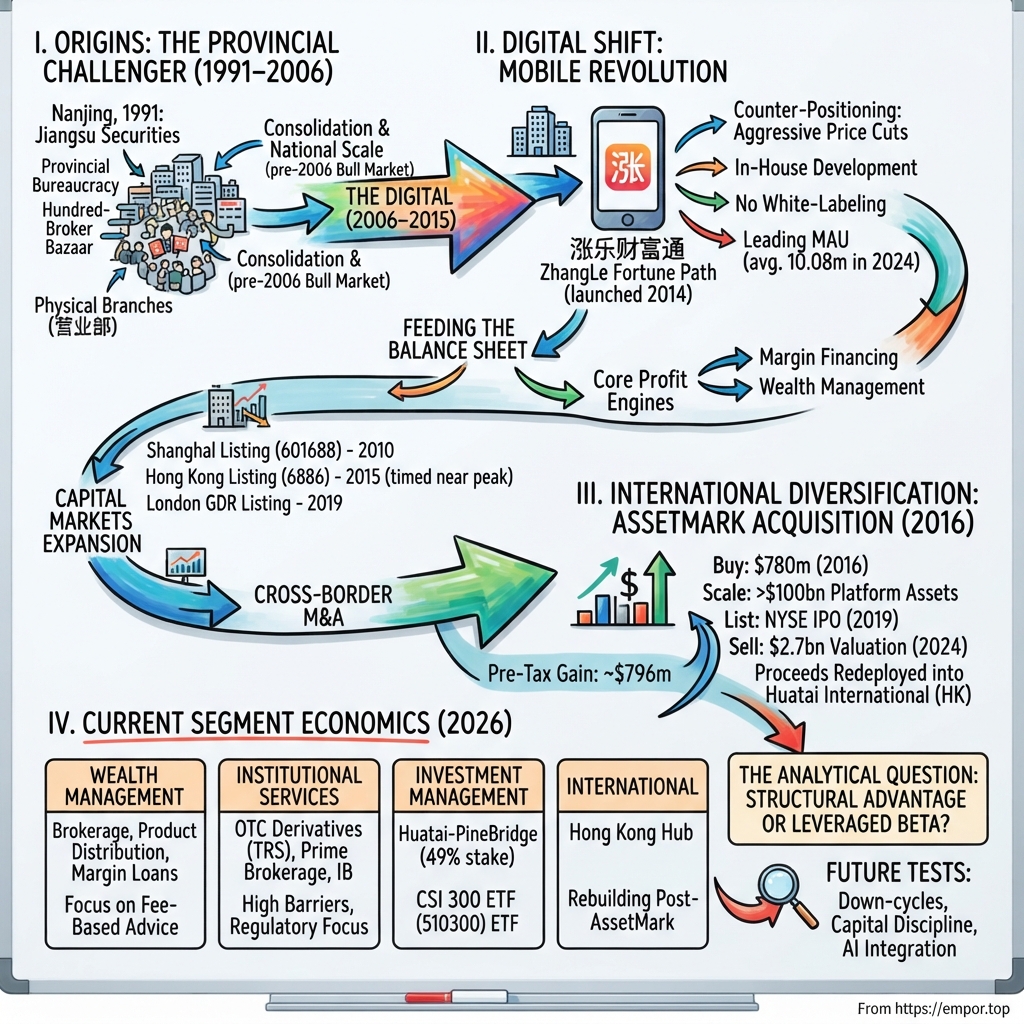
The narrative follows a structured progression. First, the origins: a provincial broker operating outside the political center of Beijing and the institutional hub of Shanghai, utilizing its marginal status to innovate independently. Second, the digital shift: a strategic decision around 2007 to displace traditional brokerage fee structures through software rather than branch expansion, creating 涨乐财富通 ZhangLe Fortune Path, the mobile app that secured Huatai's retail market position. Third, capital markets expansion across Shanghai in 2010, Hong Kong in 2015, and London in 2019, alongside cross-border transactions including AssetMark. Fourth, current segment economics in 2026 across wealth management, institutional services, investment management, and an international division whose financial results reflect distortion from the AssetMark divestment. Finally, the analysis evaluates governance structures, strategic execution, competitive positioning, key operational risks, and core metrics for monitoring performance.
Throughout, the analysis hinges on a central question: is Huatai gaining market share through structural advantages, or is its financial performance primarily reflecting elevated A-share trading turnover? The investigation begins where that structural transition took root.
 Subscribe on LinkedIn
II. Origins & Founding Context: The Provincial Challenger (1991–2006)
The predecessor entity was approved by the People's Bank of China headquarters in December 1990, received its business licence on 9 April 1991, and opened for business on 26 May 1991. It renamed itself Jiangsu Securities Co., Ltd. in 1994, became Huatai Securities Limited Liability Company in March 1999, and converted into a joint stock company — Huatai Securities Co., Ltd. — on 29 November 2007.1
This regulatory progression reflects the political economy of early Chinese finance: a central bank licence granted to a province, a provincial government building a securities firm to foster local economic development, and successive corporate restructurings as financial regulations formalized ahead of public listings.
The hundred-broker bazaar
Understanding why Huatai's subsequent strategy succeeded requires examining the structure of China's early brokerage industry. China's stock exchanges opened in Shanghai and Shenzhen at the turn of the 1990s in a domestic market with high household savings, few alternative investment channels, and limited public familiarity with equity risk. The result was an intense retail speculative boom. To trade, investors physically visited brokerage branches (营业部) — bustling halls where crowds watched price boards, discussed stocks, and queued to submit paper order slips.
The economics of physical brokerages were straightforward. Fixed commission rates were high and regulated, and client relationships were bound by local geography. A firm's competitive position depended directly on real estate footprint: the number, location, and seating capacity of its branches. Dozens of regional brokers, each backed by a provincial or municipal government, expanded branch networks under this logic.
Consequently, the industry's cost structure, career incentives, and operational authority centered on physical distribution. Branch managers held substantial internal influence, headquarters allocated capital primarily to leases and hardware, and regional governance meant branch executives frequently shaped corporate strategy.
Standard disruption theory highlights the vulnerability of such asset-heavy distribution models to digitization. The more formidable challenge for incumbents was organizational: few traditional firms could adopt digital distribution when doing so directly undermined the internal power base of their branch networks.
The Nanjing advantage
Huatai was positioned to pursue digital distribution in part because it had less traditional franchise value to protect.
Jiangsu was one of China's wealthiest provinces, supported by a strong private-enterprise base around Suzhou, Wuxi, and Nantong. Yet Nanjing was not a primary financial capital. Mandates for major state-owned enterprise listings naturally flowed to Beijing-based firms like CITIC Securities (中信证券), with their central government ties. Similarly, institutional trading concentrated around Shanghai incumbents like Guotai Junan (国泰君安). The highest-margin investment banking segments were structurally difficult to access for a provincial broker.
Instead, Huatai possessed a large retail hinterland, a provincial owner focused on financial returns, and no established institutional profit pool to defend. While dominant incumbents protected high traditional commission rates, a provincial challenger faced lower opportunity costs to undercut market pricing.
This retrospective framing requires qualification. Many provincial brokers possessed identical marginal status yet failed to innovate, with several eventually liquidated or absorbed by larger peers. Marginality provided operational latitude rather than a guaranteed strategy. Huatai's differentiation lay in pairing that latitude with a focused operational plan.
Consolidation and the build-out
Before executing its digital transition, Huatai underwent a traditional consolidation phase. A prolonged bear market after 2001 exposed widespread client asset misappropriation across Chinese securities firms, prompting regulatory restructurings and forced closures. Huatai survived by acquiring the assets and licences of distressed regional peers, expanding its branch footprint into new provinces ahead of the 2006–2007 bull market.
This consolidation gave Huatai national scale in the branch network that it would soon seek to bypass. The pivot to digital distribution was made possible only after the firm spent years acquiring the physical infrastructure that it later cannibalized.
By late 2007, Huatai had converted to a joint stock company and ranked among China's largest securities firms by account count. However, its cost structure remained dependent on physical branch traffic — a model the firm would systematically dismantle over the subsequent decade.
III. The Digital Inflection: Counter-Positioning & The Mobile Revolution (2006–2015)
In the years following its 2007 joint-stock conversion, Huatai's executive leadership confronted a severe internal challenge: convincing branch managers to accept steep commission cuts while directing new clients toward a mobile application designed to bypass physical branches entirely.
That internal realignment marked the start of Huatai's strategic transformation from a traditional regional broker into a technology-led distribution platform.
The commission war
For years, Chinese retail brokerage commissions operated as a comfortable, administered spread. Through the late 2000s and 2010s, industry commission rates collapsed, and Huatai emerged as one of the most aggressive price-setters. The firm priced near regulatory and operational cost floors, leveraging low-cost digital account opening to capture high volumes of price-sensitive retail traders.
This strategy exemplified counter-positioning: adopting a business model that established incumbents could not emulate without inflicting disproportionate harm on their own existing operations. A traditional, branch-heavy broker attempting to match Huatai's reduced commission rates would not only earn less per trade across a heavy fixed cost structure of leases and personnel underwritten at higher historical rates, but would also severely impair the compensation of the branch managers who controlled its distribution. Consequently, established competitors responded slowly and partially.
Huatai's model rendered that physical cost base largely redundant. By shifting account opening, capital transfers, research delivery, order execution, and product distribution into software, the marginal cost of serving an additional customer approached zero. Physical branches were gradually reoriented from high-volume transaction centers into advisory outposts.
Building ZhangLe rather than renting it
The decisive execution choice arrived in 2014 with the launch of 涨乐财富通 ZhangLe Fortune Path.
At the time, most Chinese brokerages licensed their trading applications from third-party vendors such as 同花顺 Flush or 大智慧 Great Wisdom and applied custom branding. While white-labeling reduced initial software investment, it surrendered user interface habits, client data, and relationship touchpoints to external software providers. When competing brokerages offer functionally identical applications, price remains the only differentiator, allowing technology vendors to consolidate industry bargaining power.
Huatai chose to develop its platform in-house. In-house development required larger upfront capital expenditures, longer implementation timelines, and several iterations of early software releases. In return, the firm secured direct control over user distribution: the ability to present wealth management products, margin loans, research, and fund subscriptions at the exact moment of investor activity, while capturing behavioral data to optimize conversion.
The strategy yielded substantial distribution scale. Across full-year 2024, ZhangLe averaged more than 10.08 million monthly active users, ranking first among Chinese brokerage applications — ahead of Guotai Junan's Junhong at 8.85 million, Ping An Securities at 7.52 million, and CITIC's Xin e Tou at 6.23 million.8 While Huatai held a clear lead over the second-ranked app, the margins across top competitors remained competitive, reflecting a crowded market rather than absolute dominance.
That distinction carries structural implications for Huatai's competitive moat. A trading application does not generate direct user-to-user network effects; an additional retail account does not inherently increase the platform's utility to existing users. Instead, Huatai's advantage rests on scale economies — spreading fixed technology and infrastructure costs across a larger transaction base — combined with modest client switching friction tied to account transfers, historical data, and platform familiarity. These operational advantages provide durable cost efficiencies, though they remain vulnerable to well-capitalized competitors. Financial media portals such as 东方财富 East Money, which acquired a brokerage license to target price-sensitive retail investors, demonstrate that digital distribution funnels can also be constructed from outside traditional finance.
Feeding the balance sheet
The core financial return of Huatai's digital strategy relied on the balance-sheet businesses operating behind the application.
Compressed trading commissions generated modest standalone profits. The primary economic value of a high-volume retail funnel lies in monetization through higher-margin, capital-intensive financial services. Chief among these is 融资融券 margin financing and securities lending, where the brokerage extends credit or securities to clients, earning an interest spread over its institutional funding costs secured by liquidatable collateral.
Under this model, the mobile application functions as a client acquisition vehicle, while the corporate balance sheet serves as the primary profit engine. A retail account established through low-commission trading can convert over time into a margin borrower, a wealth management client, or a fee-paying advisory subscriber. Low trading commissions effectively functioned as a loss-leader strategy to acquire long-term customer relationships.
However, this balance-sheet-heavy model entails substantial pro-cyclical risk. Margin trading volumes expand rapidly during market rallies and contract sharply during downturns, while the market value of the underlying collateral declines simultaneously. For example, China's total margin financing market reached approximately RMB 2.54 trillion at the end of 2025, representing a 36.26% year-over-year increase.9 Relying on peak margin balances can overstate structural profitability, as demonstrated by the severe contraction in Chinese margin balances during the 2015–2016 market correction.
Three listings, two of them well-timed
Expanding this balance-sheet-driven strategy required substantial equity capital.
Huatai completed its domestic A-share listing on 26 February 2010, trading on the Shanghai Stock Exchange under ticker 601688.1 Five years later, on 1 June 2015, the firm listed H shares on the Hong Kong Stock Exchange under ticker 6886.1
The timing of the Hong Kong debut proved critical. The Shanghai Composite Index reached its cyclical peak on 12 June 2015 — just eleven days after Huatai's Hong Kong listing — before entering a sharp contraction that erased trillions in market capitalization and prompted state market interventions. Huatai secured international equity capital near the peak of a major market cycle.
This execution reflected prevailing market access rather than unique strategic foresight; major Chinese brokerages issued equity during the period as buoyant valuations opened public listing windows. Nevertheless, the successful equity raise significantly fortified Huatai's balance sheet prior to the post-2015 market downturn, providing capital that subsequently supported its international expansion.
The subsequent market contraction tested Huatai's digital model. As market turnover declined, margin balances contracted, and industry commission rates continued to fall, Huatai maintained its technology capital expenditures throughout the downturn. Sustaining investment during an industry contraction underscored the firm's long-term operational commitment to digital distribution over short-term earnings management.
IV. Cross-Border M&A & The AssetMark Masterclass (2016–2024)
In April 2016, Huatai executed one of the most unconventional acquisitions in modern Chinese finance: purchasing AssetMark Financial Holdings, a turnkey asset management platform (TAMP) headquartered in Concord, California, that served independent American financial advisers.
Understanding why a provincial Chinese broker acquired operational middleware for U.S. registered investment advisers reveals more about Huatai's strategic ambitions than the transaction's financial return alone.
What AssetMark actually was
At its core, a turnkey asset management platform handles back-office operational infrastructure for independent financial advisers. Independent advisers manage client relationships and fiduciary responsibilities, while the platform executes portfolio construction, trade clearing, custody reconciliation, performance reporting, billing, and compliance. The adviser retains the client relationship while the platform charges an asset-based fee.
This model provides recurring, high-retention revenue tied to the structural shift of wealth management from commission-based trading to fee-based advisory. Crucially, this aligned with the long-term objective of Chinese financial regulators and brokerages: replacing high-churn transaction fees with stable, fee-based wealth management.
Huatai framed the acquisition as importing an operational playbook to China. The firm's domestic fund investment advisory business, which reached RMB 30.6 billion across 1.01 million clients by 2025, represents the local application of that concept.2 However, public disclosures do not isolate whether owning AssetMark directly accelerated this capability or merely coincided with China Securities Regulatory Commission (CSRC) pilot programs pushing the broader industry toward fee-based advisory. The primary rationale was financial diversification: acquiring a U.S. dollar-denominated, fee-based revenue stream to offset a core business exposed to volatile domestic trading volumes.
The London listing
Alongside its U.S. expansion, Huatai engaged in cross-border capital markets initiatives. On 17 June 2019, the firm became the inaugural issuer under the westbound leg of the Shanghai–London Stock Connect, listing global depositary receipts (GDRs) on the London Stock Exchange at $20.50 per GDR.10 The base offering raised approximately $1.538 billion, expanding to $1.692 billion upon full exercise of the over-allotment option.11
The transaction served both financial and diplomatic functions. As a bilateral market-opening initiative between Chinese and British regulators, the Stock Connect program required a credible pioneer. As a provincial firm without central state political baggage, Huatai offered a suitable candidate. The listing established Huatai as a triple-listed brokerage across Shanghai, Hong Kong, and London, enhancing its international profile.
However, the Shanghai–London Stock Connect did not develop into a deep liquidity channel. Westbound GDR issuances remained sporadic as geopolitical and economic relations shifted. While Huatai secured equity capital and achieved a prominent capital markets milestone, the link did not evolve into the primary cross-border capital channel envisioned at its launch.
Knowing when to sell
Huatai's divestment of AssetMark demonstrates effective transactional execution, though its financial return requires objective evaluation.
The divestment followed a clear sequence: after purchasing AssetMark in 2016 for $780 million, Huatai conducted an initial public offering on the New York Stock Exchange in 2019 to establish public liquidity while retaining majority control. After scaling platform assets past $100 billion, Huatai agreed in April 2024 to sell its controlling stake to private equity firm GTCR at $35.25 per share, valuing AssetMark at approximately $2.7 billion.5 Huatai received roughly $1.79 billion in cash proceeds for its block, generating an estimated pre-tax gain of $796 million.6 The transaction closed in September 2024.7
Evaluating the divestment involves three distinct factors:
First, valuation timing. By monetizing AssetMark in 2024 following a prolonged expansion in wealth-technology valuation multiples, Huatai exited a mature asset near a valuation peak rather than retaining it indefinitely for strategic positioning.
Second, regulatory risk management. By 2024, Chinese state-linked ownership of critical U.S. wealth management infrastructure presented growing regulatory scrutiny and cross-border political risk. Exiting the asset mitigated escalating geopolitical compliance exposure.
Third, total investment returns. Huatai invested $780 million in 2016 and realized roughly $1.79 billion from its remaining stake in 2024, alongside capital retrieved during the 2019 IPO, generating an estimated gross return of approximately 2.5 times invested capital over eight years. This equates to an internal rate of return in the mid-teens—a solid outcome comparable to broad U.S. equity market performance over the same period, but achieved while navigating cross-border integration, currency fluctuation, and regulatory complexity. The transaction's primary distinction lies in execution: unlike many Chinese financial institutions that struggled to monetize overseas acquisitions made during the mid-2010s, Huatai completed the full investment cycle and harvested cash gains.
The capital allocation verdict, tested
Assessing whether the AssetMark transaction reflects a broader corporate culture of capital discipline requires examining how management deployed the divestment proceeds.
Rather than distributing the proceeds through a special dividend, Huatai maintained a conventional payout structure. In 2025, total cash distributions reached RMB 4,965 million—representing RMB 5.50 per 10 shares, including a RMB 1.50 interim dividend—against RMB 16.38 billion in net profit attributable to shareholders, yielding a payout ratio of approximately 30%.2 For the first half of 2026, the interim distribution was set at RMB 1.80 per 10 shares.3
Management reallocated the realized capital into core balance-sheet operations—contributing to a 32.31% expansion in total assets during 20252—and into capital injections, including up to HK$9 billion (approximately $1.15 billion) earmarked for its wholly-owned offshore entity, Huatai International.12 Consequently, Huatai exchanged a fee-based, dollar-earning wealth platform for capital deployed into margin-lending and trading activities.
This capital allocation strategy aligns with domestic regulatory incentives that reward net capital expansion and support institutional market share growth. However, it indicates a preference for balance-sheet scaling over direct shareholder payout. Assessing whether management maintains disciplined capital allocation across cycles will depend on dividend stability and return metrics during future market contractions.
The AssetMark divestment also introduced significant accounting noise into Huatai's financial reporting. Because the pre-tax gain was recognized in 2024 within the international business segment, the subsequent roll-off caused international segment revenue to drop 46.75% in 2025 to RMB 5.92 billion, while Huatai International's net profit contracted by approximately 54%.13 CEO Zhou Yi explained that excluding the one-off disposal gain from the 2024 baseline, Huatai International's underlying 2025 revenue actually expanded by 23.8% under Chinese Accounting Standards.13 While this adjustment is mathematically consistent, it underscores how large non-recurring M&A gains can distort segment performance metrics across reporting periods.
With the cross-border restructuring phase concluded, evaluating Huatai requires analyzing the earnings power of its core operating divisions.
V. Business Segment Deep Dive & Revenue Economics
On any Chinese brokerage earnings call, segment financial results often resemble shifting weather patterns. Annual segment revenues regularly fluctuate by 30%, 40%, or upwards of 170%, reflecting broad market turnover far more than structural operational shifts over a twelve-month period.
Huatai reports across four operating segments. In 2025, on an operating revenue base of RMB 35.81 billion—a figure distinct from total revenue of RMB 47.22 billion, which includes other income items—wealth management contributed RMB 15.86 billion, or 44.30%, up 29.85% year-over-year. Institutional services grew 42.42%, investment management expanded 176.35%, and international segment revenue declined 46.75% to RMB 5.92 billion, driven by the AssetMark divestment baseline effect.132
Evaluating these segment results requires examining the specific operational mechanisms driving each division.
Wealth management: the funnel and the loan book
Wealth management represents Huatai's core public identity, generating roughly 44% of operating revenue.
The segment comprises three primary revenue streams: high-volume, low-margin brokerage commissions tied directly to trading turnover; financial product distribution fees generated by selling mutual funds and structured products across the mobile application; and net interest income dominated by margin financing.
First-half 2026 results illustrate how sharply these revenues gear to prevailing market activity. Consolidated net revenue from securities brokerage reached RMB 4.7 billion, up 61% year-over-year, while net revenue from financial product distribution rose 114%.3 A doubling of product distribution revenue within six months reflects renewed household fund purchasing rather than a sudden structural expansion in distribution capacity; the identical funnel generated far lower returns during the market lull two years prior.
A key strategic indicator is revenue mix. While commission revenue tracks market trading turnover, distribution and asset advisory fees function more like an annuity, charged on asset balances rather than transaction velocity and persisting through lower-volume quarters. Huatai's fund investment advisory assets reached RMB 30.6 billion across 1.01 million clients by 2025,2 representing a modest share of its broader wealth franchise. This demonstrates that the firm's transition from transaction-based commissions to fee-based advice remains in an early stage. While management has consistently prioritized this strategic pivot across multiple reporting periods, empirical evidence that advisory fees have materially dampened overall earnings cyclicality remains limited.
Furthermore, regulatory policy continues to compress intermediary fee pools. The China Securities Regulatory Commission (CSRC) has mandated multi-stage reductions in mutual fund management fees, trading commissions, and distribution charges across the asset management industry since 2023. For a retail engine monetizing partly through fund distribution, regulatory caps represent a permanent shift in economic value from financial intermediaries to end-investors. While Huatai can expand its share within a consolidated market, it cannot unilaterally alter regulatory fee ceilings.
Margin lending provides the segment's primary interest spread. Huatai ranked second in Chinese margin financing and securities lending during the first half of 2026.3 The business yields attractive spreads on over-collateralized loans above wholesale funding costs, but carries inherent pro-cyclical risk. During sharp market contractions, collateral liquidations risk triggering credit defaults for the brokerage while simultaneously accelerating broader market declines.
Institutional services: the quiet compounder
While wealth management serves as Huatai's public retail interface, institutional services provides a more defensible franchise against regional competitors.
The core revenue driver is over-the-counter (OTC) equity derivatives—specifically total return swaps (TRS). Under these contracts, an institutional client obtains economic exposure to a stock portfolio without direct ownership, paying the broker a financing fee while the firm hedges the underlying market positions. Operating a profitable TRS book requires real-time risk pricing across thousands of holdings, cost-effective hedging execution, and substantial balance-sheet capacity to warehouse residual risk.
This operational complexity creates high barriers to entry. Smaller brokerages face structural disadvantages because fixed technology expenditures and net capital requirements on warehouse positions do not scale down with lower volume, establishing a durable competitive advantage.
Surrounding the derivatives platform are prime brokerage services for domestic quantitative funds, FICC market-making, and investment banking. Huatai's institutional client base expanded beyond 6,500 domestic and international institutions by H1 2026, with sovereign wealth fund accounts increasing 64% year-over-year, alongside a fifth-place ranking in 2025 public fund brokerage commissions.3 In investment banking, 2025 domestic equity lead underwriting reached RMB 66.7 billion, while all-category bond underwriting totaled RMB 1.41 trillion—including RMB 81.1 billion across 290 technology innovation bond issues, up 132%.2 During the first half of 2026, domestic equity lead underwriting reached RMB 53.3 billion, bond underwriting totaled RMB 718.9 billion, and the firm secured 12 Hong Kong IPO sponsorship mandates, ranking third.3
However, the segment faces ongoing regulatory scrutiny. The CSRC has systematically tightened oversight of institutional trading and derivative activities. Regulatory developments include final rules on programmatic trading requiring pre-trade reporting and real-time exchange monitoring;14 risk management guidance curbing exposure to snowball-style structured products; a net capital requirement of at least RMB 500 million over the preceding six months for derivatives trading under the Derivatives Trading Supervision and Management Measures (Trial), effective 16 November 2026;15 and directives ordering brokerages to restrict new cross-border exposures offered through total return swaps.16
These regulatory measures exert dual pressures on the industry. Elevated capital thresholds and compliance mandates reinforce the market position of well-capitalized incumbents like Huatai over smaller peers. Conversely, restrictions on cross-border swaps, quantitative trading, and structured products constrain total volume and margins in high-return institutional lines.
Investment management: the ETF that ate the market
Beyond reported growth rates, the segment's key asset is its strategic position in Chinese index products.
Huatai holds a 49% equity stake in Huatai-PineBridge Fund Management, a joint venture alongside PineBridge Investments, which also holds 49%.17 Huatai-PineBridge manages the Huatai-PineBridge CSI 300 ETF (code 510300), the largest exchange-traded fund in the Chinese market. The fund's asset scale reached approximately RMB 422.3 billion at year-end 2025, expanding to roughly RMB 437.4 billion by 9 January 2026.18 In 2026, the fund declared a distribution of approximately RMB 11 billion, marking the largest single dividend payout in Chinese ETF history.19
The primary strategic value of 510300 extends beyond management fee income. Because index ETF management fees in China remain low, a 49% share of fund management fees yields modest net revenue. However, the product serves as the benchmark instrument for Chinese large-cap equity exposure: it underpins the Shanghai exchange's CSI 300 ETF options contract and serves as a primary vehicle for state-linked market stabilization purchases. Managing the market's central beta benchmark provides institutional order flow visibility and liquidity provision opportunities that exceed direct fee income.
Huatai also retains a minority equity stake in China Southern Asset Management.20 Income from these non-consolidated associates flows through equity-method accounting, contributing to historical volatility in reported segment revenue growth.
However, an equity-accounted 49% stake does not grant sole operational control. Huatai cannot unilaterally adjust fee structures, product development, or distribution strategies for Huatai-PineBridge. The holding represents an advantageous equity placement in Chinese passive asset growth rather than a fully integrated, controlled asset management unit.
International: the segment with an asterisk
Following the structural distortion from the 2024 AssetMark sale, the international division is undergoing operational rebuilding. Huatai Financial Holdings (Hong Kong) Limited—operating as Huatai International—consolidates cross-border equity derivatives, Hong Kong wealth management, and HKEX underwriting services, supported by planned capital injections of up to HK$9 billion.12
The optimistic case highlights a rebounding Hong Kong initial public offering market, where Huatai's third-place sponsorship ranking in H1 20263 positions it to capture rising underwriting mandates. The cautious perspective notes that following the divestment of AssetMark, Huatai's international operations have re-centered on highly competitive Hong Kong equity and derivative markets, competing directly against CICC, global investment banks, and mainland peers. Rebuilding the international division presents a direct test of whether management's capital allocation execution on AssetMark can be mirrored in organic capital deployment.
This operational pivot highlights the broader governance framework shaping Huatai's strategic direction.
VI. Corporate Governance, Management Credibility, & Culture
On 23 January 2026, Huatai Securities executed a leadership transition at the board level when 王慧清 Wang Huiqing succeeded the retiring 张伟 Zhang Wei as chairman.21 Born in February 1970, Wang holds master's degrees in public finance and law, alongside accounting and legal qualifications. He served as a Huatai supervisor from 2016 to 2018 before leading Jiangsu High-tech Investment Group, a provincial investment platform, and became the firm's Party Committee Secretary in November 2025 — a designation that customarily precedes the board chairmanship at Chinese state-owned enterprises.21 Financial news outlet Caixin had reported the impending transition in December 2025.22
In Chinese financial state-owned enterprises, governance functions through a distinct division of authority. The chairman serves primarily as the senior political figure, managing relations with the provincial shareholder, maintaining alignment with national policy priorities, overseeing risk, and directing Party affairs. Operational execution, by contrast, sits with the chief executive officer. Wang's background across provincial state investment, law, finance, and prior supervisory experience at Huatai reflects a custodian appointment intended to maintain institutional stability rather than signal a strategic pivot.
The continuity that matters
The more consequential element of the transition was the reappointment of 周易 Zhou Yi as chief executive officer.21
Zhou has directed Huatai's operations since 2019 and stands as the principal architect of the firm's technology-driven distribution strategy and international expansion. In an institutional environment where senior state-owned enterprise executives rotate frequently among state entities on administrative schedules, a long-tenured chief executive remaining in place across a board leadership transition provides rare strategic continuity.
However, this continuity highlights a notable key-person vulnerability. Much of Huatai's operational differentiation and strategic consistency over the past seven years remains closely tied to a single executive. Key-person risk at a state-owned enterprise carries a distinct dimension: administrative reassignments can occur independently of commercial performance or corporate operational cycles.
Ownership and the limits of mixed-ownership reform
Huatai operates without a single controlling shareholder. Control rests with 江苏省国资委 the State-owned Assets Supervision and Administration Commission of Jiangsu Province, exercised through a network of state-owned entities. As of the third quarter of 2025, Jiangsu High-tech Investment held roughly 3.95%, ranking as the fifth-largest shareholder.21 Historically, 江苏国信 Jiangsu Guoxin Investment Group, wholly owned by the provincial asset regulator, has functioned as the primary state shareholder.23
The flagship initiative in Huatai's 混合所有制改革 mixed-ownership reform occurred in 2018 through a private placement of equity to strategic corporate investors. 阿里巴巴 Alibaba Group invested RMB 3.5 billion for approximately 3.25% of the enlarged share capital,23 while conglomerate 苏宁 Suning committed RMB 3.4 billion for a 3.16% stake.24
Initial market expectations suggested these technology investments would unlock direct operational synergies between commercial platforms and retail wealth management. Disclosed results show a more modest reality: no verifiable operating transformation has been attributed to the Alibaba investment, while Suning entered a severe debt restructuring that led to its founder's departure following a state-backed stake sale in 2021.25 The equity placement provided tangible growth capital, but the underlying operational partnerships functioned primarily as symbolic strategic alignments rather than catalysts for core business integration.
Where mixed-ownership reform appears to have exerted influence is on internal corporate culture. Market-based compensation arrangements, commercial hiring practices, and decentralized product development reflect greater operational flexibility than is typical among traditional state-owned peers. Because internal culture remains difficult to quantify externally, this flexibility is best understood as a plausible supporting factor for observed operational agility rather than a fully verifiable structural guarantee.
Reading management against its own record
Evaluating management credibility requires assessing disclosure consistency across market cycles and checking whether executive commentary directly addresses operational headwinds.
Two recent disclosures illustrate this reporting posture. First, following the sharp drop in international segment revenue in 2025 caused by the AssetMark sale, chief executive Zhou Yi provided a detailed reconciliation separating the non-recurring divestment gain in the 2024 baseline from underlying operational performance, noting that underlying segment revenue expanded 23.8% year-over-year.13 Explicitly isolating one-off transactional accounting effects provides a clearer picture of recurring segment trends, even if the calculation highlights favorable underlying growth.
Second, Huatai expanded its digital strategy in October 2025 by launching AI 涨乐 AI ZhangLe, an artificial-intelligence-native trading application developed in partnership with 科大讯飞 iFlytek. Designed to process natural-language investment intent, the application provides portfolio analysis, performance attribution, and scenario modelling, reaching five million cumulative downloads by the first half of 2026.3 Executive leadership framed the initiative as an enterprise-wide transformation, stating in its first-half 2026 report that sustainable competitive advantage requires a systematic, organization-wide approach to artificial intelligence.3
While widespread adoption of artificial intelligence terminology across Chinese brokerage reporting warrants cautious interpretation, Huatai's prior record of building proprietary digital distribution platforms distinguishes its technology commitments from routine industry narrative. However, cumulative download figures reflect initial user distribution rather than direct monetization. Establishing whether the artificial intelligence platform delivers genuine economic value will depend on future evidence of higher revenue per account, enhanced client retention, or structural reductions in operating costs rather than initial download metrics.
Across these disclosures, management maintains a pattern of detailed operational reporting alongside consistent long-term strategic positioning. While Chinese brokerages rarely issue formal numerical forward guidance, this multi-year consistency provides a transparent baseline for evaluating ongoing operational execution.
VII. Playbook: Business & Investing Lessons
Stripping away its specific Chinese market context, Huatai's corporate trajectory offers four broader business lessons — each paired with an essential operational caveat.
1. Attack the profit pool you were never invited to share
Counter-positioning succeeds primarily from a position of relative weakness. Huatai could slash retail brokerage commissions toward operational cost floors because retail trading fees were not its primary profit pool — it possessed neither a dominant national branch network to cannibalize nor elite institutional underwriting franchises to protect.
The essential caveat: counter-positioning buys a temporal window rather than a permanent moat. Incumbents eventually adapt, and the aggressive pricing model that proved disruptive around 2010 became standard industry practice a decade later. Today, Huatai's commission discount offers little pricing power. The durable asset is not the price differential itself, but the massive retail account base acquired while that gap existed.
2. Own the interface, or rent the customer
Developing ZhangLe in-house rather than white-labeling third-party software stands as the highest-return operational decision in Huatai's history, offering insights that apply far beyond financial services.
Delivering financial products through third-party software creates three structural vulnerabilities: platform differentiation collapses to price, behavioral user data accrues to the software vendor, and the vendor gains the operational leverage to disintermediate the broker. The Chinese brokerage sector demonstrated this risk directly: firms that rented vendor interfaces competed almost exclusively on commission fees, while software providers consolidated enough user distribution that financial portal East Money acquired a brokerage license to become a formidable competitor.
The essential caveat: proprietary software development is capital-intensive and slow, yielding positive returns only when supported by sufficient transaction volume to amortize fixed infrastructure costs. For smaller, sub-scale brokerages, licensing third-party software was — and remains — the economically rational choice.
3. Monetise flow through the balance sheet, and price the cyclicality honestly
Under this framework, low-margin trading execution functions as a loss leader, while margin financing, asset distribution, and wealth management fees provide the core profit engine — an economic model central to global retail fintech.
The essential caveat: monetizing user traffic through the balance sheet transforms an asset-light fee model into a capital-intensive credit and market risk exposure. Consequently, Huatai's earnings quality carries greater cyclical sensitivity than a pure software or advisory platform, requiring higher regulatory capital reserves and creating convex downside risk during market contractions. A margin lending portfolio generates attractive interest spreads during market expansions, but converts into a collateral liquidation challenge during a severe crash.
4. Sell foreign assets while someone still wants them
The strategic takeaway from the AssetMark divestment extends beyond standard transaction timing. It demonstrates that cross-border assets carry geopolitical risk factors that remain largely unpriced on balance sheets until regulatory conditions shift. A Chinese-owned wealth management platform serving independent American financial advisers faced a higher regulatory and geopolitical discount rate by the mid-2020s than when it was acquired in 2016.
The essential caveat: Huatai redeployed the divestment proceeds into its Hong Kong-centered international division — a market where it operates as one of many mainland competitors rather than an owner of unique wealth-technology middleware. Divestment execution and capital deployment are distinct capabilities, and Huatai's long-term capital efficiency in its recycled offshore investments remains unproven.
These four principles explain how Huatai built its market position. Whether they translate into a durable long-term moat across future market cycles remains the central question for investors.
VIII. Hamilton Helmer 7 Powers & Porter's 5 Forces Analysis
Applying competitive strategy frameworks to Chinese securities firms requires objective scrutiny, as strategic models are useful only when tested against market realities.
The powers Huatai actually has
Scale economies — present, moderate. Huatai's technology stack, risk management systems, and trading infrastructure represent substantial fixed costs spread across more than ten million monthly active app users8 and an institutional client base exceeding 6,500 institutions.3 A broker operating with a fraction of that volume cannot justify an equivalent platform investment. This represents Huatai's most defensible competitive power. However, its scope is constrained: several top-tier Chinese brokerages match or exceed Huatai's scale. CITIC Securities, in particular, possesses the balance-sheet capital and operating scale to match any technology expenditure Huatai undertakes. Scale economies protect Huatai against regional competitors rather than top-five peers.
Process power — present in institutional trading. Proprietary risk pricing, hedging execution, and inventory management for a large over-the-counter derivatives and index-ETF market-making operation reflect accumulated organizational expertise rather than off-the-shelf software. Developing these capabilities requires years of operational refinement, remains largely invisible in standard disclosures, and cannot be easily replicated by acquiring individual teams. This operational capability represents the power most likely to endure across market cycles, though it remains highly vulnerable to tightening regulatory constraints on derivative products.
Counter-positioning — historical, now largely spent. Counter-positioning proved decisive between roughly 2008 and 2016 when Huatai bypassed physical branch networks. That structural advantage is no longer operative; every major Chinese brokerage now provides mobile applications and low commission rates. Consequently, counter-positioning does not offer a forward-looking competitive moat.
Switching costs — present, weak. Account transfer frictions, transaction histories, and user habits create real but modest retention. Chinese retail investors frequently maintain active trading accounts across multiple brokerages, limiting client lock-in.
Branded power, network economies, cornered resource — largely absent. Retail brokerage exhibits no meaningful user-to-user network effects, and the Huatai brand commands no pricing premium, competing primarily on execution cost and functionality. The nearest equivalent to a cornered resource is Huatai-PineBridge's position managing the market-dominant CSI 300 ETF,18 though that asset resides within a 49%-owned joint venture rather than a fully controlled subsidiary.17
Net assessment: two active powers, one historical, and three absent. This profile describes a well-positioned Chinese securities firm rather than a structurally insulated franchise.
Porter, applied to Chinese brokerage
Rivalry: high and escalating. CITIC Securities maintains a larger balance sheet and superior positioning in elite investment banking mandates. Guotai Junan's merger with Haitong Securities established a domestic competitor of comparable operating scale. Meanwhile, financial portal East Money targets retail investors from outside traditional finance, using a media-native acquisition funnel and a lower fixed cost structure. Furthermore, regulatory policies promoting industry consolidation to build "first-class investment banks" are systematically creating larger, better-capitalized competitors.
Buyer power: high. Retail investors remain price-sensitive and routinely trade across multiple platforms. Similarly, quantitative hedge funds—the industry's most lucrative institutional client segment—are highly fee-sensitive and readily reallocate trading volume to secure superior execution speeds or cheaper margin financing. Neither client segment is locked into a single provider.
Substitutes: medium to high. Bank wealth management subsidiaries, insurance products, third-party fund distribution platforms such as 天天基金 East Money Direct and 蚂蚁财富 Ant Fortune, and direct-to-consumer fund offerings compete for household savings. This substitute threat is most intense within fee-based wealth management—the exact growth segment Huatai seeks to expand.
New entrants: low and structurally constrained. Securities licenses remain strictly regulated by the CSRC, while net capital requirements for complex financial activities continue to escalate—highlighted by the RMB 500 million net capital threshold under the trial derivatives supervision measures.15 High regulatory barriers to entry represent the most favorable competitive force protecting incumbent brokerages.
Supplier power: low. Exchanges, clearinghouses, and market data services are standardized and strictly regulated. The primary input supplier is capital, where Huatai's funding costs are determined by its state background and investment-grade credit rating rather than by supplier pricing power.
The synthesis
Applying Porter's framework reveals a protected sector characterized by intense internal rivalry—an oligopoly protected by regulatory entry barriers where incumbents compete aggressively for market share. This dynamic accurately characterizes the Chinese securities sector.
Within this industry structure, Huatai's investment thesis hinges on earning a return premium through digital distribution efficiency and institutional risk management. This thesis survives scrutiny in a narrowed form: Huatai demonstrates superior digital retail distribution compared to median regional brokers and maintains strong institutional derivative capabilities relative to most peers. However, it holds no structural advantage over CITIC Securities, while its lead in mobile app active users over top rivals is measured in incremental percentages rather than order-of-magnitude multiples.8
Ultimately, Huatai's long-term performance depends on disciplined capital allocation and sustained domestic market turnover—the latter of which remains entirely beyond management's control.
IX. Risk Radar & Skeptical-Investor Stress Test
Evaluating a Chinese securities firm requires acknowledging a fundamental reality: the business model operates as an operationally leveraged, balance-sheet-intensive derivative of domestic equity market turnover, functioning within a regulatory environment that can shift rapidly and without advance consultation.
The cyclicality is the business, not a risk to the business
In the first half of 2026, Huatai posted a 49.23% increase in revenue and a 54.87% surge in net profit,3 driven by elevated trading turnover, expanding margin balances, and strong product distribution. However, when market sentiment cools, this mechanism operates in reverse. If A-share trading turnover drops, brokerage commissions decline proportionally, while margin balances contract from a market-wide expansion of 36.26% achieved in 2025.9 Consequently, net interest income shrinks, retail investors halt fund purchases—causing distribution fees to plunge—and proprietary trading and market-making returns deteriorate simultaneously. Because these business lines contract in tandem, the firm possesses no internal structural hedge against a market downturn.
The 2015 to 2018 market correction provides a clear historical precedent. Although Huatai had already established its mobile application, reduced commission rates, and differentiated its retail distribution, its earnings still contracted sharply during the subsequent market deleveraging. Digital distribution improved Huatai's relative market share within the brokerage industry, but it did not insulate the firm from broader industry cycles. Any forward-looking valuation model that extrapolates recent growth rates must explicitly account for this structural cyclicality.
Regulation cuts both ways, and the tightening is current
While institutional derivative and algorithmic trading rules were detailed in the segment analysis, the critical distinction is that regulatory tightening remains active rather than historical. The new trial derivatives supervision measures will take effect on 16 November 2026, formalizing higher capital thresholds, while the CSRC has instructed brokerages to halt new cross-border exposures offered through total return swaps as part of broader capital control enforcement.151614
The operational impact is direct. Cross-border total return swaps represent a high-margin institutional line, and restricting these transactions removes revenue that cannot easily be replaced by equivalent domestic offerings. Because regulatory interventions often take the form of informal administrative guidance rather than published statutory amendments, financial institutions face ongoing policy unpredictability alongside formal rule changes. The offsetting benefit—where higher net capital requirements gradually consolidate market share among top-tier firms—acts slowly and provides uncertain immediate relief against lost high-margin business.
Fee compression is permanent in a way cyclicality is not
While cyclical downturns eventually rebound, regulatory fee reductions impose permanent structural changes. The CSRC's multi-stage mandates capping mutual fund management fees, trading commissions, and distribution charges permanently transfer economic value from financial intermediaries to end-investors. For Huatai's wealth management segment, these fee caps lower the long-term revenue yield generated from client assets, requiring the firm to expand advisory assets under management simply to offset lower baseline pricing.
The stress test: three questions a short-seller would ask
"You called the AssetMark exit disciplined. Where did the money go?" Management reallocated the proceeds directly into balance-sheet operations and capital commitments for its offshore subsidiary, Huatai International.12 Meanwhile, total assets expanded by 32.31% in 2025 while the annual payout ratio remained near 30%.2 A skeptical investor would contend that Huatai liquidated a differentiated, fee-earning wealth platform to fund capital-intensive, cyclical domestic operations, and that labeling the transaction strategic discipline mistakes an isolated, successful exit for a permanent capital allocation framework. While management argues that domestic net capital expansion is rewarded by regulators and that Hong Kong's market recovery offers growth opportunities, the long-term efficiency of this capital deployment will ultimately be judged by the return generated on the HK$9 billion offshore commitment rather than initial strategic statements.
"Is the ROE premium competitively earned or cyclically borrowed?" In 2025, Huatai's net profit grew by 6.72% while total assets surged by 32.31%,2 demonstrating that returns on incremental balance-sheet expansion were modest even before accounting for the international divestment baseline effect. The earnings recovery in 2026 tracked broader market turnover rather than structural efficiency gains. Skeptics argue that balance-sheet expansion is outstripping earnings power, and that competitors adopting similar digital and prime brokerage services will gradually erode remaining margin premiums. A balanced assessment indicates that Huatai's return on equity reflects a combination of structural platform advantages and favorable market cycles, with the 2025 gap between asset growth and net profit growth representing a key point of ongoing analytical scrutiny.
"What is the AI programme actually worth?" To date, the primary disclosed performance metric for the AI ZhangLe platform is five million cumulative downloads.3 Without detailed operational disclosures regarding revenue per client, user retention rates, or measurable cost savings attributable to the application, investors should view the artificial intelligence initiative as a long-term strategic option rather than a quantified driver of current earnings.
The overhangs worth naming
Beyond core market cyclicality, several specific risks warrant monitoring. Geopolitical exposure persists through Huatai's U.S.-registered entities and cross-border institutional business, leaving the firm vulnerable to both domestic capital controls and foreign regulatory scrutiny. Credit risk remains embedded within margin lending and equity-pledged financing—segment lines that incurred widespread industry losses during the 2018 market downturn. Operational and compliance risks are heightened for a digital distribution model holding financial data for tens of millions of retail accounts under China's data security and personal privacy regulations. Finally, an operating cash outflow of approximately RMB 12.6 billion in 202513—while typical for a brokerage expanding its trading asset base—underscores the significant divergence between reported accounting profits and actual cash generation in a capital-intensive financial business.
X. Bull vs. Bear Case & Key KPIs
Why Huatai wins from here
The affirmative case rests on three distinct pillars, each supported by varying degrees of empirical evidence.
The first is the retail franchise. Huatai enters market expansions supported by the most-used brokerage application in China8 and a proven capacity to convert retail engagement into margin loans—ranking second in the industry in the first half of 20263—and wealth product sales, which more than doubled during that same six-month period.3 In a retail trading rally, Huatai demonstrates some of the highest operating leverage among domestic brokerages. This pillar is well supported by operational data, though it reflects cyclical earnings sensitivity rather than a permanent competitive moat.
The second pillar is institutional process power. Huatai's over-the-counter derivatives, prime brokerage, and market-making infrastructure represent complex capabilities that competitors cannot easily replicate. Furthermore, escalating regulatory capital requirements are narrowing the field of qualified institutional competitors.15 This capability represents the firm's most structurally durable advantage, though its limited visibility in public disclosures leaves investors relying primarily on indirect operational metrics.
The third pillar is structural exposure to Chinese passive investing through Huatai-PineBridge Fund Management. Domestic household allocations to index products remain in an early stage compared to international benchmarks, and Huatai owns a 49% stake in the manager of China's dominant CSI 300 index fund, which holds approximately RMB 437 billion in assets.1817 While this holding provides exposure to index growth, it remains an equity-accounted associate stake whose financial contribution flows through as investment income rather than consolidated revenue.
What breaks the case
The bear case does not require a structural failure; it requires only a prolonged drop in market turnover.
During a market contraction, wealth management revenues contract simultaneously: commission income falls, financial product distribution slows, and client borrowing contracts from the RMB 2.54 trillion market-wide margin financing balance reached after recent expansions.9 Under these conditions, operating leverage amplifies earnings declines. The 2025 performance—where net profit grew 6.72% while total assets expanded 32.31%2—demonstrated that balance-sheet expansion does not automatically yield proportional profit growth.
Compounding this cyclical vulnerability are structural headwinds: regulatory fee mandates that permanently lower commission and fund distribution yields; regulatory constraints on algorithmic trading, derivatives, and cross-border total return swaps that target high-margin institutional lines;141516 state-backed industry consolidation creating larger competitors; and the risk that capital redeployed from the AssetMark sale into competitive Hong Kong markets delivers lower returns than the disposed asset was earning.
Finally, governance structure introduces a distinct key-person vulnerability: as a provincial state-owned enterprise whose strategic continuity relies heavily on a long-tenured chief executive, administrative executive reassignments represent an ongoing operational risk.21
The calibrated verdict
Evaluating these factors together yields a measured assessment of Huatai's core investment claims:
The claim that Huatai holds a durable retail distribution advantage survives in narrowed form. Huatai leads the market, but its lead over second-place competitor applications is measured in percentage points rather than order-of-magnitude multiples.8 This distribution advantage reflects an active user base and scale efficiencies rather than user network effects, requiring ongoing technology capital expenditure to maintain.
The claim that Huatai maintains a differentiated institutional franchise survives but remains unproven from public disclosures. Available evidence rests on operational metrics—such as market rankings, institutional client counts, and balance-sheet capacity—rather than isolated segment return metrics.
The claim that Huatai acts as a disciplined capital allocator is narrowed substantially by its operational record. A successful divestment of AssetMark, followed by a conventional 30% dividend payout ratio and significant capital redeployment into offshore operations,212 demonstrates opportunistic execution rather than a structural commitment to shareholder capital return.
The claim that artificial intelligence initiatives represent a new competitive advantage remains unsupported by disclosed financial results.3
Three KPIs worth tracking
Evaluating Huatai's ongoing performance requires focusing on three primary operational metrics:
1. ZhangLe Fortune Path monthly active users and the distribution gap relative to the second-ranked brokerage app. The critical indicator is the size of the lead rather than absolute user counts. Huatai's retail distribution thesis depends on whether its active user advantage expands, stabilizes, or narrows as traditional peers and digital competitors increase technology investments. A narrowing user gap provides the earliest signal that early digital counter-positioning gains are diminishing.
2. Margin financing and securities lending balances, alongside Huatai's market share of national balances. This metric offers a clear measure of both earnings capacity and balance-sheet risk. While absolute margin balances track broader market cycles, market share trends reveal whether Huatai is capturing balance-sheet market share or simply riding market turnover. Gaining market share during flat or contracting volume periods would indicate structural competitive strength.
3. Full-cycle return on equity relative to top-tier domestic brokerage peers. Long-term performance depends on whether Huatai's operational model generates a structurally higher return on deployed capital than peers such as CITIC Securities and Guotai Junan. A return premium that emerges only during market rallies reflects cyclical market leverage, whereas a premium sustained through market down-cycles signals a durable competitive moat. The 2025 divergence—where assets grew 32.31% while profit increased 6.72%2—underscores the necessity of tracking full-cycle capital efficiency.
Notably omitted from this key metric list are headline revenue growth, net profit, artificial intelligence download statistics, and underwriting league table rankings. These figures primarily reflect prevailing market conditions and reporting conventions rather than underlying structural performance.
XI. Outro
Return to Nanjing for a moment. A provincial securities company opened its doors in May 1991 with a licence from the central bank and a mandate from its provincial government sponsor.1 It was one of dozens of regional brokers, holding no natural claim on China's financial future.
Thirty-five years later, that firm is triple-listed across three continents, operates the country's most-used brokerage app, maintains a trillion-yuan balance sheet, and has completed a full buy-build-list-sell cycle on an American wealth platform that few of its domestic peers attempted or could have executed.
The driver was not brilliance in any single decision, but a sequence of choices that each appeared costly when made: developing proprietary software rather than licensing vendor tools, cutting commissions before market forces mandated it, sustaining technology investments through bear markets, and monetizing a growing foreign asset while valuation multiples remained favorable and regulatory risks manageable.
What the historical record does not support, however, is the neater narrative — that these operational choices enabled a structural escape from the core economics of Chinese brokerage. Huatai still derives the bulk of its earnings from the trading turnover, client leverage, and risk appetite of Chinese retail and institutional investors. Management built a stronger operating position within that market cycle, not an exit from it. The true test of that position will become visible not during the next market expansion, but during the next prolonged downturn.
References
-
HTSC 2018 Annual Report — About Us, corporate history and listing milestones ↩↩↩↩↩
-
Huatai Securities' revenue reaches $6.83b in 2025 — China Daily Asia, 2026 ↩↩↩↩↩↩↩↩↩↩↩↩
-
Huatai Securities Reports Steady Earnings Growth in H1 2026 Driven by Professional Excellence and AI Breakthroughs — Media OutReach Newswire, 2026-08-28 ↩↩↩↩↩↩↩↩↩↩↩↩↩↩↩
-
AssetMark to Be Acquired by Huatai Securities — Willkie Farr & Gallagher LLP, 2016-04 ↩
-
AssetMark Signs Definitive Agreement to be Acquired by GTCR — Business Wire, 2024-04-25 ↩↩
-
Huatai Securities Cashes Out of U.S.-Listed Unit With $796 Million Gain — Caixin Global, 2024-04-26 ↩↩
-
Huatai Securities sells entire AssetMark stake for $1.79 billion — Investing.com, 2024-09 ↩↩
-
Shanghai-London Stock Connect welcomes its first issuer, Huatai Securities — London Stock Exchange Group, 2019-06-17 ↩
-
Clifford Chance advises Huatai Securities on its historic London GDR listing — Clifford Chance, 2019-06 ↩
-
China's Huatai Securities Appoints New Chairman, Plans $1.15 Billion Capital Injection for Overseas Unit — BigGo Finance, 2026 ↩↩↩↩
-
Huatai Securities' 2025 Results Show Divergence: International Revenue Plummets Nearly 50% — BigGo Finance, 2026 ↩↩↩↩↩
-
China Rolls Out Stricter Rules for Quant Trading to Curb Market Volatility — Caixin Global, 2024-05-16 ↩↩↩
-
China's CSRC Sets RMB 500 Million Capital Threshold for Brokerages, Futures Firms in New Derivatives Trading Rules — BigGo Finance, 2026 ↩↩↩↩↩
-
China securities regulator ordered cross-border swap curbs, sources say — The Standard ↩↩↩
-
Huatai-PineBridge Joint Venture — PineBridge Investments ↩↩↩
-
Huatai Securities Co., Ltd. — Company overview and subsidiaries, Huatai Securities official site ↩
-
China's Huatai Securities Undergoes Major Leadership Reshuffle: Wang Huiqing Takes Over as Chairman — BigGo Finance, 2026 ↩↩↩↩↩
-
China Major Brokerage Huatai Set to Get New Chairman, Sources Say — Caixin Global, 2025-12-12 ↩
-
Alibaba Expands Financial Empire With Huatai Securities Purchase — Caixin Global, 2018-08-06 ↩↩
-
Alibaba Lands Stake in China's Biggest Securities Brokerage for USD512 Million — Yicai Global, 2018 ↩
-
Suning founder steps down after stake sale — China Daily, 2021-07-14 ↩
 LinkedIn
 WhatsApp
 Reddit
 Hacker News
 Email
Email Kindle
 RSS Feed
 Spotify
 Apple Podcasts
 Amazon Music
 Audible
 YouTube