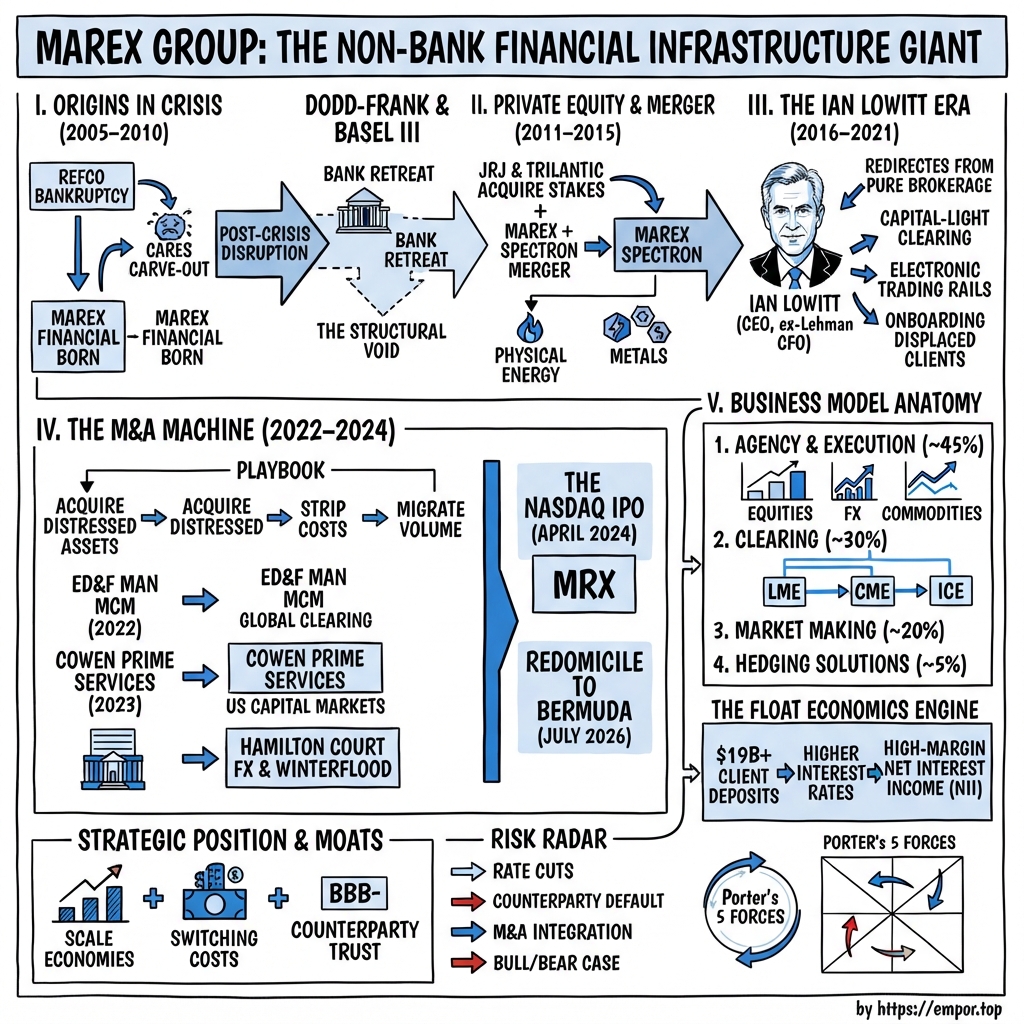
Marex Group Limited: Building the Non-Bank Financial Infrastructure Giant
I. Introduction & Episode Roadmap
On the morning of August 12, 2026, a company barely known outside commodities trading circles five years earlier reported its sixth consecutive record quarter as a public firm. Quarterly revenue reached $695.8 million, up 39% year over year, while adjusted profit before tax rose 56% to $165.9 million. That performance yielded an adjusted return on equity of 37.8%, well above the returns of most major global banks.1 Investors responded immediately, pushing the stock up more than 15% that day.2
The company was Marex Group Limited. Its chief executive, Ian Lowitt, was the last chief financial officer of Lehman Brothers.
Consider the underlying lineage. The executive who signed off on Lehman's final financial statements—having inherited the CFO role in June 2008 and held it for roughly ninety days before the largest bankruptcy in U.S. history—now leads a NASDAQ-listed firm holding more than $19 billion in client clearing accounts. Furthermore, Marex itself was built from the assets of Refco, the commodities brokerage that collapsed in 2005 following a major accounting fraud.
Two notable financial collapses of the modern era are thus linked within a single institution. That history suggests either a cautionary tale or one of the more striking second acts in modern finance. By mid-2026, financial performance points to the latter, though critical risks and caveats remain.
The core thesis, and why it deserves scrutiny
The bullish investment thesis for Marex is straightforward: following the 2008 financial crisis, regulatory frameworks like Dodd-Frank and Basel III raised capital requirements, making it expensive for major banks to deploy balance sheet capacity for small and mid-sized clients. Clearing a $400 million commodity hedge fund, warehousing physical copper risk, or offering prime brokerage services to a $1 billion equity fund consumed regulatory capital that banks preferred to reserve for their largest corporate relationships. As global banks pulled back, non-bank intermediaries like Marex stepped in to fill the gap.
That narrative is directionally accurate, but it is shared by virtually every non-bank intermediary in the market. It does not by itself explain why Marex, unlike its competitors, expanded profits for twelve consecutive years, growing adjusted profit before tax from roughly $230 million in 2023 to $418.1 million in 2025.3 Nor does it account for how a business that aborted a London initial public offering in 2021 at a sought valuation of roughly £500 million4 reached a market capitalization above $5 billion by August 2026.5
Several structural factors drove this shift. Higher interest rates transformed idle client collateral balances into a high-margin profit center. A targeted, repeatable acquisition strategy expanded the firm's reach. Management, led by a former investment bank CFO, restructured the brokerage to operate as a capital-allocated balance sheet business rather than a traditional commission broker. Finally, persistent volatility across global commodity markets created an exceptionally favorable operating environment for market intermediaries.
The map
This analysis examines how these elements converged: beginning with the collapse of Refco and the distressed carve-out that established Marex Financial; moving through the private equity ownership phase and the 2011 merger with Spectron that expanded its energy broking footprint; tracing Lowitt's appointment and the transition from a traditional voice broker into a clearing infrastructure provider; detailing the acquisition strategy that absorbed ED&F Man Capital Markets, Cowen's prime brokerage business, Hamilton Court, and Winterflood; and examining its NASDAQ listing and redomiciliation to Bermuda.
Critical questions remain behind the record quarterly figures. How much of Marex's earnings growth reflects durable structural advantages versus temporary tailwinds from commodity volatility and elevated interest rates? How robust was the company's defense against short-seller allegations of accounting irregularities in August 2025? How vulnerable are earnings to future rate cuts? And what are the risk-management implications of a $34 million loss incurred in January 2026 when a natural gas client defaulted on a margin call?6
Understanding the current business requires returning to its origin: a high-profile financial collapse.
 Subscribe on LinkedIn
II. Origins in Crisis: Refco's Downfall and the Birth of Marex (2005–2010)
On October 10, 2005, Refco Inc. disclosed that its chairman and chief executive, Phillip Bennett, had concealed roughly $430 million of bad debt from auditors and investors.7 Refco had gone public just two months earlier. At the time, it was one of the world's largest independent futures brokerages, serving agricultural hedgers in the U.S. Midwest and energy traders in Geneva.
Nine days later, the company filed for Chapter 11 bankruptcy.7 Its stock collapsed roughly 98%, ending up on the pink sheets at 65 cents after the New York Stock Exchange delisted the shares.7 Bennett had used loans funded by Refco itself to purchase bad receivables off its balance sheet, routing the transactions through an offshore entity he controlled to conceal the true borrower. The fraud unwound the firm in less than two weeks.
The 4:30 a.m. walk-out
The aftermath revealed the stark realities of restructuring a regulated broker-dealer.
When Refco's assets went to auction on November 10, 2005, Marathon Asset Management, a New York credit firm, bid for the crown jewel: the regulated U.S. futures commission merchant. At 4:30 a.m., Marathon dropped out.8 The U.S. business was sold to a consortium led by J.C. Flowers & Co. for $768 million.7
Immediately after bowing out of the U.S. auction, Marathon struck a deal for Refco's European operations, acquiring approximately 300 employees, 2,000 customer accounts, an electronic futures trading division, and exchange-trading software.8 The transaction structure highlighted the capital intensity of regulated brokerages: Marathon assumed about $17 million in liabilities, but had to inject roughly £100 million—about $196 million at the time—in regulatory capital to satisfy solvency requirements.8
That capital injection underscores a fundamental reality of the industry. Unlike traditional operating companies, a broker-dealer's primary asset is its regulatory license to clear and intermediate risk, which regulators require to be backed by equity capital. This dynamic shapes the competitive landscape for non-bank intermediaries: entry barriers are high, distressed sellers face severe balance sheet constraints, and capitalized buyers with existing licenses can extract significant economic value.
By late January 2006, Marathon had assumed operational control and rebranded the entity as Marex Financial, placing former Refco managing director Mark Slade at the helm as chief executive.8 Key clearing memberships and client accounts remained intact under the new banner while the legacy liabilities were left behind.
Then the world broke again
Marex Financial operated as a modestly profitable European commodities broker for its first two years. Then the 2008 financial crisis triggered a dramatic rewrite of global financial regulations.
The introduction of Dodd-Frank in the United States and Basel III internationally fundamentally altered bank economics by increasing capital requirements. Risk-weighted asset rules mandated that banks back every loan, derivative, and client margin account with higher buffers of equity capital, while leverage ratio rules restricted overall balance sheet expansion regardless of asset risk.
For major banks, low-margin, capital-intensive activities like futures clearing became far less attractive relative to higher-return businesses such as bond underwriting or M&A advisory. Consequently, global banks began scaling back, pruning smaller accounts, exiting physical commodity warehousing, and raising minimum revenue thresholds for prime brokerage clients.
The void, described plainly
This pullback created a broad group of displaced market participants: Midwestern grain cooperatives hedging crops, physical commodity merchants financing metal inventory, mid-tier energy utilities, and mid-sized commodity funds. While financially sound, these clients no longer generated sufficient returns to justify space on major bank balance sheets, yet still required clearing and execution services.
This retreat opened a substantial market vacancy. Competitors like StoneX, ADM Investor Services, and R.J. O'Brien sought the same opportunities. Marex, however, would eventually treat serving these middle-market clients not merely as a high-margin niche, but as an infrastructure business requiring scale. Building that scale would take another decade, new equity partners, a key merger, and leadership focused on active capital allocation.
The first of those structural shifts arrived in 2011.
III. The Marex Spectron Merger & Private Equity Stewardship (2011–2015)
In 2010, a private equity consortium acquired control of Marex from Marathon Asset Management. The lead investor was JRJ Group, founded by former Lehman Brothers executives Jeremy Isaacs and Roger Nagioff, alongside Trilantic Capital Partners and BXR Group.9
The acquisition carried a striking irony: a brokerage forged from the assets of one collapsed institution was bought by veterans of another, and would later be led by Lehman's final CFO. Yet the strategic logic was pragmatic. Executives who had navigated the sudden collapse of a major intermediary understood firsthand that liquidity buffers and counterparty confidence are not theoretical abstractions—they are the foundation of the business.
Buying the energy franchise
On March 22, 2011, Marex agreed to acquire Spectron Group from Norwegian exchange operator Imarex ASA for approximately $154.1 million.9 Nagioff, then chief executive of Marex, described the combination as "transformational for shareholders, clients and employees of both firms."9
The strategic rationale was straightforward. At the time, Marex operated primarily as an execution and clearing broker in metals, agriculture, financial futures, and foreign exchange—an exchange-facing business serving producers, banks, hedge funds, and professional traders.9 Spectron, by contrast, was a wholesale broker of over-the-counter energy and commodity products, covering natural gas, power, environmental credits, freight, crude oil, coal, weather derivatives, and metals across desks in London, continental Europe, Asia, and the United States.9
The acquisition produced a hybrid model rare among independent firms: an intermediary capable of servicing clients across exchange-traded and OTC markets, spanning metals and energy, through both voice brokers and electronic platforms. Trilantic later noted that the combined entity, rebranded as Marex Spectron, became one of the largest independent commodity brokers in the world.10
The broader commercial logic laid the groundwork for Marex's long-term expansion. Commodity market participants rarely require a single transaction; an oil refiner, for example, must hedge crude inputs, refined output, freight rates, power consumption, environmental credits, and currency risk on receivables. Broadening the product catalog allowed the firm to generate incremental revenue per client without a proportionate increase in customer acquisition costs. Marex spent the subsequent decade expanding this multi-product coverage model, a strategy management continued to emphasize years later: on the second-quarter 2026 earnings call, Lowitt attributed revenue growth among top accounts not to acquiring new clients, but to existing clients "expanding the breadth of their relationship."2
The lean years
Despite the expanded product footprint, operating conditions from 2012 through 2016 proved challenging.
Three macroeconomic and structural headwinds pressured earnings simultaneously. First, commodity market volatility muted following post-crisis spikes, dampening trading volumes and client activity. Second, near-zero central bank interest rates eliminated interest income on client cash collateral. While elevated rates convert collateral balances into high-margin revenue, zero-rate environments reduce client balances to an administrative and compliance cost center.
Third, traditional voice broking faced ongoing structural margin compression. Intermediating orders over the phone carries high fixed personnel expenses, minimal switching costs for clients, and no proprietary technology moat. Star brokers frequently changed firms, taking key accounts with them. Simultaneously, electronic trading venues compressed execution spreads on liquid benchmark contracts. Under these conditions, pure voice brokerages saw employees capture the bulk of trading economics while shareholders absorbed operating volatility.
The strategic conclusion
Faced with these pressures, Marex's owners and management concluded that traditional broking alone was unsustainable. Rather than competing harder for pure transactional volume, the firm shifted its strategic focus toward owning clearing and execution infrastructure.
In this market context, infrastructure refers to high-barrier positions in the clearing value chain: serving as the clearing member of record facing the exchange, holding client margin, managing position settlement, providing client-facing trading technology, and maintaining the necessary regulatory licenses and capital buffers. Unlike individual voice brokers, clearing infrastructure creates sticky institutional relationships, captures interest income on collateral balances, and generates operational leverage as transaction volumes scale across fixed overhead.
This strategic pivot altered the firm's economic model. While commission broking relies on transactional fees subject to price competition, clearing infrastructure generates recurring revenues from collateral balances and clearing fees tied to regulatory access. Marex's subsequent evolution was designed as a deliberate pivot from high-churn transactional broking toward capital-allocated clearing services.
Executing that strategy required leadership experienced in balance-sheet management, liquidity planning, and regulatory capital requirements. Ian Lowitt, who had joined Marex as chief financial officer in July 2012, was appointed chief executive in January 2016.11
IV. The Ian Lowitt Era: From Lehman CFO to Non-Bank Brokerage Kingpin (2016–2021)
Ian Lowitt brings an unusual background to institutional finance. He earned bachelor's and master's degrees in electrical engineering from the University of the Witwatersrand in Johannesburg before attending Oxford as a Rhodes Scholar, where he completed a master's in philosophy, politics, and economics alongside a master's in economics.11
Over fourteen years at Lehman Brothers, Lowitt held several senior operational and balance-sheet roles, serving as global treasurer, global head of tax, co-chief administrative officer, and chairman of the firm's Delaware savings bank.11 As treasurer, he observed firsthand the mechanics of institutional failure: while asset losses accumulate over time, liquidity panics manifest rapidly.
On June 12, 2008, Lowitt was named Lehman's chief financial officer, succeeding Erin Callan.11 Roughly ninety days later, the firm filed for Chapter 11 bankruptcy. Following the collapse, he oversaw the integration of Lehman's North American assets into Barclays and subsequently served as chief operating officer of Barclays Wealth America.11
The uncomfortable question, and the honest answer
Lowitt's tenure at Lehman raises an obvious question for market participants: does leading the finance department of a failing investment bank prepare an executive to manage a leveraged non-bank intermediary, or does it serve as a red flag?
The argument for Lowitt rests on risk discipline forged in crisis. An executive who managed a multi-billion-dollar balance sheet through a liquidity run understands that maintaining ample cash reserves is essential to surviving market shocks. Under Lowitt, Marex has consistently maintained elevated liquidity buffers, accepting the associated capital drag despite scrutiny from equity analysts focused on net interest income.
This approach was evident during the company's 2026 earnings presentations. On both the first- and second-quarter calls, chief financial officer Rob Irvin explained that the group deliberately holds liquidity well above regulatory minimums. While paying to maintain undeployed borrowing capacity depresses net interest income, Irvin characterized the cost as a necessary insurance policy.2 By the end of June 2026, Marex reported $8.1 billion in total funding sources and $1.8 billion in excess liquidity headroom.1
Lowitt's experience also shaped Marex's risk disclosure practices. The firm regularly reports detailed risk metrics, including average daily value-at-risk (VaR), the percentage of profitable trading days, and quarterly realized credit losses. In the first half of 2026, Marex recorded an average daily VaR of $5.8 million against total revenues of approximately $1.4 billion, with profitable trading days reaching 87%.1 These disclosures reflect an operational focus on managing tail risk and downside exposure.
Turning a broker into a platform
Upon becoming chief executive in 2016, Lowitt implemented a three-pillar strategy aimed at shifting the business from voice broking to financial infrastructure:
Moving up the value chain. Management redirected resources away from commoditized transaction broking toward clearing, market making, and structured solutions—services where Marex maintains direct control over client relationships and balance-sheet risk. By 2025, financial results reflected this strategic pivot: the Clearing division generated $528.2 million in revenue at an adjusted margin of 49.5%, while the Agency and Execution division produced $1.05 billion in revenue at a 26.8% margin.3 High-margin clearing revenues provided the firm with predictable, infrastructure-like cash flows.
Building proprietary technology rails. Marex allocated significant capital to upgrade electronic execution venues, clearing software, and real-time risk architecture. Futures clearing functions essentially as a high-volume data processing operation. Managing risk across thousands of contracts spanning global exchanges requires real-time portfolio revaluation, automated margin calculations, and instantaneous netting of offsetting exposures. By automating these workflows, Marex reduced the marginal cost of onboarding institutional clients, allowing the firm to profitably service middle-market accounts that tier-one banks rejected due to high operational overhead.
The operational efficiency gained through technology was demonstrated within the Solutions division. During 2025, management replatformed the firm's entire structured-products operational stack. On the first-quarter 2026 earnings call, Lowitt acknowledged that the technology overhaul had been a distraction that absorbed substantial management bandwidth.6 However, the operational benefits materialized the following year: Solutions revenue more than doubled year over year in the first quarter of 2026 to $93.0 million, supported by straight-through processing capabilities that enabled automated product structuring and execution.6 While heightened market volatility contributed to the revenue increase during the period, the technology upgrade established scalable operating leverage.
Capturing market share during industry dislocations. Intermediary markets frequently consolidate following competitor distress. High-profile failures, such as the 2011 bankruptcy of MF Global, alongside ongoing retrenchment by major banks, routinely left institutional trading desks and client accounts seeking new clearing venues. Institutions equipped with regulatory licenses, surplus capital, and automated risk systems can absorb displaced market share efficiently, providing Marex with a recurring channel for organic customer growth.
The setback that mattered
Despite operational progress, the firm encountered a major strategic setback in mid-2021. In June 2021, Marex Spectron cancelled its planned initial public offering in London, citing "more challenging IPO market conditions."4
The withdrawal reflected broader public market skepticism. Institutional investors in London remained cautious toward mid-cap financial services firms, favoring larger capitalization stocks, while another European financial firm had withdrawn its listing just days earlier.4 More fundamentally, public equity markets continued to value Marex as a cyclical transaction broker rather than an essential clearing infrastructure provider, resulting in lower valuation multiples.
Altering that market perception required scaling the business and expanding its geographic footprint. Over the subsequent three years, management pursued an aggressive acquisition strategy to build institutional scale.
V. The M&A Machine: Roll-Ups, Distressed Bargains, and Scale (2022–2024)
Every serial acquirer says it is disciplined. The useful question is what specifically it refuses to pay for.
Marex's answer, articulated repeatedly by Lowitt, is that it does not pay for earnings. It pays a premium over the tangible book value of a regulated business and then judges itself on how fast that premium comes back. The distinction sounds like accounting pedantry. It is not.
Here is the mechanic. When you buy a broker-dealer, most of what sits on its balance sheet is cash, near-cash and highly liquid assets held against client positions. Acquire it and you acquire that equity — it does not evaporate. So the real economic cost is not the headline consideration; it is the excess over the net assets you receive. Lowitt spelled this out in August 2026: "much of the book equity we acquire in the transaction consists of cash or cash equivalents or very liquid assets. So while we're attentive to total consideration, our focus is on the recovery of premium."2
That framing is genuinely different from a conventional roll-up, and it has a testable consequence: it should produce very short payback periods. Marex has now given investors the data to check.
Case study one: ED&F Man Capital Markets
On August 1, 2022, Marex agreed to acquire ED&F Man Capital Markets, the financial brokerage arm of the agricultural commodities group ED&F Man.12 The target had roughly 450 employees globally and generated over $235 million of revenue in 2021 — against Marex's own revenue base at the time, a substantial bite.12 Marex did not disclose the consideration in its announcement.12
The strategic content was clearing scale and geography. ED&F Man Capital Markets brought futures and options, metals, fixed income, equities, energy and FX capability, plus a presence in Dubai and Asia-Pacific and, critically, a genuine US franchise.12 Marex had been a European firm with American ambitions. This made it a transatlantic one.
It also carried a lesson in deal structuring that would matter three years later. Marex bought the UK operations as an asset purchase rather than an entity purchase, deliberately leaving behind the legal shell — ED&F Man Capital Markets Limited — which was exposed to an FCA fine and litigation with European tax authorities.13 When a short seller later alleged Marex had failed to consolidate that entity, the answer was that Marex never owned it.13 Careful structuring at the point of acquisition is not glamorous. It is, on this evidence, extremely valuable.
Completion came in stages across the second half of 2022, with the UK business transferring in October and the US and Dubai entities in December.[^14] Staging a transfer of regulated entities across jurisdictions is standard practice, but it means these deals take quarters, not weeks — an underappreciated constraint on how fast even a willing acquirer can compound.
Case study two: Cowen's prime brokerage
The second deal is the one Lowitt has repeatedly called the most significant Marex has done, and it is the best single piece of evidence for the acquisition thesis.
In September 2023, Marex agreed to acquire the legacy prime brokerage and outsourced trading business of TD Cowen, completing on December 1.[^15] The deal brought approximately 160 people across eight offices, along with multi-asset custody, high- and low-touch execution, financing, securities lending and capital introduction — rebranded Marex Prime Services and Marex Outsourced Trading, and led by Jack Seibald and Michael Rosen.14[^15] The consideration was not disclosed.14
Prime brokerage, for the non-specialist, is the full-service back office a hedge fund rents rather than builds. The prime broker holds the fund's assets, lends it money and stock, settles its trades, and introduces it to investors. It is sticky — moving a prime relationship means re-papering counterparties and re-plumbing operations, typically a multi-month project — and it is balance-sheet intensive, which is exactly why the largest banks concentrate on the largest funds.
What happened next is the number that matters. On the second-quarter 2025 call, Lowitt disclosed the business had generated $85 million of revenue at Cowen and was running "well above $200 million" on the Marex platform on a first-half annualised basis.13 By the second quarter of 2026, Prime revenue alone reached a record $120 million in the quarter.2
Roughly tripling a business's revenue in under two years is not cost synergy. It is a genuine platform effect — and Lowitt's own explanation of the mechanism is worth weighing sceptically. Asked in August 2026 whether the growth came from constrained bank capacity or Marex's own capabilities, he declined to claim credit: "I'm not quite sure what the drivers are here, whether it's lack of capacity at some of the big banks or whether it's the very specific capabilities we bring."2 He was more specific about where Marex competes: not for the largest prime mandates, which "end up with the large banks," but with funds in the $500 million to $2 billion range.2
That is an unusually precise and unusually modest account of a competitive position — and it is falsifiable. If bank balance sheet capacity loosens and Marex's prime balances stall, the structural claim weakens.
Case study three: filling in the map
The subsequent deals were smaller and more surgical. Hamilton Court, a provider of FX services to mid-sized UK and European corporates, and Aarna Capital, an Abu Dhabi clearing and execution business, both closed in 2025, alongside the Brazilian agricultural brokerage Agrinvest.3
Winterflood is the most instructive. In July 2025 Marex agreed to buy the UK equity market maker from Close Brothers Group for approximately £103.9 million in cash — a figure representing a premium of about £15 million over net assets.15 Winterflood held roughly 15% of London Stock Exchange volume by volume and served over 400 institutional clients.15 Management projected the premium would be repaid within two to three years.15
Then Marex did something that reveals the method: it kept the market-making engine and sold the custody arm. Regulatory approval for the disposal came in the first half of 2026 and the sale generated a $35 million gain recognised in the second quarter.1 In effect, Marex acquired one of Britain's leading equity market-making franchises, sold a non-core piece, and materially reduced its net outlay. Buy the whole, keep the part you want, recycle the rest.
Management put hard numbers on the aggregate in August 2026: across Aarna, Hamilton Court and Winterflood, Marex paid a combined premium of around $60 million for businesses generating roughly $16 million of post-tax profit at acquisition; by the second quarter of 2026 those three were running at an annualised $60 million of post-tax profit — about 3.5 times pre-acquisition earnings, meaning annual profits now roughly equal the entire premium paid.2
Those are extraordinary figures. Two cautions are warranted. First, they are management-selected and management-calculated, not audited segment disclosures, and they cover the deals that worked. Second, the period involved exceptionally favourable trading conditions; a market maker acquired in a volatile year will look brilliant regardless of integration quality. The claim is credible but not yet stress-tested through a quiet market.
The listing
On April 24, 2024, Marex priced its initial public offering at $19.00 per share, and the shares began trading on the NASDAQ Global Select Market the following day under the ticker MRX.16 The deal totalled 15,384,615 shares, of which only 3,846,153 were new shares issued by the company and 11,538,462 were sold by existing shareholders, for gross proceeds of approximately $292.3 million.16
The structure tells the story. Three quarters of the offering was a sponsor exit. Marex raised roughly $73 million of new equity — meaningful but not transformative for a firm of its size. This was a liquidity event first and a capital raise second, and investors were right to read it that way at the time.
The more consequential fact is the sell-down that followed. By mid-April 2025, after a second follow-on, the pre-IPO private equity holders had cut their stake from 64% at listing to approximately 17%.13 Lowitt described increasing the public float as "an important strategic goal," and for once the corporate language understates the point: a shrinking overhang and a broadening shareholder base materially change how a stock trades.
The move to Bermuda
The final structural act came in 2026. Shareholders approved a redomiciliation on May 21, the English High Court sanctioned the scheme on June 26, and the change took effect at 08:41 London time on July 1.17 A Bermuda-incorporated Marex Group Limited became the parent; the former UK parent was renamed Marex UK Holdings Limited; shares exchanged one for one.17
Lowitt's stated rationale was to rationalise a corporate structure that "had become complex due to our significant growth in recent years, including through acquisitions," and to bring the group under US-style corporate law consistent with its NASDAQ listing.17 On the first-quarter call he was explicit about what the move was not: it was not motivated by tax — the group remains UK tax domiciled — and not expected to deliver capital efficiencies, with operational savings described as "relatively modest."6
That is a refreshingly deflationary description from a chief executive, and it should be taken at face value. But investors should note one substantive consequence management stated plainly: following the redomicile, the group is no longer subject to consolidated FCA capital and liquidity requirements.2 Irvin said the firm intends to manage internally to similarly conservative standards.2 Intention is not regulation. Self-imposed discipline works until a board decides otherwise, and this is now a genuine governance question that did not exist eighteen months ago.
Which brings us to the machine itself. What, exactly, does Marex do to make money?
VI. Business Model Anatomy: Segment Economics & The Float Engine
Strip away the segment labels and Marex does four things: it holds client funds and faces clearinghouses on their behalf; it executes trades; it provides market-making liquidity; and it structures customized risk management products. Everything else is secondary.
Agency and Execution: the growth engine
Agency and Execution has grown into Marex's largest division by revenue, generating $1,049.2 million in 2025—a 51% increase driven overwhelmingly by the securities business and prime services specifically.3 Profitability expanded even faster: adjusted profit before tax rose 160% to $280.9 million as operating margin widened to 26.8%.3 In the second quarter of 2026, the segment generated $351.0 million of revenue at a 33% margin.1
When segment profit grows three times faster than revenue, the underlying product mix is shifting. Pure agency execution—routing client orders to exchanges for a commission—is a thin-margin activity. Prime brokerage, where Marex holds assets, extends financing, and lends securities, carries far higher economics. What appears as a single segment is effectively a low-margin execution broker being transformed by a higher-margin financing platform.
The strategic vulnerability is the inverse of that growth. Prime brokerage revenue scales directly with client balances and financing spreads, both of which depend on market leverage. Lowitt acknowledged in August 2026 that prime balances "increased and then dropped a bit as a result of adjustments in pricing in some of the more volatile stocks."2 Prime services thrive during bull markets, but earnings contract quickly when institutional leverage unwinds.
Clearing: the foundation
Clearing generated $528.2 million of revenue in 2025 at an adjusted operating margin of 49.5%, making it the firm's most profitable division by margin.3
The underlying market mechanics explain these high margins. When institutional clients trade futures, they do not face the exchange directly; they trade through a clearing member, which faces the exchange's central counterparty. The clearing broker posts collateral to the exchange and collects margin from the client, standing behind the transaction if the client defaults.
Marex monetizes that relationship in two distinct ways: charging transaction fees per contract cleared, and earning interest on client cash collateral.
These two revenue streams operate under contrasting dynamics. Transaction fees depend directly on trading volume. Interest income, by contrast, equals the total volume of client collateral balances multiplied by prevailing interest rates.
The float engine, explained
This mechanism functions as Marex's float engine, anchoring the primary debate surrounding the firm's earnings power.
In practice, the business operates much like a non-lending bank. Clients deposit cash collateral, which Marex holds in cash equivalents and high-quality liquid assets. The spread between asset yields and client interest payouts generates net interest income. Because exchange memberships, risk management infrastructure, and compliance operations represent fixed overhead, incremental collateral balances cost very little to service, allowing net interest margin to flow almost entirely into pre-tax profit.
That collateral pool has expanded rapidly. Average clearing client balances stood at $13.0 billion across 2025,3 climbed to an average of $16.0 billion in the first quarter of 2026,6 and reached $19.1 billion in the second quarter—up from $14.0 billion in the fourth quarter of 2025.1
Management attributes this growth to three factors: rising commodity prices and market volatility that mechanically inflate exchange margin requirements; increased trading activity from existing accounts; and market share gains, which management quantified at approximately $1 billion in net new client balances through early August 2026.2
Only client acquisition represents a durable structural advantage. Lowitt offered a measured assessment during the second-quarter earnings call, noting that margin requirements depend "more [by] price than volatility," suggesting balances should hold if commodity prices stay elevated, while acknowledging that "unusual levels of trading activity from some of our clients in the first half" would likely normalize.2
The interest rate reality check
That dynamic introduces a key nuance that complicates a simplified bullish narrative.
Despite expanding collateral balances, group net interest income has steadily declined. Net interest income totaled $227.1 million in 2024,18 fell to $152.6 million in 2025,3 and dropped an additional 20% year over year in the first half of 2026 to $70.6 million.1
Three structural factors drove that reduction. First, central bank policy rates eased, with the average Federal funds rate falling approximately 100 basis points during 20253 and another 70 basis points year over year into 2026.6 Second, debt issuance expanded interest expense, which nets against interest income: Marex issued $500 million of senior notes in November 2024 and another $500 million in May 2025,13 followed by a $500 million senior note offering in April 2026 and a $500 million hybrid capital issue in the second quarter.1 Third, management's policy of holding substantial liquidity buffers creates an ongoing drag on net returns.
Consequently, framing Marex as a simple leveraged play on elevated interest rates overlooks how the business has performed. Falling interest rates have acted as a direct headwind to net interest income for two years. Profit growth during this period came instead from fee and trading expansion across Agency and Execution, Market Making, and Solutions—providing empirical backing for the firm's business diversification model.
The counterweight is equally significant: surging client balances offset lower interest rates, but those balances were boosted by elevated commodity prices and market volatility. If commodity prices normalize while interest rates continue to decline, both collateral volumes and net interest margins could contract simultaneously.
Market Making and Solutions
Market Making—providing liquidity across metals, energy, agriculture, foreign exchange, and equities—generated $235.5 million in revenue in 2025.3 Revenue then expanded rapidly in 2026, rising 164% year over year in the first quarter6 and 106% in the second quarter.1 That growth reflected both the consolidation of Winterflood and elevated market volatility.
During the second-quarter earnings call, Lowitt offered an operational observation on trading conditions, noting that extreme market volatility does not always benefit market makers. In chaotic markets, bid-ask spreads widen unpredictably and holding inventory carries heightened risk. Moderate to high volatility, such as that experienced in the second quarter, provided a more manageable trading environment.2
The Solutions division—which designs custom OTC hedges for commodity and currency exposures and structures debt notes for wealth channels—generated $196.8 million in 20253 and reached $71.0 million in the second quarter of 2026.1 While it remains the smallest division, its earnings rely heavily on favorable market volatility and steady equity valuations.
What the portfolio actually delivers
The performance of the overall portfolio was demonstrated in the second quarter of 2026. Trading volumes across Marex's primary exchanges dropped 17% quarter over quarter, market volatility moderated, and benchmark interest rates remained flat.2 Despite those headwinds, adjusted profit before tax grew 9% sequentially.2
While a single quarter does not establish a permanent trend, the period tested the firm's income stability. The group's daily profit-and-loss distribution illustrates this dynamic: over the twelve months ending June 2026, Marex logged 58 trading days with daily profits exceeding $3 million—representing roughly a quarter of all sessions—compared to 11 loss-making days.2 Daily revenue distribution shifted heavily toward high-profit sessions while downside trading days remained infrequent.
Maintaining limited downside trading days in a business intermediating leveraged commodity exposure reflects either disciplined risk controls or an un-stress-tested risk model. A January 2026 client default provided direct evidence on that balance, representing a risk event examined later in this analysis.
VII. Playbook: Business & Investing Lessons
Four transferable lessons emerge from the Marex story—each useful well beyond a single intermediary, and each carrying a limit worth defining.
Lesson one: intermediaries get paid for other people's anxiety
Most businesses dread market uncertainty; intermediaries thrive on it. When commodity prices spike, three forces work in tandem to benefit a clearing broker: trading volumes increase as participants adjust positions, exchange margin requirements rise to expand the interest-bearing collateral pool, and bid-ask spreads widen to boost market-making revenue.
The first quarter of 2026 provided a clear illustration. Natural gas experienced multiple two- to three-standard-deviation daily price swings in late January—which management described as a one-in-35-year occurrence—while crude oil rose roughly 70% through March to well above $100 a barrel.6 During the period, Marex's market-making revenue jumped 164% year over year, while metals revenue more than doubled.6
The limitation is that this dynamic does not represent true antifragility; rather, it reflects positive exposure to market volatility accompanied by severe operational tail risk. The same volatile conditions that generate record revenue also elevate counterparty default risk, as demonstrated by the January 2026 client default. Put simply, a clearing intermediary holds a series of short positions on client solvency alongside a long position on overall trading activity. While trading volume usually outweighs credit default, the risk remains real.
Lesson two: regulation creates markets by destroying them
Post-2008 capital regulations did not eliminate global demand for clearing, hedging, and financing; they relocated the supply. Activities that became marginal inside major banks—burdened by strict capital charges, equity costs, and compliance overhead—became attractive core businesses for independent specialists operating with lower cost structures and unconstrained capital allocation.
This dynamic reflects a recurring pattern in modern finance: when regulatory mandates render an activity unprofitable for traditional incumbents, the business migrates rather than disappears. Similar shifts occurred in mortgage origination, leveraged lending, and middle-market corporate credit.
The limitation is that migrated market share brings its underlying risk with it. Non-bank intermediaries now carry counterparty exposures once held by global banks, but with thinner capital cushions and without central bank liquidity facilities. Furthermore, this regulatory arbitrage narrows if policymakers extend bank-like capital requirements to non-bank entities or if bank balance sheet capacity expands again.
Lesson three: buy the plumbing, not the people
Brokerage acquisitions carry a historically poor record because human capital can easily depart. Purchasing a star trading desk often means paying a premium for relationships that can walk out the door.
Marex's acquisition strategy deliberately targets infrastructure instead. The firm acquires corporate carve-outs and orphaned subsidiaries whose core value resides in exchange licenses, client contracts, technology infrastructure, and regulatory capital, then integrates them onto a larger operating platform. Lowitt detailed this approach regarding Hamilton Court, noting that management took "a good business, but one that's struggling because it's just not that big," and applied Marex's risk frameworks, hedging capabilities, and market access so the acquired team could focus on client execution rather than infrastructure management.2
This model aims to enhance the productivity of acquired teams by eliminating operational bottlenecks. This logic differs fundamentally from traditional headcount cost-cutting, explaining why post-acquisition revenues at Cowen Prime Services and Hamilton Court expanded rather than contracted.
The limitation is that platform leverage relies on maintaining a superior operating infrastructure. As an organization grows, the incremental efficiency gain from adding another business naturally diminishes. Moreover, Marex's average headcount expanded 31% year over year to 3,364 by the second quarter of 2026—a pace of organizational growth that tests management oversight.1
Lesson four: float is a business model, not a balance sheet item
Insurance companies have long recognized that managing capital between collection and payout represents a core revenue driver. Clearing brokers operate on a similar float model, though near-zero interest rates rendered client balances largely unprofitable for much of the post-2008 decade.
The key takeaway from Marex's expansion is not simply that elevated interest rates enhance float value, but that float scale serves as an effective hedge against declining interest rates only if client balances grow faster than benchmark rates fall. Marex demonstrated this dynamic between the fourth quarter of 2025 and the second quarter of 2026, increasing client balances by roughly 50% during a period of flat-to-declining interest rates, even as overall group net interest income contracted.1
Ultimately, float represents a powerful engine that requires organic client acquisition to remain effective, rather than passive reliance on favorable rate cycles.
While these four principles explain how the business model operates, whether Marex can sustain its position against emerging cyclical and competitive risks remains an open question.
VIII. Strategic Position & Competitive Moats
Consider a thought experiment in competitive strategy: building a rival to Marex from scratch with unlimited capital.
Poaching individual brokers provides limited traction, as client revenue increasingly attaches to the clearing platform rather than the trader. Undercutting on price is equally difficult because clearing commissions are thin and net interest income relies on scale unavailable to a startup. A new entrant would need to secure clearing memberships across major venues like the LME, CME, ICE, and Eurex; obtain regulatory authorizations from the FCA, CFTC, SEC, and international counterparts; allocate hundreds of millions of dollars in regulatory capital; construct real-time cross-exchange risk engines; secure investment-grade credit ratings; and convince institutional risk committees at hedge funds and commodity houses to trade with an unproven counterparty.
Establishing those capabilities represents a five-to-ten-year effort with uncertain returns. These high entry barriers protect incumbents, but being difficult to displace does not guarantee long-term market dominance. An examination of Marex’s strategic position reveals varyingly defensible competitive advantages.
Seven Powers, assessed honestly
Scale economies — strong and expanding. The fixed costs of operating a clearing broker are substantial and largely invariant to trading volume, encompassing exchange memberships, compliance infrastructure, real-time risk technology, regulatory reporting, and credit facilities. Spreading these fixed overheads across a client balance base approaching $20 billion and an annualized revenue run rate near $2.8 billion generates significant operating leverage. This efficiency is reflected in the firm's margin trajectory: adjusted profit before tax margin expanded from 20.0% in 2024 to 20.7% in 2025, reaching 23.8% in the second quarter of 2026.1831 Chief executive Ian Lowitt offered conservative guidance on this performance, stating that he expects future margin expansion to be "slow and steady rather than something that's dramatic."2
Switching costs — moderate to high. Transferring an institutional clearing relationship requires renegotiating legal agreements, establishing margin facilities, migrating position data, and re-testing operational connectivity—a process that typically spans several months. Prime brokerage relationships carry even higher switching friction. Retention during periods of stress underscores this dynamic: following short-seller allegations against the firm in August 2025, U.S. client balances remained essentially flat, while Lowitt reported that two of the world's largest hedge funds extended their clearing mandates during the week of the report.13 However, sophisticated institutional clients routinely maintain multi-broker clearing arrangements, meaning high switching costs protect existing client tenure without guaranteeing exclusive wallet share.
Counterparty trust and credit ratings — the central but fragile moat. Marex Group holds BBB- credit ratings from both S&P Global Ratings and Fitch Ratings, with Fitch maintaining a positive outlook, while its operating subsidiaries Marex Financial and Marex Capital Markets Inc. carry BBB ratings from S&P.19 Although BBB- represents the lowest rung of investment-grade status, the designation is critical for institutional counterparty risk committees, serving as a binary requirement for onboarding.
This investment-grade status creates a virtuous cycle: higher credit standing reduces funding costs, enabling competitive pricing that attracts institutional clients, which in turn expands balance scale and supports credit metrics. Reflecting this advantage, Marex's second-quarter 2026 debt issuances priced at materially tighter spreads than previous offerings and were significantly oversubscribed.1 Conversely, a credit downgrade below investment grade would force institutional clients to review or terminate clearing mandates, making counterparty solvency perception a vital yet vulnerable asset.
Branding, network effects, and proprietary resources — weak to absent. Beyond its institutional reputation, Marex possesses minimal traditional brand equity. The business exhibits no network effects, as client utility does not increase with additional platform participants. Furthermore, the firm controls no proprietary technical or natural resources. While counter-positioning exists—given that major banks face stringent regulatory capital rules that limit competition in mid-tier clearing—this dynamic depends on regulatory frameworks that could evolve. While integration capability suggests emerging process efficiency, recent operational success remains relatively brief.
Overall, Marex relies on two strong competitive advantages in scale and credit access, supported by moderate switching costs, rather than an unassailable strategic monopoly.
The five forces
New entrants — low threat. High regulatory capital requirements, multi-jurisdictional licensing, and the necessity of establishing institutional counterparty trust create substantial barriers to entry.
Buyer power — moderate and increasing. Marex services sophisticated institutional clients with significant market power. Company disclosures indicate growing client concentration: 77 accounts generated more than $5 million in annual run-rate revenue in 2026, up from 49 in 2025 and 36 in 2024, representing a 59% revenue increase from this tier.2 While management highlights this trend as evidence of expanding account relationships, it also underscores an increasing reliance on a concentrated group of high-volume counterparties.
Supplier power — low, with key structural exceptions. While transaction and exchange fees are generally passed through to clients, derivative exchanges exert structural leverage by setting initial margin methodologies. Because clearing members must comply with exchange margin rules, Marex acts as a price-taker on the regulatory margin requirements that directly dictate its interest-bearing collateral pool.
Substitutes — low. Exchange-traded derivatives mandate clearing through registered clearing members, while bilateral over-the-counter transactions require substantial counterparty capital. On-chain settlement and market tokenization represent potential long-term alternatives, though Marex has actively engaged with these technologies by enabling USDC stablecoins as initial margin under a CFTC pilot program, executing on-chain repo transactions using tokenized Treasuries via the Canton network, and developing clearing support for prediction markets.2 Addressing digital asset adoption, Lowitt stated that Marex does not hold a dogmatic view on market infrastructure tokenization, but aims to "make good money for those people who clearly do believe that this is what their business is."2
Rivalry — moderate, driven by industry consolidation. StoneX Group serves as Marex's closest direct peer—a NASDAQ-listed, non-bank multi-asset intermediary with a market capitalization of approximately $8.0 billion in mid-August 2026, compared to Marex's valuation of roughly $5.1 billion.5 Meanwhile, Interactive Brokers, valued at approximately $159 billion, operates an automated, retail-and-professional electronic brokerage model that illustrates the valuation multiples achievable at scale.5 Other market participants include interdealer brokers such as BGC Group and TP ICAP, alongside major futures commission merchants like ADM Investor Services and R.J. O'Brien.
Competitive dynamics in non-bank intermediation center on sector consolidation rather than aggressive price competition. As regulatory overhead favors larger operators, Marex has positioned itself as an active consolidator, with Lowitt stating at the firm's 2026 investor day that Marex is "increasingly the acquirer of choice."2
Marex's competitive moat remains effective but conditional—dependent on maintaining investment-grade credit ratings, executing complex acquisition integrations, and operating within volatile market conditions.
IX. Skeptical Stress Test, Risk Radar, & Bull vs. Bear Case
On August 5, 2025, short seller NINGI Research published a report describing Marex as "a financial house of cards."20 The report alleged a multiyear accounting scheme involving off-balance-sheet entities, fictitious intercompany transactions, and misleading disclosures designed to conceal losses and inflate profits.20 Marex shares dropped sharply following the publication, and plaintiff law firms soon announced class-action investigations.
The short report, point by point
Eight days later, Chief Executive Officer Ian Lowitt opened the company's second-quarter earnings call with a direct rebuttal rather than standard operating commentary.
Characterizing short seller reports as "part of the ecosystem which ensures markets function well," Lowitt acknowledged that the allegations, "if true, were serious," while stating that Marex could "rebut all of the allegations."13 He then addressed each claim individually.
Addressing the allegation regarding off-balance-sheet entities, Lowitt maintained that all activities were consolidated and that the two Luxembourg entities named in the report were fully included in financial statements.13 He clarified that one entity, VPF, was acquired in 2020 alongside listed derivatives market maker BIP rather than created internally, and noted that both entities carried a combined net asset value of about $2 million, a daily value-at-risk of around $100,000, and a peak net asset value over three years of $8 million.13 He added that the apparent scale resulted from Luxembourg reporting conventions that grossed up derivative long and short positions that IFRS rules net out.13
Regarding the unconsolidated ED&F entity, Lowitt stated that Marex never acquired the legal shell, having structured the UK transaction as an asset acquisition specifically to isolate the firm from legacy regulatory fines and tax litigation.13
Addressing the discrepancy between rising market-making revenue and declining volume metrics, management explained that the disclosed volume figure tracked only exchange-traded activity, omitting corporate bond market making and stock lending, and noted that Marex had retired the metric in early 2025 after determining it no longer accurately reflected the expanded business.13
On cash flow classification, management noted that including proceeds from structured notes and debt issuances within operating cash flow is permitted under IFRS and disclosed in line items and footnotes, allowing analysts to adjust the figures if desired.13
Lowitt also emphasized that audit firm Deloitte had issued unqualified opinions for ten consecutive years, and that Marex's audit committee—which includes a former chief financial officer of the CME who serves on the FASB's Financial Accounting Standards Advisory Council—had evaluated each claim point by point.13
How to weigh it
The speed and specificity of the company's response stood out compared to typical corporate responses under short attack.
However, assessing the report requires separating factual disputes from accounting interpretations. Classifying debt and structured note proceeds within operating cash flow is permitted under IFRS and common among financial institutions, and Marex discloses the practice clearly. Yet this accounting choice means headline operating cash flow does not serve as a clean proxy for core cash generation, requiring analysts to adjust the metric when evaluating underlying performance.
Second, retiring the volume metric in early 2025—months before the short report cited volume trends as evidence—presents an optical challenge. While management's explanation that the metric tracked a diminishing portion of total activity is commercially logical, eliminating a key disclosure shortly before it became contentious naturally invited scrutiny.
Market reaction following the episode favored the firm. Between the publication of the short report and mid-August 2026, Marex shares more than doubled, trading near $71 compared to a 52-week low of $27.91.5 Client balances remained stable, and S&P Global Ratings affirmed the firm's credit rating.19 While share price performance does not adjudicate accounting practices, the stability of client deposits and credit ratings indicates that counterparties and rating agencies accepted management's disclosures.
The January default: a real loss, honestly disclosed
A more direct test of the firm's risk management occurred during an operational stress event in early 2026.
In January 2026, severe volatility in natural gas markets caused a Marex clearing client to default, resulting in a $28.2 million trading loss and a $5.7 million credit provision in the Clearing segment.6 Management outlined the incident during its March investor day and detailed the financial impact in first-quarter results, explaining that the loss was partially absorbed by a roughly 20% reduction in variable compensation across Clearing and support functions.6
The incident highlighted three structural characteristics of the business model. First, extreme market volatility creates a dual effect: while it inflates trading and clearing revenues, it simultaneously heightens counterparty default risk. Second, the group's cost structure incorporates a significant buffer, as performance-linked compensation accounts for roughly 55% of total operating expenses, allowing variable cost reductions to cushion earnings hits.6 Third, despite absorbing the default loss, the Clearing division expanded adjusted profit before tax by 2% year over year during that quarter.6
Addressing analyst questions in August 2026 regarding softer trailing margins in Clearing, Lowitt attributed the compression entirely to the first-quarter client default, asserting that underlying divisional margins consistently run between 49% and 50%.2 The segment subsequently reported a 49% margin in the second quarter of 2026, aligning with that guidance.1
On the same earnings call, management disclosed that a small number of additional clients experienced liquidity pressures during the market surge but avoided insolvency and resolved their positions.6
The risk radar
Rate sensitivity — real but complex. Lower central bank interest rates have reduced net interest income over the past two years, even as overall profits expanded. The primary risk to earnings is not rate cuts in isolation, but a scenario where falling interest rates coincide with declining commodity prices. Because margin requirements—and total client collateral balances—depend heavily on prevailing commodity price levels, a simultaneous decline in rates and prices would compress collateral volume and interest spreads concurrently.2 Marex has not yet encountered this double contraction during its time as a public company.
Counterparty default — systemic tail risk. The March 2022 nickel crisis on the London Metal Exchange serves as an industry benchmark for counterparty risk. Intraday nickel prices spiked above $100,000 per tonne on March 8, 2022, prompting the exchange to suspend trading and retroactively cancel approximately $3.9 billion in trades, largely because Tsingshan Holding Group held short positions of 100,000 to 200,000 tonnes, with roughly 80% structured through off-exchange bilateral derivatives invisible to the exchange.21 One broker was reported to have failed to meet hundreds of millions of dollars in margin calls the day before the suspension.21 Marex's realized credit losses have remained historically low, totaling $0.7 million in the first half of 2025—roughly 0.1% of revenue—with zero credit losses in several recent quarters.131 While this reflects strong risk controls, historically low losses provide limited assurance against unprecedented systemic events.
Integration and organizational strain. Marex has executed a rapid series of acquisitions, absorbing ED&F Man Capital Markets, Cowen's prime brokerage, Aarna Capital, Hamilton Court, Agrinvest, Winterflood, Levmet, and Webb Traders within four years, while the acquisition of Bright Point International remains pending. Webb Traders, an options market maker announced in February 2026, was scheduled to close in mid-2026.22 Levmet, a metals and energy liquidity provider, was announced in June 2026.23 The pending acquisition of Bright Point—a Singapore-headquartered clearer operating across Asia and Europe—is projected to add roughly $800 million in client balances and over 70 staff upon closing in late 2026 or early 2027.24
Lowitt framed Bright Point's Asian footprint as access that would be difficult to build organically, though the expansion increases exposure to distinct regulatory frameworks.2 Concurrently, Winterflood had yet to achieve management's targeted 20% operating margin, with leadership acknowledging in May 2026 that performance remained below that threshold.6
Governance and structural complexity. Rapid dealmaking presents accounting and oversight challenges. Consolidation across multiple acquisitions creates reporting complexity, a point Lowitt acknowledged during discussions of short-seller claims.13 Furthermore, redomiciling to Bermuda removed consolidated capital supervision by the UK Financial Conduct Authority, replacing external regulatory oversight with internal risk guidelines. The firm also issued $2.0 billion in debt and hybrid capital over a two-year span while maintaining a risk-adjusted capital ratio near 12%—a modest buffer above S&P's 10% threshold for strong capitalization.1 Meanwhile, shareholder approval for a stock buyback in May 2026 was framed by management as optionality rather than an active capital return plan, with priorities remaining focused on investment-grade ratings, dividends, and acquisitions.6
Sponsor overhang — largely resolved. The reduction of pre-IPO private equity ownership from 64% to approximately 17% within twelve months eliminated a primary technical headwind on the stock price.13
Bull case
The positive investment thesis centers on four main elements:
First, expanding client relationships. Average revenue per client grew 34% over two years, while the number of accounts generating more than $5 million in annual revenue more than doubled, indicating that institutional counterparties are consolidating trading activity onto the platform.2
Second, disciplined acquisition execution. Historical transactions demonstrate rapid payback periods on net assets acquired, with management noting that pending deals like Bright Point were negotiated at low single-digit multiples of premium paid over book value.2
Third, revenue diversification. The second quarter of 2026 demonstrated profit resilience, generating sequential growth despite lower exchange trading volumes.
Fourth, optionality in market infrastructure. Marex has developed early capabilities in cross-margining U.S. Treasury futures against cash Treasuries—which management noted was active with three clients and had more than ten in the pipeline—alongside digital asset prime brokerage and prediction market clearing.2 Lowitt noted that cross-margining is unlikely to drive near-term revenue materially, serving instead as a demonstration of technical capability.2
In total, management expressed confidence in targeting the upper end of a 10% to 20% annual growth range, supported by a track record of year-over-year adjusted profit expansion in 19 of 20 quarters and average quarterly profit growth of 48% since the initial public offering.2
Bear case
The cautious perspective interprets these conditions through a different lens:
First, operating conditions have been exceptionally favorable. Global geopolitical conflicts, energy dislocations, and supply chain volatility created ideal trading conditions for intermediaries. Because Marex benefits directly from market turbulence, recent earnings reflect an unusually supportive environment rather than a baseline norm.
Second, rapid organizational expansion carries integration risks. Increasing headcount by nearly one-third in a single year while consolidating acquired regulated broker-dealers across multiple jurisdictions places heavy demands on compliance and operational controls.
Third, cyclical exposure to rates and commodity prices. A simultaneous decline in central bank benchmark rates and commodity price levels would reduce both client collateral balances and net interest margins.
Fourth, asymmetric tail risk in clearing. Credit losses in derivative clearing are rare but concentrated, and the client default in January 2026 demonstrated that extreme price swings can breach client margin buffers.
Finally, valuation expectations. With shares trading near the top of their 52-week range in August 2026 after doubling over the prior year, current pricing reflects elevated earnings expectations that leave limited margin for error if market volatility normalizes.5
Ultimately, the core question for investors is how much of the firm's recent growth rate persists under lower market volatility. Management's long-term target of 10% to 20% annual growth suggests a more moderate trajectory than recent quarterly prints, reflecting the distinction between cyclical tailwinds and durable structural expansion.
X. Epilogue & Core KPIs to Watch
Twenty-one years after Refco's implosion, the business built from its European assets has become a Nasdaq-listed group with a market capitalization above $5 billion,5 roughly $2.8 billion of annualized revenue, and more than 3,300 employees.1 It clears trades on major global derivatives exchanges, makes markets in metals, energy, agriculture, foreign exchange, and equities, operates a prime brokerage for mid-sized hedge funds, and structures financial products distributed across four continents.
That evolution is measured less by top-line growth than by structural repositioning. In 2021, public markets valued it as a commodities broker and declined to pay.4 By mid-2026, the company converted nearly half of its clearing revenue into profit, held $19 billion in client collateral, and commanded valuation multiples closer to financial infrastructure. Whether that revaluation proves durable remains the central open question—one that will be settled by the next quiet market environment rather than a volatile one.
To date, management execution has largely aligned with its strategic guidance. Management committed to revenue diversification to insulate earnings from exchange volume fluctuations, a claim supported when sequential profit expanded during the quieter second quarter of 2026. The firm projected rapid premium recovery on acquisitions, which materialized across its 2025 cohort. It targeted gradual margin expansion driven by product mix rather than sudden spikes, and it disclosed a significant early-2026 client default promptly. This track record has established narrative consistency with public markets.
Significant operational risks counterweight that execution. Recent financial performance benefited from an exceptionally favorable backdrop of market volatility and elevated interest rates. Concurrently, the redomiciliation to Bermuda removed consolidated capital supervision by the U.K. Financial Conduct Authority, while rapid balance-sheet expansion and aggressive acquisitions leave the organization absorbing unprecedented operational change.
Three KPIs that matter
Average clearing client balances. This metric serves as a key barometer for Marex's core clearing business, reflecting client acquisition, wallet-share expansion, and total market margin demand while directly driving net interest income. Evaluating this metric requires distinguishing between cyclical tailwinds and structural expansion: collateral gains driven by elevated commodity prices and exchange margin hikes reflect temporary market conditions, whereas gains from newly onboarded accounts represent durable growth. Management now discloses net new balances from new clients separately.2 Investors should track that sub-line rather than rely solely on headline balance growth.
Net interest income relative to total revenue. This ratio provides a direct test of whether profit growth stems from durable structural advantages or cyclical tailwinds from interest rates and collateral expansion. The critical test for the business model will occur during a period when central bank interest rates and commodity prices decline simultaneously. If fee-based agency execution, market making, and solutions revenues sustain earnings through such a contraction, the firm's business diversification thesis will be validated.
Adjusted profit before tax margin, alongside realized credit losses. These metrics must be evaluated together to assess the relationship between profitability and risk exposure. Margin captures operating leverage, acquisition integration, and the structural shift toward higher-margin clearing infrastructure. Realized credit losses reveal the price of the risk incurred to generate those returns. Management has guided to mid-20s margins over roughly a three-year horizon.6 A firm expanding margins while credit losses stay negligible is executing effectively. Conversely, margin gains accompanied by rising credit losses suggest the firm is taking unpriced risk.
XI. Outro
Marex's story is ultimately about who manages market infrastructure when global banks decide that clearing and intermediation no longer justify their capital allocations.
Since the 2008 financial crisis, non-bank specialists with lower overhead and targeted operational focuses have stepped in to execute the capital-intensive work of holding client collateral and clearing exchange transactions. Marex grew into one of the largest among them. The firm emerged from the European assets of a collapsed brokerage, restructured under private equity ownership, expanded through an energy brokerage merger, and appointed a chief executive shaped by Lehman Brothers' collapse who focused the business on a persistent strategy: owning clearing infrastructure rather than chasing transactional volume.
By mid-2026, the company's operating record demonstrates consistent execution against targets, clear disclosure around credit losses, and detailed responses to short-seller scrutiny. What that record cannot yet prove is how the platform performs when market volatility subsides, interest rates fall, trading conditions normalize, and acquisition growth stops inflating year-over-year comparisons. That cyclical test faces Marex as it does every market intermediary. When it arrives, the firm's long-term position will turn on two core questions: whether client collateral balances remain intact, and whether risk management continues to absorb counterparty stress without damaging the balance sheet.
References
-
Marex Group Limited announces second quarter 2026 results — GlobeNewswire via The Manila Times, 2026-08-12 ↩↩↩↩↩↩↩↩↩↩↩↩↩↩↩↩↩↩
-
Earnings call transcript: Marex posts record Q2 2026 results, shares jump 15% — Investing.com, 2026-08-12 ↩↩↩↩↩↩↩↩↩↩↩↩↩↩↩↩↩↩↩↩↩↩↩↩↩↩↩↩↩↩↩↩
-
Marex Group plc announces fourth quarter and full year 2025 results — Marex, 2026-03-03 ↩↩↩↩↩↩↩↩↩↩↩↩
-
Marex Spectron cancels London IPO in 'challenging' market — Reuters via Euronews, 2021-06-09 ↩↩↩↩
-
Marex Group Limited (MRX) stock quote and market data — Nasdaq ↩↩↩↩↩↩
-
Marex Group plc announces first quarter 2026 results — Marex, 2026-05-06 ↩↩↩↩↩↩↩↩↩↩↩↩↩↩↩↩↩
-
Refco files Chapter 11 — The Spokesman-Review, 2005-10-19 ↩↩↩↩
-
Marex Group Reaches Agreement to Acquire Spectron Group — PR Newswire, 2011-03-22 ↩↩↩↩↩
-
Marex to acquire ED&F Man Capital Markets — PR Newswire, 2022-08-01 ↩↩↩↩
-
Marex (MRX) Q2 2025 earnings call transcript — The Motley Fool, 2025-08-13 ↩↩↩↩↩↩↩↩↩↩↩↩↩↩↩↩↩
-
Marex Buys Cowen Prime and Outsourced Trading Business — Markets Media, 2023 ↩↩
-
Marex Group plc to acquire UK equity market maker Winterflood Securities — Marex, 2025-07-25 ↩↩↩
-
Marex Group plc announces pricing of initial public offering — Marex, 2024-04-24 ↩↩
-
Marex redomiciliation to Bermuda: Scheme becomes effective — GlobeNewswire via The Manila Times, 2026-07-01 ↩↩↩
-
Marex Group plc announces record fourth quarter and full year 2024 results — Marex, 2025-03-06 ↩↩
-
Marex rebuts allegations in short seller report — Structured Retail Products, 2025-08 ↩↩
-
The Nickel Short Squeeze: What Happened? — International Banker ↩↩
-
Marex Group plc to acquire equity derivatives market maker Webb Traders — Marex, 2026-02-06 ↩
-
Marex Group Limited agrees to acquire Bright Point International to expand its clearing business in Asia Pacific — GlobeNewswire via Taiwan News, 2026-07-09 ↩
 LinkedIn
 WhatsApp
 Reddit
 Hacker News
 Email
Email Kindle
 RSS Feed
 Spotify
 Apple Podcasts
 Amazon Music
 Audible
 YouTube