NH Investment & Securities Co., Ltd.: The Story of Korea's Capital Markets Giant
I. Introduction & Episode Roadmap
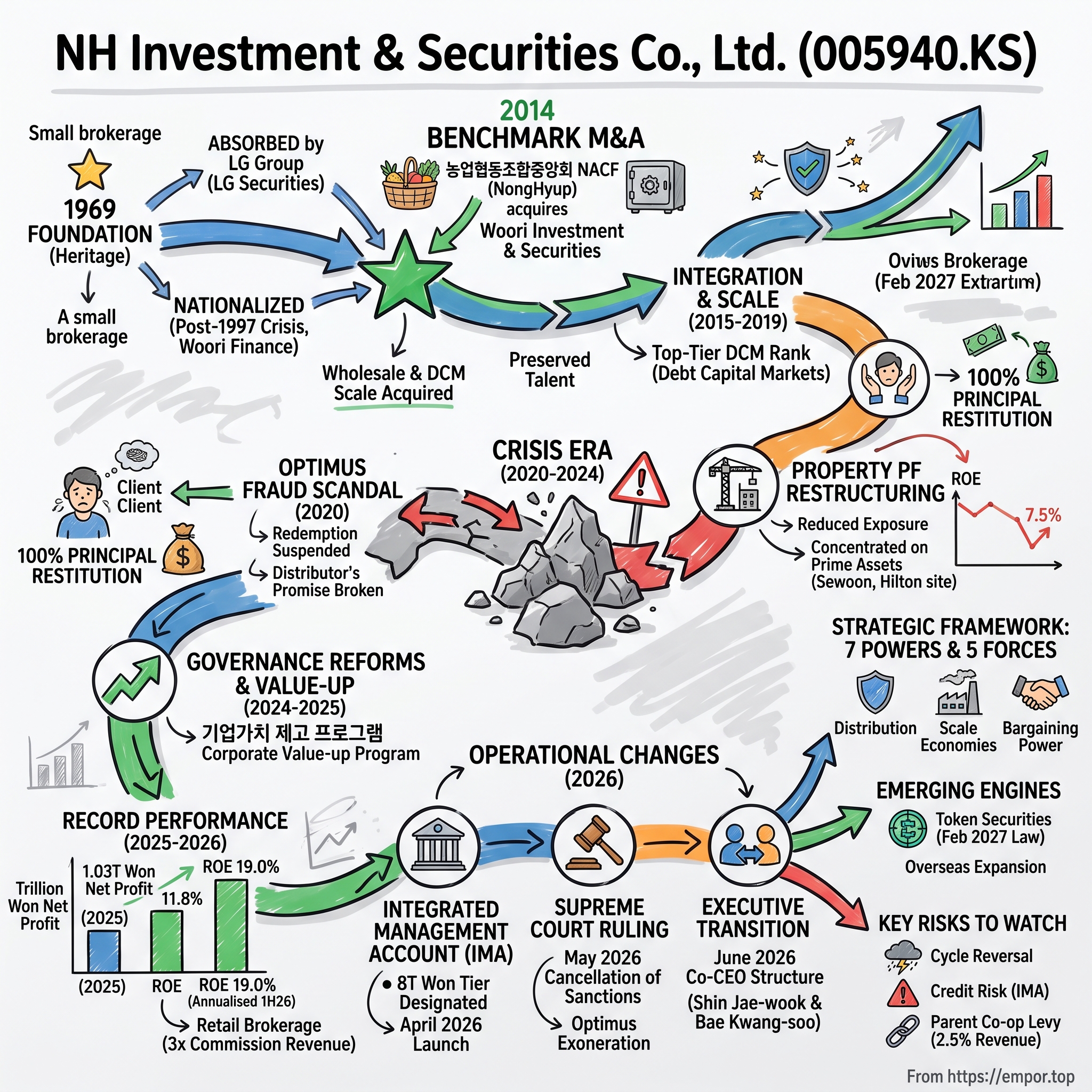
On the last Thursday of January 2026, in a Yeouido conference room — the financial district in Seoul often called Korea's Manhattan — the finance team of NH투자증권 NH Investment & Securities circulated milestone performance figures. Consolidated operating profit for 2025 reached 1.42 trillion won, while consolidated net profit rose roughly 50 percent year-over-year to 1.03 trillion won. Return on equity climbed to 11.8 percent, compared with 7.5 percent in 2023.1
The net profit figure represented a major industry threshold: no South Korean brokerage had ever earned a trillion won in net profit in a single fiscal year. For an industry long characterized by analysts as a low-return, high-beta appendage to the banking sector — profitable during retail market booms and vulnerable during downturns — crossing that benchmark signaled a shift in earnings scale.
Notably, the first Korean brokerage to reach this threshold was not an independent private-sector firm, but a cooperative-owned enterprise.
NH Investment & Securities is controlled, through an intermediate financial holding company, by 농업협동조합중앙회 National Agricultural Cooperative Federation (NACF, or NongHyup), a cooperative federation established by statute to enhance the economic position of South Korean farmers. Its ultimate equity owners are regional agricultural cooperatives across provinces such as Jeolla and Gyeongsang. Concurrently, its investment banking arm underwrites corporate bond issuances for major industrial groups including Samsung, SK, and 현대자동차 Hyundai Motor. That corporate structure — an agricultural cooperative controlling one of the country's prominent debt underwriting operations — shapes the institution's operating dynamics.
The company acquired this position through the 2014 acquisition of 우리투자증권 Woori Investment & Securities — itself formed from the former LG Securities — from a state-controlled holding company during a government privatization drive. Rather than building an investment bank organically, NongHyup purchased an established franchise, acquiring its institutional client network, debt trading desks, and operational infrastructure.
For much of the subsequent decade, public equity markets priced the stock at a discount to book value, reflecting the "Korea discount" common among domestic listed companies. In NH's case, market participants cited the parent structure: a cooperative parent requiring cash flow for agricultural programs created an incentive to prioritize dividend payouts over compounding retained equity.
That valuation paradigm shifted following regulatory reforms. South Korea's government launched the 기업가치 제고 프로그램 Corporate Value-up Program in 2024, later amending the Commercial Act to clarify directors' fiduciary obligations to all shareholders and linking tax incentives for high-dividend companies to formal value-enhancement disclosures.18 As domestic equities re-rated, shares of NH Investment & Securities — which had traded between 0.4x and 0.6x price-to-book for years — reached 28,500 won on August 2, 2026. This reflected a market capitalization of approximately 10.1 trillion won, bringing market value in line with net assets at a trailing price-to-earnings ratio near seven.17
With the valuation discount largely closed, the investment case now depends on underlying operating performance rather than price-to-book convergence.
The institution has also undergone operational and governance changes. In March 2026, the 금융위원회 Financial Services Commission designated NH Investment & Securities as an eight-trillion-won tier comprehensive financial investment business operator, granting it an 종합투자계좌 Integrated Management Account licence — an authorization held by only three firms in South Korea.10 In May 2026, the Supreme Court finalized the cancellation of administrative sanctions previously imposed regarding the firm's role in the 옵티머스자산운용 Optimus Asset Management fund fraud.4 In June 2026, the board elected not to reappoint the chief executive following the record-setting financial year, transitioning leadership to a co-CEO structure.15
These developments — record earnings, licensing expansion, legal resolution, and executive transition — occurred within a six-month span.
This analysis evaluates those events across seven sections:
First, the historical lineage and the 2014 acquisition, assessing transaction valuation and structural integration. Second, segment economics and revenue drivers benchmarked against South Korean peer brokerages. Third, risk management evaluations focusing on the Optimus mis-selling case and 부동산 PF real estate project financing exposure. Fourth, corporate governance under cooperative ownership, Value-up execution, and the leadership restructuring. Fifth, strategic initiatives in tokenized securities and international expansion. Sixth, competitive positioning and financial resilience. Finally, key operational and market risks facing the firm.
The analysis begins with the foundation of the modern business: the 2014 acquisition that established its capital markets scale.
 Subscribe on LinkedIn
II. Heritage, Genealogies, & The Benchmark M&A (1969–2014)
There is a particular kind of South Korean corporate history that reads like a family tree drawn by a bureaucrat: a firm founded in one decade, absorbed into a 재벌 chaebol in the next, nationalized after a currency crisis, privatized a decade later, and ultimately sold to an agricultural cooperative. NH Investment & Securities follows exactly that path, and its lineage explains its core operational strengths.
The lineage traces back to the late 1960s, to a small Seoul brokerage that was eventually absorbed into the LG Group and became LG Securities, later LG Investment & Securities. That history matters less for the corporate brand than for the market era. Through the 1980s and 1990s, a chaebol-affiliated securities house in South Korea functioned primarily as a debt underwriting shop. South Korea's corporate sector financed its industrialization through debt, and the brokerage houses that learned to place that paper with domestic institutional buyers — insurers, pension funds, and bank trust accounts — built executive relationships that survived multiple ownership changes.
The Asian financial crisis of 1997–1998 reorganized the financial sector. South Korean conglomerates were forced to shed financial subsidiaries, and the government took control of large parts of the banking system, assembling rescued institutions into Woori Finance Holdings, a state-controlled holding company. The former LG securities business landed in that portfolio and was rebranded in 2005 as 우리투자증권 Woori Investment & Securities.
Under Woori ownership, the firm established itself for a decade as a leading wholesale investment bank in South Korea. Rather than building a dominant retail branch network, it focused on institutional debt underwriting and corporate finance.
The forced seller
Eventually, the South Korean government moved to recoup its restructuring funds.
Woori Finance Holdings had been established using public money, creating political pressure for successive administrations to return capital to the state treasury. Because privatizing the core banking arm proved difficult, authorities split the group to auction non-bank subsidiaries first. That decision placed Woori Investment & Securities up for sale due to state divestment objectives rather than operational distress.
NongHyup emerged as the winning bidder. In June 2014, 농협금융지주 NH NongHyup Financial Group completed the package acquisition of Woori Investment & Securities, Woori Aviva Life Insurance, and Woori FG Savings Bank for approximately 1.15 trillion won.2 On the final day of 2014, the acquired brokerage merged with NongHyup's smaller existing securities unit, forming NH Investment & Securities.
Operationally, the transaction combined two contrasting entities. On one side was NongHyup's original securities arm — a small retail network serving cooperative depositors with minimal investment banking capabilities. On the other was Woori Investment & Securities, a dominant wholesale underwriting franchise. In most corporate acquisitions, the buyer's management imposes its operational culture. Here, NongHyup lacked equivalent wholesale banking operations to superimpose. As a result, the smaller existing entity was integrated into Woori's platform, and the surviving company retained the acquired business leaders and deal-making staff under the new parent name.
That structural approach preserved operational continuity, though it also deferred deeper cultural and managerial integration between the cooperative parent and the investment bank.
Did NongHyup overpay?
Financially, the transaction price appeared defensible, while the strategic acquisition of market position was the main value driver.
Evaluating a securities firm differs from evaluating an industrial company because a brokerage balance sheet consists largely of financial assets marked at or near market value. Consequently, book value serves as a primary valuation anchor. Purchasing a brokerage at a discount to net asset value implies paying less than stated net equity while obtaining licenses, institutional client relationships, and underwriting market share. The package transaction priced the securities unit below its stated equity, leading analysts to view the acquisition price as fair to favorable.
Industry trends frame the transaction's long-term context. The South Korean brokerage sector spent much of the subsequent decade trading below book value, meaning a transaction near book value in 2014 was not a deep bargain relative to future equity valuations. However, building an institutional investment bank organically presented high barriers. For instance, 미래에셋증권 Mirae Asset Securities achieved comparable wholesale scale only through its later acquisition of KDB Daewoo Securities, whereas organic expansions in South Korean investment banking frequently suffered from talent attrition.
Through the acquisition, NongHyup acquired an established institutional platform and deal execution capabilities that would have been difficult to build from scratch. Bond underwriting relies on established institutional placement networks, execution habits, and market timing expertise across corporate debt tranches.
The integration question
The primary long-term risk of the acquisition was organizational rather than purely financial. A cooperative federation operates with public-interest mandates, committee governance, and risk-averse regional banking operations. An investment bank relies on variable incentive compensation, rapid deal execution, and active balance sheet risk-taking. A common risk when a conservative parent buys an investment bank is that rigid risk controls suffocate deal velocity, prompting key underwriters to leave.
That outcome did not materialize immediately. NH Investment & Securities maintained top-tier league table rankings in South Korean debt capital markets throughout the post-acquisition decade and expanded its origination in structured finance and real estate project financing.
At the same time, maintaining operational autonomy meant the parent company did not fully integrate the investment bank's risk governance. Leaving a high-yield, risk-taking business operating largely on its inherited controls within a cooperative parent structure created latent governance vulnerabilities — issues that surfaced six years later during subsequent market disruptions.
III. Business Architecture, Segment Economics, & Industry Structure
Walk into the Yeouido headquarters on a busy morning in 2026 and you would find four quite different businesses sharing a balance sheet, a brand, and very little else. One of them sells stock trades to schoolteachers on a phone app. One of them prices a subordinated bond for a shipbuilder. One of them runs a proprietary fixed-income book. One of them manages the wealth of families with more than a billion won in assets. They are bundled together because Korean regulation permits it and because the funding is cheaper when they are — not because they share customers.
Understanding NH Investment & Securities means resisting the temptation to treat it as one company. It is a portfolio, and the portfolio's composition changes dramatically with the market cycle.
What the first half of 2026 revealed
The half-year results, reported in July 2026, were the loudest possible demonstration of that point. Consolidated net profit attributable to shareholders reached 965.2 billion won, up 107.6 percent year on year; operating profit was 1.317 trillion won; net operating revenue rose 89 percent to 2.26 trillion won. Annualised return on equity was 19.0 percent.11
Now look underneath. Brokerage commission income was 795.0 billion won, up 211.7 percent. Financial product sales revenue was 125.9 billion won, up 127.2 percent. Investment banking revenue was 205.5 billion won.11
Read those three numbers together and the composition of the record becomes clear: this was overwhelmingly a retail cycle, not an investment banking cycle. Brokerage revenue tripled. IB revenue did not. The KOSPI surpassed the 5,500 level for the first time in February 2026 and Korean equities have been among the strongest-performing markets globally, drawing heavy foreign inflows and, more importantly for a brokerage, an enormous surge in domestic retail turnover.18 When domestic households trade, a firm with a large retail account base earns commissions on the way in and on the way out, plus interest on the margin loans that finance the enthusiasm.
This is the single most important thing a long-term investor needs to internalise about a Korean brokerage: annualised ROE of 19 percent in a bull half-year is not the normalised earning power of the business. It is what the business produces when the retail cycle is running hot. The medium-term target the company itself set — sustainable ROE of 12 percent — is the more honest number, and even that sits above the roughly 9 percent the firm averaged over the five years preceding the value-up plan.5
Investment banking: the inheritance, tested
The IB franchise is the part of the company that is supposed to be structural rather than cyclical, and 2026 provided an unusually clean test of that claim.
In debt capital markets, NH Investment & Securities finished the first half of 2026 as the number one bookrunner across all DCM products, with 19.77 trillion won arranged and a 23.95 percent share, displacing KB증권 KB Securities — which had held the top position for thirteen consecutive years — into second place at 19.30 trillion won and 23.38 percent.13
That headline needs an immediate qualification, and it is a qualification that cuts against the conventional description of NH as the perennial king of Korean corporate bonds. In plain corporate bonds specifically, KB retained first place with 6.61 trillion won and a 20.28 percent share; NH was second with 6.13 trillion won and 18.81 percent.13 NH won the overall crown because the mix of the market shifted: straight corporate bond issuance contracted 22.6 percent year on year, while paper issued by consumer-finance and card companies expanded to nearly half of all DCM volume — a segment where NH's product coverage is broader.13
The analytical conclusion is more interesting than either the bull or bear caricature. NH's DCM franchise is genuinely top-two and demonstrably able to gain share when the composition of issuance moves. It is not, however, an unassailable monopoly; it shares the top of the table with a well-capitalised bank-affiliated rival that has beaten it in the core product for more than a decade. The moat here is real but shallow — it is a duopolistic incumbency, not a toll booth.
Equity capital markets told a similar story with a different rhythm. NH reclaimed the top of the Korean IPO league table in the first half of 2026 with 692.2 billion won underwritten, ahead of 삼성증권 Samsung Securities at 640.7 billion won and KB at 210.1 billion won. But the ranking was decided almost entirely by a single mandate: the 케이뱅크 K Bank listing, worth 498 billion won of underwriting, in a total first-half IPO market of just 2.08 trillion won.14 One deal determined the league table.
That is the structural truth about ECM in a mid-sized market. League-table position in Korean IPOs is a lumpy, mandate-by-mandate business in which a single large deal swamps a semester of steady mid-cap work. Investors who treat an ECM ranking as evidence of durable advantage are reading noise as signal. The average underwriting commission in that half was 3.52 percent, with larger deals commanding lower percentage fees — meaning the mega-deal that wins the ranking is also the deal that earns the thinnest margin per won.14
Wealth management: the quiet compounding
The wealth business is where the most genuinely interesting long-term trend sits, and it gets far less attention than the league tables.
Clients holding at least 100 million won with the firm grew from roughly 90,000 in 2019 to 310,000 by the end of 2025 — and then to 455,000 by mid-2026. Clients with more than a billion won numbered over 33,000 at the half-year. Total customer assets reached 612 trillion won.111
A large share of that growth is simply asset appreciation: when the index doubles, clients cross wealth thresholds without depositing a further won. But the count of affluent households is not purely a price effect, and the direction has been consistent through both good and bad markets. Wealth management revenue is more annuity-like than brokerage commission, because it derives from balances rather than turnover, and it is the segment most likely to hold up when the retail trading boom eventually cools.
The retail delivery mechanism sits on two legs. The traditional leg is the branch and private-banking network, historically fed by the relationship with 농협은행 NH NongHyup Bank and its nationwide footprint — a genuine distribution asset in regional Korea, where a farmer-cooperative bank is often the incumbent financial institution rather than a challenger. The digital leg is 나무 Namuh, the mobile brokerage platform aimed at younger, price-sensitive investors, which competes on convenience and fee waivers rather than on advice.
The competitive pressure on that second leg is real. 토스증권 Toss Securities, launched in 2021 out of Korea's dominant consumer fintech app, built its position on interface design and zero-fee fractional trading of foreign shares, and the entire industry now competes on lifetime commission waivers for new accounts. The economics of that fight are unsentimental: in commoditised execution, the marginal price goes to zero, and the winner is whoever has the lowest customer acquisition cost or the best cross-sell. NH's answer has been to compete on adjacent services — ETF portfolio advisory, robo-advisory, scheduled accumulation orders that work outside regular trading hours — rather than on headline price. Whether that is a durable differentiator or a temporary feature advantage is genuinely unresolved.
It is worth being precise about why this matters more than the headline commission rate suggests. A brokerage does not primarily monetise a retail account through trading fees; it monetises it through everything that sits on top — margin lending interest, foreign exchange spreads on overseas trades, distribution fees on funds and structured products, and eventually a wealth advisory relationship when the client's balance gets large enough to warrant one. A fintech competitor that captures the twenty-six-year-old's first account is not stealing much revenue today. It is acquiring, at very low cost, the option on that customer's next thirty years of accumulating assets. The incumbent's defence has to be that when balances grow, the customer wants advice rather than an interface — which is a plausible bet, and an untested one.
The firm's own framing of the retail push has leaned on infrastructure rather than price: management attributed the first-half surge specifically to strengthened digital and global trading capability alongside a broadened customer base in both domestic and overseas equities.11 Overseas equity trading is the more revealing half of that sentence. Korean retail investors have moved a great deal of money into US-listed shares over recent years, and foreign execution carries a wider spread than domestic — which means the mix shift toward overseas trading is quietly margin-accretive even as domestic commissions compress. It is also the segment where Toss competes most aggressively.
Trading, treasury, and the balance sheet
The fourth business is the least visible and the most consequential for risk. A Korean mega-brokerage runs a large fixed-income and derivatives book, funds itself substantially in short-term wholesale markets, and extends margin credit to retail clients. Asset management and interest-related revenue reached 831.5 billion won in the first half of 2026, up 62.5 percent.11
The mechanism is worth explaining plainly, because it is where the sector's crises originate. A brokerage borrows short and holds longer-duration assets — bonds, structured notes, real-estate loans. When funding markets are calm, the spread is profit. When they seize, the same book becomes a liquidity problem, because the assets cannot be sold at the marks. Korea has lived through that sequence twice in recent memory, and it is the reason regulators care so much about net capital ratios.
Where NH sits among the top five
Against peers in the first half of 2026, the picture is one of a strong performer in a strong market rather than a lone standout. Among the four bank-affiliated brokerages, NH led with 965.2 billion won of net profit, ahead of KB Securities at 796.3 billion, 신한투자증권 Shinhan Securities at 577.7 billion, and 하나증권 Hana Securities at 273.1 billion — a combined 2.61 trillion won.12 Outside that group, Mirae Asset was expected to post materially higher half-year net profit, helped substantially by valuation gains on an investment in SpaceX, while Samsung Securities and 키움증권 Kiwoom Securities rode retail strength.12
The Mirae comparison is instructive in a way that flatters NH. Mirae's outsized half was significantly driven by a mark-to-market gain on a private holding — real money, but not repeatable operating income. NH's half was driven by commissions, product sales, and fees. Neither is high quality in the sense of being recession-proof, but transaction-driven revenue at least reflects customer activity rather than a valuation event.
That, ultimately, is the shape of the business: a top-two debt house welded to a top-five retail platform, funded by a large balance sheet, owned by a cooperative. It generates spectacular returns in bull markets and mediocre ones otherwise. To understand why the market spent so long refusing to capitalise the good years, one has to go back to what happened in 2020.
IV. Crisis Era: The Optimus Scandal & Real Estate PF Restructuring (2020–2024)
In June 2020, redemption requests on a set of private funds distributed through NH Investment & Securities branches were suspended. The funds bore the name 옵티머스자산운용 Optimus Asset Management and carried a marketing narrative that made them exceptionally attractive to retail buyers: capital was purportedly deployed into short-term receivables backed by South Korean public entities. For conservative savers navigating a near-zero interest rate environment, the product offered quasi-government credit risk alongside yields well above standard bank deposits.
In reality, the proposition was hollow. The public-sector receivables the funds claimed to hold did not exist at anywhere near the advertised volume.
The anatomy of the failure
Across the entire Optimus fund complex, investors committed roughly 1.2 trillion won. NH Investment & Securities served as the primary distribution channel, accounting for approximately 470 billion won of total sales.3 Although the firm had neither created nor managed the funds, nor chosen their underlying assets, it had endorsed and relayed the manager's pitch directly to its retail client network.
In April 2021, the dispute settlement panel of the 금융감독원 Financial Supervisory Service (FSS) issued a ruling with little precedent in South Korean retail finance. Instead of dividing fault among the fund manager, custodian, and distributor to award partial damages, the panel invoked the legal doctrine of cancellation due to mistake. It determined that the underlying investment contracts were void because the underlying assets never existed as represented. Finding that NH Investment & Securities had failed to adequately explain product risks, the panel recommended full principal restitution, placing roughly 300 billion won at stake.3
The following month, NH Investment & Securities accepted the recommendation, agreeing to return 100 percent of the invested principal to affected clients.
Why that decision was harder than it looks
Years later, full restitution can easily appear to have been the only logical course. At the time, however, the decision triggered intense internal debate that underscored how leadership evaluated balance-sheet risk against institutional franchise value.
The argument for contesting the ruling was compelling. The brokerage itself had been misled by the fund manager. Accepting full restitution meant absorbing hundreds of billions of won in losses stemming from a third party's fraudulent scheme, while setting a potential precedent that financial distributors act as default insurers for product failures. Competitors involved in concurrent fund mis-selling disputes chose to litigate aggressively.
Conversely, the argument for full repayment rested on commercial survival. A wealth management platform relies fundamentally on client trust—the assumption that the distributor has vetted the instruments it markets. If retail investors conclude that due diligence is nonexistent, brand equity erodes rapidly, threatening high-net-worth client relationships built over decades. Management ultimately prioritized franchise value over short-term earnings, absorbing the direct financial hit.
Subsequent growth in client assets indicates that prioritizing institutional reputation was sound commercially, even if that recovery coincided with a broader market boom. Crucially, the decision demonstrated that executive leadership recognized the long-term economic value of its retail distribution network.
The courtroom reversal nobody expected
Regulatory enforcement proceeded along a separate track from investor compensation. In 2022, the Financial Services Commission (FSC) imposed a three-month partial business suspension on the brokerage alongside sanctions against six current and former executives. The regulator concluded that the firm had marketed the funds without adequate verification and had presented speculative claims as facts—specifically, the assertion that over 95 percent of fund assets were invested in public-entity receivables.4 Former chief executive 정영채 Jeong Young-chae received a reprimand-grade warning, an administrative sanction that effectively prevents a financial executive from holding future senior positions in the industry.
The firm challenged the administrative actions in court. On May 16, 2026, the Supreme Court's First Division finalized the complete cancellation of both the partial business suspension and the executive sanctions. The court ruled that evidence was insufficient to establish that NH Investment & Securities knew the fund's asset holdings were uncertain, or that it had deliberately made definitive assurances while anticipating that private debt instruments would replace public receivables.4 In a parallel proceeding, Jeong secured a final ruling overturning the FSC reprimand against him.4
The Supreme Court ruling established an important legal standard in South Korea: financial distributors cannot face administrative sanctions for selling fraudulent products without proof that they had knowledge of the underlying fraud. For NH Investment & Securities, the verdict cleared a regulatory blemish that had weighed on its valuation multiple for years.
At the same time, the legal victory carries distinct boundaries. The ruling did not affirm that the firm's product due diligence was rigorous; it held only that the evidence failed to meet the statutory threshold for administrative penalties. The firm still absorbed the client restitution losses. For market analysts, distinguishing between a lack of proven fraud knowledge and robust operational oversight remains critical to evaluating future risk controls.
The second crisis: property
As legal proceedings over Optimus unfolded, a broader cyclical crisis hit South Korea's financial sector. Korean 부동산 PF real estate project financing relies on developers borrowing against projected cash flows with minimal equity, using short-term bridge loans that are refinanced into long-term facility debt once permits and presales are secured. Brokerages expanded aggressively in this market, earning lucrative fees both as direct lenders and as credit enhancement providers for asset-backed commercial paper.
The model functioned smoothly in a low-interest-rate environment but faltered when benchmark rates rose sharply from 2022. Refinancing markets froze, development projects stalled, and investor demand for project-related paper evaporated. By the second quarter of 2024, non-bank financial institutions—including brokerages, savings banks, and mutual cooperatives—held approximately 63.5 percent of South Korea's project finance debt, pushing total quasi-PF exposure to roughly 230 trillion won.19 Consequently, delinquency rates on term PF loans across the financial sector rose from 0.96 percent in 2023 to 2.60 percent in 2025.19
NH Investment & Securities responded by reducing overall exposure and concentrating its remaining portfolio. Management restructured its real estate holdings around high-quality, completed or near-completed prime assets—including Parc1 in Yeouido, the Sewoon redevelopment, Haeundae Centum, and the former Millennium Hilton site—prioritizing asset quality and risk-adjusted return over balance-sheet volume while divesting larger secondary sites.119
This strategy reflected pragmatic risk mitigation rather than foresight. The firm built up loan-loss provisions, executed asset sales, and accepted a temporary decline in profitability—with return on equity dropping to 7.5 percent in 2023—rather than refinancing unviable projects.1 This disciplined balance-sheet management aligned with financial best practices, though it was also accelerated by financial regulators who introduced strict supervisory guidelines requiring financial institutions to classify project loans into standardized risk tiers and enforce resolution plans for distressed assets.19
Together, the fund mis-selling scandal and the real estate financing downturn illustrated twin risks inherent to capital markets franchises: distributing third-party investment products without rigorous asset verification, and extending credit dependent on perpetual market liquidity. How effectively the firm has embedded these lessons depends heavily on its corporate leadership—bringing the focus directly to a boardroom that has recently undergone significant governance changes.
V. Current Management, Corporate Governance, & The Value-Up Mandate
In December 2024, the board of NH Investment & Securities approved a corporate value-enhancement roadmap. The target was a sustainable return on equity of 12 percent and a price-to-book ratio of 1.0 by 2028. Under this plan, core business segments—investment banking, wealth management, and asset management—were required to earn the market's estimated 10 percent cost of equity, with adjacent operations supplying the remaining increment to reach 12 percent. To anchor shareholder returns, the board committed to a minimum annual dividend floor of 500 won per common share, supplemented by variable distributions tied to annual performance.5
The roadmap was presented by 윤병운 Yoon Byeong-un, a career insider who advanced through the corporate finance and investment banking coverage desks across the LG–Woori–NH lineage before assuming the chief executive role in March 2024. Yoon's background contrasted with the traditional appointment of parent-cooperative delegates. Rising from the firm's underwriting ranks, he brought technical capital markets experience and engaged institutional investors on capital management metrics, risk provisioning, and dividend commitments.
While the value-up mandate was driven partly by broader regulatory policy, subsequent execution closely aligned with management's stated targets.
The record on returns of capital
For fiscal year 2024, the board declared total cash dividends of approximately 329.3 billion won—reflecting 950 won per common share and 1,000 won per preferred share—a 17 percent year-over-year increase that represented a payout ratio of 52.6 percent on a separate-basis net income.6 Concurrently, the board authorized a buyback and cancellation of approximately 3.4 million common shares, valued at roughly 50 billion won.6
Share cancellations carry particular weight in South Korean corporate governance, where share buybacks often remain in corporate treasuries rather than permanently shrinking the share count. NH Investment & Securities executed a 51.5 billion won share cancellation in April 2024—its first in 13 years—followed by a 48.7 billion won cancellation completed in May 2025.7
Following record performance in 2025, the board expanded capital distributions further, declaring 1,300 won per common share and 1,350 won per preferred share. Total cash dividends rose 48.6 percent to 487.8 billion won, ratified at the 59th annual general meeting on March 26, 2026.78 This resulted in a separate-basis payout ratio of 53.7 percent and a consolidated payout ratio of 47.3 percent, establishing one of the highest payout levels in the domestic securities sector. Combining cash dividends and share cancellations, total shareholder payout ratios reached approximately 55 percent for 2024 and 52 percent for 2025.7
The firm thus delivered on its commitment to industry-leading capital returns, maintaining payout ratios above 50 percent across shifting market cycles and converting repurchased shares into permanent share cancellations.
The parent problem, quantified
However, evaluating the firm's capital allocation requires examining its relationship with its controlling shareholder. The ownership chain runs from regional agricultural cooperatives to the National Agricultural Cooperative Federation (NACF), which owns NH NongHyup Financial Group outright. NH Financial Group holds a controlling stake of approximately 60 percent in NH Investment & Securities, expanded over time through rights offerings where the parent acted as sole subscriber.9
A key mechanism connecting the corporate structure is the 농업지원사업비 agricultural support fee. Under South Korea's Agricultural Cooperatives Act, financial subsidiaries pay the federation a levy calculated at 2.5 percent of gross revenue to fund agricultural and rural assistance programs.16 Because this fee is levied on revenue rather than net profit, it scales directly with top-line growth. Total levies across NH Financial Group rose from 450.4 billion won in 2022 to 611.1 billion won in 2024, with cumulative fees reaching 487.7 billion won through the third quarter of 2025 and tracking toward roughly 650 billion won for the full year.16
This top-line deduction expanded even as group net profit contracted 1.8 percent over the same period—making NH Financial Group the only major domestic financial holding company to record earnings contraction during that interval.16
In November 2025, the Financial Supervisory Service issued a management caution and six improvement orders to NH Financial Group regarding the fee structure. Regulators noted that the group failed to evaluate how revenue levies and required internal reserves impacted affiliate capital adequacy ratios, ordering the parent to incorporate fee impacts into medium-term capital planning and establish formal channels for subsidiary input on dividend and reserve policies.16
The regulatory intervention highlighted how top-line parent extractions pose structural capital planning considerations for regulated subsidiaries. Offsetting these extractions, the parent has provided capital when needed to expand operating scale. NH Financial Group subscribed 650 billion won in new equity in 2025, helping NH Investment & Securities cross the 8 trillion won equity threshold required for integrated management account licensing, and approved a further 400 billion won third-party equity allotment on June 2, 2026, raising total net assets from 9.97 trillion won at the end of March toward 10.28 trillion won.9
This structure creates dual dynamics: revenue-based levies absorb operating capital, while targeted equity injections fund balance sheet expansion for regulatory licensing.
The CEO who won and was replaced anyway
Despite achieving record performance and executing value-up initiatives, executive leadership underwent unexpected changes at the conclusion of Yoon's term in March 2026. The 59th annual general meeting passed without a CEO reappointment on the agenda, as the company cited the need for further review of governance structure options while Yoon continued serving pending a decision.8
On June 30, 2026, shareholders formally approved a co-CEO governance structure. The nomination committee recommended two internal executives: 신재욱 Shin Jae-wook, former head of real estate and infrastructure, appointed to oversee investment banking, asset management, wholesale operations, and corporate administration; and 배광수 Bae Kwang-soo, former head of wealth management, appointed to lead wealth management, digital platforms, distribution channels, and research.15 Management framed the transition as a move toward generational change and divisional specialization, providing no formal explanation for departing from single-CEO leadership following record financial results.15
The transition introduces distinct operational considerations. From a functional perspective, expanding into complex balance-sheet operations under the new integrated management account license alongside growing retail wealth management may support dedicated divisional leadership. However, co-CEO governance structures require clear operational boundaries and alignment across capital allocation committees. At the time of the announcement, the exact mandate and authority of the coordinating committee remained unconfirmed.15
Furthermore, executive terms among domestic bank-affiliated financial subsidiaries typically follow a two-year initial cycle with one-year extensions, governed by parent nomination decisions. This creates a management horizon shorter than multi-year strategic plans, meaning execution of the 2028 value-up targets now rests with leadership that did not design the original framework.
VI. Speculative & Emerging Growth Engines
Every South Korean brokerage's investor presentation over the past four years has featured a slide on token securities. Virtually none have shown meaningful revenue.
Token securities: a law, not yet a market
The regulatory framework, however, has finally shifted. Amendments to South Korea's Electronic Securities Act and Capital Markets Act — the enabling legislation for 토큰증권 token securities — passed the National Assembly on January 15, 2026, with the Financial Services Commission setting an effective date of February 4, 2027.20 The legal changes bring distributed-ledger issuance and record-keeping under the electronic securities framework while permitting brokerages to distribute investment contract securities, a category covering fractionalized claims on real estate, artwork, and intellectual property.20 Industry proponents have projected a total market opportunity reaching hundreds of trillions of won.21
NH Investment & Securities moved early to position itself, forming an alliance of prospective issuers and technology partners centered around its Namuh mobile platform. The underlying strategy assumes that whichever platform controls retail distribution will capture the economics of the emerging asset class.
Yet a realistic assessment indicates that 2026 remains a foundational period. Subordinate regulations, supervisory rules, and market clearing systems remained under specification through mid-2026, with the FSC targeting that window for draft guidelines.20 The actual market landscape will take shape only after those detailed rules are finalized. Furthermore, recent industry developments urge caution: several early fractional-investment platforms struggled to meet licensing standards under the incoming regime and ceased operations — a reminder that formalizing a market introduces institutional compliance costs that smaller operators cannot easily sustain.20
For investors, token securities are best modeled with minimal near-term valuation weight. The critical variables to monitor are whether secondary trading rules allow sufficient market liquidity and whether NH can convert its alliance network into revenue-generating underwriting mandates once the law takes effect in February 2027.
The IMA licence: the real near-term option
A far more immediate and material growth driver is less headline-grabbing but already contributing to earnings.
On March 18, 2026, the FSC designated NH Investment & Securities as an eight-trillion-won tier comprehensive financial investment business operator, authorizing it to offer 종합투자계좌 Integrated Management Account services — making it only the third South Korean firm to receive the license.10 The Securities and Futures Commission approved the application on March 11, 2026, following a 650 billion won capital injection from the parent company and an initial September 2025 filing.9
Under the IMA framework, the firm can accept principal-protected client deposits, pool the capital, and deploy it into corporate lending and venture financing while capturing the net interest margin, capped at 100 percent of the firm's equity.9 Policy makers designed the instrument to channel household savings directly into industrial and corporate financing, creating a bank-like funding mechanism on a brokerage balance sheet.
The initial product offering launched in April 2026 raised 400 billion won within five days. Corporate clients accounted for roughly 55 percent of the total, while about 60 percent of incoming sales represented net new assets drawn from competing financial institutions.9 Following the subsequent equity expansion, analysts estimated the higher capital base would support approximately three trillion won in additional risk-weighted asset capacity.9
That 60 percent figure is the critical metric. It indicates that the account is capturing fresh client balances rather than recycling existing retail deposits — the key distinction between genuine franchise expansion and balance-sheet reshuffling. The corresponding risk, however, is clear: operating an IMA transforms a fee-for-service business into a spread-based credit book. A firm that spent the 2022–2024 period provisioning against real estate loan defaults is now authorized to build a significantly larger principal exposure. The underwriting discipline demonstrated during the property workout will face a direct test as this balance sheet grows.
Overseas: patient, small, unproven
The international network — spanning subsidiaries and offices in Hong Kong, London, New York, Singapore, and Southeast Asia — remains modest relative to the domestic platform. Operations focus on cross-border debt origination, sourcing foreign alternative assets for domestic institutional investors, and regional wealth management. It has not been a material earnings contributor, and the industry's recent write-downs on offshore commercial property offer a clear cautionary lesson, even as South Korean regulatory authorities have assessed systemic risk from overseas real estate exposure as limited.19 For valuation purposes, international operations represent long-term optionality rather than immediate core earnings.
Beyond these emerging initiatives, the central question determining long-term equity returns is whether the firm's core franchise possesses a durable competitive moat.
VII. Strategic Frameworks: 7 Powers & 5 Forces Analysis
Strip away the league tables and ask the question a strategist would ask: if a well-funded competitor decided tomorrow to take this business, what would stop them?
Applying Hamilton Helmer's 7 Powers
Distribution power is the primary claim, and it is real but narrowing. The relationship with NH NongHyup Bank gives the securities firm access to a branch network that reaches deep into rural and provincial Korea, where the agricultural cooperative bank is frequently the incumbent — not a challenger — financial institution. A Seoul-headquartered private brokerage cannot replicate that footprint at any sensible cost; building it would require decades and would still not confer the local institutional trust that comes from being the co-op. That is a genuine structural asset for gathering wealth balances.
The qualification is that its value is decaying at the margin. Every year, more Korean retail assets are gathered through mobile apps where a branch in a provincial county is irrelevant, and the fastest-growing retail cohort has never entered a brokerage branch. Distribution power here is best understood as a durable advantage in a slowly shrinking channel.
Scale economies exist but are ordinary. A debt capital markets franchise arranging nearly 20 trillion won of paper in a single half-year spreads the fixed costs of syndicate desks, credit analysis, and settlement infrastructure across a large volume. The same applies to trading and technology platforms. But the relevant comparison is not against a startup — it is against four other firms of comparable scale, all of whom clear the same fixed-cost hurdles. Scale here is table stakes for membership in the top tier, not a source of superior returns within it.
Process power is the most defensible claim, and the least measurable. Underwriting corporate debt is a craft business. Knowing which insurer will absorb a thirty-year tranche, which issuer's treasurer wants a private placement rather than a public deal, and how to price a hybrid three days before a Bank of Korea decision — that knowledge is organizational, accumulated over decades across the LG–Woori–NH lineage, and it does not transfer when a competitor hires two managing directors. The evidence for it is the franchise's survival through a change of ownership, a mis-selling scandal, a property downturn, and multiple leadership transitions with its top-two position intact.
The counter-evidence is equally concrete: KB Securities held the corporate bond crown for thirteen straight years against exactly this franchise.13 Process power that cannot beat the direct competitor in the core product is process power that produces parity, not premium returns.
Counter-positioning is absent. NH is a conventional incumbent. It does nothing that a competitor is structurally unwilling to copy — which is the actual test of counter-positioning. If anything, the counter-positioner in this market is Toss Securities, whose zero-fee model NH cannot fully match without cannibalizing its own commission revenue.
Switching costs are weak in retail and moderate in institutional. Moving a retail brokerage account in South Korea takes minutes. Moving a corporate bond mandate takes a phone call — but the chief financial officer who has used the same bookrunner for eight consecutive issuances has a genuine incentive not to switch, because an underwriting failure is career-threatening and the incumbent has consistently delivered. That asymmetry, rather than contractual lock-in, represents the actual switching cost in investment banking.
Branding and cornered resources: neither applies materially. The NongHyup name carries trust in rural Korea but holds little distinct advantage in Gangnam or Hong Kong.
Porter's Five Forces
Threat of new entrants: low, by regulation. The mega-investment-banking license tiers in South Korea are defined by equity capital thresholds — four trillion won for the core designation and eight trillion won for integrated management account authority — and clearing them requires either decades of retained earnings or a parent willing to supply substantial capital.10 That creates a formidable barrier, keeping the core competitive group stable for a decade. The important caveat is that regulatory barriers protect the license, not the underlying profit pool: Toss Securities entered retail brokerage and captured market share without needing mega-IB capital.
Bargaining power of buyers: high in retail, moderate in institutional. Retail investors face negligible switching costs in an industry competing on lifetime fee waivers; the commission pool per trade compresses structurally, masked only by spikes in market volume. Corporate issuers hold more power than standard narratives suggest — a conglomerate treasurer conducts a bookrunner selection process for every major transaction, and with two firms closely tied at the top of the table, the issuer maintains a credible alternative on every mandate.
Bargaining power of suppliers: the unusual one. For most financial institutions this force is minor. For NH it is material, because the controlling shareholder functions as a supplier of the brand and charges a fee calculated at 2.5 percent of gross revenue.16 That represents a supplier with pricing power established by statute rather than negotiation, creating a permanent claim on revenue ahead of other stakeholders.
Threat of substitutes: moderate and rising. For corporate issuers, bank loans serve as a direct substitute for debt issuances, with domestic commercial banks competing actively for corporate financing. For retail savers, substitutes include direct-indexing applications, foreign brokerages, and digital asset venues.
Rivalry: very high, and structurally so. Five to seven firms of similar scale, licenses, cost structures, and product lines compete for a domestic profit pool driven primarily by overall market turnover rather than proprietary differentiation. The 2026 debt capital markets ranking shifted after thirteen years because the market mix moved toward financial paper, not because any single firm altered the structural landscape.13 That dynamic is characteristic of a maturing, commoditized market.
The composite picture: NH Investment & Securities possesses a genuine distribution asset in a channel of declining relative importance, a craft advantage that delivers parity rather than dominance in its core product, and regulatory protection that shields its operating license rather than its profit margin. It remains a well-run cyclical business with a modest structural edge rather than an insulated compounder with an unassailable moat.
VIII. Activist Stress Test, Material Risk Radar, & Investment Thesis
Consider an instructive scenario: a South Korean value-focused institutional investor, or one of the domestic activist funds emboldened by governance reforms, sits across from the co-CEOs with a short list of demands. Several operational and governance friction points would immediately come under scrutiny.
What an activist would attack
First: cap the parent's levy, or at least disclose its capital impact. The agricultural support fee is calculated on gross revenue, meaning it expands in profitable years regardless of net margins and remains a burden during market downturns. The Financial Supervisory Service has already addressed this issue, ordering the parent financial group to analyze the fee's effect on subsidiary capital ratios and establish formal channels for affiliate input on dividend and reserve policies.16 An activist demand would be straightforward: publish full subsidiary-level disclosures detailing the exact annual financial cost and capital consumption of the levy on NH Investment & Securities.
Second: make share cancellation the default, not a discretionary measure. Although the firm executed share cancellations in three consecutive years, each event relied on an isolated board decision of roughly 50 billion won — a modest figure relative to annual cash dividends approaching half a trillion won.67 When a stock trades at or below book value, repurchasing and cancelling shares is mechanically more accretive per share than issuing cash dividends. The heavy tilt toward cash distributions reflects the cash-flow requirements of a 60 percent controlling shareholder rather than an optimal capital allocation framework.
Third: clarify executive succession governance. Removing a chief executive following a record-setting financial year, without a detailed public rationale and under a cooperative federation parent, illustrates the governance patterns that institutional investors frequently challenge.15
Fourth: justify equity balance sheet expansion. Consecutive capital injections have expanded equity toward 10.3 trillion won.9 Incremental capital must earn returns above the estimated cost of equity to avoid diluting the 12 percent return-on-equity target — an arithmetic challenge that intensifies as the equity base grows. Bullish investors view these equity injections as essential fuel for the Integrated Management Account franchise, whereas cautious analysts note that the larger balance sheet raises the hurdle for sustained valuation re-rating.
The institutional counter-argument warrants equal consideration. A cooperative parent with implicit state backing provides structural credit support in wholesale funding markets. During systemic credit freezes, a brokerage backed by NongHyup maintains distinct funding access compared with standalone peers. The central strategic question for minority shareholders is whether that downside protection justifies the ongoing cost: a permanent top-line revenue levy combined with a dividend-focused capital allocation policy.
The risk radar
Cycle reversal represents the primary operational risk. The first half of 2026 produced a 19 percent annualized return on equity, propelled by a tripling in retail brokerage commission income.11 Retail trading volume remains one of the most volatile revenue streams in capital markets. If equity market turnover contracts from peak levels, commission fees, margin lending balances, and financial product distribution income decline concurrently.
This revenue concentration amplifies cyclical downturns. During market drawdowns, retail revenue streams contract simultaneously: lower trading volumes compress transaction fees, client deleveraging reduces margin loan interest, structured product demand dries up, and falling asset prices lower wealth management advisory fees. Because core operating costs — including branch real estate, digital infrastructure, and professional staff — remain largely fixed in the short term, operating margins compress rapidly during market retrenchments.
Credit risk is shifting rather than dissipating. While project finance exposures have been reduced and concentrated in prime commercial assets, term-loan delinquency across South Korean financial institutions rose through 2025, savings banks faced delays offloading pre-construction sites into 2026, and trust firms absorbed completion-guarantee liabilities.19 Concurrently, the Integrated Management Account license permits the firm to build an additional principal credit book equal to 100 percent of net equity.9 Consequently, overall credit risk exposure on the balance sheet is likely to expand over the medium term.
Interest rate and liquidity risks remain inherent. Maintaining a large fixed-income portfolio funded through short-term wholesale markets leaves earnings sensitive to yield curve shifts and repo market conditions.
Retail commission compression reflects a structural shift. Fee-waiving competition among digital trading platforms persists even during lower-volume periods, keeping structural downward pressure on execution margins.
Co-CEO operational execution faces structural tests, particularly as the exact authority and scope of the executive coordinating committee remain under development.15
Regulatory oversight continues to evolve. Although the Supreme Court ruling eliminated administrative sanctions regarding past fund distribution,4 domestic supervisory standards regarding product suitability and internal controls have tightened, while regulatory scrutiny of parent-subsidiary capital flows has intensified.16
Why this wins from here
The positive investment case rests on three distinct pillars:
First, the underlying revenue base has expanded beyond transactional brokerage. High-net-worth client counts roughly quintupled between 2019 and mid-2026, providing stickier balance-based wealth management fees.111 Additionally, 60 percent of funds raised during the initial Integrated Management Account launch represented net new client assets.9 If these asset balances persist through market cycles, baseline return on equity will remain above the 9 percent historical average recorded prior to the Value-up initiatives.5
Second, capital distribution policies have demonstrated consistent execution. Maintaining shareholder payout ratios above 50 percent across varied market environments, accompanied by permanent share cancellations rather than treasury share accumulation, provides empirical evidence of capital discipline.67
Third, national governance reforms provide an ongoing tailwind. South Korea's capital market initiatives have advanced from voluntary corporate disclosures to statutory fiduciary clarifications and tax incentives for high-dividend issuers, establishing a durable framework for shareholder returns.18
What breaks it
Conversely, the cautious investment case highlights clear structural constraints:
The initial valuation re-rating has largely occurred. The primary catalyst for the stock was a valuation discount of 0.4x to 0.6x price-to-book on a single-digit return profile. At 28,500 won, representing a market capitalization of approximately 10.1 trillion won against net assets near 10.3 trillion won, the stock trades near one times book value — reaching the firm's formal 2028 target two years ahead of schedule.179 Over the preceding 52 weeks, shares traded between 18,340 and 42,600 won.17 Consequently, future shareholder returns depend on underlying earnings growth and dividend yield rather than multiple expansion.
Furthermore, ownership friction points persist. The top-line revenue levy remains fixed by statute, the controlling shareholder requires consistent dividend cash flows, and regulatory authorities continue to scrutinize parent-level capital extractions.
Finally, competitive moats remain narrow across core operating segments. The firm holds second position in core corporate bond underwriting,13 faces aggressive zero-commission competition in retail trading from fintech platforms, and relies on sporadic mega-mandates to secure top equity underwriting rankings.14
In summary, the firm operates as a well-managed, cyclically exposed investment bank that has fulfilled its initial capital-return commitments. However, its valuation now reflects these operational improvements, while its corporate structure maintains permanent revenue obligations to its controlling shareholder.
The three things to watch
Normalized return on equity across a full market cycle. The key operational metric is not the peak 19 percent annualized return achieved during a retail trading surge, nor the 7.5 percent trough of 2023, but whether the business can sustain returns near its 12 percent target during normalized market conditions.
Debt capital markets sub-segment market share. While overall debt league tables shift with issuance composition, market share in plain corporate bonds provides the clearer measure of competitive strength against primary peers.
Capital return composition between cash dividends and share cancellations. A rising proportion of permanent share cancellations indicates capital allocation focused on per-share equity value, whereas a high payout ratio limited strictly to cash distributions indicates parent cash requirements dictating cash demands dominate capital strategy.
IX. Business Lessons & Epilogue
There is a photograph that would summarise this story better than any chart: a bond syndicate desk in Yeouido, pricing a multi-tranche issue for one of Korea's largest conglomerates, on behalf of a firm whose ultimate owners are village agricultural cooperatives. Nothing about that arrangement is intuitive. Almost everything about it has worked.
Three lessons generalise beyond Korea.
Acquiring capability is often cheaper than building it — but only if you leave it intact. NongHyup did not attempt to grow an investment bank organically. It bought an established platform at a defensible price from a forced seller and, critically, chose not to remake the business in the parent's image.2 The franchise survived the ownership transition because its deal-making talent and institutional habits were left undisturbed. The corollary is uncomfortable and equally important: the same hands-off integration that preserved the underwriting culture also left a risk-taking platform running on inherited controls inside a parent that did not fully understand what it was distributing. Both the 2026 league-table crown and the 2020 fund scandal descend from that single integration philosophy.
When a distributor's promise is broken, pay quickly. The full-principal restitution decision cost hundreds of billions of won for a fraud the firm did not commit.3 Five years later, the Supreme Court cancelled administrative sanctions on the grounds that knowledge of the fraud was never established.4 A firm that had contested client compensation as aggressively as it fought the regulatory penalties might have been legally vindicated but commercially crippled — and the affluent client base that subsequently quintupled would have been rebuilt from a much lower base, if at all.111 Reputation in wealth management is not a soft asset; it is the core asset.
In a mature, low-multiple market, capital returned beats capital deployed — but only if the returns are permanent. The most consequential action the firm took between 2024 and 2026 was not a deal. It was resuming share cancellations after a 13-year gap and maintaining total payout ratios above half of net earnings through a trough year and a record year alike.67 The lesson carries a sharp caveat, however. Cancelling roughly 50 billion won of stock while distributing nearly ten times that amount in cash to a 60 percent controlling shareholder reflects a capital allocation policy shaped as much by parent cash requirements as by per-share value creation.
Where this stands in August 2026
The company enters the second half of 2026 in its strongest operating position in history, paired with its most ambiguous strategic landscape in a decade. It holds an integrated management account licence shared by only two competitors.10 It captured the top position in overall debt capital markets from a rival that held the lead for 13 consecutive years.13 It has been legally cleared of the fund scandal that overshadowed its reputation for half a decade.4 And it is led by two co-CEOs appointed in late June 2026, operating under an untested governance structure to deliver multi-year targets established by prior leadership.15
The valuation discount that long defined this stock has largely closed. That re-rating fulfills the primary prediction of the Value-up thesis, shifting the investment narrative from price-to-book expansion to ongoing earnings power: specifically, whether a franchise carrying a statutory revenue levy to its cooperative parent can sustain double-digit returns when retail trading volume eventually normalizes.
That question will not be answered by league tables or dividend announcements alone. It will be decided when the retail trading cycle turns.
References
-
NH Investment & Securities Joins 'Trillion Won Club' With Record Profit — Seoul Economic Daily, 2026-01-29 ↩↩↩↩↩↩
-
NongHyup Financial Completes Acquisition of Woori Investment & Securities — Yonhap News Agency, 2014-06-27 ↩↩
-
NH Investment advised to pay full compensation to some investors over hedge fund scandal — The Korea Times, 2021-04-06 ↩↩↩
-
Top Court Upholds Cancellation of NH Investment & Securities' Optimus Sanctions — Seoul Economic Daily, 2026-05-22 ↩↩↩↩↩↩↩
-
NH투자증권, 밸류업 시동…ROE 12%, PBR 1배 '주력' — Bloter, 2024-12-19 ↩↩↩
-
NH투자증권, 배당 지급·자사주 소각 결정…주당 950원 지급 — Money Today, 2025-03-06 ↩↩↩↩↩
-
NH투자증권, 고배당 전통·자사주 소각 합류…주주환원 2.0 — Korea Financial Times, 2026-04-04 ↩↩↩↩↩↩
-
NH투자증권, 보통주 1300원 현금배당 확정…주총 안건 원안 통과 — Edaily MarketIn, 2026-03-26 ↩↩
-
2년 연속 자본 확충 나선 NH투자증권, IMA 날개 단다 — Insight Korea, 2026 ↩↩↩↩↩↩↩↩↩↩
-
금융위원회, NH투자증권㈜에 대한 종합금융투자사업자(8조원) 지정 — GNN News, 2026-03-18 ↩↩↩↩
-
NH투자증권, 상반기 순이익 9652억원 '역대 최대'…브로커리지 수익 3배로 — SAT Economy, 2026-07 ↩↩↩↩↩↩↩↩
-
'은행계 증권사' NH·KB·신한·하나, 상반기에만 2.6조 벌었다 — Insight Korea, 2026-07 ↩↩
-
DCM 순위 엇갈렸다…NH투자증권 종합 1위·KB증권 회사채 선두 — CEO Score Daily, 2026-07-08 ↩↩↩↩↩↩↩
-
2026 상반기 리그테이블: NH투자증권, '케이뱅크' 품고 IPO 1위 탈환 — The Value News, 2026 ↩↩↩
-
윤병운 빠진 NH투자증권···IB·WM 투톱 체제 조율 시험대 — Newsway, 2026-06-15 ↩↩↩↩↩↩↩
-
NH Investment & Securities (KRX:005940) Statistics & Valuation Metrics — StockAnalysis, 2026-08-02 ↩↩↩
-
South Korea Corporate Value-up Guidelines and Programme — Financial Services Commission ↩↩↩
-
Tackling Korea's Real Estate Project Finance Challenges — ASEAN+3 Macroeconomic Research Office ↩↩↩↩↩↩
-
토큰증권 시대, 법적 기반은 마련됐지만 진짜 시장은 이제부터다 — Electronic Times (etnews), 2026-07-07 ↩↩↩↩
 LinkedIn
 WhatsApp
 Reddit
 Hacker News
 Email
Email Kindle
 RSS Feed
 Spotify
 Apple Podcasts
 Amazon Music
 Audible
 YouTube