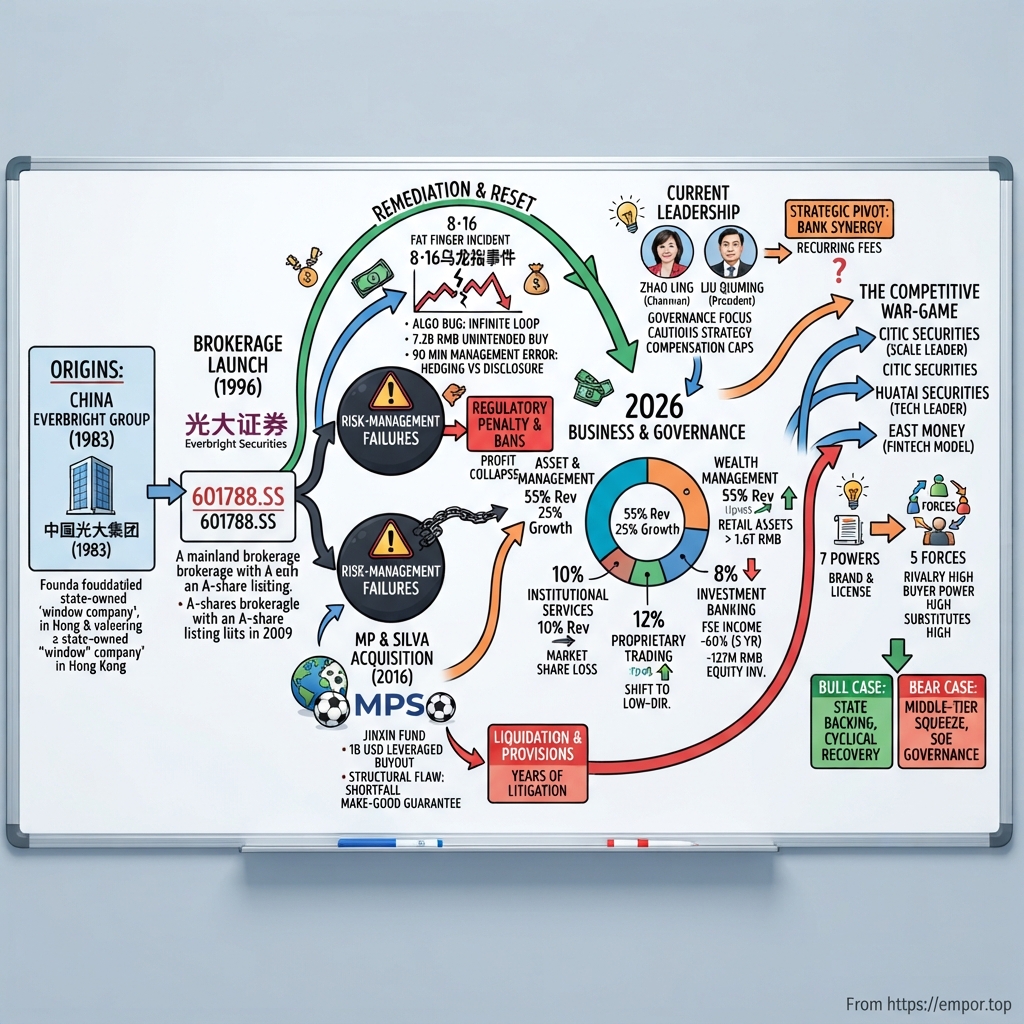
Everbright Securities: Scandal, State Backing, and the Search for Scale
I. Introduction & Episode Roadmap
At 11:05 a.m. on August 16, 2013, the Shanghai Stock Exchange did something it had never done before in the middle of an ordinary summer session: it went vertical. In roughly seventy seconds, the SSE Composite Index leapt almost six percent. Blue chips — the big banks, PetroChina, the insurers, the names that move like container ships — slammed into their daily limit-up ceilings simultaneously. Traders across Lujiazui stared at screens and reached, reflexively, for the only explanation that made sense: a stimulus package must have leaked. A bank bailout. A state rescue. Something enormous.
There was no policy. There was a software bug inside one brokerage's proprietary trading system, and the brokerage was 光大证券 Everbright Securities Company Limited.6
What makes the episode noteworthy is not the spectacle, but that those seventy seconds were not an aberration in the firm's character. They were the first of two demonstrations of the same underlying flaw, three years apart, in completely different businesses.
That is the paradox at the center of this story.
Everbright Securities is not a fly-by-night operation. It is a full-licence Chinese investment bank listed on the 上海证券交易所 Shanghai Stock Exchange under code 601788, with a secondary listing in Hong Kong, sitting inside one of the People's Republic's oldest and most politically wired financial conglomerates, 中国光大集团 China Everbright Group.13 It has a brokerage network stretching across the mainland, an asset management arm, an investment bank, a research house, and — behind all of it — the implicit balance sheet of the Chinese state. It is exactly the kind of institution that is supposed to be boring.
Instead, it has been the backdrop for two of the most instructive risk-management failures in modern Chinese finance. The first was the seventy seconds of 2013, an episode Chinese markets still call the 8·16乌龙指事件 8.16 Fat Finger Incident, which ended with a record regulatory penalty and lifetime bans for senior executives.7 The second, three years later, was a billion-dollar leveraged buyout of a European sports-television-rights business that most of the people underwriting it had almost certainly never watched a match on — a deal that ended in a London liquidation, a Chinese tech company's implosion, and years of litigation provisions grinding through the income statement.410
The question at the center of this analysis is deceptively simple. How does a state-backed financial pillar manage to trigger a market-paralysing algorithmic panic, incinerate over a billion dollars in a botched European media buyout, and still remain profitable, growing, and in 2026 posting its best half-year in years? And more usefully for anyone evaluating where the business goes from here: what did those failures actually cost, structurally, in a Chinese securities industry that has spent the last decade consolidating toward scale?
The Roadmap
The examination follows a clear progression. First, the origin story — how a Hong Kong "window company" created to bring foreign capital into a reforming China spawned a mainland brokerage, and what state parentage genuinely buys and genuinely costs. Then the anatomy of the 2013 meltdown, which is less a story about a software bug than a story about what management did in the ninety minutes afterwards. Then the 浸鑫基金 Jinxin Fund and the MP & Silva catastrophe, a case study in how a subsidiary can write guarantees the parent did not price. Then the business as it actually exists in 2026 — five segments, wildly different economics, one of them still bleeding. Then the people currently running it, chairman 赵陵 Zhao Ling and president 刘秋明 Liu Qiuming, and whether their record over time supports the "we have changed" narrative. Then the competitive war-game: Hamilton Helmer's 7 Powers, Porter's Five Forces, and an honest comparison against 中信证券 CITIC Securities and 华泰证券 Huatai Securities. And finally the bull case, the bear case, and the small number of metrics actually worth tracking.
The analysis begins where the money and the licence originated.
A key analytical posture is required from the outset. This is a company with a dramatic history, and dramatic histories invite two equally lazy conclusions: that the scandals define it permanently, or that they are ancient news now fully priced. Neither survives contact with the numbers. The task is to work out exactly which parts of the damage were financial and therefore repairable, which parts were franchise damage and therefore not, and what the current business would look like if the A-share market stopped cooperating.
 Subscribe on LinkedIn
II. State-Owned Roots & The Everbright System
The Window Company
Picture Hong Kong in 1983. The Sino-British negotiations over the colony's future were grinding forward, the Hang Seng was jittery, and the People's Republic was five years into 改革开放 reform and opening up with an acute problem: it needed foreign capital, foreign equipment, and foreign know-how, but had almost no institutional plumbing to acquire any of them. Beijing's answer was a category of entity now largely forgotten outside China — the "window company," a state-owned vehicle incorporated offshore, staffed by trusted cadres, and licensed to do business in the capitalist world on the mainland's behalf. China Everbright Group was one of the first and most important of them, founded in Hong Kong that year.1
The word 光大 translates loosely as "glorious and great," reflecting the era's self-image. The mandate was less poetic: buy aircraft, buy machinery, raise money, learn how international finance actually worked, and bring that knowledge home. Over the following decade, Everbright expanded from a trading and investment agency into a financial conglomerate — a bank, an insurance business, an asset manager, a Hong Kong-listed investment arm in China Everbright Limited, and eventually a securities house.
1996: A Brokerage for a New Market
Everbright Securities was launched in 1996, at precisely the moment mainland China needed one. The Shanghai and Shenzhen exchanges were barely six years old. State-owned enterprises were being corporatised and listed by the hundreds. Somebody had to underwrite that paper, and somebody had to open brokerage accounts for the tens of millions of ordinary Chinese households discovering equities for the first time. Everbright Securities was built to do both, and its A-share listing on the Shanghai Stock Exchange followed in 2009 — raising the permanent capital a balance-sheet-intensive securities business needs, and giving the parent a publicly marked valuation for the first time.12
The timing of that listing is worth noting. 2009 was the year after the global financial crisis, when Chinese policy had turned sharply expansionary and domestic equities had rebounded violently. Chinese brokerages have an almost mechanical habit of raising equity capital into strong markets, because that is when their own shares are most highly valued and when the balance-sheet businesses they want to fund look most attractive. It is rational, but for existing shareholders, it is also a recurring source of dilution in this industry. Everbright's share count has risen over time — from roughly 2.4 billion weighted average shares in 2006 to about 4.6 billion by the mid-2020s — representing a nearly twofold increase in the claims on the same franchise.11 Any assessment of long-run value creation must be made on a per-share basis rather than in aggregate, and the per-share picture is materially less flattering.
What the Licence Is Worth
What does state parentage actually buy? Three concrete advantages exist, and it is worth being precise because the phrase "state backing" is often used as a catch-all explanation for resilience.
First, funding cost. A Chinese brokerage is, economically, a leveraged spread business. It borrows in the interbank and bond markets, lends against securities collateral through margin financing and stock-pledge lending, and warehouses inventory in its proprietary trading book. Every basis point saved in borrowing costs flows directly into net interest margin. A firm whose ultimate shareholders include Central Huijin Investment — the state's holding vehicle for its financial-sector stakes — and, above it, the Ministry of Finance, borrows at rates a privately controlled peer of equivalent size simply cannot match. That is a real, durable, measurable advantage.
Second, mandates. Chinese corporate finance remains substantially a state-to-state business. When a provincial SOE issues a bond or a central enterprise conducts a follow-on equity raise, the syndicate is not selected purely on pitchbook quality. Relationships, political comfort, and shared ownership lineage matter. A brokerage inside the Everbright system enters those conversations with an inherent institutional advantage.
Third, distribution. 中国光大银行 China Everbright Bank operates a national retail branch network. In theory, a brokerage that can distribute wealth-management products through a sister bank's client base gains a customer-acquisition channel that a standalone broker would have to buy at market prices. Later analysis will examine whether that theory has actually translated into revenue, as the empirical evidence for this persistent claim remains thin.
It is worth pausing on the fourth advantage state parentage bought, which is often overlooked: regulatory sequencing. Chinese financial liberalisation has rarely been a general opening. Instead, it has proceeded through pilot programs in which the regulator selects a small group of firms, permits them to operate a new business under supervision, and broadens the permission set if operations remain stable. Being in the initial cohort is exceptionally valuable, allowing firms to accumulate clients, systems, and operational expertise while competitors wait. When China launched its margin trading and short selling pilot in early 2010, the initial permissions went to a handful of selected brokerages — establishing what would become one of the most lucrative profit pools in the industry, as lending money to retail investors against their shareholdings is a high-spread, collateralised business that scales directly with market volume.9 Everbright's position inside the state financial system provided precisely the credentials required for inclusion in those early cohorts.
However, that sequencing advantage decays quickly. A pilot permission is a head start, not a permanent moat. Once a business becomes generally licensed, competition shifts to price, technology, and balance-sheet capacity, with market share moving to firms with the largest balance sheets and most efficient technology infrastructure. This pattern shapes nearly every competitive challenge in Everbright's history: its structural advantages stem from ownership, but they are non-differentiating because they are shared with every other SOE brokerage in China.
The Bill for the Backing
What does state parentage cost? Here, the empirical record is unusually clear.
Three distinct costs exist, each measurable.
First, it caps executive and employee compensation. Under 共同富裕 common prosperity guidelines and subsequent regulatory pressure on financial-sector pay, Chinese securities firms have compressed remuneration across the board, with SOE brokerages facing the strictest limits. Everbright's chairman drew pre-tax compensation of roughly RMB 1.97 million in 2025, while its president received about RMB 1.82 million.15 These compensation levels make it difficult to compete for top quantitative talent or premier technology investment bankers against private funds or offshore platforms. Average compensation across the firm has drifted toward the lower end of its peer group, and total headcount fell by nearly 1,500 people over the five years to 2025 — the steepest decline among comparable brokerages.15 The metrics indicate a firm losing ground in the competition for industry talent.
Second, state parentage has historically created a structural risk-management mismatch: the speed at which a state-backed balance sheet can deploy capital often exceeds the speed at which its risk-control functions understand that capital's exposure. Abundant, low-cost capital combined with growth mandates and compliance frameworks designed for simpler businesses produced both major risk failures in Everbright's history. This does not mean SOE ownership inherently causes operational failures; rather, it demonstrates that access to cheap, politically comfortable capital carries specific operational hazards that Everbright failed to contain twice.
Third, state ownership introduces conflicting corporate objectives that affect valuation. A listed company controlled by the state serves multiple principals. While minority shareholders prioritize return on equity, the controlling shareholder balances financial returns against systemic stability, credit allocation to policy-favoured sectors, employment preservation, and risk avoidance. While these goals often align, at the margin — such as deciding whether to underwrite a marginal state-linked issuer or return excess capital rather than retain it for future policy mandates — minority shareholders do not hold the deciding vote. This alignment constraint is explicitly disclosed in the firm's mandate, representing a structural condition of the investment rather than a temporary phase.
The first time this structural control failed, the capital was not even deployed by a human being.
III. Inflection Point I: The 2013 "8·16 Fat Finger" Algorithmic Meltdown
Seventy Seconds
The common name is a misnomer, and the misnomer matters. "Fat finger" implies a trader typing too many zeros—a human error, embarrassing but bounded. What occurred inside Everbright Securities' strategic investment desk on that August morning was categorically worse: no human was involved in the moment of failure.
The underlying mechanism was straightforward. The desk operated an arbitrage strategy designed to exploit minute price discrepancies between exchange-traded funds and their underlying stock baskets, or between index futures and the index itself. Because these strategies generate thin per-trade margins, they rely on high speed and massive volume. Executing them requires an order-management system—software that translates high-level strategy instructions into thousands of discrete exchange orders.
Everbright's software contained a fatal flaw in its handling of unexecuted orders. In a properly functioning system, an unfilled order is either retried in a controlled sequence or canceled. At Everbright, logic errors in order generation and retries caused the system to regenerate orders in an infinite loop. Crucially, no automated, independent capital limit existed to halt execution. The system functioned like a thermostat with no upper limit, continuously demanding more buying power with no safety switch to cut off trading.
Within minutes, the algorithm generated buy orders totaling roughly 23.4 billion yuan. Around 7.2 billion yuan of those orders actually executed before staff could intervene.6 To put that sum in perspective, Everbright Securities earned just 206 million yuan in net profit for all of 2013.11 In under two minutes, a single automated loop acquired an equity position worth more than thirty times the firm's entire annual earnings—at prices driven artificially skyward by its own buying.
Why the Market Believed It
The market's reaction provided a textbook lesson in financial reflexivity. Observers looking at the trading tape could not see a software bug; they saw only massive, price-insensitive buying across China's largest state-backed blue chips. Market participants drew the logical inference that Beijing had launched a major stimulus or market rescue. That assumption fit the pattern of state intervention, but it was entirely wrong. Trading volume surged as market participants chased the phantom signal, only for index gains to collapse later in the session as the truth began to emerge.
The Ninety Minutes That Mattered More
The transition from an operational mistake to a legal catastrophe unfolded over the next ninety minutes.
Everbright management realized almost immediately that the firm held billions of yuan in unintended long equity exposure, purchased at inflated valuations in a market bound to collapse once the error became public. From a pure trading perspective, the textbook reaction was to hedge the exposure. Before making any public disclosure, the trading desk shorted stock index futures and converted equities into exchange-traded funds to offset the position.
The 中国证券监督管理委员会 China Securities Regulatory Commission evaluated that response through a strictly legal lens. In the regulator's determination, Everbright possessed material, non-public information: specifically, that the morning's market surge was driven entirely by its own technical glitch and would unravel upon disclosure. Trading on that knowledge prior to public announcement constituted insider trading. The CSRC established that exploiting non-public information about an operational failure is legally indistinguishable from trading ahead of corporate earnings or mergers. Consequently, the CSRC imposed penalties totaling roughly 523 million yuan, issued lifetime market bans to senior personnel connected to the decision, and restricted the firm's ability to open new business lines.78
The direct financial fallout was severe. Everbright's net income collapsed from roughly 1.0 billion yuan in 2012 to 206 million yuan in 2013—a fifth of the prior year—with return on equity falling below one percent.11 Yet the long-term strategic damage proved far more debilitating. Investment brokerages depend fundamentally on institutional trust. Clients witnessed Everbright's risk controls fail in real time, followed by executive management quietly hedging the firm's position before informing the market. Both actions gave institutional investors compelling reasons to route order flow elsewhere. Furthermore, the regulatory freeze on new business lines arrived just as Chinese brokerages were expanding into lucrative, balance-sheet-intensive activities such as margin financing, derivatives, and prime brokerage. Sitting out part of that build-out phase imposed a multi-year competitive handicap.
Attributing the August 16 incident to simple misfortune or a rare software bug is contradicted by the facts. The defect lay in order retry logic—a routine, predictable failure mode in algorithmic design. The disaster occurred because the firm lacked an independent risk circuit breaker outside the trading software, and because executive management prioritized loss mitigation over immediate market disclosure. Both were structural governance failures rather than bad luck. This pattern makes the firm's subsequent crisis three years later particularly revealing: while the second failure involved a different asset class on a different continent, it shared the exact same underlying vulnerability—balance-sheet exposure accumulating faster than internal oversight could identify or control.
Examine why the regulator's insider-trading ruling stood as a vital precedent. A defense of management's actions suggests the firm faced an emergency, owed a fiduciary duty to shareholders to limit capital losses, and acted prudently by hedging. That argument fails market neutrality standards. The counterparties taking the other side of those hedges were purchasing index futures and selling protection based on price levels that Everbright alone knew were artificial. Every yuan Everbright saved through early hedging represented capital extracted from market participants who lacked that information. Financial markets can absorb participants who make execution errors; they cannot function if failing institutions are permitted to transfer the cost of their errors to uninformed counterparties. This principle explains the severity of the CSRC's enforcement: heavy fines, business restrictions, and lifetime market bans for key decision-makers.
The incident also reshaped the regulatory framework for automated trading across China's securities industry. Regulators subsequently mandated strict order-throttling controls, exchange-level member circuit breakers, automated pre-trade capital checks, and real-time risk verification across all brokerages. In effect, Everbright absorbed the cost of upgrading the industry's operational standards. While peer institutions gained valuable risk-management lessons at no cost, Everbright surrendered two years of profits, eroded its institutional standing, and became the enduring Chinese-language shorthand for algorithmic failure.
A final distinction is essential when evaluating the firm's ongoing disclosures. The 2013 loss did not stem from incorrect market direction calls; it resulted from accumulating positions the firm never intended to hold. Managing market risk—taking calculated views on asset prices—is a core brokerage function. Operational risk—where internal machinery acts without authorization—represents pure loss without compensating return. Investors should treat operational risk far more strictly than investment misjudgments, a distinction underscored by the fact that both defining losses in Everbright's history belonged firmly to the operational category.
IV. Inflection Point II: The MPS Debacle & Cross-Border M&A Hubris
The Gold Rush
In 2015 and 2016, Chinese capital pursued European assets with extraordinary intensity. Hotel chains, football clubs, film studios, insurance companies, industrial groups — domestic investment returns were compressing while offshore diversification gained momentum, leading Chinese financiers to conclude that global trophy assets were undervalued by incumbents who failed to appreciate the growth of the Chinese consumer. Sports media rights sat near the top of the acquisition list. The underlying thesis was simple: China had 1.4 billion people, a rapidly growing appetite for European football, and virtually no domestic infrastructure for monetising it.
The Asset
MP & Silva was the primary asset matching that thesis. Founded in 2004 by Riccardo Silva and Andrea Radrizzani, MPS operated as an intermediary: it purchased international broadcasting rights from sports leagues and rights-holders — including Serie A, Premier League packages, tennis, and motorsport — and resold them to global broadcasters, capturing the spread. At its peak, it was one of the world's prominent independent sports rights agencies.
In 2016, a Chinese consortium acquired 65% of the business for approximately US$1 billion.4 The purchasing vehicle was the Jinxin Fund, a special-purpose investment partnership. The orchestrator and general partner was 光大资本 Everbright Capital, the alternative-investment subsidiary of Everbright Securities. The most visible co-investor was 暴风集团 Baofeng Technology, a Shenzhen-listed video-streaming company that had briefly become one of the highest-flying momentum stocks in A-share history.10
Two Failures, One Fatal
Deconstructing the transaction reveals two distinct breakdowns — one of valuation and one of structure — with the structural error proving decisive.
The valuation failure was the more conventional mistake. MPS did not own underlying media rights; its business consisted of reselling third-party contracts of finite duration. Enterprise value was essentially the present value of a rolling book of medium-term agreements, combined with the key personnel relationships required to renew them. Those commercial relationships resided largely with a small group of founders. Reporting on the collapse indicates the transaction failed to secure those founders with the long-dated non-compete and retention structures essential for a rights-agency acquisition.4 Acquiring a business whose primary assets walk out the door every evening without contracting for their return effectively means paying a control premium for a portfolio of expiring contracts. That vulnerability materialized quickly: key broadcasting rights were lost, renewals failed to materialize, and the core business hollowed out.
The structural failure proved far more damaging, ultimately transferring the deal's liabilities directly onto Everbright Securities' consolidated balance sheet rather than confining them to a fund write-down.
Jinxin was structured in capital tranches. Senior limited partners — including 招商银行 China Merchants Bank and Shanghai Huarui Bank — provided the bulk of the capital in a priority position. In standard private equity structures, senior limited partners assume equity risk while holding waterfall priority; they are not lenders, and face principal loss if the underlying asset fails. In Jinxin's case, Everbright Capital provided these senior investors with liquidity support undertakings — known in Chinese markets as 差额补足承诺, or "shortfall make-good" commitments. In economic substance, these agreements transformed the senior limited partners' equity risk into a functionally guaranteed obligation of Everbright Capital.4
The result was an equity exposure with capped upside and virtually uncapped downside through the guarantee. Furthermore, these commitments were issued without corresponding board-level authorization or appropriate risk provisioning at the parent level. The balance-sheet exposure existed long before the parent institution priced or managed it — reproducing the pattern of the 2013 incident through legal documentation rather than software code.
The Bill Arrives
The subsequent collapse was swift and public. MPS lost major broadcasting contracts and entered court-ordered liquidation in the United Kingdom in October 2018.4 Baofeng Technology, whose acquisition strategy far outpaced its cash generation, disintegrated, with its founder becoming a central cautionary figure of China's tech boom.10 Meanwhile, Everbright Securities discovered that its subsidiary's side commitments had become a parent-level obligation, exposing the firm to contingent liabilities running into billions of renminbi and forcing heavy earnings provisions.
The financial toll was severe. Net profit attributable to shareholders plunged from roughly RMB 3.0 billion in 2017 to RMB 103 million in 2018 — a drop of over ninety percent — before recovering only modestly to RMB 568 million in 2019.11 That performance compressed return on equity to approximately 0.2% and 1.2% across those two years — returns below a basic savings account, generated on tens of billions of renminbi in shareholder equity. In effect, two full years of corporate earnings were surrendered to a failed European rights broker.
The Reckoning
Governance consequences followed over the subsequent years. Former chairman 薛峰 Xue Feng stepped down and became the subject of an investigation. In May 2022, Caixin reported a further wave of senior departures at the brokerage amid a broader anti-graft campaign across China's financial sector, demonstrating that institutional accountability extended well beyond a single transaction.5 Legal disputes lingered for years until September 2023, when the firm reached settlements over the failed acquisition with reported payouts in the hundreds of millions of dollars.4
The analytical conclusion is clear. Everbright's two defining institutional crises occurred three years apart, originated in different business units, and involved entirely different asset classes and legal jurisdictions. What connected them was a shared failure in real-time risk visibility: the institution's inability to recognize the scale of the financial obligation it had created at the moment of creation. Evaluating the current management team requires assessing whether this underlying exposure-visibility flaw has been permanently resolved, rather than merely noting the cessation of algorithmic arbitrage or European buyouts.
Before evaluating that question, the analysis must examine how the firm operates today and where its earnings currently originate.
V. Segment Breakdown & Core Revenue Drivers
The Shape of the Business
Behind the headlines, Everbright Securities operates as a five-engine business where one division drives most of the earnings, another has shrunk for half a decade, and a third continues to generate losses.
The Numbers as Reported
For full-year 2025, the firm reported operating revenue of roughly RMB 10.85 billion, up about 13% year-on-year, while net profit attributable to shareholders rose 22% to approximately RMB 3.72 billion.1415 Total assets stood at RMB 318 billion, supported by shareholders' equity of RMB 71.9 billion.15 Operational momentum continued into the first half of 2026, with revenue reaching RMB 6.06 billion—an 18.2% gain—and net profit attributable to shareholders climbing 32.5% to RMB 2.23 billion.1213 Profit excluding non-recurring items grew by 33.6%, confirming that the earnings expansion stemmed from core operations rather than one-off gains.
These results reflect a supportive market environment in mainland equities. A closer look at the segment breakdown reveals the underlying quality of those earnings.
Wealth management is the primary growth engine. In 2025, the wealth management division generated RMB 5.96 billion in revenue—roughly 55% of the firm's total—representing a 25% year-on-year increase.15 Client assets expanded to over RMB 1.6 trillion, reaching a five-year high.14 This retail franchise combines brokerage commissions, fund distribution fees, and net interest income from 融资融券 margin financing, where clients borrow against existing shares to expand their market exposure.
Margin financing yields attractive net interest margins when equity markets rally and retail investors seek leverage. However, margin balances contract quickly during market downturns, and sharp price drops introduce collateral liquidation risks. Because margin financing requires substantial capital, Everbright's state-backed status provides a genuine funding cost advantage. Yet the segment's heavy reliance on retail trading volume and leverage means its fast expansion reflects cyclical tailwinds rather than structural fee-advisory gains.
Institutional services and proprietary trading present mixed signals. Institutional customer services—encompassing equity research, fund-manager trading seats, and quantitative platform services—generated RMB 1.10 billion in 2025, virtually unchanged from the prior year.15 Flat revenue during a buoyant market signals lost market share, reflecting persistent institutional caution following the 2013 trading incident and aggressive competition from larger rivals.
Meanwhile, the firm's proprietary investment and trading desk generated RMB 1.29 billion, an 18% increase year-on-year.15 Management has aimed to reallocate capital into low-directional, absolute-return strategies to damp historical earnings volatility. While an 18% gain in a rising market aligns with that objective, the portfolio's market neutrality remains untested until the next sustained market downturn.
Investment banking remains a persistent weak spot. Corporate financing revenue reached RMB 884 million in 2025, up just 2% year-on-year.15 The broader trajectory highlights a deeper contraction: investment banking fee income dropped from RMB 1.99 billion in 2020 to RMB 775 million in 2025—a multi-year decline exceeding 60%, even as peers like 中金公司 CICC expanded their underwriting franchises.15
This contraction carries consequences beyond lost underwriting fees. An active investment bank feeds institutional sales, equity research, and corporate advisory relationships across the entire firm. While regulatory tightening by the CSRC reduced overall A-share IPO activity across the industry, Everbright's loss of relative market position coincided with firm-wide headcount reductions and below-average employee compensation.15 Management highlighted record real-economy financing volume of RMB 959 billion in 2025—up 10%, including RMB 180.9 billion in green industry underwriting and RMB 294.2 billion in technology sector deals.14 However, the contrast between rising policy-driven transaction volumes and a halving of fee income underscores severe fee-compression and market-share erosion.
Asset management is stabilizing, while equity investment continues to bleed. Asset and wealth product management generated RMB 1.18 billion in 2025, up 2%, as 光大证券资管 completed its strategic transition toward standardized, liquid investment products.15 Moving away from legacy channel business lowers per-unit fee margins but builds a more resilient fee base. In contrast, the equity investment segment—housing legacy principal investments and private equity holdings inside Everbright Capital—reported negative revenue of RMB 137 million in 2025.15 A decade after the MPS acquisition, the subsidiary behind the transaction remains a drag on consolidated results.
Peer comparisons highlight structural lagging. Everbright's 2025 revenue growth of 13% and net profit growth of 22% trailed broader industry averages of 20% and 31%. The firm's net profit ranking dropped to thirteenth nationwide, down from eleventh in 2023.15 Return on equity stood at 5.2% in 2025, recovering from 4.5% in 2024 but remaining below 2023's 6.4% and far short of industry scale leaders.11
What a Decade of Results Actually Shows
The long-term revenue trajectory illustrates the firm's structural reset. Operating revenue peaked at RMB 20.4 billion in 2021 before declining sequentially to RMB 10.9 billion in 2025—a halving of top-line revenue over four years, even as net profit recovered.11 Part of this reduction reflects intentional balance-sheet de-risking and smaller proprietary books, but it also reflects top-funnel contraction in investment banking. Improving margins on a halving revenue base indicates cost discipline and risk reduction rather than market-share gains.
Historical comparisons illustrate the cyclical range of the business. During the 2015 bull market, Everbright generated RMB 7.6 billion in net profit on a smaller capital base, delivering a return on equity of nearly 19%.11 By contrast, crisis-plagued years saw return on equity collapse to 0.2%, while recent normalized years hover around 5%. This wide dispersion reflects a capital-intensive intermediary whose long-run returns remain tied to market cycles.
Ultimately, brokerage revenue acts as a transaction tax on broader market activity. While a firm cannot control trading volumes or underwriting pipelines, it can manage its cost structure, risk controls, and revenue mix. Shifting toward recurring asset-based fees represents the central strategic challenge for Everbright Securities. As of 2026, the firm remains a cyclically recovering, mid-tier brokerage whose profit rebound rests primarily on retail market activity, while its highest-value institutional franchise remains constrained.
VI. Current Management, Governance & Modern Strategy
The Language of the Results Briefing
At its annual results briefing for the 2025 financial year on March 28, 2026, Everbright Securities presented a specific narrative. Chairman Zhao Ling emphasized that the firm was anchored on building a service-oriented investment bank, pointing to policy-driven achievements — such as record financing volumes, green finance, technology underwriting, and pension products — as its headline successes.14
That framing reflects an institution defining success by policy alignment alongside commercial performance. As a state-controlled entity, Everbright operates under controlling shareholders that evaluate management against broader national mandates in addition to financial returns. This dual mandate is an accurate description of the firm's governance reality, but it carries a clear implication for investors: maximizing return on equity is not the sole objective function.
Who Is Running It
Zhao Ling assumed the chairmanship following post-scandal leadership restructuring, moving from within the broader Everbright group with a banking background rather than a capital-markets orientation. That background aligned with a parent company prioritizing internal control and discipline. President Liu Qiuming provides the operational complement. Born in 1976, Liu holds a master's degree from Shanghai University of Finance and Economics and an EMBA from China Europe International Business School; his career spanned institutional leadership at Shenyin Wanguo Securities, a managing director role at UBS Securities, and a vice-presidency at Ping An Securities before he joined Everbright.16
This leadership structure pairs a chairman focused on governance credibility with a president tasked with commercial expansion. Assessing their stewardship requires measuring action against historical precedents and stated commitments. On this standard, the empirical record shows distinct contrast.
On capital allocation, current management has demonstrated restraint. The firm has avoided repeating complex structures like the Jinxin fund, abstaining from large offshore principal investments. Having absorbed historical provisions and settled the MPS litigation in 2023, management repositioned the Hong Kong subsidiary, 光大证券国际 Everbright Securities International, away from principal trading toward wealth management for high-net-worth clients.4 Public disclosures and results briefings have adopted a cautious tone, prioritizing explicit risk management over aggressive expansion goals.14
However, avoiding new crises differs from establishing fully effective risk controls. Through 2025, the firm accumulated branch-level regulatory sanctions and became entangled in securities-fraud litigation involving a former client issuer.15 While routine regulatory actions affect many Chinese brokerages, these ongoing compliance issues indicate persistent operational friction rather than complete systemic remediation. The evidence suggests material reduction in extreme tail risk, even as day-to-day risk management remains an area of ongoing effort.
The Incentive Problem
A structural constraint shapes executive incentives across state-owned brokerages. Chinese SOE securities firms do not grant equity options, and executive pay remains subject to regulatory limits under common prosperity policies. In 2025, the chairman received approximately RMB 1.97 million in pre-tax compensation, while the president received roughly RMB 1.82 million — figures significantly below compensation at private asset managers, offshore platforms, or foreign investment banks.15 This compensation structure creates a specific incentive alignment: management's primary objective is avoiding severe operational failures that threaten careers within the state system, rather than pursuing high return on equity. While this cautious orientation fits a firm recovering from past risk failures, it presents a structural headwind for shareholders seeking aggressive franchise expansion in talent-dependent businesses like investment banking and institutional trading.
Back to Basics
This incentive structure leads directly to a conservative operational strategy: leveraging China Everbright Bank's branch network to distribute retail wealth products, expanding client assets, and capturing cyclical equity market tailwinds without taking balance-sheet risk. The expansion of client assets beyond RMB 1.6 trillion in 2025 demonstrates execution under this approach.14 However, official disclosures do not isolate how much growth stemmed from bank-channel cross-selling versus general equity market appreciation. While parent bank synergies have been a central strategic thesis for two decades, the wealth segment's ongoing reliance on transaction-linked revenue indicates that a durable, high-margin fee advisory model remains unproven.
This dynamic leads directly to a central analytical question: in a Chinese securities industry undergoing steady consolidation toward market scale, what proprietary advantages does Everbright possess that peers cannot easily replicate?
VII. Competitive Analysis: 7 Powers & 5 Forces Framework
Seven Powers
Evaluating Everbright Securities alongside peers such as CITIC Securities, Huatai Securities, 国泰君安 Guotai Junan, and 东方财富 East Money clarifies the structural boundaries of its franchise.
Hamilton Helmer's 7 Powers framework asks a specific strategic question: what mechanism prevents competitors from eroding a firm's market share and profitability over time?
Scale economies: moderate, and on the wrong side of the divide. Research platforms, trading technology, risk systems, and compliance infrastructure are largely fixed costs spread across firm revenue. An institution twice the size of a peer amortizes those investments at half the unit cost—and in Chinese securities, market leaders are significantly more than twice Everbright's size. A thirteenth-place ranking by net profit with the gap to the top ten widening represents the operational signature of subscale economics, rather than a firm quietly compounding market share.15
Counter-positioning: absent. Counter-positioning requires a business model incumbents cannot emulate without damaging their existing economics. Everbright operates as a conventional incumbent, relying on branch-based distribution, traditional commission structures, and full-service operations. If any player holds counter-positioning power in this market, it is East Money, whose internet-native, low-cost brokerage—built atop a financial information portal—directly targets the commission pool Everbright depends on, a cost structure a branch-heavy state enterprise cannot match without cannibalizing its legacy revenues.
Switching costs: low where it matters most. Transferring a Chinese retail brokerage account requires minimal effort, and retail investors remain highly sensitive to commission pricing. While margin financing relationships and account inertia create minor operational stickiness, these dynamics represent routine friction rather than a durable economic moat.
Branding and cornered resource: genuine assets with non-differentiating value. The 中国光大 brand conveys default safety to Chinese retail savers, for whom institutional solvency is a primary consideration. Furthermore, a full-tier securities license operating within a state financial conglomerate represents a cornered resource in the literal Helmer sense—it cannot be purchased on the open market and is politically granted. This combination underwrites both low wholesale borrowing costs and access to state-connected underwriting mandates. However, because this asset is shared with every other state-owned brokerage, it protects Everbright's solvency far more than it defends its market share.
Process power: historically negative, currently neutral at best. Process power exists when an organization executes operational tasks with superior, hard-to-replicate internal capabilities. Everbright's historical risk failures demonstrate the opposite pattern, indicating that recent management efforts have focused on reaching industry parity rather than establishing an operational advantage.
Evaluated together, Everbright possesses a single durable power—its brand and license cornered resource—that provides little differentiation within its state-backed peer group, while the structural powers driving relative returns favor larger competitors.
Five Forces
Applying Porter's Five Forces highlights where industry profits face structural compression.
Rivalry: intense. Chinese brokerage commission rates have faced persistent downward pressure for years. Competition for institutional research allocation and trading volume remains aggressive, while CSRC mutual fund fee reforms have further compressed research commission pools. Everbright's flat institutional revenue during a buoyant market year illustrates this gradual loss of market share.15
Commission compression across Chinese equities represents a structural shift rather than a temporary price war. Because order execution is a standardized commodity, pricing converges toward operational cost, which continues to decline with technological advancement. The primary strategic response across the sector has been moving into non-commoditized services—wealth management, advisory, financing, and structured products. However, when every market participant pursues the identical strategic pivot, competitive intensity shifts to the new offerings, compressing returns across those business lines as well.
Buyer power: high across client segments. Institutional asset managers facing regulatory fee reductions actively push fee pressure down the value chain, while retail clients regularly migrate toward lower-cost platforms. Neither group encounters meaningful switching costs when reallocating capital.
Substitutes: high and structural. Bank wealth management subsidiaries (理财子公司) compete directly for retail savings, independent distribution platforms such as 蚂蚁财富 Ant Fortune capture fund distribution flows, and digital platforms like East Money contest primary brokerage accounts. Everbright must simultaneously defend retail commissions, product distribution fees, and wealth allocation market share against distinct categories of competitors.
New entrants: low. Regulatory licensing requirements under the CSRC prevent unapproved technology platforms from entering the market directly. Because licenses remain scarce and tightly regulated, competitive threats originate from existing licensed fintech operators rather than external entrants.
Supplier power: low overall, with key talent constraints. Capital serves as the primary input for a financial intermediary, and Everbright's state ownership ensures reliable, low-cost borrowing. The primary exception lies in specialized human capital, where compensation caps limit the firm's capacity to compete for top industry talent.
The Field
Comparing Everbright directly against key competitors highlights its relative positioning. CITIC Securities operates as the sector's scale leader, leveraging the industry's largest balance sheet, deepest institutional franchise, and broad product suite to secure major underwriting and trading mandates. Huatai Securities built its market position by investing early in retail technology, creating a digital platform that lowered customer acquisition costs across the industry. Guotai Junan combines balance-sheet scale with strong institutional sales and research, benefiting directly from ongoing regulatory consolidation that concentrates market share among top-tier institutions. Meanwhile, East Money established an alternative model, leveraging a financial information and community platform to acquire users efficiently before monetizing them through brokerage and fund distribution.
Against these rivals, Everbright's competitive claim relies neither on market-leading scale nor technology leadership. Instead, its position rests on a national full-service footprint, a recognized state brand, and distribution synergies with China Everbright Bank within a heavily regulated market. While this combination protects the firm's core franchise, current operational evidence reveals no clear mechanism for expanding market share against top-tier competitors. In an industry characterized by rising fixed technology and compliance costs alongside declining fee rates, stagnant market share leads to gradual margin erosion.
The resulting business profile is that of a protected mid-tier incumbent—shielded from insolvency by regulatory barriers and state ownership, yet squeezed across key drivers of return on equity.
VIII. Material Risk Radar & Skeptical Investor Stress Test
The Risk Radar
Evaluating Everbright Securities from the perspective of a skeptical, market-neutral investor reveals five distinct operational and structural risks embedded in the 2025 financial disclosures.
First, fee compression driven by regulatory mandate rather than market cycles. The CSRC's mutual fund fee reforms directly reduce what fund managers pay brokerages for research and trading, while simultaneously compressing distribution economics across wealth management products. This dynamic is not a cyclical headwind that reverses when market sentiment improves; it represents a permanent structural reduction in the fee pool imposed by a regulator committed to lowering industry costs. A wealth-management strategy premised on growing fee-based advisory income is thus being executed into an environment of active regulatory fee compression.
Second, proprietary and market-beta exposure. Everbright's recent earnings recovery has derived disproportionately from the business lines most directly exposed to equity market direction. The 2019 financial result—RMB 568 million of net profit generated against a shareholders' equity base in the tens of billions—illustrates how rapidly the income statement contracts during unfavorable market conditions, even excluding legacy provisions.11 Management's strategy to reposition the proprietary book into absolute-return, low-directional strategies is the stated mitigant, but its effectiveness remains untested in a sustained market drawdown.
A key structural reality of the brokerage model is that operational risks correlate rather than diversify during a downturn. In a falling market, brokerage commission revenue contracts alongside trading volume, margin financing balances shrink as clients deleverage, the proprietary trading portfolio faces markdowns, investment banking pipelines stall as corporate issuers delay offerings, and credit impairments rise as loan collateral values fall—all driven simultaneously by the same underlying market drop. Operating across five business divisions provides limited risk diversification when systemic headwinds hit. Consequently, expanding recurring, asset-based fee income represents the firm's only genuine structural hedge, making its execution the single most critical strategic metric to monitor.
Third, legacy tail risk. The settlement of the MPS litigation resolved the firm's largest known contingent liability, and several years without major new operational failures offer meaningful reassurance.4 However, the equity investment division reported negative revenue in 2025, branch-level regulatory sanctions continued to accumulate through the year, and the firm remained involved in issuer-fraud litigation.15 The central lesson of the Jinxin Fund structure was that substantial off-balance-sheet commitments can be written before parent-level governance identifies them. Outside observers cannot independently confirm the absence of similar instruments; they can only observe that the firm has operated for several years without another comparable issue coming to light—a distinction that provides reassurance bounded by public disclosure rather than absolute proof.
Fourth, execution risk in the strategic pivot. Converting Chinese retail investors—who have historically favored self-directed equity trading—into fee-paying advisory clients requires a fundamental shift in investor behavior rather than a simple product rollout. Every major Chinese brokerage is attempting this identical transition simultaneously, yet Everbright is navigating the pivot while contending with a shrinking workforce and below-average employee compensation.15
Fifth, capital management and dilution risk. Chinese financial regulations tie a brokerage's allowable business scale directly to its net capital, requiring firms to raise equity capital to expand balance-sheet-intensive activities. For a firm delivering mid-single-digit returns on equity while trading below book value, issuing new shares below net asset value dilutes existing shareholder equity. The firm's historical pattern of raising capital during strong equity markets remains the primary precedent, making a buoyant market environment the exact setting where such equity issuances are evaluated.11
What an Activist Would Demand
A disciplined activist investor analyzing Everbright's capital allocation and operational metrics would highlight five specific structural questions.
"Explain the equity investment desk." A principal investment unit that wiped out two years of corporate earnings a decade ago and produced negative revenue in 2025 demonstrates clear downside exposure without delivering compensating returns. The activist demand is straightforward: ring-fence the unit, run off its legacy holdings, or divest it entirely, rather than framing it as strategic optionality.
"Explain the investment banking cost structure." With underwriting fee income down by over sixty percent over a five-year period alongside below-average compensation for investment bankers, maintaining a full-service investment banking operation risks subsidizing an underperforming unit. Management must either allocate the capital and compensation required to rebuild a competitive franchise or resize the unit to focus strictly on sectors where state-enterprise relationships consistently secure underwriting mandates.
"Explain the capital structure." Everbright maintains a substantial equity base while generating mid-single-digit returns on equity and trading below book value.11 If the firm cannot consistently earn its cost of capital on incremental equity, the activist's core question is why that capital is retained rather than returned to shareholders through higher dividend payouts or share buybacks. The counter-argument—that a licensed securities firm must maintain capital buffers and that its controlling state owner prioritizes national policy mandates—is real, but it underscores the core investment reality: minority shareholders co-invest alongside a controlling entity whose strategic objectives extend beyond maximizing return on equity.
"Explain the disclosure emphasis." Emphasizing record aggregate real-economy financing volumes during a period when investment banking fee income sits near multi-year lows is understandable for a state-backed enterprise. However, a skeptical analyst interprets this framing as a signal regarding which operational metrics management prefers the market to focus on.
"Explain the headcount contraction." Experiencing the steepest five-year staff reduction among peer brokerages alongside below-average compensation represents either an aggressive cost-discipline initiative or an inability to retain productive talent.15 Determining which interpretation holds true requires evaluating revenue per employee within fee-generating divisions rather than firm-wide cost ratios. Disclosed results show that the units most dependent on specialized talent—investment banking and institutional services—are precisely those that have stagnated or contracted, supporting the less favorable interpretation.
These analytical hurdles do not make Everbright Securities uninvestable, but they define the exact operational and capital constraints under which its investment case must be weighed.
IX. The Investment Story Spine: Bull vs. Bear Case
The strategic debate surrounding Everbright Securities centers on a clear question: can the firm leverage its state backing and cyclical earnings recovery to narrow its valuation gap, or do structural scale constraints and state-owned enterprise governance limit its long-term return potential?
Why It Could Win
The bull case rests on three primary pillars.
First, state parentage provides an institutional backstop. Central Huijin and the Ministry of Finance, acting through China Everbright Group, ensure that the firm retains secure, low-cost access to funding through market cycles in which private or weaker competitors encounter refinancing stress, substantially mitigating core solvency risk.1 For a balance-sheet-intensive financial intermediary, this funding advantage provides a durable operational floor.
Second, legacy liabilities have cleared while core profitability has recovered. Everbright has traded below its book value following years of provisioning, but the MP & Silva litigation that weighed on a decade of financial results reached settlement in 2023.411 Corporate earnings subsequently rebounded, with 2025 net profit attributable to shareholders reaching approximately 3.72 billion yuan—roughly six times its 2019 trough—and first-half 2026 net profit expanding by more than 32% year-on-year, driven primarily by core operations rather than non-recurring items.121315 With the equity priced below book value while generating mid-single-digit returns on equity, any sustained improvement in operating leverage that lifts returns toward high single digits presents upside potential through valuation re-rating.
Third, distribution scale offers unrealized potential. Operating within the Everbright conglomerate provides access to China Everbright Bank’s national retail branch network alongside more than 1.6 trillion yuan in total client assets.14 If management successfully converts a larger portion of these assets into recurring fee-based wealth management and advisory revenue, the firm's earnings mix will become less dependent on market turnover, supporting a higher valuation multiple.
Why It Could Fail to Outperform
The bear case rests on the same facts evaluated through a structural lens.
The central bear argument is the middle-tier trap, a position supported directly by multi-year trend data. Everbright lacks the balance-sheet scale to challenge industry leaders like CITIC Securities or Huatai Securities, lacks the low-cost digital architecture of platforms like East Money, and remains constrained by executive pay caps that hamper recruitment in high-margin institutional businesses. A drop in net profit ranking to thirteenth from eleventh nationwide, below-average growth during a supportive market, a multi-year drop in underwriting fees exceeding sixty percent, and the steepest headcount reduction among peers all reflect this structural squeeze.15 Mid-tier institutions in this competitive position face persistent margin pressure and risk long-term consolidation.
Second, state-owned enterprise governance caps equity upside while protecting downside. Strict regulatory limits on compensation, policy-driven financing mandates, and management incentives prioritized around operational risk avoidance rather than return-on-equity maximization align with a stable, mid-return institution. While such a profile offers stability at an appropriate valuation, it limits the firm's capacity to compound earnings into a premier financial franchise.
Third, broader regulatory and structural headwinds constrain overall industry profitability. CSRC fee reductions across mutual funds, tighter IPO review standards, and broader margin compression have lowered earnings ceilings industry-wide. Consequently, Everbright's recent profit rebound reflects a cyclical recovery from a low operational base during a favorable market environment rather than a structural increase in long-term return potential.
Testing the Claims Against the Record
Evaluating these competing arguments against empirical history provides clear resolution.
The state-backing thesis is confirmed by historical precedent: the firm successfully absorbed a 523 million yuan regulatory fine, a near-total earnings collapse in 2018, and billions of renminbi in contingent liabilities without encountering solvency or continuity crises.711 The institutional backstop is a demonstrated reality rather than theoretical assumption.
The valuation-recovery thesis holds in a qualified form. While net profits have rebounded and major litigation has concluded, the equity investment segment continues to generate negative revenue, branch-level regulatory sanctions persist, and current earnings remain dependent on supportive market volumes.15 The severe tail risks of past crises have been cleared, but residual operational drags remain, and current earnings levels have yet to be tested through a sustained market downturn.
The distribution-synergy thesis receives the least support from historical performance. Everbright Securities and China Everbright Bank have operated within the same corporate group for decades, yet the brokerage has not translated that connection into a differentiated, high-margin fee structure. Wealth management revenues remain heavily tied to retail trading turnover, while overall returns on equity have lagged peers without captive banking networks. While modern wealth management product platforms offer new cross-selling opportunities, bank distribution synergies represent unproven optionality rather than an established structural moat. Validating this claim requires demonstrating a rising share of recurring product distribution and advisory fees during periods of declining market volume; conversely, if wealth management revenue contracts in step with retail trading turnover during the next downturn, the synergy thesis will be disproved.
Finally, the management-credibility thesis—that internal risk controls have been permanently remediated—is supported by several years of disciplined capital deployment and the absence of major operational failures, yet remains qualified by ongoing branch-level compliance actions and persistent losses in principal investments.1415 Operational risk management has improved materially from past crisis levels, but sustained excellence across all divisions remains to be established.
The Short List
Three core metrics define the firm's operational trajectory.
First: wealth management revenue composition—specifically monitoring financial product distribution income (代销金融产品收入) alongside total client assets under management. Sustained growth in distribution and advisory fees independent of trading turnover indicates a successful wealth management pivot. Conversely, if distribution fees move in direct tandem with market volume, earnings growth reflects market beta rather than structural advisory adoption.
Second: return on equity relative to top-five sector leaders. The relative performance gap provides greater analytical clarity than absolute return numbers. If Everbright's return on equity recovers while its gap against scale leaders remains wide, the middle-tier trap thesis is confirmed; a sustained narrowing of that return gap represents the clearest evidence of competitive improvement.
Third: credit and asset impairment provisions (计提信用减值准备) alongside equity investment segment results. Impairment provisions trending toward zero combined with positive net revenue in principal investments would confirm full balance-sheet remediation. Conversely, renewed provisioning spikes or continued negative segment revenue would indicate persistent legacy liabilities.
This analytical focus deliberately excludes commonly cited volume metrics. Total real-economy financing volumes, client account growth, and underwriting league tables reflect activity rather than profitability. As Everbright's recent operating history demonstrates, record financing volume can coexist with a fifty-percent decline in underwriting fee income; transaction activity that fails to generate fee revenue represents operational workload rather than economic return.
X. Epilogue & Playbook Lessons
There is an enduring memory across Chinese trading desks of that August morning in 2013: the tape going vertical, rumors flying, and the sudden conviction that Beijing had announced a massive market intervention. What actually occurred was far simpler and more dangerous: a piece of software asked a question, and nothing in the building was configured to say no.
The Playbook
Three main lessons emerge from the Everbright story, and they generalize well beyond a single Chinese brokerage.
Shadow guarantees are the most asymmetric instrument in finance. The Jinxin structure gave Everbright Capital a minority share of a leveraged equity upside and, through the shortfall make-good undertakings, something close to the full downside of the senior investors' capital. No amount of diligence on MP & Silva's broadcasting contracts would have saved that trade, because the fatal term was not in the target's business — it was in the side letters. Whenever an institution provides liquidity support, make-good commitments, or comfort undertakings that convert someone else's equity risk into its own obligation, the economics of the transaction have been silently inverted. The exposure that matters is rarely the one on the front page of the investment committee memo.
Software control is operational control. An automated strategy without a hard, independent capital ceiling — a limit enforced outside the strategy's own logic, which cannot be overridden by malfunctioning code — is not a trading system. It is an unbounded commitment machine. The seventy seconds of the 8.16 Fat Finger incident cost more than the firm earned in the surrounding year, and the mechanism was a simple retry loop. Any institution running automated execution should be able to answer one question instantly: what stops this, and is the safeguard independent of the system that might break?
State backing is a floor, not an engine. Everbright's ownership meant that two catastrophic events — a record regulatory penalty and a billion-dollar failed buyout — produced impaired earnings rather than insolvency. That protection is real and valuable. But the same structure that guarantees the floor also caps the ceiling: compensation constraints that lose talent auctions, policy-defined success metrics that depart from shareholder returns, and an incentive system that rewards the absence of disaster more than operational excellence. Over the decade since 2013, Everbright has been rescued by its ownership and, on the evidence of its declining league-table position, constrained by it.
A fourth lesson applies more broadly to evaluating institutions with similar histories. The instinct after a scandal clears is to treat the overhang as removed and the valuation discount as an opportunity. Sometimes that holds true. But the essential question to ask is whether the crisis destroyed capital or destroyed franchise. Destroyed capital is recoverable: provisions are taken, settlements are paid, and earnings normalize. Destroyed franchise is not easily repaired, because clients who left, bankers who were never hired, and mandates that went elsewhere compound silently in the opposite direction. Everbright's post-2018 recovery provides unambiguous evidence that its capital damage was repaired. Its five-year underwriting decline and stagnant institutional business demonstrate that its franchise recovery remains an open question.
What Everbright Securities represents today is legible enough: a durable, systemically protected, mid-tier Chinese securities firm with a genuinely improved risk posture, a recovering earnings base riding a favorable market, a wealth management franchise with real assets but an unproven fee model, an investment bank that has been shrinking for five years, and a principal investment legacy that has not fully stopped bleeding.
The most useful analytical frame for the decade ahead may be this: Everbright has spent ten years proving it can survive its own mistakes. It has not yet demonstrated that it can win against top-tier competitors. Those represent fundamental differences in capability, and the second test is only now beginning in an industry that has grown more concentrated, more regulated, and less profitable than the one the firm was built to serve. Whether the next decade becomes the story of an institution that used its state-backed floor as a growth platform, or one that mistook survival for strategy, will be determined by the core metrics outlined above — not by the language of annual results briefings.
References
-
Everbright Securities Official Portal — Everbright Securities Company Limited ↩↩↩↩
-
Shanghai Stock Exchange Listed Company Information Disclosure — SSE ↩
-
HKEXnews Listed Company Disclosures (6178.HK) — Hong Kong Exchanges and Clearing ↩
-
Everbright Securities Settles Lawsuits Over Botched MPS Deal — Caixin Global, 2023-09-22 ↩↩↩↩↩↩↩↩↩
-
Top Executives at State-Owned Brokerage Resign Amid Graft Crackdown — Caixin Global, 2022-05-13 ↩
-
Everbright Securities Blames Trading Error on System Glitch — South China Morning Post, 2013-08-19 ↩↩
-
Everbright Securities Fined for Insider Trading Following Trading Error — South China Morning Post, 2013-11-15 ↩↩↩
-
China Securities Regulatory Commission Administrative Penalty Decision — CSRC ↩
-
China Launches Margin Trading Pilot Scheme for Selected Brokerages — Financial Times, 2010-01-25 ↩
-
Baofeng Founder's Downfall Offers Cautionary Tale for China's Tech Sector — South China Morning Post, 2019-05-29 ↩↩↩
-
Everbright Securities Co Ltd (601788:CH) Company Profile & Data — Bloomberg ↩↩↩↩↩↩↩↩↩↩↩↩
-
坚守功能性定位 奋楫"十五五"新程 光大证券召开2025年度业绩说明会 — 新华网, 2026-03-28 ↩↩↩↩↩↩↩↩
 LinkedIn
 WhatsApp
 Reddit
 Hacker News
 Email
Email Kindle
 RSS Feed
 Spotify
 Apple Podcasts
 Amazon Music
 Audible
 YouTube