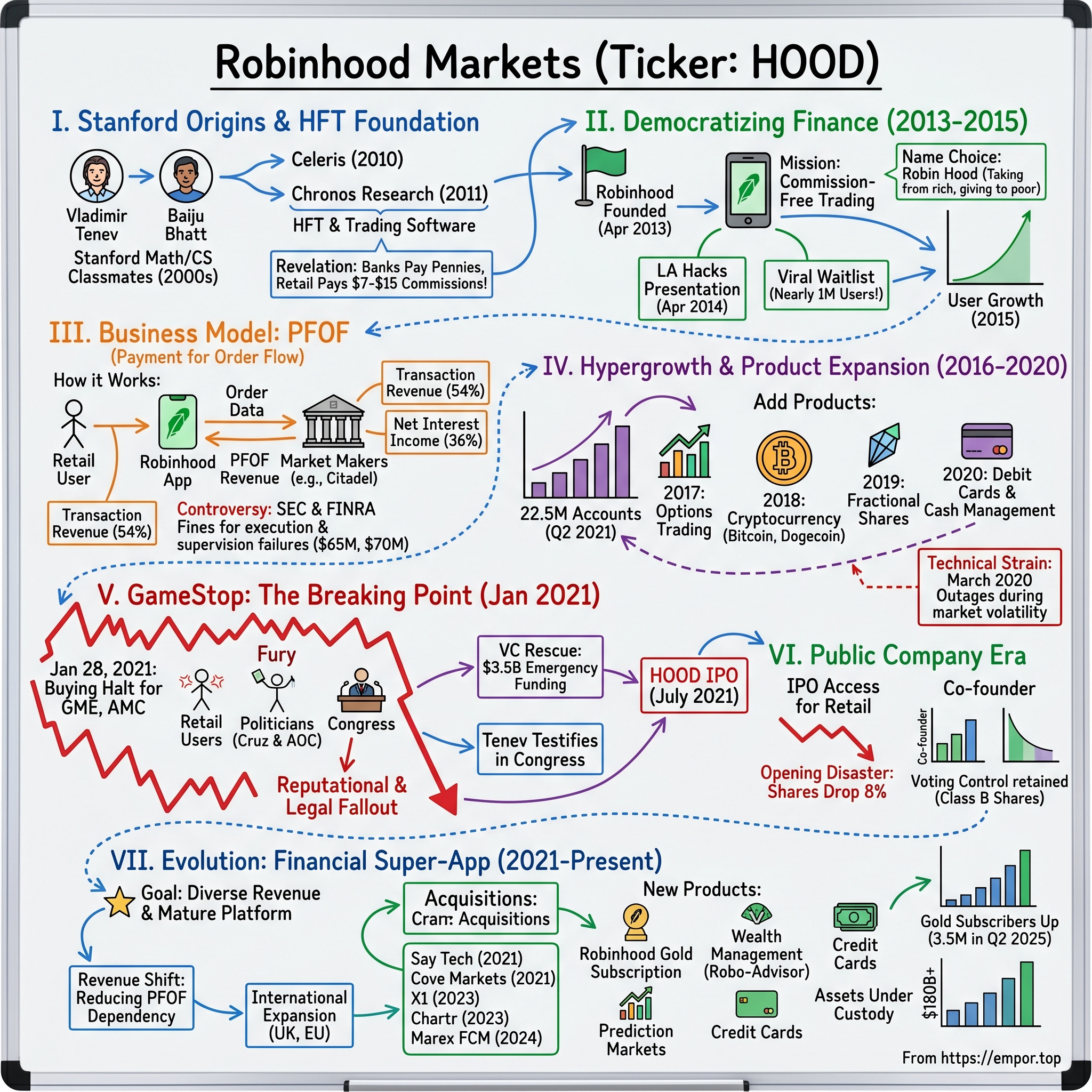
Robinhood Markets: The Anatomy of Market Microstructure Disruption
I. Introduction & Episode Roadmap (10–15 min)
At roughly 5:11 a.m. on Thursday, January 28, 2021, an automated notification reached Robinhood Securities. Sent by the National Securities Clearing Corporation—the clearinghouse utility that guarantees the settlement of U.S. equities—the notice stated that Robinhood had to post an aggregate collateral deposit of approximately $3.7 billion before normal trading could open.1 Three days earlier, that collateral requirement had stood at roughly $124 million.1 In the span of a single week of meme-stock volatility, the brokerage that pledged to "democratize finance for all" learned that the clearing infrastructure of Wall Street operated without regard to consumer mission statements.
That morning provides the clearest lens into Robinhood Markets because it reveals the company's central paradox. Robinhood is an outward-facing consumer brand whose underlying economics depend entirely on market microstructure: order routing, clearinghouse collateral, liquidity tiers, and multi-day settlement cycles. Co-founders Vlad Tenev and Baiju Bhatt were not consumer-app designers who drifted into finance; they were trading-software engineers who evaluated retail brokerage from inside market plumbing and recognized an intermediation fee structure that software could bypass.
The core thesis of this analysis is that Robinhood was never merely a retail trading app. It was an exercise in strategic counter-positioning, underpinned by a low-overhead cost structure that incumbent brokerages could not replicate without impairing their own income statements. By relying on payment for order flow rather than commissions, and by operating a software architecture with near-zero marginal costs to service incremental accounts, Robinhood normalized zero-commission trading across the industry. When Charles Schwab eliminated trading commissions in October 2019, TD Ameritrade shares dropped roughly 26% in a single day,2 and within months both TD Ameritrade and E*Trade agreed to be acquired by larger competitors.3
Yet the same interface architecture that lowered barriers for millions of first-time investors also relied on celebratory digital confetti, lottery-style stock rewards, automated options approvals, recurring infrastructure outages, a customer tragedy involving a 20-year-old account holder, and what was then the largest regulatory financial penalty ever levied by FINRA.4 Market democratization and behavioral gamification were never separate initiatives at Robinhood; they were two facets of the same core mechanism, leaving regulators, lawmakers, and investors to debate which aspect defines the enterprise.
Today's business looks markedly different from the liquidity-constrained brokerage of early 2021. For fiscal 2025, Robinhood reported $4.5 billion in net revenue—an increase of 52%—and $1.88 billion in net income.5 The company entered the S&P 500 on September 22, 2025.6 By mid-2026, it served 28.4 million funded accounts holding $369 billion in total platform assets,7 while management positioned the platform as a "Financial SuperApp" encompassing retail trading, retirement accounts, credit cards, banking services, digital assets, prediction markets, and tokenized equities.5
The stock, however, continues to reflect its historical volatility. Following a rapid advance in 2025, shares dropped more than 50% from their October 2025 crypto-driven peak before staging a partial recovery,8 and management returned to the convertible bond market in June 2026.9 For long-term investors, the central question is not whether Robinhood commands substantial scale. The question is whether management has converted a cyclical, trading-heavy business into a durable financial institution, or simply diversified into new categories of retail speculation.
Evaluating that transition requires looking beyond headline revenue growth, which has routinely expanded during retail trading frenzies. More diagnostic indicators include whether net asset inflows remain positive during subdued market environments, whether subscription and banking revenue hold up through falling interest-rate cycles, and whether average customer account balances expand as Robinhood's core user demographic ages. These tests run throughout the analysis and anchor the concluding framework around three decisive metrics.
This examination follows the chronological trajectory of Robinhood's institutional evolution. It starts with the quantitative trading origins of two immigrant-family math and physics graduates, breaks down the mechanics of commission-free trading and payment for order flow, and revisits the liquidity crunches of March 2020 and January 2021. It then tracks the post-IPO contraction, the subsequent pivot toward net interest income, the buildout of today's multi-product bundle, the firm's acquisition track record, corporate governance under founder-controlled dual-class shares, and a peer competitive analysis. It concludes with an investment thesis spine and three falsifiable operating metrics that will validate or disprove the long-term bull case. The story begins, fittingly, in a physics classroom.
 Subscribe on LinkedIn
II. Stanford Origins & The Market Microstructure Apprenticeship (2006–2012) (25–30 min)
Vlad Tenev, born Владимир Тенев in the Black Sea port of Varna, Bulgaria, in 1987, arrived in the United States as a five-year-old.101 Both of his parents worked at the World Bank, and his father, an economist, handed him Stephen Hawking's A Brief History of Time at age seven, turning family dinners into academic seminars.110 The family relocated from Delaware to Maryland and eventually to Alexandria, Virginia; Tenev later described an upbringing that was financially constrained, intellectually rigorous, and shaped by the heightened expectations placed on the only child of visa-holding immigrants.10 In his congressional testimony, he framed Robinhood's founding mission through that personal history, recalling that he was born into a country whose financial system was "not accessible to ordinary people and was on the verge of collapsing."1
Baiju Bhatt also grew up in Virginia as the only child of immigrants, carrying similarly demanding academic expectations.101 The two met not in an undergraduate dormitory, but during a Stanford summer physics program, where they bonded over voluntarily taking grueling graduate-level coursework that offered no academic credit at all.10 That detail is telling: it reflects two analytical thinkers drawn to complex technical problems for their own sake—a temperament that later yielded Robinhood's streamlined software architecture, but also contributed to a recurring tendency to underestimate the non-technical frictions of finance.
Graduating into a crisis
Tenev graduated with a mathematics degree in 2008, straight into the teeth of the global financial crisis. Unable to land a derivatives-trading role or a position at Google, he enrolled in UCLA's mathematics PhD program.10 Bhatt, meanwhile, joined a high-frequency trading firm in Marin County, California, where he saw firsthand how thoroughly electronic systems had transformed the mechanics of modern markets.10
In 2010, Tenev left UCLA to co-found Celeris with Bhatt, building high-frequency trading software in South San Francisco.10 The venture failed commercially, although Tenev later recalled that he poured "my heart and soul into it."10 The pair regrouped, moved to New York, and in 2011 bootstrapped Chronos Research, selling algorithmic trading software to banks and hedge funds and generating several million dollars in annual revenue within about a year.10 Chronos was a viable, profitable business, but Tenev came to feel it was not much of a legacy.
The asymmetry they saw from inside the machine
Chronos gave the two founders an unusual vantage point into market mechanics. Their institutional clients paid essentially nothing to execute trades, while retail investors were still being charged roughly $10 per order at incumbent brokerages.10 To two engineers spending their days optimizing microseconds for hedge funds, that disparity appeared less like an immutable business model than a structural anachronism.
The insight had a second layer, and it is the mechanism that underpins Robinhood's entire business model. Wholesale market makers such as Citadel Securities actively seek to trade against individual investors because retail orders are, in market microstructure terminology, "uninformed." An individual purchasing ten shares of a stock is rarely executing on short-term alpha that will move the broader market within milliseconds; an institutional desk unloading one million shares frequently is. The market maker's operating model resembles a casino in reverse: it seeks a high volume of small, uncorrelated orders it can internalize and match, rather than concentrated wagers from counterparties with superior near-term information.
That dynamic makes retail order flow valuable enough that wholesale market makers will pay brokerages to direct orders to them, while still providing the end customer an execution price marginally better than the best publicly quoted prices. In U.S. equities, that benchmark is the National Best Bid and Offer, or NBBO. For example, if a stock is quoted at a $10.00 bid and a $10.02 offer, an internalizing market maker can sell to a retail buyer at $10.015—delivering half a cent per share in price improvement to the customer—while capturing the remaining spread as gross profit, a portion of which is rebated back to the originating broker.
The technical DNA
Under SEC Rule 606, brokerages must publicly disclose order routing practices and payments received, while wholesale market centers report execution quality under Rule 605.1 To retail investors, those regulatory filings were dense and obscure. To Tenev and Bhatt, they provided a blueprint. The founders recognized that if a brokerage could route orders programmatically, clear trades cost-effectively, and acquire users through software rather than physical branch networks and expensive ad campaigns, commissions could drop to zero while the underlying economics remained profitable.
This technical pedigree differentiated Robinhood from standard consumer fintech startups. The core proposition was not a marketing layer wrapped around a legacy brokerage chassis, but a low-overhead cost structure engineered from first principles by founders who had built infrastructure for institutional trading desks. Jan Hammer of Index Ventures, an early investor, later compared their problem-solving mindset to the stranded astronaut in The Martian: when confronted with an unfamiliar challenge, their default instinct was to engineer their way through it.10
That engineering self-assurance would prove to be Robinhood's most potent operational asset—and, as subsequent market crises demonstrated, its most persistent blind spot. In 2013, the two founders concluded that the structural gap they had identified was wide enough to anchor an entirely new financial institution.
III. The Commission-Free Revolution & Counter-Positioning (2013–2018) (35–45 min)
In the spring of 2014, the founders met with Jan Hammer at Antonio's Nut House, a Palo Alto dive bar, to negotiate a $13 million Series A financing.10 Index Ventures had already led a $500,000 seed round the previous October.10 During the conversation, the 26-year-old Tenev asserted that Robinhood would eventually be worth "not just billions, but dozens of billions."10 While such early-stage bravado is common among founders, public markets would eventually validate that valuation, though not before severe operational strains nearly brought down the firm.
The waitlist that marketed itself
Robinhood's launch became a textbook case study in viral software marketing. The founders posted their concept on Hacker News with a straightforward proposition: equity trading without commissions.10 Within a month, 50,000 people had signed up, and the pre-launch waitlist ultimately approached one million prospective users.10 By displaying each registrant's exact place in line and allowing them to move up by referring friends, the interface converted early adopters into an organic, unpaid marketing channel.
The brokerage began granting access with its iOS launch in December 2014, gained rapid traction across Reddit, and crossed $1 billion in cumulative transaction volume by October 2015.10 By 2018, according to Index, Robinhood had expanded to roughly four million users, surpassing E*Trade's customer count.10 Regulatory enforcement records from FINRA document the scale of that expansion: an account base of fewer than 500,000 in 2015 surged to more than 31 million funded accounts by 2021.4
The demographic profile of these accounts explained both the operational strength and the underlying fragility of the model. FINRA's 2021 order noted that many Robinhood customers self-identified as first-time investors, with a median account balance of approximately $240 and an average balance of roughly $5,000.4 Those figures revealed Robinhood's strategic advantage: it aggregated a demographic that incumbent brokerages had ignored because small-dollar accounts were uneconomical to service under traditional, branch-heavy cost structures.
The counter-positioning masterstroke
In business strategy, counter-positioning describes a challenger adopting a business model that incumbents cannot match without causing severe damage to their existing revenue. Robinhood presented a clear example. When Charles Schwab ultimately eliminated online trading commissions, it estimated the move would forfeit $90 million to $100 million in quarterly revenue, or roughly 3% to 4% of its total; TD Ameritrade estimated an impact of $220 million to $240 million per quarter, representing roughly 15% to 16% of its top line.2 For an independent online broker, matching Robinhood's zero-commission model meant voluntarily eliminating nearly a sixth of quarterly revenues.
That math explains why incumbents waited years to respond. Traditional brokerages were not blind to the competitive threat; they were economically constrained by their own fee models. Every quarter that established brokers held out, Robinhood accumulated younger retail investors at an acquisition cost driven by customer referrals rather than prime-time advertising. Removing account minimums reinforced that dynamic, since an entry-level investor with $240 fell outside the customer profile that incumbent cost structures were built to serve.
Owning the plumbing
Over time, Robinhood moved to clear its own transactions. By the time of the 2021 meme-stock surge, Robinhood Financial operated as the introducing broker that ingested customer orders, while Robinhood Securities, an affiliated clearing broker and member of several clearinghouses, handled clearing and settlement.1 Self-clearing is the brokerage equivalent of an e-commerce retailer owning its own warehouses and fulfillment logistics. It is capital-intensive and operationally unforgiving, but it allowed Robinhood to control customer cash balances, launch securities lending, finance a margin lending book, and retain economics that previously went to third-party clearing firms.
Crucially, self-clearing also meant that Robinhood itself, rather than a clearing partner, became directly liable to clearinghouses for collateral deposits when market volatility surged. In 2018, that operational trade-off looked like unmitigated upside. In January 2021, that same direct clearing obligation nearly forced the brokerage into liquidation.
Historical falsification: the checking and savings debacle
The limits of applying a rapid-iteration software mindset to regulated finance emerged in December 2018. Robinhood announced "Checking & Savings," a no-fee cash account offering a 3% interest rate that the company advertised as protected by the Securities Investor Protection Corporation.11 Stephen Harbeck, then president of SIPC, publicly contradicted that representation within hours, clarifying that SIPC protects cash deposited with a broker-dealer for "one limited purpose, to purchase securities," and emphasizing that "SIPC does not protect checking and savings accounts."11 Harbeck stated that Robinhood had never consulted SIPC before announcing the product and that he had alerted the SEC's Division of Trading and Markets.11
FINRA later found that Robinhood had distributed promotional emails for the product to more than 8.2 million customer accounts, citing the campaign among the primary disclosure violations in its 2021 disciplinary order.4 Management promptly withdrew the offering and later restructured it as a cash management sweep program backed by partner banks.
The episode refuted a key assumption of the firm's early expansion: that consumer fintech could disrupt banking-style services by launching first and resolving regulatory compliance later. Regulators and industry watchdogs rejected that approach outright. What proved viable was a more measured path: fintech platforms could offer banking products, but only by navigating the established licensing frameworks and partnership timelines of chartered institutions. Robinhood's eventual banking product, launched in late 2025 and holding $3 billion in deposits by mid-2026, demonstrated that the regulated model could function effectively; the 2018 rollout remains an enduring lesson in the consequences of treating regulatory oversight as an interface detail.712
With counter-positioning established and its clearing plumbing in-house, the central structural question remained: how did a brokerage charging zero commissions generate sustainable revenue? The answer lies in the mechanics of modern market microstructure.
IV. The Plumbing: Payment for Order Flow & Market Structure Economics (40–50 min)
Consider the mechanical sequence behind a standard retail transaction: an investor taps buy on ten shares of a stock quoted at $50.00 bid and $50.02 ask. In the milliseconds that follow, Robinhood's router directs the order to an internalizing wholesale market maker, which executes it at $50.012. The customer pays eight-tenths of a cent less per share than the publicly quoted offer price, the market maker retains a sliver of the bid-ask spread as trading profit, and Robinhood collects a fraction of a cent per share for routing the volume. The user never sees a commission charge. Stripped of financial jargon, this mechanism is payment for order flow.
How PFOF really works
While payment for order flow predated Robinhood by decades and was widely utilized across the retail brokerage sector, Robinhood brought the practice under intense public scrutiny by building its entire consumer pitch around zero commissions. In congressional testimony, Tenev outlined the arrangement directly: Robinhood Securities collects payment for order flow from wholesale market makers while regularly reviewing execution quality, asserting that its routing infrastructure is engineered to prioritize trade execution.1 The formal disclosure regime governing the practice rests on SEC Rule 606 reports—the same regulatory filings the founders studied during their quantitative software days.1
The substantive institutional critique of payment for order flow does not center on legality or secrecy. Rather, it concerns an inherent structural conflict of interest: an introducing broker may face financial incentives to route customer orders to the market maker offering the highest rebate rather than the one delivering the best execution price. SEC regulatory enforcement actions in Robinhood's operating history confirmed that this conflict was far from theoretical.
Myth vs. reality: what actually pays the bills
A persistent misconception among casual market observers is that Robinhood is fundamentally an equity-order-flow business. In practice, regulatory filings and quarterly disclosures reveal that equity transaction rebates represent a modest portion of overall revenue. In the second quarter of 2026, equity trading revenue stood at $129 million out of $1.31 billion in total net revenue—roughly one-tenth of the company's top line.7 While that share expanded from earlier operating cycles when equities accounted for approximately 5% of net revenue, driven by elevated equity market volumes across 2026, it remains a secondary contributor.
Options trading serves as the primary transaction engine. In the second quarter of 2026, options revenue generated $342 million, representing roughly 44% of total transaction-based revenue.7 The underlying mechanics explain the divergence: options contracts carry wider bid-ask spreads and more complex derivative pricing structures than liquid equities, creating a substantially larger pool of economic surplus that wholesale market makers can rebate to the originating broker. A retail account trading a single options contract yields considerably more revenue for Robinhood than an order for multiple shares of a large-cap stock.
Cryptocurrency trading introduces sharp cyclical volatility to that transaction base. Robinhood captures transaction rebates on digital asset orders, generating revenue that has fluctuated wildly across market cycles. During the retail crypto peak in the second quarter of 2021, crypto revenue reached $233 million, compared with just $5 million in the prior-year quarter.13 By the second quarter of 2026, amid a broader digital asset downturn, crypto revenue retreated to $100 million—a 38% year-over-year decline, even with Bitstamp's trading volumes incorporated into the crypto franchise.7
Underpinning these transaction lines is net interest revenue, derived from the interest spread earned on customer cash swept into partner bank networks, margin lending balances, securities lending programs, and corporate cash reserves. At $389 million in the second quarter of 2026, net interest income remained Robinhood's single largest revenue line.7 This distribution leads to an analytical reality that complicates both bull and bear narratives: critics targeting equity order flow are scrutinizing a minor revenue contributor, while proponents framing Robinhood as a pure software platform often overlook that the majority of top-line revenue is generated by high-margin options rebates, margin lending, and interest-rate spreads.
A clear retail analogy is a dining establishment that waives an upfront cover charge. Customers notice the absence of an entry fee and assume the venue relies on hidden fees. In practice, the enterprise generates its profits on specialty drinks and desserts. At Robinhood, the waived cover charge was the equity brokerage commission, the high-margin drinks are options, crypto, and prediction contracts, and the dessert is the net interest margin captured across cash balances and margin lending.
The enforcement record
Financial regulators have repeatedly examined Robinhood's routing and disclosure practices, establishing an extensive enforcement record. In December 2019, FINRA assessed a $1.25 million fine against Robinhood for best-execution failures.4 One year later, in December 2020, the SEC charged Robinhood Financial with misleading customers regarding its revenue sources and failing to satisfy its duty of best execution, resulting in a $65 million civil penalty.14 The SEC's investigation determined that between 2015 and 2018, Robinhood routed customer orders to market makers offering unusually high order flow rebate rates, accepting inferior execution prices that collectively cost retail customers $34.1 million in price degradation, even after subtracting the commissions saved by trading without upfront fees.14 Erin Schneider, then Director of the SEC's San Francisco Regional Office, noted that "innovation does not negate responsibility under the federal securities laws."14
In June 2021, FINRA announced its largest financial penalty to date, levying a $57 million fine and ordering approximately $12.6 million in customer restitution.4 The disciplinary action sanctioned recurring platform outages, misleading customer communications, and automated options-approval systems that FINRA found relied on internal algorithms referred to as "option account approval bots."4 Regulatory scrutiny persisted into the subsequent market cycle: in March 2025, FINRA imposed a $26 million fine alongside $3.75 million in restitution on Robinhood Financial and Robinhood Securities for deficiencies spanning anti-money-laundering controls, oversight of clearing infrastructure during the January 2021 volatility, and supervision of paid social-media influencers.15
This enforcement history reveals a recurring structural dynamic. While the associated monetary penalties remained manageable relative to Robinhood's ultimate operating earnings power, the frequency and breadth of regulatory actions were telling. Over a six-year span, multiple regulatory agencies identified systemic deficiencies across execution quality, customer disclosures, technical stability, and supervisory controls. Rather than reflecting an entrenched regulatory moat, the pattern documented a young brokerage whose compliance infrastructure and supervisory relationships were forced to mature from an exceptionally low baseline.
The Schwab shockwave
On October 1, 2019, Charles Schwab formally announced the elimination of online trading commissions on U.S. stocks and exchange-traded funds, lowering fees from $4.95 to zero.2 TD Ameritrade and ETrade matched the zero-commission policy within hours, prompting public equity markets to abruptly reprice the legacy brokerage model: Schwab's shares fell roughly 10%, TD Ameritrade's about 26%, and ETrade's about 16%.2 A wave of industry consolidation followed in short order. Schwab's acquisition of TD Ameritrade closed on October 6, 2020, creating a combined firm with roughly $6 trillion in client assets and 28 million brokerage accounts.16 Meanwhile, Morgan Stanley signed a definitive merger agreement to acquire ETrade on February 20, 2020, in an all-stock deal valued at roughly $58.74 per ETrade share at signing.3
This incumbent repricing provided a definitive real-world test of Robinhood's strategic position. If the early investment case presumed that zero-commission trading represented an enduring competitive moat, Schwab's move dismantled that assumption overnight: free equity trading became an industry-standard baseline. Yet Robinhood continued to expand, demonstrating that its structural advantage did not reside in the zero-dollar price tag alone. Instead, the firm's defensibility rested on the low-overhead cost structure that made zero-commission trading economically viable, combined with a modern mobile interface that had already secured distribution among a rising demographic of first-time investors.
The irony is that the incumbents' capitulation arrived just months ahead of the largest retail trading surge in modern financial history—an influx that would soon test whether Robinhood's internal clearing plumbing could withstand the very volume it had worked to attract.
V. The Pandemic Supercycle & The Gamification Trap (2020–2021) (35–40 min)
On Monday, March 2, 2020, as the Dow Jones Industrial Average posted its largest one-day point gain since 2009, Robinhood customers watched the rally from the sidelines.17 The platform went down for most of the trading day and into the following morning.17 A week later, on March 9, when the Dow plunged more than 2,000 points and circuit breakers halted trading for 15 minutes, Robinhood suffered another systemic outage.17 It was the platform's third failure in eight days, striking amid the most violent market volatility in more than a decade on a service that had marketed itself as the frictionless gateway to modern investing.
The perfect macro storm
The onset of the pandemic created an unprecedented operating environment for retail brokerage: widespread lockdowns, government stimulus payments, suspended professional sports, and near-zero interest rates. Robinhood's customer numbers expanded rapidly. In congressional testimony in February 2021, Tenev stated that Robinhood had surpassed 13 million customers; by mid-2021, net cumulative funded accounts reached 22.5 million, up 130% year over year.113 Monthly active users climbed to 21.3 million in the second quarter of 2021, more than doubling from the prior-year period, while platform assets under custody crossed $102 billion.13
This was the moment the strategic counter-positioning of the 2010s paid its principal dividend. Although incumbent brokerages had matched the zero-commission standard, Robinhood remained the default consumer brand for first-time retail investors opening an account on a smartphone in 2020. The pandemic did not invent the Robinhood model; rather, it compressed several years of customer acquisition into a few frenetic quarters.
Infrastructure under siege
The co-founders, then serving as co-CEOs, attributed the March outages to "stress on our infrastructure — which struggled with unprecedented load."17 Technical reporting at the time characterized the breakdown as a "thundering herd" problem that overwhelmed Robinhood's Domain Name System routers—the digital directory that directs client applications to backend servers. The failure resembled a stadium crowd rushing through a single turnstile at the same moment: the gateway buckles not because it is flawed under normal conditions, but because it was never engineered for the entire audience to exit at once.
Regulatory scrutiny followed quickly. FINRA later established that the operational deficiencies were systemic, concluding that Robinhood had experienced repeated outages and critical systems failures between 2018 and late 2020, that the March 2–3 outage prevented all 12.5 million customer accounts from accessing the platform, and that the firm's business continuity plan was not reasonably designed.4 FINRA ordered roughly $5.2 million in customer restitution tied specifically to outage-related losses,4 while Robinhood pledged compensation to affected users on a case-by-case basis.17
The gamification backlash and a tragedy
Robinhood's interface choices—including digital confetti bursts following trades, scratch-card mechanics revealing free promotional shares, push notifications designed to prompt trading, and frictionless options approvals—became a focal point for regulators and lawmakers. FINRA documented that while the company's referral program highlighted the chance of winning high-value shares, there was an approximate 98% probability that any awarded free stock would be worth only $2.50 to $10.00.4
The operational and human costs of automated workflows culminated in tragedy in June 2020. Alex Kearns, a 20-year-old student in Illinois, saw his Robinhood account display an apparent negative cash balance of roughly $730,000 following an early assignment on an options spread, accompanied by an automated notification demanding an immediate payment exceeding $170,000.[^18] He emailed customer support three times, received only automated replies, and died by suicide.[^18] FINRA later established that the displayed balance was erroneous: the app had shown –$730,165.72 when the account's actual cash balance was –$365,530.60, the result of a display defect that doubled negative balances, and determined that approximately 4.2 million customers had been shown similarly inflated negative buying power figures.4 Attorneys representing the Kearns family also argued that, given the structure of his multi-leg options positions, he may not have lost money at all.[^18]
Robinhood subsequently tightened eligibility requirements for options trading, introduced live phone callbacks from customer support agents, and expanded its options educational resources.[^18] While necessary, these structural reforms arrived only after severe harm had occurred. The broader institutional lesson was that when a brokerage prioritizes interface delight and frictionless access above operational safeguards, the failure modes are not merely poor user experiences; they carry profound financial and human consequences.
For investors, the pandemic supercycle demonstrated retail demand at extraordinary scale while laying bare the operational vulnerabilities that rapid growth exacerbates. Robinhood had built a consumer interface that millions of users embraced, but had coupled it to clearing and server infrastructure unprepared for market extremes. Seven months after Kearns' death, the firm would face an even greater systemic shock.
VI. GameStop: The Breaking Point & Structural Falsification (January 2021) (45–55 min)
By the final week of January 2021, a company once viewed as a symbol of declining mall retail became the focal point of the global financial system. On Reddit's r/wallstreetbets forum, retail traders converged on GameStop, AMC Entertainment, and several other heavily shorted stocks, purchasing underlying shares alongside high volumes of short-dated out-of-the-money call options. As options market makers hedged those long call contracts by purchasing underlying stock, equity prices surged, forcing accelerated short covering by institutional desks. Hedge funds with concentrated short positions, most visibly Melvin Capital, absorbed severe losses. Analysts later described the market volatility as a five-standard-deviation event, representing an occurrence with roughly a one-in-3.5-million probability.1
Why a broker must post collateral
Understanding the operational breakdown that followed requires examining modern clearing and settlement plumbing. In early 2021, U.S. stock trades settled two business days after execution, an industry cycle known as T+2.1 During that two-day interval, clearinghouses bear counterparty risk that a participating broker could fail prior to trade completion. To insulate the settlement system against that risk, the NSCC requires clearing brokers to post collateral calculated partly from a Value-at-Risk model that estimates potential losses across a firm's unsettled positions.1 When volatility spikes and retail trading volume concentrates heavily in a handful of high-beta securities, that required capital cushion expands rapidly.
Robinhood recognized the mounting operational strain, though not the unprecedented scale that materialized. Robinhood's NSCC collateral obligation stood at roughly $124 million on January 25, and by January 27 the firm had raised margin requirements on GameStop and other volatile names to 100%, making them non-marginable.1
The 5:11 a.m. notice
Tenev's congressional testimony recounted the morning of Thursday, January 28, in minute-by-minute detail. At approximately 5:11 a.m. Eastern time, the NSCC's automated notice showed a Value-at-Risk requirement of nearly $1.3 billion—up from $696 million—plus an "excess capital premium charge" of more than $2.2 billion.1 That extra penalty was triggered because the VaR requirement had surpassed Robinhood Securities' regulatory net capital. In total, the NSCC calculated that Robinhood owed a clearing-fund deposit of approximately $3.7 billion; with $696 million already on deposit, roughly $3 billion was due before markets opened.1
Between 6:30 and 7:30 a.m., Robinhood's operations team decided to restrict purchases of GameStop and other volatile securities, allowing customers to sell existing positions but not buy.1 Robinhood informed the NSCC of the restrictions, and the clearinghouse first cut the excess capital premium by more than half, then waived it entirely for the day shortly after 9:00 a.m., leaving a collateral requirement of about $1.4 billion—nearly ten times the amount required on January 25.1 Robinhood deposited roughly $737 million to meet that revised obligation.1 Purchase restrictions on certain securities remained in place in some form until February 5.1
The emergency rescue
To reopen normal trading and rebuild its capital buffer, Robinhood raised $3.4 billion of new capital within days.1 Assembled under severe time pressure from existing venture backers, much of it took the form of convertible notes that, under terms disclosed in the IPO prospectus, converted into equity at a 30% discount to the eventual IPO price.18 The brokerage survived, but existing shareholders absorbed substantial dilution to finance that liquidity backstop.
The episode illustrated the practical divide between accounting solvency and clearinghouse liquidity. Tenev told Congress that Robinhood Securities remained in compliance with SEC net-capital rules at all relevant times.1 While technically and legally accurate, that distinction mattered little to millions of retail clients abruptly blocked from buying the most actively traded stocks in the country. The collateral call was a liquidity constraint rather than balance-sheet insolvency, but in clearance and settlement, liquidity shortages are precisely how brokerages fail.
Congress and conspiracy theories
On February 18, 2021, the House Financial Services Committee held its hearing, "Game Stopped? Who Wins and Who Loses When Short Sellers, Social Media, and Retail Investors Collide," with Tenev testifying alongside Citadel's Ken Griffin, Melvin Capital's Gabe Plotkin, Reddit's Steve Huffman, and Keith Gill, the retail investor known online as "Roaring Kitty."[^20] Public scrutiny and political anger centered on suspicions that Robinhood had halted buying to protect short-selling hedge funds or its wholesale market-making partners. Tenev's testimony rejected that suspicion directly, stating that trading restrictions were not imposed at the request of hedge funds or to manipulate GameStop's price.1 The clearinghouse collateral mechanics detailed in regulatory filings corroborate that defense, pointing to an acute clearing liquidity squeeze rather than counterparty collusion. Years later, FINRA's 2025 disciplinary action faulted Robinhood Securities for failing to reasonably supervise its clearing technology during the January 2021 volatility, a reminder that internal plumbing deficiencies contributed directly to the crisis.15
Structural falsification: did trust break?
In February 2021, the central bear thesis maintained that Robinhood had broken trust with its core users and damaged its consumer brand beyond repair. Subsequent operational data rejected that absolute view. Net cumulative funded accounts continued climbing to 22.5 million by June 2021, and monthly active users peaked in that same quarter.13 While retail anger was pervasive across online forums, customers did not depart in volumes large enough to impair platform scale in the short run.
That resilience did not signify an unassailable competitive moat. Rather, while account switching costs were low, the urgency to transfer modest balances was equally low, and legacy competitors offered mobile interfaces that remained far less intuitive for first-time investors. Customer inertia, however, is not brand loyalty. The real test of user retention unfolded once pandemic stimulus and retail trading enthusiasm receded, revealing that the reputational damage expressed itself as dormant disengagement rather than immediate account closures. Before confronting that retrenchment, however, Robinhood prepared to enter the public markets in the shadow of the meme-stock storm.
VII. The IPO, Post-Pandemic Hangover, & The Great Restructuring (2021–2023) (35–40 min)
On July 28, 2021, Robinhood priced its initial public offering at $38 per share, the bottom of its $38 to $42 target range, raising $2.1 billion from the sale of 55 million shares at an equity valuation just under $32 billion.19 In a move aligned with its populist branding, the company reserved 20% to 35% of its Class A shares for its own retail users through its newly launched IPO Access feature.19 The platform created to democratize financial markets was offering retail investors direct access to its own capitalization. Pricing at the bottom of the range, however, offered an early indication that institutional allocators viewed the brokerage with considerably more skepticism than retail enthusiasts did.
The stock's early secondary trading mirrored the speculative turbulence of the meme stocks it hosted. Shares rallied sharply within days of the debut before beginning an extended retreat as retail trading subsided, cryptocurrency valuations plunged, and tighter monetary policy revalued speculative equities. By mid-2022, the stock was trading at a small fraction of its IPO price.
The hangover in the numbers
Underlying operating metrics captured the severity of the retail trading retreat far more precisely than the equity price. In the second quarter of 2021, at the height of the meme-stock surge, Robinhood generated $565 million in net revenue, supported by 21.3 million monthly active users and $233 million in crypto transaction revenue.13 By the fourth quarter of 2022, monthly active users had dropped nearly in half to 11.4 million, crypto transaction revenue had plummeted to $39 million, and platform assets under custody had shriveled to $62 billion.20 For the full year 2022, net revenue contracted to $1.36 billion as transaction revenue fell 42%, producing an annual net loss of $1.03 billion.20
Funded accounts, however, proved remarkably resilient, holding near 23 million throughout the contraction.20 That divergence provided the definitive empirical answer to whether the January 2021 trading restrictions had broken platform trust. Users did not close their accounts en masse or transfer their balances to legacy rivals; they simply stopped opening the app. Robinhood had assembled a massive, sticky population of small-dollar accounts whose activity remained heavily cyclical. As a consumer distribution asset, that user base held significant latent value, but it was not yet equivalent to a primary financial relationship.
Cutting the pandemic cost base
Operating an infrastructure sized for pandemic peaks against a deflated retail trading environment quickly forced an aggressive corporate restructuring. In April 2022, Robinhood eliminated roughly 9% of its full-time workforce. In August, management enacted an even deeper reduction, laying off approximately 23% of remaining staff—roughly 713 employees—which brought total headcount down from around 3,100 to about 2,400.21 In an internal announcement, Tenev acknowledged that he had approved aggressive headcount expansion under the faulty assumption that heightened pandemic engagement would persist into 2022, writing bluntly: "this is on me."21 He also admitted that the April reductions "did not go far enough."21
For investors assessing corporate governance, that sequence served as an instructive measure of management discipline. While Tenev exhibited direct personal accountability, the requirement for a second, more severe round of layoffs underscored that the initial cut had been calibrated to optimistic forecasts rather than operating realities. Executive leadership had treated a once-in-a-generation confluence of stimulus payments, stay-at-home orders, and zero interest rates as a permanent baseline—a miscalculation paid for in restructuring severance.
The pivot nobody planned
As the company curtailed operating expenses, an exogenous shift in monetary policy altered the firm's earnings trajectory. As the Federal Reserve aggressively raised interest rates across 2022 and 2023, the uninvested cash sitting in millions of retail accounts suddenly generated significant yields. Net interest revenue reached $167 million in the fourth quarter of 2022.20 For the full year 2023, net interest revenue surged 119% to $929 million, eclipsing transaction-based revenue, which fell 4% to $785 million.22 For the first time in its corporate history, Robinhood generated more revenue from holding customer deposits than from facilitating their trading volume.
The rapid rise in interest rates was a macroeconomic windfall rather than an internal design, but management actively mobilized around it. The firm expanded its Robinhood Gold subscription tier by offering an attractive yield on uninvested cash balances, pulling fresh capital onto the platform. These cash inflows, combined with a streamlined cost structure, brought the company to the threshold of operating profitability. The fourth quarter of 2023 produced net income of $30 million, and Robinhood reported adjusted EBITDA of $536 million for the full year against a GAAP net loss of $541 million, with the variance largely explained by $871 million in stock-based compensation.22
A frequent narrative surrounding this recovery asserts that Robinhood executed a deliberate, permanent pivot from transaction velocity to balance-sheet monetization. The operating disclosures substantiate that shift for 2022 and 2023, but refute it as a permanent corporate transformation. By 2025, market enthusiasm rebounded, driving the revenue mix decisively back toward trading: transaction-based revenue reached $2.63 billion, compared to $1.51 billion in net interest revenue.5 The more accurate assessment is that Robinhood established a counter-cyclical second engine: a balance-sheet model that generates steady income when rates are high and trading is subdued, complementing its transaction engine during market rallies. That second engine, along with an expanding suite of adjacent products, laid the groundwork for management's broader push toward a multi-product financial super app.
VIII. The Financial Super App Architecture: Segment Economics & Materiality (40–50 min)
On the second-quarter 2026 earnings call, Chief Financial Officer Shiv Verma walked investors through a newly expanded tally: Robinhood operated 13 business lines each generating at least $100 million in annualized revenue.127 Eighteen months earlier, on the fourth-quarter 2024 call, then-CFO Jason Warnick had cited nine.23 That metric captured management's financial super-app thesis: aggressive product diversification designed to insulate the business from the transaction cyclicality that had previously impaired its top line.
The revenue map today
In the second quarter of 2026, Robinhood reported $1.31 billion in net revenue, an increase of 32% year over year, alongside $573 million in net income.7 Transaction-based revenue remained the largest component at $776 million, led by options at $342 million, followed by event contracts at $156 million, equities at $129 million, and cryptocurrencies at $100 million.7 Net interest revenue generated $389 million, while other revenue, which includes Robinhood Gold subscription fees, contributed $143 million.7
Three structural details emerge from that revenue distribution. First, event contracts—primarily prediction markets covering sports, political elections, and macroeconomic indicators—surpassed both equities and crypto during the quarter, expanding more than tenfold year over year.7 While earlier market commentary treated prediction markets as low single-digit side bets, they had grown to account for more than a tenth of net revenue. Second, crypto's contraction in 2026 illustrated how quickly a leading transaction line can deflate: crypto transaction revenue fell 47% year over year in the first quarter and 38% in the second.247 Third, headline net income of $573 million was bolstered by $129 million in one-time gains from deconsolidating funds, an accounting adjustment that investors must isolate when evaluating normalized operating run rates.12
Net interest revenue warrants closer inspection because its year-over-year growth has steadily decelerated, slowing from 39% in the fourth quarter of 2025 to 24% in the first quarter of 2026 and 9% in the second.5247 That residual growth was driven not by deposit spreads, but by an accelerating margin lending book, which reached $21.6 billion—an increase of 127% year over year—even as benchmark interest rates softened.7 In practical terms, Robinhood increasingly generates interest income by lending retail customers money to purchase additional securities. While margin financing hedges against compressing cash-sweep spreads, it introduces a distinct vulnerability: a highly leveraged retail customer base during an acute market drawdown.
Unit economics and the size of the average account
Robinhood closed the second quarter of 2026 with 28.4 million funded accounts and $369 billion in total platform assets under custody, producing an annualized average revenue per user of $187.7 Platform assets expanded 32% year over year while funded accounts grew just 7%, demonstrating that top-line asset expansion was propelled primarily by deepening wallet share among existing account holders rather than an influx of new users.7
This dynamic underpins Robinhood's unit-economics thesis. Management posits that the business does not require account balances comparable to Charles Schwab if its marginal cost to service incremental accounts remains near zero, allowing the firm to capture users early in their financial lifecycles and compound asset growth alongside them. Recent capital flows support that premise: net deposits reached $68.1 billion in 2025—representing 35% of platform assets at the beginning of that year—and brought in an additional $21.7 billion in the second quarter of 2026 alone.57 However, broader market appreciation also lifts asset values, which flatters deposit-to-asset ratios during equity bull markets. Furthermore, the average customer balance remains a fraction of those at institutional incumbents, and Robinhood does not report a distinct cost-to-serve metric per funded account, meaning its structural cost efficiency must be inferred from overall operating margins rather than verified from line-item disclosures.
Gold: the membership that holds the bundle together
Robinhood Gold, priced at $5 per month or $50 annually, functions as the connective tissue across this multi-product bundle.25 The subscription tier reached 4.8 million members in the second quarter of 2026, an increase of 39% year over year, reaching a record adoption rate of 17% of all funded accounts.712 Gold packages high-yield cash sweeps, preferential margin lending rates, professional research tools, enhanced retirement contribution matches, and exclusive access to the Robinhood Gold Card.
The retirement match serves as the platform's primary customer retention mechanism. Robinhood provides a 1% match on individual retirement account contributions for standard users and a 3% match for Gold subscribers, stipulating that matched funds must remain in the account for five years to avoid early removal penalties; Gold members must also maintain their subscription for at least one year following their initial Gold match.26 Transferring assets off the platform before five years elapse similarly triggers early-removal forfeiture fees.26 The structure functions as a corporate loyalty incentive paired with an asset vesting schedule. Robinhood Retirement assets under custody reached $26.5 billion by year-end 2025, with management disclosing that it had distributed over $500 million in cumulative contribution matches.5
The Robinhood Gold Card, developed on the proprietary underwriting and card-issuing stack acquired through X1, offers 3% cash back across all retail categories and 5% on travel booked through the Robinhood travel portal, restricted strictly to Gold subscribers.25 By mid-2026, the card had surpassed one million cardholders and $17 billion in annualized purchase volume, lifting the credit card franchise past $100 million in annualized revenue.7 In parallel, Robinhood Banking, rolled out to Gold subscribers starting in late 2025, gathered $3 billion in deposits across more than 240,000 funded accounts, with approximately 40% establishing automated direct deposits.712
Uninvested cash balances remain central to the platform's economics. Customer sweep cash reached $32.8 billion at the end of 2025, an increase of 26% year over year, supplying the underlying balance sheet that generates net interest revenue.5 Every Gold product enhancement that attracts direct deposits or liquid cash onto the platform serves two complementary objectives: it raises customer switching costs while funding the net interest spread.
Whether Robinhood Gold represents a durable consumer subscription franchise or a rate-sensitive yield-seeking pool remains an open question for investors. The subscription base expanded through 2025 even as benchmark interest rates began to ease, an encouraging sign of user engagement. Nonetheless, maintaining a 3% uncapped cash-back credit card alongside a 3% retirement match represents substantial customer acquisition expense, and Robinhood's public disclosures provide insufficient unit-level data to evaluate whether Gold operates profitably on a standalone basis.
Sizing the speculative bets
Robinhood Legend, the company's dedicated desktop platform for active traders, surpassed $100 million in annualized revenue by mid-2026.7 Agentic Trading, introduced in May 2026 to enable automated algorithmic rules, attracted nearly 100,000 users and over $100 million in assets during its initial weeks.7 In consumer expansion, Robinhood's Trump Accounts offering recorded more than seven million sign-ups and $1.5 billion in deposits following its launch on July 4, 2026.7 Rapid user onboarding, however, comes at an operational cost: management raised first-quarter 2026 operating expense guidance by $100 million, citing the need to support infrastructure and compliance demands surrounding the rollout.24
Prediction markets have moved well beyond experimental status. Robinhood initiated the category following its retail election contracts in late 2024,23 and subsequently partnered with Susquehanna International Group to form a joint venture that acquired a 90% controlling interest in the MIAX Derivatives Exchange on January 21, 2026.27 Rebranded as Rothera, the entity holds both a designated contract market license and a derivatives clearing organization license from the Commodity Futures Trading Commission, enabling Robinhood to capture exchange and clearing fees alongside customer brokerage commissions.275 Rothera commenced matching and clearing selected contracts in June 2026.7
That direct clearing ownership amplifies both regulatory exposure and operating leverage. On August 28, 2026, the U.S. Court of Appeals for the Ninth Circuit ruled 3–0 against Kalshi, holding that sports event contracts do not constitute "swaps" under federal commodities law and that federal statutes do not preempt state gambling regulations, creating a direct circuit split with the Third Circuit.28 Native American tribal gaming authorities across California, Wisconsin, and New Mexico filed suit against both Kalshi and Robinhood, while 44 state attorneys general and gaming regulators jointly challenged the CFTC's regulatory jurisdiction in public comments on the agency's June 2026 proposed rulemaking.28 Consequently, the fastest-growing transaction vertical on Robinhood's income statement also carries the most contentious legal footing. That balance between aggressive product expansion and regulatory exposure connects directly to how management has deployed capital to build and acquire these businesses.
IX. M&A Strategy & Capital Deployment Benchmarking (30–35 min)
In August 2021, two weeks after its initial public offering and with its equity still buoyed by pandemic retail enthusiasm, Robinhood deployed $140 million in cash to acquire Say Technologies, a shareholder proxy voting and investor communications platform.29 As the firm's first major transaction as a public company, the deal was struck near the peak of the fintech valuation cycle for a product that reinforced the democratization narrative but has never been reported as an independent revenue line.29 Because management has never broken out Say's standalone operating results, evaluating the acquisition's return on invested capital remains impossible. The purchase stands, however, as an instructive snapshot of capital allocation when the balance sheet was flush and market valuations were historically elevated.
The deals, one by one
The subsequent attempt to acquire Ziglu proved far more revealing of management's evolving discipline. In April 2022, Robinhood agreed to purchase the UK cryptocurrency and payments app for roughly $170 million, renegotiated the purchase price down to approximately $72.5 million in August 2022 as digital-asset valuations tumbled, and ultimately terminated the transaction in February 2023, recording a $12 million impairment charge alongside fully written-off advance payments.30 Management advocates framed the termination as evidence of financial rigor in walking away from an impaired asset; skeptics noted that committing to an inflated valuation in the first place still cost millions of dollars in breakup expenses. Both perspectives carry validity, demonstrating that the firm's early post-IPO dealmaking remained reactive to market swings rather than strategically proactive.
The acquisition of credit-card startup X1 represents the company's clearest commercial success. Announced in June 2023 as a $95 million cash acquisition, the transaction supplied Robinhood with an income-based underwriting model and a modern card-issuing platform.31 That technical infrastructure became the foundation of the Robinhood Gold Card, which by mid-2026 supported a credit-card business generating more than $100 million in annualized revenue.7 On a simple payback metric, the acquired technology recovered its purchase price in top-line run rate within three years, though the credit card's standalone profitability—including underlying credit-loss provisions—remains undisclosed.
The acquisition of global cryptocurrency exchange Bitstamp, announced in June 2024 and completed in June 2025 for approximately $200 million in cash, brought more than 50 international regulatory licenses and registrations alongside Robinhood's first institutional digital-asset operation.3233 Management reported that Bitstamp's institutional trading volumes more than doubled following the integration, and by the second quarter of 2026, Bitstamp accounted for $22 billion of Robinhood's $40 billion in total crypto notional volume.57 While the strategic logic of securing international regulatory clearance and institutional volume was sound, the macroeconomic timing proved challenging: the transaction closed just months before a broader digital-asset downturn reduced Robinhood's cryptocurrency transaction revenue by nearly half.
The acquisition of TradePMR, announced in November 2024 and closed on February 26, 2025, was valued at approximately $300 million—funded roughly 60% in cash and 40% in stock-based equity compensation—and added a custodial platform managing roughly $43 billion in assets under administration across approximately 350 registered investment advisory firms.3435 Management highlighted the transaction as accretive on an adjusted EBITDA basis and planned an additional $85 million in 2025 capital investment to construct an advisor referral network.35 That reliance on adjusted metrics warrants scrutiny: while acquiring a wealth-management custodial bridge makes strategic sense to retain customers as their account balances mature, Robinhood has not yet disclosed empirical data showing that retail users are transitioning to affiliated advisors at meaningful scale.
On June 1, 2026, Robinhood completed its acquisition of WonderFi, the Canadian digital-asset platform operating brands including Bitbuy and Coinsquare, for approximately C$250 million.36 The integration helped lift Robinhood's international funded customer count past one million accounts.7 Along with the Rothera prediction-markets joint venture, the transaction rounded out an active M&A cycle focused on acquiring regulatory licenses and regional market access.27
The capital return and the capital raise
Alongside strategic acquisitions, capital deployment expanded into corporate share repurchases. Robinhood initiated a share buyback program in the third quarter of 2024 and steadily expanded its authorization.5 In March 2026, the board authorized a new $1.5 billion repurchase program, adding more than $1.1 billion of incremental capacity to be executed over approximately three years.8 Through the end of 2025, Robinhood had repurchased roughly 22 million shares for $910 million, at an average execution price of $40.64.5 Those early buybacks proved well-timed as the stock recovered, though execution prices subsequently climbed: the firm repurchased an additional $414 million of equity in the second quarter of 2026 at an average price of roughly $94 per share.7
Then, on June 22, 2026, Robinhood priced an upsized $2.2 billion offering of zero-coupon convertible senior notes due 2029, with an initial conversion price of approximately $174 per share.9 The company deployed roughly $290 million of net proceeds to concurrently repurchase 2.7 million shares and purchased capped call transactions structured to offset equity dilution up to approximately $238 per share.9 Management allocated the remaining capital to general corporate purposes, explicitly noting availability for prospective acquisitions.9
This dual approach of concurrent equity repurchases and debt issuance warrants a balanced evaluation. While the post-2022 record demonstrates a marked improvement in corporate discipline—evidenced by targeted infrastructure acquisitions like X1, prudent deal cancellations when asset values deteriorated, and repurchases launched at cyclical lows—Robinhood continues to opportunistically access capital markets during favorable conditions. Given its near-fatal brush with clearinghouse liquidity requirements in 2021, holding a sizable balance-sheet cushion is an understandable operational safeguard. For public investors, the critical question is whether the $2.2 billion convertible offering ultimately finances further share repurchases, capital support for the rapidly expanding margin lending book, or larger outbound acquisitions—deployments that carry vastly different risk profiles and return expectations. That capital allocation decision rests squarely with an executive leadership team whose governance control remains unusually secure.
X. Governance, Ownership, & Current Management Credibility (25–30 min)
At Robinhood's annual shareholder meeting on June 2, 2026, investors re-elected all ten directors and endorsed executive compensation by an overwhelming margin, casting more than 1.5 billion votes in favor of the say-on-pay advisory resolution against roughly 21 million opposed.37 While that tally appeared to signal near-unanimous investor backing, the result was largely an artifact of capital structure arithmetic. Co-founders Vlad Tenev and Baiju Bhatt hold all 109.7 million Class B super-voting shares, which carry ten votes apiece. Alongside approximately 791 million single-vote Class A shares, that structure concentrates roughly 58% of total voting power in the hands of the founders.38
Even stripping out the founders' Class B shares, the voting results reflected genuine baseline support rather than an underlying revolt: assuming every Class B vote was cast in favor, public Class A holders still endorsed Tenev's re-election by a substantial majority.3738 The practical takeaway is that while active shareholder dissent is absent, the governance structure provides public shareholders no operational mechanism to enforce accountability if performance falters.
Founder control and the board
Tenev and Bhatt's control is formalized through their dual-class shareholdings and a binding Founders' Voting Agreement.38 Robinhood's board composition does incorporate meaningful structural safeguards: eight of its ten directors are independent, Jonathan Rubinstein serves as lead independent director, and all standing committees—including a dedicated Safety, Risk and Regulatory Committee established in the wake of earlier compliance lapses—are staffed entirely by independent members.38 While that structure reflects stronger governance hygiene than many founder-controlled technology companies, independent committees cannot alter the core corporate reality: public equity holders lack the legal power to replace executive leadership without founder consent.
The founders' changing roles
Bhatt stepped down as Chief Creative Officer in March 2024, after more than a decade as co-founder and earlier co-CEO, to focus on a new venture, while remaining on the board.3940 Tenev serves as the sole founder in an executive capacity, holding the dual roles of chairman and CEO. He also co-founded Harmonic, an artificial intelligence startup focused on mathematical reasoning that raised a $100 million Series B round in July 2025.10 For institutional allocators and governance observers, an outside venture of that scale raises reasonable questions regarding executive focus, while proponents view it as a founder engaging directly with frontier technologies that could influence automated trading software. Although Robinhood's operating performance offers no empirical evidence that executive attention has wavered, concentrated founder authority alongside external commitments represents an ongoing key-person risk.
Executive leadership has also transitioned in the finance seat. Jason Warnick, who joined from Amazon in 2018 and guided the brokerage through its IPO and subsequent restructuring, announced his retirement in late 2025.41 Shiv Verma, who had served as company treasurer and head of finance and strategy since 2018, succeeded Warnick as chief financial officer in the first quarter of 2026.415 The market's initial reaction was skeptical: shares declined 10.8% on the day the transition was announced, despite third-quarter revenue doubling year over year.41 Promoting a long-tenured internal deputy minimized operational handover friction, but it also ensured that the executive team evaluating Robinhood's aggressive product expansion is the same leadership cadre that designed it.
Compensation: from excess to restraint
In 2021, ahead of the public listing, the board granted each founder a market-based equity award valued at roughly $1.4 billion, contingent on aggressive share-price hurdles, alongside supplemental tranches tied to even higher valuation thresholds.42 The grants attracted widespread investor criticism for awarding outsized paper windfalls to founders who already held substantial equity stakes.42 Following the post-IPO share price collapse, however, Tenev and Bhatt took an unusual step in corporate governance: in February 2023, the founders agreed to cancel 35.5 million unvested shares tied to those awards, triggering a one-time non-cash accounting charge of $485 million but eliminating up to $50 million in quarterly stock-based compensation expense moving forward and reducing Robinhood's fully diluted share count by 3.5%.20
That voluntary forfeiture anchored a broader reduction in corporate equity dilution. Total stock-based compensation declined from $871 million in 2023 to $305 million in 2025.225 According to the 2026 proxy statement, Tenev drew a nominal base salary, did not participate in the corporate cash bonus program, and received no new equity grants in 2025.38 On compensation, the empirical record demonstrates genuine discipline: management surrendered significant paper wealth and curbed stock issuance to realign overhead with market reality. The lingering caveat for public shareholders is that Robinhood's 2026 operating expense guidance explicitly excludes items such as "executive award modifications," leaving open the possibility of future non-routine equity grants.5
What analysts ask, and what management answers
During the fourth-quarter 2024 earnings call, Wall Street analysts repeatedly questioned management on Robinhood's vulnerability to falling interest rates. Warnick responded that the platform was "designed to thrive regardless of the macro backdrop on interest rates," highlighting the expanding roster of business lines generating over $100 million in annualized revenue.23 By the second quarter of 2026, when year-over-year net interest revenue growth had decelerated to 9%, rate sensitivity had faded as a central topic on earnings calls as executive leadership shifted emphasis toward transaction volume velocity, net asset inflows, and new product launches.127 Management's assertion that the firm can decouple from interest-rate cycles has proven valid during periods of high equity and prediction-market trading volume; whether that earnings resilience holds during a combined downturn of falling interest rates and depressed retail trading activity remains unverified.
Operating expense guidance provides a clearer test of management forecasting discipline. Management entered 2026 projecting adjusted operating expenses between $2.60 billion and $2.725 billion, raised that target in April to $2.70 billion to $2.825 billion to absorb operational infrastructure and compliance costs associated with Trump Accounts, and narrowed the range in July to $2.675 billion to $2.775 billion.5247 Calibrating spending within a defined corridor demonstrates a level of budgeting rigor that contrasts sharply with the erratic hiring expansions of 2021 and early 2022, when executive leadership was forced to execute two disruptive rounds of workforce layoffs in a single year.21
On digital-asset oversight, the shifting regulatory backdrop has played as decisive a role as internal compliance reforms. In May 2024, the SEC issued a Wells notice to Robinhood Crypto, warning of impending enforcement action regarding its token listings and custodial practices.43 Following an administrative transition, the SEC's Division of Enforcement notified Robinhood on February 21, 2025, that it had concluded its investigation without recommending enforcement measures.44 Several months later, the agency also withdrew its 2023 regulatory proposals for a mandatory order-competition mechanism and a separate best-execution rule—the two policy initiatives that posed the most direct existential threat to payment-for-order-flow economics.45 While these regulatory dismissals delivered immediate relief to Robinhood's primary revenue engines, policy shifts driven by political transitions do not represent permanent structural deregulation, leaving those business models vulnerable to future regulatory pivots.
Management's posture in its latest regulatory confrontation—tokenized equities—signals a return to an assertive public stance. When AMC Entertainment's chief executive demanded in September 2026 that Robinhood halt trading in digital tokens referencing AMC common stock, Robinhood Chief Legal Officer Dan Gallagher publicly responded, "Send your lawyers," while Tenev reaffirmed that the company stood firmly behind its tokenized stock offerings.46 While management's legal conviction may ultimately be vindicated in court, the confrontational tone recalls the firm's historical pattern of shipping aggressive consumer products ahead of established regulatory consensus. That willingness to test regulatory perimeters remains a defining trait of Robinhood's operating culture, shaping how the brokerage competes against both entrenched Wall Street institutions and nimble fintech rivals.
XI. Strategy Tear-Down: Porter’s Five Forces & Hamilton Helmer’s 7 Powers (30–35 min)
Viewed from the strategy desk of Charles Schwab in 2026, the competitive threat Robinhood poses has evolved considerably. The initial challenge—a venture-backed startup eliminating equity commissions—was neutralized years ago when incumbents matched zero-commission pricing across the board. The contemporary threat is far more nuanced: a digital platform serving more than 28 million funded accounts, commanding a dominant demographic of younger retail investors, capturing an expanding share of retirement balances, and deploying aggressive incentives—such as 3% retirement matches and 3% cash-back credit cards—to siphon assets from legacy brokerage accounts. For industry strategists and investors, the fundamental question is whether Robinhood's advantages are structural and defensible or merely the product of subsidized customer acquisition.
Porter's Five Forces
Threat of new entrants: low to medium. While developing a slick mobile interface requires minimal capital, assembling a vertically integrated, self-clearing brokerage infrastructure presents formidable regulatory and financial hurdles. Securing broker-dealer licenses, maintaining net regulatory capital, building supervisory compliance systems, and absorbing clearinghouse collateral volatility demand deep balance sheets, as the January 2021 liquidity crunch demonstrated. An early-stage consumer startup can still enter the market through introducing-broker relationships or white-label partners, but replicating Robinhood's complete technology stack—including internal clearing, digital-asset licenses, and a CFTC-regulated exchange—requires years of operational execution and substantial capital.
Supplier power: high in trading, but shifting. The wholesale market makers that purchase retail order flow form a concentrated group, and Robinhood's annual regulatory filings explicitly flag counterparty concentration with firms such as Citadel Securities.47 If market makers narrow order rebates or adjust internalizing spreads, Robinhood's trading margins face immediate compression. To hedge that vulnerability, management has pursued vertical integration into market plumbing: the Rothera joint venture and the acquisition of Bitstamp represent deliberate efforts to reduce reliance on third-party market venues in event contracts and cryptocurrency, respectively.2733
Buyer power: historically high, but gradually moderating. Individual retail investors can transfer accounts with relative ease, and many maintain active balances across multiple brokerage platforms. In response, Robinhood has introduced explicit retention friction: the five-year holding requirement attached to retirement contribution matches, the cross-product utility of the Robinhood Gold subscription, and direct-deposit integrations with Robinhood Banking are specifically designed to raise the friction of leaving.267
Rivalry: intense. Robinhood operates in an unusually crowded competitive arena, facing distinct specialized competitors across multiple verticals. Charles Schwab, Fidelity, and Interactive Brokers compete for long-term custodial assets and sophisticated active traders; Webull and emerging mobile platforms target entry-level retail investors; Coinbase defends digital-asset volumes; and prediction exchanges such as Kalshi, along with commercial sportsbooks, compete for speculative wagering volume. By pursuing a multi-product super-app model, Robinhood is fighting on more fronts simultaneously than any single rival.
Substitutes: medium to high. Discretionary retail risk capital is highly fungible, moving freely between equity trading, cryptocurrency speculation, sports wagering, prediction markets, and automated robo-advisors. Robinhood's strategic response is internal absorption: rather than allowing retail volume to migrate toward external alternatives, the platform incorporates these speculative and savings substitutes directly into its own app. While this expands the company's total addressable market, it also broadens its regulatory exposure and supervisory surface area.
Hamilton Helmer's 7 Powers
Counter-positioning: historically decisive, but now largely spent in core brokerage. Counter-positioning served as Robinhood's primary strategic weapon between 2013 and 2019, as Charles Schwab and TD Ameritrade were paralyzed by the quarterly commission revenue they would sacrifice by matching zero-dollar trades.2 Once incumbents absorbed that revenue hit and eliminated commissions, that structural advantage vanished. Robinhood is attempting to establish fresh counter-positioning wedges in secondary verticals—such as offering tokenized equities to international users and funding 3% retirement contribution matches that asset-rich incumbents cannot easily replicate across trillions of dollars in existing balances without crushing their operating margins. However, these newer initiatives remain too early in their lifecycles to assess definitively.
Scale economies: real, but asymmetrical. In fiscal 2025, Robinhood's net revenue expanded 52% while combined adjusted operating expenses and stock-based compensation grew 17%, illustrating substantial operating leverage in its digital software model.5 Yet in absolute terms, Robinhood commands only a fraction of the multitrillion-dollar custodial scale maintained by Charles Schwab or Fidelity. Robinhood's scale advantage is structural rather than aggregate: it resides in maintaining a near-zero marginal cost to service incremental small-dollar accounts that legacy branch networks and high-touch custodial platforms cannot profitably support.
Switching costs: historically low, but deliberately rising. Following the January 2021 meme-stock restrictions and the 2022 retail market contraction, customer behavior demonstrated that users disengage during downturns rather than actively close accounts, largely because modest balances gave them little financial incentive to transfer elsewhere. To convert that passive inertia into durable retention, management introduced explicit switching frictions: the mandatory five-year holding period on retirement contribution matches, the Robinhood Gold Card, and automated banking features represent the platform's first deliberate mechanisms designed to create financial penalties or administrative inconvenience for departing customers.26 Early adoption has been encouraging, with Gold penetration reaching 17% of funded accounts, but the decisive test will be customer retention through an extended market downturn.12
Network effects: weak in brokerage, emerging in exchange plumbing. Traditional retail trading is an isolated activity rather than a networked one; an incremental user placing an equity order creates negligible direct utility for other retail accounts. Viral referral mechanics generated explosive early customer acquisition, but viral distribution does not constitute a two-sided network effect. A potential exception lies in proprietary exchange infrastructure: through the Rothera joint venture, event-contract and prediction markets could develop classic exchange-driven liquidity networks, where deeper market depth attracts greater trading volume, though that dynamic remains speculative today.
Branding: culturally entrenched, yet deeply polarized. Robinhood established itself as the default consumer brand of the modern retail investor, and its addition to the S&P 500 in September 2025 signaled mainstream institutional acceptance.6 Yet brand equity remains a double-edged asset: the same consumer identity that commands immense organic brand recognition continues to carry the reputational baggage of the January 2021 meme-stock trading halts, recurring platform outages, and regulatory scrutiny surrounding gamified interface design.
Cornered resource: absent. While obtaining clearing licenses, state money-transmitter approvals, and CFTC derivatives designations requires significant capital and regulatory scrutiny, these assets are not proprietary or monopolistic. Similarly, Robinhood's routing relationships with wholesale market makers are standard commercial arrangements governed by federal market microstructure rules rather than exclusive bilateral partnerships.
Process power: moderate and expanding, but historically vulnerable. The company's product velocity, spanning Robinhood Legend, Agentic Trading, and tokenized equities, remains visibly faster than that of legacy incumbents.7 When sustained over time, rapid execution generates genuine organizational process power. However, that agile software ethos historically became a liability whenever product rollouts outpaced compliance, risk management, and regulatory coordination, as the failed checking-and-savings launch in 2018 and the pandemic outages of 2020 demonstrated.
Evaluating Robinhood across its competitive landscape sharpens this strategic picture. Charles Schwab and Fidelity maintain decisive advantages in institutional trust, product breadth, and multitrillion-dollar custodial scale, giving them the balance-sheet capacity to absorb fee compression and replicate standalone features over time. Interactive Brokers dominates in professional-grade trading execution, automated margin rates, and international exchange access. Coinbase commands deeper liquidity and regulatory breadth across dedicated digital assets, while Kalshi established early-mover standing in federally regulated prediction markets. Robinhood rarely defeats specialized incumbents within any single vertical in isolation. Instead, its competitive advantage resides in bundling these diverse financial activities into a cohesive, consumer-friendly mobile interface tailored for a rising demographic that is still accumulating net worth.
The strategic conclusion is that Robinhood's edge does not depend on an impregnable moat, but rather on a self-reinforcing thicket of operational advantages: a low marginal cost to serve small balances, organic distribution among younger investors, an expanding subscription bundle designed to raise customer switching costs, and rapid product iteration. While none of these attributes is unassailable on its own, their combination proves far more durable than the single commission-free pricing advantage of the early 2010s. Whether that bundled architecture is sufficient to sustain compounding economic returns across changing macroeconomic cycles forms the basis of the investment thesis.
XII. The Investment Spine: Bull vs. Bear & Forward Falsification Radar (30–35 min)
Public market investors in Robinhood have navigated severe whiplash across market cycles. After shedding the vast majority of its equity value following the 2021 initial public offering, the stock staged a powerful recovery to become one of the market's top performers in 2025 and gain entry into the S&P 500.6 Yet shares subsequently surrendered more than half their value from an October 2025 peak as cryptocurrency trading activity subsided.8 By the time the WonderFi transaction closed in June 2026, Robinhood commanded a market capitalization of approximately $82 billion.36 While the company's underlying operating fundamentals have stabilized relative to the early post-IPO contractions, they remain tethered to retail trading sentiment. The central investment question, therefore, is which operating cycle an investor is underwriting: a secular generational wealth transfer or a leveraged retail trading boom.
Why Robinhood wins
The first bull argument centers on capturing a generational wealth transfer. Robinhood's core customer demographic is young and in the early stages of asset accumulation. Net deposits in 2025 totaled 35% of platform assets at the start of that year, while retirement assets doubled over the same twelve-month period.5 If Robinhood continues to capture a substantial share of fresh savings as its users age and their earnings rise, platform assets under custody can compound at rates outpacing broader market appreciation.
The second pillar rests on software-driven operating leverage. In 2025, net revenue grew 52% while adjusted operating expenses expanded just 17%, generating a 76% surge in adjusted EBITDA.5 In the second quarter of 2026, Robinhood posted an adjusted EBITDA margin of 57%.12 That degree of margin expansion reflects an operating profile closer to a high-volume financial exchange or software platform than a traditional, branch-based retail broker.
The third pillar is aggressive category expansion. By assembling a multi-product bundle spanning Robinhood Gold, credit cards, banking services, retirement accounts, registered investment advisor custody through TradePMR, institutional digital assets via Bitstamp, and prediction markets through Rothera, management has established diversified revenue engines designed to reduce vulnerability to any individual asset-class downturn.735
Why it might not
The primary bear counterargument begins with rate sensitivity. Deceleration in net interest revenue growth—slowing from 39% year over year in late 2025 to 9% by mid-2026—highlights the earnings drag from softening benchmark yields.57 To offset that compression, Robinhood has relied heavily on its expanding margin lending book. While profitable during market advances, margin lending introduces acute credit and collateral liquidation risks during sudden market selloffs, precisely when customer trading volumes typically contract.
The second critique contends that the business represents cyclical trading beta rather than a durable consumer platform. Cryptocurrency transaction revenue contracted sharply in 2026, and event contracts—the platform's fastest-growing transaction vertical—remain heavily concentrated in seasonal sports wagering.247 Robinhood has repeatedly demonstrated a talent for identifying and monetizing emergent speculative retail appetites, progressing from equity options to digital tokens and prediction markets. While that tactical agility drives near-term transaction bursts, it does not constitute predictable, recurring subscription revenue.
The third vulnerability lies in regulatory asymmetry. The accommodating regulatory climate of 2025 and 2026—marked by the SEC closing its crypto investigation without enforcement action and rescinding proposed order-competition rules that threatened payment-for-order-flow economics—could reverse under future administrative leadership.4445 Meanwhile, prediction markets operate under an active federal circuit split and face legal opposition from state gaming regulators and tribal authorities, while tokenized equities have provoked public legal threats from corporate issuers such as AMC Entertainment.2846
An institutional stress test surfaces four governance and balance-sheet concerns: the founders' super-voting dual-class shares insulate executive leadership from public shareholder accountability; the $2.2 billion convertible debt offering provides capital that could subsidize speculative acquisitions; the rapid expansion of retail margin lending lacks detailed stress-test disclosures; and management's reliance on non-GAAP terminology, such as transactions being "accretive on adjusted EBITDA," obscures underlying GAAP returns on invested capital.38935
Weighing these arguments against the historical record yields a calibrated assessment rather than an absolute verdict. The bull thesis that Robinhood has evolved into a diversified financial institution is supported by its roster of business lines generating over $100 million in annualized revenue and robust organic net deposits, but is constrained by the reality that its fastest-expanding verticals in 2025 and 2026—event contracts and margin lending—are also its most cyclical and legally contested. Conversely, the bear critique that Robinhood is merely a retail speculation venue is contradicted by the sustained expansion of its retirement balances, Gold subscriptions, and consumer banking deposits, yet remains partially valid: corporate profitability continues to fluctuate with retail risk appetite, as the 2026 digital-asset retrenchment demonstrated.724
The forward falsification radar
Evaluating which trajectory dominates requires tracking three falsifiable operating metrics:
First, net deposits as an annualized growth rate of total platform assets. Robinhood discloses this metric quarterly, reporting 35% for full-year 2025 and an annualized 28% in the second quarter of 2026.57 The thesis that Robinhood is maturing into a primary savings institution would be falsified if this annualized deposit rate decelerates into the low single digits during a stagnant or declining equity market, when organic savings cannot rely on asset appreciation to mask net outflows.
Second, Robinhood Gold subscriber totals and penetration rates. Reaching 4.8 million subscribers and a 17% adoption rate across funded accounts, Gold has begun operating as a genuine membership franchise.712 If Gold subscriber growth stalls or contracts as cash yields soften, it would confirm that users view Gold primarily as a rate-sensitive yield play rather than an integrated financial bundle.
Third, total platform assets per funded customer, derived directly from reported platform assets and funded accounts. The premise that Robinhood compounds along with its user base requires this average balance to expand consistently across an entire market cycle, rather than rising solely during bull-market rallies. If asset growth per customer stagnates across multiple years, it would indicate that maturing, affluent investors continue to graduate their primary wealth to legacy custodians such as Charles Schwab, Fidelity, or Vanguard.
These three benchmarks distill the long-term investment debate. They also reflect the enduring strategic lessons that Robinhood's institutional evolution offers to operators and investors navigating modern financial services.
XIII. Business & Investing Playbook Lessons (20–25 min)
In the weeks following Charles Schwab's elimination of commissions in October 2019, conventional market commentary questioned whether Robinhood could survive. Incumbents had matched zero-commission pricing, seemingly erasing the upstart's defining differentiator. Seven years later, Robinhood's evolution offers five durable operational and strategic lessons.
1. Cost asymmetry is a potent weapon, but only until incumbents absorb the financial hit. Robinhood's counter-positioning succeeded initially because established competitors faced sacrificing up to 15% to 16% of their revenue to match zero-dollar commissions.2 Once incumbents accepted that top-line hit, the competitive advantage migrated from headline pricing to the cost structure underneath. For investors evaluating market disruptors, the diagnostic test is not whether a challenger offers lower prices, but whether its marginal cost to serve remains structurally lower after incumbents match the price.
2. Consumer brands inherit the systemic risks of market plumbing. The collateral demands of January 2021 were dictated by automated clearinghouse risk formulas, yet retail customers held the consumer application responsible when trading was restricted.1 Any fintech platform that clears trades, routes orders, or holds customer deposits absorbs the tail risk of that underlying infrastructure. That same operational exposure extends to Robinhood's expanding margin lending book, sweep deposits, and proprietary prediction-market clearinghouse.
3. Payment for order flow is the most scrutinized revenue stream, but rarely the most consequential. While regulatory debates and public controversies fixated on equity order routing, Robinhood's actual profitability was powered by higher-margin options contracts, digital assets, prediction markets, and net interest spreads on cash balances.7 When analyzing retail brokerages, investors must evaluate underlying bid-ask spreads and balance-sheet yields rather than focusing exclusively on headline equity order flow.
4. Strategic resilience often requires monetizing unpredictable macroeconomic regimes. Robinhood capitalized on near-zero interest rates and retail stimulus trading during 2020 and 2021, pivoted to harvest cash-sweep yields as interest rates surged across 2022 and 2023, and reaccelerated transaction growth through new product categories during the market rebound of 2024 and 2025.13225 That operational flexibility preserved the business across sharp cyclical turns. Yet it also confirms that financial performance remains heavily coupled to broader macroeconomic shifts and speculative sentiment that executive leadership cannot control.
5. Compliance discipline preserves capital just as effectively as revenue growth. Fines, customer restitution, infrastructure remediation, and the dilutive emergency financing of January 2021 all drained financial resources that stronger risk management and supervisory controls would have safeguarded.4141 Regulatory goodwill cannot be acquired overnight, and shifting administrative attitudes should never be mistaken for permanent deregulation.
These five lessons frame the overarching strategic question: what kind of financial institution has Robinhood become, and what role will it occupy across the next decade?
XIV. Epilogue: The Maturation of a Disruptor (10–15 min)
In September 2026, Robinhood's public dispute with AMC Entertainment over tokenized shares illustrated how the company's market position has shifted. After AMC's chief executive attacked Robinhood's stock tokens as an unauthorized parallel market using his company's name, Robinhood publicly asserted that it operated within securities laws and refused to back down.46 The outsider of 2013 has become an established market participant, defending its proprietary product architecture directly against corporate issuers.
That progression captures Robinhood's broader institutional arc. The firm began as an upstart promising to dismantle Wall Street's retail fee structure, found itself cast as the villain of the meme-stock revolt, and subsequently matured into a profitable S&P 500 enterprise spanning retirement accounts, credit cards, consumer banking, and advisory custody.65 Yet underneath that diversified footprint, speculative activity—spanning options, digital assets, and event contracts—continues to supply a substantial portion of net revenue.7
The strategic test over the coming decade is whether Robinhood can retain and deepen relationships with its customers as they accumulate wealth. Bitstamp and WonderFi extend its digital-asset infrastructure and international reach; TradePMR provides a custodial bridge to registered investment advisors; and Robinhood Gold, retirement contribution matches, and banking services are engineered to establish primary financial relationships.333635 Each initiative offers a plausible avenue for asset retention, but none has yet been proven at the scale the stock's valuation implies.
What remains settled is Robinhood's historical impact on market structure. Every zero-commission stock trade executed across Charles Schwab, Fidelity, or E*Trade traces back to the competitive pressure initiated by two quantitative software engineers. Whether that disruption yields a durable, multi-generational institution or remains an agile, cyclical trading venue is the question investors will determine through the operating metrics above, one quarter at a time.
References
-
Testimony of Vladimir Tenev, Co-Founder and CEO of Robinhood Markets, before the House Committee on Financial Services — U.S. House of Representatives, 2021-02-18 ↩↩↩↩↩↩↩↩↩↩↩↩↩↩↩↩↩↩↩↩↩↩↩↩↩↩
-
3 Online Brokers Cut Commissions To Zero As Free Trading Edges Toward The Norm — NPR (via WPSU), 2019-10-01 ↩↩↩↩↩↩
-
Morgan Stanley Form S-4/A Registration Statement for the E*TRADE Merger — SEC EDGAR, 2020 ↩↩
-
Letter of Acceptance, Waiver and Consent No. 2020066971201: Robinhood Financial LLC — Financial Industry Regulatory Authority, 2021-06-30 ↩↩↩↩↩↩↩↩↩↩↩↩
-
Robinhood Reports Fourth Quarter and Full Year 2025 Results — Robinhood Markets via GlobeNewswire, 2026-02-10 ↩↩↩↩↩↩↩↩↩↩↩↩↩↩↩↩↩↩↩↩↩↩
-
AppLovin, Robinhood Markets and Emcor Group Set to Join S&P 500 — S&P Dow Jones Indices, 2025-09-05 ↩↩↩↩
-
Robinhood Reports Second Quarter 2026 Results — Robinhood Markets via GlobeNewswire, 2026-07-29 ↩↩↩↩↩↩↩↩↩↩↩↩↩↩↩↩↩↩↩↩↩↩↩↩↩↩↩↩↩↩↩↩↩↩↩↩↩↩↩↩
-
Robinhood (HOOD) Lifts Buyback Program to $1.5 Billion — CoinDesk, 2026-03-24 ↩↩↩
-
Robinhood Closes Offering of $2.2 Billion of 0.00% Convertible Senior Notes Due 2029 (Form 8-K Exhibit 99.1) — SEC EDGAR, 2026-06-25 ↩↩↩↩↩
-
Trade Winds: The Rise, Reckoning and Reimagining of Vlad Tenev — Index Ventures ↩↩↩↩↩↩↩↩↩↩↩↩↩↩↩↩↩↩↩↩
-
Robinhood's Checking Account Poses Legal Issues: SIPC Chief — American Banker, 2018-12-14 ↩↩↩
-
Robinhood (HOOD) Q2 2026 Earnings Call Transcript — The Motley Fool, 2026-08-07 ↩↩↩↩↩↩↩↩↩
-
Robinhood Reports Second Quarter 2021 Results (Form 8-K Exhibit 99.1) — SEC EDGAR, 2021-08-18 ↩↩↩↩↩↩
-
SEC Charges Robinhood Financial With Misleading Customers About Revenue Sources and Failing to Satisfy Duty of Best Execution — U.S. Securities and Exchange Commission, 2020-12-17 ↩↩↩↩
-
FINRA Orders Robinhood Financial to Pay $3.75 Million in Restitution to Customers; Fines Robinhood Financial and Robinhood Securities — Financial Industry Regulatory Authority, 2025-03-07 ↩↩
-
Schwab Acquisition of TD to Close Oct. 6 — InvestmentNews, 2020-10 ↩
-
Robinhood Trading App Experiences 3rd Outage in 8 Days as Stocks Plunge — Banking Dive, 2020-03 ↩↩↩↩↩
-
Robinhood Markets, Inc. Form S-1 Registration Statement — SEC EDGAR, 2021-07-01 ↩
-
Robinhood Prices Shares at Low End of Marketed IPO Range — The National, 2021-07-29 ↩↩
-
Robinhood Reports Fourth Quarter and Full Year 2022 Results — Robinhood Markets via GlobeNewswire, 2023-02-08 ↩↩↩↩↩
-
Robinhood Lays Off 23% of Staff, CEO Vlad Tenev Says, 'This Is on Me' — TechCrunch, 2022-08-02 ↩↩↩↩
-
Robinhood Reports Fourth Quarter and Full Year 2023 Results — Robinhood Markets via GlobeNewswire, 2024-02-13 ↩↩↩↩
-
Robinhood Markets (HOOD) Q4 2024 Earnings Call Transcript — The Motley Fool, 2025-02-12 ↩↩↩
-
Robinhood Q1 2026 Earnings: Revenue Up 15%, Crypto Down 47% — Yahoo Finance, 2026-04-28 ↩↩↩↩↩↩
-
Robinhood Gold Card Announcement: Earn 3% Cash Back Everywhere — CNBC Select ↩↩
-
Robinhood and Susquehanna JV Complete Acquisition of MIAX Derivatives Exchange — The TRADE, 2026-01 ↩↩↩↩
-
Legal Status at Odds: Tracking Developments in Prediction Markets and Sports Betting — DLA Piper, 2026-09 ↩↩↩
-
WilmerHale Represents Robinhood in $140M Acquisition of Say Technologies — WilmerHale, 2021-08-31 ↩↩
-
Robinhood Cancels Ziglu Acquisition As It Reduces Expenses — Crowdfund Insider, 2023-02 ↩
-
Robinhood Acquires Credit Card Startup X1 for $95M — TechCrunch, 2023-06-22 ↩
-
Robinhood to Acquire Bitstamp — Robinhood Newsroom, 2024-06-06 ↩
-
Robinhood Completes $200M Acquisition of Crypto Exchange Bitstamp — CoinDesk, 2025-06-03 ↩↩↩
-
Robinhood to Acquire TradePMR to Enter Wealth Management Space — Robinhood Newsroom, 2024-11-19 ↩
-
Robinhood Closes TradePMR Deal and Calls It 'Accretive' — RIABiz, 2025-02-27 ↩↩↩↩↩
-
Robinhood Completes Acquisition of WonderFi for C$250 Million — Investing.com, 2026-06 ↩↩↩
-
Robinhood Markets, Inc. Form 8-K: Results of 2026 Annual Meeting of Stockholders — SEC EDGAR, 2026-06-02 ↩↩
-
Robinhood Details 2026 Proxy and Growth Metrics (DEF 14A Summary) — Stock Titan, 2026-04-22 ↩↩↩↩↩↩
-
Robinhood Co-Founder Baiju Bhatt to Step Down as Chief Creative Officer — Bloomberg, 2024-03-21 ↩
-
Robinhood Co-Founder Steps Down — Banking Dive, 2024-03-25 ↩
-
Exclusive: Robinhood Gives Founders Second Chance at $1.4 Billion Windfall — Reuters via Yahoo Finance, 2021 ↩↩
-
Robinhood Receives SEC Wells Notice Over Cryptocurrency Business — Reuters, 2024-05-06 ↩
-
US SEC Closes Investigation Into Robinhood's Crypto Business — CoinDesk, 2025-02-24 ↩↩
-
SEC Formally Withdraws Fourteen Rule Proposals — Proskauer Rose LLP, 2025-06 ↩↩
-
AMC CEO Escalates Robinhood Stock Token Fight, Calls for Trading Halt — CoinDesk, 2026-09-04 ↩↩↩
-
Robinhood Markets, Inc. Form 10-K for the Fiscal Year Ended December 31, 2025 — SEC EDGAR, 2026 ↩
 LinkedIn
 WhatsApp
 Reddit
 Hacker News
 Email
Email Kindle
 RSS Feed
 Spotify
 Apple Podcasts
 Amazon Music
 Audible
 YouTube