Who wins the race to make satellite launches cheaper and more frequent?
A satellite launch appears to be one rocket leaving one pad, but it brings together several histories: Cold War missile engineering, governments seeking independent access to orbit, NASA’s shift towards buying transport services, factories learning to reuse hardware, constrained launch ranges, and rising demand from broadband, defence and Earth-imaging constellations. Global orbital launch attempts rose from 102 in 2019 to 329 in 2025, according to astronomer Jonathan McDowell’s launch log.1 Yet more launches do not automatically mean more profit, and many competitors remain loss-making. The likely winners will be the companies that combine reliability, rapid repeat flights, production scale and committed commercial or strategic customers. Others must show that their rockets offer more than an expensive alternative to a shared ride.
A beeping sphere turns rockets into national infrastructure
On 4 October 1957, a Soviet rocket lifted off from the Tyuratam launch site in the Kazakh Republic, later known as Baikonur. Its payload was a polished metal sphere weighing 83.6 kilograms; NASA histories round that figure to 183 or 184 pounds.23 Sputnik 1 carried neither a camera nor a weapon, only a radio transmitter that beeped. Listeners with shortwave receivers could hear it passing overhead. That was its geopolitical message: a machine built by one superpower was crossing the other’s skies every ninety-odd minutes, beyond anyone’s reach.
The effort was led by the Soviet designer Сергей Королёв (Sergei Korolev). The rocket was the R-7, developed as an intercontinental ballistic missile intended to carry a nuclear warhead.3 Korolev redirected that capability towards orbit: a missile able to throw a bomb halfway around the world could also send a small object all the way around it.3
That is the basic principle of orbit. Throw a ball horizontally from a very tall tower and, the harder it is thrown, the farther it travels before landing. At roughly 7.8 kilometres a second in low orbit, the ground curves away beneath it as quickly as it falls. But a rocket must first climb through the dense lower atmosphere, steer precisely onto its planned path, separate spent stages safely and release its payload under control. Any of those steps can fail.
The Americans learn that a rocket is a system
The United States had planned a satellite launch of its own. In 1955, the White House announced a mission for the International Geophysical Year, a scientific campaign established by the International Council of Scientific Unions for 1957–58. It selected Vanguard, a Navy-led project, for the task.4 The programme was deliberately civilian, separated from the Army’s missile work so that the first American satellite would not appear to be a weapon.
Sputnik made that distinction politically untenable. On 6 December 1957, before the press at Cape Canaveral, the Vanguard TV-3 rocket rose about a metre from its platform, shook and disintegrated in flames.2 The failure illustrated a lasting commercial reality: a launch vehicle is useful only when its engines, guidance, structure, range, telemetry, payload and operating team work together at once. A rocket that succeeds on paper, or on a test stand, is not yet a transport service.
The United States recovered through a different team. Wernher von Braun, the German engineer who had built the V-2 missile for Nazi Germany and was brought to America after the war, led the Army rocket group in Huntsville, Alabama. His Jupiter-C rocket launched Explorer 1 on 31 January 1958.5 Its radiation counter, built by University of Iowa physicist James Van Allen, detected belts of charged particles trapped by Earth’s magnetic field, now known as the Van Allen belts.2 The first American satellite therefore made a scientific discovery as well as reaching orbit, reinforcing the economic logic that would later support launch: satellites had value after arrival.
Governments become the permanent customer
The political response shaped the industry for the following half-century. Congress passed the law creating NASA on 29 July 1958. The agency opened on 1 October, tasked to “plan, direct, and conduct aeronautical and space activities”.2 Launch became national infrastructure: state-built, state-funded and justified by security and prestige. Cape Canaveral and Tyuratam were military ranges; rockets were adapted missiles; governments were the customers.
The industry’s later components were already visible. Missile engineering supplied engines and guidance. Satellite science, followed by communications and weather observation, supplied the purpose. State-owned ranges supplied launch sites. A small group of specialised manufacturers supplied parts. National ambition supplied the budget.
Did a technological first create a business?
Technical feasibility did not quickly create a market. Although orbit was reached in 1957, governments bought almost every launch for decades, using contractors or state design bureaus working to their specifications. Satellites were scarce, expensive and custom built, while launches were occasional missions rather than a routine service. Technical capability created sovereign spending; regular private demand took much longer to emerge.
That distinction matters when interpreting current launch statistics. McDowell’s log shows attempts roughly tripled between 2019 and 2025.1 The earlier record suggests that a revolutionary capability alone does not ensure attractive supplier returns. Customers must buy launches repeatedly at prices that cover the cost of providing them.
Over the next two decades, the answer to “who buys?” remained largely unchanged, but the answer to “who builds?” broadened. Other countries watched the superpowers and concluded that renting a ride from either was not enough.
 Subscribe on LinkedIn
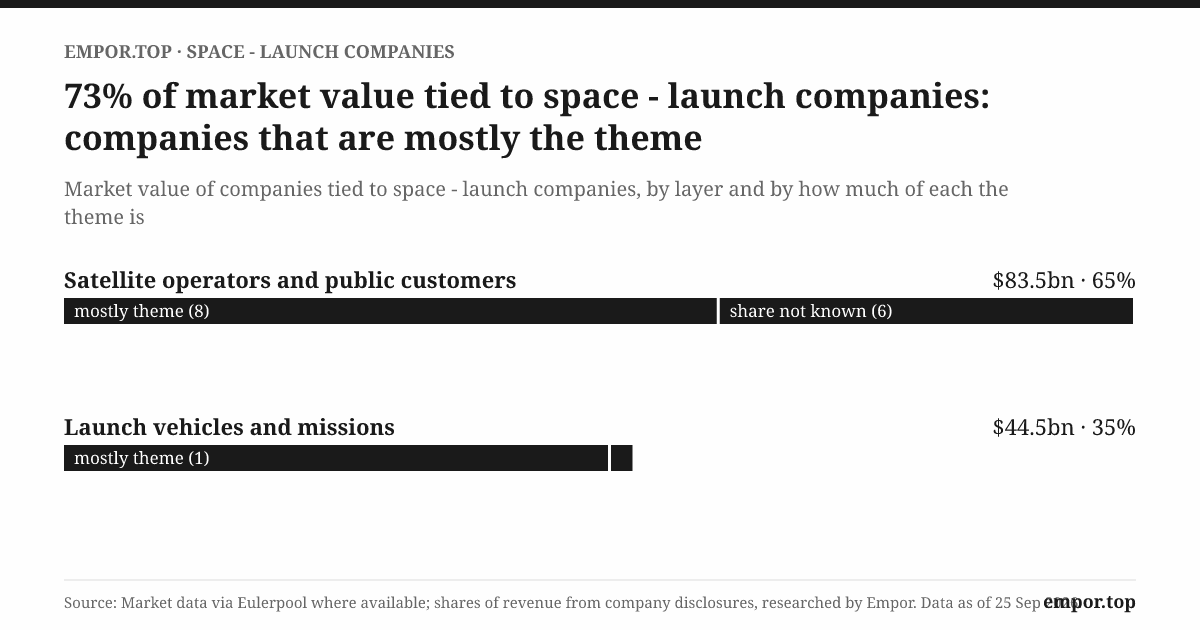
73% of market value tied to space - launch companies: companies that are mostly the theme
Market value of companies tied to space - launch companies, by layer and by how much of each the theme is
Satellite operators and public customers $83.5bn · 65%
mostly theme (8) $51.1bn · share not known (6) $32.4bn
Launch vehicles and missions $44.5bn · 35%
mostly theme (1) $42.6bn · share not known (2) $1.9bn
Market value of the listed companies in each layer, in US dollars, on 25 Sep 2026, split by how much of each company's revenue comes from the theme: mostly theme (75% or more), core (20–75%), meaningful (5–20%) and small part (under 5%).
This is the value of companies associated with space - launch companies, not the value of the theme: too little of the theme's revenue is disclosed company by company to show that.
Who is left out · 57
- Northrop Grumman – Space Systems (Launch systems and propulsion): Not a listed company, or market value not available
- Astra Space (Launch systems and propulsion): Not a listed company, or market value not available
- Korea Aerospace Industries (Launch systems and propulsion): Not a listed company, or market value not available
- Hanwha Aerospace (Launch systems and propulsion): Not a listed company, or market value not available
- HyImpulse (Launch systems and propulsion): Not a listed company, or market value not available
- Boeing – Defense, Space & Security (Launch systems and propulsion): Not a listed company, or market value not available
- Lockheed Martin – Space (Launch systems and propulsion): Not a listed company, or market value not available
- Airbus – Defence and Space (Launch systems and propulsion): Not a listed company, or market value not available
- Safran – ArianeGroup (Launch systems and propulsion): Not a listed company, or market value not available
- IHI – Aero Engine, Space and Defense (Launch systems and propulsion): Not a listed company, or market value not available
- Kawasaki Heavy Industries, Ltd. – Aerospace Systems (Launch systems and propulsion): Not a listed company, or market value not available
- OHB SE – ACCESS TO SPACE (Launch systems and propulsion): Not a listed company, or market value not available
- China Aerospace Times Electronics Co., Ltd. – Launch-vehicle avionics (Launch systems and propulsion): Not a listed company, or market value not available
- Larsen & Toubro Limited – Heavy Engineering and Aerospace (Launch systems and propulsion): Not a listed company, or market value not available
- MTAR Technologies Limited – Space and Defence (Launch systems and propulsion): Not a listed company, or market value not available
- Walchandnagar Industries Limited – High-tech manufacturing (Launch systems and propulsion): Not a listed company, or market value not available
- Curtiss-Wright Corporation – Aerospace and Defense (Launch systems and propulsion): Not a listed company, or market value not available
- Linde plc – Industrial gases (Launch systems and propulsion): Not a listed company, or market value not available
- Air Products and Chemicals, Inc. – Industrial Gases (Launch systems and propulsion): Not a listed company, or market value not available
- Redwire Corporation – Space Infrastructure (Launch systems and propulsion): Not a listed company, or market value not available
- Karman Holdings Inc. – Propulsion Systems (Launch systems and propulsion): Not a listed company, or market value not available
- L3Harris Technologies, Inc. – RS-25 and retained Rocketdyne investment (Launch systems and propulsion): Not a listed company, or market value not available
- Solar Industries India Limited – Space applications (Launch systems and propulsion): Not a listed company, or market value not available
- Shaanxi Zhongtian Rocket Technology Co., Ltd. – Solid rocket business (Launch systems and propulsion): Not a listed company, or market value not available
- Shaanxi Aerospace Power Hi-Tech Co., Ltd. – Aerospace propulsion equipment (Launch systems and propulsion): Not a listed company, or market value not available
- Air Liquide S.A. – ArianeGroup industrial partnership (Launch systems and propulsion): Not a listed company, or market value not available
- Hexcel Corporation – Defense and Space (Launch systems and propulsion): Not a listed company, or market value not available
- Howmet Aerospace Inc. – Defense and Space (Launch systems and propulsion): Not a listed company, or market value not available
- China Aerospace Science and Technology Corporation (Launch vehicles and missions): Not a listed company, or market value not available
- United Launch Alliance (Launch vehicles and missions): Not a listed company, or market value not available
- Blue Origin (Launch vehicles and missions): Not a listed company, or market value not available
- Arianespace (Launch vehicles and missions): Not a listed company, or market value not available
- Mitsubishi Heavy Industries – Space systems (Launch vehicles and missions): Not a listed company, or market value not available
- Firefly Aerospace (Launch vehicles and missions): Not a listed company, or market value not available
- Relativity Space (Launch vehicles and missions): Not a listed company, or market value not available
- Stoke Space (Launch vehicles and missions): Not a listed company, or market value not available
- China Rocket (Launch vehicles and missions): Not a listed company, or market value not available
- ExPace (Launch vehicles and missions): Not a listed company, or market value not available
- LandSpace (Launch vehicles and missions): Not a listed company, or market value not available
- Galactic Energy (Launch vehicles and missions): Not a listed company, or market value not available
- Space Pioneer (Launch vehicles and missions): Not a listed company, or market value not available
- iSpace (Launch vehicles and missions): Not a listed company, or market value not available
- CAS Space (Launch vehicles and missions): Not a listed company, or market value not available
- Indian Space Research Organisation / NewSpace India (Launch vehicles and missions): Not a listed company, or market value not available
- Skyroot Aerospace (Launch vehicles and missions): Not a listed company, or market value not available
- Agnikul Cosmos (Launch vehicles and missions): Not a listed company, or market value not available
- PLD Space (Launch vehicles and missions): Not a listed company, or market value not available
- Isar Aerospace (Launch vehicles and missions): Not a listed company, or market value not available
- Rocket Factory Augsburg (Launch vehicles and missions): Not a listed company, or market value not available
- Orbex (Launch vehicles and missions): Not a listed company, or market value not available
- Gilmour Space Technologies (Launch vehicles and missions): Not a listed company, or market value not available
- Hindustan Aeronautics Limited – Space and launch-vehicle manufacturing (Launch vehicles and missions): Not a listed company, or market value not available
- Exolaunch (Launch sites and mission services): Not a listed company, or market value not available
- Data Patterns (India) Limited – Space Systems (Launch sites and mission services): Not a listed company, or market value not available
- Amazon – Project Kuiper (Satellite operators and public customers): Not a listed company, or market value not available
- Eutelsat – OneWeb (Satellite operators and public customers): Not a listed company, or market value not available
- EchoStar Corporation – Satellite Services (Satellite operators and public customers): Not a listed company, or market value not available
Source: Market data via Eulerpool where available; shares of revenue from company disclosures, researched by Empor. Data as of 25 Sep 2026.
The figures, and the other charts, in the research dossier →
Europe, Japan, India and China decide that access cannot be rented
On 24 December 1979, at the Guiana Space Centre in Kourou, French Guiana, Ariane 1 lifted off. Earlier countdowns that month had been halted.6 Its successful flight gave Europe what it had sought for years: the ability to put satellites into orbit without relying on Washington or Moscow.
The motive was political before it was commercial. During early-1970s negotiations with the United States over communications-satellite launches, European governments concluded that dependence on a foreign launcher also meant dependence on foreign priorities. The European Space Agency, formed in 1975, backed Ariane, with France's space agency CNES driving the programme.7 In 1980 Europe created Arianespace to sell Ariane launches commercially, the first company established specifically to market launch services to customers worldwide.7
What a launch family actually is
A launch-vehicle family resembles a railway system more than a single train. It requires a factory, trained crews, a launch pad, flight-tracking and safety systems, and a schedule of customers over years. A rocket programme likewise needs a production line, testing, a range that can clear airspace and track flights, and a forward manifest. If any element stops for long, specialised workers and suppliers can be hard to retain.
The analogy fails where the business risk is greatest. A failed train usually stops; a failed rocket often explodes, publicly destroying a payload that may cost more than the launch and take years to build. Each mission therefore carries a risk of catastrophic loss. Customers scrutinise a vehicle's flight record, while new rockets struggle to win business before establishing one.
Four more countries build their own railways
Europe was not alone. Japan developed domestic launchers through its space agencies, now combined as JAXA, and heavy-industry groups; Mitsubishi Heavy Industries $7011.T builds and operates the H3 rocket.8 India's space agency, ISRO, developed the PSLV, GSLV and later LVM3 rockets, and created NewSpace India Limited to market them.8 China retained Long March rockets within a state system now run by 中国航天科技集团有限公司 (China Aerospace Science and Technology Corporation, CASC).8 South Korea's government-led Nuri programme came later, with Hanwha Aerospace $012450.KS building engines and Korea Aerospace Industries $047810.KS among its industrial partners.8
In Europe, the industrial base consolidated around two parents. Airbus $AIR.PA and Safran $SAF.PA jointly own ArianeGroup, which designs and builds Ariane rockets, while Italy's Avio became prime contractor for the smaller Vega rocket.8 Kawasaki Heavy Industries $7012.T and IHI $7013.T took roles in Japan's programmes, with IHI supplying solid-rocket motors.8
Why governments pay for more rockets than they strictly need
Why sustain a domestic launcher that costs more than a foreign alternative? Some payloads cannot wait. A spy satellite, military communications satellite or navigation system is a national asset; if the only available launcher belongs to another country, its manifest, export rules and politics help determine when the payload flies. Governments describe a dependable domestic ability to launch priority payloads as “assured access to space”. They may pay for redundancy that a purely commercial buyer would not.
That support can preserve a capability without making it cheap, fast or commercially competitive. Europe's Ariane 5 flew for almost three decades but was retired before its successor was ready, leaving Europe without its own heavy launcher until Ariane 6 first flew on 9 July 2024.9 Policy support kept the capability in place; it did not guarantee launch cadence, low costs or competitiveness. Subsidy can sustain the system, but it cannot ensure reliable operations.
India shows the other side of the model. In March 2023, ISRO's LVM3 carried 36 satellites for OneWeb, a British broadband company, under a NewSpace India contract to launch 72 satellites, completing OneWeb's first-generation constellation.10 A rocket developed for strategic purposes became a commercial carrier when a private customer needed capacity quickly. Sovereign launchers can compete for commercial work, though their schedules and prices remain shaped by policy.
The supplier thread
Behind every national rocket sits an industrial base. Solid-rocket motors, cryogenic engines, turbopumps, tanks, structures, avionics and industrial gases take years to qualify: to prove through testing and flight that they work reliably in a particular vehicle. In the United States, such work flowed to Northrop Grumman $NOC, Boeing $BA and Lockheed Martin $LMT, among others; in India, to Larsen & Toubro $LT, Hindustan Aeronautics $HAL and MTAR Technologies $MTARTECH.NS.8 National launch programmes were therefore also industrial policy. They distributed specialised work across companies and created suppliers whose qualified parts were difficult to replace quickly.
By the early 1980s, the state-led model had gone global. It created high barriers to entry: building a launcher required government funding, a government range and a government customer base. In Washington, however, legislation and a later procurement experiment began to change who could try to clear those barriers.
The government changes from builder to customer
In 1984 Congress passed the Commercial Space Launch Act, assigning the Department of Transportation responsibility for licensing and regulating commercial launches. The law acknowledged that private operators might eventually sell launches on their own account rather than work solely as government contractors.11 That function later moved to the Federal Aviation Administration, whose Office of Commercial Space Transportation still licenses American commercial launches and re-entries.12
A launch licence is less like a driving licence than permission to operate a chemical plant that briefly closes part of the sky. Operators load hundreds of tonnes of propellant, clear airspace and shipping lanes, and fly vehicles that can scatter debris far from the launch site if they fail. The regulator protects people and property on the ground and in the air; it does not certify that a rocket will meet its customer's needs. A licence is therefore necessary, but says nothing about commercial readiness.
The 1984 law opened the door, but few companies crossed it profitably for the next two decades. The United States concentrated astronauts and much cargo activity on the Space Shuttle, while Ariane and established American and Russian vehicles dominated commercial satellite launches.
A procurement experiment
NASA's more consequential change came after the loss of Space Shuttle Columbia in 2003. With the Shuttle due to retire, the agency needed another way to send cargo to the International Space Station. In 2006 it began Commercial Orbital Transportation Services, or COTS.13 Rather than own a vehicle designed to its specifications, NASA paid fixed sums as companies met development milestones, left most design choices to them, and planned to buy delivery services at fixed prices once their vehicles worked. NASA would act as customer rather than owner.
Alan Lindenmoyer, who led NASA's commercial cargo office, ran the programme within an agency accustomed to specifying and overseeing every part of a vehicle.13 COTS was a calculated trade: NASA accepted more risk from unproven companies in return for lower costs and the possibility that a market beyond NASA could emerge.
The contest, round one
On 18 August 2006 NASA selected Space Exploration Technologies, or SpaceX, and Rocketplane Kistler, an Oklahoma company that had inherited a reusable-rocket design from Kistler Aerospace, in the first COTS round.14
Elon Musk founded SpaceX in 2002 after making his fortune at the internet-payments company PayPal. He argued that launch costs exceeded what the underlying physics required.13 When NASA selected the company, it had not reached orbit. Its Falcon 1 failed on its first three attempts before succeeding on the fourth in September 2008, when SpaceX was close to running out of money.13
Rocketplane Kistler did not reach that point. NASA ended its agreement in October 2007 after the company failed to raise sufficient private capital for its milestones.14 In February 2008, NASA signed a replacement agreement with Orbital Sciences, an established Virginia company that built smaller rockets and satellites.1415 On 23 December 2008, NASA awarded its first Commercial Resupply Services contracts: twelve cargo missions to SpaceX using Dragon and eight to Orbital using Cygnus.14 COTS funded development; the resupply contracts paid for operating flights and created the prospect of recurring revenue.16
In May 2012, a Dragon capsule berthed with the space station, completing SpaceX's demonstration objectives.13 A company founded a decade earlier had delivered cargo to an orbiting laboratory.
The episode established a pattern that would recur across the industry. NASA selection alone did not create a service. Rocketplane Kistler had a design, a government partner and a milestone schedule, but could not finance the gap to operation. Technical promise required capital through repeated flights.
Two founders, two models
Peter Beck founded Rocket Lab $RKLB in New Zealand in 2006, the year COTS began.17 An engineer from outside the established aerospace industry, Beck chose a smaller vehicle. Electron was designed to carry satellites of a few hundred kilograms to precise orbits for customers unwilling to wait for a larger rocket's schedule. It first reached orbit in 2018; Rocket Lab later moved its headquarters to California and listed in the United States.17
Rocket Lab now combines Electron launches, HASTE, a suborbital testing variant used largely for defence work, and a larger spacecraft and components business.17 Its reported revenue is therefore not launch-only revenue.
SpaceX followed a different model: it sold launches to outside customers, then built Starlink, its satellite-broadband network, which became its largest launch customer.18
A bridge customer
The International Space Station gave these entrants what new launch companies rarely have: a regular, demanding and creditworthy buyer. Cargo missions provided milestones, cash and credibility before commercial satellite constellations reached scale. New launch providers face a circular problem: customers want a flight record, but a flight record requires customers. NASA's cargo contracts helped SpaceX and Orbital break it.
Fixed-price procurement shifted risk rather than eliminating it. It imposed discipline and cost NASA less than a traditional programme, but failures, delays and cash shortfalls fell on suppliers and their investors. Rocketplane Kistler's termination showed that a fixed-price contract could end when a company lacked the money to continue. The approach benefited the buyer when several capable bidders existed; suppliers needed patient capital to survive its demands.
COTS helped fund new rockets. It did not solve the industry's oldest cost problem: after each flight, the vehicle's most expensive hardware fell into the ocean.
The rocket that came back changes the price of admission
On the evening of 21 December 2015, a Falcon 9 lifted off from Cape Canaveral carrying 11 communications satellites for Orbcomm. Minutes later, as the second stage continued towards orbit, the first stage turned, relit its engines and landed upright on a pad near its launch site.19 NASA’s Astronomy Picture of the Day described it as the first controlled landing of a booster that had helped launch satellites. The stage was recovered for wear and reusability analysis, but retired rather than flown again.19
That distinction matters. Recovering a booster demonstrates that it can return; it does not demonstrate that it can be returned to service cheaply.
What reuse is, and what it is not
A cargo ship would be prohibitively expensive if its hull were scrapped after every voyage. Reusing it reduces the cost of each trip only if inspection, repair and turnaround cost less than building a replacement, and if reliability holds. The same is true for a recovered booster. Savings diminish if refurbishment takes months, consumes thousands of labour hours or reduces reliability.
The comparison has limits. A ship failure at sea does not usually suspend a fleet carrying other customers’ cargo. A failure involving reusable rocket hardware can ground an entire fleet while engineers determine the cause.
The reusable vehicle that came first
The United States had tried reuse before, with sobering results. Space Shuttle orbiters flew repeatedly and their solid boosters were recovered from the sea, but the system required extensive work between flights and never achieved the low-cost, high-frequency service its designers had envisaged. It also suffered two catastrophic failures. Challenger broke apart shortly after launch on 28 January 1986, killing its seven crew members,20 and Columbia was lost during re-entry on 1 February 2003, killing seven more.21 Commercial satellites were largely moved off the Shuttle after Challenger. Reusable hardware, the Shuttle showed, did not automatically produce low-cost operations.
Musk’s claim that reuse would transform launch economics therefore warranted scrutiny. Falcon’s approach differed in several respects: it recovered only the first stage, generally the largest and most expensive element, rather than attempting to recover the whole vehicle; it flew a common core design often enough for each mission to inform subsequent operations; and Starlink gave SpaceX a steady internal customer. When an external customer’s satellite was delayed, the company could use capacity for its own constellation.
By the first quarter of 2026, according to the prospectus SpaceX published that June, 39 of its 40 Falcon launches used previously flown boosters; in 2025 it flew 157 missions on flight-proven boosters.18 SpaceX describes Falcon 9 as the world’s first orbital-class reusable rocket.22 Reuse had become its standard operating model.
Cadence is the number that matters
The economic variable is cadence: the number of missions a provider flies, and the regularity with which it flies them. A rocket factory, pad, launch team and control centre carry substantial fixed costs whether a company launches ten times a year or 100. More reliable flights spread those costs over more missions and generate more operational data. Frequent launches also give customers a flight record that a vehicle flying only twice a year cannot match.
But greater cadence can reduce customer prices faster than it increases the operator’s profit. A provider offering frequent, reliable and lower-cost launches establishes a reference price for rivals. Some benefit from reuse accrues to the operator; some passes to customers. Competitors without reusable hardware face the resulting pressure without sharing the cost advantage.
Everyone else responds
Competitors responded in different ways. United Launch Alliance, the Boeing and Lockheed Martin joint venture that inherited Atlas and Delta, developed Vulcan to replace both vehicles. Blue Origin, founded by Amazon’s Jeff Bezos, pursued New Glenn, a large reusable rocket. Europe moved from Ariane 5 to Ariane 6 and from Vega to Vega C. Chinese commercial companies began developing methane-fuelled rockets, as methane produces less engine soot and can be better suited to reuse. Rocket Lab used Electron’s flight record as a base for Neutron, a larger, partly reusable rocket.8
Has reuse made launch a commodity?
Reuse has led some observers to describe launch as a commodity business in which the cheapest ride wins. The evidence supports a narrower conclusion. Falcon has become the commercial price benchmark that other providers must address, and the FAA’s long-range forecast identifies reuse as a principal force reducing launch costs.23 Yet launches remain differentiated products. A military satellite needs a vehicle certified for national-security missions. A satellite requiring a particular orbit at a particular time cannot necessarily use the next available shared ride. Export controls limit some customers’ choice of launcher, while pad availability constrains the number of flights from a site. For such missions, a low-cost shared ride is not an adequate substitute for a dedicated, certified and timely launch. Reuse has raised the competitive threshold in commercial launch; it has not eliminated the value of certainty.
The next test is already under way. SpaceX’s larger Starship had completed suborbital test flights, including a July 2026 mission that deployed test Starlink satellites before they re-entered. It was scheduled to attempt its first orbital flight on 28 September 2026.24 If Starship enters routine service, it could reset the benchmark again. For now, that flight remained a scheduled test.
Cheaper transport would matter less without cargo. Smaller satellites and the constellations built from them supplied the next source of demand.
Small satellites turn a rocket factory into a transport network
A rideshare mission can release dozens of small satellites in orbit, each for a different customer: one may photograph farmland, another relay broadband, another track ships by radio signal and another test a military sensor. They share a rocket because splitting the flight lowers the cost of each ride.
A rideshare resembles a scheduled bus: it is cheaper because passengers share the fare, but it travels to a fixed destination on a fixed timetable. A customer needing a particular orbit, launch date or special handling may need a dedicated mission—a taxi in this analogy—on a smaller rocket or a larger vehicle purchased outright.
How satellites got small and numerous
Demand changed for reasons only partly related to rockets. Electronics became smaller and cheaper. Universities and startups built CubeSats from standard ten-centimetre cubes, often using components adapted from consumer technology. Cloud computing reduced the cost of storing and processing satellite imagery and data. The internet created demand for broadband delivered from space.
The more significant shift was from individual satellites to constellations: hundreds or thousands of satellites in low Earth orbit, a few hundred to a couple of thousand kilometres above the surface, working together to provide global coverage. At that altitude, satellites can support lower-latency connections and higher-resolution imagery, but each covers only a limited area and may last only a few years. Constellations therefore create recurring demand: operators deploy satellites, then replace them. For launch providers, that can turn an occasional order into a continuing manifest.
The customers, and what they buy
Amazon $AMZN is building a broadband constellation first called Project Kuiper and now branded Amazon Leo. In April 2025, a ULA Atlas V launched its first production satellites. ULA said it would launch more than half of the planned constellation of more than 3,200 satellites, describing the arrangement as the world's largest commercial launch agreement.25 Amazon also bought launches from other providers, including Blue Origin. New Glenn was due to carry Amazon satellites in June 2026 before a test-stand explosion intervened, as the next chapter recounts.26
Eutelsat's OneWeb, which previously turned to India's LVM3, operates a rival low-orbit network. AST SpaceMobile $ASTS is building large satellites intended to connect directly to ordinary mobile phones. Iridium operates a mature low-orbit network of 66 operational satellites for phone and data links.8 Globalstar $GSAT and Viasat $VSAT are established operators; Telesat is building its Lightspeed low-orbit network; SES operates in several orbits and bought Intelsat in 2025. Planet, BlackSky, Spire and Synspective operate Earth-observation and data fleets; 中国卫通 (China Satellite Communications) $601698.SS is China's state-linked satellite operator.8
These companies are launch providers’ customers. Their deployment plans, financing and operating performance shape how many launches are booked.
Demand is real, and so is its cost
Empor's scorecard illustrates why demand for satellites does not translate directly into launch-provider profits. AST SpaceMobile reported $70.9m in revenue in 2025 but spent roughly 15 times that amount on capital projects, equal to about 1,501% of revenue.8 Telesat spent 183% of revenue on capital projects while building Lightspeed, even as revenue fell by 27%.8 Iridium, whose network is already deployed, spent 11.5% of revenue on capital projects and generated free cash flow equal to 34.4% of revenue.8
Constellation builders must finance satellites, ground stations, spectrum and often years of losses before a network pays for itself. Launch is one cost among many. When capital is readily available, deployment programmes can fill rocket manifests. When financing tightens, operators can defer deployment—and the associated launches.
Walking the chain from gas to customer
A launch is a chain of businesses, in the order the work occurs.
It begins with liquid oxygen, liquid hydrogen, methane or kerosene, plus nitrogen and helium, supplied by industrial-gas companies including Linde $LIN, Air Products $APD and Air Liquide $AI.PA.8 Next come engines and solid motors; tanks and stages; carbon-fibre composites from companies such as Hexcel; metal castings and fasteners from Howmet Aerospace $HWM; controls and electronics from Curtiss-Wright $CW; and structures, separation systems and propulsion from specialists such as Redwire and Karman.8 The launch company then integrates, tests and flies the vehicle. Supporting infrastructure includes the pad, the range that tracks the flight and clears airspace, the licence, and mission assurance: evidence that the vehicle meets a customer's reliability requirements. After separation, rideshare integrators such as Exolaunch deploy individual satellites.8 The satellite operator then takes over. End users may include a farmer, a shipping company, a defence ministry or a household with a dish.
A single launch can create value at each link, but the rocket seller does not necessarily capture most of it. When capacity is scarce, launch providers can charge more. When capacity is ample, value may shift to the companies that own the customer relationship, spectrum rights and data.
Do more satellites mean more launches?
More satellites do not automatically produce proportionally more launches. Larger rockets can carry more satellites per flight, allowing a constellation to grow faster than launch totals. Rideshares combine payloads from many customers. Early satellite failures can require additional launches, while longer-lived satellites reduce replacement demand. McDowell's log counted 329 orbital attempts in 2025, a measure of activity rather than launch revenue, payload mass, market share or profit.1
Demand has nevertheless drawn a crowded field of rockets to the pad. The next contest is between capacity with a proven flight record and programmes still seeking their first dependable repeat flight.
The contest is not for rockets; it is for dependable turns on the pad
On 9 July 2024, Ariane 6 lifted off from Kourou on its first flight, restoring Europe’s own heavy-launch capability.9 Earlier that year, on 8 January, ULA’s Vulcan made its maiden flight.27 Both were significant achievements. Neither answered customers’ central question: can the company build, certify, schedule, insure and fly the rocket again next month, and the month after that?
A maiden flight shows that a rocket can work once. Cadence shows that a company can operate it routinely. The gap between those milestones is where much of the industry’s capital is spent—and lost.
SpaceX: the benchmark
SpaceX is the benchmark against which other commercial providers are measured. Its advantage is operational rather than the result of a single invention: reusable first stages, a factory producing engines and stages at volume, multiple active pads and Starlink as an internal customer able to absorb spare capacity. Its 157 flights on reused boosters in 2025 are a record no commercial competitor approaches.18 Its prospectus, approved by Germany’s financial regulator BaFin in June 2026 ahead of what TechCrunch described as the largest initial public offering in history, put space-segment revenue at about $4.1 billion in 2025, according to Empor’s reading of the filing.18248 The offering closed later that month, and SpaceX's shares now trade on Nasdaq under the symbol SPCX.46
SpaceX led commercial orbital cadence and booster reflight by a wide margin as of 2026. The nearest challengers by launch count were state systems, chiefly China’s, whose economics are not disclosed. That lead was built through flight data accumulated faster than rivals could match. It depends on continued reliability, rapid turnaround and sufficient pad throughput. Starship could widen the gap, but it had not yet reached orbit.
SpaceX in public: what the filings now show
The listing gives outsiders their first audited view of the benchmark's accounts. The filings confirm the size of SpaceX's lead more clearly than they settle its economics. The Space segment, which designs, builds and launches its rockets, reported $4.09 billion of revenue in 2025.18 Rocket Lab reported $602 million and Avio about $670 million.8 The comparison is only rough. SpaceX's segment combines launch services with development contracts, Rocket Lab's revenue includes its spacecraft business, and Avio's depends on European public programmes.
The gap in cadence is wider still. SpaceX flew 165 Falcon launches in 2025, while Rocket Lab flew 21 Electron and HASTE missions. Empor's data give no comparable annual count for Avio.18338 However, most Falcon flights carry SpaceX's own Starlink satellites. In the first half of 2026 it flew 77 Falcon missions, only 17 of them for outside customers. A year earlier the figures were 81 and 21.47 Revenue follows the customer flights, not the total. In the June quarter, customer launches rose from nine to ten and Space revenue rose 29% to $962 million, yet over the half-year Space revenue fell 1.9%.47 In 2025 the segment grew 7.6%, slower than Rocket Lab's 38% and Avio's 22.7%.188 SpaceX's flight count shows how much its rockets are used and how much the company learns from them. It is not a measure of what outside customers pay.
Reuse has made each flight cheaper, but it has not yet made the segment profitable. In 2025 the Space segment's direct costs were $1.35 billion, well below its revenue. However, $3.00 billion of research and development, mostly on Starship, turned that into an operating loss of $657 million, after a $21 million profit in 2024.18 That loss was about a sixth of the segment's revenue. Rocket Lab's operating margin was negative 38% and Avio's was a positive 1.5%.8 None of the three listed launch companies yet reports a settled profit margin on its launches, and SpaceX's segment result cannot be read as the profit on Falcon missions alone.
Buying SpaceX shares also means buying far more than launch. The group's 2025 revenue was $18.67 billion. Connectivity brought in $11.39 billion and AI $3.20 billion, against $4.09 billion from Space.18 In the quarter to June 2026, group revenue rose 92% to $7.8 billion, with a net loss of $541 million. Those figures chiefly reflect connectivity and AI rather than rockets.47 The filings still do not disclose the price of a Falcon launch, a launch-only backlog, the profit each mission contributes, or the cash that launch generates. The listing fills a large gap in what investors can see. It confirms SpaceX's lead in cadence and scale, but it does not give the other listed launch companies a like-for-like yardstick.
ULA: the certified alternative
United Launch Alliance pursued a different source of value: certification. Under Tory Bruno, its chief executive until he left for Blue Origin in December 2025, ULA developed Vulcan for the most demanding American government missions.28 In March 2025, the U.S. Space Force certified Vulcan for National Security Space Launch missions after a process covering 52 certification criteria, more than 180 tasks, two flight demonstrations and extensive reviews. That made ULA one of two certified providers, alongside SpaceX.29 Where the customer is buying certainty, that qualification can matter more than price.
Certification is a meaningful moat, but not an invulnerable one. ULA flew five missions in 2024 and six in 2025, below its plans, and interim chief executive John Elbon set a goal of 18 to 22 launches in 2026.28 Then, on 12 February 2026, a solid-rocket booster on the USSF-87 mission suffered a nozzle failure before separation. The payload still reached orbit, but a similar nozzle problem had occurred on Vulcan’s second certification flight in October 2024.30 The Space Force paused national-security missions on Vulcan pending an investigation. ULA expected to return to flight by the end of 2026, probably with an Amazon mission.30 It had a backlog of more than 80 missions, including 47 for Amazon.28 That backlog becomes revenue only when the rocket flies.
The GEM 63XL booster involved is made by Northrop Grumman.30 The episode shows how supplier quality can determine a launch company’s cadence.
Blue Origin: from first flight to setback
Blue Origin’s New Glenn reached orbit on its first flight on 16 January 2025, although the booster was lost during its landing attempt.3132 Its second flight, in November 2025, launched NASA’s twin ESCAPADE Mars probes and achieved the first booster landing.32 That suggested progress towards repeat operations.
Two setbacks followed. On its third flight, in April 2026, a cryogenic leak froze a hydraulic line and caused a second-stage thrust problem, leaving an AST SpaceMobile satellite in the wrong orbit.26 On 28 May 2026, during a static-fire test ahead of a fourth flight intended to carry Amazon satellites, a New Glenn rocket exploded on its pad at Launch Complex 36, Blue Origin’s only orbital launch site, destroying the transporter-erector.26 Jeff Bezos called it a “very rough day” and said the company would rebuild.26 New Glenn had not flown since April.32 Blue Origin is privately held and discloses no financial results. It had demonstrated orbital flight and booster recovery, but not regular operations.
Rocket Lab: the listed pure play with a big bet
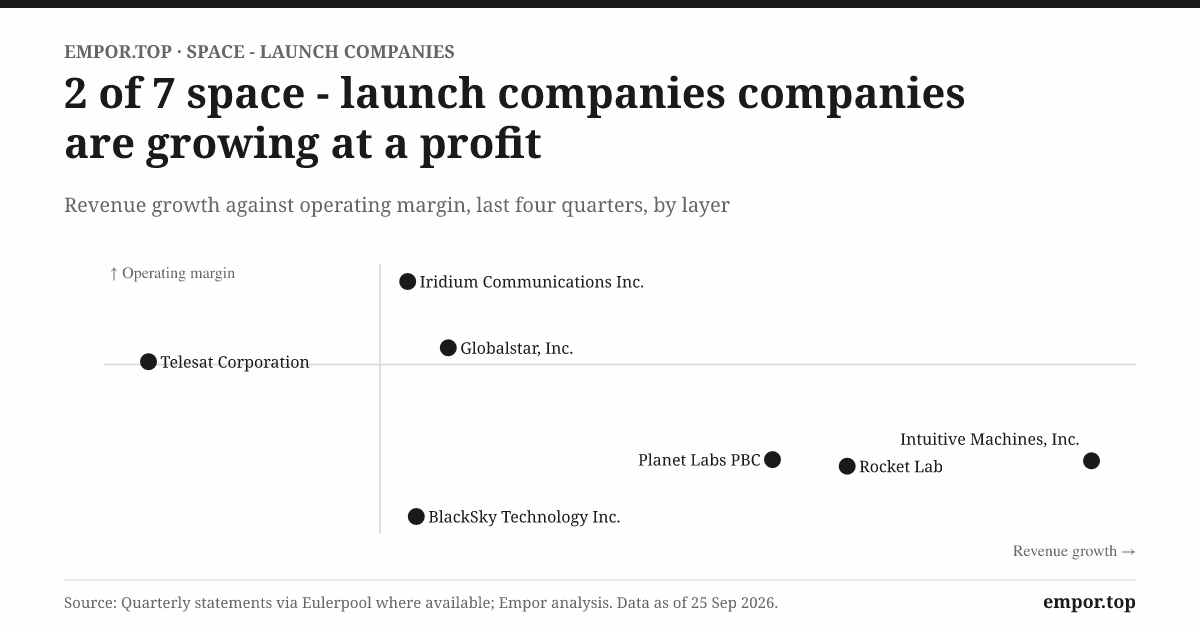
SpaceX is now far larger, but most of its revenue comes from connectivity and AI.18 Rocket Lab remains the largest listed company whose business centres on launch, and the only one in Empor’s data with reported rapid growth. Electron and HASTE flew 21 missions in 2025, and the company ended the year with $1.85 billion of contracted backlog.33 Revenue rose 38% to $602 million in 2025.17 But it remained loss-making: operating margin was negative 38%, and cash burn after capital spending exceeded half of revenue.8
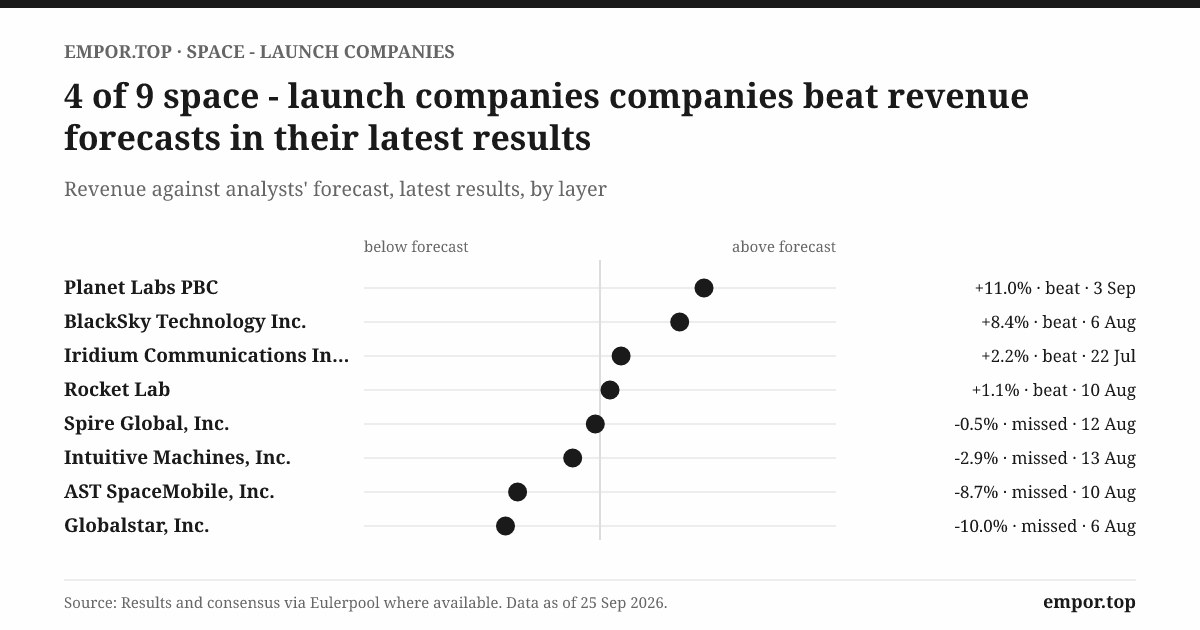
The trend improved in the quarter to June 2026. Revenue rose 62% year on year to $234 million, while operating margin narrowed to negative 24.6%.8 Rocket Lab beat analysts’ revenue forecasts in each of its previous four quarters, though it missed their earnings forecast in the latest one.8 Operating progress was evident; durable cash generation was not.
The pivotal question is Neutron, the partly reusable medium-lift rocket intended to move Rocket Lab from small launches into the larger market dominated by Falcon. On 21 January 2026, a Neutron first-stage tank ruptured during pressure testing, pushing the first flight from mid-2026 to late 2026.34 By August, the company said in filings that the window for a launch before year-end was narrowing and that it could slip into 2027.34 Beck said the goal was to reach the tenth flight as quickly as possible rather than merely the first.34 That is the more relevant measure, but investors must still wait for the vehicle to fly. Rocket Lab’s market value stood at $42.6 billion on 25 September 2026, with enterprise value at about 53 times sales, down from $64.0 billion at the end of June.8 Those figures do not determine value, but they indicate how much investor expectation rests on an unflown rocket.
Avio: a real business, a narrow lead
Avio, listed in Milan, is prime contractor for the Vega and Vega C rockets.8 It is the clearest listed European launch company. Its 2025 revenue rose 22.7% to €594 million, about $670 million, and its operating margin was 1.5%. That made it the only listed launch provider in Empor’s data with a positive operating margin for the year.8 In the six months to June 2026, revenue grew 6.9% and operating margin slipped to negative 1.3%.8 Empor’s data do not separate launch-services revenue from propulsion and other work. Avio led listed launch-provider profitability, but narrowly; the result was recent and depended on European institutional programmes whose timing can materially affect results.
A direct comparison with Rocket Lab would mislead. Rocket Lab’s revenue includes a substantial spacecraft business, while Avio’s includes propulsion for European programmes; they report on different schedules and in different currencies. Rocket Lab grew faster and lost more. Avio earned a small profit on slower growth shaped by public programmes.
China: state scale and a commercial swarm
China operates the world’s second large launch system. CASC’s Long March family flies at state scale, alongside commercial and state-linked companies including China Rocket, ExPace, 蓝箭航天 (LandSpace), Galactic Energy, 天兵科技 (Space Pioneer), iSpace and CAS Space.8 LandSpace’s Zhuque-2 became the first methane-fuelled rocket to reach orbit in July 2023.35 China’s reuse race accelerated in 2026: CASC’s Long March 10B recovered its booster with an offshore barge and catch wires on its first flight on 10 July, and in August LandSpace landed a Zhuque-3 booster on legs on land, after its first attempt in December 2025 ended in abnormal combustion during recovery.36
These were technological milestones, not proof of reusable economics. China’s launch companies do not disclose financial results in a form comparable for outside investors. Export controls and sanctions also limit Western satellite customers’ ability to buy Chinese launches and Western investors’ ability to own the companies.
The capital test for challengers
Beyond these companies is a long list of challengers: Firefly, Relativity and Stoke in the United States; Skyroot and Agnikul in India; PLD Space, Isar Aerospace, Rocket Factory Augsburg and Orbex in Europe; Gilmour Space in Australia; and HyImpulse in Germany. Their records illustrate the distance between a prototype and a service.
Astra, once a listed small-launch prospect, ended Rocket 3 operations in August 2022 after only two of nine launches succeeded, citing poor reliability.37 Relativity flew Terran 1 for the first time in March 2023; it reached space, but its upper stage failed to reach orbit. Within weeks, the company shelved the vehicle to focus on the larger reusable Terran R.38 Rocket Factory Augsburg’s first-stage test at the SaxaVord spaceport in Shetland ended in fire in August 2024.39 Space Pioneer’s Tianlong-3 first stage broke free from its test stand in June 2024 and crashed in nearby hills; its first orbital attempt, in April 2026, failed shortly after lift-off.40 Isar’s Spectrum cleared the pad in Norway on its first flight in March 2025, then was terminated about 30 seconds later and fell into the sea.41
None of these incidents rules out successful new entry; SpaceX’s early record was similarly difficult. They do show why announced capacity should be discounted until repeat missions occur.
Small launch versus the bus
Small rockets sell control over orbit and timing. A rideshare slot sells a lower price. As Falcon conducts regular rideshare missions, small-launch providers must show that control is worth a substantial premium. The number of startups is therefore less informative than the number that can win recurring paid missions at prices covering their costs beneath the ceiling set by Falcon’s rideshare service.
One company often grouped with launch stocks does not belong in this contest. Virgin Galactic flies tourists on suborbital hops; it does not place satellites in orbit. Its 2025 revenue was $1.5 million.8 Treating it as a satellite-launch comparison is a category error.
The launch company captures only part of a launch’s value. Some of the more durable tolls may lie further up the chain, with hardware suppliers, ranges and strategic customers.
The quieter businesses beneath the flame
Behind each launch is a supply chain that must perform at one exact moment. Trucks and pipelines deliver liquid oxygen, liquid hydrogen or methane, nitrogen and helium to the pad. Power, range radar, tracking stations, weather teams, safety officers, software and hundreds of people must also be ready. Any link can stop the countdown.
The anatomy of a rocket, and the limit of the analogy
A rocket can be compared with a body: propulsion acts as the heart, moving propellant at enormous rates; tanks and stages form the torso; avionics—the flight computers and sensors—serve as a nervous system; and composites and metals provide the skeleton. The comparison helps explain the parts, but has limits. A body can compensate for some failures; a rocket usually cannot. One valve, weld or nozzle can end a mission.
Where suppliers hold leverage
Because failure is costly, customers value hardware with flight heritage. A “flight-qualified” part has been proven through testing and prior missions for a particular use. Replacing it can require requalification, adding time, cost and risk. That can give established suppliers more leverage than ordinary manufacturers.
NASA’s Space Launch System, built for the Artemis Moon programme, illustrates the division of work. Boeing builds the core stage and Northrop Grumman the twin solid-rocket boosters, according to NASA’s Artemis II reference guide.42 The core stage’s RS-25 engines come from former Aerojet Rocketdyne, whose parent became L3Harris Technologies $LHX.42 These are established government-programme relationships, not evidence that the companies are direct launch-services investments.
Karman has more direct exposure than most listed suppliers. Its 2025 annual report said that Space & Launch accounted for 36.9% of its $471.5m revenue, with payload-protection systems, interstages and propulsion hardware supplied across more than 130 programmes.43 But space and launch are broader than satellite launch, and missiles and defence remain important parts of Karman’s business.
The supplier map also follows the national launch systems described earlier. IHI and Kawasaki work on Japanese programmes; Hanwha on Korea’s Nuri; Larsen & Toubro, Hindustan Aeronautics, MTAR and Walchandnagar Industries on Indian launch manufacturing; Data Patterns $DATAPATTNS on test and ground-support electronics; Solar Industries India $SOLARINDS on energetic materials for solid motors; and China Aerospace Times Electronics, Shaanxi Zhongtian Rocket Technology and Shaanxi Aerospace Power Hi-Tech on avionics, solid rockets and propulsion equipment within China’s state-directed system.8
Why the stock-market read-through is usually weak
For most suppliers, launch work is mission-critical but too small to determine overall results. Boeing’s defence, space and security division generated $27.2 billion of revenue in 2025; Northrop’s space systems segment generated $10.8 billion; and Airbus’s defence and space division generated €13.4 billion.8 Those businesses cover much more than launch, and none reports launch-only revenue. The same applies to Lockheed Martin, Safran, Linde, Air Products, Air Liquide, Hexcel, Howmet and Curtiss-Wright. An investor buying these shares for launch exposure is chiefly buying aircraft, defence electronics or industrial gases.
The Vulcan booster problem showed the reverse relationship. Nozzle failures on Northrop’s GEM 63XL booster paused national-security missions on a certified rocket for months.30 A relatively small supplier programme can therefore determine a launch provider’s annual cadence.
The range and the regulator
A spaceport is more than concrete. It requires airspace coordination, environmental approvals, range-safety systems, payload-processing buildings and a licence. In the United States, the FAA’s Part 450 rule, effective from 2021, allows an operator to hold one performance-based licence across several vehicle configurations and sites.44 By the March 2026 transition deadline, the FAA said SpaceX, Blue Origin, Firefly, Rocket Lab and ULA, among others, had moved vehicles onto the framework.44 The agency recorded 204 licensed commercial operations in fiscal 2025, a record, and its 1,000th licensed or permitted operation that August.45
Faster licensing helps only vehicles ready to fly. Blue Origin had a licence; after the May 2026 explosion, it lacked a working pad.
Do suppliers automatically win when launches grow?
More launches need not translate directly into more parts sales. First, reuse reduces the number of new first stages and engines required per mission: Falcon’s high reflight share means SpaceX builds fewer boosters than it flies. Second, long contracts and programme timing can delay benefits, while fixed-price supplier contracts can compress margins when costs rise.
Empor’s cross-layer test examined whether growth in launch-provider revenue appears in supplier revenue a few quarters later. The reported history is too limited to establish a pattern.8 The connection is plausible but unproven. It may favour suppliers of expendable upper stages and satellite makers more than suppliers of reusable boosters.
Rising activity alone is therefore insufficient. Investors can watch launch totals climb while earning poor returns if price competition, fixed costs and funding needs outpace operational gains.
Cheap access can enrich satellites and impoverish rocket makers
Imagine two futures a decade from now. In both, reusable heavy rockets operate routinely, the cost of reaching orbit falls sharply, and broadband, imaging and defence networks use cheap, frequent launches. In one, a small group of providers earns attractive margins from high utilisation. In the other, too many launch companies compete for too little profit, and most of the savings flow to their customers. Both futures could produce the same number of launches.
The myth that a rising tide lifts every rocket
More launches do not mean that every space company benefits. Transport history offers a warning. Airlines made travel cheaper and more routine, yet the industry often earned little while airports, aircraft makers and travel businesses did better. Container shipping transformed trade but repeatedly bankrupted shipping lines. When transport capacity becomes abundant, value can shift to the businesses that use it: those with customers, spectrum, data and ground networks.
That distinction changes who benefits from the same trend. A launch boom is clearly useful to satellite operators with strong demand. It benefits launch providers only if their costs fall faster than their prices.
The optimistic chain
The bullish case follows a sequence. Reliable reuse shortens turnaround times, raising capacity. Funded constellations and defence programmes fill that capacity. A small number of dependable providers spread fixed costs across more flights and widen margins. Suppliers of qualified hardware sell more parts, while satellite operators obtain more capacity at lower cost. SpaceX provides evidence for each link. The unresolved question is whether other providers can replicate it.
The pessimistic chain
The bearish case runs alongside it. New providers raise capital to build overlapping capacity. Falcon’s price and cadence force them to cut prices. Rideshare absorbs much of the small-satellite market. Delays defer revenue, while repeated share issues fund losses and dilute existing owners. Customers retain the benefit of lower launch prices; providers retain the development risk.
The industry’s record supports that concern. The Shuttle showed that reusable hardware can remain costly to operate. Rocketplane Kistler, Astra and Relativity’s first rocket showed that licences, contracts and early flights do not by themselves create a business. Europe showed that governments may sustain launch capacity for strategic reasons rather than commercial returns, limiting the prices commercial providers can charge.
What today's numbers say
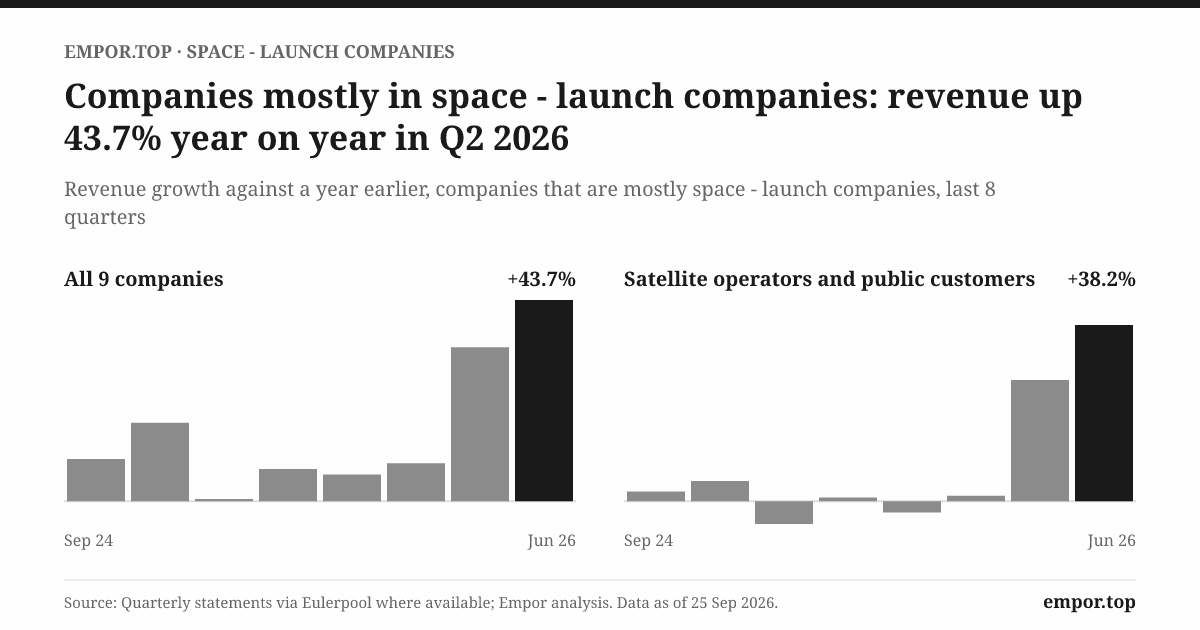
Empor’s data on listed launch companies support neither case cleanly. Their combined revenue grew 61.6% year on year in the quarter to June 2026, but their combined operating margin was negative 52.3%.8 Virgin Galactic’s small revenue base and large losses heavily distort that figure. Yet Rocket Lab alone still reported a negative 24.6% operating margin.8 Its narrowing losses support the case for scale, but the sector’s cash economics remain unproven.
Satellite-operator figures contain a similar qualification. Combined revenue rose 61% in the June quarter, but much of that increase came from SES, whose revenue more than tripled after acquiring Intelsat, and from Intuitive Machines’ lunar contracts rather than a broad rise in organic demand.8 The median operator grew 7.9%.8 Headline growth therefore reflected acquisitions as much as underlying demand.
Shareholders have been rewarded ahead of demonstrated profits. The listed launch-vehicle group returned 515% in US dollars over three years, weighted by market value, while the median company in the theme increased its share count by about 15% over three fiscal years.8 The market has embraced the story; the companies have yet to show that it produces durable returns.
No single space multiple
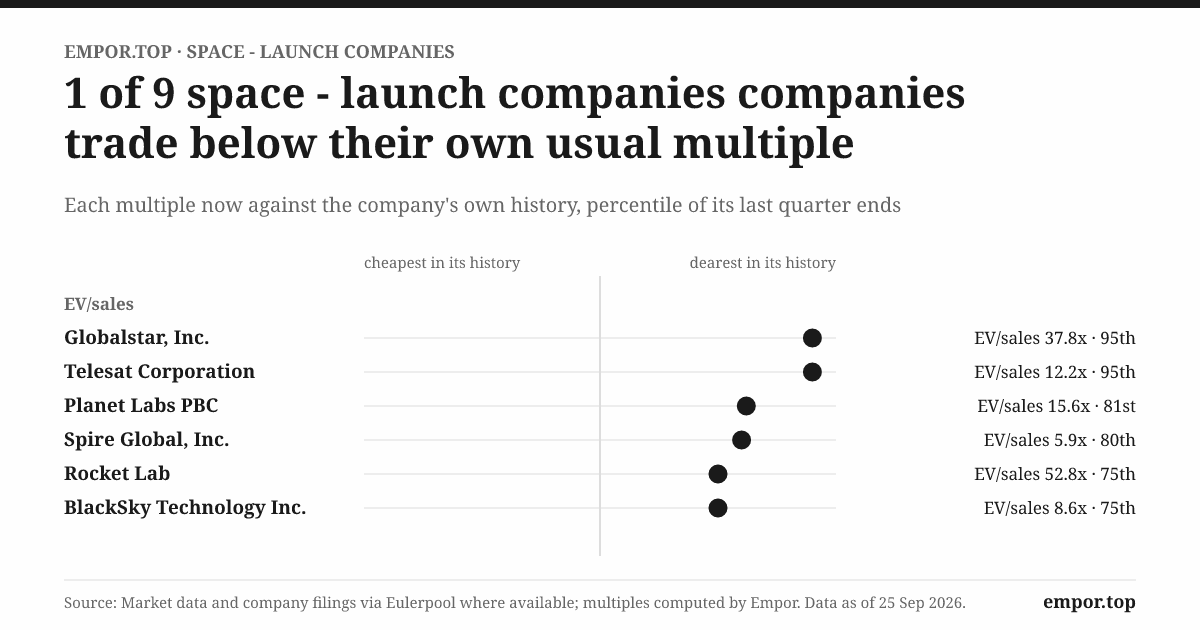
Valuations show how differently investors price these businesses. On 25 September 2026, Rocket Lab’s enterprise value was about 53 times sales, compared with about 1.2 times for Avio, 7.6 times for Iridium and 222 times for AST SpaceMobile.8 Those figures do not establish which share is cheap. They reflect different revenue quality, maturity, margins and capital needs. Rocket Lab is valued on Neutron and scale; Avio on European programme work; Iridium on cash from an established network; and AST SpaceMobile on a network still under construction. There is no single “space multiple”, and using one company’s valuation to judge another is misleading.
Oil, interest rates and the limits of patterns
Two external forces should, in theory, matter. Higher oil prices raise the cost of fuel, industrial gases, chemicals and factory energy. Brent crude averaged about $94 a barrel in the quarter to September 2026, up 36% from a year earlier.8 That might be expected to pressure launch-company gross margins. Empor’s test found no consistent relationship across listed launch companies: Rocket Lab’s margin moved loosely in the expected direction about a quarter later, while Avio’s showed no link.8 That result is plausible because propellant is a small share of a rocket’s cost, while labour, hardware, failures and programme mix carry more weight.
Higher long-term interest rates may matter more because launch and constellation companies require substantial capital long before they produce returns. The US ten-year Treasury yield was around 5% in the September quarter.8 Here, too, the data show no broad relationship: among satellite operators, only Iridium and Thaicom moved loosely in the expected direction, while BlackSky’s losses moved the other way.8 Short reporting histories, irregular results and one-off events obscure the signal. A few years of patterns are evidence rather than proof; in this case, the evidence remains limited.
The investment case therefore rests less on headline launch totals than on early signs that cost, cadence and financing are beginning to align.
The four signs that decide whether the race becomes a business
Before a countdown, a launch director polls the range, weather, propulsion, flight software and safety teams. Every station must report “go”. Investors need a similarly disciplined checklist: a few indicators that test whether announced capacity is becoming a viable service, often before revenue reflects it.
Repeat orbital flights, vehicle by vehicle
The first signal is successful orbital flights by each vehicle, and the interval before its next mission. A rocket must fly reliably before customers commit substantial contracts, so this measure distinguishes operating capacity from announcements. Jonathan McDowell’s continuously updated launch log provides the broadest public record; it counted 329 orbital attempts worldwide in 2025.1
The case strengthens if Vulcan, New Glenn, Neutron and Chinese reusable rockets complete repeat missions without extended stand-downs. It weakens for any vehicle that fails again or misses its stated return window: Vulcan by the end of 2026, New Glenn after its pad is rebuilt, and Neutron on its planned first flight before or during 2027.302634
Reflight share and turnaround time
The second signal measures reuse directly: the share of launches using previously flown boosters and the time between flights. These figures reveal whether recovery is improving capacity and costs before the effect reaches reported results. SpaceX reported that 39 of its 40 Falcon launches in the first quarter of 2026 used flight-proven boosters.18
Confirmation would come from rising reflight shares and shorter turnarounds at SpaceX and, eventually, challengers. The thesis weakens if boosters are recovered but cannot be reflown promptly or economically.
Funded satellites and binding launch contracts
The third signal separates constellation ambitions from satellites that are financed, in production and booked on specific rockets. Customers often commit to launches and begin satellite production years before deployment, making those commitments an early test of whether new capacity will be used.
ULA reported a backlog of more than 80 missions, including 47 for Amazon, while Planet reported contracted backlog of $815m in July 2026.288 The evidence becomes stronger as awards convert into flown missions; it weakens if anchor customers defer or cancel programmes.
Backlog conversion alongside shrinking losses
The fourth signal is whether demand becomes profitable revenue. Margin and cash-burn trends show whether a provider is spreading its fixed costs across enough flights or passing lower prices through to customers.
Rocket Lab’s next results were due on 9 November 2026. It ended 2025 with $1.85 billion of backlog and reported a negative 24.6% operating margin in the June 2026 quarter.338 The case improves if revenue rises while losses continue to narrow. It weakens if backlog grows but cash needs and share issuance grow faster.
Pads and permits
The fifth signal is whether ranges and regulators allow flight-ready vehicles to operate at their intended cadence. A pad or licensing bottleneck can cap launches before it appears in revenue. The FAA publishes licensing actions as they occur; by March 2026, operators including SpaceX, Blue Origin, Firefly, Rocket Lab and ULA had transitioned to the Part 450 framework.44
The test is whether that flexibility supports more frequent flights. The constraint may instead shift to pads, ranges, safety reviews or environmental approvals.
The answer
SpaceX has demonstrated the full operating loop: reusable hardware, high cadence and internal demand through Starlink. ULA has a different advantage in certification for demanding government missions, although its 2026 booster problems showed that certification does not remove execution risk. Rocket Lab, Avio, Blue Origin, CASC and China’s commercial challengers are pursuing variations of that model, but each has recently faced a failure, delay or thin margin.
The winner is unlikely to be the company that announces the most rockets. It will be the one that turns a launch vehicle into a reliable, financeable and repeatable transport service before price competition transfers most of the savings to satellite operators.
Glossary
- Assured access to space: A country’s dependable ability to launch priority payloads when needed without relying on another country’s rockets.
- Cadence: How often a provider launches and how predictably it maintains that rhythm.
- Dedicated launch: A mission largely controlled by one customer, offering more control over schedule and orbit than a shared ride.
- Flight-qualified: Proven through testing and prior flights to be reliable enough for a particular mission.
- LEO: Low Earth orbit, ranging from a few hundred to about 2,000 kilometres above Earth; it is used by most communications and Earth-observation constellations.
- Launch range: The people, tracking systems, airspace controls and safety procedures that make a launch site usable.
- Mission assurance: Evidence that a vehicle and its operations meet a high-consequence customer’s reliability requirements.
- Part 450: The FAA’s US licensing framework for commercial launches and re-entries.
- Payload: The satellite or spacecraft carried by a launch vehicle.
- Reflight: Using recovered hardware, usually a first-stage booster, on another mission.
- Rideshare: Several customers sharing one launch, lowering cost but reducing control over timing and orbit.
- Solid rocket motor: A motor fuelled by solid propellant, valued for high thrust but often difficult to qualify.
- Turnaround: The time needed to inspect, refurbish and prepare a vehicle or pad for its next mission.
References
-
Orbital launch attempts per year — Jonathan McDowell, planet4589.org ↩↩↩↩
-
Sputnik and the Origins of the Space Age — NASA History ↩↩↩↩
-
65 Years Ago: Sputnik Ushers in the Space Age — NASA, 2022 ↩↩↩
-
America's First Satellite Established Foothold in Space — NASA History ↩
-
Space - Launch companies: research dossier, scorecard, trends, pulse and links tables — Empor, 25 September 2026 ↩↩↩↩↩↩↩↩↩↩↩↩↩↩↩↩↩↩↩↩↩↩↩↩↩↩↩↩↩↩↩↩↩↩↩↩↩↩↩↩↩↩↩↩↩
-
Europe's new Ariane 6 rocket powers into space — European Space Agency, 9 July 2024 ↩↩
-
ISRO launches India's largest LVM3 rocket carrying 36 OneWeb satellites — The Week, 26 March 2023 ↩
-
Commercial Space: Federal Regulation, Oversight, and Utilization — Congressional Research Service ↩
-
Commercial Space Transportation — Federal Aviation Administration ↩
-
Commercial Orbital Transportation Services: A New Era in Spaceflight (SP-2014-617) — NASA, 2014 ↩↩↩↩↩
-
10 Years Ago: The First Operational Cygnus Cargo Mission to the Space Station — NASA History ↩↩↩↩
-
NASA Partners with Orbital Sciences for Space Transport Services — NASA, 2008 ↩
-
Rocket Lab 2025 Annual Report on Form 10-K — Rocket Lab, SEC filing ↩↩↩↩
-
SpaceX EU Prospectus, approved by BaFin — SpaceX, 5 June 2026 ↩↩↩↩↩↩↩↩↩↩↩
-
The Falcon 9 first stage has landed — NASA Astronomy Picture of the Day, 28 December 2015 ↩↩
-
35 Years Ago: Remembering Challenger and Her Crew — NASA History ↩
-
20 Years Ago: Remembering Columbia and Her Crew — NASA History ↩
-
FAA Aerospace Forecast Fiscal Years 2025–2045: Commercial Space — Federal Aviation Administration ↩
-
SpaceX will try to put Starship in orbit for the first time on September 28 — TechCrunch, 15 September 2026 ↩↩
-
United Launch Alliance Successfully Launches Amazon's First Operational Satellites — ULA, 28 April 2025 ↩
-
Blue Origin's New Glenn rocket explodes during prelaunch testing at Cape Canaveral — Spaceflight Now, 29 May 2026 ↩↩↩↩↩
-
ULA sets sights on ramping up launch cadence in 2026 — Spaceflight Now, 11 February 2026 ↩↩↩↩
-
U.S. Space Force certifies United Launch Alliance Vulcan for National Security Space Launch missions — U.S. Space Force, March 2025 ↩
-
ULA confirms successful solid rocket booster test as Vulcan anomaly investigation continues — Spaceflight Now, 14 May 2026 ↩↩↩↩↩
-
Rocket Lab fourth-quarter and full-year 2025 financial results — Rocket Lab ↩↩↩
-
Window for 2026 launch debut of Rocket Lab's Neutron rocket 'is narrowing' as development continues — Spaceflight Now, 10 August 2026 ↩↩↩↩
-
LandSpace becomes first commercial Chinese company to land an orbital-class booster — Spaceflight Now, 19 August 2026 ↩
-
Relativity Space shifts focus to accelerate Terran R rocket — Via Satellite, 12 April 2023 ↩
-
Statement on RFA One test — SaxaVord Spaceport, August 2024 ↩
-
Isar Aerospace lifts off successfully during first test flight of orbital launch vehicle — Isar Aerospace, 30 March 2025 ↩
-
Karman Holdings 2025 Annual Report on Form 10-K — Karman Holdings, SEC filing ↩
-
FAA streamlines commercial space license approvals — Federal Aviation Administration, March 2026 ↩↩↩
-
Liftoff: Transportation Secretary Sean P. Duffy announces major move to streamline commercial space licensing — Federal Aviation Administration ↩
-
Space Exploration Technologies Corp. announces closing of initial public offering, including full exercise of underwriters' option to purchase additional shares — SpaceX, June 2026 ↩
-
SpaceX Quarterly Report on Form 10-Q for the quarter ended 30 June 2026 — SpaceX, SEC filing ↩↩↩
 LinkedIn
 WhatsApp
 Reddit
 Hacker News
 Email
Email Kindle
 RSS Feed
 Spotify
 Apple Podcasts
 Amazon Music
 Audible
 YouTube