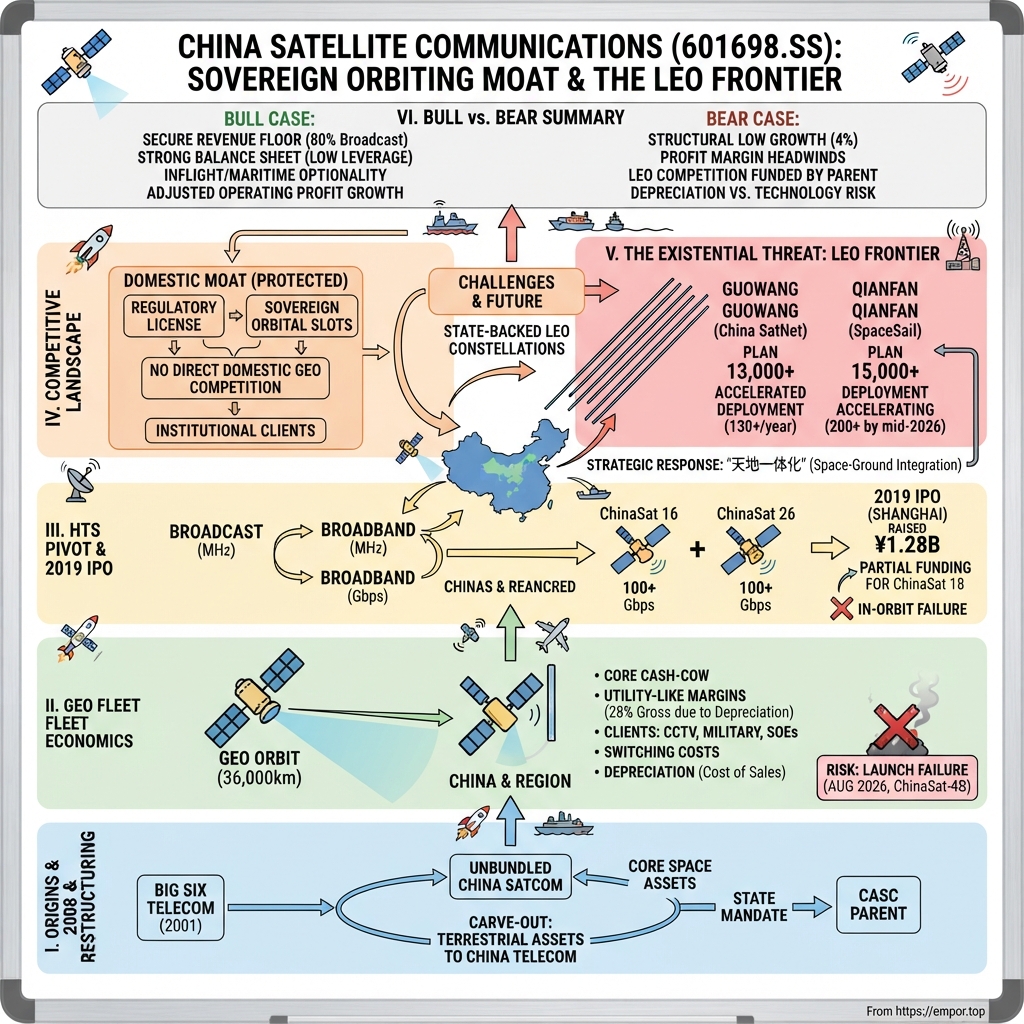
China Satellite Communications Co., Ltd. (601698.SS): The Sovereign Orbiting Moat & The LEO Frontier
I. Introduction & Episode Roadmap
On the evening of August 10, 2026, at the Wenchang launch site on Hainan Island, a 长征七号改 Long March 7A rocket lifted off at 8:02 p.m. carrying a communications satellite named 中星4B ChinaSat-4B. For roughly eighty-five seconds, the flight appeared nominal — the plume steady, telemetry clean, and the tropical night sky lit orange. Then, while still in first-stage flight before stage separation, the vehicle exploded. Observers on the ground watched a fireball bloom and a debris cloud drift across the dark sky. Xinhua confirmed within hours that the mission had failed and the satellite had not reached orbit.12 Chinese aerospace authorities stated that the cause remained under investigation.3
The event offered a literal illustration of the company's operating model. China Satcom does not build rockets or manufacture spacecraft. It purchases satellites from its state parent, relies on a state-built launcher to place them into geostationary orbit, and rents out the resulting radio frequency capacity over a fifteen-year lifespan. When a launch succeeds, the business operates as a steady annuity. When it fails, several hundred million renminbi and three to four years of capital planning vanish at an altitude of twenty kilometres.
Almost every high-altitude domestic flight in China offering inflight Wi-Fi, a large share of maritime vessels operating across the South China Sea and beyond, the nationwide distribution feed for 中央广播电视总台 CCTV (China Central Television) alongside provincial broadcasters, and emergency backhaul deployed during terrestrial fibre outages route through the satellite fleet owned and operated by 中国卫星通信集团股份有限公司 China Satellite Communications Co., Ltd., known domestically as 中国卫通 China Satcom and listed in Shanghai under ticker 601698.
The standard bull thesis presents a simple narrative: a state-sanctioned monopoly over commercial satellite communications in the world's second-largest economy, anchored 36,000 kilometres in geostationary orbit, generating utility-like margins under parent 中国航天科技集团有限公司 CASC (China Aerospace Science and Technology Corporation), with an embedded call option on satellite broadband. Financial disclosures reveal a more nuanced reality. The regulatory moat is real, but profit margins differ from typical utility expectations. Reported gross margin in FY2025 was roughly 28% rather than the 50%-plus often attributed to space utilities, primarily because satellite depreciation sits within cost of sales.4 Revenue growth has remained in the low single digits for years, while profitability has faced headwinds: in the first half of 2026, revenue reached ¥1.229 billion, up 0.66% year-on-year, while net profit attributable to shareholders declined 37.36% to ¥113 million.5
The central strategic question is not whether China Satcom possesses a moat, but how durable that moat remains. Specifically, can a sovereign-licensed geostationary operator earn an adequate return on capital as demand shifts from broadcast megahertz to broadband gigabits, particularly while two major state-adjacent low-Earth-orbit (LEO) constellations — 国网 Guowang and 千帆星座 Qianfan — are being deployed by parallel state enterprises?
This roadmap outlines the analysis ahead. It begins with the 2001 mandate and the 2008 电信体制改革 telecom restructuring that reorganized China's state telecom sector and assigned its satellite assets to CASC. The study then dissects fleet economics, examining capital expenditures, depreciation schedules, and the accounting structure behind a 28% gross margin alongside higher cash margins. It traces the high-throughput pivot from 中星16号 ChinaSat 16 to 中星26号 ChinaSat 26, the 2019 Shanghai listing, and the strategic transition into broadband data services. Finally, the analysis evaluates governance under CASC, applies Hamilton Helmer's 7 Powers and Porter's Five Forces frameworks, assesses competitive positioning against emerging LEO networks, and outlines key performance indicators that will track execution moving forward.
The history begins with the company's origins: not a conventional startup business plan, but a sweeping state telecom reorganization.
 Subscribe on LinkedIn
II. Strategic Origins & The 2008 Watershed Restructuring
Chinese satellite communications began, as most things in Chinese aerospace did, with a song. On April 24, 1970, 东方红一号 Dongfanghong-1 reached orbit broadcasting the melody of "The East Is Red" — a satellite whose payload was essentially a radio transmitter playing a political anthem. It proved little commercially, but everything symbolically: China could place an object in orbit and transmit signals across the globe.
Bridging the gap between that symbolic launch and a functioning domestic satellite communications industry took three decades. For most of those years, China leased transponder capacity from foreign operators. The practical consequence was that Chinese broadcast and government traffic depended on hardware owned by overseas entities. For a state that had spent the 1960s experiencing the risks of technological reliance on foreign powers, this was an uncomfortable compromise — a strategic vulnerability that Beijing eventually moved to eliminate.
The Big Six and the Orphan
The 2001 founding of China Satellite Communications Corporation established it as one of China's "Big Six" basic telecom operators, alongside China Telecom, China Mobile, China Unicom, China Netcom, and China Railcom. Yet within that lineup, it remained an outlier. While the other carriers sold dial tone and mobile service to hundreds of millions of consumers, China Satcom sold transponder capacity to a small group of institutional clients. It had also accumulated a small terrestrial telecom arm that struggled to achieve competitive scale against the incumbent state giants.
This structural mismatch shaped the company's subsequent history. Combining a satellite operator with a consumer telecom carrier offered minimal synergy, pairing two distinct businesses with different customer bases, capital expenditure cycles, and regulatory regimes under a single entity.
The 2008 Carve-Up
In 2008, state planners addressed the inefficiency through a major sector reorganization. The 电信体制改革 telecom restructuring of that year consolidated the six state carriers into three integrated operators — China Mobile, China Unicom, and China Telecom — and unbundled China Satcom.
Its struggling terrestrial assets, including fixed-line and cellular operations, were stripped out and folded into 中国电信 China Telecom. The core space assets — including spacecraft, orbital slot filings, ground stations, and the space-segment license — were transferred to CASC, the state aerospace prime contractor responsible for manufacturing China's rockets and satellites.
As a conventional corporate transaction, placing a telecom operator inside a defense and aerospace manufacturer appeared unusual. As industrial policy, however, the logic was clear. Rather than cultivating a commercial telecom competitor, state authorities sought to build a vertically integrated space communications enterprise — a single group capable of specifying a satellite, having a sister institute manufacture it, using another sister unit to launch it, and operating the payload under a sovereign license. The 2008 restructuring effectively created a public utility tied directly to a state manufacturer.
The Licence That Is the Business
The primary asset China Satcom retained from the 2008 restructuring was a regulatory permit: a basic telecommunications business license covering satellite space-segment communications across China. In a domestic market where infrastructure operating rights are granted by decree rather than open competition, this license represents greater long-term value than any individual satellite. Spacecraft depreciate on a fifteen-year schedule; the license does not expire.
The license carries a distinct regulatory framework, overseen by the 国家广播电视总局 NRTA (National Radio and Television Administration) for media broadcasting and the 工业和信息化部 MIIT (Ministry of Industry and Information Technology) for telecommunications. It also entails specific policy obligations, requiring the company to maintain coverage over remote border regions and ensure uninterrupted national broadcast distribution. These services operate under policy mandates rather than commercial market rates.
This framework — guaranteed domestic market protection in exchange for non-commercial service duties — represents the foundational dynamic of China Satcom's business model. It explains why the company faces no domestic competitors in its core market, while also clarifying why its return on equity resembles that of a regulated utility rather than a high-margin monopoly.
This leads directly to the operational network itself: nineteen spacecraft and the core economics of leasing radio frequency capacity from geostationary orbit.
III. GEO Fleet Economics & The Core Cash-Cow Engine
The core physical principle is straightforward. Position a satellite 35,786 kilometres above the equator and it orbits at the precise speed of Earth's rotation. From the ground, it appears stationary. Point a dish at it once, bolt it down, and it requires no further adjustment. A single geostationary satellite can illuminate roughly one-third of the planet's surface.
That geometry explains why geostationary orbit (GEO) dominated satellite communications for half a century. For linear broadcasting, the architecture is highly efficient: a single transmitter and uplink send signals to every dish within the footprint simultaneously, at essentially zero marginal cost per additional viewer. A television network distributing a feed to thousands of cable headends across a continent cannot match those economics with terrestrial fibre.
However, the same physics imposes a fundamental constraint. A radio signal travelling up to GEO and back down covers about 72,000 kilometres, requiring roughly a quarter of a second in each direction at the speed of light. That half-second round-trip latency is imperceptible when watching a television broadcast. Yet it becomes disruptive for real-time video calls, cumbersome for web browsing, and unusable for interactive applications. Both the commercial foundation and structural vulnerability of China Satcom stem from this physical lag.
What a Satellite Costs
Building and deploying a large GEO communications satellite is a multi-year, multi-billion-renminbi undertaking that encompasses the spacecraft bus, communications payload, launch vehicle, insurance, and ground control infrastructure. While individual programme costs are not broken out in financial disclosures, the aggregate capital commitment is evident on the balance sheet. At the end of FY2025, total assets stood at ¥22.406 billion against parent-attributable equity of ¥15.988 billion, yielding an asset-liability ratio of 9.63%.6 This reflects a fleet funded predominantly through equity and retained earnings rather than leverage.
Once a satellite is commissioned, the operating cost structure inverts. In-orbit maintenance requires modest ongoing outlay—primarily control center operations, engineering staff, station-keeping propellant, and gateway stations. Whether transponder capacity is leased at full or partial utilization, the incremental cash cost of carrying additional traffic is negligible. This operational profile explains why space-segment leasing is conventionally characterized as a high-margin business.
Why the Reported Margin Doesn't Look Like It
Despite low incremental cash operating costs, China Satcom reported an FY2025 gross margin of roughly 28% and a net margin near 18%.4 The bridge between cash generation and accounting profitability lies in depreciation, which represents the critical accounting dynamic of the business model.
The company depreciates satellite bodies over 13.5 to 18.5 years, a period matching design life minus approximately eighteen months.7 Annual fleet depreciation exceeded ¥1 billion in each year from 2020 through 2024, and reached ¥575 million in the first half of 2025 alone.7 Relative to FY2025 revenue of ¥2.645 billion,6 depreciation absorbs roughly one-third to 40% of top-line revenue before accounting for operational overhead.
This structure creates two distinct operational pictures. On a cash basis, space-segment leasing generates steady cash flows reminiscent of a regulated utility. On a reported accounting basis, however, the business yields a modest mid-single-digit return on equity because financial statements continuously charge earnings for orbital capital consumption.
Both metrics provide essential perspective. Depreciation reflects a physical reality: spacecraft have finite operational lives, and retired satellites must be replaced to preserve revenue streams. Capital consumption is not an accounting abstraction but an accrual of ongoing fleet replacement obligations. Disregarding depreciation to highlight gross cash flow assumes orbital assets regenerate without capital expenditure—an assumption disproved by real-world launch risks, as evidenced by the August 2026 mission failure.
The Revenue Engine
The core revenue engine remains space-segment capacity leasing. China Satcom rents C-band and Ku-band transponders under multi-year contracts, primarily to broadcast distributors—such as CCTV and provincial television networks—and to state-owned enterprise (SOE) private networks. Key enterprise use cases include remote monitoring for oil and gas pipelines lacking terrestrial coverage, electrical grid management, and backup networks for emergency management agencies requiring resilient connectivity during landline outages.
These institutional clients exhibit high retention rates driven by structural switching costs. A television broadcaster distributing a national feed relies on thousands of ground receive sites pointed at a specific orbital slot; switching providers requires physically repointing dish infrastructure nationwide. Similarly, emergency agencies rely on standardized, certified equipment that cannot be readily swapped. The resulting switching costs are physical and operational rather than merely contractual.
Conversely, because these key clients are state institutions and state-owned enterprises, pricing power is constrained. The state acts as a buyer focused on controlling national infrastructure costs and maintaining administrative oversight of communications pricing. This tension bears directly on whether the space-segment license functions as a true cornered resource or a regulated public obligation.
What the Numbers Say
The financial results depict an operator with protected domestic demand and low direct operating costs, but modest returns on invested capital. In FY2025, revenue grew 4.08% year-on-year to ¥2.645 billion, while net profit attributable to shareholders declined 2.92% to ¥441.24 million.6 Low single-digit top-line expansion coupled with contracting net profit on an equity base approaching ¥16 billion aligns not with an unconstrained monopoly, but with a regulated utility whose capital base expands faster than its realized pricing.
A notable detail in the FY2025 disclosures is that net profit excluding non-recurring items rose 69.39% to ¥392 million,8 indicating that non-operating items distorted the headline net figure and that underlying core operations performed better than the primary line implied. This divergence highlights the importance of tracking adjusted operating metrics alongside reported net income.
The underlying strategic challenge remains that China Satcom's most secure revenue streams are tied to legacy broadcast distribution—a maturing market segment as demand shifts toward broadband data services.
IV. The High Throughput Satellite (HTS) Pivot & 2019 IPO
By the mid-2010s, global satellite operators faced a common structural inflection point: linear television distribution had peaked.
The decline was gradual rather than sudden, driven by the steady expansion of terrestrial infrastructure. Fiber-optic networks reached deeper into China's interior each year, while mobile IP networks achieved the bandwidth necessary for video transport. Provincial television stations that previously relied on satellite transponders to reach local headends shifted traffic to less expensive landlines. While individual contract renewals represented small incremental negotiations, the cumulative trend pointed in a single direction.
From Megahertz to Gigabits
To address this shift, the industry turned to high-throughput satellites (HTS), a technology that fundamentally altered space-segment economics.
A conventional broadcast satellite functions like a stadium floodlight, projecting a single wide beam over an entire country. While highly efficient for linear television—where every receiving dish processes identical content—it is inefficient for broadband, as all users within the footprint compete for the same pool of capacity.
In contrast, a high-throughput satellite operates like a grid of spotlights. By projecting dozens of narrow spot beams over smaller geographic areas, non-overlapping beams can reuse the same radio frequencies, allowing identical spectrum to serve multiple regions simultaneously. Coupled with high-frequency Ka-band spectrum, which provides broader bandwidth than legacy C-band and Ku-band allocations, total spacecraft capacity increases by more than an order of magnitude.
Commercially, this architecture changes the business model. Instead of leasing transponders—fixed blocks of megahertz billed annually—the operator sells data throughput measured in gigabits per second. This shift introduces a different sales dynamic, customer profile, and operating cost structure. While selling transponders to institutional broadcasters requires minimal sales overhead, providing broadband to airlines and maritime fleets requires ground terminals, hardware installation, regulatory certification, and ongoing technical support.
The Inflection Points
中星16号 ChinaSat 16, launched in 2017, served as China Satcom's initial Ka-band proof of concept. Although modest in throughput by subsequent standards, it was the fleet's first spacecraft engineered to sell data capacity rather than raw transponder bandwidth. The satellite established the foundation for domestic inflight connectivity; by the end of 2022, Sichuan Airlines had outfitted a portion of its Airbus A320 fleet with Ka-band terminals operating primarily over ChinaSat 16.9
A broader capacity expansion occurred on February 23, 2023, with the launch of 中星26号 ChinaSat 26, China's first satellite with total capacity exceeding 100 gigabits per second (Gbps).10 Built by CASC's China Academy of Space Technology (CAST) on the enhanced 东方红四号 DFH-4E bus, the spacecraft features 50 transponders, 94 Ka-band user beams, and 11 gateway beams. It is designed to support up to one million simultaneous user terminals, delivering peak data rates of 450 megabits per second (Mbps) downlink and 200 Mbps uplink per terminal.[^11]10
The principal strategic objective of this deployment lies in unit economics. A high-capacity spacecraft built on an established bus platform lowers the capital expenditure per gigabit compared to legacy satellites. For geostationary operators, lowering cost per bit represents the primary defense against latency advantages held by terrestrial and low-Earth-orbit networks in unserved or underserved markets.
Following ChinaSat 26, the company brought 中星19号 ChinaSat 19 and 中星6E ChinaSat 6E into operational service. On February 22, 2025, China Satcom launched 中星10R ChinaSat 10R aboard a Long March 3B enhanced rocket from Xichang. Built on the DFH-4E platform, the replacement satellite provides coverage across China as well as portions of West, South, and Southeast Asia.11 By the end of FY2025, the company's operating fleet comprised 19 commercial communications and broadcast satellites.6
The 2019 Listing
China Satcom funded a portion of this fleet expansion through public equity markets. In June 2019, the company listed on the Shanghai Stock Exchange at an issue price of ¥2.72 per share, raising approximately ¥1.28 billion. Disclosures allocated roughly ¥100 million to working capital and the remainder to the ChinaSat 18 satellite program.12
The offering was notable for its structure and scale relative to the fleet. Net proceeds of ¥1.28 billion represented a modest addition to a balance sheet whose total assets now exceed ¥22 billion, providing sufficient capital to only partially fund a single spacecraft. Furthermore, the transaction preserved parent control, leaving CASC with a controlling majority while public investors held a small minority stake.12 Consequently, the listing functioned primarily as a corporate governance and market valuation exercise rather than a transformative balance-sheet transaction.
The proceeds allocated to ChinaSat 18 also underscored the sector's operational risks. Following its August 2019 launch, the spacecraft experienced an in-orbit anomaly and failed to enter commercial service. Along with the August 2026 launch failure of ChinaSat-4B detailed earlier, the loss demonstrates the vulnerability of capital investments to space-segment hardware risks—a profile that distinguishes orbital fleet operators from conventional land-based utilities.
Sizing the Growth Engine
Despite multi-year investments in high-throughput infrastructure, value-added and integrated information services—comprising inflight connectivity, maritime broadband, and private enterprise networks—account for approximately 15% to 20% of total revenue. On a ¥2.645 billion revenue base, this segment generates roughly ¥400 million to ¥550 million annually.
These results indicate that the high-throughput pivot has not fundamentally altered the company's financial profile. Traditional transponder leasing continues to generate approximately four-fifths of total revenue and nearly all operational profits. Rather than immediately transforming earnings, capital outlays in Ka-band hardware have primarily secured strategic optionality in data services, while expanding the annual depreciation charges assessed against fleet operations.
V. Segment Breakdown & Financial Architecture
The reason China Satcom's revenue growth has not translated into expanding profit margins becomes clear upon comparing the fundamental economics of its two operating segments.
Segment One: Renting Sky
Space-segment capacity leasing accounts for approximately 80% of total revenue. The core product consists of dedicated spectrum capacity on a specific satellite over a fixed term. Contracts are multi-year, renewal rates remain high, and the customer base is predominantly institutional. Once a spacecraft is operational in orbit, the incremental cost of serving an additional transponder lease is negligible.
This segment functions as the primary profit engine, yet it faces structural growth constraints. Expanding revenue requires either raising prices or increasing available capacity. Price increases are difficult to execute against state and quasi-state buyers that possess both policy leverage and access to terrestrial fibre alternatives. Expanding capacity requires launching additional spacecraft, which immediately triggers new multi-year depreciation charges.
This dynamic represents a fundamental tension inherent to geostationary operators globally. Top-line expansion in space-segment leasing requires substantial upfront capital outlays, which are then recognized as annual depreciation over a fifteen-year asset lifecycle regardless of capacity utilization.
Segment Two: Selling Connectivity
The value-added and integrated information services segment sells a fundamentally different product: end-to-end connectivity delivered to mobile platforms and enterprise networks. This includes inflight Wi-Fi for commercial airlines, maritime broadband under the 海星通 Hai Xing Tong brand—whose network the company states covers over 95% of major maritime routes globally6—emergency communications support, and custom network integration for government and industrial clients.
Gross margins in this segment are materially lower than in space-segment leasing due to structural cost factors. While transponder leasing delivers pure bandwidth with minimal direct operating overhead, providing managed connectivity requires purchasing satellite terminals, funding aircraft-type certification and installation, integrating hardware into cabin systems, and delivering ongoing technical support. These terminal and installation expenses scale directly with volume and sit directly within cost of sales.
This dynamic illustrates the classic challenge facing infrastructure operators expanding downstream. While moving closer to the end user captures a larger addressable market, it also introduces a higher operational cost structure that dilutes overall profitability. The company's reported blended gross margin of roughly 28% reflects both fleet depreciation and this shifting business mix—an effect likely to become more pronounced as managed services expand.
The Aviation Beachhead — and Its Pace
The inflight connectivity business represents the critical test of China Satcom's ability to commercialize its high-throughput fleet. However, adoption rates to date demonstrate the extended timeline required for aviation deployment. As of the first half of 2023, six years after the launch of ChinaSat 16, the company had completed Ka-band network retrofits on 15 narrow-body aircraft, serving roughly 700,000 passenger journeys.[^11]
Operational progress has continued. In its 2026 interim report, the company noted that its aviation subsidiary was participating in a Civil Aviation Administration pilot programme for coordinated forward- and rear-cabin applications, having completed hardware and software development while proceeding with the installation and testing of high-throughput equipment on commercial transport aircraft.5 Regulatory pilot programmes often serve as the precursor to broader commercial mandates within China's civil aviation sector.
Nevertheless, these disclosures emphasize technical certification and pilot trials rather than commercial scale. The disclosures omit key metrics such as total installed fleet count, average revenue per aircraft, or binding airline commitments. For an investment thesis reliant on inflight connectivity becoming a material earnings driver, regulatory testing does not substitute for commercial deployment, and past retrofit rates highlight the deliberate pace of adoption.
The Parent Ecosystem
Underpinning China Satcom's entire operating model is its position within CASC. Satellite payloads are manufactured by 中国空间技术研究院 CAST (China Academy of Space Technology), while launch services are provided by 中国运载火箭技术研究院 CALT (China Academy of Launch Vehicle Technology). The satellite operator, spacecraft manufacturer, and launch provider all function within a single state-owned enterprise group.
This vertical integration provides clear strategic advantages. China Satcom does not compete on the open market for launch slots, negotiate delivery schedules against external satellite buyers, or face reliance on foreign launch providers—a relevant consideration given long-standing U.S. export controls that restrict Western-component satellites on Chinese launch vehicles and vice versa.
However, this structure eliminates market-based price discovery. Because the spacecraft supplier, launch provider, and controlling shareholder are identical entities, internal transfer prices are established administratively. External investors cannot evaluate whether procurement costs reflect market value, as no counterfactual bidding process exists. Related-party transactions of this magnitude represent a structural analytical limitation inherent to the corporate framework.
Financial statements also reveal a notable working-capital trend. Accounts receivable grew approximately 56% year on year in FY2025,4 far outpacing top-line revenue growth, and by the 2026 interim report stood at more than 270% of the prior year's attributable net profit.5 While institutional clients such as state broadcasters and government agencies carry low default risk, receivables expanding at roughly fourteen times the rate of revenue create a working-capital drag that slows the conversion of reported accounting profits into cash flow.
Who is making these decisions, and what does their record say?
VI. Management Credibility, Governance & Capital Allocation
A specific executive career path exists within China's state aerospace apparatus: an engineer completes a doctorate and spends twenty-five years moving between design institutes, programme offices, and operating subsidiaries within a single state enterprise group. Throughout that trajectory, evaluation focuses primarily on operational reliability—ensuring space systems function securely and without disruption—rather than on generating commercial returns on capital.
That career profile defines the leadership running China Satcom.
The Leadership
Chairman 孙京 Sun Jing, born in August 1972, holds a doctorate and serves as both chairman and Party committee secretary—the dual leadership role standard across Chinese central state-owned enterprises (SOEs), reflecting a governance structure that operates on parallel corporate and political tracks.13 He was elevated to chairman from general manager in 2023.
General Manager 马海全 Ma Haiquan, born in November 1973 and also holding a doctorate, was appointed in July 2025 and nominated as a non-independent director, assuming the deputy Party secretary role alongside executive responsibilities.[^15]13
What is most revealing about these appointments is not executive résumés but compensation structure. Sun Jing's disclosed FY2025 remuneration was ¥927,300.8 For context, that compensation is comparable to what a mid-level engineer earns at a Western technology firm, despite Sun overseeing a publicly listed company with ¥22 billion in total assets and a national strategic mandate. There is no equity component, no stock options, and no performance-share plan of the kind that drives Western corporate management.
The strategic implication is clear: management is not incentivized to optimize for equity market valuations, because compensation is entirely decoupled from share price performance. Instead, executive performance is evaluated on state priorities: operational continuity—zero broadcast outages and uninterrupted government communications—technological self-reliance, and the preservation of state assets. While those are coherent policy objectives, they differ fundamentally from maximizing minority shareholder returns. An investor analyzing China Satcom as if it were managed for total shareholder return is misinterpreting the company's operating mandate.
Ownership and Its Consequences
CASC and affiliated state entities have controlled the overwhelming majority of shares since the 2019 listing, leaving a modest public float.126 The governance implications for minority shareholders are clear: outside investors possess no mechanism to influence corporate strategy, with no prospect of activist campaigns, proxy contests, or takeover premiums. Investor protection relies almost entirely on regulatory disclosure mandates and the state's interest in maintaining orderly capital markets for listed SOEs.
The limited free float also results in a thin trading volume, leaving the equity vulnerable to price volatility driven by market sentiment surrounding Chinese commercial space ventures rather than shifts in fundamental earnings.
The Capital Allocation Record
On a balance-sheet basis, the company maintains a conservative capital structure. An asset-liability ratio of 9.63% indicates a capital-intensive business funded almost entirely through equity and retained earnings rather than debt.6 Dividend distributions have remained steady, with FY2025 payouts totaling ¥132.65 million, representing a 30% payout ratio of attributable net profit.6
However, evaluating capital allocation through a commercial lens reveals key structural considerations:
The capital drag. A large cash and near-cash reserve funded by equity yields modest investment returns—evidenced by the ¥43.34 million generated from cash management activities in FY20256—which weighs directly on return on equity. From a commercial standpoint, this capital is maintained for strategic resilience rather than yield optimization; the controlling shareholder prioritizes an unassailable financial buffer, while public equity holders absorb the lower returns. This structure represents a persistent drag on capital efficiency tied to the company's policy role.
The R&D question. Cumulative research and development expenditure totaled ¥345 million over the five-year period leading into early 2025.11 Against an annual revenue base of ¥2.6 billion, this represents approximately 2% to 3% of sales—a modest commitment for an enterprise navigating a major sector technology transition. R&D functions primarily within CASC's research institutes rather than on China Satcom's balance sheet. Consequently, whether the financial benefits of that innovation flow to the payload operator or remain with the state equipment manufacturer depends on internal transfer pricing that outside investors cannot independently verify.
Depreciation and impairment risks. Capital deployment into high-throughput geostationary satellites relies on 13.5- to 18.5-year depreciation schedules at a time when low-Earth-orbit constellations threaten to compress industry-wide bandwidth pricing per gigabit. If market price compression accelerates faster than depreciation schedules assume, asset carrying values could become impaired relative to future cash flows. Western GEO operators such as Intelsat and Eutelsat previously experienced severe balance-sheet distress when asset valuations were marked down against shifting market conditions. For China Satcom, low financial leverage converts a potential solvency crisis into a valuation issue, providing a key risk buffer.
The execution record. Launch and in-orbit anomalies—such as the loss of ChinaSat 18 and the August 2026 launch failure of ChinaSat-4B—reflect risks inherent to rocketry rather than direct operational errors by satellite management. Nonetheless, the resulting capacity gaps directly affect the operator's business plan. Key indicators to monitor include how management details the financial impact of the ChinaSat-4B failure, insurance cost recoveries, and replacement timelines, or whether disclosures remain generalized under standard SOE reporting practices. Following the mission failure, the cause remained under investigation and the company had not quantified the financial impact.3
Management's operational track record reflects reliable execution within a conservative capital structure, consistent dividend payouts, and alignment with national policy mandates. However, evidence demonstrating commercial capital allocation efficiency remains limited, as the company operates under a strategic utility framework rather than a market-driven corporate model.
Transitioning to the competitive environment will clarify how these governance dynamics interact with emerging LEO constellation networks.
VII. Competitive Landscape & Strategic Frameworks
An evaluation of China Satcom's market positioning reveals two distinct operating environments: domestic insulation and international exposure.
Domestically: No One Is Coming
In mainland China's commercial GEO satellite communications segment, there is no second operator. This market structure was not won through open competition; it is a direct regulatory outcome. A prospective entrant would require a basic telecommunications space-segment license, ITU orbital filings coordinated through Chinese administrative channels, several billion renminbi in capital, guaranteed launch access, and regulatory authorization to serve state broadcast and government clients. Each step requires explicit state approval—and authorities have granted that mandate exclusively to China Satcom.
Regionally: The Sister Company
亚太卫星 APT Satellite (HKEX: 1054.HK) provides an instructive contrast, operating GEO capacity across the Asia-Pacific region while also backed by CASC.14 In a Western corporate structure, operating two parallel satellite fleets under a single parent across overlapping geographies would invite calls for consolidation. That this dual structure persists underscores that state planners are optimizing for objectives beyond eliminating internal redundancy—specifically, maintaining a Hong Kong-listed commercial entity for international business while China Satcom executes the domestic sovereign mandate.
Globally: Better Margins, Smaller Board
Compared with Western GEO operators such as SES, Eutelsat-OneWeb, Intelsat, and Viasat, China Satcom's core domestic business demonstrates greater structural stability, even if its gross margins reflect orbital depreciation rather than unconstrained pricing power. While international GEO operators have spent a decade enduring price competition from capacity oversupply and declining broadcast revenues—forcing several into financial restructurings—China Satcom remains insulated from such commercial pressures at home.
The corresponding limitation is the company's constrained international commercial footprint. Its revenue remains concentrated within Greater China and adjacent regions, serving predominantly Chinese institutional clients. A domestic regulatory license offers no protection abroad, where the operator must compete on price and service against global incumbents with established sales infrastructure and against low-Earth-orbit networks offering superior latency. The protective moat, in short, ends at the national border.
Hamilton Helmer's 7 Powers
Cornered Resource — the primary power, with a caveat. The space-segment license and sovereign orbital slot allocations function as a cornered resource in Helmer's framework—assets to which China Satcom holds exclusive access that competitors cannot replicate. However, Helmer's framework specifies that a cornered resource must yield superior economic returns, whereas China Satcom's mid-single-digit return on equity reflects regulated utility economics. A more precise formulation is that the license guarantees market access and baseline demand rather than excess profit. The regulatory framework shields the company from domestic competition but does not confer pricing power, as the granting authority also acts as the dominant customer with a policy mandate to control infrastructure costs.
Scale Economies — operational but bounded. Centralized tracking, telemetry, and control infrastructure managing 19 spacecraft spreads ground-segment fixed costs across a broad fleet. While economically real, these savings remain modest relative to the underlying capital expenditure required for satellite manufacturing and launch.
Switching Costs — the strongest commercial defense. Migrating a national broadcast distribution network or certified emergency communications system off an incumbent satellite payload involves substantial expense, long operational lead times, and technical risk. This dynamic represents the company's most durable commercial advantage during the transition toward LEO networks, safeguarding its installed client base even if new growth shifts elsewhere.
Process Power, Branding, Network Economies, Counter-Positioning — largely absent. The operator possesses no proprietary operational process that peers cannot replicate, no consumer-facing brand equity, and no positive network effects, as satellite capacity degrades under congestion rather than gaining value with user scale. Furthermore, China Satcom occupies the position of an established incumbent being counter-positioned against by emerging LEO operators, rather than acting as a market disruptor.
Porter's Five Forces
Barriers to entry: absolute within the domestic GEO market. Regulatory licensing, ITU orbital filings, and capital requirements make GEO satellite entry impossible without explicit state authorization—explaining why competitive disruption takes the form of alternative satellite architectures rather than new GEO operators.
Supplier power: high, and internally consolidated. Parent company CASC controls satellite manufacturing, launch vehicles, and launch scheduling while maintaining voting control over China Satcom. This alignment eliminates standard commercial supplier negotiations in favor of administrative allocation within the state enterprise group.
Buyer power: substantial, despite market protection. The customer base is highly concentrated among state broadcasters, provincial media groups, government ministries, and state-owned enterprises. While security mandates prevent these entities from abruptly discontinuing service, buyers retain significant leverage over transponder pricing, can shift non-critical traffic to terrestrial fiber, and can direct future broadband budgets toward state-sponsored LEO networks. Where the client, regulator, and owner represent branches of the same state authority, buyer power constitutes a primary strategic constraint.
Threat of substitutes: high, and intensifying. Terrestrial fiber and 5G expansion continue to shrink the geographic footprint where GEO satellite coverage is essential. Simultaneously, LEO satellite constellations target latency-sensitive data applications that geostationary orbit physically cannot support.
Rivalry among existing competitors: negligible today, signaling structural disruption. The absence of direct domestic GEO rivalry reflects a protected utility model that is increasingly vulnerable to cross-technology competition from emerging LEO architectures.
That structural transition is already underway as state-backed LEO constellations deploy dozens of satellites each month.
VIII. The Existential Threat: GEO vs. LEO Mega-Constellations
The economic and technical assumptions underpinning geostationary satellite communications have been reshaped by orbital geometry.
A geostationary satellite operates at an altitude of 35,786 kilometres. By contrast, a low-Earth-orbit (LEO) satellite operates between 500 and 1,200 kilometres—roughly one-fiftieth the distance. This spatial difference reduces round-trip signal latency from approximately 500 milliseconds to about 20 milliseconds, matching the performance of standard terrestrial broadband. At 20 milliseconds, satellite links comfortably support real-time enterprise applications, cloud computing, interactive video conferencing, and low-latency data transport that GEO physics cannot match.
The trade-off for low latency is orbital coverage. Because a LEO satellite covers a much smaller geographic footprint and travels across the sky at eight kilometres per second, maintaining continuous coverage requires constellations of hundreds or thousands of spacecraft operating with coordinated signal handoffs and automated ground-tracking terminals. For decades, the capital costs of deploying and replacing thousands of short-lived satellites made LEO constellations financially unfeasible. That calculus shifted when mass-production manufacturing and reusable launch vehicles transformed spacecraft from bespoke infrastructure into standardized industrial outputs.
China's Sovereign Response
China's strategic response to this shift has emerged through two state-backed mega-constellation initiatives, neither of which is operated by China Satcom.
The first entity, 中国卫星网络集团有限公司 China SatNet—a dedicated state-owned enterprise established directly under central authority—is constructing the 国网 Guowang constellation. Guowang is planned at roughly 13,000 satellites operating across two primary sub-constellations: GW-A59 in very low orbit below 500 kilometres and GW-A2 near 1,145 kilometres, with a long-term ambition of direct-to-handset connectivity.15 Network deployment commenced in December 2024 and accelerated rapidly through 2025, as launch cadence compressed from one-to-two months down to three-to-five days, placing over 130 satellites into orbit during the year.15 Orbital launches have continued through 2026.16
The second major initiative is 千帆星座 Qianfan (also known internationally as SpaceSail), developed by state-backed 上海垣信卫星 SpaceSail (Shanghai Spacecom Satellite Technology). Qianfan is planned at approximately 15,000 satellites across three deployment phases, anchored by a first-phase target of 1,296 spacecraft.17 By mid-2026, Qianfan had passed 200 satellites in orbit, targeting 324 by mid-year and 648 by year-end.1718
These deployment figures contrast sharply with China Satcom's operational fleet of 19 geostationary spacecraft. Guowang placed roughly seven times China Satcom's entire fleet count into orbit in a single calendar year. Furthermore, the capital allocated to these LEO mega-constellations substantially exceeds China Satcom's historical balance-sheet capacity, driven by entities created by state planners specifically for high-volume orbital deployment.
This dual structure highlights a critical strategic reality: rather than tasking its incumbent GEO operator with building low-Earth-orbit broadband infrastructure, the Chinese state established parallel corporate entities. Whether driven by the distinct industrial requirements of LEO deployment—which demand high capital velocity and automated volume manufacturing rather than regulated GEO fleet management—the strategic consequence remains identical. The primary capital expansion and technological evolution of Chinese space-based broadband are occurring outside China Satcom's balance sheet.
Why GEO Does Not Simply Die
Despite these headwinds, assessing GEO technology as obsolete oversimplifies the competitive landscape. Three structural factors preserve a defensible operational role for geostationary fleets:
One-to-many broadcast economics. For distributing identical linear video signals to tens of thousands of fixed receiving terminals, a geostationary satellite remains unmatched in capital efficiency. A LEO constellation distributing identical linear feeds across a moving network faces greater architectural complexity and higher cost per point of distribution. So long as state policy mandates satellite-based distribution for national television feeds, this core revenue stream remains protected.
Wide-area latency-insensitive applications. Remote pipeline monitoring, electrical grid telemetry, backup connectivity for industrial facilities, and secondary data backhaul operate effectively despite half-second latency. For these low-bandwidth, non-interactive use cases, switching to LEO hardware offers minimal operational benefit.
Strategic sovereignty and infrastructure resilience. A fully domestic GEO fleet supported by national ground gateways and sovereign ITU spectrum allocations provides an unassailable fallback network. The state maintains this infrastructure for national security and administrative resilience regardless of commercial LEO pricing—the precise policy imperative that established China Satcom's original regulatory license.
The Hybrid Defence, and Whether to Believe It
In response to LEO competition, management has articulated a strategy centered on 天地一体化 (space-ground integration). This approach aims to transition China Satcom from a transponder capacity landlord into an integrated network service provider, bundling GEO bandwidth with LEO connectivity and terrestrial networks for aviation, maritime, government, and defence clients.
The commercial logic of hybrid integration is straightforward. Enterprise buyers of mobile broadband—such as airlines or shipping operators—require continuous coverage across diverse geographies rather than specific orbital architectures. Under a managed-service model, the provider controlling customer relationships, terminal hardware, regulatory certifications, and billing infrastructure can route traffic across whichever satellite orbit or terrestrial network offers the most efficient throughput. In this framework, China Satcom's GEO spacecraft function as one input among several, while its primary assets shift toward regulatory licenses, operational certifications, and enterprise client relationships.
However, management's ability to execute this transition remains unproven. Historical disclosures highlight a deliberate commercialization pace: six years after launching its initial Ka-band satellite, China Satcom had completed Ka-band retrofits on only 15 commercial aircraft, while value-added and integrated services continue to generate less than 20% of total revenue. Furthermore, executing a hybrid service strategy requires wholesale capacity agreements with LEO operators such as China SatNet and SpaceSail. Because those state-backed LEO entities are developing their own direct enterprise sales capabilities, China Satcom cannot guarantee access to LEO capacity on favorable wholesale terms.
Consequently, China Satcom's defensible market positioning narrows to institutional and regulated sectors—such as civil aviation, state maritime operations, and emergency management—where regulatory licenses, security clearances, and established state relationships outweigh raw orbital economics. The broader claim that China Satcom will serve as China's general-purpose satellite connectivity provider across all market segments is not supported by current operational metrics. Validating that broader growth narrative would require disclosed, sustained expansion in installed aviation and maritime terminal counts alongside rising recurring service revenues—metrics that have not yet materialized in corporate filings.
IX. Investment Story Spine & Material Risk Radar
Why It Wins
The affirmative case rests on four distinct pillars of varying strength.
First, the regulatory license and orbital rights are irreplaceable assets that protect the core revenue base. National broadcast distribution and state-owned private networks are unlikely to migrate to low-Earth-orbit alternatives in the near term, constrained by high switching costs and state policy favoring sovereign control. This dynamic establishes a stable floor beneath roughly 80% of total revenue.
Second, the balance sheet provides exceptional financial insulation. An asset-liability ratio under 10% ensures the company can absorb launch failures, soft pricing cycles, or asset impairments without existential risk.6 In an industry where several Western GEO incumbents have faced financial restructuring, this low financial leverage offers meaningful downside protection.
Third, state ownership guarantees priority launch access and captive institutional demand that commercial competitors would have to contest on the open market.
Finally, the aviation and maritime business units provide embedded optionality on China's underpenetrated inflight and maritime connectivity markets.
Why It May Not
The counter-case is grounded in more immediate structural constraints.
Returns on capital remain structurally modest. Generating a mid-single-digit return on equity against a ¥16 billion equity base—with top-line growth near 4% alongside contracting net profit—reflects a business consuming capital almost as quickly as it creates value.6 The current corporate strategy offers no clear catalyst to alter this dynamic: expanding capacity requires capital outlays for spacecraft, new orbital assets generate immediate depreciation charges, and pricing power against state institutional buyers remains constrained.
Operational metrics have deteriorated in recent periods. In the first half of 2026, net profit fell by more than one-third year-on-year on essentially flat revenue.5 Meanwhile, accounts receivable have expanded significantly faster than top-line revenue,45 signaling persistent cash-conversion friction rather than temporary operational noise.
Most critically, the primary competitive threat is being financed by the company's controlling shareholder. While regulatory licensing shields China Satcom from domestic commercial rivals, it offers no protection if state planners reallocate strategic priority toward parallel state enterprises—a shift demonstrated by the direct capitalization and rapid deployment of Guowang and Qianfan.
Finally, the operational fleet carries significant impairment risk, depreciating over 13.5- to 18.5-year asset lifecycles while low-Earth-orbit technology advances across three-to-five-year cycles.
Myth vs. Reality
Three common market assumptions regarding China Satcom require re-examination:
Myth: China Satcom operates as a high-margin space utility delivering 50%-plus gross margins.
Reality: The company reported an FY2025 gross margin of roughly 28%.4 While cash margins on fully depreciated, leased transponder capacity are high, reported accounting margins are diluted because fleet depreciation sits directly within cost of sales and the expanding managed-services segment incurs substantial terminal hardware costs.
Myth: The stock offers a pure-play equity investment in China's commercial space expansion.
Reality: China Satcom functions as a low-growth, state-priced infrastructure operator whose equity price occasionally trades on broader space sector sentiment while its underlying earnings remain decoupled from commercial space activity. The primary capital expansion in Chinese space broadband is concentrated within state-backed LEO entities such as China SatNet and SpaceSail.
Myth: Domestic monopoly status provides strong pricing power.
Reality: A sole-source provider facing concentrated monopsonistic demand from state entities yields financial stability rather than economic rent, as demonstrated by a decade of low single-digit revenue growth and stagnant profit margins.
The KPIs That Matter
Evaluating execution requires tracking three primary key performance indicators:
Transponder capacity utilization across C-, Ku-, and Ka-bands. Utilization serves as the clearest measure of whether market demand is matching expanding fleet capacity. Broadening in-orbit bandwidth alongside stable or declining utilization signals that capital is being allocated into an oversupplied market, serving as an early indicator of potential asset impairment.
Revenue per unit of capacity—measured per transponder-year in legacy bands and per gigabit in Ka-band. This metric tracks whether the operator can preserve pricing against terrestrial fiber expansion and LEO-driven bandwidth price compression. Because utilization can be sustained through price discounting, evaluating utilization alongside yield provides the truest measure of underlying economic value.
Active mobile terminal counts across commercial aircraft and maritime vessels. Installed terminal counts represent the benchmark for verifying management's high-throughput growth strategy. While corporate disclosures have historically reported these metrics only sporadically, sustained growth in active terminals paired with expanding recurring service revenue would confirm commercial adoption. Continued lack of consistent disclosure suggests adoption remains limited.
Risk Radar
LEO substitution. The primary risk is not that low-Earth-orbit networks capture legacy television distribution contracts, but that new mobile broadband requirements—across commercial aviation, maritime shipping, and remote industrial sites—increasingly default to LEO architectures, capping China Satcom's long-term addressable expansion.
Launch and in-orbit failures. Space-segment hardware risks remain material, as demonstrated by the launch failure on August 10, 2026.12 Launch and satellite anomalies consume capital, delay revenue generation, and create operational coverage gaps that require fleet redeployment.
Component and export-control restrictions. Radiation-hardened space electronics and gateway equipment remain sensitive to international export controls. While state industrial policy prioritizes domestic replacement, localization efforts introduce hardware cost overhead and timeline risks.
Working-capital friction. Expanding accounts receivable create an ongoing drag on cash conversion, delaying the conversion of accounting profits into cash flow despite low customer default risk.
Governance and related-party pricing. Procuring spacecraft and launch services from parent entity CASC without independent market pricing leaves minority shareholders unable to verify whether capital procurement costs reflect fair market value.
Terrestrial infrastructure expansion. The continued rollout of terrestrial fiber-optic networks and 5G cellular coverage steadily reduces the geographic areas where satellite connectivity remains essential.
X. Playbook & Core Business Lessons
Lesson 1: A sovereign moat is a fortress with a fixed perimeter. State licensing provides exceptionally strong competitive protection—preventing domestic entrants, price wars, and market share loss. Yet that protection stops precisely at the border of the regulatory grant. China Satcom has maintained its domestic position while struggling to build a meaningful international business, and both outcomes stem from the same structural cause. The broader lesson for investors evaluating a regulated monopoly is to measure the moat's total perimeter, not just its depth. A deep moat around a shrinking or bounded domain leads to a slow liquidation of growth.
Lesson 2: Infrastructure owners do not get to choose when technology changes. A geostationary operator commits capital across a fifteen-year lifespan, while the low-Earth-orbit technology cycle disrupting it moves across three-to-five-year generations. An incumbent asset owner facing this shift has two primary defenses: move downstream into direct customer relationships—a capability space-segment landlords rarely possess—or serve as the efficient fallback for applications that low-latency constellations serve inefficiently. China Satcom is pursuing both paths, though progress in value-added managed services remains modest. For capital-intensive incumbents navigating technological disruption, the critical question is whether management is buying a defensible long-term position or merely buying time—a distinction revealed by operating metrics rather than strategic rhetoric.
Lesson 3: Vertical integration into a state parent is a supply guarantee and a pricing blindfold. Parent ownership by CASC guarantees China Satcom priority access to spacecraft manufacturing and launch capacity that independent peers cannot replicate. However, it also means the company's primary capital outlays are established administratively rather than through market-based price discovery. Furthermore, parent-level priorities—including national capability building, employment, and industrial policy—take precedence over subsidiary return on capital. When state planners launched national low-Earth-orbit initiatives, they created parallel dedicated entities rather than tasking their established geostationary operator. Placement inside a state enterprise group guarantees access to infrastructure, but it does not guarantee priority in future growth mandates.
XI. Epilogue & Bull vs. Bear Summary
Six weeks after the launch failure of ChinaSat-4B, China Satcom remains fundamentally what it was before: nineteen geostationary satellites, one sovereign telecommunications license, and an ongoing negotiation with the laws of orbital physics.
The bull case positions China Satcom as a conservatively financed, dividend-paying sovereign infrastructure asset with a protected revenue floor that terrestrial and LEO competitors cannot easily erode, paired with an embedded option on domestic inflight and maritime connectivity. Nearly debt-free, the company maintains the balance-sheet resilience to absorb capital shocks that forced several Western peers into financial restructuring. Adjusted net profit excluding non-recurring items rose sharply in FY2025 even as headline earnings declined,8 indicating that core operational performance was stronger than headline figures suggested. Should ongoing pilot programs with civil aviation authorities transition into fleet-wide mandates, the managed-services segment could expand into a material earnings driver.
The bear case views the company as a legacy geostationary operator generating a modest mid-single-digit return on an expanding equity base, constrained by stagnant top-line growth, declining interim profits, accounts receivable outstripping sales, and a sector-wide technology transition funded outside its balance sheet. The state authority that grants its domestic regulatory license has directed its primary broadband capital elsewhere, building low-Earth-orbit constellations planned at thousands of satellites against China Satcom's nineteen spacecraft. Meanwhile, the value-added services unit operates with lower margins and has yet to alter overall corporate earnings after a decade of development, while capital outlays continue to fund fifteen-year orbital assets in a market where bandwidth pricing per gigabit faces ongoing compression.
Both arguments stem from the same underlying operational and financial facts. Long-term performance will not be determined by the core broadcast distribution business, which delivers stable cash flows but limited top-line expansion. Instead, resolution depends on whether active terminal adoption across commercial aircraft and maritime fleets begins to compound—and whether future corporate disclosures provide the operational transparency required to verify that growth.
 LinkedIn
 WhatsApp
 Reddit
 Hacker News
 Email
Email Kindle
 RSS Feed
 Spotify
 Apple Podcasts
 Amazon Music
 Audible
 YouTube