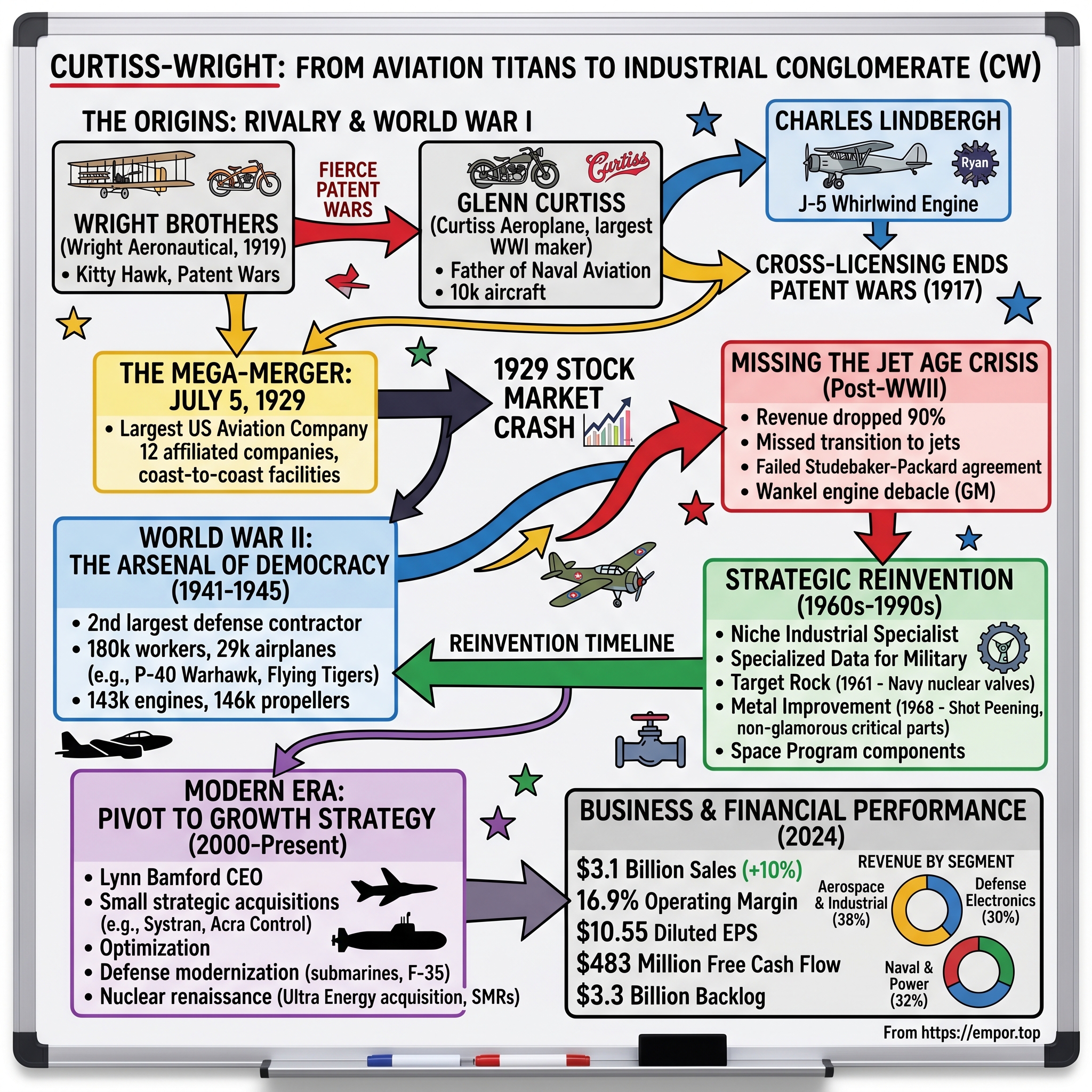
Curtiss-Wright: From Aviation Titans to Industrial Conglomerate
I. Introduction & Episode Roadmap
On a 118-acre campus in Cheswick, Pennsylvania, about 15 miles up the Allegheny River from Pittsburgh, roughly 860 employees build a machine rarely seen outside the U.S. Navy. The component is a canned motor pump designed to move superheated, radioactive water through the primary loop of a submarine's nuclear reactor. Because the submarine operates deep underwater for months without maintenance, the pump integrates the motor and impeller inside a single sealed pressure boundary, eliminating shaft penetrations and mechanical seal leak risks. Within the economics of a $4 billion submarine, the component represents a small fraction of total costs, but its operational reliability is absolute.
In July 2026, Curtiss-Wright announced an $80 million multi-year expansion to construct two buildings at the Cheswick facility. The project expands manufacturing and testing capacity, creating approximately 150 jobs while retaining the existing 860 roles. Funding combines internal capital, U.S. maritime industrial base allocations, and a $1.21 million grant from Pennsylvania's PA SITES program.1 While $80 million is modest for a firm that generated $554 million in free cash flow in 2025, the investment illustrates a long-term strategic focus.2 Over decades of structural industry shifts, Curtiss-Wright reoriented its business around critical, mission-essential components with low tolerances for failure.
Curtiss-Wright Corporation (NYSE: CW) reported 2025 sales of $3.50 billion—up 12% year-over-year—with an operating margin of 18.1% and record free cash flow of $554 million.2 Following two guidance increases in the first half of 2026, management's August 2026 outlook projected full-year sales of $3.77 billion to $3.81 billion, an operating margin between 19.1% and 19.3%, diluted earnings per share of $15.10 to $15.40, and free cash flow of $585 million to $605 million.3 Order backlog reached $4.5 billion by the end of June 2026.3 Despite tracing its corporate ancestry to aviation pioneers Glenn Curtiss and Orville and Wilbur Wright, the company has not manufactured a complete aircraft since World War II.
That transition highlights a broader corporate evolution. During World War II, the manufacturer produced approximately 143,000 aircraft engines and 13,738 P-40 Warhawks, employing 180,000 workers as one of the largest U.S. defense contractors. By the early 1990s, revenue had contracted to the low hundreds of millions. The firm subsequently repositioned itself as a specialized hardware supplier whose products now equip every U.S. Navy nuclear-powered vessel and every commercial nuclear reactor in North America.45
This trajectory was not linear. It involved missing the transition to jet propulsion, spending two decades on costly diversification attempts, experiencing severe revenue contraction, and ultimately executing a deliberate rebuild focused on high-consequence systems where regulatory qualification and reliability create high barriers to entry.
The roadmap for this analysis:
The pioneer era and the great rivalry — patent litigation, early scale, and the engine that powered Charles Lindbergh across the Atlantic. The 1929 mega-merger and the wartime arsenal — peak aviation manufacturing, alongside the Lockland engine scandal that triggered a Senate investigation chaired by future President Harry Truman. The jet age collapse and the Wankel folly — the consequences of optimizing for legacy technology on the eve of disruption. The quiet component pivot — specialized valves, metal shot peening, and the systematic accumulation of nuclear and defense certifications. The "Pivot to Growth" era — Chief Executive Officer Lynn Bamford's operating playbook, serial bolt-on acquisitions, open-architecture defense electronics, and nuclear sector momentum. The investor audit — evaluating sole-source supplier positions, shipyard capacity constraints, and key risks to the current investment thesis.
Throughout this narrative, core claims material to the investment case are evaluated against historical operational missteps. Curtiss-Wright's century-plus operating record provides valuable context on strategic risk and execution failures.
Recent market dynamics provide essential context before examining this history. Through the summer of 2026, the company's shares declined roughly 25% over a single month and fell by a similar margin over three months—even as management raised financial guidance and secured new U.S. Army contracts—though the one-year total return remained positive and the five-year return remained substantial.6 This price action suggests the market is evaluating valuation multiples rather than questioning current operational results. That dynamic—strong operating metrics alongside valuation pressure—frames the business analysis ahead.
 Subscribe on LinkedIn
II. The Wright Brothers & Glenn Curtiss: Rivalry, WWI Boom, & Lindbergh's Spark (1903–1928)
Glenn Hammond Curtiss did not set out to be an aviator; he set out to build speed. Manufacturing and racing motorcycles in Hammondsport, New York, Curtiss rode a custom V8-powered motorcycle to an unofficial 136 miles per hour in 1907, briefly becoming the fastest person on Earth. He was an engine designer before an aircraft builder, an ordering of priorities that defined the firm bearing his name. While Orville and Wilbur Wright treated flight primarily as a control problem—focusing on maintaining directional stability—Curtiss approached aviation as a challenge of propulsion and iterative development: build, test, break, and redesign.
That operational split quickly evolved into patent litigation. The Wright brothers held a 1906 U.S. patent covering wing warping paired with a coordinated rudder—the technique of banking an aircraft by twisting wing surfaces while applying the rudder to maintain turn trajectory. Curtiss used hinged control surfaces attached to the wingtips—ailerons—to achieve lateral control through a different mechanical approach. The Wrights argued, and federal courts largely concurred, that their patent covered the broader function of lateral control rather than merely their specific mechanism.
A decade of legal disputes followed, which aviation historians generally view as having slowed early U.S. aircraft development. In 1917, the U.S. government forced a resolution by forming the Manufacturers' Aircraft Association. This trade entity compelled manufacturers to cross-license aircraft patents into a shared pool, ensuring the nation could build military aircraft during World War I.7 The action demonstrated a recurring pattern: when the government is the sole customer and national security is at stake, proprietary legal protections can be restructured by sovereign mandate.
World War I provided Curtiss with massive industrial scale. The Curtiss Aeroplane and Motor Company operated three manufacturing plants in Buffalo, New York, employed roughly 18,000 workers, and manufactured approximately 10,000 aircraft during the war—briefly becoming the world's largest aircraft producer.8 Its central product, the JN-4 "Jenny," saw total production exceed 6,000 units across Curtiss and contracted partners. Its primary innovation was practical: dual stick controls allowing an instructor and student to operate the aircraft from separate cockpits.9 Rather than functioning as a primary combat aircraft, the Jenny served as the principal training platform for early American military aviation.
During the same era, Wright Aeronautical—the commercial successor to the Wright brothers' early ventures—shifted focus from airframes to engines. In the mid-1920s, the company developed the J-5 Whirlwind, an air-cooled radial engine that significantly improved operational reliability for long-distance flights. On May 20–21, 1927, Charles Lindbergh completed the first non-stop solo transatlantic flight from New York to Paris in the Spirit of St. Louis, powered by a single Whirlwind engine over 33.5 hours of continuous flight. The accomplishment established Wright as a leading brand in aviation propulsion and helped catalyze the aviation investment boom of 1928–1929.
Historical falsification: did pioneer patents and first-mover scale build a durable moat?
The historical premise that early patent dominance and manufacturing scale established a defensible commercial moat is not supported by the operational record.
First, patent exclusivity proved fragile. A decade of Wright patent litigation consumed substantial financial resources and management focus without producing lasting licensing revenue, as federal authority superseded private patent rights once military demand accelerated.7 Proprietary rights vulnerable to sovereign override do not constitute a durable competitive moat.
Second, wartime production scale failed to guarantee long-term market position. Curtiss's expansion depended on wartime military contracts, which ended abruptly with the 1918 armistice. Surplus JN-4 Jennies flooded the civilian market, suppressing demand for new commercial aircraft for years; the U.S. Army retired the model in 1926, with surplus airframes at several fields eventually dismantled or burned.9 Curtiss underwent severe financial contraction and reorganization, shifting operational control to Wall Street financiers. Clement Melville Keys, who joined Curtiss in 1916 as an unsalaried vice president, acquired a controlling interest in 1920 and served as president through 1929, steering the company back from near-bankruptcy.10
This period demonstrated that manufacturing volume without long-term recurring program commitments provided minimal economic durability, while legal exclusivity against a primary sovereign customer offered limited protection. Long-term business defensibility ultimately depended on deep qualification inside safety-critical systems—a strategic focus that emerged decades later.
The immediate aftermath of this era produced neither stability nor immediate durability. Instead, it led to the largest consolidation in early American aviation history, executed on the eve of the Great Depression.
III. The 1929 Mega-Merger & WWII "Arsenal of Democracy" (1929–1945)
Clement Melville Keys was a financier and corporate organizer rather than an engineer, but he recognized a reality that technical founders often overlooked: by the late 1920s, aviation was a capital-markets phenomenon as much as an industrial one. Public enthusiasm following Charles Lindbergh's transatlantic flight had made aviation securities exceptionally easy to sell.
In the summer of 1929, Curtiss Aeroplane and Motor merged with Wright Aeronautical to form the Curtiss-Wright Corporation, with Keys as president of the combined enterprise.510 The consolidation unified the principal Curtiss and Wright operations along with 18 affiliated companies and 29 subsidiaries, capitalized at $75 million with total assets exceeding $70 million.4 The transaction instantly created the largest aviation enterprise in the United States.
Twelve weeks later, the stock market crashed.
What followed were 15 years defined by two distinct operational eras under the same corporate banner. Throughout the 1930s, Curtiss-Wright operated as a shrunken, export-dependent business sustained primarily by international military sales of the P-36 Hawk and modest peacetime orders from the U.S. Army Air Corps. Structured around three core divisions—airframes, Wright Aeronautical engines, and propellers—the enterprise focused on cash conservation and operational survival through the Great Depression.
With the outbreak of World War II, military demand transformed Curtiss-Wright into one of the largest industrial manufacturers in the United States. Total workforce expanded to approximately 180,000 employees. Over the course of the war, the company produced roughly 143,000 aircraft engines, 146,000 propellers, and more than 26,000 complete aircraft, pushing annual sales above $1 billion in two consecutive years—an unprecedented revenue scale at 1940s price levels.4
Its hardware defined American wartime aviation. Production included 13,738 P-40 Warhawk fighters—the third most produced U.S. fighter of the war, made famous by the shark-mouth insignia of the American Volunteer Group in China—and more than 7,000 SB2C Helldiver dive bombers.5 Most strategically consequential was the Wright R-3350 Duplex-Cyclone, an 18-cylinder twin-row radial engine that powered the B-29 Superfortress fleet, including the aircraft that carried atomic weapons to Japan.45 At its peak, Curtiss-Wright engines powered a majority of U.S. military aircraft.
Historical falsification: did wartime scale prove world-class execution?
That unprecedented manufacturing volume masked severe systemic quality breakdowns, offering essential context for evaluating the company's modern operational controls.
In January 1943, the Senate Special Committee to Investigate the National Defense Program—commonly known as the Truman Committee after its chairman, Senator Harry S. Truman of Missouri—received complaints from Army inspectors at Wright Aeronautical's engine plant in Lockland, Ohio, where the R-2600 Twin Cyclone was built. Inspectors alleged that plant management pressured them to approve defective parts and complete engines.11
A Senate subcommittee investigation in April 1943 revealed institutionalized quality assurance failures: falsified test results on gear hardness, forged inspection records, rejected components remixed into production, omitted inspection steps, and internal quality managers rendered powerless by executive throughput pressure. On April 22, 1943, the military downgraded the Lockland facility's inspection rating from Class A to Class B.11 Contemporary accounts reported that over a quarter of engines failed basic testing.12
The institutional response highlighted the contractor's political leverage. The Justice Department sued Wright Aeronautical and eight executives over the sale of defective engines but never pursued the lawsuit. Legal accountability fell on military oversight personnel: three Army Air Forces officers, including Lieutenant Colonel Frank Greulich, were court-martialed and imprisoned for neglect of duty. The corporation paid no penalties, and recommended contract renegotiations were never executed.12 Playwright Arthur Miller later adapted the scandal into the drama All My Sons.
Operational remediations eventually stabilized quality at the facility: the military increased inspector staffing, mandated the destruction of rejected parts, and extended engine run-in testing. Retrospective checks of engines built during the early 1943 window showed acceptable operational performance, averaging over 775 running hours, and by 1944 the Army Materiel Command rated plant management and quality satisfactory.11
The Lockland scandal demonstrates that under extreme production volume, cost-plus contracting, and a single captive government customer, internal quality assurance collapsed due to corporate culture rather than engineering capability. It also underscored the political reality of wartime procurement, where legal penalties targeted military inspectors rather than the prime contractor.
This history directly shaped Curtiss-Wright's modern competitive position. High-barrier products like naval nuclear valves and canned motor pumps remain defensible today because the U.S. Navy's Naval Reactors organization subsequently instituted an unyielding qualification regime—built specifically on the assumption that commercial suppliers under deadline pressure will compromise quality. Curtiss-Wright's current moat is largely the product of sovereign oversight created in response to historical industry failures. While management highlights process discipline as a core internal strength, that discipline was originally mandated and enforced by a sole customer with absolute market leverage.
When World War II ended, defense orders contracted abruptly—and this time, a fundamental technological shift rendered legacy propulsion obsolete.
IV. The Jet Age Crash, Wankel Folly, & The Pivot to Component Niche (1946–1990s)
In 1945, Wright Aeronautical's R-3350 was the most powerful production piston aircraft engine in the world. Featuring 18 cylinders across two rows, a supercharger, and roughly a decade of refinement, it represented the pinnacle of reciprocating engine engineering.
Yet within eight years, that specialized expertise lost almost all of its commercial value.
The gas turbine did to the piston engine what the transistor would later do to the vacuum tube. It was not an incremental improvement, but a categorical shift—offering fewer moving parts, vastly higher power-to-weight ratios at altitude, and a manufacturing discipline centered on high-temperature alloys, precision castings, and aerodynamic blade design. Curtiss-Wright's institutional knowledge resided in crankshafts, cylinders, and valve trains. Competitors like General Electric and Pratt & Whitney focused on turbomachinery; GE leveraged its work on turbosuperchargers, while Pratt committed its corporate capital to turbine development. Curtiss-Wright, still generating substantial revenue from piston volume, attempted to hedge.
The hedge failed across both business lines. The military airframe division collapsed first: after failing to secure military orders for its postwar designs, the company closed the Curtiss Airplane Division in March 1951, ending 40 years of aircraft manufacturing.5 The engine business eroded next. Curtiss-Wright licensed the British Armstrong Siddeley Sapphire and produced it as the J65 starting in 1952. When the government canceled those contracts, the company lost its standing among primary American aero engine suppliers.5 Commercial aviation completed the shift: with the arrival of the Douglas DC-8 and Boeing 707, commercial airlines abandoned piston engines entirely.
The resulting financial contraction was severe. Sales stood at roughly $475 million in 1951 and exceeded $500 million by the end of 1955, before falling to $388 million in 1958 and $329 million in 1959, with annual earnings dropping from $25 million to $14.3 million in a single year.4 The downward trajectory continued over the next three decades. By 1990, revenue had contracted to $214 million with $6.8 million in earnings; in 1993, the firm posted a net loss of $5.6 million on sales of $158.9 million.4 Measured from its wartime peak, Curtiss-Wright had become a fraction of its former size.
The distraction years. Corporate capital allocations during this decline reflected significant strategic missteps.
In July 1956, under Chief Executive Officer Roy T. Hurley, Curtiss-Wright entered into a complex management and financial assistance agreement with the struggling Studebaker-Packard Corporation. The arrangement included roughly $35 million in loans and management services, $10 million for Studebaker's remaining defense contracts, $25 million as prepaid rent on facilities in Michigan and Indiana, options to acquire 45% of Studebaker-Packard's stock at a deep discount, and Hurley personally directing the automaker's operations for three years.413 The transaction yielded no lasting automotive presence, generated no proprietary technology, and distracted executive leadership while the core aerospace business required a response to turbine propulsion.
Curtiss-Wright then pursued rotary engines, acquiring exclusive global aircraft rights and North American rights across all applications for Felix Wankel's rotary combustion design. The company spent nearly two decades attempting to commercialize the technology. The effort peaked in 1970 when General Motors paid $50 million for a five-year non-exclusive North American development license.4 The licensing windfall briefly boosted corporate earnings, and by 1972, Curtiss-Wright stock had become a speculative vehicle for rotary engine enthusiasm.
However, the Wankel engine proved commercially unviable due to high fuel consumption and difficult emissions characteristics. The 1973 oil embargo eliminated market tolerance for those inefficiencies, leading General Motors to abandon its rotary program and leaving Curtiss-Wright without a viable commercial market.4
Historical falsification: was the Wankel license "cheap optionality"?
The assertion that acquiring rights to an emerging technology provides low-cost optionality is contradicted by Curtiss-Wright's operational record.
The $50 million licensing payment provided near-term cash, but masked a core flaw: the absence of end-customer demand. Curtiss-Wright licensed its technology to partners seeking to evaluate an architecture rather than deploy it. More than 15 years of engineering capital were invested in a platform that produced no durable revenue stream, during a period when the company's core markets were contracting and technical resources could have been redirected. The initial licensing fee was the sole validation of the strategy, and it proved misleading.
Development contracts and prototype work represent the modern equivalent of a licensing option. They generate near-term revenue, but they do not prove end-market demand. Subsequent sections of this analysis apply this exact test to modern growth initiatives.
The pivot that actually worked. While large-scale technological bets failed, two smaller acquisitions established the foundation for the contemporary business.
In 1961, Curtiss-Wright acquired Target Rock Corporation.14 Founded in 1951, Target Rock specialized in severe-service valves for the U.S. nuclear Navy, supplying components for USS Nautilus, the world's first nuclear-powered submarine.14 Standard valve designs featured stems passing through pressure boundaries sealed by packing, which inevitably allowed minor leakage—an unacceptable risk inside a submarine's radioactive primary loop. Target Rock developed solenoid-operated and pilot-operated valves that eliminated shaft penetrations and leak paths. Once qualified by Naval Reactors, these designs were embedded for the operational lifespan of the reactor plant.
In 1968, Curtiss-Wright acquired Metal Improvement Company, a specialist in controlled shot peening.4 The process bombards metal component surfaces with spherical media to induce plastic deformation in the outer layer, leaving it in residual compression. Because fatigue cracks initiate under tensile stress at the surface, the compressively stressed outer layer extends component fatigue life. A related application, peen forming, uses asymmetric treatment to shape large aircraft wing panels without mechanical dies. As a process-oriented service, the business relied on proprietary specifications embedded directly into customer engineering drawings, requiring full re-qualification to replace the supplier.
Neither acquisition attracted significant attention at the time, but together they defined Curtiss-Wright's long-term strategy: shifting away from platform ownership to secure qualified positions within mission-critical sub-components. Whether that strategy established a durable competitive moat or merely a specialized niche remained a central question over subsequent decades.
V. Modern Strategic Evolution: From Sub-Scale Supplier to Defense & Nuclear Titan (2000–2020)
By the late 1990s, Curtiss-Wright had become a modest enterprise generating roughly $300 million in annual revenue across a fragmented mix of product lines—valves, actuation, surface treatment, flow control, and motion control—without a unifying strategic focus.4 Though profitable, the operation resembled a standalone division of a larger industrial conglomerate rather than a scalable defense platform. The transformation began with a deliberate shift in capital allocation: acquiring scale in specialized niches where stringent regulatory and technical qualifications, rather than price competition, dictated supplier selection.
The pivotal transaction in the company's modern evolution occurred on October 29, 2002, when Curtiss-Wright acquired substantially all assets of the Electro-Mechanical Division (EMD) of Westinghouse Government Services for $80 million in cash plus assumed liabilities. Located in Cheswick, Pennsylvania, EMD had generated $146 million in 2001 sales as the primary supplier of reactor coolant pumps, main coolant pumps, advanced motors, generators, and secondary propulsors for U.S. Navy nuclear propulsion.15
Purchased for roughly half a year's revenue, the division became the anchor of a segment projected to generate $1.66 billion in sales by 2026.315 While the deal stands out as an exceptional capital allocation decision, it also highlights an important nuance in the company's narrative. The decades of proprietary naval metallurgy associated with Cheswick represent the historical maturity of the facility's engineering capability rather than a moat dug originally by Curtiss-Wright. The company acquired a pre-built franchise and has served as its steward since 2002.
The defense electronics roll-up. The second pillar of modern growth was assembled over fifteen years through serial acquisitions centered on a single structural trend: the Pentagon's transition away from proprietary, vertically integrated electronics toward modular, open-standard hardware.
This procurement directive—the Modular Open Systems Approach, or MOSA—shifted defense architecture away from closed systems built by prime contractors. Historically, upgrading a custom mission computer required relying exclusively on the original prime vendor. Under MOSA mandates, physical, electrical, and software interfaces must adhere to published open standards, allowing specialized vendors to supply interchangeable computing modules.
While MOSA pressured prime contractors' margins, it created substantial market demand for specialized producers of ruggedized open-architecture hardware. Curtiss-Wright systematically expanded its capabilities through targeted acquisitions: acquiring Systran in 2003 for high-speed data communications; purchasing Dublin-based ACRA Control in July 2011 for approximately €42 million ($61 million) to secure the world's most widely installed flight-test instrumentation system; and adding Pacific Star Communications (PacStar) in November 2020 for $400 million in cash, bringing tactical network management software and over $120 million in annual sales.1617
By 2026, the assembled defense electronics business generated operating margins near 28%—the highest in Curtiss-Wright's portfolio and among the top tier across defense electronics.3 High operating margins reflect the strong pricing power and high switching costs created by deep technical qualification in mission-critical hardware.
The naval and nuclear anchor. Concurrently, Curtiss-Wright deepened its positions within the Cheswick and Target Rock franchises. According to the company's 2025 annual filing, the segment supplies power-dense compact motors, generators, steam turbines, valves, and secondary propulsion systems to the U.S. Navy—most notably supporting the Virginia-class and Columbia-class submarine programs and the Ford-class aircraft carrier program—supplemented by maintenance and repair services across three coastal centers.18 The filing also emphasizes production revenue across active ship classes and early development funding for the next-generation SSN(X) attack submarine, embedding the firm's components into naval architecture years before ship construction begins.18
In commercial nuclear markets, the company supplied main reactor coolant pumps for Westinghouse's AP1000 reactor design, deployed at the Vogtle nuclear plant in Georgia and the V.C. Summer project in South Carolina.
Historical falsification: did 2010–2020 bolt-on M&A deliver predictable compounding?
The narrative that Curtiss-Wright's acquisition strategy consistently generated high organic compounding is challenged by three key elements of its financial record.
First, total top-line expansion remained modest. Net sales grew from $1.893 billion in 2010 to $2.488 billion in 2019—a compound annual growth rate of approximately 3.1%, a figure that includes inorganic contributions from acquisitions.1920 The decade also included an outright contraction, with revenue falling from $2.206 billion in 2015 to $2.109 billion in 2016.20
Second, capital deployment resulted in significant divestiture losses. In 2014, Curtiss-Wright disposed of four non-core businesses for $153 million, recording pre-tax losses exceeding $29 million alongside asset impairments of $1.9 million in domestic surface technologies, $6.2 million in aviation ground support equipment, and $33.1 million in downstream refining.21 In 2015, the company sold its downstream oil and gas business for $19 million after taking $40 million in impairments, while exiting five total businesses for $31 million in proceeds and pre-tax losses exceeding $17 million.22 Across those two years, nine businesses were divested at cumulative pre-tax losses exceeding $45 million exclusive of impairments—units previously acquired under the same strategic rationale applied to modern bolt-ons.
Third, technical execution in commercial nuclear hardware faced notable setbacks. In January 2013, Curtiss-Wright discovered that a blade fragment had separated from a casting inside an AP1000 reactor coolant pump, forcing a recall of shipped units and requiring two years of redesign and corrective testing. The delays contributed to broader schedule overruns on AP1000 projects, culminating in Westinghouse filing for Chapter 11 bankruptcy in March 2017 as costs at the Vogtle expansion escalated from an initial $14 billion budget to over $35 billion.23
While key acquisitions like EMD and PacStar proved highly successful—establishing strong positions and high operating margins—the historical record qualifies the broader M&A thesis. Bolt-on acquisitions did not produce consistent organic growth throughout the 2010s, a portion of invested capital was later written off, and process execution encountered costly manufacturing flaws. Ultimately, Curtiss-Wright demonstrated an ability to acquire qualified niche suppliers and expand operating margins, but maintaining organic revenue growth above mid-single digits through flat defense budget cycles remains an unproven benchmark.
What changed after 2020 was not the strategic framework, but the operating discipline and executive leadership enforcing it.
VI. The "Pivot to Growth" Era & Operational Architecture (2021–Present)
Lynn Bamford is an engineer by training who spent three decades in defense electronics before she ran anything. That background shapes the way she talks, and the way she talks is unusual for a defense CEO. On earnings calls she gets granular about specific programs — a helium circulator, a turret drive, a mission computer — in a register closer to a program review than an investor presentation. Asked in August 2026 about a major submarine funding announcement, she gave an answer most CEOs would not: yes, it was good for the industry and good for the shipbuilders, but "it's not a dramatic change in our order flow or how our business is going to transpire over the next couple of years."24 That is a chief executive declining free credit for someone else's headline.
Bamford became president and chief executive on January 1, 2021, under a succession plan the board announced the previous December, and added the chair title in May 2022. She had joined the company in 2004 and previously ran its defense and power segments — including the defense electronics portfolio she is widely credited with building, and which remains the highest-margin part of the company.25 Alongside CFO K. Christopher Farkas, she launched two initiatives with deliberately unglamorous names: "Pivot to Growth," the strategy, and "One Curtiss-Wright," the operating framework meant to make a federation of acquired niche businesses behave like a single company — shared supply chain leverage, shared restructuring discipline, cross-segment technology transfer.
The clearest example of what "One Curtiss-Wright" is supposed to mean in practice is electromechanical actuation. Curtiss-Wright developed roller-screw and motor technology for commercial and industrial applications, then adapted it for defense. An actuator is simply the muscle that converts an electrical command into physical motion — pointing a launcher, moving a control surface. A roller screw does that conversion with far higher load capacity and life than a conventional ball screw. That same core technology now appears on fighter jet programs, on ground-based mobile launchers, and in the U.S. Army's air defense program. Farkas has repeatedly attributed part of the Aerospace & Industrial segment's margin expansion to exactly this mix effect: commercial technology spun into defense applications at better margins.24
The deal record since 2021. Three transactions define the period, and their sizes tell you as much as their contents.
Safran Aerosystems Arresting Company closed on July 5, 2022 for $240 million in cash, and it is a lovely business to understand.26 When a military jet has a brake failure or an aborted takeoff, a land-based arresting system — a cable stretched across the runway, connected to energy absorbers — stops it. SAA had an installed base of more than 5,000 systems across over 70 countries.26 The economics are aftermarket-heavy and the qualification is per-airbase. It slotted into Naval & Power alongside carrier arresting gear.
Keronite Group followed in November 2022 for $35 million, adding plasma electrolytic oxidation to the surface treatment portfolio — a process that grows a hard, ceramic-like oxide layer on lightweight alloys such as aluminium, magnesium and titanium, making them wear- and corrosion-resistant without the weight penalty of a coating.[^27] Thirty-five million dollars is a genuinely small cheque. It is also exactly the kind of process-technology tuck-in that compounds inside an existing service network.
Ultra Energy — Ultra Nuclear Limited and Weed Instrument — completed on January 2, 2025 for $200 million in cash, with approximately $65 million of 2023 sales. It brought reactor protection systems, neutron and radiation monitoring, and temperature and pressure sensors for commercial nuclear plants.27 Note the multiple: roughly three times revenue for a safety-instrumentation business at a moment when nuclear sentiment was inflecting. That is not a bargain price; it is a strategic price.
And then, notably, nothing. Asked about M&A on the August 2026 call, Bamford acknowledged the gap directly: the last acquisition closed at the end of 2024, the team has been active and looked at many properties, but "the markets are just frothy right now," and multiples on assets transacting in Curtiss-Wright's space have been elevated. She flagged one significant property under evaluation while adding the caveat that "many seem optimistic until they are not."24 Farkas had framed the same conditions in May: scarcity of high-quality strategic assets, elevated multiples, and stringent application of financial filters — against a balance sheet with leverage approaching record lows, a fully untapped revolver, and roughly $3 billion of borrowing capacity, after some $2.5 billion deployed on acquisitions since the Pivot to Growth began.28
For a serial acquirer, twenty months without a deal is data. The charitable reading is discipline. The skeptical reading is that the model requires acquisitions to sustain growth and the price environment has closed the window. Both can be true, and the resolution shows up in what gets bought next and at what multiple.
Capital returns and reinvestment. With M&A stalled, capital went two other places.
Into the business: the $80 million Cheswick expansion, plus a roughly 30% year-over-year increase in capital expenditures in 2026 and R&D growing faster than sales — research and development expense rose from $85.8 million in 2023 to $95.2 million in 2025.318 Layered on top is maritime industrial base funding from the Navy, which Curtiss-Wright disclosed had reached approximately $95 million of awards by August 2026, up from roughly $70 million at the end of March and about $15 million three years earlier.2428 Bamford has been explicit about the strategic purpose: the funding positions the company to gain content and "potentially become a second source" on the Navy's most critical platforms.24
And back to shareholders: on May 14, 2026, the board raised the quarterly dividend 8% to $0.26 per share, an annualized $1.04 and the tenth consecutive annual increase.29 The buyback moved faster. A $60 million program began in January 2026; on August 10 the company added $100 million, taking planned 2026 repurchases to $160 million; on August 18 it added another $100 million, bringing the total to $260 million with $290 million of authorization remaining.3031 Two identical $100 million expansions announced eight days apart is not a routine cadence — it reads as a board responding to a share price that had fallen sharply despite rising guidance.
Where the numbers stood. The 2025 full year set records across the board: sales of $3.50 billion, operating income of $634 million, adjusted operating margin of 18.6% (up 110 basis points), adjusted diluted EPS of $13.23 (up 21%), free cash flow of $554 million at 111% conversion, new orders of $4.1 billion at a 1.2x book-to-bill, backlog of $4.1 billion, and $465 million of share repurchases.2 Through 2026, first-half organic sales grew 9% and organic operating income 19%, with adjusted margin reaching 19.4% in the second quarter.3
The analytical read: this is a business converting demand into cash unusually well, and the margin expansion is coming from three identifiable sources rather than one — volume absorption in factories that were previously underutilized, product mix shifting toward higher-value content, and restructuring savings from programs run in 2024 and 2026. Two of those three are finite. Absorption benefits fade as capacity fills; restructuring savings are one-time by definition. Only mix is potentially durable, and mix is the hardest to forecast. Management's own second-half 2026 guidance concedes part of this, telling investors to expect the favorable Defense Electronics mix seen in the first half to "normalize by year end."24
Historical falsification: does "Pivot to Growth" guarantee smooth organic acceleration?
No, and management's own commentary is the best counterevidence — which is precisely why it belongs here rather than in a distant risk section.
Start with the shape of the year. The 2026 plan is heavily back-end loaded. Farkas told investors to expect Defense Electronics revenue flat-to-down sequentially in the third quarter, with "a big fourth quarter," and acknowledged the awkwardness directly: "We have had those in the past. We have been doing a lot of work to make sure that we are not facing those. But unfortunately, given the timing of the orders, it is going to be a big fourth quarter for that business."24 That is an honest answer and an uncomfortable one. A guidance structure that requires a record fourth quarter is a guidance structure with limited margin for error.
Second, the segment that was supposed to be the growth engine went backwards in the quarter. Defense Electronics sales fell 3% year over year in Q2 2026, on the timing of tactical communications revenue.3 Management attributed the pattern to the aftermath of a continuing resolution and the 2025 government shutdown, which delayed orders by roughly two to three quarters, and pointed to the recovery in the order book — Defense Electronics orders up 18% in Q1 and 47% in Q2 — as evidence that it is timing, not demand destruction.2428 Asked directly by Deutsche Bank's Scott Deuschle whether the delays might reflect customers rethinking what they want to buy, Bamford said the evidence points to timing.24 The order book supports her. But the episode establishes the mechanism: this business is structurally exposed to the U.S. congressional appropriations calendar, and no amount of backlog immunizes a book-and-ship product line from a budget stalemate.
Third, and most structural, is the shipyard constraint. Naval defense is guided to 7–9% growth in 2026 and represents about 27% of total sales.3 That revenue is recognized on component manufacturing milestones rather than ship deliveries, which is why Curtiss-Wright's naval numbers have held up while submarine construction at General Dynamics Electric Boat and Huntington Ingalls has run behind plan. But the insulation is a timing effect, not an escape. If hull construction slips far enough for long enough, the Navy's procurement of ship sets slows, and the milestones slow with it. Bamford's own framing of the $77 billion in submarine awards — helpful for the industry, not transformative for her order flow — is the honest version of this: Curtiss-Wright's naval growth is bounded by how fast the shipyards can absorb what it builds.24
The calibrated conclusion: the Pivot to Growth has genuinely worked, and the evidence is stronger than a single good year — organic growth, margin, EPS and cash conversion have all run ahead of the targets management set at its May 2024 Investor Day, which called for organic revenue CAGR above 5%, EPS CAGR above 10%, free cash flow conversion above 105% and top-quartile margins.32 What the record does not support is the word smooth. The strategy produces lumpy quarters, appropriations-driven order gaps, and back-loaded years. Investors underwriting a straight line should underwrite a staircase instead.
VII. Segment Deep-Dive, Economic Drivers, & Competitive Moats
To understand where the money actually comes from, it helps to stop thinking about Curtiss-Wright as a defense company and start thinking about it as three separate businesses that share a balance sheet and a supply chain organization.
Naval & Power — the anchor. This is the largest segment: $1.503 billion of 2025 sales at a 16.3% adjusted operating margin, guided to $1.655–1.668 billion in 2026 at 16.8–17.0%.3 It contains the canned motor coolant pumps from Cheswick, the severe-service valves from Target Rock, quiet electric propulsion, the arresting systems business, ship repair through three coastal service centers, and now Ultra Energy's nuclear instrumentation. Its end markets are the U.S. Navy's nuclear propulsion program, the commercial nuclear aftermarket, and next-generation reactors.
The moat here is the most-cited and least-examined thing about the company, so let us be precise about what it is. It is not a patent. It is not brand. It is that Naval Reactors and the Nuclear Regulatory Commission both operate qualification regimes in which the supplier, the facility, the process and the personnel are approved as a package, and requalifying an alternative supplier is a multi-year exercise whose cost vastly exceeds any plausible unit-price saving. In Hamilton Helmer's taxonomy this is a blend of Process Power and Switching Costs: the capability is embedded in accumulated organizational routine, and the customer's cost of switching is measured in program schedule rather than dollars.
The competitive set is small and specialized: BWX Technologies (BWXT) — the dominant naval nuclear reactor and fuel supplier and, in practice, the most direct comparable — plus Flowserve (FLS) in industrial and nuclear pumps, and Framatome and Westinghouse in commercial reactor systems and services. What is striking is how few of these overlap directly with Curtiss-Wright's specific niches. That is the moat working.
Now the honest bound on it. First, as established, the AP1000 coolant pump recall demonstrates that sole-source qualification does not mean flawless execution, and that the customer bears the consequence of the supplier's error.23 Second, the Navy is not passively accepting single points of failure. Bamford noted on the May 2026 call that the Department of War's tone favors "more commercial acquisition, be more willing to do second sources, dual sourcing equipment," adding — with unusual candour — "we need to be a great supplier into our customers... and we're not perfect."28 Her strategic answer is to play offense: use the maritime industrial base funding to become a second source on parts Curtiss-Wright does not currently supply.2428 That is the right response, and it also concedes the premise. When your dominant customer is actively pursuing dual sourcing as policy, "sole source" describes a current condition rather than a permanent structure.
Defense Electronics — the profit engine. Sales of $1.019 billion in 2025 at a 27.3% margin, guided to $1.055–1.075 billion at 27.5–27.7% in 2026 — the highest-margin business in the portfolio by a wide distance.3 Ruggedized embedded computing built to open standards, PacStar tactical communications, ACRA flight-test telemetry, secure data storage, turret drive stabilization.
The economics work because of a specific, verifiable mechanism: flight-safety and program qualification. Once a card is qualified into a mission system on a fighter or a helicopter, replacing it mid-program means re-running airworthiness certification for a component that might represent a fraction of a percent of platform cost. Nobody does that to save money. Meanwhile MOSA mandates keep the door open to Curtiss-Wright on new content, because the primes are no longer permitted to lock competitors out at the interface. It is an unusual configuration: open standards for winning the business, closed qualification for keeping it.
The named competition is formidable — Mercury Systems (MRCY), General Dynamics Mission Systems, L3Harris (LHX), and Collins Aerospace within RTX. The relevant peer test is margin, and here the comparison is favourable: sustaining 28% operating margins in a segment where several competitors have struggled to hold the mid-teens is meaningful evidence, not rhetoric.
Two new demand vectors are worth watching without over-crediting. Bamford described initial orders on Golden Dome — the layered homeland missile defense architecture — spanning detection systems, secure tactical data links and networking, launchers, and directed energy applications.24 And she framed the wave of venture-funded defense entrants as a customer opportunity rather than a competitive threat: those firms build end systems — drones, underwater vehicles, ground vehicles — and need Tier-2 and Tier-3 COTS content they can integrate in weeks rather than developing over years.24 That logic is sound. It is also unproven at scale, and the correct posture is to treat it as an option rather than a forecast.
Aerospace & Industrial — the cyclical one. Sales of $977 million in 2025 at a 17.4% adjusted margin, guided to $1.058–1.070 billion at 18.5–18.7% in 2026 — the fastest margin improvement of the three.3 Electromechanical actuation, sensors, industrial valves, and the surface treatment services network built on Metal Improvement and Keronite.
This segment is where the commercial cycle lives. It rides Boeing and Airbus narrowbody and widebody production rates on the OEM side, and off-highway and on-highway industrial vehicle demand on the other. Farkas told investors in August 2026 that the industrial vehicle order book had risen 21% year to date, with on-highway now forecast up high single digits and off-highway up mid-single digits, while specialty vehicles and industrial automation were expected down low single digits — and he explicitly described the 1–3% full-year sales guidance for general industrial as "somewhat conservative" given that order book.24 That is a credible disclosure pattern: specific submarket detail, orders and revenue distinguished, conservatism named rather than implied.
Competitors here are the classic flight-control and industrial specialists: Woodward (WWD), Moog (MOG.A), Senior plc, and — as the aftermarket-pricing benchmark everyone measures against — TransDigm (TDG).
Putting the moat framework together. Through Porter's lens, Curtiss-Wright's position is strongest on threat of entry and threat of substitutes, and weakest on buyer power. Entry into naval nuclear or flight-critical actuation requires years of qualification with no revenue; substitutes barely exist for a component defined by a customer specification. But buyer power is genuinely concentrated: sales to the U.S. Government and to foreign government end users represented 58% of total net sales in 2025, up from 57% in 2024 and 56% in 2023.18 The trend is toward more government exposure, not less. And government contracts carry termination-for-convenience rights, audit rights, and — increasingly — an explicit policy preference for dual sourcing.
Through Helmer's Seven Powers, the credible claims are Switching Costs and Process Power. Cornered Resource is the one to resist: Curtiss-Wright bought the Cheswick franchise in 2002 and holds it at the Navy's discretion.15 Scale Economies are modest — this is a $3.5 billion company competing against divisions of firms ten times its size. There is no network effect and no counter-positioning. Two real powers, honestly held, is a good outcome; five would be a story.
The practical investor translation: the moat protects margins far better than it guarantees growth. Curtiss-Wright's 28% Defense Electronics margin and 111% cash conversion are moat evidence. Its 3.3% revenue CAGR across the 2010s is evidence of what the moat does not do. Growth here comes from end-market cycles and from acquisitions — which puts unusual weight on whether management is any good at both.
VIII. Management Credibility, Incentives, & Capital Allocation Audit
Evaluating an executive team requires moving beyond corporate rhetoric to measure promised targets against actual operational performance—and examining how leadership compensation shapes capital allocation priorities.
The promise-versus-outcome record. At its May 21, 2024 Investor Day in New York, Curtiss-Wright issued three-year targets off a 2023 base: organic revenue CAGR above 5%, EPS CAGR above 10%, free cash flow conversion above 105%, operating income growth exceeding revenue growth, and top-quartile margins relative to its proxy peer group.32
Against that benchmark, 2025 delivered 12% sales growth, 110 basis points of adjusted margin expansion, 21% adjusted EPS growth and 111% free cash flow conversion;2 2026 guidance calls for 8–9% sales growth, 14–16% EPS growth and better than 105% conversion.3 The proxy statement discloses that measured under the company's own compensation plans, 2025 adjusted organic sales growth was 11.6%.33 By August 2026, Bamford stated that the company was on track to exceed every major metric from the 2024 Investor Day at both the top and bottom line, and that new long-term targets would come at an Investor Day planned for the second quarter of 2027.24
This is a management team that set targets and beat them. It is also fair to note two qualifiers. First, targets were set at a cyclical inflection in defense and nuclear demand that few anticipated in May 2024, meaning market tailwinds contributed to outperformance. Second, exceeding a three-year plan in its second year raises the question of whether initial targets were set conservatively—a question the 2027 Investor Day will answer, as investors will expect a higher bar.
What management is paid to do. The structure of executive compensation clarifies corporate priorities.
The annual incentive plan is scored on adjusted operating margin, year-over-year organic sales growth, and working capital as a percentage of sales, plus an individual performance component weighted at 20% that the committee can zero out entirely.33 Working capital as a percentage of sales is an unusual and practical metric for an annual bonus—it serves as a direct lever on cash conversion, explaining management's persistent emphasis on driving that ratio below 18%.24
The long-term plan splits three ways: performance share units at 40% of the award, tied to three-year relative total shareholder return against the peer group; cash-settled performance units at 30%, tied to three-year average total sales growth (weighted 60%) and three-year average adjusted EPS growth (weighted 40%); and time-based restricted stock units at 30%.33 Performance-based pay accounts for 66% of the CEO's target compensation.33
Two observations follow from this design. First, the long-term plan measures total sales growth rather than organic growth, meaning acquisitions count toward payouts. For a company listing M&A as a primary capital allocation priority, this design incentivizes dealmaking over organic reinvestment alone. Second, the 40% weighting on relative TSR aligns executive pay with shareholder returns, though a large portion of pay remains tied to broader peer-group stock movements outside executive control.
The 2023–2025 cycle paid out at maximum—200% of target—on both performance share units and cash performance units, as three-year relative TSR ranked in the 93rd percentile of the peer group.33 Shareholders supported the payout, approving the 2025 say-on-pay vote with over 92% support.33 Corporate governance practices align with standard benchmarks—anti-hedging and anti-pledging policies, clawbacks including a Dodd-Frank Section 16 policy, no tax gross-ups on change-in-control, stock ownership guidelines requiring a 50% hold on net shares until met, and a lead independent director in Robert J. Rivet since May 2024.33
One board nomination signaled strategic intent rather than routine governance: in 2026, the company nominated Jeffrey J. Lyash, former President and CEO of the Tennessee Valley Authority, for election as a director.33 As TVA is one of the largest nuclear operators in the United States and an active pursuer of small modular reactors, adding nuclear utility leadership reflects management's long-term commercial growth focus.
Prepared remarks versus Q&A. The contrast between scripted executive presentations and unscripted analyst exchanges illustrates how management addresses operational realities.
The prepared remarks remain formulaic: Pivot to Growth, One Curtiss-Wright, alignment to secular trends, compounding earnings at a mid-teens pace, and R&D growing faster than sales. In August 2026, Bamford expressed strong confidence, stating that "the future remains extremely bright," and confirming that "we can confidently state that we are on track to exceed all of the major financial metrics issued at our '24 Investor Day."24
The Q&A provides clearer insight into operational details, where management's transparency holds up across key exchanges.
Stifel analyst Nathan Jones pressed on the gap between quarterly orders running $1.1 billion to $1.2 billion for three consecutive quarters and revenue averaging around $925 million—asking when backlog converts. Farkas attributed the gap partly to demand strength and partly to the duration of booked contracts—including the multiyear C-17 cockpit modernization program, long-term turret drive stabilization production orders for international ground vehicles, and research and development contracts.24 Rather than offering vague assurances, management explained that longer-dated orders convert on extended schedules distinct from short-cycle revenue.
Baird analyst Jan-Frans Engelbrecht asked how much of second-half Defense Electronics revenue was already in backlog. Farkas declined to give the number.24 While protecting commercial sensitivity, this leaves investors evaluating back-half guidance without quantified coverage in the highest-margin segment.
Jones also asked about supply chain constraints from data-center demand for advanced electronics. Bamford said supply chain pressure had "definitely increased in the first half of this year," with similarities to 2022, though not to COVID-era severity; that the team is largely secured for 2026 revenue and focused on 2027 positioning; and that after leadership attended a Micron event in Manassas, Virginia on May 22, 2026, the company received priority allocation from Micron.24 She also flagged pressure on certain rare-earth compounds used in surface treatment, describing dual-sourcing work, qualification of alternative powders with customers, and price adjustments to reflect input costs.24
This structured response—naming risks, timeframes, verifiable mitigations, and pricing actions—demonstrates operational discipline. Across recent calls, the pattern holds: when Defense Electronics missed expectations in early 2026, management named the continuing resolution and 2025 government shutdown as causes, provided a 60-to-90-day recovery timeframe, and subsequently produced order growth of 18% and 47% in the following two quarters.2428
This operational record demonstrates target discipline, clear disclosure, and effective execution during favorable market conditions. However, performance during an economic downturn remains untested. Because every year of the Bamford tenure occurred during rising defense budgets, nuclear sector momentum, and recovering commercial aerospace, management's ability to navigate broad market contractions represents the key unverified element of the investment case.
IX. The Activist / Skeptical Investor Stress Test & Risk Radar
If a skeptical fund built a short thesis on Curtiss-Wright in September 2026, it would not attack the underlying business quality. Instead, it would focus on the gap between a strong operating company and the valuation multiple the market has paid for it—and search for operational vulnerabilities that could justify a re-rating.
Challenge one: the shipyards are the governor, not the backlog. Naval defense accounts for roughly 27% of sales and represents the company's largest single growth contributor in 2026.3 Revenue is recognized on component manufacturing milestones, allowing Curtiss-Wright to report expansion despite well-documented delays in submarine construction. However, those milestones depend on Navy orders for ship sets intended for future hulls. If General Dynamics Electric Boat and Huntington Ingalls Industries remain constrained by labor shortages over an extended period, procurement rates must eventually align with physical shipyard output. In the short seller's view, naval growth is currently insulated by component pre-positioning rather than immune to shipyard bottlenecks. Management's characterization of the recent $77 billion submarine funding allocation—as beneficial for shipbuilders but not a material accelerator for the firm's immediate order flow—aligns with that risk.24 The key operational indicator to monitor is whether inventory and unbilled receivables begin accumulating faster than top-line revenue.
Challenge two: dual sourcing cuts both ways, and it is now policy. The sole-source competitive moat relies on the premise that the primary customer prefers a single qualified vendor. However, Chief Executive Officer Lynn Bamford acknowledged a strategic shift in the Department of War's posture toward increased commercial acquisition and broader dual sourcing.28 Management contends that Curtiss-Wright can capitalize on this shift by securing second-source roles for components it does not currently produce, backed by maritime industrial base funding awards that expanded from roughly $15 million to about $95 million.2428 While capturing new platform content represents a viable growth opportunity, it does not alter the underlying structural reality: premium pricing power inherent to sole-source arrangements remains vulnerable when the sole customer actively views single-source reliance as a supply chain risk.
Challenge three: the acquisition machine has stalled at a critical juncture. Curtiss-Wright's historical model relied on a combination of organic expansion, bolt-on acquisitions, margin expansion, and share repurchases. With no transaction completed since late 2024 and leadership characterizing M&A asset prices as elevated,24 acquisition-driven growth has paused. Although the balance sheet retains significant capacity—including an untapped revolving credit facility and roughly $3 billion in total borrowing capacity—management redirected capital toward share repurchases by approving two $100 million buyback expansions within eight days in August 2026.283031 Reallocating capital to repurchases when acquisition multiples are high is sound financial management. However, executing those buybacks after equity value dropped by nearly 25% over a single month highlights management's view on stock valuation.6 The critical analytical question is whether this reflects permanent discipline or a temporary pause that could end in an overpriced acquisition to meet growth targets—particularly given an executive compensation structure that measures total sales growth, including acquired revenue.33
Challenge four: the returns profile versus pure aftermarket compounders. Curtiss-Wright pays substantial acquisition multiples for specialized assets—such as $400 million for PacStar, $240 million for Safran Arresting, and $200 million for Ultra Energy on approximately $65 million in sales—and subsequently drives operational improvements.172627 This approach differs fundamentally from high-margin aftermarket models like TransDigm, which rely heavily on proprietary replacement parts pricing and aggressive financial leverage. Because Curtiss-Wright maintains capital-intensive manufacturing plants, testing facilities, and coastal service centers, its return on invested capital remains structurally below asset-light models. Skeptical investors question whether a firm delivering mid-teens earnings growth, a low payout ratio—with an annualized dividend of $1.04 per share representing roughly 7% of projected 2026 earnings above $15—and moderate capital intensity merits a premium valuation multiple.293 Equity markets reflected this exact valuation scrutiny during August and early September 2026.
Challenge five: qualification does not equal commercialization. Applying the lessons of historical diversification to modern nuclear initiatives highlights the distinction between technical development and firm volume. The commercial nuclear thesis depends heavily on new reactor construction, with an upcoming order for AP1000 reactor coolant pumps serving as the primary catalyst. In May 2026, management noted that an AP1000 order was excluded from full-year guidance but remained expected within the year, a position reaffirmed during the August earnings call.2824 Federal support advanced in June 2026 when the Department of Energy issued a conditional $17.5 billion loan guarantee to back up to ten AP1000 reactors, enabling long-lead equipment procurement prior to final investment decisions.24 While institutional funding frameworks are established, binding component orders had not materialized by early September 2026. Similarly, small modular reactor engagements—such as helium circulator development for X-energy that transitioned from design to prototype manufacturing—currently yield early-stage revenue at lower development margins, which management expects to expand as volume ramps later in the decade.28 Development contracts demonstrate technical involvement, but sustained earnings depend on volume manufacturing.
Risk radar — the ones with an actual mechanism.
Appropriations risk. Federal budget stalemates and continuing resolutions directly disrupt order timing in short-cycle Defense Electronics. This structural vulnerability was demonstrated in 2025, when budget delays deferred segment bookings by two to three quarters.2428
Supply chain and input costs. High demand from data center expansion has tightened advanced semiconductor availability, while raw material constraints pressure rare-earth compounds used in surface treatment. Although Curtiss-Wright uses Defense Priorities and Allocations System ratings, supplier agreements, dual sourcing, alternative material qualifications, and contractual price adjustments to manage these pressures, supply chain lead times remain an active operational risk.24
Customer concentration and contract terms. Direct and indirect government sales accounted for 58% of total revenue in 2025, exposing the business to federal contract termination rights, regulatory pricing oversight, and audit provisions.18 Additionally, SEC filings emphasize that because the company acts as a subcontractor on most defense programs, substantially all reported backlog remains subject to modification or cancellation by primary contractors or government agencies.18
Regulatory timeline risk in commercial nuclear. Regulatory approval schedules under the Nuclear Regulatory Commission remain outside company control. Licensing or review delays could push commercial manufacturing revenue into the 2030s, even as equity valuations reflect near-term expectations.
Execution risk on capacity. Expanding the Cheswick plant, managing a 30% increase in capital expenditures, and qualifying as a second-source supplier require simultaneous operational execution across a workforce of approximately 9,200 employees.243 The 2013 AP1000 reactor coolant pump recall serves as an operational reminder of the financial and schedule consequences of component quality failures in nuclear systems.23
Accounting estimates on long-term contracts. Percentage-of-completion accounting requires management to project total costs and revenue at contract completion based on estimates of project schedules, labor rates, material inflation, and technical requirements—a process annual filings describe as complicated and subject to many variables.18 Because operating margins are recognized over time based on estimated costs, unexpected cost overruns or schedule delays directly impact reported net income. While disclosures reflect standard accounting compliance, contract estimation represents a critical financial sensitivity in the business model.
X. Playbook: Business & Investing Lessons
1. Surviving disruption usually means abandoning the product lines that built the brand. Curtiss-Wright's mid-century contraction was not caused by incompetence, but by achieving world-class capability in a technology that stopped mattering. The company survived because it eventually stopped trying to be an aircraft builder, an engine manufacturer, an automotive partner, or a rotary engine licensor, pivoting instead to become a supplier of qualified content inside third-party platforms. The generalizable lesson for investors: when an enterprise faces a structural technological transition, the critical signal is whether management defends the legacy franchise or redeploys capital into adjacent niches where accumulated process expertise retains value. The former path is more comfortable, but usually fatal.
2. The economics of boring, high-consequence components are extraordinary—and specific. A canned motor coolant pump represents a tiny fraction of a submarine's total build cost. However, if that pump fails, a warship becomes inoperable. That structural asymmetry—trivial cost paired with catastrophic failure risk—generates durable pricing power, because no buyer will re-tender a qualified supplier simply to trim unit costs. But that asymmetry functions only where a rigorous, formal qualification regime exists; the same component logic does not protect Curtiss-Wright's industrial vehicle products, leaving that segment exposed to broader construction and agriculture cycles.
3. Serial bolt-on acquisitions represent a tactic, not an inherent virtue. Curtiss-Wright has executed standout deals—the $80 million acquisition of the Cheswick franchise remains one of the premier industrial transactions of the century—and it has bought poorly enough to write off nine businesses across 2014 and 2015 at material pre-tax losses.1521 The defining metric is neither deal size nor acquisition cadence, but whether the acquired business operates within a defensible qualification regime. PacStar and Ultra Energy fit that criterion; downstream oil and gas refining equipment did not.
4. Regulatory certification is a moat with a landlord. Naval Reactors qualification and Nuclear Regulatory Commission certification build entry barriers that low-cost competitors and private equity roll-ups cannot breach. Yet the authority granting the certification is often the same customer that purchases the hardware, determines contract pricing, audits financial records, and reserves the right to cultivate a second source. Certification moats are rented rather than owned. The rent is paid through flawless execution, and the customer retains a long memory—a reality the Lockland engine scandal demonstrated at immense historical cost.
5. Prioritize customer demand signals over executive narrative. The most informative disclosures in Curtiss-Wright's record are those where management conveys specific customer requirements: the Navy's strategic push toward dual sourcing, the Department of Energy's financial backstop for AP1000 equipment procurement, and the Army's budget allocation for air defense platforms. Those third-party metrics provide verifiable demand indicators, whereas corporate rhetoric does not.
XI. Bear vs. Bull Case Analysis
Evaluating Curtiss-Wright requires testing the company against its direct competitors, examining how key competitive forces apply across its portfolio, and determining which of two distinct investment narratives the operational evidence supports.
The competitive forces that constrain growth. While switching costs anchored in regulatory qualification and process expertise built within specialized facilities protect core franchises, several market forces actively constrain the business.
Rivalry remains low within existing program niches but intensifies when competing for new platform content. No competitor challenges Curtiss-Wright's naval coolant pump position on active reactor designs. However, Mercury Systems, General Dynamics Mission Systems, L3Harris Technologies, and Collins Aerospace compete aggressively for new embedded computing contracts. The Modular Open Systems Approach that allows Curtiss-Wright to supply components to prime contractors also permits competitors to bid for the same interfaces. Defense Electronics' operating margin near 28% indicates strong current positioning, but margin compression would signal diminishing open-architecture advantages.
Supplier power has increased across key technology inputs. When executive leadership highlights attending a semiconductor event to secure priority component allocations from a named supplier, it illustrates that supply access requires active management rather than routine procurement.24 Demand from data center expansion has tightened advanced chip availability, while specialty powders for surface treatment remain vulnerable to rare-earth supply constraints. Although Curtiss-Wright maintains supplier mitigation protocols, input cost pressures have risen.
Buyer power represents the primary structural constraint, driven by a customer base that generates over half of total revenue from government end users, broad contract termination and audit rights, and sovereign policies favoring dual sourcing.
Threat of entry and substitution remains low, providing the firm's most durable operational barrier.
Under Hamilton Helmer's Seven Powers framework, the operational record demonstrates two clear advantages—switching costs and process power—alongside one absent power and one contested claim. Scale economies are absent, as Curtiss-Wright operates at a fraction of the size of major defense prime contractors. Cornered resource remains contested: while the naval nuclear franchise provides high barriers to entry, the business was acquired in 2002 and operates at the discretion of a sovereign customer. These two core powers support a defensible niche business, though one distinct from high-margin aftermarket compounders like TransDigm.
The bear case.
Shipyard constraints cap near-term expansion. The company's primary naval growth engine depends on construction throughput at external shipyards. While milestone-based revenue recognition temporarily decouples component sales from ship deliveries, persistent shipyard delays could eventually slow component procurement—a risk signaled if inventory and unbilled receivables outpace top-line growth.
Appropriations delays create recurring order volatility. Congressional budget stalemates and continuing resolutions directly affect order timing in short-cycle businesses. The 2025 continuing resolution and government shutdown delayed Defense Electronics bookings by two to three quarters, resulting in a 3% year-over-year revenue decline in the second quarter of 2026 and shifting required performance into a heavily back-loaded fourth quarter.324
Commercial nuclear conversion timelines remain extended. An anticipated AP1000 reactor coolant pump order—discussed across two consecutive earnings calls—had not been finalized by early September 2026 and was excluded from full-year financial guidance.2824 Concurrently, small modular reactor engagements remain in design and prototyping phases. If broader commercial nuclear deployment shifts into the 2030s, revenue realization will lag market valuation expectations.
Commercial product lines remain exposed to broader economic cycles. Approximately 30% of total sales derive from commercial aerospace, process, and general industrial markets tied to commercial aircraft production rates, construction activity, and agricultural demand. Unlike defense nuclear positions, surface treatment and industrial vehicle components do not benefit from sole-source regulatory protection.
Acquisition-driven growth faces elevated market multiples. The firm has not closed an acquisition since late 2024, with management pointing to elevated asset valuations, even as executive long-term incentive compensation continues to measure total revenue expansion, including inorganic growth.2433 High market multiples combined with compensation incentives created around total top-line growth heighten capital allocation risks if asset prices remain elevated.
The bull case.
Broad demand across core end markets supports order momentum. Management maintained or raised financial guidance across naval defense, aerospace defense, commercial aerospace, commercial nuclear, and industrial markets in August 2026, with total year-to-date orders increasing 12% against 9% sales growth and sustaining a book-to-bill ratio above 1.2x.324
Margin expansion reflects multi-segment operational improvement. Segment margins display broad-based gains, with Defense Electronics near 28%, Aerospace & Industrial guided to 18.5–18.7%, and Naval & Power expanding through volume absorption across manufacturing facilities.3
Free cash flow generation demonstrates operational efficiency. Free cash flow conversion exceeding 105% of adjusted net income—achieved alongside a 30% increase in capital expenditures and working capital managed below 18% of sales—highlights improved operational discipline under current leadership.242
Dual-sourcing initiatives expand addressable naval content. Expansion of U.S. Navy maritime industrial base awards from $15 million to approximately $95 million enables Curtiss-Wright to target component positions on naval platforms where it is not currently the incumbent supplier.2428 If executed successfully, sovereign dual-sourcing mandates create opportunities to capture market share from competitor platforms.
Low balance sheet leverage provides strategic flexibility. Operating with leverage near historical lows, an untapped revolving credit facility, and approximately $3 billion in borrowing capacity provides capital deployment flexibility should asset valuations normalize.28
Evaluating the investment thesis. The bear case primarily concerns operational timing and valuation multiples, whereas the bull case focuses on market position and execution discipline. The bear argument does not contend that Curtiss-Wright's competitive moat is eroding, but rather that revenue realization remains subject to customer schedules and budget cycles. Historically, the firm has maintained qualified positions over extended periods while experiencing volatility in contract conversion timelines.
Key operational metrics to monitor. Three primary indicators provide direct verification of the investment thesis:
1. Naval & Power organic sales growth relative to segment orders. Comparing organic sales growth against order intake reveals whether shipyard construction rates are translating into recognized revenue or accumulating in backlog. Expanding orders alongside flat organic sales would signal operational delays at customer shipyards.
2. Defense Electronics operating margin. Maintaining operating margins near 28% provides empirical evidence that switching costs and qualification barriers remain effective. Sustained margin compression would indicate that open-architecture mandates are increasing price competition.
3. Commercial nuclear new-build order conversion. Booking firm orders for AP1000 reactor coolant pumps represents the key operational benchmark distinguishing new-reactor equipment manufacturing from aftermarket component servicing.
Securing production orders remains essential, as early development contracts and prototype manufacturing do not guarantee long-term volume production—a distinction demonstrated throughout Curtiss-Wright's operational history.
XII. Epilogue: What Would Curtiss & The Wrights Think Today?
There is a particular irony in the name over the door.
Glenn Curtiss and the Wright brothers spent the most productive years of their lives in courtrooms arguing over aviation patents. Wilbur Wright died of typhoid fever in 1912 at age 45, having spent his final years consumed by litigation, while Orville sold his interest in the Wright Company in 1915. Curtiss continued designing around the disputed patents until World War I compelled the federal government to mandate cross-licensing through a shared industry pool. Both sides won portions of the legal argument, but neither secured lasting commercial market dominance.
When their successor companies merged in 1929, the combined enterprise produced airframes and piston engines for two more decades before losing those prime positions during the transition to jet propulsion—ceding market leadership to competitors like General Electric, Pratt & Whitney, Boeing, and Lockheed.
Today, the enterprise carrying both names manufactures no aircraft. Instead, it produces specialized content: actuators that move control surfaces, sensors that report system conditions, shot-peened skins that resist fatigue cracking, embedded computers that process tactical data, severe-service valves that eliminate pressure leaks, and canned motor pumps that operate continuously without seal failure. Its components equip commercial airliners, fighter jets, helicopters, uncrewed aerial vehicles, submarines, aircraft carriers, and nuclear power plants—individually modest in cost, but essential to platform operation and difficult to replace.
There is a broader corporate lesson in this evolution. Curtiss and the Wrights fought over ownership of an idea. The enterprise that outlasted them relies on a foundation far less romantic: accumulated qualification. Decades of certified process specifications, audited facilities, and proven performance under strict regulatory oversight form entry barriers that cannot be patented or rapidly duplicated. Yet that qualification remains subject to sovereign discretion, as the customer that grants it retains the authority to cultivate alternative suppliers.
Corporate survival over a century has required an unsentimental willingness to abandon original product lines. Curtiss-Wright ceased being an aircraft manufacturer to remain a viable enterprise. Whether its current focus—naval nuclear systems, open-architecture defense electronics, and commercial nuclear hardware—proves as enduring as its founders' legacy depends on long-term order execution rather than short-term margin expansion.
XIII. Recent News & Catalyst Tracker
Second quarter 2026 results and a second guidance raise (August 5, 2026). Curtiss-Wright reported sales of $924 million—up 5% year-over-year—with an adjusted operating margin of 19.4% and adjusted diluted earnings per share of $3.72, up 15%. Free cash flow reached $160 million at a 116% conversion rate, while orders of $1.1 billion yielded a 1.16x book-to-bill ratio, pushing order backlog to $4.5 billion—a 10% increase from year-end.3 Although management raised full-year guidance across every headline metric, equity markets responded with a sell-off. The market reaction highlights a central dynamic: an operational beat failed to satisfy elevated valuation expectations.6
The $80 million Cheswick expansion (July 2026). The project adds two buildings to expand manufacturing and testing capacity, creating approximately 150 jobs while retaining more than 860 existing roles, supported by federal maritime industrial base allocations and state grants.1 The expansion functions as a dual capacity bet on naval submarine build rates and commercial nuclear expansion, while establishing the physical infrastructure required to compete as a second-source supplier.
Two share repurchase expansions, eight days apart (August 10 and August 18, 2026). The board approved two separate $100 million additions to its buyback program, increasing planned 2026 repurchases from $60 million to $160 million and then to $260 million, executed under accelerated 10b5-1 plans and leaving $290 million in remaining authorization.3031 While management framed the additions as confidence in company strategy and balance sheet strength, the rapid execution—occurring alongside a falling share price and a paused acquisition pipeline—provides the more compelling strategic signal.
A $40 million award from Leidos for the U.S. Army's air defense program (August 31, 2026). Under the contract, Curtiss-Wright will supply electromechanical actuators and DuraCOR 8044 mission computers for the Indirect Fire Protection Capability Increment 2 system—a ground-based air defense platform designed to defeat cruise missiles, rockets, and uncrewed aircraft, with planned deployment for the defense of Guam.34 The award is strategically notable because it combines actuation and embedded computing on a single platform, demonstrating the cross-segment integration targeted by the "One Curtiss-Wright" framework. Management noted that the program remains positioned for expanded funding under the fiscal 2027 defense budget.24
Addition to the Bloomberg 500 Index (effective September 10, 2026). Curtiss-Wright is set to join the Bloomberg 500 Index as one of ten additions in the September reconstitution.35 While index inclusion shifts institutional ownership, it leaves underlying business fundamentals unchanged.
What sits ahead. Three key catalysts will determine operational trajectory over the next twelve months. First, investors must monitor whether the anticipated AP1000 reactor coolant pump order is formally booked, alongside long-lead equipment procurement backed by the Department of Energy's June 2026 conditional loan commitment.24 Second, performance will depend on whether the fourth quarter of 2026 delivers the record revenue and operating margin above 20% required by full-year guidance—a demanding benchmark management established in public.24 Third, the planned Investor Day in the second quarter of 2027 will establish a new multi-year framework to replace targets already achieved ahead of schedule.24 This event will recalibrate market expectations: setting aggressive new targets would signal confidence in long-term nuclear and defense electronics growth, whereas conservative targets would suggest leadership views recent expansion as cyclical rather than structural.
References
-
Curtiss-Wright Announces $80 Million Multi-Year Investment to Expand Its Operations in Cheswick, Pennsylvania — Curtiss-Wright Corporation, 2026-07-06 ↩↩
-
Curtiss-Wright Reports Fourth Quarter and Full-Year 2025 Financial Results (Form 8-K, Exhibit 99.1) — SEC EDGAR, 2026-02-11 ↩↩↩↩↩
-
Curtiss-Wright Reports Second Quarter 2026 Financial Results and Raises Full-Year 2026 Guidance (Form 8-K, Exhibit 99.1) — SEC EDGAR, 2026-08-05 ↩↩↩↩↩↩↩↩↩↩↩↩↩↩↩↩↩↩↩
-
History of Curtiss-Wright Corporation (International Directory of Company Histories) — FundingUniverse ↩↩↩↩↩↩↩↩↩↩↩
-
The Curtiss-Wright Corporation — U.S. Centennial of Flight Commission ↩↩↩↩↩↩
-
Curtiss-Wright (CW) Stock Cools As Margin Gains Meet Valuation Doubts — Simply Wall St News, 2026 ↩↩↩
-
The Role of Patents in the History of Aviation — WIPO Magazine ↩↩
-
The JN-4 Jenny: The Plane that Taught America to Fly — U.S. National Park Service ↩↩
-
Clement Melville Keys Papers (NASM.XXXX.0091) — Smithsonian National Air and Space Museum ↩↩
-
R-2600 Lockland Investigation — Aircraft Engine Historical Society ↩↩↩
-
The Scandal that Led to Harry S. Truman Becoming President — HistoryNet ↩↩
-
Charge of the Light Brigade: The Last Stand of the Packard Motor Car Company — Ate Up With Motor ↩
-
Curtiss-Wright Corporation Form 8-K: Acquisition of the Electro-Mechanical Division of Westinghouse Government Services — SEC EDGAR, 2002-10-29 ↩↩↩↩
-
Curtiss-Wright Acquires Acra Control — Avionics International, 2011-07-29 ↩
-
Curtiss-Wright Completes Acquisition of Pacific Star Communications, Inc. — Business Wire, 2020-11-02 ↩↩
-
Curtiss-Wright Corporation Annual Report on Form 10-K for fiscal year 2025 — SEC EDGAR, 2026-02-12 ↩↩↩↩↩↩↩
-
Curtiss-Wright Corporation Annual Report on Form 10-K for fiscal year 2010 — SEC EDGAR, 2011-02-25 ↩
-
Curtiss-Wright Corporation Annual Report on Form 10-K for fiscal year 2019 — SEC EDGAR, 2020-02-27 ↩↩
-
Curtiss-Wright Corporation Annual Report on Form 10-K for fiscal year 2014 — SEC EDGAR, 2015 ↩↩
-
Curtiss-Wright Corporation Annual Report on Form 10-K for fiscal year 2015 — SEC EDGAR, 2016-02-25 ↩
-
Westinghouse: Origins and Effects of the Downfall of a Nuclear Giant — World Nuclear Industry Status Report ↩↩↩
-
Curtiss-Wright (CW) Q2 2026 Earnings Call Transcript — The Motley Fool, 2026-08-12 ↩↩↩↩↩↩↩↩↩↩↩↩↩↩↩↩↩↩↩↩↩↩↩↩↩↩↩↩↩↩↩↩↩↩↩↩↩↩↩↩↩
-
Curtiss-Wright Corporation Form 8-K: CEO Succession Plan — SEC EDGAR, 2020-12-03 ↩
-
Curtiss-Wright Completes Acquisition of Safran Aerosystems Arresting Company — Business Wire, 2022-07-05 ↩↩↩
-
Curtiss-Wright Completes Acquisition of Ultra Energy — Business Wire, 2025-01-02 ↩↩
-
Curtiss-Wright (CW) Q1 2026 Earnings Transcript — The Motley Fool, 2026-06-01 ↩↩↩↩↩↩↩↩↩↩↩↩↩↩↩
-
Curtiss-Wright Announces 10th Consecutive Year of Dividend Increase; Raises Quarterly Dividend by 8% to $0.26 Per Share — Business Wire, 2026-05-14 ↩↩
-
Curtiss-Wright Announces $100 Million Expansion of 2026 Share Repurchase Program (Form 8-K, Exhibit 99.1) — SEC EDGAR, 2026-08-10 ↩↩↩
-
Curtiss-Wright Announces New $100 Million Expansion of 2026 Share Repurchase Program (Form 8-K, Exhibit 99.1) — SEC EDGAR, 2026-08-18 ↩↩↩
-
Curtiss-Wright Hosts 2024 Investor Day and Provides New Long-Term Financial Guidance — Business Wire, 2024-05-21 ↩↩
-
Curtiss-Wright Corporation Definitive Proxy Statement (DEF 14A) — SEC EDGAR, 2026-03-26 ↩↩↩↩↩↩↩↩↩↩
-
Curtiss-Wright Awarded $40 Million in Contracts by Leidos to Supply Electromechanical Actuation and Mission Computing for U.S. Army Indirect Fire Protection Capability Program — Curtiss-Wright Corporation, 2026-08-31 ↩
-
Bloomberg 500 (B500) Index Adds Ten Securities Following September Reconstitution — Bloomberg L.P., 2026 ↩
 LinkedIn
 WhatsApp
 Reddit
 Hacker News
 Email
Email Kindle
 RSS Feed
 Spotify
 Apple Podcasts
 Amazon Music
 Audible
 YouTube