Which financial exchanges have the strongest toll roads—and can new venues break them?
An exchange is a machine for rules and trust. It brings together strangers who want to trade, matches their orders and, when it operates a clearinghouse, stands behind the bargain until settlement. This story traces Wall Street's membership clubs, Chicago's grain pits, the first electronic networks, clearinghouses made more central after 2008, retail booms in emerging markets and crypto's effort to rebuild markets without a central operator. It matters because trading technology has become cheaper to build, yet the leading exchanges still earn some of the highest margins in business. New venues, from event-contract markets to on-chain derivatives, are testing whether those margins can endure. The strongest toll roads are not trading screens. They are liquid benchmark contracts, clearing networks and the data habits built around them. New venues can gain ground, but only if they win participants' trust and retain liquidity after introductory incentives fade.
A pact under a tree, a grain town by a lake
On 17 May 1792, weeks after a financial panic shook New York, twenty-four brokers signed the short document later known as the Buttonwood Agreement.1 They agreed to deal first with one another and to charge a fixed commission. The arrangement turned a loose street market into a club with rules; over two centuries, that club became the New York Stock Exchange.
Why would competitors limit their freedom? A panic makes clear that the price of a trade includes the risk that the other side will not honour it. A club whose members know one another, share rules and can expel cheats reduces that risk. The commission was the price of membership in a safer market.
This is the first thread of the story: capital formation. A company seeking money for a canal, railway or factory can sell shares rather than borrow. But savers are less likely to buy a share they cannot later sell. A stock exchange provides a credible market in which companies can raise permanent capital and investors can turn their claims into cash. The comparison with an auctioneer has limits. An auctioneer calls prices; an exchange also determines who may trade, disciplines rule-breakers and records transactions. That record—the price history—would eventually become a business worth more than trading itself.
Move west, fifty-six years later. In 1848 Chicago was a grain town on a lake, supplied by new canals and railways that brought in wheat and corn faster than merchants could store or price it. That year, merchants founded the Chicago Board of Trade as a cash market for grain. Almost immediately, members began trading “to-arrive” agreements: promises to deliver grain at a future date for a price set today.2
A futures contract grew out of those agreements. It is, at its simplest, a price reservation for future delivery. A farmer worried about lower prices at harvest can lock in a price; a miller concerned about higher prices can do the same from the other side. Futures are not inherently bets, though speculators with neither grain nor a mill can use them that way. Their willingness to take the other side often enables farmers and millers to hedge.
The decisive change came in 1858, when the Board of Trade standardised the terms of its forward contracts.2 Previously, every agreement was bespoke: a specified amount of grain, of a given quality, delivered at a particular place and time. Standardisation fixed the grade, quantity, delivery date and terms. One contract could then be exchanged for another. Farmers, merchants, banks and speculators could all refer to the same price for the same exposure.
That remains the core insight behind today's CME Group $CME, descended from Chicago’s exchanges. The valuable product was never a room of shouting traders, nor is it now a generic matching engine. It is a shared standard that varied users accept as the reference price. Once enough participants do so, a rival contract with slightly different terms begins at a disadvantage: with fewer trades, its price is less reliable; because its price is less reliable, fewer participants trade it.
Regulation followed closely. In 1859 Illinois granted the Board of Trade a charter that provided self-regulatory authority, standard grades and inspectors whose judgments were binding.2 The licence and the contract developed together. Six decades later, after an earlier federal law had been struck down, the US Grain Futures Act of 1922 made official designation as a “contract market” a condition of operating the business.2 Running a US futures exchange thereafter required permission, creating a barrier to entry.
It is tempting to describe this as the birth of a natural monopoly: a clever standard that locked in users indefinitely. The record was more complicated. Early organised markets were fragmented; Chicago had rival boards, including the Chicago Butter and Egg Board, which became the Chicago Mercantile Exchange in 1919.3 Rules did not prevent periodic corners, speculative manias or failed firms, helping explain repeated federal intervention. A standard becomes a toll road only when enough users regard it as the least risky place to transfer a particular risk. That standing must be maintained and can be lost when the contract no longer fits the underlying trade.
By the late nineteenth century, two founding threads were in place: a venue for raising and trading capital, and one for trading standardised promises about the future. Both depended on something neither club could guarantee alone: that a stranger on the other side of a trade would pay.
 Subscribe on LinkedIn
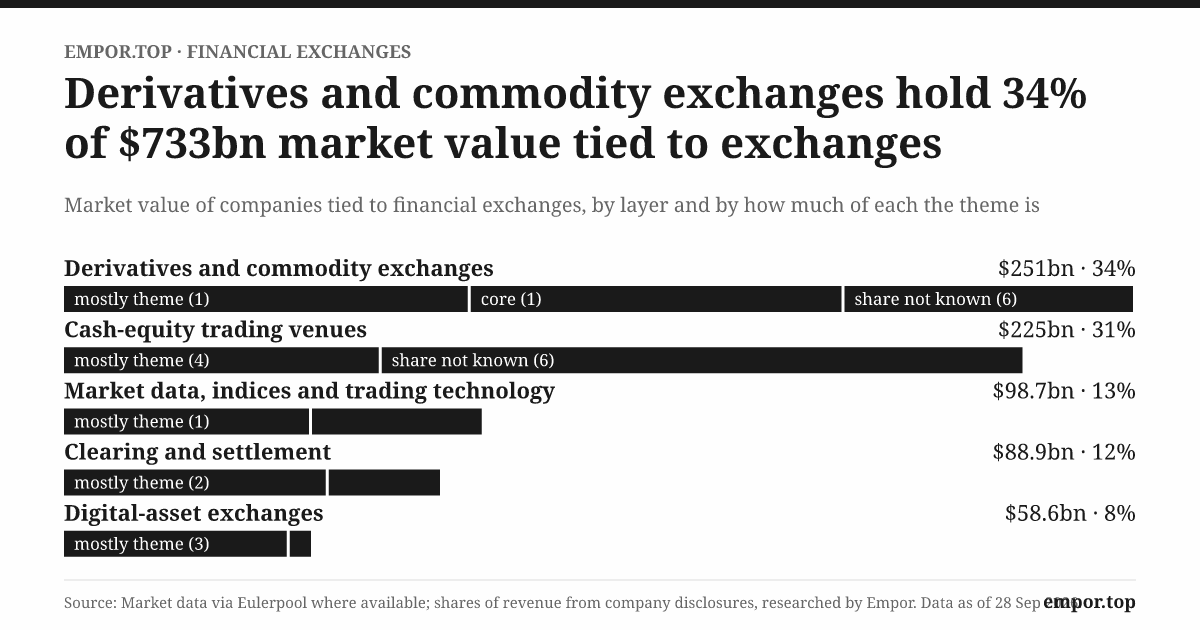
Derivatives and commodity exchanges hold 34% of $733bn market value tied to exchanges
Market value of companies tied to financial exchanges, by layer and by how much of each the theme is
Derivatives and commodity exchanges $251bn · 34%
mostly theme (1) $95.4bn · core (1) $87.6bn · share not known (6) $68.4bn
Cash-equity trading venues $225bn · 31%
mostly theme (4) $74.5bn · share not known (6) $151bn
Market data, indices and trading technology $98.7bn · 13%
mostly theme (1) $58.2bn · share not known (1) $40.5bn
Clearing and settlement $88.9bn · 12%
mostly theme (2) $62.1bn · share not known (2) $26.8bn
Digital-asset exchanges $58.6bn · 8%
mostly theme (3) $52.9bn · share not known (4) $5.7bn
Market rules, listings and surveillance $10.0bn · 1%
mostly theme (2) $3.0bn · share not known (4) $6.9bn
Market value of the listed companies in each layer, in US dollars, on 28 Sep 2026, split by how much of each company's revenue comes from the theme: mostly theme (75% or more), core (20–75%), meaningful (5–20%) and small part (under 5%).
This is the value of companies associated with financial exchanges, not the value of the theme: too little of the theme's revenue is disclosed company by company to show that.
Who is left out · 21
- Saudi Tadawul Group (Cash-equity trading venues): Not a listed company, or market value not available
- IEX Group (Cash-equity trading venues): Not a listed company, or market value not available
- Members Exchange (Cash-equity trading venues): Not a listed company, or market value not available
- 24 Exchange (Cash-equity trading venues): Not a listed company, or market value not available
- National Stock Exchange of India (Derivatives and commodity exchanges): Not a listed company, or market value not available
- BGC Group – FMX (Derivatives and commodity exchanges): Not a listed company, or market value not available
- SIX Group (Clearing and settlement): Not a listed company, or market value not available
- Moscow Exchange (Clearing and settlement): Not a listed company, or market value not available
- Multi Commodity Exchange of India Clearing Corporation – MCX Clearing Corporation (Clearing and settlement): Not a listed company, or market value not available
- S&P Global – S&P Dow Jones Indices and Commodity Insights (Market data, indices and trading technology): Not a listed company, or market value not available
- Broadridge Financial Solutions – Global Technology and Operations (Market data, indices and trading technology): Not a listed company, or market value not available
- Morningstar – Morningstar Indexes (Market data, indices and trading technology): Not a listed company, or market value not available
- Binance (Digital-asset exchanges): Not a listed company, or market value not available
- OKX (Digital-asset exchanges): Not a listed company, or market value not available
- Kraken (Digital-asset exchanges): Not a listed company, or market value not available
- Bybit (Digital-asset exchanges): Not a listed company, or market value not available
- Crypto.com Exchange (Digital-asset exchanges): Not a listed company, or market value not available
- Hyperliquid (Digital-asset exchanges): Not a listed company, or market value not available
- Kalshi (Digital-asset exchanges): Not a listed company, or market value not available
- GMO Financial Holdings – Cryptoasset exchange business (Digital-asset exchanges): Not a listed company, or market value not available
- SBI Holdings – Digital-asset business (Digital-asset exchanges): Not a listed company, or market value not available
Source: Market data via Eulerpool where available; shares of revenue from company disclosures, researched by Empor. Data as of 28 Sep 2026.
The figures, and the other charts, in the research dossier →
The promise that made markets bigger: standard contracts and a guarantor
In 1888 Victorian London, a new institution began clearing futures in coffee, sugar and other soft commodities: the London Produce Clearing House.4 It was the predecessor of today’s LCH, one of the world’s most important clearinghouses. Its service would eventually matter more than many of the trading floors around it.
After a marketplace matches a buyer and seller, a central counterparty, or CCP, can step between them. Through a legal process called novation, it becomes the buyer to every seller and the seller to every buyer. Each party deals with the CCP rather than needing to assess the creditworthiness of the other.
The CCP does more than hold money. It measures risk daily, requires both sides to post collateral, known as margin, and, if a member defaults, closes its positions and draws on a layered set of financial resources, including a default fund supplied by members. Clearing does not eliminate risk; it concentrates risk management in one institution.
Chicago had already moved in this direction. The Board of Trade established its first clearing organisation in 1883, initially on a voluntary basis.33 On both sides of the Atlantic, the aim was to let merchants trade confidently with people they had never met. That confidence widened the potential market for a standard contract.
Confidence in the stock market, by contrast, collapsed in 1929. The crash and subsequent depression persuaded Congress that disclosure and oversight could not be left to private clubs. The Securities Exchange Act of 1934 created the Securities and Exchange Commission.6 A US stock exchange thereafter operated under a public licence, with obligations to police its members and support disclosure for investors. Those requirements raised costs, but provided a form of trust that a private membership club could not create on its own.
Chicago produced the next major development. On 19 April 1973, the Chicago Board Options Exchange opened the first marketplace for listed stock options.5 Its founding president, Joe Sullivan, had spent years persuading regulators and floor traders that options could trade openly alongside shares. The debut was small: Cboe says it listed calls on sixteen stocks and traded 911 contracts on its first day.5
An option is an insurance-like right. Its buyer pays a premium for the right, but not the obligation, to buy or sell a share at a fixed price before a specified date. It can let an investor limit a potential loss for a known upfront cost. Unlike an insurance policy, however, the option can be resold at any time; buyers without shares to protect are taking a view on price movements.
Options had existed before 1973 as private, dealer-arranged agreements with varying terms. What changed was standardisation, combined with dedicated clearing. Fixed strike prices and expiry dates, backed by a single clearing organisation—the body that became the Options Clearing Corporation—turned a bilateral promise into a repeatable product.5 This became the core franchise of Cboe Global Markets $CBOE. Listed-options trading remains concentrated because liquidity tends to accumulate in the contracts participants already use.
Clearing is often described as making markets safe. The narrower claim is more accurate: it reduces the risk that one participant’s failure spreads through a web of bilateral promises. But it also concentrates operational, model and default-management responsibility in a small number of institutions. If a clearinghouse underestimates margin needs or its systems fail during a crisis, the consequences are not local. Clearing changes where risk sits and who is accountable for managing it; it does not abolish risk.
By the early 1970s, markets had rules, standard contracts and guarantors. They still faced a physical bottleneck: people standing in a room and shouting prices. The next thread would make that room optional.
When the floor lost the argument
On 8 February 1971 Nasdaq began operating in the United States. Its later history describes it as the world’s first electronic stock market, initially an electronic quotation system in which dealers posted competing prices on screens rather than meeting in one room.7 The screens showed quotes before they executed trades, but the principle was established: a market could be a network rather than a place.
This was the third thread: electronic communication. At its centre was the matching engine, software that pairs buy and sell orders. It operates as a fast, rule-bound queue, determining priority and the price at which an order can be filled. Milliseconds therefore mattered to those competing in the queue. Yet the matching engine was rarely the moat: comparable software can be built or bought, and exchanges have long licensed their own systems to other venues.
Nasdaq’s path illustrated the point. It evolved from a quotation system into a full electronic exchange, then into a provider of listings, data, indexes, anti-financial-crime software and technology used by other venues.7 Nasdaq $NDAQ reported $8.2 billion in revenue in 2025, but disclosures in Empor’s data did not separate venue-operation revenue from its software and data businesses.17 That lack of separation reflects a broader shift: as exchanges became software businesses, value could move from executing a trade to the services surrounding it.
Chicago held on to its pits for longer. Traders in coloured jackets used hand signals, while membership rights gave the floor an entrenched constituency. But CME launched Globex, its electronic futures platform, in 1992.3 For years, the screen handled overnight trading while the pit dominated the day. The balance gradually shifted as distribution, speed and data became as important as physical membership. A trader in London or Singapore could then reach a Chicago contract as readily as one nearby.
India took a different path, with greater consequences for this story. For more than a century, securities trading had been dominated by the Bombay Stock Exchange, now BSE, an open-outcry market centred on one city. In 1992 the National Stock Exchange of India was incorporated to build a national, screen-based market. It began wholesale-debt trading and, in 1994, cash-equity trading electronically.8 Brokers far from Mumbai could trade on the same terms as those near Dalal Street. NSE’s Nifty 50 index later became the reference for derivatives contracts that now dominate Indian trading.
Why did electronic trading lower costs without dissolving concentration? Because liquidity attracted more liquidity. Tighter spreads—the gap between the best buy and sell prices—drew in orders, and additional orders narrowed spreads further. This liquidity network effect did not depend on a trading floor. It was weaker in fungible cash equities, where the same share could trade on many venues and orders could be routed elsewhere. It was stronger in benchmark futures and options, where positions remained open for weeks and could be netted through a clearinghouse.
Electronic trading widened access, but it also enabled high-speed competition, fragmentation and new forms of routing power. In 2005 the SEC adopted Regulation NMS, modernising US equity-market rules and requiring orders not to be executed at prices worse than those displayed elsewhere.9 The rule linked venues and lowered the cost of starting a new one. Over the following two decades, exchanges, off-exchange venues and wholesale market makers competed for individual orders in an increasingly complex ecosystem. Investors generally paid less to trade, but cash-equity economics shifted towards firms controlling order flow and data.
Once exchanges became software rather than clubs, a more radical question followed: why should members own them at all?
The great remaking: exchanges become companies
On 22 September 2000, the stock exchanges of Amsterdam, Brussels and Paris merged to form Euronext, the first pan-European exchange group.10 The national bourses had long been institutions of civic pride, some centuries old. But as capital moved more easily across Europe, smaller exchanges faced pressure to fund the technology needed to compete.
This was the fourth thread: demutualisation and consolidation. For most of their history, exchanges were mutuals, owned by the brokers who traded on them. Demutualisation made them shareholder-owned companies, separating trading rights from the right to share in profits. It gave exchanges capital for acquisitions and technology, but also created a conflict regulators still confront: an exchange became both a profit-seeking seller of access and data and the front-line disciplinarian of its customers.
Euronext $ENX.PA is the descendant of that experiment. It retains national listing franchises while combining trading, clearing and data within one group. In 2025 it reported €1.8 billion in revenue and a 50.8% operating margin; almost all of its revenue falls within this theme.17 Its route to that position, however, was far from direct.
The most consequential entrant came from outside the old clubs. Jeff Sprecher, an entrepreneur who had worked in power-plant development, founded Intercontinental Exchange in 2000 to move over-the-counter energy trading onto an electronic platform.11 He had bought a small Atlanta electricity-trading business for a nominal sum, backed by energy and banking firms seeking a neutral screen. Over two decades of deals, ICE paired benchmark commodity contracts with clearing and data, then added mortgage technology, reducing its reliance on any single trading cycle. In 2013, the digital challenger acquired the New York Stock Exchange itself.12
That deal completed a reversal already under way. In 2006 the NYSE merged with Archipelago, an electronic trading network, and the Pacific Exchange to form the publicly traded NYSE Group, ending members’ ownership dating to the Buttonwood signers.1 The floor did not defeat its electronic challenger; it absorbed it. The precedent for today’s new venues is clear: a better design can reshape an incumbent, but incumbents can also buy, copy or connect to it.
Intercontinental Exchange $ICE is now diversified. It reported $12.6 billion in revenue in 2025, with about 64% attributed in Empor’s data to exchange activity and most of the remainder to mortgage technology and other services.17 Describing all of ICE as an exchange obscures that diversification; describing it as a mortgage-software company overlooks the energy-benchmark franchise at its centre.
Chicago consolidated in 2007, when the Chicago Board of Trade and the Chicago Mercantile Exchange merged to form CME Group, bringing major US futures benchmarks in interest rates, equity indexes and agricultural commodities under one roof.3
Germany followed a different model. Deutsche Börse $DB1.DE built a vertically integrated chain: Xetra for cash trading, Eurex for derivatives and clearing, and Clearstream for settlement and custody. While other groups separated trading from post-trade services, Deutsche Börse kept each link in-house. Clearstream reported €22.7 trillion of assets under custody in July 2026.17 That figure measures scale rather than revenue; the group’s 2025 revenue was €7.4 billion. But custody at that scale is difficult to dislodge, because moving it would require thousands of institutions to alter their operations.
Consolidation did not produce the unified European capital market its architects had envisaged. National law, taxation, clearing preferences and issuer relationships kept markets distinct. Euronext’s first incarnation ended in reversal: after ICE acquired NYSE Euronext, it retained the London derivatives business, LIFFE, and spun out the continental exchanges as an independent Euronext in 2014.10 The record qualified the consolidation thesis. Mergers could provide technology and data scale, but rarely removed the national anchors that supported local exchanges’ pricing power.
By 2008, exchanges had become companies, many listed on their own markets and competing for trades, listings and data customers. The financial crisis would show that the least glamorous part of the business was often the most important.
The crisis makes the back office the front line
In September 2008, Lehman Brothers collapsed. Among the positions it left behind was an interest-rate-swap portfolio at LCH's SwapClear service with a notional value of about $9 trillion across more than 66,000 trades.4 LCH had to hedge and auction the book while markets were in freefall. It said it completed the process using the defaulter's margin, without losses to other clearing members.4
The episode changed policymakers’ view of financial plumbing. Much of the crisis unfolded in over-the-counter markets, where derivatives are negotiated privately between two parties. Such contracts can be tailored to specific needs, but that flexibility can obscure the web of obligations and complicate an unwind. By contrast, a market cleared through a central counterparty had a defined record of exposures and an institution responsible for managing a default.
The policy response came in Pittsburgh. On 25 September 2009, G20 leaders committed that all standardised OTC derivatives should be traded on exchanges or electronic platforms where appropriate and cleared through central counterparties by the end of 2012.13 That commitment is the fifth thread of this story. It redirected capital, technology and regulatory attention towards clearing, turning the back office into a strategic asset. Clearinghouses were no longer cost centres attached to exchanges; they became systemically important institutions handling mandated flow.
London Stock Exchange Group $LSEG.L illustrates how thoroughly this shift changed a company’s identity. LSEG took a majority stake in LCH in 2012 and completed its acquisition of Refinitiv, the data and workflow business, in 2021.4 It now combines the London Stock Exchange, LCH, the FTSE Russell index business and a large data operation. Its 2025 revenue was £9.3 billion.17 The trading venue remains strategically important, but recurring data and post-trade businesses now define much of the group’s economics. Headline accounting ratios, affected by acquisition amortisation, are therefore not directly comparable with those of a pure exchange.
Around the world, clearing and settlement often form domestic bottlenecks. Brazil's B3, Australia's ASX, Switzerland's SIX and India's Central Depository Services sit where securities records, collateral practices and regulation meet. B3 reported a 65% operating margin in 2025.17 Central Depository Services (India) $CDSL, which holds dematerialised securities for Indian investors, increased revenue by 14.4% in the year to March 2026 and traded at 57.9 times earnings—a valuation that assumes continued growth in India’s investor base.17 Replacing such institutions would mean rebuilding the ledger of ownership and the operating links around it, which is why rivals rarely attempt it.
This is also where the divide between developed and developing markets becomes concrete. In developed markets, venue, clearing and settlement functions are separated or closely supervised. The SEC oversees US securities venues and the CFTC oversees futures markets; in Europe, national authorities and ESMA apply extensive rules to trading, clearing and crypto.25 The system imposes demanding resilience, conduct and capital requirements. It raises costs and can slow new products, but supports the institutional trust needed to attract pension funds and central banks. Developing markets can formalise more quickly amid surging retail participation, new issuers and national policy goals. Their rules, capital controls and enforcement can also change economics more abruptly. Russia's Moscow Exchange, cut off from much of the Western financial system, is the extreme example: its figures reflect sanctions as much as market activity.
Should investors treat clearinghouses as low-risk utilities? The description is incomplete. Clearing fees are recurring and barriers to entry are unusually high. Yet a CCP also faces risks unlike those of a conventional utility: a cyber failure, a flawed margin model or the default of a large member can bring sudden losses and political scrutiny. ASX offers a quieter warning. Its free cash flow in the year to June 2026 was deeply negative because it was spending heavily to replace core post-trade systems after an earlier project failed.17 Strong post-trade franchises still require costly upkeep.
Regulation had built formidable moats in post-trade. At the same time, market-opening policies in Asia were creating new pools of trading flow on a different scale.
Two different growth stories: China access and India's weekly expiry
On 17 November 2014, Hong Kong Exchanges and Clearing launched Shanghai–Hong Kong Stock Connect.14 The scheme allowed investors on either side to trade eligible shares through local brokers, custodians and clearinghouses, linking the two markets without requiring participants to join the other exchange directly.
Hong Kong Exchanges and Clearing $0388.HK (香港交易所) became more than Hong Kong’s national stock exchange. Its position rests on Connect, its role as a listing venue for Chinese companies seeking international capital and its clearing links—not simply its share of local cash-equity trading. Connect was later extended to Shenzhen and bonds, and it remains central to HKEX’s cross-border business.15
Market access can resemble a toll road: it creates a crossing governed by agreed rules for identity, custody and settlement. But a financial border can be closed, subject to quotas or rerouted by political decisions on either side. HKEX’s results show both the value and volatility of that position. Revenue grew 68.1% in 2025 and its operating margin reached 73.1%, as mainland interest and new listings recovered.17 Revenue had fallen in 2022 and 2023 as sentiment towards China weakened.17 The infrastructure is durable, but its traffic depends on decisions made beyond the exchange.
India offers a different growth story. NSE’s electronic network, Nifty index contracts and national member base produced a powerful liquidity loop in equity options. NSE reported a 75% share of the relevant Indian market in fiscal 2026.17 Empor’s data do not include audited financial statements for NSE as a listed company. NSE has published offer documents, but a completed listing could not be independently confirmed at the time of writing, so this story treats it as a major exchange whose shares are not yet verifiably public.32
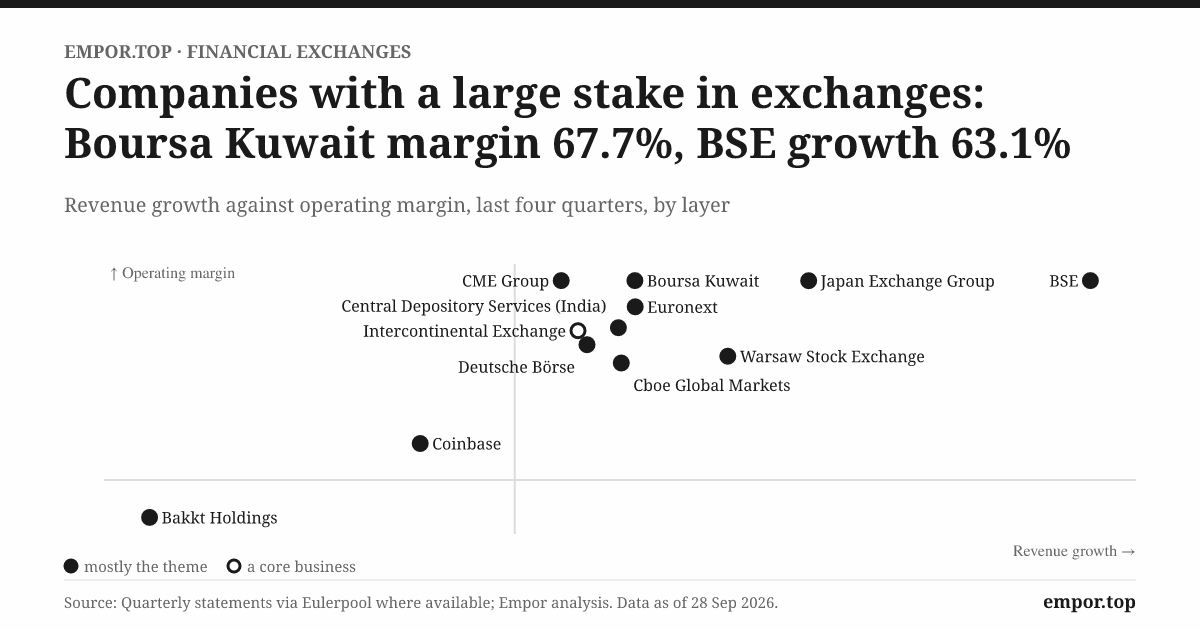
BSE $BSE, the older exchange that NSE overtook, rebuilt relevance through index options. Revenue grew 74.1% in the year to March 2026, to about ₹5,148 crore, and its operating margin rose to 63.1% from 18.2% three years earlier.17 The change illustrates the operating leverage of a successful derivatives contract: much of an exchange’s cost base is fixed, so additional trading can translate rapidly into profit. But a listed contract alone is insufficient; it must become a routine market for traders, market makers and hedgers.
India’s formalisation has also created several profitable gateways. Multi Commodity Exchange of India $MCX.NS dominates commodity derivatives, including gold and crude oil, and its revenue grew 107% in fiscal 2026.17 Indian Energy Exchange $IEX operates a physical electricity market for generators and distribution companies, reporting an 80.7% operating margin.17 CDSL maintains securities ownership records. Together, they illustrate how rapid entry into formal markets can support several distinct infrastructure businesses.
The scale of derivatives activity is striking. SEBI reported average daily notional turnover in Indian equity futures and options of ₹592 lakh crore in January 2026 and ₹514 lakh crore in February.28 Notional turnover overstates the economic value at risk, since much of the activity involved inexpensive short-dated options. Even so, it indicates the trading volumes from which exchanges collect fees.
Regulation may reshape that fee pool. On 1 October 2024, SEBI introduced measures to strengthen the equity-index-derivatives framework, including larger contract sizes, tighter monitoring and limits on the number of weekly expiries each exchange could offer.16 The regulator’s research had found that most individual traders in equity derivatives lost money.29 The measures show a distinction from Chicago’s benchmark-contract model: an Indian regulator can alter the product design that helped establish an exchange’s liquidity lead.
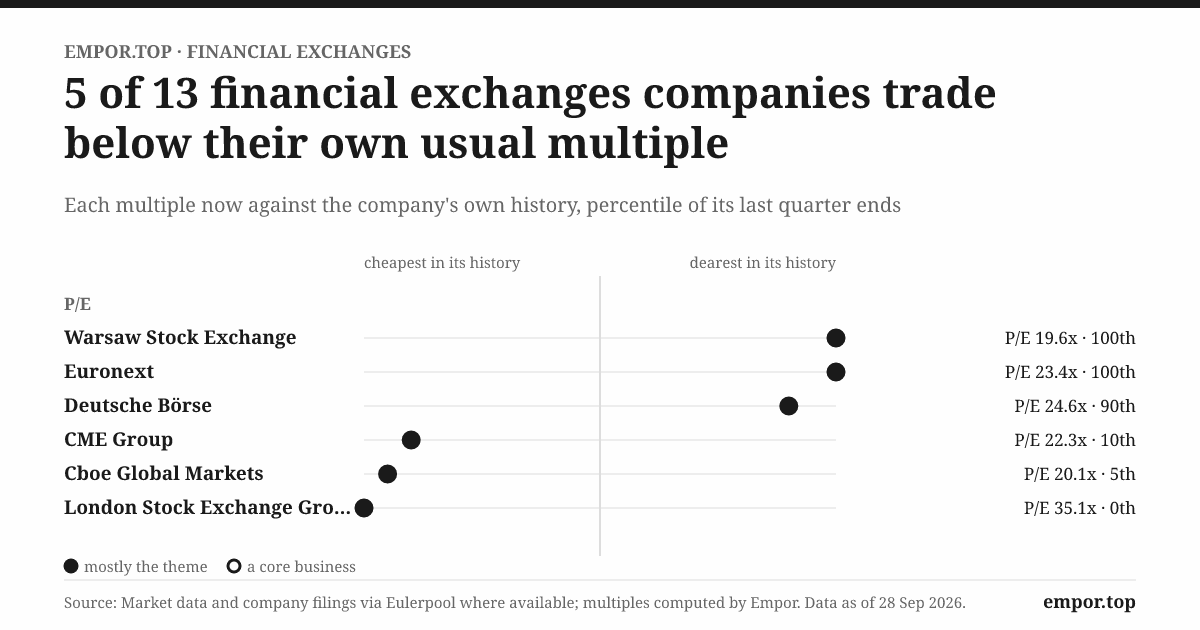
The recent figures therefore indicate effective execution and unusually heavy activity, not necessarily a permanent growth rate. MCX traded at 448.3 times trailing reported earnings and BSE at 45.0 times, compared with a combined 26.7 times multiple for derivatives and commodity exchanges.17 MCX’s extreme multiple partly reflected a low earnings base after a costly technology migration. Whatever the explanation, both valuations place the durability of earnings at the centre of the investment case.
The optimistic view is that India’s investor base remains small relative to its population, leaving room for years of growth in formal markets. The more cautious view is that short-dated retail options were especially profitable for exchanges because they were especially unprofitable for many retail traders—and that SEBI intends to curb them. The next two quarters of open interest, contract mix and revenue per trade will provide a clearer test than a single rule announcement.
The same tension—between formalising a market and allowing it to run with fewer constraints—is now playing out more broadly in crypto, event contracts and the push towards markets that never close.
Bitcoin asks whether an exchange needs an owner
On 31 October 2008, as banks failed on both sides of the Atlantic, someone using the name Satoshi Nakamoto published a nine-page paper, “Bitcoin: A Peer-to-Peer Electronic Cash System”.18 It proposed recording ownership of digital money without a bank: a network of computers would use proof of work to agree on a shared transaction history.
A blockchain is often compared with a communal spreadsheet that anyone can read and no one can secretly rewrite. But updating it requires a technical consensus process that consumes real resources. The ledger provides neither an exchange nor customer service, and it does not guarantee a trade if the other side disappears. Bitcoin replaced trust in an institution with verification; it did not specify where people would buy and sell the asset.
Centralised crypto exchanges filled that gap. Coinbase $COIN, founded in 2012 by Brian Armstrong, a former Airbnb software engineer, offered a familiar bridge: bank-linked accounts, custody of coins and a simple interface between conventional money and crypto assets.19 It grew into the largest regulated US crypto platform. But it is more than an exchange, combining brokerage, custody and staking services, so only part of its revenue represents exchange fees in the sense used in this story. It reported $7.2 billion of revenue in 2025.17 Its transaction revenue in the second quarter of 2026 was $599.2 million.30
The first major warning had arrived earlier. In February 2014, Mt. Gox, then a major Tokyo-based bitcoin exchange, filed for bankruptcy protection after customers’ coins went missing.20 It had generated exchange-like volume without the custody controls, governance and safeguards users had assumed. The question for every subsequent crypto venue has been straightforward: who holds the assets, and who oversees that holder?
A rival architecture sought to remove the holder. In November 2018, Hayden Adams, a mechanical engineer laid off from Siemens who had taught himself to code smart contracts, deployed Uniswap on the Ethereum blockchain.21 Rather than an order book operated by a company, Uniswap used automated market-making pools. Users deposited pairs of tokens, while a formula in code set the price at which others could swap one for the other. The design did not require permission to trade, but shifted risk to the code, to liquidity providers whose deposits could lose value, and to the tokens being traded.
Hyperliquid applies that idea to derivatives. It is an on-chain venue for perpetual futures—contracts without expiry that allow leveraged positions on crypto prices. It tests whether a venue can build deep, fast derivatives liquidity without conventional custody or a licensed operator. The evidence available to this story shows substantial activity, not that institutions accept the associated legal, custody and market-integrity trade-offs.17
Then came a failure that tested the claim that code had removed the need for trusted intermediaries. In November 2022, FTX, one of the largest offshore crypto exchanges, collapsed. The CFTC alleged that its founder, Sam Bankman-Fried, controlled both the exchange and Alameda Research, a trading firm, and that customer funds had been misused.22 FTX was a centralised venue, not a protocol. Yet its failure underscored a broader point: wherever customers entrust assets to a person or system, governance, conflicts of interest and custody determine the market’s safety.
The crypto-exchange landscape reflects those lessons unevenly. Binance, OKX, Bybit and Crypto.com, the largest venues by activity, operate largely offshore. Kraken, Gemini and Bullish seek regulated status in major markets. Coincheck and GMO’s crypto business operate under Japan’s licensing regime, while OSL operates under Hong Kong’s. Their reported financials are difficult to compare. Bullish reported roughly $245 billion of revenue in 2025 because it records the gross value of some digital-asset sales—a figure that reveals little about a trading venue’s economics.17 Empor’s digital-asset layer showed combined revenue falling 84.7% in the June 2026 quarter and a negative combined operating margin, while bitcoin traded about 38% below its level a year earlier.17 Gross crypto “revenue” should therefore not be treated as a comparable measure across business models.
The relationship with crypto prices is clearest where the business model is simplest. Coinbase’s quarterly revenue growth has historically moved closely with bitcoin’s price; elsewhere in the layer, the data show no consistent pattern, as would be expected from businesses with different customers and accounting methods.17 A few years of correlation are evidence, not proof. The same connection that lifted Coinbase in 2024 was weighing on it in 2026.
Crypto showed that trading venues could be built without the old membership clubs. It has not established that they can earn comparable trust without equivalent safeguards. The present contest is over which forms of crypto and event-market liquidity regulators will allow to connect with institutional money.
Licences, liquidity and the challengers at the gate
On 4 November 2020, the CFTC designated KalshiEX a contract market.23 Co-founded by Tarek Mansour, the company did not list shares or crypto assets. It sought to list contracts on events: whether an economic statistic would exceed a threshold, whether a storm would make landfall and, later, political and sporting outcomes.24
An event contract is a standardised claim that pays if a specified outcome occurs. It can transfer risk—for example, for a business exposed to a rate decision or weather event—but can also turn elections, games and data releases into speculative products. The regulatory boundary is therefore central to the business. Kalshi sought to fit event trading within the established contract-market licence held by Chicago exchanges for a century, then contest each product category with regulators.24 Its private financials are undisclosed.
Kalshi is one of several challengers testing incumbents. In US cash equities, IEX introduced a short delay intended to reduce the speed advantage of the fastest traders. Members Exchange, or MEMX, was founded by brokers and market makers seeking lower trading costs. 24 Exchange is pursuing near-continuous equity trading. In options, Miami International Holdings expanded rapidly: its exchanges accounted for 18.4% of US multi-listed options volume in August 2026.17 In Treasuries and interest-rate futures, BGC Group $BGC is backing FMX, a venue intended to challenge CME's hold on US rates futures.17 Abaxx Technologies is building physically settled contracts for liquefied natural gas, gold, battery materials and environmental credits.17
The pattern is clear. A newcomer can enter cash equities with a different price or rule because shares are fungible and routing is transparent. Benchmark derivatives are harder to dislodge. Open positions sit at the incumbent clearinghouse, where they are netted against other positions to reduce margin requirements. Moving them can increase collateral costs, while hedgers are reluctant to leave the price that other market participants use as a reference.
Miami International Holdings illustrates the difference between winning volume and earning attractive returns. Revenue rose 19.6% in 2025 to $1.4 billion, but the group reported a net loss and a 2.7% operating margin, compared with Cboe's 32.1%.17 Much of its revenue consists of options transaction fees before rebates and payments to liquidity providers; acquiring options-market share is expensive.31 Abaxx reported about C$1.0 million of revenue in 2025.17 Its opportunity depends not on the energy transition in general, but on whether producers and buyers adopt its contracts as reference prices and use their delivery mechanisms rather than trading mainly because of promotional incentives.
Regulatory regimes also shape which challengers can grow. In the United States, SEC and CFTC licences bring surveillance, resilience requirements and public filings. Crypto remains more fragmented. The European Union's Markets in Crypto-Assets Regulation, MiCA, requires authorised trading platforms to publish transparent rules, maintain orderly trading and ensure timely settlement.25 Its transitional arrangements ended across the EU on 1 July 2026; ESMA has said that providing crypto services in the EU without authorisation after that date breaches the rules.26 Hong Kong's licensing regime has made OSL a locally regulated model, while Japan's rules provide a different route for the digital-asset businesses of Coincheck, GMO and SBI Holdings $8473.T.
US approval of spot-bitcoin exchange-traded products on 10 January 2024 marked a different sort of opening.27 It allowed conventional exchanges and fund managers to package bitcoin for investors who need not open an account with a crypto venue. That can expand demand for regulated custody and conventional exchange listings. It may also shift some value away from retail crypto transaction fees, since an ETF investor trades a fund share rather than a coin.
A licence does not guarantee commercial success. IEX, MEMX and 24 Exchange have approvals and distinct market designs, but none has displaced incumbents in listings or data. Kalshi's licence gave it a legal home, not liquidity. Regulation becomes a challenger's advantage only when it brings in participants who previously could not, or would not, trade—as India's electronic reforms did for NSE, and as MiCA may do for authorised crypto platforms. The test is simple to describe and difficult to manufacture: whether market share and open interest persist after rebates end.
To see where those tolls are collected, and where money slips past them, it helps to follow a single trade.
Where every trade leaves a toll—and where it does not
Picture four orders arriving on the same morning. A pension fund wants to hedge interest-rate exposure; a manufacturer wants to fix next year’s electricity price; a saver wants to buy an exchange-traded fund; and a trader wants a leveraged bitcoin position. None reaches an exchange directly. Each arrives through a member firm, bank or broker authorised to access the venue. Brokers are a separate story; this one follows the order after it leaves them.
The chain begins with an issuer, hedger or investor seeking capital, a price or protection. Members and market makers supply orders and stand ready to buy or sell. The venue sets rules, matches orders and sells connectivity and data. The clearinghouse guarantees the trade, calls margin and manages defaults. A central securities depository or custodian settles ownership and keeps the record. Index and data providers license the benchmarks and price feeds embedded in users’ workflows.
Not every trade pays every toll. A retail share order may be internalised by a wholesale market maker and never reach an exchange. A bespoke swap may remain bilateral. A bitcoin perpetual may trade offshore or on-chain. High notional volume is not revenue, and collateral held by a clearinghouse belongs to its members rather than its shareholders.
The most durable fees sit in different parts of the chain. Listings, membership and surveillance create recurring revenue, but remain exposed to the issuance cycle; a weak year for initial public offerings becomes visible quickly. Cash-equity trading is the most competitive layer because orders can be routed to the best available price. Successful options and futures contracts are harder to dislodge because their liquidity and open positions are less portable. Clearing, settlement and custody are costly to build and legally scarce, though they also carry tail risks. Data, indexes and connectivity turn price formation into subscription revenue.
Each leader owns a different link. CME leads US interest-rate, equity-index and agricultural futures; it averaged 29.8m contracts a day in the second quarter of 2026 and earned a 64.9% operating margin in 2025.17 ICE leads energy benchmarks such as Brent and owns the NYSE. Cboe leads listed index options and sells proprietary data around them. Deutsche Börse owns the Xetra–Eurex–Clearstream chain. LSEG owns LCH and one of the world’s largest data businesses. MSCI $MSCI licenses equity indexes tracked by trillions of dollars of funds and reported a 54.7% operating margin.17 S&P Global $SPGI licenses the S&P 500 and prices commodities through its benchmark business; together, those activities produced about $4.1 billion of revenue in 2025.17 Morningstar $MORN runs a smaller index business, while Broadridge $BR supplies post-trade technology to banks and brokers. Tradeweb $TW operates electronic marketplaces for bonds and swaps—institutional venues alongside, rather than within, the stock-and-futures model.
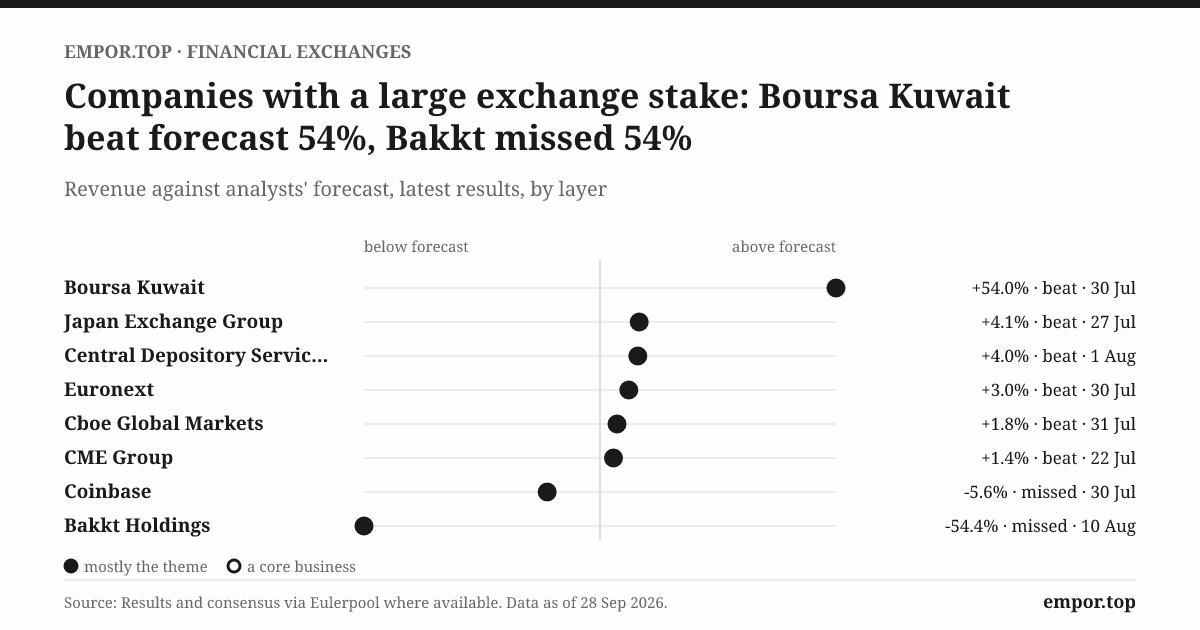
A second model sits beside these global franchises: the national monopoly. B3 in Brazil, ASX in Australia, Bursa Malaysia, the JSE in South Africa, Boursa Kuwait, the Tel Aviv Stock Exchange, the Warsaw Stock Exchange $GPW.WA, NZX, Saudi Arabia’s Tadawul, Mexico’s BMV and Argentina’s BYMA control most of their countries’ trading, clearing or settlement. Such infrastructure can be powerful, but its economics move with domestic interest rates, capital controls, listings and policy. JSE Limited $JSE.JO traded at 11.9 times earnings, while the Tel Aviv Stock Exchange traded at 51.3 times; the gap reflected local growth expectations more than a basic difference in the business.17 Singapore Exchange $S68.SI and Japan Exchange Group $8697.T sit between the two models, combining national cash markets with regional derivatives.
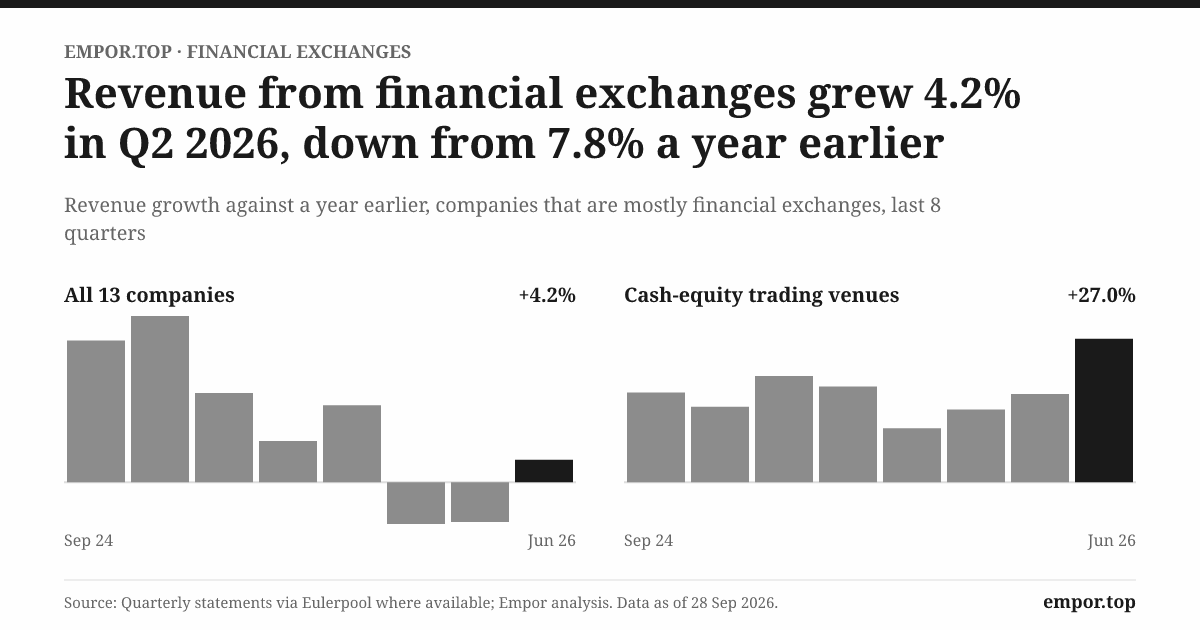
The latest figures showed a strong period for market activity. In the June 2026 quarter, combined revenue at cash-equity venues rose 26.1% from a year earlier; clearing and settlement revenue rose 15.4%; and derivatives and commodity exchanges grew 9.6%. Their operating margins were 46.1%, 50.8% and 54.9%, respectively.17 Every company in those three layers grew. The question is how much reflected volatility that could fade.
The data suggest that volatility helps, but not uniformly. Nasdaq and Cboe showed a clear historical pattern: revenue growth tended to rise in the same quarter as expected US market volatility, measured by the VIX.17 CME’s record pointed the other way at the tested delay, perhaps because rates and commodity contracts respond to distinct drivers. MSCI and LSEG, whose revenue is mostly subscription-based, tended to grow more slowly when volatility was high.17 B3 showed a positive link one or two quarters later. For most companies, however, the data showed no consistent relationship. A pattern over a few years is evidence, not proof.
The strongest toll road is therefore one that combines a user habit, a trusted clearing arrangement and a recurring claim on information. A prominent launch is not enough.
The test of the toll road
The paradox is straightforward. Trading technology is cheaper than ever: a small team can build a capable matching engine, and cloud computing has reduced the cost of operating one. Yet the leading mature exchanges still earn margins that most businesses cannot match. CME converts more than six of every ten dollars of revenue into net profit.17 The scarce assets are not technological.
They are benchmark contracts linked to trusted clearinghouses; data and workflow products built around those prices; and, in some countries, regulation and settlement systems that make replacement difficult. CME’s network of benchmark contracts and clearinghouse, ICE’s energy benchmarks, data business and NYSE franchise, Deutsche Börse’s chain from Eurex to Clearstream, LSEG’s combination of LCH and data, and Cboe’s index-options franchise all have elements of this model. Each controls a price that many users need, a guarantee they trust or a record they pay to access.
Cash-equity leadership is more contestable. Nasdaq, Cboe, NYSE, MIAX, MEMX and IEX compete on routing, fees and market design, and market share can shift quickly. The relevant question is not who holds share today, but whether that share survives once rebates, special pricing and unusually favourable market conditions fade.
The record suggests four main routes for entrants. A new benchmark can solve a genuine hedging problem and build lasting open interest. A challenger can enter with committed liquidity providers and clearing access. A regulatory change can bring in participants who previously could not trade. Or an incumbent’s pricing, outage or design failure can make the costs of switching acceptable.
Most entrants will not meet that test. Approval, a launch, low fees and an attractive interface do not create a two-sided market. The industry’s history—from pits to screens, mutuals to listed companies, bilateral swaps to central clearing, and crypto’s failures—narrows the challenger case without dismissing it. NSE displaced BSE by building a better national market. ICE established an electronic energy market before acquiring the NYSE. Both expanded participation rather than competing on price alone.
Two outcomes remain plausible. In the more favourable case, around-the-clock trading, Treasury competition, energy-transition contracts, event markets and regulated crypto create new standards. Entrants that retain liquidity could add clearing and data revenue, as Chicago’s exchanges once did. In the less favourable case, activity fragments among low-cost venues, offshore platforms and internalisers; incentives compress fees; regulators curb retail derivatives; and incumbents retain the more profitable clearing and data layers while newcomers compete for thin trading margins.
The investment record adds a separate warning. Across the listed companies Empor tracks, shares returned about 55% over three years but were roughly flat over the past year, while the group traded at 32.6 times combined earnings.17 A sound theme need not produce strong returns if an investor chooses the wrong layer or company, or pays too much.
Five indicators may move before revenue does.
The first is open interest and average daily volume in benchmark contracts. Open interest measures positions that remain outstanding, helping distinguish sustained hedging from day trading. CME averaged 29.8 million contracts a day in the second quarter of 2026, while SGX averaged 1.3 million in August 2026.17 Both publish monthly figures. Growth that continues as markets calm would support the case for durable hedging demand; sustained declines would suggest that new risks are not moving onto exchanges.
The second is market share after incentives. Because share can respond quickly to pricing, it can indicate whether a challenger’s liquidity is durable before revenue does. MIAX reported 18.4% of US multi-listed options volume in August 2026, while NSE reported 75% of its market in fiscal 2026.17 Venues publish such figures monthly. A challenger that retains share as rebates normalise may be building a network; one that loses it may have been renting liquidity.
The third is India’s contract mix after SEBI’s rules. Monthly exchange and SEBI data on open interest and institutional participation will indicate whether the market is maturing or merely contracting. SEBI’s latest reading put average daily notional turnover at ₹514 lakh crore in February 2026.28 Rising open interest and institutional participation would support a more durable market; a sharp expiry-led reversal would narrow the growth case for BSE, NSE and MCX.
The fourth is regulated crypto custody and professional volume. Custody balances can move before transaction fees because institutions generally deposit assets before trading. Coinbase reported $246 billion of crypto assets under custody in the second quarter of 2026, and discloses the figure quarterly.17 Growth following MiCA authorisations and ETF adoption would support the case for regulated venues; continued migration offshore or falling fees per trade would challenge it.
The fifth is clearing resilience. Margin calls during stress, operational incidents and changes in required capital—disclosed quarterly by clearinghouses and when regulators act—can alter economics faster than volume trends. A clean record through a stressed market supports the safety premium. A material outage or a loss shared among members would reopen the question of whether that premium is deserved.
The exchange of the future may trade at midnight, settle in tokens or list a contract on tomorrow’s weather. It becomes a toll road only when users trust its price enough to bring their largest risks there—and trust what happens when the other side fails.
Glossary
- Average daily volume (ADV): the average quantity traded each day. It signals activity, though not necessarily durable demand.
- Central counterparty (CCP): an entity that becomes the buyer to every seller and the seller to every buyer after a trade.
- Central securities depository (CSD): infrastructure that records securities ownership and supports settlement.
- Clearing member: a bank or specialist firm that posts collateral and accesses a CCP for itself and its clients.
- Contract standardisation: setting fixed contract terms so that many parties can trade the same instrument.
- Data licence: a fee for using prices, benchmarks or market information in software, trading or investment products.
- Default fund: member-contributed resources that may be used after a defaulting member’s margin has been exhausted.
- Internalisation: execution of an investor’s order by a dealer or wholesaler rather than on an exchange.
- Liquidity network effect: the cycle in which more orders improve execution and attract further orders.
- Margin: collateral posted against a trade to cover potential losses.
- Market maker: a participant that continuously quotes prices at which it will buy and sell.
- Open interest: the number of derivatives contracts that remain outstanding. It is often more useful than a single day’s volume for judging persistence.
- Order book: the ranked queue of offers to buy and sell at different prices.
- Take rate: the revenue a venue retains for each unit of activity.
- Venue: a regulated exchange or other marketplace where orders meet.
References
-
History of the CFTC: US Futures Trading and Regulation Before the Creation of the CFTC — CFTC ↩↩↩↩
-
Midwest grain trade: history of futures exchanges — CME Group ↩↩↩
-
Remarks at the SEC's 90th anniversary — US Securities and Exchange Commission, 6 June 2024 ↩
-
NSE history and milestones — National Stock Exchange of India ↩
-
Regulation NMS — US Securities and Exchange Commission, June 2005 ↩
-
Intercontinental Exchange 2015 Form 10-K — US Securities and Exchange Commission ↩
-
G20 Leaders' Statement: The Pittsburgh Summit — G20 Information Centre, 25 September 2009 ↩
-
Launch of Shanghai-Hong Kong Stock Connect — HKEX, November 2014 ↩
-
Measures to strengthen equity index derivatives framework for increased investor protection and market stability — SEBI, 1 October 2024 ↩
-
Financial Exchanges research tables and dossier: pulse, scorecard, trends and links, company filings and market data via Eulerpool — Empor, 28 September 2026 ↩↩↩↩↩↩↩↩↩↩↩↩↩↩↩↩↩↩↩↩↩↩↩↩↩↩↩↩↩↩↩↩↩↩↩↩↩
-
Bitcoin: A Peer-to-Peer Electronic Cash System — Satoshi Nakamoto, 2008 ↩
-
Coinbase Global 2021 Form 10-K — US Securities and Exchange Commission ↩
-
CFTC charges Sam Bankman-Fried, FTX Trading and Alameda with fraud — CFTC, December 2022 ↩
-
CFTC designates KalshiEX LLC as a contract market — CFTC, 4 November 2020 ↩
-
MiCA Article 76: Operation of a trading platform for crypto-assets — ESMA ↩↩
-
Statement on the end of transitional periods under MiCA — ESMA, 17 April 2026 ↩
-
Statement on the approval of spot bitcoin exchange-traded products — US Securities and Exchange Commission, 10 January 2024 ↩
-
SEBI Bulletin, March 2026 — Securities and Exchange Board of India ↩↩
-
Study on equity derivatives trading — Securities and Exchange Board of India, July 2025 ↩
-
Coinbase Global Form 10-Q for the quarter ended 30 June 2026 — US Securities and Exchange Commission ↩
-
Miami International Holdings 2025 Form 10-K — US Securities and Exchange Commission ↩
 LinkedIn
 WhatsApp
 Reddit
 Hacker News
 Email
Email Kindle
 RSS Feed
 Spotify
 Apple Podcasts
 Amazon Music
 Audible
 YouTube