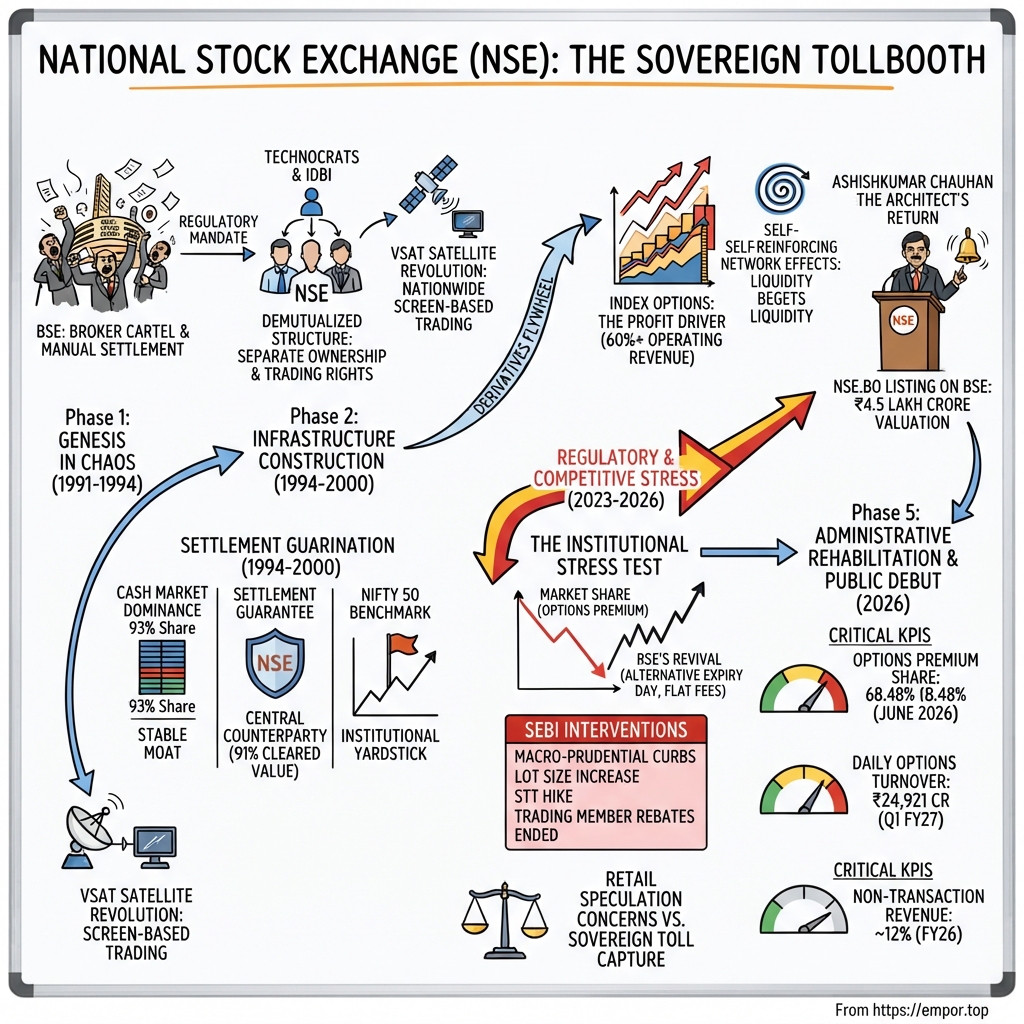
National Stock Exchange of India (NSE): The Sovereign Tollbooth
I. Introduction & Episode Roadmap (00:00 – 15:00)
On the morning of September 24, 2026, a ticker appeared on the trading screens of the Bombay Stock Exchange that once would have seemed unthinkable to the brokers who shouted orders in its trading ring: NSE. The National Stock Exchange of India, established in the early 1990s explicitly to dismantle BSE's monopoly over Indian capital markets, debuted as a publicly traded company on the board of its oldest competitor. The stock opened at ₹1,800, just above its ₹1,785 offer price, reached an intraday high of ₹1,876.70, and closed its first session valued at roughly ₹4.5 lakh crore, ranking it among the country's most valuable listed corporations.12 Across the table at the listing ceremony stood BSE Managing Director Sundararaman Ramamurthy, an NSE veteran, who described the milestone as "a dream come true."1 NSE Chief Executive Ashishkumar Chauhan, one of the exchange's founding architects, thanked what he described as "a family of 36 lakh people," the shareholder base that now owns the core plumbing of India's capital markets.1
The symbolic contrast was conspicuous, but the underlying economics were even more striking. In FY25, the exchange reported consolidated total income of ₹19,177 crore and net profit of ₹12,188 crore—a 47% net profit expansion in twelve months, yielding an after-tax profit margin of roughly 63% on total income.3 Few commercial enterprises of comparable scale retain nearly two out of every three rupees earned as net margin. The IPO valued the business at approximately ₹4.4 lakh crore, and following its debut, Screener data reflected a price-to-earnings multiple of roughly 50.42 Public markets typically reserve such multiples for fast-growing consumer platforms or software franchises, not utility-like market infrastructure providers that take no credit risk.
The transaction was structured entirely as an offer for sale of 12.64 crore shares by existing institutional investors. As a result, NSE raised no primary capital; the entire ₹22,560 crore in proceeds went directly to selling shareholders.1 The transaction marked India's second-largest public issue after Hyundai Motor India, generating roughly ₹90,300 crore in aggregate bids and closing 5.7 times subscribed.1
The central paradox
The core tension governing NSE's business model is institutional. The exchange operates simultaneously as a national public utility, a self-regulatory front-line supervisor of its trading members, and a profit-maximizing quasi-monopoly. Crucially, the primary driver of its profitability—index options trading—is the precise instrument that the Securities and Exchange Board of India spent 2024 and 2025 actively seeking to restrict. In FY26, options transaction charges represented roughly 60% of NSE's revenue from operations.4 When regulators caution against excessive speculative volume, the policy target directly intersects with NSE's top-line revenue.
A parallel friction involves duration. NSE submitted its initial draft prospectus in December 2016.5 Reaching the opening bell required nearly a decade, an interval consumed by regulatory investigations into preferential co-location access for algorithmic trading firms, a governance breakdown involving an anonymous spiritual adviser receiving confidential board communications, a prolonged four-hour market outage, and protracted consent proceedings. The Supreme Court of India cleared the remaining legal hurdles on September 18, 2026, one day after public IPO bidding commenced.6
Why "sovereign tollbooth"
The tollbooth analogy captures the structural economics of market infrastructure. An exchange collects fee income on aggregate transactional volume regardless of trader intent or ultimate profitability, incurring negligible marginal cost to process incremental transactions. Yet this tollbooth operates across public highway infrastructure designed, monitored, and regulated by the state. Every structural transformation in NSE's history—from its incorporation to its governance crisis and eventual public listing—originated from regulatory mandates and ministry policy rather than purely organic market forces.
The central analytical question is therefore institutional rather than purely commercial: it centers on the structural relationship between a licensed quasi-monopoly and the sovereign authority that grants its operating franchise, and the degree of value capture permitted to equity holders when public policy and private profit objectives diverge.
The roadmap
This analysis proceeds across five structural phases. First, the origins: how a technocratic founding team sponsored by state-backed development institutions deployed satellite telecommunications to unseat a century-old broker cartel within two years. Second, infrastructure construction: how dematerialized share settlement, the benchmark Nifty 50, and the domestic derivatives complex were established on NSE's architecture. Third, institutional impairment: the co-location probe, dark-fibre access controversies, and the governance fallout. Fourth, administrative rehabilitation under Ashishkumar Chauhan leading to regulatory clearance and market debut. Fifth, the contemporary stress test: macro-prudential curbs on retail derivatives and BSE's revival, which reduced NSE's market share of options premium from nearly 97% in FY24 to approximately 68% by the June 2026 quarter.7
Why win, and why not
The bullish thesis for NSE rests on three core propositions. First, that its deep order book, integrated clearing corporation, and benchmark index franchise generate self-reinforcing network effects that competitors cannot permanently dislodge. Second, that the structural transition of Indian domestic household financial savings into capital market instruments provides a secular tailwind that benefits exchange volumes across market cycles. Third, that historical governance deficiencies have been systematically addressed, allowing the equity to trade strictly on operating fundamentals rather than regulatory overhang.
The counter-thesis highlights structural vulnerability: in index options, the segment accounting for the majority of exchange earnings, these structural advantages have been curtailed by external intervention. Regulatory caps restricted contract design, a competitor restructured its expiration schedule, and fiscal authorities increased transaction taxes across trading segments. The editorial objective is to evaluate how much durable moat remains when tested against sovereign discipline.
That shift in options market share outlines the central dilemma. The conventional investment case assumes exchange liquidity functions as an unassailable moat. Recent operating data demonstrates that regulatory mandates can reshape market share and fee structures overnight. Evaluating that balance requires returning to the open-outcry trading ring where the modern market was first conceived.
 Subscribe on LinkedIn
II. The Bombay Ring & The Big Bull Scam: Genesis in Chaos (1991–1994) (15:00 – 35:00)
In the early 1990s, the trading floor of the Bombay Stock Exchange inside the Phiroze Jeejeebhoy Towers operated as an open-outcry ring—a physical scrum of jobbers and brokers in white shirts shouting bids, flashing hand signals, and exchanging paper chits. Executed prices were effectively determined by the loudest, best-connected floor members at any given moment. A retail investor in Lucknow or Guwahati had no reliable way to verify whether the price recorded on a physical contract note matched the actual trade executed in Bombay. Settlement was an arduous fortnightly cycle in which physical share certificates—frequently stolen, forged, torn, or carrying mismatched signatures—moved across the country by courier, regularly rejected by company registrars under the dreaded designation of "bad delivery."
Crucially, the exchange was a mutual association owned and governed by the very brokers who executed trades on its floor. The intermediaries who profited from information asymmetry were the same individuals who drafted trading rules and managed disciplinary oversight. Reform proposals routinely foundered in committee, because the committee was the broker fraternity itself.
Badla and the bubble
Layered on top of this physical settlement friction was badla, an informal carry-forward mechanism that allowed market participants to roll over speculative positions across settlement cycles upon paying a financing charge. In practice, badla functioned as leveraged futures trading without formal contract specifications, standardized margin requirements, or a centralized clearing counterparty. The mechanism functioned smoothly during bull phases, but lacked systemic buffers against sudden shocks.
In 1992, that structural fragility triggered an unprecedented financial crisis. Harshad Mehta, a prominent broker nicknamed the "Big Bull" by the press, exploited gaps in the inter-bank market for government securities. Using informal paper instruments known as bank receipts, Mehta funneled short-term liquidity from commercial and foreign banks into equity markets with minimal oversight. When the arrangement unraveled in April 1992, it exposed thousands of crores in diverted institutional funds, sent the equity market tumbling, and underscored the near-total lack of transparency in domestic capital allocation. For economic policymakers in New Delhi, the primary takeaway was institutional: the architecture of the mutual exchange had actively enabled the abuse.
Pherwani's blueprint
Systemic reform had already been mapped before the crisis unfolded. A high-level committee chaired by M.J. Pherwani, former chairman of the Unit Trust of India, had recommended the creation of a modern national stock exchange owned by institutional investors rather than trading members. Following the 1992 crash, the recommendation became a regulatory priority. The founding shareholders were not trading intermediaries, but the institutional pillars of state-led finance: the Industrial Development Bank of India (IDBI), alongside other development finance institutions, public-sector banks, and state insurers like the Life Insurance Corporation of India (LIC). NSE was incorporated on November 27, 1992.8
The exchange's operational blueprint was developed by a lean executive cadre deputed from IDBI. Led by R.H. Patil, the founding team included young professionals such as Ravi Narain, Chitra Ramkrishna, and Ashishkumar Chauhan, an IIT Bombay mechanical engineer who had joined IDBI as an industrial finance officer.89 Over the subsequent three decades, those three executives would sequentially lead the exchange through its initial market expansion, preside over its most damaging regulatory crisis, and return to shepherd it to the public board.
Counter-positioning before the phrase existed
The foundational design choice made by NSE’s architects was structural: the absolute separation of trading rights from exchange ownership. Brokers could trade on the new venue, but they could not hold equity or occupy board seats. NSE implemented this demutualized architecture from inception, years before global institutions such as the London Stock Exchange and the New York Stock Exchange transitioned away from member-owned floor models. Exchange access was conditioned on transparent net-worth requirements and capital-adequacy deposits rather than proprietary seats inherited through families or acquired from retiring members.
This design represented a classic instance of business counter-positioning. Incumbent leadership at BSE could not adopt NSE’s open, demutualized framework without forcing its own member-owners to dismantle their trading monopolies and fee structures. Consequently, NSE could roll out automated, anonymous order matching and national price discovery precisely because its institutional board derived no income from trading opacity.
The platform began with a deliberate, lower-risk proof of concept: the Wholesale Debt Market segment, which launched on June 30, 1994, to process institutional trading in government debt and corporate bonds.8 Because secondary bond trading was concentrated among commercial banks and financial institutions—the very entities that capitalized NSE—the segment offered an aligned, sophisticated user base for computerized matching. Equities represented the larger commercial prize, but scaling screen-based equity execution nationwide required overcoming a physical bottleneck unrelated to market microstructure: India's legacy telecommunications network.
The founders' long hold
This institutional origin produced a notable shareholder configuration during NSE's September 2026 public debut. Thirty-four years after bankrolling the exchange's establishment, the public financial institutions that funded its launch remained major equity holders, and several opted to retain their stakes. LIC, the exchange's largest institutional shareholder with a 10.72% interest, sold no shares during the initial public offering.18 Patient public capital, deployed to resolve an acute market failure, ultimately generated one of the most profitable financial assets in the domestic economy.
That lineage also establishes the foundational identity of the enterprise. NSE was not conceived as a venture-backed commercial platform seeking market capture; it was designed by state-owned institutions as an instrument of national economic policy. That structural origin explains both its durable competitive strength—a sovereign mandate to build market infrastructure across India—and its persistent vulnerability: the state that established the exchange retains both the regulatory mandate and the policy prerogative to continually redefine its commercial boundaries.
III. The Satellite Revolution: Inventing Screen-Based Architecture (1994–2000) (35:00 – 55:00)
In 1994, obtaining a landline telephone in most Indian cities meant placing a name on a government waiting list and waiting for years. Terrestrial leased data lines were expensive, unreliable, and controlled by state telecom monopolies. An exchange attempting to connect a broker in Indore or Coimbatore could not simply lease a high-speed line.
Instead of navigating the copper grid, NSE looked upward, engineering a system to route orders via satellite. Member brokers installed very small aperture terminals (VSATs)—compact dish antennas—on their office rooftops, linking desktop trading screens directly to NSE's central mainframe in Mumbai. The proprietary platform, named the National Exchange for Automated Trading (NEAT), matched bids and offers anonymously on strict price-time priority. The physical trading ring, floor-broker discretion, and clubby personal relationships were replaced by an automated execution engine.
Deploying satellite links was fundamentally a distribution strategy disguised as telecom engineering. By activating terminals in regional commercial centers that Bombay's financial establishment had never directly served, NSE did not merely capture BSE's existing client base; it created a new national market. Regional brokers who had historically routed orders to Bombay by telephone—accepting whatever execution prices floor members reported back—could now trade directly against a transparent, nationwide order book. The broad domestic investor base that later underpinned NSE's market dominance originated with those rooftop antennas.
The operational contrast was stark: if BSE operated as a private auction room where the auctioneer knew everyone on the floor, NSE built an open, continuous limit order book where a broker in a tier-three city saw the same prevailing price, at the exact same second, as a premier Mumbai brokerage.
The eighteen-month conquest
Equity trading on NSE began on November 3, 1994.8 Incumbent floor brokers initially dismissed the platform, arguing that serious market participants required face-to-face negotiation and would never trust order execution to an anonymous computer system. That skepticism eroded rapidly. Within about a year of starting operations, NSE's daily turnover exceeded BSE's.8 The market shift was propelled less by commission discounts than by verifiable execution: for the first time, an investor outside Mumbai could confirm that the price printed on a contract note reflected actual market clearing levels rather than an intermediary's markup.
BSE eventually responded in 1995 with its own screen-based platform, the BSE On-Line Trading (BOLT) system. By then, however, the migration of order flow was self-reinforcing. As liquidity concentrated on NSE's central order book, narrower bid-ask spreads attracted higher trading volumes, which in turn deepened the order book and further improved execution pricing. That self-perpetuating liquidity network effect established the core commercial moat that NSE defended for the subsequent three decades.
Guaranteeing every trade
While automated screens delivered price transparency, they did not eliminate counterparty risk—the threat that an anonymous trader on the other side of a transaction would fail to deliver cash or securities. To insulate the market against settlement defaults, NSE established a dedicated subsidiary, National Securities Clearing Corporation Ltd (now NSE Clearing Ltd), which acted as a central counterparty by novating every trade: stepping between participants to become the legal buyer to every seller and the seller to every buyer.
This institutional guarantee was backed by a Settlement Guarantee Fund capitalized through member contributions and exchange reserves. In practice, NSE transformed an unstable web of bilateral counterparty credit exposures into a single, creditworthy promise. That clearing institution became one of the exchange's most durable and least scrutinized commercial assets; in the June 2026 quarter, it handled about 91% of cleared value in Indian equity derivatives.7
Killing paper, building a benchmark
The remaining operational bottleneck was the physical share certificate. To eliminate the chronic delays, theft, and forgery that had plagued fortnightly paper settlements, NSE co-promoted the National Securities Depository Limited (NSDL) in 1996, creating the architecture for electronic, dematerialized share ownership. Dematerialization permanently ended the era of "bad delivery" disputes. NSE retained a substantial equity interest in NSDL for decades, holding about 24% when NSDL listed in August 2025.9
With automated matching and dematerialized clearing established, the exchange introduced an institutional yardstick. On April 22, 1996, NSE launched the Nifty, a 50-stock benchmark built on modern index methodology, as a broader alternative to BSE's 30-stock Sensex.8 In market infrastructure, a benchmark index is not merely a statistical gauge; it is a proprietary commercial product. Every institutional fund mandate, exchange-traded fund, and index derivative requires a trusted underlying benchmark, and the owner of that index controls the licensing rights across the entire product ecosystem. NSE Indices, first set up as a joint venture with CRISIL, would later become the custodian of the Nifty family of indices.10
What the first six years proved, and what they did not
It is tempting to view NSE's early triumph as proof that superior technology inevitably unseats legacy market operators. The historical record suggests a more measured conclusion. NSE prevailed during the 1990s because it combined satellite technology with a structural advantage the incumbent could not replicate: a demutualized corporate structure free from broker governance conflicts, backed by the balance sheets of sovereign development institutions. BSE eventually adopted electronic screens, but the incumbent took years to dismantle the mutual ownership model that impaired its ability to adapt. When a demutualized, publicly listed BSE returned three decades later armed with modern high-speed technology, the competitive dynamic in derivatives unfolded very differently. The early era demonstrated that NSE's primary moat was institutional design, not proprietary code alone.
By 2000, the first six years of operation had established the three pillars that anchored NSE's economics: the country's deepest cash order book, a trusted central clearing counterparty, and the flagship benchmark index. What the exchange still lacked was the specific financial instrument that would transform a high-volume public utility into an exceptionally profitable corporate franchise. That instrument arrived with the new millennium.
IV. The Derivatives Flywheel & The Nifty Empire (2000–2010) (55:00 – 1:20:00)
On June 12, 2000, NSE launched trading in Nifty index futures.8 Index options, single-stock futures, and stock options followed over the next year.10 At the time, the launch appeared to be a sensible operational modernization rather than a market revolution. Trading volumes were modest, participants were predominantly institutional desks and proprietary trading firms, and the regulatory logic was defensive: Indian authorities had banned badla, creating an urgent need for a standardized, margin-backed, centrally cleared replacement for leveraged carry-forward trading.
Consequently, India became an unusually heavy user of single-stock futures among major global markets, as those contracts directly absorbed the speculative trading capital that badla had left behind.
Why liquidity snowballs
Derivatives exchanges demonstrate self-reinforcing network effects far more intensely than cash equity markets. A futures or options contract holds practical utility only if a market participant can enter and exit positions at minimal frictional cost. Tight bid-ask spreads attract order flow; order flow attracts professional market makers; and market makers further compress bid-ask spreads. Crucially, while cash equities can be listed across multiple bourses and settled interchangeably, a derivatives contract written on a specific exchange is cleared exclusively by that venue's designated clearinghouse. A trader cannot open a Nifty option on one exchange and close it on another. This contract-level lock-in explains why BSE's early derivatives initiatives struggled to gain traction, and why NSE maintained near-complete dominance over domestic equity derivatives throughout the 2000s and 2010s. As late as FY24, NSE's share of equity options premium stood at 96.86%.7
Nifty goes offshore
The Nifty benchmark also crossed national borders. NSE licensed the index to the Singapore Exchange, where SGX Nifty futures allowed international institutional funds to hedge Indian market exposures in U.S. dollars, outside domestic trading hours and domestic regulatory jurisdiction. Each morning in Mumbai, domestic traders monitored SGX Nifty pricing for early indications of how local cash markets would open.
This international footprint proved to be a double-edged commercial success. While it demonstrated global institutional demand for the Nifty benchmark, it also established a substantial pool of offshore Nifty-linked derivatives trading beyond sovereign jurisdiction, leaving NSE to collect licensing royalties rather than direct transaction tolls. That cross-border arrangement would eventually be restructured in 2023, an institutional transition examined in Section VIII.
New asset classes, uneven results
The 2000s were also characterized by continuous product experimentation. In 2008, NSE became the first Indian exchange to offer currency futures, introducing a securities lending and borrowing scheme around the same time.10 Subsequent rollouts included interest-rate and debt trading platforms, volatility index futures, and, eventually, commodity derivatives. The broader commercial record, however, reveals a divergent trajectory. None of these adjacent asset classes approached the financial scale of equity derivatives. Currency derivatives expanded into a meaningful market before contracting sharply after the Reserve Bank of India tightened regulations in 2024 to require participants to demonstrate underlying foreign exchange exposure,11 demonstrating how swiftly sovereign intervention can curb an entire product line. Commodity derivatives, meanwhile, remained entrenched at the Multi Commodity Exchange of India (MCX). The institutional lesson was clear: liquidity accumulated in one asset class does not automatically transfer to adjacent contracts. Every new product category confronts an independent cold-start dilemma.
What an index option actually is
For non-specialist observers, an index option functions structurally as a short-dated, asymmetric contract with an upfront, capped financial exposure. Paying a cash premium purchases the right to profit if the Nifty moves above a designated level through a call option, or below it through a put option, prior to a specified expiration date. If the underlying index fails to breach that threshold, the contract expires worthless and the entire premium is forfeited. A weekly contract that remains far out-of-the-money on the morning of its expiration session can trade for just a few rupees per unit, mimicking the payout profile of a low-cost lottery ticket. This asymmetric dynamic explains why expiration sessions emerged as the highest-volume trading days across Indian financial markets. For NSE, every single transaction—regardless of whether the underlying position yields a profit or a total loss—generates an incremental clearing and transaction toll.
Myth vs reality: the single-stock futures market that wasn't
During the early rollout of financial derivatives, the prevailing market assumption held that Indian trading would remain anchored in single-stock futures, utilized primarily by institutional desks and member brokerages hedging underlying cash portfolios. Subsequent market evolution contradicted that expectation. Over the ensuing two decades, trading activity migrated decisively from futures to options, and from single-stock instruments to broad-market index benchmarks. Options offer a structural asymmetry that linear futures contracts lack: a retail buyer's maximum downside is strictly bounded by the upfront premium paid, which can be negligible for contracts expiring within days. This capital-efficient structure proved exceptionally attractive to individual retail participants operating smaller trading accounts. By the 2020s, NSE had become the world's largest derivatives exchange by number of contracts traded, a milestone the World Federation of Exchanges first recorded in 2019.10 In FY26, NSE accounted for roughly 51% of global equity derivatives contracts.4
This operational scale reveals the critical nuance underpinning NSE's core economics. The exchange's modern profitability is not broadly distributed across diversified capital-market products; rather, it is concentrated in high-frequency retail purchases of short-dated index options. That revenue architecture represents a far more politically exposed foundation than the headline milestone of "world's largest derivatives exchange" implies. A commercial enterprise whose primary growth engine depends on retail speculative turnover operates under the perpetual risk of regulatory intervention designed to protect household savings—a structural friction that emerged as a central theme in subsequent market reforms.
Meanwhile, as electronic trading volumes accelerated, execution latency began to supersede broad geographical access. A new category of high-frequency trading firm entered the market, valuing execution speed measured in microseconds just as open-outcry ring brokers had once valued physical trading-floor relationships.
V. The Dark Age: Co-Location, Dark Fiber, & The Himalayan Yogi (2009–2022) (1:20:00 – 1:50:00)
In January 2015, an anonymous whistleblower describing himself as a Singapore-based algorithmic trader delivered a letter to SEBI. It alleged that select trading members had gained unfair, preferential access to NSE's real-time market data feed before the rest of the market, and that senior exchange insiders were aware of the arrangement. A copy was sent to financial journalist Sucheta Dalal, whose magazine Moneylife published the allegations in June 2015.12 Rather than initiating an independent inquiry to address the governance concerns, NSE responded with an aggressive defamation suit.
How a head start was built
To understand the mechanics of the controversy, one must examine exchange co-location. Beginning around 2009–10, NSE began renting rack space inside its primary data center, permitting algorithmic and high-frequency trading firms to place their computer servers in immediate physical proximity to the matching engine. Globally, co-location is a conventional institutional service: shorter physical cables reduce the microsecond latency required to route and execute orders. The controversy at NSE stemmed from the specific architectural design of its tick-by-tick (TBT) market data feed.
Consider a newspaper that, rather than landing simultaneously on every subscriber's doorstep, is delivered by a solitary courier following a fixed route house by house. The subscriber at the start of the delivery run reads the news before those at the end. NSE's initial TBT system broadcast market data across multiple servers sequentially via TCP/IP architecture, rather than disseminating it concurrently to all connected members. A trading firm that connected first to a lightly loaded server systematically received price and order-book updates fractions of a second ahead of competitors. SEBI's subsequent investigation identified the absence of a randomizer, flaws in IP address allocation, load-balancing deficiencies, and unauthorized access to secondary servers as critical architectural failures.6 Certain trading members, notably OPG Securities, were found to have logged repeatedly into backup servers carrying virtually no operational load, securing an unearned execution advantage.[^13]
A parallel controversy involved dark fiber. Select brokerages secured dedicated, point-to-point fiber-optic links between NSE's data center and BSE's co-location facility through Sampark Infotainment, an infrastructure provider that lacked regulatory authorization for the service.6 A faster transmission line between two matching engines gave high-frequency desks a material advantage in cross-market arbitrage, enabling them to detect a price adjustment on one exchange and trade on the other before rival participants could react.
The lawsuit that backfired
In July 2015, NSE filed a ₹100 crore defamation suit against Moneylife.12 Justice Gautam Patel of the Bombay High Court declined to issue an injunction against the publication, observing that the journalists had granted the exchange ample opportunity to provide clarification prior to publication. The court dismissed the suit and imposed ₹50 lakh in costs on NSE, directing ₹1.5 lakh each to founders Sucheta Dalal and Debashis Basu and ₹47 lakh to two charitable hospitals.12 NSE eventually withdrew the litigation in September 2017.12 For institutional observers, the episode revealed a cultural shift that balance sheets could not capture: an enterprise established to replace opaque broker rings with public transparency had responded to legitimate investigative scrutiny with legal retaliation.
The regulatory bill
On April 30, 2019, SEBI issued an enforcement order directing NSE to disgorge ₹624.89 crore, alongside 12% annual interest accrued from April 1, 2014, payable into the Investor Protection and Education Fund.6[^13] Compounded over five years, the impounded sum exceeded ₹1,000 crore. In January 2023, the Securities Appellate Tribunal (SAT) set aside the disgorgement ruling, concluding that NSE had not directly profited from the preferential access, but upheld findings that the exchange failed to ensure equitable access and ordered it to pay ₹100 crore to the investor protection fund.6 SEBI appealed the decision to the Supreme Court, preserving legal uncertainty until the parties negotiated a comprehensive consent settlement. Under that pact, NSE agreed to pay ₹1,491.21 crore—comprising ₹1,223.56 crore for the co-location probe and ₹267.65 crore for the dark-fiber matter—which the Supreme Court formally approved on September 18, 2026.6 A related investigation into trading access points and network connectivity had been resolved separately in October 2024 through a ₹643 crore settlement.5
The legal finding that NSE did not extract direct illicit gains from the access lapses was significant. Yet the total financial toll across seven years of litigation and two regulatory settlements exceeded ₹2,100 crore. More consequential than the cash settlement, however, was the structural penalty: an institutional freeze that delayed NSE's public listing by nearly a full decade.
The yogi
If the co-location probe exposed architectural and engineering deficiencies, the subsequent chapter revealed an astonishing collapse of internal governance. Chitra Ramkrishna assumed the roles of Managing Director and CEO in April 2013, succeeding founding architect Ravi Narain, before resigning unexpectedly in December 2016.13 In February 2022, SEBI released a 190-page regulatory order detailing extraordinary executive conduct. The regulator found that Ramkrishna had shared sensitive, confidential internal records—including five-year financial projections, dividend policy scenarios, organizational restructuring plans, and unreleased board agendas—with an unidentified individual she described as an ascetic spiritual guide residing in the Himalayas, consulting him directly on executive strategy and performance appraisals.1314
This external influence directly shaped top-level recruitment. In 2013, Anand Subramanian, a mid-level executive at public-sector logistics firm Balmer Lawrie earning under ₹15 lakh annually with no prior capital-markets background, was hired as Chief Strategic Advisor at an annual compensation of ₹1.68 crore. His compensation escalated to ₹2.01 crore in 2014, ₹3.33 crore in 2015, and ₹4.21 crore in 2016, alongside a redesignation as Group Operating Officer.13 SEBI levied penalties of ₹3 crore on Ramkrishna, ₹2 crore each on NSE, Narain, and Subramanian, and barred Ramkrishna and Subramanian from associating with any registered market infrastructure institution for three years.13
The critical takeaway for investors lies beyond the eccentric narrative details. A board populated by prominent independent directors and institutional nominees, charged with supervising a systemically critical financial utility, failed to detect or intervene as confidential strategic data flowed to an unverified outside actor and an unqualified executive received outsized compensation packages. It represented an institutional breakdown of oversight rather than a routine corporate HR dispute.
February 24, 2021: the day the screens went dark
The institutional crisis culminated in operational disruption. On the morning of February 24, 2021, price feeds across NSE halted shortly past 10:00 a.m. By 11:40 a.m., derivatives trading was shut down, followed minutes later by the cash equity market.15 The disruption was traced to failures in redundant telecom lines that severed communication with the real-time risk management engine at NSE Clearing; deprived of risk monitoring, the exchange could not safely permit matching to continue. The Reserve Bank of India later highlighted the "ineffectiveness of interoperability because of shutting down of the NCL" as the critical failure, compounded by the exchange's inability to execute an orderly failover to its disaster recovery site.15 Order matching resumed late in the afternoon, with trading hours extended until 5:00 p.m. to allow participants to manage open leverage.15 For an ecosystem managing massive retail and institutional exposures, the nearly four-hour outage served as an acute reminder that single points of operational failure can lurk within even the most established market monopolies.
By the time SEBI formally halted processing of NSE's public draft prospectus, the institution created to modernize Indian finance had become a primary case study in governance and operational vulnerability. The defining question facing market authorities by 2022 was whether the exchange could be rehabilitated without compromising the deep liquidity that made it indispensable. The regulatory solution began with the appointment of an executive who had helped build the platform three decades earlier.
VI. The Return of the Architect: Ashishkumar Chauhan & The Public Debut (2022–2026) (1:50:00 – 2:15:00)
In July 2022, Ashishkumar Chauhan returned to the institution he had helped design three decades earlier.16 He had left NSE in 2000 for senior executive roles at Reliance Industries, joined BSE as deputy CEO in 2009, and became its chief executive in 2012.16 At BSE, he oversaw a technology overhaul that the exchange marketed as the world's fastest, with response times of six microseconds, and guided BSE's public listing in February 2017—fittingly, on NSE.169
Chauhan occupies a distinct position in Indian financial infrastructure. An engineer by training who speaks about exchanges in the language of throughput and operational uptime, he also maintains an active public presence, frequently framing broad capital-market participation in terms of national development. Regarded by market observers as the "father of derivatives" in India for his role in building the early derivatives market,9 he became, by Business Today's count, the only chief executive to take two major Indian stock exchanges public, having also been involved in the listings of CDSL, Protean, and NSDL.9
He inherited an institution that, in the contemporary assessment of Business Today, was "bogged down by governance lapses, a co-location scam, technical glitches and a phone-tapping probe."16
The interregnum and the broken IPO promises
Chauhan was not the first external executive tasked with rehabilitating the institution. Vikram Limaye, a corporate banker brought in after Ramkrishna's exit, led NSE from February 2017 to July 2022.8 His tenure stabilized exchange finances and captured the volume expansion of the pandemic-era retail trading surge, but it also coincided with the February 2021 market outage, and the draft prospectus filed in December 2016 never reached the public board on his watch. That history provides essential context when weighing management guidance on timing. For most of a decade, exchange leadership described an IPO as imminent, yet public listing remained elusive. NSE was forced to reapply for SEBI's clearance in August 2024, after legacy enforcement proceedings kept the original filing in limbo.5 Investors assessing management execution must therefore balance two realities: while the final sequence from regulatory clearance to public debut ran roughly as Chauhan predicted, the institution as a whole failed to deliver on its listing commitments for years.
What changed, and what is claimed to have changed
Management's framework for institutional rehabilitation rested on four pillars: resolving legacy regulatory cases, strengthening technology and resilience, divesting non-core assets, and completing the public issue. The first and fourth objectives are verifiable. The October 2024 settlement and the September 2026 Supreme Court-approved settlement closed the most visible enforcement matters.56 SEBI Chairman Tuhin Kanta Pandey noted in January 2026 that the regulator's no-objection certificate was at "a very advanced stage."5 Chauhan, for his part, estimated an execution window of eight to nine months from regulatory clearance to listing.5 The debut in September 2026 arrived in close alignment with that projected schedule, providing a tangible marker of operational credibility.
Claims regarding resilience are harder for outside observers to audit. The exchange has experienced no repeat of a multi-hour trading halt on the scale of February 2021, and its systems have absorbed substantially higher message volumes: NSE disclosed a peak of 21.89 billion messages and 201 million trades in a single day on March 24, 2026.7 While demonstrating vast messaging capacity, such metrics do not prove that the disaster-recovery vulnerabilities exposed during the 2021 clearing failover have been permanently resolved; live failover resilience can only be definitively tested under acute market stress.
On governance, NSE operates without an identifiable promoter. Its shareholder registry is dispersed among domestic and foreign institutions and, following the listing, millions of individuals, while its board includes independent public-interest directors mandated under SEBI rules for market infrastructure institutions. Senior management holds no material equity stake. While that structure removes the traditional Indian corporate governance risk of value extraction by a controlling family, it introduces a separate operational tension: executive accountability is divided between fiduciary duties to public shareholders and front-line regulatory obligations to the sovereign supervisor.
Pruning NSEIT
In April 2024, NSE agreed to sell the digital technology services business of its subsidiary NSEIT to Investcorp for ₹1,000 crore, retaining the digital examinations business.17 The strategic rationale was straightforward: operating a third-party IT services consultancy for commercial banks and insurers represented an unnecessary operational distraction for a systemically vital utility, particularly as SEBI pushed market institutions to focus on their core remit. The sale was sensible corporate housekeeping. Whether it demonstrated forward-looking capital-allocation discipline remains debatable: NSEIT was a legacy diversification that the exchange itself had chosen to build, making its divestment a corrective restructuring rather than an unalloyed strategic triumph.
The listing itself
The public offering ran from September 17 to 21, 2026, at a price band of ₹1,700 to ₹1,785.1 Institutional demand was heavy: the anchor book, allotted to 189 institutional investors, drew bids of nearly ₹1.2 lakh crore, oversubscribing the allocation roughly twenty times over.18 The sellers were an extensive roster of legacy institutions, including Temasek's Aranda Investments, Stock Holding Corporation of India, SBI Capital Markets, and ChrysCapital, most of whom sold only about 7% of their holdings.18 LIC, the largest institutional shareholder with 10.72%, did not sell at all.18 Business Today called it a "token sale."18
That institutional stance carried two implications. While it signaled that sophisticated long-term holders preferred to retain their economic exposure, it also ensured that the freely traded public float remained small relative to the exchange's aggregate valuation, a condition that can amplify secondary-market price volatility.
On listing day, the market reaction was muted by the standards of Indian mega-IPOs, registering a 0.84% premium at the open.1 That restrained debut was more informative than an exuberant first-day spike. At roughly 50 times trailing earnings, the market had already priced in considerable operating success; the opening prints signaled to investors that the burden of proof now rests on future earnings expansion rather than past institutional dominance. Evaluating what those earnings depend on requires examining the inner workings of the commercial machine.
VII. The Business Model: Anatomy of a Capitalist Utility & Segment Economics (2:15:00 – 2:45:00)
NSE operates structurally as a toll road characterized by a distinct traffic pattern. The vast majority of participants on its network are not long-term investors buying and holding shares, but high-frequency traders entering and exiting short-dated index options expiring within days. Each transaction yields an incremental toll, while the underlying processing infrastructure incurs virtually no additional marginal cost whether handling one trade or one million in a single session.
Where the money comes from
In FY26, NSE generated approximately ₹16,600 crore in revenue from operations, while total income—incorporating investment and treasury gains—reached ₹18,713 crore.219 Exchange disclosures in its offer documents detailed the underlying revenue composition:4
Transaction charges accounted for ₹13,057 crore, or roughly 78.6% of operational revenue. Within this pool, equity options represented the overwhelming majority at ₹9,998 crore, delivering 60.2% of total operating revenue. By contrast, cash equity trading—the traditional public image of stock exchange operations—contributed approximately ₹1,555 crore, or 9.3%. Equity futures generated ₹1,480 crore, representing 8.9%.
Beyond transaction fees, data connectivity services, encompassing co-location and related rack infrastructure, contributed ₹1,129 crore, or 6.8%. Market data feeds and terminal subscriptions provided ₹470 crore, or 2.8%. Listing services—the recurring annual and initial fees paid by more than 3,000 listed corporate issuers—yielded just ₹352 crore, or 2.1% of revenue from operations.47 Ancillary operating lines accounted for the remaining ₹842 crore.
This revenue architecture establishes two institutional realities. First, corporate listing fees—the reputational hallmark of serving as India's primary capital-raising venue—are financially marginal. Second, the exchange's consolidated profitability remains structurally reliant on a solitary product category. Because index options generate 60% of operating revenue at minimal incremental cost, the entire enterprise functions as a leveraged exposure to the regulatory treatment, premium turnover, and fee structure of that single market segment.
How the toll is actually priced
The mechanics of the options toll illustrate why the operating environment transformed after 2024. Transaction fees are levied on option premiums—the actual cash paid to purchase contracts—rather than on the vastly larger notional exposure of the underlying index. NSE has historically charged approximately ₹3,000 per crore of premium traded, whereas BSE initially established aggressive promotional pricing before raising its fee to roughly ₹2,950 per crore for its highest-volume members.20 Operating revenue in options is essentially the product of this fee rate multiplied by total premium traded on the exchange.
That equation is determined by three variables: aggregate premium turnover, market share, and unit pricing. Over the past three years, external actors have systematically seized control of all three levers. The market regulator compressed the underlying premium pool by expanding contract lot sizes, mandating weekly expiration limits, and adjusting margin thresholds. BSE captured market share by recalibrating contract schedules and expiry days. Finally, SEBI's "true-to-label" fee directive, examined in Section IX, eliminated the volume-tiered rebates that NSE historically used to incentivize major brokerages. A commercial franchise whose primary revenue levers are determined by regulatory decrees and competitive pricing adjustments demonstrates far less unilateral pricing power than its headline operating margins suggest.
The hidden float
The ₹2,113 crore differential between operating revenue and total income in FY26 is primarily attributable to investment and treasury earnings. NSE Clearing maintains substantial member collateral balances, client margin deposits, and statutory allocations to the Settlement Guarantee Fund, while the parent exchange manages a considerable cash reserve. In IPO research notes, institutional brokerages noted that the exchange operates without debt and retains substantial liquid reserves.18 While treasury income represents a substantial, recurring cash flow, it remains sensitive to domestic interest-rate cycles and regulatory restrictions specifying how clearing collateral may be invested and whether interest earnings accrue to the clearinghouse or its clearing members.
Operating leverage, in both directions
Because modern matching engines incur negligible marginal costs whether processing 10 billion order messages or 20 billion, the exchange model generates extraordinary operating leverage. In the first quarter of FY27, NSE reported revenue of roughly ₹4,560 crore, EBITDA of ₹3,594 crore, and profit after tax of ₹3,120 crore, delivering an EBITDA margin in the high seventies and a net profit margin above 68%.4
Operating leverage, however, operates symmetrically. FY26 marked the first full financial year reflecting SEBI's macro-prudential curbs on equity derivatives alongside BSE's aggressive market-share expansion. While broad equity market activity continued to expand, NSE's consolidated total income moderated, and profit after tax contracted by roughly 15%, dropping from ₹12,188 crore in FY25 to ₹10,302 crore in FY26.19 Options transaction charges declined from ₹10,194 crore to ₹9,998 crore over the same period.7 Because the exchange's fixed technology, compliance, and administrative overhead could not contract in tandem, incremental revenue reductions flowed directly through to net earnings.
Fourth-quarter results for FY26 also absorbed legacy exceptional charges, including an ₹84 crore provision for consent settlements in the co-location and dark-fiber proceedings, alongside ₹223 crore in corporate social responsibility provisions.19 While modest relative to annual earnings, these disbursements demonstrated that historical compliance liabilities continued to affect reported profits right up to the public offering.
Returns and payouts
Capital efficiency metrics reflect this balance-sheet composition. Financial portal Screener reported a return on equity of approximately 28.6% and a return on capital employed of 40.6% for the most recent fiscal year.2 While robust by capital-market standards, these figures sit well below the 40% ROE frequently cited in market commentary, diluted by a massive equity base built from accumulated retained earnings, statutory clearing reserves, and settlement guarantee funds. Capital return to shareholders accelerated substantially ahead of the listing: total dividend payouts nearly doubled to roughly ₹8,662 crore in FY26, according to Spark Capital's IPO research, supported by a board-recommended final dividend of ₹35 per share, which included a special dividend of ₹10 per share.1819
A broader metric illustrates the exchange's macroeconomic integration. In FY26, NSE reported contributing ₹59,186 crore to the public exchequer, predominantly via the collection and remittance of statutory trading levies, including the Securities Transaction Tax.19 That sovereign fiscal receipt was more than five times NSE's own annual net profit. The state extracts substantially more revenue from transactional liquidity on the platform than the equity holders who own the tollbooth. This fiscal asymmetry frames the ultimate policy dilemma: the sovereign serves simultaneously as the primary financial beneficiary of domestic trading activity and the ultimate authority empowered to restrict it.
While transaction processing defines the contemporary earnings engine, an equity valuation trading at roughly 50 times trailing earnings requires adjacent growth drivers. The strategic question is whether non-transaction businesses can expand rapidly enough to matter.
VIII. Hidden Engines & Future Optionality: Sizing What Matters (2:45:00 – 3:05:00)
On July 3, 2023, a contract that had resided in Singapore for more than two decades came home. SGX Nifty transitioned into GIFT Nifty, shifting trading to the NSE International Exchange (NSE IX) in Gujarat's GIFT City, India's designated international financial services centre.21 For Indian policymakers, the repatriation represented a sovereign victory: the benchmark offshore derivative on Indian equities now trades within domestic jurisdiction, inside a special economic zone engineered to offer tax-exempt, dollar-denominated execution to foreign institutions.
GIFT Nifty: strategic, not yet material
The strategic case for GIFT Nifty is clear. It provides NSE with a dollar-denominated contract spanning trading sessions across Asia, Europe, and North America, anchoring the exchange's relationship with the offshore institutional community. The financial case, however, requires arithmetic discipline. Exchange disclosures do not break out standalone revenue for GIFT Nifty, and nothing in NSE's FY26 revenue composition indicates that the contract contributes more than a fractional share to consolidated earnings. For public shareholders, it represents a long-dated call option on India's financial integration rather than an immediate earnings driver. The operational benchmark that would alter that assessment is verifiable disclosure showing NSE IX generating a material percentage of consolidated revenue.
For global institutional allocators, the appeal of GIFT Nifty centers on operational friction. Accessing onshore markets in Mumbai requires Foreign Portfolio Investor registration, local currency conversion, Indian tax filings, and adherence to domestic market hours. GIFT Nifty provides synthetic exposure to the identical index benchmark in U.S. dollars, under an offshore-style regulatory framework, across nearly twenty-one hours of the global trading day. Yet that convenience introduces a structural cannibalization risk: GIFT Nifty competes directly with NSE's domestic cash and derivatives order books for foreign institutional flows. While part of its volume expansion is genuinely additive, an indeterminate portion simply reroutes transactions that would otherwise settle onshore in Mumbai. Until exchange management provides transparent segment reporting, public market investors must evaluate claims of GIFT City functioning as a "second engine" as strategic aspiration rather than realized cash flow.
NSE Indices and the passive wave
A second potential growth engine is index licensing. The Nifty 50 and Nifty Bank serve as the institutional benchmarks for the vast majority of Indian equity mutual funds, exchange-traded funds, and structured products. As domestic household savings migrate into passive index trackers and systematic investment plans, licensing fees should theoretically expand. The Nifty brand represents a formidable proprietary asset: an asset management firm rolling out a domestic large-cap index fund has virtually no viable alternative beyond the Nifty 50 or BSE's Sensex. Yet NSE does not report index licensing as a standalone line item in its operating revenue, and domestic asset-management expense ratios are subject to stringent regulatory caps. The intellectual property is indisputable, but its standalone commercial scale remains modest, subsumed within ancillary operating receipts.
SME Emerge
NSE inaugurated its dedicated small- and medium-enterprise platform, Emerge, in 2012.8 While the platform benefited from an unprecedented boom in micro-cap initial public offerings across FY25 and FY26, the aggregate listing and transaction fees generated by these smaller issuers remain financially negligible. Moreover, heightened regulatory scrutiny from SEBI regarding speculative excesses and governance standards in the SME segment underscores that the platform functions primarily as an incubator for future main-board listings rather than a transformative revenue engine.
Myth vs reality: "data will become the next engine"
A recurring theme among bullish market analysts is that NSE can replicate the strategic diversification of mature global exchange operators by monetizing proprietary data, benchmark analytics, and technology services. At institutions such as the London Stock Exchange Group, data and analytics generate the majority of enterprise revenue, while CME Group extracts substantial recurring income from market data licensing.
NSE's operational record suggests a much narrower reality. In FY26, data connectivity services, terminal data feeds, and listing fees collectively represented roughly 11.7% of operating revenue, and the non-transaction contribution has remained tightly range-bound.4 Structural constraints explain that ceiling. SEBI exercises direct regulatory supervision over infrastructure pricing, enforcing cost-reflective and transparent fee schedules. Furthermore, co-location—which accounts for the vast majority of non-transaction revenue—sits at the epicenter of the historical regulatory probe that delayed NSE's public listing for a decade, ensuring permanent regulatory sensitivity around pricing power and equitable access. In addition, the domestic trading ecosystem remains overwhelmingly dominated by retail participants and proprietary firms that are exceptionally sensitive to execution costs.
The conclusion is not that non-transaction diversification is impossible, but that its financial contribution is strictly bounded. NSE will remain fundamentally reliant on high-volume transaction processing for the foreseeable future. While ancillary services will continue to expand in nominal terms, they cannot realistically offset a cyclical or regulatory downturn in options turnover. The quantitative threshold that would invalidate this skepticism is a sustained expansion in the non-transaction share of revenue during periods when cash and derivatives trading volumes are also growing, rather than merely during volume contractions.
Certification is not commercialization
A consistent operational pattern characterizes NSE's expansion into adjacent product lines. The exchange has demonstrated an exceptional ability to establish pioneering market infrastructure: it built the nation's first electronic order book, launched the domestic currency derivatives segment, established an early SME exchange, and successfully repatriated offshore benchmark trading from Singapore. Translating institutional firsts into substantial, recurring corporate earnings, however, has proven far less consistent. Currency derivatives contracted sharply when central bank regulations shifted; NSEIT was built over years only to be divested; and SME listings generate fees measured in single-digit crores. GIFT Nifty and index licensing may eventually break this mold, but the burden of proof rests on audited revenue disclosures rather than transaction milestones or press announcements. Until management presents dedicated financial reporting for these divisions, market participants must treat them as strategic assets of indeterminate commercial value.
With prospective growth drivers placed in realistic financial perspective, the core investment thesis returns to the primary engine: transactional liquidity. And that engine, since 2023, has faced concerted pressure from regulatory intervention and competitive resurgence simultaneously.
IX. The Competitive Siege: BSE's Resurgence & The Regulatory Guillotine (3:05:00 – 3:30:00)
For fifteen years, BSE's equity derivatives business struggled to gain institutional traction. Successive product relaunches and volume-incentive programs failed to make a meaningful dent in NSE's liquidity. Then, in the first quarter of FY24, BSE relaunched its Sensex and Bankex options with a straightforward, decisive structural adjustment: it scheduled contract expirations on a different day of the week from NSE's flagship contracts.20
War game: how BSE got back in
The microeconomics of weekly options center on expiration day. As time value decays rapidly toward zero, minor underlying index swings produce outsized percentage moves in option premiums, concentrating the vast majority of transactional volume into expiration sessions. NSE had established an expiration schedule distributed across multiple days for different indices. BSE exploited the remaining gap by offering market participants an alternative expiration session unencumbered by a competing NSE contract, providing proprietary trading desks and active retail traders an uncrowded venue on that day. BSE paired this calendar design with aggressive pricing, initially setting fees well below NSE's rate per crore of premium before gradually narrowing the spread.20 Furthermore, BSE Chief Executive Sundararaman Ramamurthy, a veteran of NSE's founding executive team, understood the operational and market-microstructure playbook of his former employer from the inside.
The strategic pivot proved far more effective than market observers anticipated. BSE's average daily premium turnover climbed from approximately ₹4,800 crore in the fourth quarter of FY24 to roughly ₹7,180 crore in the first quarter of FY25.20 NSE's subsequent financial disclosures charted the resulting shift in market share: its share of equity options premium turnover contracted from 96.86% in FY24 to 87.43% in FY25, fell further to 74.71% in FY26, and reached 68.48% in the June 2026 quarter.7 Yet across that identical period, NSE's dominance in other market segments remained intact: its share of cash equity market turnover held near 93%, while its share of equity futures remained above 99%.7
That divergence delivers the single most revealing piece of empirical evidence regarding the limits of exchange network effects. In market segments where NSE faced no differentiated contract design, its liquidity moat proved impregnable. But in the one product category where BSE introduced a credible alternative on a distinct calendar day, NSE surrendered nearly thirty percentage points of market share in roughly two years.
The regulator redraws the board
Simultaneously, the regulatory environment tightened. SEBI increasingly framed the explosive growth in retail options trading as a systemic household-finance concern rather than a benign expansion in financial inclusion. A landmark study published by the regulator in September 2024 revealed that 93% of individual futures and options traders incurred net financial losses between FY22 and FY24, with aggregate retail losses surpassing ₹1.8 lakh crore over the three-year period.22 For market authorities, speculative churn on that scale represented a significant public-policy issue.
The initial regulatory intervention reshaped broker economics. Under SEBI's "true-to-label" directive issued on July 1, 2024, and effective October 1, 2024, market infrastructure institutions were required to charge uniform, flat transaction fees across all trading members, eliminating volume-based discount slabs.23 Under the legacy tiered system, large discount brokerages paid exchanges lower wholesale rates on high aggregate volumes while billing retail end-clients at higher standard rates, pocketing the rebate spread. Discount brokerage Zerodha publicly disclosed that such rebates constituted roughly 10% of its operating revenue, estimating the contribution at 10% to 50% across industry peers.24 By mandating equal fees across all brokers regardless of volume, the circular forced exchanges to overhaul their fee structures and stripped NSE of a primary commercial mechanism historically deployed to retain high-volume retail intermediaries.
A second, more restrictive intervention altered contract architecture directly. On October 1, 2024, SEBI introduced a comprehensive framework of macro-prudential measures.[^26]25 The rules restricted each exchange to offering weekly derivative contracts on only a single benchmark index, compelling NSE to discontinue weekly expiries on Bank Nifty and other index products in order to preserve the weekly Nifty 50 contract. In addition, the regulator raised the minimum contract size for index derivatives to ₹15 lakh, effectively tripling lot sizes and expanding the Nifty lot from 25 to 75 units; mandated upfront collection of options premiums from retail buyers; eliminated calendar-spread margin offsets on expiration days; imposed an additional 2% extreme loss margin on short options positions during expiry sessions; and instituted intraday monitoring of member position limits.25 In May 2025, SEBI restricted exchange expiration days strictly to Tuesdays or Thursdays, curtailing the rolling multi-day expiration calendar across the trading week.7
Two additional policy shocks followed. On July 3, 2025, SEBI issued an interim order against U.S. quantitative trading firm Jane Street, alleging manipulative trading patterns around Bank Nifty expiration sessions, impounding approximately ₹4,843 crore and barring the firm from domestic markets pending the outcome of proceedings; Reuters subsequently reported that weekly index options turnover dropped by roughly a third in the immediate aftermath of the ban.26 While Jane Street denied any wrongdoing, the episode illustrated the degree to which domestic options liquidity relied on a concentrated cluster of high-frequency proprietary desks, exposing the exchange to regulatory action targeting its largest volume contributors. Finally, in the Union Budget for 2026-27, the central government increased the Securities Transaction Tax on equity futures from 0.02% to 0.05% and on options premiums from 0.1% to 0.15%, effective April 1, 2026, explicitly characterizing the fiscal hike as a "reasonable course correction in the F&O segment."27
What the evidence says
Viewed collectively, this empirical record dismantles the conventional thesis that exchange liquidity creates an unassailable commercial monopoly. Instead, it establishes a more precise conclusion: NSE's network effects remain exceptionally formidable in segments where contracts are standardized, non-differentiated, and fungible—such as cash equities and equity futures—but prove vulnerable in segments where regulatory mandates permit rival venues to introduce differentiated contract specifications and alternative expiration schedules.
Equally, the operational data defines the clear boundaries of the bear case. Even as NSE surrendered options market share, its options transaction revenue expanded. In the June 2026 quarter, options transaction charges rose approximately 16% year-on-year, from ₹2,373 crore to ₹2,744 crore, sustained by an underlying premium pool that expanded by roughly one-third.7 Average daily premium turnover on NSE increased to approximately ₹24,921 crore during the quarter, compared to roughly ₹22,089 crore across FY26.7 In financial terms, NSE was conceding market share within an expanding aggregate market. The unresolved commercial question is whether that aggregate volume expansion can continue following the April 2026 transaction tax increases, and whether BSE's market-share gains have begun to plateau.
Myth vs reality: "BSE only won on price"
A common bull-case rationalization suggests that BSE captured derivatives market share primarily through fee discounting, and that volumes will inevitably migrate back to NSE as pricing harmonizes. Disclosed market data contradicts that premise. BSE narrowed its promotional pricing significantly, lifting its top-tier fee to approximately ₹2,950 per crore of premium—virtually matching NSE's prevailing fee schedule—yet NSE's options market share continued to decline throughout FY26 and into the June 2026 quarter.207 That persistent erosion indicates that structural factors drove the shift: an alternative expiration day providing high-turnover traders a second distinct weekly liquidity event, a Sensex index contract serving as a viable institutional proxy, and regulatory directives that forced NSE to eliminate its secondary weekly contracts. By restricting each exchange to a solitary weekly index, SEBI effectively guaranteed that BSE's Sensex would remain one of only two weekly index derivatives in the Indian financial system. Rather than simply suppressing speculative excess, regulatory intervention institutionalized a domestic duopoly.
The analytical takeaway is that NSE's options market share is fundamentally governed by regulatory design and contract specifications rather than unassisted liquidity dynamics. Empirical stabilization will require several consecutive quarters in which NSE's premium share holds steady. Conversely, continued market-share erosion during periods of aggregate premium growth would indicate that competitive displacement remains active.
This competitive and regulatory crucible defines the contemporary investment debate. The structural frameworks that follow examine how these dynamics shape NSE's long-term valuation.
X. Playbook: Business & Investing Lessons (3:30:00 – 3:50:00)
If an activist fund manager were handed NSE's annual report and tasked with uncovering its structural vulnerabilities, the first page flagged would not be the income statement. It would be the market-share disclosure showing cash equities near 93% and options premium near 68%. That divergence provides the clearest summary of NSE's competitive position, and it serves as the lens through which traditional strategy frameworks must be evaluated.
Hamilton Helmer's 7 Powers
Network economies remain NSE's dominant power, but operating data demonstrates that they are strictly product-specific. In cash equities and index futures, near-total market share has held firm across three decades. In index options, by contrast, the regulator's decision to permit and then standardize alternative expiration schedules gave BSE an architectural path around NSE's liquidity pool. The network effect is powerful, but its effective boundary is drawn by regulatory circulars.
Scale economies are substantial and verifiable. The identical matching engine and clearing architecture process billions of daily messages at negligible marginal cost, which explains EBITDA margins consistently in the high seventies. BSE, however, operates on the same underlying economic model on a smaller base. Scale delivers an immense advantage in absolute cash generation, but it does not represent an insurmountable barrier that an agile challenger cannot breach.
Switching costs are moderate rather than prohibitive. Trading members connect to both bourses, and modern algorithmic execution and risk management engines are engineered to route flow seamlessly between them. BSE's rapid market-share gains prove that brokerages and institutional desks will shift trading volume whenever a contract offers viable liquidity and distinct scheduling. The primary technical switching cost resides in open interest, as an open NSE contract must be closed on NSE. Yet in an ecosystem dominated by ultra-short-dated contracts, open interest turns over every few days, making structural lock-in far shallower than in markets dominated by multi-month institutional contracts.
Cornered resource is most pronounced in the central clearing counterparty and the benchmark index franchise. NSE Clearing's roughly 91% share of cleared equity derivatives value is exceptionally difficult for any rival to replicate, and the Nifty 50 remains the default institutional benchmark for domestic and international capital.7 Yet BSE's Sensex has proven entirely sufficient as a proxy trading vehicle for active options participants, capping the commercial value of Nifty exclusivity in short-dated retail derivatives.
Counter-positioning served as NSE's foundational power against the broker-owned Bombay Stock Exchange in 1994. Today, that dynamic has dissolved. BSE is a demutualized, publicly listed, technology-driven competitor led by an executive cadre steeped in NSE's own operational playbook. If anything, counter-positioning now operates in reverse: BSE can afford to price aggressively and experiment with contract design because, as the challenger, it has substantial market share to capture and far less legacy options revenue to defend.
Branding and process power are secondary. While the NSE brand commands broad public recognition and retail trust, the co-location probe and governance controversies demonstrated that institutional credibility had to be painstakingly rehabilitated rather than taken for granted. In operational process, matching-engine technology has largely commoditized, leaving little scope for microsecond speed advantages alone to serve as an enduring competitive moat.
Porter's Five Forces
Threat of new entrants is exceptionally low. Securing regulatory recognition as a recognized stock exchange demands rigorous capital-adequacy thresholds, standalone clearing infrastructure, and statutory approval. The prolonged history of the Metropolitan Stock Exchange of India (MSEI), which has operated for years with negligible market share, illustrates the near-insurmountable barrier of cold-starting trading liquidity from scratch.
Buyer power, exercised by intermediaries and active trading firms, is moderate and expanding. Modern retail brokerages—including Zerodha, Groww, and Angel One—aggregate tens of millions of active accounts, and SEBI's flat-fee mandate has heightened broker sensitivity to exchange transaction tariffs. Concurrently, a concentrated cluster of quantitative and proprietary trading desks accounts for an outsized portion of options turnover; regulatory enforcement against Jane Street underscored how swiftly market liquidity can compress when a primary volume contributor is sidelined.
Supplier power is low. Technology vendors and telecom carriers are essential to infrastructure uptime—as the February 2021 market outage illustrated—but they capture negligible economic rent from exchange profits. Listed corporate issuers, who effectively supply the underlying trading inventory, possess minimal bargaining power: corporate listing fees remain modest, and companies list where investor liquidity already congregates.
Threat of substitutes is moderate. Offshore derivatives, GIFT City contracts, and alternative speculative products can absorb domestic risk capital at the margin, although currency controls and statutory transaction levies restrict material leakage. In practice, the primary functional substitute for an NSE index option is simply a BSE index option.
Competitive rivalry has consolidated into an active duopoly in equity derivatives alongside a durable near-monopoly across cash equities and futures. Transaction fees, expiration calendars, and lot-size designs represent the core operational battlegrounds—and the regulatory supervisor retains the unilateral authority to adjust the rules of engagement at will.
The lessons
Three broader lessons emerge for operators and institutional investors.
First, a network effect is only as durable as the regulatory definitions that govern contract substitutability. When supervisory rules permit or mandate alternative calendar schedules, liquidity pools can fragment far more rapidly than conventional economic theory assumes.
Second, a commercial monopoly operating as a vital financial utility must expect its pricing power and product architecture to be treated as instruments of public policy rather than private optimization.
Third, an exchange's most defensible moats are often its least celebrated assets: the central clearing counterparty and the deep cash equity order book, rather than the high-margin, headline-grabbing options complex.
Those structural realities frame the ultimate investment debate between the bull and bear theses.
XI. Bear vs. Bull Case & The 3 Critical KPIs (3:50:00 – 4:10:00)
That institutional appetite was evident before public bidding commenced, when the anchor book drew bids of nearly ₹1.2 lakh crore, oversubscribing the institutional tranche roughly twenty times.18 Yet when trading commenced on September 24, the stock opened barely above its offer price.1 That combination—overwhelming institutional demand paired with a restrained secondary debut—captures the central investment debate: market participants broadly recognize NSE as an exceptional financial franchise, but disagree over how much future earnings expansion is already discounted in the valuation, and how much economic rent sovereign authorities will ultimately allow the tollbooth to extract.
The bull case
India's financialization runway. NSE's registered investor base expanded to more than 13 crore accounts, up from slightly over 5 crore unique investors around FY22.710 Household savings continue to migrate from physical assets and bank deposits toward capital market instruments through mutual funds, systematic investment plans, and direct equity ownership. Every phase of that structural allocation flows through NSE's cash order book, clearing house, and benchmark index franchise. Crucially, this pillar of the investment thesis depends least on speculative retail options trading, backed by NSE's stable 93% market share in cash equities.7
A cash machine with structural margins. Even after absorbing regulatory interventions and competitive headwinds in FY26, NSE generated more than ₹10,000 crore in net profit, operated without debt, and distributed a substantial portion of earnings as dividends.1819 First-quarter profit for FY27 of approximately ₹3,120 crore indicated that underlying earnings power rebounded as aggregate premium turnover expanded.4
Growth in a larger pie. The June 2026 quarter demonstrated that total options premium turnover can continue to expand even under tighter regulatory standards, lifting NSE's options transaction revenue despite market-share losses.7 If BSE's market-share gains approach a plateau, NSE will participate directly in secular derivatives growth with immense operating leverage.
The bear case
Regulatory ceiling on the core product. SEBI's macro-prudential framework, the flat-fee mandate, and the central government's transaction tax increases all reflect a clear policy consensus: sovereign authorities view speculative retail derivatives activity as a structural threat to household financial health. The regulator's empirical findings on retail trading losses provide ongoing political justification for intervention.22 Should retail losses persist, supervisory tools—ranging from further curbs on contract expiries to stricter retail eligibility criteria—target the exchange's single largest revenue driver.
Share erosion without a proven floor. NSE's share of equity options premium turnover has contracted each fiscal year since FY24 and continued to slide in the June 2026 quarter.7 Crucially, public disclosures provide no empirical evidence that market share has stabilized. BSE has demonstrated its willingness to compete aggressively on contract design and calendar scheduling, and every percentage point of volume surrendered erodes NSE's highest-margin revenue stream.
Legacy and tail risks. While the primary co-location and dark-fiber institutional enforcement proceedings have been resolved through court-approved settlements, ongoing proceedings against individuals from the governance era preserve reputational friction, and any operational disruption echoing the February 2021 trading halt would provoke severe regulatory penalties. Concurrently, the heavy concentration of options liquidity among a small cohort of high-frequency quantitative firms introduces structural fragility.
Valuation. Trading at roughly 50 times trailing earnings, the market price reflects expectations of sustained volume expansion.2 Yet operating results for FY26 demonstrated that net profit can contract by 15% in a single year when regulatory constraints and competitive pressure hit concurrently.19 A skeptical allocator would argue that public markets are pricing a regulated, state-supervised utility experiencing market-share erosion in its primary product at multiples typically reserved for unregulated software platforms.
The activist's stress test
An activist allocator scrutinizing the franchise would highlight four structural tensions. First, balance-sheet accessibility. While NSE operates debt-free and has accelerated dividend distributions, a substantial portion of its cash balance is ring-fenced by statutory requirements: member collateral deposits, Settlement Guarantee Fund contributions, and clearing reserves cannot be freely returned to equity holders. Public shareholders cannot treat total balance-sheet cash as discretionary capital. Second, corporate diversification track record. NSEIT was developed over decades before being divested, while commodity derivatives and adjacent asset classes have struggled to achieve meaningful scale. This operating record justifies skepticism toward new diversification initiatives. Third, governance alignment. Operating without an identifiable promoter and governed by a board structured around SEBI-mandated public-interest directors, executive decision-making is structurally split between public shareholder returns and statutory supervisory duties. The regulatory trajectory from 2024 to 2026 demonstrates that sovereign investor-protection mandates consistently supersede corporate earnings optimization. Fourth, segment transparency. Exchange disclosures do not break out standalone profitability for GIFT Nifty, index licensing, or co-location services, preventing outside investors from independently assessing the return on capital of prospective non-transaction growth engines.
The risk radar
Beyond competitive rivalry and regulatory intervention, two operational risks require scrutiny. First, operational resilience and system stability. For a systemically critical financial utility, operational uptime is existential. The February 2021 outage demonstrated that a communication breakdown in a single clearing subsystem can paralyze national price discovery, and message traffic has multiplied manifold since. Second, counterparty and client concentration in derivatives. The regulatory enforcement action against Jane Street demonstrated that domestic options liquidity is heavily concentrated among a select group of high-frequency quantitative desks; when a major quantitative trading desk is barred, market-wide weekly options activity can contract abruptly.26 Neither vulnerability registers in trailing accounting margins until an operational shock occurs.
Weighing it
The empirical evidence supports a measured assessment rather than either ideological extreme. NSE's core cash equity, futures, and clearing franchises remain exceptionally resilient. Its options franchise, while extraordinarily lucrative, has proven both contestable by an agile competitor and vulnerable to macro-prudential intervention. Long-term shareholder returns will ultimately depend on whether options market share finds an empirical floor and whether public authorities permit the aggregate options premium pool to continue expanding.
The three KPIs that matter most
1. NSE's share of equity options premium turnover. This metric provides the definitive gauge of whether the exchange's options moat has stabilized or continues to erode. In the June 2026 quarter, that share stood at 68.48%.7
2. Average daily options premium turnover on NSE. Premium turnover—rather than headline notional value—governs actual fee generation following market microstructure reforms. Reflecting the combined impact of aggregate market growth, regulatory restrictions, and competitive share, daily premium turnover averaged approximately ₹24,921 crore in the June 2026 quarter.7
3. Non-transaction revenue as a share of operating revenue. This ratio measures the exchange's progress in monetizing data connectivity, index licensing, listing fees, and GIFT City operations to diversify away from index options dependency. Non-transaction activities represented roughly 12% of operating revenue in FY26.4
Examined together across successive quarterly disclosures, these three metrics will reveal the underlying trajectory of the franchise far more reliably than management commentary.
XII. Epilogue & Lessons for Founders and Investors (4:10:00 – 4:25:00)
In 1994, a young IDBI engineer helped link rooftop satellite dishes to a mainframe in Mumbai so that a broker in a regional town could see the identical price as a Dalal Street insider. On September 24, 2026, that same engineer stood beside his counterpart at BSE—an NSE alumnus—as NSE shares debuted on the competitor's board. The arc between those rooftop antennas and that listing bell encapsulates the essential economics of Indian market infrastructure.
The tollbooth exists at the sovereign's pleasure
NSE was established by public institutions to resolve a broken, cartelized market. It achieved extraordinary profitability by constructing the electronic rails for domestic capital. Yet when its primary earnings engine became reliant on millions of retail households absorbing persistent losses in short-dated options, the state intervened through supervisory circulars, contract curbs, and fiscal tax hikes. The contribution to the public exchequer, exceeding five times NSE's own net profit, demonstrates that the government commands an immense direct stake in transactional liquidity, yet sovereign authorities still chose to tighten market rules.19 For equity allocators, regulatory intervention is not an episodic external shock; it is a permanent, structural feature of the operating model.
The practical implication is that the relevant strategic question regarding any prospective NSE growth driver is not merely whether market participants demand it, but whether regulatory authorities will permit it to compound. Initiatives that align with sovereign policy—such as expanding domestic retail participation in cash equities, facilitating passive investment flows, and onshoring offshore trading to GIFT City—operate with institutional tailwinds. By contrast, products that authorities perceive as systemic threats to household financial stability, above all short-dated retail index options, operate under a policy ceiling that no technological efficiency or commercial incentive can permanently lift.
Culture decays quietly
An institution founded as a model of technocratic market modernization generated, within two decades, preferential co-location access, a retaliatory defamation lawsuit against investigative journalists, and a chief executive sharing confidential board papers with an unidentified mystic. None of those failures stemmed from software glitches or hardware breakdowns. They occurred because board oversight deferred, critical inquiries met legal hostility, and commercial dominance cultivated institutional insularity. Such vulnerabilities exist within any entrenched monopoly, and they rarely register on balance sheets until a crisis erupts.
The most informative signal emerged outside the executive suite. The initial warning regarding preferential data feeds did not surface through internal compliance controls or board committees; it originated from an anonymous offshore trader and an independent financial publication, and the exchange's immediate institutional response was litigation. For public allocators evaluating dominant market infrastructure, management's treatment of external scrutiny serves as an early barometer of governance resilience, often years before supervisory authorities step in.
The structural penalty of that breakdown extended far beyond regulatory consent fines and settlement disbursements. It manifested as a decade-long institutional freeze during which the enterprise could not establish public price discovery, legacy founding shareholders could not achieve liquidity, and executive leadership remained consumed by legal defense rather than competitive positioning.
A franchise shaped by its referee
For institutional builders and corporate founders, NSE’s evolution offers a principle that contradicts standard technology playbooks. The exchange’s defining triumphs—the 1994 unseating of the open-outcry ring and the derivatives expansion of the 2000s and 2010s—were achieved by moving faster than legacy incumbents and deploying technology to bypass established bottlenecks. Conversely, its most damaging setbacks—the co-location settlement, the postponed initial public offering, and the recent erosion of options market share—occurred when supervisory authorities determined that execution speed had outpaced equity and regulatory intent. In regulated financial infrastructure, the commercial product is never just the matching algorithm or the contract specification; it is the regulatory rulebook under which transactions clear. An enterprise that loses sight of its supervisor eventually discovers that the referee also designs the playing field.
What would change the story
Three verifiable developments would fundamentally alter the investment thesis. First, sustained empirical stabilization in NSE’s equity options premium share over several consecutive quarters would indicate that the domestic duopoly has reached competitive equilibrium, shifting primary risk from market-share loss to macro-prudential policy. Second, a renewed round of SEBI restrictions—whether targeting additional expiration schedules, tightening retail participation criteria, or expanding capital requirements—would test how much of the underlying derivatives premium pool is structurally durable. Third, transparent segment reporting that breaks out standalone revenue and profitability for GIFT City contracts and index licensing would enable public markets to determine whether non-transaction optionality can generate meaningful cash flow. Each marker is measurable in disclosed filings; none requires relying on executive rhetoric.
Re-founding is possible, but it is not a moat
Ashishkumar Chauhan’s executive tenure proved that an enterprise with a deeply entrenched market franchise can rehabilitate regulatory standing: negotiate consent settlements, divest non-core subsidiaries, and execute a complex, long-delayed public debut on an eight- to nine-month timeline. Yet that identical interval demonstrated that administrative rehabilitation does not insulate an incumbent from competitive erosion. Institutional cleanup and the surrender of nearly thirty percentage points of options premium market share unfolded concurrently. For equity allocators, the critical analytical discipline is to decouple operational repair from competitive defense: restoring regulatory confidence is a mandatory prerequisite for public valuation, but the underlying network effect—and the supervisory directives that govern contract substitution—determines how much economic rent the business can ultimately retain.
The rooftop satellite dishes of 1994 have long been superseded by dark fiber and co-located server racks processing tens of billions of daily messages. The foundational compact, however, remains unchanged. NSE collects its transactional tolls because the sovereign demands a transparent, computerized national market and licenses NSE to operate its primary rails. As long as supervisory trust endures and public policy supports trading liquidity, the sovereign tollbooth remains one of the most profitable commercial franchises in Indian finance. But when policy priorities diverge from corporate volume growth, as the market reforms of recent years have demonstrated, even the world's largest exchange by contract volume discovers that its fortunes are ultimately governed by someone else's rulebook.
References
-
NSE Shares Make Muted Dalal Street Debut, List With 0.84 Percent Premium on BSE — ETV Bharat, 2026-09-24 ↩↩↩↩↩↩↩↩
-
National Stock Exchange of India Ltd — Consolidated Financials — Screener.in ↩↩↩↩↩
-
NSE Q4 FY25 Results: Net Profit Slumps 31% QoQ Amid Lower Trading Volumes — Business Today, 2025-05-06 ↩
-
NSE IPO Opens on September 17: Over 78% of FY26 Revenue Came From One Segment — Upstox, 2026-09 ↩↩↩↩↩↩↩↩↩
-
SEBI Chairman Indicates NSE IPO No-Objection Certificate May Be Issued Within January 2026 — ScanX, 2026-01 ↩↩↩↩↩↩
-
Supreme Court Allows NSE-SEBI Settlement in Co-location, Dark Fibre Cases — The Tribune, 2026-09-18 ↩↩↩↩↩↩↩
-
NSE's Options Premium Share Falls to 68.48% by June 2026 (RHP Analysis) — Multibagg, 2026-09 ↩↩↩↩↩↩↩↩↩↩↩↩↩↩↩↩↩↩↩
-
NSE IPO: Ashishkumar Chauhan Set to Add Another Feather to His Cap With 5th Listing — Business Today, 2026-09-09 ↩↩↩↩↩
-
RBI Circular on Foreign Exchange Management — Exchange Traded Currency Derivatives — Reserve Bank of India, 2024 ↩
-
National Stock Exchange Withdraws Rs 100-Crore Defamation Case Against Sucheta Dalal's Moneylife — Scroll.in, 2017-09-12 ↩↩↩↩
-
Himalayan Yogi Influenced Ex-NSE MD's Decisions? SEBI Suspects 'Money-Making' Scheme — The Week, 2022-02-14 ↩↩↩↩
-
The Himalayan Yogi and the NSE Governance Crisis Explained — Reuters, 2022-02-18 ↩
-
NSE Trading Halt: RBI Says Failure at NSE Clearing Led to Outage on 24th February — Moneylife ↩↩↩
-
Ashishkumar Chauhan Takes Charge as NSE CEO & MD — Business Today, 2022-07-26 ↩↩↩↩
-
Investcorp to Acquire NSEIT, the Digital Technology Services Business of NSE, for INR 1,000 Crores — Investcorp, 2024-04-29 ↩
-
NSE IPO: What Sets India's Second Largest Issue Apart? A Token Sale — Business Today, 2026-09-21 ↩↩↩↩↩↩↩↩↩
-
NSE Dividend 2026: Board Recommends ₹35/Share Final Payout; Check Details, IPO Update — Upstox, 2026-05 ↩↩↩↩↩↩↩↩
-
BSE: The Ultimate Comeback — ProInvest Nirmiti (Substack) ↩↩↩↩↩
-
SGX Nifty Transition to GIFT Nifty Operational Launch — NSE International Exchange, 2023-07-03 ↩
-
Updated SEBI Study Reveals 93% of Individual Traders Incurred Losses in Equity F&O Between FY22 and FY24 — SEBI, 2024-09-23 ↩↩
-
Charges Levied by Market Infrastructure Institutions – True to Label — SEBI, 2024-07-01 ↩
-
SEBI's "True to Label" Circular — Zerodha Z-Connect, 2024-07 ↩
-
SEBI's New Rules for Index Derivatives: Here's What's Changing — Zerodha Z-Connect, 2024-10 ↩↩
-
India's Ban on Jane Street Raises Concerns Over Regulator Role — Al Jazeera, 2025-07-18 ↩↩
-
STT Hike From April 1: What It Means for Futures and Options Traders — Outlook Money, 2026 ↩
 LinkedIn
 WhatsApp
 Reddit
 Hacker News
 Email
Email Kindle
 RSS Feed
 Spotify
 Apple Podcasts
 Amazon Music
 Audible
 YouTube