Which copper owners can turn scarce rock into lasting cash?
Copper mining is the business of owning rock that holds a little copper and turning it, slowly and expensively, into metal that someone will pay for. It sits where several separate worlds meet: ancient metallurgy and modern geology, giant open pits and Chinese smelters, national governments that treat copper as sovereignty, and the power grids, electric cars, solar farms and data centres that now need more of it. It matters now because demand is broad and visible while new mines take close to two decades to arrive, and in 2026 copper prices and miners' profits have both jumped. The short answer: rock with copper in it is common, and what is actually scarce is permitted, financed, connected and working mining capacity. Lasting cash belongs to owners with low-cost payable tonnes, long mine lives, by-product support and balance sheets strong enough to survive the next price collapse. Explorers and developers hold real options, but only a producing mine can prove the cash.
The metal humans found before they found mining
Long before anyone dug a mine, someone picked up a lump of reddish metal, found it could be hammered into shape without shattering, and made an ornament from it. According to the US Geological Survey, people were using copper for ornaments around 8000 BCE.1 That makes copper one of the oldest industrial materials humans have. It showed up before writing, before the wheel and well before anything people would recognise as a company.
That first copper did not come out of a mine. It was native copper: pure metal that nature had already concentrated in cracks and veins, lying ready to be hammered. Some thousands of years later, around 5500 BCE, copper tools helped carry societies out of the Stone Age.1 Then came the step that turned copper from a curiosity into a strategic material. Around 3000 BCE, metalworkers found that copper alloyed with tin made bronze, which was harder, held an edge and cast well.1
Native copper was rare, though, and most of the world's copper was locked inside rock. That brings in the word the rest of this story depends on. Ore is rock that holds enough of a metal to be worth extracting. A useful picture is tea leaves scattered through a mountain. The copper is there, but it is spread thin, and you have to move and grind a lot of mountain to collect it. The picture only goes so far. With tea, any leaf will brew. With copper, the mineral form, the grade (how much copper each tonne of rock holds) and the recovery (how much of it a plant can actually pull out) decide whether the rock is ore or just rock. A mountain with a fraction of one per cent copper can be a fortune in one place and worthless in another, depending on the chemistry of the minerals, the distance to a railway and the cost of power.
An island named for a metal
Ancient trade gave copper its first geography. Cyprus was so closely tied to copper in the Bronze Age Mediterranean that its mines, smelting sites and trade in ingots are central to how the British Museum presents the island's ancient history.2 Copper moved by ship and tin moved from far away, and a Bronze Age economy depended on both arriving. Cypriot miners, Roman engineers who later worked the same kinds of deposits, and Andean societies that worked copper on another continent each learned the same lesson separately. The metal was useful everywhere, but getting it depended on fuel, labour and trade routes that could break.
Why did copper win so many roles? Its physical traits did the work. It conducts heat and electricity extremely well, bends without cracking, resists corrosion and alloys easily. Those traits carried it into coins, cooking vessels, plumbing, weapons and tools. None of that needed copper to be scarce. Copper's first advantage was that it was useful.
The oldest recycling business in the world
A second thread runs through the ancient record, and modern investors tend to forget it. Copper was recycled from the start. Bronze objects were melted down and recast. Broken tools became new ones. Because copper does not rot or burn away, nearly every kilogram ever mined is still somewhere, in a wire, a pipe, a statue or a scrap yard. So the copper economy has never been purely a mining economy. Every generation has drawn on two sources: new metal dug from the ground and old metal pulled back from use.
This matters for how today's scarcity story is judged. The simple version holds that because copper is useful and mines are hard to build, the world must run short, and whoever owns rock wins. The ancient record already shows how that argument can go wrong. When tin routes failed, societies switched alloys. When fuel ran short, smelting moved. When a deposit's easy ore ran out, people walked away from the mine. Scarcity has always pushed back through substitution, reuse and abandonment. The record does not kill the scarcity story, but it narrows it: a shortage has to beat all those escape routes before it turns into lasting cash for the owner of the rock.
For thousands of years copper was an important metal without being an indispensable one. What changed that was a technology that could not work without it: electricity.
 Subscribe on LinkedIn
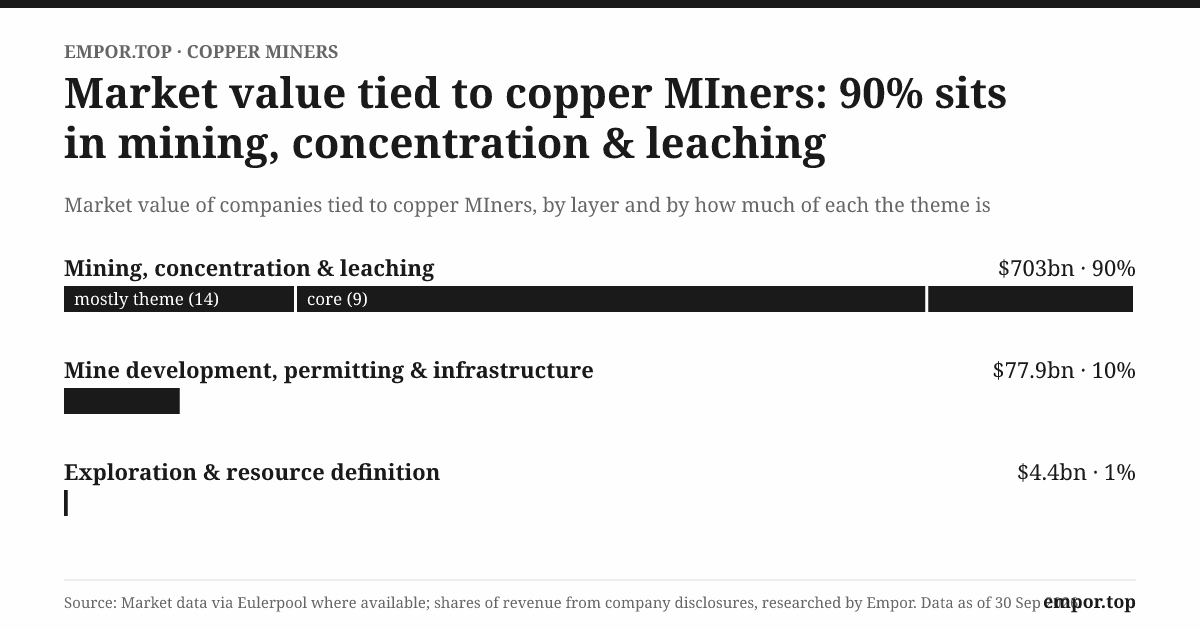
Market value tied to copper MIners: 90% sits in mining, concentration & leaching
Market value of companies tied to copper MIners, by layer and by how much of each the theme is
Mining, concentration & leaching $703bn · 90%
mostly theme (14) $153bn · core (9) $414bn · share not known (7) $136bn
Mine development, permitting & infrastructure $77.9bn · 10%
share not known (14) $77.9bn
Exploration & resource definition $4.4bn · 1%
share not known (2) $4.4bn
Market value of the listed companies in each layer, in US dollars, on 30 Sep 2026, split by how much of each company's revenue comes from the theme: mostly theme (75% or more), core (20–75%), meaningful (5–20%) and small part (under 5%).
This is the value of companies associated with copper MIners, not the value of the theme: too little of the theme's revenue is disclosed company by company to show that.
Who is left out · 30
- Philex Mining (Mine development, permitting & infrastructure): Not a listed company, or market value not available
- McEwen Mining – Copper (Mine development, permitting & infrastructure): Not a listed company, or market value not available
- Ivanhoe Electric – Copper (Mine development, permitting & infrastructure): Not a listed company, or market value not available
- Codelco (Mining, concentration & leaching): Not a listed company, or market value not available
- BHP Group – Copper (Mining, concentration & leaching): Not a listed company, or market value not available
- Glencore – Copper (Mining, concentration & leaching): Not a listed company, or market value not available
- Rio Tinto – Copper (Mining, concentration & leaching): Not a listed company, or market value not available
- Anglo American – Copper (Mining, concentration & leaching): Not a listed company, or market value not available
- Teck Resources – Copper (Mining, concentration & leaching): Not a listed company, or market value not available
- KAZ Minerals (Mining, concentration & leaching): Not a listed company, or market value not available
- South32 – Sierra Gorda (Mining, concentration & leaching): Not a listed company, or market value not available
- Jinchuan Group (Mining, concentration & leaching): Not a listed company, or market value not available
- Eurasian Resources Group (Mining, concentration & leaching): Not a listed company, or market value not available
- Barrick Mining – Copper (Mining, concentration & leaching): Not a listed company, or market value not available
- Atlas Consolidated Mining and Development (Mining, concentration & leaching): Not a listed company, or market value not available
- Vale – Copper (Mining, concentration & leaching): Not a listed company, or market value not available
- MMC Norilsk Nickel – Copper (Mining, concentration & leaching): Not a listed company, or market value not available
- Sumitomo Metal Mining – Copper (Mining, concentration & leaching): Not a listed company, or market value not available
- JX Advanced Metals – Copper (Mining, concentration & leaching): Not a listed company, or market value not available
- Marubeni – Copper (Mining, concentration & leaching): Not a listed company, or market value not available
- Mitsui & Co. – Copper (Mining, concentration & leaching): Not a listed company, or market value not available
- Grupo México – Copper (Mining, concentration & leaching): Not a listed company, or market value not available
- Harmony Gold Mining – Copper (Mining, concentration & leaching): Not a listed company, or market value not available
- Greatland Resources – Copper (Mining, concentration & leaching): Not a listed company, or market value not available
- Evolution Mining – Copper (Mining, concentration & leaching): Not a listed company, or market value not available
- Central Asia Metals – Copper (Mining, concentration & leaching): Not a listed company, or market value not available
- Merdeka Copper Gold (Mining, concentration & leaching): Not a listed company, or market value not available
- Western Mining – Copper (Mining, concentration & leaching): Not a listed company, or market value not available
- Zhejiang Huayou Cobalt – Copper (Mining, concentration & leaching): Not a listed company, or market value not available
- Vedanta – Copper (Smelting & refining): Not a listed company, or market value not available
Source: Market data via Eulerpool where available; shares of revenue from company disclosures, researched by Empor. Data as of 30 Sep 2026.
The figures, and the other charts, in the research dossier →
The mountain Daniel Jackling decided was ore
At the start of the twentieth century, the mountains west of Salt Lake City held a copper deposit that most serious miners dismissed. The copper at Bingham Canyon was real but weak, spread in tiny amounts through huge volumes of rock. Anyone trained in the old ways went after the rich veins underground. A young metallurgical engineer named Daniel Jackling looked at the same low-grade rock and made a bet that reshaped the industry: with enough scale, enough machinery and enough railway, the whole mountain could be ore.5
To see why that bet paid off, the story has to go back a couple of decades, to the moment copper stopped being merely useful and became necessary.
The wiring of industrial life
In 1835 a constant electric light was demonstrated, the first link in a long chain of improvements.3 In 1879 and 1880 Thomas Edison patented and refined a practical incandescent lamp.3 A lamp was useless without generators to power it and wires to carry the current, and the best practical conductor for those wires was copper. In 1882 Edison's Pearl Street Station in New York began distributing commercial power to customers.4
Edison's direct-current system had a weakness: it could not send power far. George Westinghouse bet on alternating current, which could be stepped up to high voltage and carried long distances. In 1896 a Westinghouse line carried power from Niagara Falls to Buffalo.4 Now electricity could travel from a river to a city, and every mile of that journey meant metal. Lighting, motors, telephones and transmission lines all turned copper's conductivity into a mass-market requirement. The world needed far more copper than rich veins could supply.
Enos Wall's claims, Jackling's company
The Utah Geological Survey's account of Bingham Canyon credits a mine owner named Enos Wall with recognising the low-grade copper on his claims.5 Jackling, together with the backers Spencer Penrose and Charles MacNeill, acquired Wall's ground and formed the Utah Copper Company in 1903 to mine it on a scale nobody had tried before.5
The geology behind the bet has a name that recurs throughout this story. A porphyry copper deposit is an enormous, dilute system formed when hot fluids rose from deep magma and left copper minerals scattered through a large body of rock. Porphyries are the world's copper workhorses. None of them is rich, but they are huge. A vein is a stream you pan by hand. A porphyry is a lake with a trace of metal dissolved in it, and you only profit from it if you can pump the whole lake.
Pumping the lake took three things together. First, steam shovels and open pits that could move rock in volumes underground miners never could. By 1906 Utah Copper and its neighbour Boston Consolidated were running large-scale steam-shovel operations.5 Second, a concentrator: a mill that crushes and grinds the ore and then throws away most of the waste rock, so that only a copper-rich concentrate travels on to be smelted. Panning for gold is a fair comparison up to a point. You wash away the dirt and keep the heavy stuff. Industrial concentration adds chemistry. In flotation, the ground ore is mixed with water and reagents so that copper minerals stick to air bubbles and float off as froth while the waste sinks. Third, a railway, a power supply, a smelter and a town for the workers.
In 1907 Bingham Canyon shipped the first copper produced from a porphyry deposit, and the Utah Geological Survey treats that as proof that scale and processing could turn dilute rock into an industry.5
Capital decides who owns the mountain
Jackling's engineering needed money on a scale few mining promoters could raise. The Guggenheim family, whose American Smelting & Refining empire already controlled smelting capacity, brought capital, railways and smelting to the arrangement. Then the financial crisis of 1907 hit. Credit dried up just as the new mines needed it most, and consolidation followed. The episode gave the industry its first hard lesson: a good orebody still needs deep pockets, and owners who can fund the lean years end up holding the assets of those who cannot. Utah Copper's lineage eventually ran through Kennecott into Rio Tinto, which still operates Bingham Canyon today.
Bingham also showed that by-products count. The same rock that carries copper often carries gold, silver and molybdenum. Selling them lowers the net cost of each pound of copper. A by-product credit works like a supermarket that sells the bones and trimmings from its meat counter, so the steaks cost less to supply. That idea explains why some of today's lowest-cost copper mines look cheap on paper: a good share of their costs is paid by other metals.
What Bingham changed, and what it did not
Bingham Canyon set the template for modern copper ownership: mine, railway, mill, smelter, power and company town, all bound together and owned together. It also gives the best rebuttal to a popular claim, that technology will always solve scarcity. Technology did transform copper. Jackling lowered the grade at which rock counts as ore, and that multiplied the world's usable resources. What he did not lower was the need for capital, infrastructure and time. Every later technology in this story follows the same pattern. The threshold for what counts as ore moves down, and the bill for turning it into metal stays as large as ever or grows.
Once copper became the wiring of national economies, governments stopped being content to tax the mountain. They wanted to own it.
When copper became a country's balance sheet
In July 1971 Chile's Congress voted unanimously to nationalise the country's large copper mines.7 It was a rare moment of agreement in a deeply divided country. Left and right alike accepted that the mines in the Andes and the Atacama belonged to Chile and not to the American companies that had built them.
Foreign mines on Chilean soil
The mines at the centre of that vote had been built with foreign capital and engineering in the early twentieth century. Chuquicamata, in the northern desert, had its industrial facilities inaugurated in 1915 and became one of the world's great long-lived copper districts.9 El Teniente, Salvador and Andina formed the core of what would become the national copper system. Anaconda and Kennecott, working through operating companies such as Braden Copper, ran them and sent the profits north.
For Chile the arithmetic was stark. Copper was the country's largest export and its main source of foreign currency, yet the decisions about how much to invest, how much to produce and how much profit to keep were made in New York. As copper grew more important to the national budget, that arrangement grew harder to defend.
Chileanisation, then nationalisation
The first move came from the centre. In 1966 Eduardo Frei's Christian Democratic government set up mixed companies in which the Chilean state would hold 51% of the major copper mines, a policy called "Chileanisation".7 In 1967 the state acquired majority stakes in Chuquicamata, El Teniente and Salvador.8 Frei's approach was a negotiated partnership: foreign expertise stayed, while control shifted gradually.
Salvador Allende's government, elected in 1970, finished what Chileanisation had started, and the 1971 vote completed nationalisation.7 After the military coup of 1973, the regime kept the mines in state hands. On 1 April 1976, Decree Laws 1.349 and 1.350 formally created the Corporación Nacional del Cobre, Codelco, as the state's mining, industrial and commercial corporation.7 Three very different governments, pulling in different political directions, reached the same conclusion: Chile's copper would stay Chilean.
A different kind of shareholder
State ownership changes what "lasting cash" means. A private miner answers to shareholders who want dividends and growth. Codelco answers to a state that wants tax revenue, jobs, national prestige and industrial policy all at once. Its copper cash flow first supports the national budget and only then pays for reinvestment in its own mines. Codelco's board and its relationship with the state differ from those of listed companies.10
The results have been mixed. Codelco kept control of inherited districts that no private company could assemble today, along with the infrastructure, water rights and skilled workforce that come with them. Codelco's 2025 copper revenue was roughly $18.3bn, counting both its own copper and third-party copper it bought and resold (an Empor estimate that adds the two lines together).23 But the mines are old. Grades fall as pits deepen, and big replacement projects need billions in capital that has to compete with every other claim on the state's purse. Nationalisation kept the resource in Chilean hands. It did not guarantee that the resource would be run productively.
The same argument, across the copper belt
Chile was not alone. Zambia, the Democratic Republic of the Congo, Peru, Indonesia and China all bound copper ownership to sovereignty, industrialisation or foreign-exchange earnings at various points. The institutions shaping upstream copper still include Chile's Congress and Ministry of Mining, China's industrial planners and state-owned enterprise regulators, and the licensing, export and state-participation regimes of the DRC and Zambia. Those African regimes offer some of the fastest copper growth while exposing investors to infrastructure, policy and logistics risk, according to the Empor dossier.23
This history narrows one common investor claim, that private ownership is always the surest route to lasting cash. In copper, the state is often a partner, a tax collector and sometimes the owner, and it can change the rules. The history cuts both ways, though. Nationalised copper systems still needed foreign capital, technology and partners to grow, and today's biggest new mines are nearly all joint ventures between private companies, state-linked groups and governments.
By the 1980s the sector was opening up again, and the next force to reshape copper came from a buyer, not an owner.
China turns copper into a global system
In December 2001 China formally joined the World Trade Organization, after negotiations on its accession concluded in September that year.11 Few people then saw it as a copper story. Within a few years it had become a major copper story. China's factories, apartment towers, power lines and appliances pulled in copper faster than the world's mines could supply it.
New giants before the boom
The supply side of this story began earlier, and it began with the same giant porphyries that Jackling had shown how to mine. In 1981 geologists discovered Escondida after repeated drilling in Chile's Atacama Desert. BHP describes the deposit as the basis for the world's largest copper mine.37 In 1984 BHP acquired Utah International, which gave it US, Chilean and other international assets and turned it into a global resource company.6 Escondida began producing copper in 1990.6 It showed that the next generation of giant mines would be built by joint ventures with enormous infrastructure budgets. BHP operates it, and Rio Tinto holds a stake.14
Then came the dealmakers. In 2001 Ivanhoe Mines, the exploration company built by the promoter Robert Friedland, reported gold-copper mineralisation at what became Oyu Tolgoi in Mongolia's Gobi Desert.18 Friedland's specialty was finding very large deposits and then bringing in the partners and capital to develop them. That model left others to finish the job. Oyu Tolgoi's open pit began mining in 2011, its concentrator started in 2013, and sustainable underground production began in March 2023, all under Rio Tinto's control.16 By December 2022 Rio Tinto had acquired full ownership of Turquoise Hill, the successor to the original Ivanhoe Mines.17
Friedland's team, now under the Ivanhoe Mines name, had already turned to Africa. In 2008 it discovered the Kamoa copper deposit in the DRC, and in 2016 it identified Kakula nearby, which materially raised the grade and scale of the combined complex.15
Supercycle, bust, supercycle
Chinese demand collided with a supply side that could not respond quickly. Chinese demand, supply disruptions and delayed new capacity pushed prices to new records between 2004 and 2007, according to the USGS history of copper prices.12 Then the 2008 financial crisis hit. Prices collapsed and inventories rose.12 Structural demand did not protect anyone from a cyclical crash.
Chinese stimulus revived demand, and prices peaked again in 2011. The IMF says the long rise gave way to a broad commodity decline in the following years.13 This is the counter-history every copper bull has to face. Between 2011 and 2016, demand kept growing, yet prices fell, because new supply, inventories and macroeconomic conditions shifted together. A demand story, however true, does not set the price by itself.
The toll booth moves
China did not just buy copper. It built smelters and refineries, faster than the world's mines could fill them. The International Energy Agency reports that China accounted for more than 90% of global smelter growth since 2005.21
To see why that matters, you need to understand treatment and refining charges, or TC/RCs. A mine usually sells concentrate, not pure metal. The smelter that turns concentrate into copper charges the miner a fee, deducted from the price, to do so. Think of it as a toll that miners pay to use the road to market. When concentrate is plentiful and smelters compete for business, the toll is high. When smelters have been overbuilt and concentrate is scarce, the smelters compete for feed instead, and the toll collapses. That is what happened. The IEA reports that the annual benchmark treatment charge fell from about $21 per tonne in 2025 to $0 in 2026, with spot charges negative since 2024.21 A toll booth that pays drivers to use its road is a toll booth in trouble. Bargaining power has shifted upstream, to whoever owns the concentrate.
China's owner base grew alongside its smelters. Zijin Mining, CMOC Group, China Nonferrous Mining, Jiangxi Copper, Tongling Nonferrous Metals and Yunnan Copper built or bought mines at home and abroad, often in the DRC and Zambia, using state-linked capital and joint ventures. Beijing's copper plan for 2025–2027 aims to grow domestic resources and recycling and to impose more discipline on smelting expansion.36
Surplus now, shortage later?
The China era leaves investors with two sets of numbers that seem to contradict each other. The International Copper Study Group, the industry's statistical body, forecasts that adjusted mine production will grow 1.6% in 2026 and 2.3% in 2027, and it expects a small refined surplus of 96,000 tonnes in 2026 and a larger one of 377,000 tonnes in 2027.19 The IEA, looking further ahead at the pipeline of announced projects, projects a 25% gap between copper supply and demand by 2035. That is down from the 30% it estimated a year earlier.20
Both can be true. A refined market can be in surplus this year because smelters have plenty of capacity and some concentrate is still coming through, while the project pipeline is still too thin to replace ageing mines over a decade. The ICSG measures the next two years. The IEA models the next ten. Neither has settled the question, and the IEA's own downward revision is a reminder that long-range gaps are estimates built on assumptions.
By the mid-2020s the question was no longer whether copper was useful. It was which owners controlled the points where the system could break.
From ore to wire: the chain that pays
Follow one tonne of rock. A haul truck carries it out of the pit to a crusher. The crushed ore goes to a mill, then to flotation cells, and leaves as concentrate. The concentrate travels by truck, rail or pipeline to a port, then by ship to a smelter, often in China. There it becomes anode copper, and a refinery turns it into cathode: flat plates of copper about 99.99% pure. The cathode goes to a rod plant, the rod to a wire drawer, and the wire into a transformer, a car, a building or a data-centre busbar. At each step someone takes a cut. The question for investors is who takes the biggest one, and why.
The long front end
The chain begins years before any truck moves. Exploration means drilling holes, mapping geology and assaying rock samples. Resource definition turns scattered drill results into an estimate of how much copper sits where, at what grade and with what confidence. Metallurgical tests then ask whether the rock gives up its copper cheaply. The result is a contained copper figure: the theoretical metal in the ground. Contained copper is an estimate, closer to an inventory count taken from the outside of a sealed warehouse than to a bank balance. Nobody can spend it until it has been mined, processed, sold and paid for.
The next stage is where most of the time goes: permits, water rights, power contracts, roads, port access, community agreements and financing. Only after those are in hand does a board take a final investment decision and start construction.
Three ways to get copper out
Once mining starts, processing follows the chemistry of the ore. Sulphide ores, the most common kind in large porphyries, follow the crushing, grinding and flotation route described above to make concentrate. Oxide ores and some low-grade material go a different route. They are piled into heaps and sprayed with acid, which dissolves the copper, a method called heap leaching. The copper-bearing solution then goes through SX-EW: solvent extraction pulls the copper into a cleaner liquid, and electrowinning plates it out as cathode on the mine site, with no smelter needed. The LIX 63 reagent, developed by General Mills in 1963, made possible the first small copper SX-EW plant in Arizona.22 SX-EW lets a mine skip the smelter and its toll entirely, though it only works on the right kind of ore.
For deep deposits there is block caving. Miners undercut a huge block of ore from below and let gravity break it into rubble, which is drawn off through tunnels underneath. Oyu Tolgoi's underground mine uses this method.16 Block caves are cheap per tonne once running, and expensive and slow to build.
Payable copper and who gets paid
The miner is not paid for all the copper it mines. It is paid for payable copper: the metal that survives recovery losses, minus the smelter's deductions and charges. The difference between contained, recovered and payable copper is where a lot of apparent value disappears. A resource of a million tonnes might yield much less payable metal after recovery rates, mining losses and smelter terms are applied.
Where does the money end up? The Empor dossier reduces upstream profit to a simple sum: payable tonnes times the realised copper price, plus by-product credits, minus cash costs, sustaining capital, overhead and financing costs.23 Low-cost mine owners keep the largest margin in that sum when grades are good. Smelters earn conversion income, though current concentrate scarcity has squeezed it. Governments collect royalties, taxes and, where they own stakes, dividends. Contractors, equipment makers, power suppliers, transport companies and local communities receive the operating and capital spending. Fabricators earn a conversion margin on rod and wire, and pass metal costs on to their customers with some delay.
The weakest link sets the pace
The chain is only as strong as its least replaceable link. A billion-dollar orebody produces nothing without a permit, a power line, water, sulphuric acid for leaching, a port and skilled people. Strategically important relationships are often financially small: a community agreement or a transmission connection can decide whether a mine runs at all.23
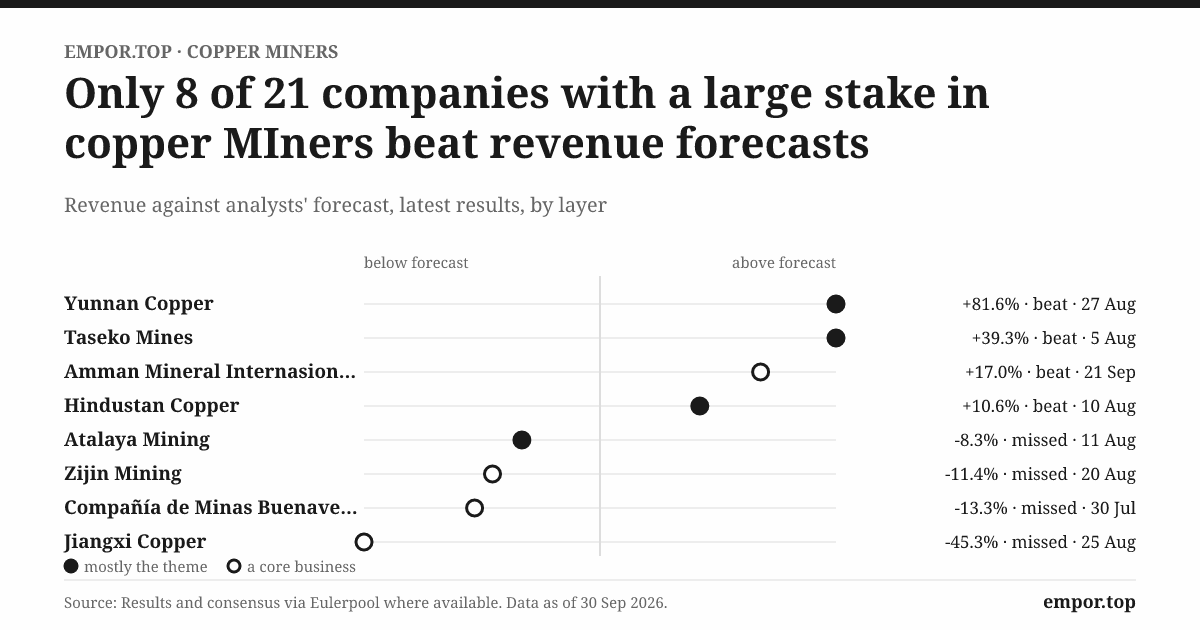
The chain also shows why "copper company" is too loose a label. The integrated Chinese groups make the point. In 2025 Jiangxi Copper [$600362.SS] booked about $75.8bn of revenue, Tongling Nonferrous Metals [$000630.SZ] about $24.1bn and Yunnan Copper about $25.0bn, yet their operating margins were 3.3%, 4.2% and 1.3%.23 These companies buy a lot of concentrate from other miners and earn a thin conversion margin on it, and the collapse of treatment charges has squeezed exactly that margin. Their revenue grows with the copper price while their profits stay thin. Revenue measures how much copper passes through a company. Profit measures how much of the rock it owns.
With the chain in view, the owners can be compared by the bottleneck each one controls rather than by the word "copper" in their names.
The owners are not playing the same game
Picture three scenes on the same day in 2026. In Peru and Mexico, Southern Copper's pits and plants turn rock into metal at operating margins that most industries would envy. High in the Andes on the Argentina–Chile border, an NGEx Minerals drill rig pulls up core at Lunahuasi that might one day be a mine. Somewhere else, a developer's lawyers wait for a permit that would let construction begin. All three are "copper stocks". They are playing different games, and the rules of one do not apply to the others.
The inheritors of scale
The first group owns giant districts that took generations to assemble. Codelco is the largest state platform, with own-source copper output of about 1.334 million tonnes in 2025 according to the dossier.23 BHP operates Escondida, which produced about 1.3 million tonnes in the year to June 2026.23 Freeport-McMoRan [$FCX] owns Grasberg in Indonesia, Morenci in Arizona and Cerro Verde in Peru. Glencore [$GLEN.L] combines mines such as Collahuasi and Antamina with a trading and logistics business. Rio Tinto [$RIO.L] holds Oyu Tolgoi, Kennecott and its Escondida stake. Anglo American [$AAL.L] owns Collahuasi, Quellaveco and Los Bronces, and Teck has built Quebrada Blanca.
Their advantage is not just size. It is the ability to spread railways, power lines, water systems and technical know-how over many deposits and many expansion phases. That advantage is hard to copy, because a new district would need decades and would face permitting rules the old ones never did.
Freeport shows both the strength and the fragility of this model. Grasberg's gold and molybdenum credits help keep Freeport's reported copper cash cost low at about $2 per pound in the quarter to June 2026.23 Grasberg is also a single, very large point of failure. The mine produced about 1.0 billion pounds of copper in 2025, roughly 454,000 tonnes by Empor's conversion, and Freeport has published updates on restart plans for the district.23 While copper prices surged, Freeport's revenue in the June 2026 quarter fell 7.3% from a year earlier, and its operating margin of 28.5% was lower than a year before.23 By-product protection cushions costs. It cannot make up for tonnes that never leave the mine.
The pure plays with the best current economics
The second group lives almost entirely on copper and publishes the numbers to prove it. Southern Copper [$SCCO], controlled by Grupo México, runs long-lived mines in Mexico and Peru with large by-product streams. On current disclosed profitability it leads the listed large-cap field: an operating margin of 52.2% in 2025, 61.2% in the June 2026 quarter, and a return on capital employed of about 41%.23 Antofagasta [$ANTO.L], the Chilean pure play with its own railway, is the closest comparable, with a 46.0% operating margin in its latest half.23 Those figures reflect copper prices acting on low-cost assets. Southern Copper's margin moved closely with the copper price over the past six years, one of the clearest links in the Empor data.23
Is the lead permanent? The record says no. Southern Copper's margins depend on grades, Mexican and Peruvian policy and permits for its next projects, any of which can change. Antofagasta shows how accounting profit can come apart from cash: despite its high margins, its trailing free cash flow was negative, because it is spending heavily on growth.23 A strong margin tells you how good today's rock is. It does not say whether tomorrow's rock will be as good or how much the next mine will cost.
Smaller pure plays show the same pattern at more modest scale. Lundin Mining, with Candelaria and Caserones in Chile and Chapada in Brazil, lifted its operating margin to 44.1% in the June 2026 quarter, and its return on capital rose to 16.5%.23 Ero Copper in Brazil and Atalaya Mining in Spain both turned negative free cash flow in 2022–2024 into positive free cash flow in 2025.23 These are companies whose economics improved sharply once copper prices rose, which is what the theme predicts, but they did not prove resilience at low prices.
The growth builders
The third group grows by buying, building and expanding faster than anyone else. Zijin Mining [$601899.SS], 紫金矿业 in Chinese, produced about 885,600 tonnes of copper in 2025 across China, the DRC, Serbia and elsewhere.23 Its operating margin rose from 11.4% in 2022 to 32.3% in the June 2026 quarter.23 CMOC Group [$603993.SS], 洛阳钼业, runs Tenke Fungurume and Kisanfu in the DRC. Its return on capital climbed from under 9% in 2022 to nearly 38% in the latest quarter, the steepest improvement among the large producers.23 Ivanhoe Mines co-owns Kamoa-Kakula with Zijin and the DRC government. The complex produced about 389,000 tonnes in 2025, of which Ivanhoe's 39.6% share was around 154,000 tonnes.23 MMG, the Hong Kong-listed owner of Las Bambas in Peru, lifted its latest-half operating margin to 49.2%.23
Who leads on growth? It is contested. Zijin leads on scale of output. CMOC leads on the pace of improvement in returns. Ivanhoe leads on grade: Kamoa-Kakula's head grade was about 2.4% in the latest quarter, several times that of typical Chilean porphyries.23 Each lead was built differently. Zijin and CMOC bought into overseas resources and used capital, procurement and processing skill to expand them. Ivanhoe found its deposit itself.
The case against the growth builders is not about geology. Their growth imports country, governance and integration risk, and ownership structures make their numbers hard to compare with Western miners' figures. Ivanhoe is the sharpest example of a gap between promise and cash: its trailing free cash flow margin was about −80% and its revenue missed consensus by a quarter in its latest results, as the market pays for growth and grade rather than current cash.23 MMG shows how above-ground problems can dominate. Las Bambas depends on a road through communities that have repeatedly blocked it, and transport access matters as much as the orebody.
The politically leveraged
The fourth group carries risks that can swamp everything else. First Quantum Minerals, a Canadian producer with Kansanshi and Sentinel in Zambia, lost the use of its largest mine when Panama halted Cobre Panamá in November 2023 after the country's Supreme Court declared the mine's concession unconstitutional. The company says the mine can supply up to 1.5% of global copper.24 Nearly three years later, First Quantum's return on capital sat around 5% and its net income was close to zero, even with copper prices at records.23 One lost mine can dominate an otherwise attractive portfolio.
KGHM Polska Miedź [$KGH.WA] mines deep underground in Poland and also owns Sierra Gorda in Chile. It trades at a low multiple of earnings, about 7.4 times, which reflects deep, costly mines, silver exposure and weaker cash conversion.23 Amman Mineral Internasional [$AMMN.JK], which runs the Batu Hijau complex in Indonesia, has swung wildly as it built a smelter and expanded, with a sharp fall in revenue in 2025 followed by a rebound.23 China Nonferrous Mining operates in Zambia and the DRC. Barrick Mining [$B], a gold major, owns Lumwana in Zambia and the Reko Diq project in Pakistan, where copper growth is still mostly in the future.
The mid-sized operators
The final group runs one to a handful of mines each. Hudbay Minerals operates Constancia in Peru and mines in Canada. Capstone Copper runs Mantoverde and Mantos Blancos in Chile, Pinto Valley in Arizona and Cozamin in Mexico. Taseko Mines runs Gibraltar in British Columbia and is building Florence in Arizona. Sandfire Resources owns MATSA in Spain and Motheo in Botswana. Boliden [$BOL.ST] mines Aitik in Sweden and also runs smelters and recycling. In Australia, Aeris Resources, AIC Mines, 29Metals and Kantra Copper run smaller operations. Atico Mining runs El Roble in Colombia, and Central Asia Metals recovers copper from old waste dumps at Kounrad in Kazakhstan using SX-EW. Hindustan Copper [$HINDCOPPER] is described in the dossier as India's only listed copper-ore miner. Its FY2026 operating margin was 41%, and at 40 times earnings the market already prices in its scarcity value.23
For these companies, execution is everything. The June 2026 quarter shows the range: Aeris and Sandfire earned high margins and generated cash, while 29Metals and Atico lost money even at record prices.23 The same copper price produced very different results depending on grade, mine life, costs and debt.
What the numbers say about the contest
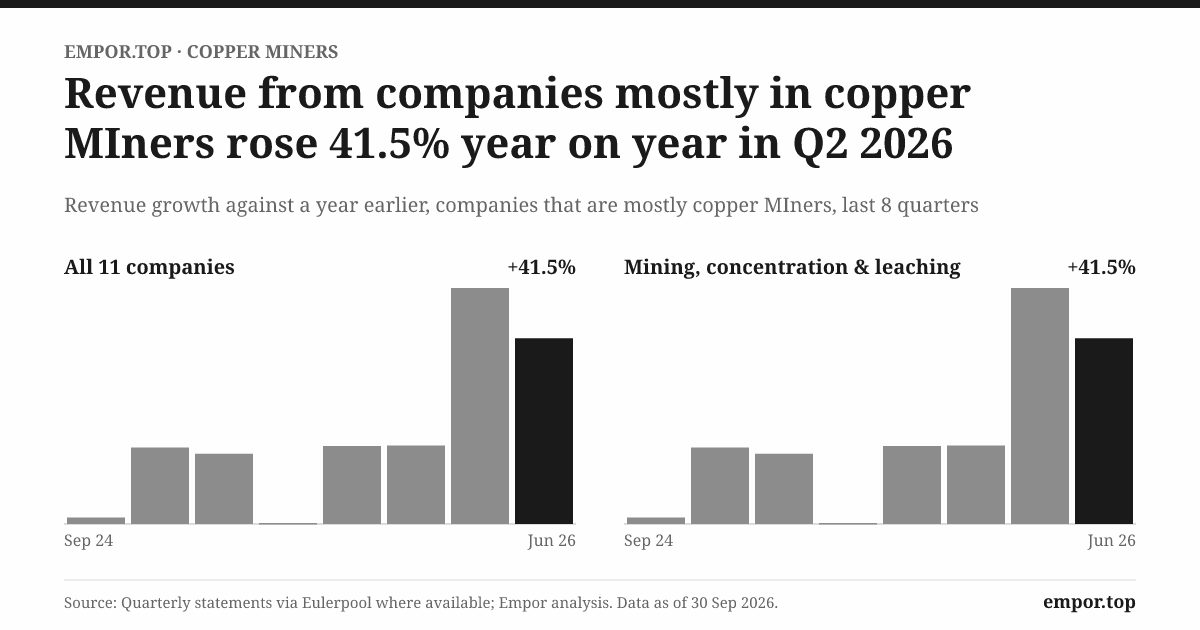
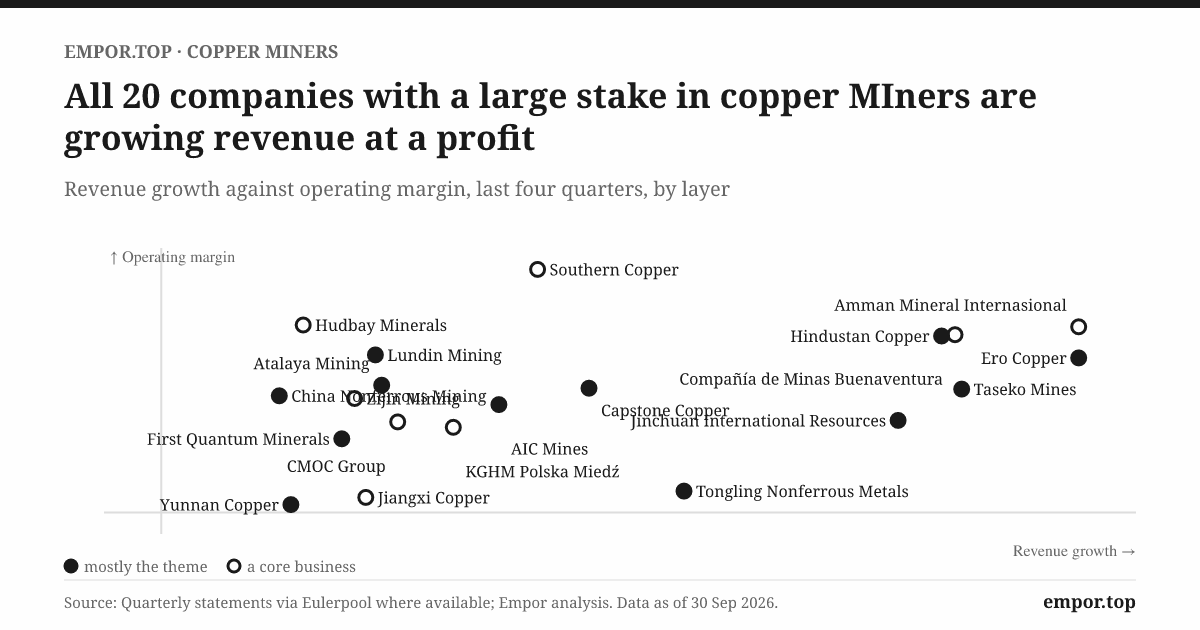
Taken together, the mining layer's revenue grew 25% in the June 2026 quarter from a year earlier, and 28 of the 30 operating companies that report every quarter grew revenue.23 The combined operating margin reached 21.0%, up 4.6 percentage points.23 Median return on capital among the miners roughly doubled from about 8% in 2024 to 16.5% in the latest quarter.23
The lead of the scaled, cash-generating owners over pre-revenue names is widening, because they are the ones turning the price into cash now. Among producers, though, the fastest improvers were not the biggest. CMOC, MMG, Lundin, Capstone and the smaller Australian operators improved returns faster than Freeport or the integrated Chinese smelter-miners.
Other companies own copper only indirectly. Buenaventura holds 19.58% of Cerro Verde and receives its copper income mostly as dividends. Japan's trading houses and metals groups, Mitsui [$8031.T], Marubeni [$8002.T], Sumitomo Metal Mining [$5713.T] and JX Advanced Metals [$5016.T], hold minority stakes in Chilean and American mines, and their shareholders receive only part of the mine economics. South32 [$S32.AX] owns 45% of Sierra Gorda inside a diversified group. Western Mining [$601168.SS] owns Chinese domestic mines such as Yulong. Zhejiang Huayou Cobalt [$603799.SS] holds DRC copper-cobalt interests inside a battery-materials group. Vedanta [$VEDL] is mainly a smelter and refiner today and belongs in the midstream comparison. For all of these, copper revenue or stakes appear in the filings, but the link between copper and group profit is not clean. Vale, Norilsk Nickel, Harmony, Greatland and Evolution own real copper assets inside groups where copper is not decisive for the whole.
Today's contest is fought with mines that already exist. Tomorrow's supply contest is being decided before any mine revenue appears.
The long queue of rocks waiting for permission
A junior mining company announces a new resource estimate: hundreds of millions of tonnes of copper-bearing rock, billions of pounds of contained metal. The share price jumps. Within hours, investors are asking the question that actually matters: when does construction start, and who pays for it?
A ladder with many rungs
Between a discovery and a mine lies a ladder, and every rung can break. The company must move from drilling and metallurgy through studies, permits, infrastructure, financing, construction and commissioning. Studies include a preliminary economic assessment (PEA), a prefeasibility study (PFS) and a feasibility study (FS); each one narrows the uncertainty, and none of them builds anything. Only at the top does the company earn revenue.
S&P Global found an average of about 17.5 years from discovery to production in its September 2026 study of copper discoveries, and found that the industry is expanding existing mines much more than it is adding new ones.26 In its July 2026 study of permitting delays, S&P Global reported a figure of 16 years across the assets it examined and found that projects not yet operating can approach 30 years, with permitting a leading cause of delay.27 The two figures differ because the samples differ. Both say the same thing: the queue is measured in decades, not years.
Explorers: options on geology
At the bottom of the ladder, NGEx Minerals and Northisle Copper and Gold show how differently the market values exploration. NGEx, a Lundin-group company, has made high-grade copper-gold-silver intercepts at Lunahuasi in Argentina. It also holds about 69% of Los Helados, where Lundin Mining has joined as a partner.23 Its market value was about $3.6bn at the end of September 2026, with no revenue.23 Northisle's North Island project in British Columbia holds a large resource, but its resource is at about 0.14% copper, a much lower grade. It was valued at about $835m.23
Which is the exploration leader? NGEx leads on market re-rating and grade. Northisle is closer on reported resource scale. Neither has produced a pound of copper, and drilling results and financing will decide which option ends up worth more.
Big projects without a clear path
The next group owns large undeveloped resources. Solaris Resources is developing Warintza in Ecuador, where community agreements and permits determine its value. SolGold's Cascabel, also in Ecuador, is a large copper-gold project with major financing and permitting needs. (The market value Empor's data shows for SolGold, about $72bn, is inconsistent with its history and should not be relied on.)23 Aldebaran Resources owns Altar in Argentina. Oroco Resource holds the PEA-stage Santo Tomás project in Mexico. Copper Fox Metals holds a carried interest in Schaft Creek, which Teck operates, so its fate depends on a partner's priorities.
Brownfield and restart projects
A brownfield project expands or restarts a mine where infrastructure already exists. A greenfield project starts from nothing. Brownfield is usually faster and cheaper because the roads, power and often the permits are already in place. Arizona Sonoran Copper's Cactus project sits on an old mine site in Arizona. Highland Copper's Copperwood in Michigan is permitted. Cyprium Metals' Nifty in Western Australia offers existing infrastructure and the option of producing cathode by SX-EW. The market has noticed: the development layer's shares returned 78% over the past year.23 Rising prices do not finance or build a mine, though, and dilution is the cost of waiting. The median development company's diluted share count rose 46% over three years.23
Nearer-term and financed developers
Orion Minerals in South Africa describes its Prieska project as fully permitted.23 Philex Mining says it is using its ageing Padcal mine to fund the move to Silangan in the Philippines. McEwen Copper, controlled by the listed McEwen Inc., is advancing Los Azules in Argentina. Ivanhoe Electric, another Friedland company, is working on Santa Cruz in Arizona and Tintic in Utah. It pairs exploration technology with copper projects, and its small 2025 revenue came mainly from technology services.23 Hot Chili is developing Costa Fuego in Chile, FireFly Metals is developing Green Bay in Newfoundland, and Cobre holds Sierra Atacama in Chile and exploration ground in Botswana's Kalahari.
Money for these projects increasingly comes from outside the equity market. Royalty and streaming companies, export-credit agencies and government programmes offer staged capital, grants, loan guarantees and letters of interest. A letter of interest is not committed debt, and streaming reduces the equity needed today by handing away part of the metal tomorrow.23
When geology loses
The strongest evidence against the idea that "a large resource means future supply" comes from Alaska. Northern Dynasty Minerals' Pebble deposit is one of the largest undeveloped copper-gold resources in the world. On 30 January 2023, the US Environmental Protection Agency used its Clean Water Act powers to restrict development, citing expected harm to the Bristol Bay salmon fisheries.28 Geological scale did not overcome social and regulatory barriers. Northern Dynasty was still worth about $774m at the end of September 2026, with no path to production shown in its filings.23
Trilogy Metals sits in between. Its Arctic and Bornite deposits in Alaska's Ambler district are high grade, and South32 is its 50% partner in Ambler Metals, but the project depends on a federally permitted road that has not been built.23 Rio Tinto's Resolution Copper project in Arizona is another reminder that even a major company's major project can remain tied up for years in land, water, tailings, Indigenous rights and legal disputes.
Resource figures themselves add a final caution. Companies use different cut-off grades, confidence categories, ownership shares and copper-equivalent assumptions that fold other metals into a copper number. Two headline figures of "a billion pounds" can mean very different things.
When prices rise, every project on the ladder looks better on paper. Not every project becomes a mine, and not every price rise becomes a shortage.
A high price is not the same as a shortage
In the quarter to June 2026, copper averaged $13,318 per tonne, according to the IMF price series published through the Federal Reserve Bank of St. Louis, 40% more than a year earlier.29 In the same months, the International Copper Study Group forecast that the refined copper market would be in surplus this year.19 How can the price of something soar while the market has more of it than it needs?
How a price move reaches each layer
The answer starts with how the price moves through the chain. A mine sells copper at prices tied to the market, usually the average over a recent month or two, adjusted later once the final price is known. So when copper rises, a producer's revenue and margin rise almost immediately. The Empor data bears this out, loosely. Across 28 producers with enough history, operating margins moved with the copper price in the same quarter for 19 of them.23 For Freeport, Southern Copper, Antofagasta, KGHM, MMG, Lundin and several smaller miners, the link was clear. For Freeport, a 10% rise in copper typically came with an operating margin about four percentage points higher.23
The pattern breaks where the model predicts it should. CMOC, Tongling and Sandfire showed no clear link. Hudbay moved the opposite way from expectations. Yunnan Copper's margin followed copper only about three quarters later.23 Each break has an explanation: by-products such as cobalt or zinc, ramp-ups, one-off accounting items, or the fact that an integrated smelter buys concentrate at a price that rises along with the metal it sells. A few years of prices and margins moving together is evidence, not proof. Costs, currencies and hedges often move at the same time.
Energy is the other half of the story. Diesel, electricity and explosives are major mining costs, so dearer oil should squeeze margins with a lag. WTI oil averaged about $96 a barrel in the June 2026 quarter, 48% higher than a year earlier.30 Here the data shows no consistent link at the expected delay of one quarter. The effect appeared later, if at all, and a few companies moved the other way.23 Grades, currencies, by-product credits, power contracts and hedges all blur the diesel effect. For now, copper prices are rising faster than energy costs, and that gap is where the current margin gains come from.
For a developer, a higher price improves project economics on paper immediately. Financing, permitting and construction respond slowly, so the developer's value rises long before its production does. For a custom smelter, higher prices matter less than the treatment charge, and with benchmark charges at zero, the smelter's position has weakened.21
Is the high price drawing in new supply?
High prices are supposed to bring new supply, and there are early signs that new supply is responding. The IEA reports that copper-focused mining companies raised investment by 8% in 2025, while exploration spending held broadly steady.25 Yet the Empor universe's capital spending was only 6.9% of revenue over the past year, below its usual level of 8.2%.23 Revenue has grown faster than investment. That keeps free cash flow high today, and it means supply is not yet responding at the pace the price might suggest.
What the market has already paid for
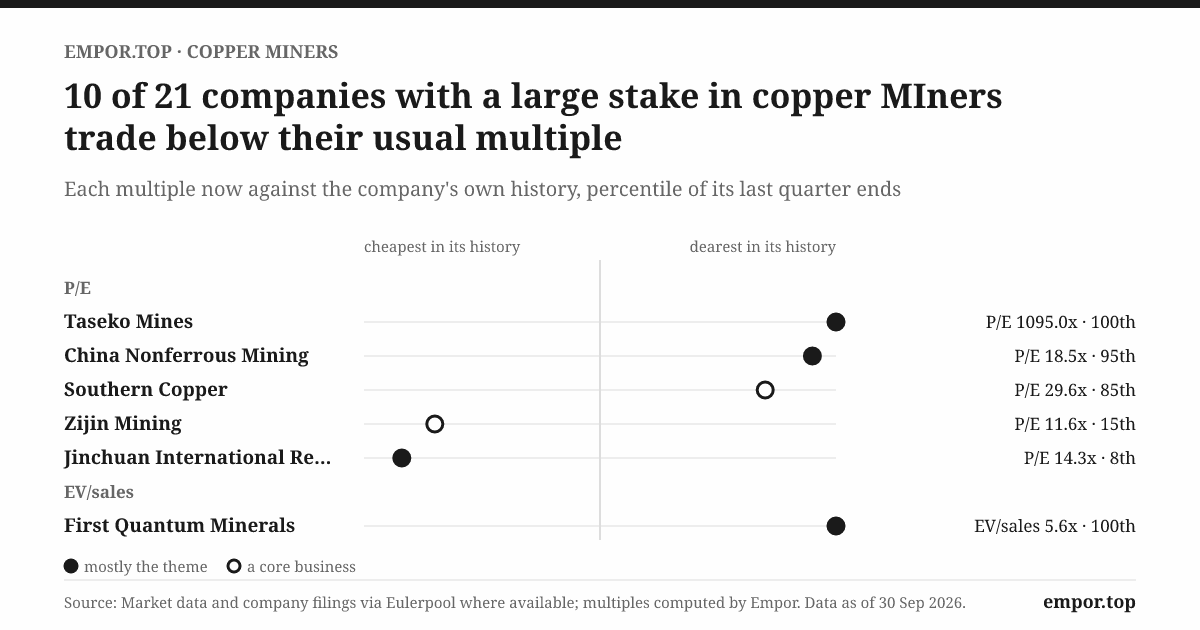
Investors did not wait. Weighted by market value, the listed copper owners returned about 44% over the year to 30 September 2026 and about 119% over three years.23 Analysts expect combined revenue to grow about 35% into the next fiscal year, against about 12% a year from 2020 to 2025.23 The combined price-to-earnings ratio of 18.5 sits within its range of recent years (between about 13 and 42 times), so this is not an extreme valuation. It does mean the market expects the high price to hold and the new tonnes to arrive.23 The theme can be right while the shares disappoint, if the price softens, costs catch up or projects run late.
The record of price spikes
History argues for caution. The copper price collapsed in the 1970s and 1980s, in 2008, and again from 2011 to 2016.12 Each time, high prices drew in new supply, encouraged substitution and recycling, and brought financial selling when conditions turned. Today's zero treatment charge does support the claim that concentrate is tight, and that is a genuine upstream advantage. Forecasts of new supply, though, are not delivered tonnes, and company guidance has to be checked against actual production, quarter after quarter.
The evidence narrows the claim that high prices mean lasting profits. They mean high profits now for low-cost producers. Whether those profits last depends on which of three forces wins next: demand, new supply, or the world finding ways to use less copper.
The next move: more mines, more scrap, or less copper
An electric car, a new transmission line, a solar farm and a data centre all compete for the same metal. Each uses copper in its wiring, motors, transformers or cooling. Each is being built in larger numbers than a decade ago.
The demand threads
The deployment figures are real, not just announcements. The IEA reports that global electric-car sales exceeded 20 million in 2025, about a quarter of new-car sales.31 Renewable capacity additions were about 800 gigawatts in 2025.32 Data centres used about 485 terawatt-hours of electricity in 2025, and the IEA projects close to 950 terawatt-hours by 2030.33 Energy technologies drove roughly three-quarters of demand growth across key energy minerals in 2025.20 In the IEA's stated-policies scenario, copper demand from clean technologies rises from about 7.7 million tonnes in 2024 to about 10.9 million in 2030, while all other uses grow more slowly.38
Those threads are independent. Grid spending, carmaking, power generation and data-centre construction answer to different customers, budgets and policies. A slowdown in one does not have to mean a slowdown in all, which makes copper demand broader than a single-product boom.
The supply responses
Supply has more than one way to respond. New mines and expansions are the obvious response.26 Recycling is the second. The IEA expects recycling to materially reduce the need for new mine supply by 2050.20 Scrap can come back faster than a new mine can be built. The third is substitution: aluminium can replace copper in some conductors and cables where weight and cost matter more than space and conductivity. The fourth is technology. AI-assisted targeting and better geophysics might improve the odds of discovery, though the dossier rightly warns that claims have to become repeatable discoveries before they count.23 The fifth is going deeper: block caves, leaching of lower-grade material, and more power- and water-intensive systems that unlock ore at a higher cost.
Where the money could move
Each response moves profit somewhere. If recycling accelerates, some profit moves from miners to scrap processors and integrated smelters. If concentrate stays scarce, profit keeps moving from custom smelters to miners, and China's plan to discipline smelter growth would reinforce that.36 If aluminium substitution spreads, profit moves from copper to aluminium in the applications where it works. If governments keep treating copper as strategic, capital and permits will favour state-backed and well-located owners. The UK, for example, now treats copper as a growth mineral in its critical-minerals strategy.39 And if large African and Latin American projects arrive on schedule, the scarcity premium that low-cost owners now earn will shrink.
Consolidation is the incumbents' response. Anglo American and Teck agreed to a merger of equals meant to create a copper-focused global group. On 23 July 2026, Anglo American said the deal remained on track, with final regulatory approval still outstanding and the companies still operating separately.34 Teck has been mailing letters of transmittal to shareholders ahead of completion.35 The logic is scale: combining Collahuasi, Quellaveco, Quebrada Blanca and their project pipelines. Until the deal completes, it remains an announced option, not a single company.
The case against the optimists
The optimistic case, that demand runs ahead of supply for a decade, has three weak points. First, the IEA's 25% gap for 2035 depends on its model, and the IEA itself reduced it from 30% within a year.20 Second, the ICSG's nearer-term figures show mine supply growing and refined surpluses in both 2026 and 2027.19 Third, demand for infrastructure can grow while the copper used per unit falls, through thinner wires, aluminium, better designs or higher voltages. The record leaves the demand claim standing but unproven in its strongest form. What would settle it is the next few years of delivered tonnes, recycled supply and copper use per unit of grid, per car and per data centre.
Investors need signals that move before revenue does, and that separate a lasting bottleneck from a price cycle.
The test of lasting cash
Go back to the three objects this story has followed: an orebody in the ground, a mine on a balance sheet, and a copper cathode leaving the plant gate. Only the last one is cash. The question is which owners can reliably turn the first into the last, through high prices and low ones. Five signals, each of which moves before a miner's revenue does, will help answer it.
The refined copper balance. This measures whether delivered supply is keeping up with use. It moves early because it adds up mine, smelter and scrap output against consumption before those flows reach company accounts. It settles the core disagreement between a near-term surplus and a long-term shortage. The International Copper Study Group publishes it monthly, along with forecasts twice a year. Its April 2026 forecast showed a refined surplus of 96,000 tonnes in 2026 and 377,000 tonnes in 2027.19 Recurring deficits with stable demand would support the scarcity case. Surpluses that persist through 2027 alongside a falling price would weaken it.
Treatment and refining charges. The toll miners pay smelters shows how scarce mine feed is relative to smelter capacity. It moves ahead of mine revenue because smelters feel concentrate shortages first. It settles whether bargaining power stays upstream. Annual benchmarks are set each year, and spot charges are reported continuously. The 2026 benchmark was about $0 per tonne, with spot charges negative since 2024.21 Charges that stay at zero or below through 2027 would confirm the concentrate squeeze. A lasting return to positive charges would show that mine supply is catching up.
Project conversion. This counts how many discoveries reach a final investment decision, enter construction and reach production, and how long they take. It is the earliest sign of future supply, visible years before the tonnes arrive. It settles whether the bottleneck is real or just slow. S&P Global publishes studies each year, and company milestones come out quarterly. The latest reading is a discovery-to-production average of about 16 to 17.5 years, depending on the sample.2627 A sustained rise in on-time construction starts would weaken the bottleneck story. Continued slippage would strengthen it.
Delivered mine performance. Grade, recovery, payable tonnes, cash cost and sustaining capital, reported quarterly by each owner, show whether a higher price is turning into more cash. These figures move before annual profits and expose weak economics quickly. The Empor numbers to watch include Grasberg, Escondida, Quebrada Blanca and Kamoa-Kakula, whose 2025 or FY2026 output ranged from about 190,000 tonnes at Quebrada Blanca to about 1.3 million at Escondida.23 Rising tonnes at stable costs would support the large owners. Price gains that do not raise free cash flow would reveal poor ownership economics.
Copper-intensive deployment. EV sales, renewable additions, grid spending and data-centre electricity, published by the IEA each year and by industry bodies more often, lead copper demand by months or years. They settle whether demand is broad and durable. The latest readings are more than 20 million EVs, about 800 gigawatts of renewables and about 485 terawatt-hours of data-centre power in 2025.313233 A slowdown across several of these threads at once, or clear evidence that copper intensity is falling, would weaken the demand case.
The answer
The best owners are not necessarily the ones with the largest resources or the biggest share-price gains. Lasting cash goes to owners that turn geology into payable tonnes, keep margins through the cycle and hold back enough capital for the next mine. Today that describes Codelco and the large, low-cost, by-product-supported owners, with Southern Copper leading on current profitability among listed miners. Zijin, CMOC and Ivanhoe Mines, along with the few developers that have permits, infrastructure and partners, control more of tomorrow's options. Their risk is that they own the future tonnes while also carrying the country, construction and financing risks that come with them. What decides it is timing: whether tomorrow's tonnes arrive before today's scarcity rent disappears, and whose balance sheet is still standing when they do.
Glossary
Ore and grade. Ore is rock with enough metal to be worth extracting. Grade is the share of metal in it, usually a fraction of one per cent for large copper mines.
Porphyry copper. A huge, dilute copper deposit formed by hot fluids rising from magma. Porphyries supply most of the world's mined copper.
Contained copper. The theoretical copper in a deposit before losses in mining, processing and smelting.
Mineral resource. Mineralisation estimated with some geological confidence, not yet shown to be economic to mine.
Mineral reserve. The part of a resource shown to be economically mineable under stated technical and price assumptions.
Payable copper. The copper a miner is actually paid for after recovery losses, smelter deductions and charges.
Concentrate. Ground ore after most of the waste has been removed, rich enough in copper to ship to a smelter.
Cathode. Plates of copper about 99.99% pure, the standard traded form of refined metal.
Flotation. A process that uses air bubbles and reagents to separate copper minerals from waste rock.
SX-EW. Solvent extraction and electrowinning: a way to produce cathode at the mine from leached ore, with no smelter.
Treatment and refining charges. Fees miners pay smelters to process concentrate. Low or negative charges mean concentrate is scarce.
By-product credit. Revenue from gold, silver, molybdenum, cobalt or other metals that lowers the net cost of copper.
Brownfield. An expansion or restart at a site that already has infrastructure.
Greenfield. A new project that needs new infrastructure, permits and operating systems.
Block caving. Underground mining that undercuts a large block of ore and lets gravity break it for collection below.
References
-
Electricity Transmission primer — US Department of Energy ↩↩
-
Open-Pit Copper Mining at Bingham Canyon — Utah Geological Survey ↩↩↩↩↩
-
WTO successfully concludes negotiations on China's entry — World Trade Organization, 2001 ↩
-
Copper supply, demand and price history, SIR 2012-5188 — US Geological Survey ↩↩↩
-
The End of the Super Cycle? — International Monetary Fund, 2015 ↩
-
What happened to the company that owned Oyu Tolgoi? — Ivanhoe Mines investor FAQ ↩
-
Copper Market Forecast 2026–2027 — International Copper Study Group, April 2026 ↩↩↩↩
-
Global Critical Minerals Outlook 2026, Executive summary — International Energy Agency ↩↩↩↩
-
Copper prices have hit record highs, but smelters face mounting strategic pressures — International Energy Agency ↩↩↩↩
-
Evolutionary and Revolutionary Technologies for Mining — National Academies ↩
-
Copper Miners theme data and research dossier — Empor, 30 September 2026 ↩↩↩↩↩↩↩↩↩↩↩↩↩↩↩↩↩↩↩↩↩↩↩↩↩↩↩↩↩↩↩↩↩↩↩↩↩↩↩↩↩↩↩↩↩↩↩↩↩↩↩↩
-
Global Critical Minerals Outlook 2026, Market overview — International Energy Agency ↩
-
Copper discoveries 2026: expansion over addition as new discoveries lag — S&P Global Market Intelligence, September 2026 ↩↩↩
-
Mine permitting delays and the discovery-to-production timeline — S&P Global Market Intelligence, July 2026 ↩↩
-
Final Determination for the Pebble Deposit Area — US Environmental Protection Agency, 2023 ↩
-
Global price of Copper (PCOPPUSDM) — FRED, Federal Reserve Bank of St. Louis ↩
-
WTI crude oil price (MCOILWTICO) — FRED, Federal Reserve Bank of St. Louis ↩
-
Global EV Outlook 2026, Trends in electric cars — International Energy Agency ↩↩
-
Global Energy Review 2026, Solar PV and wind — International Energy Agency ↩↩
-
Key questions on energy and AI, Executive summary — International Energy Agency ↩↩
-
Teck announces mailing of letter of transmittal for merger of equals with Anglo American — Teck Resources, 2026 ↩
-
Copper industry high-quality development plan 2025–2027 — Government of China, 2025 ↩↩
 LinkedIn
 WhatsApp
 Reddit
 Hacker News
 Email
Email Kindle
 RSS Feed
 Spotify
 Apple Podcasts
 Amazon Music
 Audible
 YouTube