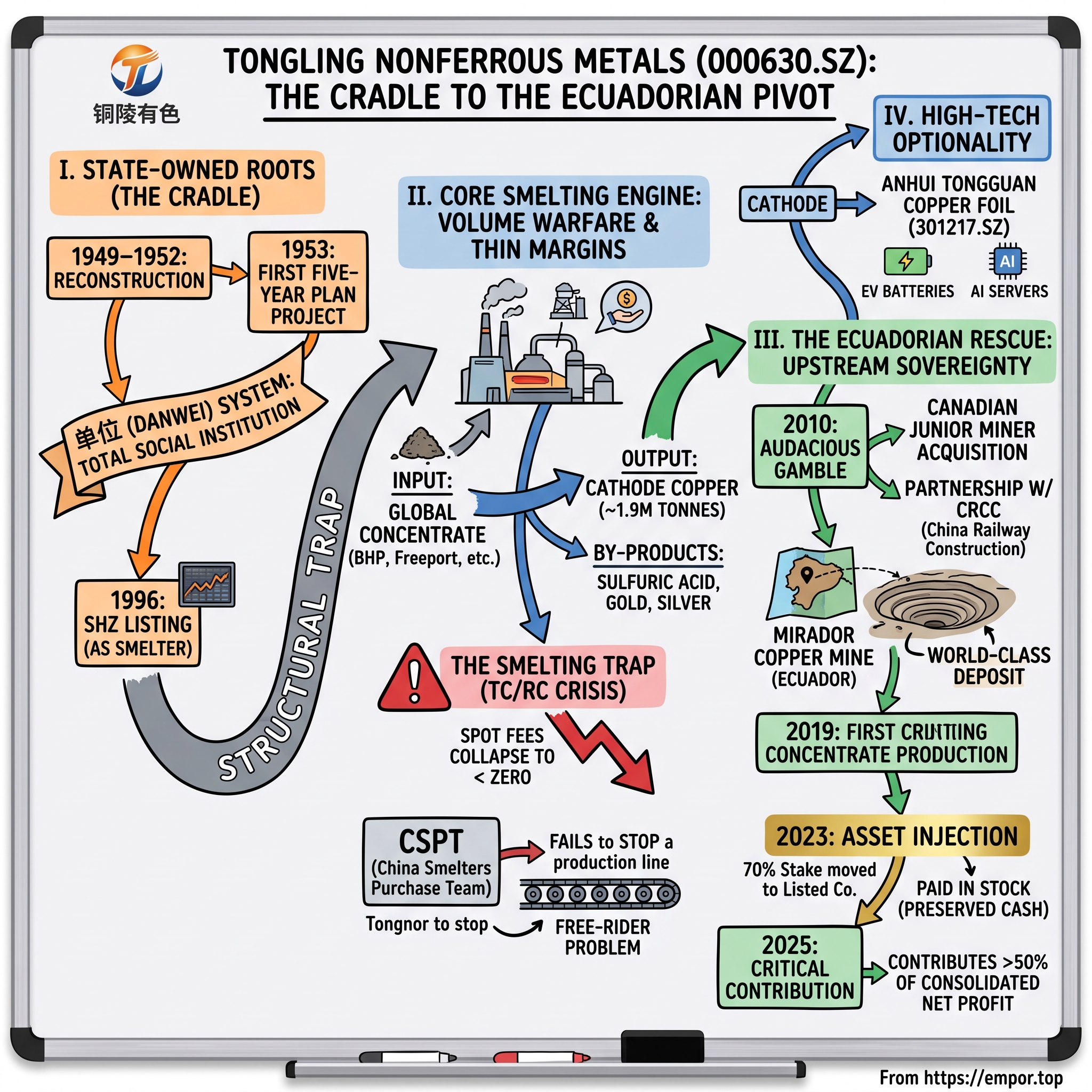
铜陵有色 Tongling Nonferrous Metals: The Cradle of China's Copper Industry and the Ecuadorian Pivot
I. Introduction & Episode Roadmap
Picture a spreadsheet that would make any capital allocator do a double-take. At the top sits a number so large it reads like a national statistic: roughly 172.7 billion RMB of revenue in 2025 — call it 24 billion US dollars, more than the annual GDP of Iceland. Then your eye travels down the page, past cost of goods sold, past a dense thicket of processing and financing lines, until it lands, finally, on the bottom line. Net profit attributable to shareholders: about 2.415 billion RMB.1 That is a net margin of roughly 1.4 percent. For every hundred yuan of copper, acid, gold, and silver that moves through the machine, a little over one yuan sticks.
This is the central paradox of 铜陵有色金属集团股份有限公司 Tongling Nonferrous Metals Group Co., Ltd. (000630.SZ, listed on the Shenzhen Stock Exchange, SHZ). It is one of the largest copper enterprises on Earth by tonnage and revenue, and one of the thinnest by profit. To understand why is to understand a structural condition that afflicts nearly all of Chinese heavy industry — a condition we'll call the Smelting Trap.
Here is the trap in one sentence: China built the most dominant copper refining complex the world has ever seen, and in doing so made itself utterly dependent on the foreign miners who dig the ore out of the ground. Refining copper — turning muddy concentrate into gleaming 99.99 percent cathode — is a service business. You take someone else's rock, you charge them a fee to purify it, and you live and die by that fee. When the miners have the leverage, the fee collapses, and the smelter, for all its scale, has almost no defense. In 2024 and 2025 that fee didn't just collapse; it went negative. Smelters found themselves in the surreal position of paying miners for the privilege of processing their ore.6
So how does a company earn 2.4 billion RMB when its core business is structurally underwater? The answer sits nine thousand kilometers away, in a remote fold of the Ecuadorian Andes: the 米拉多铜矿 Mirador Copper Mine, a world-class open-pit deposit that Tongling controls through a 70 percent stake in 中铁建铜冠投资有限公司 CRCC-Tongguan Investment Co., Ltd. (中铁建铜冠 CRCC-Tongguan). Mirador is the mine — the thing that actually earns money. In 2025 the CRCC-Tongguan joint venture generated around 1.862 billion RMB in net profit, and Tongling's 70 percent slice of that, roughly 1.303 billion RMB, accounted for more than half of the listed company's entire consolidated bottom line.1 One asset, a fraction of the top line, carrying the majority of the profit. The dog is the smelter; Mirador is the tail, and the tail is wagging the dog.
This episode is the story of how a company got itself into the Smelting Trap, and how — with a nine-year, billion-dollar detour through the Amazonian jungle — it clawed part of the way out. We'll trace the arc: the post-1949 reconstruction roots in Anhui's ancient copper country; the decades of building enormous, low-margin domestic refineries during China's infrastructure supercycle; the audacious 2010 gamble to buy a Canadian junior miner and its Ecuadorian prize; the 2023 financial engineering that finally moved that prize onto the listed company's books; and the raw-material squeeze of 2024–2026 that has made upstream control the only game that matters. Along the way we'll meet a new management team, an unusual arbitration win, a high-tech copper-foil spin-off, and a set of questions every long-term investor in this name has to answer.
A word on posture before we begin. This is not a company that markets itself the way a consumer brand or a Silicon Valley darling does; it is a state-controlled industrial enterprise whose disclosures are written in the measured, output-focused language of the Chinese state sector. That makes it all the more important to read it independently — to separate what management asserts from what the evidence proves, to weigh the incentives of the people making the decisions, and to test the bull case against the ways it could plausibly break. The copper business rewards patience and punishes wishful thinking in roughly equal measure, and Tongling is a textbook case of both. So let's start where the copper started — in the ground beneath Tongling, three thousand years ago.
 Subscribe on LinkedIn
II. The Cradle of Chinese Copper: State-Owned Roots
Long before there was a stock ticker, there was the smell of charcoal and molten metal drifting over the hills of Tongling in Anhui Province. This stretch of the lower Yangtze has been mining and smelting copper for something like three thousand years — bronze ritual vessels cast here helped define the material culture of the Shang and Zhou dynasties, and the Tang and Song courts drew coinage metal from these same seams. When Chinese historians later called Tongling the "ancient copper capital," they were not indulging in marketing. The city's very name, 铜陵, means "copper hill."
That deep history matters less for its romance than for what it left behind: a region whose entire identity, labor force, and infrastructure were organized around one metal. So when the Chinese civil war ended and the new government turned to the grinding work of reconstruction, Tongling was an obvious place to rebuild. Formal reconstruction of the mines began in 1949, and organized production resumed in 1952 — the first copper base of the People's Republic rising from the wreckage of the war economy.
A pillar of the First Five-Year Plan
The decisive moment came a few years later. Under China's 第一个五年计划 First Five-Year Plan (1953–1957), the state — with heavy Soviet technical assistance — designated 156 flagship industrial projects that would form the skeleton of a modern economy. Steel, coal, machine tools, power generation, and, crucially, nonferrous metals. Tongling's copper complex was folded into this program, and the phrase that would follow the company for the next seventy years was born: the Cradle of China's Copper Industry. It was here that New China smelted its first electrolytic copper, drew its first copper wire, and trained a generation of metallurgists who would fan out to build the rest of the country's copper base.
To be designated a Five-Year Plan pillar was not merely an honor; it was a form of destiny. It meant the enterprise existed to serve national output targets, not shareholder returns — a distinction that still shapes the company's behavior today and that we'll return to repeatedly. In this world, tonnage was the product and self-sufficiency was the mission. Success was measured not in return on invested capital but in tonnes of electrolytic copper delivered to the grid, the arsenal, and the machine-tool plants of a country trying to industrialize a generation in a decade. The engineers who ran the place were heroes of production, and the yardstick they were judged by — how much copper, how reliably, how cheaply for the state — is essentially the same yardstick their successors are judged by today. That is a remarkable institutional continuity, and it is the hidden reason the company behaves the way it does in a capital market that expects something quite different.
The danwei and the long transition
For decades Tongling operated the way every major Chinese state-owned enterprise (SOE) did: as a 单位 danwei, a total social institution. The company didn't just employ workers; it housed them, schooled their children, staffed the hospital where they were born and the clinic where they retired, ran the canteen, and organized the sports teams. The mine and the town were, functionally, the same organism. This is essential context for the modern investment case, because the social obligations baked into an SOE's DNA — keep the plant running, keep the workers employed, keep the province's industrial statistics healthy — don't vanish when the enterprise lists on a stock exchange. They become a permanent, quiet weight on the scale whenever management contemplates shutting capacity.
Through the 1990s, as China dismantled the planned economy piece by piece, Tongling made the long transition from a local mining bureau into a corporatized industrial group. The listed vehicle arrived in 1996, when the reorganized business went public on the Shenzhen Stock Exchange as Anhui Tongdu Copper Co., Ltd. under the code 000630.SZ; the company was renamed Tongling Nonferrous Metals Group Co., Ltd. in 2007, adopting the identity it carries today.
But here is the detail that defines everything downstream: the vehicle that went public was, in its bones, a smelter. The listed company's center of gravity was refining and processing capacity — the furnaces, the electrolytic tank houses, the acid plants — not orebodies. China's copper geology is, frankly, mediocre; the country holds only a modest share of global reserves, and what it has tends to be low-grade and deep. So the enterprise that Chinese industrial policy needed Tongling to be was one that could take the world's copper concentrate and turn it into the wire and tube that built the country. It became a champion at the middle of the value chain and a permanent tenant at the mercy of the top. To see why that's such a precarious place to stand, we have to understand the economics of the furnace itself.
III. The Core Smelting Engine: Paper-Thin Margins and Volume Warfare
Walk into one of Tongling's flagship smelters — the ultra-modern 金隆 Jinlong or 金冠 Jinguan complexes near the Yangtze — and the first thing that hits you is the scale. Rivers of molten metal, tank houses stretching the length of several football fields, gantry cranes moving cathode sheets the size of doors. It looks, unmistakably, like power. Enormous, humming, industrial power. And yet the economics of what happens inside are closer to those of a toll booth than a gold mine.
The toll-booth business model
Here's the mechanic, in plain terms. The copper that arrives at the gate isn't metal — it's concentrate, a grey-brown powder that's only about 20 to 30 percent copper, the rest a jumble of sulfur, iron, and trace elements. The smelter's job is to bake, blow, and electro-refine that powder into cathode copper that is 99.99 percent pure. For performing this transformation, the smelter charges the miner a fee, split into two parts: the Treatment Charge (TC), a per-tonne fee on the concentrate, and the Refining Charge (RC), a per-pound fee on the contained copper. Together, TC/RCs are the smelter's real revenue. The copper itself largely passes through — the smelter buys concentrate at a price linked to the copper market and sells cathode at a price linked to the copper market, so the metal price mostly washes out. What the smelter actually earns is that processing fee, plus whatever value it can wring out of the by-products.
Think of it as a laundromat for metal. The customer brings dirty clothes; you charge a fee to wash them; you don't get to keep the clothes. If a hundred laundromats open on the same street and there's a shortage of dirty laundry, the price of a wash cycle craters — and that, in miniature, is the entire drama of the Chinese copper industry over the past two years.
There is one more subtlety worth internalizing, because it's where the smelter can add value beyond the toll. Concentrate is not pure copper; it's a cocktail. Buried in that grey powder alongside the copper are grams of gold, silver, and a periodic table of minor metals, plus a lot of sulfur. A modern smelter is really an extraction machine that pulls all of these out — the copper into cathode, the sulfur into acid, the precious metals into a residue. So while the headline business is the toll on copper, a well-run smelter earns a second, quieter income from everything else it liberates. Hold that thought; it becomes the difference between life and death when the toll itself disappears.
Riding the infrastructure supercycle
For a long stretch, though, the toll-booth business was a wonderful place to be. Through the 2000s and 2010s, China poured concrete and strung power lines at a pace no economy had ever attempted. Every apartment tower, high-speed rail line, air conditioner, and kilometer of electrical grid demanded copper, and the country's appetite seemed bottomless. China went from a bit player in refined copper to producing roughly half the world's supply, and the smelters that fed that demand rode a decade-long wave. Tongling met that demand the only way it knew how: by building furnaces, and building more furnaces. By 2025 the company's cathode copper output reached roughly 1.9548 million tonnes — nearly two million tonnes of refined copper in a single year — placing it among the largest copper refiners on the planet, with a stated 2026 target of around 2.108 million tonnes.2 When concentrate was plentiful and smelting capacity relatively scarce, TC/RCs sat comfortably in the range of $70 to $80 per tonne, and running two million tonnes of throughput through efficient modern furnaces was a genuinely profitable enterprise.
The Jinlong and Jinguan complexes that anchor this output are not the sooty, Dickensian smelters of the industrial imagination. They are among the most technologically advanced copper plants in the world, using flash-smelting and oxygen-enrichment technology that Tongling licensed, adapted, and in some respects improved upon — the company has been a genuine leader in raising smelting recovery rates and cutting energy per tonne. This is the paradox of Chinese heavy industry in one plant: world-class engineering deployed in a structurally poor business. Being brilliant at something that isn't worth much is its own kind of tragedy, and it's the tragedy that has defined Tongling's core for a generation.
The structural weakness hiding in plain sight
But scale at the furnace masked a fragility at the mine. For all its refining might, Tongling's own domestic mines are modest. The deep-well 冬瓜山铜矿 Dongguashan Copper Mine, one of the country's deepest at over a kilometer down, yields on the order of 30,000 tonnes of copper a year; the more modern 沙溪铜矿 Shaxi Copper Mine adds more; but the listed company's domestic mined-copper output has historically totaled only around 50,000 tonnes annually. Set that against nearly two million tonnes of refining capacity and the arithmetic is brutal: Tongling has historically mined only a low-single-digit-to-low-double-digit percentage of the copper it refines. The rest — the overwhelming majority — must be bought as concentrate on the global market, from BHP, from Freeport-McMoRan, from Chile's state miner Codelco. Note the convention here: those are Western and Latin American companies with their own Latin-script names, so they stay as they are; we don't dress them in characters they never wore.
The strategic implication is stark. Mining is where the fat margins live, because an orebody is a cornered resource that no competitor can replicate. Smelting is a service, and services with low switching costs and abundant capacity have no pricing power. Tongling had spent decades maximizing the low-margin half of the equation.
The CSPT: strength in numbers, in theory
The industry's response to this imbalance was collective bargaining. In the mid-2000s, China's leading smelters banded together to form the 中国铜原料联合谈判小组 China Smelters Purchase Team (CSPT) — a cartel-like buying club whose members, including Tongling alongside 江西铜业 Jiangxi Copper and 金川集团 Jinchuan Group, would pool their purchasing volume to negotiate annual benchmark TC/RCs with the global miners and set floor prices for spot purchases. The logic was sound: if the miners were an oligopoly, the smelters would answer with an oligopsony. The CSPT would meet quarterly, agree on a floor TC/RC below which no member would buy concentrate, and present a united front to BHP, Freeport, and the rest — a genuinely clever institutional answer to a structural weakness.
For years it worked well enough, and in the fat years the benchmark negotiation was a ritual the whole global copper trade watched. But a buyers' club only has power when its members are willing to walk away from a bad deal — to actually stop buying, and therefore stop producing. A floor price is only a floor if someone will refuse to go beneath it. Keep that condition in mind, because when the real crisis arrived, it was precisely that willingness that failed to materialize. The very SOE incentives that built these smelters — produce, employ, hit the provincial output target — turned out to be incompatible with the discipline the cartel required. A buyers' club whose members physically cannot stop buying is not a cartel; it is a suggestion.
IV. The "Smelting Trap" Explodes: The 2024–2026 TC/RC Crisis
Every trap needs a trigger, and this one snapped shut in late 2023 in a place called Cobre Panamá.
The perfect storm
First Quantum Minerals' Cobre Panamá was one of the largest new copper mines in the world, a source of roughly 400,000 tonnes of copper a year — a meaningful chunk of globally traded concentrate. In late 2023, after a public backlash and a Supreme Court ruling in Panama, the mine was abruptly ordered shut. Overnight, a river of concentrate vanished from the market. Layer onto that shock the slow-motion problems the industry had been ignoring: falling ore grades at aging Chilean mines, chronic delays in bringing new projects online, and — the accelerant — a wave of new Chinese smelting capacity coming on stream at exactly the wrong moment. More furnaces, chasing less ore.
The result was the most violent inversion the copper industry had ever seen. Spot TC/RCs, which had spent years around $70–$80 per tonne, went into free-fall through 2024, punched through zero, and kept going into negative territory.6 By the time smelters and miners sat down to negotiate 2026 terms, the Chilean miner Antofagasta had agreed a benchmark treatment charge of zero with a Chinese smelter — a number that, a few years earlier, would have been unthinkable.11 Negative TC/RCs mean exactly what they sound like: to keep their furnaces fed and their fixed costs covered, smelters were effectively paying miners to take their concentrate off their hands. The laundromat was now paying customers to bring in laundry.
To feel why this is so ruinous, sit for a moment with the smelter's cost structure. A two-million-tonne copper refinery is a mountain of fixed cost — the furnaces, the tank houses, the workforce, the depreciation, the environmental systems all cost roughly the same whether the plant runs at full tilt or half. The processing fee was supposed to cover all of that and leave a margin. When the fee goes to zero or below, every one of those fixed costs still has to be paid, but the revenue line that was meant to pay them has vanished. The rational short-term response — run harder, to spread the fixed cost over more tonnes and squeeze more by-product out — is exactly the collectively self-destructive behavior that keeps the fee crushed. It is a beautifully vicious trap, and it explains why smelters kept expanding output straight into the teeth of the worst margins in the industry's history.
Tongling itself was not immune to the pressure to flinch. At the depths of the squeeze the company signaled it would trim output — reports in the period pointed to plans to cut copper production on the order of 20 to 30 percent at affected operations to avoid processing concentrate at a loss.14 Whether such cuts fully materialized at the group level is precisely the open question the sector-wide data casts doubt on. The gap between what a smelter says about discipline in a press release and what the aggregate output statistics later reveal is, for the analyst, one of the more revealing tells in this industry.
The toothless cut
Faced with an existential squeeze, the CSPT did what cartels do — it announced a cut. In late 2025, China's major copper smelters publicly committed to reduce refined copper output by more than 10 percent in 2026, a coordinated retreat meant to starve the miners of demand and force TC/RCs back up.7 It was a bold, headline-grabbing pledge. It also, in the event, largely failed to translate into actual tonnes.
Why? The free-rider problem — the same flaw that has undone commodity cartels for a century. Each individual smelter has every incentive to let everyone else cut while it keeps running flat out, capturing market share and spreading its fixed costs over more tonnes. And Chinese smelters face a pressure sharper than pure economics: they are, in large part, SOEs, and behind each one stands a provincial government that wants the plant running, the workers paid, the local GDP intact, and the fixed depreciation absorbed. The reasons Tongling was built — output, employment, self-sufficiency — are the exact reasons it is loath to idle a furnace. So the cut evaporated. According to China's own statistics, refined copper output actually grew by around 7.4 percent year-on-year in early 2026, and rival smelters like Jiangxi Copper and Yunnan Copper quietly raised their 2026 production guidance rather than lowering it.[^8] The commitment to discipline collided with the structural imperative to produce, and the imperative won. For an investor, this is the single most important behavioral fact about the sector: its participants cannot credibly commit to restraint, which means the cure for negative TC/RCs will have to come from the supply side — new mines — not from smelter solidarity.
By-product salvation
So how does a company keep the lights on when its main product line is bleeding? The answer, in Tongling's case, is chemistry. Copper concentrate is loaded with sulfur, and when you roast it, that sulfur becomes sulfur dioxide — which a modern smelter captures and converts into sulfuric acid, the workhorse chemical of fertilizer and industrial production. In 2025 Tongling produced roughly 6.2185 million tonnes of sulfuric acid, an enormous by-product stream that turns an environmental liability into a revenue line.2 Even more valuable are the trace metals that ride along with copper into the electrolytic tank house and settle at the bottom as anode slime — a black sludge so rich it is essentially a secondary ore. From that slime Tongling recovered about 20.51 tonnes of gold and 579.55 tonnes of silver in 2025.2 To put that in perspective, twenty tonnes of gold is the annual output of a respectable mid-sized gold mine, produced here as a by-product of copper refining. At the elevated gold and silver prices of the mid-2020s, that precious-metals stream is not a rounding error; it is a material part of what keeps the smelting segment's head above water when the processing fee itself has gone negative. In effect, Tongling runs a substantial gold-and-silver business hidden inside a copper refinery, and in a year of negative TC/RCs that hidden business is doing a great deal of the load-bearing.
This is the deeper reason the largest smelters have survived a squeeze that should, on paper, have bankrupted them: the more sophisticated the plant, the more value it extracts from everything that isn't copper, and the longer it can endure a zero-fee world. It is a genuine competitive advantage — but a defensive one. By-product recovery lets you survive the trap; it does not let you escape it. And surviving is not the same as thriving — to actually thrive, Tongling needed to own a mine. A real one.
V. The Billion-Dollar Ecuadorian Gamble: Acquiring Corriente Resources
Around the turn of the 2010s, a strategic anxiety hardened into official doctrine in Beijing. The country had built the world's manufacturing engine, but that engine ran on raw materials it did not control — iron ore from Australia, oil from the Gulf, and copper concentrate from a handful of Western mining majors. In a tense geopolitical scenario, those supply lines were leverage held by others. The mandate that emerged — call it upstream sovereignty — was simple: Chinese enterprises should go out and own the resources their factories depended on. 走出去 going out became the watchword of a generation of state-backed deals.
An unlikely pairing and a Canadian target
For copper, one of the most consequential of those deals was assembled not by Tongling alone, but by an odd couple. On one side, the Tongling parent group — Tongling Nonferrous Metals Group Holding Co., Ltd. — which had the metallurgical expertise but limited experience building anything in a foreign jungle. On the other, 中国铁建股份有限公司 China Railway Construction Corporation (中国铁建 CRCC), one of the state's colossal engineering and construction champions, a company that built railways across mountains and could pour concrete anywhere on Earth but knew little about copper. Together they formed a 50/50 joint venture, 中铁建铜冠 CRCC-Tongguan: the miner's knowledge of the metal wedded to the builder's knowledge of megaprojects.
Their target was a Canadian-listed junior called Corriente Resources, whose value lay entirely in what it held in Ecuador. In late 2009 the venture struck a definitive agreement, and in early 2010 it launched a cash take-over bid at C$8.60 per share — valuing Corriente at approximately C$679 million.5 The acquisition closed on May 31, 2010, with financing help from Chinese state banks including a large syndicated loan anchored by China Development Bank — the machinery of state capital doing exactly what it was designed to do.13 A small Vancouver junior had just become the vehicle through which China would plant its flag in the Andes.
The prize in the jungle
The prize was Mirador, in the province of Zamora Chinchipe in southeastern Ecuador — a classic porphyry copper deposit, the kind of large, relatively low-grade orebody that rewards enormous open-pit scale. The measured and indicated resource is on the order of 1.257 billion tonnes of ore at an average copper grade of about 0.48 percent, translating to roughly 6 million tonnes of contained copper.3 By any measure, a world-class asset. But it sat in one of the most challenging places imaginable to build a mine: remote, mountainous, drenched in rainfall, at the headwaters of the Amazon basin, in an ecologically sensitive region far from any existing industrial infrastructure. There was no precedent — Ecuador had never hosted a large-scale open-pit copper mine before. Mirador would be the first.
The long, painful build
What followed was a nine-year grind. Construction began in 2012, and by the time the mine poured its first copper concentrate in 2019, the partners had sunk on the order of $1.4 billion into the ground.13 That capital bought a piece of frontier industrial engineering: a concentrator plant carved into the hillside, tailings storage dams engineered to hold back mining waste in a high-rainfall seismic zone, and a slurry pipeline system to move concentrate down out of the mountains. Every tonne of equipment had to be hauled up switchback roads; every specification had to satisfy an environmental regime the operators were, in many respects, learning as they went.
Trial by fire: the ESG reckoning
And then there was the resistance — the part of the Mirador story that no engineering budget could line-item away. The region is home to Indigenous Shuar communities, and Mirador became a flashpoint for a prolonged, bitter conflict over land, water, and consent. There were protests and legal blockades in 2012, and the fight escalated over the following decade; in 2022 an Ecuadorian court weighed claims that the project had violated Indigenous rights, and environmental organizations including international watchdogs documented allegations of forced displacement, deforestation, and water contamination downstream of the tailings works.[^9] A Chinese SOE consortium, accustomed to operating in a domestic environment where the state could clear obstacles, found itself having to learn Western-style community consultation, environmental litigation, and reputational management on the fly — often clumsily, sometimes under international scrutiny.
For an investor, the ESG history is not a footnote; it is a live, recurring operational risk — and not a hypothetical one. Mirador has seen its production disrupted and then restored during its operating life, a reminder that the mine's cash flows are contingent on a social license that has to be renewed continuously rather than won once.15 Community opposition and legal challenges have interrupted the mine before and can do so again, and they hang over the planned expansion. There is a deeper structural point here, too: Mirador sits at the headwaters of the Amazon, in a country where mining is politically contested at the national level, which means the risk is not merely a dispute with one village but a fault line that runs through Ecuadorian electoral politics itself. A single adverse court ruling or a populist turn in Quito could do what no operational problem could.
The lesson of the acquisition years is that resource sovereignty is not bought with a tender offer alone — it is paid for, continuously, in the currency of political and social conflict. The Chinese state and its enterprises learned, at Mirador, that the "going out" strategy exports not just capital but exposure: to foreign courts, foreign electorates, and international NGOs whose leverage over a state-owned Chinese consortium is far greater in Zamora Chinchipe than it would ever be in Anhui. Which raises an obvious question: if Mirador was so risky and so slow to build, why did shareholders of the listed company end up owning it at all? For the first nine years, they didn't — and that turns out to be the cleverest part of the whole story.
VI. The Great Restructuring: Injecting the Crown Jewel
Here is a puzzle that would have nagged any sharp-eyed shareholder of 000630.SZ in, say, 2018: the company whose stock they owned was a smelter, structurally trapped, earning razor-thin margins — and yet the parent group that controlled it was quietly building a world-class copper mine in Ecuador. Why wasn't the great asset inside the listed company? Why were public shareholders exposed to all the pain of the Smelting Trap and none of the upside of the mine?
The parent-subsidiary firewall
The answer was deliberate, and, in hindsight, elegant. The parent group held Mirador during its most dangerous years — the nine-year, $1.4-billion, jungle-building, protest-plagued pre-production phase — precisely so that the listed company would not have to. Public shareholders were shielded from a decade of geological uncertainty, construction overruns, community blockades, and the risk that Ecuador's politics might blow the whole thing up before it produced a single tonne. The parent, backed by the deep balance sheet of the state, absorbed that risk. The firewall between parent and listed subsidiary functioned as a giant, patient incubator. Only once the mine was de-risked — built, permitted, ramped up, and generating cash — would it be worth moving across the wall.
The 2023 asset injection
That moment arrived in 2023. With Mirador operating and cash-generative, Tongling Nonferrous (the listed company) agreed to acquire the parent's 70 percent stake in CRCC-Tongguan for approximately 6.673 billion RMB, a transaction that valued the joint venture at around 9.53 billion RMB and was formally approved through mid-2023.34 The structure of the payment is where the financial engineering gets interesting, and it tells you a great deal about how a cash-constrained SOE thinks about preserving liquidity.
Rather than draining its balance sheet, Tongling paid overwhelmingly in paper. Roughly 85 percent of the price — about 5.67 billion RMB — was settled in newly issued shares priced at 2.65 RMB each. Another 5 percent, about 334 million RMB, came in the form of convertible bonds. And only the final 10 percent, roughly 667 million RMB, was paid in actual cash.3 The company acquired a controlling stake in a world-class mine while parting with less than 700 million RMB of hard money. For a business perpetually short of high-margin cash flow, that structure was the difference between a transformative deal and an unaffordable one.
There's a subtle elegance to paying in stock here that's worth spelling out. Because the parent group was already the controlling shareholder, issuing new shares to the parent in exchange for the mine didn't dilute the parent's control — it simply converted the parent's ownership of Mirador into a larger ownership of the whole listed company. The parent came out the other side holding more of Tongling, and Tongling came out holding the mine, all without a bank loan or a rights issue that would have hit minority holders in the pocket. It is the kind of intra-group asset shuffle that Chinese SOE conglomerates have refined into an art form: use the listed vehicle as the permanent home for de-risked, cash-generative assets, and use paper rather than cash to move them there.
Was the price fair?
Now, the skeptic's question: injecting a parent's asset into a listed subsidiary is a related-party transaction, the kind of deal where minority shareholders often get quietly fleeced as the parent marks up the price. Was this one fair? The available evidence suggests it was, unusually, priced for the minorities rather than against them. On the numbers implied by the deal, the stake was acquired at roughly 3.6 times EV/EBITDA and around 5 times forward earnings — a steep discount to the 8-to-10-times EV/EBITDA multiples at which global mining peers typically trade. Rather than extracting maximum value, the parent injected a crown-jewel asset at a mining-cycle-trough valuation, making the transaction highly accretive to the listed company. Whether that reflects genuine alignment or simply a state parent executing a policy objective — consolidating strategic copper assets into a public champion — is a judgment call. Either way, the arithmetic favored the public shareholders.
The immediate payoff, and an arbitration coup
The payoff was swift and, frankly, dramatic. In 2025 CRCC-Tongguan generated approximately 1.862 billion RMB of net profit, and Tongling's 70 percent share — about 1.303 billion RMB — accounted for more than half of the listed company's total consolidated net profit of roughly 2.415 billion RMB.1 Recall the paradox we opened with: a smelter earning almost nothing on 172 billion RMB of revenue. The 2023 restructuring is the resolution of that paradox. The mine now carries the company, and without it the 2025 result would have been a shadow of itself. This is the single cleanest illustration in the whole story of why upstream ownership matters — the same copper business, but one end of it earns real money and the other barely breaks even.
There was a bonus, too. In the tangle of legacy agreements attached to Mirador sat a 1 percent Net Smelter Return (NSR) royalty — an obligation to hand over one percent of the mine's revenue to a prior royalty holder, in perpetuity. NSR royalties are insidious precisely because they are levied on the top line, not on profit: the mine owes them whether it makes money or not, and over the multi-decade life of a large orebody they compound into an enormous sum. CRCC-Tongguan contested the obligation and won an international arbitration that exempted the mine from the royalty, permanently lifting that drag on free cash flow. A 1 percent revenue royalty on a mine that could produce hundreds of thousands of tonnes of copper a year for decades is worth a great deal in present-value terms; eliminating it was a quiet, high-return legal victory that rarely makes headlines but meaningfully improves the asset's lifetime economics.
Taken together, the 2023 restructuring and the arbitration win transformed the listed company's earnings profile in the space of two years — from a pure smelter fully exposed to the coming TC/RC storm into a hybrid whose profits are now anchored by a discounted, royalty-free stake in a world-class mine. It is, on the evidence, the best capital-allocation decision in the company's modern history. With the crown jewel now on the books and paying off, attention turned to the people who would have to steward it through its next, trickier chapter.
VII. The Ding-Wen Era: Current Management, Ownership, & Capital Allocation
Leadership transitions at Chinese SOEs rarely arrive with the drama of a Silicon Valley founder ouster. They tend to unfold as orderly, choreographed handovers, announced in the flat prose of a stock-exchange filing. So it was in the autumn of 2025, when Tongling disclosed that its long-serving chairman had reached retirement age and would step down, and that a new leadership generation would take the helm.8
The engineers in charge
Chairman 丁士启 Ding Shiqi, born in 1966, is a lifer of the classic SOE mold — an engineering PhD carrying the title of "professor-level senior engineer," who spent roughly three decades climbing through the group's operating divisions, including stints running its mining and copper-foil businesses. He is a metals man, not a financier, and his résumé signals continuity: someone who knows the furnaces and the orebodies from the inside rather than an outsider brought in to shake things up.
Alongside him, General Manager 文燕 Wen Yan, born in 1971, brings a metallurgy background from 中南大学 Central South University — the country's premier training ground for nonferrous-metals engineers — and rose by running the operational heart of the company, the Jinlong and Jinguan smelters that we met earlier. When Tongling's board was reconstituted in the shareholder vote of May 2026, Wen Yan drew the highest approval of any director at 98.97 percent, with Ding Shiqi close behind at 98.71 percent — the kind of near-unanimous tallies that are routine at controlled SOEs but that nonetheless confirmed the new team's mandate.9 Two engineers, deeply steeped in the company's core operations, now run it. That is reassuring for operational competence and, arguably, less so for the kind of aggressive capital-markets creativity the next chapter may demand.
SOE governance: what actually motivates the people at the top
Here the neutral investor has to be clear-eyed about incentives, because they differ profoundly from what a Western shareholder might assume. Executive shareholding at Tongling is negligible — management does not get rich if the stock triples, and does not get wiped out if it halves. There are no meaningful stock options tethering their fortunes to the share price. Instead, the people running Tongling are evaluated by provincial state-asset authorities (the local 国资委 SASAC) against a scorecard that prizes operational stability, workplace safety, resource self-sufficiency targets, and energy-intensity and emissions reductions — the metrics of a national industrial champion, not a return-maximizing enterprise.
This is not a criticism so much as a diagnosis, and it cuts both ways. On the positive side, it produces genuine long-term consistency: Tongling has pursued upstream resource security patiently for fifteen years, through cycles that would have made a quarterly-earnings-driven company flinch. The Mirador saga — a decade of patient risk-warehousing followed by a shareholder-friendly injection — is exactly the kind of move that a management team obsessed with the next quarter's EPS would never have had the stomach to see through. On the negative side, it means capital agility is not what management is optimized for. Do not expect bold buybacks, opportunistic divestitures, or a willingness to shutter a loss-making furnace ahead of the province's blessing. When we discussed the free-rider problem in the smelting cartel, this incentive structure was the deep cause: management is rewarded for keeping output up, not for maximizing per-tonne profit.
For the neutral investor, the practical takeaway is to read management's statements through this lens. When Tongling's leadership talks about "high-quality development," "resource security," and "green transformation," it is speaking the genuine language of its incentive scorecard, not a euphemism for shareholder returns. Those goals may align with shareholder value — resource security certainly has — but the alignment is a happy coincidence of national and investor interest, not a governance guarantee. The moment the two diverge, the scorecard, not the share price, will win. That is neither good nor bad in the abstract; it is simply the operating system, and pricing the stock without understanding it is a mistake.
The first real test: Mirador Phase II
Every new team gets an early exam, and the Ding-Wen team's is already on the table: Mirador Phase II. The plan is to roughly double the mine's ore-processing capacity, dramatically lifting copper output and pushing Tongling's overall self-sufficiency toward levels that would materially loosen the Smelting Trap. But the expansion depends on securing an updated mining contract with the Ecuadorian government, and that negotiation has run into the country's chronic political instability and slow-grinding administrative processes. Company disclosures have acknowledged that the Phase II mining contract signing has faced delays, putting the previously envisioned expansion timeline at risk even as the physical construction work advances.12 How management communicates this — whether with concrete milestones or with the vague reassurance that so often substitutes for candor at SOEs — is itself a test of credibility that public-market investors should watch closely. The upside optionality of Mirador Phase II is real; so is the sovereign risk attached to it, and the two are now the pivot of the entire equity story. But copper cathode and Ecuadorian ore are not the only cards Tongling holds. There is also a small, high-tech bet buried in the group that deserves its own look.
VIII. High-Tech Optionality: Anhui Tongguan Copper Foil (301217.SZ)
Not everything about Tongling is measured in millions of tonnes. Some of it is measured in microns — and to understand why that matters, imagine trying to manufacture a sheet of metal so thin that a stack of a thousand of them would be about as thick as a fingernail, wide enough to roll off a machine in a continuous kilometers-long ribbon, and flawless enough that a single pinhole ruins it. That is the copper-foil business, and it represents the company's most credible attempt to escape the commodity trap by climbing the value chain into something that actually rewards engineering skill.
From cathode to foil
In 2022 the group carved out and listed 安徽铜冠铜箔集团股份有限公司 Anhui Tongguan Copper Foil Group Co., Ltd. (铜冠铜箔 Tongguan Copper Foil) on the Shenzhen Stock Exchange's ChiNext growth board under the code 301217.SZ, retaining majority control while giving the foil business its own currency and public profile.10 The strategic logic is to take the cathode copper that the group already produces and transform it into something with real differentiation and margin — electronic copper foil.
Why a sheet of copper can be high-tech
It sounds almost too simple: copper foil is just copper, rolled or electro-deposited very, very thin. But the thinner and more uniform you can make it — and Tongguan produces foils down to around 4.5 microns, roughly a tenth the thickness of a human hair — the more valuable and technically demanding it becomes. Two applications drive the business. The first is the anode current collector in lithium-ion batteries: every EV battery cell needs an ultra-thin, flawless copper foil, and shaving microns off its thickness directly improves the battery's energy density, which is why battery makers prize the thinnest reliable foil they can get. The second is high-frequency copper-clad laminate for advanced printed circuit boards — the substrates beneath 5G base stations and the AI server accelerators now in furious demand. In both cases the foil sits at a genuine technological frontier, and its buyers care about quality and consistency, not just price.
Sizing the materiality — honestly
It would be easy to let the AI-and-EV buzzwords inflate this segment's importance, so here is the neutral read. Copper foil is still, at bottom, a processing business with moderate margins, not the gusher of free cash flow that the Mirador mine has become. It has suffered its own bout of overcapacity and price pressure as Chinese producers raced to add foil lines for the battery boom, and its profitability has been volatile. The honest framing is that Tongguan Copper Foil is an option, not an engine — a strategically sensible, technically legitimate call on China's EV and AI supply chains that could become material if it wins share in the premium, high-margin foil grades, but that today does not move the group's consolidated numbers the way one Ecuadorian open pit does. For investors, it belongs in the "optionality" column: worth watching, not worth underwriting the thesis on. With the pieces of the business now on the table — the trapped smelter, the rescuing mine, the high-tech option — we can finally war-game the whole thing.
IX. Strategic Playbook & Competitive Landscape
Strip away the history and the geography, and the investment question reduces to a single one: does Tongling actually have a durable competitive advantage, or is it a price-taking commodity processor with one good asset bolted on? To answer it properly, we'll run the business through two classic strategy lenses and then hold it up against its most instructive peers.
Hamilton Helmer's 7 Powers
Helmer's framework asks which of seven structural "powers" a company genuinely possesses. For Tongling, the honest scorecard is mixed.
Cornered Resource — Strong, but singular. The Mirador mine is the real thing: a large, low-cost, long-life orebody that cannot be conjured up by a competitor with capital alone. Orebodies are the textbook cornered resource, and Mirador is Tongling's. The caveat is concentration — the company's cornered-resource power rests overwhelmingly on one asset in one politically volatile country, which makes the power potent but fragile.
Scale Economies — Moderate, and pointed the wrong way. At nearly two million tonnes of refining capacity, Tongling enjoys real unit-cost advantages in smelting; big modern furnaces process copper more cheaply per tonne than small ones. But scale in a service business you don't control the inputs to buys efficiency, not pricing power. Being the world's most efficient laundromat is worth nothing when there's no laundry to wash. Tongling's smelting scale lowers its costs but gives it zero leverage over the miners who set its revenue.
Switching Costs and Brand — Weak to nonexistent. Refined copper is a globally fungible commodity traded to a purity standard. A cathode is a cathode; buyers switch on price. There is no brand premium, no lock-in, no proprietary formulation. The one nuance is the copper-foil business, where quality qualification with battery and PCB customers creates modest switching costs — but that's a small slice of the group.
The verdict from Helmer is that Tongling's durable edge is asset-based (Mirador) rather than franchise-based. It owns something scarce; it does not operate a business others can't copy.
Porter's Five Forces
Porter's lens is even less flattering to the core business, and it explains the Smelting Trap in structural terms.
Supplier power is extreme. The global miners who sell concentrate are a concentrated group sitting on irreplaceable orebodies, and the events of 2024–2026 proved just how completely they can dictate terms — all the way to negative processing fees. This is the dominant force in Tongling's world.
Rivalry is high and self-defeating. China has built far more smelting capacity than the available concentrate can feed, and because each smelter is loath to idle — for the SOE reasons we've belabored — they compete cannibalistically for ore, bidding the processing fee into the ground. The industry's own overbuilding is the second great force pressing on margins.
Buyer power is moderate (copper's end-buyers are fragmented), the threat of substitutes is low over any relevant horizon (aluminum substitutes at the margin, but copper's conductivity is hard to replace, and electrification is a structural tailwind), and barriers to entry are high (smelters are enormously capital-intensive). But the two forces that matter — supplier power and internal rivalry — are both brutal. Porter's framework says, in effect: the smelting business is a bad business, structurally, and no amount of operational excellence fixes that. The only escape is to change which business you're in — to become a miner. Which is exactly what the peer comparison drives home.
The peer benchmarking test
紫金矿业 Zijin Mining — the road not taken. If you want to see the alternative strategy, look at Zijin. Where Tongling spent decades building furnaces, Zijin spent them buying and building mines, all over the world, with an entrepreneurial, risk-tolerant, mining-first culture. The result is a company with dramatically higher resource self-sufficiency, superior return on equity, and a valuation multiple that reflects the market's preference for the scarce end of the value chain. Zijin is the living proof that the constraint on Tongling was strategic, not inevitable — the copper was there to be owned; Tongling simply optimized for the middle of the chain instead. The 2010 Mirador gamble and the 2023 injection are, in a sense, Tongling belatedly trying to walk part of the way down Zijin's road.
江西铜业 Jiangxi Copper — the mirror image. Jiangxi Copper is the more apt comparison, because it shares Tongling's affliction. It is even larger in refining volume, and it faces the identical structural margin squeeze from low mined-copper self-sufficiency. When TC/RCs collapsed, Jiangxi suffered the same way — and, tellingly, it too raised rather than cut 2026 output, embodying the free-rider dynamic. Comparing the two, Tongling's distinguishing feature is precisely Mirador: a larger overseas mining contribution relative to its size than Jiangxi has managed, which is the clearest argument that Tongling's upstream pivot, however partial, is real. The peer test resolves to a clean thesis: Tongling wins from here only to the extent it becomes more like Zijin and less like Jiangxi — that is, only to the extent it keeps shifting profit from the furnace to the mine.
Myth versus reality
It's worth pausing to fact-check the consensus narratives that cling to a name like this, because a few of them are misleading.
Myth: "It's a $24-billion-revenue copper giant, so it's a copper powerhouse." Reality: the revenue is a measure of throughput, not power. As we've seen, the great majority of that top line is pass-through metal value and razor-thin processing, and the actual profit engine is a single mine that contributes a fraction of the revenue. Judging Tongling by its revenue rank is like judging a supermarket by the value of the goods on its shelves rather than the margin it keeps.
Myth: "The Mirador injection was a related-party grab that shortchanged minority holders." Reality: the structure and the discounted valuation point the other way — this was a case of a state parent handing a de-risked asset to the listed vehicle at a cycle-trough multiple. The legitimate governance concern with Tongling is not that the parent extracts value in transactions; it's the quieter, chronic drag of an incentive system that isn't built around per-share returns.
Myth: "Negative TC/RCs mean the whole company is losing money." Reality: the by-product and, above all, the mining income kept the consolidated entity solidly profitable through the worst of the fee collapse. The smelting segment was under water; the company was not. Conflating the two misreads the entire structure of the business — which is, in the end, the single most important thing to get right about this name.
X. The Investment Spine: Bull & Bear Stress Tests
Every good analysis eventually has to plant a flag and say: here is why this could work, and here is what would break it. Let's do both, without a thumb on the scale.
The bull case
One: Mirador Phase II delivers. If Tongling and its partner resolve the Ecuadorian permitting logjam and execute the expansion — roughly doubling ore throughput and lifting total mine copper output well above 200,000 tonnes — the company's self-sufficiency ratio would step change upward. More owned copper means more of the fat mining margin and less exposure to the toll-booth fee, structurally re-rating the earnings mix toward the profitable end of the chain. This is the single biggest lever in the story.
Two: TC/RC mean reversion. The current negative-fee environment is a symptom of a concentrate deficit, and deficits, in mining, cure themselves — high prices and processing shortages eventually pull new supply into the market. If global mine supply recovers meaningfully in 2027 and beyond, processing charges could normalize back toward historical levels, and Tongling's two million tonnes of refining capacity would swing from a drag back to a profit center. The bull doesn't need this to happen soon, only eventually.
Three: premium foil growth. If Tongguan Copper Foil captures share in the highest-margin grades — AI-server-grade PCB foil and the thinnest EV battery foils — the optionality we described could start to register in group earnings, adding a genuine growth vector on top of the copper base.
Underlying all three is a structural tailwind the bull will lean on hard: electrification. The energy transition is, at its core, a copper story — every electric vehicle uses several times the copper of a combustion car, every wind turbine and solar farm and grid upgrade is copper-hungry, and every AI data center is a copper sink of transformers, busbars, and cabling. If the world genuinely electrifies over the coming decades, copper demand grows structurally while new large orebodies remain scarce and slow to permit. In that world, the owner of a large, low-cost mine is holding an appreciating asset, and the smelter's processing fee eventually normalizes as the concentrate deficit that crushed it gets priced into more mine supply. The bull case, distilled, is that Tongling sits on the right side of the biggest commodity demand story of the century — provided it can protect and grow the one asset that gives it upstream exposure.
The bear case — an activist's stress test
Now hand the microphone to a skeptical long/short investor, and the case turns sharply.
One: Ecuadorian sovereign risk is not hedgeable. The entire bull thesis leans on a single mine in a country with a history of political turbulence, resource nationalism, Indigenous-rights litigation, and community blockades. A hostile change in tax or royalty regime, a court-ordered suspension, or renewed unrest at Mirador wouldn't dent the thesis — it would gut it, because Mirador is carrying the majority of profits. Concentration this extreme is itself the risk. The Phase II delay is not a scheduling hiccup; it is the sovereign risk showing its face in real time.
Two: the smelting cash drain. Here is the activist's sharpest cut. As long as spot TC/RCs sit at or below zero, the smelting division is a value destroyer — it consumes working capital, absorbs fixed costs, and, in the ugliest framing, uses the cash the mine generates to subsidize the perpetuation of loss-making furnaces the province won't let management close. An activist would ask, bluntly: why not shut the worst smelting capacity and harvest the mine? And the answer — you can't, because of employment and provincial politics — is precisely the governance flaw the bear is pricing in.
Three: SOE capital inefficiency. Tongling faces heavy, largely non-discretionary capital expenditure — green-energy retrofits, emissions upgrades, safety and efficiency mandates — dictated by state policy rather than by return-on-capital math. Money spent to satisfy an energy-intensity target is money that may earn a low incremental return, and an activist would flag the risk that the company keeps reinvesting in a structurally low-return smelting base to meet objectives that have nothing to do with shareholder value. This is the "diworsification" concern in its SOE-specific form.
What actually determines the outcome: three KPIs
Cut through all of it, and the ongoing story of this company can be tracked through three numbers. The reader should watch these; we won't compute them here.
Mined-copper self-sufficiency rate. Historically stuck in the low-teens percent, this is the number. It is the direct measure of how far Tongling has escaped the Smelting Trap, and Mirador Phase II is the mechanism meant to push it toward and beyond 20 percent. If self-sufficiency rises, the thesis is working; if it stalls, it isn't.
Smelting-segment gross margin. This tracks the TC/RC cycle in real time — the barometer of whether the core processing business is bleeding or healing. It's the single cleanest read on the sector-wide squeeze.
Mirador Phase II capital expenditure and permitting milestones. Because the whole upside hinges on the expansion, the tangible progress markers — the signed mining contract, the capex drawdown, the commissioning schedule — are the leading indicators of whether the bull case converts from plan to production.
XI. Outro, Lessons & Epilogue
Step back from the tonnes and the treatment charges, and the Tongling story delivers a lesson that reaches far beyond one Chinese copper company.
Downstream scale is an illusion of power without upstream control. For decades Tongling looked mighty — two million tonnes of refined copper, tens of billions of dollars of revenue, furnaces visible from space. And for decades that mightiness earned almost nothing, because it sat at the mercy of the people who owned the rock. The company's near-two-percent net margin in a year of record revenue is the whole lesson in a single ratio. Being big in the middle of a value chain is not the same as being powerful; power lives at the scarce end, and for copper, the scarce end is the mine.
Resource sovereignty is real, but its price is brutal. The escape from the trap — Mirador — did not come cheap or fast. It took a $679-million acquisition, a $1.4-billion nine-year build, a decade of protests and litigation in a fragile foreign democracy, an intricate related-party restructuring, and the patience of a state balance sheet willing to warehouse the risk until the asset was safe. Securing raw materials in the twenty-first century means billions of dollars of risk capital, decades of patience, and the stomach for geopolitical and social conflict in places where a mine is never just a mine. Tongling's investors are today reaping the reward of that price — but they are also fully exposed to the risk that the reward can be revoked by an Ecuadorian court or a change of government.
And so the final thought. Tongling Nonferrous is, in miniature, the story of China's whole industrial coming-of-age: the pivot from hyper-growth volume — build the furnaces, refine the tonnes, feed the construction boom — toward the harder, riskier, more mature work of owning the resources upstream and climbing the value chain into microns-thin high-tech materials downstream. Whether the company completes that transition, or remains a trapped smelter with one heroic mine grafted on, is the question the next few years — and those three KPIs — will answer. The furnaces of the Yangtze made China's copper century. Whether Tongling owns the next century depends on a mine in the Amazon, and on a management team of engineers now being asked to become something more than engineers.
References
-
Tongling Nonferrous Metals 2025 Annual Report Summary — CNINFO (巨潮资讯网), 2026-04-20 ↩↩↩
-
Tongling Nonferrous 2025 production figures: copper cathode, sulphuric acid, gold and silver output — Shanghai Metal Market (SMM) ↩↩↩
-
Acquisition of CRCC-Tongguan Investment 70% Stake — Asset Restructuring Report, CNINFO, 2023-07-15 ↩↩↩
-
Tongling Nonferrous: 6.67 Billion Yuan Related Acquisition of 70% Equity of CRCC-Tongguan Approved — Shanghai Metal Market (SMM) ↩
-
CRCC-Tongguan Investment Co., Ltd. to Acquire Corriente Resources Inc. for C$679 Million in Cash — Newsfile / Lexpert, 2010 ↩
-
China copper smelters propose production cuts as treatment charges collapse — Reuters, 2024-03-13 ↩↩
-
China copper smelters agree to output cuts to cope with fee collapse — Mining.com, 2025-11-28 ↩
-
Announcement on the Retirement of the Chairman and Election of a New Chairman — CNINFO (巨潮资讯网), 2025-10-28 ↩
-
Tongling Nonferrous Shareholder Meeting Completes Board Re-election: Wen Yan 98.97%, Ding Shiqi 98.71% — Sina Finance, 2026-05-13 ↩
-
Anhui Tongguan Copper Foil Group Co Ltd (301217.SZ) Company Profile — Investing.com ↩
-
Antofagasta agrees zero copper processing charges for 2026 with Chinese smelter — Mining.com ↩
-
Tongling Nonferrous: Mirador Copper Mine Phase II Expansion Progressing as Planned — Shanghai Metal Market (SMM) ↩
-
China Development Bank contributes to loan to CRCC to acquire Corriente Resources and the Mirador Copper Mine — AidData ↩↩
-
China's Tongling Nonferrous cuts copper output by 20-30 pct — Mining.com ↩
-
Tongling Nonferrous: Mirador Copper Mine Resumes Normal Production with Dual Production Lines — Shanghai Metal Market (SMM) ↩
 LinkedIn
 WhatsApp
 Reddit
 Hacker News
 Email
Email Kindle
 RSS Feed
 Spotify
 Apple Podcasts
 Amazon Music
 Audible
 YouTube