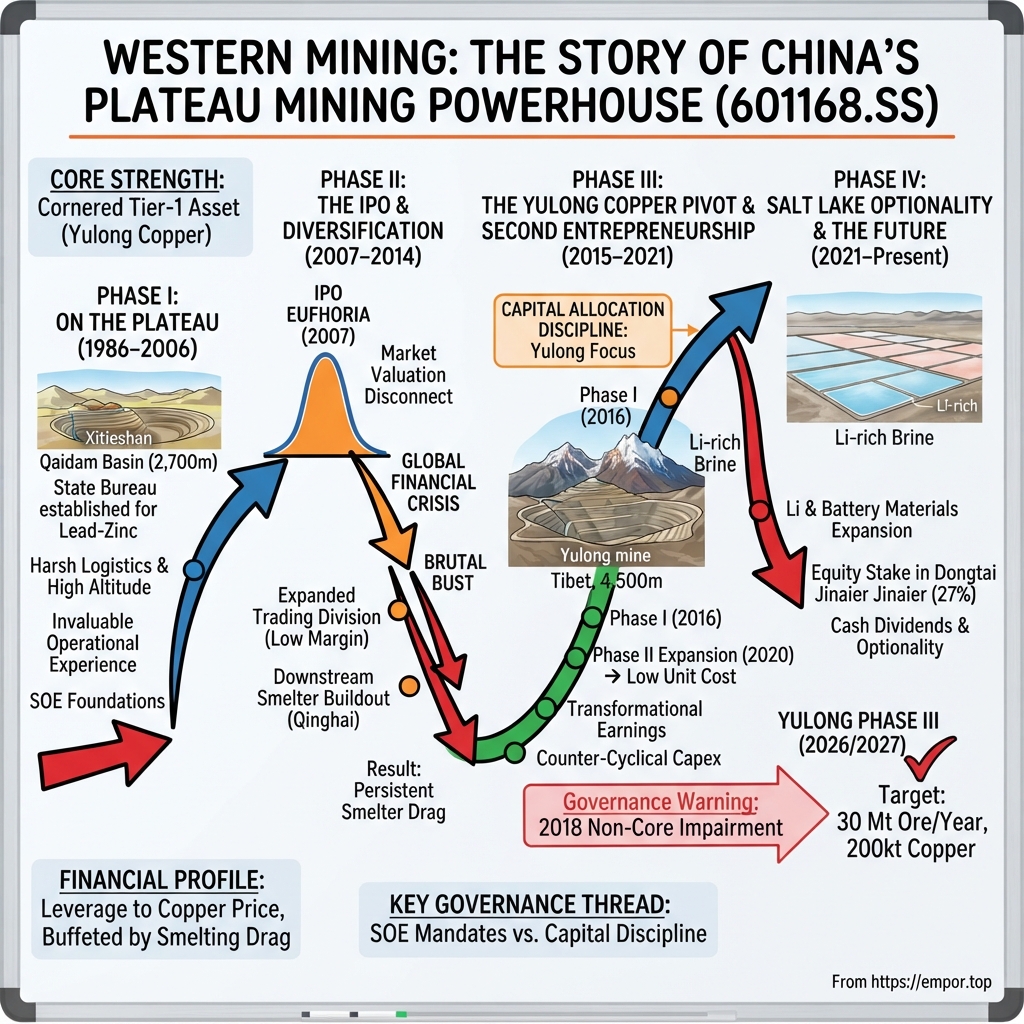
Western Mining: The Story of China's Plateau Mining Powerhouse
I. Introduction & Episode Roadmap
Drive west out of Xining on the Qinghai–Tibet highway and the landscape empties out fast. Within three hours, green terraces give way to gravel, then to salt flats that stretch to the horizon in a white glare so complete that truck drivers wear sunglasses at dusk. This is the 柴达木盆地 Qaidam Basin, a closed depression roughly the size of England sitting 2,700 metres above sea level. For most of modern Chinese history, it was valued for two things: salt and emptiness.
Somewhere in the middle of that expanse, on the northern rim of the basin, a ridge called 锡铁山 Xitieshan — literally "tin iron mountain" — holds one of the richest lead-zinc orebodies China has ever mined. In 1986, the state established a mining bureau there. Workers arrived on trucks, lived in prefabricated dormitories, and worked at an altitude where water boils at 91 degrees Celsius and a common cold can turn into pulmonary edema. Forty years later, that mining bureau has evolved into 西部矿业股份有限公司 Western Mining Co., Ltd. (601168.SS). The company it grew into no longer makes most of its money from lead and zinc at all.
Instead, its primary earnings driver is copper, extracted from a mountain another 1,800 metres higher and 1,500 kilometres deeper into the plateau.
The financial numbers reflect that scale. For full-year 2025, Western Mining reported revenue of ¥61.69 billion, up 23% year on year, with total net profit of ¥6.15 billion and ¥3.64 billion attributable to shareholders of the listed company.12 Results accelerated into the first half of 2026, delivering what management described as the strongest first half in company history: revenue expanded 25% to ¥39.44 billion, while attributable net profit climbed 123% year on year to ¥4.17 billion.34 Operating cash flow rose roughly 67% over the same period.4 Copper alone — primarily from a single mine — generates around 70% of revenue and roughly 60% of gross profit.5
That concentration defines both the core story and its principal risk.
This analysis traces four primary threads. The first is geological and operational: what it takes to extract metal on the 青藏高原 Qinghai-Tibet Plateau, where world-class deposits conflict with a punishing operational environment. The second is structural economics: the stark margin difference between owning an upstream mine and operating a downstream smelter — a distinction Western Mining learned through costly experience, and one that still splits its income statement. The third is governance: the realities of operating as a provincial state-owned enterprise (国有企业 SOE) ultimately answerable to the 青海省国资委 Qinghai Provincial SASAC, an entity that delivers mineral concessions while historically directing non-core capital calls. The fourth is optionality: the company's expansion into 柴达木盐湖 Qaidam Salt Lake lithium and battery materials, and whether that segment represents a genuine growth engine or a minor line item.
Underlying these issues is a fifth, critical thread regarding capital allocation. In 2018, the company recorded a single impairment large enough to erase roughly seven years of accumulated profit — originating not from an operational failure or commodity slump, but from a minority stake in a provincial investment conglomerate it had been persuaded to fund.6 Any evaluation of management credibility at Western Mining must account for that event alongside its operational successes.
One organizing question frames the analysis: will Western Mining generate sustained returns because it controls irreplaceable assets, or simply because copper prices remain elevated?
These represent distinct investment cases with different failure modes. The former relies on structural competitive advantage; the latter depends on favorable commodity cycles. The evidence for each warrants systematic review.
 Subscribe on LinkedIn
II. Origins on the Plateau: Xitieshan & Early SOE Foundations (1986–2006)
The establishment of the 锡铁山矿务局 Xitieshan Mining Bureau in 1986 was an act of industrial policy rather than private entrepreneurship. As China accelerated its mid-1980s industrial expansion, demand surged for galvanized steel, brass, batteries, and wiring—all requiring steady supplies of lead and zinc. To secure domestic production, the state-run China Nonferrous Metals Industry Corporation turned to the high-grade deposit at Xitieshan, located in 青海省海西州 Haixi Prefecture.
Xitieshan's core advantage lay in its geological grade. While most domestic lead-zinc deposits in China were thin, complex, and expensive to process, Xitieshan was a high-grade sedimentary-exhalative deposit: thick, continuous, and economically resilient. That structural cost advantage allowed the operation to generate positive cash flow even during severe commodity downturns that forced marginal mines to shut down.
Operating a mine at 3,000 meters in the Qaidam Basin presented severe logistical challenges. Fuel, chemical reagents, machinery parts, and food had to be trucked hundreds of kilometers across harsh terrain frozen for six months of the year. Internal combustion engines lost efficiency in thin air, while crew rotations were dictated by altitude acclimatization rather than standard shift optimization. Surviving these operational realities built an institutional capability—the technical expertise required to construct and operate complex industrial infrastructure under extreme environmental conditions. Western Mining would later rely heavily on this operational experience as it expanded deeper into the plateau.
In 2000, the state reorganized the mining bureau into a modern joint-stock enterprise named Western Mining, backed by the Qinghai provincial government with a directive to serve as the province's premier mining entity. For Qinghai, a remote province with a modest tax base and vast mineral resources, Western Mining was not simply a financial investment; it was an economic instrument for regional development and revenue generation.
The shift from an administrative mining bureau to a joint-stock company altered the organization's strategic purpose. Rather than operating purely as a production unit, Western Mining was restructured to attract external capital and prepare for an eventual public listing. Achieving a public market valuation required a broader growth story beyond a single profitable mine, driving the company to pursue aggressive asset acquisitions.
Its state backing facilitated rapid access to major mineral resource concessions. During the early 2000s, Western Mining assembled a broad asset portfolio across western China, acquiring the 获各琦铜矿 Huogeqi Copper Mine in Inner Mongolia while securing exploration and mining rights for the 四川呷村银多金属矿 Gacun Silver-Polymetallic Mine in Sichuan and the 西藏玉龙铜矿 Yulong Copper Mine in Tibet.[^7] These transactions were negotiated state allocations in remote regions where private commercial capital remained scarce.
The primary entry barriers in these regions were neither capital nor technology, but political standing to secure concessions combined with the operational capacity to develop remote assets. However, because state-granted advantages carry implicit political obligations, this foundation also exposed the company to strategic non-core directives from provincial authorities over time.
Two of those early acquisitions remain notable contributors to the business. Huogeqi, located in Inner Mongolia's Bayannur region, provided a stable copper asset that continues to serve as the company's secondary copper supply. Meanwhile, Gacun in western Sichuan is a volcanogenic massive sulfide deposit containing significant silver alongside lead and zinc. High-value silver by-product credits offset primary extraction costs, supporting operating margins in the lead-zinc segment even during periods of weak base-metal prices.
The most consequential acquisition was Yulong. In 2003, the asset consisted of an unproven concession on a remote Tibetan peak lacking roads, electricity, and water infrastructure. Though initial development appeared highly uncertain, Yulong eventually emerged as Western Mining's core cash-generating asset.
By 2006, Western Mining possessed a cash-generating lead-zinc flagship, a growing portfolio of copper and polymetallic properties, and strong provincial government backing. However, it still lacked major scale, an integrated downstream strategy, and exposure to public capital markets. Those elements converged in mid-2007 as the company prepared for its initial public offering amid a historic domestic equity market boom.
III. The 2007 IPO Euphoria & The Brutal Bust (2007–2014)
On July 12, 2007, Western Mining listed on the 上海证券交易所 Shanghai Stock Exchange at an issue price of ¥13.48 per share.7 The stock surged 144% on its first trading day to close at ¥32.97.7 Within months, market speculation drove the equity higher still. For a brief period, a company whose cash flows rested primarily on a single lead-zinc mine in the Qaidam Basin alongside early-stage exploration licenses carried a market valuation comparable to established global mining majors.
The valuation disconnect was highlighted in the company's pre-IPO shareholder register. In July 2006, roughly a year before the listing, Goldman Sachs acquired 32.05 million shares from an existing shareholder at ¥3 per share, marking its first pre-IPO equity investment in a firm that subsequently listed on the mainland A-share market.8 By opening day, that stake was valued at nearly eleven times the entry price. Following subsequent cash dividends, bonus shares, and equity capitalizations, contemporaneous industry estimates placed the institution's effective cost basis at a fraction of a yuan per share.8 The transaction underscored the vast gulf between private valuations anchored in operational fundamentals in 2006 and the public market pricing driven by retail enthusiasm in 2007.
Viewing the 2007 listing solely as a speculative bubble ignores its structural function. The initial public offering achieved its primary goal: transforming a provincially owned mining operator into a publicly capitalized corporation equipped with substantial cash reserves, institutional oversight, and public reporting standards. The core strategic issue was not the capital raised, but how management deployed those funds and the macro environment in which those capital allocation decisions occurred.
By late 2007, management faced intense strategic pressure. Western Mining had become one of the most highly valued mining entities in Asia, yet its operating asset base remained modest. Equity markets were discounting rapid production growth that the existing asset portfolio could not support. Under such conditions, public companies face compelling incentives to deploy capital aggressively through rapid acquisitions and capital expansion, while receiving little market encouragement to hold cash through the peak of a commodity cycle.
That market environment collapsed with the 2008 Global Financial Crisis. Copper prices plummeted from roughly $8,900 per tonne to below $3,000 within six months, accompanied by steep declines in lead and zinc. For a producer whose revenues were directly indexed to global benchmark prices, earnings fell sharply. Beyond the collapse in equity valuation, the downturn exposed fundamental structural vulnerabilities in Western Mining's corporate design.
The first structural issue was an expanded trading division. Similar to many domestic peers during that era, Western Mining operated a high-volume, low-margin metals trading and marketing division. While this business generated tens of billions of yuan in top-line revenue, it operated on paper-thin operating margins measured in fractions of a percent, contributing minimal net income while introducing commodity inventory risk and futures exposure to the balance sheet.
The second and more persistent vulnerability stemmed from downstream expansion. Capitalized with IPO proceeds, the company invested heavily in refining assets, constructing lead, zinc, and copper smelters in Qinghai alongside 预焙阳极 pre-baked anode facilities to supply them. The strategic rationale in 2007 focused on capturing the full value chain from raw ore to refined metal, seeking to add processing value and reduce reliance on unrefined concentrate sales. However, this strategy misjudged the underlying economics of industrial metals processing.
A copper smelter functions primarily as a toll processor rather than a commodity trader. It converts copper concentrate—raw ore processed into a concentrate containing roughly 20 to 30 percent copper—into refined cathode metal in exchange for a processing fee, known as the treatment charge and refining charge (TC/RC). A smelter's revenue is dictated by this fee structure, supplemented by by-product recovery of precious metals and sulfuric acid. Crucially, processing fee rates are determined by global supply and demand dynamics between available mine concentrate output and total regional smelting capacity.
Consequently, smelter profitability depends on the relative scarcity of processing capacity rather than high underlying copper prices. Across two decades, rapid domestic expansion of Chinese smelting capacity outpaced global mine development, compressing processing margins. By 2026, annual benchmark copper treatment charges settled at zero dollars per tonne, with spot terms falling into negative figures—forcing smelters to effectively pay miners for concentrate while relying entirely on by-product recovery and sulfuric acid sales for revenue.910 Zinc processing experienced a similar compression; by mid-2026, industry commentary noted that zinc processing fees had contracted to the point where smelters were effectively paying mines to secure raw material.11
The economic distinction between mining and smelting is clear. Upstream mine ownership resembles owning finite, high-grade agricultural land where supply cannot be duplicated. Downstream smelting resembles operating a processing facility in a market with low barriers to entry and ample capital access. While both operations process the same end commodity, only the upstream deposit possesses structural protection from supply expansion. Over time, processing margins tend to converge toward or below the cost of capital, allowing upstream resource owners to capture the bulk of economic rents. Throughout the 2000s and 2010s, China's metals industry built processing capacity far faster than upstream supply could expand.
Western Mining invested heavily in downstream processing near the peak of the commodity cycle. Net profits reflected these structural headwinds, dropping to roughly ¥570 million in 2008, rebounding temporarily to around ¥989 million in 2010, and declining to ¥350 million in 2013 and ¥290 million in 2014.12 For a company whose market capitalization had briefly rivaled global diversified majors, annual earnings below ¥300 million underscored the limited returns of downstream processing assets.
This period highlighted an important lesson in capital allocation: vertical integration creates economic value primarily when directed toward scarce assets rather than abundant processing capacity. Western Mining integrated downstream into smelting facilities at a time when upstream ore deposits were the genuinely scarce link in the value chain. Capital committed to smelting assets reduced the funds available for mining acquisition and development, requiring years of strategic adjustments to rebalance the portfolio.
Compounding this structural challenge, the company was soon to encounter an even larger non-operational drain on its capital.
IV. The "Second Entrepreneurship" & The Yulong Copper Pivot (2015–2021)
Western Mining frames its turnaround story around a strategic initiative known as 二次创业—or "second entrepreneurship"—led by chairman 张永利 Zhang Yongli. Under this corporate narrative, after a period of expanding low-margin trading, smelting, and non-core diversification, management refocused on Tier-1 upstream mining assets, pruned peripheral operations, and executed a transformational expansion of its flagship copper mine in Tibet.
While this narrative reflects real operational progress, two aspects require closer scrutiny: the historical origin of the Tibetan copper asset and the capital allocation record that accompanied its development.
First, the central asset of this expansion—the 西藏玉龙铜业股份有限公司 Tibet Yulong Copper Co., Ltd. mine—was not an acquisition of the second-entrepreneurship era. Western Mining had held rights over the deposit since the early 2000s. On November 21, 2007, four months after its initial public offering, the company paid 紫金矿业 Zijin Mining ¥106.25 million to increase its stake from 41% to a controlling 58% interest.13 Phase I approval for the mine followed that same month.[^15] The strategic asset was secured early and at a modest price; converting the concession into an operating mine, however, required another decade.
Located near 西藏昌都 Qamdo in eastern Tibet at elevations exceeding 4,500 meters, Yulong is a porphyry copper deposit whose geological characteristics dictate its economics. Porphyry deposits form when stalling magma releases metal-rich hydrothermal fluids into surrounding fractured rock, creating vast, lower-grade halos of copper mineralization rather than concentrated, high-grade veins. Because the mineralization is broadly distributed, selective mining is unfeasible. Extraction requires open-pit bulk mining across large benches, making unit economics entirely dependent on processing scale to drive down costs per tonne of ore.
Yulong's primary geological advantage lies in its upper zone, where ore grades exceed typical porphyry averages and allow for low-cost open-pit extraction. Combining above-average grades with open-pit mining at scale places Yulong in the bottom quartile of global cost curves, preserving profitability even during severe copper price downturns.
Developing an asset at 4,500 meters presented severe technical and logistical obstacles. High altitude alters concrete curing, reduces internal combustion engine efficiency, restricts construction to short seasonal windows, requires strict medical screening for personnel, and entails the stringent environmental permitting standards applied across the Qinghai-Tibet Plateau.
The decade-long gap between acquisition in 2007 and initial commissioning in 2016 involved factors beyond internal corporate focus. In the late 2000s, eastern Tibet lacked the high-voltage power grid and heavy-transport road network required to supply power and transport massive volumes of ore concentrate continuously. Because porphyry economics demand immense volume—which in turn requires power and transport infrastructure—the mine could not be developed on an accelerated timeline prior to broader regional infrastructure investment.
Ultimately, development depended as much on external regional development as internal corporate execution. A decade of public investment in plateau highways, power transmission, and logistics transformed a remote orebody into an operational asset. Western Mining's key strategic decision was holding its controlling stake throughout the dormant period, positioning the firm to construct large-scale operations as regional infrastructure matured.
Phase I development concluded in 2016. The Phase II expansion—the largest capital investment in Western Mining's history—was completed in December 2020, a milestone management highlighted as the realization of its "second entrepreneurship."14 Subsequent debottlenecking expanded annual processing capacity to 22.8 million tonnes of ore by November 2023, delivered on schedule.1516 This expansion elevated Yulong into one of the largest operating copper mines in China.
The operational significance of Phase II lay in its structural impact on cost architecture. In open-pit porphyry mining, low-throughput operations absorb high fixed costs for overburden waste stripping against modest production volumes. Expanding throughput allows the same pit geometry to generate substantially higher ore volume per unit of waste removed, driving down unit operating costs. The capacity expansion to more than 20 million tonnes annually shifted Yulong's position on global cost curves, demonstrating how processing scale functions primarily as a cost-reduction strategy that simultaneously drives volume expansion.
The resulting financial transformation reshaped the company's income statement. Annual net profits rose from under ¥300 million in 2014 to billions of yuan a decade later, driven predominantly by Yulong. While this operational success established a strong core cash generator, it also created heavy earnings concentration in a single asset.
That operational achievement stands alongside a major non-operational capital allocation failure during the same development period.
In 2013, Western Mining committed ¥2.966 billion to acquire a 35.89% stake in 青海投资集团 Qinghai Investment Group, becoming the second-largest shareholder in a provincial state-owned conglomerate with no operational synergy with core mining.6 On January 29, 2019, the company initially forecast a modest 2018 net profit of approximately ¥100 million. Less than three months later, on April 18, 2019, management revised its performance, reporting a net loss of ¥2.063 billion—its first annual loss since listing. The loss resulted from a ¥2.522 billion impairment that wrote the entire carrying value of the Qinghai Investment Group equity stake down to zero.6 The Shanghai Stock Exchange issued an inquiry letter demanding explanations for the sudden impairment, the prudence of earlier accounting assumptions, and the lack of prior disclosures regarding severe operational distress at a major affiliate.6 Financial press reports noted that Western Mining had also paid substantial premiums for underperforming assets over the preceding decade.17
This impairment provides crucial context for evaluating the corporate turnaround. The record indicates dual corporate tracks: strong technical competence in developing and operating high-altitude mining assets, paired with a documented history of directing capital into non-core provincial mandates. While seven years have elapsed without a similar non-operational impairment, sustained capital discipline remains a key variable for investors monitoring future capital allocation decisions.
With its primary copper asset fully expanded and legacy capital write-downs recognized, Western Mining entered the mid-2020s with a redefined asset base and operational profile.
V. Core Business & Segment Economics: Mine Ownership vs. Smelting Drag
An examination of Western Mining's income statement reveals two distinct businesses with opposing economics sharing a single balance sheet.
The first business generates modest top-line revenue but extraordinary profits. It extracts copper from the flagship Yulong mine in Tibet and, secondarily, the Huogeqi mine in Inner Mongolia to sell as concentrate. Copper accounts for roughly 70% of group revenue and around 60% of gross profit, with profitability overwhelmingly concentrated in upstream mining rather than metal refining.5 Mining gross margins at Yulong reach levels rarely seen in traditional industrial operations. Because open-pit extraction and concentrate flotation carry largely fixed operating costs, revenue per tonne moves directly with prevailing market prices. Consequently, when copper prices rise, nearly the entire incremental gain flows straight to the bottom line.
This operational leverage was fully on display in the first half of 2026. Management attributed the record earnings surge to realization prices rather than volume gains, noting that copper traded between ¥91,500 and ¥114,000 per tonne—up from roughly ¥71,000 to ¥82,000 per tonne in the prior-year period—alongside price increases in molybdenum, lead, zinc, gold, and silver.5 The financial results reflect this dynamic clearly: a 123% surge in attributable net profit alongside a 25% increase in revenue represents pure operating leverage on rising commodity prices rather than a structural shift in competitive position.34 While Yulong remains a formidable Tier-1 asset, the performance in early 2026 reflects macro market strength more than internal operational changes.
The second business presents the opposite profile: substantial top-line revenue paired with structurally depressed profitability. Western Mining's smelting division—encompassing approximately 750,000 tonnes of annual capacity across copper, lead, and zinc, including the 青海铜业 Qinghai Copper and 西部铜材 Western Copper Materials facilities commissioned in late 2024—generates a large portion of group revenue but virtually none of its net profit.18 This new smelting capacity came online just as global treatment charges collapsed. A credit-rating analysis highlighted that these 2024 projects had failed to reach design performance while a sharp deterioration in treatment charges in late 2024 elevated raw-material costs and drove the smelting segment into operating losses.18
These smelting investments offer a clear window into corporate capital allocation. Industry analysts widely recognized the structural oversupply in Chinese smelting throughout the 2010s when these facilities were planned. Constructing processing plants in a landlocked plateau province far from major consumption hubs and imported concentrate markets reflected priorities beyond pure return on capital. Provincial industrial policy incentivizes local refining to generate regional employment and tax revenue rather than shipping raw concentrate to coastal processing hubs like Jiangxi. Minority shareholders bear the economic cost of these policy directives—a structural reality of the state-owned enterprise model that equity valuations must discount.
However, captive mine supply provides a critical buffer that renders this smelting drag survivable. Because Western Mining satisfies a significant portion of its smelter feedstock internally, compressed external treatment charges function as internal transfer pricing adjustments rather than absolute cash drains. While pure-play smelters suffer severe margin compression during periods of low treatment charges, an integrated miner-smelter transfers economic margin between business segments. Internal self-sufficiency does not transform low-margin smelting assets into high-return investments, but it protects the consolidated enterprise during severe downstream downturns.
Management also defends its downstream footprint by pointing to by-product recovery and strategic flexibility. Modern copper smelters extract high-value by-products—including sulfuric acid, gold, and silver—that generate essential gross profit when primary refining margins approach zero.9 Captive smelting capacity also guarantees a dedicated processing outlet for remote plateau mines, reducing dependence on third-party offtake agreements. While these factors offer operational utility, they validate having basic processing capacity rather than the timing or capital scale of Western Mining's downstream buildout. Investors should treat the smelting segment as a permanent structural drag to discount rather than an operational turnaround waiting to happen.
A comparison with domestic mining peers highlights Western Mining's distinct structural profile:
紫金矿业 Zijin Miningpresents a sharp contrast in corporate strategy. Zijin executed a global expansion strategy, assembling a geographically diversified portfolio of copper and gold assets across Serbia, the Democratic Republic of the Congo, Colombia, and Kazakhstan.19 In 2007, Zijin sold its controlling economic interest in Yulong to Western Mining for just over ¥100 million—a transaction that proved highly advantageous for Western Mining in hindsight.13 While Zijin operates as a global multinational, Western Mining remains a domestically concentrated, single-asset-dominant producer. This concentration eliminates geopolitical expropriation risk, currency mismatches, and complex overseas integration, but leaves the enterprise unhedged against operational disruptions at its primary Tibetan mine.江西铜业 Jiangxi Copperand铜陵有色 Tongling Nonferrousoccupy the opposite end of the spectrum as massive downstream refiners with limited self-mined ore supply—the precise operational model hit hardest by historic lows in treatment charges. Western Mining maintains a significantly higher self-sufficiency ratio of equity mined copper to total smelting throughput, giving it a structural margin advantage over custom smelters during downstream market contractions.洛阳钼业 CMOCrepresents a third model centered on large-scale international cobalt and copper production in Central Africa. While CMOC faces complex geopolitical and transport risks in the DRC, Western Mining encounters severe logistical constraints across the Qinghai-Tibet Plateau, demonstrating that both operators face significant infrastructure challenges in delivering concentrate to market.
For investors, the core synthesis is straightforward: Western Mining operates not as a diversified mining major, but as a leveraged play on a single low-cost copper mine. This core asset is supported by a lead-zinc division that supplies a reliable cash flow floor, and burdened by a smelting business that consumes capital while offering negligible returns. The legacy lead-zinc assets at Xitieshan and Gacun generate roughly 20% of total mining profit, serving as an essential financial buffer should operational disruptions impact Tibetan production.
Because asset concentration in Tibet represents the central vulnerability of the entire corporate structure, operational stability at Yulong remains critical. However, parallel to its hard-rock mining operations, Western Mining has pursued a secondary growth initiative in the lithium-rich brine reserves of the Qaidam Basin.
VI. Salt Lake Optionality & The Battery Materials Expansion (2021–Present)
Standing on the edge of 察尔汗 Qarhan or 东台吉乃尔 Dongtai Jinaier in the Qaidam Basin, the landscape looks nothing like a traditional mine. Shallow turquoise waters are divided into geometric evaporation ponds, with pumps moving liquid across salt-crusted embankments. There are no open pits, no blasting, and no haul trucks; the mineral resource is dissolved in water.
Qinghai holds a substantial share of China's lithium resources in this brine form. While the core concept of pumping brine into ponds, concentrating it under high-altitude sun, and separating lithium from accompanying minerals is straightforward, physical extraction presents severe technical challenges. The primary obstacle is a high ratio of magnesium to lithium. Chilean brines feature low ratios that allow relatively simple processing, but Qaidam deposits required Chinese engineers to develop specialized adsorption and membrane technologies over two decades to make commercial separation viable.
Western Mining's participation in this brine ecosystem follows two distinct tracks.
The first track involves edible and industrial salt through an equity stake in 青海省盐业股份有限公司 Qinghai Salt Industry Co., Ltd., operator of 茶卡盐湖 Chaka Salt Lake. This asset combines a dominant regional salt position across western China with a profitable tourism operation centered on Chaka's landscape. While tourism yields attractive operating margins, the scale of the salt business remains minor alongside Western Mining's copper earnings and does not materially alter the investment thesis.
The second track focuses on lithium, where financial commitments are substantial. Western Mining acquired a 27% stake in the Dongtai Jinaier lithium resource entity for ¥3.343 billion.20 The asset operates under 青海泰丰先行锂能 Qinghai Pulead Lithium Energy, a group with an integrated supply chain spanning brine extraction, cathode materials, and battery separator films.21 By the end of 2024, the acquired entity had fulfilled its performance commitments, having distributed roughly ¥4.5 billion in interim and annual dividends during 2022 and 2023, of which Western Mining's 27% share equaled approximately ¥1.215 billion.20
That dividend flow provides clear evidence that this acquisition differed from the 2013 non-core capital outlay. Returning over ¥1.2 billion in cash dividends within two years on a ¥3.343 billion investment while meeting profit guarantees represents a far more disciplined outcome than writing off a ¥2.966 billion equity stake.
However, these distributions should not be extrapolated linearly. The dividends were generated during an unprecedented lithium carbonate price spike before market prices fell 80% to 90% from their peak. Securing cash returns from a minority stake during a market high demonstrates favorable timing, but it does not confirm underwriting quality across a full commodity cycle. The key test remains how the carrying value of the stake holds up through an extended lithium downturn. Western Mining recognized total asset impairments of roughly ¥638 million in 2025, which contributed to a sharp market selloff on June 23, 2026, when the stock dropped by its 10% daily limit amid concerns over subsidiary losses and weak performance in lead, zinc, and smelting.22 This reaction illustrates that non-core portfolio impairment risk remains active.
The strategic rationale for entering lithium warrants objective evaluation. A constructive interpretation views the investment as logical diversification: salt-lake brine is Qinghai's other major mineral asset, and as the designated provincial mining champion, Western Mining gains exposure to energy transition metals beyond copper. A more critical interpretation views the transaction as another instance of satisfying provincial development mandates. Both perspectives fit the facts. Observing whether future lithium investments remain structured as cash-yielding minority financial stakes or expand into capital-intensive operating commitments will clarify which motive dominates.
Evaluating the segment in context shows that salt and lithium assets remain secondary to a copper business that generates the vast majority of group profits. Even under optimistic recovery assumptions for lithium, the salt-lake portfolio functions as financial optionality—an asset with real intrinsic value attached to an enterprise driven overwhelmingly by copper. Positioned against total earnings, Western Mining remains fundamentally a copper producer rather than a dual-commodity enterprise.
Ultimately, the lithium segment serves as an indicator of management's capital allocation discipline. It reveals how surplus cash is deployed outside the flagship copper operations, offering a benchmark as the company prepares to execute its next major phase of copper expansion.
VII. Yulong Phase III & Current Management Credibility
On June 23, 2025, the Development and Reform Commission of the Tibet Autonomous Region approved the Phase III project at Yulong.23 The document is not a vision statement. It is a construction order, and its contents describe one of the most demanding industrial builds currently underway anywhere in China.
The scope includes a new 11 million tonne per year beneficiation plant, an expansion of hydrometallurgical capacity from 300,000 to 1 million tonnes per year, construction of the Segonglonggou tailings storage facility, and a 150 MW integrated generation–grid–load–storage power facility to supply it all.23[^26] Total investment was estimated at ¥4.79 billion, entirely enterprise-funded — no state grant component.23 Ore processing capacity rises from 22.8 million tonnes per year to 30 million, with construction targeted for completion by the end of 2026 and commissioning in 2027, taking contained copper output to a stated 180,000–200,000 tonnes per year and extending mine life post-expansion to 23 years.2324 Company communications have described a longer-range ambition of 45 million tonnes per year.24
Unpack the pieces, because two of them are more interesting than the headline tonnage.
The power facility is the tell. A 150 MW self-contained generation-and-storage installation is not a nice-to-have; it is an admission that grid supply in eastern Tibet cannot be relied upon to run a 30 million tonne concentrator. Building your own power system is expensive, but it converts an external dependency into an owned asset, and it removes a category of interruption risk that would otherwise sit outside management's control.
The hydrometallurgical expansion — more than tripling leaching capacity — matters because it addresses ore that flotation handles poorly. Yulong's oxide and mixed ores do not respond well to conventional concentration; leaching dissolves the copper chemically instead and recovers it directly as cathode. Expanding that circuit means converting material previously classified as waste or marginal into saleable metal, which improves the economics of the whole orebody rather than simply adding throughput.
The tailings facility is the risk. Tailings are the ground-up rock left after the copper is removed, stored behind engineered embankments as a slurry. On the Qinghai-Tibet Plateau, in seismically active terrain, in the headwaters region of major Asian river systems, a tailings dam is the single most consequential piece of infrastructure a mine builds and the one that regulators watch most closely.
One more thing about Phase III deserves flagging because it is easy to skim past. The project takes ore throughput up by roughly a third while targeting contained copper output that is materially higher than a third above current levels.23 That implies the incremental ore is expected to carry favourable grade or recovery, or that the expanded leach circuit is capturing metal that previously went to waste, or both. It is a reasonable expectation given the deposit, but it is an expectation rather than a certainty, and grade reconciliation — whether the ore delivered to the plant matches what the resource model predicted — is one of the most common places where large mine expansions disappoint. That reconciliation will only become visible in reported production data during 2027 and 2028.
Which leads to governance. Ultimate control runs through Western Mining Group to the Qinghai Provincial SASAC. The leadership transition was executed across 2025: 王海丰 Wang Haifeng, born in November 1973, a senior engineer in geology with an MBA from Xi'an University of Technology, was appointed chairman of the listed company in January 2025, and the Qinghai provincial government confirmed his appointment as chairman of Western Mining Group in June 2025, with Zhang Yongli stepping down and the group's business registration updated on June 6.2526 Wang had been group Party Committee secretary since September 2022 and president since January 2024 — an internal, sequenced handover rather than an outside appointment.26
For investors, the succession reads as continuity, which is neither good nor bad in itself. The relevant question is whether the operating discipline of the Yulong era survives a change in who signs off on capital. On the evidence available, the new chairman inherited a strategy already set and a Phase III project already approved; there has been no observable strategic discontinuity. Judging his capital allocation requires seeing what he authorises that is not Yulong, and that evidence does not yet exist.
On the financial track record, the picture is genuinely stronger than it was. The balance sheet carried heavy debt through the Phase II build; deleveraging since has been real, and returns on equity have expanded substantially from the depressed post-2018 base. But one claim commonly attached to this company deserves scrutiny rather than repetition. Western Mining's declared distribution for 2025 was ¥0.6 per 10 shares.1 Measured against reported earnings, that is a modest payout — and it sits awkwardly against characterisations of the company as running a consistent 30–50% payout policy with a high dividend yield. The honest statement is that the payout ratio is a variable to verify annually from the distribution announcement, not a proven policy to assume. Investors who treat dividend support as part of the downside case should check that number every year rather than inherit it from a narrative.
The company held its H1 2026 results briefing in August 2026, and the recurring themes in investor engagement are consistent and predictable: analysts press on the smelting segment's drag on consolidated returns, on the outlook for treatment charges, on impairment risk in the non-mining portfolio, and on the funding plan for Phase III.27[^31] Management's position on funding has been consistent across communications — Phase III is to be financed from operating cash flow and debt capacity, without an equity raise.23 Given the approved capital cost of ¥4.79 billion against first-half 2026 operating cash flow that rose roughly 67%, that commitment is arithmetically plausible at current metal prices.423 It is worth noting what makes it fragile: it is plausible because copper is expensive. A sustained fall in the copper price would test the same commitment under very different conditions, and the record shows this company has issued forecasts it then revised dramatically.
So the credibility assessment lands somewhere specific rather than at either extreme. On mine building — schedules met, expansions delivered, a genuinely hard project executed at altitude — the record supports confidence.15 On non-core capital deployment and on disclosure of deteriorating positions, the 2018 episode remains the most relevant disconfirming evidence and has not been repeated but also has not been structurally disproven. On shareholder returns, the claimed discipline should be verified, not assumed.
Having tested the history, the next step is to test the structural argument.
VIII. Strategic Frameworks: 7 Powers & Porter's 5 Forces
Commodity producers make structural business frameworks awkward. In a market where the product is fungible, delivered to exchange specifications, and priced in Shanghai and London, most traditional sources of competitive advantage—such as brand, switching costs, and network effects—simply do not exist. A tonne of copper cathode is identical to any other. What remains is a short list of potential advantages, requiring a rigorous look at which ones Western Mining actually commands.
Hamilton Helmer's 7 Powers
Cornered Resource — present, and the strongest item in the case. Helmer defines a cornered resource as preferential access to a coveted asset that independently enhances value on attractive terms. Yulong qualifies about as cleanly as any asset in Chinese mining: a large, high-grade, open-pittable porphyry copper deposit with a stated 23-year life post-Phase III, acquired to control for just over ¥100 million in 2007, in a jurisdiction where new concessions are allocated rather than auctioned.1323 It cannot be replicated because orebodies cannot be manufactured, and environmental permitting on the plateau makes new entrants extraordinarily unlikely.
The qualification is that a cornered resource protects the asset, not the company. It does nothing to prevent management from deploying the cash flow generated by that asset unwisely—a distinction the company's own history demonstrates.
Scale Economies — present, and specific. Open-pit porphyry mining is a fixed-cost business. Moving from 3.5 million tonnes of annual throughput to 22.8 million and onward to 30 million spreads the cost of pit access, workforce, power, and haulage across far more tonnes.1523 The resulting low unit-cost position enables Yulong to stay profitable through price troughs that force higher-cost operations to idle. This is scale economics in its purest textbook form.
Process Power — claimed, partially supported, frequently overstated. The argument is that decades of operating at high altitude have produced proprietary cold-climate, high-altitude processing and metallurgical capability. There is truth to the operational challenge: flotation chemistry, water management, and equipment de-rating genuinely behave differently in thin, cold air, creating knowledge that accumulates slowly and is hard to buy. But Helmer's process power requires an advantage a competitor cannot replicate even knowing what you do. Chinese engineering institutes are capable, and the relevant technical expertise resides within a broader design and contracting ecosystem shared across the industry. The defensible version of this claim is narrower: Western Mining has an operational head start and an institutional willingness to work in places others avoid. That is an operational advantage, but not a structural moat on par with owning the orebody.
Not present: Counter-positioning, switching costs, branding, and network economies. A raw commodity producer possesses none of these dynamics, and claiming otherwise misinterprets commodity economics.
Porter's Five Forces
Supplier power — high, and it is the government. The critical input for a miner is neither equipment nor reagents; it is the mineral concession itself, and the supplier of concessions is the state. That relationship has been overwhelmingly favorable to Western Mining, which holds exclusive rights over assets in provinces where its parent is a state instrument. Yet a dependency that runs favorably is still a dependency that carries obligations—the 2013 provincial investment being the clearest illustration of what those obligations can cost.6
Buyer power — low in bargaining terms, absolute in pricing terms. No individual smelter can squeeze Western Mining on a concentrate contract. But the company is a complete price taker on refined metals, with revenue set daily by SHFE and LME benchmarks. In Porter's terms buyer power is low; in practical terms the company has zero pricing power, which is the more important fact.
Threat of substitutes — low and arguably falling. Aluminum substitutes for copper in certain transmission and busbar applications when the price spread justifies it, creating marginal substitution risk. But the primary demand vectors driving copper—grid buildout, electric vehicles, renewable generation, and power infrastructure for data centers—depend on thermal and electrical conductivity where aluminum is a poor trade-off.
Threat of new entrants — very low. Tier-1 copper deposits are globally scarce, discovery-to-production cycles run well over a decade, and on the Qinghai-Tibet Plateau the permitting regime makes greenfield entry close to theoretical.
Myth versus reality on the "plateau moat." The most frequently repeated claim about this company is that its high-altitude operating capability constitutes a durable competitive advantage—that nobody else can do what it does where it does it. The reality is narrower. What the plateau genuinely provides is a deterrent to entry, and that deterrent protects the concession, not the company's operating margin. Competent Chinese mining contractors could operate Yulong if handed the license tomorrow. The reason none of them will is that the license is unavailable. So the moat is the license; the altitude is what makes the license hard to challenge. Conflating the two overstates the company's transferable skill and understates its dependence on a political allocation.
Rivalry — moderate, and structurally different from most industries. Producers do not compete for customers; they compete for position on the global cost curve. Yulong's low unit cost means that in a downturn, the mines that close belong to someone else. Rivalry bites elsewhere—in competition for new concessions and acquisitions, where Zijin and CMOC have both demonstrated more aggressive and more international dealmaking capability.19
The composite picture is a company with one exceptionally durable asset-level advantage, one solid operational advantage, no corporate-level advantage against commodity price cycles, and a governance structure that has historically imposed costs alongside the benefits it confers. That is a specific and defensible characterization—and it sets up exactly the questions a skeptical investor would ask.
IX. Skeptical Investor Stress Test & Risk Radar
An activist investor building a short thesis, or a long-only portfolio manager stress-testing a position before sizing it, would examine a distinct set of operational, governance, and macroeconomic vulnerabilities. A comprehensive risk memo highlights eight core vulnerabilities.
One mine is the company. Concentration risk does not require a catastrophic event to pose a major challenge for investors. Copper generates roughly 70% of group revenue and approximately 60% of gross profit, with earnings overwhelmingly concentrated in a single operating mine.5 Any event that halts or materially slows production at Yulong—whether a pit-wall geotechnical failure, a tailings storage incident, a permitting suspension, an extended weather or seismic disruption, or a winter power or transport outage—would eliminate the vast majority of group earnings. The lead-zinc operations at Xitieshan and Gacun provide a reliable financial floor, but they cannot replace Yulong's scale. For investors, this asset concentration cannot be diversified away within the existing portfolio; it can only be priced.
The regulatory environment is tightening, not loosening. The 青藏高原生态保护法 Qinghai-Tibet Plateau Ecological Protection Law established a strict statutory framework across the region, imposing elevated requirements for water conservation, waste management, habitat protection, and land restoration. While mining operations remain permitted, the compliance baseline is higher than in other regions of China and enforcement is centrally monitored. Key operational exposures include stringent tailings dam inspection standards, strict water consumption caps in alpine watersheds, and regulated waste-rock disposal. The Phase III expansion introduces a new tailings storage facility directly into this heightened regulatory regime.[^26] Operating a single flagship asset in one of the country's most ecologically sensitive regions exposes the enterprise to regulatory risks that differ fundamentally from those faced by geographically diversified miners.
The smelting drag is structural and getting worse, not cyclical and mean-reverting. With benchmark copper treatment charges falling to zero and spot terms turning negative, capital deployed in smelting yields weak returns, with little operational catalyst for recovery while domestic smelting capacity exceeds global concentrate supply.910 Zinc processing economics have experienced a similar margin compression.11 A critical view suggests writing down or exiting these downstream processing assets rather than absorbing ongoing operational losses. In practice, management continues to operate the facilities, relying on captive mine feedstock to cushion the margin compression. While internal self-supply mitigates consolidated losses at the group level, it does not alter the poor return on capital of the individual smelting investments.
Non-core impairment risk has not been eliminated. Impairments totaling ¥638 million in 2025, alongside the resulting equity selloff in June 2026, indicate that non-core assets outside the primary mining operations remain vulnerable to carrying-value adjustments.22 Lithium assets are particularly exposed following the steep price decline from 2022 market highs, especially given that the 27% stake in Dongtai Jinaier was acquired for ¥3.343 billion under significantly higher valuation assumptions.20
Related-party and parent-company exposure. As a listed subsidiary within a provincial state-owned enterprise structure, Western Mining operates within an extensive network of parent and affiliate transactions, encompassing asset transfers, shared operational services, financial guarantees, and intercompany credit. While these arrangements are routinely disclosed and standard for state-owned groups, they also create channels through which controlling shareholder priorities can influence capital allocation. The 2013 equity subscription in Qinghai Investment Group illustrates how non-core capital allocations can emerge through these structures. Analyzing related-party transaction disclosures offers critical visibility into corporate governance, as intercompany capital flows carry strategic implications that differ from direct mining operations.
Governance and the disclosure record. The 2018 reporting sequence—a positive profit forecast in January followed by a ¥2.063 billion net loss announcement in April and an immediate stock exchange inquiry regarding unannounced affiliate distress—remains a central governance precedent.6 While seven consecutive years without a similar non-operational impairment demonstrate improved capital control, the underlying governance structure remains unchanged, with a provincial state entity as the controlling shareholder balancing corporate returns against broader regional policy objectives.
Execution risk on a large build in a hard place. The Yulong Phase III expansion represents a ¥4.79 billion capital commitment encompassing a new concentrator plant, a tripling of hydrometallurgical leaching capacity, a dedicated tailings facility, and a 150-megawatt self-contained power installation at high altitude, targeted for completion within eighteen months of regulatory approval.23 Industrial expansion projects in high-altitude environments face inherent risks of cost overruns and timeline delays due to harsh weather windows, logistics constraints, and specialized labor requirements. Management's track record provides a positive precedent, as the late-2023 expansion at Yulong was completed on schedule.15 However, executing Phase III on time and within budget requires maintaining this operational performance across a larger capital deployment.
Macro and cycle. The economic feasibility of Phase III relies on sustained strength in underlying copper prices. A global industrial slowdown, a deceleration in domestic infrastructure activity, or a temporary pause in grid and electrification investment would compress cash flows, challenging the self-funding capacity of the current capital expansion plan. The strong performance reported in the first half of 2026 was driven primarily by elevated commodity prices.5 Operational leverage impacts financial performance during market downturns just as effectively as it amplifies earnings during price rallies.
These structural vulnerabilities do not render Western Mining uninvestable, but they define a clear set of operational and macro failure modes that investors must evaluate when balancing the company's asset quality against its market valuation.
X. Bull vs. Bear Case & Key KPIs
The bull case
The investment thesis for Western Mining rests on three reinforcing pillars.
The first is the macroeconomic environment for copper. Grid modernization and expansion, electric vehicles, renewable generation, and power infrastructure for artificial intelligence data centers drive rising consumption. On the supply side, global pipelines for major copper discoveries remain constrained, existing deposits face declining grades, and permitting timelines continue to lengthen. This structural supply-demand imbalance positions Western Mining as a leveraged beneficiary of high copper prices.
The second is funded and permitted volume growth. The Yulong Phase III expansion elevates annual processing capacity from 22.8 million to 30 million tonnes of ore, targeting annual contained copper output of 180,000 to 200,000 tonnes upon commissioning, with construction scheduled for completion at the end of 2026 and production starting in 2027.2324 Unlike early-stage growth stories, execution depends on completing approved infrastructure rather than securing new exploration concessions or external financing.
The third pillar is cost positioning. A bottom-quartile unit cost structure on a high-grade open-pit porphyry deposit preserves operating margins during commodity downturns. Combined with a self-sufficiency ratio superior to custom smelters, this cost architecture provides structural downside protection across commodity cycles.
The bear case
The bear case presents an equally compelling counter-narrative.
Excluding commodity price gains, the first half of 2026 was a baseline operational period whose record earnings were driven overwhelmingly by broader market pricing—a dynamic management explicitly acknowledged.5 Should copper prices retrace toward historical averages, operational leverage operates in reverse against an enterprise burdened by unprofitable smelting assets and a lithium investment acquired near peak market valuations.
Asset concentration represents an ongoing structural vulnerability. A major operational or regulatory disruption at Yulong would create an earnings decline that secondary segments cannot offset, particularly given the mine's location within China's strictest ecological protection zone.
Furthermore, capital allocation discipline remains unproven over a full cycle. Western Mining's record includes a major financial loss from a non-core provincial investment, a downstream expansion constructed into structural overcapacity, and asset impairments as recently as 2025.61822 Set against those missteps are a primary copper asset acquired at low cost, expanded on schedule, and a lithium minority stake that has returned cash dividends.131520 Which pattern defines future capital deployment remains the central unresolved governance question.
Evaluating the bear case also requires identifying non-critical risks. Foreign expropriation risk is negligible because operations are concentrated domestically—a key distinction relative to peers with African or Latin American exposure. Currency mismatches are similarly limited. Technological obsolescence does not threaten a physical orebody, as processing innovations alter costs at the margin without replacing underlying metal demand. Finally, material substitution away from copper is constrained by electrical conductivity requirements in core applications. The primary risks facing Western Mining are cyclical commodity exposure, asset concentration, and governance discipline, rather than existential technological or geopolitical threats.
The calibrated view
Balancing these opposing perspectives clarifies the core investment thesis. The asset-quality case withstands scrutiny: Yulong is a verifiable, low-cost, long-life asset undergoing funded expansion. By contrast, the management-quality case holds only in a limited capacity; mine development capabilities are proven, but broader capital allocation discipline remains burdened by past non-core failures. Furthermore, market characterizations of a "defensive dividend" remain unverified given the modest distribution declared for 2025.1 The company's primary structural advantage resides in its orebody rather than corporate decision-making—and physical orebodies deplete over time while capital allocation decisions compound.
Evaluating a natural resource producer requires distinguishing operational fundamentals from commodity price cycles. High market prices do not confirm management excellence, nor do low prices indicate operational failure. Fundamental asset metrics—ore grade, strip ratio, processing throughput, mine life, unit cash costs, and relative position on the global cost curve—remain largely consistent across cycles and dictate long-term survival. Market prices simply determine the timing and magnitude of cash flow generation. Separating structural asset quality from macro price fluctuations is the essential analytical task, shaping the selection of key performance indicators.
The three KPIs that matter
Evaluating Western Mining's forward trajectory depends on three primary operational metrics:
1. Yulong equity mined copper volume, in thousands of tonnes per year. This metric provides a direct measure of whether Phase III development translates capital expenditures into physical output on schedule. Production trends should be evaluated against the targeted 180,000 to 200,000 tonne benchmark following the scheduled completion of construction at the end of 2026.23 Any operational delays would provide an early indicator of degradation in the volume growth thesis.
2. Yulong C1 cash cost per tonne of copper. This metric quantifies the mine's competitive moat. C1 cash cost reflects direct cash operating expenses per tonne prior to financing and depreciation, defining Yulong's relative position on the global cost curve. Upward pressure on C1 costs—resulting from declining ore grades, deeper pit haulage, increased power or reagent expenses, or underutilized processing capacity—would signal an eroding cost advantage well before financial impact appears in headline earnings during a high-price environment.
Secondary indicators, such as top-line revenue, provide limited insight because substantial turnover originates from low-margin smelting and trading operations. Revenue changes driven by smelting volume do not reflect core profitability, and consolidated net income reflects prevailing metal prices as much as operational efficiency. Evaluating volume and unit cost data prior to headline net income yields a more accurate assessment of underlying performance.
3. Smelting segment EBIT alongside the declared dividend payout ratio. Evaluated together, these metrics provide a window into capital allocation discipline. Operating earnings from smelting indicate whether management is mitigating structural downstream margin compression. The actual dividend payout ratio, derived directly from annual distribution announcements, reveals whether surplus cash flow is returned to shareholders or redirected into non-core projects. Persistent smelting losses combined with low dividend payouts and rising non-core capital deployment would indicate a recurrence of legacy capital allocation patterns.
XI. Epilogue & Playbook Lessons
A widely circulated photograph of the Yulong open pit captures concentric benches cut into a mountainside more than 4,500 metres above sea level, haul trucks reduced to specks, and brown ridgelines stretching to the horizon beneath a dark alpine sky. It is a stark visual summary of Western Mining: formidable industrial execution deployed in an unforgiving environment.
Four primary lessons emerge from the forty-year arc spanning Xitieshan to Yulong Phase III.
Asset quality beats enterprise quantity, and the arithmetic is not close. Western Mining spent the years following its IPO accumulating top-line revenue through trading operations, smelters, and downstream processing, producing an enterprise that earned under ¥300 million on billions of yuan in turnover.12 It spent the subsequent decade concentrating capital into a single orebody acquired for just over ¥100 million, transforming the business into a multi-billion-yuan earnings machine.13 The controlling stake in Yulong cost less than a rounding error compared to the capital committed to smelting furnaces and non-core equity investments. In extractive industries, the scarce asset is the orebody. Every unit of capital deployed into abundant downstream processing represents capital withheld from high-margin upstream resources—a principle that extends far beyond mining.
Regional SOE governance is a package deal, and both halves are real. Provincial alignment secured concessions for Western Mining across Tibet, Inner Mongolia, Sichuan, and Xinjiang on terms unavailable to private entities, while providing essential state support for high-altitude power, transport, and permitting. That same alignment, however, resulted in a ¥2.966 billion equity investment in a provincial conglomerate that was ultimately written off entirely, alongside a downstream smelting footprint that served regional industrial policy better than shareholder returns.618 Investing in provincially controlled resource companies requires accepting both sides of that dynamic. Managing this reality requires continuous oversight, monitoring non-core capital deployment as rigorously as mine production.
A resource company is two businesses, and the market usually prices only one. The first business is geological—defined by orebody size, grade, mine life, and position on the cost curve. Driven by geology and early asset selection, this operational foundation receives most of the market's analytical focus. The second business is financial: managing the cash flows generated by the physical asset. Western Mining's history demonstrates how sharply these two dimensions can diverge. While geological quality remained exceptional, capital allocation delivered both a transformational mine expansion and the complete write-off of a multi-billion-yuan investment within the same decade. Evaluating a resource company solely on its orebody misses half the enterprise.
The capex cycle is where returns are made, and timing is counterintuitive. Western Mining committed to its largest historical expansion and brought Yulong Phase II online in December 2020, as copper recovered from a pandemic trough while peers conserved cash.14 Management followed with another expansion in November 2023 during a period of subdued market sentiment.15 Those counter-cyclical investments positioned the company to capture maximum volume when copper prices surged to between ¥91,500 and ¥114,000 per tonne in the first half of 2026.5 Investing through market troughs and harvesting during peaks is conceptually simple but executionally difficult, requiring capital commitments precisely when market sentiment is unfavorable. Phase III, sanctioned during elevated prices and targeted for commissioning in 2027, tests whether management can maintain capital discipline when market confidence is high.23
The copper deposit at Qamdo will endure well past 2040. Whether Western Mining compounds the cash flow it generates or disperses it into non-core commitments remains the central question for the decade ahead—and the historical record offers evidence for both outcomes.
References
-
财报快递|西部矿业(601168)2026年上半年净利润暴增123%,经营现金流大增67% — 证券之星, 2026-07-29 ↩↩↩↩
-
西部矿业(601168)2026年中报管理层讨论与分析:铜价驱动业绩爆发 — 证券之星, 2026-07-29 ↩↩↩↩↩↩↩
-
巨亏20亿,一年亏光七年净利润!西部矿业年报大变脸,上交所火速问询 — 每日经济新闻, 2019-04-19 ↩↩↩↩↩↩↩↩
-
Zijin Mining Group Co., Ltd. — Official corporate website ↩↩
-
Western Mining Co., Ltd.: Yulong Copper Mine Phase III Project Approved, Copper Ore Production Scale Increased to 30 Million mt/Year — Shanghai Metal Market, 2025 ↩↩↩↩↩↩↩↩↩↩↩↩↩
 LinkedIn
 WhatsApp
 Reddit
 Hacker News
 Email
Email Kindle
 RSS Feed
 Spotify
 Apple Podcasts
 Amazon Music
 Audible
 YouTube