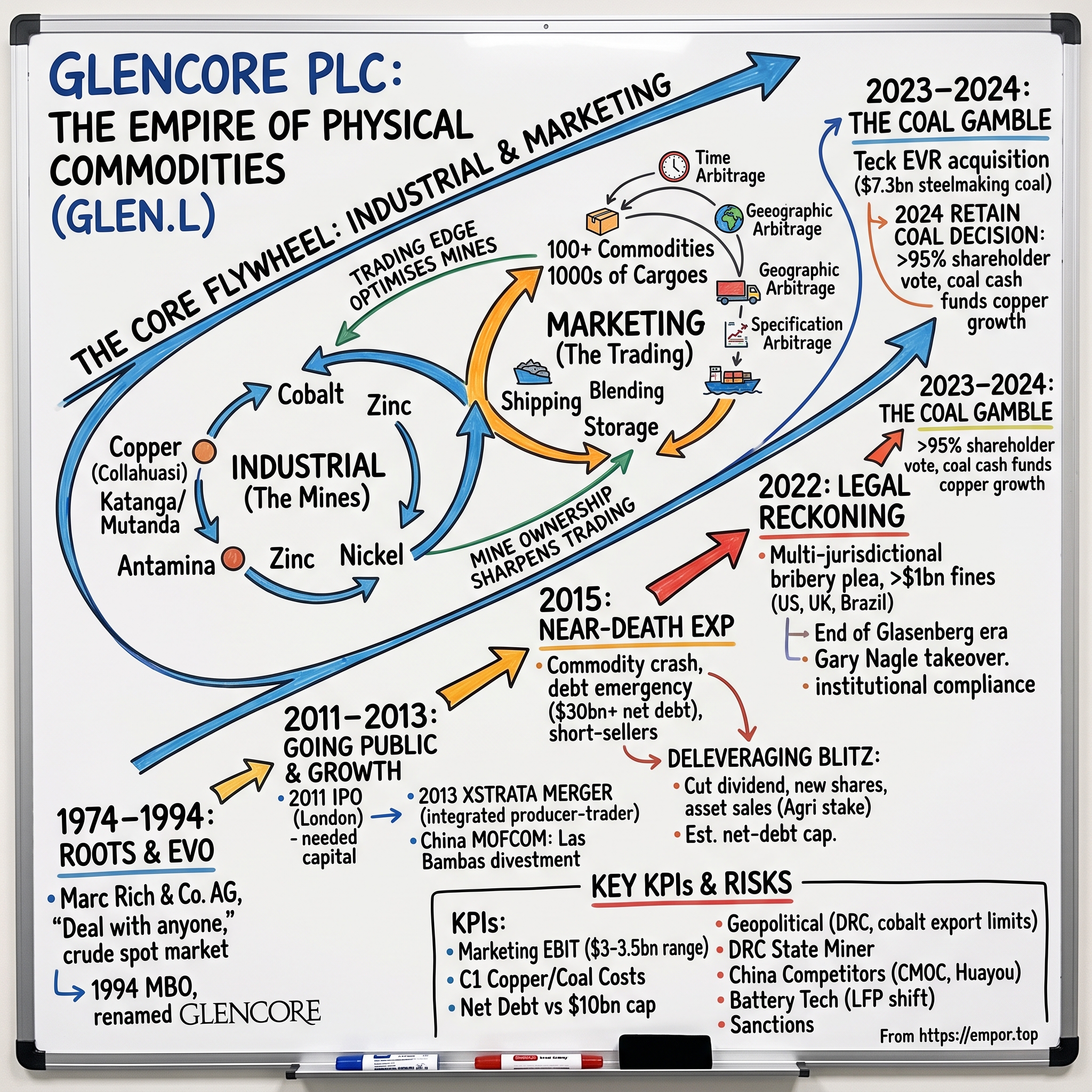
Glencore plc: The Empire of Physical Commodities
I. Introduction & Episode Roadmap
Somewhere on the open ocean tonight, a bulk carrier chartered by Glencore is steaming toward a Chinese port with a hold full of coal that was mined in Australia, blended to a buyer's exact specification, financed against a bank letter of credit, and hedged on a futures screen in Baar, Switzerland — all before the vessel ever left harbour. Multiply that by roughly one hundred physical commodities, thousands of cargoes, a fleet of chartered ships, storage tanks, blending yards, smelters, and mines on five continents, and you begin to see the machine. Glencore does not simply dig things out of the ground. It moves the physical world's raw materials from where they are cheap and abundant to where they are dear and scarce, and it collects a margin at every seam.
Glencore plc trades on the London Stock Exchange under the ticker GLEN.L. It is one of the largest natural-resources companies on Earth, a group whose revenue runs into the hundreds of billions of dollars and whose reach spans copper, cobalt, zinc, nickel, thermal and metallurgical coal, oil, and the agricultural and metal trading desks that sit atop them. But the revenue figure is almost a distraction. What makes Glencore genuinely unusual is its structure: it is two very different businesses fused into one balance sheet. On one side sits an Industrial portfolio — the mines and smelters that produce the physical tonnes. On the other sits a Marketing division — the trading house, descended directly from Marc Rich's original oil-trading outfit, that buys, blends, ships, and sells raw materials for third parties and for Glencore itself. The company likes to describe the relationship between the two as a flywheel, each side feeding the other. Whether that flywheel is a durable competitive advantage or a marketing metaphor is one of the questions this story exists to test.
Here is the central tension. Glencore is, on paper, one of the best-positioned companies in the world for the energy transition. It owns Tier-1 copper deposits — copper being the metal that wires every electric vehicle, every data centre, and every grid upgrade — and it aims to grow copper output toward roughly 1.6 million tonnes by 2035.8 Yet it funds that copper future with the cash flows of thermal coal, the single most ESG-toxic commodity in the investment universe. It is a company that pleaded guilty to bribery on two continents, paid out more than a billion dollars in fines, and then, two years later, asked its shareholders whether it should keep the dirtiest part of its portfolio — and its shareholders emphatically said yes. So which is it? Is Glencore the ultimate cash-flow machine for decarbonisation, quietly funding the copper build-out of the future with the unloved coal cash flows of the present? Or is it a structurally discounted stock, permanently marked down by ESG capital flight, governance scars, and the political risk of operating where cleaner peers will not?
This is a story that resists an easy answer, and the honest version requires holding both possibilities at once. Over the next several sections we will walk the arc:
First, roots and metamorphosis — how a company literally born from a fugitive commodities trader's playbook became a FTSE-100 giant, from Marc Rich's 1974 founding through the 1994 management buyout, the 2011 London flotation, and the transformative merger with the miner Xstrata in 2013.
Second, the near-death experience — the 2015 commodity crash that nearly broke the balance sheet, the debt emergency that had short-sellers calling Glencore the "Lehman Brothers of commodities," and the financial re-engineering that followed.
Third, the legal reckoning — the multi-jurisdictional bribery settlements of 2022, the end of the founder-trader era under Ivan Glasenberg, and the handover to Gary Nagle.
Fourth, the coal-and-copper gamble — the acquisition of Teck's steelmaking coal business and the extraordinary 2024 decision to keep coal rather than spin it off, backed by a shareholder vote that told management, in effect, to stop apologising and start compounding.
And finally, the economic dissection — unit economics, the competitive war-game against pure miners like BHP and Rio Tinto and private trading houses like Trafigura and Vitol, the strategy frameworks that explain where the moat is real and where it is thin, and the bull and bear cases as a genuinely skeptical investor would frame them.
Let's begin where every good origin story begins: with an outsider who refused to play by the rules.
 Subscribe on LinkedIn
II. Roots & Evolution: From Rogue Trader to Public Giant (1974–2013)
In 1974, a Belgian-born, Bolivia-and-New-York-raised trader named Marc Rich walked out of the venerable commodities firm Philipp Brothers, taking his colleague Pincus Green and a Rolodex of contacts with him, and set up shop in the quiet Swiss canton town of Baar. The firm was called Marc Rich & Co. AG, and its founding idea was audacious in its simplicity: create a genuine spot market for crude oil. Until then, oil moved largely under long-term contracts controlled by the great state monopolies and the majors. Rich's insight was that if you were willing to deal with anyone, price aggressively, take physical delivery, and move barrels wherever the arbitrage pointed, you could insert yourself as the market-maker between producers who needed to sell and refiners who needed to buy.
That willingness to "deal with anyone" is both the origin of Glencore's DNA and the origin of its lifelong reputational problem. Rich traded through the 1979 oil shock, dealt with revolutionary Iran, apartheid-era South Africa, and a long list of counterparties that made Western governments uncomfortable. In 1983, U.S. prosecutors indicted him on charges including tax evasion and trading with Iran during the hostage crisis; he fled to Switzerland and spent the next seventeen years on the run from American justice, famously receiving a controversial presidential pardon from Bill Clinton on the last day of his term in January 2001. But strip away the courtroom drama and what Rich built was a machine for physical arbitrage — the practice of profiting from price differences across three dimensions: geography (the same metal is worth more in Shanghai than in Zambia), time (buy now, store, sell later when the curve rewards it), and specification (blend a cheap high-sulphur cargo with a premium low-sulphur one to hit a buyer's exact grade). Those three arbitrages remain the intellectual core of Glencore's trading business to this day.
The turning point came in 1993–94. Rich had over-extended the firm in a disastrous attempt to corner the zinc market and lost a fortune; his partners, sensing mortal danger and weary of their founder's toxic legal shadow, forced him out. In 1994, a group of senior trading executives bought the business from Rich in a management buyout and rechristened it Glencore — a compression of Global Energy, Commodities and Resources. The rename was more than cosmetic. It severed the company, at least in name, from its fugitive founder and installed a new operating philosophy: an intensely meritocratic, secretive, employee-owned partnership in which traders were paid like owners because they were owners. Profit was recycled into equity; the biggest producers ran their own books with enormous autonomy; and the culture prized aggression, frugality, and results over pedigree.
The man who would come to personify that culture was Ivan Glasenberg, a South African former competitive race-walker with an accountant's discipline and a legendarily spartan lifestyle. Glasenberg joined the coal desk in 1984, rose through the ranks by out-hustling everyone around him, and became chief executive in 2002. He was famous for arriving at the office before dawn, for a near-total absence of corporate frills, and for a personal fortune that he kept overwhelmingly in Glencore shares — a signal that when he made decisions, he was risking his own net worth alongside the firm's. Under Glasenberg, Glencore's partnership model reached the limits of what private capital could support. And that limit is what drove the single most consequential decision of the company's modern history.
The problem was structural. Physical commodity trading is enormously capital-hungry. To finance a cargo of copper worth tens of millions of dollars, a trader needs bank credit lines; to secure those lines cheaply, the firm needs a large, permanent equity cushion; and to grow into owning the infrastructure that makes trading more profitable — the ports, the smelters, the mines — it needs even more. A private partnership funds its equity out of retained profits and departing partners' cashed-out stakes, which creates a permanent tension: every dollar paid out to a retiring trader is a dollar that leaves the balance sheet. By 2011, Glencore had outgrown the model. So in May 2011, the secretive Swiss partnership did the thing it had spent forty years avoiding: it went public, floating on the London Stock Exchange with a secondary listing in Hong Kong at a valuation of roughly $60 billion. The initial public offering was one of the largest London had ever seen and instantly minted a cohort of new paper billionaires among the partners.
The IPO resolved the capital problem and created a new one. A public company answers to index funds, pension trustees, proxy advisers, and the full apparatus of ESG accountability — a jarring transition for a firm whose entire competitive edge had been built on speed, discretion, and a comfort with jurisdictions that public investors would rather not think about. Glencore had traded the freedom of the partnership for the permanent capital of the public market, and it would spend the next fifteen years learning to live with that bargain.
With fresh equity in hand, Glasenberg moved almost immediately to consummate the deal he had wanted for years: a full merger with Xstrata, the Anglo-Swiss mining group that Glencore already partly owned and whose coal, copper, zinc, and nickel mines fed Glencore's trading desks. The logic was to fuse Xstrata's world-class industrial assets with Glencore's global marketing grid, creating a single integrated producer-trader with visibility into both ends of the supply chain. After a bruising, drawn-out battle over price and management control — Qatar's sovereign wealth fund, a major Xstrata holder, extracted a richer exchange ratio — the merger completed on 2 May 2013, creating an entity worth roughly $80–90 billion and present in more than thirty countries.12 Glasenberg emerged with total operational control; Xstrata's more traditional corporate culture and its cost overhead were systematically stripped out and replaced with Glencore's ruthless owner-operator ethos.
There was a price of admission the deal makers had not fully anticipated: antitrust. Because the combined group would control a large slice of the world's traded zinc and copper, regulators scrutinised it closely, and it was China's Ministry of Commerce — 商务部 MOFCOM — that extracted the most consequential concession. To win Chinese clearance, Glencore agreed to divest the enormous Las Bambas copper project in Peru. In 2014 it sold Las Bambas to a consortium led by the Chinese miner MMG Ltd for roughly $5.85 billion, with the completed transaction valued at close to $7 billion once development costs were reimbursed.13 It was a striking illustration of how central China had become to the commodities world — a Swiss-British merger reshaped by a Beijing regulator, with a marquee Peruvian mine handed to a Chinese buyer as the toll. Glencore had become a public, integrated behemoth. What it had not yet learned was how fragile that behemoth could be when the commodity cycle turned against it. That lesson arrived in 2015, and it nearly killed the company.
III. The Near-Death Experience & The Legal Reckoning (2015–2022)
In September 2015, a piece of research from Investec landed on trading desks across London with the force of a fire alarm. It argued that if commodity prices stayed where they were, Glencore's equity could be worth almost nothing — that the company's mountain of debt would swallow the entire enterprise. Within days the shares were in freefall. On a single day in late September, the stock lost nearly a third of its value. Credit-default-swap spreads — the market's price for insuring Glencore's debt against default — blew out to distressed levels. Short-sellers piled in, and a nickname began circulating that captured the panic perfectly: the "Lehman Brothers of commodities." For a company that lived and died on the confidence of its lenders — remember, trading is financed with borrowed money against bank credit lines — a crisis of confidence was not a stock-price problem. It was potentially fatal.
The mechanics of the near-death experience were brutally simple. Glencore had carried enormous net debt out of the Xstrata merger, roughly $30 billion, on the bet that commodity prices would stay elevated. Instead they collapsed. Copper fell below $2.00 a pound; thermal coal, one of Glencore's biggest earners, plunged; and the entire complex — from oil to zinc — deflated together as China's investment-led growth slowed. Suddenly the cash flows meant to service the debt shrank while the debt stayed fixed, and the ratings agencies started circling. A downgrade to junk would have raised Glencore's borrowing costs across its trading book precisely when it could least afford it, a doom loop that could have frozen the company out of the credit markets it depended on to function.
What happened next is genuinely one of the more impressive corporate turnarounds of the decade, and it revealed something about Glasenberg and his long-time chief financial officer, Steven Kalmin: when cornered, they moved with a speed that a slower, more consensus-bound company could never have matched. The response was a deleveraging blitz. Glencore scrapped its dividend, sold roughly $2.5 billion of new shares — with the partners and management buying a large chunk themselves, a deliberate signal of skin in the game — and launched a sweeping asset-sale programme aimed at cutting net debt by around $10 billion.[^16] The centrepiece of the asset sales was agriculture. Glencore sold a 40% stake in its agricultural arm, Glencore Agri (built around the Canadian grain giant Viterra), to the Canada Pension Plan Investment Board for $2.5 billion, a deal that valued the whole agricultural business at $6.25 billion; it later sold a further slice to British Columbia Investment Management, taking outside ownership to roughly half and raising over $3 billion in total from the unit.14 The company had monetised a crown jewel to save the whole.
The most important legacy of 2015, though, was not any single asset sale. It was a philosophy. Out of the trauma came a hard rule that would govern Glencore's capital allocation for the next decade: a net-debt ceiling, initially targeted around $10 billion and later managed within a $10–16 billion band depending on where the cycle sat. The idea was to build a balance sheet that could survive the next crash without a fire sale — to be a forced buyer, not a forced seller, at the bottom of the cycle. It is a discipline the company still invokes today, and as we will see, it is the single most important number an investor can watch, because everything above the ceiling flows back to shareholders and everything below it constrains their returns.
Just as the balance-sheet crisis receded, a slower-moving and in some ways more damaging reckoning was gathering. For years, investigators in multiple countries had been pulling at the threads of how Glencore actually won business in the world's hardest jurisdictions. The answer, it turned out, was often bribery. In May 2022, Glencore pleaded guilty in the United States to a decade of corruption. According to the U.S. Department of Justice, between 2007 and 2018 the company paid bribes to officials in Nigeria, Cameroon, Ivory Coast, Equatorial Guinea, the Democratic Republic of Congo, Venezuela, and Brazil, and separately ran a scheme to manipulate fuel-oil benchmark prices. Glencore agreed to pay more than $1.1 billion to U.S. authorities — including a criminal fine of roughly $428 million and forfeiture and disgorgement of about $272 million on the bribery counts, plus penalties on the market-manipulation case — and to submit to an independent compliance monitor for three years.5 In November 2022, a London judge ordered the company to pay £280 million following the U.K. Serious Fraud Office's prosecution, and Glencore reached a further settlement with Brazilian authorities.[^6]
It is worth pausing on what these settlements actually represented, because it is easy to file them away as a one-time cost. The bribery was not the work of a rogue subsidiary; the DOJ described a corporate culture in which paying off officials was a normalised cost of doing business in the pursuit of oil cargoes and mining concessions.5 That is precisely the shadow of the Marc Rich playbook — deal with anyone, win at any cost — surviving into the public-company era. For investors, the fines were the smaller problem. The larger one was the confirmation that Glencore's edge in difficult jurisdictions had been, at least in part, an illegal edge, and the open question of whether a genuinely compliant Glencore could still out-compete rivals in the DRC and West Africa without it.
These two crises — the financial and the legal — bracketed the end of an era. Ivan Glasenberg, who had run the company for nearly two decades and personified its buccaneering culture, stepped down as chief executive in mid-2021, handing the reins to Gary Nagle, a fellow South African and twenty-one-year Glencore veteran who had run the coal business. The chairmanship passed to Kalidas Madhavpeddi, an experienced mining executive brought in to strengthen board independence. On paper it was a smooth succession; in substance it was a generational handover from the founder-traders to a management class that would have to institutionalise compliance, replace legacy country managers, and separate the commercial hunger of the trading floor from the governance oversight that public markets now demanded. Whether that cultural surgery has truly taken, or whether the old instincts still lurk beneath a compliance veneer, is a question every serious Glencore investor should keep asking. The place to look for the answer is in the economics of the business itself — where the money actually comes from, and how durable those cash flows really are.
IV. The Core Business: Segment Economics & The Dual-Flywheel Model
To understand Glencore, forget the income statement for a moment and picture two engines bolted to a single chassis. The first engine is Industrial — the mines and smelters. The second is Marketing — the trading desks. They run on different fuels, spin at different speeds, and fail in different ways, and the whole investment case rests on the claim that bolting them together produces something better than either could alone.
Start with the Industrial engine, because it is where the bulk of the profits live. In a typical year, the mining and smelting assets generate somewhere between 70% and 80% of group EBITDA, and within that, two commodities dominate the story: copper and coal. Copper is the growth thesis. Glencore owns stakes in some of the best copper assets on the planet — a 44% interest in the vast Collahuasi mine in Chile, a third of Antamina in Peru, and the Katanga and Mutanda operations in the Democratic Republic of Congo, which also make Glencore one of the world's largest producers of cobalt, the battery metal that rides along as a by-product of Congolese copper. Copper is the metal the entire electrified economy is built on: an electric vehicle uses several times the copper of a petrol car, a data centre is a copper-hungry beast, and every wind turbine and grid upgrade demands more of it. Glencore's bet is that the world is structurally short of new copper supply and that owning low-cost, long-life copper is owning a call option on decarbonisation itself.
Coal is the other half — and it is the paradox at the heart of the company. Thermal coal (burned for power) and, since 2024, metallurgical or "steelmaking" coal (used to make steel) together function as Glencore's cash-generation engine, capable of throwing off between $4 billion and $8 billion of EBITDA in strong years and, in the extraordinary energy-price spikes of 2022, considerably more. Here is the counter-intuitive truth that governs Glencore's entire strategy: the most unfashionable, ESG-toxic, capital-starved commodity in its portfolio is often its single biggest source of cash. Because banks won't finance new coal mines and rivals are racing to divest, coal supply is constrained, prices stay firm, and the incumbents who keep their mines running enjoy fat margins with almost no competition for new projects. Glencore's coal assets span Australian open-cut operations, the wholly-owned Cerrejón mine in Colombia, and — as of 2024 — the newly acquired steelmaking coal mines in Canada. Around this sit the secondary industrial businesses: zinc (Kidd in Canada, McArthur River in Australia) and nickel (Murrin Murrin, the Integrated Nickel Operations), which add scale and feed Glencore's smelters but are not, on their own, the reason to own the stock.
Now the second engine: Marketing. This is the direct descendant of Marc Rich's trading floor, and it typically contributes the remaining 20–30% of group EBITDA. Glencore trades over a hundred distinct physical commodities, and the division has long guided to a "normalised" Adjusted EBIT of roughly $3.0–3.5 billion a year — a figure management treats as a through-cycle floor rather than a ceiling. In 2024, Marketing delivered $3.2 billion of Adjusted EBIT, landing at the top of that guided range even in a softer price environment.1 The importance of that number is subtle but enormous: trading profits are supposed to be counter-cyclical or at least cycle-indifferent. When commodity prices crash and the mines bleed, volatility rises, dislocations multiply, and a well-run trading desk can actually make more money — buying distressed cargoes, exploiting blown-out spreads, and providing liquidity when no one else will. If that holds, Marketing is the shock absorber that keeps group cash flow from collapsing at the bottom of the cycle. If it doesn't — if trading profits turn out to be correlated with mining profits after all — then the diversification is illusory and the two engines are really one.
This brings us to the celebrated dual-flywheel claim, which deserves genuine scrutiny rather than reflexive acceptance. The story management tells runs in two directions. First, mine ownership sharpens the trading edge: because Glencore physically operates mines, smelters, and logistics, its traders see real-world data — shipping bottlenecks, smelter treatment charges, ore-grade shifts, inventory build-ups — days or weeks before that information reaches public markets. In a business where an information advantage of even a few hours can be worth millions, owning the physical assets is like having a private weather station in a market that trades on the forecast. Second, the trading edge optimises the mines: the marketing team secures premium off-take terms, blends lower-value ore into saleable product, optimises freight, and provides a guaranteed buyer during down-cycles, which can keep a marginal mine open through a trough that would force a standalone miner to shut it.
Does the flywheel actually spin? The honest answer is: partially, and it is hard to prove from the outside. The informational advantage is plausible and consistent with why trading houses have historically bought physical assets, but Glencore does not disclose segment data granular enough to isolate exactly how much incremental profit the integration generates. A skeptic would note that Trafigura and Vitol run world-class trading books with far fewer owned mines, which suggests that captive assets are helpful but not strictly necessary to trade well. The fairest reading is that the flywheel is real at the margin — it lowers the cost and raises the quality of information and off-take — but that Glencore's marketing edge rests at least as much on the sheer scale and density of its logistics network as on mine ownership per se. The integration is an advantage; it is probably not the unique, unassailable advantage the pitch implies.
Set against the competition, the picture sharpens. Against the pure-play miners — BHP Group, Rio Tinto, Vale, Anglo American — Glencore's trading desk is a genuine differentiator: it provides a layer of margin and cash flow that a company with only spot-price exposure to its own tonnes simply does not have. Yet Glencore persistently trades at a valuation discount to BHP and Rio, and the reasons are not mysterious: its coal weighting scares off ESG-constrained capital, its jurisdictions (DRC, Colombia, Kazakhstan) carry more political risk, and its governance history still lingers. Against the private trading houses — Trafigura, Vitol, Mercuria, Gunvor — the comparison flips: Glencore has permanent public equity, access to capital markets, and a stable of captive mega-mines, whereas the privates depend heavily on syndicated bank credit and own comparatively few production assets. Glencore, in short, is the only major player that sits squarely at the intersection of both worlds — which is either its greatest strength or the reason the market can never quite decide what multiple to pay for it.
One small but strategically interesting corner deserves a passing mention, precisely because it is small: recycling and battery metals. Glencore runs electronic-scrap recycling through operations like Kidd and has struck circular-economy partnerships aimed at recovering metals from spent batteries. Today this contributes well under 5% of earnings — a rounding error against copper and coal. But it is a cheap option on a world where recycled metal becomes a meaningful share of supply, and it lets Glencore position itself, at least rhetorically, as a steward of the metals loop rather than merely an extractor. For now, though, it is optionality, not substance. The substance — and the boldest strategic bet of the Nagle era — is what Glencore did with coal in 2024, and it is where the story gets genuinely contentious.
V. Strategic Turning Point: The Teck EVR Deal & The Coal Retain Decision
For a company that had spent years telling investors it would gradually run down its coal mines and let the world's most controversial fuel quietly deplete, what Glencore did in late 2023 was jarring: it bought more coal. On 13 November 2023, Glencore agreed to acquire the steelmaking coal business of the Canadian miner Teck Resources — a set of low-cost metallurgical coal mines in British Columbia's Elk Valley, packaged as Elk Valley Resources, or EVR. The headline was a $6.93 billion cash payment for a 77% interest, implying an enterprise value of roughly $9 billion for the whole business; Teck ultimately received total cash proceeds of about $7.3 billion.34 After clearing a national-security review under the Investment Canada Act, the deal closed on 11 July 2024, with commitments to preserve jobs and maintain Canadian leadership as conditions of approval.11
Why buy metallurgical coal — and why now? The strategic logic is worth unpacking because it is more defensible than the ESG headlines suggested. Steelmaking coal is not thermal coal. It is not burned for electricity; it is an essential input to the blast-furnace process that makes the overwhelming majority of the world's steel, and there is no scaled, economic substitute available today. Green-steel technologies exist, but they are years to decades from displacing conventional steelmaking at scale. So metallurgical coal is, in effect, a commodity with resilient long-term demand, constrained new supply (nobody is financing greenfield coal mines), and — in EVR's case — a genuinely low-cost, high-margin resource base. Bolting EVR's tonnes onto Glencore's global coal-trading grid meant the company could market that coal into Asian steelmakers more profitably than Teck could alone. On a pure cash-return basis, it was a classic Glencore move: buy a cash-gushing asset that everyone else is too squeamish to own, precisely because their squeamishness keeps the price attractive.
But the acquisition created an immediate and very public problem, because it collided with a promise. Glencore's stated plan had been to combine its existing thermal coal assets with EVR and then spin the whole thing off as a separately listed coal company — a "CoalCo" — leaving the remaining Glencore as a cleaner "CleanCo" built around copper and transition metals. The theory was seductive to the ESG crowd: separate the dirty from the clean, and the market would re-rate the copper business to the premium multiple enjoyed by "green" miners while the coal business found its own natural owners. It was, in essence, a financial-engineering bet that the sum of the parts was worth more than the whole because ESG capital would pay up for the clean half.
Then, in August 2024, Glencore did something that stunned the market: it cancelled the spin-off. After consulting shareholders representing an estimated two-thirds of eligible voting shares, management reported that over 95% of those who expressed a preference wanted the company to retain the coal and carbon-steel-materials business rather than demerge it.210 Chairman Kalidas Madhavpeddi framed the reversal in the plainest possible terms: following extensive consultation, the board concluded that retention offered "the lowest-risk pathway to creating value for Glencore shareholders today."2 The dirty business was staying.
The economic rationale behind the shareholder vote is the most revealing part of the entire episode, because it exposes a gap between how ESG-minded capital says the world should work and how cash-focused owners actually behave. Shareholders looked at the numbers and reached a conclusion that management's original spin-off plan had underweighted: coal's cash flow is more valuable inside Glencore than outside it. Retained, coal's multi-billion-dollar annual EBITDA can be recycled directly into funding high-return copper growth projects — the MARA project in Argentina, Elida in Peru, the Collahuasi expansion in Chile — without diluting shareholders by issuing equity. Spun off, that same coal business would carry a higher standalone cost of capital (few banks and even fewer equity investors want to fund a pure coal play), would likely trade at a depressed multiple, and would sever the cash pipeline that could fund copper. In other words, the shareholders performed a cold capital-allocation calculation and decided that the ESG-optics benefit of "going clean" was worth less than the hard cash of keeping coal and using it as an internal bank.
Now for the harder, less flattering question — the one a neutral analyst has to ask. Was this pragmatic value creation, or was it an unprincipled ESG flip-flop? Both readings have merit, and an honest account holds them in tension. In the company's favour: the decision was backed by hard data from actual owners, not by management fiat, and the underlying capital-allocation math genuinely favours retention. Using coal cash to self-fund copper growth is defensible, arguably even elegant. Against the company: Glencore had spent years cultivating an ESG-friendly demerger narrative to appease exactly the institutional investors it was now overruling, and the reversal handed critics fresh evidence that its climate commitments bend to whatever maximises near-term cash. The "responsible depletion" framing — the idea that Glencore will run its coal mines down responsibly over time while funding decarbonisation — is a genuine commitment on paper, but it is also precisely the kind of narrative that is easy to assert and hard to verify, and it now has to survive the awkward fact that the company just spent $7 billion increasing its coal exposure. Management's credibility on this file will ultimately be judged not by the elegance of the 2024 pitch but by whether the copper growth it promised actually materialises. And that puts the spotlight squarely on the people now running the company and the framework they use to allocate its cash.
VI. Current Management, Capital Allocation, & Investor Dialogue
When Gary Nagle steps up to present results, the contrast with his predecessor is instructive. Where Glasenberg was the buccaneering founder-trader who kept his fortune in the stock and ran the company on instinct and intimidation, Nagle is a company man — a chartered accountant by training, a South African who spent his entire career inside Glencore, running coal assets in South Africa, marketing in the United States, and the global coal business before ascending to the top job in July 2021. He is, by design, a steward rather than a swashbuckler, and his mandate has been to prove that a post-scandal, professionalised Glencore can still generate the returns of the old buccaneering one. Alongside him sits Steven Kalmin, the long-serving chief financial officer whose continuity across the 2015 crisis, the legal settlements, and the leadership handover has been a stabilising force — the keeper of the balance-sheet discipline that saved the company a decade ago. Chairman Kalidas Madhavpeddi rounds out the trio, brought in to lend the board the independence and mining-executive judgement that the founder era had lacked.
The way to judge this management team is not by its rhetoric but by its behaviour against its own promises, and here the compensation design offers a useful tell. Glencore has deliberately weighted executive incentives toward free cash flow per share, return on invested capital, and climate-transition milestones rather than raw production volume. That is a meaningful signal in a mining industry historically addicted to growth-for-growth's-sake — the "diworsification" trap where miners plough cash into low-return megaprojects to get bigger rather than richer. Tying pay to per-share cash flow and returns is the language of capital discipline. Whether it is honoured in practice is the test, and the record so far is genuinely mixed.
The capital-allocation framework itself is the clearest expression of what Glencore learned from 2015. It works like a waterfall. At the top sits the hard net-debt cap — managed around $10 billion in the ordinary course, temporarily flexed upward for a value-accretive acquisition like EVR with a stated priority to rapidly deleverage back down. Beneath the cap comes a base shareholder distribution — historically a roughly $1 billion floor from industrial cash flow, topped up by an additional payout tied to marketing cash generation. And then the crucial mechanism: any cash generated above the net-debt target is, in principle, automatically returned to shareholders, via buybacks or special distributions. The elegance of the design is that it turns the balance sheet into a self-regulating cash pump — deleverage to the cap, then hand everything above it back to owners. The discipline of the design is only as good as management's willingness to honour it when a tempting acquisition or a growth project beckons, which is exactly where the tension lives.
The numbers of the last two years show the framework under real-world strain. In full-year 2024, Glencore generated Adjusted EBITDA of $14.4 billion — down 16% on the prior year, dragged by lower thermal coal prices — with funds from operations of $10.5 billion and Marketing delivering that $3.2 billion of Adjusted EBIT.1 But the EVR acquisition pushed year-end net debt up to $11.2 billion, above the roughly $10 billion cap, which meant shareholder returns were dialled back to $1.9 billion while the priority shifted to paying down debt.1 That is the discipline working as designed — the cap constrained distributions rather than being quietly abandoned. The strain intensified into 2025: at the half-year, weaker coal prices and softer copper output pulled Adjusted EBITDA down to $5.4 billion, and net debt (including marketing lease liabilities) climbed to $14.5 billion, a net-debt-to-EBITDA ratio of about 1.08x.7 For a company whose entire identity is built on balance-sheet resilience, watching net debt drift well above the cap for consecutive periods is exactly the kind of thing a skeptical investor should track closely.
Then came the deleveraging that management had promised. Two events did the heavy lifting. First, in July 2025, the long-running saga of Glencore's agricultural stake finally resolved: the merger of Viterra with the American agribusiness giant Bunge closed in an $8.2 billion transaction, leaving Glencore with roughly a 16.4% stake in the enlarged Bunge and about $900 million in cash — surplus capital that Glencore immediately earmarked for a $1 billion share buyback.6 Second, a strong second half — copper production jumped by over 500 kilotonnes on improved ore grades — drove a sharp cash-flow recovery.8 By the time Glencore reported full-year 2025 results on 18 February 2026, Adjusted EBITDA had come in at $13.5 billion (down 6% on the year, but with a second half nearly 50% stronger than the first), and net debt excluding marketing leases had been pulled back to $10.2 billion — hovering right at the cap.8 Management recommended an aggregate cash distribution of 17 U.S. cents a share, about $2 billion, split between a base payout and a top-up underpinned by the value of its Bunge shares.8 The self-regulating cash pump, in other words, sputtered under the weight of the coal acquisition and then steadied — a real-time stress test of whether the discipline holds when the cycle turns.
The most useful window into how management actually thinks, though, is the analyst Q&A, where prepared optimism meets pointed questions. Three themes recur on Glencore's calls, and they map neatly onto the genuine soft spots in the story. The first is copper production: analysts have repeatedly pressed management on guidance cuts and cost inflation, particularly at Katanga and Mutanda in the DRC and across the Chilean assets, because the entire bull case depends on copper volumes actually growing rather than perennially disappointing. The second is DRC geopolitical risk — questions about royalty structures, the relationship with the Congolese state miner Gécamines, and periodic cobalt export restrictions that can swing the market. The third, now resolved, was the drawn-out Bunge-Viterra approval process. A fourth, more existential question surfaced through 2025: whether Glencore should even remain listed in London. Management confirmed it had conducted a thorough review of moving its primary listing to New York — chasing the higher valuations and deeper capital pools of U.S. markets — and concluded in February 2026 that a move "would not be value accretive," keeping the London listing while flagging around $1 billion of targeted cost savings from an operational review.9 For UK capital markets, bruised by years of companies defecting to New York, it was a rare vote of confidence. For Glencore watchers, it was a reminder that even the company's listing is treated as a capital-allocation decision to be optimised, not a matter of loyalty.
Having mapped how the money is made and returned, the final task is to stress-test the moat itself — to ask, with the cold eye of a strategy analyst, where Glencore's advantages are genuinely durable and where they are cyclical, unproven, or merely rhetorical.
VII. Strategic Frameworks: Hamilton Helmer's 7 Powers & Porter's 5 Forces
Strip a company of its narrative and its share price, and what remains is the structural question: what, exactly, stops a competitor from doing the same thing and competing away the profits? Hamilton Helmer's 7 Powers framework is a disciplined way to answer it, and applied honestly to Glencore, it yields a nuanced verdict — some real powers, some overstated ones.
The most defensible power is scale economies, tightly coupled with what Helmer calls process power. Glencore's marketing division operates a global physical logistics grid of extraordinary density: chartered vessels, storage tanks, blending yards, off-take agreements, and smelter relationships spanning the planet. The economics of this network improve as volume flows through it — the marginal cost of trading one more cargo across an existing grid is low, and the fixed infrastructure and relationships are expensive and slow for a rival to replicate. A new entrant cannot simply buy this; it accretes over decades of relationships, credit lines, and institutional know-how about how to blend a Colombian coal with an Australian one to hit a Japanese utility's spec. This is the closest thing Glencore has to a genuine, durable moat, and it is why the trading business has held its $3+ billion earnings floor across wildly different price environments.
The most interesting power — and the most double-edged — is counter-positioning. Glencore has historically been willing to own assets and trade in complex, high-risk, Tier-2 and Tier-3 jurisdictions — DRC cobalt, Kazakh zinc, Colombian coal — where conservative, ESG-constrained majors like BHP and Rio Tinto will not tread. Their reluctance is not incompetence; it is a deliberate strategic choice driven by their own investor bases and risk appetites, and that is precisely what makes it counter-positioning: BHP cannot easily copy Glencore without alienating the very shareholders who prize its cleanliness. The catch, of course, is that this power was, in part, historically enforced through the illegal conduct the company just paid over a billion dollars to settle. The open question is whether a fully compliant Glencore can still win in those jurisdictions on legitimate terms alone. If it can, counter-positioning is a durable edge; if the edge was really the willingness to pay bribes, then the moat was draining even before the fines were paid.
The third plausible power is a cornered resource — control of genuinely scarce, low-cost, long-life deposits: Tier-1 copper and cobalt in the African Copperbelt, prime metallurgical coal in Canada and Australia. Owning an orebody that competitors cannot replicate at a comparable cost is a real advantage, though it is worth being precise: this is a power shared, in kind, by every major miner. It is a reason Glencore is a great mining company, not a reason it is uniquely advantaged versus other great mining companies. The powers Glencore conspicuously lacks are the ones that command premium multiples elsewhere: it has no branding power (copper is copper), no network effects in the consumer sense, and limited switching costs — commodities are, almost by definition, substitutable and transparently priced.
Porter's Five Forces fills in the competitive terrain. The threat of new entrants is very low: building a Tier-1 mining-and-trading business requires billions in capital, specialised credit facilities that take decades of relationships to secure, and multi-decade sovereign concessions that are not for sale. The bargaining power of buyers is moderate — most commodities trade against transparent global benchmarks (the LME for metals, API-indexed coal), which caps pricing power, but Glencore claws back premium realisations through custom blending and just-in-time physical delivery to buyers like 中国宝武 China Baowu Steel Group, the world's largest steelmaker, who will pay for reliability and exact specification. The bargaining power of suppliers is moderate-to-high, and here "suppliers" mostly means host governments: resource-nationalist states in the DRC, Zambia, and Colombia wield sovereign power to raise royalties, impose export limits, and renegotiate terms, a risk Glencore mitigates through local infrastructure investment and multi-commodity diversification but can never eliminate. And the intensity of rivalry is high — Glencore competes against both the great miners and the great trading houses simultaneously — though its unique position at the intersection of the two is precisely what keeps rivals from dislodging it in any single arena.
The framework verdict, then, is neither the triumphalist "unassailable moat" of the bull pitch nor the dismissive "it's just a cyclical miner" of the bear. Glencore has one genuinely rare structural advantage — the scale and density of its integrated trading-and-logistics network — layered on top of a collection of good-but-replicable mining assets and a jurisdictional edge whose legitimacy is now under a microscope. That is a real business with a real moat around part of it, which is exactly why the investment debate is so evenly matched.
VIII. Risk Radar, Bull vs. Bear Case, & Key Investor KPIs
Every Glencore investor is really placing a bet on how a specific set of risks resolves, so it is worth naming them precisely rather than gesturing at "commodity risk" in the abstract. The sharpest risks are geopolitical. In the DRC — the source of much of Glencore's copper and nearly all of its cobalt — the government has repeatedly raised royalties, restricted cobalt exports to prop up prices, and asserted the leverage of the state miner Gécamines. Glencore competes there directly against aggressive Chinese operators like 洛阳钼业 CMOC Group and 华友钴业 Huayou Cobalt, who have poured capital into Congolese cobalt and, at times, flooded the market and crushed the price. A second, more historical exposure is sanctions: Glencore has carried legacy equity and commercial ties to Russian resource entities, including the aluminium producer 俄铝 RUSAL and its parent En+ Group, relationships that demand careful compliance navigation in a post-2022 sanctions world. A third risk is technological: the rapid adoption of lithium-iron-phosphate (LFP) batteries, which use no cobalt, has already softened cobalt demand intensity and could structurally cap the value of Glencore's cobalt by-product. And a fourth is regulatory: having operated under a compliance monitor following the 2022 settlements, Glencore faces real penalties if it stumbles again — a second offence would be far more damaging than the first, both legally and reputationally.
With the risks named, the two sides of the trade come into focus. The bear case is coherent and should not be dismissed. It holds that Glencore is structurally "un-investable" for a large and growing pool of European and institutional capital because of thermal coal, trapping its valuation at a persistent discount — often cited at 30–40% — to cleaner peers like BHP and Rio Tinto, a discount that no amount of cash generation can fully close because the marginal ESG-constrained buyer is simply not allowed to own the stock. Layer on operational disappointment — copper guidance cuts, DRC cost inflation, the risk that the promised copper growth keeps slipping to the right — and the bear sees a company that generates cash but whose multiple is permanently capped and whose growth engine underdelivers. The 2024 decision to keep and even expand coal, on this view, locked in the discount for a generation.
The bull case is equally coherent and inverts every one of those points. It holds that Glencore is the ultimate energy-transition arbitrage: the coal division functions as a high-yield annuity, spinning off cash that funds organic copper expansion toward 1.5 million-plus tonnes a year without diluting shareholders, while the marketing division provides a $3 billion-plus earnings floor that cushions the whole enterprise through any recession. On this view, the ESG discount is not a permanent curse but a gift to the remaining shareholders — it keeps the share price low so that buybacks retire more stock per dollar, and it keeps rivals from bidding up the coal and DRC assets that Glencore is happy to own. The bull argues that cash, compounded and returned, eventually overwhelms multiple compression, and that in a decade the copper will be the story and the coal will have quietly funded it.
Notice that both cases largely agree on the facts — abundant coal cash, a real ESG discount, copper growth ambitions, DRC risk — and disagree only on which force wins. That is what makes Glencore such a clean test of an investor's own priors. It is also why the discipline of watching a small number of hard metrics matters more here than in most companies, because those metrics are what will adjudicate the debate over time.
Three KPIs matter above all others, and an investor who tracks only these will understand the business better than one who drowns in the full results deck.
First, Marketing Adjusted EBIT. This is the durability test for the trading moat. As long as it holds within or above the guided $3.0–3.5 billion range through the cycle — as it did at $3.2 billion in 20241 — the claim that the trading network is a structural, cycle-resistant advantage remains intact. If it falls durably below that floor, the entire diversification thesis weakens, because it would mean trading profits are more correlated with mining profits than management claims.
Second, industrial C1 cash costs for copper and coal. "C1 cash cost" is the direct cost of pulling a tonne of metal out of the ground and getting it to market, before capital and financing charges — think of it as the mine's break-even at the operating level. What matters is Glencore's position on the global cost curve: assets in the first (lowest-cost) quartile keep generating cash even when prices crash and higher-cost rivals are forced to shut. First-quartile costs are what let a miner survive — and buy — at the bottom of the cycle. Cost inflation that pushes Glencore's copper up the curve would be an early warning that the low-cost advantage is eroding.
Third, net debt versus the roughly $10 billion cap. This is the single most actionable number, because it is a direct switch governing shareholder returns. Below the cap, excess cash flows back to owners via buybacks and special distributions; above it — as after the EVR deal, when net debt sat at $11.2 billion in 2024 before being pulled back toward $10.2 billion by end-202518 — distributions are throttled while the company deleverages. Watching net debt track against that ceiling tells an investor, in near-real-time, whether the next dollar of cash is heading into their pocket or into the balance sheet. These three numbers, tracked over successive results, are how the abstract bull-versus-bear debate gets settled in concrete terms.
IX. Epilogue & Key Business Lessons
Step back from the fines, the flywheel, and the coal vote, and Glencore's real lesson is about the strange durability of a very old idea. Marc Rich's original insight — that whoever controls the physical movement of a commodity, and sees the supply chain from the inside, holds an information advantage over everyone trading on the screen — turned out to be robust enough to survive a fugitive founder, a management buyout, a public listing, a near-death debt crisis, and a billion-dollar bribery reckoning. The specific power that Glencore has monetised for fifty years is the fusion of physical asset control with market-clearing information, and it remains the one part of the business that is genuinely hard to copy.
The 2024 coal decision offers a second, more uncomfortable lesson about the gap between what capital markets say and what owners do. Glencore spent years constructing an ESG-friendly demerger narrative, and when it finally put the question to its actual shareholders, they chose cash over optics by an overwhelming margin. A neutral observer can read this two ways at once — as pragmatic capital allocation that refused to sacrifice billions in value for a public-relations upgrade, and as evidence that the company's climate commitments were always negotiable. Both are true. What the episode really demonstrated is that in commodities, where the product is undifferentiated and the discipline is cash, the owners who focus on cash flow tend, eventually, to get their way.
The transition from rogue oil trader to public steward of transition metals is, structurally, complete: the compliance monitors, the professionalised board, the per-share incentive design, and the disciplined net-debt cap are all in place. But structure is not the same as proof. The next decade will be decided by execution on the two things the current strategy actually promises — growing copper volumes toward the 1.6-million-tonne ambition and returning excess cash without abandoning the discipline that saved the company in 2015. If copper grows and the cash keeps flowing back, the bulls will have been right that the ESG discount was a gift. If copper keeps disappointing and the discount never closes, the bears will have been right that some businesses are priced where they are for reasons that cash alone cannot fix. Glencore has spent fifty years being underestimated and occasionally overestimated; the honest conclusion is that it remains, as it has always been, a machine for turning the physical world's dislocations into cash — and the only open question is how much of that cash ends up in shareholders' hands.
References
-
Retention of the coal and carbon steel materials business — Glencore plc, 2024-08-07 ↩↩
-
Acquisition of a 77% interest in Teck's steelmaking coal business for US$6.93bn — Glencore plc, 2023-11-14 ↩
-
Teck sells steelmaking coal unit to Glencore for $7.3 billion — Reuters, 2023-11-14 ↩
-
Glencore Entered Guilty Pleas to Foreign Bribery and Market Manipulation Schemes — US Department of Justice, 2022-05-24 ↩↩
-
Closing of Viterra/Bunge Merger — Glencore plc, 2025-07-02 ↩
-
Glencore rejects US listing in boost for UK markets — Reuters via Mining.com, 2026-02-18 ↩
-
Glencore decides against coal spinoff after talking to investors — CNBC, 2024-08-07 ↩
-
Glencore Completes Acquisition of Elk Valley Resources Steelmaking Coal Business — Glencore plc, 2024-07-11 ↩
-
Announcement of Merger Completion (Glencore Xstrata) — Glencore plc, 2013-05-02 ↩
-
Completion of the Sale of Las Bambas Copper Mine Project — Glencore plc, 2014-08-01 ↩
-
Sale of 40% stake in Glencore Agricultural Products and creation of long-term partnership with CPPIB — Glencore plc, 2016 ↩
 LinkedIn
 WhatsApp
 Reddit
 Hacker News
 Email
Email Kindle
 RSS Feed
 Spotify
 Apple Podcasts
 Amazon Music
 Audible
 YouTube