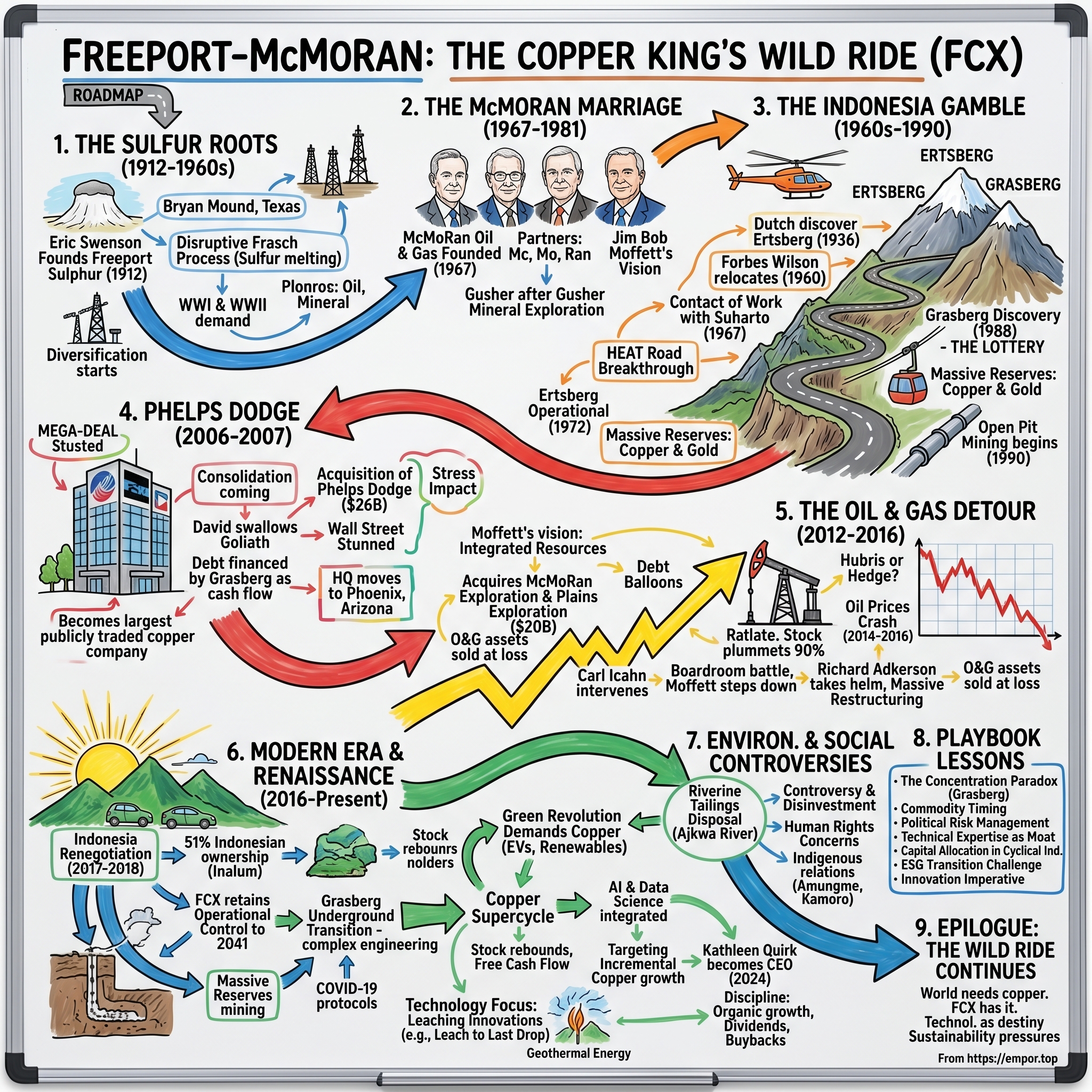
Freeport-McMoRan: The Copper King's Wild Ride
I. Introduction & Episode Roadmap
At 14,000 feet above the Arafura Sea in the Sudirman Range of Indonesian Papua, an open-pit mine carved into the flank of a mountain sacred to the local Amungme people grew so large it became visible from orbit. For three decades, haul trucks the size of two-story houses navigated its switchbacks in thin, freezing air. Then, in 2019, surface mining stopped. The ore body extended deeper into the mountain, forcing the operator to transition entirely underground, constructing a complex subterranean network of caverns and conveyors while maintaining continuous production.
That mine is Grasberg. The company is Freeport-McMoRan, and its trajectory spans a century of transformation: a 1912 startup in Freeport, Texas, extracting sulfur from Gulf Coast salt domes with superheated water, eventually came to control the largest recoverable gold deposit on Earth and become the world's largest publicly traded copper producer.
The investment thesis for Freeport in 2026 appears straightforward, which is precisely why it warrants scrutiny. Copper is the primary physical conduit of electrification—essential for electric vehicles, power grid modernization, transformers, electric motors, and artificial intelligence data centers. Freeport offers public market investors one of the purest equity exposures to that demand profile, a narrative promoted by management, echoed by sell-side analysts, and reflected in the stock's valuation multiple.
Yet Freeport's historical record shows a business far more complex than a simple macro proxy. The company has repeatedly surrendered equity and economic control of its premier asset under sovereign pressure, destroyed approximately $20 billion in shareholder capital during an ill-timed oil and gas expansion at the peak of the energy cycle, required activist intervention to force capital discipline, and in September 2025 watched its crown-jewel underground mine fill with 800,000 tonnes of wet mud, killing workers and vaporizing a year of production guidance.1
The central analytical questions facing the business extend beyond long-term copper demand:
The asset-versus-allocation paradox. Freeport has controlled one of the world's premier orebodies for nearly four decades. Has ownership of a world-class resource consistently generated superior long-term returns, or has it primarily funded expensive management ambitions during commodity cycle peaks?
Resource nationalism as a structural cost, not a headline risk. Freeport previously ceded majority ownership of Grasberg to the Indonesian state, and in 2026 agreed to cede additional equity. How much of the long-term economics of a world-class deposit actually accrues to public shareholders versus host governments?
The technology optionality. Freeport's "Leach to the Last Drop" program aims to extract hundreds of millions of pounds of copper annually from previously mined waste rock at a fraction of greenfield development costs. While technically promising, mining innovations often face execution hurdles. What is the company's track record of converting technical targets into commercial output?
The leadership handoff. Following two decades of dealmaking and diplomatic negotiations under former chief executive Richard Adkerson, longtime chief financial officer Kathleen Quirk took the helm. Does her leadership represent a fundamental strategic pivot toward capital discipline, or a continuation of established doctrine?
The path from Texas sulfur domes to Papuan glaciers and Arizona leach pads runs through the Ertsberg discovery, the Grasberg bonanza, the Phelps Dodge consolidation, the oil and gas expansion, Indonesian equity divestments, and the Quirk-era operational rebuild. Understanding Freeport's modern investment outlook requires examining these pivotal milestones, particularly the events unfolding since 2012.
 Subscribe on LinkedIn
II. From Sulfur Domes to Indonesian Glaciers: Freeport's DNA (1912–1990)
The origin story is not glamorous. It is sulfur.
In 1912, Eric Pierson Swenson founded the Freeport Sulphur Company on the Texas Gulf Coast, building the enterprise around the Frasch process. Engineers drilled into salt domes, injected superheated water to melt the sulfur underground, and forced the liquid to the surface with compressed air. Rather than digging and hauling physical ore, the technique altered the chemistry in place—establishing an operational mindset that foreshadowed Freeport's century-later leaching initiatives on Arizona copper dumps.
Sulfur built the balance sheet; geology built the company's reputation. That trajectory took shape with a Dutch geologist on a remote Pacific mountain.
The mountain that was made of ore
In 1936, Dutch geologist Jean Jacques Dozy joined an expedition to the Carstensz peaks in Dutch New Guinea. Trekking through equatorial jungle up to mountain glaciers, Dozy surveyed an outcrop so heavily mineralized it required little interpretation. He named it Ertsberg—"Ore Mountain"—and filed a report. But after the Netherlands was invaded during World War II and the Dutch colonial administration collapsed, the document sat unread in a Hague library for more than two decades.
In 1960, Freeport geologist Forbes Wilson set out to verify the discovery. What followed became mining lore: a helicopter drop into coastal swamps followed by a grueling trek through dense jungle and up near-vertical rock to reach the deposit. Ertsberg was a massive copper outcrop sitting above the clouds at 12,000 feet, four days' walk from civilization, in a territory locked in a sovereignty dispute between the Netherlands and Indonesia.
Freeport waited. In 1967, with President Suharto newly in power and eager for foreign capital, Indonesia signed its first Foreign Capital Investment Contract of Work—with Freeport as the counterparty. Freeport did not enter an established legal framework for foreign mining; it became the precedent. Its operational rights stemmed from a specific regime during a window of political vulnerability—a bargain that future Indonesian governments would come to view as an inherited concession rather than a permanent entitlement.
Engineering the impossible
Developing Ertsberg required constructing 74 miles of road from coastal swamps to the highlands, suspending a 1.2-mile aerial tramway across a deep gorge, and establishing the mountain town of Tembagapura ("Copper Town") in a previously uninhabited area. Crews operated at high altitude where weather shifts rapidly and atmosphere carries roughly 60% of sea-level oxygen.
This achievement illustrates a key element of Freeport's competitive moat. Grasberg's primary defense has never been a patent or brand, but decades of accumulated, specialized knowledge required to execute large-scale mining in extreme terrain. That institutional capability remains real—and helps explain why the Indonesian state retained Freeport as operator even after acquiring majority ownership.
The McMoRan marriage, and Jim Bob
In 1981, Freeport merged with McMoRan Oil & Gas, named after co-founders W.K. McWilliams, James R. "Jim Bob" Moffett, and B.M. Rankin. The deal brought Moffett into executive leadership.
A Texas geologist and former college football player, Moffett ran the company with the aggressive style of an oil wildcatter. He cultivated political leaders and operated on the core conviction that geology dictated corporate destiny: find enough high-grade ore, and financial outcomes would take care of themselves. That doctrine delivered extraordinary returns in the 1980s and 1990s, but nearly bankrupted the company three decades later.
Testing the founding myth
The simplified narrative of Freeport's early Papuan operations emphasizes how a Western mining company introduced roads, schools, medical facilities, and wages to an isolated region.
The historical evidence presents a more complicated reality. The 1967 Contract of Work was negotiated exclusively with Jakarta, bypassing the customary land rights of the indigenous Amungme and Kamoro peoples. Milling operations discharged mine tailings directly into the Ajkwa river system, turning a natural floodplain into a designated deposition area under environmental standards that would not pass regulatory scrutiny today. Furthermore, security arrangements with Indonesian military forces in a region marked by active separatist conflict triggered decades of human rights allegations and subsequent financial disclosure mandates regarding security payments. Low-intensity conflict and road attacks became persistent operational realities.
The analytical significance lies not in moral evaluation, but in strategic consequences. The social license deficit created during these initial decades handed Indonesian negotiators structural leverage in later contract talks. When Jakarta eventually sought to renegotiate ownership terms, it drew upon deeply rooted local grievances embedded in the initial bargain. A mining company whose primary asset rests on contested territory, under terms that excluded the local population, operates with less long-term leverage than its reserve statements suggest.
That vulnerability surfaced sharply once the deposit next door proved to be even larger.
III. Finding Grasberg & The Imperial Age of Jim Bob Moffett (1988–2006)
By the late 1980s, the Ertsberg deposit was approaching exhaustion. The mountain that had justified a road, a town, an aerial tramway, and two decades of capital investment was nearing the end of its economic life. Freeport faced a fundamental mining dilemma: substantial sunk infrastructure, a depleting orebody, and no obvious replacement.
Company geologists continued exploration drilling. Approximately three kilometers from the original discovery sat an unremarkable feature the Dutch had labeled Grasberg—"Grass Mountain"—for its grassy surface. In 1988, drill cores revealed that the hill was the eroded vent of an ancient volcano filled with high-grade copper and gold.
What Grasberg actually was
Grasberg was not merely an incremental addition to reserves; it represented a premier tier of global deposits. Sitting near the surface in close proximity to existing transport infrastructure, it contained the largest recoverable gold deposit and one of the largest copper deposits ever identified.
The gold mineralization was the key economic variable. Because mining companies report net cash costs after deducting byproduct revenue, gold sales offset a substantial portion of Grasberg's operating expenses. For extended periods, net cash costs per pound of copper ran near zero or dipped negative, effectively allowing the copper to be extracted as pure margin.
This dynamic underpinned Freeport's reputation as a low-cost producer. Rather than superior operational efficiency, the low-cost structure derived from an extraordinary geological anomaly under a single concession. In business strategy terms, Grasberg represented a classic "Cornered Resource"—preferential control of a unique asset on highly favorable terms. The durability of those terms, however, would prove to be the critical vulnerability over the next three decades.
The HEAT road
To operate Grasberg as an open pit, Freeport needed to transport heavy machinery—including massive shovels, haul trucks, and drills—to the summit. Because the aerial tramway lacked the requisite capacity, the company constructed the Heavy Equipment Access Trail (HEAT road), a switchback access route carved into the mountainside that allowed heavy equipment to reach an elevation of 14,000 feet. Open-pit production commenced in 1990.
The HEAT road reflected the operational ethos of the Moffett era: engineering solutions applied to extreme physical challenges. The corporate culture emphasized aggressive exploration, heavy financial leverage, and a conviction that operational hurdles could be overcome through sheer resolve. While this approach unlocked Grasberg, it also established a pattern of reliance on debt to fund corporate expansion.
The imperial style
Throughout the 1990s, Moffett managed Freeport's Indonesian presence through political channels alongside engineering operations, cultivating close ties with President Suharto's administration. Freeport built local infrastructure and community development programs while growing into one of Indonesia's largest corporate taxpayers. Mill throughput expanded steadily across the decade, funded by accumulating corporate debt.
For much of the decade, the strategy generated strong financial performance. Even during periods of depressed copper prices, Grasberg's gold credits sustained profitability, making Freeport equity a favored vehicle for investors seeking leveraged exposure to a commodity cycle recovery.
Testing the "unassailable titan" claim
The narrative to examine is whether Grasberg rendered Freeport immune to external shocks during the 1990s.
Historical evidence refutes this premise. Concentrating the vast majority of corporate cash flow in a single asset located within a single developing nation created a concentrated sovereign risk rather than invulnerability. When the Asian financial crisis triggered the fall of the Suharto regime in 1998, Freeport's political standing altered rapidly. The successor government in Jakarta felt no allegiance to the 1967 concession terms. Scrutiny of Freeport's environmental practices, inquiries into security payments, demands for contract renegotiation, and heightened local friction in Papua coincided with a sharp decline in global copper prices.
The analytical lesson is not that Grasberg lacked operational excellence; it remained one of the premier mineral deposits globally. Rather, high asset quality cannot substitute for jurisdictional diversification, as the primary existential risk to a mining enterprise is often contractual rather than geological. Physical deposits are stationary; concession terms remain subject to political authority.
Freeport's executive leadership absorbed this structural lesson, subsequently pursuing strategic diversification at a time when market valuations for asset breadth reached historic peaks.
IV. The Phelps Dodge Mega-Deal: Building the Copper King (2006–2011)
By 2006, copper prices had surged. Rapid industrial expansion in China consumed global metal supplies faster than producers could respond, driving a commodity that had spent the 1990s trading under a dollar a pound to historic highs. Mining chief executives who had spent a decade conserving capital suddenly held substantial cash reserves and faced market pressure to deploy them.
Freeport's answer arrived in November 2006 with the largest transaction in corporate history: a roughly $26 billion acquisition of Phelps Dodge Corporation, the Phoenix-based copper house that had been mining in the American Southwest since the 1830s.7
The deal
The consideration was $88.00 in cash plus 0.67 Freeport shares for each Phelps Dodge share — a heavily cash-weighted structure that required substantial new debt.7 The strategic rationale was direct. In a single transaction, Freeport acquired major North American mining operations, including Morenci, Bagdad, Safford, and Sierrita, alongside South American assets such as Cerro Verde in Peru and El Abra in Chile, instantly becoming the world's largest publicly traded copper producer.
The counterparty presented a notable historical contrast. Phelps Dodge was one of the oldest industrial enterprises in the United States, having navigated the early twentieth-century Arizona copper conflicts, the Great Depression, and more than a century of commodity cycles. It was acquired by a company whose domestic footprint consisted primarily of a New Orleans headquarters and its legacy sulfur operations.
Was it a good deal?
Evaluating the transaction depends heavily on the analytical time horizon.
From a valuation and timing perspective, Freeport paid roughly seven to eight times trailing EBITDA for assets whose earnings reflected peak-cycle copper prices—a classic mining M&A risk of applying standard multiples to unsustainable peak earnings. The financial consequences emerged rapidly. When the 2008 global financial crisis hit, copper prices collapsed. Layering acquisition debt onto cyclical earnings pushed Freeport's equity to market extremes, with its share price dropping from above $60 to below $10. To repair the balance sheet, management suspended the common stock dividend and issued new equity, demonstrating that balance sheet strength was maintained by urgent crisis response rather than permanent capital conservatism.
On strategic grounds, however, the transaction addressed Grasberg's core vulnerability. It established a large operating base across the United States and the Americas—jurisdictions backed by established legal systems, defined property rights, and low risk of sovereign equity demands. The acquisition diluted the political risk concentration in Indonesia that had nearly broken the enterprise in 1998. Furthermore, assets like Morenci and Cerro Verde proved to be durable, expandable operations that remain core pillars of the portfolio two decades later.
The calibrated assessment: the Phelps Dodge acquisition was strategically correct and tactically expensive. Executed near a cycle peak with high leverage, the deal imposed heavy costs on shareholders during the 2008–2009 downturn. Over a twenty-year horizon, however, the underlying assets validated the strategic rationale. The outcome highlighted a recurring pattern: Freeport's management demonstrated clear foresight in identifying necessary strategic assets, but weaker discipline in timing their purchase—a dynamic that would repeat, with greater financial consequence, within six years.
The Adkerson-Quirk operating system
Integration of the combined enterprise was directed by Richard C. Adkerson, who became chief executive officer in 2003, working alongside Kathleen L. Quirk as chief financial officer. A former Arthur Andersen partner turned mining executive, Adkerson brought a deliberate, technical public style that contrasted with Moffett's wildcatting approach, focusing earnings calls on unit costs and mine sequencing. Quirk, who joined Freeport in the late 1980s, established the company's financial architecture: standardized reporting of net cash costs, mine-by-mine capital frameworks, and a systematic deleveraging playbook that stabilized the enterprise following 2008.
This operational partnership defined the modern company. Adkerson managed sovereign relationships and capital markets while Quirk directed balance sheet strategy, providing the discipline required to navigate the 2008 downturn.
That discipline was tested six years later when Freeport expanded into oil and gas.
V. The $20 Billion Oil & Gas Folly: Capital Allocation Disaster & The Icahn Intervention (2012–2016)
On the morning of December 5, 2012, Freeport shareholders learned that the copper company had agreed to buy two oil and gas businesses.8
The market reaction was immediate: Freeport's stock fell sharply. Investors who had bought into a pure-play copper producer were suddenly holding deepwater Gulf of Mexico and California onshore oil assets, wrapped in a related-party transaction structure that raised immediate governance concerns.
The transaction
Freeport agreed to acquire Plains Exploration & Production Company for roughly $6.9 billion and McMoRan Exploration Company for roughly $3.4 billion. Including assumed debt, the total transaction value exceeded $20 billion.8 The deals closed in mid-2013, with crude oil trading above $100 per barrel.
Management's stated rationale centered on diversification: energy and copper cash flows would offset each other, broaden capital allocation options, and allow Freeport's larger balance sheet to fund energy developments that standalone firms could not support.
Testing the diversification thesis against the record
Within thirty months, almost every premise of that strategy failed a basic stress test.
Cycle timing. The acquisition occurred near a multi-year peak in crude prices. By late 2014, OPEC declined to defend oil prices, sending West Texas Intermediate into a collapse that reached $30 per barrel in early 2016. Rather than offsetting the copper cycle, oil amplified the downturn as copper prices fell simultaneously. Diversifying into a second cyclical commodity that tracks global industrial growth did not reduce risk; it doubled the company's commodity exposure.
Leverage. Consolidated net debt expanded above $20 billion. For an enterprise whose earnings depend on two volatile commodity prices, such leverage turned equity value into a vulnerable option on commodity market timing.
Impairments. Freeport wrote off billions of dollars in asset values as energy prices plummeted, recording more than $4 billion in impairment charges in 2015 alone. These write-downs represented formal recognition that the acquisition prices had far exceeded the assets' underlying value.
Governance. The transaction structure highlighted severe conflicts of interest. Jim Bob Moffett served as chairman of Freeport while maintaining deep financial ties to McMoRan Exploration, a target in which Freeport already owned a stake. Furthermore, Plains Exploration was itself a major McMoRan Exploration shareholder. Shareholder litigation followed, alleging that the deal process failed to protect independent equity holders.
The empirical record refutes management's claims of capital discipline during this period. The oil and gas expansion demonstrated a failure of capital allocation strategy. The company acquired a correlated commodity at peak prices from a related party, loaded the balance sheet with debt, and erased a substantial portion of the equity value built up since 2008.
Enter Carl Icahn
In August 2015, activist investor Carl Icahn disclosed an 8.5% stake in Freeport.14 His thesis was straightforward: the energy division was an expensive distraction dragging down a valuable copper business.
Events moved rapidly. Icahn secured board seats, and oil and gas capital expenditures were curtailed. In December 2015, Jim Bob Moffett stepped down as chairman, ending his three-decade tenure following four months of activist pressure.
To repair the balance sheet, Freeport launched a series of asset sales. The company sold a 13% interest in the Morenci mine in Arizona to Sumitomo. More significantly, it sold its controlling stake in the Tenke Fungurume copper-cobalt mine in the Democratic Republic of Congo to China Molybdenum for $2.65 billion.10
The sale of Tenke Fungurume illustrated the permanent cost of distressed leverage. Tenke was a world-class copper and cobalt deposit located in what would soon become a critical supply hub for the electric vehicle battery industry. Forced by debt obligations to raise cash quickly, Freeport sold a premier asset at a depressed point in the cycle to a strategic Chinese buyer that subsequently extracted immense value. Debt-fueled mistakes strip management of strategic flexibility, forcing the sale of high-quality assets at unfavorable times.
The sequence reveals a clear dynamic: a peak-cycle energy transaction at $100 oil pushed net debt past $20 billion, triggering massive write-downs, attracting an activist investor, forcing out legacy leadership, and compelling asset sales at distressed valuations. The disciplined, copper-focused strategy that emerged was not a proactive management pivot—it was enforced by capital market necessity.
That restructuring set the stage for Freeport's next major challenge: a renewed sovereignty battle in Indonesia.
VI. The Indonesian Standoff & The 51% Surrender: Geopolitical Nationalism at Grasberg (2016–2019)
In 2017, Chief Executive Richard Adkerson made repeated trips between Phoenix and Jakarta, attempting to persuade an Indonesian government that had altered mining regulations to honor a fifty-year-old contract. He entered these negotiations with a balance sheet still recovering from the oil and gas expansion, while Jakarta held decisive leverage: the power to halt Freeport's copper concentrate exports.
The squeeze
Indonesia's mineral policy hardened in 2017 into a strict package of regulatory demands. Foreign Contract of Work holders were required to convert to a domestic permitting regime known as the IUPK, or Special Mining Business License. Operators had to commit to building domestic smelting facilities to ensure value-added processing occurred within Indonesia rather than in Japan, South Korea, or China. Crucially, foreign miners were required to divest majority equity to Indonesian entities.9
Freeport initially resisted in public. Adkerson argued that export bans violated the established Contract of Work and asserted that Freeport would defend its contractual rights through international arbitration. While legally sound, that stance provided little immediate leverage. As legal debates continued, copper concentrate accumulated in warehouses, forcing Freeport to curtail mine production. A mine blocked from shipping its output quickly turns into a heavy cost center with a massive payroll.
What Freeport actually signed
The settlement was agreed in principle in 2017 and finalized in December 2018.9[^18] The core terms restructured the ownership and operational framework of the mine:
Indonesian state holding company PT Mineral Industri Indonesia—then operating as PT Inalum and now known as MIND ID—acquired 51.23% of PT Freeport Indonesia, leaving Freeport with 48.77%.[^18] The Indonesian entity paid $3.85 billion, a sum that bought out Rio Tinto's long-standing joint venture participation rights in Grasberg alongside a portion of Freeport's economic interest.[^18] Freeport also committed to constructing a greenfield copper smelter in East Java—the Manyar smelter at Gresik, which ultimately became a roughly $3.7 billion project.11
In exchange, Freeport secured two critical terms: extended operating rights for the Grasberg district through 2041, and retained operational control and management of the mine.[^18]
Testing the cornered resource
The claim under test: controlling Grasberg provides Freeport with an unassailable, high-margin competitive moat.
The evidence significantly narrows that claim. Freeport did not lose operational management of Grasberg—it continues to consolidate PTFI's financial results and run day-to-day operations. However, the company permanently surrendered a majority economic interest in its flagship asset, not through competitive bidding or market displacement, but under sovereign pressure. Furthermore, Freeport was required to invest billions in a domestic smelter. Smelting is a low-margin, capital-intensive, highly competitive business; building a standalone facility in Indonesia rather than selling concentrate to established Asian smelters represented a value-destructive capital commitment. The smelter was not a commercial investment—it was regulatory rent.
That rent structure proved ongoing. In February 2026, Freeport and the Indonesian government signed a memorandum of understanding extending PTFI's mining rights from 2041 through 2061. In exchange, Freeport agreed to divest an additional 12% equity stake—bringing total Indonesian state ownership to roughly 63% by 2041—alongside a headline investment commitment of approximately $20 billion.56 Freeport secured twenty additional years of access to a world-class orebody, paying for the extension with another tranche of its equity.
The calibrated conclusion: Grasberg is a cornered resource for the Republic of Indonesia. Freeport is its operator and its minority-and-shrinking economic partner. The asset's competitive moat remains real, but a majority of its economic value accrues to the sovereign. Indonesian authorities have demonstrated across successive administrations in 1998, 2017, and 2026 that concession terms will be renegotiated whenever Freeport requires long-term operational certainty. This dynamic introduces a permanent structural discount to the asset's theoretical net present value.
The block cave
While contract negotiations unfolded, Freeport executed one of the most technically demanding engineering transitions in mining history. Open-pit operations at Grasberg concluded in 2019, after yielding approximately 27 billion pounds of copper and 46 million ounces of gold. Extracting the remaining ore required transitioning entirely to underground block caving.
In simple terms, block caving involves tunneling directly underneath a massive ore deposit, undercutting the rock base to undermine its support, and allowing gravity to fracture the orebody from below. The broken ore falls into collection funnels known as draw points, where automated systems load and transport it to the surface. While block caving is the most cost-effective method for extracting deep, large-scale orebodies, it carries high operational risk. Once fractures begin propagating through the rock mass, the process cannot be paused or redirected; engineers are effectively managing the continuous, controlled collapse of hundreds of millions of tonnes of rock deep underground.
Freeport constructed two major underground complexes—the Grasberg Block Cave and the Deep Mill Level Zone. By 2021, combined underground throughput exceeded 200,000 tonnes of ore per day, fully restoring district output. In engineering terms, scaling these underground operations represented a major technical capability.
Yet as events in late 2025 would demonstrate, block caving carries severe tail risks that traditional financial models failed to price.
VII. The Modern Engine: Segment Economics, Block Caving & Current Management under Kathleen Quirk (2020–Present)
On September 8, 2025, roughly 800,000 tonnes of wet muck surged into the Grasberg Block Cave, flooding multiple levels including critical service infrastructure.116 Freeport suspended operations the following day to conduct search and rescue operations. Workers were killed, the company declared force majeure on concentrate deliveries, and the largest single source of low-cost copper in the corporate portfolio halted production.16
The catastrophe reframed Freeport's operational posture in 2026. Chief Executive Officer Kathleen L. Quirk had taken the helm barely fifteen months before the disaster occurred.
The Quirk handoff
Kathleen L. Quirk became president and chief executive officer in June 2024, succeeding Richard Adkerson, who moved to executive chairman.[^17] The succession followed a deliberate transition: Quirk was appointed president in 2021 and stepped down from the chief financial officer role in 2022.
Her background is distinct among major mining chief executives, being entirely financial and entirely internal. After joining Freeport in the late 1980s, she served as CFO starting in 2003, directing financial architecture through the Phelps Dodge integration, the 2008 financial crisis, the oil and gas expansion, the Icahn activist intervention, and the Indonesian equity divestment. Quirk managed the balance sheet through two decades of major capital allocation decisions—and was subsequently charged with directing overall corporate strategy.
That background presents a dual analytical narrative. Proponents argue that Quirk possesses a firsthand understanding of Freeport's historical missteps, attributing the post-2016 balance sheet repair directly to her discipline. Skeptics note that continuity of leadership does not guarantee institutional change, as the financial executive who oversaw debt-backed oil acquisitions now evaluates multibillion-dollar mining developments. While recent capital management supports the disciplined narrative, long-term asset decisions in the mining sector require years to fully evaluate.
What the company actually is now
Freeport in 2026 operates across three distinct geographic segments, each carrying a unique financial profile.
Indonesia (PTFI/Grasberg) serves as the primary margin driver. Substantial gold byproduct credits lower net cash costs per pound of copper significantly below the rest of the portfolio—historically under one dollar per pound and occasionally dipping near zero. However, the operation remains majority-owned by the Indonesian state, bound by domestic smelting requirements, and subject to serious geotechnical vulnerabilities.
North America—comprising Morenci, Bagdad, Safford, Sierrita, Chino, and related sites—represents the largest domestic copper production network in the United States. Unit operating costs run higher than Grasberg's, around $2.50 per pound, reflecting lower ore grades and minimal gold byproduct credits. In return, the division provides political stability and direct exposure to U.S. copper prices, which have commanded a premium over global benchmarks during Section 232 trade policy discussions.
South America—anchored by Cerro Verde in Peru and El Abra in Chile—occupies a middle position regarding costs and political risk. Cerro Verde operates at immense scale, utilizing a massive concentrator facility to process low-grade ore economically through high throughput.
The relative contribution of these regions varies with metal prices and operating status. In typical production years, Indonesia and North America each generate roughly a third or more of total revenue, with South America contributing the remainder. Indonesia, however, generates a disproportionate share of operating profit, making its late-2025 outage particularly impactful.
The 2025–2026 damage, and how management handled it
Freeport's response to the Grasberg mud rush provides a measure of modern management execution.
The company quantified the operational impact rapidly. Unaffected areas in the district—including the Deep Mill Level Zone and Big Gossan mines—resumed output in late October 2025. By November, management published a detailed, phased restart timeline for the Grasberg Block Cave targeting the second quarter of 2026.4 Management revised Indonesian output expectations to approximately 1.0 billion pounds of copper and 0.9 million ounces of gold for 2026, compared to average annual projections of 1.6 billion pounds of copper and 1.3 million ounces of gold from 2027 through 2029.4 Providing explicit operational targets and recovery dates within two months of the incident established a clear baseline for market evaluation.
By the second quarter of 2026, operational recovery was underway. Freeport reported net income of $984 million on revenues of $7.0 billion, selling 710 million pounds of copper at an average realized price of $6.17 per pound and 123 thousand ounces of gold at $4,520 per ounce.2 Consolidated unit net cash costs averaged $1.97 per pound of copper, though this metric excluded $284 million in idle facility costs directly associated with the mud rush.2 Including those idle charges, quarterly operating costs were higher than headline metrics indicated, a condition reflected in management's full-year 2026 cost guidance of approximately $1.90 per pound.2
The corporate balance sheet reflected a notable departure from historical crisis conditions. Consolidated net debt stood at $2.1 billion—excluding downstream facility debt—supported by $4.1 billion in cash reserves.2 Rather than threatening solvency as high debt loads did in 2015, the 2025 disruption was absorbed without emergency asset sales. Freeport maintained its $0.15 quarterly common dividend and continued share repurchases throughout the recovery.2
What analysts are actually pushing on
Questions raised during the second-quarter 2026 investor conference call highlighted remaining operational and regulatory friction.3
Regarding the Grasberg ramp, analysts questioned why the mine exited June 2026 processing 69,000 tonnes per day when second-half guidance projected 60,000 to 65,000 tonnes daily. Management attributed the planned step-down to scheduled chute gallery maintenance, noting that wet draw points were successfully converting to dry conditions as cave activity progressed.3 Geotechnically, the transition from wet to dry draw points is critical, as controlling groundwater intrusion directly reduces the risk of future mud rushes.
Regarding the post-2041 license extension, management confirmed submitting a formal application in June 2026 and stated they were working to finalize terms by year-end, with Adkerson reporting constructive discussions with Indonesian officials.3 Although a preliminary memorandum of understanding was signed in February 2026, formalizing the twenty-year extension remains an ongoing regulatory process.
Regarding the Manyar smelter, operational execution faced early setbacks. Inaugurated in mid-2024 following a roughly $3.7 billion investment,11 the facility suffered a fire in October 2024, halting operations shortly after commissioning. The delay required Freeport to negotiate temporary export permits for concentrate originally slated for domestic processing, creating additional regulatory complexity around a capital-intensive project mandated by host country rules.
Regarding capital allocation, management reaffirmed its performance-based payout framework—returning up to 50% of available free cash flow through base dividends, variable dividends, and share buybacks—while continuing small share purchases in Cerro Verde.3 Since 2016, Freeport has prioritized low net debt, brownfield expansions, and capital returns over major corporate acquisitions. While this framework has persisted for a decade, its durability remains untested during an extended commodity price boom.
The growth Freeport is promising instead comes from an unglamorous place: waste rock in Arizona.
VIII. The Dark Horse: "Leach to the Last Drop" Technology & Organic Growth Optionality
A drive through southeastern Arizona reveals what appear to be flat-topped hills with unnaturally regular slopes. These are not natural formations; they are waste rock stockpiles accumulated over nearly a century by Freeport-McMoRan and its predecessor companies. Mining crews drilled, blasted, hauled, and stacked this rock after testing indicated its copper grade was too low for conventional smelting.
Yet those stockpiles contain immense mineral value. Freeport estimates that roughly 38 billion pounds of contained copper remain trapped in legacy dumps across its Arizona and New Mexico operations—material whose extraction, drilling, and haulage costs were paid generations ago.
To extract that metal, Freeport launched its "Leach to the Last Drop" initiative, representing one of the company's most promising organic growth opportunities outside its traditional mining pipeline.
How it works, in plain English
Conventional copper leaching is an established hydrometallurgical process: an acidic solution is sprayed over crushed ore, dissolving the copper as it trickles through the pile. The copper-rich solution drains from the base, allowing operators to extract pure metal cathodes via electrowinning on-site, bypassing smelting, concentrate production, and off-site shipping.
However, traditional leaching is inherently slow and incomplete. Acidic solutions follow paths of least resistance through rock piles, leaving large volumes of rock untouched. Over time, metal recovery plateaus, causing dumps to be retired with most of their copper still trapped inside.
Freeport's initiative reframes those abandoned dumps as active production targets rather than exhausted waste. The program addresses recovery bottlenecks through several targeted interventions: chemical additives alter liquid surface tension to reach previously bypassed rock; deep raffinate injection forces solution into the core of stockpiles; and elevated solution temperatures accelerate chemical reaction rates—an effort supported by a U.S. Department of Energy grant for geothermal heat applications at Freeport's Arizona operations.12 Additionally, machine learning algorithms analyze operating data to map unrecovered copper pockets, directing solutions precisely where metal remains.
In essence, the initiative shifts the operational model from passively soaking a rock pile to actively squeezing remaining value from it.
The economics, and why they are genuinely unusual
The primary appeal of this approach lies in its capital efficiency. Developing a conventional greenfield copper expansion producing several hundred million pounds annually requires billions of dollars and up to a decade of permitting and construction—evidenced by Freeport's own Bagdad expansion study, which carries an estimated capital cost of approximately $4.5 billion.3 In contrast, leaching legacy stockpiles avoids the need for new open pits, mine shafts, tailings facilities, or extensive environmental permits, as the rock has already been moved and primary leach infrastructure is largely in place. Incremental operating costs remain low because the most expensive operational phase—excavating and transporting the ore—was funded in prior decades.
Management has targeted an eventual annual run rate of 800 million pounds of copper for less than $1 billion in capital expenditure. If realized, that yield would rank among the most capital-efficient growth deployments in the global copper industry.
Testing the optionality claim
Evaluating management's targets requires scrutinizing conversion rates, as claims of technical breakthroughs unlocking stranded resources are common across the mining sector but rarely delivered in full.
To date, Freeport's leaching initiative has demonstrated tangible production gains rather than speculative targets. Incremental leach output expanded from roughly 50 million pounds in 2022 to an annualized run rate of approximately 200 million pounds by 2026. In the second quarter of 2026, the program contributed 47 million pounds, bringing total output across the first half of the year to 101 million pounds.3 This represents commercial metal sold into market channels at prevailing spot prices.
However, scaling from current production to broader corporate targets presents execution hurdles. Management has established a near-term goal of reaching a 300 million pound annual run rate by the end of 2026.3 Reaching the broader 800 million pound aspiration requires scaling technologies that remain in development stages. On the second-quarter 2026 investor call, management noted that "generation-two" chemical additives—reported to be significantly more effective than first-generation formulas—and thermal injection projects were only entering demonstration phase in the second half of 2026.3
Consequently, a calibrated assessment yields two distinct conclusions: the leaching initiative is confirmed as a real, low-capital source of incremental production up to current volumes, but its trajectory toward 800 million pounds remains unproven. The initial 200 million to 300 million pounds reflect demonstrated operational execution. The remaining 500 million pounds represent technical optionality carrying unpriced engineering risk. The key benchmark for investors will be near-term execution: if the annualized run rate fails to reach approximately 300 million pounds by the close of 2026, or if second-generation additives and thermal demonstrations fail to show scalable recovery gains during 2027, long-term production targets should be marked down rather than deferred.
What makes this program strategically significant is its underlying mechanism. While traditional copper expansions require navigating complex international politics, regulatory approvals, and multi-year buildouts, Freeport's leaching strategy relies on applying chemical innovation to rock the company already owns.
IX. The Playbook & Strategic Frameworks
Stripping the corporate narrative down to its underlying structure reveals durable questions about why Freeport-McMoRan earns what it does—and whether those returns can be sustained over full commodity cycles.
Seven Powers, honestly scored
Cornered Resource—strong, but shared. Grasberg remains geologically irreplaceable, with gold byproduct credits placing it at the bottom of the global cost curve. The critical qualification is ownership: a majority of the economic value belongs to the Indonesian state, with that equity share contracted to rise further. The benefit accruing to public shareholders depends on political terms that host authorities renegotiated twice in a single decade. The competitive power of the resource is real, but economic capture by equity holders is partial.
Scale Economies—strong and durable. Americas operations like Morenci and Cerro Verde process immense tonnages of low-grade ore. Profitability at low grades relies entirely on massive throughput and fixed-cost absorption. Smaller operators cannot economically mine similar orebodies. This advantage is operationally unglamorous, durable, and independent of host-government discretion.
Process Power—moderate to strong, with notable tail risks. Deep underground block caving at high elevation and proprietary leach chemistry represent technical capabilities that competitors cannot easily replicate. However, the September 2025 Grasberg mud rush served as a stark reminder that technical expertise in block caving mitigates operational risk rather than eliminating it. Engineering capabilities may reduce the frequency of catastrophic disruptions, but they do not eliminate their potential severity.
Counter-Positioning—weak, and frequently overstated. Freeport's market position as a pure-play copper producer provides investors with direct commodity exposure relative to diversified mining peers. However, pure-play status is a portfolio characteristic rather than a structural competitive advantage. Diversified peers such as BHP and Rio Tinto remain fully capable of competing in copper markets, supported by broader balance sheets that can lower their overall cost of capital. Pure-play exposure expands Freeport's valuation multiple during copper bull markets and compresses it during downturns, without lowering unit operating costs.
Branding, Network Effects, Switching Costs—absent. Refined copper cathode is a standardized commodity. Customers do not pay a premium for corporate origin or branding.
Five Forces, applied to a commodity
Buyer Power—structurally weak. Copper trades on major exchanges like the LME and COMEX at transparent global spot prices. No single customer negotiates custom pricing terms with Freeport, eliminating the customer concentration risk common among industrial suppliers.
Supplier Power—moderate and cyclical. Procurement costs for haul trucks, heavy tires, explosives, grinding media, and skilled labor inflate during commodity upcycles. Mine labor costs across Chile, Peru, and Arizona have remained stubbornly elevated. The primary supplier constraint, however, comes from host sovereigns that control mineral rights and dynamically adjust tax, equity, and regulatory requirements.
Threat of Substitutes—low, with specific limitations. Aluminum replaces copper in high-voltage transmission lines and select building applications when price spreads widen significantly. However, aluminum cannot easily substitute in electric motors, generator windings, or fine-gauge wiring where volume-specific conductivity is required. Consequently, material thrifting occurs at the margins, but structural displacement remains limited.
Threat of New Entrants—extremely low. High entry barriers define the copper sector. Permitting a major greenfield mine in a stable jurisdiction typically requires ten to fifteen years and billions of dollars, with projects frequently stalling over environmental or community opposition. With global ore grades declining for decades and tier-one discoveries becoming rare, the ultimate barrier to entry is not merely capital, but time and regulatory consent.
Industry Rivalry—moderate and non-price. Major producers like Codelco, BHP, Rio Tinto, Glencore, Anglo American, and Southern Copper compete for mineral deposits and technical talent rather than product pricing, as exchange-traded commodities prevent price undercutting. Competition centers on cost-curve placement and long-term project access. Freeport's cost position remains superior when Grasberg operates at full capacity, but aligns closer to industry averages when that facility experiences disruptions.
The spine: why Freeport wins, and what breaks it
The case for. Copper demand benefits from strong structural tailwinds. Power grid modernization across developed economies, vehicle electrification, and electrical infrastructure for artificial intelligence data centers consume copper at rates far exceeding historical projections.13 Supply responds slowly due to lengthy development timelines and falling ore grades. Freeport stands as the largest publicly traded producer, combining a low-cost cornerstone operation in Indonesia with an extensive domestic U.S. footprint and an organic expansion pipeline—including leaching initiatives, Bagdad, and El Abra—that avoids costly external acquisitions.15 Furthermore, net debt sits near historic lows, supported by a decade of operational consistency under executive leadership.
The case against. Every element of the positive investment thesis faces counterarguments rooted in Freeport's operating history. The flagship Grasberg operation is majority-owned by a sovereign government that has repeatedly renegotiated ownership terms, and the mine suffered a major operational failure in late 2025. The most capital-efficient element of the expansion pipeline relies on leaching technologies still undergoing commercial demonstration. Americas operating assets carry higher unit costs, leaving their margins vulnerable to shifts in domestic trade policy. Capital discipline was originally forced by activist intervention rather than management initiative, remaining untested through a prolonged commodity boom. Finally, long-term growth projections rely heavily on demand forecasts, despite an industry history where consensus estimates at cycle peaks frequently prove overoptimistic.
Reconciling these perspectives reveals the core analytical takeaway: Freeport's asset base is exceptionally high quality and difficult to replicate. Yet Freeport's claim on that asset base is more contingent than reserve tables suggest, and the company's history of converting good assets into shareholder returns remains mixed—defined by a decade of disciplined repair following a decade of severe capital destruction.
X. Risk Radar & Bear vs. Bull Stress Test
What would a skeptical investor—whether drafting a short thesis or an activist challenge—attack in Freeport's current valuation?
The bear construction
Resource nationalism is a recurring expense, not a tail risk. The February 2026 memorandum of understanding offers the clearest evidence.5 Freeport secured a necessary twenty-year extension, paying for it with an additional 12% equity divestment in PTFI alongside substantial long-term investment commitments.6 Skeptics argue that host government participation should not be modeled as a stable 48.77% economic interest expiring in 2041, but as a shrinking stake subject to periodic renegotiation that systematically transfers asset value to the host state. While Chile and Peru display milder variations through ongoing royalty and windfall-tax debates, Indonesia demonstrates the full dynamic. Consequently, equity markets may be capitalizing Grasberg's cash flows at multiples suitable for owned assets rather than for a sovereign-controlled operating concession.
Block caving carries fat-tailed operational risk. The late-2025 mud rush was not a minor operational pause; it resulted in fatalities, halted district output, and erased roughly 40% of planned annual production.4 The primary analytical concern is not annual recurrence, but the inherent risk profile of deep block caving in wet, seismically active ground—a distribution that standard corporate guidance cannot capture. Investors underwriting Grasberg's projected 2027 through 2029 average annual output of 1.6 billion pounds are effectively underwriting the complete absence of another catastrophic geotechnical failure.4
The smelter is a capital sink that also fails on its own terms. Freeport directed roughly $3.7 billion into a domestic facility mandated by host rules, which then suffered a fire one month after commissioning and forced management to negotiate temporary export permits.11 Skeptics question the underlying return on that $3.7 billion investment, noting that the 2026 extension agreement reportedly imposes further multibillion-dollar capital commitments.5 Mandated capital expenditures operate as an ongoing tax paid directly through the balance sheet.
Cost inflation is eroding the cost-curve story. Headline net cash costs of $1.97 per pound in the second quarter of 2026 excluded $284 million in idle facility charges.2 Non-GAAP metrics that omit recurring operational expenses warrant strict scrutiny. Given the stark divergence between Grasberg's sub-dollar operating costs and North America's $2.50-plus cost structure, consolidated cash costs function primarily as a mix statistic that fluctuates based on Indonesian throughput.
Demand concentration risk runs through China. While Western electrification narratives dominate market commentary, Chinese construction and power grid investments remain the primary drivers of marginal copper pricing. A prolonged slowdown in Chinese real estate that is not fully counterbalanced by EV and grid expansion would depress global copper prices, regardless of data center construction in Western markets.
The bull construction
The supply side is genuinely broken in the producers' favor. Declining ore grades, scarce tier-one discoveries, decade-long permitting timelines, and years of industry underinvestment in greenfield capacity constrain global copper supply.13 Unlike typical structural shortage claims, physical lead times enforce a hard constraint: a deposit not permitted today cannot deliver commercial metal by 2033. This structural asymmetry underpins the core thesis for owning established copper producers.
The leach program is a legitimately differentiated growth source. Unlocking meaningful production volume without permitting new open pits or building new concentrators is rare in the mining sector. Freeport has validated the initial stage of its leaching initiative by delivering physical copper cathodes into market channels rather than relying on speculative engineering models.3
Balance sheet resilience changes the option value of a downturn. With net debt standing at $2.1 billion against $4.1 billion in cash reserves, Freeport retains the financial flexibility to hold core assets through cyclical troughs or acquire distressed assets from leveraged competitors—a stark contrast to its vulnerable posture during the 2016 downturn.2 The forced sale of the Tenke Fungurume deposit in 2016 serves as a clear historical baseline for the true cost of balance-sheet fragility.
U.S. exposure is an underpriced policy asset. As the primary American copper producer possessing domestic smelting and refining infrastructure, Freeport remains positioned to capture regional pricing premiums created by trade policies. On the second-quarter 2026 call, management highlighted that domestic sales are priced off COMEX benchmarks, allowing the enterprise to capture tariff-driven price spreads.3 While subject to political shifts, domestic asset placement represents a distinct strategic advantage.
The three things actually worth tracking
Evaluating Freeport's trajectory requires focusing on three fundamental operational indicators rather than superficial quarterly noise.
1. Grasberg underground throughput and draw-point condition. Daily tonnage moving through the underground block cave serves as the primary metric determining whether the 2027 through 2029 production recovery remains achievable. The key qualitative indicator—the ratio of wet to dry draw points disclosed by management—offers a leading signal on geotechnical stability.3 Sustained throughput reaching pre-incident levels would confirm operational recovery, whereas a secondary mud-rush event would fundamentally undermine the Indonesian investment thesis.
2. Leach production run rate. The near-term benchmark centers on achieving an annualized run rate of approximately 300 million pounds by the close of 2026, followed by commercial validation of second-generation chemical additives and thermal injection in 2027.3 This trajectory provides a direct test of management's capability to convert internal technical innovations into profitable metal output.
3. Consolidated net cash cost per pound, read unadjusted. Investors should monitor unit cash costs including idle facility charges and related operational expenses rather than relying solely on headline figures. This comprehensive metric synthesizes Grasberg's operational uptime, gold byproduct credits, Americas cost inflation, and domestic smelting drag. When Grasberg operates smoothly and gold prices remain elevated, unadjusted unit costs compress; operational disruptions or cost pressures show up in this metric long before impacting reported net income.
Quarterly earnings per share, realized metal prices, and dividend distributions remain downstream of these three operational variables and the global copper price—a macroeconomic factor outside corporate control.
XI. Epilogue & "What's Next for FCX"
The choice facing Chief Executive Kathleen Quirk is unusually clean for a mining leader, which makes it unusually revealing.
One path is conventional: build the Bagdad expansion in Arizona. The project study carries an estimated capital cost of approximately $4.5 billion, and management has stated the economics work at a $4.00 per pound copper price alongside a $20.00 per pound molybdenum assumption—a claim that holds up only if capital costs stay on budget, which in mining historically they have not.3 Doubling output at a large Arizona site provides multi-decade production in a stable jurisdiction. Yet it also ties up billions in capital for years before yielding a single pound of metal, and Freeport's track record with major capital commitments near cycle peaks remains the weakest chapter of its corporate history.
The alternative path is less conventional: application of additional leach solution to rock stockpiled as far back as 1974, deploying a fraction of the capital to determine whether chemistry can accomplish what heavy construction cannot. If the leaching initiative achieves even the lower bound of its targets, it will generate more incremental copper than the Bagdad expansion for a fraction of the cost, without the associated permitting delays.
In practice, Freeport will likely pursue both, making the capital allocation split between them the most reliable indicator of corporate strategy. That ratio will show whether the capital discipline enforced after Carl Icahn's 2015 intervention has become an established institutional culture or merely a temporary operational posture while the balance sheet recovered.
A third scenario operates in the background. Freeport stands as the largest publicly traded pure-play copper producer precisely as diversified mining majors designate copper a strategic priority amid a wave of industry consolidation. A producer with an established U.S. asset base, a premier Indonesian resource, and a decade-long queue of potential suitors unable to discover comparable deposits presents a compelling acquisition target—with the critical caveat that any buyer would inherit a complex sovereign relationship in Indonesia that took Freeport six decades and two major equity divestments to navigate.
The broader significance of Freeport's narrative lies in its structural evolution. A Texas sulfur enterprise became a global copper producer through the chance discovery of a Dutch geologist's forgotten survey. It constructed one of history's premier mineral operations in remote Papuan highlands, then spent three decades discovering that host country sovereignty carries greater leverage than initial concession agreements. The enterprise nearly compromised its solvency through an ill-timed peak-cycle energy expansion, underwent activist-driven restructuring, repaired its balance sheet, surrendered majority ownership of its flagship deposit to preserve long-term operational rights, executed the industry's largest underground block-cave transition—and then managed through a fatal geotechnical failure in September 2025 to return the district to production.
The structural demand thesis for copper—driven by power grids, electric motors, and data center buildouts—remains compelling, yet represents the straightforward element of the investment analysis. The critical question posed by Freeport's operational history is behavioral: when commodity prices rise, cash reserves accumulate, and strategic ambitions expand, how will executive leadership allocate capital?
Corporate history shows different answers across different cycles. That allocation record remains the vital benchmark for evaluating Freeport's long-term outlook.
References
-
Freeport Provides Update on PT Freeport Indonesia Operations — Freeport-McMoRan, 2025-09-24 ↩↩
-
Freeport-McMoRan Inc. Form 10-Q for the quarter ended June 30, 2026 — U.S. SEC EDGAR ↩↩↩↩↩↩↩
-
Freeport-McMoRan Q2 2026 Earnings Call Transcript — Investing.com, 2026-07-23 ↩↩↩↩↩↩↩↩↩↩↩↩↩
-
Freeport Provides Update on Restart Plans for Grasberg Minerals District — Freeport-McMoRan, 2025-11-18 ↩↩↩↩
-
Indonesia – Freeport signs MoU to extend mining permit beyond 2041 — IDNFinancials, 2026-02 ↩↩↩
-
Analysis: Freeport divestment deal anchors Indonesia-US tariff negotiations — The Jakarta Post, 2026-03-03 ↩↩
-
Freeport-McMoRan Agrees to Acquire Phelps Dodge — The Wall Street Journal, 2006-11-19 ↩↩
-
Freeport-McMoRan to Buy Plains Exploration and McMoRan Exploration — Reuters, 2012-12-05 ↩↩
-
Freeport-McMoRan Reaches Deal With Indonesia Over Grasberg Mine Standoff — Reuters, 2017-08-29 ↩↩
-
Freeport-McMoRan Completes Sale of Tenke Fungurume Stake for $2.65 Billion — Bloomberg, 2016-11-17 ↩
-
PT Freeport Indonesia Opens $3.7 Billion Copper Smelter in Gresik — Reuters, 2024-06-27 ↩↩↩
-
U.S. Department of Energy Award for Freeport-McMoRan Geothermal Copper Leaching Project — U.S. Department of Energy, 2024-03-12 ↩
-
Global Copper Market Forecast & Production Statistics — International Copper Study Group ↩↩
-
Carl Icahn Schedule 13D Filing on Freeport-McMoRan — U.S. SEC EDGAR, 2015-08-27 ↩
-
Freeport-McMoRan eyes 60% US copper growth — Mining.com.au ↩
-
Freeport announces force majeure at Grasberg mine — Mining Technology, 2025-09 ↩↩
 LinkedIn
 WhatsApp
 Reddit
 Hacker News
 Email
Email Kindle
 RSS Feed
 Spotify
 Apple Podcasts
 Amazon Music
 Audible
 YouTube