Intuitive Surgical: The Monopoly Meets Its First Real Test
I. Introduction & Cold Open
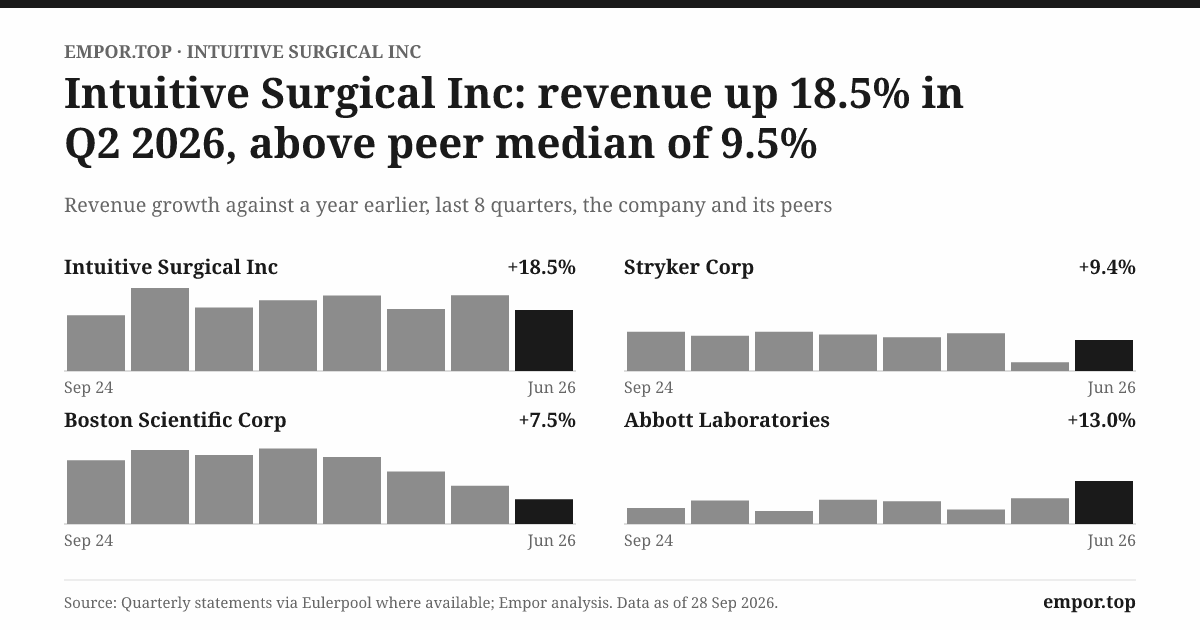
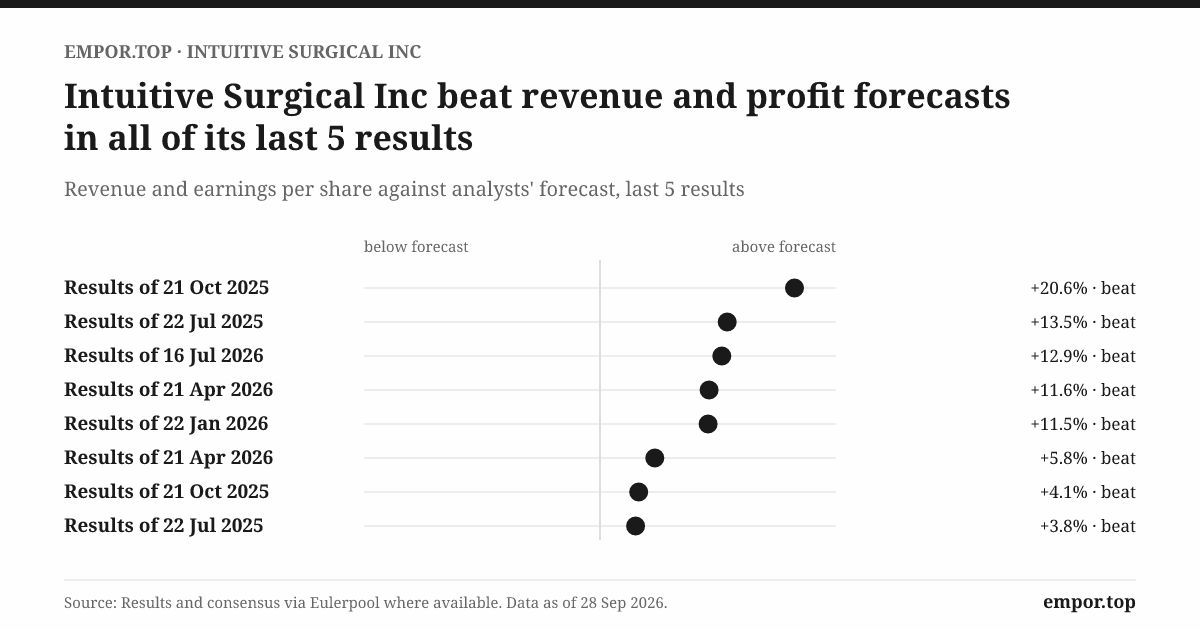
On July 16, 2026, Intuitive Surgical did everything a company is supposed to do on earnings day. Second-quarter revenue came in at roughly $2.89 billion, up 19% from a year earlier.1 Installed systems crossed 11,700.1 Management held its full-year procedure-growth guidance and actually raised its gross-margin outlook as tariff costs came in lighter than feared.4 By the standards of almost any company in medical technology, this was a very good quarter.
The stock fell about 14% the next day.
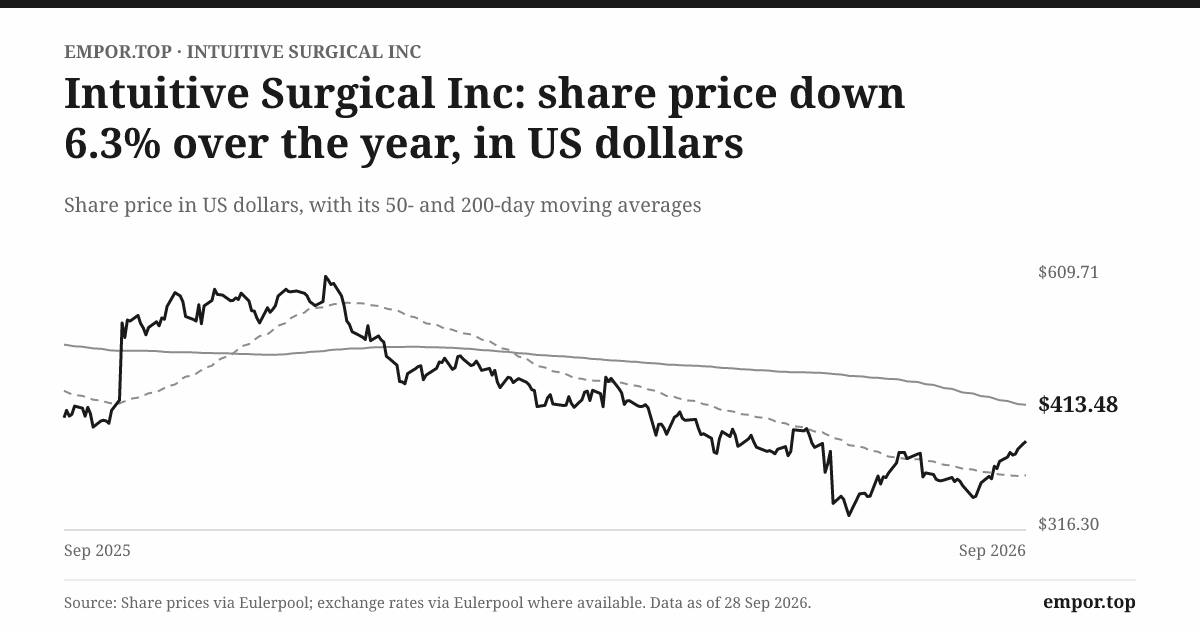
It kept falling. By late July, shares that had changed hands near $604 in early January traded as low as roughly $332, a drawdown of about 44–46% from the peak.2 The Motley Fool ran a headline in August that would have been hard to imagine a year earlier: Intuitive was having its worst year since 2008.2 No accounting scandal, no guidance cut, no product recall of the kind that usually triggers a collapse of that size. Instead, the market had simply changed its mind about one word it had used to describe Intuitive for two decades: monopoly.
To understand why that word matters, start with what Intuitive actually sells. The company designs, manufactures, and sells robotic-assisted surgical systems: the da Vinci family for soft-tissue surgery and Ion for lung biopsy.3 A surgeon sits at a console a few feet from the patient, looks into a magnified 3D view, and moves hand controls. Those motions are translated, scaled down, and filtered of tremor into the movements of tiny wristed instruments inside the patient's body. The robot does not operate on its own. It is closer to a pair of superhuman hands than to an autonomous machine.
The business model is the part investors fell in love with. Hospitals buy (or, increasingly, lease) a system, which is a large one-time sale. Then every single procedure consumes instruments and accessories that must be bought from Intuitive, and every system carries a service contract.3 It is the razor-and-blades model, but the blades are precision surgical tools and the razor sits inside an operating room that has been physically redesigned around it. In Q2 2026, instruments and accessories alone produced about $1.73 billion of the quarter's revenue, while systems produced only about $685 million.1 Most of what Intuitive earns comes from the fleet already installed, not from the next sale.
So the question this episode asks is simple to state and hard to answer: is Intuitive still an effective monopoly, or is 2026 the year the moat finally got probed by credible rivals and a more assertive Chinese state?
The case for "still a monopoly" is that nobody has yet been shown to rip out an installed da Vinci program and replace it with something else. The case against is that, within a matter of months, Johnson & Johnson received FDA authorization for its Ottava system in general surgery,2 Medtronic's Hugo won U.S. clearance and moved to expand into Intuitive's biggest categories,6 and domestic Chinese manufacturers swung from a minority to a clear majority of China's surgical-robot tenders in a single half-year.7 Each of those events, on its own, is manageable. Together, they are the first simultaneous stress test in Intuitive's public life.
The roadmap: the origin story is compressed into the first acts, because the founders left operating roles long ago and what matters is the platform they left behind. The weight of the episode sits in 2024–2026, where a CEO transition, a slowing demand backdrop, and the first FDA-cleared soft-tissue competitor in about twenty years all arrived at once. To see why that collision is so unusual, it helps to go back to a research lab in Menlo Park and a Pentagon agency that wanted to operate on soldiers from a safe distance.
 Subscribe on LinkedIn
II. Origins: From DARPA to da Vinci (1980s-2000)
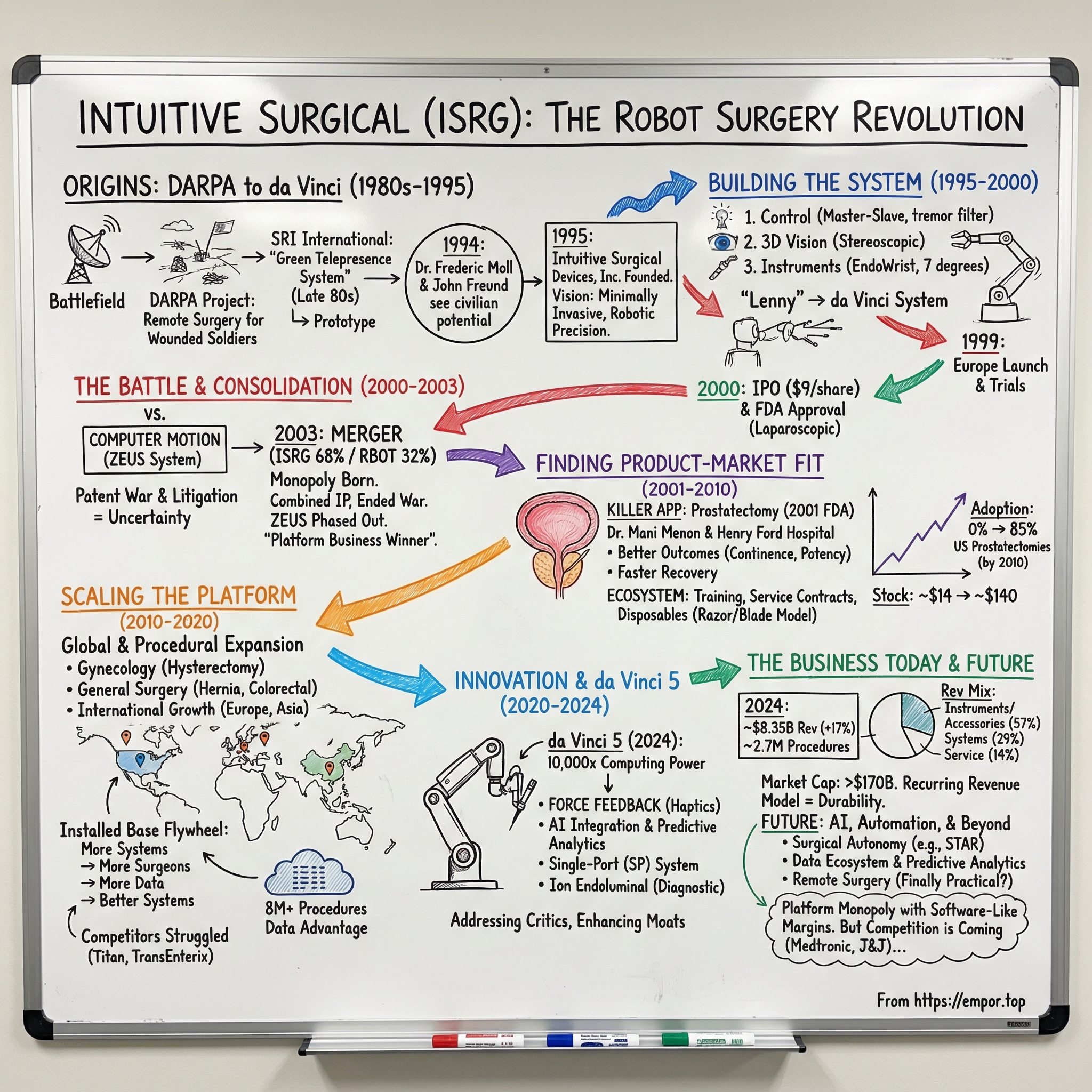
Picture a battlefield in the late 1980s imagination of defense planners: a wounded soldier in a forward medical vehicle, and a surgeon miles away, safely behind the lines, operating through a remote-controlled machine. That was the science-fiction pitch that brought military research money into "telepresence surgery" at SRI International, the Stanford-spun research institute in Menlo Park that had already given the world early work on the computer mouse.
The battlefield use case never became the business. What survived was a technical insight: if a surgeon's hand movements could be captured, digitized, and reproduced by a machine, then the machine could also improve them. It could scale a two-centimeter hand motion down to two millimeters. It could filter out the natural tremor every human hand has. And it could give the instrument tip a "wrist" that bent in ways the rigid sticks of conventional laparoscopy never could. Traditional keyhole surgery is a bit like doing needlework with chopsticks held through a mail slot, with the image upside down on a TV screen. The SRI approach promised to give surgeons their hands back inside the body.
The entrepreneurs who turned that research into a company were Frederic Moll, a physician with device-startup experience, and John Freund, a businessman with a venture and medical-device background. They licensed the SRI technology and founded the company in 1995, raising money from Silicon Valley venture investors.3 One of the young engineers at SRI who had worked on the program was Gary Guthart, who would later run the company for fifteen years. And in 1996, a mechanical engineer named Dave Rosa joined as roughly the ninth employee.[^4] Thirty years later, he would become CEO at the hardest moment in the company's history. Keep both names in mind; this story is unusual in how much of its management DNA traces straight back to the garage era.
The early engineering was a sequence of prototypes that the team nicknamed "Lenny," "Leonardo," and "Mona," each a step toward a system surgeons would actually trust with a patient. The final product was named da Vinci, a nod to the Renaissance artist-engineer who sketched anatomy and machines with equal curiosity. It launched in Europe first in 1999, where regulatory hurdles were lower, and then in 2000 received FDA clearance for general laparoscopic procedures, the same year the company went public on NASDAQ with a modest IPO of roughly $46 million.
The founding insight worth dwelling on is this: Intuitive was never really a "robot" company. Industrial robots replace human labor. Intuitive's machine replaced nothing; it made a highly paid professional better at a task that professional still performed. That distinction explains nearly everything that came later. A product that augments a surgeon has to win the surgeon, and surgeons are conservative, evidence-driven, and deeply habituated to the tools they trained on. That makes the first sale brutally hard. It also makes every sale after the first very sticky.
It also shaped the capital structure. Intuitive had to fund years of clinical work, training programs, and field support before revenue could justify it, a bet on a slow-building adoption curve rather than a quick product launch. The IPO arrived with a cleared product but no proven business, and a direct rival backed by its own patents. That rival, Computer Motion, is where the monopoly really begins.
III. Consolidating the Category: Computer Motion and the Prostatectomy Breakthrough (2000-2010)
In the early 2000s, surgical robotics was a two-company war, and both companies were losing it. Across the market from Intuitive sat Computer Motion, a Santa Barbara company whose ZEUS system and AESOP voice-controlled camera arm competed directly with da Vinci. Each side accused the other of patent infringement. Legal bills mounted, hospitals hesitated to pick a side in a fight that might end with one product enjoined, and both stocks languished.
The resolution came in 2003, when the two companies merged. Intuitive's stock traded around $14 a share on a split-adjusted basis going into the deal, a price that looks almost absurd against where it would trade two decades later. The merger did more than end the litigation. It combined the two largest patent estates in the field under one roof and retired ZEUS, leaving da Vinci as the only serious platform in soft-tissue robotic surgery for most of the next two decades. If there is a single founding act of the monopoly, this was it: not an invention, but a consolidation.
Yet patents alone do not make a business. The event that did came earlier, in 2001, when the FDA cleared da Vinci for radical prostatectomy, the removal of the prostate for cancer. It is arguably the single most important regulatory event in the company's history, and the reason is anatomical. The prostate sits deep in the pelvis, surrounded by the tiny nerves that control urinary continence and sexual function. Open surgery required a large incision; conventional laparoscopy was technically punishing in that cramped space. A magnified 3D view and wristed instruments gave surgeons a practical way to spare those nerves.
This mattered because it gave da Vinci a procedure where outcomes, not marketing, could do the selling. Men facing prostate cancer, and their urologists, cared intensely about recovery, and hospitals discovered that offering robotic prostatectomy became a competitive tool for attracting patients. Within the decade, robotic surgery became the dominant approach to prostatectomy in the United States. The installed base grew not because hospitals were persuaded that robots were futuristic, but because a specific, high-value procedure demonstrably ran better on one.
The second brick in the moat was training. Intuitive built structured programs to certify surgeons on the system, and hospitals, facing the liability questions of a new technology, came to require that credentialing. A surgeon who has spent hundreds of hours becoming fluent on the da Vinci console carries that skill in muscle memory. Asking that surgeon to switch to a different machine is like asking a concert pianist to switch to an instrument with a different key layout the week before a recital. Residents increasingly trained on da Vinci in academic centers, then carried a preference for it to the community hospitals that hired them. The switching cost lived in people, not just in contracts.
By the end of the decade, the business model had also shifted in character. Early revenue was dominated by lumpy system sales. As the fleet grew, instruments, accessories, and service became the steadier majority. Each EndoWrist instrument was designed with a limited number of uses before it had to be replaced, a feature Intuitive justified on safety and performance grounds and critics later framed as a way to lock in consumables revenue, a tension that would end up in court years later. By 2010, Intuitive was no longer a capital-equipment company with a service business attached. It was an annuity business with a capital good at the front of it. The next decade tested how far that annuity could stretch.
IV. Scaling the Platform (2010-2020)
Walk into a mid-sized American hospital in 2012 and there is a decent chance the marketing department had put a da Vinci on a billboard. Robotic surgery had become a signal of modernity, a reason for patients to choose one hospital over the one across town. That consumer-facing pull, combined with surgeon demand, created an unusual dynamic: hospitals bought systems partly to recruit surgeons and patients, and then worked to fill the machine's schedule to justify the purchase.
Filling that schedule drove the decade's biggest strategic change. Urology alone could not sustain the growth. Intuitive pushed da Vinci into gynecology, where hysterectomy became a major volume driver, and then into general surgery: hernia repair, colorectal procedures, gallbladder removal, and bariatric operations. Thoracic surgery followed. Geographic expansion into Europe and Asia broadened the base further, with Japan, Korea, and China emerging as important markets over time. Each new specialty meant new instruments, new clinical studies, and new training pathways, all funded by the cash flow of the existing fleet.
This is the installed-base flywheel in its purest form. Each system sold locks in years of instrument and service revenue. Each trained surgeon becomes a reference for the next hospital. Each new procedure raises utilization of the systems already in the field, which makes the economics of buying another system easier to justify. The system is less a product than a toll booth on a road that keeps adding lanes. It is also why Intuitive's key operating number became procedure growth rather than system sales: procedures drive recurring revenue, and recurring revenue drives value.
The decade also brought the first wave of would-be challengers, and their story is worth telling because it became the base rate for everything since. Titan Medical spent years developing single-port systems without reaching commercial scale. TransEnterix, later renamed Asensus Surgical, brought its Senhance system to market with FDA clearance but never achieved meaningful adoption against the entrenched da Vinci fleet. These were not failures of imagination; they were failures of scale. A challenger needed a product, clinical evidence, a trained surgeon base, a global service network, and a balance sheet able to survive years of slow adoption. Small companies could assemble one or two of those at a time, not all five.
The lesson investors drew was that competition in surgical robotics had a near-zero conversion rate from regulatory clearance to durable revenue. That lesson was correct for the challengers of the 2010s. Whether it applies to a challenger backed by Johnson & Johnson or Medtronic is a different question, and the rest of this story turns on it.
For shareholders, the decade was spectacular. Procedure growth in strong years ran above 20%, and the stock climbed from the post-merger recovery into the hundreds of dollars before a series of stock splits. There were stumbles: a stretch in the early 2010s when procedure growth decelerated, safety questions drew media and regulatory attention, and a securities class action followed; that episode is revisited in the governance discussion later. But the pattern held. When growth slowed, new procedures and geographies eventually re-accelerated it.
By 2020, Intuitive had an installed base in the thousands, a near-total share of soft-tissue robotic surgery, and a management team led by Gary Guthart, CEO since 2010, that had mostly grown up inside the company. It also had a problem that successful incumbents always face: its flagship platform was aging, and the next cycle of innovation would have to be paid for before it could be sold.
V. da Vinci 5, Ion, and the Last Innovation Cycle Before the Reckoning (2020-2024)
In the spring of 2020, operating rooms around the world went dark. Elective surgery was postponed almost everywhere as hospitals prepared for COVID-19 patients. For a company whose revenue depended on procedures, this was the only true demand shock in its public history, and it offered a live experiment in how the flywheel behaves during an outage. The answer was instructive. Procedures fell sharply during lockdowns and then rebounded as deferred surgeries returned. Cancer operations cannot be deferred forever. The recurring model bent but did not break, because the underlying disease burden did not disappear; it merely waited. That is a useful reference point for 2026: a pandemic that halted surgery for weeks did less lasting damage than slow structural shifts in which operations are needed at all.
The more lasting story of this period was a burst of product investment that effectively rebuilt the platform.
Ion: robotics goes endoluminal. Ion is a thin, robotically steered catheter that navigates deep into the branching airways of the lung to reach small nodules for biopsy. Think of it as a remote-controlled guide wire that can make turns a handheld bronchoscope cannot. It targets a diagnostic problem, finding lung cancer early, rather than a surgical one. That makes it genuine optionality: a second market that does not depend on the soft-tissue franchise. By 2026 it was the fastest-growing line in the portfolio, with Ion procedure growth of roughly 36% year over year in Q2 2026, well ahead of core da Vinci growth.4 The honest caveat is scale: Ion remains small relative to the da Vinci base, so its growth rate flatters more than it currently moves the total.
Single-Port: a new doorway. The da Vinci SP system passes camera and instruments through a single small incision, opening access routes that multiport systems handle awkwardly. It is real and fast-growing: single-port procedures grew about 87% in FY2025, against roughly 17% for multiport procedures.3 But the base is small, and a high percentage growth off a small base is a signal to watch, not yet a pillar of earnings.
da Vinci 5: the upgrade cycle. In March 2024, da Vinci 5 received FDA 510(k) clearance.3 Its headline feature was Force Feedback: instruments that let surgeons feel how hard they are pressing on tissue, a sense robotic surgeons had been missing. In preclinical testing, Intuitive reported up to 43% less force on tissue.3 The system also carried roughly 10,000 times the computing power of the prior generation, a foundation for the company's data and AI ambitions: recording and analyzing surgical video and system data to help surgeons improve.3 The investor translation is that da Vinci 5 was designed to start a replacement cycle across the installed base, not just to win new accounts. The early data support that: da Vinci 5 accounted for 870 of the 1,721 systems placed in 2025, up from 362 in 2024.3
The bill arrives. All of this cost money. Capital expenditure guidance climbed toward roughly $1.0–1.2 billion for 2024 as Intuitive built manufacturing and facilities capacity for the new platforms.3 For a company long admired for its capital-light annuity, this was a reminder that staying ahead required reinvestment at scale. It was also a preview of the margin pressure to come.
The claim that deserves testing here is that Intuitive's innovation cycles reliably convert into revenue. On its own record, this one holds up better than most. Ion, SP, and da Vinci 5 each moved from clearance to measurable procedure growth, unlike the challengers of the prior decade. But the proof is concentrated in growth rates rather than in profit contribution for Ion and SP, and da Vinci 5's upgrade economics will only be clear once the cycle matures. The claim survives, narrowed: Intuitive converts its own milestones well, and the KPI to watch is da Vinci 5's share of new placements.
Intuitive had spent four years rebuilding its platform. It was about to find out whether the new platform would face the same demand, and the same absence of competition, as the old one.
VI. 2025-2026: The Guard Changes While the Moat Gets Its First Real Test
A. Leadership transition
On July 1, 2025, a man who had joined Intuitive when it was still a startup in a rented building became its chief executive. Dave Rosa had arrived in 1996 as roughly the ninth employee, a mechanical engineer who then spent nearly three decades inside the company, working through manufacturing, product, and strategy roles before becoming President in May 2023.[^4] Gary Guthart, CEO since 2010, moved to Executive Chair.[^4]
On paper this was the cleanest succession imaginable: insider to insider, planned and announced in advance, with no activist pressure or forced departure.[^4] Rosa is, by background, a builder rather than a marketer, someone whose career was shaped by the unglamorous problem of manufacturing precision instruments at scale. His appointment signaled continuity. The difficulty is timing. He took over at the start of the first year of real competitive pressure in the company's history, when continuity might be exactly what the moment needs, or exactly the wrong instinct.
Guthart's continuing role as Executive Chair keeps experienced judgment in the boardroom. His personal economic stake, however, is modest relative to the company's size: roughly 1.28 million shares across a family trust and children's trusts, against about 350 million shares outstanding, well under 1%.12 He also sold shares under a pre-arranged 10b5-1 trading plan in August 2026. Such plans are routine and set in advance, so the sale says little about his view; the point is that this is a professionally managed company, not a founder-controlled one, and there is not yet a clear public read on how much operating influence the Executive Chair retains.
B. The macro deceleration, explained rather than hidden
The first crack in the "ever-compounding growth" story did not come from competitors. It came from management's own guidance. After procedure growth of roughly 22% in 2023, Intuitive guided 2024 procedure growth to 14–17%, a material reset.3 Management explained it in detail. GLP-1 weight-loss drugs were shrinking demand for bariatric surgery, which now makes up under 3% of U.S. da Vinci procedures.3 China's anti-corruption campaign in healthcare had frozen hospital capital spending. Korean physician strikes disrupted procedures. Hospital capital budgets in Japan and Europe had turned cautious.3
This is the single most valuable disconfirming data point against any framing of Intuitive's growth as structural and unstoppable. Management itself told investors that a real demand pool would shrink, and it did. A drug class changed which patients needed surgery at all. No amount of robotic excellence recaptures a procedure that no longer happens. The GLP-1 headwind remains unresolved into 2026, with no stated timeline for stabilization.4
2026 added another demand-side issue. On the Q2 2026 call, management cited the expiration of enhanced U.S. Affordable Care Act subsidies as a pressure on procedure volumes, as some patients lost or downgraded insurance coverage.4 It is worth noting what management did not do: it flagged the issue rather than hiding it inside a general comment about "softness."
The verdict to carry forward is that the deceleration is confirmed and ongoing, not a one-off miss. Credit belongs to management for explaining it, but candor about a headwind is not the same as a plan to reverse it. The forward question is whether bariatric-adjusted procedure growth re-accelerates once GLP-1 penetration plateaus, and whether China tender activity recovers.
C. The competitive assault arrives — substitution, not just entry
For two decades, the competitive story around Intuitive was a list of hopeful startups. 2025 and 2026 changed the cast.
Johnson & Johnson's Ottava. In late July 2026, J&J received FDA authorization for Ottava across ten general-surgery procedures,2 following a submission to the agency earlier.5 This was the first credible, well-capitalized challenger to da Vinci's core soft-tissue franchise in roughly twenty years. J&J brings things no startup ever had: long-standing relationships with nearly every hospital purchasing department, an enormous surgical instruments business, and a balance sheet able to absorb years of losses. Yet J&J's own record argues against over-extrapolating. The program suffered a roughly two-year delay disclosed in 2021, along with a $900 million partial charge on the acquired R&D behind it. The clearance validates persistence more than near-term share capture. Commercialization, not the FDA letter, is the test.
Medtronic's Hugo. Medtronic received FDA clearance for Hugo in urologic procedures in December 2025.6 Unlike Ottava, Hugo was already commercial outside the U.S., in more than 30 countries with tens of thousands of procedures performed.6 In June 2026, Medtronic filed to expand Hugo into general surgery and gynecology, directly encroaching on Intuitive's largest procedure categories.
CMR Surgical's Versius. The British company is not distressed: it raised more than $200 million in April 2025 and began its U.S. commercial debut in 2026. It claims to be the second most-used platform globally by procedure count, a claim not independently verified.
Distalmotion's Dexter. The most interesting near-term threat may be the one aimed away from Intuitive's strength. Dexter targets ambulatory surgery centers, the outpatient facilities where hernia repairs, gallbladder removals, and hysterectomies are increasingly performed, and where Intuitive is comparatively under-penetrated.8 ASCs have tighter budgets, smaller operating rooms, and less appetite for large capital purchases. Distalmotion raised $150 million in November 2025 specifically to pursue named ASC chains.8 Its pitch is not that it is better than da Vinci in a flagship hospital; it is that it is good enough, and cheaper, where da Vinci has not yet planted its flag.
The base rate against all of this. Vicarious Surgical, once a well-publicized entrant, received a NYSE delisting notice, disclosed going-concern doubts, and saw shareholders approve its dissolution in 2026.9 Karl Storz discontinued the LUNA hardware platform it had acquired along with Asensus Surgical in 2024. The pattern is stark: technical milestones and FDA clearances convert poorly into durable revenue in this industry. That tempers the Ottava and Hugo threats but does not erase them, because both are backed by companies with the capital and hospital relationships that Vicarious and Asensus lacked. The old base rate was built on small challengers. It is not clear it applies to giants.
D. China: a live indigenization case, not a hypothetical
A State Council procurement notice, effective January 1, 2026, gives domestically made medical devices a 20% price-evaluation advantage in government tenders.7 In plain terms, when a Chinese public hospital compares bids, a domestic robot can be priced materially higher than an imported one and still be scored as the better value.
The effect showed up fast. Domestic manufacturers' share of China's endoscopic surgical-robot procurement went from 38% in the first half of 2025 to 63% in the first half of 2026.7 That is a 25-point swing in a single half-year, not a slow drift. Named domestic players include 微创医疗机器人 MicroPort MedBot, which had accumulated more than 100 global commercial orders by 2025, and 精锋医疗 Edge Medical, which led the H1 2026 procurement rankings.7
This is the clearest evidence yet that a "why this company wins" claim is geographically bounded. Surgeon training, certification, and switching costs are powerful when the buyer is a hospital optimizing for outcomes and convenience. They travel much less well when the ultimate buyer is a state whose explicit policy is to displace the incumbent. Intuitive's moat is a customer-behavior moat, and in China the government has changed the customer's incentives.
E. The market's verdict
The stock ran from about $400 at the da Vinci 5 launch in March 2024 to an all-time high near $604 in early January 2026, then fell as low as roughly $332 by late July 2026.2 That drop came even as Q2 2026 revenue grew 19% and full-year procedure guidance was held.14
Read that carefully. The sell-off was not caused by an operating miss. It was a re-rating of how long the monopoly would last, driven by competition, China, and tariffs, layered on top of a business still performing well. That is itself informative: a stock that loses nearly half its value without a miss was priced for a future in which none of these threats would matter. The current operating numbers are where the argument has to be settled.
VII. The Business Today: Segment Economics and the Recurring-Revenue Machine
Imagine a hospital administrator reviewing the invoices from a single da Vinci. The system itself was a one-time capital decision, possibly years ago. But every month, new line items appear: instruments for each case, drapes and accessories, and the service contract that keeps the machine running. Multiply that across more than 11,000 systems and the shape of Intuitive's income statement comes into focus.
In FY2025, revenue reached about $10.06 billion, up roughly 20.5% from $8.35 billion in 2024.3 Surgeons performed more than 3.1 million da Vinci procedures, up about 18%.3 The company placed 1,721 systems, of which 870 were da Vinci 5, and the installed base ended the year at 11,106, up 12%.3 What those numbers mean together: procedures grew faster than the installed base, which says existing systems were being used more intensively. That is the healthiest kind of growth in a razor-and-blades model.
Q2 2026 extended the pattern. Revenue of about $2.89 billion broke down into roughly $1.73 billion from instruments and accessories, $685 million from systems, and $472 million from service.1 da Vinci 5 placements were 246, up from 180 a year earlier, and the installed base reached 11,710.1
The recurring mix is the real story. Instruments, accessories, and service consistently account for well over 70% of revenue.13 Economically, Intuitive looks more like a consumables-and-subscription business wrapped around a capital good than a machinery maker. The practical implication: even if system placements slow, the existing fleet keeps producing revenue as long as procedures continue. The limitation is equally important. Recurring revenue is only as durable as procedure volume, and procedure volume is exactly what GLP-1 drugs, ACA subsidy changes, and new competitors are pressuring.
Gross margin under tariff pressure. When Intuitive issued FY2025 guidance in April 2025, it opened non-GAAP gross margin guidance at 65.0–66.5%, down from 69.1% actual in 2024, citing an estimated 1.7% drag from tariffs.10 The stock fell on the news.11 Over the following year, management revised the estimate as facts changed: by Q2 2026, the tariff impact had been trimmed to about 1.0% of revenue and margin guidance raised to 68–69%.4 This is a concrete example of guidance discipline: an initial conservative estimate, then transparent revision. It is also explicitly contingent on tariff rates not escalating further.4
Financing mix shift. Leases and usage-based arrangements accounted for about 54% of Q2 2026 placements, up from 49% a year earlier.4 Management presents leasing as customer flexibility. An independent reading is that it softens the upfront capital hurdle for hospitals at the precise moment competitors are offering alternatives and hospital budgets are tight. It shifts some economic risk onto Intuitive's balance sheet and ties revenue more tightly to utilization. It is a defensive move as much as a neutral product choice.
The KPIs that matter most going forward:
- da Vinci procedure growth, ideally read excluding bariatric effects. This is the single best measure of whether demand for the platform is compounding or plateauing.
- Recurring revenue (instruments, accessories, and service) as a share of total revenue. This shows whether the annuity is holding as placements and pricing shift.
- da Vinci 5's share of new placements. This is the best proxy for the economics of the upgrade cycle.
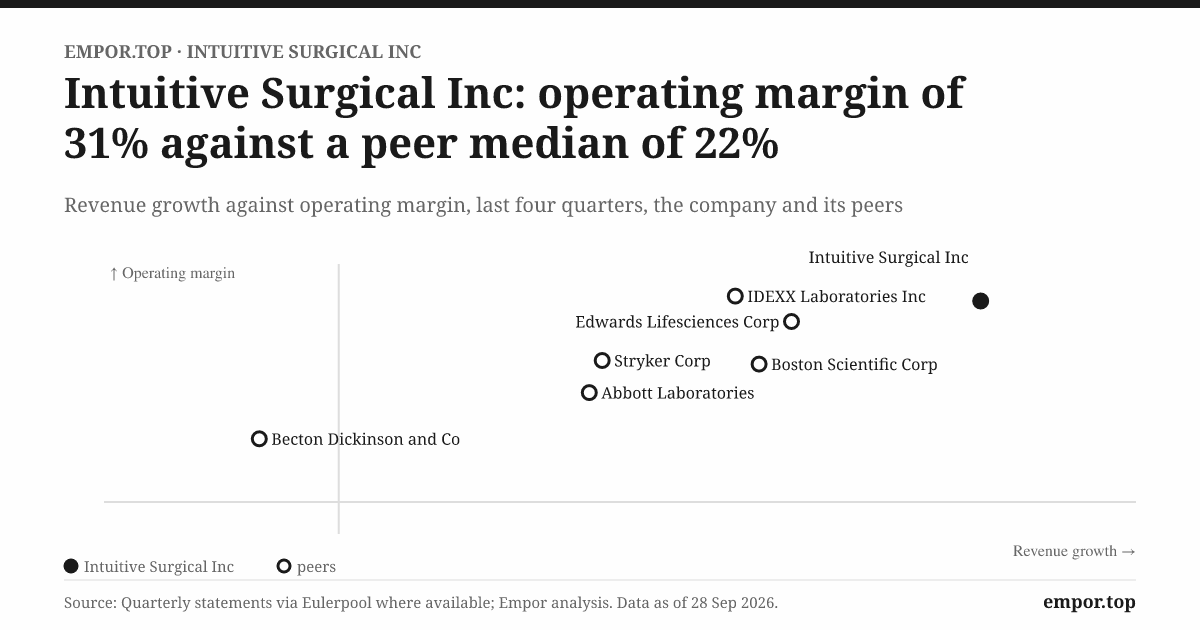
The numbers show a business still growing in the high teens with a large recurring engine. The question is whether that engine faces a new kind of competition, which is where the war-game begins.
VIII. Competition & Industry Structure: Porter, 7 Powers, and the Evidence Test
Run the war-game from the challenger's chair. Suppose a newcomer has an FDA-cleared robot and wants hospital business. Where does it attack? Not the flagship academic center with four da Vincis, a fellowship program, and surgeons who have logged thousands of cases on the console. It attacks where the incumbent is thin: new hospital builds, outpatient surgery centers, cost-conscious community hospitals, and foreign markets where governments tilt the tender. That map is exactly where competitors are aiming.
Porter's Five Forces. Buyer power is concentrated in large hospital systems, which negotiate hard, and is rising in ambulatory surgery centers, a segment with different economics, smaller budgets, and lower switching costs; that is Distalmotion's chosen battleground.8 Supplier power is low, because Intuitive largely vertically integrates instrument manufacturing.3 The threat of substitution is now credible for the first time, via Ottava and Hugo. Rivalry, long muted, is intensifying. The regulatory barrier to entry remains the highest and slowest-moving force in the industry: clearances take years, and each procedure category requires its own evidence. Rivals are clearing that barrier, but one procedure at a time.
Hamilton Helmer's 7 Powers. The strongest claims are switching costs and scale economies. Switching costs live in surgeon training, hospital credentialing, and operating-room workflows designed around da Vinci. Scale economies live in instrument manufacturing and R&D amortized across the largest installed base in the industry: Intuitive can spend on the next platform what a challenger spends on its entire business. The weakest claim is cornered resource. Patents expire, and FDA clearance is not, by itself, a durable barrier, as Ottava's arrival demonstrates. Counter-positioning arguably now runs against Intuitive in ASCs, where a cheaper, lighter system can be "good enough" in a way the premium incumbent struggles to match without cannibalizing its own pricing.
Evidence for the switching-cost claim. Across the public disclosures and press coverage reviewed for this piece, no confirmed case surfaced of a hospital system switching an existing da Vinci program to a rival platform. The competitive activity visible today is concentrated in new capacity: ASCs, new hospital builds, and ex-U.S. markets. That supports a meaningfully narrower claim than "the moat is unbreakable." The honest version: Intuitive's installed base appears sticky; its share of incremental capacity is now genuinely contested.
Evidence against unqualified pricing power. Several recent moves amount to concessions on price and terms. The planned loosening of EndoWrist instrument use limits in 2027 lets hospitals get more cases out of each instrument. The rising lease mix reduces upfront commitment.4 And a lower-cost "XiR" tier targets ASCs and smaller hospitals. Management can frame each as customer-friendly. Taken together, they are direct evidence that competitive and reimbursement pressure is already showing up in commercial terms, not just in analyst notes. The pricing-power claim is narrowed: strong in the installed base, contested at the margin.
Myth vs. reality. Myth: "Nobody can compete with da Vinci." Reality: several companies now can, legally and technically, in specific procedures. Myth: "FDA clearance for a rival means share loss is imminent." Reality: the industry's track record of converting clearances into revenue is poor, and even J&J's program was delayed for years. The truth sits in between, and it will be revealed by commercial data, not press releases.
Scale comparison. Intuitive's roughly 11,700 installed systems1 dwarf Hugo's early commercial base, CMR's last public count of about 100+ systems (from 2022, likely stale), and Ottava's zero installed base at clearance. At anything like current placement rates, no competitor approaches Intuitive's fleet for many years. The regulatory gap is closing; the incumbency gap remains enormous.
That leaves one more place to probe the moat: not the robot, but the instruments that run through it, and whether hospitals should be allowed to repair them.
IX. The Right-to-Repair Fight: Testing the Aftermarket Moat
Picture a small repair shop that figured out how to reset the counter on a da Vinci instrument's memory chip, extending its life beyond Intuitive's use limit and selling the refurbished instrument back to hospitals at a discount. To hospitals looking for savings, that was a bargain. To Intuitive, it was an unauthorized modification of a surgical device. That conflict became a years-long legal war over whether Intuitive's control of its instruments was a safety measure or an illegal tying of a repair market.
Rebotix Repair filed the original antitrust suit, alongside a related case brought by Surgical Instrument Service Company (SIS). In January 2025, the court ruled for Intuitive on all antitrust claims: no monopolization of the aftermarket instrument-repair market was proven.3 For Intuitive, this was a significant win for the economics underpinning its recurring revenue.
It was not the end. Restore Robotics Repairs, a subcontractor to SIS, sued over a later generation of EndoWrist instruments, lost at the district level, and appealed to the 11th Circuit, docket 25-14202, filed around December 2025.14 In August 2025, the Federal Trade Commission filed an amicus brief supporting the right-to-repair position.15 Federal antitrust scrutiny of instrument-reuse restrictions is therefore active and unresolved as of late September 2026.
Why this matters for investors is mechanical. Instruments and accessories are the largest revenue line.1 A ruling that forced Intuitive to permit third-party reprocessing, or regulatory pressure that pushed use limits higher, would reduce the number of new instruments hospitals buy per procedure. That goes straight to the core of the annuity.
Read alongside the 2027 use-limit loosening described earlier, the picture looks less like a company confidently defending an unassailable moat and more like one making early accommodations ahead of possible adverse rulings or regulatory pressure. The claim that the aftermarket moat is legally secure should be marked narrowed, not confirmed, and not yet rejected. The 11th Circuit ruling is the explicit forward event to watch.
Legal risk is ultimately managed by people, and the people now running Intuitive are the next question.
X. Current Leadership, Ownership, and Capital Allocation
There is a particular kind of executive who spends almost three decades at one company and never seems to leave the factory floor mentally. Dave Rosa fits that description. An engineer by training, with 29-plus years inside Intuitive, he is the strongest evidence available that the leadership change is a continuity bet, not a strategy reset.[^4] His FY2025 total compensation was roughly $21 million, mostly in equity (restricted and performance stock units), with base salary raised to $925,000 and a target incentive of 150% of salary on becoming CEO.12
Around him sits a team that skews heavily toward long tenure. Jamie Samath has been CFO since 2013, providing financial continuity through the transition.12 Other named executive officers include Henry Charlton in commercial and marketing, Gary Loeb in legal and compliance, and Mark Brosius in manufacturing and supply chain.12 This is a team of long-tenured operators rather than recent outside hires, which lowers execution risk and also lowers the odds of a sharp strategic pivot.
Incentives. Most executive pay is long-term equity, with performance units tied to relative total shareholder return (valued using Monte Carlo simulation) and to procedure-growth metrics.12 That directly links pay to the same KPI management has already had to guide down once. Say-on-pay support exceeded 93% at the 2025 annual meeting.12 Recurring shareholder proposals from John Chevedden on golden parachutes were excluded through SEC no-action relief rather than contested at a vote.13 There is no sign of governance friction, but there has also been no real independent test of it.
Capital allocation, tested against evidence. R&D has run at about 13–14% of revenue through 2023–2025,3 a heavy and consistent commitment. Capex guidance fell sharply from roughly $1.0–1.2 billion in 2024 to $625–750 million in 2025,3 a genuine reduction in capital intensity after the build-out. Share buybacks have grown in scale, with a new $5 billion authorization approved in April 2026,16 but repurchases have been opportunistic rather than mechanical, with none executed in Q1 2024 or Q1 2025.10 The company has never paid a dividend.3
M&A discipline, tested rather than assumed. Intuitive's acquisition record is remarkably thin for a company of its size. Orpheus Medical, a small hospital video and informatics company acquired in 2020, and a March 2026 buyout of da Vinci and Ion distribution rights from regional partners (ab medica, Abex, and Excelencia Robótica)16 make up essentially the whole list. There are no large write-offs from failed acquisitions because there have been few acquisitions to fail. Intuitive Ventures, its $100 million corporate venture fund launched in 2020, made 22 investments but had deployed only about $33 million by 2022.
The fair read cuts both ways. There is no evidence of reckless or overpriced deals. But there is also no evidence the company used its balance sheet to pre-empt the threats now materializing. Notably, Intuitive did not acquire Distalmotion; J&J's venture arm backed it instead, leaving a credible ASC-focused competitor capitalized partly by a rival. An activist looking for something to challenge would not target overspending. They would ask why a company with this much cash and this much to protect chose to watch the ASC threat develop rather than buy or build ahead of it. Restraint looks prudent only if the current competitors fail to scale.
The only governance blemish on the public record is dated: a 2013 securities class action related to disclosure around da Vinci safety data, settled in 2017 for $15 million plus governance reforms. It has been remediated and is not live.
XI. Risk Radar
Think of Intuitive's risks as a dashboard with six gauges, several of which have moved into yellow at the same time for the first time.
Competitive substitution. Now credible via Ottava and Hugo, concentrated in new-capacity decisions rather than installed-base displacement. The mechanism to watch is win-loss rates in new hospital and ASC builds over the next four to eight quarters, and whether any named hospital publicly replaces a da Vinci program.
China policy. An active, quantified indigenization mechanism, the 20% price-evaluation preference and 63% domestic tender share, rather than a speculative geopolitical risk.7 The risk is not a sudden ban but a steady erosion of Intuitive's share of new Chinese capacity.
Demand and macro. GLP-1-driven bariatric decline and the 2026 ACA subsidy expirations are both management-acknowledged and neither is resolved.4 Hospital capital budgets in Japan and Europe add cyclical pressure.
Regulatory and legal. The Restore Robotics 11th Circuit appeal and FTC involvement on right-to-repair represent a tail risk to instrument economics.1415 Product liability and FDA oversight are standing risks for any surgical-device maker.3
Tariffs and input costs. Quantified and improving, from 1.7% of revenue in initial FY2025 guidance to about 1.0% by Q2 2026, but explicitly contingent on rates not escalating.104 Intuitive's manufacturing footprint spans the U.S. and Mexico, among other locations, which keeps trade policy relevant.3
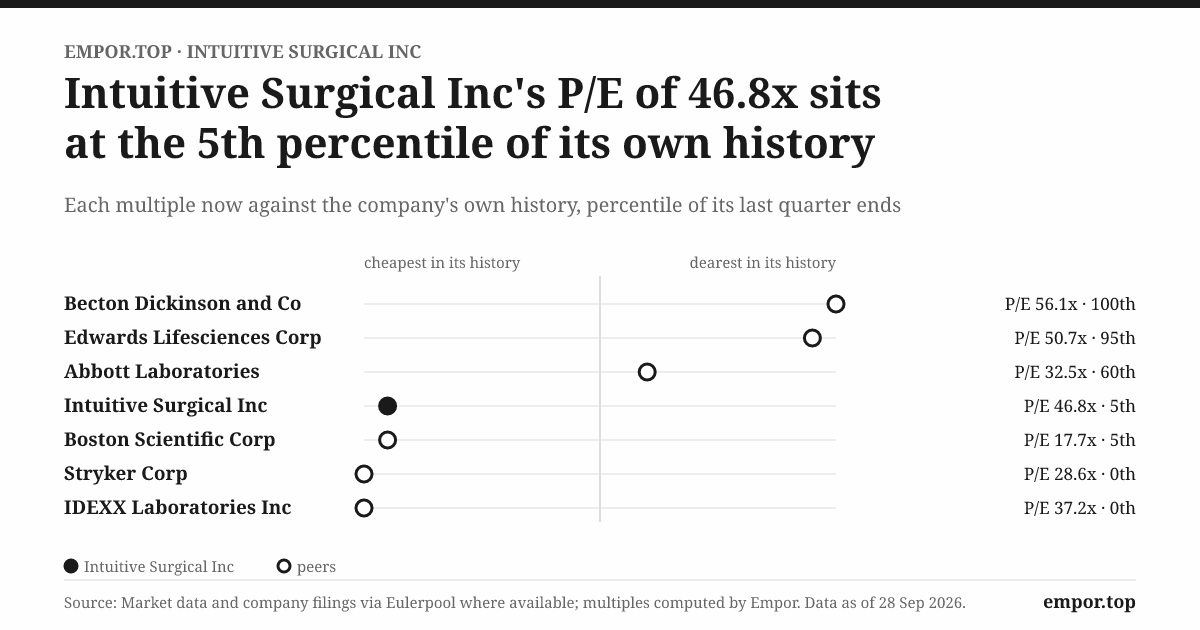
Valuation. Even after the 2026 drawdown, the stock trades at a premium multiple to medical-technology peers. That premium assumes the moat largely holds against the pressures above. If any two gauges move to red simultaneously, the premium has further room to compress even without an operating miss, as 2026 already demonstrated.
XII. Playbook: Lessons for Founders and Investors
Every great business story leaves behind a set of lessons that outlast the specific company. Intuitive's are unusually clear because its history is a long controlled experiment in building, and now defending, a platform in a regulated industry.
Regulation and training can become the moat. For years, the FDA pathway, clinical studies, and surgeon training looked like pure cost: slow, expensive, and unscalable. They turned into the most durable barrier Intuitive had, because they were slow and expensive for everyone else too. The lesson for founders: in clinically gated industries, the hardest parts of the go-to-market are often the defensible parts.
The razor-and-blades model's real test is deceleration. Recurring revenue looks invincible when unit growth is strong. The genuine test is what happens when procedure growth slows and competitors offer cheaper razors. That experiment is running now. So far, recurring revenue has held, but with concessions on price and terms beginning to show.
Insider succession is a double-edged signal. A continuity CEO carries less risk of a strategic reversal and preserves institutional knowledge. It also brings less capacity for a hard pivot if the landscape demands one. Intuitive has chosen continuity at the moment its environment is changing most.
Capital restraint is only a virtue in hindsight. Intuitive's thin M&A record looks disciplined today. It could look like missed defense if Ottava or Distalmotion scale meaningfully.
Certification is not commercialization. Vicarious Surgical and Asensus/LUNA are the control group. FDA clearances, patents, and pilots are not revenue. Ottava's and Hugo's clearances should be judged by installations, utilization, and named hospital wins over the next several years, not by their approval letters.
XIII. Bull vs. Bear Case
Bull Case
The bull case rests first on incumbency. With more than 11,700 installed systems,1 Intuitive has a fleet no competitor can replicate for many years at current placement rates. Every one of those systems has trained surgeons, integrated workflows, and service contracts attached. Through a Helmer lens, switching costs and scale economies remain intact on the available evidence.
Second, the recurring mix of well over 70% of revenue provides earnings resilience even if system placements slow.1 The installed base keeps generating instrument and service revenue as long as procedures continue, and procedures have kept growing in the teens despite GLP-1 and macro headwinds.
Third, the innovation engine still works. da Vinci 5 placements are rising as a share of the mix, and Ion and single-port show growth far above the core fleet.34 Unlike its challengers, Intuitive has a record of converting its own milestones into procedure growth.
Fourth, management has been transparent about headwinds, from GLP-1 to tariffs to China, and revised guidance as facts changed.410 If that pattern holds, it is a credibility asset during a period of uncertainty.
Finally, the 2026 sell-off may already have repriced much of the competitive risk, without any evidence yet of actual share loss in installed accounts.2
Bear Case
For the first time in about twenty years, a well-capitalized rival has FDA authorization in Intuitive's core soft-tissue procedures.2 The framing that explained why prior challengers failed, lack of capital and hospital relationships, does not apply unmodified to J&J or Medtronic. In Porter's terms, the threat of substitution has moved from theoretical to live.
China's indigenization policy is not a future risk but a measured, accelerating present one, with a 25-point domestic share swing in a single half-year.7 Buyer power there sits with a state that has chosen to favor domestic suppliers.
The GLP-1 and ACA demand headwinds are structural enough that management has twice flagged material pressure on growth without identifying a clear re-acceleration catalyst.34
The pricing concessions underway, instrument use-limit loosening, a rising lease mix, and a lower-cost XiR tier, are early evidence that pricing power is under real pressure, particularly in ASCs, where buyer power is higher and counter-positioning favors cheaper entrants.48
And unresolved federal antitrust scrutiny, via the FTC amicus and the pending appeal, adds a tail risk to the instrument economics underpinning the recurring model.1415
Weighing the two: the bull case is strongest on installed-base durability, where the evidence is affirmative. The bear case is strongest on incremental share, where the evidence (China tenders, ASC-focused challengers, pricing concessions) is already visible. The result is not a broken moat but a narrower one.
XIV. Final Analysis
Is Intuitive still the best business model in medical technology, or was that phrase a description of a monopoly period that just ended?
The evidence supports a calibrated answer. The moat's foundational claims, surgeon switching costs, training and credentialing, and scale in manufacturing and R&D, remain intact on the evidence available. No public installed-account displacement has been confirmed, recurring revenue continues to grow, and the company's own innovation cycle keeps converting into procedures. But three claims have been narrowed. Growth is not ever-compounding; management's own guidance tied it to shrinking demand pools. Pricing power is not unqualified; commercial concessions are already underway. And the moat is geographically bounded; in China, state policy has overridden customer habit.
What would disprove the remaining bull case: a confirmed installed-account switch to Ottava or Hugo, a further deceleration in procedure growth outside China, or an adverse 11th Circuit ruling on instrument repair.
What would confirm it: stabilizing China tender share, a troughing GLP-1 headwind, da Vinci 5 and Ion continuing to outgrow the base fleet, and challengers' early installations failing to reach meaningful utilization.
The honest summary is that 2025–2026 is the first period in Intuitive's public life when every one of its moat claims is being tested at once, in practice rather than in theory. The company enters that test with the largest installed base, the deepest training network, and the strongest balance sheet in the field. It also enters with a new CEO, a thinner claim to pricing power, and a market that has stopped paying for certainty. The next several quarters of data will reveal which of those facts matters more.
XV. Recent News
The most immediate event on the calendar is Q3 2026 earnings, expected around October 2026. Investors will listen for updated commentary on China tender activity, any quantification of ACA-related procedure pressure, and, most importantly, how management answers analyst questions about Ottava and Hugo in competitive deals. The Q2 call already showed management willing to discuss headwinds openly;4 Q3 will show whether it begins disclosing competitive win-loss detail or keeps the conversation at the level of procedure totals.
The 11th Circuit's ruling in the Restore Robotics appeal remains pending as of late September 2026.14 Its timing is not disclosed, and the outcome will shape how much latitude Intuitive retains over instrument reuse.
Ottava's first commercial installations and any named hospital wins will be the first real-world evidence of whether J&J can convert clearance into adoption.2 Medtronic's filing to expand Hugo into general surgery and gynecology remains under FDA review. Further data on da Vinci 5's share of placements and Ion's growth will indicate whether Intuitive's own innovation continues to outrun the competition it now faces.
References
-
Intuitive Announces Second Quarter Earnings (Q2 2026 Earnings Release, 8-K Exhibit 99.1) — SEC EDGAR, 2026-07 ↩↩↩↩↩↩↩↩↩↩↩
-
Intuitive Surgical Stock Is Having Its Worst Year Since 2008 — The Motley Fool, 2026-08-18 ↩↩↩↩↩↩↩↩
-
Intuitive Surgical FY2025 Form 10-K — SEC EDGAR, 2026-02-03 ↩↩↩↩↩↩↩↩↩↩↩↩↩↩↩↩↩↩↩↩↩↩↩↩↩
-
Intuitive Surgical Q2 2026 Earnings Call Transcript — Seeking Alpha, 2026-07-16 ↩↩↩↩↩↩↩↩↩↩↩↩↩↩↩↩
-
Johnson & Johnson Submits Ottava Robotic Surgical System to the FDA — Johnson & Johnson ↩
-
Medtronic Announces FDA Clearance of Hugo RAS System for Urologic Procedures — Medtronic, 2025-12-03 ↩↩↩
-
China's Endoscopic Surgical Robot Procurement in H1 2026: Domestic Systems Reach 63% Share — MedChina Tech ↩↩↩↩↩↩
-
Surgeries Are Moving to ASCs — Distalmotion Wants Its Robot to Drive the Shift — MedTech Dive ↩↩↩↩
-
Vicarious Surgical Loses Fight to Survive as Shareholders Approve Dissolution — MD+DI, 2026 ↩
-
Intuitive Q1 2025 Earnings Release (8-K Exhibit 99.1) — SEC EDGAR, 2025-04 ↩↩↩↩
-
Intuitive Surgical Q1 2025: Stock Falls on Tariff Guidance — MassDevice, 2025-04-22 ↩
-
Intuitive Surgical 2026 DEF 14A Proxy Statement — SEC EDGAR, 2026-03-13 ↩↩↩↩↩↩
-
Chevedden Shareholder Proposal No-Action Letter — SEC, 2025-12-31 ↩
-
Restore Robotics Repairs 11th Circuit Appeal, Docket 25-14202 — Justia Dockets ↩↩↩↩
-
FTC Maintains Support for Right-to-Repair in Med Robot Case — Law360, 2025-08 ↩↩↩
-
Intuitive Q1 2026 Earnings Release (8-K Exhibit 99.1) — SEC EDGAR, 2026-04 ↩↩
 LinkedIn
 WhatsApp
 Reddit
 Hacker News
 Email
 Kindle
 RSS Feed
 Spotify
 Apple Podcasts
 Amazon Music
 Audible
 YouTube