CVR Energy: The Refinery That Has to Earn Its Way Through the Cycle
I. A New CEO, an Old Cycle
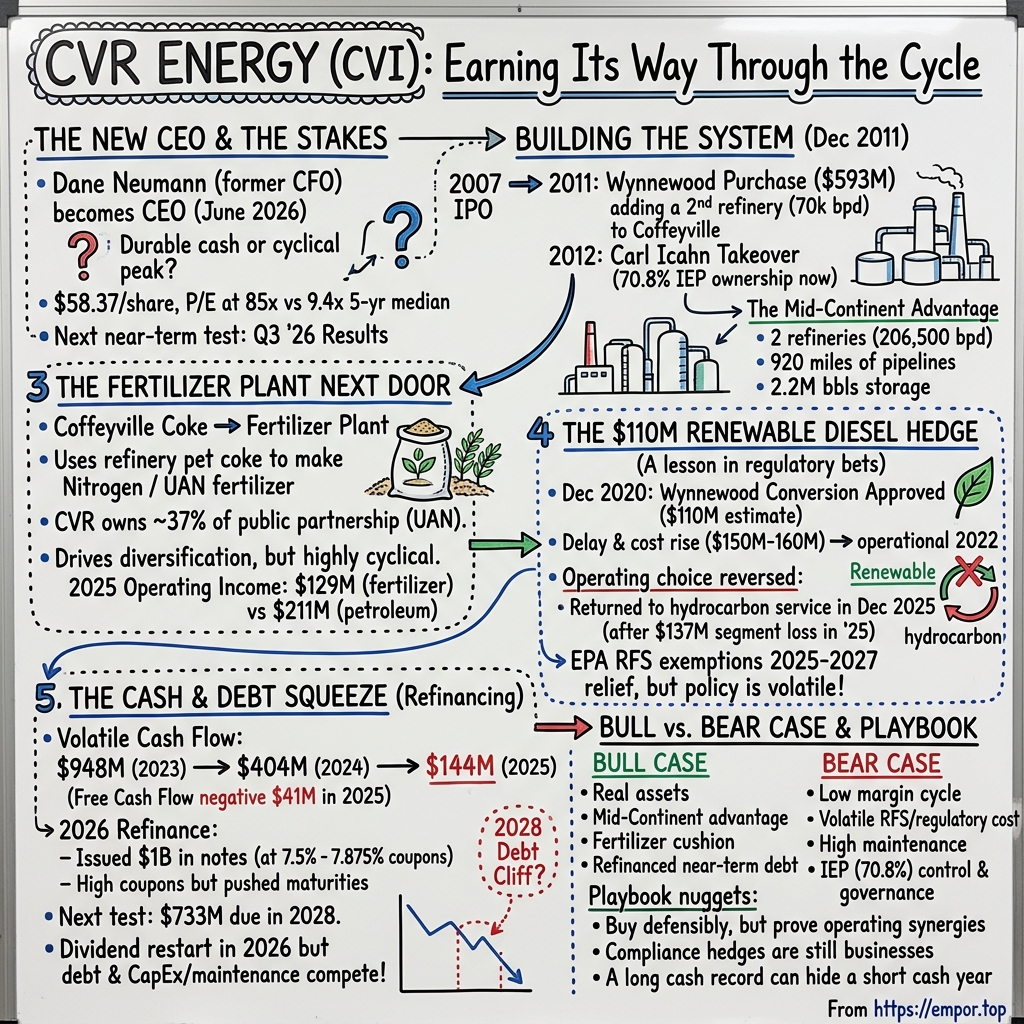
On June 18, 2026, the man who had spent years explaining CVR Energy's numbers to Wall Street became the man responsible for them. Dane Neumann, the company's executive vice president and chief financial officer, was promoted to president and chief executive of CVR Energy and of the general partner of its fertilizer partnership, CVR Partners.1 The vacancy had opened suddenly. Mark Pytosh, who had taken the top job only on January 1, resigned from the CVR companies "for personal reasons," less than six months into his tenure.12 The release that announced the change offered no more explanation than that, and a promise from Neumann to carry a philosophy of "Continuous Improvement" into every corner of the business.1
Six weeks later, Neumann sat in on his first earnings call as chief executive, next to an interim CFO, and told analysts that, strategically, he did not think "anything really changes."3 That sentence carried a lot of weight. CVR had spent the previous two years lurching from a refining boom to a near-bust, suspending its dividend, swallowing a failed renewable-fuel bet and leaning on a regulatory decision in Washington to rescue its earnings. If nothing changed, the question was whether the company that emerged from that lurch was one investors should want more of.
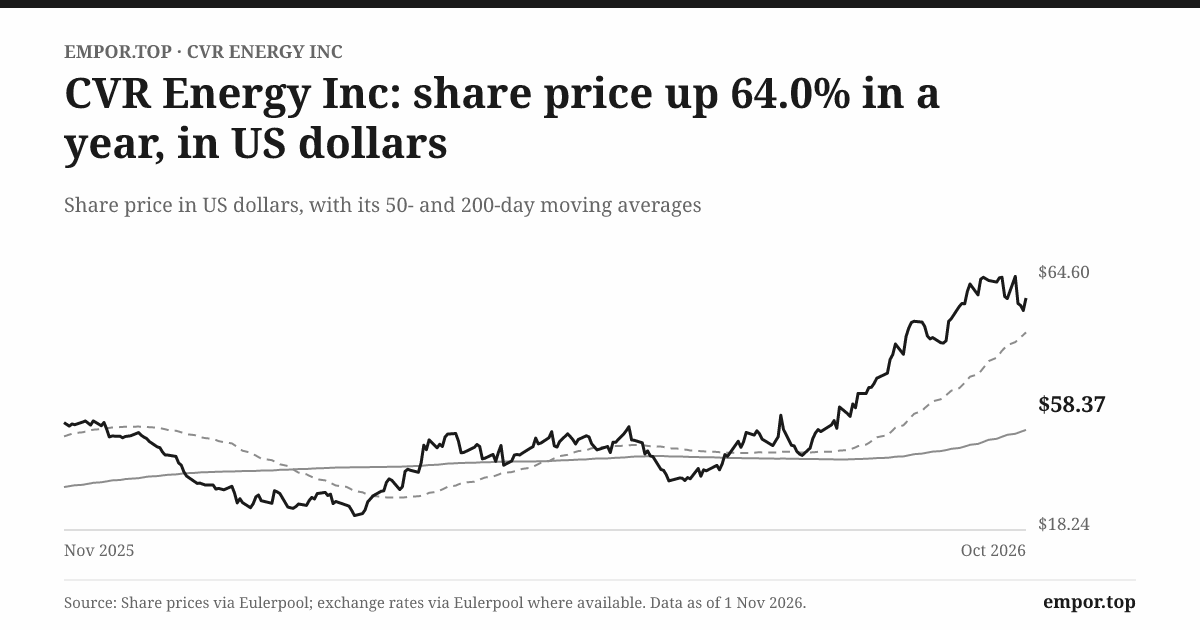
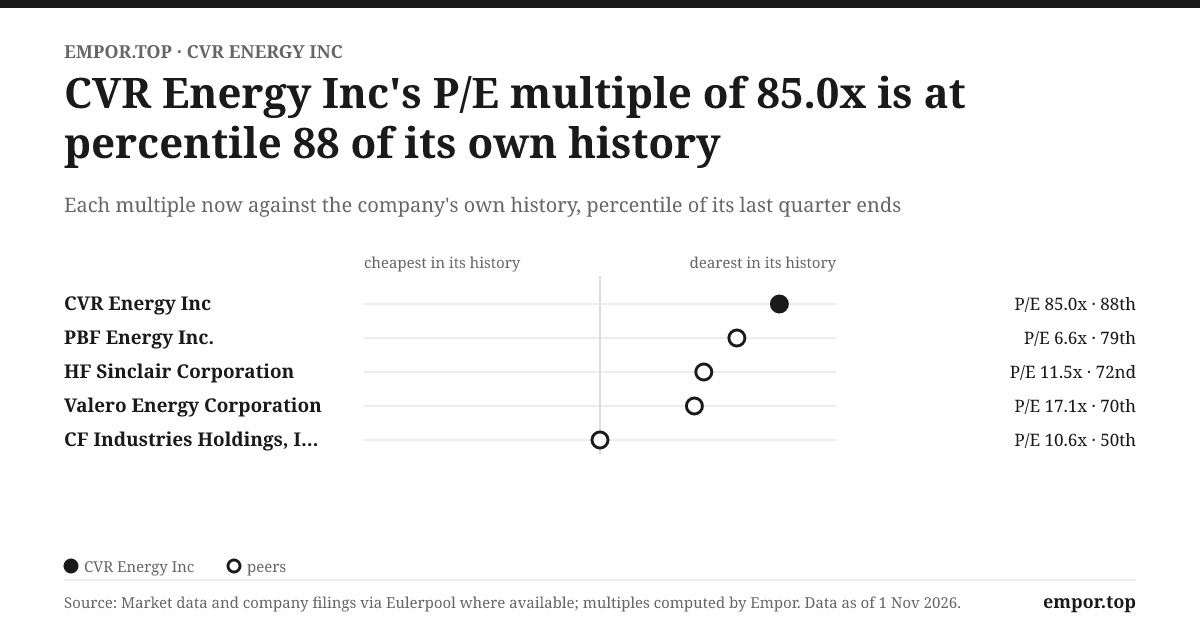
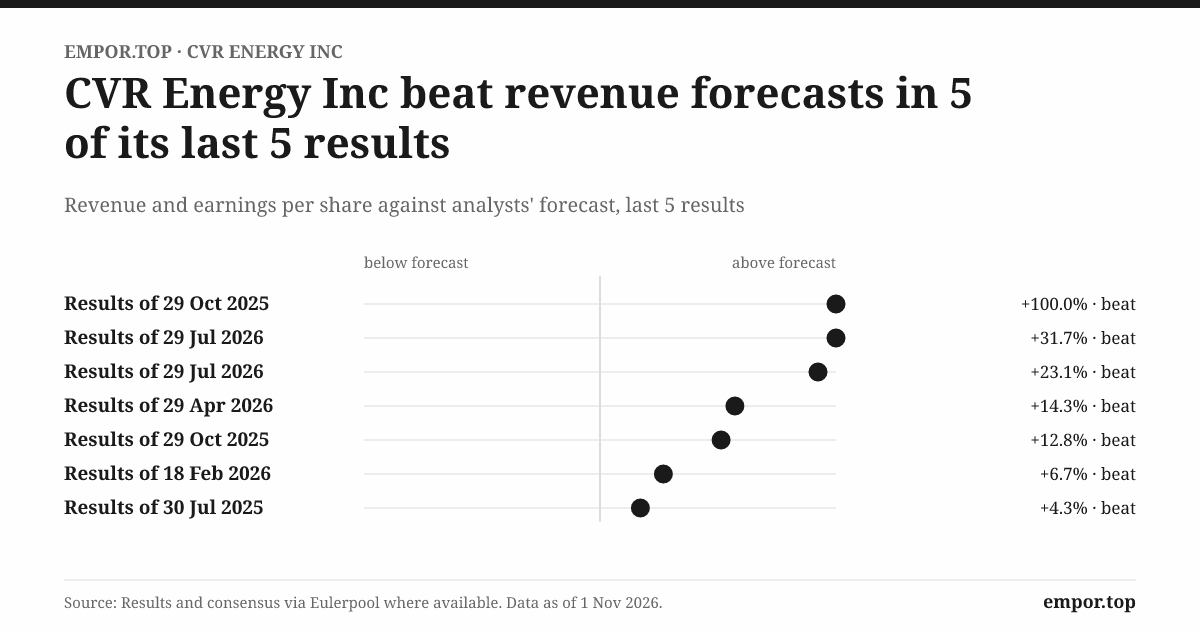
The market seemed to think so. On November 1, 2026, CVR's shares closed at $58.37, about 6% below their 52-week high of roughly $62 and nearly three times their 52-week low of about $21.4 Measured against trailing earnings, that price looks almost absurd: 85 times the last four quarters' profit, against a five-year median of about 9.4 times.4 The most recent reported quarter, the three months to June, captured the strangeness neatly. The group as a whole earned $46 million, yet after setting aside the share owed to the public holders of the fertilizer partnership, CVR's own shareholders were left with a loss of about $3 million. Strip out a pile of accounting items, mostly tied to hedges and renewable-fuel credits, and management's adjusted figure came to 34 cents a share.5
Those three numbers, a $46 million profit, a $3 million loss and 34 cents of "adjusted" earnings, all describe the same quarter. That is the first thing to understand about CVR Energy. The multiple on the screen is not a verdict on a settled recovery; it is the arithmetic of dividing a recovering share price by a set of earnings that were hollowed out by two terrible years. The stock is being priced on what the business might earn in a normal year, not on what it just reported. Which makes the obvious question the only one that matters: what is a normal year for this company?
Three narrower questions sit inside that one. The first is whether two refineries in Kansas and Oklahoma can turn their local pipelines, tanks and crude sources into returns that repeat, rather than returns that show up only when the national refining cycle is kind. The second is whether CVR can keep generating cash after its best recent year was flattered by a large, one-time regulatory windfall: the reversal of hundreds of millions of dollars of obligations under the federal Renewable Fuel Standard. The third is whether a new chief executive, inheriting a company that is roughly 71% owned by Carl Icahn's investment vehicle, can steer the next round of investment and debt decisions in a way that serves the minority holders who own the rest.6
It is worth drawing a clean boundary before going further. This is the story of CVR Energy, the New York Stock Exchange–listed company with ticker CVI: two refineries, a fertilizer business it controls but only partly owns, and a renewable-diesel experiment it has just walked away from. It is not the story of Icahn Enterprises, the sprawling holding partnership that sits above it and owns everything from auto parts to real estate. Icahn matters here as a controlling shareholder, not as a portfolio.
And the clock is running. CVR is scheduled to report its third-quarter 2026 results on November 3, two days after this story's cutoff.7 Those numbers are not known yet. They will be the first full quarter with Neumann in the chair from start to finish, the first test of whether the summer's refining strength turned into cash, and the first chance to hear how the new chief executive answers questions he can no longer hand to a CFO. To understand what he inherited, the story has to go back to a decision made fifteen years earlier, when CVR stopped being a one-refinery company.
 Subscribe on LinkedIn
II. The Second Refinery That Changed the Company
In December 2011, CVR Energy closed on a purchase that defined its shape for the next decade and a half: the Wynnewood refinery in south-central Oklahoma, a 70,000-barrel-a-day plant bought from the Gary-Williams Energy Corporation together with its storage tanks and associated assets.8 Before that deal, CVR was a single refinery in Coffeyville, Kansas, with a fertilizer plant next door. After it, CVR was a regional system: two refineries, about two hundred miles apart, drawing on the same Mid-Continent crude and selling into the same Plains and Midwest fuel markets.
The Coffeyville complex had a messier past than its tidy industrial skyline suggests. Its previous owner, the agricultural cooperative Farmland Industries, went through bankruptcy in the early 2000s, and the refinery and nitrogen fertilizer plant passed through a buyout before an investor group led by funds affiliated with Goldman Sachs and Kelso & Company bought them in 2005.9 Those private-equity owners did what private-equity owners do: they invested, tidied up the balance sheet and took the business public. CVR Energy's initial public offering, priced in October 2007, registered 18.5 million shares with an option for underwriters to buy almost 2.8 million more.9 The timing was memorable for the wrong reasons. Within a year, the financial crisis had crushed fuel demand and credit markets alike, and CVR spent its early public years proving it could survive as a single-site refiner.
By 2011 conditions had turned sharply. Crude oil from the booming shale fields and Canada was piling up in the middle of the United States, trading at a deep discount to the global benchmark, and refiners in the middle of the country could buy cheap local crude and sell gasoline and diesel at prices set by more expensive coastal markets. For a Mid-Continent refiner, that was an unusually good moment to own more capacity. Wynnewood was the bet.
The price was $593 million, including working capital and adjustments.8 CVR made its case for that price to investors in a short comparative valuation presentation, and the comparison it chose was itself revealing. On CVR's own figures, it was paying about 2.0 times Wynnewood's recent refining EBITDA and about $7,500 for every barrel a day of capacity. Its own Coffeyville refinery, valued by the market at the time, traded at about 2.3 times EBITDA and roughly $10,600 per daily barrel.[^10] In other words, management argued that it was buying the new plant more cheaply than investors were already valuing the old one. Anyone who has bought a second house in the same neighborhood will recognize the logic: if the comparable down the street costs more, the purchase looks like a bargain.
Management went further than price. It identified more than $30 million a year of potential synergies, from sharing crude purchasing and logistics, optimizing which refinery processed which crude, and coordinating product sales across a wider territory.8 Here the story needs a careful distinction. A synergy number in an acquisition announcement is a forecast, and forecasts are not savings. CVR never published a clean, audited ledger showing the $30 million arriving, year after year, and the later financial record is too noisy to isolate it: refining profits swung from tens of millions to more than a billion dollars a year over the following decade on commodity prices alone.10 What the record does show is that the two-refinery system has run at high utilization in good periods, as it did in the second quarter of 2026, and that it has also been exposed to plant-specific disasters, as the next section will describe. By CVR's own contemporaneous yardstick, the purchase did not look overpriced. Whether the promised operating advantages endured is a separate question, and one the later margins, not the 2011 slides, must answer.
The Wynnewood deal also arrived just before CVR lost its independence. In early 2012, Carl Icahn launched a tender offer for the company at $30 a share in cash, plus a non-transferable "contingent cash payment" right that would pay extra only if Icahn agreed to sell CVR to a third party at a higher price within about fifteen months.11 CVR's board fought the bid. It declined to recommend the offer, arguing that the company's long-term value exceeded $30 and that the contingent right offered shareholders little.11 Icahn kept pressing, coupling the offer with a proxy contest for the board, and in April 2012 the two sides reached an agreement that let him complete the tender if he secured a majority of the shares.11 He did. Icahn and his affiliates acquired control in May 2012, and by the end of June their stake had reached about 82%.12 The sale of the company that the contingent payment anticipated never happened. CVR went from a contested public company to a controlled one, and it has remained controlled ever since.
There was one more piece of financial engineering in that period that still shapes the ownership math today. In April 2011, a few months before the Wynnewood deal, CVR floated its nitrogen fertilizer business as a publicly traded master limited partnership, CVR Partners, under the ticker UAN.13 CVR Energy kept the general partner and a large block of the common units, while public investors bought the rest. The IPO raised capital and created a second public security, but it did not turn CVR into a pure refiner. CVR still consolidates the partnership in its accounts, still runs it through shared management, and still owns only about 37% of its common units.6 That split ownership becomes important later, when the fertilizer plant's profits look like CVR's profits on the income statement and turn out to be only partly CVR's in the shareholders' pockets.
So the company Neumann inherited was built in a rush between 2011 and 2012: a second refinery bought at a defensible price, a fertilizer business half-sold to the public, and a new controlling shareholder who had won a fight with the board. The question the Wynnewood purchase raised has never quite gone away. Did CVR build an advantaged regional system, or did it simply double its exposure to one of the most cyclical businesses in America? The answer lives in the pipes and tanks.
III. The Mid-Continent Advantage Has to Show Up in the Margin
Start at Coffeyville, in the southeastern corner of Kansas, a few miles from the Oklahoma line. Crude arrives at the refinery through a web of gathering lines and pipelines that CVR either owns or leases, and it sits for a while in tank farms before it is fed into the plant. CVR's two refineries have a combined capacity of 206,500 barrels a day: about 132,000 at Coffeyville and about 74,500 at Wynnewood.10 Supporting them is roughly 920 miles of pipeline and about 2.2 million barrels of leased crude storage, much of it near the oil hub at Cushing, Oklahoma.10
Follow one barrel through the system. It might be light crude bought from a producer in Kansas or Oklahoma and moved in CVR's own gathering network, or it might be a heavier Canadian grade arriving by pipeline. Inside the refinery, the barrel is heated and separated into fractions, then cracked, reformed and treated into gasoline, diesel, jet fuel and smaller volumes of asphalt and other products. Those products leave by pipeline and truck rack for wholesalers and fuel marketers across Kansas, Oklahoma, Missouri, Nebraska, Iowa and neighboring states. Nobody filling a pickup at a station in Wichita knows or cares which refinery made the gasoline. That indifference is the starting point of every analysis of a refiner.
The spread, and everything that eats it
A refiner's business can be explained with a grocery analogy. Imagine a baker who buys flour, butter and sugar at market prices every morning and sells bread at whatever the local bread market pays that afternoon. The baker does not control either price. Profit lives in the gap between them, minus the cost of running the ovens, paying staff, fixing equipment and complying with health rules. For a refiner, the flour is crude oil, the bread is gasoline and diesel, and the gap is called the crack spread. Out of that spread, the refiner pays its operating costs, its pipeline and storage fees, its maintenance, and, in the United States, an extra cost that bakers do not face: the purchase of renewable-fuel credits, known as RINs, to comply with federal blending mandates.
That last cost is not trivial for CVR. Because its refineries do not blend enough renewable fuel themselves, CVR must buy RINs in the market to cover its obligations, and when RIN prices spike the cost can consume a large share of the spread. In the second quarter of 2026, net RIN expense, excluding changes in the accounting liability, came to about $216 million, or roughly $11 for every barrel the refineries processed.3 Neumann did not soften the point on the call: RIN prices, he said, "have gotten completely out of hand."3 RIN prices had risen more than 125% from a year earlier, to an average of nearly $14 for every barrel CVR processed, which means that in a strong quarter for fuel margins, the credit bill alone ate a large slice of what the refineries earned.3
There is a second, quieter drain on the spread, and it is self-inflicted in the sense that it is a choice. CVR hedges part of its future refining margin by selling crack-spread swaps, contracts that lock in a margin for some barrels in advance. In a falling market those swaps protect earnings; in a rising market they give part of the upside away. The second quarter of 2026 was the second kind. CVR booked about $81 million of realized hedging losses, which its interim CFO estimated cost roughly 9% of margin capture, and it still had about 8.2 million barrels of swaps open going into the second half.3 Pressed by an analyst, Neumann said the company's historical target of hedging about 30% of production "may be a little high on a go-forward basis."3 That is a sensible answer, but it is also a reminder that a refiner's realized margin depends on judgment calls about the future, not just on the plant's efficiency. A hedge book that bleeds in good quarters and protects in bad ones is doing its job; whether CVR's sizing of that book is right will only be visible across a full cycle.
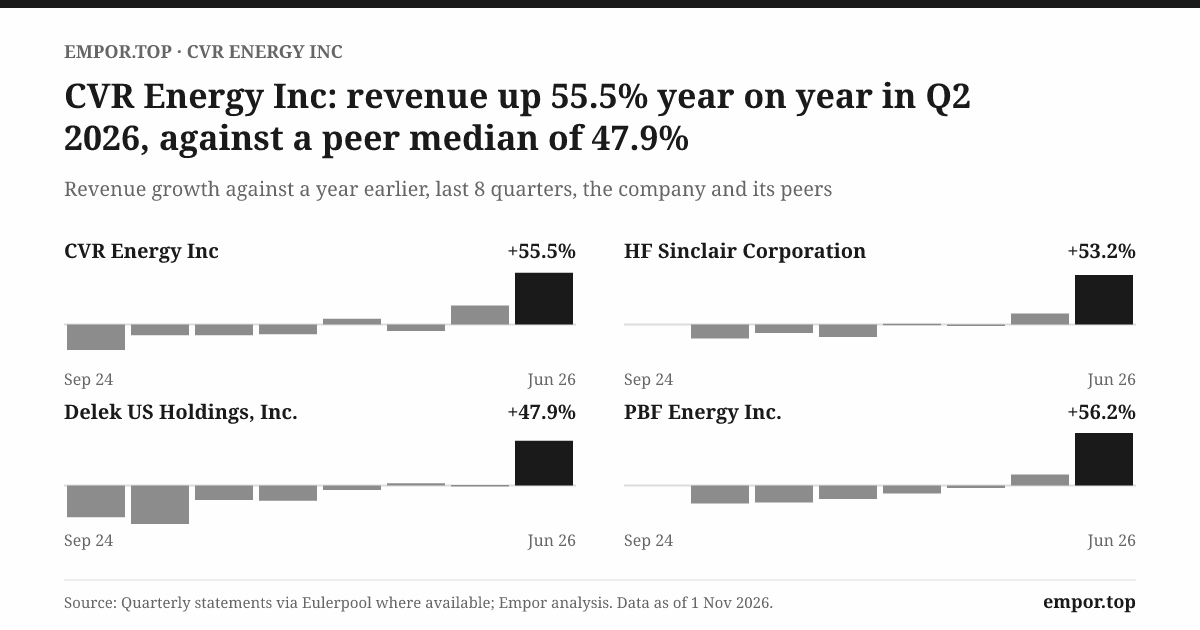
This is why revenue is a poor guide to a refiner's health. CVR's sales rose about 55% in the second quarter of 2026 from a year earlier, to about $2.7 billion, not because it sold half again as many products to new customers, but largely because fuel prices and volumes rebounded after a heavy maintenance period the prior year.54 Over a decade, CVR's revenue went from about $9.1 billion in 2014 to about $7.2 billion in 2025, with a peak near $10.9 billion in 2022.104 Those swings measure oil prices more than they measure business growth.
The number that does matter is the margin per barrel after costs. In the second quarter of 2026, CVR's refining margin came to about $9.94 per throughput barrel, and about $12.43 on an adjusted basis that strips out inventory and hedging effects, against direct operating costs of roughly $5.93 a barrel.5 A year earlier, the reported margin had been just $2.21.5 The difference between those two quarters is the whole cycle in miniature: in one, the baker barely covers the ovens; in the other, there is real money left over.
Where CVR sits among the big refiners
Place CVR on a map of American refining and its size becomes obvious. Marathon Petroleum, PBF Energy and HF Sinclair each run national or multi-regional systems, with many more refineries and far more capacity; Delek US is a closer peer in spirit, an independent with inland plants. CVR's two refineries do not compete through a consumer brand or a retail network. They compete through where they sit, what crude they can process, how complex their equipment is and how efficiently they move barrels in and out.
Michael Porter's five forces help frame the problem once. Suppliers are the crude market, and crude prices are set by global and regional benchmarks that no single Mid-Continent refiner can move. Buyers are wholesalers, distributors and large fuel marketers who can usually buy from another refinery or a pipeline terminal if CVR's price is out of line. New entrants face formidable barriers, because nobody builds a new refinery in Kansas; the capital cost, permitting and environmental burden are prohibitive. Substitutes are rising slowly, in the form of electric vehicles and renewable fuels, and policy shapes both demand and compliance cost. Rivalry among existing refiners is intense whenever capacity exceeds local demand. Put together, the forces describe an industry where the strongest available claim is not pricing power or customer lock-in, but location, logistics and operational flexibility.
That is the claim CVR makes, and it is a real one. Being near Cushing and close to Mid-Continent producers can let CVR buy crude a little cheaper than a coastal refiner, and its own gathering system can capture barrels directly at the wellhead. Being inland, it sells products into a region that historically imported fuel from the Gulf Coast, which can add a transport advantage. Those are tangible, physical advantages, and they show up in good quarters. In the second quarter of 2026, the refineries ran about 213,000 barrels a day, roughly 98% of nameplate crude capacity, compared with about 172,000 barrels a day a year earlier.53
Testing the advantage against the record
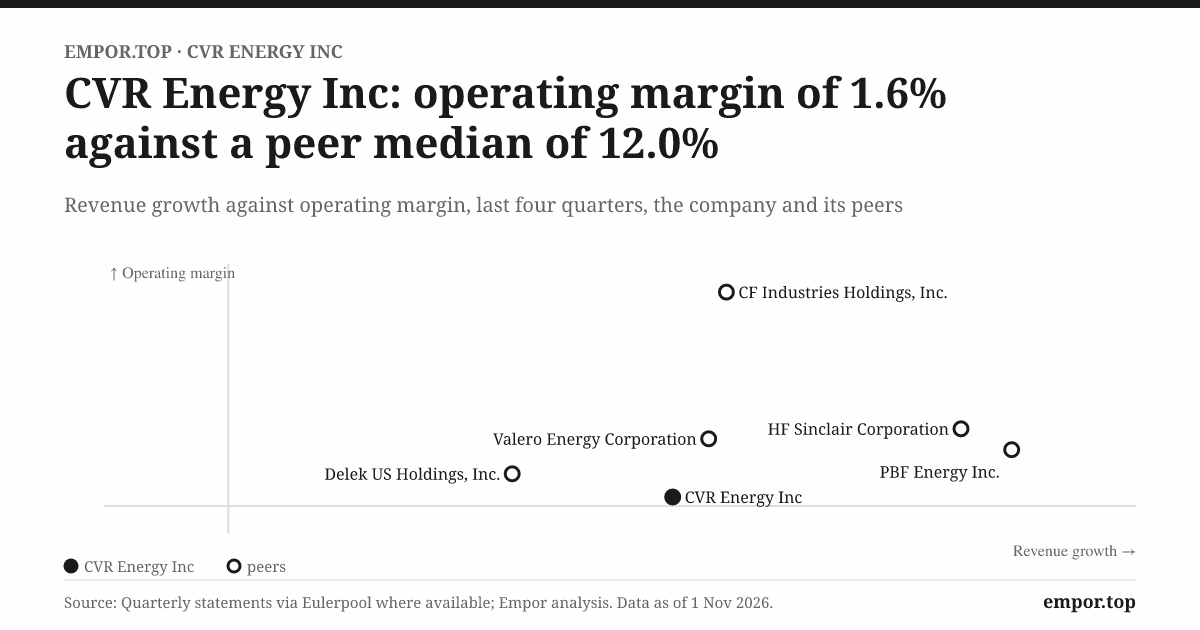
But a moat has to survive the bad years, and here CVR's record narrows the claim. The petroleum segment's operating income was about $211 million in 2025 on roughly $6.4 billion of sales, a margin of around 3%, and it had been only about $12 million in 2024.10 Those two years happened to the same refineries, with the same pipelines and the same tanks. A logistics edge that can produce $12 million in one year and $211 million in the next is not a pricing advantage; it is a lever whose payoff depends on the cycle. Over the past twelve years, CVR's operating margin has ranged from a loss of more than 8% in 2020 to about 12% in 2023, and was about 2% in 2025.4
Plant reliability is the other half of the test, and here the company's history carries human weight. On September 28, 2012, less than a year after CVR bought Wynnewood, a boiler exploded as operators restarted it during a turnaround, killing two workers.14 Federal safety regulators cited the refinery for a dozen process-safety violations, proposed penalties of about $281,000 and placed the company in their Severe Violator Enforcement Program.14 In July 2014, a fire in Coffeyville's isomerization unit burned four employees and shut the refinery for about a month.1516 And in March 2023, an employee at the Coffeyville refinery died after an incident during maintenance work.17 These events span more than a decade and do not, by themselves, establish a current safety trend. They do show that refining disruptions carry human costs as well as financial ones, and that a two-refinery company has little room to absorb them: when one of two plants stops, a third or more of the system goes dark. The record of the most recent quarter, near-full utilization, is encouraging. A longer string of such quarters, through turnarounds, is the proof that matters.
There is also an evidence gap that should be stated plainly. CVR's filings describe its locational and logistical strengths, but they do not establish that the company enjoys a sustained, full-cycle cost advantage over its peers on a comparable basis. Any claim that CVR is the low-cost operator in its region remains unproven until margins and per-barrel operating costs confirm it across a downturn. The fair verdict is that CVR has a situational operating advantage: real logistics and complexity that can widen its margin when Mid-Continent conditions cooperate, but no proof of a durable moat. The test is whether local crude economics and high utilization consistently overcome maintenance, feedstock and regulatory costs.
That test has a measurable form. Investors can watch the refining margin per throughput barrel after RIN costs, and whether throughput holds near capacity across scheduled maintenance. If those numbers stay strong when national crack spreads weaken, the advantage is real. If they collapse in step with everyone else, the advantage is geography without leverage. Which is where the plant next door to Coffeyville comes in, because CVR has long argued that it owns a second business that behaves differently.
IV. The Fertilizer Plant Next Door
Walk a short distance from the Coffeyville refinery and the landscape changes from crude tanks to something that looks more like a chemistry set. This is the nitrogen fertilizer plant, and it runs on an unusual feedstock. Most American ammonia plants use natural gas as their raw material. Coffeyville's uses petroleum coke, the dense, coal-like residue left at the bottom of the refining process. Coke from the neighboring refinery is gasified into hydrogen, which is combined with nitrogen from the air to make ammonia, and much of that ammonia is upgraded into UAN, a liquid fertilizer that farmers spray on corn and wheat fields across the Plains.10 The fertilizer business also includes a second, natural-gas-based plant at East Dubuque, Illinois.10
That physical link is the most concrete synergy in the whole CVR story. The refinery has a byproduct it would otherwise have to sell or dispose of; the fertilizer plant needs a feedstock. Coffeyville also buys coke from third parties, with about 280,000 tons contracted through December 2026, so it is not entirely dependent on its neighbor.10 But the co-location means CVR is, in a real sense, running one industrial site with two product lines.
A smaller business with a bigger share of the profit
The financial contrast between the two businesses is striking. In 2025, nitrogen fertilizer reported about $606 million of sales and about $129 million of operating income, while petroleum reported roughly $6.4 billion of sales and about $211 million of operating income.10 Fertilizer produced about a tenth of petroleum's sales, but more than half as much operating profit. The reason is simple. Fertilizer is priced on what farmers pay for nitrogen, and the plant's biggest input costs, coke and natural gas, do not move in lockstep with that price. In refining, by contrast, CVR's revenue and its feedstock cost are both oil, so the spread is thin by design.
The fertilizer business improved in 2025: operating income rose from about $90 million in 2024 to about $129 million in 2025 as nitrogen prices strengthened and feedstock costs shifted.10 And in the second quarter of 2026, the partnership's results jumped again. Its plants ran ammonia at about 99% utilization, ammonia prices at the plant gate rose to about $791 a ton from $593 a year earlier, and UAN rose to about $392 a ton from $317, lifting segment net income to about $78 million from $39 million.5
Diversification, or a second commodity?
It is tempting to treat this as a counterweight to refining: when crack spreads fall, fertilizer can carry the company. Sometimes it does. But fertilizer is its own commodity cycle, driven by global ammonia and urea prices, natural gas costs, crop prices, planting seasons and plant outages. CVR sells most fertilizer on spot and short-term contracts, many no longer than a year, sometimes with customer prepayments to lock in price and supply.10 That is not a contracted-revenue shelter; it is exposure to a different set of commodity prices.
Concentration adds another layer of risk. The two largest fertilizer customers accounted for about 28% of the segment's sales in 2025, although no single customer of the whole company represented more than 8% of receivables at year-end.10 CVR does not name those fertilizer customers and does not publish a consolidated top-customer share.
Then comes the ownership arithmetic. Because CVR controls the partnership's general partner, it consolidates the business, though outside holders own most of its common units.6 When the partnership pays distributions, about 63% of that cash leaves the CVR group for outside holders; it declared a distribution of $6.08 per unit for the second quarter of 2026.5 That is why, despite the group's second-quarter profit, CVR's own shareholders took a loss: about $49 million of profit belonged to noncontrolling interests, mostly the public owners of the fertilizer partnership.5
So the fertilizer plant is a genuinely useful business with a real operating link to the refinery, and it has contributed a disproportionate share of segment profits. But its contribution to CVR shareholders is roughly a third of what the consolidated statement suggests, and it adds a second commodity exposure under the same controlling shareholder rather than a contractual buffer. Investors who want to understand CVR's earnings should mentally shrink the fertilizer line before adding it to refining.
If fertilizer was CVR's inherited diversification, renewable diesel was its chosen one. And that bet would cost far more, and last far less, than its promoters expected.
V. The $110 Million Hedge Took Five Years to Reverse
On December 21, 2020, in the depths of a pandemic that had crushed fuel demand and pushed CVR to a loss, the company's board gave full approval to a project that management presented as both a growth opportunity and a defensive move.18 It would convert the hydrocracker at the Wynnewood refinery, a unit that normally breaks heavy oil into lighter fuels, to produce renewable diesel from vegetable oils and other bio-feedstocks. The plan called for about 100 million gallons a year of renewable diesel, an estimated cost of about $110 million, and a start-up targeted for mid-2021.1819
The logic was elegant on paper. Renewable diesel is chemically similar to petroleum diesel, so it can run in ordinary engines and pipelines, but it generates valuable federal and state credits. Every gallon CVR made itself would create RINs, which could offset some of that compliance cost. By producing its own, CVR hoped to reduce its dependence on purchased RINs and capture the credit value for itself. It was, in effect, a hedge: if RIN prices rose, CVR's compliance cost would rise, but so would the value of its own renewable output.
When the plan met the plant
The first sign of trouble came within months. In May 2021, CVR said the unit would start later than planned, citing February's severe winter storm and delays in equipment deliveries, and raised the cost estimate to $135 million to $140 million.20 In August, it paused completion altogether, because soybean oil and other feedstock prices had risen so sharply that the economics no longer justified finishing on the original schedule.21 By the end of 2021, the estimated total cost had climbed to about $170 million, with start-up pushed into the second quarter of 2022.22 The conversion was completed in April 2022, and by then the estimate stood at about $175 million, roughly 60% above the figure the board had approved.23
Technically, the project worked. The unit made renewable diesel. Commercially, it struggled. The feedstock crunch that delayed it never fully eased, renewable-diesel capacity across the United States grew rapidly as larger refiners converted plants of their own, and margins for the product shrank. CVR created a separate Renewables segment to report the business, and by 2025 the results were hard to defend: the segment recorded an operating loss of about $137 million on about $312 million of sales.10 Its customer base was also unusually narrow, with two customers each representing about half of segment sales.10
In late 2025, CVR decided to stop. The Wynnewood unit returned to hydrocarbon processing in December 2025, turning the renewable-diesel experiment back into a conventional refining unit.24 By the second quarter of 2026, CVR's results release reported only two segments, petroleum and nitrogen fertilizer.5
This was a sensible operating choice, and it should be recognized as such. Management saw the economics turn and acted rather than continuing to pour feedstock into a losing unit. But it is also an important data point for anyone weighing CVR's future "optionality." The company converted a technical milestone, producing renewable diesel, into neither the projected cost nor durable profits. A $110 million budget became about $175 million, a mid-2021 start became April 2022, and a strategic hedge became an operating loss before being reversed after roughly three and a half years of service. That record should temper how investors greet the next announced option, whether a new renewable project, a carbon-capture plan or a feedstock switch.
The real hedge came from Washington
The irony is that the largest RIN relief CVR received did not come from the plant at all. It came from the Environmental Protection Agency. Small refineries, defined by capacity, can petition the agency for exemptions from RFS obligations if compliance would cause them disproportionate economic hardship. Wynnewood qualifies as a small refinery, and for years CVR had pursued exemptions through petitions and litigation.10 Coffeyville, at nearly twice Wynnewood's size, does not, so the exemption question splits CVR's system in two: one refinery that can ask for relief, and one that must buy every credit it owes.10
The accounting of this process is itself a source of volatility that investors need to understand. CVR records its RFS obligation as a liability measured at the market price of the credits it still has to surrender. When RIN prices rise, the liability rises and charges hit earnings; when a waiver arrives, the liability can be reversed in one stroke. That is why CVR's quarterly earnings can swing by hundreds of millions of dollars on a decision made by a federal agency, and why management reports an "adjusted" figure that strips some of those swings out. Both views are useful. The adjusted number shows the underlying refining business; the reported number shows the real cash and credit obligations the company carries.
In August 2025, EPA issued a sweeping set of decisions on pending small-refinery exemption petitions covering 2016 through 2024.25 For Wynnewood, the result was dramatic: CVR's previously recorded obligations fell by more than 424 million RINs, worth about $488 million.1025 Related lawsuits were dismissed in January 2026, and CVR's year-end RFS liability fell to about $72 million from about $323 million a year earlier.10 That reversal largely explains the extraordinary third quarter of 2025, when CVR reported about $374 million of attributable net profit after a string of losses.4
It is crucial to read that number correctly. A $488 million reduction in a liability is a large policy-driven gain, not recurring refining earnings. It does not mean CVR's refineries became more profitable; it means a regulator decided that past obligations would not be enforced. And because RFS obligations keep accruing, the liability rebuilt quickly. By June 30, 2026, CVR's accrued RFS obligation had climbed to about $408 million, representing about 169 million RINs.3
Then, on August 31, 2026, EPA issued its decisions on 2025 compliance-year petitions, granting Wynnewood a full exemption for that year while proposing to reallocate the waived volumes into 2026 and 2027 requirements for other obligated parties.26 This cuts both ways for CVR. The exemption reduces Wynnewood's own burden. The reallocation could raise RIN demand and prices, affecting Coffeyville, which is not a small refinery, and any credits CVR must buy. On the July call, before the decision, management had complained that EPA was "nine months delinquent" on the petition, and said it was buying RINs for about half of Wynnewood's 2026 obligation while still seeking a full waiver.3 The net effect of the August decision on CVR's earnings depends on final rules and future credit prices, and it remains one of the biggest variables in the company's results.
Track management's explanations across these turns and a pattern emerges. In 2020 the project was framed as a hedge against RIN costs and a step toward lower-carbon fuels.18 In 2021, delays were blamed on weather, equipment and feedstock prices, which were genuine external shocks.2021 By 2025, the explanation for the shutdown was that renewable-diesel economics had weakened. Each explanation was plausible; together they describe a project whose returns depended almost entirely on factors outside management's control. The lesson is not that renewable diesel was a reckless idea. It is that a compliance hedge is still a business, with its own feedstocks, competitors and margins.
For investors, the most important consequence of the renewable-diesel episode is not the loss itself but the strain it added to CVR's cash at the worst possible time. Because when refining margins and renewable losses collided in 2024 and 2025, the company that had paid out most of its cash for a decade suddenly found it had little to spare.
VI. Cash Arrived, but Not on Schedule
Put two documents side by side and CVR looks like two different companies. On the cash-flow statement, across the twelve years from 2014 through 2025, CVR generated about $5.9 billion of operating cash, more than two and a half times its roughly $2.3 billion of cumulative net profit.4 After capital spending, free cash flow totaled about $3.5 billion, and about $2.9 billion of that, roughly 84%, went out as dividends.4 For a long-term holder, that is a powerful record: a commodity refiner that sent most of its excess cash back to shareholders for more than a decade.
On the 2025 income statement, the picture is grimmer. Net profit attributable to CVR shareholders was just $27 million, operating cash flow fell to about $144 million, and free cash flow was negative, at about minus $41 million.104 The dividend that had flowed for years stopped entirely.
Why cash beat profit, and why it stopped
The gap between cash and profit over the long run has a straightforward explanation. Refineries and fertilizer plants are expensive physical assets, and accountants spread their cost over many years as depreciation, which reduces reported profit without consuming cash in the year it is recorded. Depreciation and amortization alone reached about $403 million in 2025.10 Over a decade, that steady non-cash charge accounts for much of the difference between net profit and operating cash.
But depreciation does not explain the volatility. Working capital does. Refiners carry large payables to crude suppliers and large balances tied to inventories, receivables and accrued obligations, and these can swing by hundreds of millions of dollars in a single year. In 2025, a decline of about $289 million in other current liabilities, much of it linked to the shrinking RFS obligation, and a reduction of about $143 million in accounts payable weighed heavily on operating cash, partly offset by cash released from receivables and inventory.10 Operating cash flow went from about $948 million in 2023 to about $404 million in 2024 and $144 million in 2025.10 A cumulative twelve-year figure hides that kind of slide. Cash did arrive, but it did not arrive on a schedule a lender or a dividend investor could rely on.
Capital spending adds another layer of pressure. CVR reported capital expenditures of about $197 million in 2025, but that figure excludes the cost of turnarounds, the periodic shutdowns in which refineries are opened up, inspected and repaired. Including turnarounds, cash paid for capital projects came to about $382 million, more than 5% of revenue.10 Turnarounds are less like optional upgrades and more like an engine overhaul on an aircraft: skip them and the plant becomes unsafe or unreliable. Management's 2026 plan prioritized maintenance and reliability, with a few targeted growth projects, including the Wynnewood Alky Project, which aims to add alkylation capacity to make more high-value gasoline blending components.27 For 2026, CVR guided consolidated capital spending of about $215 million to $240 million.3
Refinancing the wall
The other claim on CVR's cash is debt, and the company spent early 2026 rearranging it. In late January, CVR priced a private placement of $1 billion of senior notes: $600 million at 7.5% due 2031 and $400 million at 7.875% due 2034.28 It used the proceeds to repay its petroleum term loan, redeem all of its $600 million of 8.5% notes due 2029, and redeem $217 million of its 5.75% notes due 2028.2829 The 2029 notes were called at 104.25% of face value, which meant paying a premium to retire them early, and CVR recognized about $28 million of loss on debt extinguishment over the first half of 2026.2
The effect was to push the bulk of CVR's maturities into the next decade. It did not eliminate the near-term wall. About $183 million of CVR Energy's 2028 notes remain outstanding, alongside $550 million of CVR Partners' secured notes due June 2028.2910 Together, roughly $733 million of notes still mature in 2028, three-quarters of them at the fertilizer partnership.
The trade-off is worth stating plainly. CVR swapped a mix of cheaper and more expensive debt, plus a floating-rate term loan, for longer-dated notes at coupons around 7.5% to 7.9%. That buys time, but it is not cheap money, and the call premium was a real cost. At June 30, 2026, total debt and finance lease obligations were about $1.8 billion, including about $570 million at the fertilizer business, against consolidated cash of about $737 million.5 Not all of that cash is surplus: about $114 million sat at the corporate level, and the remainder is spread across the refining and fertilizer businesses, where maintenance, working capital and partnership distributions all compete for it.5 Management put total liquidity outside the fertilizer partnership at about $1.1 billion, counting roughly $600 million of cash and about $540 million of availability under its asset-based revolving credit line.3 That is a comfortable cushion for a company of CVR's size. But a revolver is a line a refiner draws on when crude prices spike and working capital swells, so it is closer to an emergency tank than to spare cash. The cleaner measure of progress is gross debt. Management's stated goal is to bring debt outside the partnership down to about $1 billion, against roughly $1.2 billion at mid-year, which means about $200 million more of repayment before the company says it will consider raising the payout.35
Credit agencies have taken a cautiously better view. In November 2025, S&P revised its outlooks on CVR Energy and CVR Partners to stable, citing supportive refining conditions and expectations of lower leverage, while noting higher RIN costs and weak renewable-diesel economics.30 On October 16, 2026, Moody's upgraded CVR Energy's corporate family rating from B2 to B1, citing improved liquidity, debt reduction and solid free cash flow.3132 The upgrade is real evidence of improved near-term flexibility. It is also a reminder of where CVR stands: B1 is still several notches below investment grade, the territory of companies whose debt investors demand a premium for the risk of default.
The verdict on cash is therefore two-sided. Over a long cycle, CVR's assets have generated far more cash than accounting profit, and the company returned most of it to shareholders. But annual cash generation is volatile and maintenance-intensive, and the dividend has proven to be subordinate to liquidity and debt needs. In the first half of 2026, free cash flow recovered strongly, reaching about $264 million in the second quarter alone.5 Management reinstated a 10-cent quarterly dividend for that quarter.5 Whether that restart is the beginning of a new payout cycle or a brief pause before the next squeeze depends on who is making the decisions, and on whose interests they serve.
VII. The CFO Took the Top Job Twice in One Year
There is something unusual about the CVR leadership transition of 2026, and it is not just its speed. When longtime chief executive David Lamp resigned effective December 31, 2025, the board turned to Mark Pytosh, a veteran who had led the fertilizer partnership.6 He started on January 1. By June 18, he was gone, and the board turned to Dane Neumann, who had been CFO under both Lamp and Pytosh.16 In practice, Neumann moved from being the finance chief of an outgoing CEO, to the finance chief of a new CEO, to the CEO himself, all within roughly six months. The company also had to fill the finance chair behind him, naming Richard Roberts, from the finance and investor-relations team, as interim CFO.3
Neumann told analysts on his first call that he had been with the company for about eight years.3 That tenure gives him deep familiarity with CVR's finances, its debt and its operations, and his comments on the call were notably concrete. He said CVR still believed it needed "to grow in barrels," described the current environment as "almost ... an ideal time" for refinery portfolio rebalancing in the industry, and said growth would be funded by means "other than using cash on the balance sheet."3 He pointed to a target of about $1 billion of gross debt excluding the fertilizer partnership, and said that once that target was in reach there would be "certainly opportunity" to discuss an incremental dividend increase, but added that he did not see CVR "returning to the high, high historical levels."3
The shape of that call is worth pausing on, because the questions revealed as much as the answers. Only three analysts asked anything: Manav Gupta of UBS, Matthew Blair of Tudor, Pickering, Holt, and a Goldman Sachs analyst.3 Gupta went straight to growth and cash, and got the "grow in barrels" answer. Blair went to the hedge losses and the RIN bill, and got numbers: the $81 million realized loss, the reduced hedge exposure for the third quarter, and a confirmation that CVR was buying credits for half of Wynnewood's 2026 obligation.3 The Goldman question was the most pointed: what changes under a new chief executive? Neumann's reply, that strategically nothing really changes, was reassuring to anyone who liked the old plan and less so to anyone who wondered why the old plan's author had left after six months. No analyst asked directly about Pytosh's departure, and management did not volunteer more. The silence is not evidence of anything. It is, however, a gap that only time and consistent results can fill.
It is also worth comparing the tone with the year before. Through late 2025 and early 2026, under Lamp and then Pytosh, management's public message centered on deleveraging, the renewable-diesel exit and the pursuit of RFS relief, and the early-2026 refinancing pushed most maturities into the next decade.2728 Neumann's first call kept every one of those threads, which suggests continuity rather than a new direction. What he added was the language of growth by acquisition, which is new enough that investors have no record against which to judge it.
That last line about dividends is significant. For years, CVR was an income stock, paying out more than its net profit in many years. Neumann's language suggests a deliberate reset: debt reduction first, growth by acquisition or partnership possibly, and dividends sized to what the business can sustain. It is a sensible framework. But it is also an untested one, coming from a chief executive with a few months in the job and a predecessor who left without public explanation.
The man who owns most of the company
Above Neumann sits Carl Icahn. The 2026 proxy reported Icahn as beneficially owning about 71.2 million shares, or about 70.8% of CVR Energy, with no other holder above 5%.6 That stake gives Icahn effective control of every major decision: board composition, dividend policy, capital spending, debt strategy and any merger or sale.
In one sense, this ownership aligns Icahn with other shareholders. He owns the same common stock, receives dividends on the same per-share basis, and benefits from a rising share price like everyone else. Icahn Enterprises received about $140 million of CVR dividends in 2023 and $100 million in 2024, and nothing in 2025 when the dividend was suspended.10 Direct related-party transactions are small: about $2 million of sales and $13 million of purchases in 2025, a fraction of a percent of revenue and costs.10
The governance issue lies elsewhere: in control over the board and the payout. Only four of CVR's ten directors were deemed independent, and the company relies on the New York Stock Exchange's controlled-company exemption from the requirement for a majority-independent board.6 At the June 2026 annual meeting, the say-on-pay resolution passed with about 83.8 million votes in favor and 7.6 million against, an opposition of about 8.4% among votes cast for or against.33 Given Icahn's stake, the outcome of any vote is effectively decided in advance; the more telling number is that a meaningful share of non-Icahn holders voted against.
Pay offers another lens. Lamp's 2025 total compensation was about $8.6 million, including about $3.7 million of "other" compensation tied to his departure, in a year when attributable net income was $27 million.6 His compensation had been about $4.7 million in 2024 and $4.5 million in 2023, the latter a year in which CVR earned $769 million.6 Those numbers should be read carefully, because departure benefits and equity-linked awards are not the same as annual cash pay. Still, the pattern of a rising total in a trough year is the kind of thing a minority shareholder notices. Neumann's own 2025 compensation as CFO was about $2.2 million, and about 23,175 incentive units vested that year, at a reported value of about $828,000.6 Those units tie his pay to the share price, but they are not a substitute for a long record of owning common stock or delivering results as CEO.
There is a further historical stress test. In 2017, while serving as a special adviser to President Donald Trump on regulation, Icahn publicly advocated changing the RFS compliance rules in ways that would have benefited refiners like CVR, raising questions about conflicts of interest.34 Icahn rejected the criticism and left the advisory role later that year, and the episode does not prove any wrongdoing. But it belongs in this story because CVR's earnings remain tied to RFS policy, and the 2025 and 2026 exemption decisions show how much a single regulatory choice can move the company's results. When a company's single largest swing factor is federal policy, and its controlling shareholder has a history of high-profile advocacy on that policy, minority investors are entitled to ask how those interests are managed.
The sum of these facts is a constraint, not an accusation. Neumann brings real financial and operating knowledge. Icahn's stake aligns him with share value while concentrating influence. And the minority has limited power to test the answers it gets. That leaves investors with a final question: if they cannot vote on the strategy, how should they price it?
VIII. Analysis & Bear vs. Bull Case
Picture the stock on November 1, 2026, near its 52-week high, valued by the market at about $5.9 billion, or about $6.9 billion including debt.4 Now picture the operating record behind it: a 2025 net profit of $27 million, much of it the product of a regulatory reversal; a dividend restarted after a year of silence; a debt stack pushed out to the 2030s but still carrying a 2028 wall; and a new chief executive saying nothing really changes. The gap between those two pictures is where the investment debate lives.
How the market is pricing CVR
Its trailing P/E remains far above its five-year median.4 On enterprise value to EBITDA, a measure less distorted by one-off items and interest costs, it trades at about 9.3 times, and at about 0.8 times sales.4 Free cash flow yield, based on the most recent trailing data, is about 5.9%.4
Each of those multiples tells a different story because each uses a different "normal" year. The P/E is inflated by depressed trailing earnings, which were dragged down by losses in late 2025 and early 2026. EV/EBITDA uses a broader measure of operating profit but still depends heavily on the period chosen. As of October 30, 2026, market P/Es for peers ranged from about 3.5 times at PBF Energy and 5.8 times at HF Sinclair to about 15.4 times at Marathon Petroleum and 20.8 times at Delek US.4 CVR sits above all of them. But peer P/Es in refining are highly sensitive to where each company stands in its own cycle and to one-off items, so they are not a clean ranking. The more defensible reading is that the market is looking through CVR's trough and pricing the shares on something closer to mid-cycle earnings. Management, for its part, said in July that the business could "remain above mid-cycle conditions well into 2027."3
The bull case, stated carefully
The bull case rests on four supports. First, the assets are real and hard to replicate: two complex refineries with local crude access and logistics in a region where nobody will build a new plant. Second, fertilizer has become a meaningful profit contributor, with strong prices and high utilization in 2026. Third, policy relief has reduced some of CVR's RFS burden, with Wynnewood's 2025 exemption adding to the 2025 reversal of past obligations. Fourth, the balance sheet is in better shape: longer maturities, a Moody's upgrade and the company's stated deleveraging target. If Mid-Continent margins hold, RFS costs stay manageable, fertilizer stays supportive and the refineries run reliably, CVR could generate enough cash to cover maintenance, service its debt and return some to shareholders.
Hamilton Helmer's seven powers framework helps test how strong those supports are. CVR has some scale within its region, but not the national scale of Marathon or HF Sinclair. It has no network effects, no meaningful switching costs and no brand power with fuel buyers. It has a modest cornered resource in its pipeline and storage footprint and its co-located fertilizer feedstock, and some process power in operating complex refineries. Counter-positioning, the ability to do something rivals cannot copy without damaging themselves, is absent. That inventory is consistent with Porter's five-forces picture: CVR's best defensible advantages are physical and local, not structural pricing power.
The bear case, with the same discipline
The bear case is the mirror image. Refining margins can reverse, and when they do, CVR's two-refinery footprint offers little cushion. RFS policy can shift again, and the reallocation of waived volumes into 2026 and 2027 could raise RIN costs for Coffeyville even as Wynnewood benefits. Fertilizer prices and feedstock costs can turn against the partnership, and a large share of fertilizer profits belongs to outside unitholders anyway. Maintenance and turnarounds are relentless. Debt remains speculative grade, and the 2028 maturities still need to be refinanced or repaid. Governance is concentrated. And the company's own record shows that it can go from earning hundreds of millions to almost nothing in a year: return on equity was about 91% in 2023 and about 4% in 2025.4
An activist looking at CVR would press on three points. Why should a company with volatile cash and a 2028 wall pay a dividend at all before it reaches its own debt target? What is the full-cycle return on the capital tied up in the two refineries, and does it exceed CVR's cost of capital? And how does a controlled company with a minority of independent directors decide between acquisitions, dividends and debt reduction? Those are not accusations; they are the questions that determine whether the next cycle's cash goes to the right place.
What to watch
Three measures matter most. The first is refining margin per throughput barrel after RIN expense and turnaround effects. In the second quarter of 2026, the reported margin was about $9.94 a barrel, up from about $2.21 a year earlier, even after an RIN burden of about $11 a barrel.53 Whether that margin holds when crack spreads normalize will reveal how much of CVR's advantage is local and how much is cyclical. The second is free cash flow after maintenance capital and turnarounds, which recovered to about $264 million in the second quarter of 2026 after a negative 2025.54 The third is net debt and progress toward the 2028 maturities, measured against management's goal of roughly $1 billion of gross debt outside the fertilizer partnership, compared with about $1.2 billion of corporate debt at mid-year.35
Weighed together, the record supports a narrower thesis than either the bulls or bears would like. CVR has real assets, real local advantages and a better balance sheet than a year ago. It does not have evidence of through-cycle earnings power that would justify confidence in any single year's result. The investment case turns on normalized cash generation, not on one favorable quarter or a headline multiple. And no independent evidence in CVR's record establishes a sustained, peer-leading cost position. Investors who own the stock are, in effect, betting that the next downturn will be shallower or better managed than the last. The lessons from CVR's own history suggest how to judge that bet.
IX. Playbook: Business & Investing Lessons
Go back to Wynnewood, the plant at the center of almost every turn in this story. If CVR has lessons to teach, Wynnewood is where they were learned.
The first lesson is that a cheap purchase is a promise, not a payoff. CVR's 2011 benchmark made the price defensible; what followed depended far more on crack spreads, safety and policy than on the purchase multiple. The wider lesson for investors is to treat an acquisition's price as the opening bid on a thesis. The proof is in the operating record that follows, and a buyer who stops checking once the deal is signed has only bought a story.
The second lesson is that a compliance hedge is still a business. The renewable-diesel project showed how a clever financial idea could run into physical realities: feedstock costs, competing capacity and thin product margins. For founders and managers, the lesson is that a hedge built out of steel and soybean oil carries all the risks of a standalone business. If it would not make sense without the hedge, the hedge will not save it.
The third lesson is that a long cash record can hide a short cash year. CVR's cash and dividend record turned in 2025, when the dividend stopped. For income investors, the lesson is that a high payout in a cyclical business is not a promise; it is a decision renewed every quarter by people who can change their minds when the cycle turns.
The fourth lesson is that control can align the payout and narrow the debate at the same time. Icahn's majority stake aligns his interests with other holders on the share price, while concentrating decisions over the board, payout and strategy. Minority holders get the alignment without the vote. In a controlled company, the most important governance question is not whether the controller benefits, but whether the minority can still tell when the controller is wrong.
Underneath all four lessons is a single theme: infrastructure and policy exposure can produce both real advantage and false confidence. CVR's value depends on disciplined project returns and on surviving the cycle with the balance sheet intact, not on owning more capacity or labeling a bet an option. That brings the story back to the present, and to the next few weeks.
X. Epilogue
On November 3, 2026, two days after this story's cutoff, CVR will report its third-quarter results.7 The setting is unusual. The chief executive is still new, the stock is near its high, and much of the debt had been moved out to the next decade, though a 2028 wall remains. The company had also absorbed a major regulatory decision: Wynnewood's full exemption for 2025, paired with a proposal to reallocate waived volumes into 2026 and 2027 obligations.26
Four things will tell investors whether CVR has moved from a recovery trade to a durable cash business. The first is the refinery numbers. In July, management guided third-quarter throughput of 205,000 to 220,000 barrels a day.5 If CVR delivers near the top of that range with strong margin capture after RINs, it will suggest that the second quarter was not a fluke. If throughput slips or margins compress, it will raise doubts about reliability and the durability of the local advantage. The same guidance put third-quarter petroleum operating expenses at $110 million to $120 million and total capital spending at $85 million to $105 million, so investors will be able to check not just whether the plants ran, but whether they ran at the cost management expected.5 Investors should also listen for the explanation of any gap between adjusted and attributable earnings, which has been wide all year.
The second is policy. The August 2026 exemption decision for Wynnewood and the proposed reallocation will shape RIN prices and compliance costs for both refineries. If the final rules keep the reallocation modest and RIN prices fall from their summer highs, CVR's margin could improve sharply. If the reallocation pushes RIN prices higher, Coffeyville could bear more of the cost even as Wynnewood benefits. Management's description of the net effect will matter more than any single number.
The third is capital discipline. The Wynnewood Alky Project and other growth spending need to come with measurable returns, and Neumann's language about growing "in barrels" through means other than balance-sheet cash will need to be translated into specific deals or plans. Given the renewable-diesel history, investors are right to ask for return targets they can check later. The fertilizer business also has work under way, including an East Dubuque turnaround to complete a small ammonia expansion and a plan to add natural gas as an alternative to pet coke at Coffeyville.3
The fourth is debt. The 2028 maturities are the clearest financing milestone ahead. How and at what cost CVR refinances them will reveal what the credit markets think of the company's new shape, and whether the recent extension of maturities bought time cheaply or expensively.
All of these tests point to the same underlying question the story began with. Can CVR's operating cash, net of RIN costs and maintenance, fund its 2028 debt and earn returns on growth spending without another policy windfall? If the answer is yes, the elevated multiple will look like the market anticipating normalized earnings. If the answer is no, the stock will once again be priced as a cyclical refiner riding a temporary upswing. The tension remains unresolved, and November 3 is only the first chapter of the answer.
XI. Outro
Go back to Coffeyville one more time. Crude arrives through a network of regional pipelines and leased tanks, flows through a complex refinery, and leaves as gasoline and diesel for farms and towns across the Mid-Continent. The coke at the bottom of the barrel crosses to the fertilizer plant next door and returns to the same fields as nitrogen. And all of it is governed, in part, by rules written in Washington about how much renewable fuel must be blended into every gallon.
That is what makes CVR different from a simple bet on gasoline prices. It is a local industrial system whose returns are negotiated with commodity markets, maintenance schedules and federal policy.10 And it is a system whose final capital decisions sit with one controlling shareholder.6 The new chief executive has inherited an old cycle. CVR's story, from here, is whether local assets and sharper capital choices can make commodity cash last longer than the next turn of that cycle.
References
-
CVR Energy and CVR Partners Announce Leadership Changes, Form 8-K Exhibit 99.1 — CVR Energy, 2026-06-22 ↩↩↩↩
-
CVR Energy Q2 2026 Earnings Call Transcript — Earnings Whispers, 2026-07-30 ↩↩↩↩↩↩↩↩↩↩↩↩↩↩↩↩↩↩↩↩↩↩
-
Investor Relations: stock information and financial history — CVR Energy, 2026-11-01 ↩↩↩↩↩↩↩↩↩↩↩↩↩↩↩↩
-
CVR Energy Reports Second Quarter 2026 Results, Form 8-K Exhibit 99.1 — CVR Energy, 2026-07-29 ↩↩↩↩↩↩↩↩↩↩↩↩↩↩↩↩↩↩↩
-
Wynnewood Acquisition Announcement — CVR Energy, 2011-11-02 ↩↩↩
-
2007 IPO Registration Statement, Form S-1/A Amendment No. 9 — CVR Energy, 2007-10-02 ↩↩
-
2025 Form 10-K — CVR Energy, 2026-02-18 ↩↩↩↩↩↩↩↩↩↩↩↩↩↩↩↩↩↩↩↩↩↩↩↩↩↩↩
-
CVR Energy Board Statement on Icahn Tender Offer, Form 8-K Exhibit 99.1 — CVR Energy, 2012-04 ↩↩↩
-
OSHA Cites Wynnewood Refining Co. After Fatal Boiler Explosion — U.S. Department of Labor, 2013-03-27 ↩↩
-
CVR Refining Shuts Kansas Plant After Fire Injuries — Hydrocarbon Processing, 2014-07 ↩
-
Kansas Refinery Resumes Normal Operations — Oil & Gas Journal, 2014-09 ↩
-
Coffeyville Refinery Employee Dies After Incident — Hutch Post, 2023-03-21 ↩
-
CVR Energy Announces Full Board Approval for Wynnewood Renewable Diesel Unit Project — CVR Energy, 2020-12-21 ↩↩↩
-
CVR Energy Lets Contract for Wynnewood Refinery Renewables Project — Oil & Gas Journal, 2020 ↩
-
CVR Delays Renewable Fuel Startup at Wynnewood Refinery — Hydrocarbon Processing, 2021-05-05 ↩↩
-
CVR Energy Delays Renewable Diesel Project Due to Feedstock Price Hike — Global Energy Infrastructure, 2021-08 ↩↩
-
CVR Energy Ceases Renewable Diesel Production at Oklahoma Refinery — Biodiesel Magazine, 2026-01-28 ↩
-
August 2025 Decisions on Petitions for RFS Small Refinery Exemptions — EPA, 2025-08-22 ↩↩
-
Decisions on 2025 Small Refinery Exemption Petitions — EPA, 2026-08-31 ↩↩
-
CVR Energy Reports Fourth Quarter and Full-Year 2025 Results — CVR Energy, 2026-02-18 ↩↩
-
CVR Energy Announces Pricing of Private Placement of $600 Million of 7.500% Senior Notes Due 2031 and $400 Million of 7.875% Senior Notes Due 2034 — Business Wire, 2026-01-29 ↩↩↩
-
CVR Partners L.P. Outlook Revised to Stable — S&P Global Ratings, 2025-11-20 ↩
-
Moody's Upgrades CVR Energy to B1 on Improved Balance Sheet and Liquidity — Investing.com, 2026-10-16 ↩
-
2026 Annual Meeting Results, Form 8-K — CVR Energy, 2026-06-05 ↩
-
Icahn and the Renewable Fuel Standard Conflict Questions — Axios, 2017 ↩
 LinkedIn
 WhatsApp
 Reddit
 Hacker News
 Email
 Kindle
 RSS Feed
 Spotify
 Apple Podcasts
 Amazon Music
 Audible
 YouTube