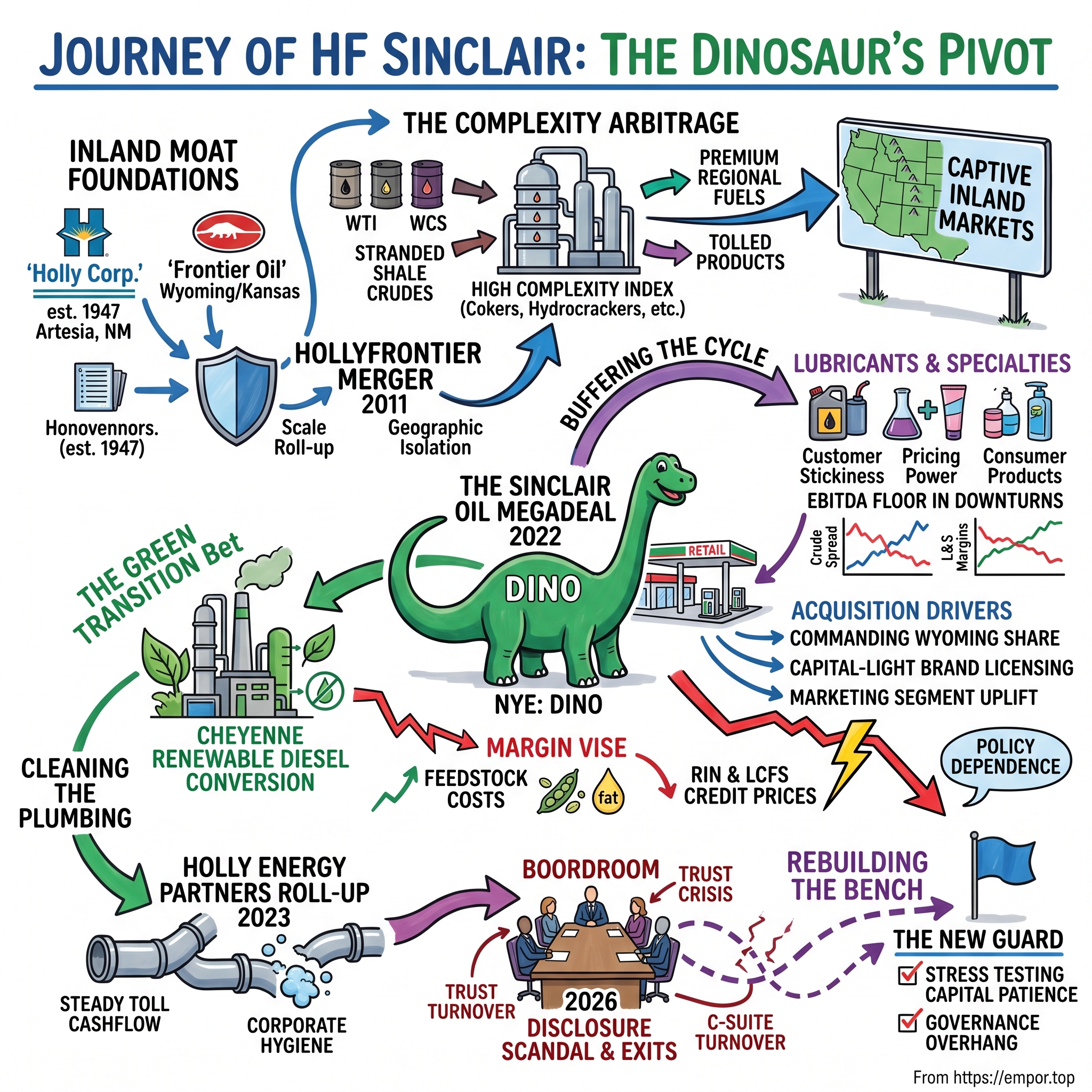
HF Sinclair Corporation (NYSE: DINO): The Dinosaur's Pivot
I. Introduction & Episode Roadmap
The Sign by the Highway
On a two-lane highway threading through the sagebrush of southern Wyoming, there is a filling station where a fourteen-foot fiberglass brontosaurus stands guard over the pumps, painted a shade of green that has not existed in nature since the Cretaceous. Generations of American road-trippers have pulled over, filled the tank, and let a kid climb onto the dinosaur for a photograph. The mascot is called Dino, and he has sold gasoline under the Sinclair banner for the better part of a century. He is nostalgia rendered in reinforced plastic — a symbol of the open road, the family station wagon, and an America that measured freedom in miles per gallon.
But nostalgia is a strange skin for what actually sits behind that dinosaur today. Dino is now the corporate namesake and the stock ticker of HF Sinclair Corporation, a company built not on sentiment but on one of the most unglamorous, capital-intensive, and cyclically violent businesses in the industrial economy: crude oil refining. The green brontosaurus is the friendly face on a machine that buys heavy, sour, discounted crude, cooks it under enormous pressure in the high desert, and sells the resulting gasoline and diesel into markets walled off by mountain ranges. It is a machine assembled, over roughly fifteen years, from the ambition and consolidation of a half-dozen regional independent refiners stitched together by Wall Street.
Consider the scale of what that assembly produced. In 2025, HF Sinclair set a company throughput record of about 652,000 barrels per day and generated roughly $2.3 billion of adjusted EBITDA across five reportable segments spanning refining, renewable diesel, pipelines, lubricants, and branded retail.15 Since the transaction that gave the company its name closed in March 2022, it had returned approximately $4.7 billion to shareholders and retired some 64 million shares — the equivalent of roughly four-fifths of all the stock it had issued to fund its acquisitions.15 Those are not the numbers of a nostalgia brand. They are the numbers of a serious industrial enterprise that learned how to turn geography into cash.
The Paradox
Here is the paradox at the center of this story. A collection of obscure, landlocked refiners — Holly Corporation of Artesia, New Mexico, and Frontier Oil of Houston — merged in 2011, spent a decade acquiring lubricant plants, specialty chemical businesses, and pipeline networks, and then, in 2022, swallowed the very Sinclair Oil that had given the world the dinosaur. The combined enterprise became something close to a private energy grid for the Rocky Mountains and the American Southwest: it made the fuel, it owned the pipes that moved the fuel, and it owned the brand on the sign where the fuel was sold.
And then, in the winter and spring of 2026, that same company walked into a governance crisis so acute that its chief executive and its chief financial officer were both pushed out within roughly ninety days of each other — after the CFO went to the board's Audit Committee with formal concerns about the CEO's conduct, and the board ultimately concluded that it could keep neither man.56 A company that had spent fifteen years methodically de-risking its earnings discovered that the risk it had not hedged was sitting in its own executive suite.
The Core Thesis
The thesis of this story is a hard one, and it resists the tidy arc that corporate histories usually get. Refining is a commodity business, and commodity businesses do not have destinies — they have cycles. Nobody pays a premium for HF Sinclair's particular molecules of diesel. What the company represents is a fifteen-year, multi-billion-dollar attempt to escape that reality through three distinct strategic levers.
The first lever is geographic isolation — the insight that a refinery no competitor can economically attack is worth more than a bigger one on the crowded Gulf Coast. The second is downstream integration — the bet that lubricants, specialty chemicals, pipelines, and branded retail could pour a stable floor beneath a violently unstable earnings stream. The third is the green transition — the wager that converting a refinery to renewable diesel could turn a regulatory obligation into a profit center.
Two of those three levers largely worked. One did not, at least not on the terms it was sold. And all three were nearly overshadowed by the boardroom rupture of 2026. Along the way the company generated genuine cash and genuine moats, and it also paid a rich premium for its signature deal, misjudged the economics of its green pivot, and detonated its own C-suite at the worst possible moment in the cycle. This is the story of both halves.
The Roadmap
The narrative runs roughly chronologically. We begin with the structural logic of inland refining and the 2011 merger that created HollyFrontier. We examine how refinery complexity turned cheap, stranded shale crude into a profit engine, and how a master limited partnership quietly financed the pipelines underneath it. We follow the diversification into lubricants and specialty hydrocarbons, the megadeal for Sinclair Oil, the messy and heavily subsidized economics of renewable diesel, and the eventual simplification of the corporate structure. Then we walk into the 2026 boardroom, where the story turns from strategy to trust. Finally, we stress-test the whole edifice against Hamilton Helmer's 7 Powers and Porter's Five Forces, and against the arguments a skeptical investor — or an activist with a sum-of-the-parts spreadsheet — would make.
Let us start where every refiner's advantage begins, and where most refiners have none: with geography.
 Subscribe on LinkedIn
II. The Inland Moat: Holly Corporation and Frontier Oil
Why a Barrel of Gasoline Hates to Travel
Picture a barrel of gasoline as a passenger who despises long journeys. It is bulky, flammable, tightly regulated, and expensive to move. Every mile it rides in a pipeline, a barge, or a tanker truck adds cost, and unlike an iPhone or a bar of gold, its value per pound is low enough that transportation can consume the entire margin. This single mundane fact — that refined fuel is costly to ship — is the foundation of everything that follows in this story. It is the reason refining, almost alone among the businesses of Big Oil, can support genuinely local, genuinely durable advantages.
Most of the world's refining capacity sits on coastlines, because that is where crude arrives by tanker and where finished product departs the same way. The Gulf Coast refiners of Texas and Louisiana are magnificent machines, some of the largest industrial installations on earth. But they compete in a global arena. Their crude is priced off internationally traded Brent, and their finished products face imports from India, the Middle East, and Asia. A coastal refiner is a price-taker in a worldwide market, and its margin is set by the marginal barrel produced anywhere on the planet.
An inland refiner plays a fundamentally different game. It sits hundreds of miles from any coast, fenced off by distance and, in the Rocky Mountains, by literal geological walls. To ship gasoline into Salt Lake City or Cheyenne from Houston, you must either build a pipeline or move it by truck and rail — and the cost is high enough that a local producer can charge a persistent premium without ever attracting a serious challenger. The landlocked refinery does not need to be the largest or the most efficient in the world. It only needs to be closer than anyone else. Distance is its moat, and distance does not get disrupted.
Holly: Small, Regional, and Quietly Profitable
Two companies built their entire existence on that insight. The first was Holly Corporation, founded in 1947 in Artesia, New Mexico — a sun-blasted oil town on the edge of the Permian Basin, where the sky is enormous and the nearest ocean is a two-day drive. Holly's crown jewel was the Navajo refinery, and for decades the company did something deeply unfashionable in an era of oil-major globalization: it stayed small, stayed regional, and stayed profitable.
While the supermajors chased offshore mega-projects and international upstream acreage, Holly patiently extended its footprint across the Southwest and up into Tulsa, Oklahoma, buying assets that larger companies considered subscale and uninteresting. That was precisely the point. Holly was never trying to conquer the world; it was trying to own a handful of valleys completely. In a business where the marginal competitor sets the price, owning the only game in a region is worth more than owning a slightly bigger share of a crowded one.
Frontier: The Pivot Into the Middle of the Continent
The second company was Frontier Oil, which began life as Wainoco Oil — an exploration and production outfit — before pivoting decisively into refining during the 1990s. It was a contrarian move at the time. Refining in the 1990s was widely regarded as a graveyard: overbuilt, margin-starved, and burdened with escalating environmental compliance costs. The majors were actively selling refineries; Frontier was buying them.
Frontier assembled inland plants in Cheyenne, Wyoming, and El Dorado, Kansas — again, not glamorous coastal giants but well-positioned mid-continent processors sitting astride the pipeline arteries that carried North American crude. Frontier's leadership grasped something that took the rest of the industry years to appreciate: the interior of the North American continent was about to become the single most interesting place in the global oil business. They were right, and they were early.
The Great Mid-Continent Crude Glut
The reason was a revolution underground. Beginning in the late 2000s, hydraulic fracturing and horizontal drilling unlocked staggering volumes of light crude from shale formations in North Dakota, Texas, and Oklahoma, while Canadian oil sands production poured heavy Western Canadian Select southward across the border. All of it collected in the middle of the continent — and there were nowhere near enough pipelines to carry it to the coasts.
Crude piled up at the storage hub in Cushing, Oklahoma, with no economic route to tidewater. And when supply is physically stranded, its price collapses. West Texas Intermediate began trading at a steep and persistent discount to global Brent — at times more than twenty dollars a barrel — and heavy Canadian crude traded at a further discount to that, because it was both stranded and difficult to process.
For a refiner sitting directly on top of this glut, it was close to a gift from the gods. The input was artificially cheap because of a pipeline bottleneck. The output was priced at a premium because of geographic isolation. The gap between the two — what the industry calls the "crack spread," the margin between the cost of crude and the value of the refined products cracked out of it — widened into a windfall that lasted years. Inland refiners in the early 2010s were, briefly, among the most attractive positions in all of American heavy industry.
The 2011 Merger of Equals
None of this was lost on Holly or Frontier, and neither was the obvious conclusion: whoever controlled more of the mid-continent could capture more of the arbitrage. In 2011, the two companies merged in a transaction valued at roughly $7 billion to form HollyFrontier Corporation, trading on the NYSE under the ticker HFC.
The logic was the classic logic of a scale roll-up, and it was sound as far as it went. Pool the inland footprints into a single system. Buy crude with greater bargaining weight and more optionality about where to send it. Strip out duplicated corporate overhead — two headquarters, two boards, two sets of public-company costs collapsed into one. Stand collectively astride the mid-continent discount rather than competing for slices of it.
What neither side fully articulated at the time, however, was that scale by itself was not the durable moat. Plenty of refiners had scale. The deeper advantage — the one that determined who actually monetized the crude glut and who merely watched it — was complexity: the physical ability to digest crude that nobody else could stomach. That is where the real money was hiding, and it is where we go next.
III. The Complexity Arbitrage: How HollyFrontier Won the Shale Boom
Not All Refineries Are the Same Machine
There is a natural temptation to think of a refinery as a single kind of thing, the way one thinks of a bakery or a steel mill. In reality, refineries differ from one another as profoundly as a household toaster differs from a commercial kitchen. The industry even keeps a score for it — the Nelson Complexity Index — and understanding what that score measures is the key to understanding why HollyFrontier printed money in the 2010s while a number of its peers merely survived.
A simple refinery essentially boils crude oil and separates it into its natural fractions by weight: some gasoline, some jet fuel, some diesel, and a heavy, near-worthless residue at the bottom. It works best when fed light, sweet crude — oil that is already chemically close to the products you want and low in sulfur. The problem is that light, sweet crude is expensive, precisely because every refinery on earth can use it. A simple refinery, in other words, buys the costly input and produces an ordinary output. Its margin is thin by construction.
A complex refinery is a fundamentally different animal. Equipped with cokers, hydrocrackers, catalytic crackers, and reformers — think of them as industrial pressure cookers and molecular re-arrangers that break heavy chains apart and reassemble them into lighter, more valuable ones — it can take the cheapest, heaviest, foulest crude on the market. The tar-like Canadian bitumen and high-sulfur sour grades that would poison the catalysts of a simple plant become, in a complex refinery, raw material for high-octane gasoline and ultra-low-sulfur diesel.
The economics of this are worth stating plainly, because they are the engine of the entire era. The complex refiner buys its feedstock at a discount because the feedstock is difficult, and sells its output at a premium because the output is high-specification. The spread between those two prices is the return on having spent billions of dollars on sophisticated equipment. That is the complexity arbitrage, and during the shale boom it separated the winners from the also-rans.
HollyFrontier's Regional Position
HollyFrontier's plants were built for exactly this trade. Concentrated in the Southwest at Navajo/Artesia and across the Rockies and mid-continent at Cheyenne, Woods Cross near Salt Lake City, El Dorado, and Tulsa, they were relatively high-complexity units sitting inside captive regional markets. The combination mattered enormously: complexity without isolation just means competing globally with a better machine; isolation without complexity means being protected but unable to exploit cheap heavy crude. HollyFrontier had both.
The company was never trying to out-scale ExxonMobil or Chevron. Those are vertically integrated supermajors that pump their own crude, refine it on multiple continents, and treat refining as one link in a much longer chain. HollyFrontier was playing the independent refiner's game — regional concentration plus complexity plus operational discipline. Its true peer set was the large independents that dominate the coasts: Valero (VLO), Marathon Petroleum (MPC), and Phillips 66 (PSX), each with far greater total capacity and far greater exposure to global product markets. Below them fought the scrappier inland specialists, Delek US (DK) and CVR Energy (CVI), competing for the same interior niches.
Independent refining is a genuinely brutal trade. There is no branded consumer willing to pay more for your product, no patent to defend, no software lock-in. You win by owning a cost advantage or a location advantage that your competitor structurally cannot copy — and you lose, sometimes catastrophically, when the spread that supports your advantage compresses. HollyFrontier's version of the advantage was to own the interior valleys that geography had already fenced off, and to fill them with machines that could eat the discounted crude sloshing around the middle of the continent.
The Midstream Engine: Holly Energy Partners
But refineries do not float in space. They need crude piped in and product piped out, and the infrastructure connecting them is a distinct kind of asset — steady, toll-like, unglamorous, and remarkably resistant to the commodity cycle. A pipeline earns a fee per barrel moved regardless of whether the barrel was refined profitably. It is closer to a toll road than to a factory.
In 2004, Holly made a move that would prove quietly and durably brilliant. It carved its pipelines and storage terminals out into a Master Limited Partnership called Holly Energy Partners, and took it public. An MLP is a tax-advantaged structure: it pays out most of its available cash to unit-holders as distributions and, in exchange, pays little or no entity-level corporate tax. For yield-hungry retail investors in a low-interest-rate world, it was catnip. For Holly, it was a financing machine.
The elegance of the arrangement is worth appreciating. By selling units to the public, Holly raised inexpensive capital to build and acquire more midstream infrastructure — capital it did not have to raise at the parent level or against its own balance sheet. Yet because it retained control of the general partner, it kept full operational command of the pipelines and tanks that fed its own refineries. Outside investors funded the plumbing; Holly ran it.
In the language of Hamilton Helmer's 7 Powers, this was a textbook Cornered Resource — a physical network of pipes, terminals, and rights-of-way threading the Rockies and Southwest that a competitor simply cannot replicate at rational cost. You cannot conjure a parallel pipeline corridor through a mountain range where the routes, permits, easements, and geography have already been claimed. The barrier is not cleverness; it is concrete, topography, and decades of accumulated right-of-way.
The Vulnerability Hidden in the Word "Spread"
Here, then, was the machine at its peak circa 2013: discounted crude in, premium fuel out, and a captive, fee-earning toll road connecting the two. When crack spreads were wide, it generated cash at a rate that made the entire enterprise look like a compounding machine rather than a commodity processor.
But the whole edifice rested on a word that contains its own warning. A spread can narrow. Pipelines eventually got built, and the WTI-to-Brent discount compressed. New refining capacity came online globally. Demand shocks arrived without notice. When the spread compresses, an inland refiner flips from cash gusher to cash incinerator with startling speed, because the fixed costs of running a refinery do not compress with it.
Management understood this. And so the next chapter of the story is about the search for something — anything — that would keep generating money when the refining cycle turned cold.
IV. The Buffering Act: Lubricants & Specialty Products
The Thing That Keeps Refining Executives Awake
Ask a refining executive what they worry about at three in the morning, and the honest answer is the crack spread. It is set by forces utterly beyond any single company's control: OPEC production quotas, hurricane season in the Gulf, a demand shock in China, a competitor's unplanned outage that tightens supply in your favor, a new export terminal in India that loosens it against you. In a good year the spread is fat and every refining CEO looks like a strategic genius. In a bad year it compresses toward zero and even superbly run refiners bleed cash.
The business has no memory and no loyalty. What it has is a cycle, and the cycle does not care how disciplined your operations are or how eloquent your investor presentations become. This is the central existential problem of pure-play refining, and it is why refiners have historically traded at low multiples of peak earnings: the market knows that peak earnings are not real earnings.
Going Downstream, Toward Chemistry
HollyFrontier's answer was to go hunting for earnings that did not move with the crack spread — businesses positioned further downstream, closer to the end customer, where margins were determined by product specification, formulation expertise, and customer qualification rather than by the daily gyrations of commodity screens.
The most attractive candidate was lubricants: the base oils and specialty fluids that go into motor oil, industrial lubricants, transformer fluids, cosmetics, food-grade white oils, and pharmaceutical excipients. The distinction from fuel is fundamental. Gasoline is a commodity — one refiner's gallon is interchangeable with another's, and the customer buys on price alone. A high-purity white oil that meets a pharmaceutical manufacturer's specification is not interchangeable with anything. It is tested, qualified, written into the customer's own regulatory filings, and audited. Switching suppliers means re-qualifying the input, which is slow, expensive, and risky.
That friction is the whole point. It creates something a refinery can never have: customer stickiness, pricing that reflects capability rather than commodity indices, and margins that persist through a downturn in fuel. Management wanted that stability badly enough to pay for it twice.
Petro-Canada Lubricants and Sonneborn
In 2017, HollyFrontier acquired Petro-Canada Lubricants from Suncor Energy for approximately C$1.13 billion — roughly US$845 million at the exchange rate of the day. Petro-Canada was one of the largest base oil producers in the world, with genuine technical depth in ultra-pure white oils and high-specification grades. It came with a global customer book, an established brand in industrial lubricants, and a production facility whose output sat at the premium end of the base-oil quality spectrum. Crucially, it was a business whose profitability curve looked nothing like a refinery's.
Two years later, in 2019, the company doubled down and acquired Sonneborn for $685 million. Sonneborn was a global leader in specialty hydrocarbons: petrolatum, microcrystalline waxes, and the white oils that end up in everything from hand cream and lip balm to the coating on a piece of chewing gum and the processing aids in plastics manufacturing. If Petro-Canada gave HollyFrontier scale in base oils, Sonneborn gave it depth in the highest-value, most specification-driven niches.
Together, the two deals created a genuinely global Lubricants & Specialties business — a segment with its own manufacturing footprint, its own commercial organization, its own customers, and its own economic logic, sitting inside a refining company. It cost well over a billion and a half dollars to assemble. The question that mattered was whether it would actually earn its keep when the cycle turned.
The Down-Cycle Test — And What It Proved
The evidence arrived, unambiguously, in 2024. That was the year the post-pandemic refining boom finally broke. Crack spreads that had been extraordinarily wide in 2022 and 2023 normalized hard, and the core refining segment fell off a cliff: Adjusted Refining EBITDA collapsed to roughly $337 million, down from well over $2.5 billion the year before.10 That is an eighty-plus percent decline in a single business line inside twelve months — the kind of swing that has historically pushed weaker independent refiners into distress or forced them to slash their dividends.
And in that same brutal year, Lubricants & Specialties generated approximately $329 million of EBITDA.10 Read that comparison again, because it is the single most important piece of evidence for the entire diversification thesis: in the trough of the refining cycle, the lubricants business contributed almost exactly as much as the refineries did. The segment held up again in 2025 at roughly $261 million, softening somewhat on seasonal weakness and higher operating costs but remaining substantially profitable.1115
Across a normalized cycle, lubricants throws off something on the order of a fifth to a third of the company's earnings, and it does so on a curve that correlates only loosely with the refining crack. That is the cash-flow floor a Gulf Coast pure-play refiner structurally lacks.
What the Evidence Actually Means
The analytical conclusion here should be stated carefully, because it is easy to over-claim. HollyFrontier did not buy itself a growth engine. Lubricants EBITDA has drifted downward from 2024 to 2025, and it remains exposed to industrial demand, base-oil pricing cycles, and its own operating cost inflation. Anyone marketing this segment as a secular compounder is overselling it.
What management did buy was a shock absorber — and a shock absorber, in a business defined by shocks, is worth a great deal. The segment converts the corporate earnings profile from a pure sawtooth into something with a durable base. It is what allows the company to keep funding maintenance capital and dividends while the refineries wait out a trough, rather than being forced into the classic refiner's death spiral of deferring turnarounds to preserve cash and then suffering worse outages as a result.
Judged on that standard — not as a growth story, but as insurance that pays for itself — the lubricants strategy has been validated by the hardest possible test: an eighty percent collapse in the core business. With that floor in place, management was ready to attempt the most audacious move in the company's history. It was going to buy the dinosaur.
V. The Green Dino Returns: The Sinclair Oil Megadeal
The Most Successful Marketing Lie in American Energy
The green brontosaurus was born in 1930, at a moment when American oilmen wanted a way to suggest that their gasoline had been aged and refined over unimaginable stretches of geological time, like a fine vintage from the age of dinosaurs. It was, scientifically speaking, nonsense — crude oil comes overwhelmingly from ancient marine algae and plankton, not from dinosaurs. But it was brilliant nonsense, the kind of vivid, sticky, emotionally resonant marketing that survives a century of consumer amnesia. Ask any American over forty to name a gas station mascot and a meaningful fraction will produce a green dinosaur.
Behind it stood one of the more colorful and compromised figures in American industrial history. Harry F. Sinclair founded Sinclair Oil in 1916 and built it with remarkable speed into a national force, assembling refineries, pipelines, and stations at a pace that made him one of the wealthiest men in the country. He also became infamous in the 1920s as a central figure in the Teapot Dome scandal — the bribery affair over the leasing of federal naval oil reserves that sent a sitting U.S. cabinet secretary to prison and stands as one of the defining corruption episodes of the era. Sinclair himself was acquitted of the underlying conspiracy but served time for contempt.
The company survived its founder's disgrace, which is itself a lesson about the durability of a good brand attached to a real asset base. Over the following century, Sinclair Oil became one of the most recognizable retail fuel names in the American West, its dinosaur perched over thousands of stations from Texas to Montana.
The Unusual Target
For most of that century, Sinclair Oil remained privately held by the Holding family's Sinclair Companies — and that is precisely what made it such an unusual acquisition target. This was not a distressed asset being dumped by a major, nor a broken-up subsidiary looking for a home. It was a well-run, closely held private company with a genuinely beloved brand, a fleet of refineries in Wyoming, its own midstream logistics, and a captive network of branded stations across exactly the geography HollyFrontier already dominated.
When HollyFrontier and Holly Energy Partners announced in August 2021 that they would combine with Sinclair Oil, and completed the transaction on March 14, 2022, it read less like an acquisition than a merger of two Rocky Mountain empires — one public, one private — into a single dominant regional entity.12 The overlap was almost eerily clean: the same states, the same isolated markets, the same customers, complementary assets.
The Deal Structure — And What It Cost
The structure is where the analysis gets genuinely interesting, and where the skepticism properly begins. Rather than pay cash, HollyFrontier handed the Sinclair owners equity: approximately 60.2 million newly issued shares of common stock, which translated into a 26.75% pro forma stake in the combined enterprise, valued at roughly $1.8 billion at the time of announcement.1
Stop and consider what that means. HollyFrontier gave away more than a quarter of itself — permanent, perpetual ownership — to acquire Sinclair. That is not a decision a board makes casually, and it is not a decision that can be undone if the thesis proves wrong. In parallel, the midstream arm, Holly Energy Partners, separately acquired Sinclair's logistics assets — pipelines and terminals — for approximately $758 million in a combination of HEP units and cash.1
The whole arrangement was wrapped in a newly formed parent holding company, and that is the moment the corporate identity changed: HollyFrontier's HFC ticker gave way to HF Sinclair Corporation, NYSE: DINO.2 It is rare and telling for an acquirer to take the acquired company's name and mascot as its own market identity. Management was signaling, quite deliberately, that it viewed the Sinclair brand as the more valuable public-facing asset.
The Goodwill Question
One tell about the price sits in the accounting. In its SEC filings, HF Sinclair recognized approximately $685.9 million of goodwill arising from the Sinclair transaction — the premium paid above the identifiable fair value of the tangible and intangible assets acquired.12
Goodwill is management's formal way of saying: we paid more than the sum of the parts is worth, because we believe the whole will be worth more. Sometimes that belief is correct and the synergies are real. Sometimes it is an admission of overpayment dressed up as optimism, and it sits on the balance sheet as a standing invitation to a future impairment charge. The accounting does not tell you which; only subsequent performance does.
Management justified the premium on three pillars, and each deserves examination rather than applause.
Pillar One: The Wyoming Position
Adding the Casper and Sinclair (Parco) refineries to the existing Rockies plants gave HF Sinclair a commanding share of refining capacity in a state that is, by geography, among the most isolated fuel markets in the continental United States. Wyoming is mountains, distance, and very few people. Importing gasoline into it from anywhere is expensive.
Concentrating that much regional capacity is about as close to a protected regional position as antitrust law will comfortably permit, and it materially strengthens the geographic moat described earlier. This pillar is real, verifiable, and structural. It is the strongest of the three.
Pillar Two: Downstream Integration and the Capital-Light Retail Model
The deal brought over 1,500 Sinclair-branded retail stations into the fold. But the crucial nuance — often missed — is that HF Sinclair does not own most of these sites outright. It predominantly licenses the brand to independent dealers and operators, collecting a fee on gallons sold under the dinosaur while securing a guaranteed, captive outlet for the fuel its refineries produce.
This is a genuinely attractive model. Owning and operating gas stations is capital-intensive, labor-intensive, and low-margin. Licensing a brand that dealers actively want, and pairing it with a fuel supply agreement, is capital-light and high-return. The company gets shelf space and volume certainty without the balance sheet burden of owning thousands of retail parcels. It also creates a real, if modest, pull-through: a dealer who wants the Sinclair sign takes Sinclair fuel.
Pillar Three: The Marketing Segment Delivers
The third pillar was the new Marketing segment, and this is where the evidence is most encouraging. It became an immediate and growing profit center, generating approximately $75 million of EBITDA in 2024 and climbing to a record $103 million in 2025 — a roughly 37% increase — as management high-graded the store network and added 117 net new branded sites during the year.1015 By early 2026 the company had also entered a retail joint venture, Green Trail Fuels, taking a 50% non-operating interest in a platform of thirty-plus sites across Colorado and New Mexico, signaling an intent to keep pushing branded distribution.15
The analytical read is that this is exactly the kind of earnings a cyclical refiner should covet: steady, growing, high-return-on-capital, and driven by execution rather than by commodity prices. A 37% year-over-year increase in a down cycle for refining is meaningful evidence that the brand has genuine pull and that management can compound it.
So Did They Overpay?
The honest verdict is mixed, and worth stating without either boosterism or cynicism. The regional consolidation is real and defensible. The Marketing segment's capital-light economics are demonstrably working and growing. The brand has proven commercial value.
But $685.9 million of goodwill and a permanent 26.75% dilution constitute an expensive entry price, and they represent a standing dare to the future. If the promised synergies and captive-outlet economics stall — if Marketing EBITDA plateaus near $100 million while the refining assets acquired underperform — then that goodwill becomes a candidate for write-down, and write-downs are how overpayment eventually confesses itself in public. Three years in, the evidence leans favorable but is not conclusive.
The bigger question mark, in any case, hung over a different bet management was making at the same time — one also dressed in green, though not the green of a dinosaur.
VI. The Renewable Fuel Illusion: RD Conversion & The RIN Compliance Trap
The Regulation Nobody at the Pump Has Heard Of
To understand why a Wyoming refiner started manufacturing diesel out of soybean oil and beef fat, you first need to understand a piece of regulatory machinery that virtually no driver has ever heard of: the Renewable Identification Number, or RIN.
Under the U.S. Renewable Fuel Standard, refiners and importers are legally obligated to ensure that a specified volume of biofuel gets blended into the national fuel supply each year. Every gallon of qualifying renewable fuel produced generates a RIN — a tradeable digital credit. If a refiner does not blend enough renewable fuel itself, it must go into the market and purchase RINs from someone who did, and then retire them to satisfy its obligation.
Think of it as a compliance tax with a floating, market-determined rate. When RIN prices are high, that obligation becomes a large and genuinely unpredictable cost on every barrel a refiner produces — a levy that can swing by hundreds of millions of dollars a year based on regulatory decisions and biofuel market dynamics entirely outside management's control. For a company whose entire strategy is built on controlling costs and owning protected positions, an uncontrollable, uncapped regulatory cost is intolerable.
The Elegant Idea
In the early 2020s, with ESG pressure mounting from investors and RIN costs biting into margins, HollyFrontier made a decision that looked visionary at the time. Rather than merely buying compliance credits from competitors, it would generate them — by producing renewable diesel.
Renewable diesel is worth distinguishing from biodiesel, because the difference matters commercially. Biodiesel is chemically distinct from petroleum diesel and can only be blended in limited proportions. Renewable diesel, by contrast, is hydrotreated to be chemically near-identical to petroleum diesel — a "drop-in" fuel that works in any diesel engine, any pipeline, any cold climate, with no blending limit. It is also richly rewarded under both the federal RFS and California's Low Carbon Fuel Standard, which stack credits on top of the physical value of the fuel.
The company took its Cheyenne, Wyoming refinery and converted it entirely from crude processing to renewable diesel production, and built dedicated pre-treatment units at Artesia and Sinclair to clean up the notoriously messy feedstocks — used cooking oil, tallow, and vegetable oils all arrive full of contaminants that would destroy a catalyst. By completion, total renewable diesel capacity reached roughly 380 million gallons per year.
On paper it was elegant: convert an uncontrollable regulatory cost center into a subsidized profit center, satisfy ESG-minded investors, and repurpose an aging refinery rather than shutter it. Management could tell a genuine energy-transition story without abandoning its core competence in processing hydrocarbons.
The Problem With Good Ideas in Commodity Industries
Reality was less obliging, and the reason is one of the oldest lessons in commodity economics: the problem with a good idea in a commodity industry is that everybody has it at the same time.
Across 2023 and 2024, a wave of refiners across North America completed their own renewable diesel conversions and greenfield builds. The market drowned in supply. And because renewable diesel producers all compete for the same inputs, the economics inverted from both ends simultaneously — a classic margin vise.
On the input side, feedstock costs surged. Soybean oil, beef tallow, distillers corn oil, and used cooking oil are all supply-constrained: you cannot rapidly manufacture more cows or more restaurant fryer grease. When a dozen new plants bid for a fixed pool of fats and oils, the price goes up. On the output side, the value of the credits sagged, as oversupply of renewable fuel and shifting policy expectations pushed RIN and LCFS credit prices down.
The renewable diesel producer was caught paying more for its raw material while receiving less for its output — precisely the wrong side of both trades. Margins that had been modeled as comfortably positive in the investment case turned negative in practice.
The Financial Evidence
The financials told the story without mercy. The Renewables segment posted operating losses through much of 2024 and 2025. The fourth quarter of 2025 closed with an Adjusted EBITDA loss of approximately $6 million — a business that had consumed serious capital to construct and was, on a cash basis, moving backwards.1115
For a company that markets itself relentlessly on capital discipline, a purpose-built green segment losing money quarter after quarter was an uncomfortable exhibit, and analysts raised it repeatedly. Management's framing on the Q4 2025 call was notably more measured than the enthusiasm of the conversion era: EVP Steven Ledbetter described the setup as "more constructive than we probably ever have since we stepped into this business" — a careful, relative statement about improving conditions rather than a claim of structural profitability.15
The 2026 Swing — And What Actually Caused It
Then, abruptly, the picture flipped. In the first quarter of 2026, the Renewables segment swung to roughly $133 million of Adjusted EBITDA, against a loss of about $17 million in the prior-year quarter — a turnaround of some $150 million in a single business line, year over year.8
What happened? The drivers, disclosed in the earnings release and discussed on the call, were threefold: the recognition of substantially greater Producer's Tax Credit benefits under Section 45Z of the tax code, including retroactive amounts; a narrowing of the spread between feedstock costs and product values; and disciplined feedstock high-grading, meaning the company shifted toward cheaper and lower-carbon-intensity inputs sourced closer to its plants.89
Note what dominates that list. A large share of the quarter's headline number was, in plain English, the delayed arrival of a government subsidy landing all at once. That is a policy event with a specific timing, not a durable improvement in operating economics. It is entirely real cash — but it is not evidence that renewable diesel has become a structurally attractive business.
Sizing the Segment Honestly
This is the crux of the renewables analysis, and it demands honesty in both directions.
The segment is not a high-growth green engine that happens to be temporarily depressed by a cyclical trough. Nor is it a worthless boondoggle. It is a business whose quarter-to-quarter profitability is determined in Washington and Sacramento at least as much as in Cheyenne and Artesia. In some quarters it loses money; in others a retroactive credit makes it look like a star performer. An investor who anchors on either extreme will be misled.
Its most defensible strategic role is not as a standalone value creator but as a compliance hedge — a mechanism to internally satisfy the parent company's own enormous RIN obligation rather than writing checks to competitors who blend. Viewed through that lens, it has a coherent rationale: even at breakeven operating economics, avoiding a large, volatile external cost has real value.
Viewed as an independent green growth engine, however, it remains speculative and fundamentally policy-dependent, and investors should treat its blockbuster quarters and its losing quarters as two faces of the same regulatory coin. There is a related and larger point here about policy dependence generally: in the fourth quarter of 2025, Small Refinery Exemptions granted by the EPA contributed roughly $313 million of EBITDA, and about $485 million for the full year — an enormous, non-recurring, policy-determined windfall that management explicitly declined to forecast forward.15 A meaningful slice of this company's recent earnings has come from regulatory decisions, not operations. That is a risk factor, and it cuts both ways.
Meanwhile, in the boring and reliable part of the business, management was quietly cleaning up the corporate plumbing.
VII. Corporate Simplification: The Holly Energy Partners Roll-up
When a Clever Structure Stops Being Clever
For nearly two decades, the master limited partnership was one of the most effective financing tools in American energy. But cleverness has a shelf life, and financial structures that exploit a specific tax or market condition tend to decay when the condition changes.
By the early 2020s, the MLP structure that had served Holly Energy Partners so well since 2004 had quietly become a liability. Three forces did the damage. First, the 2017 corporate tax reform slashed the U.S. C-corporation tax rate from 35% to 21%, dramatically eroding the MLP's core advantage — if the parent's tax rate falls by nearly half, the value of avoiding it falls correspondingly. Second, income investors had fallen out of love with the entire MLP sector after years of distribution cuts, sponsor conflicts, and disappointing total returns across the industry, which raised rather than lowered the partnership's cost of capital. Third, the structure itself generated a permanent tangle of related-party complexity.
That third problem deserves emphasis, because it is a governance issue as much as a financial one. When a public parent controls a separately traded partnership that also has public minority unit-holders, every transaction between them — every pipeline tariff, every asset dropdown, every service agreement — is a related-party negotiation between entities with different owners. Conflicts committees, fairness opinions, and litigation risk follow. The market had stopped rewarding the structure's benefits and started discounting its costs.
The Buyout
The elegant thing about controlling your own MLP is that when the structure stops paying, you can simply absorb it. In August 2023, HF Sinclair announced a definitive merger agreement to acquire all of the outstanding public common units of HEP that it did not already own, and completed the buyout on December 1, 2023.34
The terms were straightforward: public HEP unit-holders received 0.315 shares of DINO stock plus $4.00 in cash for each unit held — a mix of equity and cash that valued the minority position and folded it entirely into the parent.3 Structurally, it was the reverse of the 2004 spin-off, executed nineteen years later under inverted market conditions. The same assets that had been worth more outside the parent in 2004 were worth more inside it by 2023.
The Payoff Was Hygiene, Not Heroics
The strategic benefit here was less about a single headline number than about institutional cleanliness, and that is worth spelling out because it is easy to undervalue.
Bringing the midstream assets fully in-house collapsed a two-tier corporate structure into one. It eliminated the separate partnership's public-company overhead — its own filings, its own audit, its own board, its own investor relations function. It ended the related-party friction and conflict-of-interest machinery between parent and partnership. And most substantively, it allowed HF Sinclair to retain one hundred percent of the steady, toll-like cash the pipelines and terminals generated, rather than distributing a share of it to outside unit-holders in perpetuity.
That midstream cash is substantial and, like lubricants, refreshingly indifferent to the crack spread. The Midstream segment generated roughly $431 million of EBITDA in 2024 and delivered a record of approximately $459 million in 2025.1015 Note the direction of travel: while refining EBITDA collapsed by more than eighty percent across the cycle, midstream grew. That is precisely the behavior a diversifying asset is supposed to exhibit, and it is measurable rather than rhetorical.
Together, Midstream and Lubricants now form the twin pillars of non-refining cash flow — the two segments that keep generating money when the refineries are underwater. Add the Marketing segment's growing contribution and the company has, in aggregate, built roughly $800 million or more of annual EBITDA that does not depend on the crack spread.
The Architecture Was Finally Sound
By the end of 2023, HF Sinclair looked structurally coherent in a way it never had before: one public company, five reportable segments, a diversified earnings base with a genuine floor, a clean corporate chart, and no minority-interest complexity.
The strategy that had begun with two obscure inland refiners in 2011 had, over twelve years and several billion dollars of transactions, produced something that actually resembled the original vision — an integrated regional energy company rather than a leveraged bet on a commodity spread.
The architecture was sound. What was about to crack was not the structure but the people running it.
VIII. The 2026 Disclosure Scandal: A Crisis of "Tone at the Top"
February 24, 2026
Every governance crisis has a moment when the outside world first senses that something has gone badly wrong, and for HF Sinclair that moment arrived on February 24, 2026. The company disclosed that its president and chief executive officer, Tim Go, had been placed on a voluntary leave of absence. Within roughly a week, chief financial officer Atanas Atanasov was on leave as well.5
Two of the three most senior officers of a large public refiner, sidelined almost simultaneously, in the middle of annual reporting season. For investors, it was the corporate equivalent of an announcement that both pilots had left the cockpit — not because anything specific had been said about the plane, but because the absence itself was the signal.
The optics were sharpened by who Tim Go was. He was not a caretaker executive. Go had built a serious operating résumé across the industry — engineering and operating roles at ExxonMobil, then Koch Industries and Flint Hills Resources, where he served as vice president of operations, before running Calumet Specialty Products Partners as chief executive from 2016 to 2020. He joined HollyFrontier in July 2020, was promoted to president and chief operating officer, and became chief executive of HF Sinclair when the Sinclair transaction closed in March 2022.16 He had, in other words, personally presided over the largest transaction in company history, the HEP roll-up, and the renewables build-out. He was the architect of the modern company.
The Alarm Came From Inside the C-Suite
The trigger, it emerged, had come from the finance chair. CFO Atanasov had raised formal concerns with the board's Audit Committee regarding CEO Go's influence over the company's 2025 annual disclosure process — the exact institutional machinery by which a public company decides what to tell its shareholders — and, more broadly, regarding the executive "tone at the top."5
"Tone at the top" is a specific term of art borrowed from auditing standards. It refers to the ethical climate that senior leadership establishes, and it sits at the foundation of every internal-control framework, because no amount of procedural control can compensate for leadership that does not want controls to work. When a sitting chief financial officer invokes that phrase against a sitting chief executive, formally, in writing, to the Audit Committee, it is close to the most serious internal alarm the finance function is institutionally capable of pulling.
The board did what governance codes require. It engaged outside counsel and launched an independent investigation, and it did so quickly.
What the Investigation Actually Found
The conclusions are genuinely interesting, because they did not vindicate the accusation in the way one might expect — nor did they simply dismiss it.
On the central question, the probe found that Go had not created an unfavorable tone at the top. And critically for any investor worried about the integrity of the reported numbers, it concluded that the company's disclosure controls and procedures had remained effective. The financial statements themselves were not found to have been compromised. Interim CEO Franklin Myers made this point directly on the Q4 2025 earnings call, telling analysts that the Audit Committee's review related to "disclosure processes and not to the numbers" that had been released, and that the board remained fully comfortable with both the disclosures and the financial statements.15
That is a meaningful finding, and it should not be glossed over in the drama. The most dangerous version of this story — a CEO pressuring a CFO into misstating results, an accounting restatement, an SEC enforcement action — did not materialize on the evidence made public.
But the inquiry did not simply exonerate everyone and send them back to work. The board identified what it described as separate concerns regarding Go's communication style with his management team. And it developed deep concerns about Atanasov's own behavior and his working relationships across the broader organization. The whistle-blower and the accused had each, in the board's ultimate judgment, become part of the problem.
The Exits
Faced with a chief executive in whom it no longer had full confidence and a chief financial officer whose conduct it had come to distrust, the board chose the cleanest and most drastic available path: replace both.
In May 2026 the exits were made permanent. Tim Go reached a separation agreement, resigned from all executive and board roles effective May 11, and departed with severance of approximately $4.735 million plus partial equity vesting, conditioned on customary releases and ongoing restrictive covenants.613 Two days later, on May 13, Atanas Atanasov was formally terminated as chief financial officer, his voluntary leave converted into a dismissal.614
Into the breach stepped board chairperson Franklin Myers as interim president and chief executive, while Vivek Garg — the company's vice president, chief accounting officer, and controller — was named acting chief financial officer.6 Myers's posture on the February call had been deliberately minimal: asked repeatedly by analysts about the situation and about any parallel regulatory involvement, he offered "business as usual," said the company would "keep going forward on the plans that we have," and declined further comment.15 That is defensible legal caution during an active investigation. It is also, from an investor's standpoint, an information vacuum during precisely the period when confidence needed rebuilding.
Assessing Credibility
The analytical takeaway is uncomfortable and should not be smoothed over in either direction.
On the reassuring side: the finding that disclosure controls held and the reported numbers were not manipulated matters a great deal. And the board's willingness to act decisively against both its chief executive and its own whistle-blowing finance chief — rather than protecting the incumbent, burying the complaint, or quietly easing out only the complainant — suggests an Audit Committee that took its statutory obligations seriously. Many boards facing this fact pattern have done considerably worse.
On the damaging side: for a company whose entire investment case rests on capital discipline and trustworthy reporting, losing both the CEO and the CFO to an internal-conduct crisis inside a single quarter erodes the one intangible asset no refiner can manufacture and every refiner needs — credibility with the capital markets. It also raises an unavoidable question about board oversight in the years preceding the blowup. Interpersonal dysfunction serious enough to consume two C-suite officers rarely appears overnight; it usually accumulates in plain sight of directors who chose not to act until forced.
And the timing was as bad as timing gets. The crisis landed precisely as the refining cycle rolled over into a downturn and as the company faced a heavy capital program — the worst possible moment to be leaderless at the top of the organization. The question for the back half of 2026 was whether the new guard could stabilize the ship while the seas got rougher.
IX. The New Guard, Stress Testing, and the Skeptical Investor
Rebuilding the Bench
By the summer of 2026, HF Sinclair was being run at the very top by an interim chief executive and an acting chief financial officer — a placeholder configuration no board wants to sustain for long, and one that institutional investors reliably penalize.
On July 8, 2026, Franklin Myers moved to rebuild the operating bench even as the search for a permanent chief executive continued. The company named Steven Ledbetter — previously executive vice president, commercial, and before joining HF Sinclair in March 2023, the president and chief executive of Shell Midstream Partners GP — as president and chief operating officer, effective July 6.7 Alongside him, the board created a new senior role and elevated Valerie Pompa, the executive vice president of operations, to president of growth, technology, and transformation.7 Pompa had served as EVP of operations since March 2023 and before that as senior vice president of refining operations, meaning she had run the physical plants through the entire post-Sinclair integration.7 Myers relinquished the president title while remaining chief executive, signaling that Ledbetter would run the business day to day.7
The appointments are logical on their merits. Ledbetter brings midstream leadership experience directly relevant to the company's most defensible asset base, and he had already been the public face of the commercial and capital-return narrative on earnings calls during the crisis. Pompa brings deep operating knowledge of the refineries themselves. Neither is an outsider parachuting in without context. That a company can reshuffle this much leadership in a single year while keeping the refineries running is a real testament to organizational depth.
But it is also the setup for the harder conversation — the one a skeptical long-short investor, or an activist with a slide deck, would insist on having. The bull case only means something if it survives cross-examination, so let us run the stress test properly.
Stress Test One: Is the Payout Commitment Actually Safe?
Capital returns are central to how management sells this equity. HF Sinclair has committed to returning roughly 50% of its cash to shareholders over the long term, anchored by a regular quarterly dividend of $0.50 per share and supplemented by buybacks under a $1.0 billion repurchase authorization, with roughly $589 million remaining as of late 2025.
The track record is genuinely strong. In 2025, the company returned approximately $724 million to shareholders, and cumulatively about $4.7 billion since the Sinclair transaction closed — retiring roughly 64 million shares in the process, equal to about 79% of all the stock issued to fund its acquisitions.15 That last statistic deserves emphasis: a company that dilutes shareholders by 26.75% to buy something and then buys back nearly four-fifths of the issuance within a few years has, in effect, converted an equity-funded acquisition into a largely cash-funded one after the fact. That is real capital discipline, demonstrated in behavior rather than asserted in slides.
Now the bear's knife. Refining is among the most capital-hungry businesses in existence, and its capital needs are lumpy and stubbornly unpredictable. Refinery turnarounds — the scheduled multi-week shutdowns to rebuild the internals of a plant — routinely run over budget and over schedule, and unplanned outages can vaporize a quarter's cash flow overnight. The company guided to roughly $650 million of sustaining capital plus $125 million of growth capital for 2026, about $775 million in total, with sustaining capex down some $125 million from 2025 following the completion of a heavy maintenance cycle.15 Guidance for 2026 crude runs of 585,000 to 615,000 barrels per day reflects planned turnarounds — meaningfully below the 652,000 bpd record set in 2025.15
Here is the tension in plain terms. A payout ratio is a policy, not a law of nature. Fifty percent of a large cash flow is generous; fifty percent of a small cash flow is small, and if the denominator collapses in a prolonged crack-spread slump while $775 million of capex remains largely non-discretionary, something must give — the buyback, the balance sheet, or the maintenance program. Deferring maintenance to protect a payout is the classic refiner's error, and it pays for itself with worse outages two years later. Investors should watch whether the new leadership team treats the 50% target as a ceiling to be managed or a promise to be defended at cost.
Stress Test Two: The Governance Overhang
The near-total replacement of the executive suite in mid-2026 is not a clean slate so much as an open question. New leaders, however capable, need time to establish strategic direction, rebuild analyst trust, and demonstrate they can execute through a downturn rather than merely inherit an upturn.
Some concrete decisions are already pending on their desks. The El Dorado vacuum furnace project — a roughly $55 million investment, $37 million of which was spent in 2025, targeted for completion in the fourth quarter of 2026 and expected to add $25 million to $30 million of annual EBITDA by increasing heavy crude capacity by about 10,000 bpd and improving gas oil recovery — is a test case for capital execution.15 So is the proposed Westward refined products pipeline, a multi-phase midstream expansion on which management targeted a final investment decision by mid-2026.15 These are precisely the kinds of decisions that reveal whether a leadership transition has produced continuity or drift, and they are worth tracking closely.
The bear would argue that HF Sinclair is attempting one of the hardest maneuvers in corporate life — a full leadership transition and a cyclical downturn simultaneously — and that execution risk is elevated exactly when the margin for error is thinnest. That argument is not easily rebutted; it can only be answered with results.
Stress Test Three: The Activist's Sum-of-the-Parts
The most intellectually potent challenge is the break-up case, and it is worth constructing carefully because it is the argument most likely to arrive on the company's doorstep.
Consider the shape of this enterprise. Two segments — Lubricants & Specialties and Midstream — together generate roughly $700 million or more of steady annual EBITDA that behaves almost nothing like refining, joined by a Marketing segment producing another hundred million of capital-light, growing, brand-driven earnings. Meanwhile, the market values the entire consolidated enterprise on the depressed multiple that commodity refiners command, because that is what the ticker says it is.
An activist could stand up and make a clean argument. Specialty chemical businesses trade at high-single-digit to low-double-digit EBITDA multiples. Midstream infrastructure with contracted, toll-like cash flows trades in a similar or better range. Branded retail licensing trades higher still. Independent refining trades far lower, and deservedly so given its volatility. Therefore, the argument runs, shareholders are being penalized by conglomerate association: the stable businesses are being dragged down by proximity to the volatile core, and value would be released by separating them — spinning off or selling the lubricants and midstream assets at the premium multiples such assets command elsewhere, and letting refining and renewables stand alone.
The counter-arguments are real and should be given their due. Shared corporate overhead would have to be duplicated across two entities. The RIN-hedging logic genuinely links the refining and renewables segments — separating them would leave the refining business with a large uncovered compliance obligation. The midstream network exists in significant part to serve the company's own refineries; sold to a third party, those pipelines become a cost line rather than an asset, and the integrated crude-and-product logistics advantage weakens. And the whole point of the diversification strategy, validated in the 2024 trough, was that the stable businesses fund the cyclical one through the bottom of the cycle. Break them apart and the refining entity loses its shock absorber precisely when it needs it.
Whether a break-up would create net value is genuinely debatable. What is not debatable is that the argument is available, coherent, and quantifiable — and that a company with an interim CEO, an acting CFO, a recent governance scandal, and a depressed cyclical multiple is exactly the kind of situation that invites someone to make it. That is the stress test. Now let us put the whole thing through the frameworks.
X. The Acquired Playbook: 7 Powers, Bull/Bear, and Key KPIs
Which Advantages Are Real?
Strip away the dinosaur and the boardroom drama, and the durable question is whether HF Sinclair possesses genuine competitive power or merely a favorable position in a favorable year. Hamilton Helmer's 7 Powers is a useful scalpel here precisely because it forces the distinction between an advantage that persists through a cycle and one that evaporates the moment the spread compresses.
Cornered Resource is the strongest and cleanest of the company's powers, and it lives in the midstream network. The proprietary pipelines, terminals, and rights-of-way threading the Rocky Mountains and the Southwest are physical assets that cannot be replicated at rational cost. You cannot conjure a parallel pipeline corridor through a mountain range where routes, permits, easements, and geography have already been claimed, and no amount of capital will materially change that in a reasonable timeframe. This is why the midstream cash flow is both steady and defensible — it is protected not by cleverness or execution but by concrete and topography. The evidence supports the theory: midstream EBITDA grew to a record while refining collapsed.
Scale Economies, in the specific form of regional processing scale, is the second power. With combined crude capacity in the range of roughly 678,000 to 684,000 barrels per day concentrated in Wyoming, Utah, Kansas, and New Mexico, HF Sinclair enjoys processing scale within its home regions that no rival can match locally. The fixed costs of a refinery — labor, maintenance, environmental compliance, overhead — spread across more barrels, and the purchasing organization has enough weight to source discounted crude with real optionality about where to route it. The important qualifier is that this is regional scale. Against Marathon or Valero on a national basis, HF Sinclair is the smaller party. Its scale advantage exists only inside its geographic fence.
Brand is the third and most unusual power, and it takes the specific form of the Sinclair dinosaur. Unlike essentially every other independent refiner, HF Sinclair owns a licensed retail brand with authentic consumer recognition and genuine dealer pull. That gives it a captive, higher-margin outlet for its own production and a growing, capital-light royalty stream. The 2025 Marketing results — record EBITDA, up 37%, with 117 net new branded sites added — are concrete evidence that the brand converts to economics rather than merely to nostalgia.15 It is a modest power in the context of a multi-billion-dollar enterprise, but it is real, and it is one that pure-play refiners cannot buy.
Where the Frameworks Cut the Other Way
Now the honest caveats, because these frameworks are diagnostic tools, not advocacy devices, and applied rigorously they are considerably less flattering.
Run Porter's Five Forces across this business and the picture is sobering. Rivalry among independent refiners is intense and the product is entirely undifferentiated — nobody pays a premium for HF Sinclair's molecules of diesel, and within any given regional market the competition is on cost alone. Supplier power is meaningful: crude producers price off global benchmarks, and the mid-continent discount that once handed inland refiners a structural gift has narrowed substantially as pipeline capacity caught up. Buyer power is moderate but real, since fuel wholesalers and large commercial customers buy on price. Substitutes present the most serious long-term threat: the gradual electrification of the light-vehicle fleet slowly erodes gasoline demand, and while the timeline is long and the Rocky Mountain region will electrify more slowly than coastal metros, the direction is not in dispute.
The single force decisively in the company's favor is the threat of new entrants, which is close to zero. No one is building a new grassroots refinery in the American interior — the permitting alone would take a decade, the capital cost would be prohibitive, and no board would approve a forty-year asset into a demand curve that eventually declines. That absence of new supply is the deepest structural support beneath inland margins, and it is why existing inland refineries retain scarcity value even as the long-term demand story softens.
The synthesis: the moats here are real but narrow. They protect a region rather than an enterprise, and they cannot repeal the commodity cycle. Anyone who claims HF Sinclair has escaped cyclicality is not reading the segment data. What it has done is build a partial floor beneath the cycle — which is a genuine accomplishment, and a materially different claim.
The Bull Case
Stated fairly and without promotion, the bull case runs as follows. The inland refining moat is intact and effectively un-attackable, protected by geography and by the near-certainty that no new competing capacity will be built. Lubricants, Midstream, and Marketing together provide close to $800 million of annual EBITDA that is substantially independent of the crack spread, and the 2024 trough proved this floor is real rather than theoretical. The capital-return commitment has been honored in behavior, not merely promised — $4.7 billion returned and 64 million shares retired since 2022 is an unusually strong record of converting acquisition dilution back into per-share value.15 The 2026 capital program steps down as the heavy maintenance cycle completes, and identified projects like the El Dorado vacuum furnace carry concrete, disclosed EBITDA uplift. And the executive purge, however ugly, resolved a dysfunctional relationship at the top and let the board install operators with deep midstream and refining pedigrees rather than leaving the dysfunction to fester.
The Bear Case
The bear case is equally coherent, and rests on evidence rather than pessimism. Refining margins are descending from post-pandemic peaks with further room to fall, and 2026 throughput guidance sits meaningfully below the 2025 record because of planned turnarounds.15 The Renewables segment is structurally unprofitable without government subsidy and swings by well over a hundred million dollars between quarters on policy timing alone. A substantial slice of recent earnings — including roughly $485 million of Small Refinery Exemption benefits in 2025 — came from discretionary regulatory decisions that management explicitly will not forecast and cannot control.15 The company enters a delicate market transition with an interim chief executive, an acting chief financial officer, and an unfinished CEO search. And the $685.9 million of goodwill from the Sinclair transaction remains an unresolved judgment call sitting on the balance sheet.12
Both cases are substantially true at the same time. That is precisely why the equity trades at a cyclical refiner's multiple rather than a specialty compounder's — the market is pricing the floor and the volatility simultaneously, and reasonable people can disagree about the weighting.
Three KPIs That Matter More Than the Rest
For investors who want to cut through the quarterly noise, three metrics carry most of the signal.
First, refining gross margin per barrel, measured against regional Mid-Continent and Rocky Mountain crack spreads. This is the single largest swing factor in consolidated earnings and the truest read on whether the geographic moat is still translating into actual dollars. The critical technique is to look at the gap between what HF Sinclair captures and what the regional benchmark spread implies — that capture rate reveals operating execution and crude-sourcing skill independent of the market environment. A refiner whose capture improves in a falling market is genuinely getting better; one whose margin merely rises with the tide is not.
Second, Lubricants & Specialties EBITDA margin. This is the test of whether the diversification buffer — the entire justification for more than $1.5 billion of acquisition spending — is holding up as the stable counterweight the strategy depends on. Watch the margin percentage rather than the absolute dollars, because it isolates pricing power and mix from volume swings. A sustained margin decline here would undermine the central premise that specialty chemistry behaves differently from commodity fuel.
Third, the consolidated capital payout ratio. This is the discipline gauge and, in the current circumstances, the governance gauge as well. It reveals whether the new leadership team can fund turnarounds and growth capital while honoring the return commitment, or whether the 50% target quietly buckles under the weight of the refining cycle. Given that the company has just replaced its CEO and CFO, how the new team behaves on capital allocation in its first full cycle is the most direct available evidence about whether the discipline was institutional or personal to the departed executives.
Watch those three over the coming quarters, and you will know which way this story is turning well before the headlines do.
XI. Outro
HF Sinclair is, in the end, a study in the limits and the uses of strategy inside a commodity business.
The first lesson is that geography is destiny in refining. A landlocked, high-complexity plant behind a mountain range is a structurally better business than a larger one on a crowded coast, and no amount of capital or cleverness can conjure that advantage where the map does not already provide it. Holly and Frontier understood this decades before it became fashionable, and the entire enterprise that followed was built on compounding that single insight.
The second lesson is that geography alone does not smooth a cycle — and so diversification is not a luxury but a survival mechanism. The lubricants shelf, the midstream toll road, and the dinosaur on the sign are what allowed this company to keep funding maintenance and dividends through a year in which its core refining earnings fell by more than eighty percent. That is not a theoretical benefit. It is the difference between managing a trough and being managed by one.
The third lesson is the one the company learned most expensively. The Sinclair acquisition succeeded in building a genuinely diversified Rocky Mountain champion, complete with a beloved brand and a captive retail network, and management converted much of the dilution back into per-share value with remarkable discipline. Yet the events of 2026 demonstrate that a strong asset base and a clean corporate chart are necessary but nowhere near sufficient. The machine was well built. The moat was real. The cash was flowing. And still the enterprise came close to running aground on the oldest hazard in business — not the crack spread, not the RIN market, not a competitor, but the failure of trust between the people at the top.
The dinosaur still stands on its sign beside the Wyoming highway, indifferent as ever to quarterly results. Whether the company behind it has genuinely learned to escape the cycle, or merely to survive it with better shock absorbers and a shorter memory, is a question that the next few quarters — and the next permanent chief executive — will begin to answer.
References
-
HollyFrontier Corporation and Holly Energy Partners Announce Combination with Sinclair Oil and Formation of HF Sinclair Corporation — Business Wire, 2021-08-03 ↩↩↩
-
HF Sinclair Corporation Announces Completion of HollyFrontier and Holly Energy Partners Transactions with The Sinclair Companies — Business Wire, 2022-03-14 ↩↩
-
HF Sinclair Corporation and Holly Energy Partners LP Announce Definitive Merger Agreement — Business Wire, 2023-08-16 ↩↩
-
HF Sinclair Corporation Completes Acquisition of Holly Energy Partners LP — Business Wire, 2023-12-01 ↩
-
HF Sinclair CEO and CFO Take Leaves of Absence Amid Disclosure Review — C-Store Dive, 2026-02-24 ↩↩↩
-
HF Sinclair Parts Ways with CEO Tim Go and CFO Atanas Atanasov — C-Store Dive, 2026-05-14 ↩↩↩↩
-
HF Sinclair Provides Leadership Update — Business Wire, 2026-07-08 ↩↩↩↩
-
HF Sinclair Reports 2026 First Quarter Results and Announces Regular Cash Dividend — StockTitan / HF Sinclair, 2026-05-01 ↩↩
-
HF Sinclair (DINO) Q1 2026 Earnings Call Transcript — The Motley Fool, 2026-05-01 ↩
-
HF Sinclair Corporation Reports 2024 Fourth Quarter and Full Year Results and Announces Regular Cash Dividend — HF Sinclair, 2025-02 ↩↩↩↩
-
HF Sinclair Reports 2025 Fourth Quarter and Unaudited Full Year Results and Announces Regular Cash Dividend — HF Sinclair, 2026-02 ↩↩
-
HF Sinclair Corporation Form 10-K for Fiscal Year 2022 — SEC EDGAR, 2023-02 ↩↩
-
HF Sinclair (DINO) Form 8-K — CEO Timothy Go Separation Agreement — SEC / StockTitan, 2026-05 ↩
-
HF Sinclair (DINO) Form 8-K — CFO Atanas Atanasov Termination — SEC / StockTitan, 2026-05 ↩
-
HF Sinclair (DINO) Q4 2025 Earnings Call Transcript — The Motley Fool, 2026-02-18 ↩↩↩↩↩↩↩↩↩↩↩↩↩↩↩↩↩↩↩↩
-
HollyFrontier Announces Promotion of Tim Go to President and Chief Operating Officer — HF Sinclair, 2021 ↩
 LinkedIn
 WhatsApp
 Reddit
 Hacker News
 Email
Email Kindle
 RSS Feed
 Spotify
 Apple Podcasts
 Amazon Music
 Audible
 YouTube