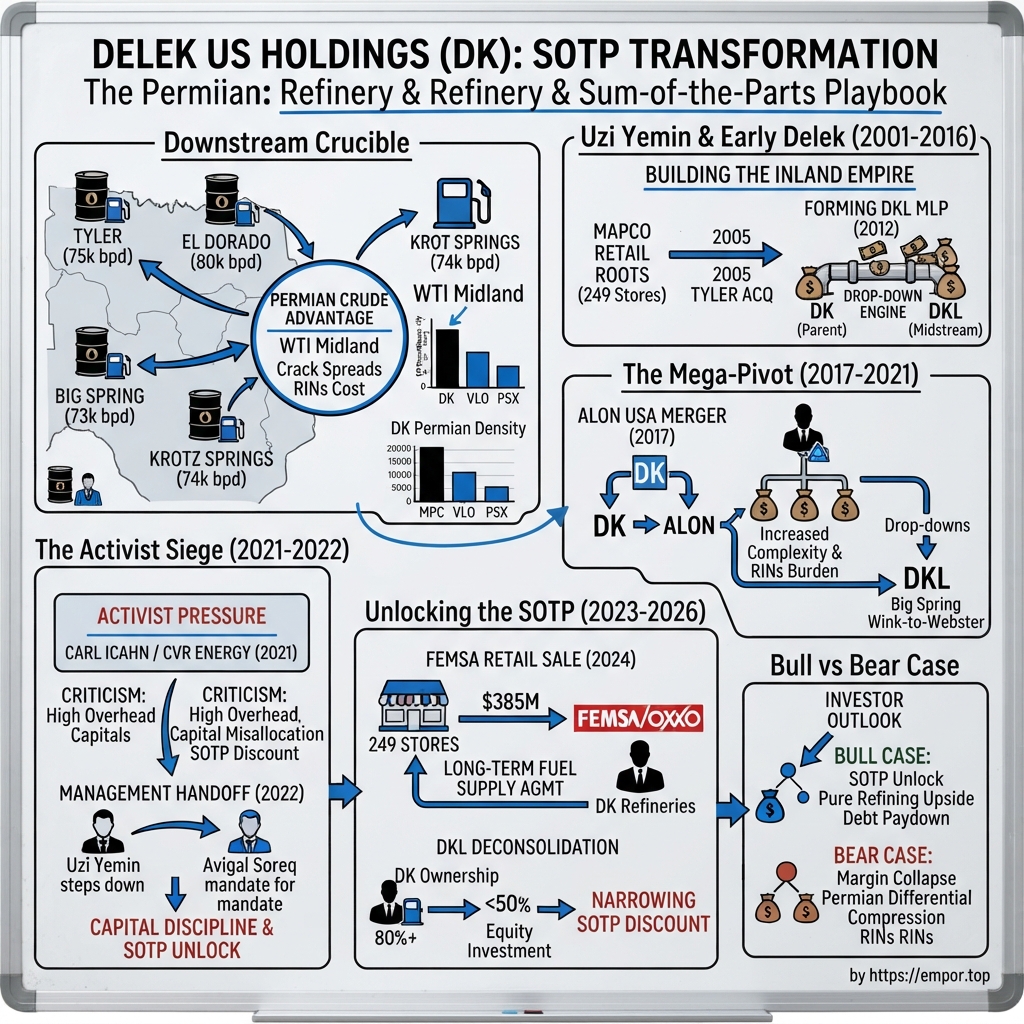
Delek US Holdings: The Permian Refinery & Sum-of-the-Parts Playbook
I. Introduction & Episode Roadmap
On the morning of August 5, 2026, a mid-cap refiner headquartered in Brentwood, Tennessee — a suburb of Nashville, roughly a thousand miles from the nearest barrel of Permian crude it processes — reported a quarter that would have seemed like a typo eighteen months earlier. Delek US Holdings posted second-quarter net income of $169.5 million, adjusted net income of $343.9 million, and adjusted EBITDA of $638.7 million on sales of $4.09 billion. The same quarter a year before, the company had lost $106.4 million on sales of $2.76 billion.1
Nothing about Delek's assets changed in those twelve months. The same four refineries sat in the same four towns. The same pipelines moved the same barrels. What changed was the spread between what a barrel of crude cost and what the gasoline and diesel made from it sold for. Delek's benchmark crack spreads rose an average of 136.0% year over year.1 That is the entire business in one sentence, and it is the primary dynamic any investor analyzing the company must grasp: Delek does not set its own prices; it rents the margin between two commodities it does not control.
Which makes the second aspect of Delek far more intriguing. This is not a pure merchant refiner. Delek US owns roughly 63% of Delek Logistics Partners, LP, a publicly traded master limited partnership that gathers crude and produced water across the Permian Basin, runs pipelines and terminals, and generates fee-based cash flow that has almost nothing to do with crack spreads.1 For years, the arithmetic of that ownership produced one of the more conspicuous valuation puzzles in American energy: the market value of Delek's stake in its own subsidiary approached — and at moments exceeded — the entire equity value of the parent company. The market was effectively valuing the refineries at zero or less.
By the third week of August 2026, that gap had narrowed considerably. Delek's shares traded around $71, against a 52-week low of $24.70 — a range that reflects the cyclical nature of refining margins rather than a strategic breakthrough.2 At roughly $4.4 billion of equity value, with about $200 million of net debt outside the partnership and a DKL stake worth approximately $1.8 billion, the market implied an enterprise value of roughly $2.8 billion for 302,000 barrels per day of refining capacity — just over $9,000 per barrel of daily capacity.12 That valuation reflects current market realities, whereas in the spring of 2025 it did not. Whether that valuation persists remains the central question.
There is a clear reason this valuation disconnect warrants analysis. Conglomerate discounts are common; discounts that exceed the entire implied value of the core operating assets are rare. When they occur, one of two explanations applies: either the market has mispriced the business in a way corporate restructuring can remedy, or the market is highlighting structural constraints — that the assets are not truly separable, that parent-level control carries a discount, or that subsidiary cash flows are inaccessible to parent shareholders. Delek serves as an active case study of these competing theories, tested publicly over four years under a management team committed to the first explanation.
The company's modern history follows four distinct phases. The first was a roll-up: an Israeli-controlled retail convenience-store operator acquired a small East Texas refinery in 2005 and expanded through acquisitions under founder-operator Ezra Uzi Yemin, who led the company for two decades. The second was a step-change expansion: the 2017 acquisition of Alon USA Energy added the Big Spring and Krotz Springs refineries, roughly 300 convenience stores, and substantial operational complexity. The third was an activist challenge: Carl Icahn's CVR Energy accumulated a stake and campaigned against the board, executive compensation, and corporate structure — losing the proxy vote while influencing the strategic narrative. The fourth phase remains underway: chief executive officer Avigal Soreq is dismantling the inherited conglomerate structure — selling the retail chain to Mexico's FEMSA, cutting costs, reducing parent-level debt, and attempting to establish separate market valuations for the refining and midstream segments.
This analysis examines the operational drivers behind these efforts, including why a 73,000-barrel-per-day refinery in West Texas can generate higher returns than a larger Gulf Coast facility; how the Renewable Fuel Standard imposes costs on non-blending refiners and why small-refinery exemptions granted in 2025 materially affected Delek's financial results; and why master limited partnerships shifted from growth vehicles in the 2010s to structural capital constraints in the 2020s.
The core question is whether Delek possesses an advantaged asset base mispriced by the market, or remains a leveraged, sub-scale refining operator whose profitability depends primarily on favorable crack spread cycles. As of August 2026, the empirical record supports elements of both perspectives, while management's core structural claims remain subject to execution risk.
Evaluating these dynamics requires first examining basic refining economics — and why geographic location, rather than overall scale, dictates profitability.
 Subscribe on LinkedIn
II. The Downstream Crucible: Refining Economics 101 & The Permian Advantage
Inside a distillation column in Big Spring, Texas — a town of 26,000 people roughly 300 miles west of Dallas on the eastern shelf of the Permian Basin — crude oil is heated until it separates by weight. The lightest fractions rise: butane, then gasoline-range molecules. Middle distillates follow: kerosene and diesel. The heavy bottoms sink to become asphalt or undergo further processing in cracking units. The plant operates, in effect, as a massive molecular sorting machine.
The underlying economics rest on a simple relationship: a refiner buys crude oil at one price and sells refined products at another. The industry shorthand for this operating margin is the "crack spread," named for the catalytic cracking units that break heavy hydrocarbon molecules into lighter, higher-value products.
The standard industry benchmark is the 3-2-1 crack spread: purchasing three barrels of crude oil to yield two barrels of gasoline and one barrel of diesel. The difference between feedstock costs and product revenue represents the refiner's gross margin before operating expenses. Delek benchmarks each of its four plants differently based on asset configuration: Tyler and El Dorado against a Gulf Coast 5-3-2 spread, Big Spring against a Gulf Coast 3-2-1, and Krotz Springs against a Gulf Coast 2-1-1 that includes high-sulfur diesel.1 That variation reflects distinct asset capabilities and product yields across the system.
Delek operates four refineries with a combined nameplate crude throughput capacity of 302,000 barrels per day.1 The 75,000-barrel-per-day plant in Tyler, Texas, sits in the East Texas oil patch, selling into a regional market where the nearest competing refiner is far away. The 80,000-barrel-per-day facility in El Dorado, Arkansas, serves the Mid-Continent, supplying asphalt and diesel into agricultural and industrial demand. The 73,000-barrel-per-day Big Spring plant operates directly inside the Permian Basin, surrounded by the crude it consumes. Meanwhile, the 74,000-barrel-per-day Krotz Springs facility in Louisiana sits on the Atchafalaya River with waterborne and pipeline access — a location offering logistics flexibility that has also frequently behaved like a liability.3
Geographic positioning dictates much of that profitability.
Crude oil does not trade at a single price; it carries regional differentials based on the cost of moving barrels from production basins to demand centers. West Texas Intermediate priced at Midland, in the heart of the Permian, typically trades at a discount to WTI at Cushing, Oklahoma, and both usually trail Brent, the global waterborne benchmark. Takeaway pipeline capacity governs those discounts: when producers drill faster than pipelines can move output, Midland crude clears at a regional discount because marginal barrels have nowhere to go.
A refinery in Big Spring buys those discounted local barrels and sells refined products into markets priced off national benchmarks. The facility avoids long-haul feedstock freight costs while collecting a regional product premium over Gulf Coast megarefineries that must ship fuel hundreds of miles inland. Delek's crude slates reflect this positioning: Big Spring runs primarily West Texas Sour and WTI Midland; Tyler processes WTI Midland and East Texas crude; and El Dorado blends WTI Midland with local Arkansas and other domestic inland grades.1 Structurally, three of Delek's four plants operate as buyers of discounted inland crude.
Krotz Springs is the exception, and the exception is instructive. Its slate is primarily Light Louisiana Sweet and WTI Midland — meaning a significant portion of its feedstock is priced off Gulf Coast waterborne dynamics rather than inland dislocation.1 The plant gains waterborne flexibility, but lacks a structural crude cost discount. During quarters when inland price differentials widen significantly, Krotz Springs does not capture the same margin expansion.
Asset scale and maintenance requirements introduce further operational complexity. A refinery is a complex chain of interdependent units — crude towers, hydrotreaters, catalytic crackers, reformers, and alkylation units — each requiring complete inspection and overhaul every three to five years. These scheduled maintenance events, known as turnarounds, cost tens of millions of dollars and take weeks to complete, during which the plant generates no revenue while continuing to incur fixed overhead. For a four-refinery company, a single turnaround takes roughly one-quarter of total refining capacity offline. For an industry giant like Valero, operating more than a dozen facilities, a single plant turnaround has a far smaller impact on quarterly results. That maintenance exposure represents a structural disadvantage of sub-scale refining that cannot be fully diversified across four assets.
Regulatory requirements add another layer of margin volatility. Under the federal Renewable Fuel Standard, refiners must blend specified volumes of biofuel into the domestic fuel supply or purchase compliance credits — Renewable Identification Numbers, or RINs — from third parties that do.
Integrated refiners with extensive blending operations generate surplus RINs, while merchant refiners without blending networks must purchase credits on the open market. This requirement creates an ongoing cash expense set by a credit market that fluctuates with regulatory policy expectations rather than operational performance.
The financial scale of this obligation is substantial. Delek reports adjusted EBITDA both with and without what it terms the renewable volume obligation (RVO) adjustment. In the second quarter of 2026, the difference between those two figures was roughly $149 million in a single quarter, or nearly a quarter of reported adjusted EBITDA.1 A policy-driven cost of this scale demonstrates how regulatory credit markets can decouple reported refining profits from physical operating performance.
Delek has long argued that this burden falls disproportionately on smaller refiners, a position that eventually yielded regulatory relief through small-refinery exemptions. However, RIN obligations remain an external cost line capable of moving annual earnings by hundreds of millions of dollars regardless of underlying plant efficiency.
Compared to sector peers, Delek's operational scale remains compact. HF Sinclair, PBF Energy, and CVR Energy offer the closest comparables in scale and inland orientation, whereas major refiners such as Valero, Marathon Petroleum, and Phillips 66 maintain equity values near $100 billion — more than twenty times the size.2 Delek cannot match those peers on purchasing power, scale, or the ability to absorb single-plant outages without impacting quarterly earnings. Instead, management points to its midstream infrastructure density in the Permian Basin as a primary point of differentiation.
Peer strategies also reveal contrasting approaches to earnings diversification. HF Sinclair pairs refining with lubricants and renewable diesel; PBF Energy operates a coastal-heavy network exposed to waterborne crude and West Coast regulatory dynamics; and CVR Energy links refining with a nitrogen fertilizer business. While peers diversified into adjacent industrial or renewable segments, Delek relied on its master limited partnership for diversification. The strategy over recent years has been to separate and highlight that midstream asset — effectively making Delek a more concentrated refining play at a time when peers were diversifying away from pure refining exposure.
Whether that midstream infrastructure density provides a durable advantage or simply another form of commodity exposure is precisely what the company's recent history has tested — beginning with an expansion strategy built on assets acquired when few others were buying.
III. Building the Inland Empire: Uzi Yemin & Early Delek (2001–2016)
In May 2001, an obscure American subsidiary of an Israeli conglomerate bought a chain of 198 gas-station convenience stores from Williams Express for $162.5 million.4 The chain was called MAPCO Express, the buyer was a newly assembled entity named Delek US, and the parent company was Delek Group (קבוצת דלק), the energy and infrastructure holding company controlled by Israeli businessman Yitzhak Tshuva. Six weeks later, Delek US added 36 more stores in Virginia for $40.1 million.4 The foundational business of what would eventually become a 302,000-barrel-per-day refining operator began by selling retail fuel and snacks across the American South.
The executive leading the operation was Ezra Uzi Yemin, an Israeli accountant by training who advanced through the Delek Group system, serving as president of Delek US from 2001, chief executive officer from 2004, and chairman from 2012.5 Yemin's strategy over two decades of transactions centered on purchasing physical assets discounted by the market, acquiring them at valuations designed to withstand downcycles, and structuring the deals through creative financial vehicles. Rather than operating as a technical refining engineer, he functioned primarily as an aggressive capital allocator entering downstream energy.
Industry observers described Yemin as an intensely hands-on executive with a detailed command of operations and a clear preference for centralized corporate control. That style manifested in the organizational architecture he created: layered entities, majority-owned subsidiaries, and structures that concentrated voting power at the top. While executive compensation would later become a focal point for activist shareholders, Delek's initial growth strategy yielded rapid expansion during an era when the company held little standing in the domestic refining market.
The company's pivotal transaction occurred in April 2005, when Delek acquired the Tyler, Texas refinery and associated pipeline infrastructure from La Gloria Oil and Gas Company for $68.1 million.4 At a throughput capacity of roughly 75,000 barrels per day, the purchase price implied an acquisition cost of under $1,000 per barrel of daily capacity—a deep discount to replacement cost. At the time, the U.S. refining sector was widely viewed as a mature, low-growth industry burdened by regulatory mandates and limited pricing power, with minimal new capacity construction nationwide.
Within three years, however, the domestic shale boom produced a surge of inland crude production, causing regional price discounts to widen substantially. Inland refiners emerged among the highest-margin operators in North American energy. While Delek benefited significantly from macro tailwinds rather than forecasting the shale expansion, low entry pricing allowed the firm to capture outsized returns as market conditions shifted.
Delek continued integrating assets around its refining footprint. Between 2004 and 2005, the company expanded its retail network across Alabama, Tennessee, and Georgia, while acquiring product terminals, pipeline gathering lines, and additional convenience stores through 2007.4 The strategy prioritized physical integration across the midstream and downstream value chain: controlling the crude gathering line, the refinery, the distribution terminal, and the retail point of sale. This approach aimed to capture incremental margins along each stage of fuel transport and distribution.
In May 2006, Delek US completed an initial public offering on the New York Stock Exchange, issuing 11.5 million shares at $16.00 per share for gross proceeds of approximately $184 million, while its Israeli parent retained majority ownership.6 The public listing provided equity currency and capital access to fund further consolidation.
The acquisition strategy also included peripheral investments. Between 2012 and 2014, Delek acquired biodiesel facilities alongside pipeline assets.4 While blending operations offered a potential structural hedge against Renewable Fuel Standard compliance costs, smaller renewable assets added operational complexity without becoming material earnings drivers.
In 2011, Delek expanded its refining footprint significantly. Between April and October of that year, the company acquired Lion Oil Company for $228.7 million, gaining control of the 80,000-barrel-per-day El Dorado refinery in Arkansas, accompanying product terminals, and approximately 600 miles of crude gathering pipelines.4 The acquisition added substantial refining capacity at under $3,000 per barrel of daily throughput while securing dedicated inland crude gathering infrastructure.
To monetize these midstream assets, Delek introduced a specialized financing structure that influenced its capital allocation strategy for the next decade.
On November 1, 2012, the company executed an initial public offering for Delek Logistics Partners, LP, pricing 8 million common units at $21.00 per unit under the ticker DKL.7 The offering closed on November 7 following the full exercise of the underwriters' overallotment option, establishing a 37.6% public limited partner interest and generating roughly $179.7 million in net proceeds.[^8] Delek transferred storage tanks, pipelines, and terminal networks supporting the Tyler and El Dorado refineries into the partnership, converting fee-based logistics cash flows into a separate public trading vehicle.
The master limited partnership model provided a low-cost funding mechanism. MLPs traditionally distributed the vast majority of operating cash flow without corporate-level taxation, allowing equity units to trade at higher valuation multiples than parent refining assets. Delek US regularly executed asset drop-downs—selling logistics infrastructure to the partnership at elevated valuation multiples, receiving cash proceeds, and retaining managerial control through its general partner interest.
During this period, Delek Group also began monetizing its equity holding in the U.S. entity, selling a 5.15% stake in Delek US in August 2012 at $23.85 per share and reducing its ownership stake to just under 63%.8
While the drop-down strategy delivered immediate liquidity and valuation premiums, it created long-term structural tradeoffs. Assets transferred to the partnership were no longer owned directly by the refining entity, and cash distributions paid to public unitholders represented earnings diverted away from the parent company. If the parent company's equity valuation subsequently lagged behind the subsidiary's multiple, the corporate structure risked creating a persistent holding-company discount.
By 2016, however, management shifted focus toward a far larger acquisition opportunity to expand the scale of its refining network.
IV. The Mega-Pivot: The Alon USA Merger & DKL Drop-Down Machine (2017–2021)
Alon USA Energy was in many ways Delek's mirror image: another American refining and retail business with Israeli ownership roots, another collection of inland plants, and another regional convenience-store chain. Crucially, it owned the Big Spring refinery — a rare North American refining asset situated directly inside the Permian Basin with integrated local gathering.
Delek acquired Alon in two stages.
In 2015, Delek acquired a 48% stake in Alon USA Energy for $6 million in stock alongside $345 million in combined cash and promissory notes — establishing a controlling position that provided operational visibility into the asset without full integration risk.4 Two years later, Delek returned to purchase the remaining equity.
The merger closed on July 1, 2017. Holders of the Alon shares Delek did not already own received a fixed exchange ratio of 0.5040 Delek US shares per Alon share, with cash paid for fractional shares. Having previously held roughly 33.7 million Alon shares — about 47% of the company — Delek emerged from closing with approximately 82.0 million total shares outstanding.910 The transaction was structured entirely in stock, allowing Chief Executive Officer Ezra Uzi Yemin to fund the largest acquisition in company history without issuing acquisition debt at a time when refining equities commanded reasonable valuations.
Corporate restructuring continued over the next seven months. In February 2018, Delek completed the acquisition of the remaining publicly held units of Alon USA Partners — the separately listed partnership that owned Big Spring — collapsing that structure into the parent company.11 The consolidated enterprise combined four refineries with 302,000 barrels per day of capacity, roughly 300 convenience stores, a wholesale marketing arm, an asphalt business, biodiesel plants, and a publicly traded midstream partnership, all managed from Nashville.
The retail acquisition added unexpected operational scope. Alon's store network included a major 7-Eleven licensing relationship, making Delek the largest 7-Eleven licensee in the United States.12 A refiner headquartered in Tennessee had become a major convenience-store operator by acquisition — creating an ancillary business unit that management would sell off seven years later.
Strategically, the transaction offered scale, Permian crude integration, and retail assets without cash outlays. Operationally, however, integration revealed significant structural challenges.
First, the four refineries did not function as an integrated system. While Big Spring delivered on its core thesis by processing low-cost Permian crude, Krotz Springs lacked dedicated gathering integration and remained exposed to volatile Gulf Coast product pricing. Second, doubling refining throughput without expanding blending capacity doubled Delek's compliance burden under the Renewable Fuel Standard — a regulatory expense linked to volume rather than profitability. Third, the merged entity grew increasingly complex, spanning multiple operating segments, legal entities, and intercompany agreements that complicated equity analysis.
Consolidated leverage accounting further distorted market perception. Because Delek consolidated Delek Logistics Partners, reported parent debt included borrowings serviced entirely by the partnership's contracted midstream cash flows. Credit analysts and equity screens evaluated the combined balance sheet, penalizing Delek twice: first through a holding-company discount on its refining assets, and second through inflated debt metrics.
Meanwhile, midstream asset transfers accelerated. In 2019, Delek US agreed to acquire a 15% interest in the Wink to Webster Pipeline — a major long-haul system moving Permian crude to Houston — with an expected net investment between $340 million and $380 million.13 The company continued acquiring midstream assets to feed its partnership drop-down strategy.
From 2018 through 2021, asset transfers followed a consistent pattern: fee-based, contracted assets were dropped down to DKL, while commodity-exposed refining assets remained at the parent level. Big Spring's logistics infrastructure, Permian gathering systems, storage tanks, and terminals were systematically transferred to the partnership. Each transaction generated cash or debt relief for the parent while expanding DKL's fee income and distribution capacity, supporting the unit price and reducing DKL's cost of capital for subsequent transfers.
However, this capital strategy carried structural trade-offs. Each drop-down provided short-term parent liquidity at the expense of long-term cash-flow quality. Over time, the parent refining business stripped away stable fee revenue, increasing its sensitivity to underlying commodity cycles.
The partnership structure initially cushioned downcycles. When pandemic-driven demand destruction collapsed refining margins in 2020, resulting in a net loss of $611.4 million for Delek, DKL's fee-based distributions continued flowing to the parent.14 The partnership provided essential cash flow during an unprecedented industry downturn.
Yet 2020 also highlighted the valuation disconnect created by the corporate structure. Consolidated financial statements combined DKL's revenue and debt while burying parent-level details beneath minority interest lines. Sum-of-the-parts calculations revealed a stark imbalance: subtracting the market value of Delek's DKL stake from its total market capitalization implied that the market valued 302,000 barrels per day of refining capacity at near zero.
Delek recorded a second consecutive net loss in 2021 of $128.3 million.14 Consecutive financial losses, high founder compensation, operational complexity, and a depressed implied refining valuation made the company a prime target for activist intervention.
V. The Activist Siege & Management Transition: CVR Energy, Icahn, & Avigal Soreq (2021–2022)
By early 2021, Delek exhibited every vulnerability that attracts activist investors: a complex corporate structure, consecutive years of net losses, a founder-chief executive with a two-decade tenure, a stark sum-of-the-parts valuation mismatch, and a fragmented shareholder base.
Carl Icahn rarely sends warning letters as a routine courtesy. When CVR Energy — the refining company in which Icahn held a controlling interest — accumulated Delek stock, it did so with a detailed structural critique already prepared.
In January 2021, CVR Chief Executive David L. Lamp wrote to Yemin proposing that three Delek directors be replaced by CVR's nominees at the annual meeting scheduled for May 6.15 CVR had built a position of roughly 15%, making it Delek's largest shareholder.16 By March 30, CVR filed a definitive proxy statement nominating Randall D. Balhorn, George J. Damiris, and Robert Edward Kent, Jr. for election to the board.15 Lamp's framing was blunt: Delek, he argued, "desperately needs new strategic direction."16
The specifics of the critique carried substantial weight because much of the core analysis proved directionally accurate.
CVR attacked executive compensation, filing suit on April 8, 2021, and characterizing Yemin's total compensation of approximately $81 million over the preceding eight years as "eye-popping" and inadequately disclosed to shareholders.16 It targeted corporate overhead, capital allocation, and the central structural problem: that the market value of Delek's DKL stake rivaled the parent company's entire equity value without a clear management strategy to unlock that discount. CVR also urged Delek to sell its convenience-store network, a proposal management publicly resisted at the time.17
The proxy contest carried unusual operational friction because CVR was an active refining competitor operating Mid-Continent plants. Its executives understood crude slates, turnaround cycles, and asset economics, granting the critique technical credibility that generalist activists rarely possess. That operational standing also provided Delek's board with a legitimate defense: granting a direct competitor board representation risked exposing commercially sensitive information regarding crude sourcing, turnaround schedules, and marketing arrangements.
Delek urged shareholders to reject the campaign, framing CVR as a competitor seeking strategic insight or a combination on favorable terms.18 At the May 2021 annual meeting, shareholders voted with management, electing Delek's full slate of directors and defeating CVR's nominees.19 However, defeating an Icahn-backed proxy challenge did not end the contest. On February 1, 2022, an Icahn-controlled entity nominated three candidates for the 2022 annual meeting, reopening the campaign.17
This time Delek agreed to a financial settlement. On March 7, 2022, the company entered into a stock purchase and cooperation agreement with the Icahn Group, repurchasing nearly 3.5 million shares — 3,497,268 shares — at $18.30 per share for a total of $64.0 million from cash on hand, canceling the shares at the time of the transaction.20 In exchange, the Icahn Group withdrew its nominations and agreed to a standstill through the completion of the 2023 annual meeting.17 While structured as an equity repurchase, the transaction functioned primarily as a corporate settlement that used company cash to remove a vocal critic from the register.
Three weeks later, on March 28, 2022, Delek announced a far more consequential leadership shift. Delek US and Delek Logistics disclosed a governance transition: Uzi Yemin, chairman since 2012, chief executive since 2004, and president since 2001, would transition to executive chairman, while Avigal Soreq would become president and chief executive officer, effective in June.5
Soreq was not an outsider to the organization. He had served at Delek US from 2012 to 2020 in senior roles including chief operating officer, chief commercial officer, and executive vice president, before leaving in early 2021 to serve as chief executive of El Al Israel Airlines — a post he held for barely a year before returning to Delek.521 Navigating a national airline through pandemic disruption provided relevant operational experience for managing a refining enterprise burdened by high fixed costs, intense cyclicality, and volatile commodity pricing.
The governance context surrounding the handoff remained sharp. Equilar's analysis of the leadership change noted that Yemin had realized more than $100 million in total compensation over his tenure — a figure that reinforced CVR's core governance complaints even after CVR exited the register.[^23]
The activist intervention achieved nuanced long-term results. CVR did not win board seats, force an immediate asset sale, or engineer a corporate merger. Nor did it exit purely at a premium: the $18.30 repurchase price proved lower than Delek's average stock price over much of the subsequent four years, granting remaining shareholders reasonable execution on price. What CVR did accomplish was placing a quantified critique of Delek's sum-of-the-parts discount into public proxy filings, establishing a benchmark that institutional shareholders and the board could no longer ignore.
Soreq's mandate effectively inverted his predecessor's growth strategy. Where Yemin's two decades focused on acquiring refineries, convenience stores, pipelines, and master limited partnerships, Soreq's objective centered on simplification — reducing corporate overhead, divesting non-core operations, streamlining parent-subsidiary structures, and closing the gap between Delek's market price and the underlying value of its assets.
The activist had lost the vote, accepted the buyout, and departed. The restructuring agenda remained.
VI. Unlocking the SOTP: The FEMSA Retail Sale & Deconsolidation Play (2023–2026)
To understand what Soreq inherited, run the arithmetic that Delek's own investors were running.
The parent consolidated DKL's revenue, DKL's EBITDA and DKL's debt onto its financial statements, while owning only part of the equity. Distributions received from DKL flowed up to the parent and were largely consumed by parent-level interest expense and corporate overhead. An investor buying Delek stock was buying a leveraged refiner, a general-partner interest, a majority stake in a public MLP, a convenience-store chain, an asphalt business and a biodiesel operation — bundled, cross-collateralized, and reported through a set of intercompany agreements that made segment analysis genuinely difficult.
The market's response to complexity it cannot underwrite is to apply a discount. Delek's discount was severe.
The first major subtraction was retail. On August 1, 2024, FEMSA — the Mexican beverage and retail group that operates the OXXO convenience-store chain across Latin America — announced definitive agreements to acquire Delek's retail operations: 249 convenience stores, roughly 90% of them in Texas with the remainder mostly in New Mexico and a small Arkansas presence, for $385 million on a cash-free, debt-free basis including inventories, along with a small fuel transportation fleet.22 The deal closed on October 1, 2024, with Delek selling 100% of the equity interests in the subsidiaries that operated the business.23
Three things about the structure are worth separating from the marketing.
The first is genuinely well-executed. Delek sold a capital-hungry, low-margin business to a buyer for whom convenience retail is a core competence and a strategic priority — FEMSA's entry into the US convenience-store market. Delek was never going to out-operate a dedicated retailer, and every dollar of store-level capital expenditure was a dollar not spent on refinery reliability.
The second is the fuel supply relationship. FEMSA's announcement framed the transaction as giving Delek "a competitive partner for ongoing and expanded retail fuel sales" and a foundation to build a longer-term partnership.22 The commercial logic is obvious: Delek keeps a wholesale outlet for product from Big Spring and Tyler without owning the real estate. But the specific terms — duration, volume commitments, pricing mechanics, exclusivity — were not disclosed, and an investor should not model a guaranteed multi-year off-take contract that has never been quantified publicly. This is the kind of claim that gets repeated in summaries until it hardens into fact. It has not been substantiated in that form.
The third is what CVR had demanded three years earlier and Delek had refused. The retail sale was, in substance, the activist's recommendation, executed by the successor management team at a moment of its own choosing. Reasonable people can debate whether the delay cost shareholders anything. What is not debatable is that the strategy changed after the pressure, not before it.
The second and larger subtraction is still underway: the economic separation of DKL. Deconsolidation — moving DKL off Delek's balance sheet and accounting for it as an equity-method investment — requires more than selling units. It requires that DKL cease to be economically dependent on its parent, which in accounting and commercial terms means shifting its cash flows toward third-party customers.
Delek has pursued this on two tracks.
On the ownership track, DKL has issued units to fund acquisitions, diluting the parent's stake as a deliberate consequence rather than a side effect. DKL acquired 3Bear Energy's Delaware Basin crude and gas gathering, processing and water operations for $624.7 million in cash, closing June 1, 2022.2425 In August 2024 it acquired Delek US's 50% interest in W2W Holdings — carrying a 15.6% indirect stake in the Wink to Webster pipeline — for $83.9 million in cash, forgiveness of a $60.0 million payable, and 2,300,000 DKL common units.26 In September 2024 it bought H2O Midstream's Midland Basin water disposal and recycling operations for $230 million, comprising $160 million cash and $70 million of convertible preferred equity.2627 On January 2, 2025 it closed the acquisition of Gravity Water Midstream for $285 million — $200 million cash and approximately 2.175 million DKL units.28 Each unit-funded deal pushed the parent's ownership down. It fell from 78.7% in January 2024 to 63.4% following the Gravity closing, and stood at approximately 63.0% including the general partner interest at June 30, 2026.291
On the commercial track, Delek restructured the intercompany agreements that had made DKL a captive service provider to its own parent. Management described the new arrangements, disclosed alongside first-quarter 2025 results, as unlocking in excess of $250 million of liquidity and moving DKL toward roughly 80% third-party cash flows on a pro forma basis.30 By the second quarter of 2026, management stated that third-party EBITDA had reached that 80% level.31
There is a subtlety here that deserves attention because it runs against the drop-down narrative entirely. In January 2026, Delek agreed to buy assets back from its own partnership: a Tyler refinery tank for $19.0 million, which closed April 1, 2026 with consideration paid in DKL common units, and El Dorado tank and terminal assets for $66.0 million, expected to close October 1, 2027.1 After fourteen years of selling infrastructure down to the MLP, the parent is now repurchasing refinery-critical assets — and paying with units, further reducing its stake. It is a coherent move if the goal is to make DKL a genuinely independent third-party midstream company while keeping the refineries' essential tankage inside the refining entity. It is also a quiet admission that some assets never should have left.
Meanwhile the balance sheet has been rebuilt. Following the monetization of 2023 and 2024 RINs, Delek executed a $380 million paydown of its Inventory Intermediation Agreement, which management projected would reduce annual interest expense by at least $40 million.32 Through the second quarter of 2026 the company reduced its term loan from $920 million to $850 million and cut standalone net debt by $72 million in the quarter.31 The result, at June 30, 2026: excluding DKL, Delek held $614.9 million of cash against $817.0 million of long-term debt — a net debt position of just $202.1 million.1 For a company that carried consolidated net debt of $2.56 billion on the same date, the distinction between "Delek's debt" and "DKL's debt" is now the single most important line in the release.1
The cost discipline has a name: the Enterprise Optimization Plan.
Launched as a business transformation in 2022, its target has been raised repeatedly — to at least $200 million of annual run-rate improvement as of the fourth-quarter 2025 report, then to approximately $220 million as of the first quarter of 2026, with $60 million contributed in the second quarter of 2026 alone.323331 Soreq's framing on the Q2 2026 call was characteristically compressed: "EOP, it's not a project. It's a lifestyle."31 The serial target increases are, on the evidence, a genuine credibility marker — the company has raised the goalpost rather than quietly missing it. The counterweight is that restructuring costs are still running through the income statement four years in: $10.9 million in the second quarter of 2026 alone.1 A permanent transformation program eventually stops being a transformation and becomes the cost structure.
Then there is the item that flatters everything: the small refinery exemptions. On August 22, 2025, the EPA granted Delek a set of long-pending petitions covering the years 2019 through 2024 across its refining system, resolving an issue that had been outstanding for several years.34 In April 2026, the D.C. Circuit unanimously vacated the EPA's denial of Krotz Springs' petition for a 2024 exemption, in a precedential decision on how "small refinery" status is measured.35 The financial effect is not cosmetic: Delek's second-quarter 2026 adjusted EBITDA of $638.7 million falls to $490.1 million excluding the RVO adjustment, and adjusted EPS drops from $5.48 to $3.64.1 Management was careful on the call to characterize the proceeds as recovery of RINs previously purchased rather than windfall gains — an unusually honest framing.31 Investors should still treat SRE benefits as non-recurring, policy-dependent, and reversible with a change in administration or a change in court.
A few second-layer items belong in the file. The accounting judgment that matters most is the treatment of DKL: as long as Delek consolidates the partnership, headline revenue, EBITDA and debt figures describe an entity that Delek does not wholly own, and every ratio computed off the consolidated statements is misleading in the same direction. Investors should build their own view off the standalone disclosures the company now provides. On insider behavior, press reports of Form 4 filings indicated that Soreq sold shares worth roughly $5.3 million in August 2026, with the stock near multi-year highs.36 Routine diversification after a large run is unremarkable in isolation, but it is the kind of signal worth tracking against management's public confidence in mid-cycle cash generation. And on the legal side, the small refinery exemption program remains subject to ongoing administrative and judicial process rather than settled law — the April 2026 D.C. Circuit ruling was a win precisely because the underlying question was contested.
Strip all of it away and the question becomes: what do the two businesses actually earn?
VII. Segment Deep-Dive: Refining Economics vs. Midstream Cash Machine
Examining Delek's second-quarter 2026 performance plant by plant highlights how differently its four refineries behave within the same macro environment. Total system throughput averaged 315,555 barrels per day — exceeding nameplate capacity as the plants ran hard to capture wider spreads. Refining production margin rose to $19.84 per barrel of throughput from $8.03 in the prior-year quarter, while operating expenses ticked up modestly from $5.17 to $5.32 per barrel.1 That divergence captures the operating leverage of merchant refining: while unit expenses rose roughly 3%, realized production margins surged nearly 147%.
Tyler stood out as the system's top performer, running 77,887 barrels per day and capturing a production margin of $23.30 per barrel against an operating cost of $4.86 — generating the highest unit margin and lowest operating cost in the portfolio.1 The East Texas facility relies neither on high complexity nor massive scale; instead, its advantage stems from proximity to local crude supplies and regional customers in a market insulated from direct competition.
By contrast, Krotz Springs processed 83,025 barrels per day, delivering a production margin of $19.55 per barrel at an operating cost of $5.39 — a solid performance driven by temporarily elevated Gulf Coast crack spreads rather than a permanent feedstock cost advantage.1 El Dorado achieved the highest throughput at 84,506 barrels per day but posted the lowest production margin in the group at $16.40 per barrel, constrained by a heavier product yield that includes asphalt and exposure to Mid-Continent pricing that trails Gulf Coast benchmarks.1
Big Spring presents the most nuanced operating profile. The refinery averaged only 70,137 barrels per day during the second quarter — below its 73,000 barrel-per-day nameplate capacity and well under the 75,659 barrels per day processed a year earlier — as it recovered from a major plant-wide turnaround completed in the first quarter.1 Despite reduced throughput, the facility captured $20.47 per barrel in production margin, second only to Tyler.1 At the same time, it registered the highest unit operating expense in the system at $6.43 per barrel.1 As a small, highly complex asset embedded in the Permian Basin, Big Spring combines structural feedstock cost advantages with elevated operating expenses and lower utilization.
That turnaround highlights the vulnerability of operating a concentrated four-refinery footprint. In the first quarter of 2026, with Big Spring offline for maintenance, Delek posted a net loss of $201.3 million and generated just $211.7 million in adjusted EBITDA, compounded by a $61 million loss in the supply and marketing segment due to weak wholesale and asphalt margins.33 A single planned overhaul at one facility, paired with seasonal market weakness, swung quarterly results into a steep loss. Over the first six months of 2026, total refining throughput averaged 287,947 barrels per day compared to 302,838 barrels per day in the prior-year period — a deficit driven entirely by Big Spring's maintenance outage.1 For a refiner of Delek's scale, operational execution and plant reliability directly dictate financial performance.
The midstream segment presents a starkly different cash-flow profile. Delek's logistics business generated record adjusted EBITDA of $143.5 million in the second quarter of 2026, up roughly 13% from $127.4 million in the prior-year period — a modest gain during a quarter when refining EBITDA surged nearly fivefold from $114.8 million to $566.2 million.1 That asymmetry underscores the midstream business model: while logistics cash flows do not capture refining margin spikes, they remain shielded during commodity downturns, providing essential earnings stability when refining results drop.
DKL generated record adjusted EBITDA of $536 million in 2025 and maintained its full-year 2026 guidance of $520 million to $560 million, reaffirming that outlook at mid-year.321 Midstream growth has been centered in the Delaware Basin, where gathering and processing adjusted EBITDA expanded to $104 million in the second quarter of 2026 from $78 million a year earlier, buoyed by higher throughput at the Libby gas plant and improved realized margins on Permian crude.37 Future expansion hinges on an integrated sour gas treating and acid gas injection project at Libby designed to handle high-sulfur gas produced alongside Delaware Basin crude. DKL drilled its initial acid gas injection well in the first quarter of 2026, with management characterization on the second-quarter call promising a "step change" in volume capacity.31 While addressing a genuine infrastructure bottleneck, the project remains incomplete as of August 2026, leaving projected volume growth dependent on future commissioning.
Two structural characteristics explain why public markets value midstream cash flows at higher multiples than refining earnings. First, gathering and terminalling revenues are primarily fee-based and frequently backed by minimum-volume commitments, rendering cash flow a function of contracted volumes rather than fluctuating commodity prices. Second, the customer mix is shifting. When DKL operated primarily as a captive provider for Delek US, investors questioned whether intercompany rates reflected market pricing or internal transfer mechanisms. Expanding third-party business addresses that governance concern, making third-party revenue share a critical benchmark of structural independence rather than merely a volume metric.
Following the retail divestiture, the third operating division comprises supply and marketing — the wholesale arm responsible for placing refined products with commercial customers and fulfilling the fuel supply agreement with FEMSA's convenience stores. This working-capital-intensive, thin-margin segment has exhibited substantial volatility. Following the $61 million operating loss in the first quarter of 2026, supply and marketing broke even in the second quarter, posting an EBITDA loss of $0.5 million compared to a positive $25.7 million contribution a year earlier.133 Despite receiving limited disclosure in financial reports, the segment remains large enough to drag down overall corporate earnings during periods of market dislocation.
Above the operating segments, corporate overhead reflects steady cost reduction. Adjusted general and administrative expenses, excluding transaction and restructuring costs, totaled $50.2 million in the second quarter of 2026, aligning with management's third-quarter guidance range of $50 million to $55 million and reflecting structural savings from the retail sale.131 Quarterly net interest expense guidance of $75 million to $85 million represents the largest ongoing non-operating drain, though the vast majority stems from DKL's $2.37 billion long-term debt burden rather than parent-level obligations.311 Separating subsidiary interest obligations from parent liability remains essential to evaluating Delek's true financial leverage.
The segment performance establishes a clear operational division of labor across the enterprise. Refining delivers commodity upside and earnings volatility, while midstream provides predictable fee income, debt capacity, and a valuation floor. The rationale for a sum-of-the-parts restructuring rests on the reality that public equity markets assign starkly different valuation multiples to these two business models — and for years, bundling them led investors to apply a persistent conglomerate discount across the entire corporate structure.
VIII. Playbook: Business & Capital Allocation Lessons
The MLP is a one-way door. Drop-down partnerships were, for a decade, the closest thing to free money in American energy: sell an asset to a vehicle that values it at a higher multiple, keep operational control, and harvest the cash. The structural flaw appears at the exit. Once the parent sells most of its high-quality, contracted cash flow to the subsidiary, what remains is a cyclical operating business carrying the consolidated debt of both entities. If the parent's valuation multiple then falls below the subsidiary's, the arbitrage runs in reverse. The only way out is a laborious, multi-year unwind involving unit issuances, intercompany renegotiations, and—in Delek's case—repurchasing assets at valuations below those at which the parent originally sold them. The lesson is not that master limited partnerships were a mistake, but that the exit strategy must be designed alongside the entry.
Selling the store while keeping the customer is good structuring — but verify the contract. Delek's retail divestiture converted low-return real estate into cash while aiming to preserve a wholesale outlet for its refined products. That represents a logical transaction structure for a refiner lacking a retail scale advantage. The key analytical caveat is discipline: an off-take relationship unquantified in public SEC filings remains a commercial expectation rather than a contracted revenue stream, and must be valued accordingly.
Location can beat scale in refining, but only in certain market conditions. A 73,000-barrel-per-day plant sitting directly atop its crude supply can out-earn a much larger coastal refinery when inland price differentials are wide. It cannot do so when those differentials narrow. That feedstock cost advantage depends on Permian pipeline takeaway capacity, which hinges on midstream capital spending—which is driven by an entirely separate industry investment cycle. Delek does not control the macro variable that makes Big Spring special. That is a structural reality of the asset, not a critique of management.
A holding-company structure is only worth its complexity if the parent can act on it. Controlling a majority-owned public subsidiary sounds valuable, but control that cannot be monetized without triggering a taxable event, a market-moving unit sale, or a governance battle functions more as a constraint than an asset. The core question for any parent-subsidiary structure is not what the equity stake is worth on screen, but what the parent can actually realize—at what price, on what timetable, and with what tax leakage. Delek's four-year separation project represents that exact calculation being worked out in public view.
Activists rarely acquire mid-caps, but they frequently reset them. CVR Energy lost the proxy vote, accepted a $64 million share buyback, and departed. Yet within twelve months, Delek had a new chief executive; within thirty months, it sold the convenience store network CVR targeted; and within four years, it cut corporate overhead, restructured intercompany agreements, and prioritized midstream deconsolidation. While the board technically prevailed on every proxy ballot, the strategic agenda shifted anyway. For investors, a credible activist campaign at a complex, discounted mid-cap is often better understood as a catalyst for strategic realignment than as a precursor to a takeover.
Cheap entry pricing is a discipline, but it is also a cycle. Delek's foundational acquisitions—buying one refinery for well under $1,000 per barrel of daily capacity and another at a deep discount to replacement cost—succeeded because domestic refining was then an unloved sector. The capital allocation discipline was real, but so was the macro timing. Investors evaluating management must separate the two: buying unloved hard assets creates value, but the ultimate magnitude of the payout depends on a commodity cycle the buyer does not control. Results achieved during one turn of a cycle provide limited insight into performance during the next.
Buying peace from an activist is a capital allocation decision and should be evaluated as one. When a company spends cash to repurchase a critic's shares, the transaction carries two distinct elements: the direct investment return on the repurchased equity, and the premium paid to remove governance friction. The first is quantifiable; the second is not. In Delek's case, activist scrutiny returned in the form of strategic priorities the board ultimately adopted. Boards treating greenmail-adjacent buybacks as routine balance-sheet actions risk underpricing the true cost of the concession.
Countercyclical repurchases must be evaluated against cycle timing. Delek repurchased $20 million of stock in the second quarter of 2026 and has retired roughly 10% of its outstanding shares since the start of 2025—a period spanning both market trough and recovery.311 Repurchasing shares consistently through a cyclical bottom demonstrates disciplined capital allocation. Continuing those $20 million quarterly repurchases with the stock trading near 52-week highs, while maintaining that excess cash will not be retained on the balance sheet, represents a distinct strategic choice that must be judged on its merits as the cycle matures.
Corporate complexity creates a measurable valuation penalty. For much of the past decade, Delek's investor communications required explaining consolidation adjustments before addressing core operations. Public markets penalize such opacity with a holding-company discount. Simplifying the corporate architecture is therefore a form of capital allocation: while unwinding intercompany agreements and restructuring reporting delivers no direct operational revenue, it may rank among the highest-return initiatives management executes.
Which brings the analysis to the central question: does this restructuring yield a durable competitive advantage, or simply a better-managed vehicle in a cyclical industry?
IX. Analysis, Strategic Powers, Risk Radar & Bull vs. Bear Case
Where the powers are — and are not
Applying Hamilton Helmer’s competitive framework asks what would happen if a competitor tried to replicate Delek’s enterprise. For most of the company's business, the answer is straightforward: nothing prevents replication, because refined gasoline and diesel are fungible commodities sold into markets where Delek holds no pricing power.
Only two potential competitive advantages withstand scrutiny, and both exist in qualified form.
First, Delek retains a process and integration advantage in the Permian Basin. The company gathers crude, transports it on owned pipelines, and refines it at Big Spring without paying third-party long-haul tariffs between wellhead and distillation column. This capability is difficult to replicate not due to proprietary technology, but because the right-of-way, acreage dedications, and gathering footprint were assembled over fifteen years and cannot be acquired at current prices. It represents a genuine cost edge, though its economic value fluctuates with the Midland crude differential, meaning the advantage periodically compresses without vanishing permanently.
The second potential edge resembles a cornered resource: Delek Logistics Partners' sour gas treating and acid gas injection capability in the Delaware Basin. Permitting an acid gas injection well is slow and heavily contested, while regional producers faced with high-sulfur gas require processing outlets. If the Libby plant's integrated solution performs as projected, the partnership will hold a scarce piece of regional infrastructure serving a captive customer base.31 Paradoxically, this defensible asset sits within the subsidiary the parent company is actively deconsolidating.
Beyond these two capabilities, Delek lacks classic competitive moats: it operates at one-twentieth the scale of Marathon Petroleum, possesses no branded pricing power after selling its retail network, faces low customer switching costs, and commands no structural counter-positioning.
Through Michael Porter’s industry structure framework, the downstream operating environment remains challenging. Supplier power is moderate: Permian crude is abundant, yet Delek’s feedstock advantage depends on takeaway pipeline constraints that midstream competitors continuously work to relieve, as every new long-haul pipeline out of the basin narrows the regional discount benefiting Big Spring. Buyer power is high given the commoditized nature of refined fuels. Industry rivalry is intense, driven by inland peers HF Sinclair, PBF Energy, and CVR Energy, as well as Gulf Coast megarefineries that route excess product inland. Barriers to entry represent the sector's primary structural protection: no greenfield refiner has been constructed in the United States in decades, environmental permitting is restrictive, and industry capacity has declined steadily. Substitution poses a long-term structural threat as light-vehicle electrification reduces gasoline demand, though Delek's product yield is heavily weighted toward diesel and distillates, which face slower electrification pressure.
Management emphasizes this yield profile, positioning Delek's higher distillate yield as an asset in the prevailing refining margin environment.1 Because commercial trucking, rail, agriculture, and aviation fuels present greater technical barriers to electrification than passenger vehicles, a distillate-heavy slate offers greater insulation against long-term demand decline, even within a contracting overall market.
Myth versus reality
Myth: Delek is a hidden midstream company wearing a refiner's costume. The reality is more complex. Delek’s midstream exposure consists of a majority equity stake in a separately listed partnership whose cash flows increasingly serve third-party customers and whose growth relies on issuing equity units that dilute the parent's ownership. Delek is systematically reducing its operational midstream identity by design. Investors seeking pure-play midstream cash flow can purchase partnership units directly.
Myth: The sum-of-the-parts discount proves the market has mispriced the business. A persistent valuation discount often reflects the market's rational pricing of a complex corporate structure that is difficult to value, costly to exit, and controlled by a majority owner whose incentives may diverge from minority equity holders. The discount highlights structural friction rather than guaranteed upside. It represents an actionable investment opportunity only if management executes a credible mechanism and timeline to eliminate it.
Myth: Selling the retail network de-risked the business. Divesting retail eliminated store-level capital expenditure and generated immediate cash, but it did not reduce Delek's exposure to refining crack spreads by a single barrel. Convenience-store earnings provided Delek’s most stable non-midstream cash flow; divesting them increased the parent company's operational cyclicality. The divestiture represented a logical strategic tradeoff, not a risk reduction.
Myth: The Permian location advantage is permanent. The crude cost discount exists only when Permian production outpaces regional pipeline takeaway capacity, evaporating whenever infrastructure catches up. Regional differentials have expanded and collapsed repeatedly across past cycles and will continue to do so.
Management credibility, tested
Avigal Soreq has led Delek for four years, establishing a sufficient operating record to evaluate execution against strategic commitments.
Narrative consistency has remained high. The three core themes — sum-of-the-parts optimization, midstream deconsolidation, and the Enterprise Optimization Plan — have anchored executive communications, public filings, and quarterly conference calls continuously from 2023 through the second quarter of 2026.3032331 Progress against these goals is documented: Delek completed the retail divestiture, reduced its partnership equity stake from 78.7% to 63.0%, expanded DKL's third-party cash flow share to roughly 80%, restructured intercompany contracts, and raised its run-rate cost reduction target twice.2913132 Management executed these structural initiatives while navigating net losses in three of the preceding five fiscal years.
Financial disclosure also exceeds sector standards in key areas. Delek reports adjusted EBITDA both with and without the renewable volume obligation adjustment, providing investors transparency to separate core refining performance from regulatory credit impacts.1 Furthermore, management explicitly framed small-refinery exemption proceeds as recoveries of past compliance costs rather than operational gains.31
Communication tone has remained consistent across market cycles. When Delek reported a $201.3 million net loss in the first quarter of 2026, management attributed the result to specific operational drivers — the Big Spring turnaround, seasonal weakness in wholesale and asphalt, and late-quarter margin recoveries — rather than relying on generalized macro explanations.33 Three months later, following record quarterly earnings, executive commentary maintained the same analytical focus on crack spreads, throughput rates, and turnaround completion.31
Critical areas nevertheless require ongoing scrutiny:
Deconsolidation lacks a defined timeline. When asked on the second-quarter 2026 call about future structural steps, management stated that all options remain under evaluation, including asset sales, acquisitions, and parent-subsidiary buybacks.31 Four years into the turnaround, maintaining strategic optionality hazards delaying a definitive structural resolution. While intermediate milestones have been achieved, management has not set a clear deadline or mechanism for the final separation required to eliminate the holding-company discount.
Mid-cycle free cash flow projections require empirical validation. Management projected mid-cycle free cash flow of $650 million to $700 million, representing an estimated 15% to 20% free cash flow yield at August 2026 equity prices, expressing heightened confidence in achieving these levels.31 This projection represents a substantial target for an enterprise that posted consolidated net losses of $560.4 million in 2024 and $22.8 million in 2025.14 Evaluating this claim requires a fully articulated set of mid-cycle margin assumptions.
The $64 million share repurchase from the Icahn Group remains a controversial capital deployment. Allocating corporate cash to buy out an activist shareholder rather than reinvesting in operations or fortifying the balance sheet during a period of financial strain represented a high-cost governance settlement.20
Restructuring expenses have persisted since 2022. Four consecutive years of restructuring charges raise questions as to whether core operating overhead has been permanently reset or is being adjusted incrementally through ongoing program expenditures.1
The risk radar
Margin collapse. Refining margins remain inherently volatile, whereas fixed operating costs are constant. As demonstrated in the first quarter of 2026, a single planned plant turnaround combined with seasonal margin weakness can generate substantial quarterly net losses.33
Differential compression. If Permian pipeline takeaway capacity expands faster than crude production, WTI Midland pricing will converge toward Cushing and Brent benchmarks, eroding the feedstock discount essential to Big Spring's profitability. Delek explicitly identifies Permian crude supply, regional pricing, gathering constraints, and transport capacity as key risk factors.1
Policy volatility surrounding RINs and SREs. Regulatory exemptions that boosted 2025 and 2026 financial results resulted from EPA administrative determinations and federal court rulings.3435 Both mechanisms remain subject to policy shifts and judicial revisions. Modeling ongoing exemption benefits assumes administrative continuity rather than operational capability.
Single-asset operational concentration. Operating four refineries means an unplanned outage at Tyler or Big Spring removes approximately one-quarter of total processing capacity, with no internal redundant throughput to offset lost production.
Backwardation market headwinds. In backwardated crude markets where prompt crude barrels trade at a premium to future deliveries, inventory loses value while moving through the refining system. Management quantified this market structure as a $6.00 to $7.00 per barrel margin drag in the second quarter of 2026, moderating to approximately $1.50 per barrel in the third quarter.31 This dynamic reduces realized margins independently of headline crack spreads.
Long-term structural demand decline. Vehicle fleet electrification poses a multi-decade headwind for domestic gasoline demand. Refining facilities require ongoing capital investment and offer limited alternative industrial uses.
The bull case
The bull thesis does not rely on elevated refining crack spreads persisting indefinitely.
Instead, it posits that Delek has restructured its balance sheet to convert favorable refining cycles into permanent equity value rather than debt service.
The balance sheet separation provides the primary evidence. Holding $614.9 million in cash against $817.0 million in long-term debt outside DKL, Delek's standalone net debt stands at approximately $202.1 million — leaving the parent company near an unlevered state.1 Achieving this balance-sheet transformation over two years through asset sales, RIN monetization, and debt reduction ensures that incremental refining cash flow accrues primarily to equity holders rather than lenders. Combined with approximately $220 million in run-rate cost reductions, a turnaround-free operational schedule for the second half of 2026, a distillate-heavy production yield, and expanding sour gas infrastructure in the Delaware Basin, Delek offers substantial operating leverage during favorable refining cycles.311
If midstream deconsolidation concludes and DKL is reclassified as an equity-method investment with an independent market valuation, investors will hold a low-leverage refining operator capable of being evaluated directly against peers HF Sinclair, PBF Energy, and CVR Energy, alongside a distinct midstream equity holding.
The bear case
The bear thesis contends that recent financial gains reflect favorable commodity cycles rather than structural strategic improvements.
Delek recorded consolidated net losses in 2020, 2021, 2024, and 2025.14 Core restructuring initiatives and asset sales occurred during these loss years, while a 136% year-over-year surge in benchmark crack spreads drove second-quarter 2026 record earnings.1 Excluding the renewable volume obligation adjustment reduces second-quarter 2026 adjusted EBITDA by nearly one-quarter.1 Absent favorable refining margins, underlying free cash flow generation narrows significantly.
The regional feedstock cost advantage remains vulnerable to third-party midstream pipeline expansion outside Delek's control. Commercial terms supporting the retail fuel off-take agreement remain unquantified in public disclosures. Krotz Springs lacks dedicated crude gathering infrastructure, leaving the asset exposed to waterborne crude pricing without the feedstock advantages of the inland portfolio. Furthermore, after four years of restructuring, management has not established a definitive timeline or mechanism for completing midstream deconsolidation. Finally, the enterprise's most defensible asset — the Delaware Basin sour gas franchise — resides within DKL, meaning the primary financial benefits of the Libby expansion may accrue to public partnership unitholders rather than Delek US shareholders.
Valuation metrics also reflect this shift. Eighteen months prior, market pricing implied near-zero equity value for Delek's refining assets; by August 2026, following a nearly threefold recovery from multi-year lows, the market implied an enterprise value of approximately $9,000 per barrel of daily refining capacity.2 The historical sum-of-the-parts discount has largely narrowed due to commodity margin expansion rather than corporate restructuring alone. Consequently, investing in Delek at current valuation levels requires relying on management to execute the final steps of its structural separation strategy.
X. Epilogue & Critical KPIs to Watch
By August 2026, Delek has become a fundamentally different corporate entity from the one Ezra Uzi Yemin assembled over two decades. Divestitures eliminated 249 convenience stores and removed a $64 million activist overhang, while parent-level net debt fell sharply and Delek's equity stake in its midstream partnership declined by roughly 16 percentage points. In their place, management introduced an operational optimization program with repeatedly raised savings targets, an intercompany architecture designed for eventual separation, and a refining system running at full capacity into the widest margin environment since the post-pandemic recovery.
Yet the underlying nature of the business remains unchanged.
Delek still operates as a price taker buying feedstocks and selling refined products at market prices across four plants whose competitive position depends on regional crude differentials set by third-party pipeline construction. The corporate transformation strengthened the balance sheet to withstand cyclical troughs and capture peak margins, but it did not eliminate commodity volatility.
For investors monitoring Delek's progress, three core metrics provide essential visibility into operational execution and structural separation.
First, refining margin capture per barrel relative to benchmark crack spreads. Delek reports production margins per barrel of throughput for each facility alongside its corresponding benchmark spread: the 5-3-2 for Tyler and El Dorado, the 3-2-1 for Big Spring, and the 2-1-1 for Krotz Springs.1 The gap between realized margins and benchmark spreads reflects operational reliability, turnaround execution, and crude slate optimization separate from macro cycles. A refiner expanding its margin capture ratio through a market downturn demonstrates operational discipline, whereas absolute margin expansion driven purely by rising benchmark spreads reflects broader market dynamics.
Second, the sum-of-the-parts valuation gap: Delek's market capitalization versus the market value of its DKL stake plus standalone net debt. Derived from daily public market data, this metric serves as the primary benchmark for management's deconsolidation strategy, indicating whether equity markets are narrowing the holding-company discount. Tracking this relationship through a full refining downcycle remains essential, as a valuation discount that narrows only during peak margin environments indicates a cyclical recovery rather than a structural re-rating.
Third, DKL's third-party EBITDA percentage. Management advanced this metric from a pro forma target to a reported figure of approximately 80%, offering a direct measure of the partnership's operational independence from its parent.3031 Because full deconsolidation depends on economic self-sufficiency rather than pure equity ownership levels, third-party revenue share tracks DKL's transition toward a standalone midstream platform.
While quarterly earnings per share, regulatory exemption headlines, and share repurchase volumes generate short-term commentary, these three structural metrics determine long-term strategic progress.
Evaluating the investment thesis also requires identifying conditions that would invalidate both the bull and bear cases. The bull thesis would be undermined by three developments: Permian takeaway pipeline expansions that eliminate the WTI Midland crude discount for a sustained period, neutralizing Big Spring's feedstock cost advantage; a stalled deconsolidation effort where DKL ownership plateaus and third-party cash flow growth halts without a final structural separation; or a re-leveraging of the parent balance sheet to finance acquisitions or fund operations during a downcycle, reversing recent debt reduction.
Conversely, the bear thesis would be disproven by a prolonged refining downturn during which Delek generates positive parent-level free cash flow, fully funds its dividend and share repurchases without increasing leverage, and continues reducing its DKL ownership stake on schedule. Such performance would confirm that corporate restructuring created durable financial resilience rather than a temporary benefit of favorable market timing.
Delek's corporate history has centered on acquiring discounted assets during market downturns and awaiting favorable cycle turns — a strategy that proved effective with Tyler in 2005 and Lion Oil in 2011. Whether management's current effort to dismantle the inherited conglomerate structure and eliminate the holding-company discount proves equally successful will be determined not by current peak margins, but by execution through the next refining downcycle.
References
-
Delek US Holdings Reports Second Quarter 2026 Results — Delek US Holdings / Business Wire, 2026-08-05 ↩↩↩↩↩↩↩↩↩↩↩↩↩↩↩↩↩↩↩↩↩↩↩↩↩↩↩↩↩↩↩↩↩↩↩↩↩↩↩↩
-
Delek US Holdings, Inc. Market Data and Quote — The Wall Street Journal ↩↩↩↩
-
Delek US Holdings — Company History — Delek US Holdings, Inc. ↩↩↩↩↩↩↩
-
Delek US and Delek Logistics Announce Leadership and Governance Updates — Delek Logistics Partners, 2022-03-28 ↩↩↩
-
Delek US Holdings, Inc. Prospectus (Form 424B4) — SEC EDGAR, 2006-05 ↩
-
Delek Logistics Partners, LP Prices Initial Public Offering — Delek Logistics Partners, 2012-11-01 ↩
-
Delek Group Sells 5% of Delek US — CSP Daily News, 2012-08 ↩
-
Delek US Holdings Announces Closing of the Acquisition of Alon USA — GlobeNewswire, 2017-06-30 ↩
-
Delek US Holdings, Inc. Quarterly Report (Form 10-Q, period ended 2017-06-30) — SEC EDGAR ↩
-
Delek US Holdings Completes Acquisition of Alon USA Partners — CStore Decisions, 2018-02-08 ↩
-
Delek U.S. Becomes Largest U.S. 7-Eleven Licensee — CSP Daily News, 2017 ↩
-
Delek US to acquire 15% interest in Wink to Webster Pipeline — Hydrocarbons Technology, 2019 ↩
-
Delek US Holdings, Inc. Annual Report (Form 10-K, FY2025) — SEC EDGAR, 2026-02-27 ↩↩↩↩
-
CVR Energy Files Definitive Proxy Statement Relating to Delek US Holdings' Annual Meeting — GlobeNewswire, 2021-03-30 ↩↩
-
Delek Pushes Back At Carl Icahn Proxy Contest — CFO.com, 2021 ↩↩↩
-
Delek US Buying Back Stock From Icahn Group — CSP Daily News, 2022-03 ↩↩↩
-
Delek Issues Statement Regarding CVR Energy and Icahn Proxy Contest — PR Newswire, 2021-04-12 ↩
-
Struggle Heats Up Over Future of Delek US — CSP Daily News, 2021 ↩
-
Delek US Holdings, Inc. Annual Report (Form 10-K, FY2022) — SEC EDGAR ↩↩
-
El Al chief executive Soreq quits to lead former US employer — FlightGlobal, 2022-03 ↩
-
FEMSA to enter the Convenience Store Industry in the United States — FEMSA / GlobeNewswire, 2024-08-01 ↩↩
-
Delek US Holdings, Inc. Announces Closing of Sale of Retail Assets to FEMSA — Delek US Holdings, 2024-10-01 ↩
-
Delek Logistics Partners, LP Announces Acquisition of 3Bear Energy — Delek Logistics Partners, 2022-04-11 ↩
-
Delek Logistics Partners, LP Current Report Exhibit 99.1 (3Bear acquisition) — SEC EDGAR, 2022-04 ↩
-
Delek Logistics Partners, LP Annual Report (Form 10-K, FY2024) — SEC EDGAR ↩↩
-
Delek Logistics Acquires EIV's H2O Midstream for $230MM — Hart Energy, 2024 ↩
-
Delek Logistics Partners, LP Announces Closing of Gravity Water Midstream Acquisition — Business Wire, 2025-01-02 ↩
-
Delek US Holdings Reports Fourth Quarter 2024 Results — Delek US Holdings, 2025-02 ↩↩
-
Delek US Holdings Reports First Quarter 2025 Results — Delek US Holdings, 2025-05-07 ↩↩↩
-
Delek US Holdings (DK) Q2 2026 Earnings Call Transcript — The Motley Fool, 2026-08-05 ↩↩↩↩↩↩↩↩↩↩↩↩↩↩↩↩↩↩
-
Delek US (DK) Q4 2025 Earnings Call Transcript — The Motley Fool, 2026-03-02 ↩↩↩↩↩
-
Delek US Holdings Reports First Quarter 2026 Results — Delek US Holdings, 2026-04-29 ↩↩↩↩↩↩
-
Delek Welcomes EPA Decision Granting Long-Awaited Small Refinery Exemptions — Delek US Holdings, 2025-08-22 ↩↩
-
Sidley Secures Precedential D.C. Circuit Decision Vacating EPA Denial of Small-Refinery Exemption — Sidley Austin LLP, 2026-04 ↩↩
-
Delek US Holdings CEO Avigal Soreq sells over $5.3m in shares — Investing.com, 2026-08 ↩
-
Delek Logistics Reports Second Quarter 2026 Results — Delek Logistics Partners, 2026-08-05 ↩
 LinkedIn
 WhatsApp
 Reddit
 Hacker News
 Email
Email Kindle
 RSS Feed
 Spotify
 Apple Podcasts
 Amazon Music
 Audible
 YouTube