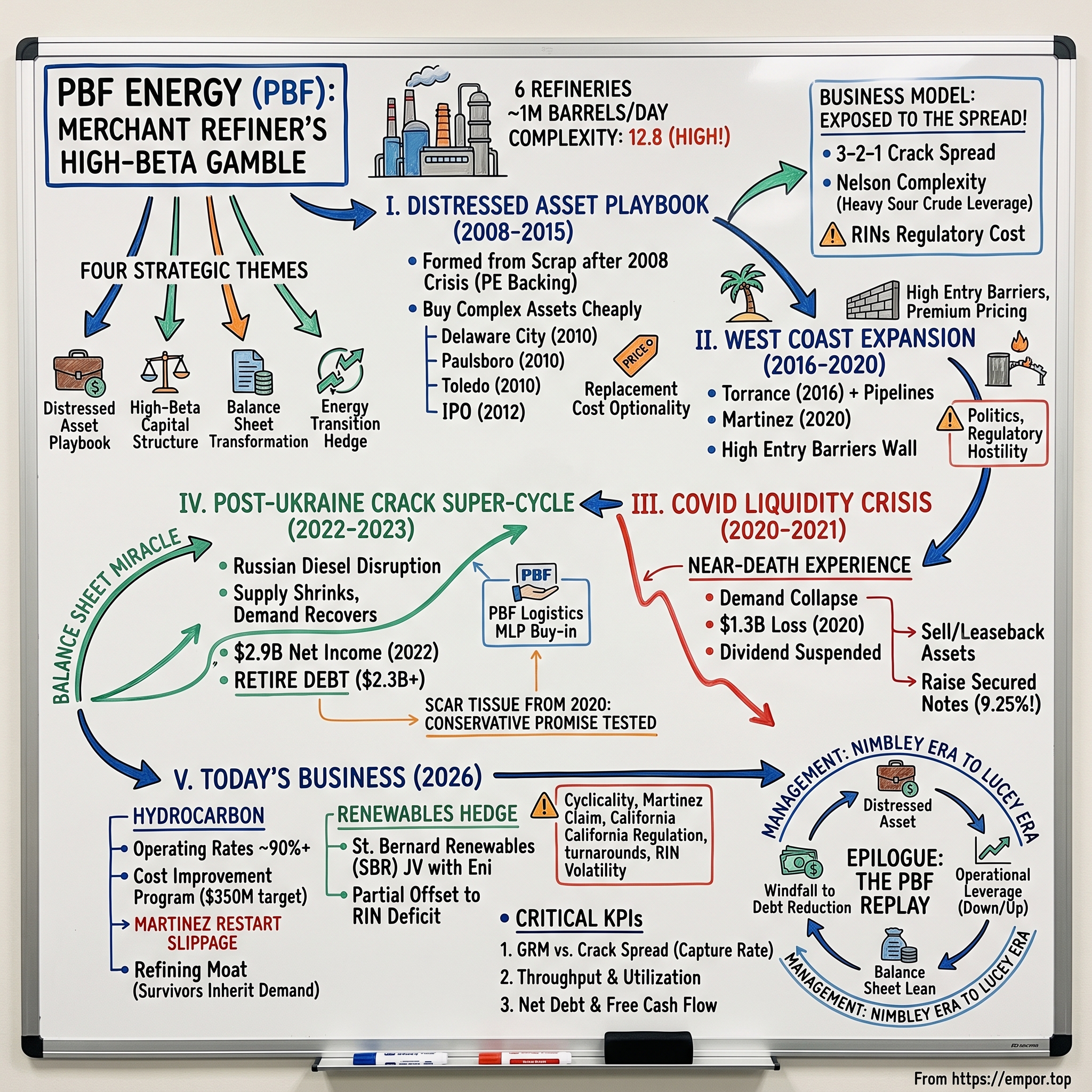
PBF Energy: The Merchant Refiner's High-Beta Gamble
I. Introduction & Episode Roadmap
On the morning of April 30, 2026, Matt Lucey opened PBF Energy's first-quarter earnings call with a sentence that refining CEOs almost never say out loud. "Indeed, today is a moment," he told analysts. "With the disruption in the Middle East, the world is in greater need of the products we produce, and therein lies the momentous opportunity for our company to perform and reward our shareholders for owning such critical infrastructure."4
It was an extraordinary thing to hear from a company that had spent the previous fourteen months in a hole of its own — or rather, of fate's — making. On February 1, 2025, a fire tore through PBF's Martinez refinery in Northern California, knocking a 157,000 barrel-per-day plant offline entirely.25 The rebuild consumed most of two years of management attention. On that same April call, PBF reported an adjusted net loss of $0.88 per share and adjusted EBITDA of just $68.7 million — for a company with roughly a million barrels a day of refining capacity, a rounding error.3 And yet the stock had roughly tripled off its 2025 low, trading in the low $60s against a fifty-two-week range that started near $21.6
That gap — between miserable reported results and a stock in liftoff — is the entire PBF story in miniature. This is not a company you own for its earnings last quarter. It is a company whose equity is a leveraged claim on the spread between what crude oil costs and what gasoline, diesel, and jet fuel sell for. When that spread widens, PBF's equity behaves like a call option. When it narrows, the same equity behaves like a distressed bond.
PBF Energy Inc. trades on the New York Stock Exchange under the ticker PBF.1 It operates six refineries across four of the five U.S. refining districts, with roughly 1,000,000 barrels per day of combined throughput capacity and a weighted-average Nelson Complexity Index of 12.8 — the highest of any independent refiner in North America.2 It was assembled, more or less from scrap, in the years after the 2008 financial crisis by two refining lifers and two private equity firms who correctly guessed that the integrated oil majors were about to dump their downstream assets at fire-sale prices.
The merchant refiner's dilemma. Understand this and you understand the whole company. ExxonMobil and Chevron own the crude that goes into their refineries and the branded stations that sell the fuel coming out. If refining margins collapse, their upstream barrels are still worth something. PBF owns neither end. It buys crude at world prices and sells products at world prices, and it keeps whatever sits in the middle after energy, labor, maintenance, and regulatory compliance costs. There is no cushion, no branded moat, no captive customer. There is only the spread — and how much of the spread the physical plant can capture.
Four themes carry this story.
The distressed asset playbook. PBF bought high-complexity refineries from fleeing oil majors at a fraction of what building them would have cost. That arithmetic looked like genius. The question this article tests is whether the assets came with liabilities that the purchase price never captured.
The high-beta capital structure. Operating leverage plus financial leverage nearly killed the company in 2020 and made it a cash machine in 2022. The same mechanism, in both directions.
The balance sheet transformation. After the near-death experience, management promised to run the business with a conservative balance sheet. That promise has now been tested twice — once in the good years, once in the bad — and the record is more nuanced than the slogan.
The energy transition, priced honestly. PBF's renewable diesel joint venture with Eni is real, modest, and instructive about how the transition is actually being financed: with someone else's capital, at small scale, as a hedge rather than a pivot.
Before any of that makes sense, though, you need to understand how a refinery actually makes money — because in this industry, almost nothing about the income statement is intuitive.
 Subscribe on LinkedIn
II. The Merchant Refining Business Model: Crack Spreads, Crude Differentials, & Nelson Complexity
Picture a very expensive, very hot kitchen. Crude oil goes in one end. It is not a single substance but a soup of hydrocarbon molecules of wildly different sizes, contaminated with sulfur, metals, and acids in proportions that vary by oilfield. Out the other end come gasoline, diesel, jet fuel, asphalt, petrochemical feedstocks, and a residue nobody wants. The refiner's job is to buy the cheapest possible soup and convert as much of it as possible into the most expensive possible products.
The 3-2-1 crack spread is the industry's shorthand for that conversion economics. Take three barrels of crude, notionally yield two barrels of gasoline and one barrel of distillate, and the difference between the value of the outputs and the cost of the input is the theoretical margin. It is a benchmark, not a bank statement. Every refiner's actual yield differs, every region's product prices differ, and energy costs — mostly natural gas and electricity to run the units — come out of that spread before anything reaches shareholders. The U.S. Energy Information Administration tracks the benchmark spreads, and the industry treats them as the tide that lifts or strands every boat.[^8]
The gap between the benchmark and reality is what the industry calls capture rate — the percentage of the theoretical crack a refiner actually converts into gross margin. Capture is where operating skill, asset quality, geography, and regulatory burden all show up in one number. It is also, as PBF's management conceded in April 2026, nearly impossible to forecast in violent markets. "Capture rates by themselves, by definition, are rules of thumb," Lucey told Wolfe Research's Doug Leggate. "And in this period of time, rules of thumb don't necessarily equate perfectly."4 Investors should note the honesty and also the warning: in the current environment, the single most useful analytical bridge between headline margins and PBF's earnings is unusually unreliable.
Nelson Complexity is the second concept, and it is PBF's core technical claim. Think of complexity as the number of tools in the kitchen. A simple refinery can only distill crude into its natural fractions — whatever the oilfield gave you, you sell. A complex refinery has cokers, hydrocrackers, fluid catalytic crackers, and hydrotreaters that break big heavy molecules into smaller light ones and strip out sulfur. The Nelson index scores that capability. PBF's system averages 12.8, with individual plants ranging from Paulsboro at 9.1 to Martinez at 16.1 — one of the most complex refineries in the world.2
Why does this matter in dollars? Because complexity is what lets a refiner buy the cheap soup. Heavy, sour crudes — Canadian Western Canadian Select, Latin American grades, California's heavy indigenous barrels — trade at a discount to light sweet benchmarks precisely because most refineries cannot process them profitably. PBF can. Lucey has framed the resulting leverage in unusually concrete terms: PBF processes roughly 200 million barrels a year of medium and heavy sour crude, so every dollar of widening in crude differentials is worth roughly $200 million a year to the company. "No one on a relative basis consumes or has the ability to consume as much heavy and sour material," he said in February 2026, arguing that upwards of 55% to 60% of PBF's throughput capacity can run those grades.8
That is the bull case for complexity, stated by the party with the most to gain from it. The honest counterweight: complexity is a conditional advantage. It pays when heavy-light spreads are wide and pays nothing when they are narrow. Between 2023 and mid-2025, OPEC+ production cuts kept heavy sour barrels scarce, spreads compressed, and PBF's supposed structural edge produced consecutive years of losses. Complexity also costs money — complex units consume enormous quantities of natural gas, and PBF has quantified the sensitivity at roughly $100 million of annual cost for every $1 move in natural gas prices.8 The moat has an operating expense line.
The third leg is regulatory, and it is the least appreciated. The federal Renewable Fuel Standard requires that a set volume of renewable fuel be blended into the U.S. transportation fuel pool each year. Compliance is tracked through credits called Renewable Identification Numbers, or RINs. A refiner that blends ethanol and biodiesel itself generates RINs; a refiner that does not must buy them on the open market. PBF, with limited blending and no retail network, is a structural buyer. In 2025, that obligation cost the company $680.1 million.2
Read that number again against PBF's 2025 results: a full-year net loss of $158.5 million.23 The compliance line item was more than four times the size of the loss. RIN prices roughly doubled over the thirteen months into February 2026, and by April were approaching, on Lucey's estimate, $13 per barrel of throughput.84 Management's public position is that the program is broken — Lucey has called it that "for over a decade" — and that the binding constraint is the ethanol blend wall, the physical limit on how much ethanol the U.S. gasoline pool can absorb.4 He may well be right on the policy merits. But for an investor, the mechanism matters more than the merits: a large, volatile, largely unhedgeable cash cost sits between PBF's gross margin and its shareholders, and its direction is set in Washington, not in Parsippany.
One accounting quirk deserves a flag, because it distorts headline earnings badly. Refiners carry enormous crude and product inventories — PBF held roughly six million barrels above its normal working level in early 2026 while waiting to restart Martinez.4 Those inventories are marked down when prices fall, producing "lower of cost or market" charges that flow through reported earnings without any cash changing hands. PBF recorded a $313 million LCM adjustment in the fourth quarter of 2025 and another $313 million in the first quarter of 2026.83 The company also hedges excess inventory, which creates a second layer of noise: in the first quarter of 2026, a violent price rally produced more than $200 million of derivative losses, roughly half of them unrealized and expected to reverse in the second quarter as the physical barrels ran through the refineries.4 None of this reflects operating performance. It does mean that any investor reading PBF's GAAP net income as a proxy for the business is reading the wrong number — in both directions.
Complexity, differentials, and compliance. Those three forces determine whether PBF prints money or burns it. The men who built the company understood all three — which is precisely why they went shopping when everyone else was selling.
III. PE Origins & The Distressed Buyout Playbook (2008–2015)
In 2008, the American refining industry was a business nobody wanted. Crude prices had spiked to $147 a barrel and then collapsed. The financial crisis gutted fuel demand. And the integrated majors had discovered something more interesting than turning oil into gasoline: turning shale rock into oil. Capital that had once funded refinery upgrades was migrating to the Bakken and the Eagle Ford, where returns looked spectacular and the assets did not require negotiating with the Environmental Protection Agency every fiscal quarter.
Into that vacuum walked Thomas O'Malley — a refining executive with a résumé built on exactly this trade. O'Malley had spent his career buying unloved refining assets, fixing them, and selling them into strength, at Tosco, at Premcor, at Petroplus. Alongside Thomas Nimbley, a career operator who understood the plants themselves, and with equity backing from Blackstone and First Reserve, O'Malley formed the vehicle that became PBF Energy.11 The thesis was almost embarrassingly simple: the majors were exiting, the assets were complex and irreplaceable, and the sellers cared more about speed than price.
The pairing of O'Malley and Nimbley mattered more than the private equity money did. O'Malley was the dealmaker and the market read — a man who had built a career on the observation that refining assets are systematically mispriced at cycle extremes because the sellers are usually strategics with other priorities. Nimbley was the plant man, the executive who could look at a mothballed distillation train and estimate what it would actually cost to make it run. Buying broken industrial assets cheaply is a common idea; having someone on the team who can credibly underwrite the repair bill is what makes it a strategy rather than a gamble. The private equity sponsors supplied the balance sheet and the patience to wait out a restart that generated no revenue for a year.
The buying spree that followed compressed a decade of ordinary M&A into eighteen months.
Delaware City, June 1, 2010. PBF paid roughly $220.0 million in cash for a refinery that Valero had shut down and written off — an idle plant on the Delaware River that most buyers would have considered scrap.11 The purchase price bought steel; restarting it took a year of capital and labor, and the plant did not resume operations until 2011.37 This was the purest expression of the strategy: buy something that does not work, on the bet that you know how to make it work.
Paulsboro, December 17, 2010. Also from Valero, this time for approximately $357.7 million excluding working capital, plus roughly $60.0 million of capital in early 2011 to complete a scheduled turnaround.11 Paulsboro gave PBF a second East Coast plant across the river from Delaware City, and with it the beginnings of a regional system rather than a collection of orphans.
Toledo, announced December 2010. Sunoco's 170,000 barrel-per-day Ohio refinery went to PBF for roughly $400 million, structured as $200 million in cash and a $200 million two-year note, with up to $125 million of additional payments contingent on the refinery's profitability.109 The seller-financed structure is worth pausing on: PBF was buying a major industrial asset with a deferred payment and an earnout, meaning less than half the headline price left the door at closing. That is what a motivated seller looks like.
Toledo also delivered something strategically distinct. Its Mid-Continent location gave PBF access to inland crude — West Texas Intermediate at Cushing, Bakken barrels from North Dakota — precisely as the shale boom was creating a persistent discount between landlocked American crude and waterborne Brent. For a few years, that discount was among the most profitable geographic accidents in American industry.
December 12, 2012: the IPO. PBF Energy sold 23,567,686 shares of Class A common stock at $26.00 per share on the New York Stock Exchange, with proceeds used in part to purchase units from the Blackstone and First Reserve affiliates.12 Roughly four years after inception, a private equity roll-up assembled from other people's cast-offs was a public company.
The valuation arithmetic is the whole lesson. Across those first three deals, PBF acquired several hundred thousand barrels per day of complex refining capacity for something on the order of $1 billion including restart capital. Building equivalent capacity from scratch in the United States — assuming permits could be obtained at all, which by 2012 they largely could not — would have cost multiples of that. The company was not buying earnings; it was buying replacement-cost optionality, on the theory that assets purchased far below the cost of recreating them eventually get repriced by the market or by the cycle.
That theory has a hole in it, and the hole is the reason this section matters. Assets trade below replacement cost for reasons. East Coast refineries carry high energy costs, difficult crude logistics, and — as would become clear — the heaviest RIN compliance burden in the country, because they refine enormous volumes without owning the blending and retail infrastructure that generates offsetting credits. Cheap is not the same as underpriced. The early PBF trades worked because the buyers were operationally excellent and the entry prices were extreme. Whether the same playbook would work at higher prices, in harder jurisdictions, was about to be tested on the other side of the continent.
IV. West Coast Expansion: The Torrance & Martinez Gambles (2016–2020)
California is, from a refining perspective, an island. It is not meaningfully connected by pipeline to the rest of the American refining system. Its fuel specifications — set by the California Air Resources Board — are stricter than federal standards, meaning that gasoline made in Texas generally cannot legally be sold in Los Angeles without reprocessing. If a California refinery goes down, replacement barrels must come by ship, often from Asia, on a voyage measured in weeks.
The economics that follow are genuinely attractive: high barriers to entry, premium product pricing, and brutal upside when supply tightens. The politics that follow are genuinely hostile: a state government that has spent two decades legislating against the product, communities that live at the fence line, and regulators empowered to fine operators into unprofitability. Every California refining investment is a bet that the economics outrun the politics.
PBF made that bet twice, and made a Gulf Coast bet in between.
Chalmette, November 1, 2015. PBF acquired Chalmette Refining LLC — the 189,000 barrel-per-day Louisiana refinery and related logistics assets — from ExxonMobil and PDV Chalmette for $322 million plus working capital, lifting total system capacity past 725,000 barrels per day.13 Chalmette brought deepwater access on the Mississippi, the ability to import heavy crude by ship and export products to Latin America and Europe, and a large footprint of adjacent land that would matter enormously eight years later.
Torrance, July 1, 2016. This was the audacious one. PBF paid $537.5 million plus working capital for ExxonMobil's 155,000 barrel-per-day Torrance refinery in the Los Angeles basin — a plant that had suffered a severe explosion in February 2015 under Exxon's ownership and had been running at reduced rates ever since.[^39]14 The deal came with a strategically remarkable logistics package: crude and product pipelines, distribution terminals, a 171-mile crude gathering system delivering San Joaquin Valley crude directly from the field to the refinery, pipelines to the Ports of Long Beach and Los Angeles, and a direct jet fuel line to LAX.14
That gathering system — the M70 pipeline — has become one of the more quietly valuable assets in the portfolio. As California refining capacity has shrunk, the number of buyers for California's own heavy, sweet, high-acid crude has shrunk with it. That crude cannot legally be exported and cannot easily move elsewhere, so it trades at a steep discount. PBF owns proprietary pipe from the field to the plant. In April 2026, Lucey called it "a real competitive advantage," and his commercial head described the barrel as "somewhat captured because it can't go offshore," trading at "a pretty good discount" to the Alaska North Slope benchmark.4 Stranded supply plus owned logistics is a durable, if unglamorous, source of margin.
Martinez, February 1, 2020. PBF acquired the Martinez refinery and related logistics from Shell for $960.0 million plus hydrocarbon inventory, with an aggregate purchase price of $1,253.4 million including final working capital of $216.1 million and an obligation to make post-closing earn-out payments tied to earnings thresholds.15 The transaction was funded with cash, including proceeds from a $1 billion private debt offering completed in January 2020, and borrowings under the revolver.15 With Martinez, PBF crossed one million barrels per day of capacity and, at a consolidated Nelson Complexity of 12.8, claimed the title of the most complex independent refiner in North America.15
Buying a damaged refinery in the Los Angeles basin from a supermajor that clearly wanted out is the founding playbook applied at higher difficulty. Exxon had the capital to repair Torrance and chose to sell instead — a decision that told any careful buyer something about how a major viewed the risk-adjusted returns of operating a complex refinery inside the South Coast air basin. PBF bought it anyway, on the view that it could operate the plant more attentively and more cheaply than a company for which it was a rounding error. On operating grounds, that judgment has broadly held; Torrance has run through the subsequent decade, completed a turnaround early in 2026, and by management's account had "a clean runway" for the rest of the year.8 On regulatory grounds, the jury has never adjourned.
Did PBF overpay? The timing invites the question with unusual force. The deal closed on February 1, 2020. Within six weeks, global fuel demand fell off a cliff. Shell converted a capital-intensive California asset into $960 million of cash at what turned out to be the last possible moment; PBF converted $1 billion of new debt into a California asset at the same moment. On pure timing, this was one of the more asymmetric handoffs in recent energy M&A.
The fairer verdict is more layered. Martinez is a genuinely elite piece of equipment — its 16.1 complexity rating is the highest in PBF's fleet — and the strategic logic of pairing it with Torrance to create a Northern and Southern California system was sound.2 The purchase multiple, on mid-cycle margins, was not obviously excessive. What the price did not capture was sequencing risk: PBF added roughly $1 billion of debt and a large new fixed-cost base immediately before the worst demand shock in the history of the industry. The asset was fine. The balance sheet was not.
Which is exactly the vulnerability that the next eleven months exposed.
V. The COVID Liquidity Crisis & The Near-Death Experience (2020–2021)
There is a particular kind of terror in owning refineries when nobody is driving. A refinery is not a factory you can switch off on Friday and restart on Monday. Idling units costs money. Restarting them costs more. The plant consumes natural gas, employs hundreds of unionized workers, and carries fixed maintenance obligations whether it processes a million barrels a month or zero. When margins go negative, a refiner does not stop losing money by stopping production. It simply chooses which way to lose it.
In March and April 2020, that was the choice facing every refiner on earth. Jet fuel demand — the highest-value product in the barrel — essentially disappeared as global aviation halted. Gasoline demand collapsed. Storage tanks filled to the brim, and in the most surreal moment of the whole episode, front-month U.S. crude futures briefly traded below zero.
PBF entered this with the worst possible balance sheet timing. In the first quarter of 2020, the company reported a $1.4 billion operating loss, driven largely by inventory write-downs as the value of crude in its tanks evaporated.26 For the full year, PBF's net loss reached $1,333.3 million, against net income of $375.2 million in 2019.16
The response was fast, comprehensive, and expensive. On March 30, 2020, PBF suspended its quarterly dividend of $0.30 per share and announced a package of measures designed to reduce 2020 cash outlays by more than $500 million through lower capital and operating expenditures, alongside a planned $530 million sale of hydrogen plants.17 Selling infrastructure you use every day and leasing it back is not a strategic decision; it is a liquidity decision. It converts a balance sheet asset into cash and a future operating cost. Companies do it when the alternative is worse.
On May 7, 2020, PBF priced $1.0 billion of 9.25% senior secured notes due 2025, closing the offering on May 13.16 The interest rate tells you everything about how the credit markets viewed PBF that spring. A company that had financed the Martinez acquisition four months earlier was now paying more than nine percent, secured, to keep the lights on. Over the course of 2020, PBF raised emergency capital at prices that would have been unthinkable the previous Christmas.
Then came the surgery on the assets themselves. In October 2020, PBF announced a reconfiguration of its East Coast system, idling the smaller of two crude units at Paulsboro along with its coker, fluid catalytic cracker, and several smaller units — consolidating throughput onto the more efficient Delaware City complex.18 This was not a temporary curtailment dressed up in strategic language; it was a permanent acknowledgment that the East Coast could not support the configuration PBF had inherited.
The market's verdict was brutal. PBF's equity fell from the high $30s to single digits over the course of 2020, and solvency became a live question rather than an academic one.6 Refining equities are levered claims on margins, and when margins go negative for a company carrying more than $3 billion of debt against a shrunken asset base, the equity is worth whatever option value the market assigns to survival.
What 2020 revealed about the business model is worth isolating from the drama. A merchant refiner's losses in a demand collapse are not merely proportional to the shortfall in volume; they compound. Product prices fall faster than crude costs, so gross margins invert. Inventory already in the tanks gets written down. Fixed costs continue. And unlike an integrated major, there is no upstream barrel whose declining production cost offsets anything, and no retail network still selling coffee and snacks to captive commuters. Every structural feature that makes PBF spectacular on the way up worked in reverse, simultaneously, over about ninety days.
PBF survived. It did not need a restructuring, it did not breach its covenants into a default, and it did not sell a refinery at the bottom. That outcome deserves credit — but it deserves the right kind of credit. The company survived because it acted quickly and because the industry recovered, not because its capital structure was resilient. Management has been candid about the lesson. The scar tissue from 2020 explains virtually every capital allocation decision PBF has made since, and it explains why, when the greatest refining boom in modern history arrived eighteen months later, the company did something almost nobody expected.
VI. The Post-Ukraine Crack Super-Cycle & The $2 Billion Balance Sheet Miracle (2022–2023)
The refining industry that emerged from the pandemic was structurally smaller than the one that went in. Marginal refineries that were shut down in 2020 as a temporary measure were never restarted; owners looked at the capital required to bring them back, looked at long-term demand forecasts, and quietly converted them to terminals or renewable diesel plants. More than a million barrels per day of North American and European capacity left the system permanently.
Then, in February 2022, Russia invaded Ukraine, and the world discovered that Europe had been importing an enormous volume of Russian diesel. Sanctions and self-sanctioning scrambled global product flows overnight. Demand had recovered. Supply had shrunk. And the industry's spare capacity — the buffer that normally caps margins — was gone.
Crack spreads did something they had not done in living memory. Benchmarks that had averaged in the low double digits per barrel for a decade blew out to multiples of that. For a company with a million barrels a day of complex capacity and no upstream or retail business to dilute the effect, the result was not a good year. It was a repricing of the entire enterprise.
The permanence of those pandemic-era closures is the underappreciated part of the story. Refining capacity that exits does not come back, because the decision to close is usually accompanied by the decision to scrap or repurpose the units. Several shuttered plants were converted into renewable diesel facilities or import terminals, which is a one-way door. The industry that had spent thirty years complaining about chronic overcapacity woke up in 2022 structurally tight, and every surviving barrel of capacity became more valuable than it had been at any point in the preceding decade.
PBF's 2022 numbers stand as one of the more remarkable single-year swings in American industrial history. The company earned net income attributable to PBF Energy of $2,876.8 million, or $22.84 per diluted share, with adjusted fully-converted net income of $2,963.5 million.19 Gross refining margin reached $22.00 per barrel excluding special items, across throughput of 337.7 million barrels.19 Two years after losing $1.3 billion, PBF earned nearly $3 billion.
What management did with the money is the part that actually matters. The refining industry's historical pattern in windfall years is depressingly consistent: buy something. Empire-building at the top of the cycle has destroyed more refining capital than any downturn.
PBF did the opposite. During 2022, the company reduced consolidated debt by more than $2.3 billion, ending the year with roughly $2.2 billion of cash and net debt of effectively zero.19 The expensive pandemic paper — including those 9.25% notes — was retired. Nimbley, then CEO, described 2022 as leaving the company "in the strongest financial position in our ten-year public company history, finishing with zero net debt while investing in our base business and expanding into renewable fuels."19
Capital returns came second, not first, and in modest size. PBF reinstated a quarterly dividend at $0.20 per share and repurchased roughly $189 million of stock — over 5 million shares — while authorizing a $500 million repurchase program.19 Set against nearly $3 billion of earnings, that is a conspicuously restrained payout ratio. Management chose the balance sheet.
The structural cleanup ran alongside the deleveraging. On November 30, 2022, PBF completed the acquisition of the publicly held common units of PBF Logistics LP, its master limited partnership, paying 0.270 of a PBF Energy Class A share plus $9.25 in cash per unit — aggregate cash consideration of $303.7 million and the issuance of 8,864,684 shares.20 Approximately 67.8% of outstanding PBFX units voted to approve the merger, and PBFX ceased to be a publicly traded company.20
The MLP had outlived its usefulness. Its original purpose was to provide a low-cost financing vehicle for logistics assets, but by 2022 the MLP market had lost its yield-driven investor base, the structure generated persistent conflicts of interest between parent and partnership, and the incremental cost of the public units exceeded the financing benefit. Buying it in eliminated a layer of governance friction and kept 100% of logistics cash flow inside the parent — a simplification that also, not incidentally, made the consolidated cash flow statement far easier for equity investors to read.
The windfall faded faster than most investors expected. By 2024, OPEC+ supply management had compressed the heavy-light differentials that PBF's complex assets depend on, global refining capacity additions had begun to arrive, and the company swung to an adjusted net loss of $456.1 million for the year.26 Two years, in other words, separated the best result in company history from a loss. Anyone modelling a merchant refiner on trailing earnings — in either direction — is modelling the weather rather than the climate.
Judged on its own terms, the 2022–2023 capital allocation record is the strongest evidence in PBF's file that the 2020 lesson was actually learned. The skeptic's caveat is that deleveraging into a windfall is the easy discipline. The hard test is what happens when the cycle turns, cash goes out rather than in, and the balance sheet has to absorb a shock. That test arrived on February 1, 2025, in Northern California.
VII. Today's Core Business & Segment Breakdown: 1,000,000 Barrels a Day Across Four Coasts
Walk the fence line of a PBF refinery and you are looking at a small city: cooling towers, flare stacks, a maze of pipe racks, tank farms holding millions of barrels, rail sidings, marine docks. PBF employed approximately 3,678 people as of December 31, 2025, of whom roughly 1,935 were covered by collective bargaining agreements, principally with the United Steelworkers.2 These are not asset-light businesses. They are among the most capital- and labor-intensive industrial operations left in the United States.
The company reports two segments, and the split is lopsided by design. Refining is the business. Logistics — terminals, pipelines, storage, rail and marine facilities — is a wholly owned support function that earns largely fee-based revenue from the refineries themselves.2 Since the PBFX buy-in, logistics is best understood not as a separate profit center but as owned infrastructure that lowers PBF's delivered crude cost and widens its market access, particularly in California and on the Gulf Coast.
The portfolio, refinery by refinery.
Delaware City, Delaware — 180,000 bpd, complexity 13.6. PBF's founding restart and its most flexible East Coast plant, capable of processing a wide range of heavy and sour crudes.2
Paulsboro, New Jersey — 155,000 bpd, complexity 9.1. The simplest plant in the fleet after the 2020 reconfiguration, and the one whose crude slate has been most disrupted by geopolitics; it historically ran Saudi Aramco barrels, and management has had to substitute since the Middle East disruption.24
Toledo, Ohio — 180,000 bpd, complexity 11.0. The Mid-Continent outlier, with inland crude access and Midwest product netbacks that behave on a different cycle from the coasts.2
Chalmette, Louisiana — 185,000 bpd, complexity 13.0. Deepwater import and export capability, flexible crude intake, and co-location with the renewable diesel joint venture.2
Torrance, California — 166,000 bpd, complexity 13.8. The Los Angeles basin plant, fed partly by PBF's own gathering system.2
Martinez, California — 157,000 bpd, complexity 16.1. The most complex plant in the system and, for fourteen months, its greatest liability.2
The 2026 operating plan gives a concrete picture of how the system is meant to run. PBF guided full-year throughput by region: 300,000 to 320,000 barrels per day on the East Coast, 135,000 to 145,000 in the Mid-Continent, 170,000 to 180,000 on the Gulf Coast, and 280,000 to 300,000 on the West Coast.24 For the second quarter of 2026 — the first with a fully operational Martinez — the company guided to 850,000 to 910,000 barrels per day in total.3 The maintenance calendar is unusually front- and back-loaded: the Torrance catalytic hydrodesulfurization and hydrotreater turnaround in the first quarter, the Martinez hydrocracker originally scheduled for the second, and then a cluster in the fourth quarter covering the Gulf Coast crude unit and coker, the Paulsboro crude unit, and the Mid-Continent fluid catalytic cracker.24 That shape leaves the second and third quarters — precisely the period of extraordinary margins — comparatively clean, which is either good planning or good luck, and either way is worth a great deal of money.7
The Martinez fire and its aftermath dominate PBF's recent financial history. After the February 1, 2025 fire, PBF announced in March 2025 that it would proceed with repairs, structuring a two-stage restart: crude and certain units early in the second quarter of 2025 at 85,000 to 105,000 barrels per day, with remaining units to follow.25 The timeline then slipped repeatedly. In January 2026 the company guided to planned operating rates by the beginning of March 2026.24 On the February 2026 call, Lucey said construction would be complete that weekend, with full operations "in early March."8 By the April 30 call, the fluid catalytic cracker was still days from feed, and full planned rates were expected in early May.34
Management did not hide from the slippage. "While the rebuild effort was completed in February, there is no question the restart took longer than expected," Lucey said, adding that "the alternative simply wasn't considered in terms of rushing through anything."4 That is a defensible answer — restarting a fire-damaged fluid catalytic cracker carelessly is how people get killed — but investors should record the pattern: three consecutive quarters of restart timing that proved optimistic. Operational forecasting on this project was not a strength.
The financial arithmetic of the outage is unusual and easy to misread. PBF has received $1.0 billion of unallocated insurance reimbursements through the first quarter of 2026, net of $30 million in deductibles and retentions, including $893.5 million during 2025 and a fourth installment of $106.5 million in Q1 2026.243 These proceeds cover both physical rebuild costs and business interruption losses, and management has repeatedly declined to break them out because the claim remains open.84 The consequence for investors: PBF's recent reported earnings contain large insurance gains that are not recurring operating income, alongside large fire-related costs excluded as special items. Neither GAAP nor adjusted figures cleanly describe the underlying business right now.
The reported results themselves. Full-year 2025 produced a net loss of $158.5 million on sales of $29.3 billion, with an adjusted fully-converted net loss of $474.6 million, or $(4.13) per share, excluding special items — throughput averaged 832,900 barrels per day at a gross refining margin of $8.77 per barrel.23 That followed a 2024 adjusted net loss of $456.1 million.26 The fourth quarter of 2025 broke the streak, with adjusted net income of $0.49 per share and adjusted EBITDA of $258 million as crude differentials widened.238 The first quarter of 2026 went backward again — an adjusted loss of $0.88 per share and adjusted EBITDA of $68.7 million — dragged down by the Torrance turnaround, the delayed Martinez restart, higher RIN expense, and roughly $200 million of mark-to-market derivative losses on hedges against an unusually large inventory build.34
The cost program is the one clean self-help story. PBF's Refining Business Improvement initiative delivered $230 million of annualized run-rate savings by the end of 2025 — approximately $160 million in operating expense reductions against a 2024 benchmark, equal to about $0.50 per barrel, plus $70 million in capital and turnaround reductions.8 The company has identified an additional $120 million to reach $350 million by the end of 2026, drawn from more than 1,300 individual initiatives averaging around half a million dollars each, with a centralized procurement function alone expected to yield over $35 million annually.8 Notably, management states the savings are net of inflation and embedded in the 2026 budget.8 Cost programs of this type are frequently reannounced rather than delivered; PBF has at least hit its first milestone and disclosed the mechanics.
One more feature of the current portfolio deserves attention, because it is easy to miss in a story dominated by California. Toledo is the only refinery in the fleet that does not live on coastal arbitrage, and it therefore behaves differently from everything else PBF owns. Its crude comes overland, its products sell into Midwestern markets with their own seasonal rhythms, and its margins move on Mid-Continent rather than Atlantic or Pacific Basin logic. In a portfolio built almost entirely on the thesis that coastal, import-dependent regions pay the most for local refining, one asset that is structurally uncorrelated with that thesis is a genuine, if modest, diversifier — and Lucey has acknowledged as much, noting that "Toledo has its own dynamics being a Mid-Con refiner."8
How PBF wins and loses now reduces to a short list. It wins when heavy-light crude differentials widen, when regional product cracks spike, when utilization runs above roughly 90%, and when natural gas is cheap. It loses when differentials compress, when a unit goes down unplanned, when natural gas spikes, and when RIN prices climb. In 2026, four of those five variables have moved in its favor simultaneously — which is why the equity has behaved the way it has, despite an income statement that has not yet caught up.
Alongside the hydrocarbon business sits a smaller experiment that management has begun describing, pointedly, as a hedge.
VIII. Transition Assets: St. Bernard Renewables (SBR) & The Energy Transition Realities
Every legacy refiner has been asked the same question by investors since roughly 2019: what is your transition strategy? Most answered with grand pledges. A few answered with capital. PBF answered with a joint venture in which somebody else wrote most of the checks.
On February 16, 2023, Eni Sustainable Mobility — the mobility and biorefining arm of the Italian energy group Eni S.p.A. — and PBF announced a 50/50 partnership in St. Bernard Renewables LLC, a renewable diesel biorefinery co-located with PBF's Chalmette refinery in Louisiana.22 The transaction closed on June 28, 2023.21
The structure was deliberately asymmetric. Eni's affiliate committed capital reimbursements and contributions totaling $835 million to PBF, of which $431 million was paid at closing, with the remainder due upon start-up of the pre-treatment unit, plus up to an additional $50 million of contingent consideration tied to project milestones and performance criteria.21 PBF contributed the facility it had already built and serves as operator.
Read that as a financing transaction as much as an environmental one. PBF had constructed a renewable diesel plant during a period when the market was pricing renewable fuel assets aggressively, then sold half of it for a sum that substantially recovered its investment while retaining half the upside and the operating role. In a business where capital discipline is the difference between surviving a cycle and not, converting a completed capital project into cash at the top of the renewables enthusiasm curve was shrewd. Whether it was good environmental strategy is a separate question; it was unambiguously good treasury management.
A word on how renewable diesel actually makes money, because the mechanics are not intuitive. Renewable diesel is chemically nearly identical to petroleum diesel but is made from fats, used cooking oil, and vegetable oils. On its own, it costs more to produce than the fossil version. It is profitable only because policy creates two parallel credit markets: federal RINs, which obligated parties must buy to satisfy blending mandates, and California's Low Carbon Fuel Standard credits, which reward fuels with lower carbon intensity. A renewable diesel plant therefore earns three revenue streams — the diesel itself, the RINs, and the LCFS credits — against one large cost, the feedstock. When too many plants are built, all three revenue streams compress at once while feedstock demand pushes input costs up. That is precisely the squeeze the industry endured in 2024 and 2025, and it explains why a facility running at design rates could still lose money.
The scale is modest and honestly presented. SBR produced an average of 16,700 barrels per day of renewable diesel in both the fourth quarter of 2025 and the first quarter of 2026, against a facility designed for roughly 20,000 barrels per day.84 Against a million barrels per day of petroleum refining, PBF's 50% share of SBR represents a small single-digit percentage of the company's economic weight. Nobody at PBF pretends otherwise.
The economics have been genuinely difficult, and the disclosure has been genuinely mixed. Renewable diesel capacity across North America expanded far faster than the mandated demand for it, compressing credit values and product margins through 2024 and 2025. In the fourth quarter of 2025, PBF recorded a $21 million loss on its SBR equity investment, with management explaining that improved credit pricing was "largely offset by higher feedstock costs" and that tariffs and regulatory uncertainty had cascaded through the feed markets.8 One quarter later, the swing came: SBR contributed roughly $8 million of EBITDA benefit and, following the finalization of the 2026–2027 Renewable Volume Obligation in March 2026, management described the outlook as "quite strong" — "the strongest it's ever been since we've been up and operating."4
The strategic rationale that survives scrutiny is the hedge, not the transition. Because SBR generates biomass-based diesel RINs and Low Carbon Fuel Standard credits, it partially offsets PBF's structural RIN deficit. Lucey put the logic plainly in April 2026: SBR "holds the story together for PBF as the hedge against RIN prices that we didn't have three years ago."4 There is a real, if imperfect, natural hedge here — when RIN prices rise and hurt the refining business, the credit-generating business becomes more valuable.
The limits are worth stating clearly. SBR is too small to neutralize a $680 million annual compliance bill. Its profitability depends on policy decisions — RVO volumes, tariff treatment of imported feedstocks, LCFS credit prices — that are as unstable as the RIN market it hedges. And a single quarter of positive contribution after a run of losses does not establish a trend. What SBR demonstrably is: a low-cost, partner-funded option on renewable fuels policy, sized so that failure would not be material and success would be pleasant. What it is not: a transition strategy that changes what PBF fundamentally is.
Which returns the question to the people running the hydrocarbon business — and whether their behavior over time supports the confidence in their language.
IX. Management, Governance, & Incentives: The Lucey Era & Capital Allocation Credibility
There is a moment on the February 2026 earnings call that tells you more about PBF's governance than any proxy statement. An analyst asks about product markets. Lucey hands off to a commercial executive. And then a familiar voice interjects: "Hey, Neil. It's Tom." Tom Nimbley — who retired as CEO effective June 30, 2023, and stepped down as Executive Chairman on June 30, 2025 to become non-executive Chairman — is still on the call, still answering analyst questions about Atlantic Basin gasoline balances.28278 He was on the April 2026 call too, offering a detailed view on how far the Strait of Hormuz disruption had cascaded into American product markets.4
Reasonable people can read this two ways. Charitably: institutional memory, a chairman who knows the physical business cold, continuity at a moment of operational stress. Skeptically: a non-executive chairman functioning as an executive is precisely the arrangement governance codes are designed to discourage, and it blurs the line between board oversight and management. Both readings are defensible. Investors who care about board independence should note it.
Matthew C. Lucey became President and CEO effective July 1, 2023, succeeding Nimbley.28 He is not a refinery operator by background — he is the finance and transactions side of the house, having joined PBF's leadership ranks and risen through the president's role. His public style is direct to the point of bluntness. He calls the RFS program "broken" and "completely stupid" in its current calibration.4 He tells analysts that pinning down capture rates in the current market is a fool's errand rather than offering a comforting range.4 When asked about optimal leverage, he refuses the premise: "what is optimal is a funny question," he told Goldman Sachs in February 2026, before explaining that in strong markets a cyclical business should get not merely deleveraged but "somewhat under-levered."8
Michael A. Bukowski, Senior Vice President and Head of Refining, carries the operational load and has been the public face of both the Martinez rebuild and the cost program.8 Joseph Marino became Chief Financial Officer following the retirement of Karen B. Davis as an executive on October 1, 2025; Marino joined PBF in 2011, served as Assistant Controller from 2015 to 2020 and Treasurer from 2020, and came from Ernst & Young before that.29 Davis rejoined the Board of Directors, having previously served from January 2020 through December 2022.29 A retiring CFO returning to the board is another arrangement that sharpens continuity and dulls independence.
Testing credibility against behavior, not language. Three tests are available.
The capital allocation promise. Management has said, consistently across years of calls, that excess cash goes to the balance sheet first. The 2022 record supports this: $2.3 billion of debt retired, with buybacks and dividends a distant second.19 The 2024–2025 record tests it in the other direction. Net debt rose from effectively zero to $1.6 billion by the end of 2025 and to roughly $2.3 billion by March 2026, as the company absorbed two loss-making years, a heavy turnaround program, the Martinez rebuild, and a first-quarter working capital draw of approximately $340 million.84 Crucially, PBF kept paying its dividend throughout — $126 million in cash dividends in 2025, with the quarterly rate held at $0.275 — while borrowing.8 That is a defensible choice, and it is also the definition of leaning on the balance sheet. Lucey has said as much: "We did lean into the balance sheet in the last 12, 24 months, and I think we'd be looking to get back to levels we had come into 2025."4 The framework survived contact with a downturn, but not without cost.
The operating promise. The Refining Business Improvement program was announced with a target and has hit its first milestone with disclosed mechanics.8 Against that, the Martinez restart schedule slipped through three consecutive quarterly guidance updates.2484 Management explained the delays specifically — equipment verification, phased commissioning, safety checks — rather than deflecting, which is the better version of a bad answer.
Narrative consistency. Comparing the February and April 2026 calls against the 2023 transcripts, the through-line is stable: coastal complexity, heavy sour crude leverage, balance sheet conservatism, hostility to the RFS as constructed, refusal to pursue speculative M&A.[^36][^37]84 PBF has not reinvented its story to fit the market. What has changed is emphasis — in 2023 the message was deleveraging and renewable optionality; in 2026 it is scarcity, "products, products, products," and the eventual return of cash to shareholders once debt comes down.
Incentives and ownership. PBF's executive compensation program ties awards to financial and operating performance including cash flow generation, returns on capital, and safety and environmental metrics, with details in the annual proxy.36 The precise current insider ownership percentage is best read directly from the latest proxy rather than approximated here; PBF had 116,926,814 Class A shares outstanding as of February 6, 2026.2
A note on how this management team communicates when things go wrong, since that is where credibility is actually earned. On the Martinez insurance claim, PBF has consistently refused to break out how much of the $1.0 billion received relates to physical rebuild versus business interruption, telling analysts repeatedly that the proceeds are unallocated and will remain so until the claim settles.84 When Wolfe Research pressed on how the balance sheet normalizes once everything is paid in and out, Lucey's answer acknowledged that "there is a whole cottage industry" around that question and that the final settlement would involve "haggling and negotiating around the edges."8 That is a non-answer, but an honest one — the alternative would have been a precise number the company cannot actually support. Investors should nonetheless recognize that a material, unquantified receivable sits inside PBF's forward cash flow picture, and that its size is being negotiated rather than calculated.
What analysts actually push on. The Q&A record is consistent and revealing. Analysts press on three things: how much of the insurance claim remains to be collected and how the balance sheet normalizes when the claim settles; whether the RIN obligation carried on the balance sheet should be treated as debt-equivalent — management's answer is that it is a rolling working capital item, continuously incurred and annually settled, not a one-time liability; and whether the widening in crude differentials is structural or seasonal.8 On the last, the company's commercial head made a specific, falsifiable argument: that sanctioned barrels from Venezuela re-entering open markets moves the differential story "into the structural camp as opposed to being seasonal."8 That is a testable claim, and investors will know within a year whether it held.
Management credibility, in other words, is neither pristine nor suspect. It is a mixed record delivered in unusually plain language — which is more than most of this industry offers.
X. Porter's 5 Forces & Hamilton Helmer's 7 Powers Analysis
Strip away the narrative and ask the structural question: is merchant refining a good business, and is PBF advantaged within it?
Porter's Five Forces.
Threat of new entrants — extremely low. This is the industry's genuine structural gift. Nobody is building a new large petroleum refinery in the United States. The permitting environment makes it effectively impossible in the states where the product is most needed, the capital cost would be enormous, and no board would underwrite a forty-year asset against a demand forecast that most institutions expect to decline. The direction of travel is the opposite: U.S. refining capacity decreased by 250,000 barrels per calendar day during 2025.33 Existing steel is, quite literally, irreplaceable.
Bargaining power of suppliers — low to medium. Crude oil is a deep, liquid, globally priced commodity, which limits any individual seller's leverage. But the qualifier matters more than the rule. Access to specific grades depends on specific infrastructure — pipelines, docks, gathering systems — and 2026 has demonstrated how quickly a supplier relationship can vanish. Paulsboro's historical Aramco slate was disrupted by the Hormuz closure, forcing substitution; conversely, the temporary shelving of Jones Act restrictions allowed PBF to run WTI and other domestic grades to East Coast plants for the first time in practical memory.4 Supplier power is low on average and spiky in the moments that matter.
Bargaining power of buyers — medium. Wholesale fuel is sold against published index prices to distributors, airlines, and commercial customers. Nobody pays a premium for a PBF barrel because it is a PBF barrel. Pricing power exists only where local supply is short — which is precisely why California and the East Coast, structurally deficit regions dependent on imports, are the most interesting parts of the portfolio.
Threat of substitutes — medium to high over the long term. Electric vehicles and efficiency standards erode gasoline demand slowly and irreversibly in developed markets. Diesel and jet fuel are far more resistant, because there is no scaled substitute for moving freight and aircraft. The 2026 experience underlines this asymmetry: it was distillate and jet, not gasoline, that led the margin surge, with U.S. jet fuel exports averaging 356,000 barrels per day in the second quarter — more than double the five-year average.5 A refiner with heavy distillate and jet exposure is better positioned for the transition's middle innings than one levered to gasoline.
Competitive rivalry — high. PBF competes with Valero, Marathon Petroleum, Phillips 66, and HF Sinclair, several of which are substantially larger and most of which have either upstream integration, retail networks, or midstream cash flows that dampen cyclicality. PBF has none of these. Competition occurs on cost per barrel, crude flexibility, yield, and reliability — and PBF's cost position, by its own account, needed a $350 million improvement program to become competitive.8 That is an admission worth weighing.
The peer comparison sharpens the point. Marathon Petroleum pairs refining with a large retail and midstream franchise. Phillips 66 has chemicals, midstream, and marketing. Valero has scale, an extensive ethanol and renewable diesel business, and its own logistics vehicle. Each of those structures dampens the cycle — smoothing earnings, supporting a dividend through troughs, and lowering the cost of capital. PBF has deliberately chosen the opposite: a nearly pure merchant refiner with wholly owned supporting logistics and no meaningful non-refining earnings stream. That is not an accident or an oversight; it is the product, and investors buying PBF are buying undiluted exposure by design. It is also the reason PBF's equity moves several times as far, in both directions, as its more integrated peers on the same change in crack spreads.
Hamilton Helmer's 7 Powers. Only two apply meaningfully, and one of them is qualified.
Cornered resource — moderate, and improving by attrition. PBF's asset base cannot be recreated under current permitting regimes, and its position is strengthening not through anything PBF does but through competitors' exits. Phillips 66 closed its 147,000 barrel-per-day Los Angeles refinery by the end of 2025, and Valero ceased refining operations at its 145,000 barrel-per-day Benicia plant, with the capacity removed from EIA estimates as of March 2026.34 Together those closures removed close to a fifth of California's in-state refining capacity. In a market that cannot import easily and cannot build, the survivors inherit the demand. This is a real power, but note its nature: it is conferred by regulation and rivals' capitulation, not earned by PBF, and the same regulatory force that creates it could take it away.
Process power — strong but conditional. The ability to run 55% to 60% heavy and sour crude and upgrade it into clean products is genuine technical capability embedded in physical equipment and operating know-how, and the $200 million-per-dollar-of-differential sensitivity quantifies it.8 The conditionality is the whole caveat: this power converts to profit only when the market pays for it. Through 2024 and much of 2025 it did not, and PBF lost money in both years.2623
The powers PBF does not have are as instructive. No scale economies relative to larger peers. No network economies. No switching costs — fuel buyers switch on price daily. No branding. No counter-positioning; PBF's model is the industry-standard merchant model, not a novel one incumbents cannot copy.
The honest structural conclusion: PBF operates in an industry with an outstanding barrier to entry and a mediocre competitive position within it, holding physical assets whose scarcity value is rising for reasons largely outside its control. That combination produces spectacular returns in tight markets and losses in loose ones — which is exactly what the record shows, and exactly what a skeptic would attack.
XI. The Skeptical Investor Stress Test, Material Risk Radar, & Bull vs. Bear Case
Imagine an activist investor building a presentation on PBF. The first slide would be titled "California."
The California exit argument. The case is straightforward. PBF's two West Coast refineries operate in a jurisdiction that has legislated against their product for two decades. In October 2024, Governor Newsom signed ABX2-1, expanding the California Energy Commission's authority to require refiners to maintain minimum inventories of state-compliant fuels, to mandate resupply plans covering production losses during planned maintenance, and to impose penalties reaching up to $1 million per day for violations after a notice period.30 The state has separately explored capping refiner margins, an idea the CEC's own vice chair warned would "serve as a deterrent" to investment. An activist would argue that PBF is holding two capital-intensive assets hostage to a legislature that has demonstrated its willingness to regulate their economics directly, and that the assets should be sold, spun, or written down.
Management's answer, and its evidence. PBF's position is that California cannot function without in-state refining and that the tightening market is a gift to survivors. The evidence has actually accumulated in their favor. California must import roughly 250,000 barrels per day of gasoline and over 50,000 barrels per day of jet fuel, plus an additional 50,000 barrels per day of renewable diesel, and the logistics of attracting those cargoes across the Pacific set a high floor under local prices.8 Meanwhile, PBF benefits on both sides of the barrel: tighter products and, because California crude cannot be exported and has fewer buyers as refineries close, cheaper local crude feeding its own pipeline.8
Sacramento's own behavior has begun to validate the scarcity thesis. In September 2025, California enacted SB 237, which among other provisions supports in-state petroleum supply and permits substantially expanded drilling permits in Kern County beginning in January 2026, with the stated objective of having California producers supply a far larger share of the crude used in the state's refineries.31 A state that spent years legislating against oil production began legislating to preserve it — after two refineries announced closures.32 That is the strongest available evidence that PBF's California thesis is not merely management rhetoric.
The unresolved risk is that the same dynamic cuts both ways. High prices at California pumps are politically intolerable, and refiners are the most convenient target. A state that intervenes to preserve supply can also intervene to cap the profits that supply generates.
Myth versus reality. Three consensus narratives about PBF deserve fact-checking against the record.
Myth: PBF is a debt-free refiner. Reality: it was, briefly, at the end of 2022.19 It is not now. Net debt stood at roughly $2.3 billion at the end of the first quarter of 2026, with net debt to capitalization at 36%.4 The zero-net-debt milestone was a moment in a cycle, not a permanent state, and it is the thing management is currently trying to get back to rather than something it has.
Myth: California is a stranded-asset problem. Reality: through the current cycle, California has been the most valuable regulatory environment PBF operates in, precisely because regulation drove competitors out. The risk is not that the assets become worthless; it is that the state captures the economics through price or margin intervention before PBF harvests them.
Myth: renewable diesel is PBF's transition hedge, so RIN exposure is handled. Reality: SBR's 50% share is a partial offset against a compliance bill that reached $680.1 million in 2025, not a neutralization of it.2 Management's own framing — a hedge it "didn't have three years ago" — is more modest than the market's occasional reading of it.4
The material risk radar.
Cyclical margin collapse. The current environment is extraordinary and, by construction, temporary. Brent traded as high as $118 per barrel on April 29, 2026, and fell to $72 by June 26, and on June 17 the U.S. and Iran signed a memorandum of understanding to resume traffic through the Strait of Hormuz.5 When trade patterns normalize, crack spreads will normalize with them. PBF's own executives said as much: recovery timing depends on distance from Hormuz, and the Americas are furthest away — which means the U.S. keeps the benefit longest, and loses it last, but loses it.4 Beyond the conflict sits the longer-term overhang of new mega-refineries in the Middle East and Asia, though PBF notes that most new Asian capacity is petrochemical-weighted rather than transportation-fuel-weighted.8
Operational risk, demonstrated. This is not theoretical for PBF. A single fire removed a refinery from service for over a year, generated $164 million of incremental operating expense in 2025 alone, and left the company dependent on an insurance claim that remains unsettled.8 Multiple regulatory investigations followed the Martinez incident.2 High-complexity refineries have more units to fail, and PBF's fleet is the most complex in the independent sector.
Regulatory and compliance cost volatility. The RIN exposure is the largest single controllable-looking cost that PBF cannot actually control, and management's own warning is that the program may break in a way that constricts coastal product supply if RIN generation cannot meet the mandated volumes.4
Turnaround capital intensity. 2026 is a heavy maintenance year, with roughly 28% to 30% more turnaround man-hours than 2025 — though notably PBF reports that cost rose only about 10%, which management offers as evidence the cost program is working.8 Management expects 2027 through 2029 scope to normalize toward the 2024–2025 average.8 Turnaround spending is non-negotiable; it lands whether margins are good or terrible.
Policy reversibility. Several of the tailwinds currently flattering PBF are administrative rather than structural, and administrative decisions reverse. The shelving of Jones Act restrictions is what allowed PBF to move domestic crude to its East Coast plants by ship — a flexibility the company explicitly credited for its second-quarter crude flexibility, and one that disappears the moment the waiver lapses.4 Venezuelan barrels returning to open markets depend on sanctions policy that has changed direction repeatedly over the past decade. The final 2026–2027 Renewable Volume Obligation that improved SBR's outlook was set by an administration that could set the next one differently.4 Investors should be careful not to capitalize into perpetuity any advantage that exists because of a decision someone in Washington made this year.
Concentration risk in the claim and the calendar. PBF's near-term cash flow depends on two events that are neither fully in its control nor precisely dated: the settlement of the Martinez insurance claim, and the duration of the current margin environment. If the claim settles late and margins normalize early, the deleveraging plan takes considerably longer than the current narrative implies.
The bull case. Physical assets that cannot be replicated, in regions that cannot import easily, at a moment when competitors are closing. Extreme upside sensitivity to any supply shock — a beta the 2026 share price has already demonstrated. A cost structure improving by a disclosed $350 million run-rate. A crude differential environment that may be structurally, not seasonally, better as sanctioned barrels return to open markets. A renewable diesel hedge acquired largely with a partner's capital. And a management team whose stated intention, in Marino's words, is to "accelerate delevering as a means of transferring value from debt to equity" — which, if margins hold, mechanically transfers enterprise value to shareholders.4
The bear case. Structural demand erosion in North American gasoline is real and permanent. The California regulatory position could deteriorate as fast as it improved. PBF has now demonstrated twice — in 2020 and again in 2024–2025 — that two bad years plus one bad event is enough to put meaningful net debt back on a balance sheet management promised to keep clean. The company has no upstream, no retail, no midstream diversification to dampen the cycle. Its competitive position within refining rests on a conditional technical advantage rather than a durable structural one. And the equity's most attractive feature — extraordinary torque to margins — is a feature only until the direction reverses.
The two cases are not actually in conflict. They are the same business described at different points in a cycle. Which brings us to what the cycle has taught.
XII. Playbook & Key Investing Lessons
Sixteen years separate the purchase of an idle refinery on the Delaware River from a CEO telling analysts that the world is desperate for his products. In between sit two near-death experiences, one historic windfall, a fire that took a plant offline for over a year, and an industry that shrank while everyone was predicting it would shrink faster. The specifics belong to refining. The lessons do not.
1. Distressed M&A requires balance sheet matching. PBF's founding trades were excellent because the entry prices were extreme and the capital structure could survive the wait. The Martinez purchase applied the same asset-selection logic with the opposite financing posture — new debt, at the top of a cycle, into a fixed-cost-heavy asset — and nearly cost the company its independence within eight weeks. The lesson generalizes well beyond refining: the quality of a distressed acquisition is determined at least as much by how it is funded as by what is bought.
2. Operating leverage is a double-edged sword, and the edges are not symmetric in time. PBF lost $1.3 billion in 2020 and earned $2.9 billion in 2022 with essentially the same assets. But the downside arrived in weeks and the upside took two years to materialize. Companies with this profile must be capitalized for the speed of the downside, not the magnitude of the upside — which is exactly the discipline PBF adopted after 2020 and exactly the discipline that 2024–2025 tested.
3. Complexity is the moat, but it is a moat with weather. The ability to process cheap heavy sour crude into clean fuels is a genuine, physically embedded advantage that competitors cannot copy without spending billions. It is also entirely dependent on the existence of a discount to capture. Investors evaluating any "process power" claim should ask the same question: what market condition must hold for this capability to be worth anything, and how often does that condition hold?
4. Geographic and regulatory diversification is real risk management, not diworsification. PBF's Toledo plant runs on Mid-Continent economics that are largely uncorrelated with California policy. Chalmette exports into global markets. The East Coast plants live on Atlantic Basin arbitrage. When a fire took out one refinery for fourteen months, four others kept running. The portfolio survived an event that would have destroyed a single-asset operator.
5. Watch what management does with a windfall, because it happens rarely and reveals everything. The single most informative data point in PBF's twenty-year history is what it did in 2022: retired debt rather than bought assets. That decision — made at the exact moment when every incentive pointed toward empire-building — is worth more as evidence about management quality than a decade of strategy slides.
6. In commodity businesses, scarcity created by rivals' exits is a legitimate source of value, but it is borrowed. PBF's improving competitive position in California was manufactured by Phillips 66 and Valero, not by PBF. Borrowed advantages should be valued differently from earned ones, because the lender — in this case, regulation and rival capital discipline — can call them back.
These lessons converge on a single question for anyone tracking the company from here: which numbers actually tell you whether the thesis is working?
XIII. Epilogue: What to Watch & The 3 Critical KPIs
As of late July 2026, PBF Energy sits in a position that would have seemed implausible eighteen months ago. Martinez is running. The most disruptive event in modern oil market history has handed U.S. coastal refiners the widest product margins in decades, with second-quarter gasoline crack spreads up 60% year over year and distillate and jet spreads more than doubling.5 Two California competitors have exited the state. The company's cost base is $230 million lighter than it was, heading toward $350 million.8 And the equity has repriced accordingly.6
The strategic horizon is therefore not about growth. Management has explicitly refused speculative M&A and has committed the next tranche of excess cash to reducing gross and net debt before returning it.4 The questions that remain are about sequencing and duration: how much cash the current margin environment actually produces, how quickly the Martinez insurance claim settles and normalizes the balance sheet, whether the heavier 2026 turnaround program can be deferred into a lower-margin period — management has signalled the Martinez hydrocracker turnaround is likely to slide toward the end of the third quarter — and at what point capital returns resume in scale.4 PBF reports second-quarter 2026 results on July 30, 2026, and that release will be the first clean read on what a fully operational system earns in this environment.35
Three metrics carry the entire investment case. Everything else is commentary.
1. Gross refining margin per barrel, read against benchmark crack spreads. This is the capture rate question, and it is the single number that separates PBF's operational and structural performance from the industry tide. A refiner in a spectacular margin environment will report good numbers regardless of skill; the question is whether it converts more or less of the available spread than peers, after energy costs and RIN expense. Management has warned that capture will be unusually noisy in the current market, which makes the trend across several quarters far more informative than any single print.4
2. Total throughput and utilization across all six refineries. Refining is a fixed-cost business, so every barrel not processed carries the same overhead as one that is. Utilization sustained above roughly 90% is the difference between spreading costs and eating them — and PBF has just spent five quarters demonstrating what happens when a major unit is unavailable during a strong market. With Martinez restored, this metric becomes the cleanest available test of whether the company can actually operate its assets reliably.24
3. Net debt, and what happens to free cash flow. Net debt is the direct measure of whether the balance sheet promise is being kept. It went from effectively zero at the end of 2022 to $1.6 billion at the end of 2025 and roughly $2.3 billion at the end of the first quarter of 2026.1984 Management has said the path from here runs down. Watching that line — and watching the split between debt reduction, dividends, and buybacks as cash arrives — is the most direct way to judge whether stated capital allocation discipline survives a period of abundance for the second time.
What would falsify the bull case. A disciplined investor should specify in advance what evidence would break the thesis, because in a cyclical business the temptation to reinterpret bad news as noise is overwhelming. Three things would do it. First, net debt failing to decline through a period of historically wide margins — that would mean either the assets cannot convert good markets into cash, or capital allocation discipline is rhetorical. Second, capture rates that remain depressed once the market normalizes and the distortions management has cited fade; sustained underperformance against benchmark spreads would suggest the complexity advantage is smaller than advertised. Third, a California intervention that directly caps refining margins rather than merely regulating inventories and maintenance — that would convert the state from PBF's best market into a regulated utility with none of a utility's guaranteed return.
PBF Energy remains what it has always been: a levered bet on the difference between the price of oil and the price of fuel, run by people who know exactly what kind of bet it is. The assets are irreplaceable. The advantages are conditional. The cycle is currently generous and will not remain so. What the next several quarters will reveal is not whether PBF can earn money in the best refining market in a generation — almost any refiner can — but what it chooses to do with the money when it arrives.
References
-
PBF Energy Inc. Investor Relations Homepage — PBF Energy Inc. ↩
-
PBF Energy Inc. Annual Report on Form 10-K for the fiscal year ended December 31, 2025 — U.S. Securities and Exchange Commission, 2026-02 ↩↩↩↩↩↩↩↩↩↩↩↩↩↩↩
-
PBF Energy Announces First Quarter 2026 Results, Declares Dividend of $0.275 per Share and Update on Restart of Martinez Refinery — PBF Energy Inc., 2026-04-30 ↩↩↩↩↩↩
-
PBF Energy Q1 2026 Earnings Call Transcript — Investing.com, 2026-04-30 ↩↩↩↩↩↩↩↩↩↩↩↩↩↩↩↩↩↩↩↩↩↩↩↩↩↩↩↩↩↩↩↩↩↩↩
-
Petroleum markets responded to disruptions in the Middle East in the second quarter — U.S. Energy Information Administration, 2026-07 ↩↩↩
-
PBF Energy Inc. Company Data & Financial Quote — Wall Street Journal ↩↩↩
-
PBF Energy Official Operations & Refining Asset Overview — PBF Energy Inc. ↩
-
PBF Energy Inc. (PBF) Q4 2025 Earnings Call Transcript — Seeking Alpha, 2026-02-12 ↩↩↩↩↩↩↩↩↩↩↩↩↩↩↩↩↩↩↩↩↩↩↩↩↩↩↩↩↩↩↩↩↩↩↩↩
-
PBF To Acquire Sunoco's Toledo, Ohio Refinery — Blackstone, 2010-12 ↩
-
PBF unit to buy Toledo refinery from Sunoco — Oil & Gas Journal, 2010-12 ↩
-
PBF Energy Inc. Registration Statement on Form S-1 — U.S. Securities and Exchange Commission, 2011-11 ↩↩↩
-
PBF Energy Inc. Final Prospectus (Form 424B4) — U.S. Securities and Exchange Commission, 2012-12 ↩
-
PBF Energy Completes Acquisition of the Chalmette Refinery and Related Logistics Assets (Form 8-K) — U.S. Securities and Exchange Commission, 2015-11-02 ↩
-
PBF Energy Completes Acquisition of the Torrance Refinery and Related Logistics Assets — PR Newswire, 2016-07-01 ↩↩
-
PBF Energy Completes Acquisition of Martinez Refinery, Creates West Coast System — PR Newswire, 2020-02-03 ↩↩↩
-
PBF Energy Inc. Annual Report on Form 10-K for the fiscal year ended December 31, 2020 — U.S. Securities and Exchange Commission, 2021-02 ↩↩
-
PBF Energy Announces Planned $530 million Hydrogen Plant Sales, Reduction in 2020 Cash Outlays, Dividend Suspension and Other Deferrals — PR Newswire, 2020-03-30 ↩
-
PBF Energy shutting fuel-producing units at Paulsboro refinery — Hydrocarbon Engineering, 2020-10-29 ↩
-
PBF Energy Reports Fourth Quarter 2022 Results, Declares Dividend of $0.20 per Share and Announces Partnership for St. Bernard Renewables Project — PR Newswire, 2023-02-16 ↩↩↩↩↩↩↩↩
-
PBF Energy Completes Acquisition of PBF Logistics — PBF Energy Inc., 2022-11-30 ↩↩
-
Eni Sustainable Mobility and PBF Energy Announce Closing of St. Bernard Biorefinery Partnership — PR Newswire, 2023-06-28 ↩↩
-
Eni Sustainable Mobility and PBF Energy Announce Partnership for St. Bernard Biorefinery in the US — Eni S.p.A., 2023-02-16 ↩
-
PBF Energy Reports Fourth Quarter and Full Year 2025 Results, Declares Dividend of $0.275 per Share — PBF Energy Inc., 2026-02-12 ↩↩↩↩
-
PBF Energy Provides Update on Martinez Refinery Operations and Issues 2026 Annual Guidance Information — PBF Energy Inc., 2026-01 ↩↩↩↩↩↩
-
PBF Energy Provides Update on Martinez Refinery — PR Newswire, 2025-03-06 ↩↩
-
PBF Energy Reports Fourth Quarter and Full Year 2024 Results, Declares Dividend of $0.275 per Share — PR Newswire, 2025-02-13 ↩↩↩↩
-
Tom Nimbley to Transition to Non-Executive Chairman of the Board — PR Newswire, 2025-03-11 ↩
-
PBF Energy Announces CEO Transition (Form 8-K) — U.S. Securities and Exchange Commission, 2023 ↩↩
-
PBF Energy Announces Joseph Marino to Become Chief Financial Officer Upon Retirement of Karen B. Davis — PR Newswire, 2025-08-19 ↩↩
-
California Energy Commission Gains Authority to Regulate Refinery Transportation-Fuel Inventories — Greenberg Traurig LLP, 2024-10 ↩
-
Senate Bill 237 (2025–2026) Bill Text — California Legislative Information ↩
-
California law and refinery closure reflect ongoing challenges for the state's fuel market — U.S. Energy Information Administration ↩
-
U.S. refining capacity decreased during 2025 — U.S. Energy Information Administration, 2026-06 ↩
-
Race for the Exit — Valero Announces Closure of Bay Area Refinery — RBN Energy ↩
-
PBF Energy to Release Second Quarter 2026 Earnings Results — Stock Titan, 2026-06-24 ↩
-
PBF Energy Inc. SEC Filings & Proxy Statement Archive — U.S. Securities and Exchange Commission (EDGAR) ↩
-
PBF Celebrates Successful Restart of its Delaware City Refinery — State of Delaware, 2011-10-07 ↩
 LinkedIn
 WhatsApp
 Reddit
 Hacker News
 Email
Email Kindle
 RSS Feed
 Spotify
 Apple Podcasts
 Amazon Music
 Audible
 YouTube