ConnectOne Bancorp: The Relationship Bank That Bought Its Way to $14 Billion
I. The Sale That Repriced the Story
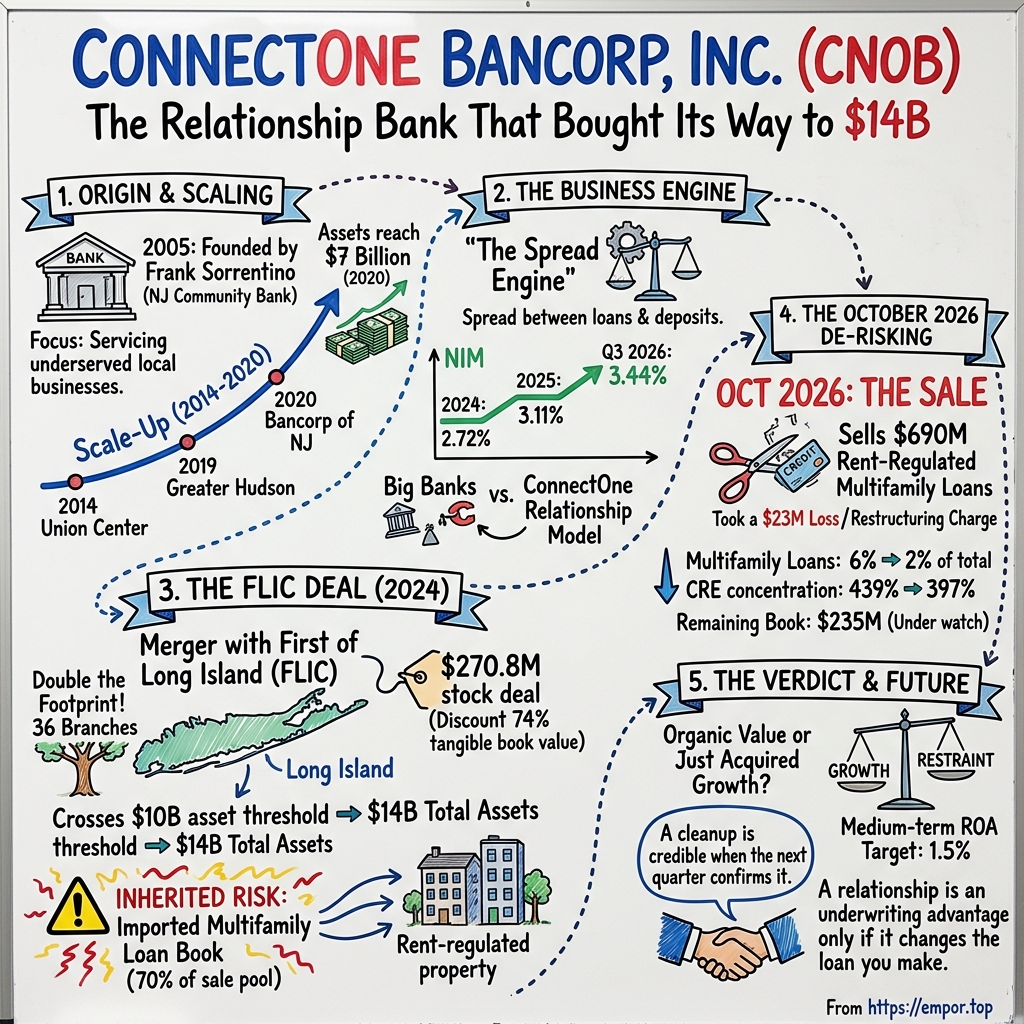
On October 29, 2026, a block of New York apartment-building loans left ConnectOne Bank's balance sheet. The pool carried $690.2 million of unpaid principal, nearly all of it secured by rent-regulated multifamily buildings in New York City, and ConnectOne had agreed to sell it at a discount rather than wait to find out what those loans would be worth in a few years.1 The price of that decision was a $23 million pretax loss, booked in the third quarter as a restructuring charge.1
Banks do not usually choose to lose money in public. They hold troubled loans, build reserves and wait for the cycle to turn. Selling a large pool at a known discount is a different act: it turns a slow argument about future losses into a single fixed number, recognised now. ConnectOne's management decided that the fixed number was cheaper than the argument.
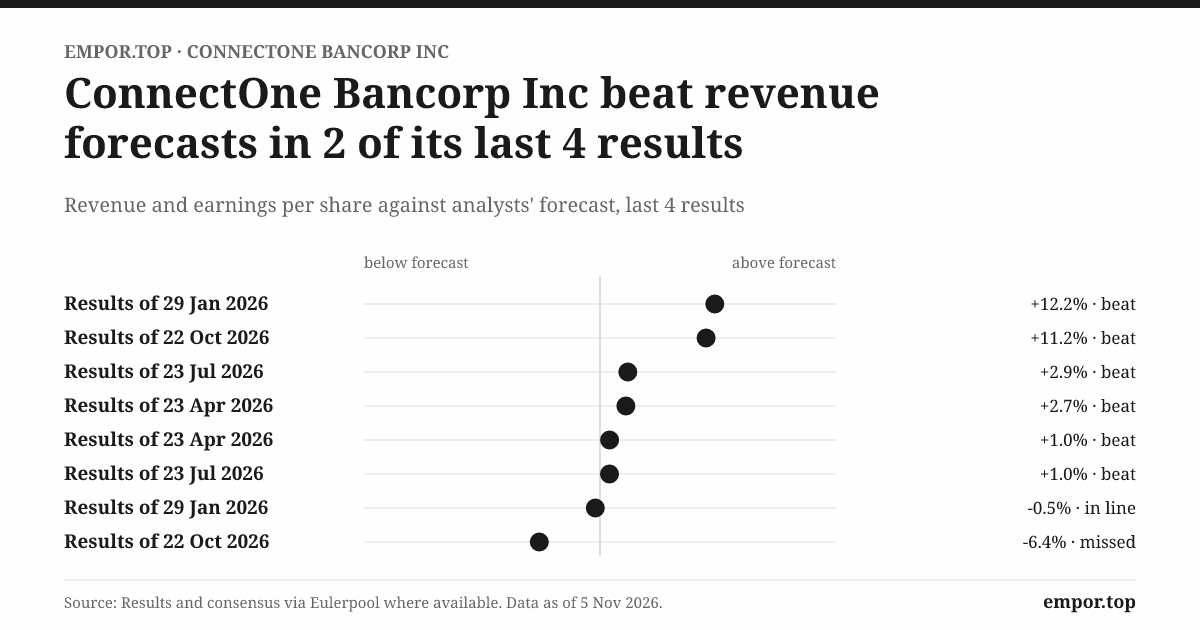
The result was a quarter that told two stories at once. On the operating measures management highlights, the third quarter of 2026 was one of the bank's best in years, with operating earnings per share of $0.95.1 On the accounting that auditors sign, diluted earnings per share were $0.59, and net income available to common shareholders fell to $29.9 million from $39.5 million a year earlier.1
The engine had improved. The reported result had fallen anyway, because the bank had paid to change the shape of what it owned.
What did the money buy? Before the sale, rent-regulated loans made up about 6% of ConnectOne's loan book; afterwards, management estimated they were about 2%.1 The bank's commercial real estate concentration, a regulatory yardstick that compares property lending with the capital standing behind it, fell on a pro forma basis from about 439% of capital to about 397%.1
That second number matters more than it looks. Federal bank supervisors have long treated 300% as the level at which a bank's property lending earns closer scrutiny, and KBRA, the rating agency that covers ConnectOne, had noted that management was aiming to bring the ratio below 400%.2 With one transaction, the bank crossed its own line.
So the opening question of this story is not whether ConnectOne had a problem. It plainly had one, concentrated in a corner of New York real estate where rent rules had squeezed landlords' income. The question is what kind of problem it was. One reading says the bank had a dangerous pocket of property credit and has now cut most of it out.
Another says the sale exposed the true cost of a growth strategy built on acquisitions, because roughly 70% of the loans sold had been originated not by ConnectOne but by The First of Long Island, the bank it bought in 2025.1 Both readings can be partly true, and the evidence for each will arrive slowly.
The stakes are simple to state. ConnectOne began as a bank for business owners, built around the idea that a local lender could know its customers better than a giant could. Through a series of mergers it has become a regional institution with roughly $14 billion of assets, still a single-bank holding company whose economics live almost entirely inside ConnectOne Bank.3
A bank that size must prove two things to deserve its shareholders' capital. It must earn more than that capital costs, and it must grow without letting one concentrated class of property loans dictate its fate. Neither proof is complete.
There is also a measurement problem worth naming at the start. A bank is not an industrial company, and the usual industrial tools tell almost nothing about it. Free cash flow, enterprise value against operating profit, the number of days customers take to pay: all of these are distorted for a lender, whose raw material is money and whose cash flows include its depositors' balances.3
The quarters around the merger are also full of accounting noise, from purchase-accounting marks to one-off charges. The cleaner path through ConnectOne's story runs through the measures the bank itself reports and regulators care about: the margin it earns between loans and deposits, the losses it takes on credit, and the return it produces on its assets and equity.
The October sale is the hinge of all of it. To understand why ConnectOne chose to pay $23 million to shrink a corner of its loan book, the story has to go back to the man who started the bank because he could not find one that served him.
 Subscribe on LinkedIn
II. The Founder Builds the Bank He Wanted
Frank Sorrentino did not come to banking as a banker. The company's own account of its origin is short and specific: when he ran a business, he could not find a bank that met all of his financial needs, so he decided to build one that would always put the client first.4
It is the kind of founding story every community bank tells, and it is easy to wave away. But it describes a real gap that a generation of business owners in northern New Jersey would have recognised.
By the early 2000s, the region's banking had been reshaped by consolidation. Large national and super-regional banks had absorbed many of the local institutions that once lent to contractors, doctors, restaurant owners and property investors in Bergen County. The big banks brought scale and products, but a business owner who needed a fast, judgement-based loan decision often found himself talking to a call centre or a credit model.
The opportunity Sorrentino saw was a bank that would make the decision locally, quickly and with a banker who knew the borrower.
The bank opened in 2005, founded, in the words of its later merger announcement, by local community and business leaders.5 It was headquartered in Englewood Cliffs, the town on the Palisades where it still keeps its head office.4 Its early years were the familiar grind of a start-up bank: raise capital, hire relationship bankers who bring clients with them, open a handful of offices, and survive a financial crisis that arrived only three years after the doors opened.
The first real inflection came in January 2014. ConnectOne, then a young bank with a headquarters and seven other offices, agreed to merge with Center Bancorp, the parent of Union Center National Bank, an older institution with 16 locations.5 The deal was valued at $243 million, and on paper Center's shareholders would own about 54% of the combined company.5
Yet it was the smaller, younger franchise whose name and leadership survived. Union Center merged into ConnectOne Bank, the holding company took the ConnectOne name, and Sorrentino became chairman, chief executive and president, with William Burns as finance chief.5 The combined bank had about $3 billion of assets and 24 branches across northern New Jersey.5
That transaction is worth pausing on because it set the template for everything that followed. ConnectOne learned early that a merger could buy scale far faster than branch-by-branch growth, and that a confident acquirer with a clear culture could absorb a larger partner. The 2014 deal also promised about $7 million of annual cost savings, roughly 14% of combined expenses, and accretion to both companies' earnings.5 It was a merger sold on efficiency and on the claim that ConnectOne's way of banking was worth spreading.
The governance of that first deal was carefully balanced. The new board had twelve members, split evenly between the two companies, and Center's chief executive, Anthony Weagley, became chief operating officer of the combined bank.5 Center's holders received 2.6 of their own shares for each ConnectOne share under a fixed exchange ratio, which is why they ended up owning the majority even as ConnectOne's people took the top jobs.5
It was a merger of near-equals on paper and a takeover in culture, and the pattern of a confident, founder-led acquirer absorbing an older institution repeated itself a decade later on a much larger scale.
The next additions were smaller but revealing. In 2019 ConnectOne bought Greater Hudson Bank, extending its footprint into New York's Hudson Valley, and BoeFly, an online marketplace that matches franchise businesses with lenders.6 Then, on January 2, 2020, it completed the acquisition of Bancorp of New Jersey, paying shareholders a mix of roughly 80% stock and 20% cash and finishing with 28 banking offices across New York and New Jersey.7
By 2020 the start-up of 2005 had grown to roughly $7 billion of assets, through a mix of organic lending and acquisitions.6
Through all of it, one person stayed at the centre. Sorrentino has run the combined company since 2014 and remains its chairman.8 Continuity of that kind is a genuine asset in banking, where clients follow bankers and culture is fragile. A founder who has built every layer of the institution knows where its risks sit and can make hard calls quickly, as the October loan sale later showed.
Continuity is also a concentration of authority. A bank in which the founder holds both the chair and the chief executive role, and in which many senior relationships trace back to him personally, has to answer a question every founder-led business eventually faces: is the advantage a system that other people can run, or is it a person? ConnectOne's growth through acquisition makes the question sharper, because every merger brings in bankers, borrowers and loans that were never shaped by the founder's judgement.
The honest reading of the origin story is therefore narrower than the marketing version. It gives the strategy a concrete customer problem and a founder who has stayed with it for two decades. It does not, by itself, prove that ConnectOne retains customers better, prices loans better or earns higher returns than its rivals.
Those are claims that can only be tested in the numbers. To test them, the story needs to look at what a bank actually sells, and why a business owner would choose this one.
III. A Bank Makes Money on the Spread Between Two Promises
Picture the customer ConnectOne was built for. A business owner in Bergen County, or now in Nassau County on Long Island, needs a loan to buy a building or expand a fleet, and an operating account to run payroll through. She can walk into a branch of one of the largest banks in the country, which will offer her a broad menu of products and a polished app.
Or she can call a relationship banker at ConnectOne, who promises a faster answer and a decision made by people who know her market.
Whichever she chooses, the bank is making two promises at once. To the depositor, it promises that money placed with it will be safe and available, and it pays interest for the privilege of using that money. To the borrower, it promises credit, which it prices at a higher rate than it pays depositors. The difference between those two rates, after the bank pays its staff and absorbs its losses, is almost the entire business.
The industry's shorthand for that difference is net interest margin, the interest a bank earns on its loans and securities minus the interest it pays on deposits and borrowings, expressed as a share of the assets that earn interest. Think of it as the markup on money. At ConnectOne, that markup fell to 2.72% in 2024, recovered to 3.11% in 2025 and reached 3.44% in the third quarter of 2026.31
On a balance sheet of roughly $14 billion, each tenth of a percentage point is worth something on the order of $13 million a year before tax, which is why the margin dominates the earnings story.
Fees play a supporting role. In the first half of 2026, fee and other noninterest income made up only about 6% of ConnectOne's revenue, according to KBRA.2 That is a thin layer by the standards of large banks, which earn substantial income from cards, wealth management, payments and trading. ConnectOne is, overwhelmingly, a spread lender. When rates, funding costs or credit losses move, there is little fee income to cushion the effect.
Why did the margin fall and then rise? The fall came from the rate shock of 2022 and 2023. As the Federal Reserve raised rates, depositors demanded more for their money, and a bank like ConnectOne, with many commercial and property loans fixed for years at the low rates of earlier times, saw its funding costs climb faster than its loan yields.
The recovery came as those older loans reached their repricing dates and rolled onto higher rates, while deposit costs stabilised and grew more slowly.9 The merger also added a deposit base and a balance sheet that, after purchase accounting reset the acquired loans to fair value, yielded more.
That last point is the caution. Purchase accounting marks acquired loans down to their fair value at closing, and the discount is then accreted back into interest income over the loans' lives. In 2025 ConnectOne recorded $23.9 million of net loan accretion.3 Some of the margin recovery is therefore a mechanical echo of the merger, not proof of better pricing. The 2026 rebound reflects asset repricing, deposit growth and a higher-yielding balance sheet. It does not establish a permanent new floor.
Now put the bank in its arena. The New York and New Jersey market is one of the most crowded banking battlefields in the world. At one end sit the national giants, led by JPMorgan Chase, with branch networks, technology budgets and deposit franchises far beyond any regional bank. In the middle sit large regionals such as Valley National.
Closer to ConnectOne's own scale are community and commercial lenders including Provident and Peapack-Gladstone, all competing for the same business owners and property investors. ConnectOne's roughly $14 billion of assets makes it a meaningful local player and a minnow beside the national banks.
Run the market through the classic competitive forces and its shape becomes clear. Buyers are powerful: a business borrower can solicit several term sheets, and a depositor can move funds with a few clicks, as the regional bank runs of 2023 showed. Rivalry is intense, because loans and deposits look much the same from one bank to the next.
The threat of new entrants is real but limited, since charters, capital rules, liquidity requirements and the cost of building underwriting skill keep new banks rare. Large incumbents also enjoy scale in technology and compliance that a $14 billion bank must work hard to match.
Two other forces round out the picture. The bank's suppliers are, in effect, its depositors and wholesale lenders, and they hold real power: when rates rise, they demand a share of the gain, and a bank with a high loan-to-deposit ratio has little choice but to pay. Substitutes are growing too.
Private credit funds now lend to the same middle-market companies and property investors that once had nowhere to go but a bank, and money-market funds and Treasury bills compete directly for idle business cash. A relationship lender's room to price above the market is squeezed from both directions.
Against that backdrop, ConnectOne's claimed edge is the relationship itself: a banker who knows the client, makes a quicker decision and bundles the loan with the operating account. The theory is sound. Commercial clients who run their payroll and receivables through a bank are slower to leave than rate-shopping savers, and those operating deposits tend to be cheaper and more stable funding.
The evidence for the theory is thinner than the theory. ConnectOne does not publish a client retention rate, a measure of how many products the average business client uses, or a consistent comparison of its efficiency with named peers. The most telling disclosure arrived on the third-quarter 2026 call, when management said much of the multifamily book it had just sold consisted of non-relationship loans, credits that came without deep deposit or operating ties.10
That admission cuts both ways. It suggests the bank knows which loans fit its model. It also shows that a meaningful part of the balance sheet did not.
BoeFly deserves a sentence in proportion. The franchise-lending marketplace is a sensible extension of a business-banking franchise, connecting franchise owners with lenders, and it is consolidated within the bank's subsidiaries.3 But the company does not disclose it as a separate segment or show it as a material source of earnings. It is a useful tool, not a second business.
Technology is the other place where the relationship model has to prove itself. A relationship bank carries the cost of experienced bankers, and that cost only pays if each banker can handle more clients without the service slipping. On the third-quarter call, management said it was building workflow technology, including what it called agentic workflows, to make bankers more efficient.10
The physical investment has stayed modest: purchases of premises and equipment were about $5 million in 2025, a rounding error beside revenue of about $606 million.3
That restraint keeps costs low, but it also means ConnectOne cannot outspend the national banks on digital products. Its bet is that a small number of well-equipped bankers, supported by software rather than branches, can deliver service a client notices. Whether that shows up in a lower efficiency ratio over time is one of the few measurable ways to tell whether the model scales.
The verdict on the engine is plain. ConnectOne is a spread business, and in the near term interest rates, funding costs and credit losses will move its results far more than any fee initiative. Relationship banking is a plausible edge, but the bank has not yet shown, in published numbers, the pricing power or customer stickiness that would make it a durable one.
That is why the biggest strategic decision of the last five years matters so much. In 2025 ConnectOne did not wait for its relationship model to grow it organically into a larger bank. It bought one.
IV. The FLIC Deal Doubled the Footprint—and Imported a Loan Book
On September 5, 2024, ConnectOne announced that it would merge with The First of Long Island Corporation, the Melville-based holding company for The First National Bank of Long Island.11 It was an all-stock deal: each FLIC share would be exchanged for 0.5175 ConnectOne shares, valuing the target at about $284 million, or roughly $12.40 a share, at the previous day's closing price.11 FLIC brought about $4.2 billion of assets, 40 branches and a deposit base about 92% concentrated in Nassau and Suffolk counties.11
The strategic logic was easy to see on a map. Long Island is one of the wealthiest suburban banking markets in the country, full of professional practices, family businesses and long-standing depositors. FLIC was an old, conservative franchise with a loyal deposit base and, by 2024, a stock that the market had marked down hard as rising rates squeezed its margin.
ConnectOne already had a presence across the New York metropolitan area. The merger promised a combined bank of roughly $14 billion of assets, $11 billion of deposits and $11 billion of loans.11
There was also a threshold to cross. U.S. banks with more than $10 billion of assets face tougher rules, including caps on the fees they can charge on debit-card transactions and more intensive supervision. Crossing the line organically is expensive, because a bank pays the extra costs before it has the scale to absorb them.
Buying across it in a single step lets the combined company spread those costs over a much larger base. FLIC took ConnectOne over the line without waiting years for organic growth.
Management sold the deal with specific promises. The announcement projected that the merger would be about 36% accretive to ConnectOne's 2025 earnings per share, once cost savings were fully phased in, with a return on average tangible common equity of about 14% and an efficiency ratio near 45%.11 The cost was 12% dilution to tangible book value per share, which management expected to earn back in about 2.9 years.11 Those numbers are the yardstick by which the merger deserves to be judged.
Was the price cheap? It depends entirely on which lens is used. KBRA described the price as about 74% of FLIC's tangible book value, meaning ConnectOne was paying well under the accounting value of the target's tangible equity.12 On that measure, it looked like a discount purchase of a franchise whose shares had been beaten down.
The earnings lens tells a different story. The fairness analyses in the merger proxy showed the deal valued FLIC at about 15.1 times its estimated 2024 earnings and 13.5 times adjusted 2025 earnings.13 The same analyses compared that with a selected group of public banks, which traded at a median of about 12.4 times trailing earnings and 9.4 times estimated 2025 earnings.13 On earnings, ConnectOne paid above those benchmarks, in some cases by a wide margin.
The two lenses do not contradict each other; they describe the same fact. FLIC was a bank whose book value was large relative to the thin profits it earned at the bottom of the rate cycle. Paying below book for such a bank is cheap only if the acquirer can lift those profits, through cost savings, better margins and the redeployment of the acquired deposits, without discovering that the book value itself was overstated by future credit losses.
A low price-to-book multiple is not a margin of safety if the book contains loans that will need to be written down.
The merger closed on June 1, 2025.14 By then ConnectOne's own share price had moved, and the stock it issued was worth about $270.8 million.3 Former FLIC shareholders received about 11.8 million ConnectOne shares, a large addition to the share register.3 Stock is not free money. Every share issued diluted the claim of legacy holders on future earnings, and that dilution is only repaid if the combined company earns more per share than ConnectOne would have earned alone.
The deal's effect on the accounts was immediate and large. Total assets rose from about $9.9 billion at the end of 2024 to about $14.0 billion a year later.3 Headcount rose from 493 to 756, almost entirely because of the acquired workforce.3 Every headline growth rate for 2025, from revenue to deposits to loans, therefore measures the merger as much as it measures the business. None of them says much about organic growth.
The year also carried hidden costs. ConnectOne booked merger expenses, recorded new goodwill and core-deposit intangibles, and set aside credit reserves against the acquired loans, including those it classified as purchased with credit deterioration.3 It issued $200 million of subordinated debt during 2025 and redeemed $75 million of older notes, reshaping its capital stack around the larger balance sheet.3
Here the yardstick bites. The merger was projected to be about 36% accretive to 2025 earnings per share. Reported diluted earnings per share fell from $1.92 in 2024 to $1.60 in 2025.3 Much of that gap reflects one-off merger costs and the initial credit provision on the acquired book, which the original projection excluded, and a fair test would compare the adjusted numbers with the adjusted promise.
But it remains true that the first year of the combined company produced lower GAAP earnings per share for legacy holders, not higher ones, and that the tangible book value earnback clock is still running.
Capital tells the rest of the story. ConnectOne carries $115 million of preferred stock issued in 2021, a layer of capital that ranks ahead of common shareholders and pays a fixed dividend before any common dividend is paid.3 It added subordinated debt around the merger to support the regulatory capital of the larger bank. Each layer was a sensible tool to fund growth without issuing more common stock at a low price.
But each layer also stands between the bank's operating earnings and the common shareholder, which is why net income available to common shareholders, rather than total net income, is the number that measures what the merger has done for legacy owners.
The deeper cost was one nobody priced in September 2024. When ConnectOne sold its rent-regulated loans in October 2026, about 70% of the pool had been originated by FLIC.1 The merger had answered the question of where ConnectOne would grow next. It had also created a harder one: what, exactly, had ConnectOne bought?
V. The Margin Came Back Before the Merger Was Fully Proven
The worst quarter came almost immediately. In the three months to June 2025, the period in which FLIC joined the accounts, ConnectOne reported a net loss of about $20 million, or $0.52 a share.3 The reasons were mostly mechanical: merger expenses and, above all, the day-one credit provision that accounting rules require an acquirer to book against the non-credit-impaired loans it buys. The loss looked alarming on a screen. Inside the bank, it was the expected cost of closing the deal.
That single quarter makes 2025 a poor year for clean comparisons. FLIC contributed only seven months of results, merger costs and provisions clouded the underlying trend, and purchase accounting added interest income that will fade as acquired loans mature. Full-year net income was $80.4 million, up from $73.8 million in 2024 but still below the $87.0 million earned in 2023.3 A bank that had grown by roughly 40% in assets was earning less than it did two years earlier.
The longer record sharpens the point. Over ten years, ConnectOne's net profit grew at about 6.9% a year. Over the three years through 2025, it fell by about 13.8% a year.3 Earnings peaked in 2021 and 2022, when the bank earned about $130 million and $125 million in successive years, helped by the unusually low funding costs of the zero-rate years.3
The rate shock then crushed the margin, and the merger has so far been a bridge back toward that peak rather than a path beyond it.
Then the margin turned. On the second-quarter call, management described loans repricing upward and deposit growth funding the balance sheet at better terms.15 The margin continued to widen, and management highlighted an operating return on assets of 1.35% in the third quarter.1
To see what that recovery means, compare like with like. Under GAAP, net income available to common shareholders in the third quarter was $29.9 million, down from $39.5 million a year earlier.1 On management's operating measure, which strips out the $23 million loan-sale loss and related items after tax, the figure was $47.9 million, up from $35.5 million.1
The gap between the two is not a trick; it is the cost of the restructuring. But investors should keep both numbers in view, because operating measures are management's own definitions, and one-off items have a habit of recurring at banks that grow by acquisition.
The fourth quarter will not be clean either. Management said the sale would incur a further $7 million to $8 million of transaction costs in the final quarter of 2026.16 Trailing GAAP earnings will therefore remain a noisy denominator for valuation into early 2027.
Fee income shows the same noise in miniature. For the first nine months of 2026, noninterest income was just $0.2 million, against $29.0 million a year earlier.16 The collapse is almost entirely accounting: the 2026 figure absorbed the $23 million loan-sale mark, while the 2025 figure had been flattered by about $10 million of nonrecurring income from a pandemic-era employee retention tax credit and a pension curtailment.16
Strip those out and management said fee income rose by about $4 million, mainly from bank-owned life insurance and gains on loan sales.16 The underlying fee business is growing slowly, which fits the picture of a bank that lives and dies by its spread.
What do the operating numbers prove? They prove that the larger balance sheet, at today's rates and today's deposit costs, can earn a respectable return. In the first half of 2026, ConnectOne's return on assets was about 1.1%, a long way above the 0.6% to 0.7% the bank earned in 2024 and 2025.23 The bank grew client deposits and loans at an annualised rate of about 11% in the third quarter, according to management on the call.10 That is real momentum.
The sequence of the year makes the point vividly. A bank that lost about 52 cents a share in the second quarter of 2025 earned about 80 cents a share in the second quarter of 2026, and then, on management's operating measure, 95 cents in the third.3161 Swings of that size are rare for a lender of this scale, and most of the distance travelled is the merger's one-off costs falling away rather than new business arriving.
The recovery is genuine, but much of it is a return to normal, not a leap beyond it.
They do not yet prove that the recovery is durable. Some of the improvement is temporary: repricing is a one-time catch-up, and purchase-accounting accretion will run down.
And the bank's interest-rate hedges, which contributed $7.5 million to net interest income in the first nine months of 2026, down from $13.3 million a year earlier, show how much of the result depends on rate structures set in earlier years.16
Those hedges are worth a plain-language explanation. ConnectOne had about $625 million of interest-rate swaps in which it pays a fixed rate and receives a floating one, protecting it against higher costs on its advances from the Federal Home Loan Bank, and matching sets of purchased and sold rate caps of $225 million each covering brokered deposits.16
Think of them as insurance policies against rising funding costs, bought when rates were lower. As those policies run off or reset, their contribution to income shrinks, and the margin has to stand more on its own.
The third-quarter call made the conversion question explicit. Analysts wanted to know why management had accepted a discount on the sale instead of working the loans out, and what would happen to the proceeds. Management's answer was that most of the cash would go into government-guaranteed securities, with the remainder used to reduce wholesale funding.9 That is a defensive redeployment.
Securities of that kind yield less than the loans they replace, so the sale trades some income for lower risk and a cleaner balance sheet. It is a sensible choice, but it means the operating earnings power of the bank after the sale will be slightly lower, not higher, than the third-quarter run rate implied before the sale.
The proof that remains outstanding is therefore a matter of time. Several quarters of post-integration earnings, after merger effects, sale costs and purchase-accounting accretion have been stripped out, are needed to establish that ConnectOne has become a better bank, not just a bigger one riding a rate cycle. And the earnings test cannot be separated from the credit test, because the cheapest way to report a high margin for a few years is to hold loans that will not be repaid.
VI. The Rent-Regulated Loans Force a Choice
At the end of June 2026, ConnectOne's nonperforming assets stood at $79.7 million. Three months later they were $64.3 million.1 A casual reader would see an improving trend. A careful one would notice that a year earlier, the figure had been $39.7 million.1 The problem had peaked, perhaps, but it had not gone away, and its source was a particular kind of building in a particular city.
New York's rent-stabilised apartments are a world unto themselves. A large share of the city's older apartments are covered by rules that cap how much landlords can raise rents each year. For decades, owners and lenders accepted those caps because they could make up the difference in other ways: deregulating units when tenants left, or recovering renovation costs through permitted increases.
In 2019 New York State tightened the rules sharply, closing most of those routes. Since then, owners of older rent-stabilised buildings have faced rising costs for taxes, insurance, labour and repairs, while their rents could rise only slowly.
For a lender, the mechanism is direct. A loan on such a building is repaid from the rents, and its safety depends on the building being worth more than the loan. When expenses rise faster than permitted rents, the cash available to service the debt shrinks. When interest rates rise, refinancing at maturity requires more cash still, and the market value of the building, which is ultimately a multiple of its net operating income, falls.
Multifamily lending on these buildings had long been seen as among the safest in commercial real estate, because the buildings were always full. After 2019 and the rate shock, full buildings stopped being enough.
ConnectOne had meaningful exposure. Multifamily loans made up about 31% of its total loan book in mid-2026, according to KBRA, and loans on New York City rent-regulated buildings made up about 5% of loans at that point.2 Much of that exposure had arrived with FLIC, whose Long Island and New York lending included a substantial book of apartment loans.
The decision management faced was the classic dilemma of a bank with a problem asset class. It could hold the loans, provide for losses as they emerged, and work out the troubled credits one by one. That path preserves the possibility of recovering more value if conditions improve, but it leaves the bank's earnings and capital exposed to an unknown tail, and it leaves the stock priced for the worst case.
Or it could sell a large block at a known discount, accept a defined loss, and move on.
ConnectOne chose the second path, selling the pool at a known loss.1 Management described the economic loss as roughly 3% of par, meaning the bank received about 97 cents on the dollar of the loans' face value once the existing reserves and purchase-accounting marks were taken into account.9 In the third quarter it also charged off $22.2 million of allowance that had been held against loans purchased with credit deterioration, tied to the pending sale.16
That 3% figure deserves a second look, because it seems small for loans described as stressed. Part of the answer is that the pool was not all troubled: a portfolio sale typically bundles performing and nonperforming loans so the buyer accepts the whole. Part is that the acquired loans had already been marked down when FLIC was consolidated, so the fair-value discount absorbed some of the loss before the sale.
The economic loss on the original face value of the FLIC loans was therefore larger than the 3% on today's book, and was spread across purchase accounting, reserves and the restructuring charge. The sale crystallised a loss that had been building since the merger.
The cleanup did not reach every loan. About $61.4 million of loans were excluded from the final sale and remained classified as held for sale.16 After the transaction, management estimated the remaining rent-regulated book at about $235 million, or roughly 2% of loans.1
The reserve picture also changed. ConnectOne's allowance for credit losses fell to $120.6 million, or 1.06% of loans, from 1.38% a year earlier, mainly because the charge-off tied to the sale removed reserves that had been held against the departing loans.16 A lower reserve ratio after a sale is logical, since the riskiest loans have gone. It also means the remaining book has less cushion if more problems surface.
The other credit indicators are mixed. Early delinquencies, loans 30 to 89 days past due, were a negligible 0.05% of loans at the end of September, which suggests no new wave of trouble.16 But criticized and classified loans, the bank's own watch list of credits showing weakness, were 2.02% of loans.16 Those are not losses, but they are the pipeline from which future losses come.
The question of who made these loans matters for what the episode reveals. About 70% of the sold pool came from FLIC.1 That points to the merger's underwriting and diligence as much as to ConnectOne's own history. ConnectOne had the opportunity to examine FLIC's loan book before it agreed to the deal, and it put fair-value marks on it at closing.
Two years later, it paid to sell a large part of the same exposure. Either the diligence underestimated how quickly rent-regulated values would deteriorate, or ConnectOne accepted the risk as the price of the deposit franchise and has now chosen to cap it. Both explanations reflect on the judgement behind the deal.
The alternative path had its own costs, and they help explain the choice. Holding the loans would have tied up capital against assets that regulators and rating agencies were watching closely, kept the concentration ratio above the 400% line and left every future quarter exposed to the next appraisal or the next rent board decision. Selling meant accepting a buyer's price, which by definition includes the buyer's required return for taking the risk.
ConnectOne effectively paid a specialist investor to own the uncertainty. Whether that was a good trade depends on what the loans would have lost if held, a counterfactual nobody will ever see. What the bank gained for certain was a smaller, more predictable risk and a cleaner story to tell regulators, rating agencies and shareholders.
There is offsetting evidence, and it should be heard. KBRA pointed to conservative multifamily underwriting across the portfolio, with an average loan-to-value ratio of about 57%, meaning the average loan was little more than half the appraised value of its building.2 That is a meaningful buffer. But a portfolio-wide average says little about the specific loans that went bad, which tend to be the ones whose values fell furthest or whose appraisals were oldest. Averages hide tails, and the sale was about the tail.
Credit is only half of a bank's risk; funding is the other. At the end of September, deposits stood at $11.78 billion, while estimated uninsured deposits at the bank were about $5.75 billion.16 Uninsured deposits, balances above the federal insurance limit, are the money most likely to move in a scare, as Silicon Valley Bank's collapse showed in 2023.
Many of ConnectOne's are operating accounts of business clients, which tend to be stickier, but the bank does not break out how much of the total that represents.
After the sale, management projected the loan-to-deposit ratio would improve to 97.1%, from about 101% at mid-year.12 A ratio near 100% means the bank lends out essentially every dollar of deposits and leans on borrowed money for liquidity, which is why reducing wholesale funding was part of the plan.
There is also exposure that sits off the balance sheet. At the end of 2025, ConnectOne had about $1.51 billion of commitments to extend credit, mostly commercial lines and loan commitments.3 These are not loans today, but they could become loans tomorrow if borrowers draw down their lines, which tends to happen when businesses are under pressure. In a downturn, drawdowns would raise both the bank's credit exposure and its need for funding at the same moment.
The sale was a credible course correction. It reduced the concentration, cleaned the balance sheet of a known problem and showed a management team willing to take a visible loss rather than hope. It is not yet proof that the remaining portfolio is clean. The decisive evidence will come in the next few quarters: the charge-offs and nonaccruals in the remaining $235 million of rent-regulated loans, the trend in criticized loans, and whether wholesale funding actually falls as promised.
Those tests point back to the people who made the decision.
VII. Sorrentino's Strategy Now Has a Measurable Hurdle
When ConnectOne's leaders stood before analysts in October 2026, the cast was familiar. Frank Sorrentino, the founder, remained chairman and chief executive.8 William Burns, who has been chief financial officer since 2012, walked through the numbers.3 Elizabeth Magennis, who leads the bank as its president and sits on the board, completed the core team.8 It is a leadership group with unusual continuity for a bank that has absorbed four acquisitions in a little over a decade.
The message they delivered was a mixture of recovery and contrition. The operating quarter was strong, the margin was rising and deposits were growing. The credit problem was acknowledged, quantified and, in management's account, largely removed. This is a story management has an obvious interest in telling well. The question for an outsider is whether their behaviour, not just their narrative, supports confidence.
Start with alignment. As of March 31, 2026, Sorrentino owned about 1.6% of the company's shares, and directors and executive officers as a group owned about 5.2%.8 At a market value of roughly $1.6 billion, the chief executive's stake is worth on the order of $25 million, enough to make the share price matter to him personally. It is not control. No single holder controls ConnectOne; Vanguard reported owning about 5.0% of the shares in its own filing.17
Then look at pay. Sorrentino's total reported compensation rose from about $3.3 million in 2023 to $4.4 million in 2025.8 The 2025 figure included an annual incentive of about $1.27 million against a target of $942,400, a payout of about 135% of target.8 Burns received about $1.5 million in 2025.8
The incentive payout is the part that deserves scrutiny. A 135% payout signals that the board judged 2025 a year of strong performance against its chosen goals. Yet 2025 was the year net income came in below 2023, diluted earnings per share fell, and a significant part of the acquired loan book was heading toward a loss-making sale.
The board's scorecard, set out in the proxy, measures more than one year's earnings per share, and closing a transformative merger is a legitimate achievement to reward.8 But shareholders who measure success by earnings per share would have seen a less impressive year than the incentive suggests.
Some of them said so. The 2025 say-on-pay resolution, the advisory shareholder vote on executive compensation, passed with about 84% of votes cast.18 That is a comfortable majority, but well below the support of more than 90% that most companies receive, and it means roughly one vote in six went against the pay plan. A material minority of owners was unconvinced that pay tracked results.
Governance checks beyond pay are largely reassuring, within their limits. The auditor gave an unqualified opinion on both the 2025 financial statements and the bank's internal controls, with no material weakness reported.3 Related-party dealings are small: at the end of 2025, loans to insiders and their interests were about $31 million and their deposits about $70 million, and the company also paid modest sums for office rent and to an advertising agency partly owned by a director.3
Management says those transactions were on terms similar to those available to unrelated parties.3 For a bank with $14 billion of assets, none of this looks material to earnings, though it is the kind of disclosure worth watching at a founder-led community institution.
The most important evidence about management is behavioural. Faced with a concentrated credit problem, much of it inherited, the team sold most of it at a visible cost and explained the trade-off on the call.9
That is what good bank management looks like in a crisis. It is also what one would expect a team to do after it had bought the problem in the first place. Credit for the cleanup must be weighed against responsibility for the acquisition.
Capital allocation offers another behavioural clue. Through the first nine months of 2026, ConnectOne repurchased only about 140,000 of its own shares, leaving about half a million shares under its existing authorisation.1 That is a token amount for a company with about 50 million shares outstanding, and it suggests management has prioritised rebuilding capital over returning it while the merger and the credit cleanup were still in progress.8
The dividend has continued; the bank paid about $32 million to common shareholders in 2025, roughly two fifths of net income.3 The restraint on buybacks is consistent with what KBRA described as the need to rebuild capital after the merger.2 It also means shareholders are, for now, being asked to wait for returns on the larger bank rather than receiving them in cash.
The risk function has also changed hands. The 2025 annual report names Mark Pappas as chief risk officer since January 2026, a new face in the seat that oversees credit concentration and the limits that are supposed to stop a problem like the rent-regulated book from growing unnoticed.3
A new chief risk officer arriving in the same year as the sale is not evidence of anything by itself. It does mean the next phase of credit discipline will be overseen by someone who did not approve the loans that had to be sold.
There is a fair point in management's favour on consistency. KBRA cited the below-400% commercial real estate concentration target before the sale was announced, and ConnectOne met it on a pro forma basis within weeks.21 A target stated and then met is the most valuable currency in management credibility.
The harder test is the next one. Management's stated medium-term goal is a return on assets of 1.5%, cited by KBRA in its September 2026 rating review.2 That is an ambitious hurdle. ConnectOne's recent returns on assets remained below that goal; even the third quarter's operating figure excluded the sale loss.321 The bank last exceeded 1.5% in 2021, when unusual conditions flattered almost every bank's returns.3
The original merger's promised return and efficiency targets remain the measurable commitments by which this management team has chosen to be judged.11 One strong quarter is not delivery. A run of quarters at or near those levels, after the costs of the merger and the sale, would be. That is the shape of the debate that an investor now has to settle.
VIII. Analysis & Bear vs. Bull Case
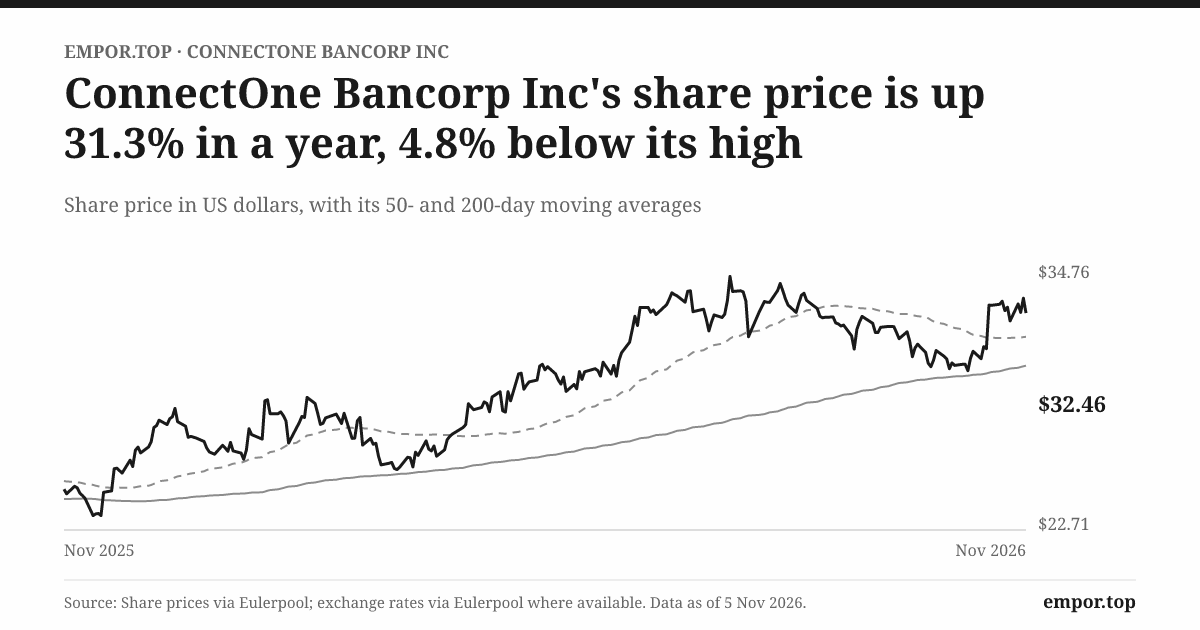
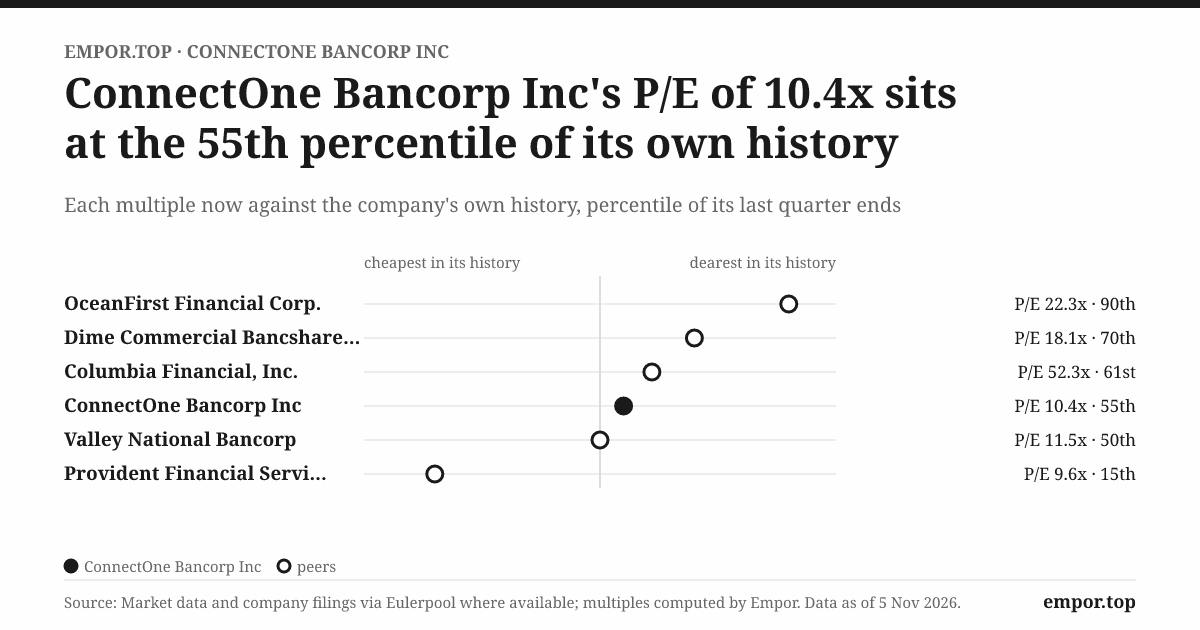
Consider an investor looking at ConnectOne in early November 2026. The shares trade around $32.46, close to their 52-week high and about 40% above the low of the past year.19 The company is valued at roughly $1.6 billion, about 10.4 times trailing earnings and almost exactly one times its book value of about $31.80 a share.1619 The bank's own five-year median price-to-earnings multiple is about 10.1 times. On that comparison, the market is paying almost exactly what it has usually paid for ConnectOne's earnings.
That is the first finding, and it deserves emphasis because it contradicts an easy narrative. A story of a bank that has fixed its problem and widened its margin invites the conclusion that the stock is cheap. Against its own history, it is not obviously cheap. The market is neither pricing a disaster nor pricing a transformation. It appears to assume that ConnectOne will earn roughly the returns of a solid regional bank, with the credit problem largely contained but not forgotten.
The right valuation tools matter here. For a bank, price to earnings and price to tangible book are the measures that link price to the returns the business can produce.
And because the sale charge and transaction costs depress trailing GAAP earnings, the 10.4 times multiple is calculated on a noisy denominator. On management's operating earnings, the multiple would be lower. On earnings after the redeployment into lower-yielding securities, the gap narrows.
A book value of one times means the market believes ConnectOne earns roughly its cost of equity on that book. The classic relationship in bank valuation is simple: a bank that earns more on its equity than investors demand trades above book, and one that earns less trades below. ConnectOne's return on equity over the last twelve months was about 9.4%.16
If the bank reaches its 1.5% return on assets goal with its current capital structure, its return on equity would rise well into the teens, and a price near book would look undemanding. If it stays near 1%, the current price is fair.
The bull case begins with the margin. Net interest margin has recovered from 2.72% to 3.44% in less than two years, and loan repricing still has some way to run as older fixed-rate loans reset.1 Client deposits and loans grew at an annualised rate of about 11% in the third quarter.10 The loan sale has cut rent-regulated exposure by about two thirds and brought commercial real estate concentration below 400%.1
KBRA affirmed the holding company's BBB senior unsecured rating with a stable outlook in September, citing the larger franchise, more diverse funding and improving profitability.2 The combined footprint across New Jersey, New York City and Long Island gives ConnectOne a much larger base of business clients to sell its relationship model to. In the bull's telling, the merger's problems are now behind it and its benefits are ahead.
The bear case begins with the same balance sheet. Even after the sale, investor commercial real estate remains the defining exposure, with a concentration ratio near 400% of capital, well above the 300% level at which regulators focus.2 Multifamily lending is still a large share of the book, and the remaining $235 million of rent-regulated loans plus $61 million still held for sale are the riskiest part of it.116
Uninsured deposits of about $5.75 billion, and wholesale funding that KBRA called still somewhat elevated, leave the bank more exposed than peers with deeper retail deposit bases.162
Capital is still being rebuilt after the merger. And the earnings record shows a bank that, after doubling its size, still earned less in 2025 than it did in 2023. In the bear's telling, the margin recovery is a temporary rate tailwind that credit losses, funding costs or integration expenses will consume.
To judge which story is winning, three numbers matter more than all the others. The first is credit: the trend in nonperforming assets, which fell to $64.3 million in the third quarter but remained well above the prior year, and in criticized and classified loans, which stood at 2.02% of loans.116 The second is the margin and the deposits that fund it: net interest margin at 3.44% and rising, along with the cost and mix of deposits behind it.
The third is returns: return on assets against the 1.5% target, alongside tangible common equity as capital is rebuilt. If credit is stable, the margin holds and returns climb toward target, the bull case strengthens. If any one of them breaks, the others will not save it.
Does the relationship model amount to a moat?
The moat question needs one full hearing, using Hamilton Helmer's seven sources of lasting advantage. Scale economies exist in banking, but ConnectOne is a mid-sized bank in a market dominated by giants, so scale is a defence against smaller rivals, not an advantage over the largest. Network effects are minimal; one depositor's presence does not make the bank more valuable to another.
Counter-positioning, a business model incumbents cannot copy without hurting themselves, is the closest fit to the original idea: a fast, local, judgement-based lender that big banks with centralised credit processes find awkward to imitate. But regional and community rivals such as Valley, Provident and Peapack-Gladstone pursue similar relationship strategies, so the counter-position is shared, not unique.
Switching costs are the strongest candidate. A business that runs payroll, receivables and treasury through a bank, with a loan tied to those accounts, faces real friction in moving. That friction is ConnectOne's best defence against price competition. Branding in banking is weak, process power is plausible but unproven, and cornered resources, such as a unique license or asset, are absent.
The honest conclusion is that ConnectOne has, at best, a modest switching-cost advantage among its core business clients, and no structural power that its peers lack.
History narrows the claim further. The bank does not publish retention rates, product-per-client data or peer efficiency comparisons that would prove relationship stickiness. The sold multifamily book was, by management's own account, largely made up of non-relationship loans.10 And the merger that brought the bank to $14 billion imported a portfolio that the relationship model did not produce.
The claim survives, but in a smaller form: ConnectOne has a credible relationship franchise in business banking, layered on a larger balance sheet of transactional property loans that compete mainly on price. What would strengthen the claim is sustained growth in client operating deposits, at a stable cost, alongside credit-adjusted returns above peers.
An activist reading the same record would press one question harder than any other. If ConnectOne could identify the rent-regulated loans as non-core and sell them in 2026, why did it acquire and keep so many in the first place, and what stops the bank from rebuilding the same concentration as it chases growth? Selling loans is a powerful tool, but it is a corrective one.
The better discipline is to slow or redirect lending before a concentration becomes a problem that requires a sale. The activist would also ask whether the 135% incentive payout in 2025 sent the right signal, and whether future pay is tied tightly enough to return on assets and credit outcomes rather than to completing transactions.
The balanced conclusion is that ConnectOne has a plausible local relationship franchise and has taken real corrective action, and the market prices it accordingly. Its case for winning from here depends on proving that the larger bank can earn better returns, consistently, without rebuilding the concentration it just paid to reduce. The evidence for that is still arriving, and the history of how the bank got here carries lessons of its own.
IX. Lessons from a Bank That Grew by Buying
The story began with a business owner who could not find a bank he liked and built one. It reached its sharpest moment twenty-one years later, when that bank paid $23 million to rid itself of loans it had bought rather than made. Between those two moments lies a set of lessons that belong to ConnectOne more than to any other bank.
The first lesson is that a relationship is an underwriting advantage only if it changes the loan you make. ConnectOne's founding promise was that knowing the client would produce better decisions. That promise is credible for business owners whose accounts, cash flows and character a banker can watch over years. It offers nothing for non-relationship loans such as the rent-stabilised apartment loans the bank sold.
When management described much of the sold book as non-relationship lending, it was conceding exactly this. A bank's culture shapes only the loans the culture touches. For founders and investors, the wider point is that a stated advantage should be tested loan by loan, not slogan by slogan.
The second lesson is that a cheap balance sheet can still be an expensive acquisition. ConnectOne paid below tangible book value for FLIC, but above comparable public banks' earnings multiples. The later sale suggested the market's doubts about part of FLIC's book were justified.
For any bank acquirer, the price that matters is not the multiple of book on signing day. It is the multiple of what the book turns out to be worth after the credit marks are done.
The third lesson is that a cleanup is credible when the next quarter confirms it. The October 2026 sale was decisive and well explained, and it met a concentration target on schedule. But banks have announced clean breaks before, only to report a second round of problems from the loans they kept.
The remaining rent-regulated loans, including those that did not sell, and the criticized loans are where the confirmation, or the contradiction, will come from. A cleanup is a hypothesis until the charge-off line agrees.
The fourth lesson is that growth is not the same as value creation. ConnectOne roughly doubled its assets between 2020 and 2025, from about $7 billion to about $14 billion. Over the same stretch, annual net income rose and then fell, ending 2025 below its 2023 level and well below its 2021 peak.3
Assets are not returns, and branch counts are not earnings per share. The bank's 1.5% return-on-assets goal is the measure of whether the growth has paid. Until it gets close, the doubling is a bigger stage, not a better performance.
Underneath all four sits a single discipline that separates a one-time reset from a repeatable bank. The best time to price a risk is before it requires a sale announcement. ConnectOne showed it could take a hard decision under pressure. The next chapter will show whether it can take the quieter version of the same decision when no one is pressing it at all.
X. Epilogue
Tonight, ConnectOne is a bank caught between two balance sheets. The one in its third-quarter filing still carried the loans it was about to sell; the one that matters, after the October 29 closing, has not yet been reported. The first full quarter after the sale, the three months to December 2026, will be the first time the bank's accounts reflect the repositioning rather than the plan for it. Its results will arrive in early 2027.
Several numbers in that report will carry more weight than the rest. The remaining rent-regulated book of about $235 million is the first. If charge-offs and nonaccruals there stay contained, the sale will look like a clean break. If they rise, investors will conclude that the problem was larger than the pool that was sold.
Commercial real estate concentration, near 397% pro forma, is the second, because the bank now has to keep it below its own 400% line while trying to grow.1 Holding that line means saying no to some property loans, which is exactly the restraint the story has been testing.
The margin is the third. It reached 3.44% in the third quarter, but the sale proceeds are being redirected into lower-yielding government-guaranteed securities and toward paying down wholesale borrowings.9 If the margin holds while deposits keep growing at a sustainable cost, the bank's earnings power is real. If the margin slips as repricing runs its course and the higher-yielding loans are gone, the recovery will look more like a cycle than a strategy.
Then there are returns and capital. Return on assets against the 1.5% target, tangible common equity as capital is rebuilt, and operating expenses against the efficiency promised when the merger was announced will show whether the integration case is being delivered.112 KBRA's ongoing surveillance of its BBB rating will offer an independent read on whether the bank's credit and funding profile is improving as management says.2
It helps to picture the two endings. In the first, the remaining rent-regulated loans season quietly, the watch list shrinks, the bank pays down borrowed money as promised and return on assets edges from the low ones toward the target. In that world, the October sale becomes the moment ConnectOne stopped being judged as a property lender and started being judged as a business bank, and the market's willingness to pay about book value would look conservative.
In the second ending, a fresh batch of troubled loans surfaces from the multifamily book that was not sold, reserves have to be rebuilt from their lower post-sale level, and the margin slips as the repricing tailwind fades. In that world, the sale will be remembered as the first instalment of a longer bill, not the last.
Most likely, the truth will arrive somewhere between those two endings and over more than one quarter, which is why patience with the evidence matters more than any single headline. The first report after the sale will tell investors which direction the bank is drifting. It will take a year of reports to tell them where it has landed.
The next earnings call will be worth listening to closely. Investors should compare what management says about the remaining credit pool, loan growth priorities and wholesale funding with what it said on the second- and third-quarter calls.159 Consistency would be a signal of control. A shift in the story, a new category of non-core loans, or a softer commitment to the funding plan would be a signal of something else.
None of these readings will settle the question alone. A single good margin print cannot prove that credit has normalised; a single quiet credit quarter cannot prove the bank has found sustainable organic growth. ConnectOne needs three things to arrive together: clean credit, stable funding and rising returns. The tension that remains is the one this story began with, now sharpened by the cost of the sale. Can ConnectOne grow its relationship franchise without recreating the concentration it just paid to reduce?
XI. Outro
Go back to October 29, 2026, and the loans leaving the building. A relationship bank, founded by a man who wanted a bank that would say yes to business owners, chose to give up $690 million of loans and a slice of its earnings to buy a less concentrated balance sheet. It was, in a sense, the opposite of a relationship: a decision to let go.
That is what makes this bank's story distinct. Sorrentino built ConnectOne on the promise of being the bank he wanted as a customer. The harder test, now, is knowing when a relationship, a merger or a loan is no longer worth keeping, and having the discipline to decide before the market decides for you. For ConnectOne, the next relationship that matters most may be the one between growth and restraint.
References
-
ConnectOne Bancorp, Inc. Announces Third Quarter 2026 Results Including Balance Sheet Restructuring and Repositioning — ConnectOne Bank, 2026-10-22 ↩↩↩↩↩↩↩↩↩↩↩↩↩↩↩↩↩↩↩↩↩↩↩↩↩↩↩
-
KBRA Affirms Ratings for ConnectOne Bancorp — KBRA, 2026-09-03 ↩↩↩↩↩↩↩↩↩↩↩↩↩↩↩
-
ConnectOne Bancorp 2025 Form 10-K — SEC, 2026-02-24 ↩↩↩↩↩↩↩↩↩↩↩↩↩↩↩↩↩↩↩↩↩↩↩↩↩↩↩↩↩↩
-
ConnectOne Bank: Building a Better Place to Be Since 2005 — ConnectOne Bank ↩↩
-
Center Bancorp, Inc. and ConnectOne Bancorp, Inc. to Merge, Creating New Jersey's Premier Community Bank — ConnectOne Bank, 2014-01-21 ↩↩↩↩↩↩↩↩
-
ConnectOne Bancorp September 2020 Investor Presentation — SEC exhibit, 2020 ↩↩
-
ConnectOne Bancorp, Inc. Completes Acquisition of Bancorp of New Jersey, Inc. — ConnectOne Bank, 2020-01-02 ↩
-
ConnectOne Bancorp 2026 Proxy Statement — SEC, 2026 ↩↩↩↩↩↩↩↩↩
-
Q3 2026 Earnings Call Transcript: ConnectOne Bancorp — Investing.com, 2026 ↩↩↩↩↩↩
-
ConnectOne Bancorp Q3 2026 Earnings Call Transcript — Earnings Whispers, 2026 ↩↩↩↩↩
-
ConnectOne Bancorp, Inc. to Expand on Long Island Through Merger with The First of Long Island Corporation — ConnectOne Bank, 2024-09-05 ↩↩↩↩↩↩↩↩
-
KBRA Affirms Ratings for ConnectOne Bancorp, Inc. Following Acquisition Announcement — KBRA, 2024 ↩
-
ConnectOne–First of Long Island Merger Proxy and Prospectus (Form S-4/A) — SEC, 2024 ↩↩
-
ConnectOne Completes FLIC Merger — SEC Form 8-K, 2025-05-28 ↩
-
ConnectOne Bancorp Q2 2026 Earnings Call Transcript — Stock Analysis, 2026 ↩↩
-
ConnectOne Bancorp Q3 2026 Form 10-Q — SEC, 2026-10-30 ↩↩↩↩↩↩↩↩↩↩↩↩↩↩↩↩↩↩
-
Vanguard Schedule 13G for ConnectOne Bancorp — SEC filing reproduced by StockTitan, 2026-04-29 ↩
-
ConnectOne Bancorp 2026 Definitive Proxy Statement — SEC filing reproduced by StockTitan, 2026-04-09 ↩
 LinkedIn
 WhatsApp
 Reddit
 Hacker News
 Email
 Kindle
 RSS Feed
 Spotify
 Apple Podcasts
 Amazon Music
 Audible
 YouTube