Provident Financial Services: The $25 Billion Jersey Bank Blueprint
I. Introduction & The $25 Billion Garden State Heavyweight
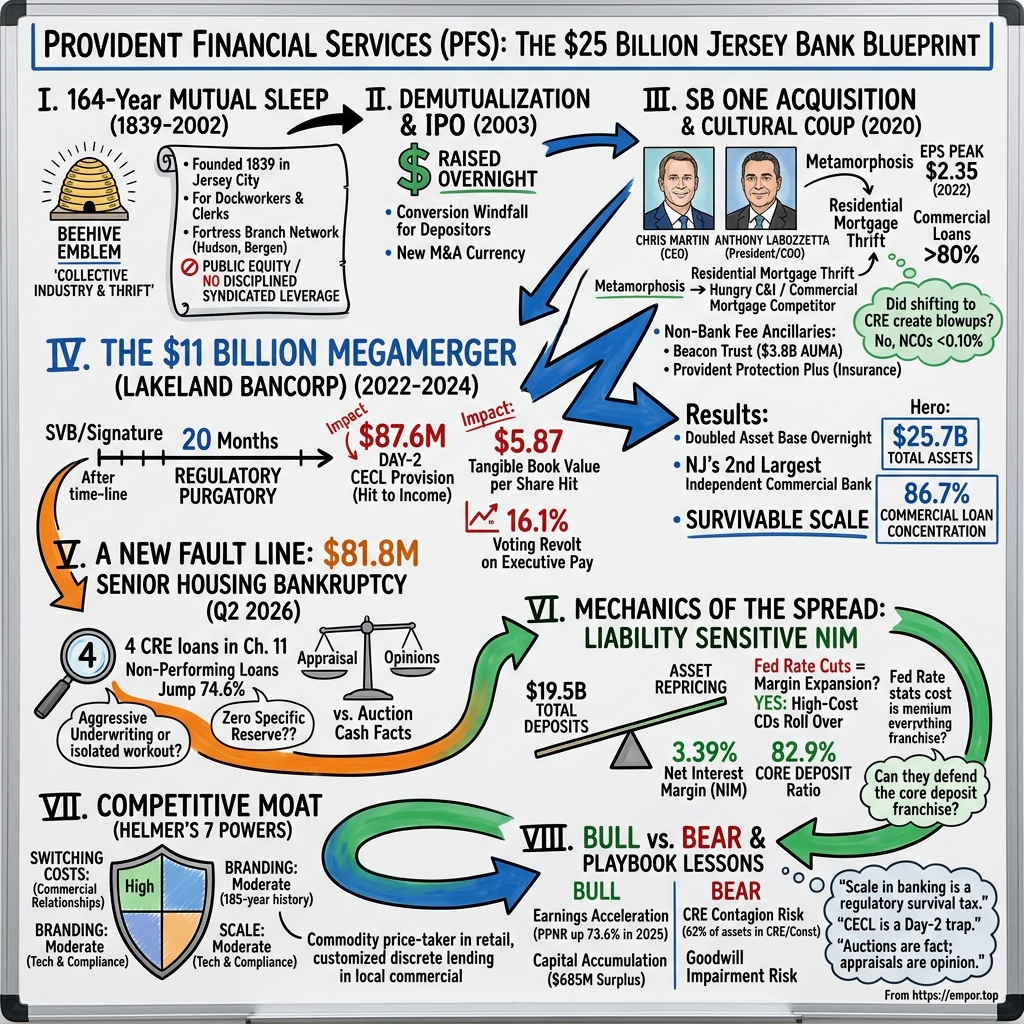
On May 16, 2024, after almost twenty months of waiting, two New Jersey banks that had spent decades competing for the same suburban borrowers became one company. Provident Financial Services, the holding company of a savings bank chartered in 1839, completed its all-stock merger with Lakeland Bancorp. To do it, Provident issued 55,644,484 new shares of common stock, and Lakeland Bank was folded into Provident Bank.1 The deal was billed as a merger of equals. What came out of it was something neither partner had been before: a regional commercial bank with about $24 billion in assets at year-end 2024, roughly double Provident's size a year earlier.1
There was no victory lap. Under the Current Expected Credit Loss accounting rules, Provident had to book an initial provision of $87.6 million against Lakeland loans that were still performing. Combined with $56.9 million of pre-tax merger costs, that left 2024 diluted earnings per share at $1.05, less than half the 2022 peak.1 A year later, at the April 2025 annual meeting, about one in six votes cast on executive pay went against the board.2
Here is the puzzle. Provident is a 187-year-old institution that was born to keep dockworkers' savings safe. Today it is a commercial lender. At the end of 2025, 86.7% of its $19.5 billion loan book was commercial: commercial mortgages, multi-family, construction, and loans to operating businesses.1 By June 30, 2026 total assets had reached $25.7 billion.3 The bank got bigger on purpose, and getting bigger changed what kind of bank it is.
The thesis spine
This story keeps coming back to one dilemma facing American banks with between $10 billion and $50 billion in assets. A bank that size pays for the technology, compliance staff, and regulatory scrutiny of a large institution. Unless it can spread those costs over a dense base of local deposits and loans, the economics get squeezed from above by the money-center banks and from below by credit unions and fintech deposit platforms. Provident's answer was to double in size. This piece argues the move was close to necessary, and that it came with a price: the company now depends on how well it underwrites commercial real estate, to the point where a single borrower's bankruptcy can move the stock.
That borrower already exists. In the first half of 2026, four loans on senior housing properties totaling $81.8 million became tied up in related bankruptcy filings. Non-performing loans nearly doubled, and Provident set aside no specific reserve against those loans.3
The four questions
The investigation follows four questions:
- Credit quality. Is the $81.8 million senior housing exposure a fully collateralized one-off, or the first sign of trouble in a book that is overwhelmingly commercial?
- Operating leverage. Can the combined bank keep its post-merger profitability while finishing the Lakeland systems conversion and holding on to deposits in overlapping northern New Jersey towns?
- Margin mechanics. Provident earns a 3.39% net interest margin and pays 2.91% on its interest-bearing liabilities. What happens to that spread as rates fall?1
- Capital and valuation. Can tangible book value per share, $16.42 at mid-2026, compound fast enough to absorb about $765 million of goodwill and intangibles and the new shares issued for Lakeland?3
The answers start in a nineteenth-century port town across the river from Manhattan.
 Subscribe on LinkedIn
II. The 164-Year Sleep: From the Jersey City Waterfront to Demutualization
In 1839 Jersey City was a working port. Ferries crossed to Lower Manhattan, warehouses lined the Hudson, and the town was filling with clerks, longshoremen, and newly arrived immigrants paid in cash, with nowhere safe to keep it. The Provident Institution for Savings was founded for those people. Its name described its purpose: to be provident, putting aside today's small surplus against tomorrow's need. Today's Provident Bank, a New Jersey-chartered savings bank insured by the FDIC, traces its charter to that founding.1
For the next 164 years the bank had no shareholders in the ordinary sense. It was a mutual, owned in effect by its depositors. That structure shaped what kind of bank it could be.
What mutuality buys, and what it costs
A mutual savings bank has no stock to promote, no quarterly earnings consensus to beat, and no outside owners pushing for higher returns. Its main tasks are to survive and to keep the community's trust. Through the panics of the nineteenth century, the Depression, and the savings-and-loan crisis of the 1980s, that conservatism held up well. The bank mostly made home loans and small business loans in its own counties and grew slowly, branch by branch, across northern and central New Jersey.
Mutuality has a structural weakness, though. A mutual cannot issue shares, so it cannot pay for an acquisition with stock or raise equity in a hurry. In the 1990s and early 2000s, interstate banking became fully legal and national banks began buying regional franchises along the Northeast corridor. A standalone thrift without its own acquisition currency was likely to end up as somebody else's target. Deregulation did not make mutuals unsafe. It made them strategically stuck.
The conversion
Provident chose to leave mutual ownership. In 2002 it formed Provident Financial Services, Inc. as a Delaware corporation to carry out a mutual-to-stock conversion, and the shares began trading on the New York Stock Exchange on January 16, 2003.1 In a standard conversion, depositors receive priority rights to buy shares, and the bank ends up with a large cushion of new equity and, for the first time, a currency it can use.
Did the conversion turn a conservative thrift into a reckless acquirer? The long-run record says no, at least for the first two decades. By 2014 Provident had about $8.5 billion in assets, and by 2019 it had about $9.8 billion. That works out to low single-digit annual growth for a company that had public stock to spend.14 Net income moved from about $74 million in 2014 to about $113 million in 2019, and diluted EPS from $1.22 to $1.74.1 That is steady, but it is not the record of a fast-growing compounder. The public-company Provident kept the mutual's caution and the modest returns that went with it.
So the conversion created the option to grow through acquisitions, and for years management used it sparingly. That changed when a smaller bank from Sussex County brought in a new leadership team.
III. The Trojan Horse: How Anthony Labozzetta and SB One Rewrote the DNA
In July 2020 most of New Jersey's branches were operating behind plexiglass and appointment lists, and Provident closed a deal that looked minor. It acquired SB One Bancorp, a Sussex County community bank, adding about $1.8 billion in assets.1 Total assets went from $9.8 billion to $12.9 billion in a single year, partly because of pandemic-era deposit inflows.14 On the surface, Provident had absorbed a smaller competitor in the northwest corner of the state.
The more important addition was SB One's chief executive, Anthony J. Labozzetta. He came over to the larger bank and was appointed President and CEO of Provident Financial Services in 2022.15 In bank mergers the acquiring bank's leaders usually stay in charge. Here, the leader of the smaller bank ended up running the combined company.
A commercial banker's instincts
Labozzetta's background is in relationship commercial banking: the lender who knows which developer is overextended, which family-owned distributor needs a bigger credit line, and which municipal treasurer is open to moving the town's operating accounts. His Provident followed that instinct. Retail lending has shrunk to a small part of the business. By the end of 2025, residential mortgages and consumer loans together were 13.3% of loans held for investment.1 Commercial mortgages, at about $11.6 billion, made up the largest single category, followed by roughly $3.2 billion in commercial and industrial loans, $1.6 billion in multi-family, and about $0.5 billion in construction.1
The reason is straightforward. A 30-year fixed-rate home loan earns a thin spread, ties up funding for a long time, and does little to bring in deposits. A commercial customer borrows at a higher spread and often brings operating accounts, payroll, and treasury services along. The move toward commercial lending is a move toward relationships that generate deposits as well as loans.
The early results were good. Net income dipped to about $97 million in 2020, a year that included the pandemic and the SB One integration, then rose to a pre-Lakeland record of $175.6 million in 2022. Diluted EPS reached $2.35 that year.1 Rising rates helped every bank in 2022, so not all of that gain belongs to the strategy. It still showed that Provident's balance sheet could earn considerably more when it was put to work harder.
The fee businesses
Two smaller subsidiaries add to the spread income. Beacon Trust Company, the wealth and fiduciary arm, earned $29.3 million in fees in 2025 on about $3.8 billion of assets under management and administration. Provident Protection Plus, an insurance broker, earned $18.3 million in commissions.1 Neither one changes the investment case. Together with deposit and lending fees of $42.8 million, they bring non-interest income to about one-eighth of revenue.1 That gives some protection when margins tighten, but not much.
On governance, one item was worth checking. Provident Protection Plus leases offices from a real estate company in which Executive Vice President George Lista owns a 50% stake. Rent was $266,477 in 2025, which is a rounding error against $458.7 million of non-interest expense, and the arrangement is disclosed in full.15 Loans to directors and their related interests totaled $66.1 million, or about a third of a percent of the loan book, made on market terms under Regulation O.1 Neither looks like a problem.
Testing the transformation
The question is whether the move into commercial lending caused problems early. Through 2023 it did not. Net charge-offs, meaning loans actually written off, were 0.08% of average loans that year, which is very low for any bank with this much commercial exposure.16 That record gave the board confidence that the new leadership could take more credit risk and stay disciplined, and it shaped how the board approached the much larger deal that followed.
IV. The $11 Billion Megamerger: Lakeland Bancorp, Twenty Months of Delay, and the Day-2 Hit
In late September 2022 Provident and Lakeland Bancorp announced their combination. The logic was easy to follow. Lakeland, based in Oak Ridge, had a dense branch network across Morris, Sussex, and Passaic counties, much of it in the same territory as Provident and SB One. Combining the two would let the bank close overlapping branches, run one back office, and spread technology spending over twice the assets.
Then the environment shifted. In March 2023 Silicon Valley Bank and Signature Bank failed, and First Republic followed in May. Bank regulators, under criticism for missing the warning signs, slowed approvals for regional bank mergers. Provident and Lakeland waited. The deal closed on May 16, 2024, about twenty months after it was announced.17
Deal anatomy
The consideration was entirely stock: 0.8319 Provident shares for each Lakeland share, which meant issuing 55,644,484 new shares.1 Basic share count went from about 74.8 million in 2023 to about 130.5 million, an increase of roughly three-quarters.1 Lakeland added about $11.2 billion of assets.1
An all-stock merger of equals means Provident shareholders paid with ownership rather than cash. Legacy holders now own a little over half of a much larger company, and the per-share economics depend on the combined bank earning enough to justify the dilution.
The Day-2 accounting problem
CECL accounting creates an odd result in bank acquisitions. When a bank buys a loan book, the loans are marked to fair value, and that mark already includes an estimate of credit losses. CECL then requires the buyer to set up an allowance for expected losses on the acquired loans that are not credit-impaired, and to run that allowance through the income statement as a provision. This is often called the "Day-2" provision, because it is recorded right after the loans come onto the books. The effect is that the same expected losses are counted twice.
For Provident, that came to an $87.6 million provision in 2024.1 Add $56.9 million of pre-tax merger costs, and 2024 net income was $115.5 million, below 2023 even though the bank was much larger.1 Spread over the larger share count, diluted EPS fell to $1.05.1
None of this was a cash loss. Most of it was accounting timing. But it was real dilution of book value, and it showed up in tangible book value per share: at June 30, 2026 the gap between stated book value per share ($22.29) and tangible book value per share ($16.42) was $5.87, the per-share cost of about $765 million of goodwill and core deposit intangibles, most of which came from the merger.3
Paying for capital
The bank also had to strengthen its capital at a bad moment. On May 9, 2024, a week before closing, Provident issued $225 million of fixed-to-floating subordinated notes due 2034 at a 9.00% coupon, which is expensive for a regional bank with an investment-grade rating.18 The notes count as Tier 2 regulatory capital, and the rate is fixed until May 2029.1 Provident also took on Lakeland's $150 million of 2.875% subordinated notes.1 Taken together, subordinated debt cost an average of 8.27% in 2025, much higher than any other funding source on the balance sheet.1 This was part of the price of closing a bank merger in 2024.
The pay vote
Then there was compensation. Thomas J. Shara, Lakeland's former CEO, became Executive Vice Chairman. His 2024 pay was $5.81 million, of which $4.16 million was change-in-control and contractual merger payments. Labozzetta's 2024 pay was $3.50 million.5 In a year when EPS fell by more than half, the former head of the acquired bank earned substantially more than the CEO of the surviving one.
Shareholders noticed. At the April 24, 2025 annual meeting, Say-on-Pay received 14.7 million votes against and 76.5 million for, about 16% dissent.2 That is not a defeat, but it is well above the low single digits that most regional bank pay plans receive. Provident's filings do not say what changes, if any, the board made to its pay practices in response.
Things changed by the next meeting, which a skeptic would note was helped by much better results. In 2025 consolidated net income rose to a record $291.2 million, or $2.23 per diluted share.1 Shara's pay fell to $2.88 million with the merger payments behind him, and Labozzetta's was essentially flat at $3.52 million.5 At the May 21, 2026 meeting, dissent on pay dropped to about 3%.9
Who captured the value?
So far the answer is mixed. Lakeland's selling shareholders got a stake in a larger, more liquid company. Executives on both sides were paid. Legacy Provident shareholders went through a sharp decline in reported earnings and a large dilution of tangible book value, and 2025 EPS of $2.23 is still below the $2.35 the standalone bank earned in 2022.1 The merger made the bank bigger. It has not yet made each share earn more. The case now depends on whether the larger bank can grow per-share earnings beyond the old peak, and in 2026 that depends on a senior housing borrower in bankruptcy court.
V. The $81.8 Million Senior Housing Fault Line
Picture the credit review as the second quarter of 2026 closed: four commercial real estate loans, all tied to senior housing properties, all related to filings in a bankruptcy process, $81.8 million in total.3 Senior housing has been a hard business since the pandemic. Labor costs are high, occupancy has been slow to recover, and operators who borrowed when money was cheap have been refinancing at much higher rates.
The effect on the reported numbers was large. Non-performing loans went from $78.4 million at the end of 2025 to $136.9 million at June 30, 2026, an increase of about three-quarters in six months.13 This one relationship accounted for about 60% of the bank's non-performing loans.3 Non-performing assets reached about 0.54% of total assets, up from 0.32%.3
The zero-reserve decision
Management did not set aside any specific reserve against the four loans. Its explanation is that updated 2026 appraisals and the initial bids submitted in the bankruptcy sale process indicate the collateral covers the loans in full.3 The total allowance for credit losses was $184.7 million, essentially the same as at year-end.3
Because non-performing loans nearly doubled while the reserve stayed put, coverage fell: the allowance covered about 235% of non-performing loans at year-end 2025 and about 135% at mid-2026.13 That does not mean the bank is under-reserved. CECL reserves cover expected losses across the entire portfolio, not only the loans that have already stopped paying. It does mean the cushion against the loans that have stopped paying is much thinner than it was.
The arithmetic is simple. If the properties sell for 20% less than the loan balances, the loss is about $16 million. At 30%, it is about $25 million. Either amount is more than the $5.0 million of total net charge-offs the bank took in the first half of 2026.3 Neither would threaten the company's solvency, since $25 million is less than three weeks of 2025 pre-provision earnings. But either would show that the 2026 appraisals were too optimistic, and that would change how the market looks at the rest of the commercial book.
What the auditor examines, and what it doesn't
KPMG's clean opinion on the 2025 financial statements and internal controls contained one Critical Audit Matter: the collectively evaluated portion of the credit loss allowance, $178.8 million of the $184.8 million total at year-end.1 This is the modeled reserve, built on probability-of-default and loss-given-default estimates, economic forecasts, and management's qualitative adjustments. Critical Audit Matters on CECL are standard for banks, so this is not a warning sign. It does show that most of Provident's reserve rests on model assumptions, and the senior housing collateral judgment rests on appraisals. Both involve judgment that the reported figures make look more precise than they are.
Testing the "isolated workout" claim
The best case for management is the bank's loss history. Net charge-offs were 0.08% in 2023, 0.09% in 2024, and 0.07% in 2025, as the commercial book roughly doubled and went through a full merger integration.1 A bank that keeps realized losses that low through a rate shock has shown real underwriting skill.
The counterargument concerns how concentrated the risk is, not the loss rate. About 87% of loans are commercial, and roughly $13.7 billion of them are secured by commercial property (commercial mortgages, multi-family, and construction combined).1 Commercial real estate problems tend to arrive as a few large defaults rather than many small ones. A clean loss history therefore says relatively little about the next large default. The senior housing loans were performing at year-end 2025, and six months later they made up most of the bank's problem loans.
The fair conclusion is that the loss history supports the claim that Provident underwrites carefully. It does not support the stronger claim that commercial real estate concentration is safe. What will decide the question is the cash price when the bankruptcy auction closes. If the four loans are recovered at or near par, management's call is vindicated. If the haircut is double-digit, investors will reasonably start to treat appraisal-based reserving across the book with more suspicion.
While that question is open, the rest of the business keeps generating earnings, and most of those earnings come from the spread between what the bank earns on assets and what it pays for funding.
VI. Mechanics of the Spread: NIM, Easing Cycles, and Core Deposits
Every month Provident's Asset/Liability Committee looks at the same basic question: if rates move, which side of the balance sheet reprices faster? For a bank, almost every interest rate decision comes down to that.
Taking apart the 3.39% margin
A bank's net interest margin works like a markup. In 2025 Provident earned an average of 5.68% on about $22.4 billion of interest-earning assets: 6.01% on loans and 4.09% on securities.1 It paid 2.91% on about $17.6 billion of interest-bearing liabilities: 2.47% on deposits, 4.23% on wholesale borrowings, and 8.27% on subordinated notes.1 Because a portion of funding is non-interest-bearing checking and equity, the margin on the whole asset base was 3.39%, up from 3.26% in 2024 and 3.16% in 2023, and it was still 3.39% in the first half of 2026.13
That increase deserves attention because it happened while the bank was integrating a large merger. Some of it is accounting: when acquired loans are marked down to fair value, the discount accretes back into interest income over time, which lifts reported yields. Provident's filings do not make it easy to separate this accretion from the underlying margin, so investors should treat part of the 3.39% as a temporary benefit of the merger that will fade.
Spread income dominates. Net interest income was $760.6 million in 2025, about 87% of net revenue.1 This is fundamentally a spread business, and fees play a supporting role.
What the rate model shows
The committee's December 2025 simulation found the bank slightly liability-sensitive, meaning its funding costs reprice somewhat faster than its asset yields. A gradual 100-basis-point decline in rates would add about $5.6 million to net interest income over twelve months, and a 200-basis-point decline would add about $11.8 million, roughly 1.5%.1 A rise in rates would reduce net interest income by a similar amount.1
The certificates of deposit drive much of this. Provident has about $3.3 billion of CDs, and most of them mature within a year.1 As they come due, they can be rolled into lower rates fairly quickly, which reduces funding costs. On the other side, a large share of the commercial loans float with Prime or SOFR and reprice down almost right away.
The overall sensitivity is small. A 1.5% change in net interest income from a 200-basis-point move indicates a balance sheet that is roughly matched, not one built to benefit from rate cuts. The model also depends on deposit-pricing assumptions: if depositors push for higher rates or the bank holds rates up to keep customers, the projected benefit could disappear.
The longer-term view is less comfortable. Economic value of equity, which measures the present value of all assets minus all liabilities, declines by about 1.9% under an immediate 100-basis-point drop in rates and by about 5.2%, or roughly $200 million, under a 200-basis-point drop.1 Over a one-year horizon, falling rates help a little. Over the life of the balance sheet, they hurt, because the value of non-maturity deposits as cheap funding shrinks faster than long-duration assets gain value.
How sticky are the deposits?
Funding is where Provident's franchise is strongest. Total deposits were about $19.3 billion at the end of 2025 and $19.5 billion at mid-2026.13 Core deposits (checking, savings, and money market accounts) made up about 83% of the total.1 Large CDs of $250,000 or more, the kind of money most likely to leave in a panic, were only about 4.8% of deposits.1 In March 2023, banks failed because a small number of very large uninsured depositors left within hours. Provident's deposit base is made up of many smaller accounts, which makes it much more stable.
The bank also uses wholesale funding. Federal Home Loan Bank advances and other borrowings rose from $2.1 billion to $2.4 billion in the first half of 2026.13 These borrowings cost more than core deposits and are used to fund loan growth that deposits do not cover. That is reasonable in small amounts. If it keeps growing, it could indicate that loan growth is outpacing the deposit franchise.
The deposit base helps the margin. Whether it gives Provident a real competitive advantage is the subject of the next section.
VII. Competitive Moat: Porter's 5 Forces and Helmer's 7 Powers
Take a developer in Morristown looking for an $18 million mixed-use construction loan. A national bank may treat a deal that size as too small to bother with, or put it through standardized underwriting that misses local details. A small community bank may not have the lending limit to take it on. A regional bank of Provident's size can approve it with local credit officers who know the town's zoning board, and can include the treasury, escrow, and payroll services that keep the developer's operating accounts at the bank.
That middle-market commercial customer is where Provident has a real advantage. The question is how large that advantage is.
Hamilton Helmer's 7 Powers
Scale economies: moderate. Data processing cost $37.4 million in 2025, about 4.3% of net revenue, down from 5.1% in 2024 when the bank was absorbing Lakeland.1 Fixed compliance and technology costs spread over twice the assets is the main financial reason for the merger, and the expense ratios support it. But scale is relative. Provident spends a tiny fraction of what JPMorgan or Bank of America spends on consumer technology. It can keep up with peers of similar size, but it cannot outspend the largest banks.
Network economies: none. A bank's customers do not get more value because other customers bank there.
Counter-positioning: none. Provident runs a conventional commercial bank. No incumbent is held back from copying it.
Switching costs: high for commercial customers, low for retail. This is where Provident's main strength lies. A company with its payroll, sweep accounts, lockbox, and credit lines at Provident faces months of work and real risk to move them. A retail saver can move money in a few minutes on a phone. That is why core commercial deposits are valuable and why retail savings are mostly price-driven.
Branding: modest, regional. A local bank founded in 1839 earns some trust in its markets, which shows up in the core deposit mix. That trust is local and does not let the bank charge more than competitors.
Cornered resource: low. Commercial lenders move between banks along the New York and New Jersey corridor all the time, and their relationships often go with them.
Process power: moderate, and hard to verify. Detailed knowledge of local real estate and borrowers is the kind of advantage that helps keep charge-offs low. The senior housing case is a current test of whether that knowledge is as good as it appears.
Porter's five forces
Threat of new entrants: low. Since 2023, regulators have made it very hard to charter a new bank, and few have been formed in the Northeast.
Bargaining power of borrowers: moderate to high. Strong commercial borrowers shop their loans among Valley National, Fulton, M&T, and others, and spreads reflect that competition.
Bargaining power of depositors: moderate. Retail customers compare rates. Municipal and corporate treasurers bargain hard. The low share of large uninsured deposits limits how much damage any one of them can do.
Threat of substitutes: high. Private credit funds compete for commercial real estate and middle-market loans, often moving faster and offering higher leverage. Fintech treasury products and money market funds compete for operating cash.
Rivalry: intense. Valley National is about $61 billion in assets, Fulton about $32 billion, and Eastern Bankshares about $22 billion, and all of them compete for the same customers in overlapping markets.
Verdict on the moat
Provident has a moat where it has local density and sticky commercial treasury relationships. It is narrow and regional, and it is real in that segment. Outside that segment, Provident is a price-taker. The record supports this view: deposits held up through the 2023 bank failures and through the merger, and the margin improved. But the core deposit share of about 83% is not exceptional for a regional bank, and the bank's reliance on wholesale borrowings shows that deposits alone cannot fund all the lending it wants to do. The capital base offers some protection: a consolidated common equity tier 1 ratio of about 11% at June 30, 2026.3
VIII. Analysis & Bear vs. Bull Case
On an institutional sales desk in Manhattan, the Mid-Atlantic regional banks are grouped by price-to-tangible-book. Valley National trades near tangible book, held down by worries about rent-stabilized New York multifamily loans. Fulton trades at roughly 1.3 to 1.4 times. Provident, which just disclosed a large jump in non-performing loans, trades at about the same level as Fulton.
As of October 2, 2026, PFS closed at $22.35.[^10] That is about 1.0 times book value, about 1.36 times tangible book value of $16.42, and about 9.3 times trailing earnings of $2.40 per share.3[^10] The $0.96 annual dividend yields about 4.3%.1
At that price the market seems to be assuming that Provident's earnings power is real and the senior housing problem will be resolved without major losses, while not paying anything extra for growth. The valuation is ordinary for its peer group. It does not suggest the market expects a credit problem, and it does not price in much success.
The bear case: a bank that grew faster than its margin of safety
Concentration risk. About $13.7 billion of loans are secured by commercial property, and the senior housing case shows that one relationship can nearly double problem loans in a quarter.13 A 30% haircut on the senior housing collateral would mean a charge-off of about $25 million. More importantly, it would undermine the appraisal-based reasoning behind the reserve for the whole commercial book.
Intangibles. About $765 million of the roughly $2.9 billion of equity, around 26%, is goodwill and intangibles.3 These are not available to absorb losses, and a serious downturn would lead to goodwill impairment testing.
Integration execution. Provident recorded about $1.5 million of core systems conversion costs in Q2 2026.13 A large core conversion is the point in a bank merger where customers are most likely to notice problems and leave.
Expensive capital. About $409 million of subordinated notes, including the $225 million at 9%, cost more than $20 million a year in interest.13
Not yet accretive. 2025 EPS of $2.23 is still below the 2022 standalone peak of $2.35.1 On a per-share basis, legacy holders are not yet better off than before the merger.
The bull case: earnings power that has been demonstrated
Pre-provision earnings. Pre-provision net revenue, meaning earnings before credit losses and taxes and a rough measure of how much loss a bank can absorb, rose about 74% in 2025 to $411.7 million.1 At that rate, Provident earns its entire year-end-2025 reserve in about half a year.
Rate sensitivity. The bank is slightly liability-sensitive, so modest rate cuts should not hurt net interest income, and the CD book will reprice lower. This is a small benefit, not a major tailwind.
Excess capital. At mid-2026 the holding company had about $685 million of common equity tier 1 above the 7% requirement including the buffer.3 Tangible book value per share rose from $15.54 at the end of 2024 to $16.42 by June 2026.13
Discipline on headcount. Full-time staff rose only modestly in 2025, to 1,817, after the merger had brought headcount up from about 1,100.1 The bank has consolidated without cutting the commercial lenders who generate revenue.
Credit history. Low net charge-offs through 2023–2025 and a clean audit opinion give management's view of credit some support.
What an activist would push on
A skeptical investor would ask three questions. First, why has a bank with about $685 million of excess common equity tier 1 and a stock near 1.36 times tangible book not bought back more shares? Share count barely changed in the first half of 2026.3 Second, why is the bank carrying 9% subordinated debt when it has that much excess equity, and will it redeem the notes at the 2029 call date? Third, how much does the board's credit committee know about the largest exposures, and how many other single relationships could cause a similar spike in problem loans? The filings do not give a breakdown of the largest borrowers.
The KPIs that matter
Three measures cover most of the case:
- Net charge-off ratio. Last reading: 0.05% annualized in the first half of 2026, after 0.07% in 2025.13 The senior housing outcome will show up here first.
- Net interest margin. 3.39% in both 2025 and the first half of 2026, after rising for two years.13 This tests whether the liability-sensitivity model holds as rates fall.
- Tangible book value per share. $16.42 at June 30, 2026, up from $15.54 eighteen months earlier.13 This is the measure of whether the merger is creating value per share.
IX. Playbook: Business & Investing Lessons
1. "For a regional bank, scale is a fixed cost you either cover or get crushed by." Provident did two acquisitions, SB One in 2020 and Lakeland in 2024, and data processing costs fell as a share of revenue. A $10 billion bank still has to pay for compliance, cybersecurity, and core banking systems that are close to what a $25 billion bank pays. The lesson for founders and investors in regulated industries is that minimum efficient scale is set largely by regulators, and it keeps rising.
2. "In bank M&A, the first year's earnings are accounting, not economics." The $87.6 million Day-2 CECL provision and the drop to $1.05 in EPS were mostly accounting effects. They hit reported earnings on loans that were still performing. Investors who sold on the 2024 number misread it. The real costs, such as dilution of tangible book value, 9% subordinated debt, and merger payments to executives, were less visible and lasted longer. Look past the headline loss to the costs that stay.
3. "An appraisal is an opinion. The auction price is the fact." Provident set no specific reserve against $81.8 million of loans to a bankrupt borrower, based on 2026 appraisals and early bids. That may prove right. But until a court approves a sale and cash changes hands, the collateral value is an estimate, and an estimate made under some pressure to look good.
4. "In a merger of equals, the equal who ends up in charge comes out ahead." Anthony Labozzetta came to Provident from the smaller bank in 2020. By 2024 he was running a $25 billion bank. Acquired-bank executives received merger payments that one in six shareholder votes opposed. Merger announcements talk about equal partnerships, but what matters for shareholders is who controls credit decisions and capital allocation afterward.
X. Epilogue
As of October 2026, Provident is a bank with real earnings power, a solid deposit base, and one large unresolved credit question. Three events will settle the investment case.
The senior housing auction. The bankruptcy sale of the four properties is expected to conclude in late 2026 or early 2027. Recovery at or near the full loan balance would support management's zero-reserve decision and strengthen the case that the bank underwrites carefully. A haircut above about $10 million would point the other way, and investors would reasonably question appraisal-based reserving throughout the commercial book.
The margin through rate cuts. The third- and fourth-quarter 2026 results will show whether the margin holds above about 3.35% as rates fall. If it does, the liability-sensitivity model is working. If it slips, the merger accretion and deposit-pricing assumptions were doing more of the work than they appeared to.
Capital return. Tangible book value per share is on track to pass $17 if earnings stay near current levels. With about $685 million of excess common equity tier 1, the board will have to decide whether to return capital through buybacks to offset some of the shares issued to Lakeland. That decision will show what the board thinks the bank's capital is for.
The underlying tension remains. Provident was founded to protect small savers, and it is now a commercial lender whose results depend on real estate outcomes across three states. It has earned some credibility over the past few years. Whether that credibility holds depends largely on the result in bankruptcy court.
XI. Outro
In 1839, the founders of the Provident Institution for Savings in Jersey City assumed that banking meant collecting the unspent savings of working people and lending them out carefully. Today the company holds about $19.5 billion of deposits and lends against office buildings, apartment towers, warehouses, and senior housing in New Jersey, New York, and Pennsylvania.3
The name has stayed the same while the business underneath it changed completely. Provident spent 164 years as a mutual, focused on survival. In the twenty-odd years since, it has bet that staying small was the bigger risk.
References
-
Form 10-K for the Fiscal Year Ended December 31, 2025 — Provident Financial Services, Inc., 2026-02-27 ↩↩↩↩↩↩↩↩↩↩↩↩↩↩↩↩↩↩↩↩↩↩↩↩↩↩↩↩↩↩↩↩↩↩↩↩↩↩↩↩↩↩↩↩↩↩↩↩↩↩↩↩↩↩↩↩↩↩↩↩↩↩
-
Form 8-K Current Report (Item 5.07 Voting Results) — Provident Financial Services, Inc., 2025-04-29 ↩↩
-
Form 10-Q for the Quarterly Period Ended June 30, 2026 — Provident Financial Services, Inc., 2026-08-07 ↩↩↩↩↩↩↩↩↩↩↩↩↩↩↩↩↩↩↩↩↩↩↩↩↩↩↩↩
-
SEC EDGAR Company Facts API (CIK 0001178970) — U.S. Securities and Exchange Commission ↩↩
-
Form DEF 14A Proxy Statement for 2026 Annual Meeting — Provident Financial Services, Inc., 2026-04-08 ↩↩↩↩
-
Form 10-K for the Fiscal Year Ended December 31, 2023 — Provident Financial Services, Inc., 2024-02-28 ↩
-
Provident Financial and Lakeland Bancorp Complete Merger — Equipment Finance Advisor, 2024-05-17 ↩
-
Financial Institutions Ratings and Surveillance Directory — Kroll Bond Rating Agency (KBRA) ↩
-
Form 8-K Current Report (Item 5.07 Voting Results) — Provident Financial Services, Inc., 2026-05-22 ↩
 LinkedIn
 WhatsApp
 Reddit
 Hacker News
 Email
Email Kindle
 RSS Feed
 Spotify
 Apple Podcasts
 Amazon Music
 Audible
 YouTube