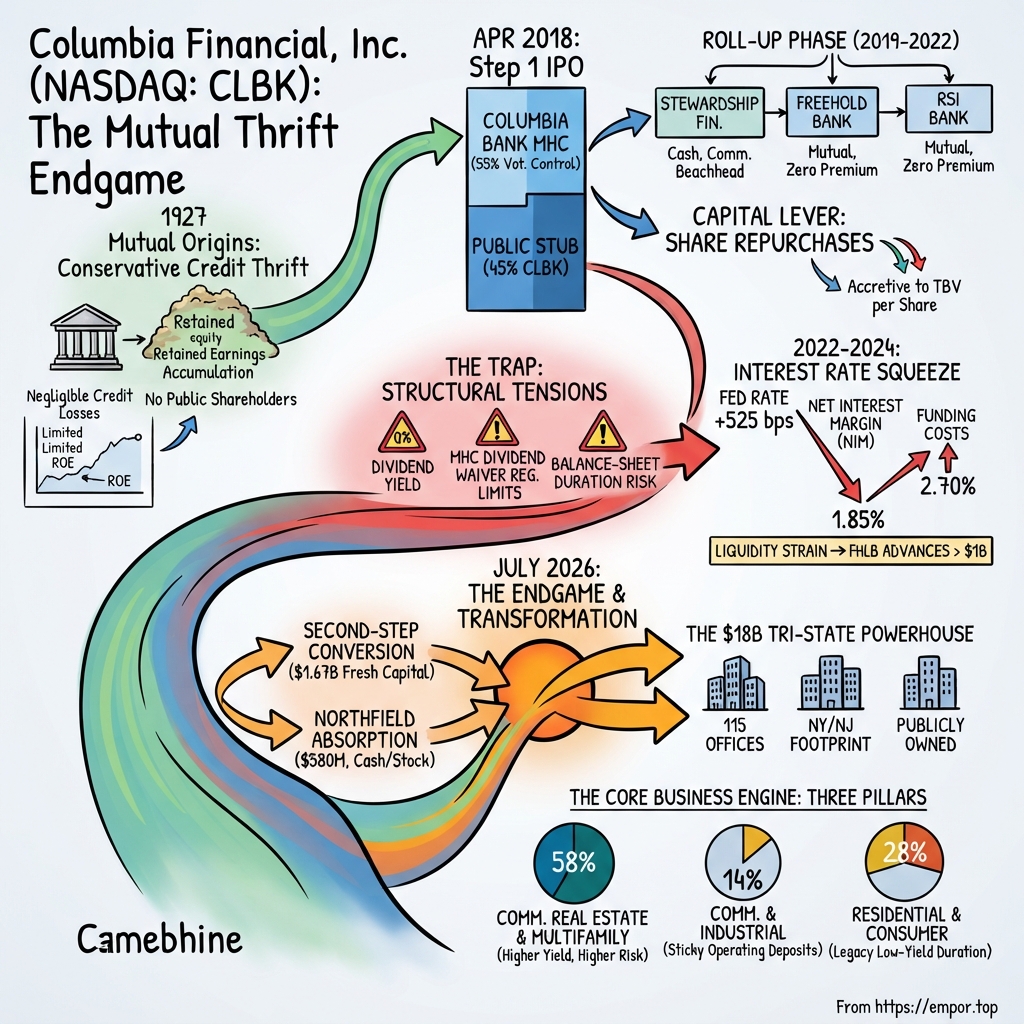
Columbia Financial, Inc. (NASDAQ: CLBK): The Mutual Thrift Endgame and the Making of an $18 Billion Tri-State Powerhouse
I. Introduction & Episode Roadmap
On the morning of Monday, July 20, 2026, in an unremarkable office building on Route 208 in Fair Lawn, New Jersey — a town of 35,000 residents wedged between the Passaic River and the Garden State Parkway — a corporate structure that had stood since the Coolidge administration quietly dissolved.
Columbia Bank MHC, the mutual holding company that had controlled Columbia Financial, Inc. since 2018, ceased to exist. In its place, a newly incorporated Columbia Financial, Inc. issued 167,236,353 shares of common stock at $10.00 per share, raising gross proceeds of approximately $1.67 billion in a subscription and community offering open first to the bank's depositors.5[^8] In the same closing, Columbia absorbed Northfield Bancorp, Inc. — a $5.7 billion thrift holding company based on Staten Island — in a stock-and-cash transaction valued at roughly $580 million.[^7][^8]
Executed simultaneously, the two transactions roughly doubled the institution's size. Total assets expanded from approximately $10.5 billion to about $18.0 billion.[^8] The branch footprint broadened to roughly 115 offices spanning northern and central New Jersey, Staten Island, Brooklyn, Queens, and Long Island.[^8] For the first time in its 99-year history, Columbia Bank was wholly owned by public shareholders.
Behind this closing lay a deeper structural puzzle.
The Puzzle
For nearly a century, Columbia Bank operated without public shareholders, a stock ticker, quarterly earnings calls, or equity analysts tracking basis-point swings in its efficiency ratio. As a mutual savings institution, its depositors were legally the owners. Retained earnings were not distributed; they accumulated as surplus equity. The bank navigated the Great Depression, the savings-and-loan crisis of the late 1980s, and the 2008 financial crash — three downturns that eliminated the majority of American thrifts — largely through conservative, low-margin stability.
Yet after decades of insulated operation, the bank spent eight years executing one of the most structurally complex maneuvers in American corporate finance: a two-step mutual-to-stock conversion.
Traditional mutual status had become an operational constraint. By the 2010s, a mutual thrift typically generated modest returns on equity near 5% with limited avenues for expansion: it could not issue stock to fund acquisitions, could not structure equity compensation for executives, and faced the heavy fixed compliance burdens imposed across the banking sector after Dodd-Frank. Full public conversion represented the primary mechanism to break that constraint without selling the franchise.
The Structural Drama
Three institutional tensions define this transition:
The first was the mutual holding company structure itself. The MHC framework, introduced by thrift regulators in the 1980s, left a minority portion of the bank's equity trading publicly while the mutual entity retained a voting majority on behalf of depositors. Outside investors held a "stub" equity stake: entitled to economic value and theoretical dividends, but powerless to compel a sale against the MHC's controlling vote. It functioned effectively as a public company in a mutual straitjacket.
The second was a regulatory mechanism governing capital return. Under the Federal Reserve's Regulation MM, an MHC seeking to waive dividends declared by its subsidiary bank must clear significant procedural hurdles, including depositor votes and supervisory non-objection.[^16] Rather than navigate that process, Columbia elected to pay no regular cash dividend. As a result, its shares offered a 0% yield in a regional banking sector where investors routinely prioritize dividend income. Capital return was channeled entirely into share repurchases.
The third was balance-sheet duration risk. Columbia entered the post-2020 cycle positioned for persistent low interest rates, funding long-duration fixed-rate mortgages and securities with deposits assumed to be stable and low-cost. When the Federal Reserve raised the federal funds rate by 525 basis points between March 2022 and July 2023, deposit costs climbed while asset yields remained fixed. By late 2024, management restructured the portfolio by liquidating $352.3 million in low-yielding securities. The transaction generated a pre-tax loss of $37.9 million, dragging the company to a full-year 2024 net loss of $11.7 million, compared with net income of $46.8 million in 2023.[^9]1
That sequence — a depository with negligible credit losses driven into an annual deficit by duration mismatch rather than defaults — highlights the central operational vulnerability of the franchise leading up to its conversion.
Roadmap
This story examines the institution's 1927 founding and mutual operating model; the April 2018 first-step IPO that raised $498 million and established a public acquisition vehicle; the subsequent roll-up strategy that acquired Stewardship Financial for cash and integrated Freehold Bank and RSI Bank through non-cash mutual mergers; the 2022–2024 interest rate squeeze; the July 2026 conversion and Northfield acquisition; the combined company's current balance sheet; governance considerations surrounding the deployment of $1.7 billion in fresh capital; a competitive assessment using Hamilton Helmer's 7 Powers and Porter's Five Forces; a stress test of core investment theses against Columbia's historical record; and the operating metrics that will determine whether the transformed franchise can generate adequate returns.
The underlying tension: Columbia spent a century avoiding credit losses, only to find in the four years leading up to its 2026 transformation that underwriting discipline alone cannot protect a bank from balance-sheet duration risk.
 Subscribe on LinkedIn
II. Thrift Origins & The Century-Long Mutual Foundation (1927–2017)
In 1927, Bergen County was still largely rural. The George Washington Bridge was four years from opening. Fair Lawn was farmland giving way to suburban subdivisions, with Radburn — the planned "town for the motor age" — breaking ground that same year just a few streets away. Families arriving from Paterson's textile mills and from across the Hudson River needed residential mortgages, but commercial banks of that era rarely extended long-term loans to industrial workers.
Into that gap stepped the building and loan association: a cooperative model in which members pooled savings and took turns drawing from the reserve to purchase homes. Columbia Bank traced its founding to 1927 in that mold — a local, member-owned institution chartered to finance suburban homeownership.1
The mutual structure shaped the next nine decades of institutional behavior. A traditional mutual thrift holds no external equity and cannot raise capital beyond its own retained earnings. Depositors are nominally the owners but exercise little practical control over governance, leaving the board self-perpetuating. Every dollar of profit not absorbed by operating expenses remains on the balance sheet as surplus equity.
That design created a distinct corporate profile. With no public shareholders demanding quarterly earnings growth, management faced little incentive to reach for yield. With no mechanism to issue equity in an emergency, the institution faced a powerful incentive never to need rescue capital. Thrifts operating in this framework were conservative by construction, and institutions that abandoned that discipline rarely survived.
Surviving the Slaughter
The test of that model arrived in the 1980s. The Garn–St. Germain Depository Institutions Act of 1982 deregulated thrift asset powers. A large cohort of savings institutions responded by expanding aggressively into high-yield commercial paper, junk bonds, raw land, commercial development syndications, and speculative ventures designed to out-yield the rising cost of deregulated deposits. The resulting collapse of the savings-and-loan sector cost American taxpayers more than $100 billion and eliminated roughly a third of the industry.
Columbia did not participate. Its asset mix stayed anchored in one-to-four family residential mortgages at conservative loan-to-value ratios, funded by retail deposits gathered through branches in Bergen, Passaic, and Morris counties.1 The decision was not driven by prophetic management foresight; rather, the mutual structure provided neither the currency nor the incentive for aggressive balance-sheet expansion. The same governance limits that capped return on equity also insulated the franchise from self-destruction.
That track record demonstrated a durable credit conservatism, sustained across multiple management teams and reaffirmed during the 2008 financial crisis. Yet credit discipline did not ensure broader balance-sheet agility — a vulnerability that became apparent during the rapid monetary tightening of 2022 to 2024.
The Rise of Thomas J. Kemly
Thomas J. Kemly joined Columbia Bank in 1982, entering the accounting and finance division just as the industry was embarking on deregulation.8 Over three decades, he advanced through finance, risk, credit, and operations before becoming President and Chief Executive Officer in 2012.8
A 44-year career spent entirely inside a single institution presents a dual analytical profile. On credit quality, Kemly managed the loan book across multiple cycles, maintaining negligible non-performing loan ratios that reflected rigorous underwriting standards. At the same time, decades spent inside an insulated mutual provided limited experience managing an asset-liability duration mismatch at a publicly traded bank facing the fastest Federal Reserve tightening cycle in four decades.
Through the 2010s, Kemly's stated strategy adhered to core mutual principles: keeping credit losses low, maintaining a physical branch presence in core communities, accreting capital through retained earnings, and preparing for the consolidation sweeping New Jersey community banking.
The Trap
By the mid-2010s, that operating model encountered severe structural constraints.
The regulatory regime following the Dodd-Frank Act converted bank compliance into a heavy fixed-cost burden: Bank Secrecy Act and anti-money laundering (BSA/AML) programs, cybersecurity infrastructure, Current Expected Credit Losses (CECL) modeling, and heightened consumer compliance standards. For an institution with roughly $5 billion in assets, those overhead requirements absorbed an expanding share of already modest earnings.
At the same time, the mutual charter closed off three strategic necessities. First, Columbia could not issue stock as acquisition currency while regional competitors actively consolidated. Second, it could not offer equity-based incentive compensation to recruit commercial lending teams without paying substantial cash premiums. Third, retaining surplus capital without an avenue for deployment or shareholder return depressed return on equity into the mid-single digits — leaving the franchise well-capitalized but strategically immobile.
In 2017, the board voted to pursue a standard two-step conversion under a mutual holding company structure, subject to oversight by the Federal Reserve and the New Jersey Department of Banking and Insurance.1 The decision was less a bid for aggressive expansion than a recognition that the pure mutual charter had become an operational constraint.
Yet the mutual holding company framework introduced its own structural compromises, trading an outright constraint for a complex regulatory middle ground.
III. The April 2018 IPO & The MHC Playbook: Engineering the Half-Public Stub
Thrift conversion IPOs are among the most peculiar transactions in American capital markets, and understanding what unfolded in April 2018 requires understanding why the offering price is almost universally set at $10.00.
In a conventional initial public offering, investment bankers discover a clearing price through order-book demand. In a thrift conversion, they do not. Instead, an independent appraiser establishes an aggregate valuation range for the institution, regulators approve the appraisal, and shares are issued at a fixed statutory price — conventionally $10.00 — through a subscription priority queue beginning with eligible depositors. Because the appraised pre-offering value typically sits at a discount to the pro forma tangible book value created by injecting the offering proceeds into the balance sheet, conversion stocks historically opened above issue. Depositors exercising their subscription rights at $10.00 were, in effect, purchasing an equity stake in accumulated surplus reserves that generations of prior depositors had built but could never directly monetize.
The First Step
On April 19, 2018, Columbia Financial, Inc. — organized as a mid-tier stock holding company — sold 49,832,345 shares at $10.00 per share, raising $498.3 million in gross proceeds.1 Concurrently, 62,580,155 shares, or approximately 55% of the total outstanding common stock, were issued to Columbia Bank MHC, while 3,476,675 shares, roughly 3%, were contributed to the Columbia Bank Foundation, the institution's charitable arm.1 The stock began trading under the ticker CLBK on the NASDAQ Global Select Market on April 20, 2018.1
In practical terms, roughly 45% of the institution's economic equity entered public hands, while voting control and the majority ownership stake remained locked inside the mutual entity.
Why Only Half?
The immediate analytical question is why the board chose a partial conversion rather than completing a full mutual-to-stock transaction in 2018 to capture all available proceeds.
The answer lies in capital indigestion. Columbia held roughly $5.5 billion in assets at the time.1 A full conversion would have layered more than $1.1 billion in fresh equity onto that balance sheet, driving the tangible common equity ratio above 20% and mechanically depressing return on equity into the low single digits. Commercial banking relies on leverage; equity forms the denominator of return metrics. Raising excessive capital too quickly, well beyond the bank's immediate capacity to deploy it into prudent loans, is not an unalloyed windfall. Instead, it creates a persistent performance drag that public markets routinely penalize with a steep discount to book value.
The MHC structure functioned as a shock absorber against that trap. By selling roughly 45% of the equity, Columbia raised sufficient capital to fund several years of organic expansion and targeted acquisitions, established a public acquisition currency, and developed a public trading history. The remaining 55% of the equity value remained parked in the mutual holding company, earmarked for a second-step conversion years later once the balance sheet had expanded enough to absorb the second capital tranche.
The strategy appeared prudent on paper, but it front-loaded strategic flexibility while deferring structural risk. The eventual second step would have to be priced based on the institution's financial condition and operating environment whenever management finally moved to execute it — and in 2018, neither management nor regulators anticipated a 525-basis-point Federal Reserve tightening campaign unfolding in the interim.
The Dividend Problem
Here the structural mechanics imposed immediate operational costs.
In a standard commercial bank holding company, dividends are distributed pro rata to all common shareholders. In an MHC framework, the mutual holding company is the majority shareholder. If the MHC accepts its proportional dividend, cash leaves the operating bank and accumulates in an inactive mutual entity with no operational use for the funds. Conversely, if the MHC waives its entitlement to dividends, the retained capital disproportionately enriches public minority shareholders — a dynamic that bank regulators historically scrutinized as an indirect transfer of economic value away from the mutual's depositor-members.
Under the Federal Reserve's Regulation MM, obtaining approval to waive dividends requires clearing substantial procedural hurdles, including depositor member voting and formal supervisory non-objection, which the Federal Reserve routinely approached with skepticism.[^16] Rather than navigate that regulatory friction, Columbia's board chose to bypass the process altogether, electing not to pay a regular cash dividend on its publicly traded shares.
The resulting consequence was severe. For a substantial portion of institutional and retail regional banking investors, bank equities serve primarily as income-generating vehicles. Dividend-growth funds and retail investors screen heavily on dividend yield. A zero-yield depository stock was automatically filtered out of institutional mandates, cutting CLBK off from a major segment of dedicated regional bank capital. This structural dynamic, alongside the operational earnings headwinds that followed, helps explain why CLBK traded at a persistent discount to tangible book value throughout its years as an MHC.
Buybacks as the Only Lever
With cash dividends off the table, share repurchases became management's sole viable tool for returning capital. Between 2019 and 2025, the board authorized successive stock repurchase programs, systematically retiring shares in the open market and accreting tangible book value per share for remaining holders.18
From a purely mechanical standpoint, repurchasing shares at a discount to tangible book value is immediately accretive to per-share equity: the company retires an equity claim on the balance sheet for less than its underlying carrying value. Judged against that narrow financial standard, the policy was rational and management executed it consistently.
Yet treating the buyback program as evidence of superior capital-allocation discipline requires significant nuance. Columbia repurchased stock primarily because regulatory and structural constraints barred any other method of capital distribution. A constrained corporate decision that happens to be financially sound is fundamentally distinct from proactive balance-sheet optimization. When assessing the post-conversion capital-return strategy, investors must avoid assuming that past repurchase discipline will naturally persist once structural restrictions no longer mandate it.
The more revealing test of capital allocation was how Columbia deployed the $498 million raised in its first-step offering. That capital was not amassed merely to support repurchases; it was assembled to finance an aggressive bank acquisition campaign.
IV. The Roll-Up Phase: M&A Under the MHC Umbrella (2019–2022)
Armed with nearly half a billion dollars in fresh capital and nine decades of pent-up balance-sheet capacity, Columbia moved quickly into the bank M&A market, announcing its first transaction within eighteen months of the initial public offering.
Deal #1: Stewardship Financial — The Commercial Beachhead
Atlantic Stewardship Bank was an unusual institution: a northern New Jersey community bank with an explicitly faith-based identity, known for tithing 10% of its pre-tax profits to charitable and ministry organizations. It held roughly $960 million in assets across twelve branches, and it brought capabilities that Columbia conspicuously lacked: an established commercial lending operation, middle-market business relationships, treasury management services, and the non-interest-bearing operating deposits generated by commercial accounts.
Columbia completed the acquisition on November 1, 2019, paying $15.75 per share in cash for total consideration of approximately $137 million.[^11]
The strategic rationale mirrored the standard playbook for thrifts transitioning toward commercial banking. A residential thrift's retail deposits are expensive in the sense that matters most over an interest rate cycle: they are rate-sensitive savings and certificate balances with minimal relationship stickiness. In contrast, commercial operating accounts are low-cost because businesses maintain payroll and operational balances in transactional accounts, moving them only when relocating an entire banking relationship. Acquiring Stewardship represented an entry point into that stickier commercial funding model.
Evaluating the transaction's financial execution, however, reveals a more complicated record.
At $137 million for a $960 million bank, Columbia paid approximately 1.57 times tangible book value.[^11] Peer valuations for Northeast bank transactions during that period averaged closer to 1.35 times. Columbia paid a full cash premium at what proved to be the peak of the pre-pandemic credit cycle.
Four months after the transaction closed, COVID-19 disrupted regional commerce. Non-PPP commercial borrowing stalled, and the Federal Reserve cut the federal funds rate to near zero, compressing yields across the commercial loan portfolio Columbia had just purchased at a premium. Concurrently, the zero-rate environment sharply reduced the immediate economic value of non-interest-bearing deposits, whose benefit lies entirely in the spread earned above their zero cost.
This outcome does not suggest reckless management; banking institutions could not have modeled a global pandemic. Rather, it underscores that Columbia's initial deployment of public equity involved an above-market cash multiple whose financial return was significantly delayed by macroeconomic headwinds. Because the company never disclosed deal-level return metrics that would allow external analysts to verify whether the acquisition ultimately earned its cost of capital, management's track record as an M&A operator remained unproven — an important consideration when assessing the much larger acquisition of Northfield Bancorp years later.
Deal #2: Freehold Bank — The Free Acquisition
Columbia's second transaction took the opposite structural form, illustrating one of the distinct advantages of the mutual holding company model.
In December 2021, Freehold Bank — a roughly $300 million institution in Monmouth County — combined with Columbia.[^12] Structurally, Freehold MHC merged into Columbia Bank MHC, while Freehold Bank merged directly into Columbia Bank.
No stock was issued. No cash changed hands. No acquisition premium was paid, and no goodwill was created on the balance sheet.
That zero-premium structure highlighted the core strategic utility of the MHC framework beyond capital staging. When two mutual institutions combine, there are no public shareholders requiring an acquisition premium or a buyout premium. The transaction is a bilateral negotiation between governing boards over board representation, personnel retention, local branding, and community lending commitments rather than a competitive bidding auction. Through this non-cash merger, Columbia acquired an established franchise in affluent Monmouth County for essentially the cost of operational integration.
Deal #3: RSI Bank — Deepening the Middle
Columbia followed the same template when it agreed to combine with RSI Bancorp, M.H.C. and RSI Bank in December 2021, completing the transaction in 2022.7 Headquartered in Rahway, RSI brought roughly $620 million in assets and four branch locations across Union and Middlesex counties — again delivering low-cost retail core deposits without a public-market takeout multiple.7
In roughly twelve months, these two mutual mergers added nearly $1 billion in assets and extended Columbia's footprint contiguously down the Route 1 and Garden State Parkway corridors, all at an effective acquisition premium of zero.
The Scorecard, and the Threshold
By the end of 2022, Columbia had expanded from roughly $6.0 billion in assets to more than $10.4 billion.1
Crossing $10 billion in assets represented far more than a balance-sheet milestone; it triggered a structural step-change in federal oversight. Under U.S. banking law, surpassing $10 billion subjects an institution to direct Consumer Financial Protection Bureau examination, heightened supervisory stress-testing expectations, and the interchange fee caps mandated by the Dodd-Frank Act's Durbin Amendment. For a retail-oriented depository, the Durbin Amendment permanently restricts debit card fee income, introducing immediate revenue attrition and millions of dollars in annual compliance overhead.
This dynamic forms a defining structural hurdle in mid-tier American banking: at $10 billion in assets, an institution absorbs the full cost structure of large-bank regulation without possessing the scale to absorb it efficiently. Depository institutions facing this threshold face two strategic choices: either grow substantially beyond $10 billion to amortize higher fixed overhead across a much larger asset base, or sell to a larger peer. Columbia chose rapid expansion.
That decision occurred, however, precisely as the Federal Reserve embarked on the fastest interest rate tightening campaign in four decades.
V. The Great Rate Shock: NIM Collapse and the Q4 2024 Balance Sheet Reset
Every banking crisis has a moment where the arithmetic becomes undeniable. For Columbia, that moment arrived in late 2024 with a spreadsheet displaying two stark figures side by side: a portfolio of debt securities yielding roughly 1.8%, and Federal Home Loan Bank advances costing roughly 5.4%.
The structural imbalance was immediate. The institution was borrowing near five-and-a-half percent to fund assets yielding under two percent. Every day that position remained unaddressed, negative carry drained net interest income. Yet selling the securities meant crystallizing paper losses that had previously sat unrealized in accumulated other comprehensive income, bypassed by the income statement.
The question was how a depository institution with virtually no credit defaults reached that predicament.
The Mechanism, in Plain Language
Commercial banking fundamentally relies on borrowing short and lending long. Deposits can leave an institution overnight, while a thirty-year fixed mortgage cannot reprice for three decades. The spread between those two horizons defines the business model, generating steady profits so long as short-term funding costs remain below long-term asset yields.
Columbia entered 2022 with an asset base heavily weighted toward fixed-rate residential mortgages originated during the pandemic at yields in the low-to-mid 3% range, five-to-ten-year fixed commercial real estate loans underwritten in the same period, and a securities portfolio accumulated when the ten-year Treasury yielded below 1.5%.1 The asset side of the balance sheet was largely fixed, low-yielding, and long in duration.
Then, between March 2022 and July 2023, the Federal Reserve raised the federal funds rate by 525 basis points — the fastest monetary tightening in four decades. The regional banking turmoil of March 2023, marked by the failures of Silicon Valley Bank, Signature Bank, and First Republic, accelerated the pressure. Depositors who had historically ignored deposit yields began actively monitoring their cash, and money market funds yielding 5% were readily accessible through mobile applications.
Columbia's liabilities repriced within months. Its assets barely moved.
Falsifying the Sticky Deposit Moat
This episode serves as a direct test of the central investment thesis surrounding traditional thrifts throughout the 2010s.
The claim: A century-old community bank with dense branch coverage across affluent, established New Jersey suburbs commands a low-beta core deposit franchise. Customers maintain accounts out of generational habit and local loyalty rather than yield sensitivity. That relational inertia creates an economic moat, ensuring funding costs rise far more slowly than benchmark interest rates.
The evidence: That assumption failed to hold under stress. Columbia's cost of deposits climbed from under 0.50% before the tightening cycle to more than 2.70%, reflecting a cumulative deposit beta — the portion of the Federal Reserve's rate hikes passed through to depositors — exceeding 50%.1 That trajectory aligned with regional industry averages rather than indicating an insulated, low-beta franchise. Non-interest-bearing deposits, the institution's lowest-cost funding base, dropped from roughly 22% of total deposits to under 14% as commercial and retail customers shifted balances into certificates of deposit and high-yield money market accounts.1 Net interest margin compressed from approximately 2.85% in 2021 to below 1.85% by mid-2024.1 To bridge deposit outflows and fund ongoing loan commitments, Columbia tapped more than $1.0 billion in FHLB advances at borrowing rates between 5.30% and 5.50%.1
The verdict: The historical record rejects the broad claim of deposit stickiness and narrows it to a more specific operational reality. Relationship stickiness holds primarily for commercial operating accounts, where deposits are tied to working capital, payroll, and treasury management services that carry high switching costs. For retail savings and certificates of deposit, Columbia's funding behaved like a commodity priced against the Treasury curve. Suburban brand loyalty provided stability in a zero-interest-rate environment, but offered little defense when short-term yields reached 5%.
What would change the verdict: The deposit beta recorded during subsequent monetary cycles on the combined post-Northfield franchise, which features an expanded commercial operating mix. If that cumulative beta falls materially below 50%, the deposit-moat thesis would warrant upward revision. Until then, the historical data does not support it.
The Climax: The Q4 2024 Reset
By late 2024, management recognized that holding low-yielding securities until maturity represented an ongoing earnings drag. In the fourth quarter, Columbia executed a comprehensive balance-sheet restructuring, selling $352.3 million in low-yielding available-for-sale securities and realizing a pre-tax loss of $37.9 million, or approximately $27.2 million after taxes.[^9]
The accounting impact hit earnings directly. Columbia reported a net loss of $21.2 million for the fourth quarter of 2024, pulling full-year 2024 results to a net loss of $11.7 million, compared with net income of $46.8 million in 2023.[^9]1
An institution with negligible loan losses posted an annual net loss. The outcome illustrated a fundamental reality of depository banking: interest rate and duration risk can impair earnings just as severely as credit defaults, even though rate risk rarely surfaces in conventional asset-quality metrics like non-performing loan ratios.
Was It the Right Call?
Mechanically, the trade was rational, and the arithmetic was direct. Management redeployed the liquidation proceeds to retire expensive FHLB borrowings and fund new commercial loans originated above 7%, citing annualized net interest margin expansion in the low-to-mid twenty basis point range.[^9] Columbia returned to profitability in the first quarter of 2025 with net income of $8.9 million.2 In present-value terms, crystallizing an upfront loss to eliminate a persistent negative spread is typically the economically sound decision, and addressing the drag directly rather than deferring it reflected proactive balance-sheet management.
Yet the primary analytical lesson centers on balance-sheet construction in the years preceding the sale, rather than the transaction itself. The economic loss did not originate with the fourth-quarter liquidation; it occurred when interest rates surged, leaving unrealized losses embedded in the portfolio. The consequential operational choices took place in 2020 and 2021, when Columbia extended duration into a historically low interest rate environment without sufficient interest-rate hedging.
That divergence highlights the management team's profile: rigorous in underwriting credit, but average to lagging through 2024 in managing balance-sheet interest rate risk — a tension examined formally in Section X.
That record elevated the strategic stakes for what followed: doubling the institution's balance sheet and absorbing $1.7 billion in fresh equity through the July 2026 conversion and Northfield integration.
VI. The 2026 Endgame: Northfield Mega-Merger & The $1.7B Second-Step Conversion
On February 2, 2026, Columbia announced two interdependent transactions in a single press release.[^7]
The first was the second-step conversion: Columbia Bank MHC would convert from mutual to stock form and dissolve, offering the remaining majority ownership stake to the public. The second was the acquisition of Northfield Bancorp, Inc. (NASDAQ: NFBK), a $5.7 billion thrift holding company headquartered in Woodbridge, New Jersey, with an operating franchise centered on Staten Island.[^7]
Structuring the two maneuvers concurrently was deliberate. A full second-step conversion injects substantial capital onto the balance sheet; the operational challenge of raising that much equity is deploying it productively before returns on equity collapse. Pairing the offering with an immediate acquisition absorbed a meaningful portion of the proceeds at closing, mitigating the near-term drag of surplus cash. Whether that deployment generates adequate risk-adjusted returns remains an open question examined in subsequent sections.
The Mechanics of $1.67 Billion
A second-step conversion mirrors the first step on a significantly larger scale. An independent appraiser values the fully converted enterprise, incorporating the pro forma contribution of the pending merger. Shares not already represented by public minority holdings are then sold at the statutory $10.00 price through a subscription queue that prioritizes eligible depositors.
Under this framework, Columbia Financial, Inc., reincorporated as a Maryland corporation, issued 167,236,353 new shares at $10.00 per share, generating gross proceeds of approximately $1.67 billion.35 Existing public CLBK shareholders received newly issued shares under an exchange ratio designed to preserve their proportional economic interest, adjusted for the offering proceeds and the merger consideration.3 Columbia Bank MHC was formally dissolved, the Columbia Bank Foundation retained its equity stake, and the company became wholly owned by public shareholders.5[^8]
For minority shareholders who had held the stub equity since the 2018 IPO, the closing marked the realization of the conversion thesis: transforming a structurally discounted, non-voting-majority security paying no regular dividend into standard commercial bank equity with customary corporate governance and the full strategic optionality of a public depository.
The Northfield Terms
Northfield was valued at approximately $580 million in aggregate, with consideration split roughly 70% stock and 30% cash.[^7] Northfield shareholders could elect either $14.25 in cash or 1.425 shares of Columbia common stock per NFBK share, subject to customary proration procedures to achieve the target mix.[^7]
Strategically, the acquisition accomplished what Columbia could not readily achieve organically: extending the franchise across the Arthur Kill and the Hudson River. Northfield had long operated as a leading community bank on Staten Island, with additional branches across Brooklyn, Queens, and Long Island.[^7] For a New Jersey institution historically confined to the suburbs, entering the outer boroughs of New York City shifted the franchise from an intrastate footprint into a broader metropolitan banking market.
Yet geographic expansion also introduced substantial balance-sheet risk. Northfield's loan portfolio was heavily concentrated in New York City multifamily and commercial real estate — an asset class under persistent pressure following New York's Housing Stability and Tenant Protection Act of 2019, which curtailed rent increases on rent-stabilized properties and depressed underlying collateral values. By absorbing Northfield, Columbia did not simply acquire an outer-borough retail deposit base; it took on concentrated exposure to one of the most heavily scrutinized segments of regional bank lending.
Purchase accounting rules provided a partial initial buffer: acquired loans were marked to fair value at closing, absorbing known credit and interest-rate discounts directly on the opening balance sheet rather than through subsequent provision expenses. However, purchase accounting marks do not protect against future credit deterioration. If multifamily credit quality weakens beyond the initial marks, the resulting write-downs will flow directly into Columbia's provision line.
Approvals and Closing
The Federal Reserve Board issued its order approving the conversion and the acquisition on May 8, 2026.4 Northfield shareholders approved the merger at a special meeting on June 25, 2026.10 Both transactions closed simultaneously on July 20, 2026, and Northfield stock was delisted.5[^8]
The Pro Forma Institution
The combined enterprise that emerged from the July 20 closing represented a fundamental shift in scale: approximately $18.0 billion in total assets, roughly $11.9 billion of loans, about $12.5 billion of deposits, and a branch footprint of roughly 115 offices spanning northern and central New Jersey, Staten Island, and the New York outer boroughs.[^8]
This transformation presents two core considerations for investors.
First, Columbia resolved its immediate regulatory overhead mismatch. It is no longer an institution absorbing large-bank compliance costs on a marginal $10 billion balance sheet. However, whether $18 billion in assets provides sufficient operating scale in a tri-state market populated by regional competitors operating between $50 billion and $100 billion, as well as multi-trillion-dollar money-center institutions, remains an ongoing question.
Second, the enlarged franchise faces a demanding capital-efficiency test. Management must now generate an attractive return on equity against a balance sheet expanded by $1.67 billion in fresh cash equity. Achieving that return will require a leadership team whose historical expertise lies in conservative suburban thrift underwriting to manage the integration of an acquired New York commercial real estate portfolio amid an uncertain economic and regulatory environment.
Evaluating management's capacity to meet that challenge requires examining the precise composition of the combined balance sheet.
VII. Anatomy of the Core Business & Financial Engine
Beneath its reconstructed corporate structure, Columbia remains fundamentally a spread lender: an institution that gathers deposits from New Jersey and New York households and businesses and deploys them into real estate loans.
The institution does not maintain distinct reportable operating segments, operating instead as a single integrated community commercial banking business.1 Within that single segment, however, sit three distinct lending engines with markedly different operating economics.
The Three Engines
Commercial real estate and multifamily represents the largest exposure, accounting for roughly 58% of the loan book on a combined basis: apartment buildings across northern New Jersey and the New York outer boroughs, owner-occupied industrial and commercial facilities, and investor-owned commercial properties.1[^7] This engine serves as the bank's primary earnings generator while carrying its principal balance-sheet risk. Commercial real estate loans offer higher yields than residential mortgages and greater operational efficiency per dollar of origination, as a single commercial lending officer can underwrite a $12 million apartment building in the time required to process several individual home loans. Historically across the banking sector, commercial real estate has also served as the primary origin of credit cycles and distress.
Commercial and industrial lending and business banking comprises roughly 14% of the portfolio: working capital lines, equipment financing, and, most critically for funding stability, the treasury management accounts that generate commercial operating deposits.1 Although the smallest of the three lending categories, this engine carries outsized strategic importance because commercial operating balances were the only segment of the deposit base to exhibit pricing resilience during the 2022–2024 monetary tightening cycle. The 2019 acquisition of Stewardship Financial established the initial framework for these capabilities, and expanding commercial operating relationships represents management's primary lever for stabilizing core funding costs over the next five years.
Residential one-to-four family and consumer lending accounts for approximately 28% of the portfolio: prime owner-occupied residential mortgages and home equity lines of credit.1 This portfolio reflects Columbia's legacy thrift origin, but under current market conditions it delivers the lowest risk-adjusted return. Prime residential mortgages operate as a commoditized national product characterized by narrow net interest spreads and extended asset duration — precisely the asset profile that generated the duration mismatch and net interest margin compression between 2022 and 2024.
Fee income is generated from a conventional array of non-interest sources — including title insurance agency services, wealth management and brokerage, bank-owned life insurance, and deposit service charges — contributing roughly 8% to 12% of net revenues.1 In regional banking, an institution generating less than 15% of revenue from non-interest sources operates essentially as a pure spread lender, offering minimal non-interest income to buffer earnings when spreads compress. Columbia maintains no significant counter-cyclical revenue stream.
The Credit Record
Where the institution's century-long mutual discipline remains most evident is in its credit performance.
Through the interest rate and banking stresses of 2023 to 2025 — a period that produced widespread commercial real estate deterioration across the regional banking sector — Columbia's non-performing loans remained negligible. Commercial real estate non-performing loans stood at approximately 0.04% of the portfolio, or about $3.4 million, as of early 2025.2 The allowance for credit losses has been maintained between roughly 0.70% and 0.80% of total loans, supported by weighted-average loan-to-value ratios on commercial real estate collateral below 60%.12
That loan-to-value standard explains the credit record's durability. A loan underwritten at a 55% loan-to-value ratio can absorb a 45% decline in collateral valuation before the lender faces principal impairment. That conservative collateral cushion, rather than proprietary underwriting models, is what enabled Columbia to navigate downturns that eliminated peer thrifts.
An essential qualification applies to this performance: it reflects Columbia's standalone underwriting track record. Northfield's New York City multifamily and commercial real estate portfolio was originated under separate institutional credit policies. With only two months of combined operating history following the July 2026 closing, reliable performance data on the integrated portfolio has yet to mature. Consequently, conclusions regarding credit durability apply exclusively to the legacy franchise.
Deposit Economics
The branch network is situated across affluent New Jersey counties — Bergen, Morris, Essex, Monmouth, and Middlesex — alongside Staten Island.1[^7] Average deposits per branch exceed $105 million, a strong metric for a community institution that reflects substantial physical density in high-income markets.1
Branch density remains an important structural asset. Rather than representing an obsolete cost center, an office network averaging $105 million per branch operates as an efficient deposit-gathering infrastructure, because the fixed overhead of a physical branch remains relatively constant regardless of balance size. While the 2022–2024 cycle demonstrated that branch density does not prevent retail depositors from seeking market yields, it enables Columbia to service those balances at a lower operating cost per dollar than a thinner, less concentrated footprint.
The resulting operational profile presents clear parameters: low credit losses and an efficient retail deposit network paired with minimal fee diversification and direct exposure to changes in net interest margin. Whether that operating engine generates an adequate return on equity now depends on executive leadership and its deployment of newly raised conversion capital.
VIII. Management, Governance, & Capital Allocation Scorecard
In January 2026 — weeks before announcing the Northfield merger — Columbia restructured its senior finance and commercial leadership.6 In ordinary times, such changes might represent routine corporate realignment; in this instance, they marked the operational pre-positioning of an executive team preparing to manage an institution twice its previous size.
The Leadership
Thomas J. Kemly continues as President and Chief Executive Officer. His tenure includes three major structural milestones: the 2018 first-step initial public offering, the non-cash mutual mergers that absorbed Freehold and RSI without paying an acquisition premium, and the simultaneous 2026 conversion and Northfield acquisition. That record demonstrates creative structural execution for a community banking executive. The counterweight, established during the 2022–2024 monetary tightening, is that this same leadership team oversaw the balance-sheet duration mismatch that required a $37.9 million pre-tax loss to correct. The record reflects two distinct operational profiles: conservative credit underwriting paired with delayed balance-sheet interest-rate risk management.
Thomas Splaine, Jr. was appointed Executive Vice President and Chief Financial Officer in January 2026, having previously served as Chief Accounting Officer and held senior financial positions at other regional institutions.6 Splaine faces a demanding operational mandate: overseeing post-merger systems integration, managing CECL reserve modeling across an acquired New York loan book underwritten under different credit standards, and addressing the deployment of surplus capital.
Dennis E. Gibney, the bank's longtime Chief Financial Officer, transitioned in the same January 2026 restructuring to First Senior Executive Vice President and Chief Banking Officer, assuming responsibility for revenue generation, commercial lending expansion, and deposit growth across the combined network.6
Reassigning a veteran chief financial officer to lead revenue operations indicates that the board views deposit gathering and commercial loan growth as the binding constraints on future returns. Whether a career finance executive can accelerate commercial relationship banking remains an open execution question, measurable through the growth rate of non-interest-bearing operating deposits over coming quarters.
Compensation and Alignment
Executive equity compensation is administered through the 2019 Equity Incentive Plan and post-conversion equity arrangements, utilizing performance-based restricted stock units tied to return on average tangible common equity and relative total shareholder return against the KBW Regional Banking Index.8
Targeting return on average tangible common equity directly addresses the metric a heavily capitalized depository struggles most to achieve, aligning executive compensation with balance-sheet efficiency. Concurrently, measuring total shareholder return against a regional bank index isolates management performance from broader industry-wide interest rate fluctuations.
Conversion transactions conventionally allocate approximately 8% to 10% of total shares to employee stock ownership plans and related benefit plans, distributing equity widely across the workforce.3 While broad employee ownership supports organizational retention, it also establishes a substantial internal voting block that historically supports incumbent management — an important governance consideration for an institution that has just dissolved its controlling mutual parent.
On governance oversight, shareholder voting at the 2025 annual meeting proceeded without reported material dissent on board elections or executive compensation proposals.9 That vote, however, reflected the governance dynamics of the prior mutual holding company framework rather than the expectations of an expanded base of institutional and public shareholders.
The Capital Glut
The central strategic challenge confronting the post-conversion institution is the management of surplus capital.
Columbia operates with a Tier 1 risk-based capital ratio above 16% — roughly double the regulatory threshold for well-capitalized status and well above the regional peer median near 12%.3 Pro forma tangible common equity exceeds 14% of total assets.3 By prudential solvency standards, the institution is fortress-capitalized.
From a return perspective, however, that capital cushion presents an immediate hurdle. Return on equity measures net income against equity. Doubling balance-sheet equity without generating a corresponding increase in net earnings mechanically compresses the ratio. Columbia raised $1.67 billion in fresh capital against an operating franchise that, in its strongest recent year, earned $46.8 million.1
Management has three principal avenues for deploying that capital, each subject to distinct operating constraints:
Organic loan growth requires time and sustained credit demand at acceptable net interest margins across the tri-state area, one of the most competitive banking corridors in the United States. Expanding a loan portfolio rapidly in a crowded lending environment historically increases credit vulnerability.
Share repurchases face regulatory timing limits. Under federal conversion rules, an institution completing a second-step conversion is generally prohibited from repurchasing common stock during the first full year following conversion, absent extraordinary circumstances and formal regulatory approval, with repurchases during years two and three restricted by annual volume caps.3 Consequently, management's historical capital-return mechanism — repurchasing shares below tangible book value — remains unavailable until roughly mid-2027.
Cash dividends are now legally permissible, as the dissolution of the mutual holding company eliminates the dividend-waiver constraints imposed under Regulation MM. Establishing a regular quarterly cash dividend allows Columbia to appeal to income-focused bank equity investors who were previously restricted from holding the stock. Yet even an active dividend payout absorbs only tens of millions of dollars annually against an equity base measured in billions, leaving the broader capital surplus intact.
That dynamic leaves further bank acquisitions as the remaining deployment lever — the same mechanism that drove Columbia's balance-sheet growth over the prior decade, though now conducted without the zero-premium mutual merger structure that enabled earlier expansion.
Management has targeted a return on average tangible common equity in the 9% to 11% range.3 Generating those returns from a mid-single-digit starting baseline on an equity base expanded by $1.67 billion — during the initial regulatory window before share repurchases can resume — represents the defining operational test for the converted institution.
IX. Strategic Analysis: 7 Powers, Porter's 5 Forces, & The Mid-Size Squeeze
Setting narrative momentum aside, the central structural question comes into focus: does Columbia possess a durable economic advantage, or does it operate as a commodity spread lender distinguished primarily by conservative credit underwriting?
Evaluating the franchise through Hamilton Helmer's 7 Powers framework highlights the limits of that operating model.
Scale Economies — Emerging, Real, Insufficient
Scale represents Columbia's primary strategic justification for absorbing Northfield. Core IT processing contracts, enterprise regulatory compliance systems, cybersecurity infrastructure, digital banking channels, and model risk management function largely as fixed overhead. Spreading those expenses across an asset base expanded by 70% lowers the operating cost per dollar of assets.
Yet relative scale dictates competitive economics. Reaching $18 billion in assets improves efficiency compared to operating as a standalone $10 billion thrift, but it provides little pricing advantage against the institutions competing for the same commercial borrowers. Money-center competitors like JPMorgan Chase amortize technology and compliance budgets across roughly $4 trillion in assets. In commercial banking, where the underlying product is fungible capital, relative cost position determines pricing power. Columbia shifted from an acute scale disadvantage to a more moderate one. In that context, scale economies operate as a defensive shield against fixed overhead rather than an offensive competitive weapon.
Switching Costs — Moderate, and Asymmetric
As the deposit flight of 2022 to 2024 revealed, switching costs within the franchise vary sharply by customer segment. They remain substantial for middle-market commercial and treasury management clients, where changing primary depositories requires re-documenting credit facilities, reconfiguring enterprise payroll, and establishing new cash management infrastructure. Conversely, switching costs are effectively zero for retail time deposits and rate-sensitive online savers. Consequently, Columbia's switching-cost power remains concentrated in commercial lending and business banking — the smallest of its three lending engines.
Cornered Resource — Exhausted
The conversion also brought an important structural tradeoff.
For eight years following its 2018 initial public offering, Columbia held an unusual structural capability: the legal authority to absorb peer mutual institutions through bilateral MHC-to-MHC mergers without paying acquisition premiums, issuing common equity, or recording balance-sheet goodwill. Because a mutual depository lacks public shareholders, negotiations did not involve competitive auctions. Transactions like Freehold and RSI were, in economic substance, acquisitions executed without a capital-market premium. Few depositories in the country possessed that mechanism, and Columbia utilized it twice to add roughly $1 billion in assets.
With the dissolution of the mutual holding company on July 20, 2026, that capability ended permanently. Reorganized as a standard commercial bank holding company, Columbia must now compete for future bank acquisitions in open cash-or-stock bidding against regional peers, paying market multiples while absorbing goodwill and tangible book value dilution.
The structural mechanism that generated unencumbered balance-sheet growth during the roll-up phase was surrendered to execute the conversion. Projections assuming future bank acquisitions will match the capital efficiency of the Freehold and RSI transactions model an operating advantage the franchise no longer retains.
Network Effects, Counter-Positioning, Branding, Process Power — Weak to Negligible
Retail and commercial banking generate negligible network effects. Columbia exhibits no counter-positioning; it delivers relationship lending using the same business architecture as regional peers. Its brand identity remains locally familiar across northern New Jersey and Staten Island, but carries no national pricing power. Nor does the institution demonstrate proprietary process power; its low historical loss ratios stem from conservative collateral thresholds rather than proprietary underwriting technology, and conservative underwriting policies can be adopted by any board willing to sacrifice asset yield for credit safety.
Evaluating the franchise against Helmer's framework indicates emerging operational scale and partial switching costs, counterbalanced by the retirement of its primary cornered resource. The converted institution operates without a wide economic moat.
Porter's Five Forces
Threat of new entrants — low. De novo bank chartering across the United States has remained subdued for over a decade. Stringent capital mandates, FDIC deposit insurance requirements, and the fixed cost of deploying physical and regulatory infrastructure deter new entrants, protecting existing depositories from unchartered competition.
Bargaining power of depositors — high, and structurally elevated. The 2022–2024 tightening cycle established that depositors armed with digital banking tools can shift retail savings into Treasury-backed money market funds within minutes. Having established that behavioral pattern during a 5% interest rate environment, depositors are unlikely to revert to passive pricing acceptance. That dynamic permanently compresses deposit margins across the regional banking sector.
Bargaining power of funding suppliers — moderate to high. Relying on Federal Home Loan Bank advances, brokered certificates of deposit, and institutional wholesale funding during periods of liquidity contraction leaves the marginal cost of balance-sheet funds dictated by broader capital markets rather than internal branch pricing.
Threat of substitutes — high and rising. Private credit funds have captured meaningful market share in middle-market commercial real estate and business lending. These non-bank lenders operate without deposit insurance assessments, Community Reinvestment Act mandates, or bank regulatory capital ratios. On the funding side, Treasury bills, sovereign debt, and money market funds serve as liquid, higher-yielding substitutes for conventional bank deposits.
Competitive rivalry — intense. The New York–New Jersey metropolitan area represents one of the most densely banked corridors in North America. Regional competitors maintain substantial local scale: Provident Financial Services expanded to roughly $25 billion in assets through its Lakeland Bancorp acquisition, Valley National operates with approximately $60 billion, ConnectOne holds around $10 billion, and Kearny operates near $8 billion. Competing above them are national institutions, including JPMorgan Chase, Bank of America, and TD Bank, which maintain overlapping branch footprints and marketing budgets that exceed Columbia's total non-interest expense base.
Four of the five industry forces lean negative, while the single favorable force — high barriers to new bank formation — insulates incumbents collectively without granting Columbia an individual advantage.
The Mid-Size Squeeze
Synthesizing both frameworks outlines a persistent operating challenge. Columbia occupies the regional banking tier between $10 billion and $30 billion in assets: large enough to trigger direct federal oversight and heightened compliance costs, yet lacking the asset base to absorb that overhead with the efficiency of larger institutions. In this tier, mid-sized institutions compete for commercial borrowers against competitors with lower wholesale borrowing costs, while offering commoditized credit products that limit pricing flexibility.
Historically, regional depositories in this operating zone pursue one of two long-term strategies: consolidating aggressively to build regional scale, or pursuing a sale to a larger peer. By completing the second-step conversion, Columbia amassed the surplus capital required to pursue regional acquisitions — while simultaneously eliminating the mutual voting block that historically prevented outside acquirers from pursuing the franchise.
X. The Historical Falsification Layer & Material Risk Radar
Every investment case rests on core claims. The critical analytical exercise is not simply to list those claims, but to test each against the strongest disconfirming evidence in the institution's operating record to determine what survives scrutiny.
Thesis Claim 1: Superior Asset-Liability and Risk Management Discipline
The claim: A century-old institution shaped by a conservative mutual culture manages balance-sheet risk with exceptional prudence.
The mechanism that would break it: Unhedged interest-rate duration mismatch, substantial unrealized securities marks, and forced balance-sheet liquidation at a loss.
The disconfirming evidence: Columbia extended asset duration into historically low interest rates during 2020 and 2021 without adequate interest-rate hedging. When monetary policy tightened, the resulting duration mismatch halved the bank's net interest margin, necessitated more than $1.0 billion in high-cost Federal Home Loan Bank advances, required a $37.9 million pre-tax loss to restructure the portfolio, and pushed the institution into an annual net loss during a period characterized by virtually zero credit defaults.1[^9]
That outcome represents a substantial, economically consequential breakdown in balance-sheet duration management occurring under incumbent leadership. While management moved decisively to remediate the exposure through the fourth-quarter 2024 balance-sheet repositioning, resolving an existing balance-sheet vulnerability does not demonstrate forward-looking duration management.
Verdict: Rejects the claim as stated. Columbia's risk culture has proven rigorous in credit underwriting, but average to lagging in balance-sheet interest-rate risk. Evaluating the franchise requires separating credit quality from duration management rather than conflating both into a single presumption of institutional conservatism.
What would revise it: Disclosures evidencing an active, comprehensive hedging program on the combined balance sheet, alongside interest-rate sensitivity disclosures in regulatory filings demonstrating materially reduced exposure to parallel rate shocks across both rising and falling interest-rate environments.
Thesis Claim 2: The Untouchable Suburban Retail Deposit Franchise
Tested in Section V. Verdict: Narrows the claim. Commercial operating accounts demonstrate genuine relationship stickiness, whereas retail savings balances and certificates of deposit behave as price-sensitive commodity funding tied to broader market rates. The observable benchmark that would warrant revising this assessment is the cumulative deposit beta recorded across the combined franchise during the next monetary tightening cycle.
Thesis Claim 3: Flawless Capital Deployment Through M&A
The claim: Management has systematically created shareholder value through depository acquisitions and will replicate that success with the Northfield integration.
The mechanism that would break it: Purchase-price overpayment, goodwill impairment, inherited credit distress, or post-merger integration friction.
The disconfirming evidence: The historical acquisition record is bifurcated. The Freehold and RSI transactions were highly accretive additions of established community franchises completed without an acquisition premium, but they depended on a mutual holding company structural capability that was permanently dissolved in the July 2026 conversion. Conversely, Stewardship Financial — the sole prior transaction executed in an open market utilizing public capital — was acquired at approximately 1.57 times tangible book value in cash immediately before the pandemic and subsequent zero-rate regime eroded the near-term economic spread on acquired commercial deposits.[^11]
The two zero-premium mergers relied on a corporate mechanism that no longer exists, while the single transaction testing management's ability to price an open-market acquisition occurred at an above-peer multiple at a cyclical peak. Absorbing Northfield — a roughly $580 million transaction carrying concentrated exposure to rent-regulated New York City multifamily real estate — tests that competitive M&A capability rather than the mutual merger playbook.[^7]
Verdict: Leaves the claim intact but unproven, shifting the burden of proof onto management. The Northfield transaction is strategically coherent and transformative in geographic scale. Yet it represents the largest, most credit-exposed, and most integration-intensive transaction in the company's history, undertaken by an executive team whose prior public-market acquisition track record consists of a single, fully priced cash deal.
What would confirm or falsify it: Realized cost synergies relative to management's targets; credit migration within the acquired New York City commercial real estate portfolio relative to day-one fair-value marks; and tangible book value per share accretion, which serves as the definitive scoreboard for whether the transaction generated or diluted long-term equity value.
Current Material Risk Radar
Commercial real estate refinancing. A substantial volume of commercial real estate debt across the combined institution matures between 2026 and 2028, having been originally underwritten at coupons between 3.5% and 4.5% and now facing refinancing at materially higher market rates.1[^7] The underlying risk operates through debt service coverage: a commercial property underwritten to cover annual debt service at a 4.0% coupon by 1.30 times may fail to cover debt service at 6.5%, even if property occupancy remains stable and tenants pay rent on schedule. While conservative loan-to-value ratios provide meaningful protection against ultimate loss severity in liquidation, they do not insulate borrowers from refinancing default if property cash flows cannot support higher debt service. This dynamic represents the primary potential source of credit surprise over the next twenty-four months, with the principal vulnerability concentrated in the acquired outer-borough commercial book.
Post-conversion return dilution. With share repurchases restricted by federal conversion rules through roughly mid-2027 and organic balance-sheet expansion constrained by regional lending competition, return on average tangible common equity will face persistent downward pressure from the enlarged equity base. Mid-sized depositories delivering depressed returns on equity historically trade at persistent discounts to tangible book value, creating a self-reinforcing valuation discount that restricts the company's ability to use common equity as an effective acquisition currency.
Integration and cultural execution. Northfield operated as an independent, Staten Island–centric community thrift with dedicated core IT systems, internal credit policies, and entrenched commercial borrower relationships. Depository integrations frequently fall short of modeled cost reductions due to core systems conversion friction, branch personnel retention commitments, and customer attrition during operational transitions. While management targeted substantial cost savings, sufficient post-closing operating history does not yet exist to evaluate execution.[^7]
The compounding overhang: all three primary risk vectors converge across the same operational window. The commercial real estate maturity schedule, the post-conversion return-on-equity trough, and the operational integration timeline overlap directly through 2027.
XI. The Bull vs. Bear Case & Skeptical Investor Stress Test
The Bull Case: The Compounding Regional Powerhouse
The optimistic thesis begins with balance-sheet durability. A pro forma tangible common equity ratio exceeding 14% establishes Columbia as one of the most heavily capitalized depositories in the regional banking sector.3 By solvency metrics, the institution faces no near-term capital strain, requires no dilutive equity raises during an economic downturn, and carries sufficient surplus equity to absorb credit stress that would challenge thinly capitalized competitors. In an operating environment shaped by the regional liquidity shocks of 2023, that capital cushion provides meaningful balance-sheet insulation.
Second, the pathway to net interest margin recovery relies on mechanical balance-sheet turnover rather than operational re-engineering. Liquidating low-yielding securities in late 2024 eliminated a major negative carry; purchase accounting marks on Northfield reset acquired assets to prevailing market yields; and new commercial loans are entering the portfolio at coupons well above maturing vintages. Returning toward net interest margins in the upper 2% range depends largely on allowing the legacy fixed-rate portfolio to roll over into current lending rates over time.
Third, the prospective resumption of capital returns offers a defined balance-sheet lever. Once the statutory one-year repurchase restriction expires around mid-2027, Columbia will possess substantial excess capital alongside the regulatory authority to buy back common stock. If the shares continue to trade at a discount to tangible book value, open-market repurchases would accrete tangible book value per share while shrinking the equity denominator depressing return on equity.
Fourth, establishing a regular cash dividend — a tool unavailable during eight years under the mutual holding company structure — broadens market access to dividend-focused institutional funds and retail income investors who were previously restricted from holding the non-yielding equity. That transition expands the shareholder base independently of near-term operating performance.
The Bear Case: The Capital-Bloated Regional Trap
The skeptical counter-thesis requires no severe operational failure to materialize; it emerges directly from balance-sheet arithmetic.
Surplus capital mechanically depresses return on tangible common equity through at least 2027 and into 2028. Public equity markets evaluate regional banks primarily on returns relative to their cost of capital, and an institution generating mid-single-digit returns on equity routinely trades at a persistent discount to tangible book value regardless of collateral quality. The equity can trade at an optical discount on an asset basis while appearing fully valued on current earnings power — a valuation disconnect that can take years to resolve.
Credit quality in outer-borough commercial real estate represents the second vulnerability. Northfield's concentrated exposure to multifamily and commercial properties in Brooklyn, Queens, and Staten Island introduces collateral governed by New York's restrictive 2019 rent regulations, alongside fixed-rate commercial loans originated at cyclical low yields that must refinance into a higher interest-rate environment. Columbia's pristine historical credit record reflects suburban underwriting; it provides little empirical assurance regarding the ultimate performance of an acquired urban portfolio under economic stress.
Third, cost-reduction targets face execution friction. Depositories frequently fall short of modeled efficiency gains during community bank integrations, as customer retention commitments, branch overlap management, and relationship-lending personnel retention constrain planned expense cuts.
The Activist Stress Test
The more consequential governance shift involves structural takeover vulnerability.
For eight years, Columbia Bank MHC's controlling voting majority insulated leadership from shareholder intervention. Regardless of valuation discounts or depressed returns, outside investors possessed no legal avenue to force structural changes.
Following the July 20, 2026 conversion and MHC dissolution, that insulation disappeared. Columbia Financial is now a fully public bank holding company operating with regulatory capital roughly double standard minimums, returns on equity constrained to the single digits, and shares trading at an extended discount to underlying book value. That combination aligns with the screening criteria of bank-focused activist investment firms, such as HoldCo Asset Management, Driver Management, and PL Capital.
The activist critique centers on capital efficiency: surplus equity is trapped on the balance sheet, single-digit returns fail to earn the institution's cost of capital, and the franchise would generate higher financial returns if integrated into a larger regional consolidator possessing lower wholesale borrowing costs and established compliance infrastructure.
Management's initial defense rests on statutory and operational timelines. Federal conversion regulations legally bar share repurchases until mid-2027, while integrating Northfield provides an operational rationale for depressed near-term returns. That sequence grants leadership an operational window, but not an open-ended mandate. If the combined institution fails to demonstrate a viable trajectory toward double-digit return on average tangible common equity by 2028, pressure to pursue a sale to a larger peer will likely intensify — and an overcapitalized, clean-credit depository anchored across the New York–New Jersey corridor represents an attractive acquisition target.
This dynamic clarifies the core investment decision. Columbia represents either an emerging regional consolidator in the early stages of deploying a substantial capital base, or an overcapitalized franchise that will ultimately be sold at an acquisition premium. Both paths are plausible, but each carries distinct financial implications that will be determined by operating execution over the coming eight quarters.
XII. Epilogue, Durable Investing Lessons, & Key Forward KPIs
Ninety-nine years after a building and loan association opened in Fair Lawn to help local workers finance homes, the institution has become an $18 billion metropolitan bank holding company with no mutual parent, no controlling voting block, and an enlarged equity base awaiting disciplined deployment.
Three analytical lessons generalize well beyond this ticker.
The economics of thrift conversion are real, and they are structural rather than operational. A two-step conversion monetizes a century of undistributed surplus by selling it to an eligible subscriber queue at an appraised regulatory price. That pricing discount has attracted a dedicated investor cohort for four decades. Yet the same structural mechanism that creates the discount also creates the operational overhang: the institution finishes conversion with substantially more capital than its near-term earnings power can support, spending subsequent years deploying or retiring that excess equity through acquisitions and share buybacks. Understanding that a conversion represents a balance-sheet event rather than an immediate earnings catalyst separates an aligned investment horizon from a miscalculated one.
Interest rate risk is credit risk wearing a different costume. Columbia's non-performing loan ratios through 2024 ranked among the lowest in American banking, yet the company still posted a full-year net loss. Every conventional asset-quality metric — charge-offs, non-accruals, loan-to-value ratios, and reserve coverage — indicated an immaculate balance sheet right up to the moment the institution reported an annual deficit. Duration does not appear on a credit dashboard. For depository investors, asset-liability duration disclosures and securities marks warrant as much scrutiny as non-performing loan tables.
The middle is the hardest place to stand. Between roughly $10 billion and $30 billion in assets, a depository absorbs the full regulatory overhead of a large institution while competing on price against money-center peers with structurally cheaper wholesale funding and multibillion-dollar technology budgets. In that tier, a stable equilibrium rarely persists. Institutions either push through to regional scale or become acquisition targets. With its July 2026 transactions, Columbia equipped itself with the capital to pursue the former while removing the mutual voting shield that historically prevented the latter.
The Three Numbers That Will Settle It
The strategic trajectory of the combined franchise compresses into three observable metrics.
First, net interest margin alongside the cost of total deposits. Together, they define the core spread-lending engine. The bull thesis requires net interest margin to expand into the upper-2% range while deposit costs stabilize. If margin widens and funding costs plateau, the 2024 securities repositioning and the Northfield integration are functioning as designed. If margin stalls below 2.5% while deposit costs creep upward, the franchise is being repriced by aggressive regional competition — a headwind that excess capital cannot resolve.
Second, tangible book value per share, tracked alongside return on average tangible common equity. Tangible book value per share serves as the definitive scoreboard for an acquisitive bank, capturing whether M&A generates real accretion, whether share repurchases retire stock at sensible valuations, and whether earnings compound per-share equity. Concurrently, return on average tangible common equity — the core metric governing executive equity compensation — dictates whether public markets assign a premium or a persistent discount to that book value. Management has targeted a 9% to 11% return on average tangible common equity; evaluating execution requires observing the multi-quarter trajectory toward that target rather than any single post-closing reporting period.
Third, non-performing assets as a percentage of total loans. Columbia's credit record represents its most durable historical asset and the element most exposed by the Northfield transaction. The critical operational indicator is credit migration within the acquired New York City multifamily and commercial real estate portfolios as fixed-rate loans reach their coupon reset dates. If Columbia's conservative underwriting discipline successfully takes root across the Arthur Kill, the strategic rationale for the merger remains intact. If non-performing assets climb within the acquired portfolio, the largest transaction in company history will have imported the precise balance-sheet risk Columbia spent nearly a century avoiding.
Nearly a century of underwriting discipline built the accumulated surplus that funded this transformation. Whether the next chapter compounds that equity or depletes it will ultimately be answered not in the boardroom, but in the credit performance of a loan book Columbia did not originate.
References
-
Columbia Financial, Inc. Form 10-K for Fiscal Year Ended Dec 31, 2024 — U.S. SEC EDGAR, 2025-03-14 ↩↩↩↩↩↩↩↩↩↩↩↩↩↩↩↩↩↩↩↩↩↩↩↩↩↩↩
-
Columbia Financial, Inc. Form 10-Q for Quarterly Period Ended March 31, 2025 — U.S. SEC EDGAR, 2025-05-09 ↩↩↩
-
Columbia Financial, Inc. Form S-1/A Registration Statement (Second-Step Stock Conversion) — U.S. SEC EDGAR, 2026-03-20 ↩↩↩↩↩↩↩↩
-
Federal Reserve Board Order Approving Conversion and Acquisition of Northfield Bancorp, Inc. — Federal Reserve System, 2026-05-08 ↩
-
Columbia Financial, Inc. Form 8-K: Completion of Second-Step Conversion and Merger with Northfield Bancorp — U.S. SEC EDGAR, 2026-07-21 ↩↩↩↩
-
Columbia Financial, Inc. Form 8-K: Executive Management Transitions and Officer Appointments — U.S. SEC EDGAR, 2026-01-29 ↩↩↩
-
Columbia Financial, Inc. Agreement to Combine with RSI Bank — U.S. SEC EDGAR Form 8-K, 2021-12-21 ↩↩
-
Columbia Financial, Inc. Definitive Proxy Statement for Annual Meeting of Stockholders (Form DEF 14A) — U.S. SEC EDGAR, 2025-04-18 ↩↩↩↩
-
Columbia Financial, Inc. Form 8-K Voting Results of Annual Meeting of Stockholders — U.S. SEC EDGAR, 2025-05-23 ↩
-
Northfield Bancorp, Inc. Form 8-K: Results of Special Meeting of Stockholders on Merger — U.S. SEC EDGAR, 2026-06-25 ↩
 LinkedIn
 WhatsApp
 Reddit
 Hacker News
 Email
Email Kindle
 RSS Feed
 Spotify
 Apple Podcasts
 Amazon Music
 Audible
 YouTube