Dime Community Bancshares: Can a New York Relationship Bank Grow Beyond Its Real Estate Roots?
The quarter Dime put two bets on the table
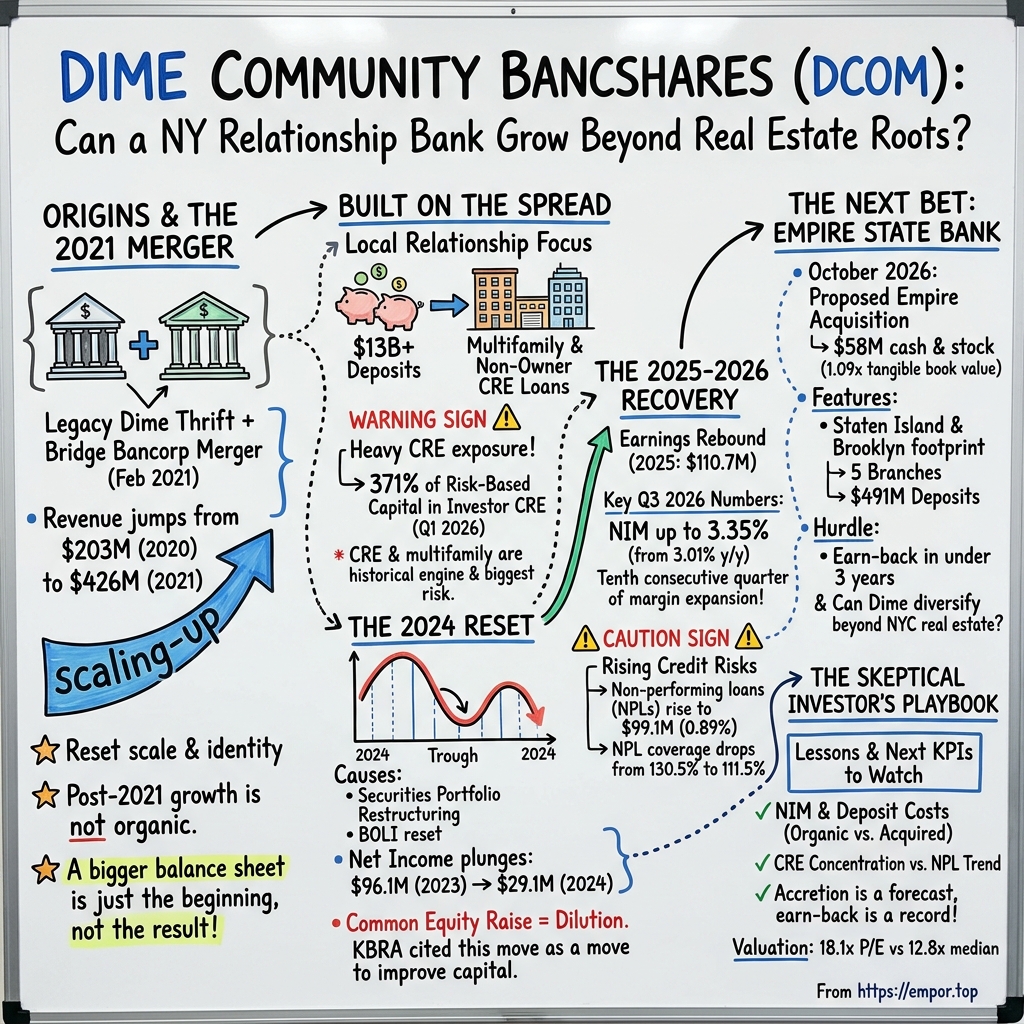
On the morning of October 20, 2026, Stuart Lubow got on the phone with the analysts who follow his bank and had two pieces of news. The first was the kind every bank chief executive hopes to deliver: the net interest margin, the spread between what Dime earns on its loans and securities and what it pays for its money, had risen again. It was the tenth quarter in a row that it had gone up.1 The second piece of news was announced the same morning. Dime had signed an agreement to buy Empire State Bank, a small commercial lender headquartered on Staten Island.2
The two announcements belong together. A bank that has spent two years rebuilding its earnings stops mainly defending itself and starts choosing where to grow. In Dime's case it chose both at once: keep widening the spread at home, and buy its way into the one New York City borough where it had no real branch presence.
The headline number was the margin. In the third quarter of 2026 Dime's reported net interest margin was 3.35%, up from 3.01% a year earlier.3 On a balance sheet earning interest on about $14.4 billion of assets, a gain of a third of a percentage point works out to tens of millions of dollars of extra annual income, most of it reaching profit because the branches, bankers and computers cost about the same whatever the spread is.1 Net profit for the quarter was about $42 million, roughly two-thirds higher than a year earlier, and diluted earnings per share reached 90 cents.3 Return on average assets, a key measure of bank profitability, reached 1.10%.1 For a bank that two years earlier had earned almost nothing for a full year, that was a long way back.
The same quarterly report contained a less flattering number. Non-performing loans, the loans on which the bank no longer expects to collect interest as scheduled, had risen to $99.1 million, or 0.89% of all loans. A year earlier they had been $72.1 million, or 0.67%.3 The reserve set aside for future losses was also stretched thinner. It now covered problem loans about 1.1 times, down from about 1.3 times.3 On the call, Chief Financial Officer and Chief Operating Officer Avinash Reddy explained the increase as two specific problems. One was a long-troubled business borrower tied to property management, against which the bank had set aside $6 million. The other was a slow-paying, rent-regulated apartment loan that had been charged down after a new appraisal. He told analysts that provisions would probably stay near recent levels for "the next couple of quarters."1
The Empire deal is small by comparison. Empire had about $596 million of assets and $491 million of deposits at September 30, 2026, and Dime agreed to pay about $58 million in cash and stock, or about 1.09 times Empire's tangible book value.2 Measured against Dime's own deposit base of about $13.1 billion, Empire's deposits are less than 4%.3 Management projected that the deal would add about 3.5% to earnings per share once cost savings were realized and dilute tangible book value by about 2%, a dilution it expected to earn back in under three years.2
So the investor's question is not whether Dime is recovering. The reported numbers settle that. The question is whether the recovery will last, and whether the bank can grow from here without taking on too much risk or issuing too many shares. That breaks into three tests. Can earnings keep growing from the 2024 trough without another securities gain doing the work? Can Dime shrink its commercial real estate concentration, the business that built the franchise, without credit losses rising? And will Empire earn back what Dime is paying for it?
One more piece of housekeeping. In this story the company is called Dime, but the legal name has recently changed. At its annual meeting in May 2026, shareholders approved renaming the holding company Dime Commercial Bancshares, Inc.4 It still trades on the New York Stock Exchange as DCOM and remains the holding company for what is now Dime Commercial Bank.3 The old name, Dime Community Bancshares, survives in the data feeds and on the conference-call operator's script. The new name signals management's ambition: a commercial bank serving businesses, not a savings institution living on apartment-building mortgages. Whether the balance sheet matches that ambition is the subject of this story.
That ambition has a history, and the current version of it began five years earlier with a merger that turned out to be one of the more unusual in recent New York banking.
 Subscribe on LinkedIn
The merger that made today's Dime
Two banks had grown up with different maps of New York. Dime Community Bank was a Brooklyn savings institution with well over a century behind it. For decades its business had been simple: take deposits from the neighborhood and lend them, in large blocks, to the owners of apartment buildings across the boroughs. It had been public since the 1990s, and in 1998 it registered shares to absorb another local thrift, Financial Bancorp. That registration was a merger filing, not a public offering, a sign that consolidation had long been part of how Dime grew.[^5] Bridge Bancorp grew up at the far end of Long Island. Its subsidiary, BNB Bank, was headquartered in Bridgehampton, on Montauk Highway, among the farm stands and summer houses of the East End.5 Bridge was a business bank, not a mortgage bank: it served the contractors, merchants and municipalities of Suffolk County, and their deposits flowed in with the seasons.
In July 2020, in the middle of the pandemic, the two banks announced they would combine in what they called a merger of equals.[^7] Each was too small to compete on technology and compliance spending with the national banks that dominated New York, and each had what the other lacked. Dime had a large, cheap-to-run multifamily loan book in the city. Bridge had commercial relationships and a deposit franchise with a high share of business accounts. Combined, they could claim a single footprint from Manhattan to Montauk.
The deal closed on February 1, 2021, and its legal structure was unusual. Legally, Bridge was the survivor: Legacy Dime merged into Bridge Bancorp, which then renamed itself Dime Community Bancshares, and BNB Bank absorbed Dime Community Bank and took the Dime name.5 Legacy Dime shareholders received 0.648 of a Bridge share for each share they owned.5 Under the accounting rules, however, Legacy Dime was treated as the acquirer, because its shareholders and its larger balance sheet carried the economic weight.6 So the historical financial statements that carried forward were Dime's, and the stock began trading under Dime's old ticker, DCOM, in place of Bridge's BDGE.5
The leadership arrangements were just as carefully balanced. Kevin O'Connor, who had run Bridge since 2008, became chief executive. Kenneth Mahon, Legacy Dime's chairman, became executive chairman, with a role that included succession and mergers. Stuart Lubow, who had come up through Legacy Dime's banking side, became president and chief operating officer. Avinash Reddy, Legacy Dime's chief financial officer, then 37, kept the finance job.5 Each side designated six of the twelve directors, and governance protections were written to last 36 months.5 The arrangement was built to keep the peace for three years, the time needed to show the merger was more than two companies sharing a ticker.
The combined bank had more than $12 billion of assets, more than $9 billion of deposits and over 60 branches.7 O'Connor and Mahon said the merger created "the premier community-based business bank in our region."7 Calling yourself the premier bank of a region is a claim, not a result. The test was whether the larger balance sheet would earn more per dollar than the two pieces had earned apart.
The merger also complicates the financial history that investors now see. Reported revenue roughly doubled, from about $203 million in 2020 to about $426 million in 2021, but the business being measured had changed.[^10] A ten-year chart that shows revenue compounding at about 20% a year and net profit at about 17% includes a year in which two banks were added together.[^10] Exclude that step and the recent picture is more modest. Over the last three fiscal years revenue grew about 15% a year, while net profit fell about 11% a year, because 2022's peak profit of about $143 million gave way to the trough of 2024.[^10] The five-year profit growth rate of about 20% a year starts from a pandemic-depressed 2020 and the pre-merger perimeter, so it flatters the result.
The fair verdict is that the merger reset Dime's scale and identity, but it does not prove better economics. The economics are the subject of what came after. In 2022, the first full year with both banks working on one platform and with rates still low, the combined bank earned a return on equity of about 12% and a return on assets of about 1.1%.[^10] That was respectable for a regional bank. Then the Federal Reserve raised rates at the fastest pace in four decades, and the weakness in Legacy Dime's model became visible. A multifamily loan made at 3.5% for five years does not reprice when deposit rates double. By 2024 return on equity had fallen from about 12% in 2022 to about 1.5%.[^10]
That fall led to the management change that frames the current story. Lubow took over as chief executive as O'Connor stepped back.8 Mahon remained chairman.9 The question passed to Lubow and Reddy was the one the merger had put off: what kind of bank Dime would be if apartment-building loans could no longer carry the earnings.
Their answer depended on how the business actually makes money.
A business bank built on the spread
Picture a mid-sized wholesale distributor in Hauppauge or a medical practice in Queens. The owner opens an operating account at Dime, the account through which payroll, receivables and supplier payments move. On a typical day tens or hundreds of thousands of dollars sit there, and much of it earns little or no interest because it is working money. A year later the owner wants a line of credit to buy inventory before a busy season, or a term loan for new equipment. The banker who opened the account already knows the cash flows, so the bank makes the loan at a rate a few percentage points above its own cost of funds.
That, in miniature, is Dime's business, and nearly everything else is detail. Deposits and a modest amount of borrowing fund a pool of assets made up mainly of loans, plus securities and cash. The bank earns interest on the assets and pays interest on the funding. That spread is measured as net interest margin. From that margin the bank has to pay salaries, rent and technology, and set aside reserves for loans that will not be repaid. What remains, after tax, is profit.10
Dime operates at a real scale. It had about $15.3 billion of assets at the end of 2025.10 At September 30, 2026, deposits excluding mortgage escrow funds were about $13.06 billion.3 It employed about 900 full-time-equivalent staff at the end of 2025.10 The bank presents itself as a Greater Long Island and New York City franchise, with branches running from Manhattan and Brooklyn out to the East End.10
Fees play a supporting role. Dime earns service charges on deposit and loan accounts, card-processing fees, fees for arranging interest-rate swaps for borrowers, investment-services commissions, and income from a title-insurance business.10 In a normal year these produce something in the low tens of millions of dollars. Management's guidance going into 2025 was $40 million to $42 million of non-interest income for the year.11 Against net interest income of several hundred million dollars, fees are useful but not decisive. Dime is a spread business, and its fortunes rise and fall with the spread.
The spread has two moving parts, and Dime's history is the story of each.
The asset side was shaped by the Legacy Dime model. At the end of 2025 the bank held about $3.42 billion of multifamily and residential mixed-use loans, along with about $2.93 billion of non-owner-occupied commercial real estate loans, meaning loans to investors on office, retail, industrial and similar properties they do not themselves occupy.10 Together that is more than half of a loan book of roughly $11 billion. Multifamily lending in New York is a particular business. A large share of the city's apartments are rent-stabilized, so landlords' revenue grows only as fast as a state board allows. The loans are typically fixed for five years and then reset. For decades the defaults were rare, the loans were large and cheap to service, and banks such as Dime could book them in volume with lean staff. That was the engine.
Then two things happened. Rates rose sharply from 2022, so loans written at low fixed rates kept earning low yields while deposit costs climbed. And New York's 2019 rent law sharply limited landlords' ability to raise rents on regulated units, which squeezed the cash flow behind many older loans. Dime's multifamily book was not in crisis, but it became a low-yielding and slow-moving asset. On the Q4 2024 call, Lubow said multifamily loans were the bank's lowest-yielding loan asset, at about 4.49%.11
The liability side is where management has put its effort, and where it has the most to show. In early 2024 Dime hired a number of deposit-gathering teams from the former Signature Bank, whose failure in March 2023 had scattered some of New York's best-connected commercial bankers.11 By January 2025 Lubow said those teams had brought in about $1.8 billion of core deposits, roughly 40% of them non-interest-bearing, across more than 11,000 accounts.11 Reddy told analysts that each team took "three-to-four years" to reach a steady state.11 Those hires were followed by lending teams, specialty-finance groups, a private bank and, in October 2026, a new affordable-housing lending group.1
The results show up in the funding mix. KBRA, the rating agency, reported that Dime had added more than $3 billion of core deposits since 2023, that non-interest-bearing deposits were about 31% of the total, and that the bank's deposit cost of 1.61% in the first quarter of 2026 was about a quarter of a percentage point below the average of its rated peers.12 By the third quarter, Lubow said non-interest-bearing deposits had risen above 32% and core deposits were up about $1.1 billion year on year.1 Reddy described a deposit base that was now 70% to 75% business deposits, compared with roughly 65% two years earlier.1 Meanwhile, the bank shrank its dependence on rented money. Brokered deposits fell from about $423 million at the end of 2024 to $200 million a year later, and Federal Home Loan Bank advances fell by $173 million in the first nine months of 2026, to $335 million.103
Where does that leave Dime among its rivals? It operates in one of the most crowded banking markets in the world. On one side are national banks with branches on nearly every corner of Manhattan, technology budgets in the billions and the balance sheets to make loans no regional bank could hold. On the other are New York regionals and thrifts, from the much larger Flagstar to Long Island and Queens institutions closer to Dime's size, such as Flushing Financial. In between, private credit funds and insurers increasingly compete for the larger commercial real estate loans. A bank with about $15 billion of assets has a lower lending limit than the giants, cannot match their brand advertising, and spends a larger share of its revenue on compliance. Its potential counterweight is density: enough branches, bankers and relationships in a specific geography that local businesses find it easier to bank with Dime than with a larger institution whose relationship manager changes every eighteen months.
Management pushes this claim hard. On the October 2026 call Reddy said, "We think we have got the best footprint in our area. We have got the best bankers. We have got the best branch network."1 Dime has also reported a leading share of deposits in its Greater Long Island market, a claim that depends on the bank's own definition of that market and on the date of FDIC survey data.10 Deposit market share in one region, measured one way, shows that the franchise has been gathering money where it operates. It does not by itself show a durable advantage.
Is there a moat here? The record supports a modest version of the claim. Dime has shown that it can hire experienced teams and that those teams bring deposits, including the most valuable kind, operating accounts that pay little interest. Its deposit cost was below that of rated peers in early 2026.12 Those are real data points. But Dime does not disclose the evidence that would prove pricing power or switching costs: customer retention, account attrition, win rates on loan bids, or the rates it pays compared with competitors on like-for-like accounts. Management's own words also show the limits. Reddy said on the third-quarter call that consumer deposits were shrinking as a share of the bank "because we are not the high rate payers out there for consumer deposits."1 That is a candid admission that, for at least one group of customers, price beats relationship. On the evidence, Dime has a local deposit-gathering franchise that is working, not a proven moat. The fuller test of competitive position belongs at the end of the story, after the credit evidence is in.
The franchise's central tension is that the real estate book is both the engine that built Dime and the exposure that makes the durability question so consequential. Before Dime could grow away from that book, it first had to deal with the cost of the low-rate years. In late 2024 it chose to take that cost all at once.
The restructuring that made 2024 look worse
By the autumn of 2024, Dime's balance sheet was carrying the low-rate years. Securities bought when yields were near zero were still earning little. A legacy portfolio of bank-owned life insurance, policies banks hold on employees' lives as a tax-advantaged investment, was also earning less than then-current alternatives. Every quarter those assets dragged on the margin. Management could wait years for them to mature, or it could sell them, take the loss, and reinvest at current rates.
In the fourth quarter of 2024 Dime chose to sell, and it paid for the decision with new equity. It raised about $136 million in net proceeds from what Lubow called "a significantly oversubscribed common equity offering," and Dime said the transaction was accretive to tangible book value.11 Part of the money was used to absorb the cost of repositioning the securities and life-insurance portfolios.11 Reddy said the securities repositioning was completed "towards the end of November," so the fourth quarter got only one month of benefit.11 The life-insurance restructuring came in two stages: a surrender of legacy policies in December, then purchase of about $85 million to $90 million of replacement policies in January 2025, which Reddy expected to add about $5 million to $5.5 million a year of tax-free income.11 Surrendering the old policies triggered a tax charge in the fourth quarter.11
The cost was a $42.8 million loss on securities in 2024.10 Combined with the tax charge on the life-insurance surrender and an elevated loan-loss provision of $13.7 million in the fourth quarter, it pushed Dime to a fourth-quarter loss.113 For the full year, net income fell from $96.1 million in 2023 to $29.1 million.10 The tax rate for the year jumped above 40%, a mark of the life-insurance charge.[^10] Non-interest income for the year was negative, a $4.0 million loss, because the securities loss was larger than all the bank's fee income combined.10
Reading the trough correctly is the key to judging everything that followed. The 2024 earnings collapse was not mainly a sign of a failing loan book. It was largely an accounting realization of losses that rate increases had already imposed. Selling an underwater bond does not create the loss; it recognizes it, but it also frees the money to earn current yields. The securities loss alone was larger than the year's entire net income. Without it, and before tax effects, 2024 would still have been a weak year, because the bank's spread was being squeezed. But it would not have been a near-zero year.
The equity raise deserves its own scrutiny, because it diluted shareholders. Dime sold new shares when its stock traded well below where it does today, and existing holders now own a smaller share of the bank. The test of whether that was wise is what the capital bought. Lubow said the raise lifted the common equity tier 1 ratio, the regulators' core measure of loss-absorbing capital, above 11%, with total capital above 15.5%.11 Eighteen months later KBRA reported a common equity tier 1 ratio of 11.9%, cited the fourth-quarter 2024 equity raise, and said capital and reserves "now track much closer to rated peer averages than in prior years."12 In the same report it said management "appears comfortable operating near current levels, suggesting limited upside."12 That is a two-sided verdict. The raise did strengthen resilience. It also did not mark the start of a fortress-capital strategy. Dime used the equity to fix the balance sheet and fund growth, not to build an unusually large buffer.
The payout record also shows the trough's effect. Dividends paid in 2024 were more than twice net profit available to common shareholders, because the dividend was held steady while earnings collapsed.[^10] In isolation a payout above 200% would be a warning. Here it reflects a board that treated the loss as a one-time event and did not cut the dividend. In 2025 the payout returned to about half of profit.[^10] Dime did not buy back shares in 2024 or 2025; it still had about 1.57 million shares of buyback authorization at the end of 2025.10
What did management promise in exchange? On the January 2025 call, Reddy laid out a specific path. December 2024's core margin of about 2.84% was "a good base NIM to use," and he saw "a pathway to a 3% net interest margin in 2025 and a NIM greater than 3.25% in 2026, with continued expansion in 2027 and approaching the 3.50% area."11 The path did not depend only on Federal Reserve cuts. About $1.9 billion of loans yielding around 3.95% were due to reprice or mature in the second half of 2025 and in 2026, which Reddy estimated could add 35 to 40 basis points to the margin.11
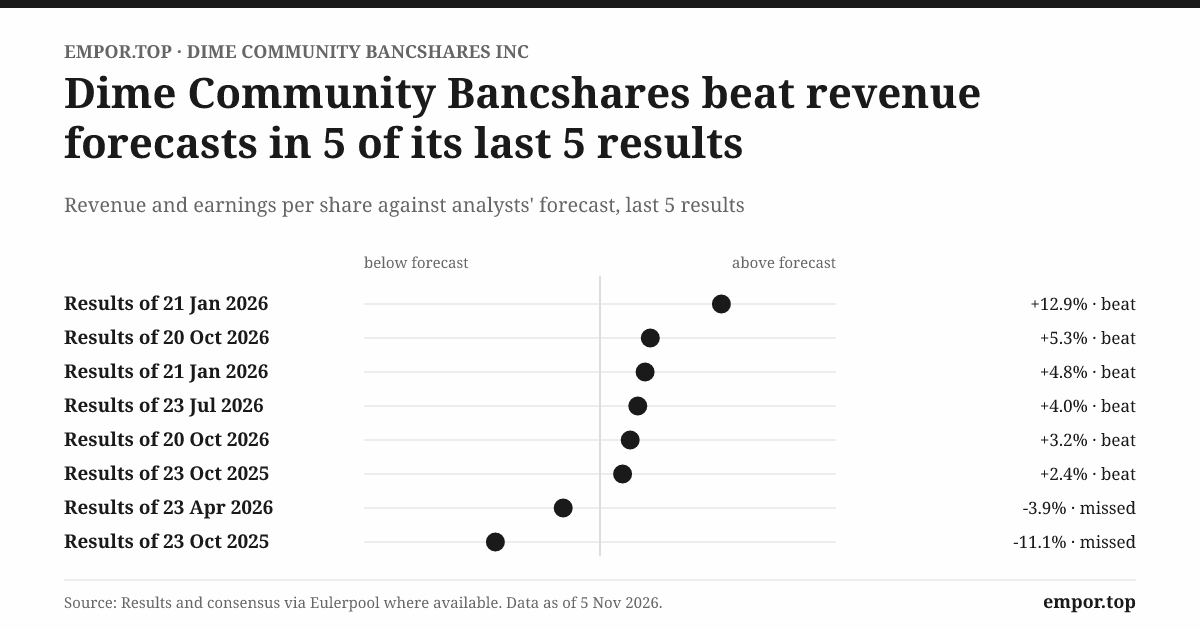
That is a falsifiable promise, and it is worth checking now. The third-quarter 2025 margin was 3.01%, so the 3% target for 2025 was met.3 The third-quarter 2026 margin was 3.35%, above the 3.25% marker for 2026.3 On this specific, dated, numerical claim, management delivered. That record matters, because the same managers are now making new promises about margins and about Empire.
The restructuring also left a test. If the reset worked, earnings from here should rise because net interest income grows and expenses stay disciplined, not because the bank books another unusual gain. Some of 2025's rebound did come from the reversal of 2024's loss, and separating that from the recurring improvement is the next step.
A recovery with two different sources of growth
The record quarter of October 2026 came at the end of a long climb. The margin continued to rise, and Reddy noted that even excluding purchase-accounting benefits and prepayment fees, the third-quarter run-rate margin was about 3.32%, compared with 3.22% the previous quarter.1 Core pre-tax, pre-provision earnings were about $70 million, or about 1.06% of average assets for the quarter.1 Core cash operating expenses were about $64.3 million, which put the core efficiency ratio, the share of revenue consumed by operating costs, below 48%.1
To see how much of the recovery is repeatable, start with 2025. Net income rose to $110.7 million from $29.1 million in 2024, and was also above 2023's $96.1 million.10 The increase came from two different sources. The first was net interest income, which rose by about $89.9 million as deposit costs fell and loans repriced.10 That is the core banking engine working. The second was non-interest income, which improved by $48.9 million. Of that, about $43 million was simply the swing in securities results: a large loss in 2024 became something close to neutral in 2025.10 Higher income from the replacement life-insurance policies added about $7.0 million and service charges about $3.2 million, partly offset by smaller gains on the sale of other assets.10 Against those gains, operating expenses rose $26.6 million, the loan-loss provision rose $6.9 million, and income tax rose $23.8 million.10
This breakdown is the honest answer to whether 2025 was a real recovery. It was, but it had two parts. Roughly two-thirds of the revenue improvement came from the spread, and roughly a third came from not repeating 2024's securities loss. The second part was real money, but it cannot happen twice. Anyone extrapolating 2025's percentage rise in profit into 2026 was counting the easy comparison as growth.
The 2026 numbers offer a cleaner test, because there was no securities loss to recover from. Quarterly net profit rose from about $25 million in the third quarter of 2025 to about $42 million a year later, while the quarterly operating margin, operating profit as a share of revenue, widened from about 21% to about 28%.3[^10] Here the improvement comes from the spread and operating leverage, not from a non-interest-income swing. The repeatable part of the recovery is now doing the work.
The third-quarter call shows how management describes that engine and where analysts pushed. In prepared remarks, Lubow said business loans had grown about $929 million in a year, about 30%, and that the loan pipeline stood at about $1.4 billion at a weighted average rate of about 6.5%.1 Reddy raised the margin target: a margin "over 3.60%" on the existing balance sheet by the end of 2027, up from the previous target of over 3.50%.1 He also gave a profitability goal of a return on assets above 1.31% by the second half of 2027 and an efficiency ratio that he wanted to bring down to 45%.1
Stephen Moss of Raymond James asked whether higher rates and spread compression across the industry threatened that target. Reddy said the bank was "actually increasing the NIM guidance," that deposit costs had drifted only a couple of basis points above the quarter-end level of about 1.68%, and that loan yields were rising.1 The key mechanism, he explained, is about $2 billion of fixed-rate loans still to reprice, at about 4.40%, against new loans in the pipeline at about 6.5%.1 Not all of those loans will stay with Dime, he said, because some will refinance elsewhere. Matthew Breese of Stephens asked about deposit betas, the share of a rate increase that the bank passes on to depositors. Reddy said he expected betas on the way up to be similar to those on the way down, and argued that the bank's non-interest-bearing deposits were "real operating accounts" that would not migrate to higher-rate products as they had in the last tightening cycle.1 He also gave a quantified sensitivity: the first rate increase was worth "a couple of basis points" to the margin, and subsequent increases were likely neutral.1
That answer contains both the bull case and its caveat. If operating deposits really stay put when rates rise, Dime's funding advantage is real. If they behave as deposits did in 2023, when customers across the industry moved cash into higher-yielding accounts, the margin target becomes harder. The bank's own interest-rate model, in its third-quarter filing, estimated that a gradual 200-basis-point rise would increase first-year net interest income by about 4.3%, while a 100-basis-point decline would reduce it by about 0.5%.3 Those are model outputs, built on assumptions about deposit behavior, not observed results.
Compared with the January 2025 call, the narrative has been consistent. Then, management described the balance-sheet reset, a NIM path driven by loan repricing, and a hiring push from deposits toward lending; Reddy said the effort would become "more balanced" between deposits and loans after 80% to 90% of effort had gone to deposits.11 Twenty-one months later the repricing has happened roughly as described, the lending teams are producing loans, and the margin targets have moved up, not down. Management deserves credit for that consistency. The obvious counterpoint is that the targets are set by the same people being measured, and that the period has been relatively benign for the kind of credit losses that would interrupt them.
The people leading the bank matter here. Lubow is a lifelong New York commercial banker who took over in September 2023, during the low point of the rate squeeze.8 His style on calls is that of a salesman for the franchise: he talks about bankers, teams and pipelines, and leaves the arithmetic to Reddy. Reddy, who was in his late thirties when he kept the finance job after the merger, has become the second center of gravity; the May 2026 employment agreements added the chief operating officer title to his role.8 On calls he does most of the quantitative work, and his answers tend to be specific, with numbers that can later be checked.
Pay is where shareholders have been less enthusiastic. Lubow's reported compensation was $4.11 million in 2025, up from $3.55 million in 2024 and below $4.52 million in 2023, and the 2025 total included a $1.25 million annual incentive and $1.16 million of stock awards.8 At the May 2026 annual meeting the say-on-pay proposal passed, but about 8.35 million shares voted against and 25.15 million in favor, which means about a quarter of the votes cast for or against opposed it.4 For a mid-cap bank, that level of opposition is a real signal. It does not prove that pay is badly designed. It does show that a meaningful group of institutional holders was unconvinced that pay tracked performance, and the comparison of 2025 bonuses against an exceptionally weak 2024 is one plausible reason.
Ownership is institutional and dispersed. In the 2026 proxy, BlackRock reported about 13.9% of the shares, Wellington about 9.7%, Vanguard about 6.7%, Dimensional about 5.3% and T. Rowe Price about 5.1%, and no holder had control.8 Wellington and T. Rowe Price had crossed the 5% reporting threshold since the prior year's snapshot, while BlackRock had trimmed slightly from about 14.3%.138 These are large asset managers, many of them index-driven, and their holdings say little about whether executives are aligned with outside shareholders. The board, at least on paper, is independent: ten of eleven directors were independent at May 2026, with Lubow the only insider.8
The recovery, then, is real and mostly repeatable. What remains unproven is whether the margin can keep growing while the bank takes the hardest step in its strategy: shrinking the real estate book that still defines its risk.
The CRE concentration test
In June 2026, KBRA affirmed Dime's ratings, including a BBB rating on the holding company's senior unsecured debt and a BBB+ rating on the bank's deposits, and kept the outlook at Positive.12 A Positive outlook means the agency sees a meaningful chance of an upgrade. KBRA cited "management's successful execution of its operating strategies, notably its deposit gathering and loan portfolio diversification initiatives."12 In the same report it identified the main thing holding the rating back: investor commercial real estate concentration of 371% of total risk-based capital at the end of the first quarter of 2026, which it called "still-elevated."12
That ratio is central to the risk. U.S. bank supervisors pay closer attention when a bank's commercial real estate loans to investors exceed 300% of its total risk-based capital and have grown quickly. The reasoning is simple. If loans worth almost four times your capital are all tied to the same kind of collateral in the same city, a property downturn can consume a large part of that capital at once. For a New York multifamily lender, a high ratio was normal for decades. After the regional bank failures of 2023 and the difficulties at larger New York multifamily lenders, the market stopped treating it as normal.
For a bank, the relevant credit evidence is not overdue invoices from customers but delinquent and non-accruing loans. A loan that is 30 to 89 days past due is a warning; one that is 90 days past due and still accruing interest is a bank betting on a quick cure; one on non-accrual is a loan the bank no longer expects to collect on schedule.
Start with the improvement. At the end of 2024, management's target was to bring the CRE concentration down to "the low 400s."11 By the end of the first quarter of 2026 it was 371%, and on the October 2026 call Lubow said it had fallen to 338% during the third quarter.121 That means management beat its own target by a wide margin. Reddy said that operating below 350% while other local banks operated "between 375 to 450" would set Dime apart, and that the bank "will be rewarded in the medium to longer term with a higher valuation."1 Whether the valuation follows is the market's call. The reduction itself is real.
How was it achieved? Two forces. Capital grew, through retained earnings and the 2024 equity raise, which enlarged the denominator. And the real estate book shrank. Lubow said about $150 million a quarter of multifamily loans had been paying off or refinancing elsewhere, along with $150 million to $175 million of other commercial real estate in prior quarters.1 Reddy expected about $500 million more multifamily runoff, which would bring multifamily below 25% of total loans, from about 27% now.1 Meanwhile, business loans grew about 30% in a year.1 Thomas Geisel, the chief commercial officer, described growth across traditional commercial and industrial lending and new specialty businesses such as fund finance, with net business loan growth rising from about $125 million in the first quarter of 2026 to about $350 million in the third.1
The diversification is genuine. It also comes at a cost. Shrinking the real estate book means letting go of loans and relationships that the bank spent decades building, and much of the runoff is borrowers refinancing with other lenders. The new business loans earn more, but they also carry a different kind of risk: commercial and industrial loans depend on a business's cash flow, not a building's rent roll, and their losses tend to arrive faster and with less collateral behind them. Indeed, the third-quarter provision was partly for "specific reserves on C&I loans."1 The mix is becoming less concentrated, not risk-free.
Now the less comfortable side. Non-performing loans remained elevated at $99.1 million, or 0.89% of loans.3 The allowance for credit losses rose to 0.99% of loans, from 0.88%, but it rose more slowly than problem loans, so coverage fell from about 131% of non-performing loans to about 112%.3 KBRA noted that non-performing assets and net charge-offs "have remained above historical norms in recent years," partly because of what it called management's proactive approach to identifying and resolving problem credits, and said net charge-offs had averaged about 0.3% of loans over the previous six quarters.12 For a lender whose multifamily book historically lost almost nothing, an annual charge-off rate around 0.3% is a regime change.
There are offsets. No loans were 90 or more days past due and still accruing at September 30, 2026.3 Loans 60 to 89 days past due were $23.2 million, down from $30.1 million at the end of 2025.3 Reddy said substandard loans, those with well-defined weaknesses, fell about 7% from the previous quarter, and that 30-to-89-day delinquencies declined.1 Those are early-stage indicators, and they are improving. So the problem loans are rising in the late stage while the pipeline of new problems is narrowing. That pattern is consistent with a bank working through a known group of troubled credits rather than discovering a new wave, though only later quarters can confirm it.
The rent-regulated portfolio is the heart of the matter. KBRA estimated that New York City rent-regulated multifamily loans were about 10% of total loans.12 On the third-quarter call, Breese asked how much of the multifamily problem was rent-regulated. Reddy answered that all of the multifamily non-performing assets were rent-regulated, and that none of the free-market apartment loans were non-performing.1 He described a rent-regulated book of roughly $1 billion that was shrinking, by about $40 million in the quarter, with an older pre-2019 portion down to about $275 million, and said the bank was no longer making new rent-regulated loans.1 He acknowledged "could there be some, you know, hits over time? Sure," but called the exposure "very manageable."1
That answer narrows the risk, but it also locates it. The 2019 rent law constrained rent growth on regulated buildings, while operating costs, insurance and taxes kept rising. A building whose loan was underwritten before 2019 on the assumption of rising rents may not support a refinancing at today's rates. Dime's losses so far have been modest relative to its capital, and its pre-provision earnings, about 1.85% of assets according to Reddy, give it a large cushion to absorb credit costs before they reach capital.1 But a bank reporting rising problem loans, with its multifamily non-performing assets concentrated in one regulated housing segment, while the reserve coverage of those loans falls, has not passed the credit test. It is in the middle of it.
KBRA's own conditions frame what comes next. It said an upgrade was "possible over the medium term if DCOM continues to strengthen profitability and reduce concentration risk, while maintaining sound credit performance."12 It said negative action could follow "unexpected credit issues, more aggressive capital management, or a reversion of its improved liquidity/funding profile."12 Two of those three conditions, profitability and concentration, are moving the right way. The third, credit performance, is the one in question.
Three indicators will settle it. The first is investor CRE concentration, now about 338% by management's count and falling. The second is non-performing loans and the reserve coverage of them, now 0.89% of loans and about 112% coverage, both moving in the wrong direction over the past year. The third is the pace of business-loan growth that replaces the real estate runoff. If concentration keeps falling while problem loans stabilize, the diversification story will be largely proven. If problem loans keep rising faster than reserves, the margin gains will be spent on provisions.
It was in this setting, with credit unresolved and the margin rising, that Dime decided to buy another bank.
Empire: a small deal with a measurable hurdle
Staten Island is the least connected of New York's five boroughs, linked to Manhattan by a ferry and to Brooklyn by the Verrazzano-Narrows Bridge. Its businesses tend to bank locally. Empire State Bank was founded there in 2004, a New York state-chartered commercial bank whose holding company, ES Bancshares, traded over the counter.9 By September 2026 it had five branches, three on Staten Island and two in Brooklyn, about $596 million of assets, $518 million of net loans and $491 million of deposits.2
Dime signed the agreement on October 19, 2026, and announced it the next morning.9 Under the terms, Dime will pay $30 million in cash and up to 720,000 of its own shares, for a total value of about $58 million, or $8.39 per Empire share, based on Dime's ten-day average share price of $38.55.2 Empire shareholders can choose cash or stock, subject to proration so that the totals stay fixed.9 The companies said the price was about 1.09 times Empire's tangible book value, that the deal would add about 3.5% to Dime's earnings per share once cost savings were realized, and that the roughly 2% dilution to tangible book value would be earned back in under three years.2 The deal requires approval by Empire shareholders, the Federal Reserve and the New York State Department of Financial Services, and is expected to close in the first quarter of 2027.9 Empire's directors and executive officers signed voting agreements in support, and Empire would owe a $2.363 million termination fee in certain circumstances.9
Lubow's strategic case is about geography and funding. "Empire is a well-run commercial bank that has developed a strong deposit base," he said in the announcement, citing "a granular and low-cost core deposit base."2 On the call he added that Dime had "had our eye on having a greater ground-level branch presence in Staten Island for a long time," that the deal would give Dime a presence in all five boroughs, and that Empire's deposits would "have real value in a higher rate environment."1 He called it "a very low risk transaction," pointing to Empire's low loan-to-value loan book.1
Keep the scale in proportion. Empire's assets are about 4% of Dime's.210 Reddy himself called the deal "pretty small."1 Even if every projection is met, Empire will add a few percent to earnings. The deal should not dominate the growth story, and it would be a mistake to treat the 3.5% accretion as evidence that Dime's organic strategy is working. It is a separate bet.
The price itself is not obviously excessive. At about 1.09 times tangible book, Dime is paying modestly more than the accounting value of Empire's equity, and well below the multiple at which Dime's own shares trade, about 1.2 times book value.[^10] When an acquirer's stock trades at a higher multiple than the price it pays, using stock for part of the deal is usually less dilutive. The cash half of the consideration also limits dilution, and Reddy said the bank's capital allowed it to structure the deal with more than 50% cash.1 The 2021 Bridge merger is not a useful benchmark here. That was a merger of equals between two banks of similar size, priced by exchange ratio rather than premium, and its fairness analyses addressed a different question. A 2026 purchase of a $600 million bank should be compared with recent deals of similar size, and that comparison will arrive with the merger proxy.
What is missing from the public record so far is the detail needed to judge the projections. The announcement and merger agreement do not disclose the assumed cost savings or the credit mark, the discount Dime will apply to Empire's loans to reflect expected losses and below-market rates.9 On the call, Breese asked for those numbers. Reddy said the combined rate and credit mark was likely "somewhere between 4.5% and 5%," that the core deposit intangible, the accounting value assigned to Empire's deposit relationships, would be about 3% of core deposits, and that one-time deal costs would be about $12 million to $13 million before tax.1 He said the bank had "fully factor[ed] in cost savings" and expected to run Empire at a return on assets "well in excess of 2%," with an internal rate of return "well in excess of 20%."1 He estimated the deal would reduce Dime's capital ratios by about 35 basis points.1
Those numbers are useful, and they also reveal the deal's pressure points. One-time costs of $12 million to $13 million amount to more than a fifth of the $58 million price, which is typical for a small deal because systems conversions and contracts cost about the same whatever the bank's size. A 4.5% to 5% mark on roughly half a billion dollars of loans is a meaningful discount, and Reddy said he assumed a high-rate scenario, which is partly why the mark is large. An expected return on assets above 2% for the acquired business is about twice Dime's own current level, which means the projections assume deep cost cuts. Those cost cuts are the projection most worth checking once the deal closes. The executive arrangements are also in the filing: Empire's chief executive, Philip Guarnieri, will receive about $1.54 million at closing and stay on as a managing executive director at Dime Commercial Bank, and its president, Thomas Sperzel, will receive about $1.27 million.9
The S-4 registration statement and proxy, which will contain Empire's detailed financials, advisers' fairness analyses and pro forma assumptions, had not been filed by November 7, 2026.9 Until it is, the accretion and earn-back figures are management forecasts, not facts.
The case also rests on a claim about how Dime is spending management attention. When Manuel Navas of Piper Sandler asked what Dime wanted to add next, Lubow said, "strategically, I think we are really in a spot where we really have to execute and grow the business," and that he saw no significant moves beyond being opportunistic.1 Geisel added that new teams take a year to eighteen months to get their footing, and that the bank wanted to keep "focusing on the organic side."1 It is a reasonable answer, and it is also a reminder of what a skeptic might ask: why buy a bank, with its integration work, in the same year the organic engine is just reaching full speed and credit is wobbling? The answer is that the deal is small and the geography is unique. The risk is that integration costs and attention are larger than the deal's size suggests.
Empire will be judged on the numbers that arrive after closing: the actual deposit costs and retention of Empire's customers, the final credit marks, integration costs, realized cost savings, and how quickly tangible book value recovers. Those are the facts that will turn a forecast into a record. They also bring the story back to a broader question: how should anyone measure a bank's value in the first place?
What the bank's numbers can—and can't—say
Run Dime through the screens built for industrial companies and it looks very strange. Its enterprise value comes out negative, about minus $1.3 billion, because the cash on its balance sheet exceeds its market capitalization plus its debt.[^10] Its free-cash-flow yield appears to be about 10%.[^10] Its "working capital days" are in the negative thousands.[^10] On those screens Dime would look like a cash-rich company trading below the value of its bank account. It is not.
The reason is the most basic fact about banking: the cash belongs to someone else. At September 30, 2026, Dime held about $2.28 billion of cash and balances due from banks, and about $1.51 billion of securities at fair value.3 Nearly all of that is funded by customers' deposits, which can be withdrawn. The cash is the bank's liquidity, the money it needs to meet withdrawals, fund new loans and satisfy regulators. A manufacturer with $2 billion in cash and no debt could return it to shareholders. A bank that did so would cease to be a bank.
The same logic undoes the cash-flow measures. A bank's operating cash flow swings with movements in loans held for sale, accrued interest and other balances that have nothing to do with how much cash shareholders could take out. Even at the holding company, where the measure means more, Dime's 2025 operating cash flow of about $67.8 million was well below net income of $110.7 million, but the gap mostly reflected about $45.9 million of earnings the bank subsidiary kept rather than paid up to the parent, not any deterioration in the business.10 The amount that matters is the regulatory capital that the bank holds, and the amount of profit regulators allow it to send to its parent.
So the useful measurements are different. The net interest margin shows whether the spread is widening. Deposit mix and cost show how durable the funding is. Problem loans, charge-offs and reserve coverage show credit quality. Capital ratios show how much loss the bank can absorb. Return on assets ties them together into a single measure of how much the franchise earns on its balance sheet. Those measures give a mixed reading: profitability has recovered, while problem loans remain elevated.3112
There is a second reason Dime holds so much cash, and it says something about management's strategy. Breese pointed out on the October call that cash had risen to about 14% of total assets.1 Reddy said the bank liked the position "because it keeps us neutral to, you know, short term rates," that it had bought no securities in the third quarter, and that the 3.60% margin target did not assume any of the cash was put to work.1 If Dime ran its loan-to-deposit ratio at 90% to 95%, he said, the margin would be "more like, you know, 3.80%, 3.90%."1 Lubow added that larger loan growth and cash deployment would come once the CRE ratio settled, which he expected around mid to late 2027.1 In other words, the cash is partly a deliberate choice to forgo some income now in exchange for flexibility, and partly a consequence of deposits growing faster than the bank is willing to lend while it shrinks its real estate book. Either way, it is earning a short-term rate, not sitting idle, and it is an option that management says it intends to exercise.
The bank's debt is also smaller than it was. Borrowings fell from about $1.6 billion at the end of 2023 to about $371 million at the end of 2025, and in March 2026 Dime redeemed $40 million of subordinated debentures.[^10]10 At September 30, 2026, it had $335 million of advances from the Federal Home Loan Bank of New York and about $231 million of subordinated debt, and about $4.19 billion of unused borrowing capacity at the Federal Reserve secured by loans.3 The bank remained "well capitalized" under regulatory definitions.3 Paying down wholesale funding with deposits lowers costs and reduces the risk that funding disappears in a crisis, which is one of the reasons KBRA credited the bank's improved liquidity and funding profile.12
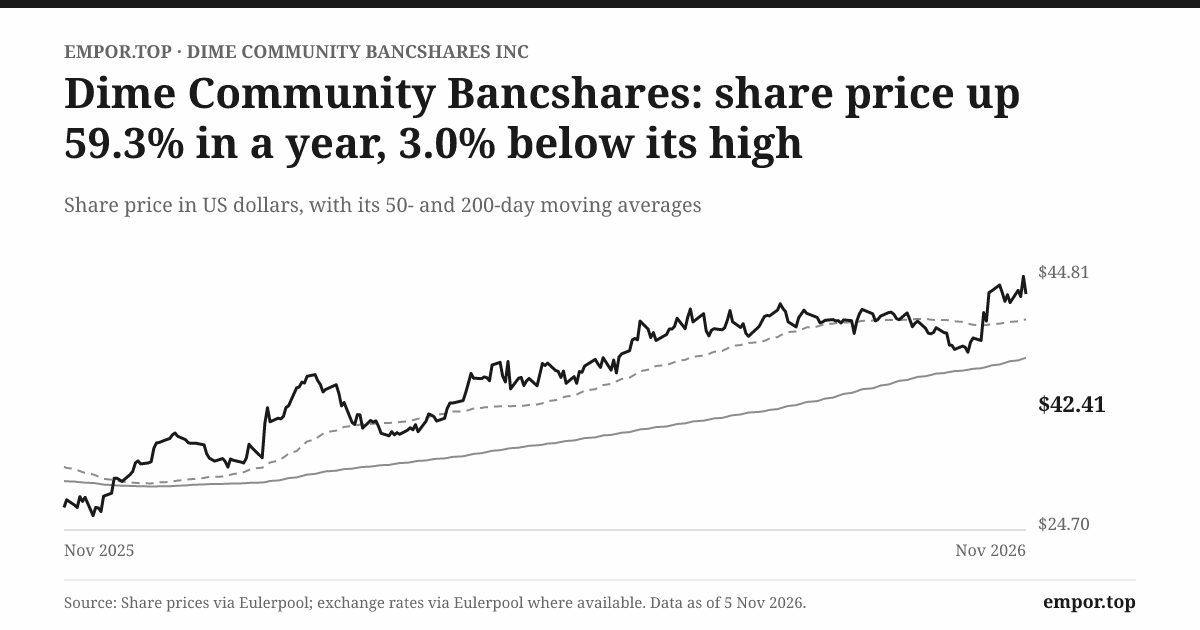
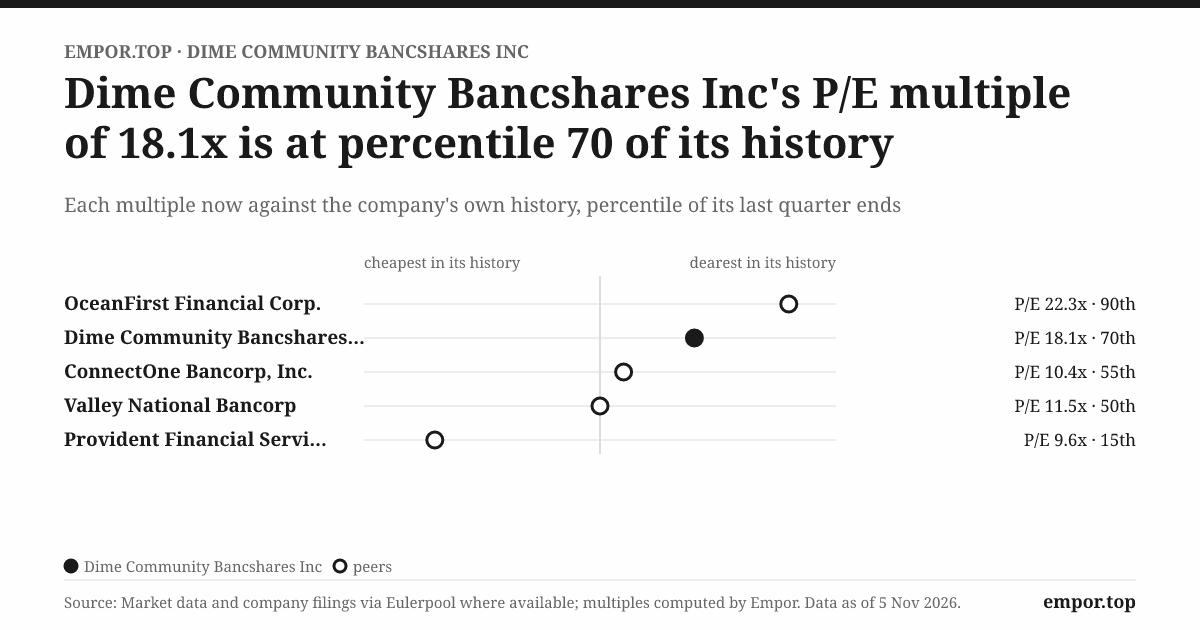
Now the valuation. On November 5, 2026, Dime's shares traded at $42.41, close to the top of a 52-week range that had begun near $25.78.[^10] That means the stock had risen about two-thirds in a year. At that price the bank's market value was about $1.8 billion, about 18.1 times trailing earnings and about 1.2 times book value of roughly $35.39 a share.[^10] Dime's own five-year median price-to-earnings ratio is about 12.8 times.[^10] In March 2026, a peer survey by Mercer Capital put Dime at about 13.9 times trailing earnings and 1.06 times book, compared with medians of about 13.3 times and 1.15 times for New York public banks.[^17] The dates and methods differ, so the comparison is context, not a same-day verdict. But the direction is clear. Over the course of 2026 the market moved Dime from roughly a peer-average multiple to a clear premium to its own history.
What does the price assume? The trailing earnings in that multiple still include the first quarter of 2026, before the latest margin gains, and a provision run-rate that management itself called elevated. Investors paying 18 times trailing earnings are betting that earnings keep rising toward management's 2027 targets of a margin above 3.6% and a return on assets above 1.3%. On book value the premium looks smaller: at about 1.2 times book, the market is paying modestly more than the accounting value of the equity for a bank that earned a return on equity of about 9% over the past year.[^10] If returns rise as projected, that book multiple is not demanding. If credit costs rise or the margin stalls, the earnings multiple will compress quickly.
The dividend record provides one more perspective. Dime paid about $50 million in common dividends in 2025, about half of profit, and the board held the dividend through the 2024 trough even when it exceeded earnings.[^10] Over twelve years the payout ratio has ranged from about 31% to more than 200%, with a median near half.[^10] A bank that keeps its dividend through a deliberate loss year is signaling confidence. It is also committing to keep paying through the next bad year, which narrows the room to retain capital when credit turns.
A sustained margin recovery with controlled credit costs could support the current valuation. Rising losses, funding pressure or another reset would make the premium hard to defend. Which of those futures is more likely depends on whether Dime has a durable reason to win.
Analysis & Bear vs. Bull Case
Imagine the argument as it would play out between two investors who have read the same filings. One says Dime has built the best-funded commercial bank franchise in its corner of New York at precisely the right moment. The other says Dime is a real estate lender with a better story, trading at a premium just as its problem loans rise. Both are looking at a lender whose margin has risen for ten quarters and whose shares trade above the bank’s five-year median, while investor real estate exposure remains large relative to capital. Dime also has a Positive credit outlook.
The bull case starts with the margin. Management hit its dated targets for 2025 and 2026, and roughly $2 billion of loans repricing from about 4.4% toward pipeline rates of about 6.5% offers a visible source of further improvement.1 The funding base has improved: core deposits are growing, non-interest-bearing deposits exceed 32%, wholesale funding is sharply reduced and deposit costs were below peers.112 CRE concentration has fallen below 340%, well below management’s January 2025 target of the low 400s.111 KBRA assigned the bank a Positive outlook, making an upgrade possible if profitability, concentration and credit performance meet its conditions.12 Operating leverage is also real: the efficiency ratio is below 48%, the team build is largely done, and the next dollar of revenue should mostly fall to profit.1
The bear case starts with the loan book. Investor real estate still equals more than three times capital, while problem loans have risen and reserve coverage has fallen.3 Dime’s non-performing multifamily loans are concentrated in rent-regulated buildings, where the 2019 law constrained rent growth.1 Diversification replaces familiar real estate risk with commercial-and-industrial and specialty-finance risk, where the bank’s teams are new and the loans unseasoned; the third quarter already brought specific reserves on business loans.1 Part of the profit rebound in 2025 came from the reversal of a securities loss, not recurring banking income. And the stock now trades at a premium that assumes the bull case continues.
Michael Porter's five forces help locate the economic pressure. Rivalry is intense: Dime competes with national banks, larger regionals and non-bank lenders for the same customers, and in its 2025 annual report it describes competition from institutions with greater resources.10 Depositor bargaining power is significant and rises with rates, as management's own admission that it is losing consumer deposits because it is not the highest payer makes clear.1 Borrowers have choices too. Much of Dime's multifamily runoff consists of borrowers refinancing at other lenders, which means they can and do leave when someone else offers better terms.1 Substitutes are growing: private credit funds, insurers and government-sponsored lenders compete for real estate and larger business loans. The threat of new entrants into deposit-taking is low because charters and compliance are costly, but that barrier protects incumbents generally rather than Dime specifically, and it imposes a proportionally higher compliance cost on a $15 billion bank than on a giant.
Hamilton Helmer's seven powers framework asks a narrower question: what lets a company earn persistently above its cost of capital in the face of competition? Of the seven, Dime might plausibly claim two. The first is a form of scale economies in a local market. A bank with a dense branch network and a full set of commercial services in one region can serve local businesses at lower cost per relationship than a newcomer. The second is something like switching costs: operating accounts, payroll, cash management and lending relationships are tedious to move, and a business owner with a trusted banker has reasons to stay. The evidence for both is real but limited. Dime does not disclose customer retention, account attrition, loan-bid win rates or comparative pricing data, which are the measures that would show the advantages in numbers. Its deposit cost below rated peers is the strongest published evidence.12 The way the deposits arrived, through teams hired from competitors, also cuts against the moat claim. Customers who followed their bankers from Signature to Dime could follow them again. In Helmer's terms, that is a relationship advantage that belongs partly to the bankers rather than the bank. Cornered resources, network effects, brand power, counter-positioning and process power do not plausibly apply. The verdict is that the record narrows the moat claim to a smaller version: a well-run local franchise with a funding advantage that is real today but depends on keeping its bankers, not a structural barrier that competitors cannot cross.
A skeptical activist would focus on capital allocation. Since late 2024, Dime has raised about $136 million of common equity, redeemed $40 million of subordinated debt, begun buying back stock—with about 1% of shares repurchased in the third quarter of 2026—and agreed to spend $30 million in cash and about 720,000 shares on Empire.111012 Each move is defensible on its own. Together they raise a fair question. The bank issued shares at a low price in 2024, is buying them back at a much higher price in 2026, and is using shares again for an acquisition. The activist would ask whether the buyback and the deal are the best use of capital while problem loans are rising, and whether a quarter of shareholders voting against the pay plan reflects incentives that reward growth more than returns.4 Management's answer is the stated target of a return on assets above 1.31% by late 2027.1 That number gives shareholders a clean way to hold it to account.
Three measures will tell the story better than any framework. The first is whether the margin keeps rising without deposit costs undoing the gain; it is now 3.35%, with deposit costs about 1.7%.31 The second is whether CRE concentration keeps falling as problem loans stabilize and reserve coverage improves; concentration is about 338%, problem loans are 0.89% of loans and coverage is about 112%.13 The third is whether business loans and core deposits keep growing organically, separate from Empire once the deal closes.1 If the first and third keep improving while the second stabilizes, the bull case is being proved. If the second deteriorates, the first and third will not matter much.
The evidence supports a credible operating recovery, not a proven moat. The premium to Dime's history needs sustained earnings quality to justify it, not just a better comparison against the 2024 trough.
Playbook: Business & Investing Lessons
Put three moments side by side. In February 2021, two banks became one, and reported revenue doubled overnight. In November 2024, the bank recognized securities losses and raised new equity. In October 2026, the same bank agreed to buy a smaller one on Staten Island. Each moment changed the bank's economics, and each produced numbers that told only half the story.
The first lesson comes from the merger. A bigger balance sheet is a beginning, not a result. The merger's own release called the combined company "the premier community-based business bank in our region," but the later rate shock showed that scale did not protect the larger, combined loan book.7[^10] For investors, the lesson is to separate acquired scale from organic growth and to judge a merger by the returns earned on the combined capital years later. For bank managers, it is that a merger solves the size problem and leaves the business-model problem untouched.
The second lesson comes from the restructuring. A loss can be a decision, but the recovery has to be earned. Dime chose to recognize its securities losses in 2024 rather than carry them for years, and followed through on its specific margin path.113 The cleaner proof came in 2026, when earnings rose without a securities loss to reverse. Investors should reward a company for taking a hit only when it follows through with dated, numerical targets that can later be checked, as Dime's management did.
The third lesson comes from the loan book. In banking, the loan book is the product—and the risk. For decades, Dime's apartment-building loans were its competitive advantage. A rate shock and a rent law turned them into its biggest constraint, and the bank now has to build a different book as those loans run off. An industrial company can change its product; a bank changes its product only as fast as its loans mature. That is why a bank's diversification takes years, and why credit indicators matter more during the transition than any story about strategy.
The fourth lesson comes from Empire. Accretion is a forecast; earn-back is a record. Management's projections may prove right, and the price looks reasonable against book value.2 But the undisclosed cost savings and the return target for the acquired bank, about twice Dime's own, mean the projections carry the weight.1 The test is what the bank reports after closing, measured against what the merger proxy promised.
The last lesson is about people. Lubow and Reddy have built credibility with their dated targets and detailed explanations on calls. That credibility is an asset, and it will be tested by the first quarter in which credit indicators move against them. What matters then is whether they adjust growth, buybacks and acquisitions to the evidence, or defend the plan.
Epilogue
Tonight, Dime is a bank in the middle of a sentence. Its margin is the highest in years and still rising. Its problem loans are rising too. It has agreed to buy a bank on Staten Island, but the paperwork that will reveal what it is really buying has not yet been filed. Its shares trade near a 52-week high, at a premium to their own history that the market has granted in about a year.[^10]
The next moment arrives in late January 2027, when Dime reports its fourth-quarter results and, as Reddy promised, gives its first formal guidance for 2027.1 That call will show whether the margin kept rising as rates moved and whether deposit costs stayed close to the 1.7% area. It will also show whether provisions stayed in the $13 million to $15 million range Reddy described, or moved down, as he said they should after "a couple of quarters."1 Each of those is a number management has put on the record.
The quarter after that will be the more important credit test. If problem loans peak and start to fall, and the reserve coverage stabilizes, it will support management's view that the bank is working through a known set of troubled credits rather than discovering a new set. If problem loans keep rising faster than reserves, the bank will have to choose between larger provisions, slower buybacks and a slower Empire integration, and the market will discover how much of the current price depended on credit staying quiet.
Then comes Empire. The S-4 and merger proxy will show the cost savings, credit marks and fairness analyses behind the projections. Approvals from the Federal Reserve and New York regulators and a vote of Empire's shareholders stand between signing and the expected closing in the first quarter of 2027.9 After closing, the first reports will show whether Empire's deposits stay and at what cost, and whether the cost savings appear in the expense line.
And at the 2027 annual meeting shareholders will get another say-on-pay vote. A year after a quarter of the votes opposed the pay plan, the result will show whether the board's choices have persuaded the holders who objected.4 By the end of 2027, management's own targets will either be met or missed: a margin above 3.6% and a return on assets above 1.31%.1 There is no clearer test than that.
The central question of the story is whether Dime can grow beyond its real estate roots. The margin says the business is earning more. The credit numbers have not yet said whether it is getting safer.
Outro
Go back to that October morning: Dime reported its best margin in years and announced an expansion into the last borough it did not cover.12 Its real estate book still defined its risk, at well over three times capital.12
Dime's wager is that it can keep the New York relationships and the spread income while letting go of the dependence that created them. The margin is rising. The next credit disclosure will show whether the bank underneath it is getting safer.
References
-
Dime Community Bancshares Q3 2026 Earnings Call Transcript — Benzinga, 2026-10-20 ↩↩↩↩↩↩↩↩↩↩↩↩↩↩↩↩↩↩↩↩↩↩↩↩↩↩↩↩↩↩↩↩↩↩↩↩↩↩↩↩↩↩↩↩↩↩↩↩↩↩↩↩↩↩↩↩↩↩↩↩↩↩↩
-
Dime Commercial Bancshares to Acquire Empire State Bank, press release (Exhibit 99.2) — SEC, 2026-10-20 ↩↩↩↩↩↩↩↩↩↩↩
-
Dime Commercial Bancshares Q3 2026 Form 10-Q — SEC, 2026-10-30 ↩↩↩↩↩↩↩↩↩↩↩↩↩↩↩↩↩↩↩↩↩↩↩↩↩
-
Annual Meeting Results and Name Change, Form 8-K — SEC, 2026-06-01 ↩↩↩↩
-
2020 Special Meeting Joint Proxy Statement/Prospectus — Dime Community Bancshares, 2020-10-12 ↩
-
Bridge Bancorp and Dime Community Bancshares Complete Merger of Equals, press release — SEC, 2021-02-01 ↩↩↩
-
Empire State Bank Merger Agreement, Form 8-K — SEC, 2026-10-20 ↩↩↩↩↩↩↩↩↩↩
-
Dime Community Bancshares 2025 Form 10-K — SEC, 2026-02-20 ↩↩↩↩↩↩↩↩↩↩↩↩↩↩↩↩↩↩↩↩↩↩
-
Dime Community Bancshares Q4 2024 Earnings Call Transcript — Stock Analysis, 2025-01-23 ↩↩↩↩↩↩↩↩↩↩↩↩↩↩↩↩↩↩↩
-
KBRA Affirms Ratings for Dime Commercial Bancshares, Inc. — KBRA, 2026-06-16 ↩↩↩↩↩↩↩↩↩↩↩↩↩↩↩↩↩↩
 LinkedIn
 WhatsApp
 Reddit
 Hacker News
 Email
 Kindle
 RSS Feed
 Spotify
 Apple Podcasts
 Amazon Music
 Audible
 YouTube