OceanFirst: The Community Bank That Bought Its Way to New York
I. A $23 Billion Bank, and a $5 Million Gap
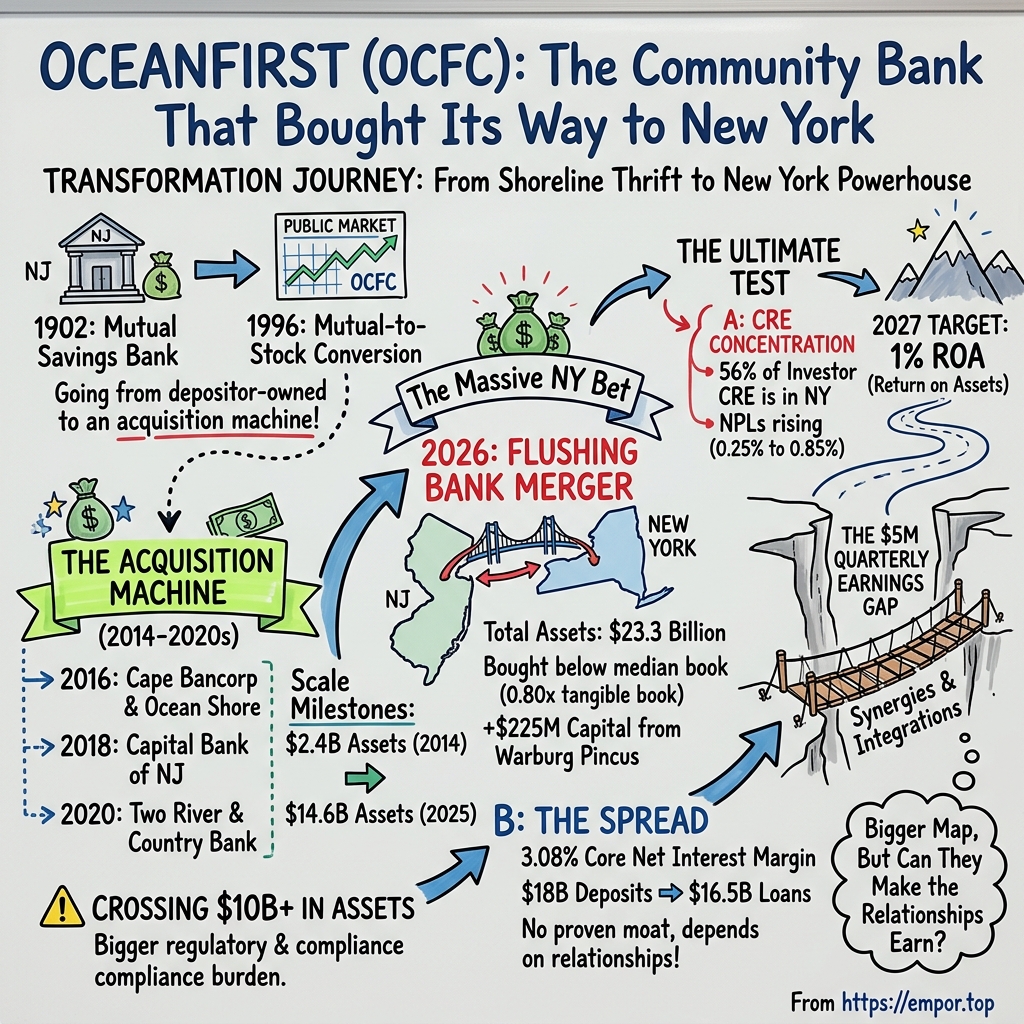
On October 28, 2026, the chief executive of a bank that began life as a small New Jersey savings institution got on a conference call to explain the first full quarter of the biggest deal in its history. Christopher Maher had spent the summer folding Flushing Financial, a Long Island and New York City lender, into OceanFirst. In September the two banks' computer systems had been merged, so customers of both banks now ran on one core platform. Analysts wanted to know if the goal he had set still held. Maher said it did: OceanFirst still aimed to earn a 1% return on assets in 2027.1
Then his chief financial officer, Patrick Barrett, gave the number that matters most in this story. Even after the merger, even after a quarter of cost cuts that beat the company's own forecast, OceanFirst was still roughly $5 million of quarterly earnings short of where it needed to be to hit that goal.1 Five million dollars a quarter is not a lot of money for a bank with more than $23 billion of assets.2 It is not trivial either. It is the distance between a deal that has paid for itself and a deal that has only made the bank bigger. That distance is what this story is about.
Start with the size of the thing. At the end of September 2026, OceanFirst Financial Corp. reported about $23.3 billion of total assets, up from $14.6 billion at the end of 2025.23 Almost all of that jump came from one transaction. Flushing brought roughly $8.7 billion of assets, branches across Queens, Brooklyn, Manhattan and Long Island, and a deposit base built over nearly a century in some of the densest and most competitive banking markets in America.4 Overnight, a bank that most investors knew as a Jersey Shore franchise had become a New York bank too.
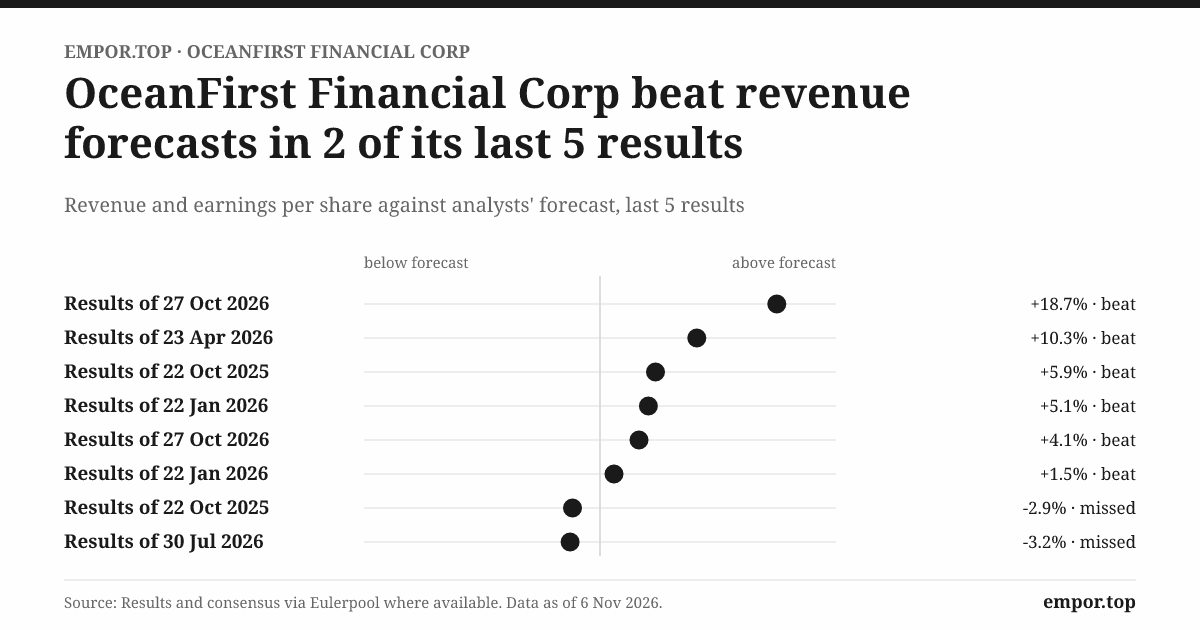
The quarter's headline figures show both sides of the story. Management's preferred measure, "core" earnings per share, came in at $0.48.5 Core earnings strip out costs management treats as one-time, most of all the bill for merging two banks. Earnings under generally accepted accounting principles, GAAP, the official measure every company must report, came in at $0.17.5 Merger costs explain most of the difference: the company cited about $37.1 million of them on the call.1 Core EPS answers a question about the future: what might this bank earn once the integration is done? GAAP EPS answers a question about the present: what did shareholders actually earn this quarter? Both matter, and for now they disagree by a factor of almost three.
The margin needs a footnote too. Net interest margin is the basic measure of a bank's economics: how much it earns on its loans and securities, minus what it pays for deposits and borrowings, as a share of its earning assets. OceanFirst reported a margin of 3.18% for the quarter.5 But some of that came from purchase accounting. When a bank buys another bank, it marks the acquired loans to their fair value, and the discount it books slowly flows back into income as "accretion." The quarter also included about $5.5 million of interest from acquired loans that paid off early.1 Management told analysts to use 3.08% as the baseline going forward, the "core" margin without those effects.1 That was a candid thing to say. It also meant the quarter's best-looking number was partly an accounting effect of the deal, not proof of a better business.
Before going further, it helps to be clear about what is being analyzed. OceanFirst Financial Corp. is the listed holding company, trading on NASDAQ under the ticker OCFC. Its main operating business is OceanFirst Bank. Since June 1, 2026, the consolidated results have also included the Flushing franchise.23 There is no parent company above it. Warburg Pincus, the private-equity firm, is a large strategic investor with a board seat, but it does not control the company.6 So everything in this story, the deposits, the loans, the credit risk and the returns, belongs to the one listed company and its shareholders.
That makes the stakes simple to state and hard to settle. For more than a decade OceanFirst has grown mostly by buying other banks. Each deal came with a pitch: more deposits, more branches, cost savings, higher earnings per share. Flushing is the largest and most ambitious of those pitches. The question is whether decades of acquisitions built a stronger regional bank, or mostly a larger one, and whether this latest deal can earn back what it cost.
The October call gave the bull case its best evidence. Core earnings rose, costs came in below guidance, the systems were combined on schedule and management reaffirmed a measurable target. It also gave the bear case its sharpest caveats. The headline margin was flattered by purchase accounting and a one-off payoff. GAAP earnings were a fraction of core. And by management's own count, a gap remained. The first full quarter is a beginning, not proof that earnings have stepped up for good. To see why investors should demand that proof, the story has to go back to a small savings bank by the shore, and to the moment it learned it could use its own stock as a currency.
 Subscribe on LinkedIn
II. A Shoreline Thrift Goes Public
In 1902, a savings institution opened its doors on the Jersey Shore to collect the deposits of local families and lend them back as home mortgages.3 That was the whole model of the American thrift. A thrift was usually a mutual institution, which meant it had no shareholders. In a loose sense, it belonged to its depositors. It paid them interest, made mortgages to their neighbors and kept whatever surplus was left as capital. It did not need to grow fast, because nobody was demanding a return on equity. It needed to be safe, local and trusted.
For most of the twentieth century that was what this bank was. The century of local history matters here for one reason: it is where OceanFirst's identity comes from. The company still describes itself as a relationship bank, the kind of lender where the commercial borrower knows the loan officer and the depositor knows the branch manager. That identity is the product the company says it is selling, from Monmouth and Ocean counties to Philadelphia and now Queens. Whether it is a real economic advantage is a question for later. For now, the important point is that it was born in a world where growth was optional.
That world changed on paper in the mid-1990s. On December 7, 1995, the holding company then called Ocean Financial Corp. filed a registration statement with the Securities and Exchange Commission to sell stock to the public.7 The filing became effective on May 13, 1996, and the mutual-to-stock conversion closed on July 2, 1996.8 With that, the depositor-owned thrift became a company owned by shareholders.
The conversion is easy to treat as a technicality. It was not. A mutual thrift can grow only by keeping its earnings. A stock company can issue new shares. It can raise capital from investors when it wants to expand, and, crucially, it can pay for another bank with its own stock instead of cash. The conversion gave the company a currency. It also gave it a new set of owners who would judge it by earnings per share, return on equity and the stock price. Those owners would want the capital raised in the conversion put to work. In American banking, one of the most common ways to put capital to work is to buy another bank.
For almost two decades after the conversion, OceanFirst grew slowly. At the end of 2014 it had about $2.4 billion of assets.3 That was a respectable community bank, but a small one in a state filled with competitors, from global giants to dozens of local savings banks. It earned about $19 million that year, and it returned a little under 9% on its equity.3 Those figures matter later because they provide a baseline. A decade on, the bank would be six times larger. The question is whether its owners would be six times better off.
The man who presided over the change arrived in 2013. Christopher Maher joined OceanFirst that year as president and chief operating officer, was appointed to the board in 2014, became chief executive in 2015 and took the chairman's seat in 2017.9 He is, in other words, the author of almost the entire expansion era. He is also an insider in the wider banking system. He served as a director of the Federal Reserve Bank of Philadelphia from 2020 through 2024 and has chaired the New Jersey Bankers Association.9 His record shows a style: he is a deal-maker who frames each transaction in terms of deposits, efficiency and execution risk, and he likes to set public numerical targets. That habit will be important when the story reaches 2027.
Look at the balance sheet over the Maher era and the trajectory looks dramatic. Assets rose from about $2.4 billion at the end of 2014 to about $14.6 billion at the end of 2025, before Flushing.3 Shareholders' equity rose from about $218 million to about $1.7 billion.3 By the time Flushing arrived, the bank's headquarters had moved too, from Toms River, the address on its 2016 press releases, to Red Bank, in Monmouth County.109 It was a small symbol of a bank shifting north, toward the larger markets of central New Jersey and, eventually, New York.
Here is where the story's central tension starts. A chart of OceanFirst's assets looks like a growth company. But a bank's assets can grow in two very different ways. It can win customers one at a time, raising deposits and making loans that its competitors wanted. Or it can buy another bank and add that bank's balance sheet to its own. The first kind of growth tests whether the franchise has an edge. The second tests whether management can price and integrate deals. Both can create value. Only one proves that customers prefer the bank.
The equity line hints at the answer. Equity grew roughly eightfold, and retained earnings cannot account for most of that, because the bank earned only tens of millions of dollars a year for most of the period.3 The rest came from issuing shares, mostly to the shareholders of the banks it bought. So the asset growth was largely purchased, and paid for with stock. To understand what those purchases bought, the story turns to 2016, the year the acquisition machine started running.
III. The Acquisition Machine Crosses $10 Billion
On July 13, 2016, OceanFirst announced that it would buy Ocean Shore Holding Co., the parent of a savings bank based in Ocean City, New Jersey.10 Ocean Shore had about $1.1 billion of assets, about $818 million of deposits and 11 full-service branches in Atlantic and Cape May counties, the southern end of the shore where summer tourists outnumber residents.10 OceanFirst had only just finished buying Cape Bancorp, another South Jersey lender, and it pitched the two deals together. With Cape and Ocean Shore combined, OceanFirst would have about $5.3 billion of assets and 61 locations, and would become the fourth-largest New Jersey-based banking institution by deposit market share.10
Maher described Ocean Shore as "an extremely valuable deposit franchise coupled with significant efficiencies and low execution risk."10 That sentence is the whole roll-up thesis in miniature. Buy a bank with sticky, low-cost local deposits. Close the branches that overlap, merge the back offices and computer systems, and remove most of the target's overhead. Then lend those deposits out across a bigger network.
The terms show how the thesis was priced. OceanFirst offered Ocean Shore shareholders $4.35 in cash plus 0.9667 of an OceanFirst share for each of their shares, about $145.6 million in total.10 That was about 132% of Ocean Shore's tangible book value, the value of its equity after removing goodwill and other intangible assets.10 It was about 20 times Ocean Shore's trailing earnings, but only about 9.3 times its estimated 2017 earnings, assuming OceanFirst achieved all the cost savings it planned.10
That last assumption carries the deal. OceanFirst projected cost savings of about 53% of Ocean Shore's non-interest expenses, about $12.4 million a year once fully phased in.10 Think about what that means. The buyer expected to eliminate more than half of the cost of running the bank it was buying. If that happened, a deal that looked expensive on Ocean Shore's own earnings would look cheap on the combined earnings. If it did not, the price looked like 20 times earnings for a small savings bank. The difference between those two views was entirely in the execution.
The deal also had a cost on day one. OceanFirst expected it to dilute its tangible book value per share by about 3.1% at closing, and estimated it would take about 3.7 years to earn that dilution back.10 It expected the merger to add about 5.4% to earnings per share in 2018, the first full year of combined operations.10 Every bank deal involves this trade: give up some tangible book now, through the premium paid and the merger costs, in exchange for higher earnings later. The "earnback" period is how long the higher earnings take to replace the lost book value. Investors learned to ask about it on every deal.
Ocean Shore was not the end. OceanFirst kept buying, and the deals got bigger. Its targets over the following years included Sun Bancorp and Capital Bank of New Jersey, both deals of the 2018 era, and then Two River Bancorp and Country Bank Holding, completed at the start of 2020.11 Two River gave the bank more weight in Monmouth County, and Country Bank gave it a foothold in New York City. The bank's assets rose from about $5.2 billion at the end of 2016 to about $7.5 billion at the end of 2018 and about $11.4 billion at the end of 2020.3 With that, OceanFirst passed $10 billion, one of the most important thresholds in American banking.
The $10 billion line matters because regulation changes there. Banks above it come under direct supervision by the Consumer Financial Protection Bureau, face caps on the fees they can charge when customers use debit cards, and must meet tougher expectations on risk management, stress testing and compliance. Many bankers have described the threshold as a cliff: a bank that crosses it needs to be big enough on the far side to absorb the extra cost. So for a bank like OceanFirst, crossing $10 billion was a commitment to keep growing.
In 2022, the company told investors what its deal program had cost. An investor presentation put the average price of its 2015 to 2020 acquisitions at about 158% of tangible book value, with a core deposit premium of about 9%.11 A core deposit premium is what the buyer pays above tangible book, expressed as a share of the target's stable deposits. It is the price of the customer relationships themselves. The presentation framed those terms as disciplined. It is fair to note that this was the company grading its own work, an internal average rather than a comparison with what other buyers paid for similar banks over the same period. It shows a consistent playbook. It does not show that the playbook created value.
How would one know? The best test is not the price paid on day one but what happened to returns in the years after. Here the record is uncomfortable. Over the decade to 2025, reported revenue grew at about 21% a year and net profit at about 13% a year.3 Those are big numbers, and they are acquisition-era numbers. Much of the growth was bought, not earned from customers the bank won on its own. A better measure for shareholders is earnings per share, because it accounts for the new shares issued to pay for the deals. Diluted EPS was about $1.20 in 2014. In 2025 it was about $1.25.3 The bank was six times bigger, and earnings per share were roughly where they had been eleven years earlier.
That comparison needs one fairness note. EPS did not stand still for eleven years. It peaked at about $2.50 in 2022, when rising interest rates briefly widened the bank's spread, and return on assets reached about 1.1% that year.3 So the acquisition machine did produce a strong year. But returns fell back afterward, to about 0.5% on assets and 4.2% on equity in 2025.3 Return on equity, which was about 8.7% in 2014, ended the period at less than half that.3
None of this proves that any earlier deal was overpaid. A bank's returns are driven by interest rates, credit cycles and competition as much as by M&A. Ocean Shore's cost savings may well have been achieved. The available record simply does not show it, and the long-run per-share result means the burden of proof is on the strategy, not on the skeptic. The fair verdict is that OceanFirst built a repeatable acquisition process, but the evidence that its acquisitions created lasting value per share is incomplete at best.
The bigger balance sheet did not prevent earnings from weakening. Which raises a more basic question: what does this bank actually do to make money, and does the size it bought give it any edge in doing it?
IV. The Spread That Pays for Everything
Picture two conversations happening at the same OceanFirst branch on the same afternoon. In one office, the owner of a small apartment building is negotiating a loan. He wants the lowest rate he can get, and he has other banks to call. At the front desk, a retiree is looking at the rate on her money-market account and comparing it with what an online bank is offering. She wants the highest rate she can get, and switching is easier than it has ever been. OceanFirst sits between them. It earns only the difference between what the borrower pays and what the depositor receives, minus what it costs to run the branch and the losses on the loans that go bad.
That difference is the spread, and it pays for everything. In 2025, OceanFirst's net interest margin was 2.90%, up from 2.72% in 2024.3 Put simply, for every $100 of loans and securities, the bank earned a little under $3 a year more than it paid for its funding. Everything else, the salaries, the branches, the technology, the credit losses, the dividend and the return to shareholders, had to come out of that $3, plus some fee income.
Three things drive the spread. The first is loan yields: what borrowers pay, which depends on the borrower's credit, the collateral, the term and how often the rate resets. The second is deposit costs: what the bank pays savers, which depends on the product mix and on competition. A checking account that pays nothing is the best funding a bank can have, while a certificate of deposit that pays market rates is among the most expensive. The third is timing. Loans and deposits reprice on different schedules, so when interest rates move, one side of the balance sheet adjusts faster than the other. A bank whose deposits reprice faster than its loans gets squeezed when rates rise. A bank whose loans reprice faster benefits.
That third driver explains much of the bank's recent history. When rates rose sharply in 2022, OceanFirst's loan yields moved up before depositors demanded more, and earnings briefly hit their peak. Then depositors caught up. They moved money into higher-paying accounts or left for money-market funds, and the bank's funding costs climbed. The margin compressed, and earnings fell for three straight years.3 This pattern was common across the industry. It is worth noting because it shows how much of a bank's profit swing comes from the rate cycle rather than from management skill.
Fees supplement the spread but do not replace it. In 2025, OceanFirst's non-interest income was about $44.7 million.3 It came from loan sales, investment gains, bankcard and deposit service fees, trust and asset management, bank-owned life insurance and fees on interest-rate swaps it arranged for commercial customers.3 That sum was equal to almost half of the bank's pre-tax profit that year, which sounds large until one notices that pre-tax profit itself was small.3 It is a useful cushion. It is not a second engine.
The company reports one business segment, banking.3 It has added some extensions. In 2024 it bought Spring Garden Capital, a specialty-finance lender, and it runs a residential mortgage operation.3 These give the bank more products to offer its customers. But they are not disclosed as separate businesses with their own revenue and profit, and nothing in the filings suggests they are yet large enough to move consolidated earnings. They should be treated as features of the core bank, not as independent growth engines.
Now the Flushing balance sheet. At the end of September 2026, the combined bank had about $18.08 billion of deposits funding about $16.49 billion of loans.2 That means it lends out roughly 91 cents of every deposit dollar. That ratio is not unusual for a commercial bank, but it leaves less room to grow loans without raising more deposits or borrowing in the wholesale market at higher cost. On the October call, management explained how it planned to improve the economics of what it had bought. It was applying OceanFirst's own pricing to Flushing's deposit base, which in plain English means it was lowering the rates it paid to some former Flushing customers.1 That should help the margin. It also tests how sticky those customers are. If they stay, the deposit franchise was worth what OceanFirst paid. If they leave, the bank will have to replace that funding at higher cost.
Who is OceanFirst competing with? Its markets now run from the Jersey Shore through central New Jersey and Philadelphia to New York City and Long Island. That is some of the most heavily banked territory in the world. At one end are the giant national banks, which have huge marketing budgets, cheap funding from millions of checking accounts and technology budgets that dwarf a regional bank's total costs. At the other end are dozens of community banks and credit unions that compete on local knowledge and personal service. In the middle sit regional banks of OceanFirst's size, including nearby public rivals like Provident Financial Services and ConnectOne Bancorp. Each has its own mix of commercial real estate, business lending and deposits, and each has its own merger history, so simple comparisons between them can mislead.
So what is OceanFirst's edge in this field? The company's answer is relationships: local bankers who know their markets, branches that give customers somewhere to go, and a level of service the biggest banks cannot match. That proposition is real in the sense that customers do value it, and community banks have survived for decades by offering it. Whether it is a competitive advantage in the investor's sense, something that lets the bank earn higher returns than its rivals for a long time, is a different question.
There is a simple test. A real relationship advantage should show up in three places. It should show up in deposit pricing: the bank should be able to pay less for deposits than competitors without losing them. It should show up in retention: customers should stay when rates change. And it should show up in returns: the bank should earn more on its equity than peers. OceanFirst does not publish customer retention rates, deposit market-share gains or data on the loans it lost to competitors. Its deposit costs rose with the industry when rates rose. And its returns fell to about half their 2014 level. On the available evidence, the relationship franchise is a sensible way to compete, not a proven moat. The Flushing deposit repricing that management described is the next real test of it.
That leaves the plan resting on scale and relationships. Scale and relationships in these markets point toward one kind of lending in particular, the kind that has long been the specialty of savings banks in the New York area. And that is where the bank's biggest balance-sheet risk sits.
V. The New York Bet Carries a CRE Concentration
In the autumn of 2026, the newly combined bank published a breakdown of its commercial real-estate loans by location. These were "investor" loans, made to landlords and developers who repay them from the rent their buildings generate. The portfolio was worth about $8.60 billion. New York accounted for 56% of it.2 That figure came after OceanFirst sold a block of multifamily loans, a sale meant in part to reduce exposure.2 In other words, even after the bank had started shrinking the concentration, more than half of its landlord lending was in one city's property market.
To understand why that matters, start with what a commercial real-estate loan really is. A bank lends a landlord, say, $10 million against an apartment building. The landlord pays interest from the rent. Most such loans have fixed rates for five years or so, and then they reset or must be refinanced. If rates were low when the loan was made and are much higher when it resets, the landlord's interest bill can jump. If rents have not risen enough to cover the higher bill, the building's cash flow no longer pays the loan. The property may also be worth less, because buyers pay less for buildings when borrowing costs are high. None of this shows up as a missed payment until it does. A loan can look perfectly healthy right up to its reset date.
This was the core risk for New York-area lenders after 2022. Rates rose sharply, and many loans written in the low-rate years started coming due. Rent-regulated apartment buildings in New York faced a special squeeze, because rules limit how much their owners can raise rents, so their income cannot rise as quickly as their costs. Flushing, as a long-established New York savings bank, had a large multifamily book. Buying it meant buying that exposure.
Regulators have a standard rule of thumb for this risk. When a bank's commercial real-estate loans exceed 300% of its capital, supervisors expect stronger risk management and closer monitoring. At the end of 2025, before Flushing, OceanFirst's multifamily and commercial real-estate loans already equaled about 433% of the bank's capital.3 So the concentration did not arrive with Flushing. It was already part of the legacy bank. Flushing added a New York flavor to it.
The asset-quality numbers moved accordingly. Non-performing loans, the ones that have stopped paying or that the bank no longer expects to collect in full, rose from about $27.8 million, or 0.25% of loans, at the end of 2025 to about $140.7 million, or 0.85%, at the end of September 2026.2 On its face that is more than a tripling of the problem-loan ratio in nine months. But most of the increase came with the Flushing book, and some of it reflects how acquisition accounting classifies inherited loans, rather than a sudden wave of new borrowers failing.2 Meanwhile, actual losses remained small. Net charge-offs, the loans written off after recoveries, were about $1.5 million in the third quarter, an annualized rate of about 0.04% of loans.2 That is a very low loss rate by any standard.
So which number should an investor believe? The answer is that they measure different things. Charge-offs tell you what has already been lost. Non-performing loans tell you what might be lost. A bank can carry a rising pile of troubled loans for a long time before it writes any of them off, especially when the loans are secured by buildings that still have value. Low charge-offs today are good news. They are not proof that the risk has passed.
Acquisition accounting makes the picture harder to read. When OceanFirst bought Flushing, it did not simply take over Flushing's loan-loss reserve. It marked the acquired loans to fair value and set up a new allowance for those it judged to have credit problems. The allowance roll-forward for the nine months to September includes about $121.3 million of initial reserves for acquired loans.2 The total allowance stood at about 1.29% of loans.2 Some of the credit cost of Flushing's book has therefore already been absorbed, on day one, through the purchase price and the reserve. That is why acquired-loan losses may not show up as large charges to future earnings. It is also why headline comparisons with the pre-merger bank are misleading: the 0.85% non-performing ratio and the 1.29% allowance describe a different bank from the one that reported 0.25% a year earlier.
There is an early-warning number too. At the end of September, about $43.1 million of loans were 30 to 89 days past due.2 These loans are late but not yet classified as non-performing. The bank stops accruing interest on a loan once it is 90 days past due or in foreclosure.2 Watching how much of that $43.1 million cures, and how much rolls into non-accrual, will reveal more about the acquired book's real health than any single quarter's charge-offs.
On the October call, Joseph Lebel, the bank's president and chief operating officer, put the risk in concrete terms. Some commercial real-estate borrowers, he said, face higher costs when their loans reprice, and some may need to put in more equity to refinance.1 Lebel is a career lender. He came to OceanFirst from Wachovia, served as its chief lending officer and chief banking officer, and has been president of the bank since 2021.9 His warning describes exactly the mechanism at work: not a recession, but the slow arithmetic of loans made at old rates meeting the new ones. When a borrower must add equity, one of three things happens. The borrower finds the money, and the loan is safer than before. The borrower sells the building. Or the borrower cannot, and the loan becomes a problem. The bank does not control which.
The company has been pulling the other lever as well. In the third quarter, it originated about $735 million of commercial loans, and total loans grew by about $216 million.25 Management presents this as proof that the franchise is still generating business. It is that. But new lending does not reduce the inherited concentration by itself. It reduces it only if the new loans go to other types of borrowers: businesses rather than landlords, or properties outside New York. And it introduces its own risk, because a bank that pushes hard to grow loans in a competitive market often does so by accepting lower rates or looser terms.
The verdict on credit is narrower than either bulls or bears would like. The acquired book explains much of the rise in non-performing loans, and current losses are low. The concentration, however, is real; it predates Flushing, and New York now dominates it. The trade facing management is a hard one. Diversifying away from commercial real estate takes years of disciplined lending in other categories. Growing loans aggressively to rebuild earnings can recreate the concentration it is trying to escape. The bank has to do both at once while integrating the largest acquisition in its history. That brings the story to the deal itself, and to the question of whether OceanFirst paid a fair price for it.
VI. Flushing: A Cheap Price, an Expensive Test
The talks began in 2024.4 Flushing Financial was a well-known name in New York community banking: a savings institution born in the Queens neighborhood that gave it its name, which had spread across Brooklyn, Manhattan and Long Island.4 Like many New York lenders, it had spent the high-rate years under pressure. Its deposits were relatively expensive, its multifamily book was large, and its earnings had fallen. OceanFirst saw something it wanted. The deal that emerged was announced at the end of 2025 and closed on June 1, 2026.122 To fund it, OceanFirst issued new shares to Flushing's stockholders and raised $225 million from Warburg Pincus.4
The strategic logic is straightforward. Flushing added a New York and Long Island branch network, deposits and customer relationships that OceanFirst would have needed decades to build on its own. Its customers include businesses and households in some of the most densely populated markets in the country. Warburg's investment provided capital to absorb the deal's costs and keep the combined bank's capital ratios healthy, and gave the investor a board seat.46 For OceanFirst, the deal was a leap rather than a step: a single transaction that made it a different kind of bank.
The price is where the story gets interesting, because by the usual yardstick of bank deals, it was cheap. Flushing's transaction value of about $579 million equaled about 0.80 times its tangible book value.4 In other words, OceanFirst paid less than the accounting value of Flushing's tangible equity. The merger documents included an advisor's comparison with 23 selected bank deals announced since 2024. The median of those deals was about 1.35 times tangible book.4 By that measure, OceanFirst paid a substantial discount to what other buyers had recently paid for other banks.
The earnings multiple tells a different story, and the contrast is revealing. The deal valued Flushing at about 15.8 times its trailing earnings, above the selected-deal median of about 13.3 times.4 On estimated 2025 earnings, the multiple was about 13.4 times.4 Why would a deal look cheap on book value and expensive on earnings? Because Flushing's earnings were depressed. A bank that earns little relative to its book value is either a bank that is temporarily under pressure, or a bank whose assets are worth less than its books say. OceanFirst was betting on the first explanation. The discount to book was the market's way of hedging against the second.
That is why the low price is the start of the analysis, not the end. Buying at 0.80 times tangible book protects the buyer only if the tangible book is real, meaning if the loans are worth what the purchase accounting says and the deposits stay. If credit losses on the acquired book exceed the marks, or if depositors leave when OceanFirst cuts their rates, the discount could disappear. Relative to the precedents cited, it would be hard to argue OceanFirst overpaid. But it would be just as wrong to call the deal a success because the multiple was low.
Management and its advisors offered a set of projections. They estimated the deal would add about 16% to OceanFirst's 2027 earnings per share, generate an internal rate of return of about 24%, and earn back the dilution to tangible book value in about three years.4 Those are estimates made before the deal closed, not results. They are also the yardstick against which the deal should be judged. The Ocean Shore deal came with similar promises, and its long-run per-share record was far from obviously better.103
The integration has so far gone in stages. The second quarter of 2026 included only one month of Flushing, June, and OceanFirst reported a GAAP loss of about $3 million for the quarter as merger costs hit.13 The third quarter was the first full quarter of the combined bank. The company completed the systems conversion in September, merger costs of about $37.1 million weighed on GAAP earnings, and core operating expenses came in at about $114.3 million.15 That was below the $120 million to $125 million range management had guided to.131 On costs, at least, the company delivered better than it promised. That matters, because cost savings are the part of a bank deal that management controls most directly.
The analyst questions on the October call were sharper than the prepared remarks. Analysts pressed on the quality of the margin, and management conceded that the 3.18% headline included accretion and early payoffs, steering them toward 3.08%.1 They asked about the 2027 target, and Barrett put the remaining earnings gap at roughly $5 million a quarter.1 They asked about the costs still to come. A simple cross-check helps here. Core EPS of $0.48 corresponds to a core return on average assets of about 0.80%.5 Going from 0.80% to 1% on a bank of this size is a larger distance than $5 million a quarter would close on its own, which suggests the company's $5 million figure already assumes that further savings and margin gains in its plan will arrive. That is reasonable for a plan. It is also a reminder that the gap to the target depends on things that have not yet happened.
The financing deserves a closer look, because it changed who owns the bank. Warburg's $225 million bought about 9.6 million common shares, about 1.8 million non-voting shares that convert into common, and a warrant for about 11.4 million more common-equivalent shares.42 The merger proxy estimated that after closing, legacy OceanFirst holders would own about 58% of the combined company, Flushing holders about 30% and Warburg about 12%.4 By August, Warburg reported owning about 9.57 million shares, or 9.9% of the voting stock.6 Warburg is a large strategic investor with a direct financial interest and a seat at the table. It is not a controlling parent. But the warrant means that if the stock rises, Warburg's share of the upside grows, which is part of the price OceanFirst's other shareholders paid for its capital.
Rating agency KBRA's view, written when the deal was announced, captured the trade well. It affirmed OceanFirst's investment-grade ratings with a stable outlook and cited the bank's scale, its granular core-deposit base and the diversification the merger would bring as strengths.12 It also named the constraints: capital below that of similarly rated peers, Flushing's higher-cost deposit mix, commercial real-estate concentration and integration risk.12 That rationale predates the June close, so it does not reflect how the integration has actually gone.
The fair verdict is that OceanFirst bought Flushing at a sensible price relative to the precedents it cited, so the evidence does not support calling it an obvious overpayment. But price is only half the test. The other half is whether the acquired deposits stay, whether the acquired loans perform and whether the promised savings show up in GAAP earnings, not just core ones. That will not be clear until the combined bank has reported a full year of results with merger costs and purchase-accounting effects separated from the recurring run rate. Which means the deal's success now depends on management's ability to deliver what it has promised. And management's record on promises is the next thing to examine.
VII. Maher's Targets Meet the Operating Record
Return to the October call, and to the moment Maher told analysts that the 1% return-on-assets target for 2027 was still in place.1 Saying so took some confidence. The company was in the middle of combining two banks. Its trailing returns were among the weakest of the Maher era. And the target itself was a public commitment that would be easy to measure and hard to explain away. Bank executives who want to avoid accountability usually speak in ranges and adjectives. Maher chose a number.
That habit makes him easier to judge than most. The useful question is not whether the target sounds achievable, but what his record says about how often his numbers have turned into results.
Start with the people who will have to deliver it. Maher's finance chief, Patrick Barrett, came from First Midwest Bancorp, where he was chief financial officer from 2017 until April 2022.9 He joined OceanFirst as CFO in June 2022 and was promoted to senior executive vice president at the start of 2025, succeeding Michael Fitzpatrick in the top finance role.9 Barrett's background matters because he arrived having already run the finance function of another sizable regional bank, and the work in front of him now is less about growth than about measurement: proving, line by line, which savings are real and recurring. On the October call he was the one who quantified the gap, which is the kind of precision investors should want from a CFO. Lebel, the lender, completes the core team.
Now the record. OceanFirst's net profit fell in 2023, 2024 and 2025, dropping about 30% to roughly $70 million in 2025.3 Return on equity fell to about 4.2% for 2025, and to about 1.9% over the twelve months to September 2026, a period that includes the merger costs.32 Those are thin returns for a bank. Most investors think of a bank's cost of equity, the return shareholders need to be compensated for the risk, as somewhere around 10%. A bank earning 4% on its equity is, in that sense, not covering its cost of capital.
It is important to read that record carefully rather than as one smooth decline. The years before the slide were not weak. Return on equity peaked at about 9.2% in 2022, and return on assets reached about 1.1% that year and in 2019 as well.3 So a 1% return on assets is not a fantasy for this bank. It has been there before. What those peaks have in common, however, is that they came at favorable moments in the rate cycle or right before the pandemic, and neither lasted. The 2027 target therefore asks OceanFirst to do something it has done before, but to sustain it at a much larger size, in a more competitive market, while absorbing a more concentrated loan book.
How is management paid to get there? Maher's total compensation was about $2.93 million in 2023 and about $3.12 million in 2025, up slightly over the period.9 Over those same three years, net income available to common shareholders fell from about $100 million to about $67 million.9 His pay, in other words, edged up while the profits he oversaw fell by about a third. The detail behind that is more nuanced than the headline. The company's annual incentive plan was funded at about 90.5% of target for 2025, reflecting below-target corporate results. But individual goals lifted payouts for the named executives, and Maher's annual incentive came in at about $890,746, or 115% of his target.9 A board can reasonably reward a CEO for completing a transformative deal. Shareholders can reasonably ask why a year of falling profits produced an above-target bonus.
Ownership tells a related story. At the record date for the merger vote, directors and executive officers as a group held about 3.4% of the pre-merger voting power.4 For a bank of this size, that is a meaningful collective stake, enough that management's personal wealth moves with the stock. But it is a group figure, and it does not reveal how much any individual executive has at risk. The more important new owner is Warburg, whose 9.9% stake and board seat put an outside investor with a direct financial interest in the room.6 Private-equity investors in banks typically push for capital discipline and clear returns, and Warburg's warrant gives it every reason to want the stock higher. That is a useful check on management, as long as Warburg's interests stay aligned with those of other shareholders.
Capital allocation over the past two years shows a management team actively managing the balance sheet. In 2025, OceanFirst bought back about 1.43 million shares for about $24.9 million, authorized a new program to repurchase up to 3 million more, redeemed its $55.5 million of Series A preferred stock and issued $185 million of subordinated notes at an initial rate of 6.375%, using the proceeds partly to refinance $125 million of notes due in 2030.3 Buying back stock below book value is often a good use of capital for a bank, because it increases book value per share for remaining holders. Then the priority changed. With the Flushing deal, the company paused repurchases to preserve capital during the integration and brought in Warburg's $225 million.14 That sequence, buying back stock in one year and selling new stock to a private-equity firm the next, is not contradictory. It does show that the bank's capital was a constraint on the deal it wanted to do.
The dividend tells the same story from another angle. OceanFirst paid about $48 million in dividends in 2025, which was about 69% of its net profit, the highest payout ratio in more than a decade.3 The dividend held steady while earnings fell, so the payout ratio rose. That is a common choice for banks that want to signal confidence. It also means that until earnings recover, the dividend consumes most of the profit that would otherwise rebuild capital.
The governance checks mostly passed. Before the merger, 11 of the board's 13 directors were independent, and the board had a lead independent director.9 The bank had completed the requirements of a Department of Justice consent order and then dissolved the board committee that had overseen compliance with it, according to the 2026 proxy.9 At the May 2026 annual meeting, the say-on-pay resolution passed with about 42.5 million votes for and about 1.8 million against.14 That was roughly 96% support among those who voted either way, a clear endorsement, though one that still left nearly two million shares registering objection to a pay outcome that rose as profits fell.
So what has management earned? It has set measurable goals, which is better than most. It delivered core expenses below its own guide in the first full combined quarter. It has stayed consistent in its narrative, from the deal announcement through the Q2 and Q3 calls, about where the savings would come from. But the longer record is one of low and declining returns, a decade in which per-share earnings went roughly nowhere despite a sixfold increase in size, and a pay structure that has not tracked profit closely. Management's credibility is therefore conditional. It will be earned or lost on a short list of things: GAAP returns reaching the target, tangible book value per share growing after merger costs and dividends, and credit costs staying manageable while the bank pursues them. The stock price already embeds a view on those odds, which makes the next question what, exactly, the market is assuming.
VIII. What the Headline Multiples Leave Out
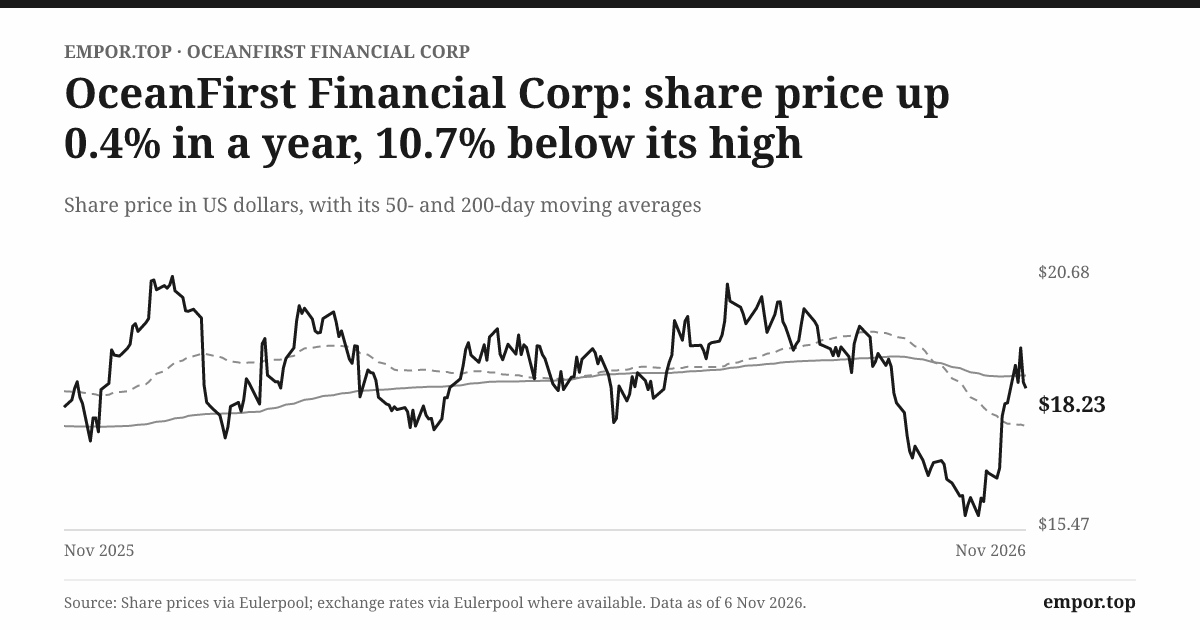
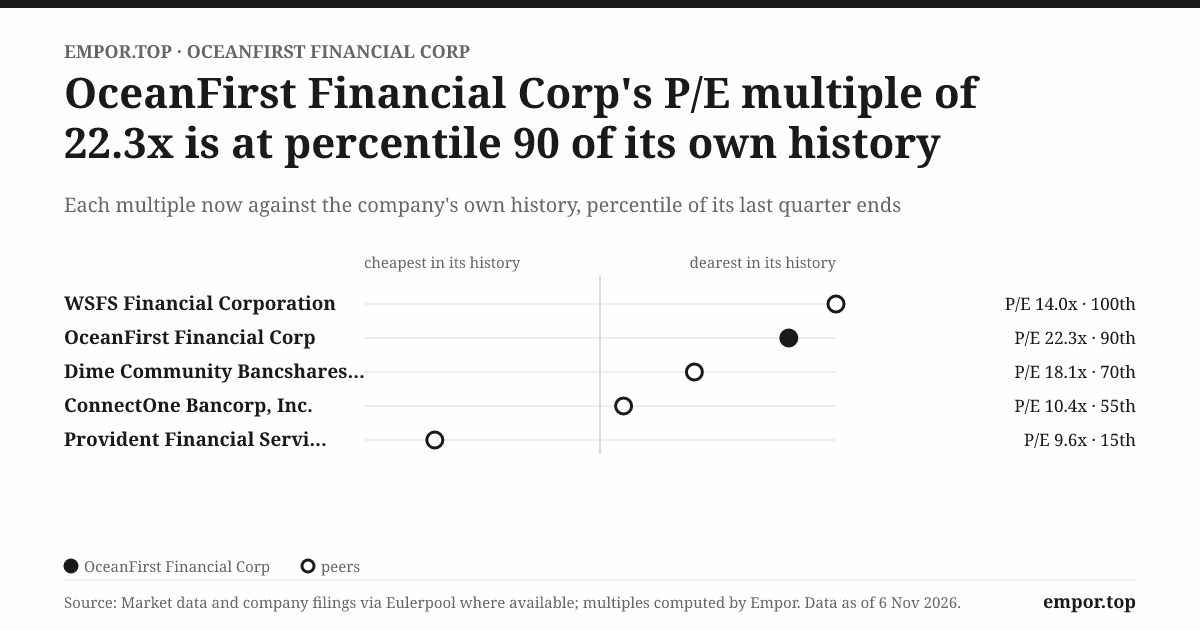
On November 6, 2026, OceanFirst's shares closed at about $18.23, roughly 11% below their high of the previous year and comfortably above their low of about $15.75. On a standard stock screen, the picture looked contradictory. The price-to-earnings ratio was about 22.3 times, more than double the stock's five-year median of about 10.7 times. Yet the price-to-book ratio was about 0.7 times, suggesting the stock traded well below the accounting value of the company. An investor glancing at those two numbers might conclude that OCFC was simultaneously expensive and cheap. Both conclusions would be premature, because neither number survives a closer look.
Start with the earnings multiple. Over the twelve months to September 2026, diluted earnings per share added up to about $0.65.23 At $18.23, that implies a P/E of about 28 times, not 22.3. The screen and the simple calculation do not match, likely because they use different share counts or different earnings periods. Either way, the trailing figure is nearly meaningless as a guide to value, because the twelve months include the GAAP loss of the second quarter and the heavy merger costs of the third. Any multiple built on that earnings base will look extreme.
The book-value figures are even harder to reconcile. Screens put book value at about $41.74 per share. The company itself reported tangible book value of about $18.08 per common share at the end of September.1 The gap between those numbers is far too large to be explained by goodwill and intangible assets alone, and the 0.7 times price-to-book ratio does not match either figure divided into the share price. The likeliest explanation is that some provider figures still reflect the pre-merger share count. Warburg's 9.57 million shares represented 9.9% of the voting stock, which implies something close to 97 million voting shares outstanding after the merger.6 On that basis, the company's market value is closer to $1.75 billion than the $1.0 billion some screens show. The lesson is that for a bank in the middle of a large merger, standard screens can be wrong in ways that matter, and the company's own reported figures should take precedence.
So what is the right way to value a bank? Professional bank investors usually focus on four things: sustainable earnings power, tangible book value, capital strength and credit risk. Revenue and operating-margin measures that work for industrial companies are not very useful here, because a bank's "revenue" depends heavily on how its data provider defines it, and the meaningful line is net interest income after credit losses.
By the measure most bank investors use, price to tangible book, OCFC trades at about one times: $18.23 against $18.08.1 That is a revealing number. It says the market is paying roughly the value of the bank's tangible equity and attaching little or no value to its franchise, its deposits or its future earnings above the cost of capital. For a bank earning a thin return on equity, that is about what one would expect. A bank that earns its cost of equity typically trades at or above tangible book. A bank that persistently earns less trades below it. The market, in other words, is not paying for the 2027 target. It is waiting to see it.
There is a reason to be careful even with tangible book, and it sits in the securities portfolio. Like most banks, OceanFirst holds a large book of bonds, and it classifies part of it as "held to maturity," which means the bonds are carried at their original cost rather than their market value on the assumption that the bank will never need to sell them. At the end of September, the held-to-maturity portfolio had a carrying value of about $3.00 billion and an estimated fair value of about $2.82 billion.2 The difference, roughly $180 million, does not reduce reported tangible book, because accounting rules let the bank ignore it as long as it holds the bonds until they mature. If the bank ever had to sell them, to meet deposit outflows, for example, the loss would become real. That is not a prediction; deposits are stable and the bank has other sources of liquidity. It is a reminder that tangible book is an accounting figure built on assumptions about the future, and that the one-times multiple the market is paying already reflects some of that uncertainty. For a bank that also carried more than $6 billion of uninsured deposits before the merger, the interaction between rate-sensitive funding and underwater bonds is the kind of risk that stays invisible until it suddenly is not.3
The core earnings run rate gives a second angle. If the third quarter's core EPS of $0.48 were annualized, it would come to about $1.92, putting the stock at roughly 9.5 times that figure.5 That is close to the 9.7 times trailing earnings of Provident Financial Services and below the 11.4 times of ConnectOne Bancorp on the same dates.1516 So on management's own core numbers, OCFC looks roughly in line with its nearby peers, not expensive. But that comparison flatters OceanFirst in one important way. Peer multiples are based on GAAP earnings, while the 9.5 times uses a core figure that excludes merger costs and includes a quarter of purchase accounting. Peer comparisons are a rough screen, not a conclusion.
Where the edge runs out
To weigh the bull and bear cases fully, it helps to look at the industry's structure, and at what kind of advantage OceanFirst might have within it.
Michael Porter's five forces framework starts with rivalry, and rivalry in New Jersey and New York banking is intense. The giant national banks, the regional banks and the community banks all chase the same commercial borrowers and the same deposits. The power of buyers, here the borrowers, is substantial, because a creditworthy commercial real-estate borrower can shop a loan across several lenders. The power of suppliers is the most important force in modern banking, and the supplier is the depositor. When rates rose, depositors demanded more, and the bank had to pay up or lose funding. OceanFirst reported about $6.46 billion of uninsured deposits in 2025, money above the government's insurance limit that tends to be the most rate-sensitive and quickest to move.3 The threat of substitutes is growing: online banks and money-market funds compete for deposits, and private credit funds compete for commercial loans. The threat of new entrants is limited by regulation and capital requirements, which protect incumbents but do not give any one bank an advantage over the others. Taken together, the forces describe a business where a regional bank can earn a fair return with good management, but where structural excess returns are rare.
Hamilton Helmer's seven powers framework asks which of seven sources of durable advantage a company possesses. Scale economies are the obvious candidate for a merger strategy. A bigger bank can spread the fixed costs of technology, compliance and management over more assets, which is the whole point of combining OceanFirst and Flushing. That is real, and the third quarter's lower-than-guided costs suggest some of it is already arriving. But the national banks have far larger scale, so it is a relative advantage over smaller community banks, not over the market. Switching costs are the second candidate. Business customers with treasury-management services, loans and deposit accounts all at one bank do find it cumbersome to move. But OceanFirst does not disclose retention rates, and the deposit repricing it is now applying to Flushing customers is the live test of how sticky they are. Brand, network effects, counter-positioning, cornered resources and process power do not apply in any meaningful sense to a regional bank of this kind. On the evidence, OceanFirst has a modest scale advantage over smaller competitors and possibly some switching costs among business customers. It does not have a moat in the strong sense.
The bull case, then, needs three things to happen. The cost savings promised for Flushing must arrive in GAAP earnings, not just core ones. The acquired deposits must stay while their rates are cut, so that the margin holds near or above its 3.08% baseline. And returns must rise toward the 1% target, which would justify a valuation above tangible book. If all three happen, the current price would look like a bank priced for its past, not its future.
The bear case points to the evidence that the bull case has not yet overcome. Commercial real-estate concentration remains high, with New York at the center. The acquired book's credit performance is unproven, and early-stage delinquencies are worth watching. The deposit base the bank bought was relatively expensive, which is part of why the price was low. And the record of the past decade shows a bank that grew much larger without growing its per-share earnings. If the returns stall below target, the market has little reason to pay more than tangible book, and every quarter of merger costs and dividends that outruns earnings erodes it.
That debate comes down to three numbers. The first is return on assets, on both a core and a GAAP basis, measured against the 1% target, with core ROAA currently around 0.80%.5 The second is commercial real-estate credit: the formation of new non-performing loans and charge-offs, currently low at about 0.04% annualized, against a non-performing ratio that has risen to 0.85% with the acquired book.2 The third is tangible book value per share, currently about $18.08, tracked after merger costs and dividends.1 If those three move the right way together, the bull case is winning. If any one of them moves the wrong way, the bear case gains ground. What OceanFirst's whole history has to teach about which way they will move is the subject of the next section.
IX. Business & Investing Lessons
A decade apart, OceanFirst made two bets that look different on the surface and are the same underneath. In 2016 it bought its way down the Jersey Shore, adding Cape Bancorp and Ocean Shore and pitching itself as New Jersey's fourth-largest banking institution by deposit market share.10 A few years later it crossed $10 billion. And in 2026 it bought its way into New York, adding more than half again to its size in one transaction and attaching a public earnings target to the result. Over the span of those bets, assets grew from about $2.4 billion in 2014 to $14.6 billion in 2025, before Flushing added roughly $8.7 billion more.34 Net profit, meanwhile, fell about 30% in 2025 alone.3 The lessons are hidden in the space between those two facts.
The first lesson is that in banking, a bigger map is not a moat until deposits stay and loans pay. OceanFirst has proved it can buy branches and customer lists efficiently; customer loyalty and pricing power still have to show up in retention and deposit costs. Flushing's depositors, whose rates are now being cut, are the next test.
The second lesson is that a low purchase multiple is an opening bid from the evidence, not the final answer. OceanFirst's below-book purchase price for Flushing4 becomes a bargain only if integration improves its deposit costs, multifamily exposure and returns. If it does, the low price will look like discipline. If it does not, it will look like the market was right. For founders and investors in any industry, the point is the same: the price of an acquisition is the beginning of a thesis, never its proof.
The third lesson is that the return target is the strategy in its shortest form. Maher's 1% return on assets target forces the deal's promised savings and its risks into a single measurable result. That is valuable precisely because it is unforgiving. A bank can explain away a missed cost target or a weak quarter for credit. It cannot easily explain away a return on assets that stays well below the goal. The low returns of recent years make the target more important, not less. Investors should hold management to it, and should notice whether the target, or its definition, starts to drift.
The fourth lesson is about proportion. The bank's other businesses may broaden what it can offer its customers, but none is disclosed separately or appears large enough to move consolidated earnings. In a bank this size, what moves the needle is the spread on $16 billion of loans and $18 billion of deposits. Everything else is a supporting act until the numbers prove otherwise. The investor's discipline is to give optionality the weight its evidence earns, and in this case the evidence is thin.
Put those together and OceanFirst shows both the power and the limits of acquisition-led banking. Deals can buy reach quickly, far faster than any bank could build it branch by branch. But reach is not the same as returns. Only recurring earnings, measured per share and after the costs of the deals that bought them, prove that the reach was worth the price. That proof is what the next twelve months are supposed to deliver.
X. Epilogue
Tonight, OceanFirst sits at an unusual moment. The September systems conversion is complete.5 The third-quarter results were in, and the filing that details them was published on November 6.2 The integration calendar, the stretch when everything could be explained as a one-time cost, is giving way to ordinary quarterly results. From here on, every quarter will be a test that the bank either passes or fails in public.
The first test is costs. The first full combined quarter came in below the company's own guide.5 What investors need next is a clear bridge: how much of the promised savings has been achieved, how much is still to come, and when merger costs will stop appearing in GAAP earnings. The moment GAAP earnings approach core earnings is the moment the integration has really ended. If the gap persists into 2027, with new "one-time" costs replacing old ones, that would say something about how well the deal was planned.
The second test is whether loans and deposits grow together, and whether Flushing's deposits stay as rates fall. The healthy outcome is modest growth on both sides, with new commercial lending going to borrowers outside the New York investor real-estate book, gradually diluting the 56% concentration. If the concentration does not fall, the bank is still carrying the same risk, only at a larger size.
The third test is credit. The acquired book's health remains uncertain, and the $43.1 million of loans that were 30 to 89 days past due at the end of September is the leading indicator.2 If most of those loans cure, the acquired book is healthier than its headline non-performing ratio suggests. If they roll into non-accrual, and borrowers facing higher repricing costs struggle to add equity, credit costs could start to eat into the earnings the deal was supposed to generate, as Lebel warned.1
The fourth test is the scoreboard itself. The combined bank's reported return on assets, return on equity and tangible book value per share through 2027 will show whether it is approaching the 1% target and the roughly three-year earnback the deal projected.4 KBRA, which affirmed the ratings before the deal closed, will also have its own view once it has seen the integration in practice.12 A rating change in either direction would be an independent signal.
Each outcome carries a clear meaning. If costs fall, deposits hold and credit stays benign, the Flushing deal will have done what its architects said it would, and OceanFirst will have proven that it can turn a purchased footprint into a better-earning bank. If costs fall but deposits leave, the deal will have bought a branch network that shrinks. If credit deteriorates, the low purchase price will have been a fair reflection of the risk rather than a bargain.
The question that remains unresolved is the same one the story started with. OceanFirst has bought a New York footprint. What it has not yet done is show that the relationships inside that footprint will earn, organically and durably, the returns that justify having bought them.
XI. Outro
Go back to the depositor at the branch on the Jersey Shore: the one whose savings, in 1902, were lent to a neighbor to buy a home.3 Her bank had no shareholders, no earnings target and no need to be anywhere but where it was. More than a century later, that bank's descendant answers to shareholders and a private-equity investor, and faces a public return target.
The defining bet is that the community-bank relationship can travel through acquisitions. The chart of its assets says the bet worked. The record of its returns says the proof is still pending.
OceanFirst has bought the map. Now it has to make the relationships earn.
References
-
Q3 2026 Earnings Call Transcript — The Motley Fool, 2026-10-28 ↩↩↩↩↩↩↩↩↩↩↩↩↩↩↩↩↩
-
2026 Q3 Form 10-Q — OceanFirst Financial Corp., SEC, 2026-11-06 ↩↩↩↩↩↩↩↩↩↩↩↩↩↩↩↩↩↩↩↩↩↩
-
2025 Form 10-K — OceanFirst Financial Corp., SEC, 2026-02-27 ↩↩↩↩↩↩↩↩↩↩↩↩↩↩↩↩↩↩↩↩↩↩↩↩↩↩↩↩↩↩↩↩↩↩
-
Joint Proxy Statement/Prospectus, Form S-4/A — OceanFirst Financial Corp., SEC, 2026-02-23 ↩↩↩↩↩↩↩↩↩↩↩↩↩↩↩↩↩
-
Q3 2026 Earnings Release — OceanFirst Financial Corp., 2026-10-27 ↩↩↩↩↩↩↩↩↩↩
-
2026 Proxy Statement — OceanFirst Financial Corp., SEC, 2026-04-27 ↩↩↩↩↩↩↩↩↩↩↩
-
OceanFirst Announces Agreement to Acquire Ocean Shore Holding Co. — OceanFirst Financial Corp., 2016-07-13 ↩↩↩↩↩↩↩↩↩↩↩↩↩
-
2022 Investor Presentation on Strategic M&A — OceanFirst Financial Corp., SEC exhibit, 2022 ↩↩
-
KBRA Affirms Ratings Following Flushing Merger Announcement — KBRA, 2025-12-30 ↩↩↩↩
-
Q2 2026 Earnings Call Transcript — The Motley Fool, 2026-08-07 ↩↩
-
2026 Annual Meeting Results, Form 8-K — OceanFirst Financial Corp., SEC, 2026-05-28 ↩
 LinkedIn
 WhatsApp
 Reddit
 Hacker News
 Email
 Kindle
 RSS Feed
 Spotify
 Apple Podcasts
 Amazon Music
 Audible
 YouTube