Valley National Bancorp (VLY): The Quiet Modernization of a Jersey Giant
Act I: Introduction & The 2023 Regional Banking Crucible
In the second week of March 2023, the ground beneath American regional banking simply gave way. Silicon Valley Bank, the $200-billion lender to half the venture-backed startups in the country, went from solvent to seized in the span of about forty-eight hours, undone by a classic run in the age of the smartphone — depositors moving billions with a thumb-swipe while the bank slept. Two days later, Signature Bank of New York was gone too. By the following weekend, every bank analyst in America was doing the same grim triage: which lender looks the most like the ones that just died? Who has too much long-duration bond exposure, too many uninsured deposits, too much concentration in one nervous corner of the economy?
It is worth pausing on why March 2023 was a genuinely new kind of danger, because it reframes everything about Valley's escape. Bank runs used to be slow — a queue forming outside a branch, a story on the local news, a day or two for panic to build. The 2023 runs were instantaneous. Depositors could move money in seconds from a phone, and they coordinated in group chats and on social media at the speed of rumor. Silicon Valley Bank lost an estimated $42 billion of deposits in a single day. That changed the physics of the problem for every regional bank in the country: it was no longer enough to be fundamentally sound over a quarter; you had to look sound in an afternoon, to depositors who could leave before lunch. In that environment, a scary-looking ratio was not an abstraction. It was a spark near dry tinder.
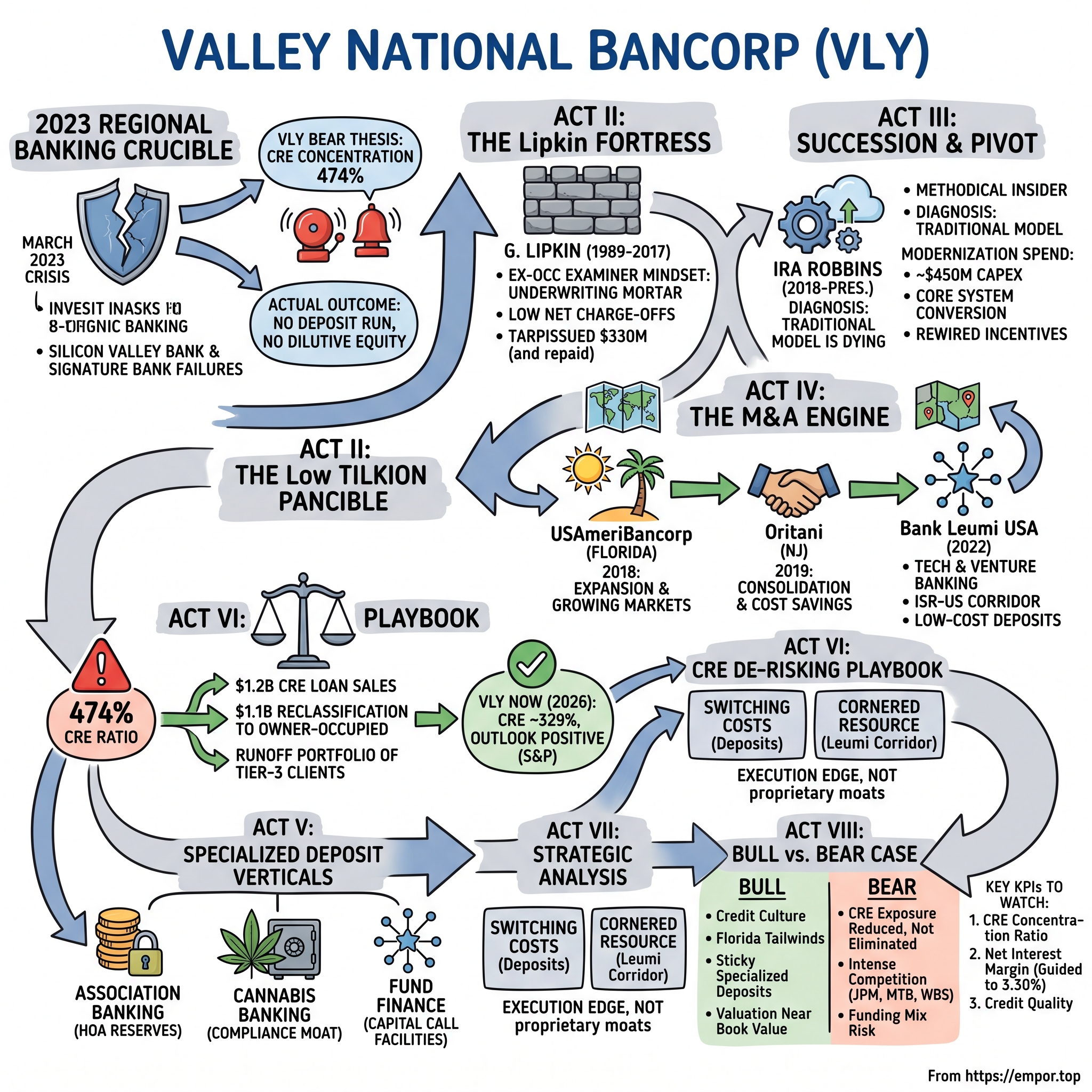
The short sellers had their answer for New Jersey. They pointed at Valley National Bancorp — ticker VLY on the NASDAQ Global Select Market, roughly $64 billion in assets and around 3,600 employees spread across some 200 branches in New Jersey, New York, Florida, and beyond, a bank whose roots run back nearly a century into the suburbs of North Jersey.1 The bear thesis fit on an index card. Valley, they said, was a commercial real estate bank wearing a community-bank costume. Its regulatory CRE concentration — the ratio that measures how much of a bank's capital is riding on commercial property loans — stood at a startling 474% of total risk-based capital at the end of 2023.2 Regulators have flagged 300% as the level at which they start asking hard questions; Valley was carrying more than half again that much. In a world suddenly terrified of office towers and rent-stabilized apartment blocks in New York, that number looked less like a business model and more like a fuse.
And so the interesting question — the one worth building an entire story around — is not why the market panicked. It is why the panic was wrong. Valley did not raise dilutive emergency equity at a distressed stock price. It was not placed under a regulatory consent order. It did not suffer a deposit run. Over the following two years it quietly walked that 474% number down to roughly 333% by the end of 2025, and to 329% by the first quarter of 2026 — without, by management's account, ever selling a share of stock to do it.23 In March 2026, S&P Global Ratings, which had spent years with a cautious eye on the sector, revised Valley's outlook to positive, explicitly crediting the CRE reduction and capital strength.5 The bank that was supposed to be the next domino instead became a case study in how you defuse a balance sheet in slow motion, in public, without blinking.
This is the puzzle we are going to unpack. But it would be a mistake to tell this only as a real-estate story, because the real story is stranger and more interesting than that. It is the story of how an almost pathologically cautious New Jersey thrift — a bank so conservative it once measured success by how little it lost — remade itself over roughly a decade into a diversified commercial lender with venture-banking teams in Palo Alto, private-banking relationships tied to Israel, deposit desks servicing homeowners' associations in Florida, and a rigorous, first-mover franchise banking the legal cannabis industry that most of Wall Street still won't touch. It is a story about a 22-year insider who inherited a fortress and decided, gently but firmly, to rebuild it while people were still living inside.
There is an irony worth naming at the outset. The very institution the market feared in 2023 owed part of its resilience to an acquisition it had made only a year earlier — buying the American arm of an Israeli bank, complete with a venture-banking franchise and a base of low-cost, sticky deposits, at a moment when almost everyone else was paying dizzying premiums for exactly that kind of asset. When Silicon Valley Bank failed, its deposits fled because they were concentrated, uninsured, and skittish. Valley's newly acquired venture and private-banking deposits, by contrast, were the kind that tend to stay. The bank that looked most exposed to the panic had, almost by accident of timing, spent the prior year buying insurance against it.
To follow it, you need to hold two facts in tension. Valley's great historical asset is credit discipline — the boring, unglamorous refusal to make dumb loans. Its great modern risk is that in reaching for growth, diversification, and yield, a bank can quietly trade away exactly the discipline that made it worth saving. Whether Valley has threaded that needle, or merely postponed the reckoning, is the thread that runs through everything that follows. Along the way we will meet an old-school examiner who built a fortress, an insider who chose to renovate it, a run of acquisitions that stretched the bank from Tampa to Tel Aviv, and a set of niche businesses — from condo-association reserves to cannabis credit — that most of Wall Street never bothered to notice. We begin where the culture was forged: in the office of a former federal bank examiner who spent thirty years teaching a bank to be afraid of the right things.
 Subscribe on LinkedIn
Act II: The OCC Examiner & The 30-Year Fortress
Every bank has a founding myth, and Valley's is deliberately modest. It opened its doors in 1927 as the Passaic Park Trust Company, a neighborhood institution in Passaic, New Jersey — a mill town whose textile economy was about to be flattened by the Great Depression.20 A bank that learns to lend money in Passaic in 1929 learns one lesson above all others: the loan you don't make can't hurt you. Over the following half-century the institution changed names more than once — Bank of Passaic and Clifton, then Valley National Bank after it absorbed the Bank of Wayne in 1976 — and slowly knit together a branch network across the affluent, slow-growing suburbs of Bergen and Passaic counties.20 For decades it was, by design, unremarkable. That was the point.
The man who turned that caution into a religion arrived in 1975 and took the top job in 1989. Gerald H. Lipkin was not a salesman or a dealmaker by temperament; he was, by training, a cop. After graduating from Rutgers in 1963 he went to work for the Office of the Comptroller of the Currency — the OCC, the federal agency that examines national banks — where he spent more than a decade learning, from the inside, exactly how banks blow themselves up.6 He rose to deputy regional administrator before crossing over to run credit at a small New Jersey bank, and he brought the examiner's mindset with him: assume the loan will go bad, and ask whether you still get paid. When Lipkin became chief executive, he had a bank of eight branches and under $2 billion in assets. When he finally handed over the keys at the end of 2017, Valley had grown to more than 200 branches across four states and over $23 billion in assets, stitched together through some sixteen acquisitions — every one of them, by his standard, a bank he understood.6
It is hard to overstate how unusual that background was. Most bank chief executives come up through the sales side — they are lenders who made their name booking big loans, or dealmakers who grew the balance sheet through acquisition. Lipkin came up through the examination side, which is the institutional equivalent of putting the fire marshal in charge of the building. An examiner's whole job is to walk into a bank, ignore the optimistic story management is telling, and ask the uncomfortable questions: what happens to this loan book if unemployment doubles, if property values fall a third, if the biggest borrower stops paying? A person who has spent a decade asking those questions for the federal government does not easily unlearn the reflex. Lipkin ran Valley as though a examiner might walk in tomorrow — because for years, one version of that examiner had been him.
What Lipkin built was a fortress, and the mortar was underwriting. In an industry that periodically loses its mind — reaching for subprime mortgages in 2006, for crypto deposits in 2021 — Valley under Lipkin was famous for the loans it declined to make. It sat out the subprime boom almost entirely. Its net charge-offs, the share of loans it actually wrote off as losses, routinely ran at or below 10 basis points a year — one-tenth of one percent — a figure that in the banking world is close to the theoretical floor.6 There is a persistent piece of Valley lore that the bank never posted an unprofitable quarter through the 2008 financial crisis. That specific claim is part of the institution's self-image more than it is a documented, independently verified fact, and it deserves to be labeled as such — but the underlying reputation, that Valley walked through the greatest banking crisis in eighty years without serious credit damage, is well earned.
Here, though, is where the origin myth needs a correction, because the neat version of this story says Valley was so strong it refused the government's 2008 bailout. It did not. In October 2008, Valley volunteered for the Treasury's Troubled Asset Relief Program and issued $330 million of senior preferred stock to the government under the Capital Purchase Program. Lipkin, far from spurning it, publicly called the terms "favorable" and "a very attractive low-cost alternative to other capital sources."8 Valley was among the healthier banks the government wanted in the program precisely to remove the stigma for weaker ones, and it repaid the money later. The distinction matters, because it tells you something true about Lipkin that the "we-took-no-help" legend obscures: he was conservative, not sentimental. When cheap capital was on offer on good terms, the examiner took it. That is worth remembering when we later judge his successor's willingness to do unglamorous, unpopular balance-sheet maneuvers.
To be fair to the fortress, this was a deeply successful strategy for a very long time. A bank that compounds book value through crisis after crisis without ever needing to be rescued is doing something most of its peers cannot. Valley paid dividends without interruption; it never had the near-death experience that humbled dozens of larger institutions in 2008; and it earned a reputation among regulators and depositors as a place where your money was, above all, safe. Lipkin's Valley was the banking equivalent of a Volvo — unglamorous, a little slow, and almost impossible to kill. For most of his tenure, that was precisely the product the market wanted from a community bank.
But fortresses have a cost, and by around 2017 Valley's was becoming visible. The very conservatism that protected the bank had left it structurally slow. Its deposit base was anchored in a high-cost, brick-and-mortar branch network sitting in the low-growth suburbs of northern New Jersey — expensive real estate gathering expensive deposits in markets where the population and the loan demand were both barely growing. Its digital capabilities were, charitably, a generation behind. And its net interest margin — the spread between what it earned on loans and paid on deposits, the fundamental profit engine of any bank — was under quiet, structural pressure as funding costs crept up and the plain-vanilla Northeast real estate lending that filled its books grew ever more competitive and ever lower-yielding. The fortress was safe. It was also, slowly, becoming a museum. The question of what to do about that would fall to a man who had spent his entire adult life inside its walls.
Act III: Succession & The Great Modernization Pivot
When a legendary CEO retires after nearly three decades, the safe move is to hire a reassuring clone — someone who promises to change nothing. Valley did roughly the opposite, though it didn't look that way at the time. In November 2017 the board announced that Lipkin would retire and that his successor, effective at the end of that year, would be Ira Robbins.7 On paper Robbins was the ultimate insider: he had walked into Valley in 1996 straight out of school, through the bank's Management Associate Program, and had spent the following two decades rotating through credit administration, retail banking, technology, human resources, treasury, and finance.7 He was, in every visible respect, a company man — which is exactly why almost no one outside the building expected him to be a reformer.
Robbins' résumé is worth dwelling on because it explains his method. He had not spent twenty-two years in one silo; he had rotated through the guts of the whole institution — credit administration, retail banking, technology, human resources, treasury, finance.7 By the time he reached the corner office he had, in effect, audited every department from within. He held a finance and economics degree from Susquehanna University and an MBA from Pace, was a graduate of the Stonier Graduate School of Banking, and was even an (inactive) New Jersey CPA — a numbers person, not a rainmaker.9 The picture that emerges is not of a charismatic outsider parachuting in with a revolution, but of a methodical insider who had quietly diagnosed the disease for years and finally had the authority to prescribe.
That reading missed something. A 22-year insider is not just loyal; he is diagnostic. Robbins had seen the machine from the inside of nearly every department, and he had reached a conclusion that would have been heresy in Lipkin's office: the traditional community-bank model was, in his view, structurally dying. The classic formula — gather sticky, low-cost retail deposits from your local branch network and lend them out against local real estate — depended on two things that were disappearing. It depended on retail deposits actually being cheap, which stopped being true the moment a saver could open a phone and move money to a 5% online account in ninety seconds. And it depended on plain real estate lending being profitable, which stopped being true as every bank in the Northeast chased the same buildings. Robbins' diagnosis was blunt: keep doing what made Valley safe, and you slowly starve.
The pivot he set in motion was less a strategy document than a cultural argument, and it is worth stating plainly because everything in the later acts flows from it. Robbins wanted to move Valley from what he described as a process-driven, defensive institution toward one that was, in his framing, agile, relationship-focused, and diversified — organized around winning a customer's entire operating relationship rather than booking a single loan. In banking, this is the difference between being a vending machine and being a partner. A vending machine sells one product — a mortgage, a construction loan — and competes purely on price. A partner holds the customer's deposits, treasury management, payroll, and lending together, which makes the relationship both more profitable and far harder for a rival to pry loose. That second model is where Robbins wanted to go, and on the Q1 2026 earnings call, nearly a decade later, he was still describing the strategy in exactly those terms — winning "primary operating relationships" and building "a stable funding engine that can support growth aspirations across cycles."1 The consistency of that language over eight years is itself a data point about management credibility; this was not a slogan reinvented every quarter.
Turning that argument into reality cost real money, and Valley spent it. Robbins undertook the kind of deeply unglamorous plumbing work that never makes headlines but determines whether a bank can compete a decade later: a full core-system conversion — replacing the aging back-end software on which every account, transaction, and report ultimately runs — plus a rebuild of the bank's data infrastructure and an organizational redesign. On the Q1 2026 call, Robbins put a number on the scale of the investment: Valley spent roughly $450 million on capital expenditure over the prior seven-to-eight-year period, against just $50 million in the comparable stretch before — a near-tenfold increase in the money going into technology and capability.1 For a bank that had spent decades proudly starving its cost base, this was a genuine philosophical break. And it was disciplined in a telling way: Robbins noted that when he became CEO, Valley had about 3,350 employees and $20 billion in assets; by early 2026 it had grown to roughly 3,607 employees and $64 billion in assets.1 Read that carefully — the balance sheet more than tripled while headcount rose only marginally. That is the definition of operating leverage: the machine got more than three times bigger without hiring a proportionate army to run it, which is exactly what all that technology spending was supposed to buy.
Robbins also did something Lipkin's era had never emphasized: he tied his own fortunes tightly to the stock and rewired the incentive structure. By the 2025 proxy, Robbins beneficially owned 650,975 shares of Valley — real skin in the game, not a rounding error.9 More importantly, he pushed the executive scorecard away from the old banker's vanity metric of sheer asset size and toward measures that actually reflect quality: return on assets, tangible book value growth, and structural efficiency. This is a subtle but important governance shift. A bank CEO paid to grow assets will grow assets, good loans or bad; a CEO paid on returns and book value has to care whether the growth is any good. Whether the incentives actually held under pressure is something we can test later against how Valley behaved during the 2023 crisis. First, though, Robbins had to solve the problem that had defined his predecessor's twilight: how do you grow when your home market won't? His answer was to go shopping — and to go where the growth actually was.
Act IV: The M&A Engine: Florida Gold & The Israel Connection
The first move told you the new CEO was serious, because it broke with New Jersey entirely. In July 2017 — even before Robbins had formally taken the chief executive title — Valley announced it would acquire USAmeriBancorp, a Tampa-based bank with roughly $4.5 billion in assets and a franchise spread across the fastest-growing corridors of Florida: Tampa Bay, St. Petersburg, Clearwater, and Orlando, with a foothold in Alabama.10 The stock-based deal was valued at roughly $816 million at announcement and closed on the first day of 2018.10 The logic was almost embarrassingly simple, and that was its strength. New Jersey's population was aging and static; Florida's was exploding with retirees, transplants, and businesses fleeing high-tax states. If your problem is that deposits and loans won't grow at home, buy your way into the place where they grow fastest.
There is a piece of internal color that makes this more than a map exercise. The Florida expansion reportedly ran into resistance from elements of the old guard, who saw it as straying from the knitting. They were wrong, and quickly. Florida became Valley's fastest-growing organic engine for both deposits and lending, the demographic wind at the bank's back precisely where the Northeast offered a headwind. Years later, when management ticked through its strongest markets on earnings calls, the list — "Coral Gables, Tampa, Morristown, Manhattan, Garden City" — put two Florida markets ahead of the New Jersey heartland.1 The USAmeriBancorp deal was the moment Valley stopped being a New Jersey bank with ambitions and started being a Sunbelt-and-Northeast bank with a barbell.
The second deal was the opposite in spirit: not expansion but consolidation. In June 2019 Valley agreed to buy Oritani Financial, a northern New Jersey thrift with about $4.1 billion in assets, in a deal valued at roughly $740 million.11 Where Florida was about reaching new customers, Oritani was about wringing cost out of an old market. Oritani's branches overlapped heavily with Valley's own footprint in Bergen and the surrounding counties, which meant the acquisition let Valley bolster its deposit share and then close redundant branches — turning two thin, competing networks into one denser, cheaper one. The freed-up capital and cost savings were not the point in themselves; they were fuel. Robbins was systematically harvesting savings from the low-growth legacy business to pay for the technology and talent that would build the new one. In the chess terms this act is named for, Florida was a move toward the opponent's side of the board; Oritani was consolidating pawns to free the pieces behind them.
Then came the move that genuinely rewired the company. In September 2021 Valley announced it would acquire Bank Leumi USA — the American arm of בנק לאומי Bank Leumi, one of Israel's largest banks — in a deal valued at roughly $1.15 billion, completed on April 1, 2022.1213 To understand why this was the crown jewel, you have to look past the price to what Valley actually bought. Bank Leumi USA was not a branch network; it was a specialist. It came with an elite technology and venture-capital banking team operating out of New York, Los Angeles, Palo Alto, Chicago, and Miami — bankers who spoke fluently to startups and their investors — and it brought with it nearly $2 billion in low-cost venture deposits and a private bank managing roughly $4.1 billion in client assets.12 For a bank whose funding base had been anchored in expensive suburban retail deposits, acquiring a franchise built on cheap, sticky, relationship-driven venture and private-banking money was a direct strike at Valley's oldest structural weakness.
There is a human dimension to why an asset like this is so hard to buy or build. Venture banking is a relationship business conducted in a small, high-trust world. A startup founder chooses a bank on the recommendation of an investor who has used that bank for a decade; the banker who lands the relationship has spent years building credibility inside a particular ecosystem. You cannot manufacture that overnight by opening an office in Palo Alto and printing business cards. The cross-border angle makes it harder still: the specific corridor between Israeli founders — Israel produces a wildly disproportionate share of the world's startups relative to its size — and U.S. capital markets is a niche that rewards exactly the kind of dual-language, dual-market relationships Leumi's team had spent years cultivating. Buying that team was buying a network that a competitor would need a decade and a great deal of luck to replicate.
It also mattered when Valley bought it. This was 2021 and 2022, the absolute peak of the tech-and-venture euphoria, when acquiring anything that touched Silicon Valley commanded a premium — rival banks were paying well north of two times book value for tech-banking franchises. Valley, by contrast, structured the Leumi deal for discipline: management guided to roughly 1% dilution of tangible book value with an earnback of about one year, meaning the deal would pay for that small hit to book value within twelve months.12 For a bank whose entire brand was credit and capital discipline, buying a glamorous asset without blowing a hole in the balance sheet was the whole point — and it looks materially better in hindsight, given that within a year the venture-banking world would be convulsed by the collapse of Silicon Valley Bank, the sector's dominant player. When SVB and Signature failed, a wave of venture and technology relationships suddenly went looking for a new home; Valley, having bought a credible venture-banking team a year earlier, was positioned to be one of them.
The M&A engine did more than add geography and deposits; it seeded new lending specialties that would drive growth years later. The clearest example is health care. By 2026, management was describing a "differentiated" health-care lending vertical — banking medical practices, senior-care facilities, and related operators — as one of the strongest sources of loan demand across the entire franchise, staffed by experienced specialists and feeding a pipeline that had roughly doubled year over year.1 This matters strategically because health-care lending is often owner-occupied commercial real estate — a doctor's group borrowing against the building its own practice occupies — which is the very category that regulators treat as business lending rather than pure property risk. In other words, one of Valley's fastest-growing new businesses happened to grow the "good" kind of real estate exposure at exactly the moment the bank was trying to shrink the "scary" kind. That was not a coincidence; it was the diversification strategy paying a dividend precisely when it was needed most.
The through-line across all of it — Florida, Oritani, Leumi, health care — is a deliberate shift from a bank defined by where it had branches to a bank defined by what it was expert at. The Leumi corridor and the specialist deposit franchises around it are where Valley's real strategic moat starts to take shape — and it is the subject of the next act.
Act V: Specialized Deposit Verticals & The Hidden Cannabusiness
Here is the mental model to hold for this whole act. Valley makes the bulk of its interest income from commercial lending — that is the visible engine, the part analysts model first. But the durable competitive advantage, the part that is genuinely hard to copy, lives on the other side of the balance sheet, in how Valley funds those loans. Lending is where the revenue shows up; deposit-gathering is where the moat is. And that leads to a truth about banking that outsiders consistently underrate: the loans get the headlines, but the deposits win the war. Anyone with capital can make a loan. The scarce, valuable, defensible thing is a base of cheap deposits that stays put when interest rates spike and competitors dangle higher yields — what bankers call low "deposit beta," meaning the deposits don't chase rates. Robbins-era Valley grasped that the way to build a durable franchise was not to out-lend rivals but to gather deposits nobody else knew how to gather. The result is a portfolio of specialist verticals that most observers, fixated on the CRE headline, never bother to look at.
The most quietly powerful of these is association banking. Homeowners' associations, condominium boards, and co-ops collect predictable monthly dues from thousands of residents and sit on large, stable reserve balances for future repairs. Those balances are close to an ideal deposit: big, sticky, and largely insensitive to interest rates, because a condo board is not going to move its reserve fund to chase an extra quarter-point. Valley built a dedicated business — with lockbox processing, treasury tools, and a concierge team aimed squarely at the property managers who actually control where those accounts sit — to capture them at scale.18 Once a property-management company has wired its dues collection, its payment processing, and its reporting into Valley's systems, moving the relationship becomes a genuine operational headache. That friction is not an accident; it is the product. It is the same workflow-integration logic that lets software companies retain customers, imported into deposit gathering.
Then there is the vertical that makes compliance officers at money-center banks break into a cold sweat: cannabis. Marijuana remains illegal under United States federal law even as a majority of states have legalized it in some form, which creates a bizarre standoff — legal, cash-generating businesses that most banks refuse to touch because handling their money can be construed as federal money-laundering. That refusal created an opening, and Valley, of all institutions, walked through it. It built a dedicated Cannabis-Related Business banking team with the compliance infrastructure — transaction monitoring, fund-movement tracking, secure cash logistics, even a cannabis-specific mobile payment tool — to bank the industry within the rules rather than around them.17 For a bank whose DNA is examiner-grade caution, this is less contradictory than it looks: the barrier to entry here is precisely rigorous compliance, which is Valley's native language.
To grasp why this is a real edge and not a gimmick, consider the trap the cannabis industry sits in. State-legal cannabis is a multibillion-dollar business, but because the federal Controlled Substances Act still classifies marijuana as illegal, national banks fear that taking a cannabis company's deposits or making it a loan could expose them to federal money-laundering liability. Legislation to fix this — the long-debated SAFE Banking Act, which would shield banks that serve state-legal cannabis businesses — has been introduced repeatedly in Congress and has repeatedly failed to become law. The result is an entire legal industry starved of ordinary banking services, forced to operate in cash and to borrow at punishing rates from specialty private lenders. That dysfunction is the opportunity. A bank willing to build genuine compliance machinery can serve creditworthy operators at rates that are high by normal banking standards but a bargain by cannabis standards — and can gather the operators' deposits, which have nowhere else to go.
The proof point arrived in September 2024, when Valley served as the lead bank arranging a $150 million syndicated senior-secured credit facility for Green Thumb Industries, one of the largest U.S. cannabis operators — a deal the parties described as a first-of-its-kind bank-led financing for the U.S. cannabis industry, replacing the high-cost debt the sector had been forced to rely on.15 Green Thumb used the proceeds to refinance more expensive debt, and the facility carried a rate of roughly SOFR plus 500 basis points — floating-rate, high-yield lending of exactly the kind that rewards a lender for stepping where others won't.15 The relationship deepened in February 2026, when the facility was expanded by an additional $50 million, bringing the total to $189 million.16 The economic logic of cannabis banking is a triple play: high-yield floating-rate loans, stable compliance-driven deposits from businesses that have nowhere else to go, and fee income from arranging the financing. It is small in the context of a $64 billion bank, but it is high-margin, hard to replicate, and emblematic of the whole strategy — find the corner of the market that scares everyone else, and get very good at it.
A quieter cousin of the venture franchise deserves a mention because it shows the same instinct applied to lending: fund finance, and specifically capital-call facilities. These are loans made not to a company but to a private-equity or venture fund, secured by the fund's right to "call" committed capital from its wealthy, institutional limited partners. Because the collateral is effectively the promise of some of the most creditworthy investors in the world to send money when asked, well-structured capital-call lending is about as safe as commercial lending gets. On the Q1 2026 call, management pointed to its fund-finance group's capital-call book as an example of lending that looks like it belongs in a riskier bucket — it sits within the broadly-watched category of loans to non-depository financial institutions — but is in fact conservatively underwritten to strong sponsors with long track records.1 It is a neat illustration of the Valley method under Robbins: find a niche that looks exotic from the outside, apply examiner-grade underwriting, and harvest a return others leave on the table for lack of expertise.
Underpinning all of these verticals is the technology spending from Act III, and by 2026 that spending had acquired a new frontier: artificial intelligence. On the Q1 2026 call, Robbins spent an unusual amount of prepared time on it, framing AI not as a science-fiction disruption but as a productivity tool bolted onto the bank's rebuilt data infrastructure.1 The concrete examples were revealingly mundane and operational: a customer-facing voice AI agent that proactively calls past-due auto-loan borrowers to prompt payment; fraud tools that verify whether a transaction is legitimate and triage suspicious-activity alerts; AI woven into underwriting, risk monitoring, and even the sales process to suggest the next best product for a client.1 The strategic claim underneath is that the years of unglamorous data cleanup — making the bank's data granular, consistent, and connected — were the true precondition for using AI at all, and that Valley did that groundwork early. This should be read with appropriate skepticism: nearly every bank in America now narrates an AI story, and the productivity gains remain largely prospective rather than proven in the financials. But the specific, deployed use cases are more credible than the usual vaporware, and they connect logically to the operating-leverage story — Robbins noted headcount had actually fallen by roughly 100 over the prior year even as the bank reinvested some of those savings into AI capability.1
Two smaller pieces round out the picture. In 2021 Valley acquired Dudley Ventures, an Arizona-based tax-credit advisory firm whose community-development arm had been awarded more than $500 million in New Markets Tax Credit allocations, giving Valley a niche stream of non-interest fee income tied to financing projects in underserved communities and green energy.14 And back in early 2020, well before the deposit wars of 2023, Valley had launched Valley Direct, a digital high-yield savings platform initially spanning eleven states — a national, branchless funnel for deposits that Robbins called "a major milestone."19 Valley Direct is a double-edged instrument, and honesty requires saying so: it gathers deposits nationally without the cost of branches, but the money it attracts is rate-shopping money, the high-beta opposite of a sticky HOA reserve account. It is a pressure-release valve to be used tactically, not the foundation of the franchise. Which brings us to the moment all of this discipline and diversification was tested at once — the CRE overhang that nearly defined Valley in the eyes of the market.
Act VI: The 474% CRE Overhang & The Non-Dilutive De-Risking Playbook
Return now to that index-card bear thesis from the opening, because in late 2023 it was the only thing about Valley the market cared about. The concentration figure — CRE loans running at 474% of risk-based capital — was real, and the fear behind it was not irrational.2 Two categories in particular terrified investors: office buildings, hollowed out by remote work, and rent-regulated multifamily housing in New York, where a 2019 change in state law had capped landlords' ability to raise rents and thereby crushed the value of the buildings and the loans against them. A regional bank sitting on a fat pile of both, at a moment when a peer like New York Community Bancorp was being forced into an emergency capital raise, looked to short sellers like a trade that wrote itself.
What Valley did next is the operational heart of this entire story, and it is worth slowing down to appreciate the craftsmanship, because the striking thing is what management refused to do. The obvious move for a bank under this kind of pressure is to raise equity — sell new stock to bolster capital and reassure regulators. But selling stock when your share price is depressed by a panic is the most expensive money there is; it permanently dilutes existing shareholders to solve a temporary fear. New York Community Bancorp's Flagstar ultimately took a dilutive capital injection at distressed terms. Robbins chose instead to shrink the problem itself rather than raise capital against it — a slower, harder, less dramatic path that required the balance sheet to be de-risked by hand.
He did it three ways, and the mechanics matter. First, outright sales: Valley sold roughly $1.2 billion of performing commercial real estate and construction loans in 2024 to institutional buyers, taking good loans off its own books to free up the capital ratio.2 Second — and this is the subtle one — reclassification. During the second quarter of 2024, Valley audited its portfolio and reclassified approximately $1.1 billion of non-owner-occupied CRE loans to owner-occupied status.2 This is not accounting sleight-of-hand; it reflects a genuine regulatory distinction. A loan on a building an outside investor rents out is treated as pure real-estate risk, but a loan on a building the borrower's own operating business occupies is treated as commercial-and-industrial lending — because it is repaid from the business's cash flow, not the property's rent. Properly reclassifying those loans lowered the CRE concentration metric because, in substance, they belonged in a different bucket. Third, runoff: Valley let its transactional, non-relationship CRE loans — the deals that never brought deposits or a broader relationship — simply mature and roll off without renewal.
The runoff piece deserves a closer look, because it reveals the strategy was about profitability, not just optics. On the Q1 2026 call, Robbins explained that Valley had spent roughly two years identifying a specific "runoff portfolio" of what he called tier-three, transactional clients — borrowers who took a real-estate loan but never brought the bank their deposits or a broader operating relationship, and who therefore earned a return below Valley's hurdle rate.1 As those loans matured, Valley simply declined to renew them, which freed up capital and lending capacity to redeploy toward higher-return, relationship-driven clients. Notice what this does: it lowers the CRE concentration ratio and raises the average profitability of the loan book at the same time. The de-risking and the return-improvement were the same maneuver viewed from two angles — which is why management could insist, credibly, that it was not being forced into a fire sale.
It also helped that Valley's actual real-estate exposure was less toxic than the headline ratio implied. On the office portfolio specifically — the category investors feared most — management stressed that its book was granular, diversified by geography, and weighted toward suburban rather than trophy-urban properties, and that by early 2026 it was seeing genuine improvement: more rational transactions, new leasing activity, and less sublease space coming back to market.1 Executives even pointed to record leasing volumes and Class A rents above $200 per square foot in New York City as evidence that the office apocalypse the shorts had priced in was not, at least in Valley's markets, materializing.1 None of this makes office lending risk-free, and a bank talking up its own worst-feared portfolio should always be read critically. But the granular, suburban-tilted composition is a materially different animal from a book concentrated in half-empty downtown towers.
The payoff was the walk from 474% to roughly 333% by the end of 2025, and to 329% by early 2026, achieved without the dilutive equity raise the market had assumed was inevitable.231 On the Q1 2026 earnings call, when an analyst pressed Robbins on the long-term target, his answer revealed the discipline underneath the maneuver: getting under 300% was, he said, a longer-term priority, but there was "very little pressure from an external perspective" forcing the pace, because the loans running off were good quality — they simply weren't hitting the return hurdle Valley now demanded.1 In other words, this was not a fire sale conducted at gunpoint; it was a deliberate rotation of lower-return relationships into higher-return ones, and the CRE metric fell as a byproduct. The external validation came in March 2026, when S&P Global Ratings revised Valley's outlook to positive, citing the successful reduction in CRE exposure and the bank's capital position.5 A skeptic should still keep one eye open here — reclassification lowers a regulatory ratio without any building actually changing, and the underlying office and rent-regulated exposures did not vanish, they simply became a smaller share of a shrinking pie. But the direction of travel, and the fact that it was accomplished without diluting shareholders during a panic, is a genuine credit to management execution. The deeper question is whether the advantages that let Valley pull this off are durable — which is where a more structural analysis comes in.
Act VII: Strategic Analysis: Porter's 5 Forces & Helmer's 7 Powers
Step back from the quarter-to-quarter drama and ask the harder question: does Valley actually have a durable competitive advantage, or is it simply a well-run bank riding a good management team that will one day leave? Banking is a brutal industry for moats. The product — money — is a commodity, capital is mobile, and any successful niche invites imitation. To test Valley honestly, it helps to run it through two frameworks investors use to separate real structural advantage from mere good execution: Hamilton Helmer's 7 Powers and Michael Porter's Five Forces.
Start with Helmer, and with the power that holds up best: switching costs. This is the strongest and most defensible thing about the Valley franchise, and it lives on the deposit side. A commercial client whose payroll, treasury management, lockbox, and reporting all run through Valley's systems cannot leave on a whim — the operational disruption of re-plumbing a company's entire cash management is a real and expensive deterrent. The same is doubly true of the specialist verticals: a property-management firm running hundreds of HOA accounts through Valley, or a cannabis operator dependent on Valley's scarce compliance infrastructure, faces switching costs that a plain deposit account never carries. This is the mechanism that turns Valley's deposits from a commodity into something closer to a subscription. It is worth noting the limit, though: switching costs protect the operating relationships, not the rate-shopping money in Valley Direct, which by design has no switching cost at all.
The second Helmer power, cornered resource, is more debatable but real in one place: the Bank Leumi corridor. The cross-border relationship pipeline between Israeli entrepreneurs and U.S. tech hubs, staffed by a specialist team with deep existing relationships, is genuinely hard for a mid-tier regional to replicate — you cannot simply post a job listing for a decade of trust between founders, investors, and bankers across two countries. Whether it rises to a true "cornered resource" in Helmer's strict sense is arguable, since larger banks could in theory poach the teams, but as a practical matter it is a differentiated asset few peers can match. The third power, scale economies, is where one should be most skeptical of the bullish framing. Valley is not a top-tier U.S. bank and enjoys no national scale advantage; what it has instead is local density — deep market share in specific geographies like northern New Jersey and Tampa Bay that confers some pricing power and branch efficiency in those markets. That is a modest, regional version of scale, not a structural moat against JPMorgan. Management's own framing on recent calls is actually more honest than the bull case: Robbins describes Valley as occupying an "underserved size range," big enough to offer a large bank's product set but small enough to give high-touch service — a positioning argument, not a scale-economics argument.1
There is one more Helmer-flavored idea worth applying, because management leans on it explicitly: a form of counter-positioning rooted in size. On the Q1 2026 call, Robbins and his team returned repeatedly to the notion that Valley occupies an "air pocket" in the market — large enough, at $64 billion in assets, to offer the full product suite of a big bank (sophisticated treasury management, capital markets, syndicated lending), yet small enough to deliver the high-touch service, fast credit decisions, and relationship focus of a community bank.1 The argument is that the true money-center banks are too big to care about a mid-market client, while the small community banks are too limited to serve one, leaving a defensible middle that Valley is deliberately sized to own. It is a plausible positioning story — and, importantly, it is a positioning claim rather than a structural moat. It depends on execution and on remaining in that size band; it is not a barrier that would stop a determined competitor from targeting the same customers, as the crowded rivalry below makes clear.
Now Porter, which mostly delivers bad news, as it should for a commodity industry. Rivalry is intense. In the New York–New Jersey metro, Valley competes for the same commercial relationships as M&T Bank (MTB), a $200-billion-plus super-regional; Webster Financial (WBS), which has built its own specialist deposit verticals and association-banking unit; and Dime Community Bancshares (DCOM), which has even launched its own cannabis and specialty-deposit teams — meaning Valley's clever niches are being actively contested, not left uncontested. It is worth being concrete about those rivals, because the competitive threat is not abstract. M&T Bank is a roughly $200-billion-plus super-regional with deep Northeast and Mid-Atlantic scale — a genuinely larger balance sheet that can out-price Valley on the biggest relationships. Webster Financial, at a comparable size to Valley, has pursued an almost parallel strategy of specialist deposit-gathering, running its own association-financial-services unit for HOAs and property managers and having bought a deposit-sweep platform administering billions in balances — meaning Valley's clever association-banking niche is directly contested by a peer executing the same playbook. And Dime Community, smaller but aggressive, has stood up its own private-banking cannabis team and a national deposits group chasing the very same low-beta specialty verticals — death care, escrow, fund banking, insurance — that Valley prizes. The uncomfortable conclusion for the bull case is that none of Valley's niches is truly proprietary; each is being actively worked by a competent, similarly-sized competitor. Valley's edge is one of execution and head-start, not of unbreachable exclusivity.
The threat of substitutes is high and structural. In a "higher-for-longer" rate environment, money-market funds and Treasury bills offer savers yields that ordinary bank deposits struggle to match, exerting relentless upward pressure on funding costs across the entire regional-banking industry — this is the substitution threat that Valley Direct both exploits and is exposed to. Buyer power — depositors' ability to move money instantly — has been permanently amplified by mobile banking, as March 2023 demonstrated in the most violent way. The forces that favor Valley are the more benign ones: the threat of new entrants is muted by the sheer regulatory difficulty of starting a bank, and supplier power is not a meaningful constraint. The honest synthesis is that Valley's advantages are real but narrow — concentrated in deposit switching costs and a handful of hard-to-copy verticals — sitting inside an industry structure that is fundamentally punishing. That is precisely the tension the bull and bear cases have to resolve.
Act VIII: Bull vs. Bear Case & Investor KPIs
So, does Valley win from here — and what would prove the thesis wrong? Let's build both cases honestly, because a fair reading of this company genuinely supports both.
The bull case rests on four planks, and its strongest feature is that it is grounded in demonstrated behavior rather than promises. First, credit culture: Valley has a nearly century-long track record, forged by an ex-examiner, of not making the loans that kill banks — and it navigated both 2008 and the 2023 panic without a solvency scare. Second, the Florida growth engine gives Valley organic demographic tailwinds that most Northeastern banks can only envy. Third, the specialist deposit verticals — association banking, cannabis, the Leumi venture and private-banking franchise — provide low-beta, hard-to-replicate funding that structurally protects the net interest margin, the single most important number in banking. Fourth, valuation: as of the first quarter of 2026, Valley reported a book value of $13.48 per share and a tangible book value of $9.94 per share, and the stock has traded close to those levels — meaning an investor is being asked to pay roughly book value for a franchise that has already done the painful work of de-risking, while some peers still trade at distressed discounts for good reason.1 The bull case, in one sentence: this is a genuinely improved bank whose stock price still reflects the old, scarier version of the story.
A word on the valuation, because it is easy to misread. Trading around book value sounds cheap, and relative to some visibly distressed peers it is — but "cheap" for a bank is only justified if the returns are adequate, and here the picture is honestly mixed. Valley's returns, while improving, remained modest through 2025: return on equity in the high-single-digit percent range and return on assets below 1%. Those are the numbers of a competent regional bank grinding its way back to health, not a high-return compounding machine. The bull is not arguing that Valley is a wonderful business trading at a discount; the argument is narrower and more defensible — that the improvement is real and under-appreciated, that the market is still pricing the 2023 fortress-under-siege while the bank has quietly become something sturdier and more diversified. If the margin expands and returns keep climbing toward peer norms, a bank earning better returns should command more than bare book value. That is the whole re-rating thesis, and it lives or dies on execution, not on the balance sheet being secretly pristine.
The bear case is equally serious and should not be waved away. The CRE exposure has been reduced, not eliminated — a genuine collapse in downtown office values or a further deterioration in New York's rent-regulated multifamily market could still spike net charge-offs, and reclassification does not make a bad building good. Competition for the very customers Valley prizes is intensifying: the former Silicon Valley Bank and Signature relationships that Leumi's team covets are also being fought over by far better-capitalized players like First Citizens (which bought SVB's remains) and JPMorgan, who can simply outspend a $64 billion bank. And there is a funding-mix risk hiding in plain sight: if the high-yield Valley Direct deposits grow faster than the low-cost specialty deposits, Valley's blended cost of funding rises and the margin advantage the bull case depends on erodes from within. An activist skeptic would add a governance-flavored challenge: Valley's returns, while improving, remain modest — return on equity in the high-single digits and return on assets under 1% in 2025 — which is respectable for a de-risking regional but hardly spectacular, and the reclassification maneuver, however legitimate, is exactly the sort of optical improvement a short seller loves to interrogate.
Underneath the bull and bear headlines sits the mechanism that will actually decide the margin question, and it is worth making concrete because it is the crux of the whole franchise thesis. Valley's funding story in early 2026 was a rotation: over the first quarter it grew direct customer deposits by more than $900 million, and used that cheaper money to pay down nearly $300 million of higher-cost brokered deposits and $350 million of expensive Federal Home Loan Bank advances.1 Total deposit costs fell 18 basis points in a single quarter as this swap played out, and the ratio of loans to non-brokered deposits improved to 106%.1 This is the specialty-deposit strategy translated into arithmetic: every dollar of sticky, relationship deposit that replaces a dollar of rented wholesale funding widens the margin, and management argued this structural rotation would keep helping even if the Federal Reserve never cut rates again.1 It is the single most important reason management expressed confidence in margin expansion — and the single clearest thing for a skeptic to watch, because if core deposit growth stalls, the whole mechanism stalls with it.
The live version of the capital debate played out in the call's Q&A, and it is instructive. Analysts pressed management on whether it could pursue high-end loan growth and keep buying back stock; CFO Travis Lan's answer was disciplined and specific — the number-one use of capital is funding high-quality loan growth, buybacks come second, and he explicitly guided that repurchases would likely be lighter than the roughly $52 million (about 4 million shares) of the first quarter to preserve capital for lending.1 He also flagged that Valley's regulatory capital ratios would rise an estimated 80 to 100 basis points if the proposed Basel III rules were adopted as drafted — a reminder that the bank was managing its capital conservatively against rules still in flux.1 That is the sound of a management team that has internalized capital discipline rather than reciting it — and notably, when an analyst asked directly about acquisitions, Robbins declined to signal any new deal, saying only that Valley would keep doing what was in shareholders' best interest.1 After a decade of aggressive M&A, a period of digestion and organic focus is itself a coherent capital-allocation choice. Analysts also probed the softest spots honestly — office exposure, non-depository financial lending (which Valley keeps at 2.6% of its portfolio versus roughly 7% for peers), and credit migration — and management's answers were concrete and quantified rather than evasive, which is itself a credibility signal.1 The efficiency ratio, a measure of costs as a share of revenue, had improved to 53.1% from 55.9% a year earlier, with management targeting a move toward 50% — evidence that the years of technology investment are beginning to show up as operating leverage rather than just spending.1
For an investor who wants to track whether the thesis is holding, three numbers matter more than all the others, and they map directly onto the three pillars of the debate. The first is the regulatory CRE concentration ratio — the scoreboard for the entire de-risking story. It has fallen to 329%, and management's stated long-term aim is to get below 300%; watch whether it keeps grinding lower or stalls, because a stall would reignite the 2023 anxieties.1 The second is the net interest margin, which sat at 3.17% in the first quarter of 2026, unchanged from the prior quarter; management has guided toward roughly 15 to 20 basis points of expansion and a margin approaching 3.30% by the end of 2026, driven by cheaper funding replacing expensive wholesale money as it matures.14 This is the direct test of whether the specialty-deposit strategy actually delivers a funding advantage or just a marketing story — if the margin expands as guided, the franchise thesis is working. The third is credit quality, best watched through the allowance for credit losses, which stood at 1.18% of loans at the end of the first quarter of 2026, alongside net charge-offs that had actually improved to 14 basis points.1 That reserve level is the market's real-time verdict on whether all that CRE the bears feared is going bad. If charge-offs stay benign and the reserve holds, the fortress is intact; if either breaks, the bear case comes roaring back.
Act IX: Epilogue & Key Takeaways
The enduring lesson of Valley's brush with the 2023 panic is not the comforting one that a safe balance sheet saves you. Plenty of banks with reasonable balance sheets were still swept up in that fear, and a few with worse ones were destroyed by it. The more useful lesson is about timing: the specialized, high-barrier niche businesses that let Valley absorb a crisis — the venture-deposit franchise, the association-banking book, the cannabis compliance moat, the Florida growth engine — were all built before the storm arrived, during the years when doing so looked like an optional, even indulgent, diversion from the core. A bank cannot construct a low-beta funding franchise in the middle of a run. The work has to be done in the calm, which is exactly when it is least rewarded and most easily deferred. Robbins' modernization was, in that sense, a decade-long insurance policy that happened to come due in March 2023.
It is worth being precise about what has actually been proven and what has not, because the temptation with a good turnaround story is to grade it before the exam is over. What is proven: Valley took a genuinely frightening regulatory ratio and walked it down by roughly 140 percentage points in two years without raising dilutive equity, without a consent order, and without a deposit run — a hard, technical, unglamorous feat of balance-sheet management that many peers could not have executed. Also proven: the funding base is meaningfully more diversified than it was a decade ago, with specialist verticals that demonstrably attract stickier, cheaper deposits, and an earnings engine that has become more efficient as the technology investment converts into operating leverage. What is not yet proven: that Valley's returns can climb from "adequate" to genuinely attractive; that its still-material office and multifamily exposures will age gracefully through a full credit cycle; and that the reach into higher-yielding niches like cannabis and venture lending will not, someday, surface the kind of credit surprise that the old fortress was built to avoid. A cautious observer keeps all three columns open.
The other thread worth pulling is what the Robbins tenure says about corporate reinvention. The conventional wisdom holds that transforming a legacy institution requires an outsider willing to break the furniture. Valley suggests a quieter alternative: a 22-year insider, who understood the fortress well enough to modernize it without demolishing the one thing that made it worth keeping — the credit discipline inherited from an old bank examiner. That is a genuinely difficult trick, because the temptation in any reinvention is to mistake the culture for the constraint, and to throw out the underwriting caution along with the branch-heavy, low-growth model. Whether Valley has truly preserved that discipline while reaching for cannabis loans, venture deposits, and Sunbelt growth is not a question that can be answered from a single strong year; it is the standing test that the next credit cycle will administer. The independent verdict for now is measured: Valley has executed a difficult de-risking without diluting its owners, diversified its funding in ways that look genuinely durable, and earned a rating agency's upgrade to a positive outlook — while carrying real, unresolved exposures and modest returns that leave the ultimate question open. It is a fortress that has learned to move. The market will decide, one CRE ratio and one margin print at a time, whether it has learned to move without losing its footing.
References
-
Valley National Bancorp Announces First Quarter 2026 Results — GlobeNewswire, 2026-04-23 ↩↩↩↩↩↩↩↩↩↩↩↩↩↩↩↩↩↩↩↩↩↩↩↩↩↩↩↩↩
-
Valley National Bancorp Form 10-K for Fiscal Year 2024 — Valley National Bancorp / SEC, 2025-02 ↩↩↩↩↩↩
-
Valley National Bancorp Reports Fourth Quarter 2025 Results — GlobeNewswire, 2026-01-29 ↩↩
-
Valley National Q4 2025 presentation: Profitability exceeds targets, ambitious 2026 outlook — Investing.com, 2026-01-29 ↩
-
Valley National Bancorp Outlook Revised To Positive — S&P Global Ratings, 2026-03-19 ↩↩
-
NJ bank mourns death of longtime CEO Gerald Lipkin — American Banker, 2025-06-20 ↩↩↩
-
Valley National Bancorp Announces the Retirement of Gerald H. Lipkin and Appointment of Ira Robbins as CEO — PR Newswire, 2017-11-02 ↩↩↩
-
Valley National Bancorp Volunteers to Participate in the U.S. Treasury Capital Purchase Program — Valley National Bancorp / SEC, 2008-10 ↩
-
Valley National Bancorp 2025 Proxy Statement (DEF 14A) — Valley National Bancorp / SEC, 2025-03 ↩↩
-
Valley National Bancorp to Acquire USAmeriBancorp, Inc. — New Jersey Business Magazine, 2017-07-26 ↩↩
-
Valley National Bancorp to Acquire Oritani Financial Corp. in Capital Accretive Transaction — GlobeNewswire, 2019-06-26 ↩
-
Valley National Bancorp to Acquire Bank Leumi USA — GlobeNewswire, 2021-09-23 ↩↩↩
-
Valley National Bancorp Announces the Completion of its Acquisition of Bank Leumi USA — GlobeNewswire, 2022-04-01 ↩
-
Valley National Bancorp Acquires Dudley Ventures and its Affiliates — GlobeNewswire, 2021-10-13 ↩
-
Green Thumb Industries Refinances its Senior Debt via Syndicated Credit Facility — GlobeNewswire, 2024-09-12 ↩↩
-
Green Thumb Industries Announces an Additional $50 Million Senior Debt Financing — GlobeNewswire, 2026-02-20 ↩
-
Banking for Cannabis & Marijuana Businesses — Valley National Bank ↩
-
Valley Bank Launches Digital Banking With Valley Direct — Patch, 2020-02-28 ↩
 LinkedIn
 WhatsApp
 Reddit
 Hacker News
 Email
Email Kindle
 RSS Feed
 Spotify
 Apple Podcasts
 Amazon Music
 Audible
 YouTube