Webull Corporation Class A Ordinary Shares: The Trading App After the Rule Changed
I. The Rule Changed; the Customer Count Didn’t
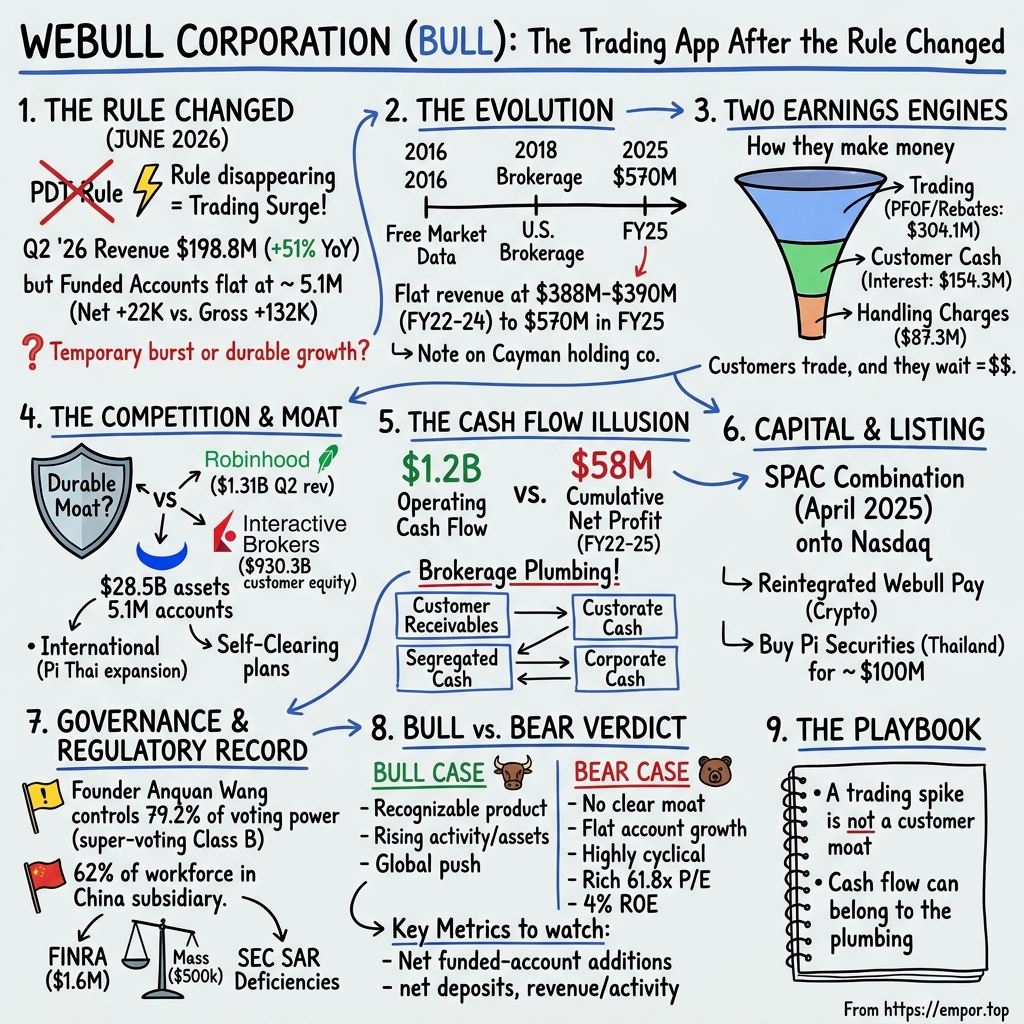
For a generation, an American trader with less than $25,000 in a margin account could make only a handful of day trades before the system stopped them cold. Then, on June 4, 2026, the pattern day trader rule went away. Webull had prepared for the day, and when the change took effect, its platform let every qualified customer place unlimited day trades.1 On that one day, the company said, it abated more than 50,000 margin calls that would have been triggered under the old regime.1 Anthony Denier, the group president who also runs Webull's U.S. business, later called the rule change "our defining event for the quarter."1
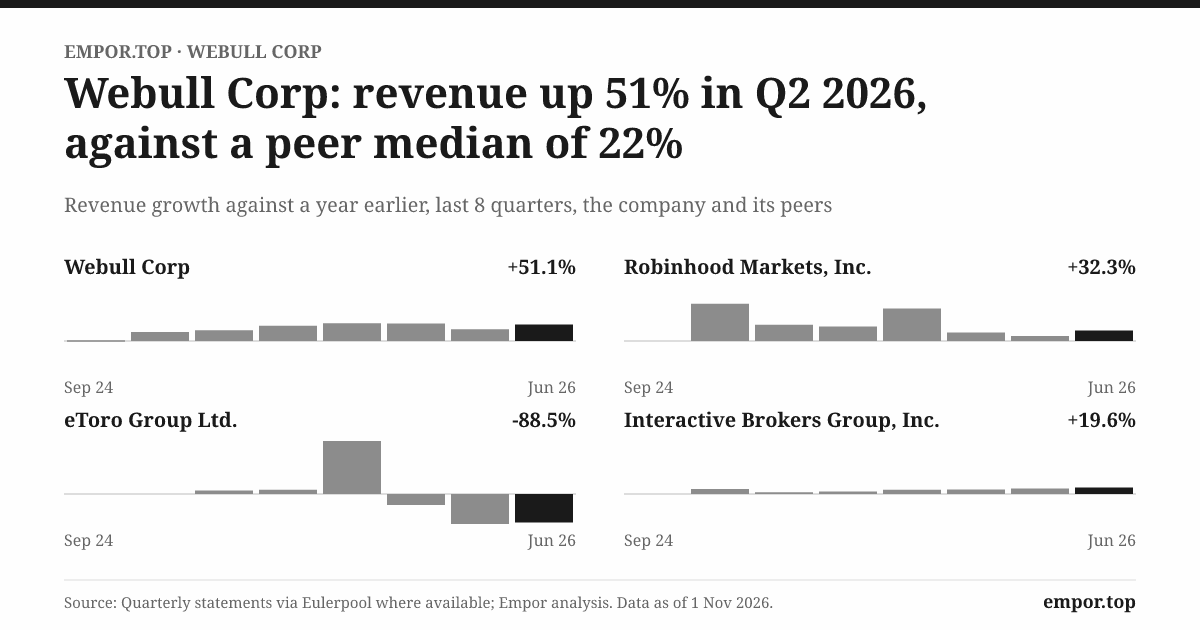
The quarter that followed was the best in Webull's short history as a public company. Revenue for the three months to June reached $198.8 million, up 51% from a year earlier.2 Customer assets on the platform climbed to $28.5 billion, up 79%.1 Daily average revenue trades, the industry's standard count of how many trades customers place each day, rose 62% to about 1.64 million.1 Operating profit came in at $45.5 million, by far the largest quarterly figure the company had reported.2
And yet one number barely moved. Webull ended the quarter with about 5.13 million funded accounts, up 8% from a year earlier.1 It had opened roughly 132,000 new funded accounts during the quarter, but after closures and a clean-up of dormant accounts, the net addition was only about 20,000.1 For every six or seven new customers who walked through the front door, almost as many walked out the back, or were shown out. That contrast, between record trading and a nearly flat customer base, is the puzzle at the center of this story.
It matters because the two halves of the quarter point to two very different companies. One is a platform that is widening its franchise: more customers, more savings, more reasons to stay. The other is a platform that is monetizing the same customers more intensely because a rule changed in their favor. Both can produce a record quarter. Only one produces a record decade.
Four questions follow from that puzzle, and they run through everything that comes after. Can Webull turn more trades into durable customer relationships, measured in deposits and accounts rather than clicks? Can its active-trader focus hold up against Robinhood, which is many times its size by revenue, and Interactive Brokers, which dwarfs it by customer assets? Can a company whose founder holds nearly four-fifths of the votes, and whose engineering is concentrated in mainland China, coexist with the regulatory trust a U.S. broker needs? And will acquisitions and new products earn back what they cost?
First, the scale of what is being judged. Webull Corporation is a Cayman Islands holding company listed on Nasdaq, and it reports as a single business: a brokerage platform for self-directed investors, operated through regulated brokers in the United States and abroad.3 It booked $570 million of revenue in 2025 and about $678 million over the twelve months to June 2026.32 That puts it in an awkward middle: too large to be a startup experiment, too small to have the scale advantages of the giants it competes with.
The first real test of the story came on the August 19 earnings call, and it is worth listening to how management framed it. In prepared remarks, the rule change was the hero. In the question-and-answer session, analysts pressed on the harder points: what happened in July, after the novelty, and how much of the surge would last. Denier's answer was confident. July options volume, Denier said, was "pretty steady," equities were a little softer than June, and August was "looking even stronger than July."1 Volumes, the executive argued, "will not revert" to pre-rule levels.1 When one analyst noted that Webull had earlier guided to at least 20% more volume from the change, Denier allowed that "there might have been a little sandbagging."1
That is a management team telling investors the catalyst is bigger and stickier than it had promised. It may prove right. But a strong first month after a rule change is evidence of a catalyst, not proof of a new baseline, and a business that had spent years standing still before its recent acceleration has more to prove than most. To understand why, the story has to go back to Changsha, and to an app that began by giving market data away.
 Subscribe on LinkedIn
II. From Free Market Data to a U.S. Brokerage
In February 2016, a small software company in Changsha, the capital of Hunan province, launched a mobile application.3 The company was called 湖南福米信息科技 Hunan Fumi Information Technology, and the app did not trade anything. It offered market information: quotes, charts, news and data that self-directed investors normally paid for or pieced together from clunky terminals.3 The idea was simple and old as the internet itself. Give away something valuable, gather an audience, and work out the business later.
The man behind it was 王安全 Wang Anquan, who would later lead the listed company as chief executive. Media reports described Wang as a former technical director in the loan division of Alibaba's Taobao and an assistant to the president of Alibaba Finance between 2006 and 2012, followed by a stint in the finance orbit of Xiaomi.4 That background explains a lot about what Webull became. Wang came out of the Chinese internet giants at a moment when they were proving that a slick consumer app, built by large and relatively low-cost engineering teams, could pull financial services onto a phone. Xiaomi and Shunwei Capital, the investment firm founded by Xiaomi chief executive 雷军 Lei Jun, together put 50 million yuan into Fumi in 2016.4 Webull was, from its first months, a product of China's mobile-finance playbook aimed at someone else's market.
That someone else was the American retail trader. In May 2018, Webull began offering brokerage services in the United States through Webull Financial LLC.3 The free-data app became a commission-free broker, with charting tools and extended-hours trading that appealed to a more active, more technical customer than the first-time investor Robinhood was courting. During the pandemic trading frenzy of spring 2020, trading on Webull reportedly rose fivefold.4 When Robinhood restricted purchases of GameStop in January 2021, Webull was also forced to suspend trading in the stock, but Denier said its halt lasted about two hours on January 29 while Robinhood's ran until evening, and new sign-ups spiked.4 Webull had found its niche: the trader who wanted more tools than a beginner's app and less complexity than a professional terminal.
The corporate structure that holds all this deserves a moment, because it changes what an investor actually owns. Webull Corporation, the listed entity, was incorporated in the Cayman Islands in September 2019.3 It sits above regulated brokers in the United States and in other markets, so the listed economics include its international operations and its technology subsidiary, not just the American broker that most customers know.3 When this story cites revenue, profit or accounts, it means the whole group.
There was one brief detour that says something about the pressures on Chinese-founded internet companies at the time. In April 2021, one of Webull's subsidiaries entered into a set of agreements with entities in China, including Hunan Fumi, that created a variable interest entity structure.3 A VIE is a contractual workaround that lets a foreign holding company consolidate a Chinese business it cannot legally own outright. Webull said it set these up "out of an abundance of caution" to comply with Chinese foreign-ownership restrictions.3 By September 2021, it had concluded that the nature of its operations did not require the arrangements, and in August 2022 it terminated them, after which Hunan Fumi no longer had any affiliation with the group.3 The structure that many Chinese tech listings still depend on was, for Webull, a fifteen-month experiment. That made the company simpler to own. It did not end questions about where its engineers sit.
Now set the operating history against the financial record, because the two tell different stories. The operating history spans a decade. The listed financial record is short and, for most of its length, flat. Revenue was essentially flat over three years, from about $388 million in 2022 to about $390 million in 2024.3 Then, in 2025, revenue jumped 46% to $570 million, and in the June 2026 quarter it grew 51% year on year.32
One relationship from those years deserves its own mention, because it shaped the economics underneath the flat line. PEAK6, the Chicago trading firm, was a minority shareholder in Webull, and its affiliate Apex Clearing handled the settlement of Webull's U.S. trades. Until May 9, 2024, that made Apex a related party.3 In 2023, Apex and Apex Crypto generated about $153 million of Webull's revenue, roughly 39% of the group total, mostly interest and fully paid stock-lending income, while Webull paid Apex about $40 million in clearing costs.3 By 2025, no related-party revenue or expense was reported.3 In other words, for much of its life a large share of Webull's balance-driven income flowed through a single partner that was also an owner. The move toward its own omnibus clearing account, and eventually toward clearing for itself, is partly a story about taking that income stream fully in-house.
The flat years were not quiet years. They contained the end of the zero-rate era, a retail trading hangover after the meme-stock boom, the shift away from a related-party clearing arrangement and a long march toward a public listing. Still, the plain fact is that for three years Webull's revenue line did not grow, and then it grew very fast. That pattern raises the question an investor has to ask before believing in the acceleration: what changed?
There are two candidate answers. One is that Webull built a better product and broader reach. It expanded into more markets, added options, futures, crypto and prediction-market features, introduced AI tools, and grew registered users to 26.8 million by the end of 2025.3 The other is that the trading environment turned in its favor. Rates stayed high enough to make customer cash lucrative, equity markets rose, retail options trading boomed across the industry, and then a federal rule that had capped small accounts' day trading disappeared.
The honest answer is that both happened at once, and the company's own record does not yet allow an investor to separate them cleanly. A good product placed in a strong market looks exactly like a great product in an ordinary one, until the market changes. To tell which Webull is, one has to understand how a broker that charges no commission actually makes money.
III. The Business Makes Money When Customers Trade—and When They Wait
Picture a Webull customer in Ohio tapping "buy" on 100 shares of a popular stock at 10:31 in the morning. No commission appears on the screen. To the customer, the trade is free. To Webull, it is the beginning of a revenue chain.
The order does not go to the New York Stock Exchange. Like most U.S. retail brokers, Webull routes it to a wholesale market maker, a large trading firm that fills retail orders, often at a fraction of a cent better than the public quote, and profits from the spread between buying and selling prices. In return for the flow of orders, the market maker pays the broker a small rebate. Multiply that rebate by millions of trades and it becomes the largest single line in Webull's income statement. In 2025, order-flow rebates were $304.1 million, more than half of the company's $570 million in revenue.3
Options make the rebate engine more powerful. An options contract carries a wider spread than a share of stock, so the rebate per contract is typically richer, and Webull's customers trade options heavily. In the June 2026 quarter, customers traded about 213 million options contracts, up 68% from a year earlier, and Denier said Webull had reached the top position among retail brokers in options for the first time.1 On top of rebates, Webull charges handling fees on some orders and contracts, such as options regulatory and exchange pass-throughs and fees in certain international markets. These handling charges added $87.3 million in 2025.3
Now follow the customer's money instead of the order. Most brokerage accounts hold some uninvested cash, and many active traders borrow against their holdings to trade on margin. Webull earns interest on both. Cash that customers leave idle can be swept or invested in short-term instruments, and margin loans carry interest rates well above the broker's own cost of funds. The broker also lends out customers' fully paid shares to short sellers and splits the fee. Together, these balance-driven earnings produced $154.3 million of interest-related income in 2025.3 Importantly, Webull reports this interest as operating revenue, not as non-operating "other income."3 It is part of the core business, not a treasury windfall on the corporate cash pile.
So Webull has two big engines and a smaller third. The first engine runs on activity: how often customers trade, and what they trade. The second runs on balances: how much customers keep on the platform, how much they borrow, and what interest rates are doing. The fees are the third. In the June 2026 quarter, the mix looked like this in rough terms: order-flow rebates of about $113 million, interest-related income of about $43 million and handling charges of about $35 million.2
The rule change shows why the first engine matters so much. With the old day-trading ceiling gone, a trader can now open and close a position ten times in one morning, and each round trip generates order flow. Webull's revenue can therefore rise sharply without a single new funded customer joining. Denier made the mechanism explicit on the August call: customers were now placing "a significant amount of smaller day trades," scalping at lower profit thresholds, which Denier said raised payment for order flow per trade.1 Trading revenue rose 66% year on year in the quarter, to about $147.7 million, while interest-related income rose only 18%.1 The rule change supercharged the activity engine and left the balance engine roughly where it was.
That gap is itself revealing. Interest income grows when customers bring more money or borrow more. It grew modestly. Trading revenue grows when the same money changes hands more often. It grew explosively. Customer assets also rose, and the average account nearly doubled to over $5,500, but a large part of any rise in customer assets in a buoyant market reflects higher stock prices rather than new deposits.1 Net customer deposits for the quarter were about $1.6 billion.1 That is real money, but it is a modest inflow for a platform whose assets rose by nearly four-fifths over the year.
What the filings do not say is equally important. Webull discloses no recurring-revenue share, no minimum customer commitments and no contract durations.3 In practice, a self-directed customer can stop trading tomorrow and move their cash next week. The company describes unit-based pricing for orders and contracts, which is the opposite of a subscription.3 Any description of the business as recurring, annuity-like or subscription-like is wrong. This is a toll road where the traffic is voluntary and the toll rate is set partly by market makers and partly by regulators.
That last point deserves emphasis because it is the hidden dependence in the model. Webull does not set its own rebate rates. Market makers decide what they will pay for flow, and they pay more when retail orders are profitable to fill, which tends to be when retail trading is frenzied. Regulators, meanwhile, have spent years debating whether payment for order flow should be restricted or reformed. The largest market maker accounted for 13.2% of Webull's 2025 revenue, and four counterparties each contributed at least 10%.3 Webull does not name them. A change in the economics of wholesale market-making, whether driven by competition, technology or rules, would flow straight through to the company's largest revenue line.
Management's own calls show how the two engines are discussed. On the May call covering the first quarter, the conversation focused on how trading revenue was growing ahead of balances and how the company was building its institutional and international businesses.5 By August, the rule change had become the explanation for nearly everything. That is not a criticism; it is what happened. But the right follow-up for an investor is whether take rates, meaning the revenue earned per trade or per contract, and activity hold after the rule-driven burst. If the smaller, more frequent trades Denier described carry higher rebates per dollar traded, that is a structural gain. If they simply reflect a burst of enthusiasm among newly unconstrained traders, the take rate could fall as behavior normalizes.
The verdict on the model is straightforward. Webull has a revenue engine that can scale very quickly, because adding trades costs almost nothing once the platform is built. That is the attraction. The same feature means results are tied to trading intensity, market levels, customer cash, interest rates and market-structure rules, five variables the company influences only partly. Which raises the question every broker eventually faces: if customers can trade anywhere for free, why should they trade here?
IV. Can a Trader’s Screen Become a Moat?
Open Webull's app on a phone and then open Robinhood's, and the difference is immediate. Robinhood looks like a consumer app: clean, bright, a few large buttons. Webull looks like a trading desk shrunk to fit a pocket, with dense charts, technical indicators, level-two quotes, options chains and an AI assistant ready to explain a chart pattern. Now open Interactive Brokers' platform, and the difference runs the other way: more instruments, more markets, more professional plumbing, and a learning curve to match. Webull sits between them, aiming at the active trader who has outgrown the first and is not ready for, or not interested in, the second.
That positioning is real, and it shows up in the numbers. But a good position on the product spectrum is not the same thing as a moat, and the size gap between Webull and its two most relevant rivals is enormous. In the June 2026 quarter, Robinhood reported $1.31 billion in revenue, more than six times Webull's $198.8 million.[^6] Interactive Brokers reported $930.3 billion in customer equity, more than thirty times Webull's $28.5 billion in customer assets.6 These businesses differ in mix: Robinhood has a large crypto and subscription business, and Interactive Brokers earns much of its income on vast global balances. So the comparison is directional, not a like-for-like valuation. The direction, though, is unmistakable. Webull is the small player in a scale business.
Run the industry through Michael Porter's five forces and the pressure points are clear. Buyers, the retail customers, have strong bargaining power, not because any single customer is large, but because they can open several accounts for free and move activity between them at will; multi-homing is cheap and common among active traders. Suppliers, meaning the market makers that pay for order flow and the clearing infrastructure that settles trades, are concentrated and powerful, as the 13.2% revenue share from a single market maker shows.3 Rivalry is intense, since every major broker has already cut commissions to zero, so competition happens through features, promotions and interest rates paid on cash. Substitutes keep multiplying: prediction markets, crypto exchanges, and wealth apps all compete for the same speculative dollar. And regulation sits over all of it, capable of reshaping routing economics, margin rules or, as June 4 proved, trading limits overnight.
Hamilton Helmer's 7 Powers framework asks which durable advantages could survive that pressure. Scale economies favor the incumbents: Robinhood and Interactive Brokers spread technology, compliance and clearing costs over far more revenue. Network effects are weak in brokerage, since one customer's trading does little to improve another's experience, aside from community features. Brand counts for something, but Webull's brand is narrower than Robinhood's. Cornered resources do not apply in any obvious way. Counter-positioning was Webull's early edge, offering pro-style tools for free when others did not, but competitors have since copied much of that. That leaves switching costs and process power as the plausible candidates, and both need evidence.
Here the company has some proof points. In the first quarter of 2026, Webull reported quarterly retention of 98.4%.7 That figure measures how many funded accounts stay, quarter to quarter, and it compares well with consumer financial apps. But the same metric looked weaker in other periods: retention was 96.9% for 2025 and 97.3% in the June quarter.31 And retention of accounts is not the same as retention of activity. A customer who keeps a Webull account but moves most of their trading to Robinhood shows up as retained. The 98.4% figure is promising, but it does not prove switching costs.
The second proof point is the institutional business. In the first quarter, institutional clients, meaning professional advisors and smaller firms using Webull's platform, accounted for about 9.5% of equity notional volume.7 Institutional customers tend to be stickier because they integrate a broker into their workflows. Yet on the August call, management put institutional assets at about $1.4 billion, roughly 5% of the total, a meaningful start rather than a second franchise.1
The third proof point is infrastructure. Webull received approval to act as a self-clearing and correspondent-clearing broker.7 In plain terms, clearing is the back-office job of settling trades, holding custody and managing the money that moves between buyer and seller. Webull completed a transition to an omnibus clearing model in October 2025.3 Doing it in-house could lower costs, give Webull more control over margin and stock-lending revenue, and allow it to clear for other brokers. But on the August call, management said the company held a clearing license and was "not currently clearing."1 An approval is a permission slip. The savings appear only when costs fall in the income statement, and they have not yet been reported.
International expansion is the other route to a larger franchise. Webull ended 2025 offering services in 14 markets with twelve broker-dealer licenses or registrations across four continents.3 By the June 2026 quarter, management said it was licensed in 35 markets and operating in 18, with about 810,000 international funded accounts and over $5 billion of customer assets in Asia-Pacific.1 That is about a sixth of the funded base. International markets can offer less competition than the United States, and a single technology platform can serve many of them. But they also bring smaller account sizes, local regulators, currency exposure and incumbents with home advantage. The rollout is a possible growth channel, not yet a demonstrated moat.
Then there is the product roadmap, where the calls themselves offer a useful test of narrative consistency. On the May call, management acknowledged that crypto coin-in, coin-out and staking features had been delayed as resources moved toward agentic AI.5 By August, the emphasis was on AI-linked tools: Webull's Vega AI assistant had about 480,000 active users, after adding roughly 160,000 in the quarter.1 Crypto, meanwhile, contributed about $2.25 million of revenue in the June quarter, just over 1%, and coin-in and coin-out were still "in the process of" being built.1 The story has shifted from crypto to AI within two quarters. Spending tells a similar story of priorities. Research and development expense was about $35.5 million in 2025, roughly 6% of revenue, down from more than 8% in 2024, because revenue rose much faster than the engineering budget.3 In the first half of 2026, technology and development expense rose to about $46 million from about $36 million, an increase of roughly a quarter, while revenue grew by more than two-fifths.2 That is operating leverage in action, and it flatters margins. It also means that for all the talk of AI, the company is not spending dramatically more on building products than it did when revenue was flat. Much of that engineering is done cheaply, by a large team in China, a point that matters again when the story turns to governance. Shifts like that are normal in a fast-moving product company. But product announcements and user counts are not evidence of monetization, and investors should ask what shipped, what customers used, and what it earned.
So what does the record say? Webull has genuine product and engagement evidence: high account retention, a top position in retail options, a growing institutional sleeve and an international footprint. It does not yet establish durable switching costs, superior customer-acquisition economics or a lasting cost advantage over larger rivals. The moat claim survives in a narrower form: Webull has a good product for a specific type of customer. Whether that becomes a franchise depends on a measure the company publishes every quarter. If trading volume rises while net account additions and net deposits stall, the platform is monetizing existing customers more intensely rather than widening its reach. Which is exactly the pattern the June quarter showed, and which makes the history of that growth worth examining closely.
V. A Rule Change Meets a Business That Had Been Standing Still
Lay two charts side by side. On the first, Webull's annual revenue from 2022 to 2024 runs almost perfectly flat, a ruler-straight line at around $390 million. On the second, quarterly revenue from the middle of 2024 onward climbs steadily, quarter after quarter, until the June 2026 quarter jumps to $198.8 million. Seen together, they look like two different companies. The question is whether the second company is winning customers or whether the same customers are simply trading more.
Start with the vocabulary, because Webull reports several customer measures and each captures a different step on the path from curiosity to cash. Registered users are people who have downloaded the app and created a login; there were about 28.2 million at the end of June, up 13%.1 Most of them never fund an account. Funded accounts are the customers who have actually put money in; there were about 5.13 million.1 Customer assets measure how much money and securities those funded accounts hold, which moves with both deposits and market prices. And trading volume, measured as daily average revenue trades, equity notional value and options contracts, measures how intensely the funded customers use the platform. Revenue comes mostly from the last two. Durability comes mostly from the middle two.
Now put the recent numbers in order. The 46% revenue growth of 2025 followed two years of essentially no growth.3 In the first quarter of 2026, funded accounts grew 8% year on year, to about 5.1 million.7 In the June quarter, after the rule change, revenue grew 51% year on year while funded accounts again grew 8%.21 The account growth rate did not change. The revenue growth rate did. That tells an investor where the acceleration came from: not from a faster flow of new customers, but from what existing customers did once they were on the platform.
The quarterly revenue line also reveals something the annual totals hide. Revenue growth swung between roughly 33% and 55% year on year across 2025, slowed to 36% in the March 2026 quarter, and then rebounded to 51% in June.2 Operating profit swung even more violently: the company reported a small operating loss of about $2 million in the March quarter and then $45.5 million of operating profit in June.2 A business whose profit can move by that much in three months is a business with high operating leverage, meaning most costs are fixed in the short run, so extra revenue falls almost straight to the bottom line, and lost revenue comes straight out of it.
Webull's monthly operating data shows what the quarterly averages smooth over. From January through June 2026, funded accounts stayed close to 5.1 million month after month, while customer assets and DARTs moved much more sharply.8 The customer count was a flat line; the activity was a mountain range. That is exactly what one would expect if a rule change and a rising market were driving growth, and exactly what one would not expect if Webull had suddenly cracked the problem of customer acquisition.
The gross-versus-net gap sharpens the point. About 132,000 gross new funded accounts in a quarter is a respectable intake for a platform of Webull's size. But the net addition of about 20,000 means that most of those gains were offset by accounts that closed or were removed.1 Denier offered an explanation on the call: the company had cleaned out dormant, low-balance accounts, a step Denier said "actually cleans up our account base," and the new deposits had come from active accounts.1 That is a plausible explanation. A broker that purges inactive accounts will show lower net additions without losing much economic value, since dormant accounts generate little revenue. But it is also an explanation that cannot be independently checked from the disclosures, because Webull does not split its closures between voluntary departures and housekeeping.
Marketing adds another wrinkle. CFO H.C. Wang told analysts that marketing spend normalized in the quarter as a 3.5% IRA matching promotion was cut to about 1%, and that marketing would normalize further over the following quarters.1 That is a reasonable move for profitability; generous deposit bonuses are expensive. But it also means the company is pulling back on one of the levers that brings in new money just as investors are asking whether the customer base can grow. If net deposits and net account additions hold up as promotions shrink, that is strong evidence of organic demand. If they slow, the earlier growth was partly bought.
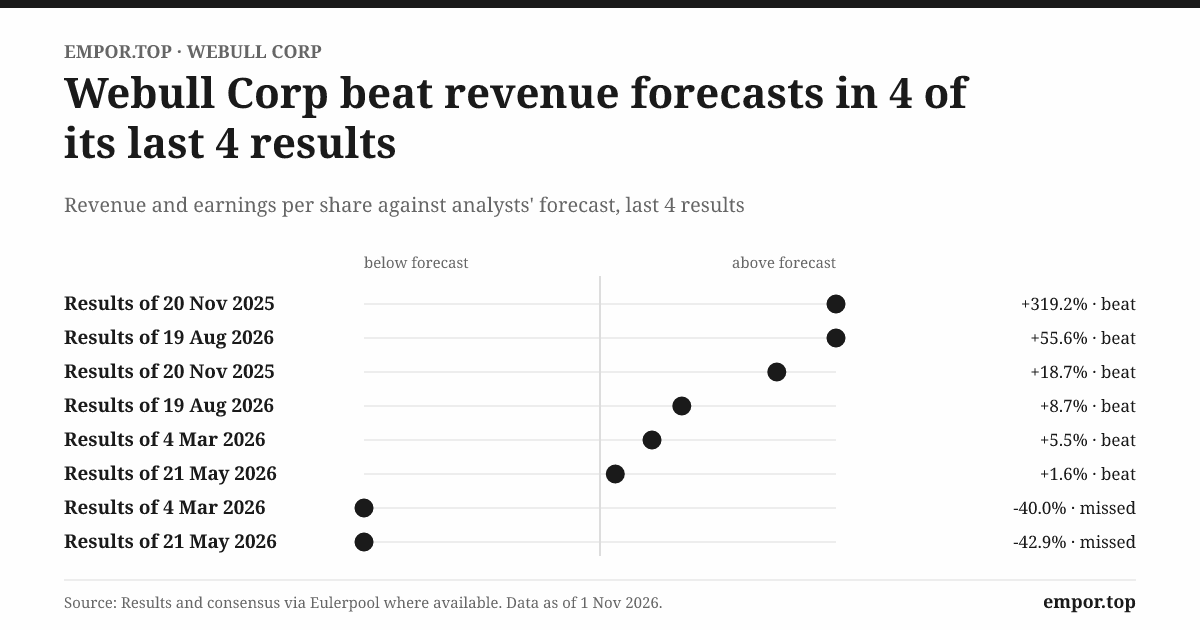
Then there is the July question. On the call, Denier described a significant amount of smaller, more frequent day trades and said July options volume was steady and August stronger still.1 Those comments should be taken seriously; management can see real-time data that investors cannot. But they should also be weighed for what they are: a description of the first two months after a regulatory shock, given by the executive responsible for the business. The company that beat its own volume guidance is also the company with every incentive to describe the new baseline in its most favorable light.
So the verdict is a narrow one. Growth has accelerated, and it is real revenue, not an accounting artifact. But the clearest immediate driver is activity, and the thin net account addition relative to gross intake leaves acquisition quality and persistence unresolved. The settling measures are explicit. The first is net funded-account additions, now running at about 20,000 a quarter on a base of about 5.1 million, a pace that barely registers. The second is net deposits and customer assets after stripping out market movements; the June quarter's net deposits were about $1.6 billion.1 The third is order-flow rebates per unit of trading activity, which shows whether the smaller trades are as lucrative as management says.
Those three measures will reveal whether the rule change brought lasting customers. But revenue is only half of a business's story. The other half is cash, and at a broker, cash behaves in ways that can mislead even careful readers.
VI. The Cash Flow That Came From Customer Balances
Here is a comparison that looks, at first glance, like a miracle. Across 2022 through 2025, Webull earned a cumulative net profit of about $58 million. Over the same four years, it reported about $1.2 billion of cash from operations.3 That is more than twenty dollars of operating cash for every dollar of profit, a ratio of roughly 2,000%. Free cash flow for 2025 alone came to about $562 million against a net profit of about $24 million.3 Any screen that ranks companies by cash conversion would put Webull near the top of the market.
The miracle is an illusion created by the plumbing of a brokerage. To see why, think of a broker as a busy train station rather than a shop. A shop's cash register measures what the shop has earned. A station's turnstiles measure the people passing through. When more passengers flow through the station, the turnstile count rises, but the station has not earned more money from each passenger. A broker's operating cash flow includes the movement of customer money and settlement balances passing through its accounts, which can swing wildly without changing what the business earns.
In 2025, movements in customer receivables and payables contributed $806.3 million to Webull's operating cash flow.3 That single item was larger than the entire year's reported operating cash flow of about $566 million, which means other items pulled the other way.3 Customer payables are money Webull owes its customers, the cash sitting in their accounts. When customers deposit more, payables rise, and the accounting records that as an inflow of operating cash. Customer receivables are mostly margin loans, money customers owe Webull. When customers borrow more, receivables rise, and that counts as an outflow. The net of these flows depends on customer behavior, settlement timing and the transition Webull made to an omnibus clearing model, not on how profitable the business is.3 Share-based compensation added another $43.9 million of non-cash expense back to the cash figure.3
The balance sheet makes the same point from another angle. At the end of 2025, Webull held $1.537 billion of segregated cash.3 Segregated cash is customer money that regulations require a broker to keep separate from its own funds, ring-fenced so that if the broker failed, customers would get their money back. It is not available to pay dividends, fund acquisitions or buy back shares. Webull's own unrestricted corporate cash, largely held in bank demand deposits, was $653.2 million.3 That is still a meaningful cushion for a company with reported borrowings of only about $78 million at year end, but it is less than half the size of the cash that sits on the balance sheet on behalf of customers.3 An investor who adds the two together and calls it liquidity is counting the station's turnstile money as the station's profit.
The corporate side of the balance sheet is conservative but not without moving parts. At the end of June 2026, Webull's borrowings consisted of $50 million of unsecured promissory notes due in April 2027 and about $17.6 million drawn on a revolving facility, while a separate $200 million syndicated credit facility was undrawn.29 The company reported that it was in compliance with its facility covenants at the end of 2025.3 Currency is a quieter drag. About 90% of cash is held in U.S. dollars, but Webull runs subsidiaries in many currencies without material hedging, and foreign-exchange losses reached about $12 million in 2025 and nearly $10 million in the first half of 2026 alone.32 For a company whose quarterly net profit can be $24 million or a loss of $21 million, a currency swing of that size is not a rounding error.
The same distortion affects a ratio that looks alarming. Webull's receivables stood at 829 days of revenue at the end of 2025, up from 56 days in 2022.3 For an ordinary company, that would mean customers were taking more than two years to pay their invoices, a red flag for revenue quality. For a broker, it means something different. Most of the receivables are margin loans to customers and amounts due from brokers, dealers and clearing organizations as trades settle. At the end of 2025, broker, dealer and clearing receivables were $563.0 million and net customer receivables were $708.8 million; by June 2026, these had grown to about $701 million and $1.01 billion.32 Those balances grew because customers borrowed more and trading rose, not because invoices went unpaid.
The company says its broker receivables were short-term and none were more than 30 days past due at either of the two most recent year ends, and that margin loans are collateralized by customers' securities.3 It recorded an expected-credit-loss allowance of about $1.49 million in 2025, a small number against more than $1 billion of customer receivables.3 That reassures on the core question: these are not stale invoices. There is a concentration wrinkle, though: at the end of 2025, two counterparties accounted for about 73% and 17% of the broker, dealer and clearing receivables, so the safety of that balance depends heavily on a couple of large clearing and trading firms.3 The remaining limit is disclosure. Webull does not publish detailed aging beyond that 30-day statement, nor a longer history of overdue balances. A margin book is safe until a sharp market drop leaves some customers' collateral worth less than their loans, and the company's tiny loss history covers a short and mostly rising market.
One more cash number needs reconciling before anyone uses it. Webull reported free cash flow of roughly $562 million for 2025,3 yet standard valuation screens put its free cash flow yield at zero. Both cannot be the measure that matters. A $562 million free cash flow against a market value of about $2.6 billion would imply a yield above 20%, a figure that would make Webull look like one of the cheapest stocks in the market. The zero-yield figure reflects a different period and treatment, in which settlement swings net out or turn negative. Neither measure, on its own, says how much cash the business generates for shareholders. The honest reading is that neither can carry a valuation conclusion without first separating customer flows from corporate earnings, which the company does not do in its headline cash-flow statement.
So the right lens is earnings quality, not cash conversion. And on that measure, the picture is volatile rather than miraculous. Operating profit was about $69 million in 2022, fell to about $23 million in 2023, turned to a loss of about $14 million in 2024, and recovered to about $59 million in 2025.3 Net profit swung from $50 million to a loss of $22 million and back to $24 million over the same years.3 Webull's earnings are small relative to its revenue, sensitive to trading conditions and still being established at scale. The cash flow statement does not change that verdict; it simply adds noise to it.
If operating cash flow cannot fund the growth story on its own, the money has to come from somewhere else. That brings the story to how Webull came to market, how it raised capital, and what it has done with it.
VII. The Listing, the Buyback, and the $100 Million Thailand Bet
Webull did not ring Nasdaq's bell after a traditional roadshow. It arrived through a special purpose acquisition company, SK Growth Opportunities, a blank-check vehicle that existed to merge with a private business and take it public. The registration statement for the combination, a merger proxy and prospectus filed on Form F-4, became effective on March 10, 2025.10 The deal closed the following month, in April 2025, and Webull's Class A shares began trading under the ticker BULL.11 That F-4 was the relevant listing document, not a conventional standalone IPO prospectus; a later Form F-1 registered the resale of existing shares and warrants, not a fresh primary offering.12
SPAC listings come with a particular kind of financial engineering. The transaction converted preferred shares and issued warrants, rights to buy shares at a fixed price in the future. When the share price rose above the exercise price, holders exercised them. In 2025, incentive warrant exercises brought in $204.5 million and public warrants another $9.3 million.3 That was welcome cash for the company, and it was also dilution for shareholders, since each exercised warrant created a new share. In the first half of 2026, Webull reversed a little of that by repurchasing about 1.8 million shares for about $11 million.2 Set the two side by side and the scale is clear: the company took in roughly twenty times as much from warrants as it spent on buybacks. The buyback is a signal, not a counterweight.
The more revealing capital decisions concern what Webull bought, and from whom. The first was Webull Pay, the group's digital-assets business. Webull spun the business out in 2023 and then brought it back into the group in 2025.3 The reintegration was not an arm's-length purchase from a stranger. The sellers included Water Castle, an affiliate owned by Anquan Wang, which received $10.6 million in cash and 870,989 Class B shares valued at about $13.2 million, and another affiliate, WPL, which received $6.9 million in cash and 567,812 shares.3 Webull says an independent committee negotiated the deal.3 The transaction also produced a step-acquisition gain in Webull's accounts.3
This deserves scrutiny for a simple reason. When a company spins out a business and later buys it back from an affiliate of its controlling shareholder, the price paid determines whether value moved from public shareholders to the founder or the other way. The consideration included super-voting Class B shares, which carry twenty votes each and so reinforced the founder's control at the same time as they compensated the founder's affiliate. The independent committee process is the right safeguard. Whether the price was fair cannot be judged without standalone financials for Webull Pay, and the company has not published a valuation analysis detailed enough to test it.
Webull's crypto business remains small, with several features delayed as resources moved to agentic AI.15
The second, larger bet was in Thailand. Webull agreed to buy Pi Securities, a Thai brokerage, for about $100 million for 99.36% of the company, paid as $20 million in cash and $80 million in Webull shares, before adjustments.2 The acquisition was completed in early September 2026.13 The strategic logic is easy to state. Pi brings a local brokerage license, an established customer base and teams who understand Thai retail investors, which would take years to build from scratch. Denier described the deal on the August call as immediately accretive to Webull's Asia-Pacific customer assets.1
What the logic does not provide is a price check. Webull did not publish Pi's standalone revenue, earnings or customer economics in its interim filing.2 Without those figures, there is no reliable acquisition multiple to set against listed brokers. For scale, the purchase price was equivalent to roughly a sixth of Webull's 2025 revenue; whether that bought a bargain or overpaid for a license is not something outsiders can determine.
The terms after closing add a further layer of financial engineering. A prospectus supplement filed on October 28, 2026 sets out a price-protection arrangement with CGH, the seller receiving Webull shares.14 If CGH's proceeds from selling up to about 12.29 million resale shares fall short of $60 million by the settlement date, Webull guarantees to make up the difference in cash.14 The supplement extended the sale window to December 24 and limited CGH's sales to 10% of daily trading volume.14 That guarantee matters because Webull's share price closed at about $5.17 on November 1, half its 52-week high; at that price, 12.29 million shares would be worth roughly $64 million, uncomfortably close to the threshold before any discount from selling into the market. Further share issuance or cash payments remain possible under the agreement. In effect, Webull took on the risk of its own stock price falling, on behalf of the seller.
The discipline test, then, belongs to current management. Within a little over a year of listing, Webull has repurchased a modest amount of stock, reacquired a business from its founder's affiliates, bought a foreign broker with mostly shares, and guaranteed the value of those shares to the seller. Each move has a coherent rationale. None yet has a disclosed return. The outcome investors should watch is whether Pi produces disclosed revenue, customers and profit, and whether stated priorities such as AI, international expansion and clearing show up in actual spending, customer additions and post-acquisition performance.
Those decisions are made by a small group of people under one person's control, which brings the story to the question of who holds power at Webull and how much trust that power has earned.
VIII. One Founder Holds the Votes; the Business Holds a Regulatory Record
Two numbers frame Webull's governance. Anquan Wang owns 16.4% of the company's ordinary shares. Wang controls 79.2% of the voting power.3 The gap comes from Class B shares, all 83.9 million of which belong to Wang, each carrying twenty votes to every one vote of a Class A share.3 Public shareholders own most of the economics. One person owns most of the decisions.
The rest of the register is a map of Webull's history. Beyond the founder, the reported large holders included Tianjin Nuofeng with about 7.1% of total shares, Jun Yuan with about 5.6%, PEAK6 entities with about 5.3% and SIG Global China Fund I with about 4.5%.3 Several of those names trace back to the company's years as a venture-backed startup in China, and PEAK6 to the clearing relationship that once made it a related party. The company reported only 23 record holders of Class A shares and one of Class B, although the true number of beneficial owners holding through brokers is far higher and is not disclosed.3
A third number frames the operational question. At the end of 2025, Webull had about 1,396 employees, and 863 of them, roughly 62% of the workforce, worked at its technology subsidiary in mainland China.3 About 800 employees across the group worked in research and development and technology.3 The engineers who build and maintain a U.S.-regulated broker's software are, for the most part, in Changsha, where the company was also building a new R&D center with an estimated cost of about $17.9 million.3
Founder control is not inherently bad. It can let a company make long-term bets that quarterly-minded boards would resist, and it can speed up execution. But it also limits outside shareholders' ability to force a course correction. Webull's six-person board had only two independent directors, and the company used both controlled-company and foreign-private-issuer exemptions from Nasdaq governance rules.3 Those exemptions are legal and common among founder-led foreign listings. They also mean fewer independent voices on the board and fewer of the checks that minority shareholders of a typical U.S. company take for granted.
Incentives sit alongside control. Executives as a group received $7.7 million in cash compensation and $16.2 million in equity compensation in 2025, including executives who left during the year.3 Webull does not disclose individual pay for its chief executive or finance chief.3 Across the company, share-based compensation came to $43.9 million in 2025, about 7.7% of revenue and almost twice the year's net profit.3 At the general meeting on October 30, 2026, shareholders approved a charter amendment and a new employee share plan covering five million shares.1516 With the founder controlling most of the votes, approval was never in doubt, and the vote totals were not disclosed at the meeting.15 Leadership has also turned over: the chief strategy officer and the chief operating officer of Webull Americas left in 2025.3
The regulatory record is the harder part, because it is not hypothetical. Start in 2023. That November, the Massachusetts Securities Division entered into a consent order with Webull Financial, imposing a $500,000 settlement over findings that included inadequate compliance resources and inaccurate reporting of customer complaints.17 Then, in November 2024, the Securities and Exchange Commission found that Webull Financial had filed deficient suspicious-activity reports between 2018 and 2022 and imposed a civil penalty of $125,000.18 Suspicious-activity reports are a broker's main tool for flagging possible money laundering or fraud to regulators; filing them poorly means a basic control did not work as intended. And in 2025, FINRA censured Webull and fined it $1.6 million over its use of social-media influencers to promote the platform and related supervisory and record-retention failures.19
None of these penalties is large relative to Webull's revenue. Their significance is in the pattern: three regulators, over three years, finding problems with three different control systems. Complaint reporting, anti-money-laundering reporting and marketing supervision are exactly the areas where a fast-growing consumer broker is most tempted to let compliance lag behind product. The record does not show Webull ignoring regulators; it shows a company that repeatedly needed regulators to point out gaps. That raises the burden of proof for any claim that controls are now robust.
On remediation, the evidence is thin rather than negative. The annual report describes compliance functions and the risks of regulatory action.3 But Webull has not published a specific list of control changes made in response to each finding, nor metrics for how their effectiveness is measured. On the August call, the conversation centered on trading activity, deposits and expansion, not on compliance improvements.1 For an investor, the absence of new actions is encouraging; it is not the same as demonstrated remediation.
Then came October 2026. On October 7, the House Select Committee on the Chinese Communist Party published a report on Webull that raised concerns about data, governance and the company's China-based operations.20 The committee's argument was that the important question is not where U.S. customer data is stored but who can access it and through what systems; a large engineering team in mainland China, in its view, creates a pathway regardless of where the servers sit.20 Webull responded two days later in a statement filed with the SEC. It disputed the report's process and conclusions, said U.S. customer data and assets remain in the United States, and said no misuse had been identified.21
It is important to separate what is established from what is alleged. The company's own filings establish that most of its workforce, and most of its engineering, is in mainland China.3 The House report's conclusions about access, risk and governance are allegations from a political body, contested by the company, and not the finding of a regulator, court or auditor. Webull's response, for its part, is a statement from an interested party. Settling the question would take an independent review by regulators or auditors of access controls, and none had been published by November 1.
The company's financial statements, audited by KPMG, carry an unqualified opinion with no emphasis-of-matter paragraph.3 That is genuine evidence that the numbers in the accounts are fairly stated. It is not a verdict on operational security or data-access controls, which an audit of financial statements does not examine.
So the credibility conclusion is this. The public-company record is too short, at about eighteen months, to judge guidance discipline in any depth. The earlier compliance actions mean claims about controls should be met with a request for evidence rather than taken on trust. The China-linked operating model is a fact, and the political scrutiny it attracts is a real risk regardless of how the allegations are ultimately resolved. Founder control means that if outside shareholders conclude a change is needed, their ability to compel it is limited. That combination is what an investor is buying alongside the trading platform, and it is part of what the market is pricing today.
IX. Analysis & Bear vs. Bull Case
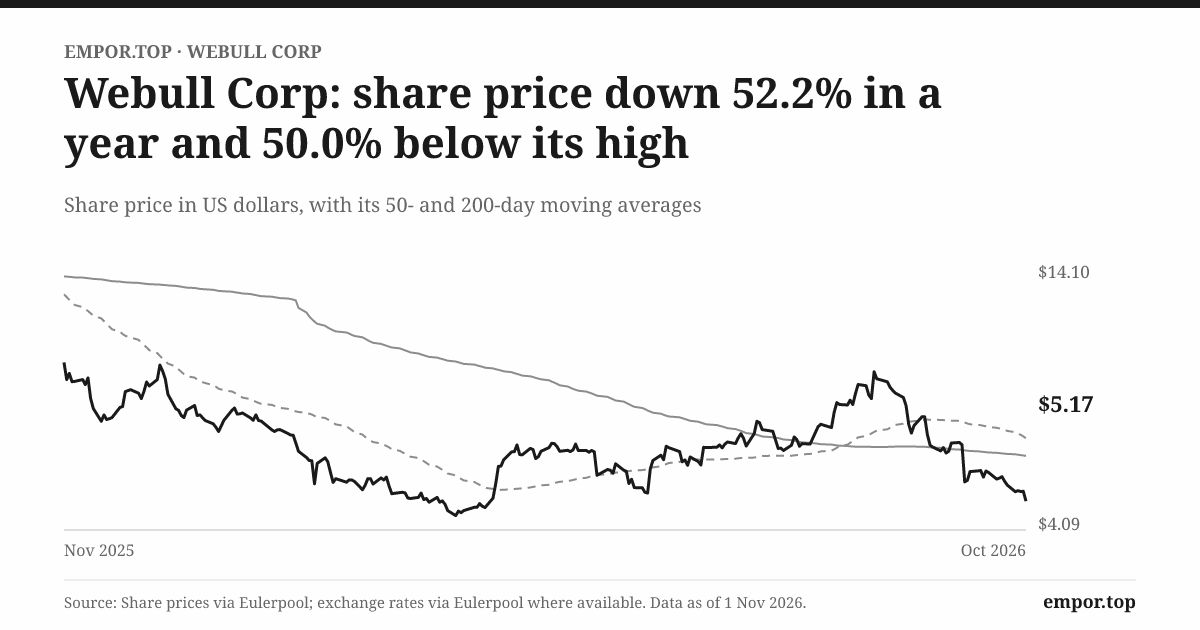
On November 1, 2026, Webull's shares closed at about $5.17.8 Within the past year they had traded as high as $10.35, so the stock sat roughly half below its 52-week peak and not far above its low of about $4.63.8 This is the strange position the company finds itself in: it has just reported the best quarter in its history, and the market values it at about half of what it did at its most optimistic moment. Over the twelve months to June, the business earned a return on equity of about 4%.2 A record quarter, a falling share price and a single-digit return on equity: the market is clearly not yet sure which Webull it owns.
Start with what the price implies. At $5.17, the company has a market value of about $2.6 billion and an enterprise value, after netting out corporate cash and debt, of about $1.7 billion.82 That buys 61.8 times trailing earnings, 3.8 times sales, 2.6 times book value and 25.3 times EBITDA. For context, around the end of October Robinhood traded at about 39.6 times earnings, Interactive Brokers at about 32.3 times and Charles Schwab at about 15.1 times.22 Business mixes and earnings bases differ, so these are reference points rather than a valuation verdict. But the direction is clear: even after halving, Webull trades at a richer earnings multiple than larger, more profitable peers. The market is paying for growth that has not yet appeared in the trailing earnings line.
One comparison should be discarded outright. Webull's median price-to-earnings ratio over five years is about 408.8 times. That figure makes today's 61.8 times look like a bargain, but it is a mirage. The company listed in April 2025 and its earnings have been volatile and often close to zero, so the historical median is computed on a short record with tiny denominators. It says nothing about fair value. The more relevant test is whether today's multiple is justified by the quality and durability of future earnings, the likely dilution and the economics of peers.
The trailing earnings themselves are only partly a guide. Net profit over the twelve months to June was about $42 million, and the June quarter alone contributed about $24 million.2 If the June quarter's activity proves to be the new baseline, the trailing multiple overstates how expensive the stock is; annualizing a single strong quarter would cut the multiple roughly in half. If the June quarter was the peak of a rule-driven burst, the trailing figure is the better guide and possibly a generous one. That is the bet the market is weighing.
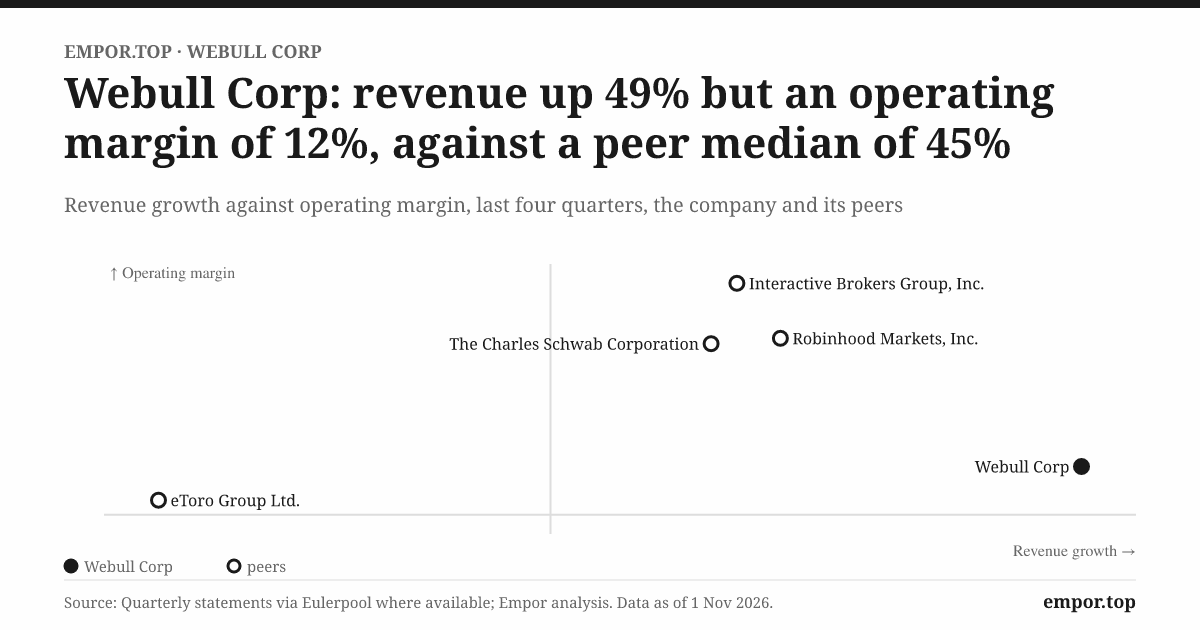
The bull case begins with the product. Webull has a recognizable platform for active traders, a top position in retail options, account retention in the high nineties, growing customer assets, a presence in eighteen operating markets and, since June, a regulatory environment that lets small accounts trade as often as they like. Its operating leverage is real: when revenue jumped in the June quarter, operating margin rose to about 23% on a reported basis, and management cited an adjusted operating margin above 31%.21 If retention stays high, funded accounts start growing faster and deposits strengthen, the current burst of activity could seed a much larger franchise, with self-clearing and international scale adding margin over time. In that world, today's multiple is a starting point rather than a ceiling.
The bear case begins with history. Before 2025, Webull's revenue was flat for three years. In the best quarter of its life, net funded-account additions were about 20,000 on a base of five million. Its two biggest revenue lines, order-flow rebates and interest, are cyclical and sensitive to rules that the company does not control; a downturn in retail trading, a cut in interest rates or a change in payment-for-order-flow economics would hit both at once. The competitive analysis earlier in this story found no proven switching costs and a large scale disadvantage against Robinhood and Interactive Brokers. Governance concentrates power in one person, the regulatory record raises the cost of trust, and the House committee's report creates political risk that is hard to price. The CGH guarantee and the employee share plan add dilution and cash exposure. In that world, a multiple above larger peers prices in growth that the business has shown only intermittently.
A skeptical investor, the kind who writes long memos or buys a small stake to push for change, would ask a pointed question. Why prioritize acquisitions, AI features and international launches while the core funded-account count is barely growing? Each initiative is defensible on its own. Together, they spread management attention and capital across many fronts while the most important measure of franchise health stalls. The skeptic would demand measurable returns: net deposits, active accounts, revenue per customer and, once clearing begins, lower clearing costs per trade. Self-clearing in particular should be treated as upside only when the savings show up in reported costs and margins. An approval is not a realized saving.
So which Webull is the market pricing? The answer seems to be a compromise: a company whose recent acceleration is real enough to command a premium multiple, but whose durability is uncertain enough to cut that multiple in half from its peak. Neither the bulls nor the bears can claim the evidence clearly favors them. The bulls have the activity and the asset growth. The bears have the history, the net account numbers and the governance. The deciding evidence has not yet arrived.
Three operating measures will deliver it. The first is net funded-account additions: about 20,000 in the June quarter on a base of about 5.13 million, growing at roughly 8% a year.1 The second is customer assets and net deposits: $28.5 billion of assets, up 79%, and about $1.6 billion of net deposits in the quarter.1 The third is trading revenue per unit of activity: trading revenue grew 66% while DARTs grew 62% and options contracts 68%, which means revenue per trade held roughly steady through the surge rather than expanding.1 Pair those with operating margin and the fully diluted share count, and an investor has everything needed to judge whether the June quarter was a beginning or a peak.
X. Playbook: Business & Investing Lessons
Go back to June 4 one more time. A rule that had stood for a generation disappeared, more than 50,000 margin calls evaporated in a single day, and a trading platform in the middle of the pack posted the best quarter it had ever reported. Few businesses get a natural experiment that clean. What Webull did with it, and what it did not, carries lessons well beyond one brokerage.
The first lesson is that a trading spike is not a customer moat. Webull's record quarter came from customers who were already there trading more often, not from a flood of new ones. The test of a platform is not how much its users do on a good day but whether more of them arrive, and stay, over years. The June surge will become evidence of a franchise only if the funded-account and net-deposit lines start climbing in its wake. For founders, this is a warning about celebrating engagement metrics; for investors, it is a reminder to ask how much of any growth spurt came from the existing base. Rule changes make for great quarters. Customers make for great companies.
The second lesson is that in a brokerage, cash flow can belong to the plumbing. Webull's 2,052% cash-to-profit ratio was not a sign of extraordinary earnings power; it reflected customer-balance and settlement flows.3 Any business that holds other people's money, from brokers to marketplaces to payment processors, will show cash numbers that flatter or punish its true economics depending on the direction of the flow. Before praising cash conversion, ask whose cash it is.
The third lesson is that a new product is not a new profit pool. Webull has shifted its emphasis among new products and markets, but the disclosed numbers still show little contribution from newer features. Platforms that keep launching features can look like innovation machines while their economics stay unchanged. The only proof that a product matters is the revenue line it creates and the cost it requires.
The fourth lesson is that control cuts both ways. Anquan Wang's control gives Webull room to move quickly, but if its bets disappoint, outside shareholders have little power to change course. A founder with control of the votes and a minority of the economics is a bet on one person's judgment, made with other people's capital. That trade can work brilliantly, but only for as long as the founder's interests and the minority's line up.
The fifth lesson is that a strategic acquisition is only as good as the returns it produces. Pi Securities came with a license, a team and a market, and Webull guaranteed the seller's proceeds. The deal cannot be judged at signing without disclosed target economics; it must be judged later, by revenue, customers and profit investors can measure. A license bought with shares is a promise to grow into it, not a growth story already told.
XI. Epilogue
Tonight, Webull stands at a hinge. The rule change that drove its record quarter is five months old. The Pi Securities acquisition was completed and will appear in the consolidated numbers for the first time. The CGH share-sale window runs to December 24, and its outcome will determine whether the company owes the seller cash, more shares or nothing at all.14 And the House committee's report hangs over the stock, contested but unresolved.
The next earnings call will be the first in which the rule change is no longer a surprise. That is when the story either confirms itself or starts to unravel. If funded accounts and net deposits accelerate, not just DARTs and notional volume, then the June quarter will look like the moment Webull's product found its market. If trading activity holds up but accounts and deposits stay flat, the company will have shown that it can monetize a fixed base more intensely, a respectable outcome but not the one that justifies a growth multiple. And if activity fades as the novelty wears off, the market will have its answer about which Webull it owned.
The mix will matter as much as the total. Watch order-flow rebates per unit of activity as trading normalizes, and watch whether interest income and stock lending grow as customers bring more cash. A business tilting toward balances is sturdier than one that depends on trading frenzy. Watch Pi's contribution, too: whether the company discloses its revenue, customers and profit, and whether those numbers justify the roughly $100 million price and the share-protection terms. Watch the final CGH settlement and the fully diluted share count after warrants, employee awards and resale shares.
Watch Washington as well. An independent finding by a regulator or auditor on data access would either lift the cloud the House report created or darken it considerably. Either outcome would matter more to the stock than any single quarter's trading volume. Alongside that, watch for evidence that the compliance shortcomings identified by Massachusetts, the SEC and FINRA have been corrected, in the form of specific control changes and a clean record going forward.
Finally, listen across the calls. Compare the prepared remarks and the answers to analysts on the March call covering 2025, the May call and the August call.2351 Track what changed in the growth story, from crypto to AI, from volume guidance to "a little sandbagging"; what management quantified and what it left vague. Credibility is built on the gap between those two, and Webull's public record is still short enough that every call adds to it materially.
The tension that remains is simple to state and hard to resolve. Those tensions could define the next five years.
XII. Outro
On June 4, 2026, a rule changed, and Webull's customers traded more, much more. The company reported a record quarter.2 It was a vivid demonstration of a business working as designed.
But the opening image holds a second picture inside it. The funded-account count barely moved.1 Webull has shown it can turn market activity into revenue. The rest remains unproven. When the rule change is old news and the traders are free to go anywhere, the question that began this story will finally have its answer: will they still be here?
References
-
Q2 2026 Earnings Call Transcript — Webull Corporation, 2026-08-19 ↩↩↩↩↩↩↩↩↩↩↩↩↩↩↩↩↩↩↩↩↩↩↩↩↩↩↩↩↩↩↩↩↩↩↩↩↩↩
-
Q2 2026 Interim Financial Statements — Webull Corporation, 2026-09-11 ↩↩↩↩↩↩↩↩↩↩↩↩↩↩↩↩↩↩↩↩
-
2025 Form 20-F — Webull Corporation, 2026-04-09 ↩↩↩↩↩↩↩↩↩↩↩↩↩↩↩↩↩↩↩↩↩↩↩↩↩↩↩↩↩↩↩↩↩↩↩↩↩↩↩↩↩↩↩↩↩↩↩↩↩↩↩↩↩↩↩↩↩↩↩↩↩↩↩↩↩↩↩↩↩
-
Webull: The Chinese-owned app that could rival Robinhood — The China Project, 2021-02-01 ↩↩↩↩
-
Q1 2026 Earnings Call Transcript — The Motley Fool, 2026-05-21 ↩↩↩↩
-
Q1 2026 Earnings Presentation — Webull Corporation, 2026-05-21 ↩↩↩↩
-
Q2 2026 Management Discussion and Analysis — Webull Corporation, 2026-09-11 ↩
-
Definitive Proxy Statement/Prospectus — Webull Corporation and SK Growth, 2025-03-10 ↩
-
Business Combination Closing — Webull Corporation, 2025-04-10 ↩
-
Pi Securities Acquisition Completion — Webull Thailand, 2026-09-08 ↩
-
Prospectus Supplement No. 1 — Webull Corporation, 2026-10-28 ↩↩↩↩
-
General Meeting Transcript — EarningsCalls.dev, 2026-10-30 ↩↩
-
Notice of General Meeting and Proxy Statement — Webull Corporation, 2026-10-01 ↩
-
Consent Order E-2022-0058 — Massachusetts Securities Division, 2023-11-07 ↩
-
SEC Administrative Order on Suspicious Activity Reports — SEC, 2024-11-22 ↩
-
House Select Committee Report on Webull — U.S. House Select Committee, 2026-10-07 ↩↩
-
Webull Statement on the House Select Committee Report — Webull Corporation, 2026-10-09 ↩
-
Q4 2025 Earnings Call Transcript — The Motley Fool, 2026-03-24 ↩
 LinkedIn
 WhatsApp
 Reddit
 Hacker News
 Email
 Kindle
 RSS Feed
 Spotify
 Apple Podcasts
 Amazon Music
 Audible
 YouTube