Stoke Therapeutics: Can One Gene Become a Business?
I. The Drug That Has to Beat the Clock
On October 29, 2026, Stoke Therapeutics' management opened its third-quarter call and read out the numbers that matter most for a company with nothing to sell yet. At the end of September the company held $358.8 million in cash and marketable securities, and management said that money should fund operations into early 2028.[^1]1 It sounds like plenty, and for a lot of businesses it would be. Then comes the other half. In the first nine months of 2026 Stoke used $179.9 million of cash to run itself, which is roughly $20 million every month going to trials, laboratories, manufacturing and the people who keep them going.2 The trial that decides whether all that spending was worth it has not read out yet. Management expects the Phase 3 result in the third quarter of 2027.1
That gap between what a genetic medicine promises and what it costs to prove the promise is the whole of this story. Stoke is trying to fix a disease at the level of the gene, by getting a child's working copy of a gene to make more of the protein the broken copy fails to make. If the idea works, it could change the course of a devastating childhood epilepsy, not just reduce the seizures. If it does not, the company will have spent more than a decade and several hundred million dollars learning that lesson in public.
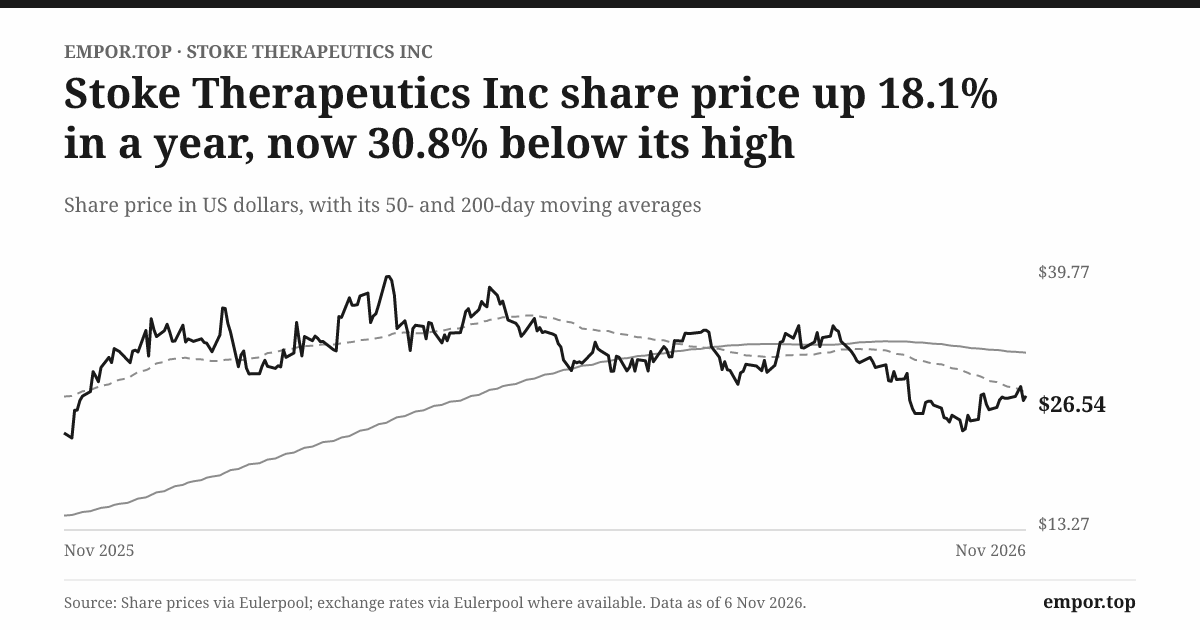
The stock market has put a price on that uncertainty. At $26.54 a share on November 6, 2026, Stoke was worth about $1.5 billion, and about $1.2 billion once its net cash is subtracted.2 That is a lot of value for a company with no approved products and no product sales.3 Investors are not paying for today's earnings, because there are none. Over the last twelve months the company lost about $3.79 a share.2 They are paying for the chance that a single molecule, zorevunersen, turns out to be a real medicine.
A few housekeeping facts help keep the story straight. Stoke Therapeutics, Inc. is a Delaware company whose shares trade on the Nasdaq Global Select Market under the ticker STOK.3 Biogen, the large neurology drugmaker, is Stoke's partner for zorevunersen outside North America. It is not Stoke's parent, it does not control the company, and Biogen's own economics have nothing to do with Stoke's financial statements except through the contract between them.39
The story keeps coming back to three questions. The first is scientific: does zorevunersen actually work when it is tested against a control group, rather than in small studies where everyone knows who got the drug? The second is commercial: even if it works, can Stoke build a durable business around a medicine that has to be injected into the spinal fluid, again and again, for a rare disease? The third is financial, and it is the one long-suffering biotech shareholders often learn about the hard way: will Stoke's way of paying for all this, which means partner cash plus steady sales of new shares, leave enough of the prize for the people who own the stock today?
None of these can be answered from a press release. The answers will come from a trial, a regulator and, eventually, from parents and neurologists deciding whether the treatment is worth what it asks of a child. To see why so much money is riding on one experiment, the story has to start with a laboratory idea about how cells read their own genes.
 Subscribe on LinkedIn
II. The Splicing Insight Became a Company
Adrian Krainer has spent most of his career at Cold Spring Harbor Laboratory on Long Island, studying a step in biology most people never hear about: splicing, the way a cell edits the raw RNA copy of a gene before it is turned into protein.4 That obscure-sounding work already had a famous result. Krainer's research on RNA splicing contributed to nusinersen, the antisense drug sold by Biogen as Spinraza for spinal muscular atrophy, one of the first medicines to show that a short, synthetic strand of genetic material could change the course of a fatal childhood disease.4 Isabel Aznarez, an RNA scientist who had worked with Krainer, saw something in the splicing machinery that suggested a broader opportunity.4
In 2014 Krainer and Aznarez teamed up with Huw Nash, who became the founding chief executive, to build a company around that insight.45 The company was Stoke Therapeutics, and its scientific thesis had a memorable acronym: TANGO, short for Targeted Augmentation of Nuclear Gene Output.5
Here is the idea in plain terms. Most people carry two copies of each gene, one from each parent. In a class of genetic diseases called haploinsufficiencies, one copy is broken and the working copy alone cannot make enough protein. Half a supply is not enough. The obvious fix is to add a new copy of the gene, which is what gene therapy tries to do, with all the difficulty of packaging DNA into a virus and getting it into the right cells. Stoke's founders saw a different lever. When a cell processes the RNA from a working gene, some of that RNA is spliced in a way that leads to nothing useful and gets thrown away. If a drug could nudge the splicing machinery toward the productive version, the healthy copy would make more protein without anyone touching the DNA.5
An analogy helps. Picture a factory that makes a part from a set of blueprints, but a share of every print run comes out with a page in the wrong place, and those copies go straight into the recycling bin. You do not need a second factory. You need someone at the printer who makes sure more of the copies come out right. Stoke's tool for that job is an antisense oligonucleotide, a short, custom-designed strand that binds to a specific stretch of RNA and changes how it is processed.5
The first test of the idea was a drug then called STK-001 and now called zorevunersen. It targets SCN1A, a gene that makes a sodium channel brain cells need in order to fire properly.5 When one copy of SCN1A is broken, the result can be Dravet syndrome, a severe genetic epilepsy that starts in infancy and brings frequent, prolonged seizures, along with developmental, behavioral and motor problems that medicines aimed only at seizures do not fix.35 Dravet was a sensible place to start because the genetic cause is well understood, the unmet need is obvious and the families are organized and motivated.
A clever mechanism is not the same as a medicine, though, and the biotech business is full of reminders. A drug can be technically novel and still fail because the dose that works is not the dose that is safe, because the effect is smaller than hoped, because it cannot be manufactured consistently, or because doctors and payers decide the benefit is not worth the burden. Stoke's founders were betting on biology. Their investors were betting that biology could be turned into products, which is a separate thing to prove.
That second bet went public in June 2019. Stoke's S-1 for the IPO described a clinical-stage company with no revenue, a platform it said could address many haploinsufficient diseases, and a lead program in Dravet syndrome heading toward its first human studies.5 Investors who bought in were funding an experiment, not buying a drug business. By then the company had a new leader, Edward Kaye, a physician-executive who had become chief executive in 2017 and who ran Stoke through its first clinical data.511
Set the S-1's ambitions next to what has happened since and the picture is lopsided in a revealing way. The platform pitch talked about many genes and many diseases. Seven years later, one program is in Phase 3 and carries nearly all of the company's value, while a second, STK-002 for an inherited eye disease called autosomal dominant optic atrophy, sits in early clinical development.3 The platform has produced a pipeline, but not yet a portfolio. That is the founding thesis in its honest form: a plausible engine for making drug candidates, which only becomes a commercial advantage once one of those candidates becomes a product. The engine's first real test came through one molecule and a few dozen children.
III. One Molecule Carries the Platform's Proof
In March 2026 the New England Journal of Medicine, the most prestigious venue in clinical medicine, published the results of Stoke's early zorevunersen studies in children and adolescents with Dravet syndrome.6 Publication there is not approval and it is not proof of efficacy. It is, however, a sign that independent editors and reviewers judged the data significant enough for the field's most-read journal, and for a small company it was the closest thing to a public coronation its science had received.
The numbers explain why. The paper covered the Phase 1/2a studies, known as MONARCH in the United States and ADMIRAL in the United Kingdom, and the open-label extension studies that followed, where patients kept receiving the drug.6 In the groups that received 70 milligrams, the median reduction in convulsive seizures ranged from about 59% to 91% across monthly intervals during the first 20 months of extension treatment.6 To put that in human terms, a child who had been having ten major seizures a month was, for the typical patient in those groups, having somewhere between one and four. These were children who were already taking a full regimen of approved anti-seizure medicines when they joined the studies.6
The more provocative claim was about what else seemed to change. Investigators also tracked measures of behavior, cognition and overall clinical status, and reported improvements over time on several of them.6 That matters because Dravet is not only a seizure disorder. Families describe the developmental stall, the language that does not come, the motor and behavioral problems, as at least as devastating as the seizures. Existing medicines do not claim to fix those. If zorevunersen raises the missing protein in brain cells, it might, in principle, improve both. That is what people mean when they call it potentially "disease-modifying."
Getting the drug there is not easy. Zorevunersen does not cross from the bloodstream into the brain in useful amounts, so it is given by intrathecal injection, a needle into the spinal fluid in the lower back, the same route used for Spinraza.67 It is not a one-time treatment. Patients receive loading doses and then repeat doses at intervals of months, which means every patient is signing up for a recurring procedure for as long as the treatment continues.7 For a business, that recurring dosing is potentially attractive because it produces repeat revenue. For a parent, it is a burden that has to be justified each time by visible benefit.
Now for the limitation, stated plainly. The early studies were designed mainly to test safety and dosing, not to prove that the drug works.6 There was no control group in the extension studies. Everyone knew they were on zorevunersen, and families and investigators who know a child is on an experimental treatment tend to see improvement, whether from hope, from closer medical attention, from changes to other medicines or from the way seizure counts naturally move up and down. Small, open-label studies have fooled the industry before. The 59% to 91% range is a strong signal. It is not a measured effect against placebo.
Safety deserves the same scrutiny. The most closely watched finding was elevated protein in the cerebrospinal fluid, which appeared in many patients on repeated dosing.6 Investigators reported that most of these elevations were not associated with symptoms, but nobody yet knows what a sustained elevation means over years of treatment, and that is exactly the kind of signal regulators want to see in longer, controlled data.6 There were also the side effects typical of spinal injections, such as headache and vomiting around the procedure.6 None of this has so far looked like a reason to stop. All of it is a reason to watch.
Why does the "disease-modifying" label matter so much to the investment case? Because it decides what kind of drug zorevunersen could become. A drug that lowers seizure counts joins a crowded shelf of anti-seizure medicines and competes on how much it lowers them. A drug that changes the trajectory of a child's development is in a category of its own, and the price, the uptake and the willingness of families to accept repeated spinal injections all depend on which of those it turns out to be. Stoke's market value is largely a bet on the second.
The open-label data did one thing decisively. It earned the right to a Phase 3 trial, and it persuaded a major partner to pay real money for the drug outside North America. What it could not do was take the step everything now depends on: turn a child's improvement in an open-label extension into a result that survives a control group and statistics. Before that test began, though, Stoke's other bet, that its platform could generate many such drugs, ran into a different kind of test, one set by a partner.
IV. The Platform Met Its First Partner Test
In May 2025, Acadia Pharmaceuticals, the San Diego neuroscience company best known for a Rett syndrome drug, told Stoke it was ending two of the research programs the companies had been working on together.8 One targeted MECP2, the gene behind Rett syndrome. The other targeted a gene the companies had never publicly named.8 The rights went back to Stoke. So did the question every platform company eventually faces: if a partner with its own reasons to want the programs decided to walk away, what were they worth?
The deal itself had started with real enthusiasm. In January 2022, Acadia agreed to work with Stoke on discovering and developing antisense drugs for several neurodevelopmental diseases, including SYNGAP1 syndrome, Rett syndrome and an undisclosed target, and paid Stoke $60 million upfront.8 Beyond that sat the usual biotech layer cake of contingent value: research funding, development and commercial milestones and royalties on any eventual sales. For a company whose whole pitch was that TANGO could be pointed at many genes, a partner paying to point it at three more was exactly the validation the platform story needed.
Context matters here, because it would be easy to make the Acadia exit sound like a clinical failure. It was not one. The programs Acadia dropped were research-stage efforts, not drugs in patients.8 Pharmaceutical companies cut early programs all the time, for reasons ranging from portfolio priorities to strategy changes to a judgment that the biology is harder than it looked. Stoke did not disclose that the science failed, and Acadia's decision cannot be read as evidence that it did.
What the exit did do was remove money from the future. Acadia's departure from the two programs ended the possibility of up to $662.5 million in potential milestones, plus the associated royalties.8 That figure needs handling with care. Most biotech milestone totals are a theoretical ceiling, the sum of every payment that would come due if every program cleared every stage and sold well, and most of that money never arrives even when a partnership continues. Still, a $662.5 million ceiling turning into zero is a real change in what the platform's partnerships could plausibly deliver. Stoke kept its rights and could seek another partner or fund the work itself.8 Neither choice is free: one requires convincing another company to take on the programs, and the other spends Stoke's own cash on programs that sit far from the clinic.
This is also the moment to be clear about what Stoke's reported revenue is. Through 2024, Stoke's revenue was almost entirely collaboration revenue, mostly from Acadia: the upfront payment recognized as research work was performed, research services billed to the partner and occasional milestones.38 It reached $36 million in 2024, up from nothing before 2021.3 Read quickly, that looks like a growing business. It is not product demand. Collaboration revenue measures how much a partner is paying for work and rights, and it moves with contract terms, not with patients. When a partner exits, the revenue can stop without anything having changed in the clinic.
Treat the Acadia episode as a test of the platform claim and the result is not a rejection, but it is a narrowing. TANGO did attract a serious partner, which is evidence that experienced drug developers saw something real. But two of the three programs that partner funded did not survive to the clinic under that partner, and the theoretical economics attached to them disappeared.8 The platform remains a hypothesis that has produced one advanced drug, one earlier clinical program and a set of research programs whose value depends on someone paying to move them forward.
What would upgrade the returned rights from an option to evidence? Something concrete: a new partner writing a check for them, Stoke committing its own money and taking one into the clinic, or a milestone that shows the science advancing. Until then, the MECP2 program and its unnamed sibling are best treated the way a careful investor treats any early biotech asset, as a lottery ticket the company still holds, not as revenue in waiting. And as Stoke absorbed that lesson, it had already signed the partnership that mattered far more, the one built around the drug that was actually working.
V. Biogen Bought Rights—and Stoke Kept the Hard Work
In February 2025, a few months before Acadia's exit, Stoke announced that Biogen would pay $165 million upfront for the right to develop and sell zorevunersen everywhere except the United States, Canada and Mexico.9 For Stoke the choice of partner carried as much meaning as the money. Biogen had already built a global business around Spinraza. If any company understood what it takes to sell an intrathecal genetic medicine to neurologists, hospitals and health systems around the world, it was this one.
The economics break into two kinds of money that need to be kept firmly apart. The first is guaranteed: the $165 million arrived and stayed. The second is contingent. Stoke can earn up to $50 million in development milestones and up to $335 million in commercial milestones, plus tiered royalties at double-digit percentages on Biogen's sales in its territories.39 Every dollar of the contingent part depends on the trial working, regulators approving the drug and patients outside North America actually being treated. The upfront payment is cash. The rest is a set of conditional promises.
The geography is the other piece. Stoke kept the United States, Canada and Mexico for itself, which in rare-disease drugs means keeping the largest and usually the highest-priced market.9 That decision is the heart of Stoke's ambition: if zorevunersen works, Stoke intends to be a commercial company in North America, not just a royalty collector. It is a bolder choice than licensing the world, and a riskier one, because building a sales force, a patient-services operation and a reimbursement team is expensive and slow.
Then came the clause that shapes Stoke's finances today. Stoke leads global development of zorevunersen and pays 70% of the agreed development costs, with Biogen paying the other 30%.39 Stoke runs the Phase 3 trial, deals with the regulators, manages the manufacturing development and pays for most of it. Biogen reimburses its share, which shows up on Stoke's income statement as development-services revenue as the work is done.3
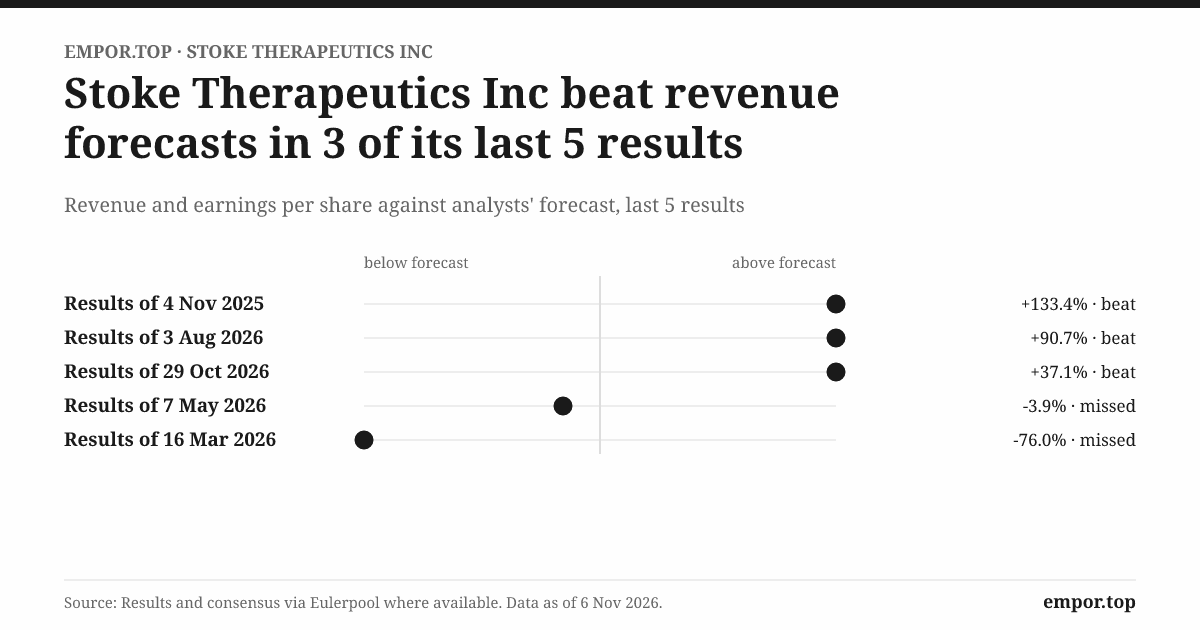
The deal transformed Stoke's financial statements for a year. Under accounting rules, the value assigned to the license itself, $150.8 million, was recognized as revenue at once when the license transferred to Biogen in February 2025.3 That one-time event pushed Stoke's first-quarter 2025 revenue to about $159 million and produced a quarterly profit of $113 million, the first of its kind in Stoke's history.23 Full-year 2025 revenue reached $184 million, about five times the year before.3 On a stock screen, it looked like a company that had broken through. It was really a company that had sold one set of rights, once.
The proof came in the following quarters. With the license transfer behind it, Stoke's revenue went back to reflecting the work it does for its partner. In the first nine months of 2026, Stoke recognized $19.3 million under the Biogen agreement, part of $26.8 million of total revenue, against $183.0 million in the same period a year earlier.2 At the end of September, Biogen owed Stoke about $7.3 million, and Stoke carried about $8.6 million of Biogen consideration it had received but not yet earned.2 That is what a cost-sharing partnership looks like on the books: a steady flow of reimbursements roughly in step with spending, not a growth engine.
There is one more party that quietly takes a slice. Stoke's underlying technology rests partly on a license from the University of Southampton, which is owed milestones and royalties, including a mid-single-digit percentage of sublicense revenue. By September 2026, Stoke had paid the university $8.9 million out of the money it received from Acadia and Biogen.2 It is a small leak, but it is a reminder that every dollar of partner money arrives with a few cents already spoken for.
It is worth being precise about what the deal was not. Biogen did not buy Stoke. It did not buy a proven product. It paid $165 million for a license to an unapproved drug in a set of territories, with the rest of its payments conditional on the drug clearing hurdles that had not yet been cleared.9 Nor had Stoke made a material acquisition of its own through September 2026, so there was no takeover premium to measure against biotech M&A and no acquired business to judge.23 The relevant comparison is with other rare-disease licensing deals, in which upfront payments of this size typically signal a partner's genuine conviction while leaving the developer exposed to most of the clinical risk.
That is the tension Stoke signed up for. Biogen brings validation, cash and a global commercial machine for the day zorevunersen is approved. But the 70% cost share means that the most expensive phase of the drug's life, a global Phase 3 trial plus all the regulatory and manufacturing work around it, is mostly paid for by Stoke. The partnership reduced Stoke's risk in the rest of the world. It did not reduce Stoke's need to prove the drug works, and the place where it has to prove it has a name.
VI. EMPEROR Is the Trial That Can Change the Story
Every early-stage biotech story eventually arrives at a room where nobody knows who got the drug. For Stoke that room is EMPEROR, a global Phase 3 trial of zorevunersen in children and adolescents with Dravet syndrome, run double-blind against a sham procedure.7 In 2026, the trial finished enrolling 162 patients.1[^11] Every child in it goes through the same experience of being prepared for a spinal injection. Some receive zorevunersen. Others receive a sham, a procedure designed to look and feel like the real thing without the drug going in. Neither the families nor the investigators assessing the children know which is which.
That design addresses the weakness in the early data. In EMPEROR, hopes and expectations are spread across both groups, so whatever difference emerges between them should be the drug's doing. The sham control is demanding for families, which is part of why it took time to enroll, but it is also what makes a positive result persuasive.
Epilepsy trials have a particular trap that makes this control essential. Seizure counts in children with Dravet swing widely from month to month, and families often enroll a child in a study when seizures are at their worst, which means that some improvement afterward is simply the numbers drifting back toward normal. Statisticians call it regression to the mean, and it flatters any uncontrolled study. Sham-treated children in EMPEROR will experience the same drift, so the drug has to beat not zero but whatever improvement the sham group shows on its own. That is the gap investors should expect to narrow between the open-label numbers and the controlled ones; the question is by how much.
The trial's primary endpoint is the change in the frequency of major motor seizures, the dramatic convulsive seizures that dominate daily life in Dravet and that families count in diaries.7 Alongside it, investigators are measuring behavior, cognition, overall clinical status and quality of life, the measures that would support the bigger, disease-modifying claim.7 That ordering matters. If the seizure endpoint wins, the trial has met its main goal. If the secondary measures also move, Stoke has the beginnings of the argument that its drug does something existing medicines do not.
On the Q3 2026 call, analysts kept circling the question of what "winning" means. They asked about statistical significance, about how large an effect would count as clinically meaningful and about how the endpoints would be analyzed.1 Management said the protocol uses the conventional 0.05 threshold for statistical significance, the standard bar that a result must clear for regulators to accept that it is unlikely to be chance.1 That is a useful answer precisely because it is ordinary: Stoke is not setting itself an unusual or relaxed bar.
The regulatory path has its own timetable. After a meeting with the U.S. Food and Drug Administration in October 2026, management said it expected to begin submitting data for a New Drug Application in the first half of 2027 and to complete the submission in the second half.1 Read carefully, that means Stoke plans to send parts of the application that do not depend on the trial result, such as manufacturing and nonclinical sections, before EMPEROR reads out, and the efficacy package afterward. Management discussed the possibility of early or rolling review, but those are FDA decisions, not commitments the company can make on the regulator's behalf, and nothing disclosed so far establishes that the agency has agreed to accelerate anything.1
The timeline itself has moved, and the way it moved is worth noting. In January 2026, Stoke updated its expectations for completing EMPEROR enrollment and for the data readout, pointing to results in mid-2027.[^12] By the second-quarter update in August, enrollment had been completed, and management's guidance for the readout settled on the third quarter of 2027.[^11] The company explained the change in terms of when the last patients were enrolled, since the readout follows a fixed treatment period after the final child enters the trial.[^11][^12] That is a modest slip, and an explained one. It is still a reminder that a timeline is a forecast, and forecasts in clinical development have a way of moving later.
There is also a limit on how much of management's confidence should be borrowed. When an analyst asked on the Q3 call what would happen if the trial narrowly missed its primary endpoint, CEO Ian Smith said that any such discussion would depend on how close the result was and the totality of the data.1 That is a reasonable answer from a chief executive. It is not evidence that the FDA would approve a drug that missed its primary endpoint. Regulators have, on occasion, approved drugs on the strength of a broader body of evidence in rare diseases with severe unmet need, but they have more often asked for another trial, and another trial would cost Stoke years and a large amount of money it does not currently have.
A competitor is coming into view at the same time. Encoded Therapeutics is developing ETX101, a gene-regulation therapy for Dravet syndrome that uses a viral vector to deliver a piece of DNA designed to switch up the patient's own SCN1A gene, in principle as a one-time treatment.10 Encoded has begun dosing patients in its own pivotal study.10 That makes ETX101 a different approach to the same root cause: Stoke's drug is a repeated injection that nudges RNA, while Encoded's is a single gene-therapy dose. It would be wrong to treat ETX101 as a current peer with market share or sales, because it has neither. It is a potential future rival, and its existence means that "first to treat the genetic cause of Dravet" is a race Stoke is leading, not one it has won.
The outcomes divide sharply. A clear win on the primary endpoint, with supportive secondary measures and a clean safety profile, could support the NDA and give Stoke its first product. A miss, or a marginal result, would force investors to reassess almost everything: whether the open-label signal was real, how long a filing would take, how much the rest of the TANGO pipeline is worth when its lead proof point has stumbled, and whether the company's cash would last long enough for another try.
What resolves the question is not the next investor presentation. It is the full EMPEROR results, the analysis of the prespecified endpoints, the safety data, the FDA's response and the filing decision that follows. Until those arrive, the most interesting question is one step further on: if the trial works, what kind of business is Stoke actually building?
VII. From a Clinical Signal to a Commercial Product
Picture the commercial challenge from inside a children's hospital. A neurologist sees a toddler with Dravet syndrome who is already on two or three anti-seizure medicines. To prescribe zorevunersen, the doctor would need to persuade the family to bring the child in for treatment, schedule an anesthesia or sedation team in many cases, secure insurance approval for what will certainly be an expensive therapy, and keep returning for treatment. That is the reality Stoke would be selling into, and it explains why the step from a clinical signal to a commercial product is a different kind of test from the one EMPEROR is running.
As of its 2025 annual report, Stoke had no product sales.3 Its revenue still comes from its Biogen partnership, through license consideration and development services.3 Over the twelve months to September 2026, that revenue came to about $28 million, and the September quarter alone produced $11.3 million.2 That is not a run rate in the usual sense. It is a partner reimbursing spending, and it rises and falls with how much work Stoke does, not with how many patients are treated.
The product economics Stoke is pursuing have two parts. In North America, if zorevunersen is approved, Stoke would sell the drug itself and keep the product revenue, after the Southampton royalties and its own costs of manufacturing, selling and supporting patients.3 Everywhere else, Biogen would sell it and Stoke would receive milestones and double-digit royalties.9 On paper that is an attractive mix, combining the high-margin economics of owning the U.S. rare-disease market with a royalty stream from a partner that does not require Stoke to build operations in Europe or Asia. In practice, both parts depend on regulatory approval and commercial execution that have not happened.
The market context needs care. Dravet patients are already treated with approved anti-seizure medicines, including fenfluramine and cannabidiol products developed specifically for this and related epilepsies, along with older drugs.3 Those medicines reduce seizures, and doctors know how to use them. Zorevunersen would not replace them overnight. It would most likely be added to them, at least at first, and its value proposition would rest on doing something they do not, which means treating the underlying SCN1A deficit. A disease-modifying claim, if it holds, would be the commercial wedge. But that claim needs clinical evidence from a controlled trial, and then it needs physicians who believe the evidence strongly enough to recommend spinal injections to families.
Competition is sharper than a quick look at today's market would suggest. The approved medicines are part of the landscape and will remain so. Encoded's ETX101, if it succeeds, would offer a one-time treatment against Stoke's repeated dosing, and families who face a choice between one procedure and many will weigh that difference seriously.10 Stoke has a Phase 3 asset with a head start. It has no disclosed comparative price, no market-share data and no head-to-head evidence that would establish a durable edge over either approved drugs or future rivals.
So how strong is Stoke's competitive position, honestly? Run the standard tests once. Stoke has scientific know-how in RNA splicing that is hard to replicate quickly, and intellectual property around its approach and its molecule.3 It has a partner in Biogen with proven global capabilities in exactly this type of medicine.9 What it does not yet have is any of the things that turn a good drug into a durable business. There are no demonstrated switching costs, because no patient is on the drug commercially. There is no scale advantage, no cost position to speak of and no commercial track record. Stoke has never launched a product. A moat requires something to protect, and at this stage the protected asset is a hypothesis with encouraging data.
The rest of the platform deserves a proportionate mention. STK-002, for autosomal dominant optic atrophy, is in early clinical development, and the returned Acadia programs sit at the research stage.38 They could add value one day. But zorevunersen drives the trial spending, the launch-readiness work and the investment case, and nothing else in the pipeline is close enough to the market to change how Stoke should be judged over the next two years.
The verdict on commercial value is therefore straightforward. It is real optionality, not a current business line. Stoke's advantage would need to show up in approved use, in patients accessing the drug, in families continuing repeat dosing, in insurers paying for it and in sales that persist past the launch excitement. None of those can be observed yet. What can be observed is how Stoke is paying to reach that point, and the bill is large.
VIII. Runway, Dilution and the Lab Lease
On paper, September 30, 2026 was a strong day for Stoke's balance sheet. Management said the company's cash was expected to last into early 2028, past the expected EMPEROR readout.[^1]2 For a clinical-stage biotech, having funding that reaches beyond the next big data event is the single most important financial fact, because it means the company does not have to raise money in the anxious months just before a readout, when its bargaining power is weakest.
Look underneath, though, and the cushion is being refilled almost as fast as it is drained. In the first nine months of 2026, Stoke lost $185.3 million and used $179.9 million of operating cash.2 Over the same period it raised $146.4 million, after costs, by selling about 4.6 million new shares through a controlled equity offering, a program that lets a company sell stock into the market a little at a time.2 In other words, roughly four-fifths of the cash Stoke burned in that stretch was replaced by selling new shares. Shares outstanding rose from about 58.9 million at the end of 2025 to about 64.8 million by September 2026, an increase of about 10% in nine months.23 The runway is real, but it is partly bought with dilution.
There is a puzzle in Stoke's history worth solving, because it shows how misleading the profit line can be for a company like this. In 2025 Stoke reported a small net loss, about $6.9 million, yet generated $45.6 million of cash from operations.3 The reason is that the Biogen money arrived as cash while the costs that ate into profit included large non-cash charges such as stock-based compensation.3 In 2026 the relationship flipped back to normal: the $185.3 million loss came with almost as much cash going out the door, because there was no large partner payment to offset spending, and changes in prepaid expenses and deferred revenue consumed cash on top of the loss.2 The lesson is that one partner payment can make a single year look nearly self-funding, and the following year shows what the business costs without it.
Take a longer view and the pattern is clear. From 2017 through 2025, Stoke's cumulative net losses came to about $470 million, while cumulative operating cash outflow was about $306 million.3 The gap is mostly non-cash charges and partner receipts, not hidden profits. None of this is unusual for a development-stage biotech, whose core assets are by definition unapproved. Cash burn is the business model until a product launches. The question for an investor is not whether Stoke burns cash, but whether each round of burning buys enough progress to justify the dilution that pays for it.
Stoke's capital-raising record shows how dependent the company has been on the equity market. After the 2019 IPO, it raised about $119.9 million net in a 2024 offering of common shares and pre-funded warrants, then about $87.8 million net under a 2025 registration, and then the $146.4 million from the 2026 controlled equity offering.32 Nowhere in this record is there a buyback.23 That is normal for a company at this stage. It also means that every promising data point in Stoke's history has been followed, sooner or later, by new shares, and shareholders who want to own the eventual prize have had to accept a steadily larger share count on the way.
Then there is a new commitment that will last much longer than the current runway. Stoke signed a lease for a 98,500-square-foot headquarters and laboratory, with aggregate base rent of about $86.6 million running through March 2038, and expected to occupy it late in 2026.2 It is not debt in the sense of a loan with covenants, but it is a fixed obligation stretching more than a decade into the future, signed by a company whose ability to pay for it over that period depends on a trial that has not yet read out. A successful launch would make the rent look like a reasonable cost of growing up. A failed trial would make it a liability to be subleased or negotiated down.
It is worth keeping the debt question in proportion. Stoke's reported borrowings were only about $3 million at the end of 2025, and the company disclosed no material funded borrowings or covenant package through September 2026.23 There is no maturity wall and no refinancing risk in the usual sense. Stoke's financing constraint is not its lenders. It is the combination of development spending, its 70% share of zorevunersen's costs and its continued access to equity investors.
Where does the money actually go? Mostly into research and development, which rose from about $89 million in 2024 to about $138 million in 2025, and then to about $149 million in just the first nine months of 2026.23 That acceleration is EMPEROR at full scale, plus the manufacturing, regulatory and pre-launch work that has to happen alongside it. Stoke had 170 employees at the end of 2025, 49 of them with M.D. or Ph.D. degrees, which is a company sized for a late-stage trial and a possible launch rather than a discovery shop.3 Capital spending on equipment and facilities has stayed small, about $5 million in each of 2025 and the first nine months of 2026.23 This is a business being deliberately invested in, and the investment is concentrated almost entirely in one bet.
That concentration is visible on the other side of the ledger too. Biogen accounted for about three-quarters of Stoke's revenue in the first nine months of 2026, and about $7.3 million of the $8.5 million Stoke was owed at the end of September came from Biogen.2 Stoke says its invoices typically run on 30- to 60-day terms, and does not publish an ageing schedule or an allowance for bad debts.2 With a counterparty of Biogen's size, collection risk is not the worry. Dependence is. If Biogen's priorities ever shifted the way Acadia's did, Stoke's reimbursements, and with them a meaningful part of its runway arithmetic, would shift too.
The interest income on its cash pile helps at the edges. Stoke earned about $13.8 million of interest in 2025 and about $10.6 million in the first nine months of 2026, from a portfolio of short-dated government, corporate and commercial-paper securities.23 That is useful money, but against a nine-month pretax loss of more than $185 million, it is a rounding error rather than a strategy.
So the balance sheet buys time, but not free time. Three indicators tell an investor how much time and at what price, and they should be watched as closely as the trial. The first is quarterly operating cash burn, which ran at about $60 million a quarter in 2026.2 The second is the runway itself, currently guided into early 2028.[^1] The third is the share count, which rose about 10% in nine months.2 If burn rises, the runway shortens. If the runway shortens, more shares get sold. And deciding how fast to spend and how much to sell falls to a management team that is itself fairly new.
IX. A New CEO, a Costly Award and a Skeptical Vote
In March 2025, a month after the Biogen deal closed, Stoke's long-time chief executive Edward Kaye stepped aside and Ian Smith, a Stoke director since 2023, took over as interim chief executive.11 Smith arrived with a long career at Vertex Pharmaceuticals, where he served as chief financial officer and chief operating officer during the years when Vertex turned its cystic fibrosis science into one of the most profitable franchises in biotech.11 That background is a clear signal of what Stoke's board wanted: someone who had seen a rare-disease company make the leap from science to sales, and who understood capital markets from the CFO's chair. In October 2025, the board removed the "interim" and made Smith permanent chief executive.11
Smith's timing made him the face of Stoke's best financial year. The company's reported 2025 results looked transformed by the Biogen license transfer, and his compensation for the year was transformed too. The 2026 proxy reported Smith's total 2025 compensation at about $27.0 million, including about $14.0 million in option awards and about $11.6 million in stock awards.11 By comparison, Kaye had received about $5.6 million in 2024 and about $3.2 million in 2025, his final, partial year.11
The number needs explaining before it can be judged. Most of Smith's $27 million is the grant-date accounting value of options and shares, an estimate of what the awards were worth when granted, not cash in his pocket.11 Options are worth nothing if the share price stays below their strike price, and stock awards typically vest over several years, so their realized value depends heavily on what happens to the stock, which in turn depends heavily on EMPEROR. A large equity grant to a new CEO is common in biotech, where boards want leaders to have a heavy stake in the outcome. Even so, $27 million is a very large reported award for the head of a company with no products, and its timing, in a year whose apparent profits came from a one-time license transfer, invites scrutiny.
Shareholders provided some. At the June 2026 annual meeting, the advisory vote on executive compensation passed, but about 13.6 million shares voted against it, compared with about 36.4 million in favor.12 More than a quarter of the votes cast opposed the pay package, a level of dissent that boards generally treat as a warning. In the same meeting, director Adrian Krainer, the scientific co-founder, received about 13.5 million withheld votes in his re-election.12 The filings do not say why shareholders voted as they did, and it would be speculation to assign a single motive. The size and structure of the pay deserve the scrutiny the vote implies, and the next proxy will show whether the board responded with tighter links between pay and clinical and regulatory milestones.
The ownership register adds context. Stoke has no controlling shareholder. At the end of March 2026, its largest holders were a collection of large mutual-fund managers and specialist healthcare investors, led by Fidelity affiliates at about 9.0%, RTW at about 8.5% and Lynx1 at about 8.3%, with Redmile, BlackRock, Morgan Stanley affiliates, Baker Bros. and Toronto-Dominion each holding between about 5% and 7%.11 That is a sophisticated, concentrated investor base. Several of those names are biotech specialists who read trial protocols closely, which makes their votes on pay and governance more meaningful than a generic protest.
The rest of the governance picture is unremarkable in the reassuring sense. After the 2026 meeting the board had nine directors, seven of them independent, and the proxy discloses no material transactions with directors, officers or large holders beyond ordinary compensation.11 Stoke has said it is not party to any legal proceeding it believes could materially harm it, and its auditor issued an unmodified opinion on the 2025 financial statements.23 That auditor was not engaged to give an opinion on the effectiveness of internal controls, which is common for a company of Stoke's size under U.S. rules, but it means that particular layer of assurance is absent.3 The CFO's pay tells a smaller story of its own: Thomas Leggett received about $1.8 million in 2025, down from about $4.5 million in 2024, when he received a large option grant.11 Large, lumpy equity awards are clearly how this board likes to pay.
Smith's tenure is too short to establish a long-run record, so the fairest way to judge him is through behavior. Here the record so far is mixed but mostly orderly. When the EMPEROR timeline moved between January and August 2026, management explained the change in terms of enrollment timing rather than leaving it unexplained.[^11][^12] On the Q3 call, management described the primary endpoint and the significance threshold consistently with the trial registration, and drew a distinction, at least in the answers on file, between what it hoped the FDA might allow and what the agency had committed to.17 Those are the habits of a team that knows sophisticated investors are listening.
The harder question is about capital allocation ahead of the evidence. Stoke is spending on launch readiness for a drug that has not yet passed Phase 3, and it signed a twelve-year lease for a larger headquarters before the result is known.2 A skeptical investor would ask whether those commitments are staged, meaning released step by step as evidence arrives, or whether they assume success. Some pre-launch investment is unavoidable if Stoke wants to sell zorevunersen quickly after approval; waiting until approval to build a commercial team would waste months. But the burden of proof sits with management to show that spending scales with evidence rather than ahead of it, and the filings so far do not break out launch spending in enough detail to tell.
What would earn confidence? Clinical execution first: delivering EMPEROR results on the guided timeline and describing them honestly, including any shortfall on secondary endpoints. Financing discipline second: raising money at moments that preserve value rather than out of necessity. And a pay structure in the next proxy that ties the large equity awards more visibly to the outcomes shareholders care about. Until then, the question of whether Stoke deserves its valuation is really a question about evidence, and the evidence has a bull version and a bear version that are both worth hearing in full.
X. The Investment Case Turns on Proof, Not Platform Language
Imagine two Stokes in late 2027. In the first, the EMPEROR results show a clear reduction in major motor seizures against sham, the secondary measures of behavior and cognition lean the same way, the safety profile holds up and Stoke completes its New Drug Application with Biogen preparing filings abroad. In the second, the difference between drug and sham is smaller than the open-label data suggested, the primary endpoint misses or barely clears, and a company spending about $60 million a quarter has to explain what comes next.2 Both futures are plausible. The current share price is a weighted bet between them.
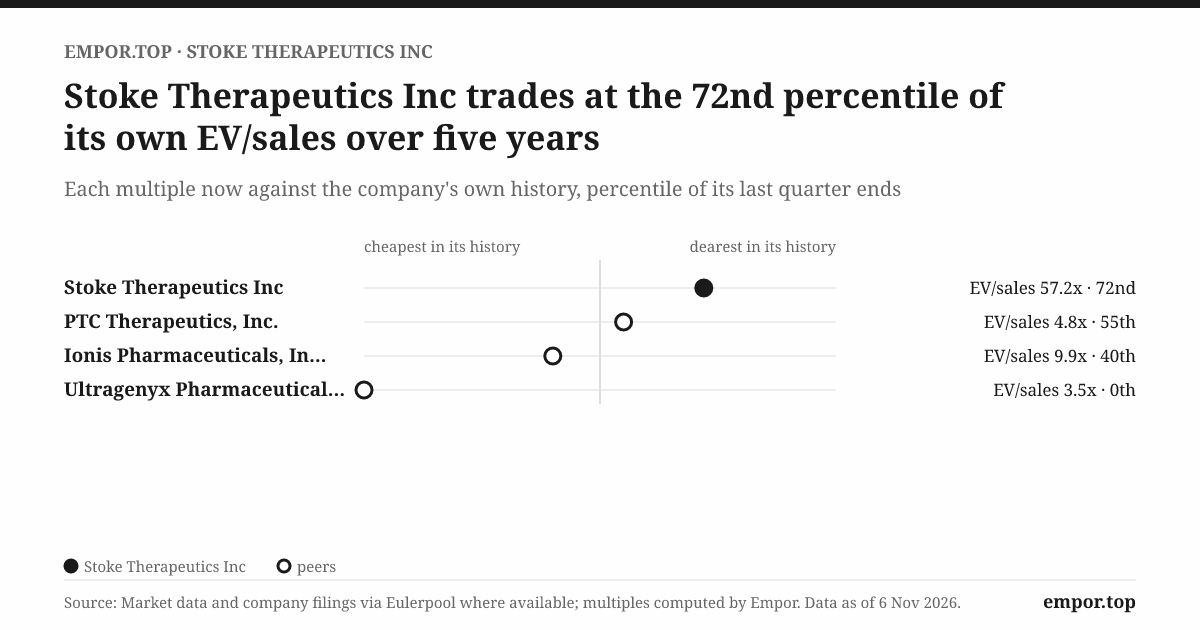
Start with what the price says. At about $1.5 billion of market value and about $1.2 billion of enterprise value, Stoke traded at roughly 54 times its trailing sales and 57 times enterprise value to sales on November 6, 2026.2 Those multiples would be absurd for a mature business, and that is the point: they are not measuring a mature business. The sales denominator is still swollen by the Biogen license transfer recognized in early 2025, and trailing earnings are a loss of about $3.79 a share.23 The 34 times price-to-earnings figure that sometimes appears in data screens uses the twelve months to September 2025, a window that included the one-time license gain, so it says nothing about the company's ongoing economics.2 No meaningful historical P/E series exists for a company that has almost never earned a profit. The valuation is best read as a clue to expectations. The market is assigning a substantial probability to zorevunersen becoming an approved, commercially meaningful medicine, and pricing in some value for the platform behind it.
The stock's own history shows how violently those expectations can swing. The shares traded between about $22 and about $38 over the past year, and sat about 31% below their high on November 6.2 Over five years, the worst drawdown was about 89%.2 Shareholders in Stoke have already lived through a period when the market priced the company close to failure. That is the base rate for single-asset biotech, and it should temper any sense that the current valuation is settled.
The bull case, at full strength, goes like this. The Phase 1/2a and extension data are unusual: seizure reductions of the size reported in the NEJM paper, sustained for well over a year, in children already on full regimens of existing medicines, plus signs of improvement on measures that existing drugs do not touch.6 EMPEROR is a properly designed controlled test with a conventional bar for success and enough patients to detect a real effect.17 Biogen, a company with deep experience in intrathecal antisense drugs, looked at the same data and paid $165 million upfront for less than the whole world.9 And if the drug works in Dravet, it validates the TANGO approach for other haploinsufficient diseases, turning a one-product story into a platform story.
The bear case deserves equal force. The early data remain unproven under a control group, and the Phase 3 primary result is unknown.6 Even with a win, Stoke pays 70% of agreed development costs, has never launched a product, sells a repeated spinal injection into a market with established medicines and faces a possible one-time gene-therapy rival.310 It already sells shares steadily to fund itself, and a delay or an ambiguous result would force it to sell more at worse prices.2 And the platform claim has already met a partner that chose to stop two programs.8
Who holds the power
Porter's five forces sharpen the picture. Buyer power is the force most likely to matter commercially: insurers and national health systems will decide whether to pay for an expensive chronic therapy, and Stoke has no record of negotiating with them. Supplier power is moderate; Stoke depends on contract manufacturers and research organizations, though its agreements generally allow cancellation subject to costs incurred.3 The threat of substitutes is real, because approved seizure medicines already serve the patients Stoke wants to treat. The threat of new entrants is embodied by ETX101 and by any other genetic approach to SCN1A.10 Rivalry is low today only because the disease-modifying category has no approved member. In the partnership itself, bargaining power sits more with Biogen than the headline payments suggest. Biogen paid a defined upfront sum, shares only 30% of costs, and owes milestones only if Stoke delivers.9
Hamilton Helmer's seven powers ask a different question: what would let Stoke earn returns above its cost of capital for a long time? Counter-positioning and network effects do not apply. Scale economies and switching costs require a commercial product and do not yet exist. Brand is irrelevant in rare-disease medicine except as physician trust, which Stoke has yet to earn commercially. Process power, the hard-won ability to design splicing-modulating antisense drugs well, is the most plausible power, and the TANGO patents, together with whatever regulatory exclusivity an approved drug would receive, could add a cornered resource.35 The Acadia exits leave that process power unproven.8
The returned Acadia rights and earlier pipeline have value only if someone pays to advance them.38 Zorevunersen remains the platform's commercial proof point.
The early-2028 runway is management's estimate, not a guarantee, and rests on assumptions about spending, Biogen's reimbursements and trial timing.[^1] Stoke has already funded much of its burn through share sales.2 Its balance sheet is strong enough to reach the readout. It is not strong enough to absorb a failed trial and fund a second one without substantial new equity.
The spine of the case therefore reduces to three things worth tracking, and only three. The first is the EMPEROR result and its timing, with the primary endpoint expected in the third quarter of 2027.1 The second is quarterly operating cash use and the runway it implies, recently about $60 million a quarter against guidance into early 2028.[^1]2 The third is the share count, which rose from about 58.9 million to about 64.8 million over the first nine months of 2026.23 Everything else, from the lease to the pay vote to the returned programs, matters mainly through its effect on those three. And those three have already taught lessons that apply well beyond Stoke.
XI. Lessons Stoke Had to Learn in Public
The strangest image in Stoke's financial history is a single quarter. In the first three months of 2025, a company that had lost money every year of its existence suddenly reported a profit of about $113 million.2 For a moment, on a screen of quarterly results, Stoke looked like a profitable biotech. By the first nine months of 2026, it was losing about $185 million.2 Nothing about the science had changed between those two moments. What changed was the accounting for $150.8 million of license revenue recognized at once, and then the absence of anything like it.3 That whiplash is where Stoke's lessons begin.
The first lesson is about the platform. A platform is a hypothesis until more than one program advances. TANGO is a genuinely clever idea, and Stoke built a company on the promise that it could treat many diseases by teaching a healthy gene to work harder. Yet the platform's commercial proof still rests on one molecule, and the only partner to fund multiple programs handed two of them back before they reached a patient.8 For founders, the wider point is that investors will pay for a platform story early and then judge it, without sentiment, by how many products it produces. For investors, it is that a portfolio of research programs is worth what someone will pay to advance it, not what a slide says it could address.
The second lesson is about partners. A partner's check buys time, not certainty. Biogen's $165 million upfront was real money and real validation from a company that knew this kind of drug better than almost anyone.9 But it did not move the clinical risk off Stoke's shoulders. Stoke still runs the trial, still pays 70% of the agreed development costs, and still has to prove the drug works before any milestone or royalty arrives.39 The upfront payment bought Stoke runway and credibility. It did not buy an answer, and the financial statements of the year it arrived made that easy to forget.
The third lesson is about evidence. A beautiful open-label curve still has to survive a control group. The NEJM data made zorevunersen one of the most talked-about programs in rare neurological disease, with seizure reductions that looked, for some patients, close to transformative.6 EMPEROR exists because nobody, including Stoke, can be sure how much of that improvement belongs to the drug. The industry has learned this repeatedly, and Stoke will learn its own version in 2027. A result that is merely good will be judged against expectations set by a result that was uncontrolled.
The fourth lesson is about money. Runway is a financing plan measured in shares. The phrase "funded into early 2028" sounds like a statement about cash, and it is. It is also a statement about the roughly 4.6 million shares Stoke sold in nine months to keep that date in place.2 Every month of runway a pre-revenue biotech reports has a price, and the price is paid by existing shareholders in the form of a smaller slice of the eventual prize. For investors in companies like Stoke, the honest way to read a runway is to ask how many shares it took to buy, and how many more the next stretch will need.
XII. The Next Two Years Decide What Stoke Is
Tonight, Stoke is a company in the waiting room. EMPEROR is fully enrolled and its patients are working through the treatment period.1 Stoke's teams are preparing the parts of a New Drug Application that do not depend on the trial result, with management expecting submission to begin in the first half of 2027 and complete in the second half.1 At September's end, Stoke held about $359 million in cash and securities; management guides to a runway into early 2028, and the company expects to move into its new headquarters before year-end.[^1]2
The first moment that decides the story is the readout, which management expects in the third quarter of 2027.1 Investors will look past the headline to the prespecified primary endpoint and supporting safety and secondary data.7 A clear win on the primary endpoint with supportive secondary data would strengthen the case for a product and the disease-modifying claim. A win on seizures alone would make it a good seizure drug in a crowded field. A miss would put the open-label story, the platform and the financing plan all under question at once.
The second moment is the FDA's response. Its decision on the application, any review designation and any remaining data requirements will determine when, not just whether, Stoke can sell the drug.1 Every quarter of delay at that stage costs Stoke something like $60 million at its current pace of spending.2
The third set of moments arrives every quarter regardless of the trial: the cash and securities balance, operating cash use, Biogen's reimbursements and the number of new shares sold.2 If spending rises toward launch while the readout slips, the early-2028 runway will look less comfortable and dilution will accelerate. If the readout comes on time and the data are strong, Stoke may be able to raise money on far better terms, or Biogen's milestones may begin to matter.
Two quieter questions will tell investors about management's priorities. One is whether Stoke advances the returned Acadia programs with its own money or a new partner, or concentrates its resources entirely on zorevunersen.8 The other is whether execution matches guidance: whether the readout arrives in the quarter management has promised, and, if forecasts change again, whether the change is explained as clearly as the January 2026 update was.[^12] A changed forecast with a reason is normal in clinical development. A narrative that shifts without explanation would be a different signal.
The tension remains exactly where it started. The clinical result is the hinge, and FDA timing, cash burn and share issuance will determine whether Stoke can turn that result into a product without paying too much for the privilege.
XIII. Outro
Go back to the October 29, 2026 call: Stoke was still waiting for the Phase 3 result that could make the business legible.[^1]1 That is what makes Stoke unlike a conventional drug company. Its income statement records partner reimbursements, its balance sheet records the shares it has sold, and its most valuable asset is a result nobody has seen yet.
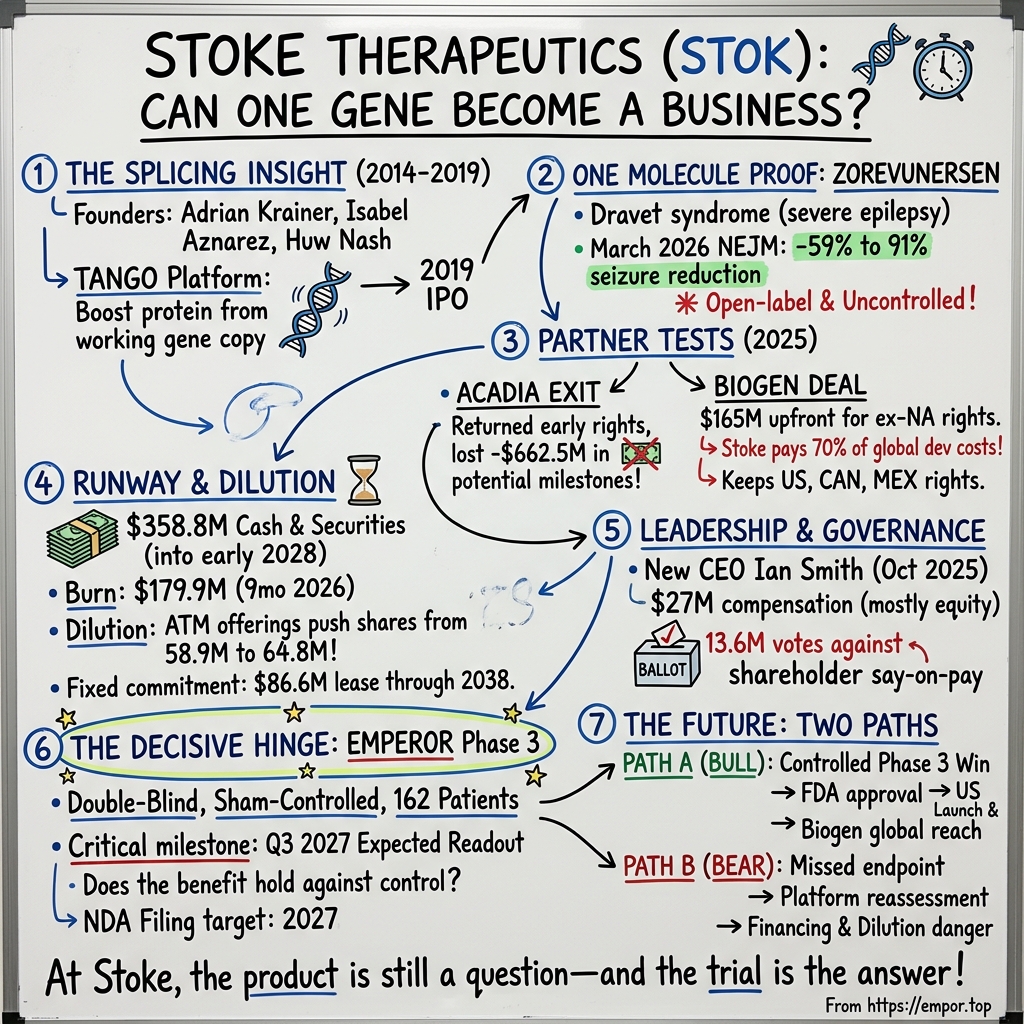
There is a fitting symmetry in that. Stoke's science tries to correct a gene's output; its investors are waiting for one trial to make the business legible. At Stoke, the product is still a question—and the trial is the answer the company has to earn.
References
-
Q3 2026 Earnings Call Transcript — Stock Analysis / Quartr, 2026-10-29 ↩↩↩↩↩↩↩↩↩↩↩↩↩↩↩↩
-
Form 10-Q for the quarter ended September 30, 2026 — SEC, 2026-11-03 ↩↩↩↩↩↩↩↩↩↩↩↩↩↩↩↩↩↩↩↩↩↩↩↩↩↩↩↩↩↩↩↩↩↩↩↩↩↩↩↩↩↩↩
-
Form 10-K for the year ended December 31, 2025 — SEC, 2026-03-16 ↩↩↩↩↩↩↩↩↩↩↩↩↩↩↩↩↩↩↩↩↩↩↩↩↩↩↩↩↩↩↩↩↩↩↩↩↩↩↩↩↩
-
Zorevunersen in Children and Adolescents with Dravet Syndrome — New England Journal of Medicine, 2026-03-04 ↩↩↩↩↩↩↩↩↩↩↩↩↩
-
Form 10-Q for the quarter ended June 30, 2025 — SEC, 2025-08-07 ↩↩↩↩↩↩↩↩↩↩↩↩↩↩
-
Form 8-K: Biogen License and Collaboration Agreement — SEC, 2025-02-18 ↩↩↩↩↩↩↩↩↩↩↩↩
-
Pivotal Study Progress for ETX101 in Dravet Syndrome — Encoded Therapeutics ↩↩↩↩↩
 LinkedIn
 WhatsApp
 Reddit
 Hacker News
 Email
 Kindle
 RSS Feed
 Spotify
 Apple Podcasts
 Amazon Music
 Audible
 YouTube