Skyward Specialty Insurance Group: The Price of Knowing When to Say No
I. The insurer that grew faster by shrinking
In 2025, an underwriter at Skyward Specialty looking at a commercial property account had the same problem as almost every property underwriter in America. The account was probably fine. The building was probably not going to burn down or blow away. But the price on offer had been falling, quarter after quarter, as fresh capital poured into a market that had been brutally expensive only two years earlier. Writing the account would add premium to the top line, which is the number Wall Street tends to applaud first. Declining it would leave that premium for a competitor.
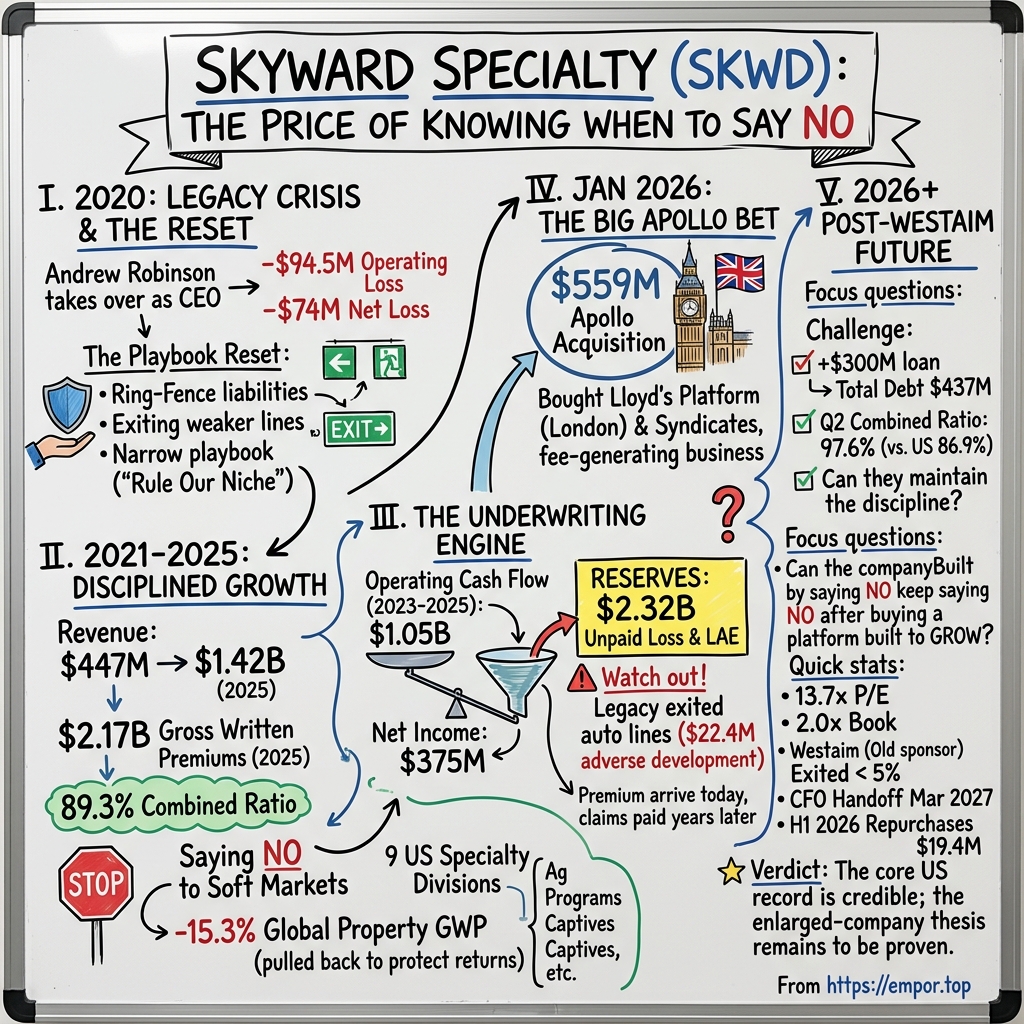
Skyward declined a lot of it. Its Global Property division, which had written about $243 million of premium in 2023, wrote about $178 million in 2025, a cut of more than a quarter while the rest of the company kept growing.1 Management said plainly why: property catastrophe pricing had softened, and the company would rather shrink a line than write it at returns it did not like.1 Across the whole company, gross written premiums still rose to about $2.17 billion, and the combined ratio, the insurance industry's cleanest scorecard, came in at 89.3%.1 In plain English, for every hundred dollars of premium Skyward earned, it paid out a little under ninety in claims and expenses, before it collected a cent of investment income.
Then, on the first day of 2026, the same company did something that looks, at first glance, like the opposite of restraint. It closed a $559 million purchase of Apollo Group Holdings, a London-based Lloyd's of London platform, financed partly with a new $300 million term loan and partly with freshly issued shares.23 The company that had just shown it could say no to growth had bought a business built to grow, in a market it had never operated at scale, with money it had to borrow.
That is the contradiction at the centre of this story. Skyward Specialty Insurance Group is a small American specialty insurer that rebuilt its reputation by being picky. It now has to prove that pickiness survives contact with a bigger, more complicated company, with a second underwriting culture, with Lloyd's catastrophe exposure, and with a debt balance that more than tripled in eighteen months.
Three questions run through everything that follows. The first is whether the niche strategy survives softer pricing, since a specialist that thrives only when markets are hard is a cyclical bet, not a franchise. The second is whether Apollo earns its price without weakening the underwriting discipline that made Skyward worth owning. The third is whether the reserves, the long tail of claims from policies already sold, and management's record are strong enough to trust the expansion at all. Insurers do not reveal their mistakes when they make them. They reveal them years later, when the claims arrive.
One piece of housekeeping matters before the story begins. Skyward's 2025 results describe a purely American business. Its 2026 results include Apollo. So the headline growth rates of 2026 mix two different things: what the old franchise did on its own, and what the company bought. In the second quarter of 2026 the reported revenue line jumped by almost half from a year earlier, and much of that jump came with the acquisition rather than from new customers walking through the door.[^2] Any investor reading those numbers has to pull them apart.
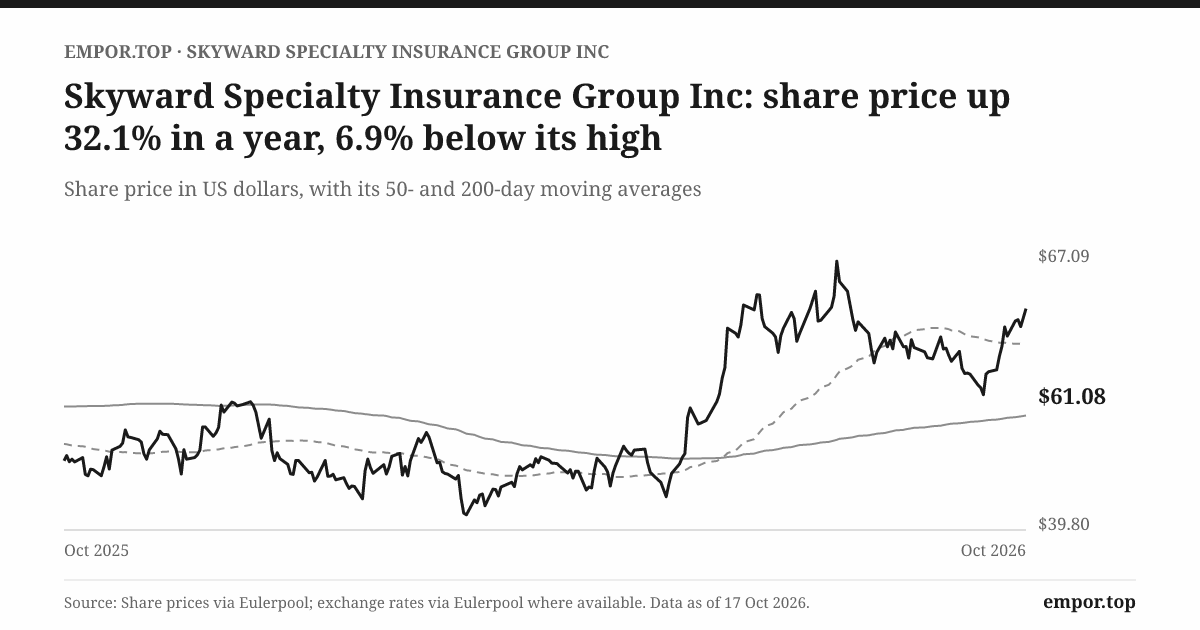
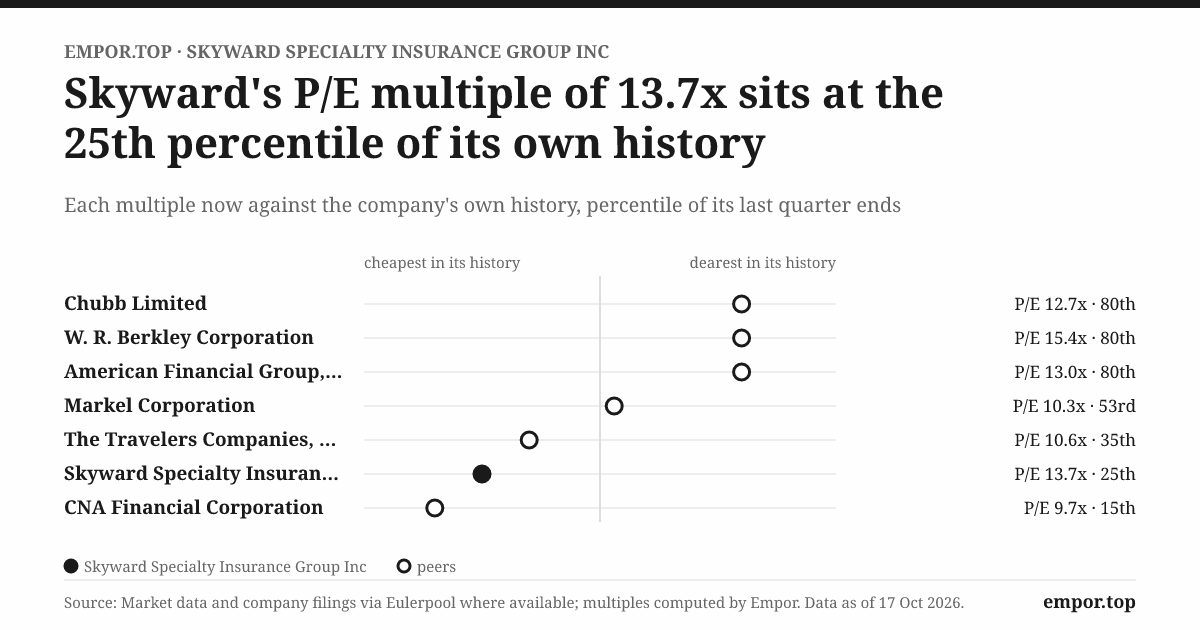
The stakes are visible in the share price. On October 17, 2026, Skyward traded at $61.08, about 13.7 times its trailing earnings and roughly twice its book value of about $30 a share.[^2]3 The market had paid closer to 18 times earnings for the stock, on median, over its five public years. So investors are paying less for each dollar of Skyward profit than they used to, even though the profits are larger and the stock sits within about 7% of its 52-week high. Something in the story makes the market hesitate, and the most obvious candidate is the London deal and the debt that came with it.
To understand why a discount might be fair, or might be an opportunity, it helps to go back to the moment the old company ran out of road.
 Subscribe on LinkedIn
II. The year the old company ran out of room
The company that became Skyward did not start life with a turnaround narrative. It started as Houston International Insurance Group, a Delaware holding company formed in January 2006, run for most of its life by founder Stephen Way, an entrepreneur who had built insurance businesses before and knew how to assemble one quickly.6 HIIG grew through a patchwork of specialty lines and operating insurers, among them Houston Specialty, Great Midwest and Oklahoma Specialty, writing a broad mix of commercial risks through brokers.6
Fast growth in insurance is easy in a way that fast growth in most industries is not. A manufacturer has to build a factory before it can sell more widgets. An insurer only has to say yes. The premium arrives immediately, and the bill for underpricing it arrives slowly, sometimes over many years, as claims are reported, litigated and paid. That is precisely the trap HIIG walked into. Its expansion across lines such as commercial auto, where accident claims could drag through courts for years, outran its ability to price and reserve for the risk.6
By 2020 the bill had come due. The company reported revenue of about $447 million that year, alongside an operating loss of roughly $94.5 million and a net loss of about $74 million.16 Equity had shrunk to about $76 million, which for an insurer is the cushion between policyholders and disaster.6 This was not a bad quarter or an unlucky hurricane season. It was the arithmetic of reserves that had been set too low on business that should not have been written at the price it was.
In May 2020, the board and the company's principal backer, the Canadian investment firm Westaim, installed Andrew Robinson as chief executive.6 Robinson was a specialty-insurance operator rather than a founder: an executive who had spent years running specialty and commercial businesses at larger carriers, including The Hanover, and who arrived with a reputation as an underwriting-first manager.6 His style, visible in years of earnings calls since, is methodical and slightly professorial: he talks about portfolio construction, about which divisions deserve capital, about the difference between growth that comes from pricing and growth that comes from exposure. Within months the company also took a new name, Skyward Specialty, in November 2020.6
His fix had three parts, and each tells you something about the company that exists today. First, narrow the playbook. Robinson called the strategy "Rule Our Niche": pick specialty corners where Skyward could be among the best underwriters, and stop pretending to be a generalist.6 Second, exit or non-renew the lines that had caused the damage, including much of the commercial auto book. Third, build a wall around the past. Skyward bought a loss portfolio transfer, a kind of reinsurance in which another company takes over responsibility for a block of old claims in exchange for a payment, covering accident years before 2018.6 Think of it as selling your attic full of unknown boxes to someone who agrees to deal with whatever is inside.
The recovery that followed is the part most investors know. Revenue climbed from about $447 million in 2020 to about $1.42 billion in 2025, a compound rate of roughly a quarter a year, while operating margin swung from a deep loss to about 15%.1 Net income reached $170 million in 2025.1 That is a genuinely different company, and it is fair to say the growth record belongs to the Robinson regime and its strategy rather than to anything that came before.
But the attic was not fully emptied. The loss portfolio transfer covered the oldest years; it did not cover everything written before the turnaround took hold. In 2025, accident years in the exited commercial auto and excess auto lines still produced about $22.4 million of adverse development, meaning claims came in worse than the reserves had assumed.1 The old company's mistakes, in other words, were still sending invoices five years after the new management arrived. That caveat travels with the rest of the story, because it is the purest test of whether an insurer's past is truly past.
Before testing that, though, it is worth slowing down and asking a more basic question: what exactly does a company like Skyward sell?
III. What does an underwriter actually sell?
Picture a broker in Dallas with an awkward file on the desk. The client is a contractor that does specialised work on energy sites, or a company that needs a surety bond to guarantee it will finish a public project, or a farm cooperative that wants to protect its crop. A standard insurer looks at the file, sees nothing that fits its rating manual, and passes. The broker needs a carrier willing to read the details, price an unusual risk, and write a policy in a form that may not exist anywhere else.
That is Skyward's customer moment. The company sells commercial property, casualty and surety coverage, mostly on policies with roughly 12-month terms, priced against the insured exposure or the policy limit.1 It does not sell directly to most policyholders. Brokers bring the business, wholesale brokers for the hard-to-place excess and surplus, or E&S, risks that standard carriers will not touch, and retail brokers for other lines.1 Skyward's underwriters decide whether to take the risk and at what price. Then the company decides how much of that risk to keep and how much to pass to reinsurers, which are insurers for insurers.
The economics follow a strange rhythm that every insurance investor has to internalise. Premium is collected up front, or in instalments over the year. It is "earned" gradually over the policy term, so a premium written in December is mostly earned the following year. Claims, meanwhile, may not be reported for months and may not be paid for years. An insurer is therefore a business that is paid first and learns its true cost later. Its profits depend on getting the price right before the cost is known.
Skyward organises its American business into nine underwriting divisions, and the shape of that portfolio matters more than the list. The largest in 2025 was Agriculture and Credit Reinsurance, at about $346 million of gross written premium, followed by Specialty Programs at about $323 million.1 Captives, where groups of policyholders share in their own risk, wrote about $276 million, and Construction and Energy Solutions about $274 million.1 Accident and Health wrote about $254 million, Transactional E&S about $198 million, Global Property about $178 million, Surety about $168 million and Professional Lines about $149 million.1 No single division is a third of the company; the biggest is roughly a sixth. That breadth is the practical meaning of "Rule Our Niche": not one niche, but a portfolio of them, which gives management room to move capital from a line where prices are falling to one where they are rising.
Reading an insurer's numbers requires one discipline above all. Gross written premium is the measure of how much business the company wrote. Net earned premium is what it kept after reinsurance and recognised over time. Underwriting income is what was left after claims and expenses. The broad "revenue" figure that data providers show, about $1.42 billion for 2025, blends net earned premiums with investment income and other items, and it is not a substitute for premium volume.1 When this story talks about how fast the business grew, it means written premium; when it talks about profitability, it means the combined ratio and underwriting income.
So where did 2025's growth come from? Written premium rose by about a quarter, from roughly $1.74 billion to $2.17 billion.1 The engines were agriculture and credit reinsurance, along with other specialty lines where the company saw attractive pricing.1 At the same time, Skyward cut Global Property as rates softened and exited business it considered unprofitable in construction, energy and professional lines.14 On the fourth-quarter call, Robinson described this as the portfolio doing what it was designed to do, leaning into lines with margin and away from lines without it.4 That claim deserves scrutiny later, but the direction of the evidence supports it: the company grew overall while shrinking exactly where pricing deteriorated.
The profit engine has two cylinders. The first is underwriting profit, the premium left after claims and expenses, measured by the combined ratio. Below 100% means the insurance itself made money; Skyward's 89.3% in 2025 meant roughly an 11-cent profit on every dollar of earned premium before investment returns.1 The second cylinder is investment income on the "float", the pool of premium held between collection and claim payment. A company that makes money on both is paid to hold other people's money and then earns a return on it. That is the business model Warren Buffett made famous at Berkshire Hathaway, and it is the one Skyward is attempting at a much smaller scale.
Beginning in 2026, the reporting changed. Skyward now shows two segments: Skyward Specialty, the American insurance operation, and Apollo, the U.K.-based Lloyd's platform.3 The two have different premiums, different underwriting results and different economics, and the story keeps them apart. The American business is an underwriter that keeps risk on its own balance sheet. Apollo is partly that and partly something else, a manager of other people's insurance capital, which comes later.
The question here is whether the American portfolio has anything a rival cannot replicate. A list of nine divisions is a description, not an advantage. The advantage, if it exists, has to show up when a broker takes a renewal elsewhere.
IV. A niche is only an edge if it survives renewal
Every year, every policy comes up for renewal. The broker who brought the account to Skyward twelve months earlier can send it to Kinsale, to W.R. Berkley, to a Lloyd's syndicate or to any of dozens of specialty carriers. Skyward has to win the business again: on price, on the wording of the policy, on how fast and fairly it paid claims last year. There is no contract that locks the customer in, no software migration that makes switching painful. A specialty insurer's moat, if it has one, has to be rebuilt every twelve months.
Start with the forces acting on the business. The policyholders themselves have little individual bargaining power: no single one accounts for more than 1% of Skyward's premiums.1 Brokers are a different story. They control which submissions reach which carriers, and a large wholesale broker can steer a stream of business toward whoever offers the best combination of price and service. Rival specialty carriers compete hard for the attractive risks; in a soft market, new capital pushes prices down for everyone. And reinsurers, the suppliers of capacity, set a price on how much risk Skyward can afford to keep. When reinsurance gets expensive, Skyward either keeps more risk or writes less.
The comparison set makes the stakes concrete. Kinsale Capital, the closest American E&S specialist, wrote about $1.98 billion of gross premium in 2025, slightly less than Skyward's $2.17 billion.71 But Kinsale earned roughly $504 million of net income that year, about three times Skyward's $170 million.71 Larger diversified specialty players such as RLI and W.R. Berkley sit on the other side of the field, broader and more established. The Kinsale comparison is the sharpest warning in this story: similar premium scale does not produce similar economics. Kinsale built its model around very low expenses, small policies and almost total control over its own underwriting; Skyward's mix includes programs, captives and reinsurance assumed, which carry different cost structures and different shares of risk retained. Premium alone tells an investor almost nothing about which company is better.
So what is the claimed edge? Management argues it is specialist expertise: teams that understand a niche deeply enough to write risks others will not, and a willingness to shrink when prices fall.4 That is plausible. Specialist underwriters who know, say, agricultural risks or surety bonds can price better than generalists, and brokers send difficult accounts to people who say yes intelligently. The test is in the measurable outcomes. If the edge is real, it should show up in retention of good accounts, in disciplined shrinkage when markets soften, and in combined ratios that stay below peers' or at least stay steady through a cycle.
The evidence is mixed in an instructive way. On retention, management has described renewal retention in roughly the 70% range in its specialty lines.5 That is respectable for E&S business, where accounts move frequently, but it also means close to a third of the book turns over each year. That is not lock-in. On shrinkage, the record is strong: Global Property was cut sharply when prices fell, and on the second-quarter 2026 call management said property and professional lines were becoming more price-competitive, with Global Property premium down about 15% year over year in that quarter.5[^2] On combined ratio, the American segment ran at about 86.9% in the second quarter of 2026, better than the company's 2025 full-year figure.[^2]
Put those clues together and the verdict is narrower than a moat. Skyward has shown underwriting focus, a diversified book of policyholders, and a willingness to give up premium. It has not shown that customers cannot leave, or that it can price risks systematically better than Kinsale. The evidence supports "disciplined specialist", not "franchise that competitors cannot copy". The KPI that would upgrade the claim is a combined ratio that stays in the high 80s even as property and professional lines soften; a slide toward the mid-90s would tell you the discipline was mostly a function of a hard market.
Two quieter relationships also shape the competitive picture. The first is broker concentration. Skyward does not disclose how much premium comes through any single broker.1 Large wholesale networks clearly matter to any E&S writer, and an investor cannot tell from the filings how dependent Skyward is on any one of them. The second is an affiliate. Skyward owns 20% of RISCOM, a wholesale brokerage and managing general agency, and in 2025 business through RISCOM produced about $120 million of net earned premium, roughly 9% of the company's total, with about $29 million of commissions paid back to it.1 That is a meaningful share of business flowing through a related party, a theme that returns when the story turns to governance.
Counterparty risk deserves the same specificity. At the end of 2025 Skyward was owed about $1.12 billion by reinsurers, money it expects to collect when reinsured claims are paid.1 Of the portion not backed by collateral, 98.2% was owed by reinsurers rated A− or better by AM Best, and a further $344 million was secured by trusts, letters of credit and funds withheld.1 That lowers the risk considerably. It does not eliminate it, and Skyward's own history explains why: one of its most important reinsurance contracts, the legacy transfer that walled off the past, ended up with a reinsurer that failed.
Before that story, though, there is the matter of money: an insurer's cash looks enormous, and it is worth asking whose cash it really is.
V. The cash arrives before the claims
A policyholder pays a premium today. The claim, if there is one, might be paid next month, or in three years after a lawsuit, or never. In the meantime, the insurer holds the money. Multiply that by tens of thousands of policies and a growing book, and an insurer can look, on its cash-flow statement, like the most cash-generative company in the market.
Skyward looks exactly like that. Over 2023 through 2025, it produced about $1.05 billion of operating cash flow against about $375 million of net income.1 Its reported free-cash-flow yield, above 15%, appears to suggest a company throwing off cash at a rate most businesses can only dream of.1 An industrial company converting nearly three dollars of operating cash for every dollar of profit would be extraordinary. For an insurer growing fast, it is mostly normal, and it is mostly not shareholders' money.
Here is the bridge. Over those three years, Skyward's reserves for unpaid losses and loss-adjustment expenses grew by about $1.18 billion.1 Those reserves are the company's estimate of claims it already owes but has not yet paid. Every dollar added to that reserve is a dollar of expense recognised in earnings but not yet paid out in cash, so it inflates operating cash flow relative to profit. Unearned premiums, money collected for coverage not yet provided, also grew by about a third of a billion dollars.1 In short, the cash surplus over earnings is the float, policyholders' money the company is holding until claims come due.
Some of the inflow never arrived as cash at all. Premiums receivable, money brokers and policyholders owed but had not yet paid, rose by a cumulative $405 million, and amounts recoverable from reinsurers rose by about $541 million.1 These are claims Skyward has on other parties, not dollars in its bank account. The reported operating cash flow already nets them out, but they explain why the float that is actually investable grows more slowly than gross premium.
The jump in receivables looks alarming on a ratio screen, where "debtor days" climb above 400.1 The explanation sits in the filings. Premiums receivable rose from about $322 million at the end of 2024 to about $544 million at the end of 2025, a period in which written premium grew by about a quarter and more business was billed in instalments.1 Skyward says credit-loss allowances on premium receivables remained immaterial, and it carried an allowance of only about $2.3 million against reinsurance recoverables.1 The company attributes the receivable build to growth and billing patterns, not to a group of customers who stopped paying. On the evidence, nobody is paying alarmingly late; the company is simply writing more, and more of it on instalments.
Where does the float go to work? At the end of 2025 Skyward held about $2.5 billion of cash and investments, which generated about $83.6 million of net investment income that year, roughly double the 2023 level as both the portfolio and yields rose.1 That investment income accounted for almost two-fifths of the company's pre-tax profit.1 The core bond portfolio carried an average credit rating of A+ and a duration of about 3.6 years, shortened from more than four years in 2024.1 Duration measures how sensitive a bond portfolio is to interest rates; a shorter one means less damage if rates rise and less temptation to reach for yield by locking money up for decades. It also matches a book whose claims are mostly paid within a few years.
There is one smaller wrinkle. Part of the portfolio sits in alternative and equity-method investments, including about $27 million in a fund managed by Arena Investors, an affiliate of the former sponsor Westaim.1 It is a small slice of $2.5 billion, but it is the kind of holding a careful investor wants to see shrink rather than grow, and it did fall from about $35 million a year earlier.1
So the verdict on the cash is straightforward. Operating cash flow and free cash flow are not measures of what Skyward could pay shareholders. They are measures of how much float the growing business accumulated, and that float belongs, economically, to the policyholders whose claims it will pay. Its value to shareholders depends on two things: the investment income it earns while held, and whether the reserves set against it turn out to be adequate. If reserves prove too low, the float was never as large as it looked. That makes the reserve question the most important question about this company, and it is the one with the longest shadow.
VI. The reserve problem that outlived the LPT
On January 31, 2025, Skyward closed a chapter that had worried investors for more than a year. It commuted its legacy loss portfolio transfer with R&Q Re, the Bermuda reinsurer that had taken over its pre-2018 claims in 2020, and collected the remaining $22.7 million it was owed, in cash.1 Commutation means both parties agree to tear up the contract for a final payment. Skyward took back responsibility for the old claims, and R&Q, which had fallen into financial distress, was out of the picture.1
The sequence is worth retelling because it captures the peculiar risks of insurance. HIIG's expansion created reserve deficiencies. The new management bought the transfer to wall those deficiencies off. Then the company that held the wall began to wobble. During 2024, Skyward booked a $13.6 million increase in its allowance for uncollectible reinsurance tied to R&Q, essentially writing down the asset in case the money never came.114 The commutation recovered the outstanding balance in full and ended the counterparty exposure. As a piece of crisis management, it worked.
But closing the counterparty question did not close the reserve question. When Skyward took back the contract, it also took back the uncertainty about what those old claims would ultimately cost. The claims themselves keep developing: lawsuits settle, injuries turn out worse than expected, juries award more than the actuaries modelled. R&Q is no longer the open risk. The underlying claims are.
The 2025 reserve footnote shows how that plays out. Overall, the company recorded about $7.5 million of net favorable prior-year development, meaning last year's estimates, in total, proved slightly too high.1 Underneath that small net figure sit two opposing streams. Short-tail lines, where claims are reported and paid quickly, released about $24.6 million, and multi-line solutions another $5.3 million.1 Against that, exited commercial auto and excess auto accident years added about $22.4 million of adverse development.1 In 2024 the picture was worse: total prior-year development was adverse by about $25.7 million, almost all of it on pre-2018 accident years.114
The consensus story is that Skyward reserves conservatively and its new business keeps releasing redundancies. The record narrows that claim. The releases came mostly from short-tail lines, where reserves resolve quickly and errors are easy to correct. The adverse development came from long-tail casualty, the lines where errors compound for years. Favorable short-tail development does not offset a recurring adverse signal from long-tail exited lines, because they measure different things. One tells you this year's property claims were lighter than feared; the other tells you the company is still learning what old casualty business really costs.
Skyward's auditor, Ernst & Young, put the same point in formal language. Its critical audit matter for 2025, the item auditors flag as requiring the most complex judgment, was the valuation of the company's roughly $2.32 billion of unpaid loss and loss-adjustment-expense reserves, and in particular the actuarial assumptions behind claims incurred but not yet reported.1 That is a standard critical audit matter for an insurer. It is also the largest liability on Skyward's balance sheet, bigger than its entire shareholders' equity by more than two to one.1 A 5% error in the reserve estimate would be worth more than half a year of 2025 net income.
There was one other blemish in the record, and it was fixed. At the end of 2024, management identified a material weakness in internal controls over information technology, specifically in user access management.14 During 2025 the company remediated it, and EY concluded internal controls were effective at year-end.1 That is a documented correction rather than an ongoing concern, but it belongs in the file as a reminder that a fast-growing insurer can outrun its plumbing.
So has the old risk been retired? The counterparty risk, yes. The actuarial risk, no. The KPI that would settle it is simple: adverse development on exited lines falling to a trivial figure, below about $5 million, in the 2026 reserve footnote. Two years of more than $20 million each do not establish that trend.
That is the backdrop against which management chose to buy another insurer's reserves, another set of syndicates, and another culture, in London.
VII. Apollo: a $559 million bet on another underwriting culture
On January 1, 2026, Skyward closed its purchase of Apollo Group Holdings, adding Lloyd's Syndicates 1969 and 1971 and a managing-agency business that runs insurance capital for third parties.23 For a company that had spent five years tidying its own house, it was the largest single decision of the Robinson era.
What exactly did Skyward buy? Lloyd's of London is not an insurer but a marketplace, where syndicates, pools of capital organised by managing agents, write risks from around the world. A managing agent hires underwriters, runs the syndicate, and earns fees and a share of profits from the capital providers who back it. Apollo is both a syndicate operator with its own risk and a manager of other people's capital, including through arrangements with partners who provide capacity.2 That second part is the interesting one. A managing agent can earn fees on premium it does not have to hold on its own balance sheet, which is closer to an asset manager than to an insurer.
The deal economics were announced in September 2025. Skyward agreed to pay a price that management described as less than nine times Apollo's projected 2025 EBITDA, and forecast double-digit accretion to adjusted operating earnings per share in the first full year.2 At closing, the consideration came to about $559 million, roughly $371 million in cash and the rest in about 3.7 million newly issued Skyward shares valued at about $51 each.3[^17] The cash came largely from a new $300 million term loan.3
The headline multiple looked disciplined. But it was a multiple of the seller's projected earnings, at the moment of sale, which is about the most optimistic number a buyer ever sees. Whether the price was cheap depends on what Apollo actually earns, net of integration costs and interest, and on how much of the projected fee income persists after the deal. The purchase accounting provides a clue to how much of the price was paid for things the balance sheet cannot easily measure: Apollo brought about $1.45 billion of gross assets, about $478 million of loss reserves, and roughly $262 million of intangible assets.[^17] A large intangible and goodwill balance is a promise that future earnings will justify it. It is not yet proof.
Why could Apollo matter more than its premium alone suggests? Because the managing-agency business can diversify Skyward's earnings away from the underwriting cycle, and because Lloyd's gives the company international distribution it could not build from Houston. In management's framing at the announcement, Apollo was a low-volatility, fee-generating platform that would make part of the group more capital-light.2 That is the bull case, and it is coherent. A business that earns fees for underwriting other people's capital needs less of its own capital per dollar of profit.
The first two quarters put early evidence beside that thesis. In the second quarter of 2026, Apollo generated about $318 million of fee-generating written premium, up about 29% from a year earlier, and about $13 million of underwriting fee income.[^2] The fee engine is growing. The underwriting side was less comfortable: Apollo's combined ratio for the quarter was 97.6%, including about 5.4 points of catastrophe losses that management attributed to conflict in the Middle East.[^2]5 Strip out the catastrophe and the segment ran in the low 90s; leave it in and the segment barely made an underwriting profit. The American segment, by comparison, ran at about 86.9%.[^2]
The group total flatters the picture if read carelessly. Total managed premiums in the second quarter reached about $1.06 billion, up about 18%.[^2] That figure includes Apollo's premium, which did not exist inside Skyward a year earlier. Acquired growth is not organic growth, and the legacy American franchise, by itself, grew more slowly while it trimmed property.
Then there is the leverage. Skyward ended 2024 with about $120 million of debt.1 By June 2026, after the term loan and a revolving credit facility enlarged to $250 million with about $115 million drawn, total debt had reached about $437 million.3 The company repaid $50 million of the term loan in the first half of 2026, and financial leverage, debt as a share of total capital, sat around 26%.3 Cash interest paid in the first half rose to about $14 million from about $3 million a year earlier.3 That is manageable for a company earning nearly $50 million a quarter, but it is a new fixed claim on earnings, and the credit agreements require Skyward's insurers to keep an AM Best rating of at least A−.3
The most useful test of management credibility is to put the September 2025 pitch beside what followed. The presentation emphasised low volatility and accretion.2 On the first- and second-quarter calls, analysts pressed on exactly the points where that pitch could crack: catastrophe exposure at Lloyd's, the capital Lloyd's requires to back the syndicates, whether Apollo's underwriting standards matched Skyward's, and how fast the term loan would come down.5 Robinson's answers were consistent with the original framing: the Middle East losses were described as an event-driven anomaly in a portfolio that otherwise performed as expected, and debt reduction remained a stated priority.5 That consistency counts for something. But a catastrophe load in the second quarter of ownership is a reminder that "low volatility" is a claim about averages, and a Lloyd's book is exposed to precisely the global events a domestic specialty writer avoids.
Apollo's 97.6% in one quarter is not proof of a failed integration. One catastrophe in one quarter rarely is. But it does leave far less room for error than the American business, and it shows the integration test is already live. The deal is too new to call value creation. A full year of segment results, with and without catastrophes, will start to answer whether management bought a fee engine or a more volatile insurer.
Which raises the governance question: with the original sponsor gone, who now decides how Skyward's capital is spent, and are they paid for the right things?
VIII. One sponsor left; the capital choices are now Robinson's
For most of its existence, Skyward had a dominant owner. Westaim, the Canadian investment company that backed the turnaround, owned about 44.5% of the common equity before the January 2023 IPO.6 Today it is gone as a major holder, the company has started buying back its own stock, and its chief financial officer has announced he will step down in March 2027.[^18] The capital choices that shape the next decade now belong to Robinson and the board.
The ownership story moved quickly. Westaim sold shares in the IPO and in two secondary offerings in 2023, ending that year with about 17.5%, and on May 9, 2024 reported a stake of about 4.8%, below the 5% reporting threshold.1315 By 2026 the largest holders were institutions: BlackRock, T. Rowe Price, Vanguard, Invesco and Capital International each held around 5% to 6%, along with director James Hays, who owned about 6%.91617 Directors and officers together held about 8.5%.9 That is a widely held company with a meaningful but not controlling insider stake.
The capital history is short, which makes each decision more visible. The IPO, priced at $15 a share, raised about $60 million of primary proceeds for the company; the rest of the shares were sold by existing holders.6 The June and November 2023 secondary offerings, at $23 and $30.50, raised nothing for Skyward because only selling shareholders sold.15 For three years, then, the company funded its growth almost entirely from retained earnings. It has never paid a dividend.1 Apollo was the first major platform acquisition.
Then came the buybacks. In the first half of 2026, Skyward repurchased about 431,000 shares for about $19.4 million, at an average price of about $45.3 With the stock at about $61 in October, those purchases look well timed in hindsight. The harder question is whether they were the best use of capital at a moment when the company was carrying acquisition debt at a floating rate above SOFR plus 150 basis points.3 Every dollar spent on buybacks was a dollar not used to repay the term loan or to hold as statutory capital supporting growth. Buying stock at about 1.5 times book while paying down debt more slowly is a defensible choice, but it is a choice that an activist would press on: the company borrowed to buy Apollo and bought back shares in the same half-year.
What are managers paid to do? Executive incentives are tied to the combined ratio, with an internal target around 89.5%, to growth in written premium, and to growth in tangible book value per share.9 Robinson's 2025 compensation was about $5.53 million, of which roughly $2.97 million was annual non-equity incentive pay and about $1.56 million stock awards.9 That design is sensible for an insurer: it rewards underwriting profit and per-share book value, which are the things shareholders care about. The tension is the growth metric. A premium-growth target, in a softening market, can pull underwriters toward writing business they should decline. The combined-ratio target is the counterweight, and the 2025 property pullback suggests the counterweight worked.
Shareholders mostly agree on pay. Say-on-Pay passed in May 2026 with about 93.5% support.10 Directors fared less well. Individual nominees saw withheld votes of roughly 28% to 32% in each of the last three annual meetings: Gena Ashe in 2026, Anthony Kuczinski in 2025, Katharine Terry in 2024.101112 That is a material level of dissent, typically driven by proxy-adviser concerns over committee composition or board independence. It is a governance signal worth tracking, not evidence of a fight for control.
The related-party cleanup is real but incomplete. Westaim's formal management agreement ended with the IPO, and advisory fees paid to affiliated holders and directors fell from about $3.6 million in 2023 to about $0.6 million in 2025.115 Yet RISCOM, the 20%-owned brokerage, still produced about 9% of net earned premiums, and Skyward still held about $27 million in the Westaim-affiliated Arena fund.1 Neither is large enough to change the investment case. Both are the sort of relationship that a fully independent company would ideally reduce over time.
The succession watch is now active. Mark Haushill, the CFO who has been at Robinson's side through the turnaround, the IPO and the Apollo deal, is set to step down on March 31, 2027.[^18] A CFO transition in the year after a leveraged acquisition is a moment to watch whether guidance, capital targets and the tone of disclosure stay consistent.
Reinvestment, in an insurer, does not look like factories. Physical capital spending was about $5.5 million in 2025, mostly software.1 The real reinvestment is people and retained capital: headcount grew from 441 in 2022 to 611 in 2025, while revenue per employee rose from about $1.4 million to about $2.3 million.1 Shareholders' equity rose past $1 billion at the end of 2025 and to about $1.27 billion by June 2026, helped by the shares issued for Apollo.13 The company is reinvesting nearly everything it earns. The question is what that reinvestment is worth, and that is the question the share price is trying to answer.
IX. Analysis & Bear vs. Bull Case
Imagine the decision as an investor faces it in October 2026. On one side of the table sits a company with about $2.17 billion of American premium, a combined ratio below 90%, a rising book value and a freshly bought Lloyd's platform. On the other side sits a price: about 13.7 times trailing earnings, against a five-year median of about 18 times, roughly twice book value, with a trailing return on equity of about 15%.13 The stock sits near its 52-week high, yet it is cheaper on earnings than it has usually been. What is the market saying?
The bull case starts with the record. Since 2020, management has narrowed the business, exited bad lines and grown premium by roughly a quarter a year while improving profitability. The adjusted combined ratio moved from about 90.7% in 2023 to about 89.3% in 2025.1 Book value per share has compounded, and earnings per share rose from about $2.17 in 2023 to about $4.06 in 2025.1 The 2025 property pullback is the single best piece of evidence for the bull: a company willing to shrink a line by more than a quarter when prices fall is behaving like an underwriter, not a premium-maximiser. Add a portfolio of nine niches that lets capital move toward wherever pricing is best, and a Lloyd's platform that could add fee income less dependent on the cycle, and the bull sees a disciplined compounder trading at a discount because the market fears a deal that may turn out well.
The bear case is equally concrete. Exited long-tail lines keep producing adverse development, more than $20 million in each of the last two years.1 Every renewal is a fresh competition, and retention around 70% means the book must be won again constantly.5 Casualty loss costs are rising across the industry as litigation gets more expensive, a problem known as social inflation, which hits exactly the kind of long-tail lines that hurt the old company. Apollo brings catastrophe exposure, already visible in the second quarter.[^2] And debt rose from about $120 million at the end of 2024 to about $437 million by June 2026.13 The bear sees a company that has tied its fortunes to a softening market just as it took on leverage and complexity.
The Kinsale comparison sharpens both sides. Kinsale wrote premium similar to Skyward's in 2025 but earned roughly three times the net income.71 The market prices Kinsale and Palomar, the high-return E&S specialists, at multiples well above Skyward's, and prices broader specialty carriers such as RLI and W.R. Berkley somewhat above it too. That gap is not an arbitrage. It reflects that Kinsale has shown structurally higher underwriting margins through a cycle, and Skyward has not. The comparison makes underwriting profitability, not premium growth, the variable that decides whether Skyward deserves to close the gap.
Run the competitive forces once, properly. Buyer power at the policyholder level is low, since no customer exceeds 1% of premium, but broker power is meaningful because brokers control the flow of submissions and Skyward does not disclose its dependence on any of them.1 Rivalry is intense and cyclical: when capital floods in, prices fall for everyone, as property and professional lines showed in 2026.5 Supplier power belongs to reinsurers, whose pricing sets how much risk Skyward can retain; its counterparties are high quality but its reliance is substantial, with more than a billion dollars of recoverables.1 The threat of new entrants is real, as Lloyd's syndicates, managing general agents and new capital can enter specialty niches quickly. Substitutes are limited for hard-to-place risks, which is the one force genuinely in Skyward's favour.
Hamilton Helmer's seven powers offer a stricter lens. Scale economies are limited: Skyward is mid-sized, and Kinsale's lower expense ratio at similar scale shows size alone does not deliver cost advantage. Network effects do not apply. Switching costs are low, since policies renew annually. Branding exists only among brokers, as a reputation for paying claims and answering quickly. A cornered resource could exist in specialist underwriting teams, but teams can be hired away, as Skyward itself has done through lift-outs.1 Counter-positioning is weak; nothing Skyward does would be costly for a rival to copy. The most plausible power is process: a culture of portfolio discipline that makes it willing to shrink. Process power is real when it persists through a cycle and survives management changes. Skyward's has survived one soft property market and has yet to survive a CFO transition or an acquisition. The honest verdict is that Skyward has a disciplined process, not a proven moat.
Three measures matter most from here. The first is the combined ratio by segment, about 86.9% in the American business and 97.6% at Apollo in the second quarter of 2026.[^2] The second is adverse development on exited lines, which was about $22.4 million in 2025.1 The third is total debt alongside book value per share: debt stood at about $437 million in June 2026, after $50 million of repayments, while book value per share was about $30.3 If the first stays steady, the second shrinks and the third falls while book value rises, the discount should look unjustified. If not, it will look prudent.
AM Best added a modest vote of confidence in August 2026, affirming Skyward's insurers at an A (Excellent) financial strength rating and revising the outlook to positive.8 That matters because the credit facilities require an A− rating and because brokers care about carrier strength. It does not guarantee Apollo integration, and it does not rate holding-company equity returns. A rating agency judges whether policyholders get paid; shareholders need more than that.
Tax and currency are minor. The effective tax rate has hovered around 20% to 22% for years.1 The core business is dollar-based, and Apollo introduced a small translation exposure, including a currency loss of about $0.7 million in other comprehensive income in the first half of 2026.3 Neither moves the thesis.
Finally, stress-test management's claims against its own history. The 2020 collapse showed that growth can outrun controls and reserves; the 2024 IT control weakness showed that even the rebuilt company can outgrow its plumbing.14 The 2025 line reductions showed willingness to shrink where pricing weakened.1 Now a new pressure arrives: acquisition debt to service and an acquired platform designed to grow. The proof that discipline survives is whether the company keeps shrinking lines when prices fall even while it needs earnings to pay down the term loan. The valuation, at a discount to its own history, suggests the market is waiting for that proof rather than assuming it.
X. Lessons from a company that learned to stop writing
Set two moments side by side. In 2020, a Houston insurer reported an operating loss of about $94.5 million on revenue of about $447 million, the bill for years of saying yes too easily.1 Five years later, the same company, renamed and rebuilt, cut its property book by more than a quarter because prices had fallen, and still finished the year with an operating margin of about 15% and a combined ratio of 89.3%.1 The distance between those two moments holds the lessons.
The first lesson comes from the Global Property pullback: in insurance, the premium you refuse can be worth more than the premium you book. Most businesses measure success by what they sell. An insurer's discipline is visible mainly in what it declines, and Skyward's most persuasive evidence of quality is a line that got smaller. For investors, the practical point is that premium growth should be read alongside shrinkage. A specialty insurer that never shrinks anything in a soft market is not demonstrating discipline; it is demonstrating appetite.
The second lesson comes from R&Q and the exited auto lines: a reserve release is not a receipt. Skyward recovered every dollar from a failing reinsurer, and the old claims still kept costing more than expected. Closing a contract is not the same as closing a risk. Founders and investors in any business that books revenue before it knows its costs, from warranties to long-term contracts, should remember that the clean ending of a dispute can coexist with a liability that is still growing.
The third lesson comes from the cash-flow statement: float is borrowed time until the claims arrive. A billion dollars of operating cash in three years looked like a fountain, and it was mostly policyholders' money waiting to be paid back. Float is valuable only when it is cheap, meaning when the underwriting makes a profit. The moment reserves prove inadequate, the float shrinks retroactively, and the cash that looked like strength turns out to have been an advance.
The fourth lesson belongs to Apollo: an acquisition is a strategy only after the acquired business earns its cost. A sub-nine-times multiple on projected earnings, a fee engine growing almost 30% and a confident presentation are all inputs. The output is a combined ratio, a debt balance and a book value per share over several years. Until then, Apollo is an expensive hypothesis, and the 97.6% second quarter is the first data point, not the verdict.
XI. The next renewal decides the story
Tonight, Skyward is a company with one half-year of Apollo inside it. The second-quarter numbers showed the American business running at about 86.9%, Apollo at 97.6%, and total debt at about $437 million.[^2]3 Behind all of it sit about $2.32 billion of loss reserves from the end of 2025, the single number that will decide whether the past five years of profits were as real as they looked.1
The next markers are already on the calendar. The third-quarter results will add another quarter of Apollo, including whatever catastrophe season brings. The 2026 annual report, due early in 2027, will deliver the first full year of Apollo's combined ratio and fee income, the first full-year test of the American segment through softer property and professional pricing, and the reserve footnote that shows whether exited auto lines kept developing badly. The same filings will show how far the term loan and revolver came down. In March 2027, Haushill steps down as CFO; in May 2027, shareholders vote on directors again, and a fall in withheld votes would say something about whether institutions are growing more comfortable with the board.[^18]10
What would change the verdict? If Apollo produces combined ratios in the low 90s or better over a full year, fee income keeps growing, and debt falls meaningfully while book value per share rises, the acquisition case strengthens, and the gap between Skyward's multiple and its history would look like an opportunity the market missed. If, instead, the reserve footnote shows another year of large adverse development in exited lines, or the American business starts growing faster than pricing justifies to help service the debt, or Apollo's catastrophe losses recur, then the investment case narrows to the old American franchise and the discount looks earned.
The question the filings have not yet answered is the one that runs underneath every number: can a company rebuilt by saying no keep saying no after buying a platform built to grow?
XII. Outro
Go back to that underwriter in 2025, looking at a property account priced a little too cheaply and deciding to let it go. That small refusal, repeated across a portfolio, is what turned a company that lost $74 million in 2020 into one earning $170 million five years later.1 It is the whole of Skyward's claim to be different.
Now picture the same company standing in a much larger room, in London, with $559 million spent, a Lloyd's platform on its books, and a debt balance it has promised to shrink.3 It writes about $2.17 billion of American premium and a growing stream of syndicate business, and it has one underwriting standard to prove across both.1 The company that learned to grow by turning business away now has to prove it can grow without turning its standards away.
References
-
Skyward Specialty Insurance Group 2025 Form 10-K — SEC, 2026-03-02 ↩↩↩↩↩↩↩↩↩↩↩↩↩↩↩↩↩↩↩↩↩↩↩↩↩↩↩↩↩↩↩↩↩↩↩↩↩↩↩↩↩↩↩↩↩↩↩↩↩↩↩↩↩↩↩↩↩↩↩↩↩↩↩↩↩↩↩↩↩↩↩
-
Apollo Acquisition Announcement and Transaction Presentation — SEC, 2025-09-08 ↩↩↩↩↩↩
-
Skyward Specialty Insurance Group Q2 2026 Form 10-Q — SEC, 2026-08-07 ↩↩↩↩↩↩↩↩↩↩↩↩↩↩↩↩↩↩↩
-
Skyward Specialty Q4 2025 Earnings Call Transcript — The Motley Fool, 2026-02-24 ↩↩↩
-
Skyward Specialty Q2 2026 Earnings Call Transcript — The Motley Fool, 2026-08-11 ↩↩↩↩↩↩↩
-
Skyward Specialty Insurance Group IPO Prospectus, Form 424B4 — SEC, 2023-01-13 ↩↩↩↩↩↩↩↩↩↩↩↩
-
Kinsale Capital Group Reports 2025 Fourth Quarter and Year-End Results — Kinsale Investor Relations, 2026 ↩↩↩
-
AM Best Revises Rating Outlook to Positive for Skyward Specialty — AM Best, 2026-08-28 ↩
-
Skyward Specialty Insurance Group 2026 Proxy Statement, DEF 14A — SEC, 2026-03-25 ↩↩↩↩
-
2026 Annual Meeting Voting Results, Form 8-K — SEC, 2026-05-11 ↩↩↩
-
2025 Annual Meeting Voting Results, Form 8-K — SEC, 2025-05-13 ↩
-
2024 Annual Meeting Voting Results, Form 8-K — SEC, 2024-05-14 ↩
-
Skyward Specialty Insurance Group 2024 Form 10-K — SEC, 2025-03-03 ↩↩↩↩
-
Skyward Specialty Insurance Group 2023 Form 10-K — SEC, 2024-04-01 ↩↩↩
 LinkedIn
 WhatsApp
 Reddit
 Hacker News
 Email
 Kindle
 RSS Feed
 Spotify
 Apple Podcasts
 Amazon Music
 Audible
 YouTube