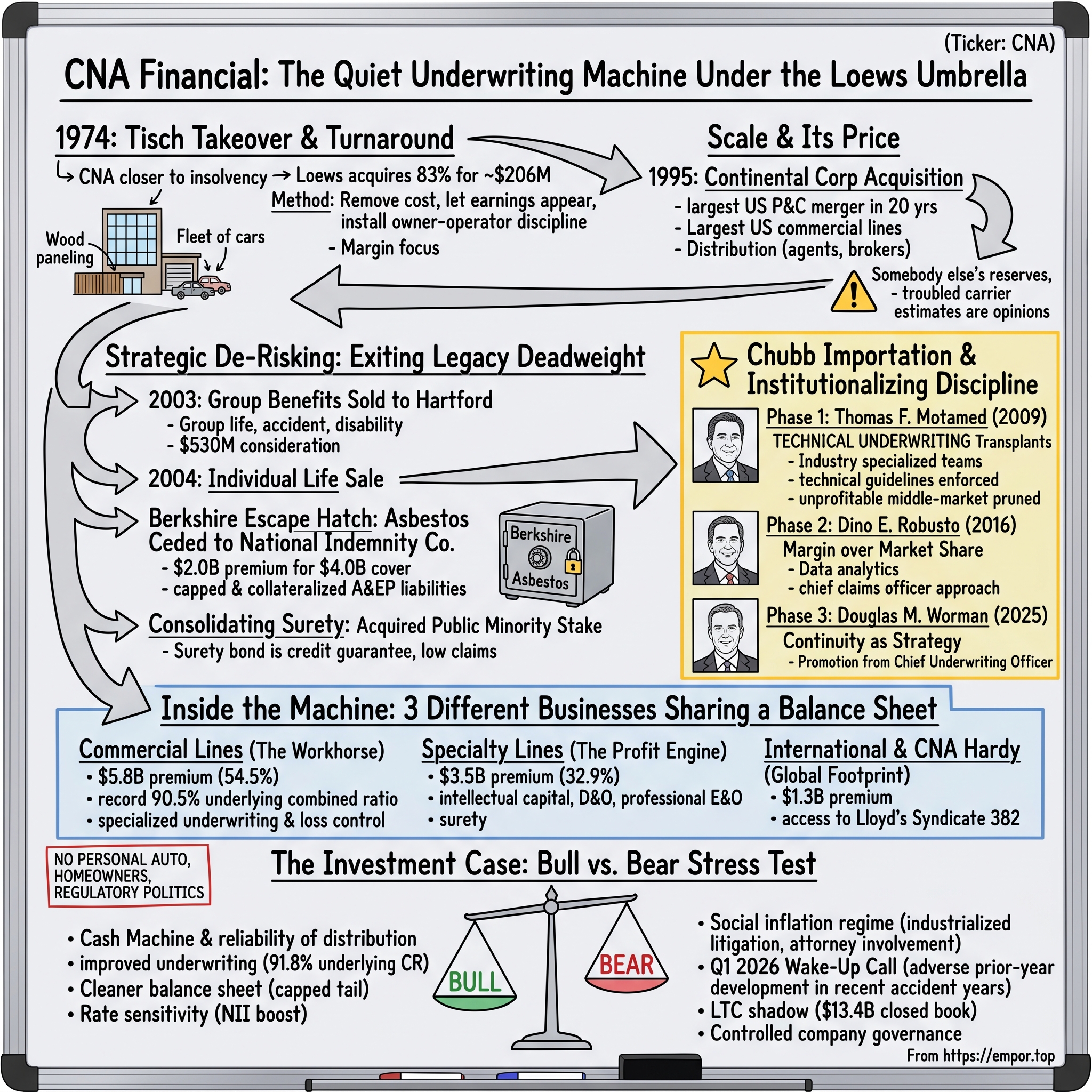
CNA Financial: The Quiet Underwriting Machine Under the Loews Umbrella
I. Introduction: The $40 Million Bitcoin Ransom & The Q1 2026 Wake-Up Call
There is a particular kind of corporate humiliation reserved for insurance companies that sell cyber coverage and then get hacked themselves.
In late March 2021, employees at CNA Financial Corporation arrived at their screens to find them useless. A ransomware strain called Phoenix Locker — a variant of Hades, built by a Russian criminal outfit widely tracked as Evil Corp — had encrypted roughly fifteen thousand devices across the company's network, including the laptops of employees working remotely and logged into the corporate VPN. A Chicago-based commercial insurer with more than a century of underwriting history had been locked out of its own filing cabinet.
What happened next stayed confidential for two months. According to Bloomberg's reporting, CNA paid the attackers approximately $40 million in Bitcoin roughly two weeks after the intrusion, after negotiations in which the criminals initially demanded 999 bitcoins and then, impatient, raised the price to 1,099.1 At the time it was the largest ransomware payment ever publicly reported. The episode later became a case study in a U.S. House Committee on Oversight and Reform memorandum examining the ransom decisions made by CNA, JBS, and Colonial Pipeline during that same brutal spring — a document that quietly noted how little federal guidance existed for companies staring at an encrypted network and a countdown clock.2
For a company whose entire operating philosophy is built on flying below the radar, it was an unwelcome spotlight. And it captures something essential about CNA: a business that spends its days pricing other people's tail risk, and occasionally discovers it has been carrying some of its own.
The company behind the headline
Strip away the drama and what remains is one of the more unusual publicly traded entities in American finance. CNA Financial Corporation trades on the NYSE under the ticker CNA. It is a commercial property and casualty insurer — no personal auto, no homeowners, no life insurance being actively sold — that wrote $10.68 billion of net written premium across its three property and casualty segments in 2025 and produced its best-ever core income of $1.342 billion for the year.3 Its shares carry a book value of $42.93 as of December 31, 2025, and $46.99 excluding accumulated other comprehensive income, the metric management prefers because it strips out the mark-to-market noise of a bond portfolio the company generally intends to hold.3
And it is roughly 92% owned by Loews Corporation, the Tisch family's conglomerate.4
That single ownership fact reshapes everything. CNA is a "controlled company" under NYSE listing standards, which exempts it from most independent-board requirements. There is no activist campaign waiting in the wings, no proxy fight, no realistic acquirer. There is instead a parent that has owned the asset since 1974, has watched it nearly die once, and now treats it as a cash-generating engine — the closest thing the Loews balance sheet has to a printing press.
The Q1 2026 crack in the glass
Which brings us to the tension that animates this story.
On May 4, 2026, CNA reported first-quarter net income of $211 million, or $0.78 per share, against $274 million and $1.00 per share a year earlier. Core income fell to $225 million from $281 million.5 The property and casualty combined ratio — the industry's single most important scorecard, measuring claims plus expenses as a percentage of premiums earned — deteriorated to 102.2% from 98.4%.5 Above 100 means the underwriting itself lost money before investment income.
Two forces did the damage. Catastrophes cost 3.6 points, or $97 million. More troublingly, prior-period reserve development was unfavorable by $106 million, or 4.1 points, concentrated in recent accident years in excess casualty and affinity professional errors-and-omissions.6 In plain language: claims from policies CNA wrote in 2022, 2023, and 2024 are turning out to cost more than the actuaries assumed, and the company had to reach back and top up the money set aside for them.
That is the specific thing long-term investors in insurers fear most. A bad catastrophe quarter is weather; it is loud, visible, and reprices quickly. Reserve strengthening on long-tail liability lines is different. It is a quiet admission that the price charged years ago was wrong, and — because casualty claims can take a decade to settle — an open question about whether the years after that are wrong too.
Management did not hide behind the weather. On the call, CEO Douglas Worman framed the reserve action as deliberate: "We will not jeopardize our long term value creation by not recognizing market trends," and the company stated flatly that it does "not anticipate social inflation abating," citing rising attorney involvement and lengthening claim development patterns.6 That is a more candid posture than the industry norm, and it is worth crediting. It is also, read another way, a warning that the cost curve on American liability litigation is not mean-reverting on any schedule CNA controls.
So the question this story tests is narrow and important: has CNA actually built a durable underwriting advantage over the past fifteen years — one visible in peer comparison, cost position, and behavior across cycles — or has it simply enjoyed a hard market that is now handing back some of what it gave? To answer that, you have to go back to a Chicago boardroom in 1974, where the company was closer to insolvency than anyone outside the building understood.
 Subscribe on LinkedIn
II. The Tisch Takeover & The 1974 Turnaround
Picture the headquarters of a mid-1970s American insurance conglomerate. Wood paneling. A private dining room with waiters. A three-thousand-square-foot executive suite for the chairman. A fleet of cars. Layers of vice presidents whose job descriptions had been written by other vice presidents. This was CNA Financial in Chicago — a company that had spent the conglomerate era buying things it did not understand, including consumer finance and home building, while its core insurance operation bled underwriting losses into a portfolio that had just been shredded by the 1973–74 bear market.
CNA was not merely underperforming. It was, by the standards of a regulated insurer, in genuine distress. Insurance companies fail in a specific and unforgiving way: statutory capital erodes, regulators impose constraints, rating agencies downgrade, brokers stop placing business, premium flees, and the erosion accelerates. CNA was walking toward that door.
Enter the brothers
Laurence and Preston Robert "Bob" Tisch had built Loews Corporation out of a chain of movie theaters and hotels through exactly the sort of unglamorous, price-obsessed capital allocation that later made Larry Tisch a kind of patron saint for value investors. Their method was consistent across decades and industries: buy assets when the market has stopped believing in them, remove every dollar of cost that does not touch the customer or the underwriting, and let the earnings power reappear on its own.
In 1974, Loews acquired roughly 83% of CNA Financial for approximately $206 million.7 That price — for what was then one of the largest insurance organizations in the United States — tells you how thoroughly the market had written the company off.
What followed has become part of Loews lore, and it is worth being precise about it because the details are the strategy. The Tisch team divested subsidiaries that were unprofitable or simply distracting, concentrating attention on the businesses worth keeping. They fired executives. They rented out the former chairman's suite and the corporate dining room to outside tenants rather than let them sit as monuments to the previous regime.7 The symbolism was not incidental; it was the point. In an underwriting business, culture is the product. If the people pricing risk believe the institution's job is to be prestigious, they will write premium to look important. If they believe the institution's job is to make money on each policy, they will decline business.
The results, and the honest caveat
By 1975 — a single year after control changed hands — CNA reported a profit of approximately $110 million, and the company remained financially sound through the following decade, growing annual revenues past $3 billion by the late 1980s.7
It is a spectacular headline, and it deserves one piece of skeptical context that admirers of the story usually skip. A swing of that magnitude in twelve months is not achieved by cost-cutting alone. Insurance results in the mid-1970s were heavily influenced by the direction of the bond and equity markets and by the reversal of the reserve and investment write-downs taken in the trough. Some of CNA's 1975 profit was genuine operating repair; some was the arithmetic of a terrible base year and a recovering market. The durable achievement was not the one-year number. It was that Loews installed an owner-operator's cost discipline that survived the decades after the rebound faded — and that it never sold.
Scale, and its price
Two decades on, CNA reached for scale. In late 1994 it agreed to acquire The Continental Corporation in a cash merger valued at approximately $1.1 billion; Continental's shareholders approved on May 9, 1995, and the deal closed the following day.8 It was believed to be the largest U.S. property-casualty merger in twenty years, and on a pro forma 1994 statutory net written premium basis it made CNA the largest U.S. commercial lines insurer, the third-largest property-casualty organization, and the sixth-largest insurance group in the country.8
Continental gave CNA what acquisitions in this industry are supposed to give: distribution. Independent agents and brokers, national in reach, embedded in the middle market. But it also delivered the thing that P&C acquisitions almost always deliver alongside it — somebody else's reserves. Continental was a troubled carrier. Buying a troubled carrier means buying its estimates of what its old policies will eventually cost, and those estimates are opinions, not facts. Much of the asbestos, environmental, and long-tail casualty exposure that would haunt CNA's balance sheet into the next century arrived, or was compounded, through the volume-building decade that Continental capped.
The strategic lesson embedded here is the one that governs CNA's next thirty years. Scale in insurance is not the same as advantage. Premium volume can be purchased at any time by anyone willing to underprice; the bill arrives later, in someone else's accident year. CNA spent the 1990s becoming big. It would spend the 2000s and 2010s discovering that the harder and more valuable project was becoming clean.
III. Strategic De-Risking: Exiting the Legacy Deadweight
There is a moment in the life of a diversified financial company when management stops asking "what else can we sell?" and starts asking "what are we actually good at?" For CNA, that moment stretched across roughly fifteen years and involved dismantling large parts of the company it had spent the previous fifty years assembling.
The logic was cold and correct. An insurer's balance sheet is a promise machine. Every liability line it retains consumes capital, occupies risk appetite, and demands actuarial attention. If a business is structurally mediocre — if CNA had no informational or cost edge relative to specialists — then holding it destroyed value even when it looked profitable, because the capital behind it could have supported commercial underwriting instead.
Selling the benefits businesses
On December 1, 2003, CNA agreed to sell its Group Benefits business — group life and accident, short- and long-term disability, and related products — to The Hartford Financial Services Group for approximately $500 million. The transaction closed on December 31, 2003, transferring roughly 1,200 employees; CNA received consideration of about $530 million and recorded an after-tax realized investment loss of $130 million on the sale.9 In February 2004, CNA followed with a definitive agreement to sell its individual life insurance business — term, universal, permanent, and individual annuities — for approximately $700 million.10
Note carefully what was not sold in either transaction: long-term care. Group LTC was carved out of the Hartford deal, and individual LTC and structured settlements were carved out of the life sale.910 Buyers were happy to take disability and mortality risk, both of which they could price. Nobody wanted long-term care.
The long-term care problem, explained plainly
It is worth pausing on why, because LTC remains the single most persistent question mark on CNA's balance sheet more than two decades later.
Long-term care insurance is a promise, made to someone in their fifties, to pay for nursing home or in-home care they might need in their eighties. Pricing it requires the insurer to forecast, thirty years forward, three separate things: how long policyholders will live, how likely they are to need care and for how long, and what that care will cost. The industry got all three wrong in the same direction. People lived longer than assumed. Fewer policyholders lapsed their coverage than assumed — an unusually painful error, because lapses are effectively free profit to the insurer. And medical cost inflation ran hot. Compounding it, the interest rates available to invest the premiums collapsed after 2008, so the money set aside grew far more slowly than the pricing had assumed.
CNA stopped writing new LTC business and put the book into run-off inside its Life & Group segment. It has not, unlike several peers, paid a reinsurer to take the block away. That decision is defensible on price — the reinsurance market charges a steep premium to assume a liability whose ultimate cost nobody can pin down — but it means the risk stays home. As of December 31, 2025, future policy benefit reserves for long-term care stood at approximately $13.4 billion, with gross reserves of about $14.0 billion including structured settlement obligations.11 The annual cash-flow assumption review in 2025 produced a pretax reserve increase of $7 million, down from $15 million in 2024.11
Those are small numbers against a $13 billion reserve, and they are the strongest evidence available that the block is behaving. The company also retains the ability to file for policy premium increases, subject to state regulatory approval — the primary lever it has when experience deteriorates.11 But investors should be honest about the shape of the risk: a book this size is a long-dated leveraged bet on morbidity, mortality, and discount rates. Small percentage errors in assumptions become large dollar figures. In 2025 the Life & Group segment produced a core loss of $44 million, wider than 2024's $23 million loss, which management attributed to unfavorable persistency — policyholders keeping coverage rather than dropping it — and lower limited partnership investment income.3 Persistency running against you is precisely the mechanism that broke LTC pricing in the first place.
The Berkshire escape hatch
If LTC was the liability CNA kept, asbestos was the one it managed to hand off — and the counterparty tells you how serious it was.
On July 14, 2010, CNA agreed to cede substantially all of its legacy asbestos and environmental pollution liabilities to National Indemnity Company, the Berkshire Hathaway subsidiary that has spent decades being the world's buyer of last resort for run-off exposure. Effective January 1, 2010, CNA ceded approximately $1.6 billion of net A&EP liabilities under a retroactive reinsurance agreement with an aggregate limit of $4.0 billion, paying National Indemnity a reinsurance premium of $2.0 billion and transferring billed third-party reinsurance receivables with a net book value of roughly $200 million. National Indemnity deposited $2.2 billion into a collateral trust for CNA's benefit.12 The transaction completed on August 31, 2010, and CNA recognized an after-tax net loss of $365 million in the third quarter, of which $344 million related to continuing operations.13
Read the terms as an economic statement. CNA paid $2.0 billion in cash and took a $365 million loss to be rid of $1.6 billion of booked liabilities, and bought $4.0 billion of cover on top. In other words, the company voluntarily paid a substantial premium over its own carried reserves — and Berkshire, which is not known for underpricing, was willing to take the other side at that number. Both parties agreed the booked reserves were probably too low. CNA's willingness to eat the loss to cap the tail, and to collateralize the counterparty risk, was the single cleanest piece of capital allocation in its modern history. It converted an unquantifiable overhang into a known cost and let the market finally see the ongoing commercial business without a fog of nineteen-fifties industrial claims sitting on top of it.
Consolidating surety
The final piece of the cleanup ran in the other direction: buying rather than selling. CNA had long controlled a majority of publicly listed CNA Surety, and in 2011 it agreed to acquire the public minority stake for $26.55 per share in cash — a 38% premium to the closing price on October 29, 2010, the last trading day before CNA's initial public proposal.14
Surety is one of the genuinely attractive corners of the insurance world, and it is worth explaining because it is unlike the rest of the book. A surety bond is not really insurance; it is a credit guarantee. When a contractor bids on a bridge, the owner demands a bond guaranteeing the job gets finished. The surety underwrites the contractor's balance sheet, backlog, and management — and expects, over a cycle, to pay very few claims, because a well-underwritten contractor does not fail. Loss ratios are structurally low, the underwriting skill is closer to credit analysis than actuarial science, and — critically — the bond is only as good as the balance sheet behind it. That last point makes surety a business where financial strength ratings are a direct barrier to entry.
Paying a 38% premium to take in a minority stake is expensive. But owning 100% of a high-return, low-volatility business you already control, funded by capital that would otherwise sit in bonds, is a rational trade for an insurer with more capital than ideas — and it removed the friction of running a separately listed subsidiary with its own public shareholders and fiduciary complications.
By the early 2010s, then, CNA had a defensible perimeter: commercial lines, specialty lines, surety, a capped asbestos tail, and one large legacy problem it had decided to manage rather than sell. What it did not yet have was a reputation for underwriting well.
IV. The Chubb Importation & Institutionalizing Discipline
Ask a commercial insurance broker in 2008 to describe CNA in one sentence and you would have heard something like: big, everywhere, cheap when they need the premium. That is not a compliment. It is the description of a carrier that competes on price because it has nothing else to compete on — and in an industry where the product is a legally identical promise across issuers, competing on price is how you eventually pay for someone else's losses.
The gap was measurable. Through the mid-2000s CNA's combined ratios sat persistently behind the industry's elite commercial underwriters. Travelers and Chubb ran mid-to-high-80s and low-90s combined ratios through good years; CNA hovered near or above breakeven on underwriting and made its money on the investment portfolio. That is a viable business model — it is, in fact, how most of the industry survives — but it is a low-return one, and it makes the company a leveraged bet on interest rates rather than on skill.
Loews' answer was not a strategy deck. It was a hire.
Phase one: Motamed and the transplant
Thomas F. Motamed joined CNA as chairman and CEO in 2009 after a long career at The Chubb Corporation, where he had risen to vice chairman and chief operating officer. Chubb, in its pre-ACE-merger form, was the industry's aristocrat: a carrier that had spent a century convincing brokers and clients that it would pay claims fairly and price risk honestly, and had earned the right to charge for it.
What Motamed imported was less a set of policies than a set of refusals. Generalist underwriters who wrote whatever crossed the desk were replaced with industry-specialized teams who understood the loss drivers in a specific business — a machine shop is not a hospital is not a law firm. Technical underwriting guidelines were tightened and, more importantly, enforced, which in practice means an underwriter's bonus stops depending on premium written. Unprofitable middle-market accounts were pruned rather than renewed at a discount. All of this shrinks the top line before it improves the bottom line, which is why it is rarely done by management teams facing quarterly public-market scrutiny — and which is the first genuinely useful thing the Loews ownership structure bought.
Phase two: Robusto and the compounding
CNA doubled the bet. Dino E. Robusto was appointed chairman and CEO effective December 1, 2016, succeeding Motamed, who retired at the end of that year.15 Robusto had spent nearly thirty years at Chubb, joining in 1986 as a commercial lines underwriter and working through chief claims officer, chief field operations officer for commercial lines, and ultimately executive vice president and president of commercial and specialty lines.15
That biography matters more than it appears. A CEO who came up through claims thinks about underwriting differently than one who came up through sales. Claims is where you learn what the policy wording actually meant, which brokers bring you the accounts that blow up, and how litigation costs behave when a plaintiff's bar gets organized. Robusto's tenure emphasized exactly those things: technical excellence, data analytics applied to risk selection, and a stated preference for margin over market share.
He inherited an international platform to work with. CNA had completed its acquisition of Hardy Underwriting Bermuda Ltd. in 2012 for approximately $227 million, buying access to Lloyd's Syndicate 382 and its marine and aviation, non-marine property, property treaty, and specialty books.1617 Lloyd's is best understood as a marketplace rather than a company: syndicates backed by capital providers underwrite the world's most specialized risks — cargo, energy platforms, political violence — in a physical and now digital trading floor where brokers walk risks from one underwriter to the next. Owning a syndicate gives an American carrier licenses, distribution, and a global specialty franchise it cannot build organically. Integrated with CNA's existing European operations, it became the CNA Hardy brand.18
Phase three: continuity as a strategy
On June 6, 2024, CNA announced that Douglas M. Worman, then executive vice president and global head of underwriting, would become president and CEO effective January 1, 2025, with Robusto moving to executive chairman and strategic advisor.1920 Worman had joined CNA in March 2017 as executive vice president and chief underwriting officer — meaning he was hired by Robusto, into the exact seat where the technical discipline lives, and spent eight years building the apparatus he now runs.19 He assumed the chairman's role at the start of 2026.
For investors, a chief underwriting officer succeeding to CEO is a legible signal. Insurance companies that promote from distribution or finance tend to pursue growth and deals; companies that promote from underwriting tend to defend margin. It is not proof of anything — plenty of underwriters have presided over reserve disasters — but it is consistent with a board that has decided the franchise's value is in risk selection.
Did it work? The honest scorecard
Here the evidence is genuinely good, with a caveat.
For full-year 2025, CNA's total property and casualty combined ratio was 94.7%, against 94.9% in 2024, including 2.3 points of catastrophe losses versus 3.6 points the prior year. The underlying combined ratio — which excludes catastrophes and prior-year development, and is therefore the cleanest read on current-year pricing and expense discipline — was 91.8%.3 Commercial delivered a record underlying combined ratio of 90.5%; Specialty 94.2%; International 91.3%.3 Net investment income reached $2,557 million, and the company generated nearly $2.5 billion of operating cash flow while producing that best-ever core income figure.3
That is a materially better company than the one Motamed inherited. A high-80s-to-low-90s underlying combined ratio in commercial lines is competitive with the industry's better operators, and it has been sustained across several years rather than appearing in one favorable one.
The caveat is the one every honest observer has to make about 2019–2024 results across the entire P&C industry: those years contained one of the hardest commercial pricing markets in modern memory. Rates rose sharply, coverage terms tightened, and almost every disciplined carrier posted improving underlying ratios. Distinguishing genuine skill from a rising tide requires watching what happens when the tide goes out — which is precisely what the reserve action of early 2026 has begun to test.
V. Inside the Machine: Segment Performance & Industry Structure
To understand what CNA actually does all day, forget the holding company and picture three quite different businesses sharing a balance sheet and a brand.
Commercial Lines: the workhorse
This is the largest piece by far — $5,821 million of net written premium in 2025, up 6% year over year, or about 54.5% of total P&C premium.3 It is the unglamorous core: property coverage on warehouses and manufacturing plants, workers' compensation, commercial auto, general liability, marine, and packaged programs for middle-market companies.
The economics in 2025 were the best in the company's history at the underlying level — a 90.5% underlying combined ratio, with an all-in calendar-year combined ratio of 95.2% once catastrophes and reserve movements were included.3 The roughly five-point gap between those two numbers is where the volatility lives, and it is worth understanding: underlying tells you whether the pricing and expense machine is working; calendar-year tells you what actually happened to shareholders' money.
How does a mid-sized carrier win middle-market accounts against Travelers, which is four times its size? Not on price — a larger carrier can always spread fixed costs over more premium. CNA's mechanism is service depth at the account level: specialized underwriters who know the industry vertical, and a loss-control function that sends engineers into a customer's facility to reduce the frequency of claims before they happen. That last piece is the genuinely interesting part of commercial insurance economics. If an insurer can help a metal fabricator cut its injury rate, both parties keep the savings, and the relationship becomes about risk management rather than annual price shopping. It is a real mechanism, though a modest one — it raises switching friction, it does not eliminate competition.
Q1 2026 showed both sides of the business. Commercial's combined ratio deteriorated to 103.5% from 101.1%, but the mix underneath was revealing: middle market grew 13% while national accounts property declined 14% under competitive pressure.6 CNA was walking away from large property accounts where pricing had softened and leaning into the middle market where it believes it has an edge. That is exactly what a disciplined underwriter is supposed to do in a softening market — declining volume in a competitive line is a feature, not a failure. Whether the middle-market growth turns out to be well-priced is a question only 2029's reserve reviews will answer.
The more uncomfortable disclosure was excess casualty, where the underlying loss ratio rose substantially even as management maintained that "margins and opportunities in this class are attractive."6 Excess casualty sits above a primary policy — it pays only after the first layer is exhausted, which means it is the layer most exposed to the enormous jury verdicts that have become common in American courts. Management is simultaneously strengthening reserves in the class and describing it as attractive. Both can be true, but investors should treat the combination as a live tension rather than a settled fact, and should read the next several quarters of excess casualty commentary against this quarter's.
Specialty Lines: the profit engine
Specialty wrote $3,515 million of net written premium in 2025, up 2%, about 32.9% of P&C premium, at a 95.3% combined ratio and a 94.2% underlying combined ratio.3
This is where the intellectual capital sits: directors and officers liability, professional errors and omissions, healthcare malpractice, financial institution lines, and surety. These are risks where the loss is not a fire or a collision but a lawsuit — and where pricing requires decades of accumulated claims data on how juries, regulators, and plaintiffs' lawyers behave in specific professions.
The moat, such as it is, is data plus reputation. A broker placing D&O coverage for a mid-cap biotech has a limited roster of carriers with the appetite, the limits, and the claims-handling credibility to be acceptable to a nervous board. Generic capacity cannot compete because it cannot price the tail.
But specialty is also the segment that produced the Q1 2026 shock: its combined ratio jumped to 102.7% from 95.1%, driven by roughly $50 million of unfavorable development in affinity professional E&O across recent accident years.6 Affinity programs — coverage sold to members of a professional association, often through a group arrangement — carry the same social-inflation exposure as any professional liability line, with the added feature that the business is aggregated rather than individually underwritten. When a program goes wrong, it goes wrong at scale. This is the clearest evidence available that CNA's specialty advantage is real but not absolute: the data edge helps you price better than a generalist, and it does not protect you from a structural shift in the legal environment.
International and CNA Hardy: the global footprint
International wrote $1,347 million in 2025, up 7%, roughly 12.6% of P&C premium, and delivered the best ratios in the company — a 91.2% all-in combined ratio and 91.3% underlying.3 The unit provides specialty and commercial solutions across the UK, continental Europe, and Canada, using Syndicate 382 to access global marine, energy, and specialty risks.18
The Q1 2026 read here was mixed in an instructive way. The combined ratio improved to 95.9%, and net written premium rose 16% — but only 7% excluding currency effects — while rates declined 4% amid competition.6 Growing premium while rates fall is the oldest warning sign in insurance. It can be entirely benign: new business at adequate absolute margins, or exposure growth as clients expand. It can also mean the underwriters are backfilling volume as prices soften. A single quarter does not distinguish the two. Consistent rate-versus-growth disclosure over the next several quarters will.
Where CNA sits in the food chain
Against its peers, CNA is emphatically not the biggest. Travelers operates at multiples of CNA's premium base and dominates standard commercial lines by sheer scale. Chubb, post-merger with ACE, is the global gold standard in corporate and specialty underwriting and operates on a wholly different footprint. The Hartford is the closest structural comparison in small commercial and middle market, and is meaningfully larger.
CNA's positioning is therefore a choice rather than an accident: a focused, business-to-business-only carrier that has deliberately declined to compete in personal auto and homeowners. That decision looks smarter every year. Personal lines carriers have spent the 2020s absorbing severe used-car and repair-cost inflation, litigation over roof claims, and a secular increase in severe convective storm losses in the U.S. interior, all while negotiating rate increases with state regulators who answer to voters. CNA sells to companies, through brokers, in a market where price is negotiated commercially rather than politically. That is a structurally better place to stand.
The trade-off is that it concentrates CNA in exactly the lines where social inflation bites hardest. There is no personal-lines diversification to offset a bad casualty cycle. Focus cuts both ways, and the first quarter of 2026 was the edge that cuts back.
VI. Corporate Governance & The Tisch Family Capital-Allocation "ATM"
Every February, a small ritual takes place that tells you more about CNA than any strategy presentation.
The board declares the regular quarterly dividend — and then declares a special dividend on top of it. On February 9, 2026, alongside fourth-quarter results, CNA raised its regular quarterly dividend by 4% to $0.48 per share and declared a special dividend of $2.00 per share, both payable March 12, 2026.3 It was the third consecutive year the special dividend arrived at exactly $2.00.
Do the arithmetic and the structure becomes obvious. Roughly $1.92 of regular dividends plus $2.00 special equals about $3.92 per share of annual distributions, against 2025 core income of $4.93 per share and a book value of $42.93.3 CNA distributes the large majority of what it earns, every year, on a schedule so predictable that the "special" dividend is special in name only.
Who receives it
Loews Corporation owned approximately 92% of CNA's common stock as of December 31, 2025.4 Every dollar of that dividend stream flows, at 92 cents on the dollar, into the Loews balance sheet — where the Tisch family has spent years recycling it into an aggressive repurchase program of Loews' own shares.
This is a coherent and, in its way, elegant capital structure. CNA is a regulated insurer that generates more capital than it can profitably deploy in underwriting; retaining that capital would drag down return on equity. Loews is a holding company that can deploy capital anywhere. So CNA upstreams the excess and Loews allocates it. The arrangement also explains why CNA runs essentially no meaningful buyback of its own shares — repurchasing stock that is 92% owned by your parent mostly just increases the parent's ownership percentage while shrinking an already tiny float.
The governance question, asked properly
A skeptical investor should ask the uncomfortable version of this: is the minority shareholder a partner or a passenger?
The board is heavily influenced by Loews, including James S. Tisch. As a controlled company under NYSE rules, CNA is exempt from requirements for a majority-independent board and fully independent compensation and nominating committees. The public float is roughly 8% of shares outstanding, which makes the stock effectively uninvestable for large institutions that need to build and exit positions without moving the price. There is no realistic scenario in which an activist forces change, no takeover premium embedded in the shares, and no mechanism by which minority holders can influence the dividend policy that governs the bulk of their return.
The counterargument — and it has genuine force — is that the same structure buys management something valuable: the freedom to shrink a line of business, decline a soft market, or strengthen reserves in a single quarter without worrying about the stock's reaction. The Q1 2026 reserve action is the case in point. A carrier under quarterly public-market pressure faces a real temptation to spread bad news across several periods. CNA took $106 million in one quarter and told investors social inflation is not going away.6 Whether that reflects genuine conservatism or merely the absence of pressure to do otherwise is not fully knowable from outside — but the behavior is the right behavior, and it is consistent with a controlling owner that has held the asset for fifty-two years and cares about 2036 more than about the next print.
There is also a discipline embedded in the dividend itself that is easy to miss. A company that upstreams most of its earnings every year cannot accumulate the surplus capital that funds ill-advised acquisitions. CNA has not made a large, transformative acquisition since Hardy in 2012. In an industry littered with value-destroying deals, that restraint is worth something — though it is worth noting that restraint imposed by structure is not the same as restraint chosen by judgment.
The genuine risk in this arrangement is a specific one. In a scenario where CNA needed to retain capital — a severe reserve deterioration, a catastrophic year, a rating agency demanding more surplus — the dividend would have to be cut, and the party whose cash flows depend on it is the same party controlling the board. That conflict has not been tested in recent memory. The strength of the balance sheet is what keeps it theoretical: AM Best upgraded the financial strength ratings of CNA's property/casualty subsidiaries to A+ (Superior) from A (Excellent) and the long-term issuer credit ratings to "aa-" from "a+", with the holding company's long-term ICR upgraded to "a-", citing very strong balance sheet strength, strong operating performance, a favorable business profile, and the historical financial support of its 92% shareholder.4
An A+ rating is not a vanity item in this industry. It is a license. Which is a useful place to start when asking what, precisely, protects CNA from competition.
VII. The Competitive Moat Analysis
Insurance is the purest commodity business that has ever managed to sustain differentiated returns. The product is a legal promise. Two carriers can issue identical wordings covering identical risks. There is no patent, no proprietary technology that competitors cannot buy from the same vendors, and no customer lock-in in the software sense. And yet the spread between the best and worst underwriters over a full cycle is enormous. Understanding why is the whole analytical game.
Applying Hamilton Helmer's 7 Powers
Of Helmer's seven sources of durable advantage, three are plausibly present at CNA — and it is worth being precise about how strong each actually is.
Cornered resource — the talent transplant. CNA's most distinctive asset is a culture it did not grow but imported: two consecutive CEOs from Chubb's technical underwriting tradition, plus the proteges and disciplines they brought with them. Underwriting judgment is tacit knowledge. It lives in the heads of people who have seen a class of business go wrong before and can smell it in a submission. That is genuinely difficult to replicate quickly, and it is the honest explanation for CNA's improvement from a mediocre carrier in 2008 to a low-90s underlying combined ratio operator today.
But "cornered resource" is a generous label. Underwriters are hired away constantly; entire teams move between carriers, and a competitor with capital can lift a specialty practice in a quarter. The right way to think about it is not as a moat but as an accumulated stock of human capital that depreciates unless continuously reinvested. The Worman succession — a chief underwriting officer promoted from within — is the mechanism by which CNA is attempting to make the culture self-replicating rather than dependent on hiring. Whether it works is a decade-long question, and Q1 2026 is a datapoint on the other side of the ledger.
Scale economies — the rating and the balance sheet. This one is more concrete. A commercial insurance buyer is not purchasing a product; they are purchasing counterparty credit that must remain good for a decade. Brokers will not place complex or long-tail risks with carriers rated below "A," and many corporate treasury policies and financing agreements prohibit it outright. That converts the AM Best rating into a hard gate, and the A+ upgrade puts CNA on the correct side of it.4
The effect is sharpest in surety, where the entire value of the bond is the strength of the entity standing behind it, and in large-limit specialty lines. It is a real barrier — but it is a barrier to entry, not to competition among the twenty or so carriers already inside the gate. Every meaningful competitor CNA faces clears the same threshold.
Switching costs — the broker integration. Commercial insurance reaches customers almost entirely through independent brokers, and at the top the market is consolidated into a handful of global firms. CNA's underwriting portals, submission APIs, and risk-control advisors are embedded in broker workflows, and the relationship-level knowledge — the underwriter who has covered a client's business for eight years and understands its operations — creates real friction at renewal.
Real, but modest. Switching costs in insurance are measured in basis points of price, not in years of migration pain. A broker with a fiduciary duty to the client will move the account for a sufficient discount. This is friction, not lock-in, and it should not be confused with the network effects or workflow entrenchment found in software.
Notably absent from the list: branding (commercial buyers do not choose insurers on brand), network economies (none exist here), counter-positioning (CNA's model is conventional), and process power (its operations are competent, not uniquely efficient). Three partial powers is a respectable showing for an insurer. It is not a fortress.
Porter's Five Forces, war-gamed
Rivalry: high, and structurally so. Property and casualty insurance has a capital-supply problem. When returns are good, capital floods in — from new carriers, from reinsurance, from insurance-linked securities — and prices fall until returns are bad again. There is no capacity constraint to enforce discipline. The 4% rate decline in CNA's international business and the 14% contraction in national accounts property in Q1 2026 are exactly what the early phase of a softening cycle looks like.6 The only defense is the willingness to shrink, which is a cultural property, not a structural one.
Buyer power: high, and concentrated. The buyers who matter are not the insureds; they are the brokers. Global brokerages aggregate enormous premium volume and use it to extract price and terms. CNA's counter is to be genuinely difficult to replace in technical niches — healthcare liability, financial institution lines, surety — where the broker's alternative roster is short. That works where the expertise is real and fails where it is not.
Threat of new entrants: low. Between state-by-state licensing, statutory capital requirements, the ratings gate, and the reality that a new carrier has no loss history to price from, greenfield entry into standard commercial lines is close to nonexistent. Capital does enter the industry, but through reinsurance, Bermuda specialty vehicles, and MGAs rather than through new nationwide primary carriers.
Supplier power: moderate and rising. An insurer's key suppliers are reinsurers and capital markets. Reinsurance pricing hardened significantly after 2022, and the cost and availability of catastrophe protection now materially affect how much risk a primary carrier retains. Meanwhile, the "supplier" of loss costs — the American legal system — has been raising prices without negotiation for a decade.
Substitutes: low but non-zero. Large corporations can self-insure or use captive insurance subsidiaries, and in stable, predictable lines they increasingly do. That skims off exactly the low-volatility business insurers would most like to keep.
The synthesis is unromantic. CNA operates in a structurally competitive industry with modest, partial advantages and one real gate. Its returns come primarily from execution — from being consistently a few points better at risk selection than the average carrier — which means the investment case rests almost entirely on whether that execution edge is durable. And that is exactly the question the last two reporting periods have put in play.
VIII. The Investment Case: Bull vs. Bear Stress Test
Set the frameworks aside and put the two sides of this business in a room together.
The bull case
A cash machine with an owner who wants the cash. The core of the bull argument is not growth; it is the reliability of distribution. CNA generated nearly $2.5 billion of operating cash flow in 2025 and distributes the bulk of its earnings annually through a regular dividend that has been steadily increased and a $2.00 special that has now appeared three years running.3 The controlling shareholder's own capital plans depend on that stream continuing, which aligns the parent's interest with the minority holder's on the single variable that drives most of the return.
Underwriting that has demonstrably improved. A 91.8% total underlying combined ratio and a record 90.5% in Commercial for 2025 are not the numbers of a mediocre carrier.3 Whatever share of that owes to the hard market, the relative improvement versus CNA's own history is a genuine achievement of the Chubb-imported discipline, and it has now been produced under three different CEOs.
A cleaner balance sheet than the history suggests. The asbestos tail is capped and collateralized. The A+ financial strength rating was upgraded, not defended.4 The LTC block, while enormous, has required only single-digit-millions of assumption-driven reserve additions in each of the last two annual reviews.11
Structural protection from the worst part of the industry. No personal auto, no homeowners, no exposure to the regulatory politics of rate filings for consumers, and no participation in the severe-weather frequency problem that has been battering personal lines carriers across the American South and Midwest.
Rate sensitivity working in reverse. A large portion of insurer earnings comes from investing the float. Net investment income of $2,557 million in 2025 exceeded the prior year, and a bond portfolio reinvesting maturities at rates well above those of the 2010s continues to lift earnings without requiring a single additional policy to be written.3
The bear case, and the activist's version of it
Social inflation is not a cycle; it may be a regime. This is the central bear argument and it deserves to be stated at full strength. Litigation funding — third-party investors financing plaintiffs' lawsuits as an asset class — has industrialized personal injury litigation. Jury awards exceeding $10 million have become routine in venues where they were once extraordinary. Attorney involvement in claims is rising, and claims are taking longer to develop, which is precisely the pattern CNA described on its Q1 2026 call.6
The mechanism that makes this dangerous is worth spelling out. When loss costs inflate faster than assumed on a line where claims settle in five to ten years, the insurer does not discover the error for years — and by then it has written several more years of business at similarly inadequate prices. The $106 million of unfavorable development in Q1 2026 was concentrated in recent accident years, not the distant past.6 That is the more worrying variety. It suggests the pricing assumptions used in 2022–2024 were too optimistic, and it raises a fair question about whether 2025 and 2026 pricing is adequate either.
An activist would press harder: management is strengthening excess casualty reserves while simultaneously describing the class as attractive and growing middle market at 13%.6 Those positions are not contradictory, but they require the company to be right about pricing at exactly the moment its own reserve review says it was wrong about pricing a few years ago. The burden of proof sits with management here.
The LTC shadow. A $13.4 billion reserve against a closed book of policies written in a different interest-rate world is an unhedged, long-duration actuarial position.11 The 2025 result — a wider Life & Group core loss driven partly by unfavorable persistency3 — is a reminder that the assumptions can move against the company in slow, compounding ways. A cash-flow-testing shortfall large enough to require a material reserve charge is a low-probability, high-severity event that no amount of commercial underwriting excellence would offset.
Structural illiquidity and the absence of a re-rating catalyst. With Loews at 92%, the float is thin.4 Institutional investors cannot build meaningful positions. There is no acquirer, no activist, no strategic review, no path to a control premium. If the market assigns the shares a lower multiple than peers, nothing internal to the company is likely to change that.
Governance concentration. The controlled-company exemptions, the board's Loews representation, and the dependence of the parent's capital plan on CNA's dividend are all facts a skeptical investor is entitled to weigh. The related-party dynamic has been benign for decades. It has also never been stress-tested by a year in which CNA needed to retain capital that Loews wanted distributed.
Cyber, still. The 2021 attack was survived and paid for, but it demonstrated that a company holding decades of commercial policyholder data is a target, and that the industry's operational-resilience posture was — at least then — inadequate. The disclosure of over 100 AI initiatives across submissions intake, claims summarization, risk analysis, and portfolio optimization is interesting on the efficiency side, and the expense ratio did improve 0.3 points year over year in Q1 2026.6 But every new automated pipeline is also new attack surface and new model risk in a business where mispricing compounds silently.
The three KPIs that actually matter
Ignore quarterly EPS. Three metrics carry the story, and readers should track them themselves rather than take anyone's calculation on faith.
One: the underlying combined ratio, by segment. This is the current-year underwriting scorecard with catastrophes and prior-year noise removed. It answers the only question that matters about the business model: is CNA charging enough for the risk it is taking right now? Watch Commercial and Specialty separately — the divergence between them in Q1 2026 was the whole story of the quarter.
Two: net prior-period reserve development. Favorable development adds to earnings; unfavorable development subtracts, and, more importantly, signals that past pricing was wrong. The critical detail is not the headline number but which accident years are moving. Development on 2015 vintages is history. Development on 2023 vintages is a forecast.
Three: net written premium growth relative to rate change. Published together every quarter, these two numbers form a lie detector. Premium growing faster than rate plus exposure growth means the company is winning business on something other than price adequacy. Premium shrinking while rates fall means the company is walking away — which, in a softening market, is what a disciplined underwriter is supposed to do.
IX. Epilogue & Lessons for Founders and Investors
There is a version of CNA's history that reads as a story of subtraction. Consumer finance, gone. Home building, gone. Group benefits, sold to The Hartford. Individual life, sold. Personal lines, exited. Asbestos, ceded to Berkshire. What remains after fifty years of pruning is a business that does three things — commercial, specialty, and international property and casualty underwriting — and one thing it wishes it did not do, which is administer a closed long-term care book until the last policyholder is gone.
That is the first lesson, and it is not specific to insurance. The company's modern performance is almost entirely attributable to its willingness to stop doing the things at which it was merely average. Each exit cost money in the year it happened — a $130 million realized loss on the Group Benefits sale, a $365 million after-tax loss to hand asbestos to Berkshire.913 Each freed capital and management attention for the one thing where CNA could plausibly be excellent. Focus is expensive to buy and only pays off later, which is why so few companies buy it.
The second lesson is about who owns you. Loews' control has functioned, for fifty-two years, as a shock absorber. It permitted a decade of deliberate shrinkage under Motamed that would have been punished by public markets. It permitted the recruitment of two consecutive outsider CEOs on the theory that culture could be transplanted. It permitted a single-quarter reserve charge with an explicit statement that social inflation would not abate, rather than a comforting smoothing exercise.
But the shield has a shadow. The same structure that insulates management from short-term pressure also insulates it from accountability. There is no independent check on capital allocation, no market for corporate control, and no liquidity for anyone who wants to leave in size. Minority investors in CNA are, in the most literal sense, riding alongside the Tisch family — sharing the dividend, sharing the underwriting risk, and holding none of the levers.
Which returns us to where this began. The $40 million ransom made headlines because it was shocking. The $106 million reserve charge made almost none, because reserve charges are boring. But one of them was a one-time operational failure that was paid for and closed, and the other is an early reading on whether a decade of underwriting discipline is strong enough to hold against a legal system that keeps raising its prices. CNA has spent fifty years proving it can subtract. The open question, and the one the next several years of reserve triangles will settle, is whether what it kept is as good as it believes.
References
-
CNA Financial Paid Hackers $40 Million in Ransom After March Cyberattack — Bloomberg, 2021-05-20 ↩
-
Memorandum on Ransomware Payments by CNA, JBS and Colonial Pipeline — U.S. House Committee on Oversight and Reform, 2021-11-16 ↩
-
CNA Financial Announces Q4 2025 and Full Year 2025 Results, Regular Dividend Increase and $2.00 Special Dividend — PR Newswire, 2026-02-09 ↩↩↩↩↩↩↩↩↩↩↩↩↩↩↩↩
-
AM Best Upgrades Credit Ratings of CNA Financial Corporation and Its Subsidiaries — Reinsurance News ↩↩↩↩↩↩
-
CNA Financial Announces First Quarter 2026 Net Income of $0.78 Per Share and Core Income of $0.83 Per Share — PR Newswire, 2026-05-04 ↩↩
-
CNA (CNA) Q1 2026 Earnings Call Transcript — The Globe and Mail, 2026-05-04 ↩↩↩↩↩↩↩↩↩↩↩↩
-
CNA Financial Corporation Form 10-K, Fiscal Year 1995 — U.S. Securities and Exchange Commission ↩↩
-
CNA to Sell Benefits Business to Hartford — Insurance Journal, 2003-12-01 ↩↩↩
-
CNA Financial Corporation Form 8-K Exhibit 99.1, Individual Life Sale — U.S. Securities and Exchange Commission, 2004 ↩↩
-
CNA Financial Corporation Form 10-K for the Year Ended December 31, 2025 — U.S. Securities and Exchange Commission ↩↩↩↩↩
-
CNA Financial Corporation Form 8-K Exhibit 99.1, National Indemnity A&EP Loss Portfolio Transfer — U.S. Securities and Exchange Commission, 2010-07-15 ↩
-
CNA Financial Corporation Form 8-K Exhibit 99.2, Third Quarter 2010 Results — U.S. Securities and Exchange Commission, 2010 ↩↩
-
CNA and CNA Surety Sign Definitive Agreement for CNA to Acquire Public Minority Stake in CNA Surety for $26.55 Per Share — CNA Financial Investor Relations, 2011 ↩
-
CNA Financial Corporation Form 8-K Exhibit 99.1, Appointment of Dino E. Robusto — U.S. Securities and Exchange Commission, 2015-11 ↩↩
-
CNA to Access Lloyd's of London with Hardy Underwriting Buy — Business Insurance, 2012-03-25 ↩
-
CNA Financial Completes Acquisition of Hardy Underwriting Bermuda Ltd. — CNA Financial Investor Relations, 2012 ↩
-
CNA's Worman to Take CEO Reins From Robusto in 2025 — Insurance Journal, 2024-06-06 ↩↩
-
CNA Financial Corporation Announces Executive Leadership Transition — CNA Financial Investor Relations, 2024-06-06 ↩
 LinkedIn
 WhatsApp
 Reddit
 Hacker News
 Email
Email Kindle
 RSS Feed
 Spotify
 Apple Podcasts
 Amazon Music
 Audible
 YouTube