Pelagos Insurance Capital: Who Really Writes the Risk?
I. The Insurer That Outsourced Its Underwriting
Picture a specialty insurer large enough to write almost $5 billion of premiums in a single year, insuring ships, satellites, energy platforms, aircraft fleets, structured credit deals and the property catastrophe exposure of other insurers. Now picture its head office. At the end of 2025, the whole group employed 108 people.1 Twenty of them worked in insurance-related functions. The rest ran operations, finance and support.1
That is not a typo, and it is not a scandal. It is the business model. Pelagos Insurance Capital Limited, the Bermuda holding company that trades on the New York Stock Exchange as PLGO, owns the licensed insurance companies, holds the capital, sets the risk appetite and carries the losses.1 But substantially all of the underwriting at its principal insurers, the daily work of finding risks, pricing them, binding them, administering them and handling the claims, is carried out by a different company called The Fidelis Partnership, or TFP.1
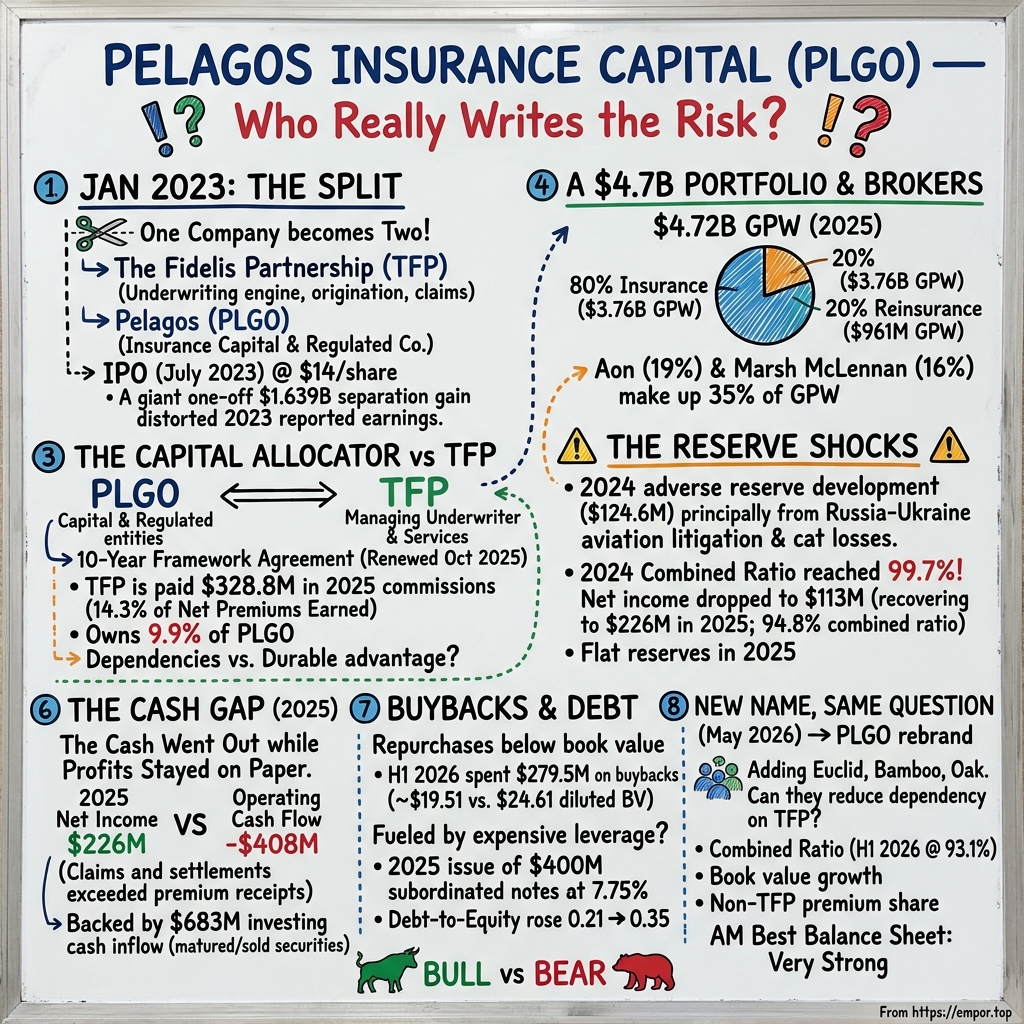
In 2025 those two companies together put $4.72 billion of gross premiums onto Pelagos's balance sheet.1 About four-fifths of that came from the Insurance segment and one-fifth from Reinsurance.1 And for its part in the work, TFP collected $328.8 million in commissions from Pelagos that year.1
That last number is the hinge of this story. For every hundred dollars of premium Pelagos actually earned after buying its own reinsurance, roughly fourteen went to TFP.1 TFP is not Pelagos's parent and it is not a subsidiary. Its employees, its revenue and its business belong to its own owners, not to Pelagos shareholders.1 Yet it is so central to how the listed company operates that any honest description of Pelagos has to start with it.
So the question running through this episode is simple to ask and hard to answer. Is Pelagos building an underwriting business of its own, or is it supplying capital to a business that another company still runs?
Management's answer is that the question is the wrong way round. In its telling, Pelagos is a "strategic capital allocator" whose edge is its network of underwriting partners, with TFP the largest and most important of them.2 The capital, the regulated insurers, the risk limits and the final say belong to Pelagos. The partners bring the expertise and the deal flow. Everyone is paid for what they contribute.
There is a real distinction buried in that pitch, and it deserves to be taken seriously. Owning a regulated insurer is not trivial. Licences, ratings, collateral, regulatory capital and a balance sheet that brokers trust take years to build and can be lost in a quarter. A managing general underwriter without a balance sheet like Pelagos's has nothing to sell. Pelagos without an underwriting engine like TFP's has nothing to insure.
But the distinction cuts both ways. If most of the skill that decides whether a risk is priced well sits outside the listed company, then the investor in PLGO is betting on a contract as much as on a company. The returns depend on whether that arrangement keeps producing attractive underwriting results, and on who captures them when it does.
The scorecard for the most recent full year looks respectable rather than spectacular. Pelagos reported $225.5 million of net income in 2025 and $205.2 million of operating net income, the company's own measure that strips out items such as investment gains and foreign exchange.3 That is roughly double the prior year. It is also a fraction of what the headline numbers said two years earlier, when FY2023 net income topped $2.1 billion, because $1.639 billion of it was an accounting gain from distributing TFP itself to shareholders.1
So three questions will be tested as the story unfolds. The first is whether the TFP arrangement is a durable advantage or a dependency dressed up as a partnership. The second is whether underwriting returns survive the softer pricing that every specialty market eventually brings, and the reserve shocks that already hit once. The third is whether the company's aggressive share buybacks, made below book value, are genuinely accretive once you allow for the capital an insurer has to keep against claims that may not be settled for years.
Underneath all three sits the oldest question in insurance: who selects the risk, who operates the engine that writes it, and who gets paid when the risk turns out well. To answer it, the story has to go back to the day one company became two.
 Subscribe on LinkedIn
II. The Business Was Split Before It Was Listed
On January 3, 2023, Fidelis stopped being one company.1 The group had started underwriting in June 2015, assembled around what its own filings describe as focused, process-driven underwriting, strong broker relationships and nimble capital deployment.1 For seven and a half years the people who sourced and priced the risks and the balance sheet that carried them lived under the same roof. Then, in a set of separation transactions, the roof was split down the middle.
On one side stood a new managing general underwriting business. The pre-split group distributed two of its subsidiaries, Fidelis Marketing Limited and Pine Walk Capital Limited, to its shareholders to form The Fidelis Partnership, and that business was then acquired by a consortium of investors.1 Many of the senior people who had built the franchise went with it, including Richard Brindle, now TFP's group chief executive and chairman.1
On the other side stood the insurance capital: the Bermuda, U.K. and Irish insurance companies, their balance sheets and their regulatory relationships.1 That entity, then called Fidelis Insurance Holdings, is the company now known as Pelagos. And from the first business day after the split, the two sides were bound together by contract. TFP would originate, underwrite, administer and handle claims under delegated authority, while also sourcing and administering the outward reinsurance the insurer bought and helping with business planning.1
Think of it as a restaurant that sold its kitchen to the chefs and then signed a ten-year contract to have them keep cooking. The diners still see the same name over the door. The landlord still owns the building, the liquor licence and the bank account. But the recipes, the suppliers and the cooks now work for someone else, and the landlord pays them a share of every plate.
The accounting consequence was enormous and almost entirely cosmetic. Because some shareholders received cash rather than an interest in TFP, the distribution was recorded at its fair value of $1.775 billion.1 That gain pushed FY2023 reported net income to roughly $2.1 billion.1 In the cash-flow statement, the company reversed a $1.707 billion largely non-cash adjustment linked to the distribution.1
No insured paid an extra dollar of premium for that gain. No claim got smaller. It was the bookkeeping shadow of a business moving out of the building. Any growth rate that starts or ends in 2023 inherits that shadow, which is why the company's reported net profit appears to grow 62.5% a year from FY2022 to FY2025 while the insurance business did nothing of the sort.1
Six months after the split, the insurer went public. The IPO priced at $14 a share and closed on July 3, 2023.4 That price sat below the original proposed range of $16 to $19 a share, a reminder that the market of mid-2023 was not eager to pay up for a newly restructured Bermuda insurer with a short standalone record.4
The structure of the offering told its own story. Of the 15 million shares sold, only 7.14 million were new primary shares, raising about $94.6 million before expenses for the company itself.4 The other 7.86 million were sold by existing holders, who took home about $104.1 million.4 More than half of the deal, in other words, was an exit, not a capital raise. The company was not listing because it needed money to grow. It was listing so that its private-equity and institutional backers had a public market to sell into and a currency to value their holdings.
That framing matters because it explains much of what came later. The large holders who owned the company before the IPO, among them Crestview, Pine Brook and SPFM Holdings, were still substantial owners years afterwards.1 A later secondary offering and a heavy buyback program would become the mechanism through which some of that ownership was reduced.1
What there was not, at any point, was a listed-company acquisition spree. Pelagos has no portfolio of bolt-on purchases to benchmark against industry multiples. The defining corporate transaction in its history is the split itself, together with TFP's sale to its consortium. That is the deal investors should study, and the question it raises is not "what did they pay?" but "what operating capability did the listed company keep?"
The answer in the filings is precise. The insurer kept its capital, its regulated entities, its risk limits, its claims oversight and the final authority over what it would and would not accept.1 It handed TFP the origination, underwriting, administration, claims handling and outward-reinsurance support.1 The company's own risk factors are blunt about the consequence: it depends on the experience and efforts of TFP's executives, including Brindle, to perform those services, and there can be no assurance those people remain at TFP.1
The filings are equally blunt on price. There is no guarantee, the company warns, that the terms of the separation and the outsourcing agreements, including the fees and commissions payable to TFP, are as favorable as they would have been if negotiated with an unaffiliated third party.1 That is boilerplate in one sense. In another sense it is the most important sentence an investor can read about this company, because it admits that the core economic bargain was struck among people who were, until January 2023, colleagues.
Since the listing, the business has grown quickly. Gross premiums written rose from $3.58 billion in 2023 to $4.72 billion in 2025, an increase of about a third in two years.1 But premium growth alone answers none of the important questions. An insurer can always grow by writing more risk, accepting thinner prices or buying less reinsurance. Whether that growth belongs to Pelagos, in the sense of reflecting skill the listed company owns and can keep, depends on what it is actually selling and why anyone buys it.
III. A $4.7 Billion Portfolio, Built Through Partners
Walk into the Lloyd's building in London on a renewal date and the trading floor looks almost medieval: brokers queueing at underwriters' boxes with slips of paper, haggling over percentages. The real product being traded is a promise. A shipowner, an aircraft lessor, a bank structuring a loan portfolio or another insurer pays a premium today, and in return the insurer agrees to pay if something specific and expensive goes wrong.
That is what Pelagos sells. Insureds and cedants, the insurers who pass part of their own risk onward, pay premiums for specified insurance, reinsurance and retrocession cover.1 Retrocession is simply reinsurance for reinsurers, the next floor up in the tower of risk. Prices are set risk by risk rather than by subscription or seat, and premiums usually arrive in instalments over the life of a policy.1 Many policies last a year; some proportional reinsurance contracts earn their premium over 24 months; a few contracts span several years.1
The timing creates the second business hidden inside every insurer. Premiums arrive before claims are paid, sometimes years before. In between, the insurer invests the money. In 2025, Pelagos earned $184 million of net investment income on those assets, plus another $22.8 million in realized and unrealized gains.1 For a company whose operating net income was about $205 million that year, investment income is not a side dish. It is close to half the meal.
The portfolio itself has two very different halves. The Insurance segment wrote $3.76 billion of gross premiums in 2025, about 80% of the total, and produced roughly $345 million of underwriting income.1 Its lines read like a tour of the world's awkward risks: property, marine, asset-backed finance and portfolio credit, energy, cyber, aviation and aerospace, and political risk, violence and terror.2 Many of these are what the company calls bespoke products, where the buyer is motivated by regulatory capital relief, capital efficiency or getting a transaction done rather than by a standard insurance need.2
The Reinsurance segment is smaller and quieter. It wrote about $961 million of gross premiums in 2025, mostly a property catastrophe book with a smaller slice of retrocession and whole-account business, and produced only about $15 million of underwriting income.12 Management describes it as an actively managed book focused on controlled aggregates and residential portfolios.5 In a year shaken by the California wildfires, a near-break-even reinsurance result is not a disaster, but it underlines where the profits actually come from.
The conclusion is worth stating plainly because the company's history muddles it. Pelagos is primarily a specialty insurer with a reinsurance sideline, not a scaled global reinsurer. Comparing it with the giants of the reinsurance league tables tells you about scale, not about like-for-like economics.
Still, scale matters, so here is the comparison. In 2025, Everest wrote roughly $15.8 billion of net premiums, Arch about $15.7 billion and RenaissanceRe about $10.0 billion, against roughly $2.4 billion for Fidelis, the name Pelagos still carried that year.6 Each of those competitors has a different mix of business, so the figures are not a race. But they are a reminder that Pelagos is a mid-sized capital provider in markets where much larger balance sheets can undercut on price, absorb a bad year more easily and offer brokers more capacity in a single phone call.
The gap between gross and net premiums deserves a sentence of its own. Pelagos keeps only about half of what it writes: roughly $2.4 billion of net premiums from $4.72 billion of gross.6 The rest it passes to its own reinsurers, which is one of the main tools it uses to shape its economics. In the first half of 2026 alone, the Reinsurance segment ceded about $386 million of its $788 million in gross premiums.2
Buying protection this way lowers volatility and frees capital, but it also hands a large share of every good year to someone else, and it creates a credit exposure if those reinsurers fail to pay. At the end of 2025, 87.1% of recoverables were owed by reinsurers rated A− or better, 7.7% was collateralized and 5.2% was owed by lower-rated names.1
So what gives a company of this size a reason to win? Management's answer has three parts: the lead position it takes on many specialty placements, the breadth of its underwriting partners and the flexibility of its capital.2 The company says it leverages its lead position to cross-sell across its portfolio and achieve preferential terms.2 The word "lead" matters. In London-market specialty insurance, the lead underwriter sets the price and wording that following markets accept. Being the lead is a sign of trust from brokers.
Which brings in the brokers themselves, and the most uncomfortable number in this section. Aon placed 19% of Pelagos's gross premiums in 2025, up from 13% in 2023.1 Marsh McLennan placed another 16%.1 Together, two firms delivered more than a third of the company's business. No individual insured or cedant reached 10%, so customer concentration in the usual sense is low.1 But the company itself warns that losing a key broker could reduce premium income, and broker concentration is the kind of dependency that rarely shows up until it bites.1
There is a human thread here worth noticing. Pelagos's chief executive, Dan Burrows, spent the years before Fidelis inside Aon Benfield, latterly as co-chief executive of its Global Re Specialty division, specializing in non-marine retrocession and in aviation, marine and energy.7 He started as a property broker at Greig Fester in the 1980s and ran the retrocession team after its merger with Benfield in 1997.7
That is a career spent on the selling side of the very markets Pelagos now buys from. It goes some way to explaining the relationship-driven DNA of the business. It also means the company's leader understands better than most how quickly a broker can redirect a placement when a competitor offers better terms.
Here is where the moat claim has to be tested, and tested once. The evidence for an advantage is real but narrow: lead positions, partner relationships and a record of growth through a hard market. The evidence against is structural. Two brokers supplied 35% of premiums; insureds and cedants can and do place risks with multiple carriers; and the filings do not establish switching costs, pricing power or a cost advantage over larger peers.
That leaves the moat intact as a hypothesis but unproven as a fact. The test that would confirm it is whether partner additions and underwriting margins persist when specialty pricing eases, as it has begun to in several lines.
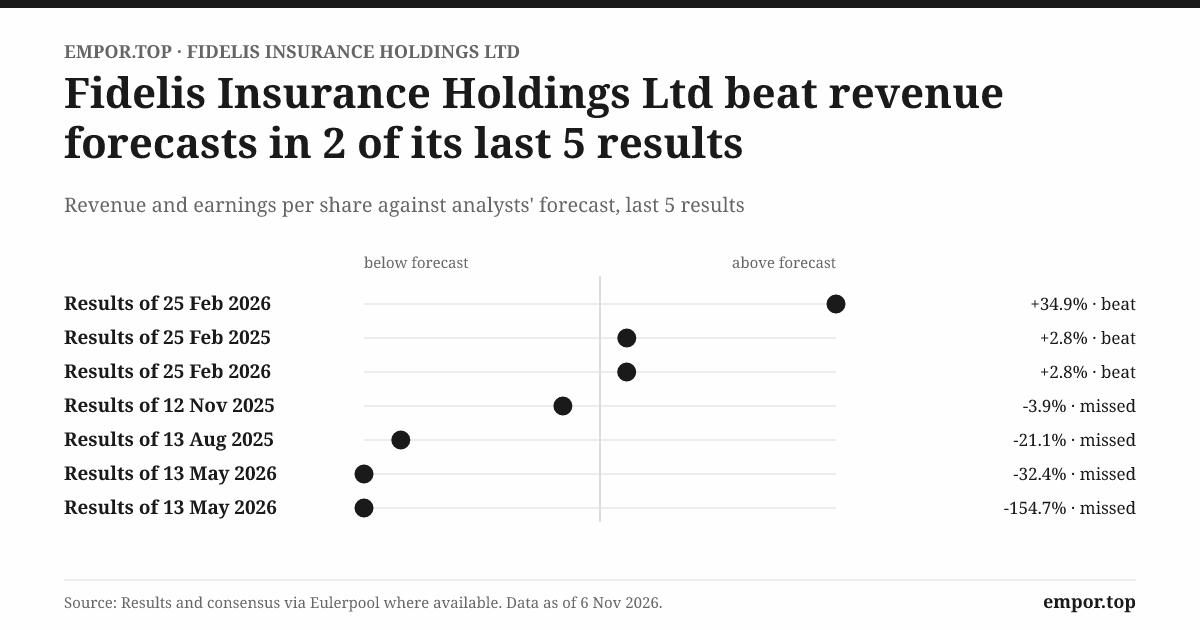
Management has set its own bar. The company targets a combined ratio, the share of every premium dollar consumed by claims and expenses, in the mid-to-high 80s over the long term, and an operating return on average common equity of 13% to 15%.3 Measured against those targets, the record so far falls short. The 2024 combined ratio was 99.7%, meaning almost every premium dollar went out again in losses and costs.3 In 2025 it improved to 94.8%, a genuine recovery but still well above the target.3 Operating return on average equity was 8.5%, below the 13% floor.3
That is not evidence of a broken business. A combined ratio below 100% means the underwriting made money before investment income, and Pelagos achieved that in both years despite heavy catastrophe losses. But it is evidence that the stated long-term economics remain a target rather than a demonstrated run-rate.
Three proof points will tell investors more than any slide. The first is the combined ratio with prior-year reserve development pulled out, so that old-year corrections do not flatter or punish the current book. The second is operating return on equity through a softer pricing cycle, not just in the hardest market for a generation. The third is premium growth from partners outside TFP, because that is the only direct evidence that Pelagos can source and select risk without relying on a single counterparty. The third point leads straight to the counterparty in question.
IV. The Partner That Still Runs the Machine
In October 2025, with little fanfare, a contract quietly reset its clock. Pelagos renewed its rolling ten-year Framework Agreement with TFP, pushing the end date of its most important commercial relationship another decade into the future.1 It was the kind of corporate event that rarely makes headlines and almost always matters more than the ones that do.
The agreement governs what TFP does for the listed company, and the list is long. TFP handles origination, underwriting, administration, claims handling and the support for outward reinsurance on substantially all activity at Pelagos's principal insurance subsidiaries.1 In plain terms, if a broker in London calls with an aviation risk or a structured credit deal, the person who answers, models the exposure, negotiates the price and later settles the claim is very likely to be a TFP employee working under authority delegated by Pelagos.
The fee structure is where the economics become legible. TFP earns an 11.5% ceding commission on certain open-market net premiums.1 For business sourced through third-party managing general underwriters, it earns a smaller 3% commission.1 It also collects a 3% portfolio-management fee.1 And on top sits a profit commission of 20% of underwriting returns above a 5% hurdle.1
Put the pieces together and the incentive structure looks like a private-equity fund's. TFP earns a base fee on the volume of business and a performance fee when the business makes money. That alignment has genuine merit: TFP does better when Pelagos's underwriting does better. But the base fee is paid whether or not a policy turns out well, and the profit share is calculated on underwriting results that can later be revised when old claims develop.
A partner paid partly on volume and partly on early profits has reasons to write more, and reasons to view the first estimate of a year's results optimistically, even when it behaves impeccably.
The money has grown with the book. TFP commissions rose from $225.3 million in 2023 to $328.8 million in 2025.1 As a share of net premiums earned, that is a climb from about 12.3% to about 14.3%.1 The direction matters as much as the level. TFP's take has been rising faster than the business it services.
The balance sheet tells the same story from another angle. At the end of 2025, TFP owed Pelagos $174.8 million, mostly premium collections not yet passed across by year-end.1 Pelagos owed TFP $457.7 million, mostly commissions plus claims that TFP had paid on Pelagos's behalf.1 The company carried no expected-credit-loss allowance against what TFP owed it.1
None of that implies wrongdoing. Money flowing in both directions between an insurer and its managing agent is normal, and timing differences at a year-end are expected. But the scale turns an operational relationship into a financial one. Pelagos is exposed to TFP's credit, to its continuity as an organization and to the conflicts inherent in a counterparty that is both service provider and shareholder.
That last point is not a footnote. Immediately after the separation, TFP acquired 9.9% of Pelagos's common shares, and it held 9.9% in early 2026.1 As long as TFP owns at least 4.9% and the Framework Agreement remains in force, it holds consent rights over specified major corporate actions.1 Some other holders sold shares during the buybacks partly to keep TFP's stake from drifting above 9.9% as the share count fell.1 The partner that runs the machine also has a seat near the steering wheel.
The company's own risk factors list what could go wrong in unusual detail. If TFP fails to perform, fails to comply with its agreements, loses key people or pursues a strategic transaction that distracts management or changes its compensation structures, Pelagos's results could suffer materially.1 Since TFP is a privately held business backed by investors, a future sale or recapitalization of TFP is not a remote abstraction. It is a normal event in the life of a private-equity-owned company, and it would land on Pelagos's most important supplier.
So how is Pelagos trying to reduce the dependency? The answer is new partners. Management has emphasized that expanded partnerships contributed to growth, and in the first half of 2026 growth came from lines including asset-backed finance and portfolio credit and property.5 The company also points to the discipline of saying no: it chose not to renew cyber business that failed its underwriting criteria.25
On the second-quarter 2026 call, analysts pushed on exactly this point, asking how the company judged the profitability hurdles that new partners had to clear and how pricing conditions were affecting appetite.8 Management's answers described partner selection in terms of underwriting returns and rating hurdles, and it framed the cyber exit as an example of that discipline at work.8 The answers were coherent. What they did not include was a number.
That is the gap that matters. Pelagos does not publish what share of its premiums is sourced and managed entirely outside TFP. Without that figure, the diversification story rests on named partner additions and management's description, not on a measurable shift in the business. Even partner business can run through TFP's administration, since the commission schedule includes a specific rate for business sourced through third-party MGUs.1
The record therefore supports a narrower claim than the marketing. TFP is not a minor service provider being phased out; it is a substantial, contractual and central part of how the company operates, and the agreement now runs into the mid-2030s. New partners are a credible path toward a broader network, but the business has not yet shown that it could readily replace TFP's operating role, and management has not published the metric that would let investors judge.
What would change that verdict? Rising non-TFP premiums alongside steady combined ratios would be the clearest signal. A falling share of fees paid to TFP would be another. And any material change in TFP's ownership, its delegated authority or the quality of its service would force a reassessment in the other direction. For now, the machine still belongs mostly to someone else, which makes the quality of its output the next thing to examine, starting with the year when that output went badly wrong.
V. The Separation Gain Hid the Earnings Problem
Set two numbers side by side and the shape of Pelagos's short public history appears. The first is $1.639 billion, the gain the company booked in 2023 for distributing TFP.1 The second is $270.3 million, the adverse reserve development it booked in the fourth quarter of 2024, when old claims turned out to cost far more than the company had expected.9 One number was an accounting windfall that flattered a year. The other was an operating loss that wiped one out.
The headline earnings make the story look like a roller coaster. Net income was about $2.1 billion in 2023, about $113 million in 2024 and about $226 million in 2025.1 Read naively, that is a collapse followed by a partial recovery. Read properly, the 2023 figure is mostly the separation, and the real comparison is between an insurance business that had a bad 2024 and a better 2025.
The fourth quarter of 2024 was the moment the story turned. The company swung to a net loss of about $122 million for the quarter, after three profitable quarters earlier in the year.9 The cause was principally aviation and aerospace exposure linked to the Russia-Ukraine conflict.9
The underlying dispute is one of the strangest in modern insurance. When Russia invaded Ukraine in 2022, hundreds of Western-owned aircraft leased to Russian airlines were stranded inside the country. Their owners, the aircraft lessors, wanted them back. They did not get them back. So they claimed on their insurance, and when insurers and reinsurers disputed whether policies covering war, confiscation or contingent risks applied, the lessors sued. The suits named more than 60 insurers and reinsurers, including entities now part of Pelagos.1
For an insurer, this kind of event is the nightmare that reserve accounting exists to handle and often cannot. The loss happened in 2022. The amount, the policy interpretation and the share each insurer would bear were not known until courts and settlements resolved them, years later. Pelagos strengthened its aviation reserves at year-end 2024 and made an allowance for ongoing settlement discussions.1 In 2025 it settled claims, and its cash outflows that year included aviation litigation settlements and Ukraine-related claims.1
Communication is part of the test. In mid-February 2025, the company put out a reserve update describing the strengthening.10 What the filings show is a company that had reported favorable reserve development in earlier years and then, in a single quarter, recorded a large adverse charge on a known, long-running legal exposure.9
The question for investors is not whether the company should have predicted the court outcomes. It is whether the earlier confidence in its reserves was appropriately cautious about a dispute that had been public since 2022. The size of the eventual charge suggests the original estimates were at the optimistic end of the range.
The full-year numbers soften the picture but do not erase it. Because earlier 2024 quarters included favorable development elsewhere, total adverse prior-year development for 2024 was $124.6 million.9 In 2025, net reserve development was close to zero.1 The pattern, in other words, was several years of releases, one sharp strengthening and then a year of standing still.
That pattern matters for a reason that goes beyond aviation. Remember that TFP's profit commission is calculated on underwriting returns above a hurdle. An insurer whose early-year results are later revised downwards has, in effect, paid performance fees on profits that turned out smaller than first reported. The filings do not quantify any clawback or true-up related to the aviation charge, so the point stays general rather than specific, but it shows why reserve accuracy is not only an accounting question here. It is also a question of who got paid for which version of the truth.
Now compare the two-year outcome rather than cherry-picking the best quarter. The 2024 combined ratio was 99.7%; 2025 improved to 94.8%.3 That is a real improvement of nearly five points, achieved in a year that also carried $515.5 million of catastrophe and large losses, including the California wildfires.3 Absorbing a wildfire year and still producing a sub-95 combined ratio says something good about the underlying book. But 94.8% remains about a full catastrophe season away from the mid-to-high-80s target.
The first half of 2026 looked better again. The combined ratio was 93.1%, helped by lower catastrophe and large losses than the wildfire-hit first half of 2025 and by favorable reserve development.25 Some of that improvement reflects luck in the weather rather than skill in the underwriting, and management's own comparisons acknowledge that the prior-year period was unusually heavy.5
There is also a new watch item hiding inside the good news. In the Insurance segment, first-half 2026 favorable development of just $5.5 million was partly offset by higher loss estimates for the Baltimore Bridge collapse in its marine line, and by increases in prior-year property direct and facultative losses.2
The Reinsurance segment contributed $30.3 million of favorable development from catastrophe and benign attritional experience.2 So the reinsurance book released reserves while the larger insurance book was still finding new costs in old years. That is not alarming at that size. It is a reminder that the aviation charge was not necessarily the last revision.
What of the auditors? KPMG gave an unqualified opinion on the 2025 financial statements and found internal control over financial reporting effective, with no emphasis-of-matter paragraph or material weakness in the cited audit section.1 The company also says it is not party to litigation it believes would materially affect its financial position.1 Both statements are meaningful. Neither removes actuarial uncertainty, because an audit tests whether reserves were set through a reasonable process, not whether the future will cooperate.
The fair verdict is this. The growth rates that span 2023 are useless as a measure of operating momentum and should be ignored. The underwriting recovered in 2025 and improved again in early 2026. But the 2024 aviation shock breaks any claim that the short post-separation record proves consistently accurate reserving.
The claim narrows to something smaller and more honest: the reserving process can absorb a large shock without endangering the company, but it has not yet shown that it avoids them. Which raises a more immediate puzzle, because in the very year the profits recovered, the cash went the other way.
VI. The Cash Went Out While the Profits Stayed on Paper
Here is the paradox in one line. In 2025, Pelagos reported $226 million of net profit, and its operating activities consumed $408 million of cash.1 For an industrial company, a gap like that would set off alarms about collections, inventory or aggressive revenue recognition. For an insurer, it can mean something much more ordinary.
Management attributed the outflow mainly to claims settlements and timing.1 The aviation litigation settlements and Ukraine-related claims were paid in cash in 2025. So were large California wildfire claims.1 Together they exceeded the cash coming in from premiums, after commissions and the cost of the company's own reinsurance.1
The best way to understand it is to imagine a household that put money aside for a roof repair three years ago and finally paid the builder this year. The expense was recognized when the damage happened. The cash left when the bill came. In insurance, the gap between those two moments can be years, and a year when several old bills come due at once will look cash-negative even if this year's business is profitable.
A few movements explain most of the swing. Premiums and other receivables absorbed about $496 million of cash, because the company wrote more business than it collected in the year.1 Paying down loss reserves, which is what settling claims means in accounting terms, used about $583 million.1 Pulling the other way, growth in unearned premiums, cash received for cover not yet provided, supplied about $733 million.1 And deferred acquisition costs, the commissions paid upfront on new policies, used another $207 million.1
So where did the money to pay those claims come from? Mostly from the investment portfolio. Investing activities produced a positive $683 million of cash in 2025, as fixed-income securities matured or were sold.1 That is not free cash generated by the business. It is the insurer drawing down the assets it had set aside for precisely this purpose.
A headline free-cash-flow yield above 27% and other industrial cash measures say little about an insurer, which is why the previous two years, positive operating cash flow of $495 million in 2023 and $618 million in 2024, are a better context than any single ratio.1
The bigger question sits on the asset side. Premiums and other receivables reached $3.32 billion at the end of 2025, up from $2.73 billion a year earlier, net of a $15.8 million credit-loss allowance.1 That is a large number for a company with about $2.4 billion of shareholders' equity. It means that more than the entire equity of the business is, at any given moment, money policyholders and cedants owe the company but have not yet paid.
A mechanical ratio makes this look worse than it probably is. Divide receivables by revenue and you get 867 debtor days in 2025, up from 401 in 2023.1 Taken literally, that would mean customers take more than two years to pay. But insurance receivables include premiums booked upfront and paid in instalments over the policy term, and reinsurance contracts that earn over two years. The ratio measures accounting structure, not late payment, and it should not be treated as proof that anyone is behind on their bills.
What the company does not publish is the information that would settle the question. The 20-F explains that the allowance is based on an aged analysis, historical write-offs and current conditions, and that contracts are generally cancellable for non-payment, with some loss obligations able to be offset against premiums owed.1
But Pelagos gives no ageing table, no quantified write-off history and no separate unbilled balance.1 The allowance rose by $4 million in 2025 after falling by $5.5 million in 2024.1 At less than half a percent of the receivable balance, it is small enough that its size alone cannot tell you whether collection quality is strong or merely unexamined.
There is a TFP angle here too. Some of the cash collected from policyholders passes through TFP before reaching Pelagos, as the year-end balance reflected.1 The cash cycle of this insurer is therefore partly the cash cycle of its partner.
The fair reading is that the 2025 cash outflow fits an insurer's cycle better than an industrial cash-conversion problem. It was a heavy claims-paying year after a reserve-strengthening year, and the explanation matches the events. But the receivable balance remains harder to assess than it should be. The test for future years is straightforward: receivables and reinsurance recoverables collected, claims paid and operating cash flow over several periods, not a single return to positive territory. Meanwhile, as cash was flowing out to claimants, a different kind of cash was flowing out to shareholders.
VII. Buybacks Became the Strategy
In the first half of 2026, Pelagos bought back 14.3 million of its own shares at a weighted average price of $19.51.2 At the end of 2025, each diluted share had been backed by $24.61 of book value.3 The company was, in effect, buying a dollar of its own net assets for about 79 cents, and it did so on a scale that would have looked remarkable for a company twice its size. The $279.5 million spent in six months was more than the company's entire 2025 net income.21
The arithmetic of buying below book value is seductive and real. When a company retires shares for less than the book value they represent, the remaining shareholders each own a larger slice of an equity base that shrank by less than the share count did. Shares outstanding fell from 96.7 million at year-end 2025 to 82.7 million by June 30, 2026, a drop of about 14% in half a year.2
Diluted book value per share rose to $26.56, up 9.1% including dividends.2 A rough calculation suggests that something like a dollar of that roughly two-dollar increase came from the buyback discount itself rather than from earnings, which makes repurchases one of the biggest single drivers of per-share value creation in the period.
To see how the company got here, follow the capital since the listing. The IPO brought in only modest primary money. Then the flows reversed. Pelagos repurchased $105.5 million of common shares in 2024 and $261.4 million in 2025.1 It began paying regular dividends, $46.2 million in 2024 and $52.3 million in 2025.1 In 2025 it redeemed $59.6 million of preferred securities.1 And it raised its buyback authorization to $200 million during 2025, then to $400 million in 2026.12
At the same time, it borrowed. In June 2025, Pelagos issued $400 million of 7.75% subordinated notes.1 They mature in 2055, their coupon resets in 2035 to a Treasury-linked rate plus 4.28%, and they cannot be redeemed before June 2030 without the Bermuda Monetary Authority's non-objection and conditions on replacing or covering the capital.1 Long-term debt reached $843.2 million at year-end, and debt-to-equity rose to 0.35 from 0.21 a year earlier.1 The company also has older junior subordinated notes whose coupon reset in April 2026.1
It would be wrong to say the debt financed the buybacks. Money is fungible, and the company has never described it that way. Regulators and rating agencies count subordinated notes like these as a form of capital, because they rank behind policyholders and can absorb losses. Seen that way, Pelagos swapped some expensive equity for somewhat cheaper hybrid capital while returning cash to shareholders. That is a recognizable playbook among Bermuda insurers.
But "somewhat cheaper" is doing a lot of work in that sentence. A coupon of 7.75% is not cheap money. Pelagos's operating return on average common equity was 8.5% in 2025.3 If the business earns only a little more on its capital than it pays its subordinated lenders, then leverage adds risk without adding much return. The case for the combined capital plan depends on underwriting returns moving toward the 13% to 15% target, not on the 2025 result repeating.
The skeptic's objection to the buyback math is more fundamental. Book value is not a liquidation value. It is an accounting estimate that depends, above all, on loss reserves being correct, and this is a company that strengthened those reserves sharply within the past two years. If reserves are understated, book value is overstated, and buying shares at 79% of an overstated book is less of a bargain than it looks. An insurer also needs capital to keep underwriting. Every dollar spent on buybacks is a dollar that cannot support new premium or absorb the next aviation-sized surprise.
The record, weighed fairly, supports a narrower version of management's description of buybacks as accretive. Share count fell materially, and book value per share rose. AM Best's April 2026 review still described risk-adjusted capitalization at the strongest level on its measure.11 What is missing is the confirmation that matters most: the post-buyback regulatory solvency ratio and capital headroom, disclosed alongside the repurchases, so that investors can see that the capital returned was genuinely surplus rather than simply available.
There is one more twist in the buyback story, and it came out on the second-quarter call. Management said that $216 million of the first-half repurchases had been privately negotiated with institutional shareholders.8 In other words, most of the buyback money did not go to anonymous sellers on the stock exchange. It went, in large blocks, to the pre-IPO holders whose names had dominated the shareholder register.
That fits the ownership record. In the March 2026 snapshot, Crestview funds owned 16.5%, TFP 9.9%, Pine Brook 8.3%, SPFM Holdings 8.3% and Leon Cooperman 8.1%.1 By June 30, 2026, Pine Brook reported about 5.77 million shares, around 7%.12 Reducing concentrated private-equity ownership can improve the public float and loosen the grip of a small group of holders on governance.
But it is important not to confuse two different things: liquidity for the sellers, and operating value creation for the buyers. The company was providing the first. Whether it also achieved the second depends on the price, and the price was below book.
There is a fair counterpoint. Buying large blocks privately below book value from motivated sellers can be better for remaining shareholders than buying the same shares in the open market, because it avoids pushing up the price and removes an overhang that might otherwise weigh on the stock for months.
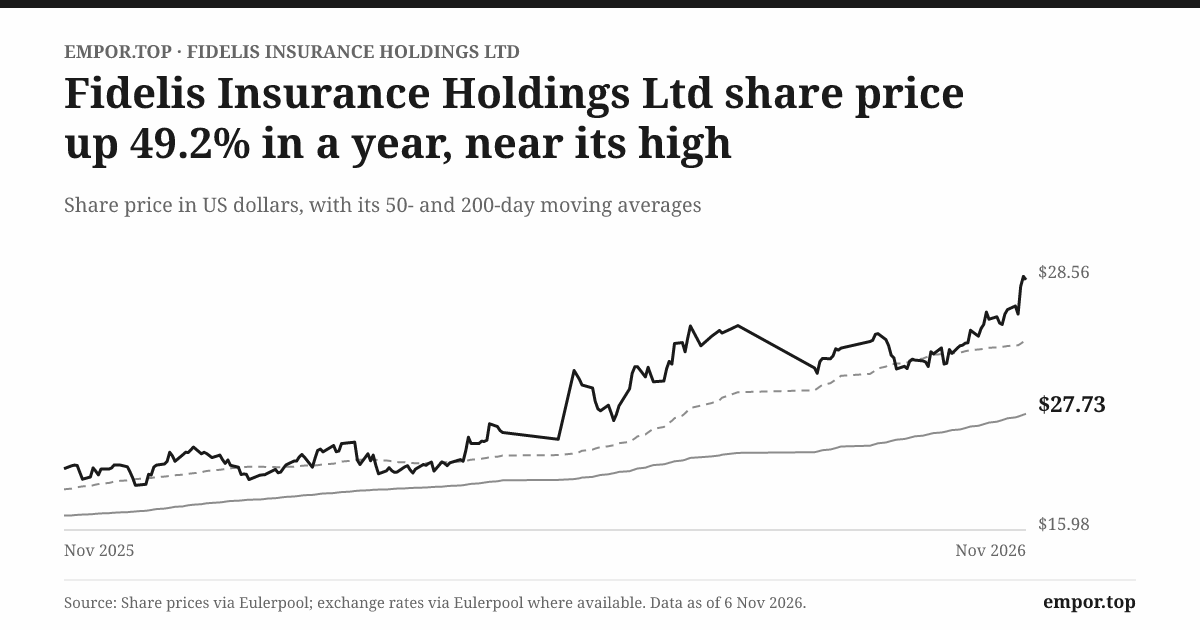
With the share price at $27.73 on November 6, 2026, near its 52-week high of $27.89 and far above the $19.51 average repurchase price, the shares retired in the first half look, in hindsight, well bought.3 Hindsight, though, is not capital discipline. The relevant test is whether capital was surplus at the moment it was spent.
The people making these calls deserve a closer look. Dan Burrows has been group chief executive since the separation on January 3, 2023, and a director since April 2022, after joining Fidelis in 2015 as U.K. chief executive and chief underwriting officer.7 He owned about 0.7% of the company in the March 2026 snapshot.1 His chief financial officer, Allan Decleir, is a Bermuda market veteran who previously served as chief financial officer of Platinum Underwriters and began his career at Ernst & Young in 1988.7 Together they run a lean team that sits between the shareholders and the partner.
Senior management's aggregate compensation for 2025 was $18.0 million, including $3.4 million of base salary, $5.0 million of cash bonuses and $8.5 million of long-term incentive grants at grant-date value.1 The 20-F does not break out the chief executive's and chief financial officer's pay individually, a disclosure format that leaves investors unable to link any one executive's pay to any one outcome, such as the aviation charge or the buyback program, without going to the proxy materials.
Management has also given investors a yardstick of its own. On the first-quarter 2026 call, Burrows spoke of the potential for year-end book value per share near $30.13 That is a useful guidance-discipline test, because it is specific and checkable. From $26.56 at the end of June, reaching $30 would require a strong second half of earnings, continued accretive buybacks, no major catastrophe and no fresh reserve surprises. If the year ends close to that level, the projection will have been earned. If it falls well short, the gap will say something about how management frames its own prospects.
The capital strategy, then, is coherent, aggressive and not yet fully proven. It works beautifully if the book value is solid and the underwriting returns reach their targets. It works less well if either one disappoints. And it unfolded at the same time as the company decided to change its name.
VIII. A New Name, the Same Operating Question
On May 12, 2026, the ticker on the New York Stock Exchange changed. FIHL became PLGO.2 The day before, Fidelis Insurance Holdings Limited had legally become Pelagos Insurance Capital Limited, following shareholder approval at the annual meeting on April 28.214 The vote was not close: 72.6 million shares for the change and about 99,000 against.14
Why rebrand at all? Part of the answer is obvious. For three years, two separate companies had carried the Fidelis name, one listed and one private, one owning the capital and one running the underwriting. Brokers, regulators and investors had to work to remember which Fidelis was which. A new name ends that confusion.
The other part is strategic. Management describes the company as a strategic capital allocator working with underwriting partners, and the new name puts that identity front and centre.2 "Pelagos" evokes the open sea, a fitting image for a business that deploys capital across many partners rather than building every capability itself. The word "Capital" in the name is doing deliberate work: it tells the market that the balance sheet, not the underwriting desk, is the company's core.
The evidence for a broadening network is real. On its 2026 calls, management named new partners including Euclid Mortgage, Bamboo Insurance and Oak Global, spanning mortgage credit, U.S. personal property and specialty lines.138 Each relationship brings premium the company did not have before and, in principle, reduces the share of the book that depends on TFP.
The cyber decision is the most concrete example of discipline in the new identity. Rather than renew cyber business that failed its underwriting criteria and rating hurdles, the company let it go, even while it was pursuing growth elsewhere.28 Walking away from premium is the hardest thing an insurer does, because volume is visible and the losses avoided never are. It is a small but meaningful data point in management's favor.
But branding is not strategy, and the distinction is worth drawing sharply. Pelagos remained leanly staffed.1 TFP remained central to operations.1 The arrangement remained long-term.1 Nothing about the name change internalized underwriting, changed the fee schedule or reduced the dependency. The evidence for a real strategic shift will have to come from the numbers: partner-sourced premium, underwriting returns on that premium and a visible decline in operational concentration.
Governance offers its own signal. At the same April 2026 meeting, chair Helena Morrissey received 901,755 votes against her re-election, compared with 37,871 against Burrows and 53,036 against director Dana LaForge.14 Morrissey is a well-known figure in British finance. She ran Newton Investment Management from 2001 to 2016, later led personal investing at Legal & General Investment Management and served as lead non-executive director at the U.K. Foreign Office.7 She has chaired the Pelagos board since the separation.7
Context matters here. Against roughly 73 million shares voted on the rebrand, 900,000 votes against is around 1% of the turnout, hardly a revolt. But it was about 24 times the protest against the chief executive, and it is the kind of signal proxy advisers and governance-focused holders send when they have concerns about board workload or chair oversight.
Morrissey sits on several other boards, including as chair of Altum Group and pension consultancy Barnett Waddingham.7 The vote is not a referendum on underwriting. It is a modest flag on board attention at a company whose central governance task is overseeing an outsourced operator.
The broader management bench shows a company slowly building out its own functions. Jason Kittinger joined as chief operating officer in September 2024, and Nicole Kapu-Leyland became group general counsel in December 2025.1 These are the roles an insurer needs to supervise a partner well: someone to own operations and oversight, and someone to own the contracts.
On credibility, the verdict stays provisional. The clean 2025 audit offered some reassurance.1 The rebrand passed overwhelmingly. The cyber exit showed the capacity to decline business. But reserve judgments remain consequential, the aviation charge showed they can move sharply, and the public record since separation is not even four years long. A new name gives Pelagos a cleaner story. It does not yet give investors a different business, which is why the valuation deserves careful examination.
IX. Analysis & Bear vs. Bull Case
On November 6, 2026, PLGO closed at $27.73, within a whisker of its 52-week high and more than 50% above its 52-week low of $18.08.3 At that price the company was worth about $2.3 billion, traded at 6.7 times trailing earnings and sat only slightly above its book value, at 1.1 times.3 Its own five-year median P/E was 5.1 times, so the shares were more expensive than their history but still cheap by most absolute yardsticks.3
How cheap? A broad screen of 20 U.S.-listed specialty insurers showed a median P/E of 9.4 times in early November 2026.15 That group is not a pure peer set, since many members write very different kinds of business, but it gives a rough sense of the gap. The market was paying about 30% less per dollar of trailing earnings for Pelagos than for the typical specialty insurer.
The tempting conclusion is that the market is wrong. The more useful question is what the price appears to assume. A P/E of 6.7 on trailing earnings that include an unusually benign first half and favorable reserve development implies that investors do not believe those earnings are normal. A price near book value implies that they think the company will earn something close to its cost of equity over time, no more. In other words, the market is pricing Pelagos as a capable but unexceptional insurer whose earnings are hard to normalize.
The bull case starts with the balance sheet. AM Best's April 2026 action affirmed A (Excellent) financial-strength ratings for the operating insurers and a BBB rating at the holding company, with a stable outlook.16 Its rationale assessed balance-sheet strength as "Very Strong," citing risk-adjusted capitalization at the strongest level at the 99.6% value-at-risk confidence level, liquid, short-duration, investment-grade assets and financial flexibility.11 The investment portfolio had an average duration of 2.7 years, with 85% in fixed maturities and short-term securities, which means the company can pay claims without fire-selling long bonds.1
The bull case then adds underwriting momentum. The combined ratio improved from 99.7% in 2024 to 94.8% in 2025 and 93.1% in the first half of 2026.32 Book value per share has risen steadily, helped by buybacks below book. Partner additions show that the platform can attract new sources of risk. And the trailing return on equity, at 18% over the twelve months to June 2026, finally looks like the business management promised.3
The bear case starts with the same AM Best report. Operating performance was assessed only as "Adequate," and the agency named aviation and aerospace reserve strengthening as a specific constraint.11 It also noted that the separation from TFP had pressured the business profile, even as TFP-generated business and new partners supported scale.11 A rating agency that calls the balance sheet very strong and the earnings only adequate is saying, in its own dialect, roughly what the share price is saying.
The bear case continues with concentration. TFP takes about 14% of net premiums earned in commissions and runs substantially all the underwriting. Two brokers supply over a third of premiums. And 2025 returns, even after recovery, were below management's own long-term target. A single bad catastrophe season or another old-year reserve charge could erase a year of ordinary underwriting profit, as the fourth quarter of 2024 demonstrated.
Porter's five forces bring the competitive structure into focus. Buyer power, through the brokers, is high: Aon and Marsh between them place 35% of the business and can redirect placements toward the many carriers that compete for specialty risks.1 Insureds and cedants can multi-source, splitting a placement among several markets, which limits any single insurer's pricing power. Supplier power is unusual and significant, because the most important supplier is not a vendor of inputs but TFP, the operator of the underwriting engine, holding a long contract and consent rights.
Rivalry is intense: Everest, Arch and RenaissanceRe each write somewhere between four and almost seven times Pelagos's net premiums.6 The threat of new entrants rises whenever catastrophe pricing is strong, because alternative capital, from insurance-linked securities to sidecars, can enter quickly and compete directly in property catastrophe and retrocession, the segments that shape Pelagos's reinsurance book. Substitutes come from the same source. Evidence for switching costs or sustained pricing power is thin.
Hamilton Helmer's seven powers framework sharpens the point. Scale economies do not favor Pelagos against much larger peers. Network economies are weak in insurance distribution. Switching costs are low for both brokers and buyers. Branding exists in the narrow sense of broker trust and lead positions, but the brand itself just changed. Process power, the hardest-to-copy organizational capability, mostly lives inside TFP rather than the listed company. Counter-positioning is the most interesting candidate: a lean capital vehicle working through multiple partners can, in theory, deploy capital into new lines faster than an integrated incumbent bound by its own underwriting teams.
Cornered resource is the other candidate, if the TFP relationship counts as one, but a resource governed by a renewable contract with a separately owned company is only partly cornered. The verdict is that Pelagos's potential advantage is counter-positioning plus relationship access, unproven through a soft market, rather than any of the classic durable powers.
So the why-win case comes down to specialty risk selection, broker and partner access, portfolio diversification, outward reinsurance to manage volatility and investment income on a conservative portfolio. The why-not case is that much of the operating engine sits with TFP, larger competitors have far greater scale and reserve shocks can overwhelm ordinary underwriting profit. History neither rejects the bull case nor confirms it. It narrows it: Pelagos has shown it can survive a large reserve charge and recover underwriting margins in a hard market, but it has not yet shown it can deliver target returns through a full cycle.
An activist would focus on three things. First, the TFP fee schedule: why commissions have risen faster than earned premium, and whether the profit-commission calculation adequately accounts for later reserve development. Second, disclosure: why the company does not publish the share of premium sourced and managed outside TFP, the regulatory solvency ratio after buybacks, or a receivables ageing. Third, capital: whether the combination of 7.75% subordinated debt and heavy buybacks leaves enough room for a bad year. None of these are accusations. They are the questions that would make the valuation easier to underwrite.
Normalizing earnings is the heart of the valuation problem. The 2023 separation gain must be excluded entirely. The 2024 reserve charge and the 2025 catastrophe year are both real costs of being in this business, not one-offs to be ignored. A fair normalized view looks at operating profit and combined ratios across the whole post-separation period, separating attritional performance from catastrophes and reserve development.
The capital-return thesis needs its own stress test. Buybacks below book support per-share value only if capital remains comfortably above regulatory and rating needs and the operating return on that capital exceeds the cost of the debt that partly replaced it. At an 8.5% operating return, that condition was barely met in 2025. At the trailing return of mid-2026, it was comfortably met. The answer depends on which year is normal.
Three KPIs carry most of the signal. The first is the combined ratio with prior-year reserve development shown separately; the latest reading was 93.1% for the first half of 2026, improving from 94.8% for 2025. The second is operating return on average common equity through the cycle; the latest full-year reading was 8.5%, below the 13% to 15% target. The third is diluted book value per share including dividends, paired with share count and capital adequacy; it stood at $26.56 at June 30, 2026, up from $24.61 at year-end 2025.23
Prepared remarks and analyst questions have told slightly different stories. In February 2025, the reserve update put the aviation charge in the language of prudence and settlement allowances.10 On the first-quarter 2026 call, the tone was confident enough to talk of book value near $30.13 On the second-quarter call, the analysts' questions went straight to partner economics, catastrophe losses and private repurchases, and the most revealing answer was the $216 million of negotiated block purchases.8
The progression shows a management team that has moved from defending its reserves to promoting its capital returns, with the operating questions still in the analysts' hands.
X. Playbook: Business & Investing Lessons
Go back to January 3, 2023, the day one company became two, and follow the money forward. The story runs through a separation gain, a reserve shock, cash flowing out to claimants and a buyback below book. Each moment teaches something that belongs to Pelagos and to no other company quite so clearly.
The first lesson comes from the split. By separating its underwriting platform, Pelagos converted its central capability into a contract. From that day on, the quality of the business has depended as much on the terms of that agreement, its fees, its delegated authority, its renewal and its consent rights, as on any decision made inside the listed company.
When the engine leaves the company, the contract becomes part of the product. Founders who spin out their operating core to raise capital or reward a team should remember that investors in the remaining entity are buying the contract along with the balance sheet.
The second lesson comes from the aviation charge in the fourth quarter of 2024. It reset the confidence built by years of favorable development. A good underwriting year is not finished until the old years stop getting worse. For investors, that means judging an insurer's record by its reserve triangles over many years, not by the most recent annual result, and treating a stretch of favorable releases as a hypothesis about the future rather than a promise.
The third lesson comes from the first-half 2026 buyback. The question it left was whether the book was as solid as the arithmetic assumed. Buying below book helps only if the book is strong enough to keep underwriting tomorrow. For any financial company, a buyback below book is a statement about the quality of the balance sheet, and investors should demand the solvency evidence that backs it.
The fourth lesson comes from 2025, when reported profits coexisted with a large cash outflow to claimants. In an insurer, profit is an estimate and cash is a fact that arrives late. The year proved that both can be honest at the same time and that the only reliable way to reconcile them is to watch several years of claims paid, premiums collected and recoverables received.
XI. Epilogue
Tonight, Pelagos stands at an interesting point in its short public life. Its shares are near their highest level in a year. Its book value per share has climbed on the back of earnings and aggressive buybacks. Its new name has been on the ticker for nearly six months. And on November 11, 2026, three days after this story's information cutoff, it is scheduled to report its third-quarter results.17
That report will answer the first, simplest question: whether the year-end book value near $30 that the chief executive described in the spring still looks reachable. A third quarter without a major catastrophe and with continued buybacks would keep it in sight. A heavy hurricane season or a fresh old-year charge would push it out of reach, and turn a confident projection into a credibility test.
Beyond the quarter, three stories will decide whether Pelagos becomes an enduring specialty capital allocator or remains a TFP-dependent insurer enjoying a favorable stretch.
The first is partner growth. If Euclid Mortgage, Bamboo, Oak Global and the partners still to come keep adding premium as specialty pricing moderates, and if management begins to publish how much of its book is sourced and managed outside TFP, the diversification thesis will have numbers behind it. If new-partner growth slows as soon as pricing softens, the capital-allocator identity will look more like a name than a model.
The second is reserves. Aviation and aerospace, the Baltimore Bridge and prior-year property direct and facultative losses are the obvious places to watch. The important discipline is to separate current-year catastrophe losses from revisions to old years, because the former are the cost of doing business and the latter are a measure of how well the business was understood when it was written.
The third is capital. The remaining buyback authorization will be measured against diluted book value per share, the cost of the 7.75% notes and the company's regulatory and rating capital. If the company keeps buying below book while publishing solvency headroom that remains comfortable, the strategy will look disciplined. If buybacks continue while capital tightens, the same strategy will look like it is borrowing tomorrow's underwriting capacity to flatter today's per-share numbers.
And underneath it all sits the cash question from 2025. A single year of positive operating cash flow will not settle it. Receivable collections, reinsurance recoveries and claims payments over several years will. The tension that remains is the one this story began with: Pelagos owns the capital and carries the risk, and the next few years will show how much of the skill behind its results is truly its own.
XII. Outro
Picture the table one more time. On one side sits a balance sheet, licensed in Bermuda, Britain and Ireland, rated A by AM Best and backed by a conservative bond portfolio. On the other sits an underwriting partner, privately owned, holding a decade-long contract and a 9.9% stake in the company it serves. Between them lies a claim, perhaps for a stranded aircraft or a collapsed bridge, that may not be settled for years.
Pelagos's defining asset may be its ability to choose risk and to choose the partners who bring it. Its defining uncertainty is how much of that capability it truly owns. The insurance capital is Pelagos's, and so is the regulated risk. TFP still runs much of the engine that writes it. The test that matters is whether Pelagos can turn that separation of roles into underwriting returns that are durable, repeatable and demonstrably its own.
References
-
Annual Report on Form 20-F for 2025 — Pelagos Insurance Capital (Fidelis Insurance Holdings), SEC, 2026-03-05 ↩↩↩↩↩↩↩↩↩↩↩↩↩↩↩↩↩↩↩↩↩↩↩↩↩↩↩↩↩↩↩↩↩↩↩↩↩↩↩↩↩↩↩↩↩↩↩↩↩↩↩↩↩↩↩↩↩↩↩↩↩↩↩↩↩↩↩↩↩↩↩↩↩↩↩↩↩↩↩↩↩↩↩↩↩↩↩↩↩↩↩↩↩↩↩↩↩
-
Second-Quarter 2026 Form 6-K — Pelagos Insurance Capital, SEC, 2026-08-12 ↩↩↩↩↩↩↩↩↩↩↩↩↩↩↩↩↩↩↩↩↩↩
-
Fourth-Quarter and Full-Year 2025 Results — Fidelis Insurance Holdings, SEC, 2026-02-25 ↩↩↩↩↩↩↩↩↩↩↩↩↩↩↩↩
-
Final IPO Prospectus — Fidelis Insurance Holdings, Stifel, 2023-06-28 ↩↩↩↩
-
Second-Quarter 2026 Results and Presentation — Pelagos Insurance Capital, 2026-08-12 ↩↩↩↩↩
-
Global Reinsurers by Net Written Premium — Beinsure, 2025 data ↩↩↩
-
Annual Meeting Information Circular and Proxy — Fidelis Insurance Holdings, SEC, 2026-03-16 ↩↩↩↩↩↩↩
-
Second-Quarter 2026 Earnings Call Transcript — StockAnalysis, 2026-08-13 ↩↩↩↩↩↩
-
2024 Annual Report on Form 20-F — Fidelis Insurance Holdings, SEC, 2025 ↩↩↩↩↩
-
February 2025 Reserve Update, Form 6-K — Fidelis Insurance Holdings, SEC, 2025-02-19 ↩↩
-
First-Quarter 2026 Earnings Call Transcript — StockAnalysis, 2026-05-14 ↩↩↩
-
2026 Annual Meeting Voting Results, Form 6-K — SEC, 2026-04-28 ↩↩↩
-
Specialty Insurance Stocks: Industry Statistics — DeltaScreener, data as of 2026-11-07 ↩
 LinkedIn
 WhatsApp
 Reddit
 Hacker News
 Email
 Kindle
 RSS Feed
 Spotify
 Apple Podcasts
 Amazon Music
 Audible
 YouTube