Hamilton Insurance Group: The Profits Behind the Premiums
I. The Quarter That Made Two Different Companies
On October 29, 2026, Hamilton Insurance Group put out its third-quarter numbers, and anyone who looked only at the top of the consolidated income statement saw a big quarter. Consolidated net income was about $228 million, one of the largest the company had ever reported.1 Revenue of roughly $828 million was close to the record it had set the quarter before.1
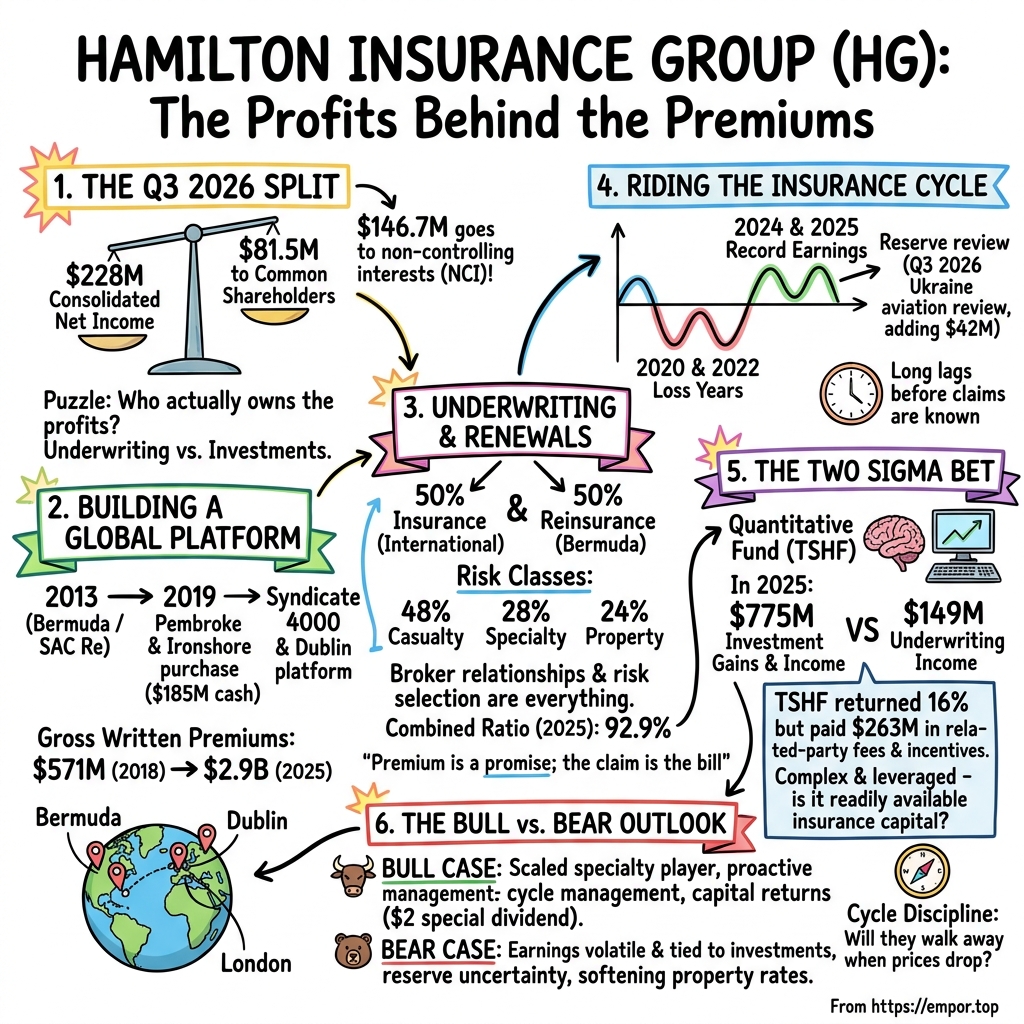
Then came the line that matters for anyone who owns the stock. Of that $228 million, only $81.5 million belonged to Hamilton's common shareholders.1 The other $146.7 million was attributed to non-controlling interests, meaning owners of a consolidated investment vehicle who are not the people holding HG shares.2 Diluted earnings per share were $0.81, against $1.32 a year earlier.1
Management offered its own figures. On its preferred non-GAAP measure, operating income was about $180 million, or $1.78 per diluted share, and annualized operating return on average equity was about 25%. The GAAP return was about 11%.3 When a company's own metric shows more than twice the profit attributable to common shareholders under GAAP, it is worth finding out what accounts for the difference.
Book value is a steadier measure. Book value per common share ended September at $29.80, up about 4.6% from $28.50 at the start of the year, and up about 11.6% once the March special dividend is added back.1 That was a good nine months. It is also a reminder that for an insurer, book value growth plus dividends is a better measure of performance than any single quarter's profit.
So one quarter produced two companies. The first earned $228 million. The second, the one listed on the New York Stock Exchange, earned a bit more than a third of that. Both numbers are accurate. They describe different things, and Hamilton's whole story sits in the space between them.
That space has three parts, and each one is a separate business question. The first is underwriting: did Hamilton charge enough for the risks it took on? The second is investments: how much of the profit came from the money it holds between collecting premiums and paying claims, and how much of that money is managed by the quantitative hedge fund firm Two Sigma? The third is the balance sheet: when the bad years come, are the reserves and the capital really there?
In the third quarter, the underwriting answer was weak. Gross premiums written rose about 17% to roughly $820 million, and for the first nine months they were up about 15%.1 Growth at that pace usually signals a confident insurer. But the combined ratio, which measures claims plus expenses for every dollar of premium earned, rose to 97.3% from 87.8% a year earlier.1 Underwriting income, the profit left over before any investment return, fell to about $16 million from $64 million.3
A combined ratio under 100% means the insurer made money on the insurance itself. At 97.3%, Hamilton still did, but only just. For every $100 of premium it earned in the quarter, it kept less than $3 before investment returns. A single bad claim or a reserve correction could wipe out a margin that thin.
That is roughly what happened. Most of the deterioration came from one place: Russia's war in Ukraine, which was already four years old. After a scheduled review of its specialty reserves, Hamilton booked about $42 million of estimated Ukraine-related losses, mostly in aviation reinsurance and retrocession, and offset that with about $30 million of favorable development on other specialty lines.3 CFO Craig Howie called the net change "about 0.3% of our total net loss reserve position."3 He was right that this is small in total. But it also shows that a loss from 2022 was still being re-estimated in late 2026.
Analysts on the call quickly moved from the size of the charge to how much exposure was left behind it. Citi's Matthew Heimermann asked about exposed limits on the Ukraine-related business. Howie answered: "I do not think it is appropriate to talk about overall limits and things like that."3 He listed the lines the team had reviewed, which were war on land, political risk, marine, trade credit and aviation, but gave no figure for the maximum Hamilton could lose.3
The other topic on the call was the next renewal. CEO Pina Albo told listeners that property reinsurance prices would fall again at the January 1, 2027 renewals, though she did not expect the cuts to match the year before. She said rates would "remain adequate and terms and conditions largely intact."3 That is a claim about the future, and the next renewal season will test it.
This is the tension the rest of the story follows. Hamilton is a young Bermuda insurer that has grown quickly, reported record earnings, paid its first dividend and won better credit ratings. Its earnings also depend heavily on a hedge fund relationship that very few insurers have. And it is now entering a softer market with a combined ratio moving the wrong way.
To see how those pieces ended up in one company, the story goes back to its beginning: the sale of a reinsurer whose original owner had to get rid of it.
 Subscribe on LinkedIn
II. A New Bermuda Insurer Buys Its Way to a Global Platform
In November 2013, Steven Cohen's SAC Capital pleaded guilty to securities fraud charges, and the plea agreement required him to sell a reinsurer called SAC Re.4 SAC Re had started operations in Bermuda only the year before, with about $500 million of capital from Cohen, Capital Z Partners and other investors.4 Now it needed a new owner, and it needed one fast.
In December 2013, a group of buyers stepped in. It was led by Brian Duperreault, a veteran insurance executive, and it included affiliates of the New York quantitative investment firm Two Sigma.4 SAC Re was renamed Hamilton Re, Duperreault became chief executive, and Two Sigma became the sole manager of the reinsurer's investable assets.4
That design was the founding idea, and it still shapes the company. Most reinsurers keep their premiums in short-term, high-grade bonds. Hamilton was built to underwrite risk with one arm and invest its capital through a quantitative hedge fund with the other. The company calls itself "a global specialty insurance and reinsurance company founded in Bermuda in 2013."5 From the start, the bet was that two separate engines of return could share one balance sheet.
The early years were the normal ones for a start-up reinsurer. Hamilton was small, wrote business that larger competitors often had first choice of, and had a short record to show rating agencies and brokers. Gross premiums written were about $450 million in 2016 and $571 million in 2018.6 In 2017, Duperreault left to become chief executive of AIG, and Hamilton lost the person whose reputation had helped launch it.7
The next chapter began in 2018 with the arrival of Giuseppina Albo, known as Pina. She had spent 25 years at Munich Re, one of the largest reinsurers in the world, and served on its Board of Executive Management.5 She had also served on the board of RGA Reinsurance and was the first woman to chair the Association of Bermuda Insurers and Reinsurers.5 Hamilton's own filings date its strategic transformation to her hiring, which was focused on "creating sustainable underwriting profitability."5
That wording quietly admitted something about the past. Before 2018, underwriting profit had not been sustainable. Albo's first job was to change how the company chose risk. Her second was to give it more ways to reach that risk.
The second job was solved by buying a platform. In March 2019, Hamilton agreed to buy two businesses from Liberty Mutual: Pembroke Managing Agency, which runs Lloyd's Syndicate 4000, and Ironshore Europe DAC, a Dublin-based insurance carrier.8 The deal closed on August 20, 2019.8 Hamilton said the purchase doubled its premium base to about $1.1 billion on a pro forma basis and gave it about £600 million of managed underwriting capacity at Lloyd's.8
"Today represents a significant milestone in Hamilton's development," Albo said at the time.8 She also predicted how people would see the deal: "Many will see this as a Lloyd's acquisition."8 She was right. In practice it was more than that. Lloyd's gave Hamilton access to London's specialty broker market. The Dublin carrier gave it an insurer based in the European Union after Brexit. Together they turned a Bermuda reinsurer into a company that could write insurance directly.
The price was modest for what changed. Hamilton paid $185 million in cash and spent another $22.6 million on transaction and integration costs.9 Liberty Mutual had its own reason to sell. It had bought Ironshore in 2017 and already ran a large Lloyd's operation, so these units overlapped with what it had. For Liberty, the sale tidied up its structure. For Hamilton, it was the base of a global platform.
The deal also reshaped the leadership team. Jonathan Reiss, whom the company described as "a founding member of Hamilton," moved from group CFO to a new role as president of strategic partnerships, and Tony Ursano, who had been president of the reinsurance broker TigerRisk Partners, came in as group CFO.8 Putting a broker-side executive in the finance chair fit the plan. Hamilton was no longer only a Bermuda balance sheet waiting for business to arrive. It was building a company that had to win business placement by placement.
Whether Hamilton overpaid cannot be settled from the price alone, because there is no clean comparable deal to measure it against. The better test is what the acquired businesses became. Today Syndicate 4000 and the Dublin carrier, renamed Hamilton Insurance DAC, form the core of Hamilton Global Specialty, which writes commercial specialty and casualty insurance for medium and large accounts.5 In 2021, Hamilton added Hamilton Select, a U.S. excess and surplus lines carrier for small and mid-sized casualty clients.5 By 2025, the International segment that grew out of the 2019 deal wrote about 52% of group premiums.10
By that measure, the acquisition did what it was meant to do: it provided the structure the rest of the growth was built on. The headline premium series should still be read carefully. Gross premiums written rose from $571 million in 2018 to $2.9 billion in 2025.610 That five-fold increase includes acquisitions, a new U.S. company, a different business mix, and the strongest pricing market in a generation. It is real growth, but it is not growth on a like-for-like basis.
Hamilton also remains small compared with the companies it competes against for broker attention. In 2025, Arch Capital wrote about $22.9 billion of gross premiums and RenaissanceRe about $11.7 billion.1112 Hamilton's $2.9 billion was about one-eighth of Arch's and a quarter of RenaissanceRe's.10 Those peers have broader mixes, including mortgage insurance at Arch and a large third-party capital business at RenaissanceRe, so the comparison is a rough guide to scale, not a market-share ranking. Still, Hamilton is the smaller company at the table.
So the history so far is a reinsurer bought out of a scandal, given a hedge fund as its investment department, and turned into a multi-platform specialty group through one well-timed purchase. That leads to the more basic question of what Hamilton actually sells, and why a broker would keep sending it business.
III. The Renewal Is the Product
Consider a renewal from an underwriter's point of view. A broker in London or New York sends a submission: a client, a schedule of risks, several years of loss history and a proposed structure. Maybe it is a regional U.S. insurer that wants to buy property catastrophe reinsurance. Maybe it is a mid-sized American manufacturer looking for excess casualty cover on top of its primary policy.
The underwriter has to decide several things, often under deadline pressure. Should Hamilton take the risk at all? If so, at what price, for how large a limit, starting at what level of loss, and how much of the risk should Hamilton keep rather than pass on to its own reinsurers? Each of those choices is a forecast of claims that may not show up for years. Getting them right is the main skill of the business.
That is the closest Hamilton has to a product. There is no subscription and no installed base. Most policies and reinsurance treaties last a year and then have to be renegotiated.10 Each contract is priced on its coverage, its limits, the point where the insurer's obligation begins, and expected losses.5
The contract structures add complications. In an excess-of-loss reinsurance treaty, Hamilton is paid a fixed or minimum premium, adjusted later for the client's actual exposure, and pays only when losses exceed an agreed threshold.5 In a proportional treaty, Hamilton takes a share of the client's premiums and pays the same share of its losses, so its results follow the client's underwriting quality.5 Some proportional business is written on a "risks attaching" basis, which means premiums can be earned over about 24 months rather than 12.10
Catastrophe business has its own feature. When a large loss uses up a client's cover, the client often pays a reinstatement premium to restore it.10 So a hurricane can increase premium revenue in the same quarter it creates claims. Revenue in this business depends on renewals, exposure, rates and losses. It does not repeat automatically like software revenue.
Two engines, three platforms
Hamilton runs this process through two reporting segments, and both are large. In 2025 International, which holds Hamilton Global Specialty and Hamilton Select, wrote about 52% of gross premiums, and Bermuda, which is mostly Hamilton Re's reinsurance book, wrote about 48%.10 By type, the book was roughly half insurance and half reinsurance.10 By line, casualty was about 48% of premiums, specialty 28% and property 24%.10
That mix means Hamilton is not mainly a catastrophe reinsurer, even though its Bermuda location suggests one. Property, where hurricanes and wildfires drive results, is less than a quarter of the book. Nearly half is casualty, meaning liability insurance such as general liability, professional lines and excess cover, where claims arrive slowly and often grow with legal costs and jury awards. The remaining specialty quarter includes marine, aviation, political risk and trade credit, which is where the Ukraine losses came from.
In 2025 the whole operation produced a combined ratio of 92.9% and underwriting income of about $149 million.10 That is a sound underwriting year: about $7 of profit for every $100 of premium earned before any investment return. It is not an exceptional result in an unusually profitable market, but it is clearly profitable.
The moat question is whether there is something lasting behind that result, so it is worth setting out once and carefully.
The main argument in Hamilton's favor is access combined with judgment. Specialty insurance is sold almost entirely through brokers. An insurer that brokers think of early, that has specialist underwriters with real expertise in difficult lines, and that holds ratings large clients accept will see better submissions. Seeing more submissions lets it be more selective. Hamilton's ratings support this. AM Best rates Hamilton Re A, and KBRA affirmed Hamilton Re at A in June 2026.1314 The combined platform supports it too, since an insurer that writes both direct insurance and reinsurance can move capacity toward whichever side is better priced.
Each of those advantages has a limit. The big brokers have strong bargaining power because they place business with many insurers and can move it. Hamilton's historical reliance on them was large: in 2018 Aon handled about 32% of gross premiums, Marsh & McLennan 24% and Willis 14%, so three brokers controlled about 70% of the business.6 Hamilton has not published comparable concentration figures for recent years, and a 2018 figure is too old to describe the current company.10 Still, the structure of the industry has not changed: the brokers hold the client relationship.
Switching costs are also hard to show. A cedent can change reinsurers at the next renewal with little friction, and many treaties are already split across a panel of a dozen or more reinsurers. Hamilton does not publish retention rates, renewal rate changes by line, or how often it holds its share of a treaty. Without those figures, any claim of loyalty is a story rather than a measured fact.
The fairest conclusion is that Hamilton's advantage is a capability, not a position. Good underwriters, good ratings and a flexible platform are what any well-run specialty insurer needs to compete. They become a moat only if they produce better risk selection than peers over a full cycle, and that would appear in loss ratios over time, not in growth rates.
The January test
The third-quarter call showed what that capability looks like when the market starts to turn. Property reinsurance had a light catastrophe year in 2025 and prices dropped at the January 2026 renewals. Albo said she did not expect cuts at January 1, 2027 to be as large as the prior year's, and that rates would remain adequate.3 Management also expected to write less property premium as a result.3
That is the proper way to handle a softening market, if Hamilton actually does it. Writing less premium when prices fall is what discipline looks like on paper. The real test comes in the first-quarter 2027 numbers, which will show whether Bermuda property premium actually fell and whether the margin on what remained held up.
Casualty showed the same pattern. Albo said casualty rates were "not uniformly keeping pace with loss cost trends," which is a significant statement in liability insurance, where claim inflation has been the industry's biggest problem since about 2019.3 She said Hamilton was "backing away from lines where it's not the case."3
Two concrete steps backed this up. Hamilton Select stopped writing medical professional liability "due to persistent unacceptable pricing and terms."3 And Albo told analysts to expect "a much more tempered growth in casualty re," noting that Hamilton "only started writing casualty reinsurance from the end of 2022."3
That second remark explains a lot. Much of Hamilton's recent growth came from a casualty reinsurance book less than four years old, started after the market had already hardened. Every accident year in that book is still immature, and for long-tail casualty, an immature year can look good on paper and later prove costly. Slowing down there is sensible. It also shows how much of the growth came from a recent, untested line.
Analysts also pressed on competition. BMO's Michael Zaremski asked about competition in excess and surplus lines, the U.S. market for risks standard insurers will not cover, where Hamilton Select operates. Albo said submission volume "is constantly going up."3 Rising submissions are a good sign, since more choice allows more selectivity. But in a softening market, more submissions can also mean more brokers shopping the same accounts for a lower price.
Citi's Matthew Heimermann asked whether AI could change wholesale distribution, the system of specialist brokers that sits between retail agents and E&S carriers.3 That question goes straight to how Hamilton gets its business. If software makes it easier to place small commercial risks, the broker relationships behind Hamilton's access matter less, and pricing and speed matter more.
Technology belongs here as an underwriting tool, not as a separate business. Hamilton talks about data and analytics and has capitalized internally developed software. Additions to intangible assets were about $9.2 million in 2025, down from $17.6 million the year before.10 The company reported more than 600 employees in both 2024 and 2025 while premiums grew by about half a billion dollars.10 That points to some operating leverage and continued investment in systems. It does not show a technology advantage, because Hamilton does not report technology as a product, and capitalized software alone says nothing about whether its risk selection beats competitors'.
So the product is the renewal, and every renewal repeats the same test. Hamilton has shown it can grow when prices are good. The more revealing test is how it handles softer prices.
IV. Growth Through Hard and Soft Markets
In 2020 Hamilton reported a net loss of about $210 million.5 In 2022 it lost about $97 million.5 Between those two years it earned about $188 million in 2021.5 For a company whose current pitch is underwriting discipline, the record through 2022 was erratic.
Then results improved sharply. Net income attributable to shareholders was about $258 million in 2023, about $400 million in 2024 and about $577 million in 2025, the last two being records.10 Reported revenue went from $739 million in 2020 to about $2.7 billion in 2025, almost four times larger.510
The common account says Albo's turnaround worked: the platform was built, the underwriting was fixed and the earnings followed. Much of that is fair. The record also shows a different and more complicated pattern.
Start with revenue. For an insurer, reported revenue mixes earned premiums with investment income and investment gains and losses. When Two Sigma has a strong year, revenue rises. When bond prices fall, as they did sharply in 2022, revenue falls. The quarterly figures show how distorting this can be. Third-quarter 2024 revenue was only about $66 million, compared with about $600 million the quarter before, which was an accounting artifact and not a collapse in insurance demand.15 Revenue is the least reliable indicator of how much insurance Hamilton is selling.
Premiums are the better gauge, and they tell a strong story. Gross premiums written were about $1.65 billion in 2022 and $2.9 billion in 2025, an increase of about three-quarters in three years.10 This period covered one of the firmest reinsurance pricing environments in years, after the heavy catastrophe and inflation losses of 2022 pushed reinsurers to raise prices and tighten terms. Hamilton expanded into that market, and the results show it largely chose well.
Separating the insurer from the investor
The combined ratio separates underwriting performance from investment performance. In 2025, underwriting was profitable.10
Now add investments back. In 2025 investment gains and income were about $775 million, against about $824 million of total pretax profit.1016 So underwriting contributed about one-fifth of what the investment portfolio contributed. Even after allowing for corporate expenses and other items, most of Hamilton's record 2025 profit came from its investment portfolio, not its underwriting.
That changes how to read the turnaround. The underwriting did improve. A company that lost money in 2020 and 2022 posted a combined ratio of about 93% in 2025, and that change is real.10 But the earnings growth that took Hamilton to record profits was driven mainly by investment returns, especially Two Sigma's returns in 2024 and 2025. In a different investment year, the same underwriting would have produced a much smaller headline profit.
The two loss years show how fragile the earnings can be. In 2020 the Two Sigma fund lost about 4.6% in the same year the underwriting lost money.5 In 2022 the fund made money, yet the group still lost money as bond prices fell and underwriting results disappointed.5 The diversified platform did not prevent either loss. Diversification reduces the swings in a good year but does not prevent a bad one.
The third-quarter call showed what management now expects from the core book. Wells Fargo's Elyse Greenspan asked whether the group's underlying loss ratio, meaning losses before catastrophes and prior-year reserve changes, was still in the mid-50s. Howie said yes and gave the targets: about 55% for the group, 54.5% for International and 56% for Bermuda.3
The reported third-quarter loss ratio was 62.0%, with about eight points coming from prior-year Ukraine reserves and about one point from the Middle East conflict, partly offset by favorable attritional development elsewhere.3 Put simply, management says the current-year business is priced the way it planned, and the problem came from losses on old business. Investors should note that both parts of that explanation rely on management's own reserve estimates.
Management's description of its own priorities has been consistent. On the third-quarter 2026 call, Albo said Hamilton "will continue to prioritize underwriting profitability over top-line growth, even if this means walking away from business."3 The wording has hardly changed since the IPO.
The behavior to test against that statement is growth. Hamilton grew premiums at double-digit rates almost every year after 2017, through both its loss years and its record years.610 Consistent double-digit growth is not proof of indiscipline, because the platform was being built and the market was hardening. But it means management has made the "walk away" promise many times without having to show it at a group level. Group premiums have not yet fallen in any year.
The first real evidence came in 2026. Ending medical professional liability at Select was a decision to give up premium, not to reprice it.3 Management's plans to slow casualty reinsurance and write less property premium at January renewals point in the same direction.3 Those are steps in the right direction. They are also small next to a book that grew about 15% in the first nine months of 2026, with most of the growth in casualty and specialty reinsurance.12
The growth also came with higher costs. Acquisition costs, the commissions and brokerage paid to win business, rose to about 27.4% of net premiums earned in the first nine months of 2026 from about 26.2% a year earlier.2 Higher commissions in a softening market can mean the business is getting more competitive, with brokers and cedents taking a larger share of each premium dollar. BMO's Michael Zaremski asked about it on the call. Howie said guidance had not changed and that the ratio "changes with business mix as well."3 That is a reasonable answer, but it is not a complete one, and the trend needs watching.
So the verdict on growth is narrower than the common account: Hamilton's record earnings depend more on investment returns than on insurance results. That makes the investment portfolio the next part of the story, and the most unusual part of the company.
V. The Two Sigma Bet Sits Beside the Underwriting Business
In 2025 the Two Sigma Hamilton Fund returned about 16%.10 Most fund managers would be pleased with that number, and most insurance investment officers would never see one like it. In the same year Hamilton paid Two Sigma about $52.6 million in management fees and allocated another $263.4 million to it as incentive compensation.10 Those incentive allocations alone were greater than Hamilton's underwriting income for the year, almost twice as large.10
That comparison is uncomfortable, but it describes the arrangement accurately. Hamilton is an insurer that also owns a large position in a leveraged quantitative hedge fund, with the fund's manager entitled to a sizable share of the profits. Anyone trying to understand the company needs to understand that.
Hamilton describes the vehicle as "a dedicated fund-of-one managed by Two Sigma," built to "provide low-correlated absolute returns."5 The idea goes back to the 2013 founding. An insurer holds large amounts of other people's money between collecting premiums and paying claims, plus its own capital. Most insurers invest that money conservatively. Hamilton's founders wanted to put a substantial share into one of the world's most sophisticated systematic trading firms, whose strategies were supposed to perform independently of insurance losses and bond markets.
When it works, the result is a balance sheet earning two returns at once: underwriting profit on premiums, and hedge-fund returns on the capital supporting those premiums. When it does not, the insurer has extra volatility in the place where policyholders and rating agencies most want stability.
Following the money
The record supports the idea in part. From 2014 through 2022 the fund returned about 12.8% a year after fees.5 Year to year it was uneven: about minus 4.6% in 2020, plus 17.7% in 2021 and plus 4.6% in 2022.5 It returned about 7.6% in 2023 and about 16% in both 2024 and 2025.10 By the end of September 2026 it was up about 16.3% for the year.3
The 2022 result deserves attention. That year bond markets had one of their worst years in modern history, and most insurers took large unrealized losses on their fixed-income holdings. Two Sigma's fund still made money. In that year, the low correlation Hamilton had been promised actually showed up.
The 2020 result cuts the other way. That year Hamilton lost money underwriting and also lost money in the fund. The fund did not offset a bad underwriting year; the two losses compounded. Low correlation on average does not guarantee the two engines will never fall together.
Now look at how much the fund matters to earnings. In 2025 its contribution to Hamilton after management fees and incentive allocations was about $300.9 million.10 Underwriting income was about $149 million.10 So Two Sigma's net contribution was about twice underwriting profit, even after Two Sigma took its share. Add the conventional bond portfolio and total investment gains and income reached about $775 million.10
The fees are high by any standard. A 2.5% annual management fee, plus 30% of net profits, plus a further 25% of profits above a 10% hurdle, is more expensive than the classic hedge-fund "two and twenty."10 The arrangement is a related-party agreement, since Two Sigma's principals were among Hamilton's founding investors, and Hamilton says the fees are "arm's-length."5 Shareholders have to decide whether the net returns justify the gross cost. Over 2024 and 2025 they clearly did. In a flat year, the management fee alone would take about 2.5% of the fund's capital, regardless of performance.
This also explains the gap at the start of the story. Hamilton consolidates the fund, so its accounts include the whole vehicle's results, including parts that belong to others. The portion owned by others, including the managing member's incentive share, appears as non-controlling interest. In the third quarter of 2026 that line was $146.7 million.1 That is how the $228 million consolidated figure became $81.5 million for common shareholders. The consolidated figure is not wrong. It just counts money that does not belong to HG shareholders.
Capital that is there, and capital that is liquid
The second issue is liquidity, and it is the one credit analysts focus on most.
Hamilton's investments are divided into two very different portfolios. At the end of 2025 the company held about $5.9 billion of cash and invested assets.10 The fixed-income portfolio was entirely investment grade, with an average credit quality of Aa3 and a duration of about 3.4 years.10 That is a cautious, short-duration bond portfolio of the kind any insurer would hold to pay claims. By September 2026 the duration had lengthened to about 3.8 years and the yield to maturity was about 5.6%, as Howie locked in higher yields while shifting toward longer-tail casualty business.3
The third quarter showed the two portfolios moving in opposite directions. The fixed-income book lost about $56 million, including realized and unrealized losses, while the Two Sigma fund returned about 6.1% in the quarter.3 New money was being invested at about 5.1%.3 That is how the arrangement is supposed to work: a quarter when bonds fell was covered by a fund designed not to move with them. It is also why much of the quarter's investment result went to non-controlling interests, since a strong fund quarter increases the share owed to the fund's other owners.
The other portfolio is the fund, which at the end of September 2026 was about 39% of total investments plus cash.3 That share is much lower than in Hamilton's early years: Two Sigma managed about 80% of invested assets in 2018 and about 49% in 2022.5 The dependence has declined, mostly because the bond portfolio grew as premiums grew. But almost two-fifths of the investment base remains in a vehicle that "employs substantial leverage," uses derivatives, and cannot simply be sold on any given day like a Treasury bill.5
The contract adds further constraints. Hamilton's commitment agreement with Two Sigma sets a target investment of the lesser of $1.8 billion or 60% of the group's net tangible assets, on a rolling three-year commitment period that renews automatically each year.5 Withdrawals outside that framework are limited to specified conditions, such as a liquidity shortfall or a required ratings or regulatory action.5 On the third-quarter call, KBW's Tommy McJoynt asked about access to the money. Howie said: "We can take funds out should we want to or need to take funds out of the fund."3 That is reassuring, but the filings describe a narrower right than the comment implies.
There is also a dependence on individuals. The filings name Two Sigma co-founders David Siegel and John Overdeck as the "Two Sigma Key Persons."5 An investment relationship built around particular founders depends on those founders staying involved.
The rating agencies see both sides. KBRA affirmed Hamilton Re at A in June 2026, citing strong capitalization and improving earnings. It also called the fund "a key credit constraint given its complexity" and of "limited utility as a near-term liquidity source."14 KBRA said what would improve its view: "reduced earnings and capital reliance on TSHF, stronger ordinary liquidity excluding TSHF."14 It also said what would hurt: "meaningful volatility in TSHF that weakens capital, earnings or liquidity."14 AM Best's 2025 review described Hamilton's balance-sheet strength as very strong but its operating performance as only adequate, partly because of what it saw as a relatively high-risk Two Sigma allocation.17
When two rating agencies, looking at the same company a year apart, both identify the same asset as the main constraint, that view is not just caution. In the agencies' assessment, Two Sigma is both the main source of earnings and the main source of risk.
The fair conclusion is that the arrangement is economically central, not an add-on. It has helped earnings materially, especially in 2024 and 2025, and in 2022 it delivered the low correlation that justified it. It also makes Hamilton harder to analyze than a standard insurer. Its earnings rely on a fund whose returns no one can forecast, its true liquidity is smaller than the headline investment total, and a significant share of the fund's gains goes to the manager before shareholders receive anything. The real test is not the fund's next annual return. It is how much capital Hamilton could actually withdraw, and how fast, after a severe catastrophe year.
The arrangement was set up at the founding. Managing it now, along with everything else, is up to Albo's team.
VI. What Albo Has Promised—and What the Record Can Prove
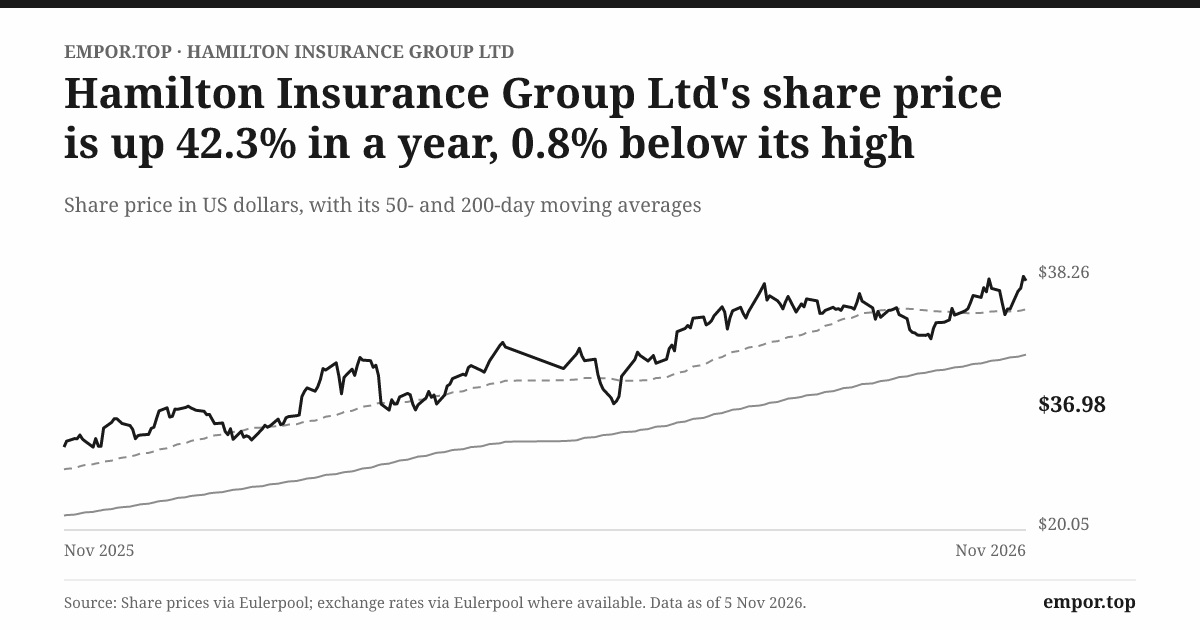
In August 2026, alongside its second-quarter results, Hamilton announced that its board had extended Pina Albo's employment through 2029.18 The timing made sense. The company had just had two record years and had paid its first dividend in March.181 By early November the shares traded near $37, close to their 52-week high.19
A contract extension expresses confidence. It does not prove anything. The useful question is what Albo's eight years in charge actually demonstrate, and what they leave unanswered.
After her long Munich Re career, Albo brought the habits of a large established reinsurer to a small company that had been losing money.5 Her early filings rarely mention growth. They repeatedly emphasize underwriting profitability.5
The team around her is relatively new in its current form. Craig Howie serves as group chief financial officer and also as group chief investment officer, which puts one person in charge of both reporting the results and overseeing the portfolio that produces most of them. That combination is efficient, but it reduces separation between those duties. Hamilton Re changed chief executives in September 2025, with Adrian Daws now running the reinsurer, and Anita Kuchma leads Hamilton Select.20 Those appointments add depth at the next level and give the board succession candidates.
They have not yet been tested through a downturn. Albo's reported compensation was about $9.0 million in 2025, compared with about $8.6 million in 2024 and $12.8 million in 2023, when she received a larger one-time equity award.20 The SEC's "compensation actually paid" figure for 2025 was about $24.8 million.20 That number is not cash. It mainly reflects the increase in value of her equity awards as the share price rose. It is the right number to understand her incentives, and it tells shareholders that her pay depends substantially on the stock price.
She also has a meaningful ownership stake. As of March 2026 she beneficially owned about 1.15 million shares, about 1.2% of all shares outstanding.20 At current prices that is a holding worth tens of millions of dollars, so her interests are aligned with shareholders' through ownership, not only through bonuses.
Shareholders were not always happy. Say-on-pay support was about 82% in 2024, a low level that usually prompts a compensation committee to contact investors.20 In 2025 support rose to more than 99%.20 The board's changes and the investor outreach appear to have resolved the objections, or the record profits did. No single vote can show which.
Ownership is spread among several large holders, and none of them has control. As of March 2026, entities affiliated with Magnitude owned about 15% of total shares, Hopkins Holdings about 9% and Sango Hoken Holdings about 9%.20 A 9.5% voting cap limits the influence of any single holder.20 The audit, compensation and nominating committees consist entirely of independent directors.20 The governance structure does not raise any obvious concerns.
Dispersed ownership also cuts both ways. With no controlling holder, no one shareholder can force management's hand. That also means no single shareholder is clearly positioned to push for renegotiating the most important contract the company has, the one with Two Sigma. That job falls to the independent directors, and the filings show no sign that they have tried.
The capital record
Capital allocation is where management's choices are easiest to see, because the actions are recorded. Hamilton's November 2023 IPO raised relatively little new money. Of the shares sold, 6.25 million were new primary shares and 10.25 million, including the overallotment, were sold by existing holders.2116 Hamilton's net proceeds were about $80.6 million.16 The IPO was mainly a way for early investors to sell, not a fundraising.
Afterward the money mostly went back to shareholders. In 2024 Hamilton bought back 9.1 million Class A shares at $12 each, a price that now looks very cheap next to a share price near $37.10 Buybacks continued in 2025 and 2026. In March 2026 the company paid a one-time special dividend of $2 per share, about $206 million in total, after not paying any dividend from 2021 through 2025.1 Including buybacks, Howie said Hamilton had returned about 9% of its beginning-of-year equity in 2026.3
The third-quarter call showed a slowdown. Hamilton repurchased only about $3 million of stock in the quarter and another $2 million after the quarter ended, bringing the year-to-date total to about $45 million, with about $134 million remaining under its authorization.3 Wells Fargo's Elyse Greenspan asked about the slower pace.3 Slowing buybacks while the stock trades near its high and reserves are being reviewed is a defensible choice. Investors should notice it either way.
Hamilton has not been making a series of acquisitions that could be judged. The 2019 Pembroke and Ironshore Europe purchase is still its only major platform deal, and its value comes from what the platform has built since, not from any purchase multiple that could be compared with peers. The available record shows no history of overpaying, but with only one significant deal, there is limited evidence either way. So what has the record shown?
It shows a team that built a multi-platform specialty group, turned around an underwriting operation that had been losing money, returned a large share of capital, and made at least two visible decisions to give up premium: leaving medical professional liability and slowing casualty reinsurance.3 Those are real achievements.
What it has not shown is behavior across a full cycle. As a public company Hamilton has existed for only three years, all in a firm or hard market. Its strongest earnings depended heavily on Two Sigma returns. And the third quarter of 2026 brought its first notable reserve pressure as a public company, after a period when management had described reserves as strong.
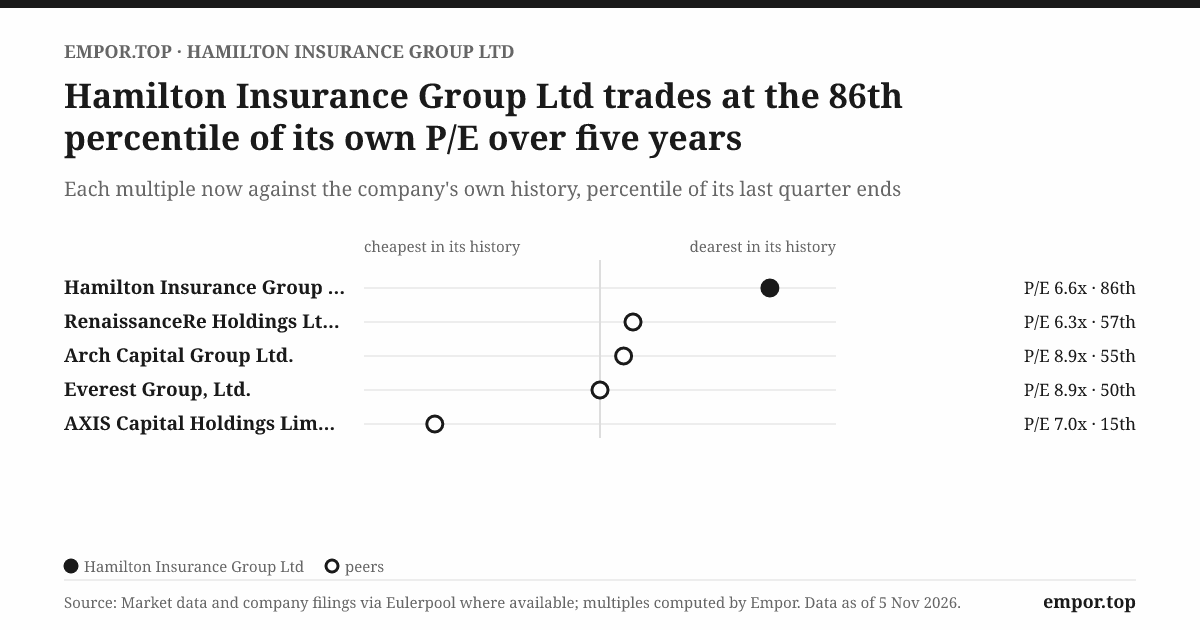
The valuation reflects that uncertainty. At about 6.6 times trailing earnings, HG trades above its own five-year median of about 5.3 times.19 It is a low multiple in absolute terms, but those earnings include investment returns no one expects to repeat every year. Arch Capital traded at about 8.0 times earnings and 1.5 times book in late October, while RenaissanceRe traded at about 6.0 times and 1.25 times book.2223 At about 1.3 times book, Hamilton is priced closer to RenaissanceRe than Arch.19 The market is not treating it as a premium franchise, but it is no longer treating it as a discounted newcomer either.
The test of management is therefore simple to state: make good on the promise to walk away from underpriced business, and do it when doing so costs premium growth. The other test concerns the past rather than the future. It is whether the premiums written in recent years were reserved correctly.
VII. The Claim Arrives After the Premium
In February 2022, Russia invaded Ukraine, and hundreds of commercial aircraft leased to Russian airlines by Western leasing companies stayed in Russia. Leasing companies filed claims against their insurers. The insurers turned to their reinsurers, and the reinsurers to their own retrocession providers. The legal disputes over who owed what took years.
Four and a half years later, Hamilton was still revising its estimate. In the third quarter of 2026, after a scheduled review of its specialty reserves, it booked about $42 million of estimated Ukraine-related losses, partly offset by favorable development elsewhere in specialty.3 On the press release's catastrophe line, prior-year Ukraine losses totaled about $47 million, almost all in the Bermuda reinsurance segment.1 Those reserve changes alone added about eight points to the quarter's loss ratio.3
Ukraine was not the only conflict affecting the book. The fighting in the Middle East added about a point of current-year losses, and Hamilton also took a loss on the Ras Laffan energy event, for which the industry loss estimate was about $1.7 billion.3 Hamilton's share was about $17 million, with about $13 million in Bermuda, or roughly four and a half points on that segment's quarter.3 Each of those is manageable. Together they show that a specialty book's risks are geopolitical as well as natural, and that wars do not follow the seasonal patterns catastrophe models are built around.
Management explained the timing as follows. Aviation reinsurance and retrocession have very long reporting lags. Information passes from airline to lessor to insurer to reinsurer to retrocessionaire, and each step adds delay. As more information came in, the estimates were updated.3 That is a reasonable explanation of how specialty reinsurance works. It also shows that the business carries uncertainty that can stay unresolved for years.
The timing mismatch
Insurance accounting rests on a basic mismatch. The insurer collects premiums at the beginning, or within months. It pays claims later, sometimes much later. In between, the balance sheet holds a reserve, which is the company's estimate of what it will eventually owe.
Some of that reserve covers claims that have been reported. A larger and more difficult portion covers claims that have happened but have not yet been reported to the insurer, known in the industry as IBNR, "incurred but not reported." Estimating IBNR means forecasting events that have already occurred but that the company does not yet know about.
Hamilton's 2025 auditor identified the valuation of IBNR reserves as a critical audit matter, meaning the area of the financial statements that required the most complex judgment.10 The audit opinion was unqualified, internal controls were judged effective, and no material weakness was reported.10 That is a clean result. A clean audit means the reserving process was reasonable when the audit was performed. It does not guarantee that the estimates will hold.
Hamilton's recent reserve history, until this year, was favorable. In 2025 it released about $64.9 million of prior-year reserves, meaning that earlier years had cost less than the company had expected.10 Releases like that are what a carefully reserving insurer typically shows. The 2026 specialty charge does not undo that record. It does show that reserve development can turn adverse, and that the most exposed lines are where Hamilton has the least information.
Other open claims remain. At September 2026 Hamilton held about $43 million of net reserves for the January 2025 California wildfires and about $12 million for the collapse of Baltimore's Francis Scott Key Bridge.2 These are insurance claims, not lawsuits against the company. Hamilton reported no material legal proceedings against it.10 But both are still developing, and each could move in either direction.
Receivables, recoverables and the missing aging schedule
The balance sheet also carries two large amounts owed to Hamilton.
The first is premiums receivable. By September 2026 Hamilton was owed about $1.2 billion of premiums, up from about $940 million at the end of 2025, with a provision for bad debts of only about $3.9 million.2 Some of that increase reflects growth. Some reflects the way reinsurance works, since many premiums are estimated from policy terms and confirmed later through reports from cedents and brokers, after the coverage period has already begun.2
The second is reinsurance recoverables, the amounts Hamilton expects to collect from its own reinsurers on claims it has paid or reserved for. At September 2026, recoverables on paid losses were about $199 million and on unpaid losses about $1.5 billion, with a total provision of about $2.1 million.2 Hamilton evaluates these using its counterparties' financial strength and the collateral they have posted.2
Taken together, Hamilton is owed about $2.9 billion, roughly equal to its total shareholders' equity of $2.9 billion at September 2026, and has provisions of about $6 million against it.32 The small provisions do not by themselves indicate a problem. Reinsurance counterparties are usually highly rated, many recoverables are collateralized, and premiums owed by brokers are seldom lost. But Hamilton does not publish an aging schedule showing how long the receivables have been outstanding, any analysis of overdue amounts, or a history of write-offs.2 Without that information, outside investors cannot check whether collections are slowing.
This is the appropriate test of balance-sheet strength for an insurer. Ratios like debtor days or free cash flow, which suit an industrial company, mislead here, because premiums arrive before claims and reserve changes affect cash flow. The figures that matter are reserves, recoverables, collateral and liquid assets.
On those measures, the balance sheet is mostly conservative. Borrowings consist of a single $150 million term loan due in June 2028, with covenants in compliance.2 In October 2026 Hamilton put in place a $330 million letter-of-credit facility to support its Lloyd's business, which provides collateral rather than borrowed money.24 Leverage is low. The uncertainty is in the estimates, not in the debt.
The information that would change this assessment is clear. Reserve development by accident year would show whether the 2023 to 2025 years are holding up. Catastrophe losses against the 6% to 7% loss ratio Howie described as the planning assumption would show whether the property book is priced correctly.3 An aging analysis of premiums and reinsurance balances would show whether the receivables are being collected. Hamilton provides some of this information and not the rest.
That brings the story back to where it began: a company whose underwriting income, investment returns and reserve estimates each tell part of the story, and which works only if all three hold up together.
VIII. Playbook: Business & Investing Lessons
Go back to the 2025 annual report. By most measures it describes a strong year. Gross premiums reached a record $2.9 billion, the combined ratio was 92.9%, underwriting income was about $149 million, and investment gains and income were about $775 million.10 Look at those last two numbers together. The insurance business made a solid profit. The investment portfolio earned about five times as much.
That relationship is where the lessons start. Hamilton's lessons are not general points about insurance. They come from the specific way this company was put together.
The first lesson comes from the Ukraine aviation charge: a premium is a promise, and the claim is what it costs to keep it. Hamilton collected premiums on aviation reinsurance and retrocession before 2022 and recognized them as earned. Then the cost of those policies arrived in pieces, through lawsuits and loss reports, for more than four years, with an adjustment still being made in the autumn of 2026.3
In long-tail and specialty lines, the profit on a policy is not known when it is booked, only when the last claim is settled. Founders building any business funded by prepayment, and investors paying for earnings that depend on reserves, should treat reported profit as an estimate until it is settled in cash.
The second lesson comes from the January renewals and the end of medical professional liability: a diversified platform helps only if management moves capacity before prices move. Hamilton was built to shift between insurance and reinsurance, and between property, casualty and specialty, according to where the best risk-adjusted prices are. Howie said as much on the call: "we are writing where we get the best risk-adjusted returns on the business."3
The flexibility is real. Its value depends entirely on timing. An insurer that cuts property after prices have already fallen, or slows casualty after a weak accident year has already been written, has the right idea too late. Hamilton's moves in 2026 came early in the softening. Whether they came early enough will only be clear in the loss ratios of 2027 and 2028.
There is a corollary for investors. A diversified insurer's premium total can stay level while the mix underneath it changes completely, and a flat total can hide a book that has moved from short-tail property into long-tail casualty. The total premium is the least informative number on the page. The mix and the price underneath it carry the information.
The third lesson is the central one: investment returns can carry the story and also obscure it. The Two Sigma fund's 16% return in 2025 helped Hamilton reach record profits.10 The incentive allocation on that return was larger than all the profit the insurance business produced.10 And in the third quarter of 2026, consolidating the fund turned $81.5 million of shareholder profit into a $228 million headline.1
Strong returns of that kind help a balance sheet and make the underlying business harder to judge, often at the same time. When a company's investment engine is much larger than its underwriting profit, investors should value the two separately, because a strong investment year can hide whether the insurance business is actually improving.
The fourth lesson comes from the founding: a business can begin in someone else's emergency. Hamilton started with the forced sale of a reinsurer whose owner had pleaded guilty to securities fraud.4 Six years later it bought its global platform from a larger competitor that was trimming overlapping operations.8 Both deals came from sellers who needed to sell for reasons that had little to do with the business itself. Distressed or unwanted assets can be good value, but only for a buyer with a clear use for them. Hamilton had one in both cases.
The fifth lesson is mainly a warning for the reader: do not turn capabilities into moat claims. Ratings, broker relationships, specialist teams and data tools are things good insurers need to compete. They become a moat only when they show up as higher retention, better pricing and lower loss ratios than peers over time. Hamilton has not yet published the retention or rate figures that would show that, and its record covers a single market cycle. The appropriate stance is to acknowledge that the capability is real and wait for the evidence of an advantage.
Those lessons establish the terms of the argument. What remains is to weigh the case for and against.
IX. Analysis & Bear vs. Bull Case
On the third-quarter call, management and analysts were in effect describing two different companies. Albo repeated the commitment to underwriting profit over premium growth and said January rates would remain adequate.3 The analysts asked about softer property rates, rising acquisition costs, the Ukraine charge and the exposed limits Hamilton would not disclose.3 Both sides were looking at the same numbers. They gave weight to different ones.
The bull case runs as follows. Hamilton is now a scaled, diversified specialty underwriter, with two segments of roughly equal size, three platforms, and a book divided across casualty, specialty and property.10 It produced a 92.9% combined ratio in 2025 and kept underwriting profitable even in a weak third quarter.101 It grew gross premiums about 15% in the first nine months of 2026 and is slowing down in the areas where pricing is weakest.13
According to the bull case, the investment portfolio adds to that base. The bond book is high quality and now yields about 5.6%.3 The Two Sigma fund has averaged double-digit returns since 2014 and has shown low correlation with markets in at least one difficult year.5 Management has returned a large amount of capital, the stock trades at about 6.6 times earnings, and book value per share plus accumulated dividends rose about 12% in the first nine months of 2026.119 For a bull, that is a profitable insurer with a valuable investment arrangement, priced like an ordinary one.
The bull would add one more point. Hamilton's recent problems are concentrated rather than widespread. They come from a single war's aviation claims, an energy loss, and a medical liability line that has already been closed. A book with problems that can be identified and removed is in better shape than one where loss costs are rising across every line.
The bear case starts from the same facts and interprets them differently. Reported earnings overstate how much profit Hamilton's underwriting can reliably produce for common shareholders. Most of the record profit came from investments, and a large part of those investment gains went to Two Sigma before shareholders received anything.10 The underwriting base itself is getting weaker: the combined ratio rose from 87.8% to 97.3% year over year in the third quarter, acquisition costs are increasing, property rates are falling, and casualty rates are not keeping up with claim inflation by management's own account.132
The reserves add to the bear's concerns. A large share of recent growth came from a casualty reinsurance book started only at the end of 2022, whose accident years are still too recent to judge.3 Specialty reserves are still moving four years after the losses began.3 Management will not disclose exposed limits.3 And roughly $2.9 billion owed to Hamilton by brokers, cedents and reinsurers is backed by a few million dollars of provisions, with no aging data disclosed.2
Then there is the fund's liquidity. Almost two-fifths of the investment base sits in a leveraged vehicle that KBRA describes as of "limited utility as a near-term liquidity source."14 If a severe catastrophe year coincided with a bad year for the fund, as happened on a smaller scale in 2020, Hamilton would face reserve increases, mark-to-market losses and limits on withdrawals all at once.5
Where the moat would have to come from
The structural analysis supports neither side cleanly.
Michael Porter's five forces give a mixed picture. Buyer power is high. The large brokers control the client relationship and send business to many insurers. In 2018, three brokers accounted for about seven-tenths of Hamilton's premiums, and the company has not since published any data showing reduced dependence.6 Cedents buying reinsurance usually spread a treaty across many reinsurers, which keeps any single one from having much leverage over price.
The threat of new entrants changes with the cycle. In hard markets, new Bermuda start-ups and third-party capital vehicles enter quickly, much as Hamilton's own predecessor did in 2012.4 Rivalry is intense and gets worse when prices fall, as they are doing in property. Substitutes exist mainly on the reinsurance side, where catastrophe bonds and other capital-markets products compete for property catastrophe risk. On the supplier side, Hamilton's most important outside supplier is arguably Two Sigma, whose fees show it has considerable bargaining power.10
Hamilton Helmer's seven powers framework is stricter. Scale economies favor much larger peers such as Arch and RenaissanceRe, which write several times Hamilton's premium.1112 Network economies do not really apply. Switching costs are low, since a cedent can move its share at the next renewal. Hamilton has no brand power with end consumers. It has no cornered resource, unless the Two Sigma relationship counts as one, and that resource takes a large share of the value it produces. Counter-positioning does not fit an insurer competing with others that have the same business model.
That leaves process power: the internal routines of underwriting, reserving and portfolio management that let a company consistently choose better risks than its competitors. Process power is the only one of the seven that Hamilton could reasonably claim. The evidence for it is a short record of improving combined ratios during a hard market. The evidence that would confirm it, meaning loss ratios that beat peers through a soft market, does not exist yet.
So the conclusion is that the moat is plausible but unproven, and it rests on underwriting process rather than any structural advantage. The test is clear. If Hamilton holds its underwriting margin as rates decline over the next two years, the process-power argument gains real support. If its combined ratio rises with the market, the claim weakens to something smaller: a competent specialty insurer that benefited from good investment returns. An activist or skeptical long-short investor would raise several issues.
The first is capital. After the special dividend and buybacks, Hamilton has given back about 9% of its beginning-of-year equity in 2026.3 That is reasonable after two record years. But rating agencies want lower reliance on Two Sigma and more liquidity outside the fund.14 The best use of capital may be keeping a larger buffer of liquid assets rather than more buybacks, so that the next hard market can be met with available capacity rather than a capital raise.
The second is disclosure. A company that consolidates a hedge fund owned in part by others should make the economics easy to follow. Hamilton reports a non-GAAP operating income of about $180 million for the third quarter, more than twice its GAAP net income for shareholders.13 The skeptic would want a simple reconciliation in every quarter: underwriting income, bond income, the fund's net contribution to common shareholders, and incentive allocations shown on their own lines.
The third is the fund agreement itself. Its initial commitment period ended in June 2026 and then rolled forward under its automatic renewal provisions.5 Every renewal is a chance to revisit the fees, the target allocation or the withdrawal terms. Nothing in the filings shows that Hamilton has reopened any of them.
Morgan Stanley's Bob Huang asked a related question on the call: whether the move toward longer-tail casualty, combined with a longer bond portfolio, would increase overall returns on equity. Howie described the trade-off. Asset duration had risen from about 3.1 to 3.2 years to 3.8 years, and he said Hamilton was "writing where we get the best risk-adjusted returns on the business."3 It is a reasonable answer. It also makes clear that Hamilton is shifting from short-tail property, where results are known quickly, toward casualty, where they are not. Whether that move adds value will depend on reserves that will not be fully tested until the end of the decade.
Three numbers to watch
Three KPIs capture almost everything that matters.
The first is the combined ratio excluding prior-year reserve development, which shows how profitable the current year's underwriting is. Management's planning assumption is an underlying loss ratio in the mid-50s plus catastrophe losses of about 6% to 7%.3 The reported nine-month 2026 combined ratio was 94.1%, after 92.9% for 2025, and it has been rising.210
The second is gross premium growth considered together with rate and exposure changes. Growth was about 15% in the first nine months of 2026.1 If growth slows while rates hold, that indicates discipline. If growth continues while rates fall, that is the warning sign.
The third is earnings to common shareholders, with the fund's net contribution and incentive allocations reported separately. Third-quarter net income to shareholders was $81.5 million, down from $136 million a year earlier.1 That is the earnings figure that belongs to HG shareholders, and it is the most important trend to follow.
On the call, management was specific about its outlook and about the reserve review, and declined to discuss aviation limits.3 The next two renewal seasons will show whether that specific guidance holds up.
X. Epilogue
As of now, Hamilton is entering January in a strong but uncertain position. Its market capitalization is about $3.8 billion, and its shares remain near their 52-week high.19 Book value per share remains about $29.80.1 The company had just reported its weakest underwriting quarter in two years, and it is heading into a renewal season where, by its own CEO's account, property prices will fall again.13
The next three or four events will settle much of the story.
The first is January 1, 2027. When Hamilton reports its first-quarter results in spring, investors will see how much property premium it actually gave up and what happened to the rates on business it kept. If property premium falls and margins hold, the commitment to walk away from business will have been met in practice for the first time at scale. If premium holds up because Hamilton accepted lower rates, the commitment will have been tested and not met.
The second is the reserves. The Ukraine aviation claims will continue to develop through courts and settlements. The California wildfire and Baltimore bridge reserves will either hold or change.2 Most importantly, the casualty reinsurance years written from 2023 to 2025 will start to mature. If those years release reserves, the growth in 2023 through 2025 was earned. If they need increases, the record was partly an artifact of reserve estimates.
The third is the fund. A year in which Two Sigma returns, say, low single digits would show Hamilton's earnings without the investment boost: underwriting income, bond income and very little else. That year will eventually come, and it will show what HG shareholders actually own. Rating agencies will be watching as well. KBRA and AM Best have both said what would change their view, and any step toward less reliance on the fund would be the clearest positive sign the balance sheet could send.1417
The fourth is how Albo's team uses capital in a softening market. Whether it holds more liquid capital or keeps buying back stock will show which risk concerns management more.
Each outcome points to a different company. In one, Hamilton holds its margins through the soft market, its reserves stay stable, and the fund adds returns instead of carrying the results. That is a disciplined specialty insurer with a unique investment advantage. In the other, the combined ratio rises with the market, reserves keep slipping and the fund has an ordinary year. That is a company whose best years depended on a hard insurance market and a strong investment market at the same time.
Hamilton has not yet experienced a soft market and a severe loss year together. Until it does, the case for and against it rests on a record that has only covered good conditions.
XI. Outro
Go back to the underwriter considering a renewal. The broker's submission is in, the deadline is near, and a price has to be set today for a risk whose real cost may not be known for five years, or longer if a war breaks out in an unexpected place.
That is the business in a sentence: underwriting risk while investing the premiums and capital held against future claims.
If Hamilton earns a durable advantage, it will show in the quality of those decisions, whether reserves prove sufficient, and whether it keeps enough liquid capital to pay claims without relying on exceptional investment returns.
References
-
Hamilton Reports 2026 Third Quarter Results — SEC Form 8-K Exhibit 99.1, 2026-10-29 ↩↩↩↩↩↩↩↩↩↩↩↩↩↩↩↩↩↩↩↩↩↩
-
Hamilton Insurance Group, Ltd. Q3 2026 Form 10-Q — FinancialFilings mirror of SEC filing, 2026-11-04 ↩↩↩↩↩↩↩↩↩↩↩↩↩↩↩
-
Hamilton Insurance Group Q3 2026 Earnings Call Transcript — StockAnalysis, 2026-10-30 ↩↩↩↩↩↩↩↩↩↩↩↩↩↩↩↩↩↩↩↩↩↩↩↩↩↩↩↩↩↩↩↩↩↩↩↩↩↩↩↩↩↩↩↩↩↩↩↩↩↩↩↩↩↩
-
SAC Re sold to investor group including Brian Duperreault and Two Sigma affiliates — Insurance Journal, 2013-12-10 ↩↩↩↩↩↩
-
Hamilton Insurance Group, Ltd. Form S-1 Registration Statement — SEC, 2023-10-16 ↩↩↩↩↩↩↩↩↩↩↩↩↩↩↩↩↩↩↩↩↩↩↩↩↩↩↩↩↩
-
Hamilton Insurance Group, Ltd. 2018 Financial Statements — Bermuda Monetary Authority, 2019-07-25 ↩↩↩↩↩
-
Duperreault appointment ties Hamilton closer to AIG — Business Insurance, 2017 ↩
-
Hamilton completes acquisition of Pembroke and Ironshore Europe; leadership announcement — Hamilton, 2019-08-20 ↩↩↩↩↩↩↩
-
Hamilton Insurance Group, Ltd. 2019 Audited Financial Statements — Bermuda Monetary Authority, 2020-07-24 ↩
-
Hamilton Insurance Group, Ltd. 2025 Annual Report and Form 10-K — SEC, 2026-02-25 ↩↩↩↩↩↩↩↩↩↩↩↩↩↩↩↩↩↩↩↩↩↩↩↩↩↩↩↩↩↩↩↩↩↩↩↩↩↩↩↩↩↩↩
-
KBRA Affirms Ratings for Hamilton Insurance Group, Ltd. and Hamilton Re, Ltd. — KBRA, 2026-06-30 ↩↩↩↩↩↩↩
-
Quarterly Results and Financial Supplements — Hamilton Investor Relations ↩
-
Hamilton Insurance Group, Ltd. 2023 Annual Report — SEC, 2024 ↩↩↩
-
AM Best Affirms Credit Ratings of Hamilton Insurance Group Members — AM Best, 2025-05-01 ↩↩
-
Hamilton Q2 2026 results and CEO employment extension — OTC Markets filing, 2026-08-06 ↩↩
-
Investor Relations Overview — Hamilton Insurance Group ↩↩↩↩↩
-
Hamilton Insurance Group, Ltd. 2026 Proxy Statement — SEC, 2026-03-24 ↩↩↩↩↩↩↩↩↩
-
Hamilton Insurance Group Announces Closing of Initial Public Offering — SEC Form 8-K Exhibit 99.2, 2023-11-14 ↩
-
Hamilton Insurance Group Letter-of-Credit Facility Amendment, Form 8-K — SEC, 2026-10-27 ↩
 LinkedIn
 WhatsApp
 Reddit
 Hacker News
 Email
 Kindle
 RSS Feed
 Spotify
 Apple Podcasts
 Amazon Music
 Audible
 YouTube