Peoples Bancorp Inc.: The Bank That Bought Its Way to the $10 Billion Line
I. The Bank at the Threshold
At the close of business on Friday, October 30, 2026, twelve bank branches in eastern Kentucky changed owners without changing their signs. Citizens Bank of Kentucky, the subsidiary of a small over-the-counter holding company called Citizens National Corporation, became a division of Peoples Bank, and its shareholders walked away with 2.10 Peoples shares and $8.00 in cash for every share they had held.1 The customers in those towns will keep banking under the old name until the following April, when the systems will finally be switched over.1 For the people behind the teller windows, it was a Friday like any other. For the company in Marietta, Ohio, that had bought them, it was the end of one deal and the beginning of a much larger wait.
The deal itself was small. Citizens brought about $646 million of assets, roughly $344 million of loans and $551 million of deposits, for a price of about $76.6 million in cash and stock.12 What made the timing interesting was what had happened a month earlier. On the morning of September 30, Peoples' president and chief executive, Tyler Wilcox, had gone on a conference call to announce that Peoples had agreed to buy Capital Bancorp, a Rockville, Maryland, bank with a credit-card business, a government-loan servicing arm and a mortgage operation, in an all-stock deal worth about $728 million.32 He called it "a transformational combination, not simply because of the additional scale."3 The Citizens closing was the warm-up act. Capital was the headliner.
The scale of that headliner is the first thing to understand about where Peoples stands tonight. At September 30, Peoples reported about $9.7 billion of total assets, which meant it sat just under the line that American bank regulation draws at $10 billion.24 On November 13 the market valued the whole company at about $1.4 billion. Capital, at the agreed price, was worth roughly half of that. When a company agrees to buy something worth half of itself, paying entirely in its own shares, the existing owners are not making a side bet. They are rewriting what they own. Management's own math says that after closing, about two-thirds of the combined company will belong to today's Peoples shareholders and about one-third to Capital's.3
So this story opens with two questions, and the rest of it tries to answer them. The first is how much of Peoples' growth comes from its own franchise, its bankers winning loans and gathering deposits in the towns it already serves, and how much comes from buying other people's franchises. The second is whether management can absorb Capital, a business unlike anything Peoples has owned before, while protecting the three things that actually determine whether a bank creates value: the quality of its loans, the stability and cost of its funding, and the returns it delivers per share rather than in total.
The long view makes the first question urgent. Over the decade from 2015 to 2025, Peoples' revenue compounded at about 15% a year and its net profit at more than 26% a year.5 Those are remarkable numbers for a bank that has been headquartered in the same Ohio River town since 1902.6 But that ten-year figure starts from an unusually weak year, and the recent record tells a quieter story. From 2022 to 2025, net profit grew by only about 1.6% a year, and diluted earnings per share actually fell, from $3.62 in 2022 to $3.01 in 2025.5 In the three most recent years, a period that included the largest acquisition Peoples had yet completed, the bank got bigger and each share earned less.
That gap is not a scandal. Earnings per share fell in part because 2022 was an unusually good year for American banks, and because a bank that issues shares to buy another bank needs time before the acquired earnings catch up with the new share count. It is, however, the central fact an investor needs to hold while listening to the Capital pitch. Peoples has shown that it can buy. The question it has not yet answered, at least not in its reported numbers, is whether buying has made each share more valuable.
Crossing $10 billion turns that question from an academic one into a practical one. Above the threshold, a bank's debit-card fees fall under a federal price cap, its supervision intensifies, and its compliance machinery has to look more like that of a regional bank than a community lender. Peoples has already told investors it expects to lose about $11 million of annual revenue from the debit-card cap alone, starting in July 2028.37 A bank that crosses the line by accident pays those costs with nothing to show for them. A bank that crosses it deliberately, by buying enough earnings to cover the toll, is making a bet that the bigger platform will earn more than the toll costs.
That is the bet at the center of this story. Peoples is at an inflection point where its next chapter depends less on how many deals it can sign than on whether it can turn a string of deals into organic growth and sustained earnings. Capital makes that test larger, more expensive to fail and more visible. To see why management believes it can pass, and why a skeptic might not, the story has to go back to the first time this small Ohio bank decided that buying was the fastest way to grow.
 Subscribe on LinkedIn
II. The Community Bank Learns to Buy
Marietta sits where the Muskingum River meets the Ohio, a brick-and-steeple town that calls itself the first permanent American settlement in the old Northwest Territory. Its headquarters have remained there since 1902.6 For most of the twentieth century it was what its name suggested: a community bank that took deposits from people in southeastern Ohio, West Virginia and Kentucky and lent them back to local businesses and homebuyers. Today the listed company, Peoples Bancorp Inc., is an Ohio financial holding company whose reported figures consolidate Peoples Bank, an insurance agency and the equipment-leasing business it bought in 2022.5 There is no parent company or controlling family behind it.5 What has changed is not its ownership. It is the size of the balance sheet.
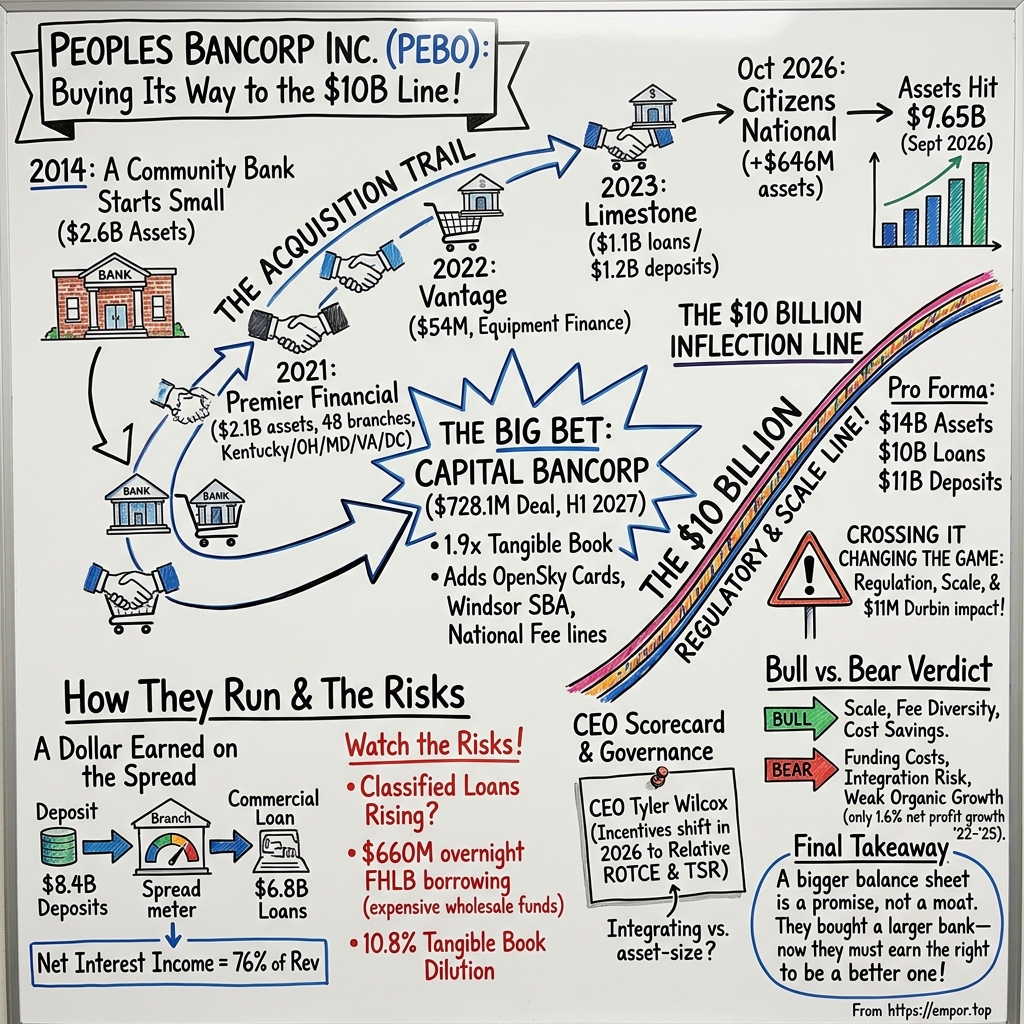
At the end of 2014, Peoples held about $2.6 billion of assets.5 By the end of 2020 the figure was about $4.8 billion, spread across 88 offices.6 By September 2026, before Citizens, it was about $9.7 billion.2 The bank nearly quadrupled in a dozen years, and the sharpest part of that climb came in a burst of acquisitions that began in the spring of 2021.
The first and largest of those early deals was Premier Financial Bancorp, a holding company based in Huntington, West Virginia. On March 29, 2021, the two companies announced an all-stock merger worth about $292 million, with Premier shareholders receiving 0.58 Peoples shares for each of theirs.6 Premier was not a small add-on. It brought about $1.9 billion of assets, $1.6 billion of deposits and 48 branches across 38 communities in five states and Washington, D.C.6 The companies said the combined company would have about $6.7 billion of assets and 136 locations, reaching from Ohio and West Virginia into Kentucky, Maryland, Virginia and the capital itself.6 Peoples promised that the deal would be immediately accretive to earnings before one-time costs, that the dilution to tangible book value would be earned back in about 2.6 years, and that the internal rate of return would exceed 20%.6
That last set of promises is worth pausing on, because it became a template. Every bank acquisition announcement in America comes wrapped in the same three numbers: how much it adds to earnings per share, how much it shrinks tangible book value per share up front, and how many years it takes for the extra earnings to refill that hole. The numbers are useful. They are also projections, made by the buyer, at the moment the buyer most wants the deal approved. Peoples would repeat the formula with Vantage, with Limestone, with Citizens and with Capital, and the useful test for an outsider is not whether the promised numbers sounded good, but whether anyone can later check them.
The man who would eventually inherit this strategy was, at the time of the Premier deal, not yet running the bank. Tyler Wilcox's path to the corner office was unusual for a banker. He started his career as an assistant city attorney in Columbus, Ohio, and joined Peoples Bank in August 2008 as associate counsel, during the worst month in modern American banking.8 He then moved into human resources, became director of compensation and benefits, then head of HR, and from 2015 ran Peoples Insurance Agency before becoming regional president for the bank's southern region in 2019.8 He went on to serve as chief operating officer and in April 2024 became president and chief executive of both the holding company and the bank.8 He was 47 at the time of the 2026 proxy.8 A lawyer who learned the bank through its people, its pay plans and its insurance agency before he ever ran its lending is a particular kind of CEO: one who knows how institutions are stitched together, which matters a great deal when the job is stitching together acquired ones.
The second deal showed a different kind of ambition. In February 2022, Peoples Bank agreed to buy Vantage Financial, an equipment-leasing company based in Excelsior, Minnesota, for $54 million in cash, plus the repayment of about $21 million of Vantage's recourse debt.9 Vantage, founded in 2011, leased business-essential equipment, mostly information-technology gear, to middle-market companies across the country, with an average deal of about $260,000 and around $147 million of lease assets at the end of 2021.9 Its originations had grown about 25% a year from 2016 to 2021.9 For a bank whose loans had mostly been made within driving distance of a branch, this was a national lending business bought off the shelf. Management projected that Vantage would add about 3% to 2022 earnings per share and more than 6% to 2023, mostly because Peoples could fund Vantage's leases with cheap bank deposits instead of the more expensive debt Vantage had been using.9
That funding logic is the cleanest piece of acquisition economics in the Peoples story, and it will come back when Capital arrives. A specialty lender that borrows at wholesale rates is worth more inside a bank that can fund it with checking and savings accounts, because the same loan suddenly earns a wider spread. The problem is that, once the deal closed, Vantage disappeared into the consolidated numbers. Peoples reports one operating segment, community banking, and does not disclose Vantage's separate earnings.5 The 6% accretion promise for 2023 may well have been met. An outside investor cannot tell. What can be seen is that the business still carries some of its own wholesale funding: at September 30, 2026, Peoples reported about $42 million of Vantage non-recourse debt among its borrowings.2 And when management talked about leasing in October, the tone was measured rather than euphoric. Wilcox expected the small-ticket leasing book, about $100 million, to grow in 2027, mostly in the second half, but said "it's not going to grow at double digits."7 The national lending platform bought in 2022 is a useful contributor, in other words, not a rocket.
The third deal was the largest test of integration. Peoples closed its acquisition of Limestone Bancorp, a Louisville, Kentucky, bank, in April 2023, for an announced value of about $177.9 million.5 Limestone added a loan portfolio of about $1.1 billion and about $1.2 billion of deposits.5 It also brought a bill. Peoples recorded about $17 million of acquisition-related expenses in 2023, with a small tail of about $0.2 million in 2024.5 That is the price of combining systems, severing contracts and paying people to leave, and it is the price an investor should expect to see again, at a larger scale, with Capital.
Limestone is also where the accounting begins to shape the story. When a bank buys loans, it marks them to fair value on the day of purchase, usually at a discount. As those loans pay down, the discount flows back into income as "accretion," a bonus that raises the reported margin without any new lending. In the fourth quarter of 2024, this purchase-accounting income added about 23 basis points to Peoples' net interest margin; a year later, it added about 8.5 The fading of that bonus is one reason 2025 earnings fell, and one reason it is hard to tell how much of the acquired banks' profit was durable and how much was a one-time gift of accounting.
Then came the 2026 sequence. Citizens was announced on April 21, 2026, and closed in October.1 Capital was announced on September 30.3 By that point, Peoples had added or agreed to add five banking and lending businesses in a little over five years.
Put the record together and the verdict is clear in one direction and murky in another. Acquisitions plainly expanded Peoples' reach: new states, a national leasing platform, a bigger deposit base and a larger branch network. They explain most of the jump in scale since 2020. But because Peoples reports a single segment and does not break out acquired versus organic loan and deposit growth over time, the filings do not cleanly answer whether each deal earned its cost of capital. That evidence problem will recur in every section that follows, and it is why the next question is not "how big did Peoples get?" but "what does a dollar actually earn once it is inside this bank?"
III. A Dollar Earned on the Spread
Follow one dollar. A retired schoolteacher in Athens, Ohio, deposits her monthly pension check into a Peoples savings account. The bank pays her a modest rate. That same afternoon, a loan officer two counties away approves a line of credit for a family-owned building-supply business that needs to stock up before spring construction season. The schoolteacher's dollar, pooled with thousands of others, funds part of that line. The bank charges the business more than it pays the schoolteacher, and the difference, after the cost of running branches and the occasional loan that goes bad, is what eventually reaches a Peoples shareholder.
That difference is called the spread, and it is the core of this business. In 2025, net interest income, the interest earned on loans and securities minus the interest paid on deposits and borrowings, made up about 76% of Peoples' revenue.5 Non-interest income, the fees, made up about 23.6%, up from about 21.7% two years earlier.5 In the third quarter of 2026, fees reached about a quarter of revenue.7 At September 30, the bank held about $6.8 billion of loans and about $7.4 billion of deposits, which meant it was lending out roughly 92 cents of every deposit dollar.47
The useful way to think about a bank like this is as a small factory with four dials. The first dial is the yield on what it lends and invests. The second is the cost of what it borrows, mostly deposits. The third is how much of its lending goes bad. The fourth is how much it costs to run the operation. Turn any dial the wrong way and shareholders feel it. The rest of this story is, in one form or another, about which of those dials Peoples controls and which ones control Peoples.
The fee businesses deserve a place in proportion. Peoples earns money from trust and investment management, from its insurance agency, from insurance premium finance, from Vantage's equipment leases and from ordinary deposit-account and card fees.5 These lines broaden the revenue base and give the bank more products to sell each customer. Insurance commissions are less exposed to interest rates than loans are. Leasing earns higher yields than a typical commercial loan. But because Peoples reports one operating segment, it does not disclose separate profit for any of these businesses.5 They are real, and they matter, but no outsider can rank them by return.
Capital's businesses belong in this picture only as a future addition, and it is worth saying clearly what they are, because they will change the shape of the company if the deal closes. OpenSky is a national credit-card platform that issues secured and unsecured cards, originated and serviced digitally, often to customers building or rebuilding credit.3 Windsor Advantage provides outsourced servicing for Small Business Administration and Department of Agriculture loans to other community banks and credit unions.3 Capital Home Loans originates residential mortgages, mostly for sale to the secondary market, and Capital also runs a government-guaranteed lending platform with expertise in solar and renewable energy.3 These are national fee and lending lines of a kind Peoples has never run at scale. They are not yet Peoples' growth engine; they are Capital's, and their promise will have to be proven under new ownership.
Now set the competitive field. Peoples, close to the $10 billion line, is a mid-sized player in a crowded American regional banking market. WesBanco, a West Virginia neighbor, became a bank of roughly $27 billion of assets when it agreed to buy Premier Financial Corp. of Defiance, Ohio, in 2024.10 Large regional and national banks with far bigger technology budgets operate across Peoples' footprint, and credit unions, online banks and nonbank lenders compete for the same deposits and borrowers. Peoples does not disclose any customer concentration in revenue, and it does not publish a local deposit market-share series that would show it gaining or losing ground town by town.5
Run that field through Michael Porter's five forces, and the evidence points in a consistent direction. Depositors have real bargaining power: they can move money to a higher-rate account at the click of a button, and the 2023 regional-bank scare taught every banker how fast that can happen. Borrowers, especially good commercial borrowers, can shop their loans among several lenders. Substitutes are everywhere, from money-market funds that compete for savings to private-credit funds that compete for loans. Large banks enjoy scale in technology and compliance spending that a $10 billion bank cannot match. On the other side, regulation is a real barrier to new entrants, because chartering a new bank is slow and expensive, and local relationship networks give incumbents an edge in small-business lending where knowing the borrower matters. The filings, however, do not show customers locked in, and they do not show Peoples consistently charging more than rivals for the same product.
Peoples' own spending gives one clue to how hard it is working to stay competitive. Its data-processing and software expense rose from about $21.6 million in 2023 to about $29.1 million in 2025, while full-time-equivalent headcount was broadly stable at around 1,450 to 1,480 people.5 That is a bank spending more on systems without adding staff, which suggests it is trying to keep pace technologically rather than harvesting the franchise. Whether that spending produces better productivity is not something the company quantifies.
Concentration risk, for a bank, lives in its loan book and its funding rather than in a few big customers. At September 30, 2026, Peoples held about $2.3 billion of commercial real estate loans, and no single industry outside a broad "other" category made up more than 2% of total exposure.2 At the end of 2025, about $2.0 billion of deposits were uninsured, of which about $616 million were backed by securities the bank had pledged.5 By the third quarter of 2026, uninsured deposits were about 27% of the total.7 That is a moderate level, neither alarming nor trivially safe, and it is a reminder that the schoolteacher's savings account is not the only kind of dollar on this balance sheet.
The honest verdict on Peoples' competitive position, then, is narrower than the word "moat" would suggest. The core is a relationship-oriented community and commercial bank with a wider-than-average set of fee businesses for its size. Scale, local relationships and product breadth plausibly help it win customers. "Relationship banking" is a reasonable description of how Peoples positions itself, but it is a positioning, not proven pricing power. The evidence that would turn it into a moat is specific: deposit costs that stay below peers through a rate cycle, steady organic loan growth without buying it, customer retention data and efficiency that beats similar banks. Some of that evidence exists in pieces. None of it is yet decisive, and the clearest test of a deposit franchise is what happens when deposits get expensive.
IV. When the Deposit Dollar Gets Expensive
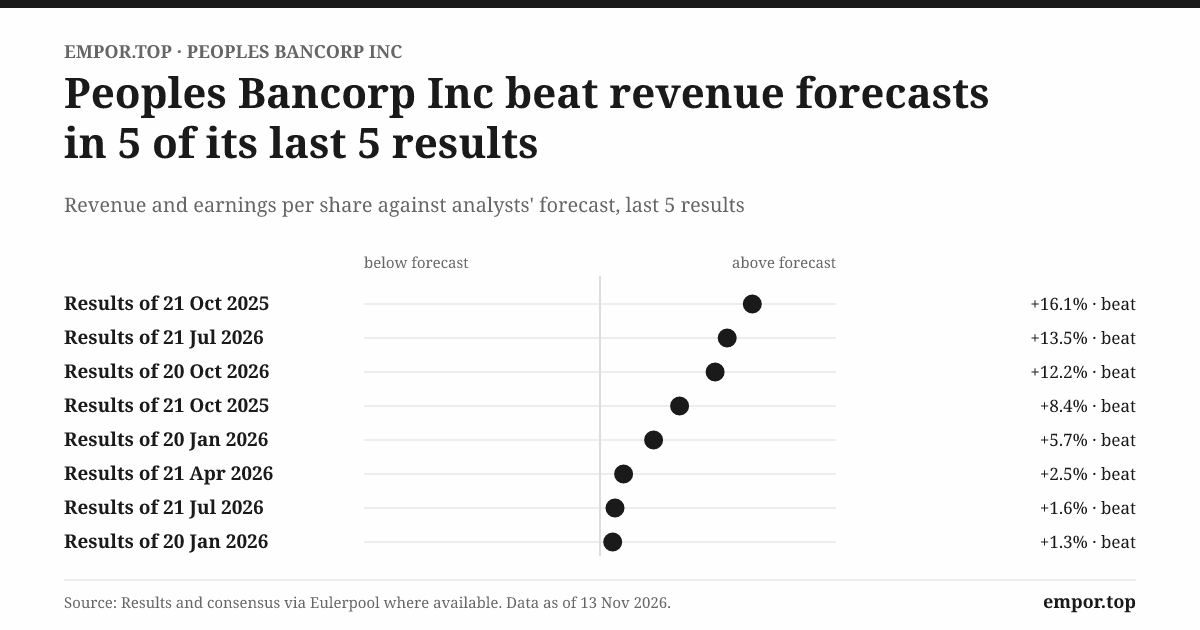
On the morning of October 20, 2026, Peoples' chief financial officer, Katie Bailey, walked analysts through what looked, on its face, like a good quarter. Net income was $32.6 million, up from about $29.5 million a year earlier, and diluted earnings per share were $0.91.74 Excluding a securities loss and deal costs, management put adjusted earnings at $1.04 a share, ahead of what analysts had expected.7 Net interest margin, the spread a bank earns on its earning assets, rose to 4.31%, up 8 basis points from the second quarter and 15 basis points from a year earlier.7 Inside the balance sheet, though, one line had grown quietly: Peoples was borrowing $660 million overnight from the Federal Home Loan Bank.2
To see why both facts matter, start with the trough. 2025 was a bad year by Peoples' recent standards. Net profit fell about 9.4%, to about $106.8 million, and the operating margin slipped from about 24.3% in 2024 to about 21.8%.5 Two forces did most of the damage. Loan-loss provisions climbed to about $42.2 million in 2025, from about $15.2 million in 2023, as the bank set aside more money for loans that might go bad.5 The purchase-accounting bonus from earlier deals was also fading.5 When a bank's profits fall because the accounting gift runs out, it is not a disaster. It is, however, a reminder that some of the earlier growth was borrowed from the future.
By the third quarter of 2026, the recovery was real. Operating profit and net profit were both higher than a year earlier, and the margin had climbed because the bank was paying less for money.4 Interest expense on deposits was about $19 million lower over the first nine months of 2026 than over the same period of 2025.7 Purchase-accounting accretion had shrunk to about 4 basis points of margin.7 That distinction is the important one. A margin that improves because funding costs fall is the kind of improvement that can persist, at least until rates or competition change. A margin propped up by accretion is the kind that fades on schedule. In the third quarter, most of the improvement was the first kind.
The credit picture was mixed in a way that rewards careful reading. Nonaccrual loans, loans on which the bank has stopped booking interest because it doubts it will be paid, were about 0.42% of total loans, and the allowance for credit losses covered those nonaccruals about 2.7 times over.4 Net charge-offs, the losses actually written off, ran at an annualized 0.35%, below the 0.41% of a year earlier.7 Ninety-nine percent of loans were current.7 Those are healthy numbers. But underneath them, classified loans, the bank's own label for loans with well-defined weaknesses, rose by about $30.1 million in the quarter, an increase of about 21%, to 2.50% of loans.7 Criticized loans, a broader watch-list category, fell by about $17.7 million.7 Wilcox attributed the classified increase to three downgrades, two commercial real estate relationships and one commercial and industrial loan, and said the bank expected to exit them with "minimal losses."7 That may prove right. It is also what bankers usually say about downgrades before they know the answer.
The funding story is where a skeptic would focus. At the end of 2025, Peoples had about $435.9 million of short-term borrowings. By September 30, 2026, that figure was about $704.1 million, while long-term borrowings had fallen from about $204.1 million to about $155.1 million.2 The overnight Federal Home Loan Bank line accounted for $660 million of the short-term total.2 Over the same quarter, average deposits fell by about $65.7 million, and non-interest-bearing deposits, the free money every bank prizes, fell by about $33.6 million.7 Loans grew by only about $19 million, roughly 1% annualized.7
Here is why that shift matters to a listener who does not run a treasury desk. A Federal Home Loan Bank advance is a perfectly normal tool; banks of every size use it. But an overnight advance reprices every day. If short-term rates rise, the cost rises with them immediately, and if the bank ever needs to replace that funding, it has to find deposits or other borrowing at whatever the market charges that week. Long-term borrowing locks in a cost. Overnight borrowing rents it. Peoples has, at the margin, swapped the first for the second. That makes the bank's margin more sensitive to rate moves and to deposit competition, and it means the 4.31% margin is partly built on funding that could cost more tomorrow.
Management's own guidance shows how much depends on the rate path. In the October call, Bailey guided to a 2027 net interest margin of 4.3% to 4.5%, excluding Capital, and the forecast assumed the Federal Reserve would raise rates by a quarter point late in 2026 and twice more in 2027.7 She said each quarter-point increase now adds about 5 basis points to the margin, down from 6 to 8 basis points a quarter earlier, and described the bank as "relatively neutral to slightly asset sensitive."7 That is a reasonable position for a bank to be in. It is also a forecast built on someone else's decisions.
The analysts on the call pressed on exactly these points, and their questions were more revealing than the prepared remarks. A Raymond James analyst asked about deposit betas, the share of each rate change a bank passes on to depositors; Bailey put non-maturity deposit betas at about 30%.7 A KBW analyst asked about deposit pricing, and Bailey's answer was candid: "we're starting to see some more competition in the market for deposits," with pressure expected to continue, especially in retail certificates of deposit.7 Hovde's analyst asked whether more securities would be sold at a loss; Bailey said Peoples "might take another two to $3 million loss in the fourth quarter."7 Those losses come from selling low-yielding bonds bought when rates were near zero, about $135 million in the second quarter at an $8.2 million loss and about $58.5 million in the third at a $4.5 million loss, and they are the bill for an old mistake common to nearly every American bank: buying long bonds at the bottom of the rate cycle.7
On loan growth, the answers were sobering. Wilcox called the third quarter the bank's "third highest quarter ever of commercial production," but commercial payoffs topped $160 million in the quarter, so most of the new lending simply replaced loans that left.7 He described commercial real estate growth as "a bit of running on a treadmill."7 For 2027, excluding Capital, management guided to loan growth of 3% to 5%.7 That is respectable for a community bank and not the profile of a growth story.
The same rate path that helps the margin hurts another part of the balance sheet. Peoples holds a large securities portfolio, about $1.76 billion at September 30, mostly government, agency and mortgage-backed bonds, plus about $301 million of cash.2 When rates rise, the market value of older, lower-yielding bonds falls, and for the available-for-sale portion that loss runs straight through shareholders' equity even though no bond has defaulted. At the end of 2025, the available-for-sale book carried a net unrealized loss of about $92.6 million.5 In the third quarter, Bailey noted that regulatory capital ratios improved while the tangible equity ratio slipped because of those larger bond losses, and tangible book value per share edged down from $23.56 to $23.35 even in a quarter of rising profit.74 It is a quiet illustration of the double edge in a rising-rate forecast: the income statement gains, the balance sheet gives some of it back, and the bank's tangible book, the very yardstick by which the Capital deal will be judged, moves with the bond market.
There is one more exposure that does not appear among the loans. At the end of 2025, Peoples had about $1.42 billion of unused loan commitments and about $7.0 million of standby letters of credit.5 These are promises to lend, ordinary for a commercial bank, but in a downturn, borrowers tend to draw on credit lines precisely when the bank would rather they did not. They are contingent credit and funding exposure, not idle paperwork.
So the funding cycle leaves an unfinished verdict. Earnings recovered from the 2025 trough because funding costs eased, and reported nonaccruals stayed modest. But the bank leaned harder on overnight wholesale funding, deposits shrank slightly, classified loans jumped and management itself warned of tougher deposit competition. The spread is back. Whether it is durable depends on the deposit base, and that is the same deposit base Peoples is now asking to fund a national credit-card and specialty-lending platform.
V. The $728 Million Bet on Capital Bancorp
The call began at ten o'clock on the morning of September 30, 2026.3 Wilcox and Bailey had a script, a slide deck and a merger agreement signed the day before.11 The terms were simple to state: Capital shareholders would receive 1.11 Peoples shares for each Capital share, in a fixed exchange, with no cash beyond fractional shares.113 Based on Peoples' average stock price over the prior twenty trading days, the deal was worth about $728 million.3 Capital put the implied value at $43.75 a share, about a 22.7% premium to its closing price the day before the announcement.12 Then Wilcox did what every acquiring CEO does on such a morning. He explained why this one was different.
It was different, and not only in size. Peoples' earlier bank deals, Premier, Limestone and Citizens, were variations on a theme: buy a community bank in or near your footprint, combine the branches, cut overlapping costs and gather more deposits. Capital is something else. At its center is Capital Bank, a relationship-based commercial bank serving the Washington, D.C., metro area. Around it sit the specialty businesses described earlier, including OpenSky, Windsor Advantage, Capital Home Loans and the government-guaranteed lending platform.3 Capital also gathers deposits through four national specialty verticals, whose recent cost, Wilcox said, was about 2.28%.3 This is a bank that has grown its assets, loans and deposits by about 20% a year over three years, and whose trailing return on average assets was about 1.58%, with a return on tangible common equity of about 16%.3 Those are the returns of a high-performing bank, comfortably above Peoples' own.
At September 30, Capital itself had about $3.8 billion of assets, about $3.1 billion of loans and about $3.3 billion of deposits.12 Put that next to Peoples plus Citizens and the combined company becomes, in management's numbers, a bank of about $14 billion of assets, $10 billion of loans and $11 billion of deposits, with fee income at about 23% of revenue.3 Management expects the combined bank's margin to run around 5% once Capital is fully in the numbers, though Bailey cautioned on the October call that the full-year 2027 margin would not reach that level.7 Much of that higher margin reflects OpenSky's card yields and Capital's specialty lending, and it comes with higher credit losses by design.
The $10 billion threshold is where the strategic case becomes concrete. Above that size, the Durbin Amendment caps the interchange fee a bank can charge merchants on debit-card transactions. Peoples already expects the rule to cost about $11 million of annual revenue beginning in July 2028.37 Capital, Wilcox said, brings "very little incremental debit card exposure."3 Management's argument is that Peoples was going to cross the line eventually, and that it is better to cross it with a bigger, more profitable engine than to stumble over it. On the call, Hovde's analyst asked whether the Durbin hit was included in the 19% accretion figure; Bailey said yes.3 That is a fair point in the deal's favor: the most predictable cost of crossing the threshold is already in the model.
Now to the price, which is where the debate lives. Capital put the implied value at 1.9 times its tangible book value per share and 12.9 times its last-twelve-month diluted earnings through June 2026.12 Those two multiples tell very different stories. Tangible book value is, roughly, what the bank's shareholders own after removing goodwill and other intangibles. Paying 1.9 times that means paying almost twice what the equity is worth on paper. By that yardstick, the deal is expensive: the median price-to-tangible-book across American whole-bank acquisitions in 2025 was about 1.43 times.13 By the earnings yardstick, it looks ordinary. The 2025 median price-to-earnings multiple was about 15.1 times, higher than what Peoples agreed to pay.13
A neighboring deal sharpens the comparison, and it comes with a confusing coincidence of names. In July 2024, WesBanco agreed to buy Premier Financial Corp., an Ohio bank based in Defiance, which has nothing to do with the West Virginia Premier that Peoples bought in 2021. WesBanco paid about 142% of tangible book value, or 1.42 times, and 12.9 times analysts' estimated 2024 earnings.10 So Capital and WesBanco's Premier sold for the same earnings multiple, though one used trailing earnings and the other forward estimates, while Capital commanded a far higher price relative to its book. The explanation is not mysterious. Capital earns much more on each dollar of its equity, so its earnings are worth more relative to book. A bank with a 16% return on tangible equity deserves a higher price-to-book than one earning 10%.
The limits of that comparison deserve one honest sentence. Deal mix, growth, asset quality and accounting assumptions differ from one transaction to the next, and a credit-card business does not carry the same risk as a branch network. The evidence supports "a premium on book, more ordinary on earnings," not a definitive verdict that Peoples overpaid. If Capital's earnings hold, the price looks defensible. If its earnings slip, the tangible-book premium becomes the number that matters, because it is the part of the price that does not shrink when profits do.
And Capital's earnings did slip in the quarter after the announcement. Its third-quarter net income was about $13.1 million, down about 12.9% from a year earlier.12 OpenSky's card accounts fell to about 576,000, down about 2% from a year earlier, and its quarterly net charge-offs rose to about $3.2 million from $2.9 million in the second quarter.12 One quarter does not make a trend. But the earnings multiple that makes this deal look reasonable was calculated on trailing results through June, and the quarter since then moved the wrong way.
Against the price, management set out its promised returns. The deal, Bailey said, would add about 19% to Peoples' fully phased-in 2027 earnings per share, dilute tangible book value per share by about 10.8% at closing, and earn that dilution back in less than three years, with a modeled internal rate of return above 25%.3 The cost savings assumption was about 30% of Capital's non-interest expense, with about 70% realized in 2027 and the rest in 2028.3 Revenue synergies, the cross-selling of Capital's products to Peoples' customers and vice versa, were "not modeled."3 Wilcox was emphatic on that point: "Notably, none of these revenue opportunities are reflected in our modeling assumptions."3
Those assumptions are disciplined in one way and aggressive in another. Leaving revenue synergies out of the model is the conservative choice; it means the deal must pay for itself through cost cuts and Capital's existing earnings. But 30% of Capital's cost base is a large cut for a deal with little branch overlap, and Wilcox's answer when Hovde asked where the savings would come from was general: corporate overlap, technology and data processing, and key vendors.3 He added that Peoples has "historically always hit" its cost-saving estimates.3 Because Peoples does not publish deal-by-deal savings realized against target, that claim is a management statement, not an audited record.
The plan also embeds its own risk budget. Peoples assumed a 3% gross credit mark on Capital's loan portfolio, meaning it expects to write down the loans by that amount at closing to reflect future losses.3 It estimated about $56.5 million of pre-tax transaction expenses.3 And it expected pro forma common equity tier one capital, the core regulatory cushion, of about 11.9%.3 A 3% mark is substantial for a commercial bank and modest for a credit-card book, which is exactly why the mix matters. OpenSky is small, about $150 million of loans against roughly $10 billion of combined loans, but its losses run far higher than ordinary commercial lending.3 Capital's company-wide net charge-offs were about 0.49% of loans, annualized, in the third quarter, compared with about 0.35% at Peoples.127 On the October call, Bailey sketched what that difference does to reserves: Peoples' allowance, about 1.11% of loans, could drift toward roughly 1.2% with Capital on board, and toward about 1.7% if Capital's individually analyzed loans are counted.7 Higher reserves are not a sign of trouble in themselves. They are the price of owning a business that lends at higher yields to riskier borrowers, and they make the 3% mark the first line of defense rather than a comfortable cushion.
The analyst Q&A on that September morning showed where the market's worries lay. KBW asked which specialty businesses would be the growth priority and about OpenSky's charge-offs. Wilcox described OpenSky as having "hundreds of thousands of clients with very small balances," said its risk-adjusted returns were in a "20 percent range," and acknowledged that Capital's net charge-offs had run "a little bit higher relative to peers" by design.3 He did not give OpenSky loss rates on the call. Raymond James asked whether Capital's 20% growth would continue, and Wilcox said combined growth would be lower and that the model used forward consensus estimates.3 Asked about Capital CEO Ed Berry's role after the deal, Wilcox said Berry was "committed to making the transaction a success today and beyond" and that they would talk about it "in the future."3 Asked about capital priorities, Bailey said the dividend was being "right size[d]" toward the lower end of its guided range, with buybacks to follow opportunistically.3
What the call did not offer was a set of measurable integration milestones beyond the timeline. Management said it expected to close in the first half of 2027 and, in response to a Brean Capital question, put systems conversion in "late third quarter, early fourth quarter of next year."3 Three Capital directors will join the Peoples board, and the key heads of the specialty units are expected to stay.113 Those are reasonable commitments. They are also the kind that are easy to make and hard to check from outside. The merger agreement adds a few harder edges: Capital's directors and executive officers signed agreements to vote for the deal, and Capital would owe Peoples a termination fee of about $30.7 million if it walked away under specified circumstances.11 Three weeks later, on the third-quarter call, Wilcox went further than he had in September, saying Capital's "historically higher growth rates than ours are something that we can perpetuate," and, asked whether Capital's growth would dip after closing, "I don't anticipate any kind of trough."7 Those are confident words about a business whose third-quarter numbers had just softened, and they set a public bar against which the first combined quarters can be measured.
The verdict on Capital, then, is that the price is high against book and not obviously high against earnings, and that the deal's return depends on three things management controls only partly: realizing a large cost cut, keeping acquired credit within the mark, and retaining the people who run businesses Peoples has never run. The specialty businesses are consequential because of their scale and profitability inside Capital. Their promise inside Peoples, the cross-selling and the deposit funding that Wilcox described, remains upside that is not in the model. Which raises the next question: what does the CEO asking shareholders to make this bet stand to gain or lose personally if it works or fails?
VI. The CEO's Scorecard Meets the Shareholder's
Every spring, a bank's board publishes a document that reads like a report card for its executives. In Peoples' 2026 proxy statement, published in March, the board graded 2025, and the grades were mediocre. Pre-tax, pre-provision return on assets came in at 1.94% against a target of 1.97%. The efficiency ratio, the share of revenue consumed by operating costs, was about 58.7% against a target of about 57.9%, a miss in the wrong direction. Pre-tax, pre-provision earnings per share were $5.17 against a target of $5.30. Net charge-offs were 0.45% of loans against a target of 0.34%.8 On every one of the four corporate goals, Peoples fell short of target.
And yet the CEO's pay went up. Wilcox's total compensation in the summary table was about $1.50 million for 2025, compared with about $1.19 million in total direct compensation for 2024, while net income fell from about $117.2 million to about $106.8 million.85 On its face, that is the kind of juxtaposition that makes governance critics sharpen their pencils.
The context matters, and it cuts both ways. 2025 was Wilcox's first full calendar year as chief executive, after taking the role in April 2024, so part of the increase reflects a full year at a CEO's salary.8 His base salary was $700,000.8 His annual cash incentive paid out at about 59.5% of salary against a target of 65%, and his long-term equity award came in at about 50.6% of salary against a target of 65%; both pools paid between threshold and target.8 In other words, the incentive system did what it was designed to do: it paid less than target because results fell short of target. Rising pay alongside falling profit merits scrutiny, but the plan's below-target payouts mean the comparison alone does not establish a governance failure.
The more interesting question is what the plan rewards. Annual goals are built on pre-tax, pre-provision returns, efficiency, earnings per share, net charge-offs and individual performance.8 Those are sensible operating metrics, but several of them grow naturally when a bank gets bigger, and none of them directly measures whether an acquisition earned back its dilution. For 2026, the board redesigned the long-term program. Half of the target award is now performance-based, tied to Peoples' return on tangible common equity and total shareholder return over three years, measured against other banks; the other half vests with time.8 Wilcox's target long-term opportunity rose to 75% of salary, and his salary rose to $735,000 for 2026.8
That redesign is a meaningful improvement, at least on paper. Return on tangible common equity is the metric that captures acquisition discipline best, because overpaying for a bank creates goodwill that does not count in tangible equity but does depress the return on it once earnings disappoint. Relative shareholder return punishes management if peers do better. The forward test is whether these incentives reward per-share returns and integration outcomes rather than balance-sheet growth alone. The 2026 plan points in that direction. Its first measurement period will not end until 2028, after Capital closes, which means the integration will be graded by the new scorecard.
Ownership is the other half of alignment. As of February 2026, Wilcox held 67,850 Peoples shares, less than 1% of the company, a stake worth about $2.6 million at the November 13 share price, a substantial portion of which consisted of unvested restricted stock.8 That is a meaningful sum for an individual and a modest one relative to the company's $1.4 billion market value and its $728 million agreement to acquire Capital. He has skin in the game, but not enough that his personal fortune rises and falls with the deal the way an owner-operator's would.
The shareholder base offers less of a check than it might. The proxy lists three holders above 5%: BlackRock at about 7.9%, Dimensional Fund Advisors at about 6.7% and Vanguard at about 5.3%.8 All three are index-oriented or systematic managers, not concentrated activists, and the proxy notes that the figures rely on Schedule 13G filings from 2023, so the current stakes may have changed.8 There is no controlling holder, no founding family and no concentrated value investor whose public filings would signal confidence or concern.
Shareholders did vote, and they approved. At the April 2026 annual meeting, the say-on-pay resolution received about 20.9 million votes in favor, about 415,000 against and about 120,000 abstentions.14 That is roughly 98% support among votes cast, a strong endorsement by any standard. But strong say-on-pay support says that shareholders accepted how executives were paid for 2025. It says nothing about whether the next $728 million acquisition will create value, and the Capital deal will need its own shareholder approval.
The capital-allocation record gives a partial answer. Acquisitions expanded the franchise, as the deal sequence made plain. But Peoples does not disclose deal-level profitability, and the provision line rose from about $15.2 million in 2023 to about $42.2 million in 2025, a reminder that a bigger loan book brings bigger credit costs.5 Return on equity, which was about 12.9% in 2022, was about 8.8% in 2025 and about 9.9% over the twelve months to September 2026.5 Dividends paid rose from about $42 million in 2022 to about $58 million in 2025, and the payout ratio climbed to about 55% of earnings.5 Shareholders have been paid steadily. They have not been paid more per share of earning power.
There is one clean signal in the record. For 2025, the auditor issued unqualified opinions on both the financial statements and the bank's internal control over financial reporting, with no material weakness reported.155 Management also told shareholders that no pending or threatened legal proceedings were expected to have a material adverse effect.5 Those are bounded assurances, covering one year's books and one year's controls, but they mean the numbers this story relies on have passed the basic test. Directors, officers and their affiliates had about $3.3 million of loans from the bank at year-end, none past due, which is ordinary for a community bank.5
Put together, the CEO's scorecard and the shareholder's do not yet line up perfectly. The incentives include earnings, efficiency and credit, and the 2026 plan adds relative returns, which is the right direction. Wilcox's shareholding is modest, pay rose while profits fell, and the system that measures him does not yet directly score the acquisitions he is making. That makes the bull and bear debate over Peoples less about whether management is trustworthy in some general sense, and more about whether its specific bets can be checked against specific numbers.
VII. Analysis & Bear vs. Bull Case
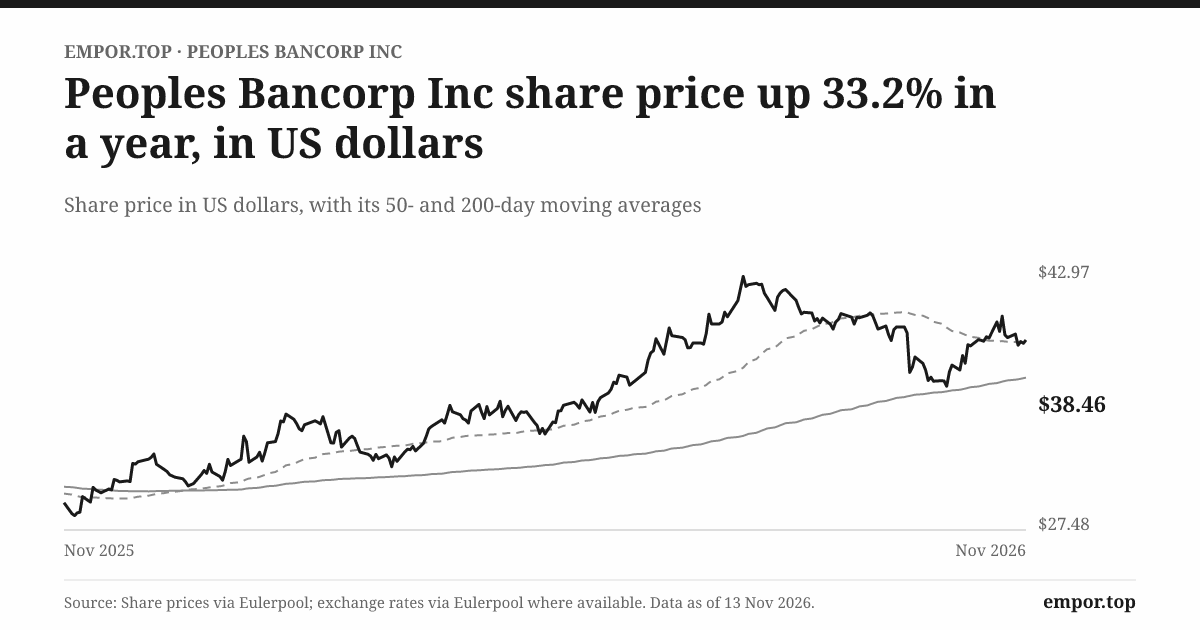
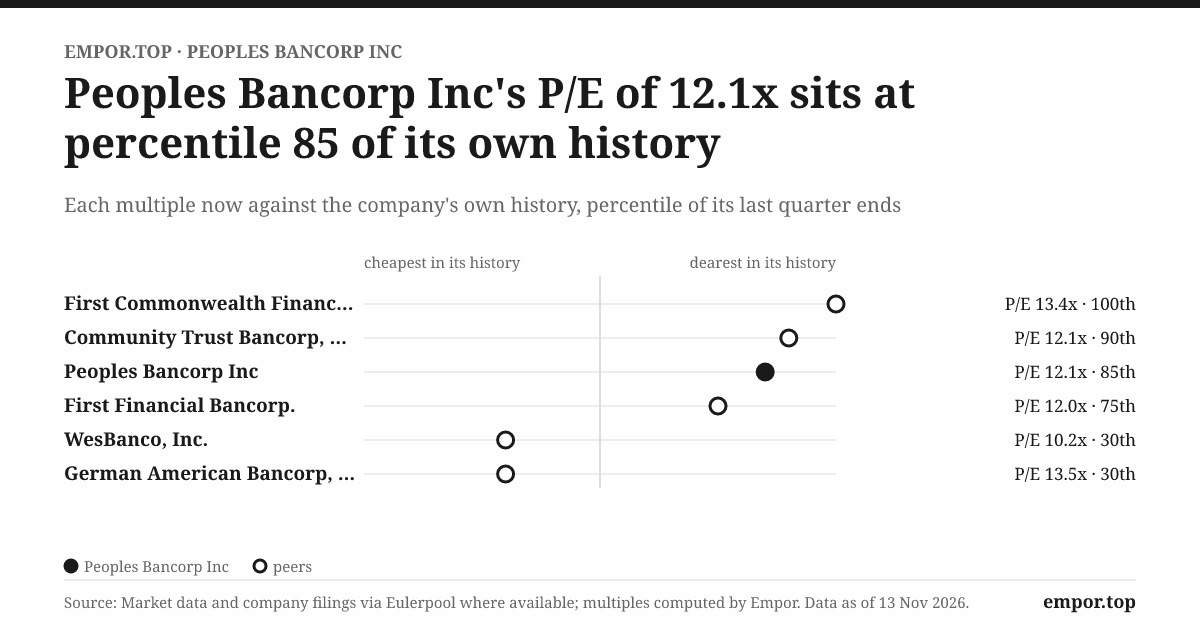
On November 13, 2026, Peoples' stock closed at $38.46, about 9% below its 52-week high of $42.14 and well above its low of $28.31. The market valued the company at about $1.4 billion, or about 12.1 times trailing earnings, against a five-year median of about 10.4 times. The shares traded at about 1.2 times book value and about 1.65 times the third-quarter tangible book value of $23.35 per share, and paid a dividend yield of about 4.3%.4 In plain terms, investors were paying more for each dollar of Peoples' earnings than they typically had over the past five years, at the very moment the company was preparing to absorb one acquisition and pursue a much larger one. The market is pricing in some of the Capital story already.
The bull case, in its strongest form, runs like this. Peoples' margin has recovered as funding costs fell, from the 2025 trough to 4.31% in the third quarter, and management guides to 4.3% to 4.5% for 2027 before Capital.7 Its fee businesses, insurance, trust, premium finance and leasing, already provide about a quarter of revenue, which gives it more diversified earnings than many banks its size.7 Its footprint now spans several states, with room to fill in through the Mid-Atlantic, Kentucky, West Virginia and beyond, and Wilcox told analysts that strategy had not changed.3 Capital brings a high-return bank with national specialty businesses, a modeled 19% boost to 2027 earnings per share and an internal rate of return above 25%, without counting any revenue synergies.3 If integration holds and cost savings arrive, the combined bank would earn more per share, carry a higher margin and cross the $10 billion line with the scale to absorb the regulatory toll. On that view, today's premium to the historical multiple is the market beginning to recognize a better business.
The bear case is just as specific. Over the three years to 2025, net profit grew only about 1.6% a year and earnings per share fell, despite the Limestone acquisition.5 The acquisition machine makes the organic trend hard to see, and the visible organic signals are soft: third-quarter loan growth of about 1% annualized, a commercial real estate book that management itself described as running on a treadmill, and deposits that shrank slightly in the quarter.7 Wholesale funding rose, with $660 million borrowed overnight.2 Classified loans jumped by about a fifth in a single quarter.7 Capital's own earnings fell year over year in the quarter after the deal was announced, and OpenSky's card accounts shrank.12 The deal itself carries about $56.5 million of pre-tax expenses and 10.8% initial tangible-book dilution.3 On this view, Peoples is growing assets faster than it is growing value, and the stock's premium multiple is paying for a promise.
Run the bank through Hamilton Helmer's 7 Powers framework, and most of the powers look modest. Scale economies exist in banking, especially in technology and compliance, but at $10 billion to $14 billion Peoples is still well below the scale of the regional giants, and its rising technology spend suggests it is paying to keep up rather than enjoying a cost advantage.5 Network effects are absent. Switching costs are real but soft: moving a commercial operating account with payroll and treasury services is a nuisance, but depositors and borrowers do move, and the slight decline in non-interest-bearing deposits in the third quarter shows the free money is not locked in.7 Counter-positioning is limited, since Peoples' model is a conventional one. Branding has local value in towns where Peoples has been for generations, but no evidence shows it commands a price premium. Cornered resources, such as exclusive licenses or unique talent, are not evident, though Capital's specialty platforms could become a modest version of one if their leaders stay. Process power, the hard-to-copy skill of integrating acquisitions well, is the power Peoples most wants to claim. It is also the power least proven by disclosed evidence, because the company does not publish integration results deal by deal.
The Porter analysis from the funding cycle reinforces that verdict. Depositor bargaining power is high and rising, as Bailey's own warning about deposit competition shows. Borrower power is moderate. Rivalry is intense. The barriers that protect Peoples, regulation and local relationships, protect every incumbent bank equally. Taken together, the claimed advantage is real but narrow: Peoples is a competent, diversified community bank in a market where competence is the price of admission, not a moat.
Valuation sharpens the question rather than settling it. A price-to-earnings ratio above the five-year median, paired with a 4.3% yield and a payout of about 55% of 2025 earnings, supports the shareholder-return case only if earnings and capital stay adequate.5 The dividend is steady; the payout ratio is higher than the twelve-year median of about 46% because earnings have not kept pace with dividends.5 Bailey's comment that the dividend would be "right size[d]" toward the lower end of its range suggests management is aware of the tension.3 One headline number deserves a warning: standard screens show Peoples with a free-cash-flow yield of about 11.7%, but for a bank, operating cash flow includes movements in loans, deposits and securities, so it is not distributable cash in the way it would be for a manufacturer. The real constraint on what Peoples can return is regulatory capital, and the deal's pro forma 11.9% common equity tier one ratio is the figure to watch.3
A skeptical investor, the kind who writes letters to boards, would push on three questions. First, why does Peoples not report organic loan and deposit growth excluding acquired balances, consistently, every quarter, so shareholders can see whether the franchise grows on its own? Second, why not publish realized cost savings and tangible-book earn-back for each past deal against the original promise, so the claim that Peoples has "historically always hit" its targets can be checked?3 Third, what is the plan if Capital's cost savings slip, if acquired credit deteriorates beyond the 3% mark, or if the tangible-book earn-back stretches past three years? None of those questions implies a failure. All of them would change the capital-allocation story if the answers came back badly.
That leads to the three numbers that matter most for following Peoples from here. The first is organic loan and core deposit growth, excluding acquired balances; the latest reading is roughly 1% annualized loan growth in the third quarter, with core deposits up only slightly, a soft direction.7 The second is net interest margin read alongside deposit costs and wholesale borrowings; the margin rose to 4.31% while short-term borrowings climbed to about $704 million, an improving spread built partly on more rate-sensitive funding.72 The third is asset quality, tracked through classified loans, nonaccruals and net charge-offs; nonaccruals are low at about 0.42% of loans, but classified loans rose to 2.50% of loans, a mixed direction that bears watching.47
The verdict is calibrated, not neutral for its own sake. The bull case rests on better spreads, a broader product base and operating leverage from scale, and the third quarter supports the first of those. The bear case rests on acquired growth masking weak organic performance while funding, credit costs and integration expenses consume the expected gains, and the record of the last three years supports that worry. At a multiple above Peoples' own history, the key proof is post-deal returns per share, not asset growth. Management's relationship-banking and cross-selling story is credible as strategy. Durable customer retention, pricing power and deal-level returns remain unproven in what the company discloses. Which leaves the larger question of what a bank like this teaches about growth when the product being sold is, in the end, a balance sheet.
VIII. Lessons from a Bank That Kept Expanding
Go back to the spring of 2021, when Peoples announced that it would absorb Premier's 48 branches and become a bank of almost $7 billion.6 The deal came with an earn-back period, an internal rate of return and a promise of immediate accretion. It also came with a quieter implication that took five years to surface: the bigger balance sheet would need to be defended every year after it was built. Each lesson from Peoples' path belongs to a specific moment in that sequence.
The first lesson belongs to the acquisition spree itself. A bigger balance sheet is a promise, not a moat. When Peoples bought Premier, Vantage and Limestone, it acquired loans, deposits, branches and customers, and its assets roughly doubled. What it did not automatically acquire was a better return on those assets. Earnings per share in 2025 were below 2022's level.5 Scale can be bought in a weekend of signing ceremonies. The returns on that scale are earned, or not, over years of quarterly results, and an investor who mistakes the first for the second will overpay for both.
The second lesson belongs to the funding cycle of 2025 and 2026. The cheapest deposit is only cheap until it leaves. Peoples' margin recovered when funding costs fell, but in the same quarter it leaned more heavily on overnight borrowing, its free non-interest-bearing deposits slipped and its CFO warned that deposit competition was rising.72 A bank's real asset is not the money it holds on a given Tuesday. It is the loyalty of the people who leave it there when someone across the street offers more. That loyalty is what Capital's specialty deposit verticals, at about 2.28%, and Peoples' own deposit base will both be tested on.3
The third lesson belongs to the purchase-accounting bonus that flattered 2024 and faded in 2025. Growth and value creation are different things, and the gap between them is measured in tangible book. Acquired loans and deposits can expand revenue on the day a deal closes, and accretion can raise the margin for a few quarters. But the lasting test is earnings per share and tangible book value per share after credit marks, integration expenses and dilution have been paid for. Capital's own plan, with 10.8% initial tangible-book dilution and a three-year earn-back, shows that management understands the arithmetic.3 The lesson is to judge the deal three years later by the same arithmetic it was sold with.
The fourth lesson belongs to the September 30 conference call. A deal model becomes credible only when it can be checked. Peoples' numbers for Capital, the 30% cost savings, the 70% phase-in, the 3% credit mark and the 19% accretion, are specific enough to measure.3 That is to management's credit. The missing piece is a public scorecard that reports them against actual results, quarter by quarter, the way the proxy now grades executives against targets. A management team that publishes its own report card earns the right to be trusted with the next deal. One that keeps the grades private asks investors to trust the process instead.
For founders and investors beyond Marietta, the broader lesson is about what kind of growth deserves a premium. Growth bought with stock is only as good as the price paid and the integration delivered, and the market rewards it eventually only if the per-share numbers follow. Peoples' story is a reminder that the most important line in a bank's results is never total assets; it is what each share earns on them, after the bad loans and the expensive funding are counted.
In banking, the spread is earned twice: once on the loan, and again by keeping the funding.
IX. Epilogue
Tonight, Peoples Bancorp is a bank of about $10 billion in the middle of a handoff. Citizens is now part of Peoples.1 Capital is signed but not closed, waiting on shareholder votes and regulatory approval. The calendar of the next eighteen months is unusually crowded, and each date on it will settle part of the argument this story has been having.
The first moments come before Capital closes. In the fourth quarter of 2026, Peoples expects $11 million to $13 million of acquisition-related expenses and a further $2 million to $3 million of possible securities losses, as it sells most of Citizens' bond portfolio to manage its balance sheet around the $10 billion line.7 The fourth-quarter results, the first to include Citizens, will show whether the margin lift Bailey projected materializes and whether deposits begin to replace overnight borrowing. On April 19, 2027, the Citizens branches are scheduled to convert to Peoples' systems.1 A smooth conversion is the minimum expectation; a messy one would be a warning for the far larger job ahead.
The decisive moment is Capital's closing. Management told analysts in October that it expected the deal to close at the "very end of first quarter, beginning of second quarter" of 2027.7 If it closes on that schedule, the first combined quarter will arrive in the middle of 2027, with systems conversion expected later that year.3 By the end of 2027, investors should be able to compare realized cost savings with the 70% phase-in target, actual deal expenses with the $56.5 million estimate, and tangible-book dilution at closing with the 10.8% projection.3 Each gap, in either direction, will say something about whether Peoples' integration skill is a real power or a claim.
The quieter tests will run alongside. Will OpenSky's card balances, Windsor Advantage's servicing and Capital Home Loans grow inside Peoples' existing markets, or remain separate acquired platforms with their own systems, which is how Wilcox said they would initially run?3 Will Capital's 20% annual growth survive a larger, more bureaucratic owner, or will it settle toward the combined bank's slower pace, as Wilcox himself suggested?3 Will the specialty deposit verticals scale across Peoples' footprint, as management hopes, or will their higher cost dilute the deposit advantage of the legacy bank?
And in July 2028, the debit-card cap will take its roughly $11 million annual bite.7 By then, the 2026 long-term incentive plan will be completing its first three-year measurement period, grading management on return on tangible common equity and total shareholder return relative to other banks.8 The two events land close together, and they ask the same question from different directions: did crossing the line make the bank more profitable per share, or simply bigger?
The next year will test integration more than ambition. The evidence that decides the story will come from four places: organic growth, the funding mix, credit migration and realized cost savings. If those move the right way, Peoples will have shown that a community bank can buy its way to regional scale and come out stronger. If they do not, the record will show a bank that grew its balance sheet faster than its value, and the premium the market is paying today will be the first thing to go.
X. Outro
Return to that Friday in October, when twelve branches in eastern Kentucky quietly became part of Peoples. That small deal was the last step before Capital. Peoples grew through acquisitions from about $2.6 billion in assets in 2014 to about $9.7 billion before Capital, which would bring it to about $14 billion.523
Peoples is a community bank trying to become a broader financial platform. It can buy a larger bank. It still has to earn the right to call itself a better one.
References
-
Peoples Bancorp Completes Acquisition of Citizens National Corporation — Peoples Bancorp Inc. (SEC filing), 2026-10-30 ↩↩↩↩↩↩
-
Peoples Bancorp Inc. Form 10-Q for the quarter ended September 30, 2026 — SEC, 2026-10-29 ↩↩↩↩↩↩↩↩↩↩↩↩↩↩
-
Peoples Bancorp and Capital Bancorp Merger Announcement Conference Call Transcript — SEC, 2026-10-05 ↩↩↩↩↩↩↩↩↩↩↩↩↩↩↩↩↩↩↩↩↩↩↩↩↩↩↩↩↩↩↩↩↩↩↩↩↩↩↩↩↩↩↩↩↩↩↩↩
-
Peoples Bancorp Q3 2026 Earnings Release — SEC, 2026-10-20 ↩↩↩↩↩↩↩↩
-
Peoples Bancorp Inc. Form 10-K for fiscal year 2025 — SEC, 2026-02-26 ↩↩↩↩↩↩↩↩↩↩↩↩↩↩↩↩↩↩↩↩↩↩↩↩↩↩↩↩↩↩↩↩↩↩↩
-
Peoples Bancorp Inc. and Premier Financial Bancorp, Inc. Announce Definitive Merger Agreement — Peoples Bancorp Inc., 2021-03-29 ↩↩↩↩↩↩↩↩
-
Peoples Bancorp Q3 2026 Earnings Conference Call Transcript — SEC, 2026-10-26 ↩↩↩↩↩↩↩↩↩↩↩↩↩↩↩↩↩↩↩↩↩↩↩↩↩↩↩↩↩↩↩↩↩↩↩↩↩↩↩↩↩↩↩↩
-
Peoples Bancorp Inc. 2026 Proxy Statement — SEC, 2026-03-06 ↩↩↩↩↩↩↩↩↩↩↩↩↩↩↩↩
-
Peoples Bancorp Announces Acquisition of Vantage Financial, LLC — SEC, 2022-02-16 ↩↩↩↩
-
WesBanco and Premier Financial Corp. Announce Merger — SEC, 2024-07-26 ↩↩
-
Peoples Bancorp Inc. Form 8-K: Agreement and Plan of Merger with Capital Bancorp, Inc. — SEC, 2026-09-30 ↩↩↩↩
-
Capital Bancorp, Inc. Q3 2026 Earnings Release — SEC, 2026-10-29 ↩↩↩↩↩↩↩
-
The M&A Monitor: 2025 Year-in-Review — Olsen Palmer LLC, 2026 ↩↩
-
Peoples Bancorp Inc. 2026 Annual Meeting Voting Results (Form 8-K) — SEC, 2026-04-28 ↩
-
Peoples Bancorp 2025 Annual Report, Report of Independent Registered Public Accounting Firm — Peoples Bancorp Inc., 2026-02-26 ↩
 LinkedIn
 WhatsApp
 Reddit
 Hacker News
 Email
 Kindle
 RSS Feed
 Spotify
 Apple Podcasts
 Amazon Music
 Audible
 YouTube