First Commonwealth Financial Corporation: The Bank That Keeps Buying Its Way Across Pennsylvania
I. Forty-Five Cents, With Two Asterisks
On the last Tuesday of October 2026, Mike Price had a good number to read. First Commonwealth Financial Corporation, the bank holding company he has run for more than a decade from Indiana, Pennsylvania, earned $44.9 million in the third quarter, up from $41.3 million a year earlier.1 Earnings per share came to 45 cents, a penny better than the quarter before.2 The net interest margin, the single number that best describes whether a bank is being paid well for the money it lends, reached 4.11%, nineteen basis points higher than a year earlier.1 For a regional bank that had spent the previous three years explaining credit problems, it was the kind of quarter a chief executive is happy to put in front of analysts.
But the quarter came with two asterisks, and both of them were visible to anyone who read past the headline. The first was a $14.2 million provision for credit losses, an unusually heavy charge for a bank of this size, set aside largely because three commercial borrowers had gone bad enough to need specific reserves.1 The second was a gift from the tax code. During the quarter the company bought renewable-energy tax credits for the first time, and the purchase cut its tax bill by $4.7 million, which management described as the equivalent of about $6 million before tax.12 Put the two side by side and the shape of the quarter changes. Roughly half the money that went into the new credit reserves came back through a one-time tax benefit, so the bottom line looked steadier than the underlying loan book did.
There was a third detail, too, and it is the one that explains why this story is worth telling at length. Nonperforming loans, the loans on which borrowers have stopped paying as agreed, rose to $95.2 million.1 Two commercial credits worth a combined $21 million had moved onto nonaccrual during the quarter, which meant the bank had stopped booking interest on them.1 Those loans were not a crisis. They were, however, a reminder that improving margins and deteriorating credit can live inside the same income statement for a long time, and that a bank's earnings are only as good as the loans that eventually pay back.
So the question hanging over First Commonwealth tonight is not whether it made money. It plainly did. The question is whether its earnings growth is getting stronger, or whether a few favorable items are hiding a credit bill that has not been fully paid. Underneath that sit three larger questions that will run through everything that follows. Can a bank of this size defend the cheap local deposits that make its economics work, when it competes against institutions many times larger and against every high-yield savings account on a phone? Is the cleanup of loans inherited through its 2023 acquisition of Centric Financial finally nearing its end? And are its acquisitions and its increasingly large share buybacks actually adding value for each share, rather than simply making the company bigger?
It helps to be clear about what the listed company actually is. First Commonwealth Financial Corporation is the holding company that trades on the New York Stock Exchange under the ticker FCF; First Commonwealth Bank is the operating bank underneath it, and that is where almost all the loans, deposits and regulatory capital live.3 Alongside the bank sit smaller insurance, wealth management and mortgage activities. They matter at the margin, and they will appear in this story, but the economics of the company are overwhelmingly the economics of a commercial bank: take in deposits, lend them out, earn the difference, and try not to lose too much of it to borrowers who do not pay.3
That also shapes how revenue should be counted. For a bank, "revenue" is not sales in the ordinary sense. The company itself treats net interest income plus noninterest income as its operating revenue, and on that definition the third quarter brought in about $143 million.1 Some data providers compute a different figure by adding up gross interest income and fees, which inflates the total and makes quarterly comparisons jump around for reasons that have nothing to do with the business. This story uses the company's own definition throughout, because it is the one that tracks what a bank actually keeps after paying its depositors.
The 45 cents, then, is real, but it is not a clean proof of recovery. Margin and earnings per share were rising on one side of the ledger. On the other, new loans were migrating into trouble, and the tax line was doing some of the heavy lifting. To understand why both things could be true at once, it is necessary to go back to how First Commonwealth became a bank that spans two states, and to the deals that drew its map.
 Subscribe on LinkedIn
II. The Branches That Changed the Map
In the summer of 2016, one of the largest bank deals in the Midwest created an unusual opportunity for a mid-sized lender from western Pennsylvania. Huntington Bancshares was buying FirstMerit, the Akron-based bank, and the Department of Justice was worried about how much of northeastern Ohio the combined company would control. The remedy was a divestiture: Huntington had to sell branches. On July 28, 2016, Huntington's chief executive Stephen Steinour announced that First Commonwealth had agreed to buy thirteen of them.4
The geography of those thirteen offices tells you exactly what First Commonwealth was buying. Eleven were in Stark County, Ohio, in towns such as Canton, Massillon, North Canton, Louisville and Canal Fulton, and two were in Ashtabula County along Lake Erie.4 At the time First Commonwealth was a $6.7 billion bank with 109 offices across seventeen counties of western and central Pennsylvania, plus a pair of mortgage offices in Ohio.4 It had never had a branch in northeastern Ohio. Now it would have a cluster of them, and the eighty employees who worked there were expected to come along.4
The real prize was the money sitting in those branches. The offices held about $735 million of deposits, against a far smaller loan book.4 And those deposits were cheap. First Commonwealth later told investors that the acquired deposits carried an average cost of about 0.22%.5 For a bank, that is the equivalent of buying a factory that comes with a long-term contract for raw materials at a deep discount. Every dollar of deposits that costs a fraction of a percent can be lent out at several percent, and the gap becomes profit year after year, so long as the depositors stay. Regulators approved the purchase that September, and the branches took the First Commonwealth name later that year.6
What made the deal clever was not just the price of the deposits but the circumstances of the sale. Huntington was a forced seller. It needed the antitrust approval more than it needed those particular branches, so it was in no position to hold out for a premium. Buying assets out of someone else's merger divestiture is one of the few ways a smaller bank can acquire an established deposit franchise without paying the full freight of a whole-bank takeover, and First Commonwealth took the chance when it came.
That deal did not happen in isolation. The longer history of First Commonwealth is that of a Pennsylvania community bank, headquartered in the small town of Indiana in the hills east of Pittsburgh, gradually turning a local base into a regional footprint.34 For decades that footprint was overwhelmingly Pennsylvanian. The turn west began in 2015, when the company acquired First Community Bank and with it an entry into Columbus, Ohio.3 The FirstMerit branches followed in 2016. Then, in 2017, First Commonwealth bought DCB Financial, the parent of The Delaware County Bank, adding nine offices in the Columbus area and turning a toehold in central Ohio into something closer to a real presence.3
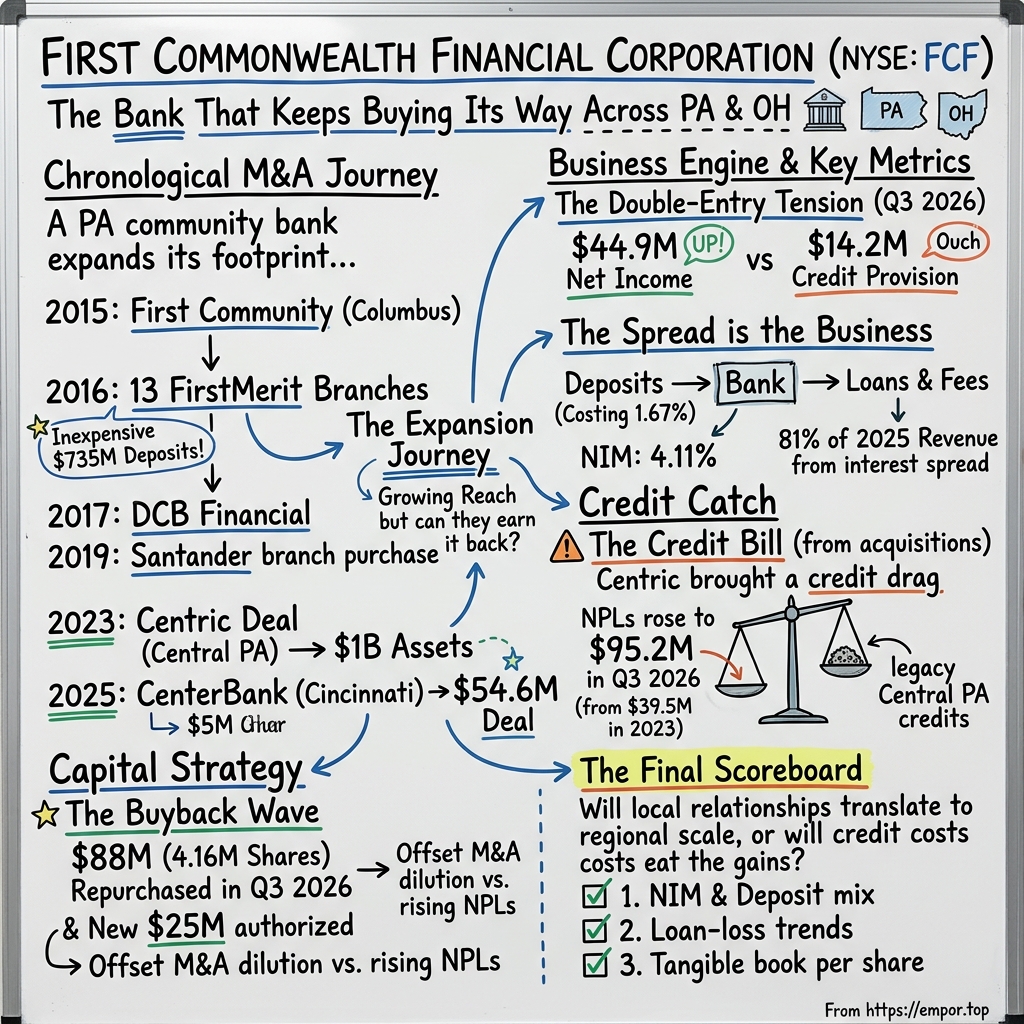
The deals kept coming, and they kept fitting together. In 2019 the bank bought a group of branches from Santander.3 In 2023 it closed the acquisition of Centric Financial, which pushed it into Harrisburg and the edge of metropolitan Philadelphia.3 And in 2025 it completed the purchase of CenterGroup Financial, the parent of CenterBank, which brought it into Cincinnati.3 Draw these on a map and a pattern appears: an arc that runs from central Pennsylvania through Pittsburgh, into eastern Ohio, across to Columbus and down to Cincinnati. Each step was contiguous with the last, or close to it. This was not a bank buying whatever happened to be for sale in faraway states. It was a bank filling in a corridor.
By the end of 2025 that corridor held roughly $12.3 billion of assets, about $9.8 billion of loans and about $10.3 billion of deposits.3 That is close to double the size the company was when it bought the FirstMerit branches. It is still modest beside the competition. PNC, headquartered in Pittsburgh, operates on a national scale, and Pennsylvania rivals such as F.N.B. and Fulton Financial are substantially larger regional banks.3
Here is where the investor has to be careful about what a map proves. More branches and more deposits are evidence of reach. They are not, by themselves, evidence of customer loyalty, pricing power or superior returns. A bank can buy its way into a city and still lose the depositors it bought as soon as a competitor pays more, or discover that the loans it acquired were underwritten to standards it would never have accepted. The coherent geography is a real strategic achievement: it lets the company share back-office costs, marketing and management across neighboring markets, and it means bankers can call on businesses across a continuous region rather than in isolated islands. But each deal still has to earn back its price through relationships that last and through earnings per share that rise after the new shares issued to pay for it.
The FirstMerit branches set a high standard for that test, because they came with cheap money and a motivated seller. Later deals would be harder to judge, and one of them would come with a bill that is still being paid. To see why the cost of deposits mattered so much in that 2016 purchase, though, it is worth stepping inside the bank and following the money.
III. The Spread Is the Business
Imagine a retired schoolteacher in Johnstown who keeps her checking account at the First Commonwealth branch down the street. She has kept it there for years, partly out of habit, partly because the tellers know her name. The balance pays her little or nothing in interest. A few miles away, the owner of a machine shop needs a loan to buy new equipment, and the same bank lends it to him at a rate several points higher than anything it pays the teacher. The difference between those two rates, multiplied across thousands of depositors and borrowers, is most of what First Commonwealth is.
That gap is called the spread, and in a bank it does the work that a product's selling price does in a manufacturer. In 2025, net interest income, the spread earned on loans and securities minus the interest paid to depositors and lenders, made up about 81% of the company's operating revenue.3 In the third quarter of 2026, net interest income on a fully taxable-equivalent basis was $116.7 million, while noninterest income, all the fees and commissions together, came to $26.7 million.1 Put plainly: for every dollar the bank keeps before expenses, roughly four come from the spread and one comes from fees.
This is why the "unit" of a bank is so different from the unit of a software company or a retailer. There is no subscription, no per-seat license and no minimum customer commitment.3 The unit is a relationship among four things: how much a customer deposits, how much the bank lends against that funding, the rates on each side, and whatever fees come along with the accounts. A deposit is a raw material and a loan is a finished product, except that the raw material can walk out the door whenever the customer wants and the finished product only proves its value years later, when the borrower pays it back. Loan volume depends on local business demand, on the bank's own credit standards, on competition and on interest rates. Deposit costs depend on how loyal customers are and on what everyone else is paying.3
The fees are the second stream, and they are worth taking in proportion rather than giving each equal billing. In 2025 total noninterest income was $96.8 million.3 The largest pieces were the ones you would expect from a branch bank: about $22.8 million in deposit service charges, about $15.6 million in interchange income from customers' debit and credit card swipes, about $12.9 million in trust income from managing money for families and estates, and about $12.7 million in insurance and brokerage commissions.3 Bank-owned life insurance, mortgage banking and the sale of loans, and interest-rate swaps sold to commercial customers made up much of the rest.3 For the fourth quarter of 2026, management guided to fee income of $24 million to $25 million, unchanged from its previous outlook, after fee income fell by about $1.3 million in the third quarter as one-time gains that had flattered the second quarter did not recur.2
Those fee lines tell a story about the customer base. Interchange and deposit service charges come from ordinary households and small businesses using their accounts. Trust and insurance commissions come from the wealthier end of the same communities, the retired doctor or the family that owns a car dealership. Swap income comes from commercial borrowers who want to lock in a fixed rate on a floating-rate loan. None of these is a separately disclosed profit engine. The company does not publish the profitability of its wealth, insurance or mortgage activities as comparable segments, so there is no way to say whether any of them earns more on its capital than the core bank.3 They diversify income, and they deepen relationships, but they do not change the basic fact that First Commonwealth's fortunes rise and fall with loan demand, funding costs, credit losses and the repricing of interest rates.
That point matters for how the company's cash should be read. In an industrial company, an investor checks whether profit turns into operating cash flow and then subtracts capital spending to find free cash flow. In a bank, that exercise breaks. In 2025 the company's cash-flow statement showed about $187.5 million of operating cash flow, but the lending, securities purchases and deposit flows that are the actual business run through the investing and financing sections of the same statement.3 When the bank makes a new loan, cash goes out; when a depositor adds money, cash comes in. Neither tells you whether the bank is profitable. So the conventional free-cash-flow yield on a bank like this is close to meaningless. The useful questions are different: are credit reserves building or being released, how fast are loans being charged off, are deposits growing or shrinking, and how much capital is left over after all of that?
The spending side of the bank is simpler. The company does not report a research-and-development line, and its purchases of premises and equipment were about $11 million in 2025, down from about $16 million in 2024 and $22 million in 2023.3 That is a small number for a bank with more than a hundred offices, and it suggests that the physical branch network is being maintained rather than expanded through construction, with growth coming from acquisitions instead. The real operating investment shows up in salaries, technology contracts and other expenses, which management guided to $74 million to $76 million for the fourth quarter.2
All of this leads to one uncomfortable truth about the spread business. The schoolteacher in Johnstown is the reason the model works. Her deposits are cheap because she values the branch, the relationship and the inertia of not moving her money. If she ever decides that a 4% online savings account is worth the trouble of switching, the bank's raw material gets more expensive overnight. Deposit loyalty can be a genuine advantage for a bank like this. It is only an advantage, though, if customers stay when a competitor offers them more.
IV. The Deposit Franchise Has to Earn Its Keep
The third-quarter release contained a small contradiction that captures the whole problem of running a community bank in 2026. The average cost of deposits fell seven basis points, to 1.67%.1 That was good news, and it fed directly into the higher margin. But in the same quarter average deposits declined by $87.1 million, an annualized drop of about 3.3%.1 Inside those totals, noninterest-bearing balances, the checking accounts that pay depositors nothing, grew, while time deposits, the certificates of deposit that pay the most, fell.1
Read one way, that is a bank deliberately letting its most expensive money leave while keeping its cheapest. Read another way, it is a bank shrinking its funding base at a moment when it is trying to grow its loans. Both readings are partly true, and the company's management has been explicit about which way it leans. On the call, CFO Jim Reske said the bank's long-term goal is to keep its loan-to-deposit ratio in the "low 90s," funding new loans with deposits rather than borrowed money, and that it assumes a deposit beta of about 25% on interest-bearing accounts without a fixed maturity.2 A beta is simply how much of a change in market rates a bank has to pass on to its depositors. A 25% beta means that when market rates move by a full percentage point, the bank expects to move its own deposit rates by only about a quarter of that. Reske added that about 80% of maturing certificates of deposit stay with the bank, some of them repriced at a retention rate.2 The loan-to-deposit ratio had reached about 92.7% in the second quarter, right at the top of that range.7
The best outside view of this franchise came from KBRA, the credit rating agency, which affirmed the company's ratings in March 2025 with stable outlooks, rating the holding company's senior debt BBB+ and the bank's deposits A-.8 KBRA's reasoning leaned heavily on the deposit base. It cited a branch-based deposit franchise in which core deposits made up about 92% of funding, and uninsured deposits of about 27%, covered 1.3 times by available liquidity.8 Those are healthy numbers. A bank that funds itself mostly with ordinary insured deposits from local customers is less exposed to the kind of sudden run that destroyed Silicon Valley Bank in 2023, where uninsured deposits from a narrow group of technology companies made up the overwhelming majority of the funding.
Now set that franchise against the battlefield. It competes against much larger rivals.3 The competitive forces in this business are not subtle, and it is worth running through them once, here.
Rivalry is fierce on both sides of the balance sheet. Every bank in western Pennsylvania wants the same good commercial borrowers and the same sticky checking accounts, and the products are close to identical. A loan is a loan; a checking account is a checking account. The bargaining power of depositors has grown enormously, because rates are now easy to compare and money is easy to move. A customer can open an account at an online bank in ten minutes. Substitutes are everywhere: credit unions with tax advantages, online-only banks that pay more because they do not carry branch costs, money-market funds that sweep savings into Treasury bills, and fintech apps that offer payments and savings without a bank brand at all. On the input side, technology and skilled labor are the costly raw materials, and they tend to favor scale, since a cybersecurity system or a mobile app costs roughly the same to build whether it serves one million customers or ten. The one force that works in First Commonwealth's favor is the barrier to entry. Starting a new bank requires regulatory approval, capital and years of building trust, so the number of new competitors with branches is small. The threat comes from existing giants and from digital substitutes, not from start-ups opening offices on Main Street.
What could make local distribution matter in that fight? The honest answer is relationships and convenience of a particular kind. A small-business owner who wants a banker to visit the shop, a family whose trust account has been managed by the same office for twenty years, an elderly customer who prefers a teller to an app: these are customers who value something the online bank cannot easily replicate, and they tend to keep more money in low-cost accounts. The deposit mix and the 1.67% cost are evidence that First Commonwealth has a lot of those customers. But the same forces push the other way. Larger networks offer more ATMs, better apps and broader product sets, and younger customers increasingly judge a bank by its software rather than its branches.
So here is where the evidence lands. The disclosed deposit mix, the falling cost of funding and KBRA's description of a branch-based core deposit franchise all support the idea that First Commonwealth has a useful, genuinely valuable deposit base. What the company does not publish is the evidence that would turn "useful" into "durable moat." It does not report customer retention rates, the sensitivity of its deposits to price changes over a full cycle beyond its modeling assumption, or a trend in its market share that would show it taking deposits from rivals rather than buying them through acquisitions.3 The 80% CD retention figure is encouraging, but it is a single data point from a single quarter.2 Without the rest, the right description is a plausible advantage rather than a cornered position. The test that would settle it is straightforward: watch whether deposit costs stay below peers and whether the deposit mix holds when rates move and competitors start paying up.
That deposit base also had to fund something. Much of the loan growth First Commonwealth wanted came through acquisitions, and the largest of those acquisitions brought in a loan book that would test the bank's credit discipline for years.
V. Centric's Growth Came With a Credit Bill
On August 30, 2022, First Commonwealth announced the biggest step east in its modern history. It would acquire Centric Financial Corporation, the parent of Harrisburg-based Centric Bank, a younger commercial lender with roughly $1 billion of assets and a presence stretching from Pennsylvania's capital toward metropolitan Philadelphia.9 The price was about $144 million in stock, or roughly 1.3 times Centric's tangible book value.910
The strategic case was easy to draw. Harrisburg and the corridor toward Philadelphia were richer, faster-growing markets than many of the small towns of western Pennsylvania where First Commonwealth had its roots. Centric brought commercial bankers with local relationships, a book of business loans, and a ready-made presence in a region where building branches from scratch would have taken years.10 Management presented the deal as accretive to earnings and as a way to add commercial scale in Central Pennsylvania.10 On a map, it extended the corridor in the one direction the company had not yet gone.
Then something unusual happened before the deal closed. First Commonwealth went back and reduced the exchange ratio, the number of its own shares each Centric shareholder would receive, by about 9.2%, after recalculating credit and merger costs.11 Bank deals are occasionally repriced, but it is rare, and it is almost never a good sign about the target. Renegotiating terms means the buyer looked more closely at the loan book and concluded it was worth less than it had first thought. In fairness, it also showed a willingness to walk back a price rather than simply swallow it, which is a form of discipline. But it was the first piece of evidence that the underwriting assumptions behind Centric needed correction, and that evidence would keep arriving.
The deal closed in early 2023, and the bill started coming in almost immediately. In 2023 alone, First Commonwealth charged off $14.8 million of commercial loans tied to Centric.3 Centric also pushed the combined company's assets above $10 billion, from about $9.8 billion at the end of 2022 to about $11.5 billion a year later.3 That threshold matters in American banking, because crossing it brings stricter regulatory requirements and a cap on the interchange fees large banks can charge on debit cards.3 So Centric changed the bank in two ways at once: it added a market, and it raised the fixed cost of being the bank that owned it.
The asset-quality numbers since then show why the drag lasted longer than the original pitch implied. Nonperforming loans were $39.5 million at the end of 2023, about 0.44% of loans.3 A year later they were $61.5 million, and at the end of 2025 they reached $91.8 million, close to 1% of the loan book.3 In the third quarter of 2026 they rose again, to $95.2 million.1 The allowance for credit losses at the end of 2025 was $125.8 million, about 1.32% of loans, but because problem loans had grown faster than reserves, the allowance covered only about 137% of nonperforming loans, down from 193% a year earlier.3 Criticized loans, the broader category of credits that regulators and the bank's own reviewers are watching closely, stood at $267.2 million at the end of 2025.3
Not every one of those problem loans came from Centric, and it would be a mistake to treat every credit loss since 2023 as an acquisition loss. The rise in nonperforming loans includes credits originated by First Commonwealth itself, including commercial real estate and business loans in its older markets. But the Central Pennsylvania portfolio keeps coming up in management's own explanations. When KBRA affirmed the ratings in March 2025, it pointed to the weakening trend in nonperforming assets and net charge-offs over 2023 and 2024, and said that trend was largely tied to acquired Centric loans that had been classified as purchased with credit deterioration.8 KBRA also noted that criticized and classified credits had improved in the fourth quarter of 2024.8 The improvement did not last: nonperforming loans rose again through 2025 and into 2026.31
On the third-quarter call, Price was direct about the legacy book. He said loans from the Central Pennsylvania entry made up about a fifth of the bank's criticized loans, a share he called "outsized," and said the portfolio was being worked down.2 Management also described the Central Pennsylvania portfolio as an ongoing drag on returns, in the range of fourteen to fifteen basis points.2 Three and a half years after the deal closed, the bank was still running a cleanup.
The latest quarter deserves a balanced reading, because it contained both bad and encouraging signs. The $14.2 million provision broke down into about $10.7 million for loans and $3.5 million for unfunded commitments, the credit lines the bank has promised but customers have not yet drawn.2 The unfunded piece reflected strong production in committed lines rather than deterioration.2 About $7.7 million of the loan provision was specific reserves on three commercial credits the bank had already identified as problems.2 Meanwhile, net charge-offs fell sharply, to $4.6 million from $11.4 million in the second quarter, or from an annualized 0.49% of loans to 0.19%.12
Chief Credit Officer Brian Sohocki explained the movement inside the problem-loan categories. Loans in the "other loans especially mentioned" category, the first rung of criticized credit, fell by about $25 million, while classified loans, the more serious rung, rose by about $26 million, mainly because two larger loans migrated into nonperforming status.2 A third loan, already nonperforming, needed additional reserves.2 Management said the reserves were appropriate based on collateral valuations, and Sohocki said watch-list loans were down by more than $100 million since the start of the year.2
This is where the distinction between concentration and contagion matters. Two newly nonaccrual commercial credits drove much of the quarter's increase in nonperforming loans.1 That is a different kind of evidence from broad deterioration across hundreds of borrowers. A bank that has a few large problem loans can work them out, foreclose on the collateral, take a loss and move on. A bank whose problems are spread thinly across the book has a deeper underwriting issue. On the evidence of the third quarter, First Commonwealth looks more like the first case. But "a few large problems" is also what every bank says at every stage of a credit cycle, and the specific credits keep arriving. The pattern of 2024 and 2025 was precisely that: contained problems, then new contained problems.
So the verdict on Centric is that the credit drag is material and has lasted longer than the acquisition pitch implied. Recent lower charge-offs are encouraging, and the shrinking watch list suggests the pipeline of future problems may be thinning. But rising nonperforming loans and new specific reserves mean the cleanup is not yet proven complete. The question that would settle it is simple to state and slow to answer: over the next several quarters, do criticized loans, migration into nonaccrual and charge-offs all decline, across both the acquired and the originated books? Or do new "contained" credits keep appearing?
Centric was not the last acquisition, and the next one tested whether the lessons had been absorbed. It was smaller, closer to the CEO's own history, and more expensive.
VI. CenterBank Was a Smaller Bet at a Richer Price
Mike Price knew Cincinnati long before First Commonwealth owned a branch there. Before he came to Pennsylvania, he spent years at National City Bank, the Cleveland-based lender later absorbed by PNC, rising from small-business banking to become chief executive of National City's Cincinnati and Northern Kentucky region from July 2004 until November 2007.12 So when First Commonwealth announced on December 18, 2024 that it would acquire CenterGroup Financial, the parent of Cincinnati's CenterBank, the chief executive was in a sense going back to a market he had once run for someone else.1314
The deal was small. CenterBank brought three Cincinnati branches plus loan-production and mortgage offices, and roughly $335.5 million of assets, including about $291 million of loans and $278 million of deposits.1315 First Commonwealth paid about $54.6 million in stock.15 It closed the acquisition in April 2025 and converted the acquired systems by June, a fast integration by the standards of bank mergers.15 On the map, it completed the Ohio arc: Columbus in the middle, northeastern Ohio from the FirstMerit branches, and now the southwestern corner of the state. The footprint logic was coherent, and the CEO's personal familiarity with the market was a genuine asset in choosing it.
The price was harder to justify than the geography. First Commonwealth's own presentation put the deal at about 1.53 times CenterBank's tangible book value and about 15.3 times its projected 2025 earnings.13 The same presentation compared those multiples with precedent bank deals, where the medians were about 1.32 times tangible book and 10.5 times earnings.13 In other words, First Commonwealth paid roughly a sixth more than a typical buyer on book value and almost half again as much on earnings. And the acquired footprint, about 0.2% of Cincinnati-area deposits on a pro forma basis, was a foothold rather than a franchise.13
Management's case for paying up rested on the usual levers of a bank merger. It projected cost savings of roughly 40% of CenterBank's expense base, accretion to earnings per share in both 2025 and 2026, and a tangible-book earnback period of less than three years.13 The earnback figure is worth explaining, because it is the most important number in any bank acquisition. When a bank pays more than book value in stock, the tangible book value per share of the buyer falls on day one, because the buyer issues new shares worth more than the hard equity it receives. The earnback period is how long it takes for the extra earnings from the deal to rebuild that lost book value. Under three years is respectable. It is also a forecast, and like the credit mark on Centric, it depends on the assumptions behind it.
The per-share frame matters even more for a deal paid in stock. First Commonwealth issued roughly three million new shares to CenterGroup's owners.15 Average diluted shares rose about 1.3% in 2025 as a result.3 During the same year the company spent about $36.5 million on buybacks, which partly offset the issuance.3 So the arithmetic of Center is not just whether CenterBank's profits grow. It is whether those profits, after the savings, are larger than the share of First Commonwealth's earnings that now belongs to the new shareholders.
That evidence is still missing. The company has not published a consistent standalone earnings contribution for the Cincinnati operations, which is normal for a bank that integrates acquisitions fully into its systems, but it means the integration claims cannot be tested directly.316 The available proof will come indirectly: whether the bank's efficiency ratio improves, whether Cincinnati deposits grow rather than run off, and whether earnings per share keep rising after the dilution. A fast systems conversion is a good operational sign. It is not the same as proving the savings.
Set CenterBank beside Centric and the comparison is instructive. The strategic logic was similar: buy a commercial bank in a contiguous, attractive market and use the acquired bankers as a platform. The differences were scale and price. Centric was bigger, and its problems came from the loan book. CenterBank was much smaller, so even a disappointing outcome cannot do Centric-sized damage, but it was bought at a premium to precedents, which means execution has to be better than average just to break even on the price. Small deals can still be expensive, and a premium paid on a small base is still a premium.
Price and his team have argued that markets like Cincinnati, Columbus and Harrisburg offer more growth than the bank's legacy towns. That may well be true. Whether the growth earns its keep depends less on the acquisitions than on what happens to the spread they are meant to feed, and in 2026 the spread was moving in the bank's favor for reasons that had a lot to do with interest rates.
VII. The Margin Turned Up; the Rate Cycle May Turn It Back
Near the end of his prepared remarks on the third-quarter call, Jim Reske offered a forecast that any bank investor would want to hear. If interest rates did not change further and the shape of the yield curve held, he said, the net interest margin could rise to around 4.20% in the fourth quarter and into the mid-4.20s in 2027, give or take five basis points.2 It was a confident outlook, carefully hedged in a single sentence. The analyst questions that followed spent much of their time on exactly the conditions that sentence contained.
To understand why the margin rose, follow the third-quarter bridge. Deposit costs fell seven basis points to 1.67%, so the bank paid less for its raw material.1 Average loans grew, at an annualized pace of about 2.6%, while average cash balances fell, which meant more of the bank's money was earning loan rates rather than the lower yield on cash.12 And loan yields rose as variable-rate loans repriced and as older fixed-rate loans matured and were replaced with new ones at higher rates.12 Reske called the environment for repricing fixed-rate loans "a real Goldilocks."2 Net interest income rose about $5.3 million from a year earlier and about $3.9 million from the second quarter.12
There was a drag hidden in the margin, too. When loans move onto nonaccrual, the bank reverses interest it had already recorded but not collected. Reske said that reversal cost about four basis points of margin in the third quarter.2 Without that reversal, the margin would have been closer to 4.15%. That is the clearest illustration in this story of how credit and the spread are not separate subjects. A bad loan does not only cost a provision; it also stops paying interest, and that loss shows up in the very number management is most eager to highlight.
The counterweight sat in the deposit numbers. Average deposits declined even as period-end deposits edged higher, and the mix shifted away from time deposits toward noninterest-bearing accounts.1 A falling deposit cost driven by expensive CDs leaving is a good outcome, but it only works if the money that leaves is not needed to fund loans. With the loan-to-deposit ratio already in the low 90s, the bank has limited room to let deposits shrink while loans grow.72
The mechanism behind all of this is worth explaining in plain terms, because it is the single largest influence on First Commonwealth's earnings. A bank's assets and liabilities reprice on different schedules. Deposits can be repriced almost immediately; many loans are fixed for years. When short-term rates fall, funding costs drop quickly while loan yields stay high, and margins widen. When rates rise, as they did through 2022 and 2023, deposit costs eventually catch up, and margins can compress until the fixed-rate loans finally roll over. The shape of the yield curve, the gap between short- and long-term rates, determines how much a bank earns when it borrows short and lends long. Management's guidance assumes the curve stays as it is. A flatter curve, or a sudden fall in long-term rates, would slow the repricing benefit. Price himself acknowledged on the call that higher rates "will dampen demand," particularly for commercial real estate loans.2 So the same rate environment that helps the margin can hurt loan growth.
The company's own history shows how much earnings move with rates and credit. In 2020, when the pandemic drove rates to zero and forced banks to build reserves, net income fell to about $73 million, down roughly 30% from 2019.3 It then rebounded to about $138 million in 2021 as credit and economic conditions improved.3 Over the decade to 2025, net profit grew about 11.8% a year, but that average conceals years of sharp decline as well as years of near doubling, and a good part of the growth came from acquisitions rather than organic expansion.3 In 2025, net profit grew about 7.0%, to roughly $152 million, slower than the long-run rate.3 The third quarter's improvement is real, but it is one point in a series that has historically swung with the rate cycle.
The analyst exchanges on the call revealed the questions that matter. Karl Shepard of RBC Capital Markets asked directly what could keep the bank from reaching 4.20% in the fourth quarter and holding it through 2027.2 Price answered that the bank has a "granular depository," meaning its deposits come in many small accounts rather than a few large ones, and that it would test deposit pricing.2 Daniel Tamayo of Raymond James pressed on the credit path and on commercial loan growth, and Price said the bank felt it was "turning the corner" on business lending, though equipment finance had slowed.2 Asked about the buyback pace by an analyst covering for KBW's Kelly Motta, Reske said the bank's $25 million repurchase tranches are sized to its retained earnings after dividends.2 Taken together, the prepared remarks emphasized margin expansion; the Q&A kept returning to the yield curve, legacy credits and the four-basis-point nonaccrual drag.
That comparison matters for credibility. Three months earlier, on the second-quarter call, management had already been describing a margin that would rise as deposit costs fell and fixed-rate loans repriced.17 The third quarter delivered on that direction. Mid-single-digit loan growth, which management still targets, has not yet arrived: 2.6% annualized is below it, although management noted that loan payoffs slowed for the first time in five quarters, which should help.2
So the verdict on the margin is conditional, as management's own forecast is. Earnings have improved because deposit costs are falling and loans are repricing, and the bank has a credible near-term path to a higher margin if the rate environment holds. But this is a cyclical tailwind, not yet a durable operating change. The tests are clear: whether the margin holds near the guided range, whether loan growth broadens across categories and reaches the mid-single digits, and whether the deposit cost and mix stay where they are when competitors respond. Those tests will also be the measure of the people who set the forecast.
VIII. Mike Price's Scoreboard
Mike Price did not arrive at First Commonwealth as a turnaround specialist or a dealmaker from Wall Street. He came up through branches. He holds a bachelor's degree from the University of Utah and an MBA from Cleveland State University.12 He joined First Commonwealth as president of the bank in November 2007, just as the financial crisis was about to break, became interim president and chief executive of the holding company in January 2012, and has been a director since March of that year.12 Now 63, he has run the company through a low-rate decade, a pandemic, the fastest rate-hiking cycle in forty years and a string of acquisitions.123
That long tenure is the best reason to judge him on outcomes rather than intentions. His partner in that record is CFO Jim Reske, whose voice is the one investors hear on margins, capital and guidance, and who personally owns about 87,600 shares.122 The board is chaired by Jon Gorney, an independent, non-executive director, which separates the roles of chair and chief executive.12
Start with what management owns. In the 2026 proxy, Price held about 392,000 shares, which is less than half of one percent of the company.12 All directors and executive officers together, twenty-one people, owned about 1.9%.12 At the October share price, Price's stake is worth something over $8 million, a meaningful amount for an individual but not the kind of ownership that makes a chief executive think like a controlling shareholder. The incentives therefore matter more than the stake.
The incentives are, on paper, well designed. The annual cash bonus is based on core earnings per share, on core pre-provision return on assets measured against a peer group, and on the efficiency ratio, again relative to peers.12 Those choices are better than many bank plans. Earnings per share punishes dilution; peer-relative measures stop management from being rewarded just because rates rose for everyone; and the efficiency ratio, which measures how much of each revenue dollar goes to expenses, pushes against bloat. Long-term awards combine stock that vests over time with stock that vests only if performance targets are met.12 For 2025, the plan paid out at 163.75% of target.12 Price's total compensation rose to about $2.0 million, from about $1.66 million in 2024 and $1.39 million in 2023.12
There is one gap in that design that a skeptical investor would immediately notice. The annual measures are built on pre-provision profitability, which means the credit losses that dominated the post-Centric story do not directly reduce the bonus. Core earnings per share does include the provision, so bad loans are not invisible, but the peer-relative profitability metric ignores them by construction. For a bank whose central question for three years has been credit, that is an odd emphasis. Shareholders did not object strongly. At the April 2026 annual meeting, the advisory vote on executive pay passed with about 72.1 million votes in favor and about 2.0 million against, a margin of support well above what would signal discontent.18 But a comfortable say-on-pay vote is evidence that shareholders are not angry, not evidence that the acquisitions met their original return targets.
So assess the behavior against the outcomes. On the positive side of the record, management has pursued a consistent strategy of expanding into adjacent markets, rather than wandering into unrelated businesses or distant states. When Centric's estimated credit costs changed before closing, management cut the terms rather than paying the original price.11 It has acknowledged on calls that credit quality remains its first priority, and it has been specific about where the problems sit, naming the Central Pennsylvania portfolio as an outsized share of criticized loans rather than hiding it inside aggregate figures.2 It has raised the dividend over time: the cash paid to shareholders more than doubled over the decade to 2025, while the payout stayed at a conservative share of earnings, around 37% in 2025.3
On the other side, the Centric deal is the clearest test of underwriting judgment in Price's tenure, and the result is mixed at best. Revising the terms was prudent, but it was also an admission that the first diligence had missed something, and the acquired-loan costs lasted years after the revised price was set. Center was bought at a premium to precedent deals, which asks shareholders to trust the same team's integration forecasts again. And the per-share earnings picture is not one of sustained compounding: earnings per share went from about 56 cents in 2015 to about $1.47 in 2025, a real gain, but with deep drops along the way, including a roughly 29% fall in 2020.3
The leadership bench below the top two has been changing. Norman Montgomery, who led business integration, retired in May 2026; Ryan Gorney became chief information officer in April; and Phillip Graves became chief accounting officer in September.19 None of these moves suggests turmoil, and the CEO and CFO have not changed. But the integration lead's departure came only about a year after CenterBank's systems conversion, which means any further acquisition would be absorbed by a team without its most experienced integrator.
What would an activist ask? Probably three things. Why should a bonus plan emphasize pre-provision returns at a bank whose recent story is dominated by provisions? What is the actual return on capital deployed in Centric and Center, measured against the price paid and the shares issued? And how does management decide between buying back stock and keeping capital for loan growth or credit losses? Management's answers on calls have been concrete on the last question and general on the first two. Credibility, in the end, rests on deal execution and credit outcomes, and the Centric assumptions needed revision while its credit drag lasted for years. That leaves the record intact but bounded: a team that is disciplined about strategy and candid about problems, but has not yet shown that it prices acquired credit risk accurately. Its biggest capital decision of 2026, though, was not an acquisition at all.
IX. The Buyback That Swallowed the Share Count
In the third quarter of 2026, First Commonwealth bought back about 4.16 million of its own shares, spending about $88 million at an average price of $21.18.12 It was, by a wide margin, the largest repurchase in the company's recent history. Period-end shares outstanding fell from about 101.1 million at the end of June to about 96.9 million at the end of September.1 Alongside the results, on October 27, the board authorized another $25 million program, which Reske said would start once the company emerged from its quiet period.12
Put that in the context of the deals. When CenterBank's shareholders received roughly three million new First Commonwealth shares in 2025, the share count went up.15 One quarter's buyback in 2026 removed more than four million. In share-count terms, the company has more than reversed the dilution from its most recent acquisition. That is a meaningful change in posture for a bank that had grown mainly by issuing stock to buy other banks.
The arithmetic of a buyback is worth walking through, because it is easy to get excited about the wrong number. Retiring about 4% of shares mechanically increases earnings per share by roughly 4%, all else equal, because the same profit is divided among fewer owners. But the money spent on the buyback no longer earns anything for the bank. At the price paid, First Commonwealth was buying its earnings at about 12 to 13 times, an earnings yield of around 7.6%.1 That is higher than the after-tax return the bank would earn by holding the cash or buying Treasury securities, so in a narrow sense the buyback was accretive. The harder question is whether it was a better use than keeping the capital to fund loans, absorb losses, or buy another bank on better terms.
That is where the capital context has to stay explicit. Regulatory ratios remain comfortably above minimums. The common equity tier 1 ratio, the measure of high-quality capital against risk-weighted assets that regulators watch most closely, was 11.9% at September 30, and the bank held about $539 million more capital than it needed to be classified as well capitalized.1 But tangible common equity, the simpler measure of hard equity against total assets that investors watch, fell from about 9.9% to 9.2% in the quarter because of the repurchase.2 These two measures should not be conflated. Regulators care about the first; the market tends to punish banks when the second falls too far. Book value also carries unrealized losses on securities. At the end of 2025, the bank's held-to-maturity securities had a fair value of about $470.7 million against a carrying value of about $519.4 million, a gap of almost $49 million that does not appear in the regulatory or book numbers.3
The history of the program shows how the buyback has evolved. The company has run recurring $25 million authorizations since at least 2021, and by the end of 2025 it had repurchased about 5.25 million shares at an average of about $14.75.3 In 2025 alone it spent about $36.5 million on buybacks while issuing shares for Center.3 The third-quarter purchase was larger than all of that and was made at an average price about 44% higher than the earlier average. So the scale of the buyback rose just as the price of the stock did. That is not necessarily wrong, since the bank's earnings had risen too, but it means the most recent repurchases carry less margin of safety than the earlier ones.
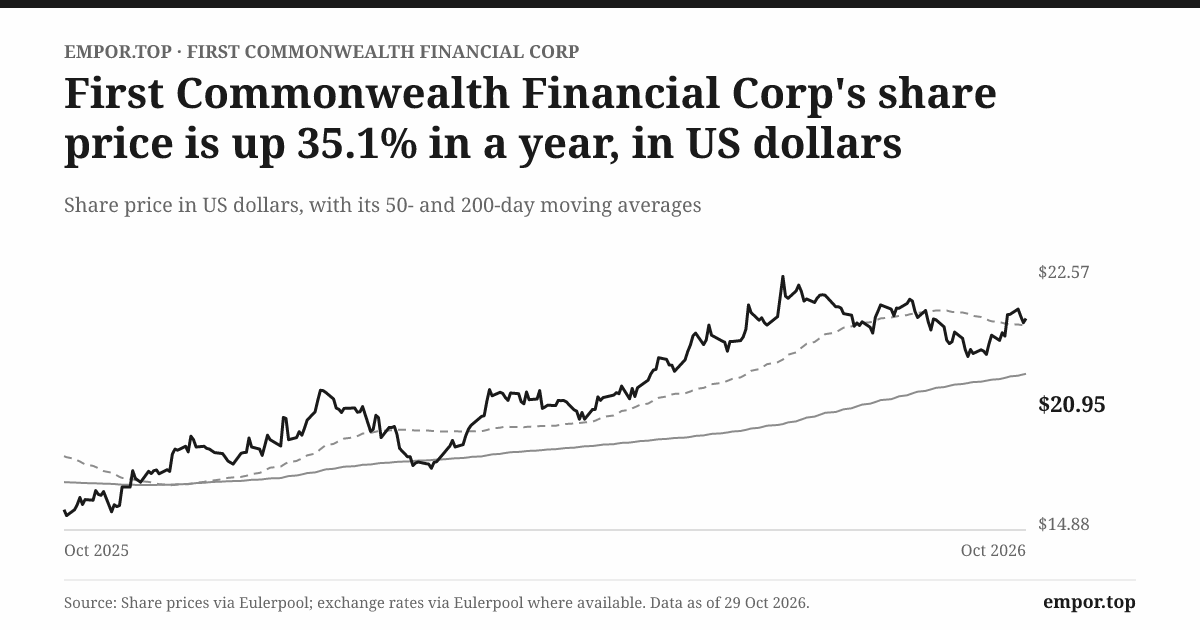
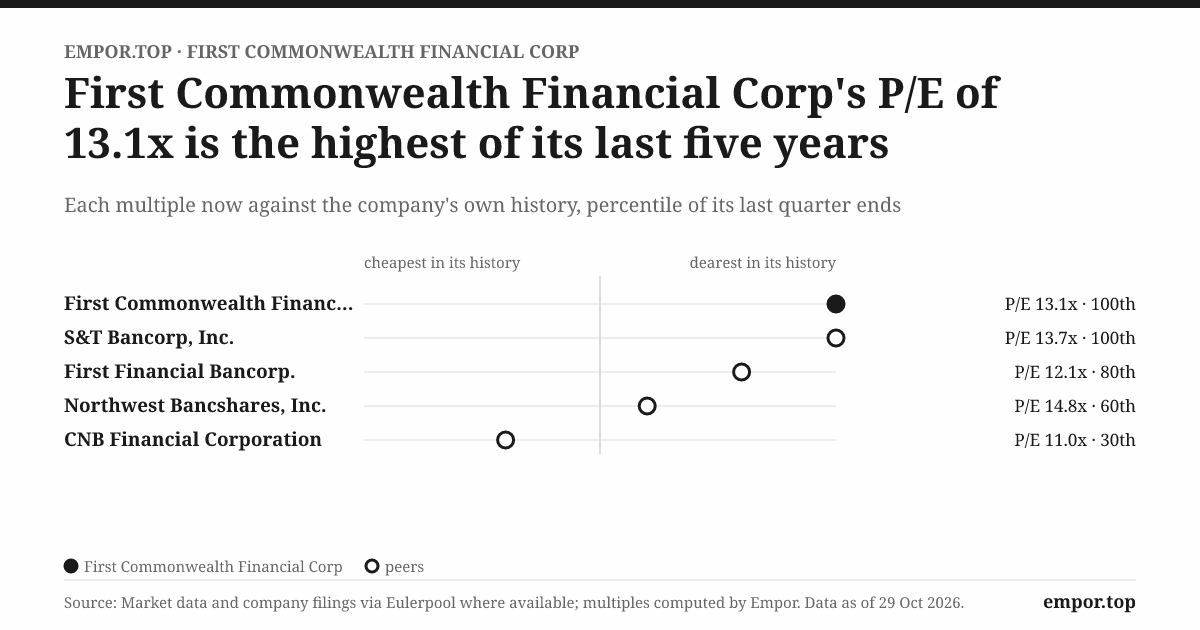
The valuation helps explain the tradeoff. At $20.95 in late October, the stock traded at about 13.1 times trailing earnings, above its own five-year median of about 11.7 times, and at about 1.4 times book value.201 The dividend yield was about 2.6%.20 For a rough comparison, Fulton Financial traded at about 11.1 times earnings in June 2026, which suggests First Commonwealth was not cheap against its closest Pennsylvania peers, though the dates do not match exactly.21 Those multiples are context, not a target. They say the market is already paying more for each dollar of First Commonwealth's earnings than it has on average over the past five years, which means a dollar of buyback today buys less of the company than it would have in 2023 or 2024.
So the verdict is that the buyback materially offset prior acquisition dilution and lifted earnings per share, but its size makes the capital tradeoff real while nonperforming loans are rising. Management's stated rule is sensible.2 The third quarter's $88 million went well beyond a single tranche. The decision should be judged against three things: whether tangible book value per share grows, whether credit needs stay manageable, and whether the capital the bank keeps earns a better return than the capital it returned.
Ask the activist's question directly: would another dollar of buyback create more value than a dollar of loan growth, liquidity or a lower-risk acquisition? Today, with loan growth below management's target and a stock priced above its historical average, the answer depends on whether loan demand picks up. If it does, capital that was spent on stock will be missed. If it does not, returning capital is the better use. That question will be answered by the business, not the board, and part of the business case management has been making is that technology will make the bank more productive.
X. The Technology Bet Is a Tool, Not Yet a New Business
On the third-quarter call, Price described First Commonwealth's technology program in terms that would have sounded unusual from a western Pennsylvania community bank a decade ago. The bank had about 35 fintech partnerships, he said, with tools aimed at fraud prevention, call-center efficiency and customer insights.2 Its 2027 investment plan, he added, would cover "technology, talent, marketing, fraud prevention, and improved banker productivity."2
The most concrete example had come a quarter earlier. On the second-quarter call, management described an AI-assisted workflow in its call center that surfaces the right procedure to an employee while a customer is on the line.17 Imagine a customer calling about a disputed debit card charge. Instead of putting the customer on hold while the representative searches a manual, the system brings up the relevant steps on screen as the conversation happens. It is a sensible tool. It is also a productivity experiment, not a reported revenue stream, and it should be given exactly that scale in any assessment of the company.
The staffing numbers show what has and has not changed. The bank had about 1,575 full-time-equivalent employees at the end of September 2026, up from about 1,548 a year earlier, a slight increase.1 Technology has not yet shown up as a shrinking workforce or a falling expense line. The company does not consistently disclose its technology spending as a separate figure or the measured returns of its partnerships; its new CIO is Ryan Gorney.319
There is a distinction here that applies to every bank of this size. Technical capability is not commercialization. Partnerships and pilots do not establish lower unit costs, better customer retention or revenue growth. A bank can sign dozens of fintech contracts and still have the same efficiency ratio, because each tool adds a license fee and an integration cost before it removes any work. What would change the assessment is measurable evidence: shorter call times, lower fraud losses, rising customer satisfaction, more loans per banker and, above all, a falling expense ratio.
The economic test brings the story back to its core. Technology matters for First Commonwealth only if it improves one of three things: deposit retention, loan economics or operating efficiency. Fraud prevention is perhaps the most important of the three, because a bank that moves more payments and service through digital channels also takes on more cyber and fraud risk, and losses from fraud flow straight into the expense line. A bank that defends its customers from scams also defends its deposit base. For now, technology looks like a way for a $12 billion bank to stay relevant against larger rivals, not a source of advantage over them. That leaves the investment case where it began, with the deposits, the loans and the people pricing both.
XI. Analysis & Bear vs. Bull Case
Put two numbers side by side and the whole investment debate fits between them. The net interest margin in the third quarter of 2026 was 4.11% and rising.1 Nonperforming loans at the end of 2025 were 0.97% of the loan book and, three quarters later, still rising.31 One is the engine; the other is the brake. The question is whether the first can keep improving while the second turns, or whether the brake catches up with the engine first.
The bull case is a story about a bank whose funding is cheaper than it looks for its size. First Commonwealth's deposits cost 1.67% in the third quarter and fell further, its funding is mostly core deposits from local households and businesses, and its uninsured share is modest.18 Its margin is heading toward the guided 4.20%.2 Loan growth of about 2.6% annualized is slow but positive, with payoffs finally slowing.12 Regulatory capital is ample, at an 11.9% CET1 ratio with more than half a billion dollars above the well-capitalized threshold.1 Fee streams from trust, insurance, interchange and deposit services add a second leg that does not depend entirely on the spread.3 And the acquisitions have produced a denser, more contiguous footprint from central Pennsylvania to Cincinnati, which lets the bank spread its fixed costs over more customers and call on businesses across a continuous region. In that version of the story, the Centric cleanup is in its last innings, charge-offs have already fallen, and the next two years deliver a higher margin on a larger, cleaner loan book with fewer shares outstanding.
The bear case is equally concrete. PNC and the larger regionals can compete on scale, product breadth and technology budgets that First Commonwealth cannot match.3 Depositors can shop rates on their phones, so the cheap-deposit advantage holds only as long as customers choose not to move. Credit losses can overwhelm spread gains: at a margin of about 4%, a bank needs to lose surprisingly few loans to give back a year's improvement. The margin itself is conditional on the yield curve, as management's own guidance says.2 And the acquisitions, priced on synergies, still have to show up in per-share returns, with Center bought at a premium and Centric's credit tail still visible. In that version, nonperforming loans keep creeping up, the margin stalls when rates move, and the bank discovers it spent its excess capital on buybacks at the top of its valuation range.
To decide between them, it helps to apply Hamilton Helmer's seven powers, the sources of durable advantage that let a company earn more than its cost of capital. Against the competitive pressures of banking, most of the seven powers are absent or weak.
Scale economies cut against First Commonwealth rather than for it. It is larger than the community banks it competes with in small towns, which helps, but it is much smaller than PNC and smaller than F.N.B. and Fulton, and in technology and compliance the fixed costs favor the biggest players.3 Crossing $10 billion in assets added regulatory expense and capped debit interchange fees, a cost the bank now carries without the scale of its largest rivals.3 Network economies, where each additional customer makes the product more valuable to others, do not meaningfully exist in branch banking. Counter-positioning, a business model incumbents cannot copy without hurting themselves, does not apply either: First Commonwealth is the incumbent, and the online banks are the ones counter-positioned against it. A cornered resource, such as a unique license or asset, does not exist; banking charters are available to anyone with enough capital and patience.
That leaves three powers worth arguing about. Switching costs are real in commercial banking. A business that runs payroll, cash management and its credit line through one bank has a great deal of friction in moving, and the bank often requires borrowers to keep their operating deposits on hand. The 80% retention of maturing CDs and the growth in noninterest-bearing balances in the third quarter are consistent with that friction.21 But the company does not publish customer retention rates or relationship-level data, so switching costs remain plausible rather than demonstrated. Branding is local and modest: a long-established name in western Pennsylvania towns carries trust, but it does not command a price premium, and in newer markets like Cincinnati the brand is barely known. Process power, an embedded way of operating that rivals cannot easily copy, would be the most valuable power for a bank, and it would show up as consistently superior underwriting. The Centric experience argues against claiming it. A bank with genuine process power in credit would not have needed to reprice an acquisition and then spend years working out the loans.
The verdict on the moat, therefore, is narrow. First Commonwealth has a useful deposit franchise and meaningful relationship friction with its commercial customers. It does not have a demonstrated moat; the evidence needed to establish one remains undisclosed. The valuation premium over its own history asks more of that franchise than the evidence yet proves. A 13.1-times multiple against an 11.7-times five-year median is not extreme, but it means the market is already pricing in some of the bull case.20
The risks are best understood through their mechanisms rather than as a list. Commercial real estate and business-credit migration raise provision needs, which is the mechanism that has already been at work. Rate changes affect both sides of the balance sheet: lower long-term rates slow the repricing of fixed loans, while competition for deposits can lift funding costs faster than the 25% beta assumes. Regulatory requirements above $10 billion add expense that does not shrink as the bank grows. And cyber and fraud risk is growing precisely because the bank, like every bank, is moving more of its service and payments into digital channels. On the evidence available, legal risk is not a material overhang: the company estimates any reasonably possible losses beyond its recorded liabilities at between zero and $1 million, and its auditor, KPMG, issued an unqualified opinion on the 2025 financial statements.37 Technology and AI, as the call-center example showed, should not be part of the investment thesis until they produce measurable results.
Three numbers will tell investors which story is winning. The first is the net interest margin together with the cost and mix of deposits, now 4.11% and 1.67% respectively, both moving in the bank's favor.1 The second is the credit trio of criticized loans, nonperforming loans and net charge-offs: nonperforming loans are at $95.2 million and rising, while charge-offs have fallen to an annualized 0.19%.12 The third is diluted earnings per share alongside tangible book value per share, after both acquisitions and buybacks. Earnings per share over the past twelve months were about $1.69, up from $1.47 for 2025.13 If all three keep improving at once, the bull case is winning. If the margin rises but credit deteriorates, the brake is catching up. And if earnings per share rise while tangible book value per share stalls, the buybacks are flattering the scoreboard.
XII. Lessons From a Bank That Grew by Buying
Go back to the summer of 2016, when Huntington had to sell thirteen branches in Stark and Ashtabula counties and First Commonwealth was there to buy them. The deposits cost about 0.22%.5 Then fast-forward to 2023, when the bank closed on Centric after cutting the exchange ratio by 9.2%, and spent the next three years explaining why its Central Pennsylvania loans were still producing problems.112 Those two moments bracket everything this bank has learned about buying growth, and the lessons belong to First Commonwealth more than to any generic bank.
The first lesson comes from the FirstMerit branches: buy the deposits when the seller has to sell. A forced divestiture is one of the few moments when a mid-sized bank can buy an established deposit base at a fair price, because the seller cares more about its regulatory approval than about the branches. But the cheap price is only half the trade. The deposits have to stay. A branch is worth what its customers do after the sign changes, and the purchase price is justified only if their cost and loyalty survive the conversion.
The second lesson comes from Centric: a credit mark is a forecast, not a force field. When First Commonwealth recalculated Centric's credit costs and reduced the exchange ratio, it was doing the right thing. Repricing protected shareholders from paying the original price. It did not make the acquired portfolio's later credit costs disappear. Accounting marks and renegotiated terms estimate how much a loan book will lose; they do not stop it from losing more. Every buyer of a bank should remember that the loans it acquires keep their history, whatever the new owner's name on the door.
The third lesson comes from Cincinnati: a small deal can still be expensive. CenterBank fit the map perfectly, it took the CEO back to a city he once ran for National City, and its systems converted in weeks.1215 None of that changed the price, which was well above the median of comparable deals.13 A coherent geography is a reason to buy; it is not a reason to pay more. Small acquisitions tend to escape scrutiny precisely because they are small, which is why their multiples deserve more attention, not less.
The fourth lesson comes from the third quarter's buyback: per-share growth is the scoreboard. First Commonwealth roughly doubled its assets over the decade, but assets are not what shareholders own. What they own is a share of earnings and of tangible book value, and those depend on how many new shares were issued to buy each bank and how many were later bought back.31 The right way to judge this bank's whole history of acquisitions and repurchases is not by the size of the map. It is by whether the earnings and hard equity behind each share kept growing after every deal and every buyback. Taken together, the lessons say one thing: acquisition value is made in underwriting, integration and the loans that survive, not in the map drawn on announcement day.
XIII. The Next Credit Migration Will Decide the Story
The third-quarter call ended with management projecting a higher margin, even as it discussed new nonaccrual credits and specific reserves.2 That is exactly where First Commonwealth stands tonight: a bank with a rising spread, a still-open credit file and a freshly authorized $25 million buyback.1
The next chapters turn on a handful of moments. The fourth-quarter results, due in early 2027, will show whether the margin reached the guided level of about 4.20% and whether the yield curve cooperated.2 If the margin reaches that level, management's credibility on rates will rise. If the margin falls short because deposit costs stop falling or loans reprice more slowly, the market will begin to see the improvement as cyclical rather than structural. In the same release, investors will see whether nonperforming loans fall below the third quarter's $95.2 million, and whether the two newly nonaccrual credits are resolved, charged off or joined by others.1 Sohocki said the resolution of the nonperformers should drive results over the next couple of quarters.2 That is a testable statement, and the next two releases will test it.
The deeper question is vintage. Investors will want to follow criticized and nonperforming loans by source—whether they were acquired or originated by First Commonwealth—and by when they were made. If the problems keep coming from the Central Pennsylvania book and that book keeps shrinking, the cleanup is ending. If new problems start appearing in loans First Commonwealth originated itself, the issue is not Centric; it is underwriting across the bank.
The CenterBank integration will reach its own verdict as well. The company says the announced savings and earnings accretion should be visible in the bank's efficiency ratio and in whether earnings per share keep rising after the share issuance.13 And the next buyback will be a capital-allocation decision worth evaluating on its own terms. If the bank keeps repurchasing at a premium to its historical valuation while nonperforming loans rise, it is betting that credit is contained. If it slows the buyback to fund loan growth, it is betting on demand. Either can be right. The tension that remains is whether current earnings are strong enough to support the growth strategy, or whether the next credit migration will force management to choose between funding growth and addressing credit losses.
XIV. Outro
Go back once more to that October earnings call. In a single quarter, the spread improved, the credit bill grew, and management bet on its own stock.12 That quarter was not an anomaly. It was the whole company in miniature.
What makes First Commonwealth unlike a bank that simply grows bigger is the constant attempt to turn local relationships into regional scale, from a hill town east of Pittsburgh to the riverbanks of Cincinnati, and the recurring test of whether the credit and capital costs let shareholders keep the gains. Every new market promises a wider local franchise. Every loan book has to prove its value one credit at a time. First Commonwealth keeps buying its way across the map; the story is whether the deposits stay and the losses stop.
References
-
Third Quarter 2026 Earnings Release — Nasdaq, 2026-10-27 ↩↩↩↩↩↩↩↩↩↩↩↩↩↩↩↩↩↩↩↩↩↩↩↩↩↩↩↩↩↩↩↩↩↩↩↩↩↩↩↩
-
Q3 2026 Earnings Call Transcript — The Motley Fool, 2026-10-28 ↩↩↩↩↩↩↩↩↩↩↩↩↩↩↩↩↩↩↩↩↩↩↩↩↩↩↩↩↩↩↩↩↩↩↩↩↩↩↩↩↩↩↩↩↩↩↩
-
Form 10-K for 2025 — First Commonwealth Financial Corporation, 2026-03-02 ↩↩↩↩↩↩↩↩↩↩↩↩↩↩↩↩↩↩↩↩↩↩↩↩↩↩↩↩↩↩↩↩↩↩↩↩↩↩↩↩↩↩↩↩↩↩↩↩↩↩↩
-
First Commonwealth to Buy 13 FirstMerit Offices — Business Journal Daily, 2016-07-29 ↩↩↩↩↩↩
-
Third Quarter 2016 Earnings Supplement, FirstMerit Branch Acquisition — First Commonwealth Financial Corporation, 2016 ↩↩
-
First Commonwealth Gets OK for Acquisition of 13 Ohio Branches — Pittsburgh Post-Gazette, 2016-09-28 ↩
-
Form 10-Q for Q2 2026 — First Commonwealth Financial Corporation, 2026-08-10 ↩↩↩
-
KBRA Affirms Ratings for First Commonwealth Financial Corporation — KBRA, 2025-03-27 ↩↩↩↩↩
-
Centric Acquisition Announcement — First Commonwealth Financial Corporation, 2022-08-30 ↩↩
-
Centric Acquisition Investor Presentation — First Commonwealth Financial Corporation, 2022-08-30 ↩↩↩
-
Q2 2023 Form 10-Q, Centric credit and margin effects — First Commonwealth Financial Corporation, 2023-08-10 ↩↩↩
-
2026 Proxy Statement — First Commonwealth Financial Corporation, 2026-03-19 ↩↩↩↩↩↩↩↩↩↩↩↩↩
-
Acquisition of CenterGroup Financial Investor Presentation — First Commonwealth Financial Corporation, 2024-12-18 ↩↩↩↩↩↩↩↩
-
Publicly Traded Pennsylvania Bank Acquires Cincinnati-Based CenterBank — Cincinnati Business Courier, 2024-12-19 ↩
-
Form 10-Q for Q2 2025, including Center acquisition accounting — First Commonwealth Financial Corporation, 2025-08-11 ↩↩↩↩↩↩
-
Q4 2025 Investor Relations Discussion Materials — First Commonwealth Financial Corporation, 2026-02-11 ↩
-
Q2 2026 Earnings Call Transcript — Stock Analysis, 2026-07-29 ↩↩
-
Annual Meeting Vote Results, Form 8-K — First Commonwealth Financial Corporation, 2026-04-28 ↩
-
Form 8-K, officer appointments — First Commonwealth Financial Corporation, 2026-09-17 ↩↩
-
Investor Relations — First Commonwealth Financial Corporation ↩↩↩
 LinkedIn
 WhatsApp
 Reddit
 Hacker News
 Email
 Kindle
 RSS Feed
 Spotify
 Apple Podcasts
 Amazon Music
 Audible
 YouTube