German American Bancorp: The Community Bank That Bought Its Way to Ohio
I. The $330 Million Bet on the Next Valley
Jasper, Indiana, is the kind of place where the bank is on the courthouse square and the banker probably knows your father. It sits in Dubois County in the southwestern corner of the state, in rolling country settled by German Catholic immigrants, and its biggest employers make furniture and office chairs. On July 29, 2024, the bank headquartered there told the world it was going to Columbus, Ohio.1
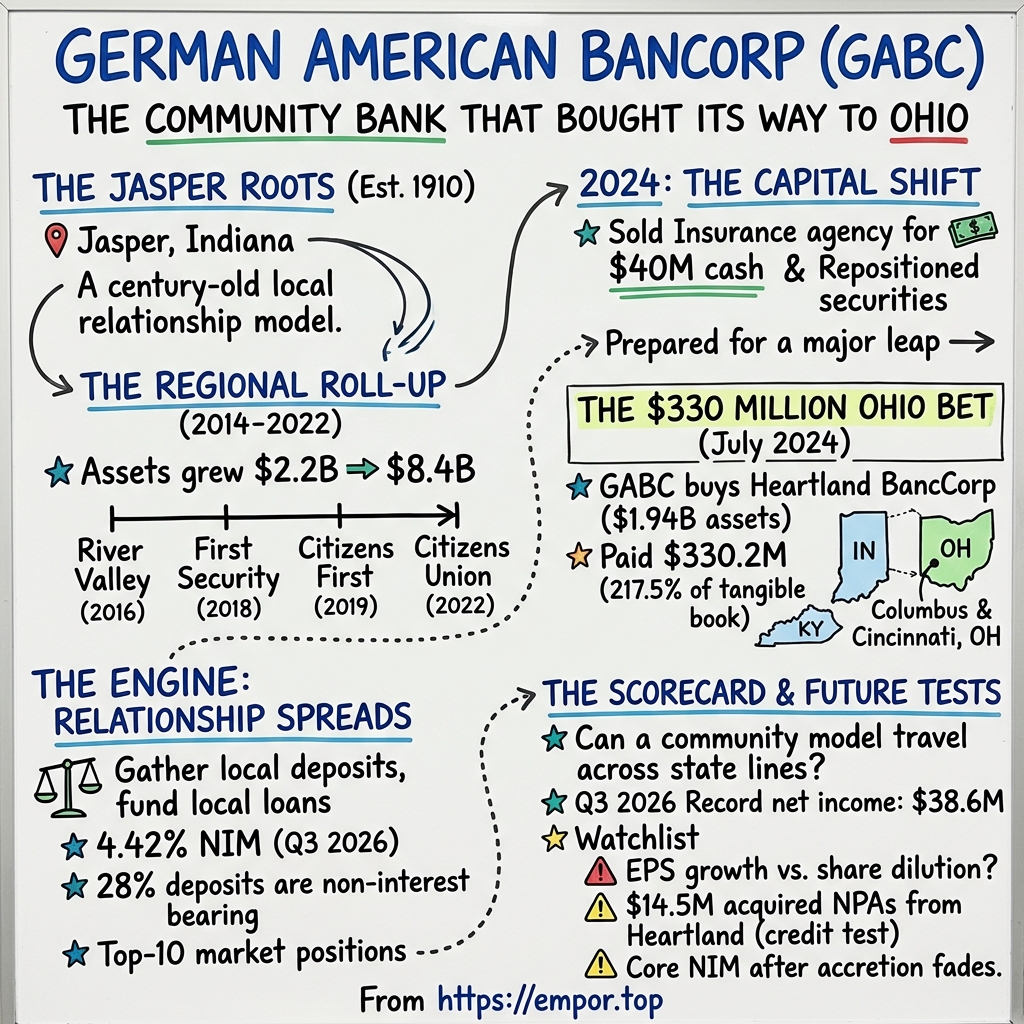
That morning German American Bancorp and Heartland BancCorp announced a definitive agreement to merge.1 Heartland was a Columbus-area community bank with 20 full-service offices, traded over the counter rather than on a major exchange, and had spent decades building a following among small businesses and families on the east side of Ohio's capital and, more recently, in Greater Cincinnati.12 German American would pay with its own stock: 3.9 of its shares for every Heartland share, with Heartland's retirement-plan holdings cashed out instead.1 The headline value was about $330.2 million.1
The mismatch is the first thing to notice. Columbus is one of the fastest-growing big metros in the Midwest and Cincinnati is a Fortune 500 town; Jasper is a county seat of about sixteen thousand people. A bank whose franchise was built in southern Indiana and Kentucky river towns was buying its way into two markets larger than anything it had ever served. When the deal closed on February 1, 2025, German American issued roughly 7.74 million new shares and paid about $23.1 million in cash.3 Heartland's shareholders woke up owning roughly a fifth of the enlarged company, and German American woke up with about $1.94 billion of new assets, $1.58 billion of loans and $1.73 billion of deposits.3
The price was the second thing to notice. At announcement, the deal valued Heartland at about 217.5% of its tangible book value and about 16.4 times its earnings.2 Tangible book is the bank's net worth after stripping out goodwill and other intangibles: roughly what would be left for shareholders if every asset and liability were settled at its carrying value. Paying more than twice that is paying for something a balance sheet cannot see: relationships, a deposit base that does not chase rates, bankers who know which local contractors pay on time. Whether that something is worth the premium is the question this story keeps circling.
The timing made the bet bolder. Interest rates were the highest in a generation, which had left banks across America holding bonds bought in the zero-rate years and now worth less than their face value. German American spent the spring of 2024 tidying its own house before it went shopping. In June it agreed to sell its insurance agency for $40 million in cash.4 In the same breath it sold about $375 million of low-yielding securities and booked an after-tax loss of roughly $27 million, which the insurance gain almost exactly offset.42 The company was swapping an old insurance business and a pile of sleepy bonds for flexibility, and then using that flexibility, plus a richly valued stock, to buy the next valley over.
Look at the 2025 income statement and the leap appears to have paid off at once. Reported revenue rose about 55% and net profit about 35%.3 Those are numbers a software company would celebrate. But the comparison is mostly arithmetic: Heartland sits in the 2025 numbers from February onward and is absent from 2024 entirely. The cleaner signal is per share. Diluted earnings per share rose only about 6%, from $2.82 to $3.00, because the profit had to be shared among millions of new owners.3 Growth in the bank's total size is not the same thing as growth in what each shareholder owns, and that gap is the first clue.
The third thing to notice is where the business stands tonight. In the quarter ended September 30, 2026, German American earned a record $38.6 million, or $1.03 a diluted share, and its net interest margin, the spread between what it earns on loans and securities and what it pays for funding, reached 4.42%.5 For a community bank that is a fat spread; many peers would be pleased to clear 3.5%. The company now holds about $8.4 billion of assets across 94 offices in Indiana, Kentucky and Ohio, and it has kept the Heartland Bank name on the doors in Columbus and Greater Cincinnati, a quiet admission that the brand Ohio customers know is worth more than the one from Jasper.36
So the stakes come down to three questions. Does German American's local deposit model, built over a century in small towns, travel across a state line into two competitive metros? Can the acquired loan book season, the banker's word for loans aging past the honeymoon period when problems typically surface, without a credit surprise? And was issuing so many shares the right currency for the deal, measured not in total profit but in earnings and tangible book value per share? The answers depend on how this bank became the kind of institution that makes deals like this in the first place.
 Subscribe on LinkedIn
II. Jasper's Bank Becomes a Regional Roll-Up
German American Bank opened in Jasper in 1910, a name that announced exactly whom it meant to serve.6 The town's farmers, woodworkers and merchants descended largely from German immigrants, and a bank called German American was making a promise about familiarity before it made a single loan. The name survived two world wars against Germany, which tells you something about how local the institution was: in Dubois County, the bank's identity belonged to the town rather than to geopolitics.
For most of the century that followed, the story is the story of thousands of American community banks. Deposits came from neighbors; loans went to neighbors. The bank grew as its corner of Indiana grew, which was slowly. What turned German American into something more interesting was a decision, made over decades and reinforced by successive leaders, that small-town banking could be scaled by buying other small-town banks.
The modern architect of that strategy was Mark Schroeder, who became chief executive on January 1, 1999 and ran the company for twenty-three years.7 Schroeder's era was a patient roll-up. Rather than leaping to a big city, German American kept acquiring banks in the kind of markets it understood: regional centers, river towns and county seats in southern Indiana, then across the Ohio River in Kentucky. Each deal added deposits that were cheap to keep and loan customers who valued a banker they could call.
The recent decade shows the pattern clearly. In 2016 German American bought River Valley Bancorp, adding scale along the Ohio River in southeastern Indiana.8 In 2018 it acquired First Security of Owensboro, Kentucky, and in 2019 Citizens First of Bowling Green, two deals that turned Kentucky from an outpost into a second home market.8 In 2022 came Citizens Union Bancorp of Shelbyville, Kentucky, a foothold in the Louisville area.8 Heartland in 2025 was the next link in a long chain, larger and farther from home, but recognizably the same move.
The numbers that result are striking. Total assets grew from about $2.2 billion at the end of 2014 to about $8.4 billion at the end of 2025, a compound rate of about 13.5% a year.93 Net profit grew about 14% a year over the decade to 2025, from about $30 million to about $113 million.3 For a bank in a slow-growing region, that is a remarkable compounding record, and it was achieved without the kind of blowups that punctuate many acquisitive banks' histories: the company's return on assets held in a narrow band around 1.2% to 1.5% the entire time, which suggests each acquired bank was folded in without wrecking profitability.39
But the record deserves a skeptical second reading. Over ten years, diluted earnings per share grew from $1.51 to $3.00, roughly doubling, while net profit nearly quadrupled.3 The difference is the shares issued to pay for acquisitions. Earnings per share compounded at about 7% a year; profit compounded at twice that. That is not a failure: a bank that doubles per-share earnings in a decade while paying a steady dividend has done respectable work. It does mean that the growth a casual observer sees in the totals overstates what each owner received, and that the deal machine was fueled substantially by stock. The roll-up made the bank bigger faster than it made each share more valuable.
The completed-deal list also proves less than it appears to. A long sequence of acquisitions establishes that management knows how to find, price and integrate small banks. It does not by itself establish that each deal beat the return shareholders could have earned elsewhere. The company does not publish a deal-by-deal accounting of returns on the capital it deployed, so the best available test is the trajectory of per-share earnings and return on equity around each wave. Return on equity was about 12% in 2014, dipped to around 10% in the late 2010s as Kentucky deals and goodwill accumulated, rose to about 14.5% in 2022 as rates turned, and fell to about 9.6% in 2025, when Heartland's goodwill and new equity arrived ahead of a full year of its earnings.39 The pattern is consistent: deals depress returns in the short run, and the bank grows back into them. The 2025 dip is the deepest of the lot, which is one reason the Heartland chapter is the most consequential test of the model.
Two changes complicate the comparison further. The first is Heartland itself, which explains most of 2025's jump. The second is the insurance sale in 2024. For years German American had described itself as a financial-services company with banking, wealth management and insurance arms. After 2024 it was a bank with a wealth-management business attached. That makes the company simpler to understand but more concentrated in a single engine: the spread between loans and deposits.
Leadership also turned over without drama. Neil Dauby, a former CPA who had joined the bank in 2001 and run its commercial lending, succeeded Schroeder as CEO at the start of 2022, and Bradley Rust, the long-serving finance chief, became chief operating officer as well.710 Dauby added the chairman's title in 2023 when Schroeder retired from the board.11 Heartland was the first transformational deal of the new team.
Which raises the question the whole roll-up rests on. When German American buys a local bank, what is it actually buying? Branches can be built. Loans can be bought in the market. What a buyer pays a premium for is the deposit base and the relationships underneath it, the habit that keeps a hardware store owner's operating account at the same bank year after year even when a money-market fund pays more. To judge whether that habit is worth a premium, you need to understand how a bank like this actually makes money.
III. The Spread Between a Loan and a Local Deposit
Picture a manufacturer in Owensboro, Kentucky, that needs a $2 million line of credit to buy steel ahead of a busy season. Her banker at German American approves it, and the money appears in her account. But the bank did not print that money. It is lending out deposits: the payroll account of a farm co-op in Jasper, the savings of a retired schoolteacher in Bowling Green, the operating cash of a dentist's office in Evansville. Every one of those depositors can move their money at any time, to another bank, a credit union, a brokerage sweep account or a Treasury bill bought on a phone. The bank's business is the gap between what the manufacturer pays to borrow and what the bank has to pay to keep those depositors from leaving, minus the occasional loan that is never repaid.
That gap is the whole game. In 2025 German American earned about $299.6 million of net interest income, which is interest collected on loans and securities minus interest paid to depositors and lenders.3 It earned about $67.3 million of noninterest income from wealth-management fees, deposit service charges, card interchange, mortgage sales and other services.3 Put those together and fees were roughly a fifth of the revenue, which is a respectable diversification for a bank this size but leaves no doubt about which engine drives the car.12
Even the word "revenue" behaves differently here. At an industrial company, revenue is what customers pay for goods. At a bank, the top line is mostly a function of two repricing clocks: how fast loan yields reset when rates move, and how fast deposit costs follow. When the Federal Reserve raised rates in 2022 and 2023, German American's loans repriced upward, but so did the rates it had to pay to keep deposits. The bank's earnings in any year are the outcome of that race. The cash-flow statement offers no shortcut either. A lender's operating cash flow mixes in loans made and deposits gathered, so the "free cash flow" figure an industrial investor would reach for is not an owner-earnings measure here. In 2025, for example, the company classified about $236 million of net new loans as an investing outflow and a roughly $70 million decline in deposits as a financing flow.3 Those are the bank's operations, not its capital spending. For a bank, earnings, capital and funding have to be read together.
The loan book reflects the territory. German American lends to consumers, to commercial businesses, to farmers in its agricultural counties and, above all, against commercial real estate, which is its largest loan category.3 The fee businesses matter at the margin: wealth management charges fees based on assets under management, earned month by month, and treasury management and card services deepen ties with business customers.13 But a bad year in commercial real estate would swamp anything the fee lines could do.
The competitive field is crowded. In Indiana alone, German American competes with Lakeland Financial, a Warsaw-based regional bank of roughly similar character with about $6.7 billion of assets, with First Merchants at roughly $18 billion, and with Old National, the Evansville-born giant now above $50 billion after its own string of mergers.14 Behind them come the national banks with their national marketing budgets, credit unions that pay no federal income tax, money-market funds that pay whatever short-term Treasuries yield, brokerages that sweep idle cash into high-yield products, and fintech apps that let a depositor move money in thirty seconds. German American cannot outspend any of them on technology or advertising. Its claim is that it does not need to.
The evidence for that claim is real but partial. KBRA, the rating agency that rates German American's debt, found the company holds a top-ten deposit-market position in most of its operating markets, and in the first quarter of 2026 its cost of deposits was about 1.41%, roughly 40 basis points below peers.12 A basis point is a hundredth of a percentage point, so 40 of them on several billion dollars of deposits is tens of millions of dollars a year of funding advantage. That is the moat in numerical form: customers who keep money at German American for a lower return than they could get elsewhere, because the relationship, the convenience or the inertia is worth it to them. Another clue sits in the deposit mix. About 28% of German American's deposits pay no interest at all.5 Those are mostly business operating accounts and checking accounts, money that sits at the bank because it is where payroll is run and bills are paid, not because of the rate.
Now test the moat rather than declaring it. The company discloses no customer revenue concentration, which is good, because no single depositor can sink it. But it also publishes no long-run customer-retention series, no history of how its deposit pricing compared with peers through past rate cycles, and no market-share table showing whether those top-ten positions are rising or falling. The 40-basis-point advantage is one quarter's snapshot from one agency. And the strongest piece of disconfirming evidence is in the company's own 2025 accounts: setting aside the balances that arrived with Heartland, deposits shrank by about $70 million over the year.3 One year's dip is not a collapse, and some of it reflects deliberate runoff of expensive deposits, but it is a reminder that local loyalty has a price, and the price rises when the money-market fund down the street pays 4%.
The industry's structure explains why. Depositors hold real power: they can compare rates on their phones and move money in minutes, as the banks that failed in 2023 learned brutally. Borrowers can shop among banks, credit unions and nonbank lenders, especially for commodity products like mortgages. Entry is hard because of regulation and because local underwriting skill takes years to build, which protects incumbents from new banks but not from existing rivals expanding into their towns. Substitutes are everywhere, from money-market funds for deposits to private credit for loans. And rivalry, while softened by local relationships, never disappears. In the language of Hamilton Helmer's seven powers, German American's advantages are a modest cost advantage in funding, rooted in switching costs that are emotional and logistical rather than contractual, plus whatever scale economies come from spreading compliance and technology across a larger base. There is no network effect, no counter-positioning against incumbents and no cornered resource. The edge is real but narrow, and it has to be re-earned every rate cycle.
Technology is where that edge is most exposed, and German American's spending on it is modest by necessity. Capital spending on property and equipment ran about $5 million a year from 2023 through 2025, and data-processing expense was about $4.5 million in the third quarter of 2026, up from $4.2 million a year earlier.35 The company had about 984 full-time-equivalent employees in February 2026.3 Those numbers describe a bank that buys its technology from vendors rather than building it, which is the only sensible choice at this scale and also means its digital experience will rarely be better than what the big banks offer. The likelier disruption from artificial intelligence is not the disappearance of the regulated lender that holds the deposits and the credit risk. It is a steady shift in what back-office work, fraud detection and customer service cost, and a bank that cannot keep pace on those costs will see its relationship advantage eaten from below. Cybersecurity sits on the same ledger: a community bank's reputation for being close and trustworthy is exactly what a breach would destroy.
That leaves the operating question that will matter most for the Ohio chapter. German American built its cheap deposit base in towns where it was among the biggest banks and its executives sat on the hospital board. In Columbus and Cincinnati it is a newcomer competing against Huntington, Fifth Third, PNC and JPMorgan on their home turf. Can it keep funding costs low while it adds loans in markets where it is a small fish? The price it paid for Heartland assumed the answer is yes.
IV. The Cost of Buying the Map
Every bank merger comes with a spreadsheet, and the one German American showed investors on July 29, 2024 had the usual tidy promises.2 The company projected cost savings equal to about 30% of Heartland's noninterest expense, phased in during 2025 and fully realized after that.2 It projected one-time merger charges of about $19.5 million.2 The company identified revenue synergies, the new loans and fee products that a larger bank can sell to the acquired bank's customers, but left them out of the model, a conservative touch that bankers like to point out to analysts.2 Beneath the spreadsheet was a price that stood out.
Start with what the money bought. Heartland brought a foothold in Columbus and Greater Cincinnati, two of the largest and fastest-growing metro areas within driving distance of German American's footprint.31 Building that presence from scratch would take a decade of hiring bankers, opening offices and slowly winning customers away from entrenched rivals. Buying it took six months. That is the strategic case, and it is a reasonable one: in banking, the hardest thing to build is a local deposit base, and Heartland had one in markets German American could never have entered organically at reasonable cost.
There is a small detail in the deal history that supports the bet. When the merger was announced, Heartland reported about $1.9 billion of assets, $1.5 billion of loans and $1.6 billion of deposits, and the two companies described a combined bank of about $8.1 billion in assets and roughly 95 branches.15 By the February 2025 closing, Heartland's deposits had grown to about $1.73 billion.3 A target that keeps adding deposits while its owners negotiate a sale, and while bigger rivals circle its customers with the usual "your bank is being acquired" pitch, is a target whose relationships seem to hold. Six months is too short to call it a pattern, but it is the right kind of early evidence, and it is the opposite of what happens when an acquired bank's best customers decide the new owner is a stranger.
Now the price. At 217.5% of tangible book value, German American paid more than twice Heartland's tangible net worth.2 For context, the Indiana Bankers Association's market analysis that autumn cited an average of about 123% of tangible book for Indiana bank deals in the prior year.16 When First Financial of Terre Haute agreed to buy Simply Bank around the same period, the price was about 132% of tangible common equity.16 By those benchmarks, Heartland cost roughly two-thirds more per dollar of net worth than the typical nearby deal.
There are fair reasons the comparison is imperfect. Heartland was more profitable than many small banks, which is why its price-to-earnings multiple of about 16 looked less extreme than its price-to-book multiple.2 It operated in Columbus, a richer growth market than rural Indiana. And the currency mattered enormously. German American's own shares traded at roughly 230% of its tangible book value when the deal was announced.2 When a buyer's stock is itself expensive, paying a high multiple in stock is less costly than it looks, because the buyer is exchanging one richly valued asset for another. Think of it as trading a house in a hot market for a house in another hot market: the sticker prices on both sides are high, but what matters is the relative exchange. Heartland's owners accepted German American shares at a premium valuation; German American accepted Heartland at a premium valuation. The question is whether the combined company earns enough to justify both.
The accounting adds another layer. When a bank buys another bank, it must restate the acquired loans at their fair value on the day of the deal. German American recorded gross credit marks of about $28.7 million on Heartland's loans, a haircut reflecting expected losses, plus additional interest-rate marks on loans and securities that had been written when rates were lower.173 Those interest-rate marks have a curious effect. Because the loans are booked below their face value, the discount is gradually recognized as extra interest income as the loans pay down or mature. This is called accretion, and it flatters the reported margin. A loan with a 5% coupon booked at a discount might show an effective yield of 6% in the bank's accounts. That boost is real cash eventually, but it is temporary: when the acquired loans are gone, so is the accretion.
The day-one accounting also created a small irony. Under current accounting rules, a bank must also set aside a reserve for expected losses on acquired loans that are not already credit-impaired, even after marking them down. That second charge, along with merger costs, explains why German American's first quarter of 2025 showed net profit of only about $10 million, the low point in the quarterly series.3 The deal briefly cost more in reported terms before it began contributing.
Did German American overpay? The honest answer is that a high price relative to tangible book does not by itself prove overpayment. What the premium does is raise the bar. Tangible book value per share was diluted at closing, because the goodwill created by paying above book is subtracted from tangible equity. The deal had to earn that dilution back through higher earnings per share. Management's model promised it would, through cost savings and Heartland's earnings. The first full-year evidence is mixed in an instructive way: 2025 earnings per share rose about 6%, and the trailing twelve months through September 2026 show earnings per share of $3.88, about 29% above full-year 2025.35 That later number is the more meaningful one, because it captures a full year with Heartland and most of the cost savings. It also captures the accretion boost, which is the part that will fade.
German American's own history offers a partial check. The Kentucky deals of 2018 and 2019 were followed by solid per-share earnings growth; earnings per share rose from $1.86 in 2018 to $3.17 in 2021, though much of that last jump owed to pandemic-era conditions.39 The Citizens Union deal in 2022 was followed by a fall in earnings per share from $3.17 to $2.78, as higher rates hit the securities book and acquisition costs landed at the same time, and earnings per share did not recover past 2021's level until the trailing period that ended in 2026.39 Those older deals, then, did not destroy value, but neither did they compound per-share earnings in a straight line. The roll-up's track record supports the claim that management integrates acquisitions without disaster; it narrows, rather than proves, the claim that the deals reliably create value per share.
Which leaves the central test. The strategic case for Heartland is plausible: the markets are attractive, the franchise was profitable, and paying in a richly valued stock softened the price. But the premium only works if Ohio deposits and loans produce sustainable earnings after the cost savings are banked and the purchase-accounting boost runs off. And to understand how German American financed its way into this position, you have to go back to a business it chose to sell.
V. Selling Insurance as the Bank Repositions
On June 3, 2024, eight weeks before the Heartland announcement, German American told investors it was selling the assets of German American Insurance to The Hilb Group, a national insurance brokerage.4 The agency had been part of the company for decades, selling property, casualty and commercial coverage to many of the same families and businesses that banked with it. The deal was worth $40 million in cash.4
The price was rich. Forty million dollars was about four times the agency's 2023 revenue and about 24 times its 2023 net income.2 Insurance brokerages have been among the most sought-after small businesses in America for a decade, because private-equity-backed consolidators like Hilb pay up for recurring commission streams that they can bolt onto larger platforms. German American was selling into a seller's market, and it crystallized a gain of about $27 million after tax.2
Why sell a business that diversified income away from the interest-rate cycle? The likely answer is that its value was higher in someone else's hands. A small agency inside a bank is a sideline; inside a national broker, it is a building block with purchasing power and specialist products the bank could not match. German American kept part of the benefit anyway: the sale included a five-year arrangement under which the bank would continue to refer customers to Hilb.4 The bank kept its customers' trust; Hilb got the commissions.
The gain did not sit idle. In the same announcement, German American disclosed that it had sold about $375 million of low-yielding available-for-sale securities, booked an after-tax loss of roughly $27 million, and planned to reinvest the proceeds at current higher yields.4 The two transactions were designed to cancel out. In plain terms, the company used the insurance gain to absorb the pain of selling bonds that had lost value when rates rose, and in exchange it locked in higher interest income for years to come. That is why the second quarter of 2024 shows reported revenue dropping to about $52 million in the quarterly series even as net profit held at about $20 million: the securities loss was netted against revenue, while the insurance gain was recorded separately.9
It was neat financial housekeeping, and it fits a pattern. Within roughly two months German American monetized a noncore business at a premium, repositioned its balance sheet for higher rates, and then committed to its largest acquisition. A generous reading calls that a disciplined portfolio shift: sell what others value more, fix the balance sheet, buy what you value more. A skeptical reading notes that the cash raised was small next to the Heartland price, which was paid almost entirely in stock. The insurance proceeds did not fund the acquisition; they made the balance sheet tidier before it, and gave the bank a stronger earnings base to show Heartland's shareholders when asking them to accept German American stock.
The sequence also carries a cost that is easy to miss. The insurance agency produced fee income that did not depend on interest rates or credit quality. After its sale, German American's fee share fell, and the company became more dependent on the spread business at precisely the moment it was doubling down on spread-business growth through Heartland. That is a defensible strategic choice for a bank that believes its edge is lending and deposit gathering, but it is a choice to concentrate, not diversify.
The insurance sale matters now as evidence about management's instincts, not as a current earnings line. It shows a team willing to let go of a legacy business when the price was right, and able to execute a coordinated set of balance-sheet moves. Whether it also shows a team that uses a strong share price to stretch for expansion is a question the Heartland results have to answer. And the first answer arrived in the form of record earnings, with an asterisk.
VI. Record Earnings, With a Purchase-Accounting Clock
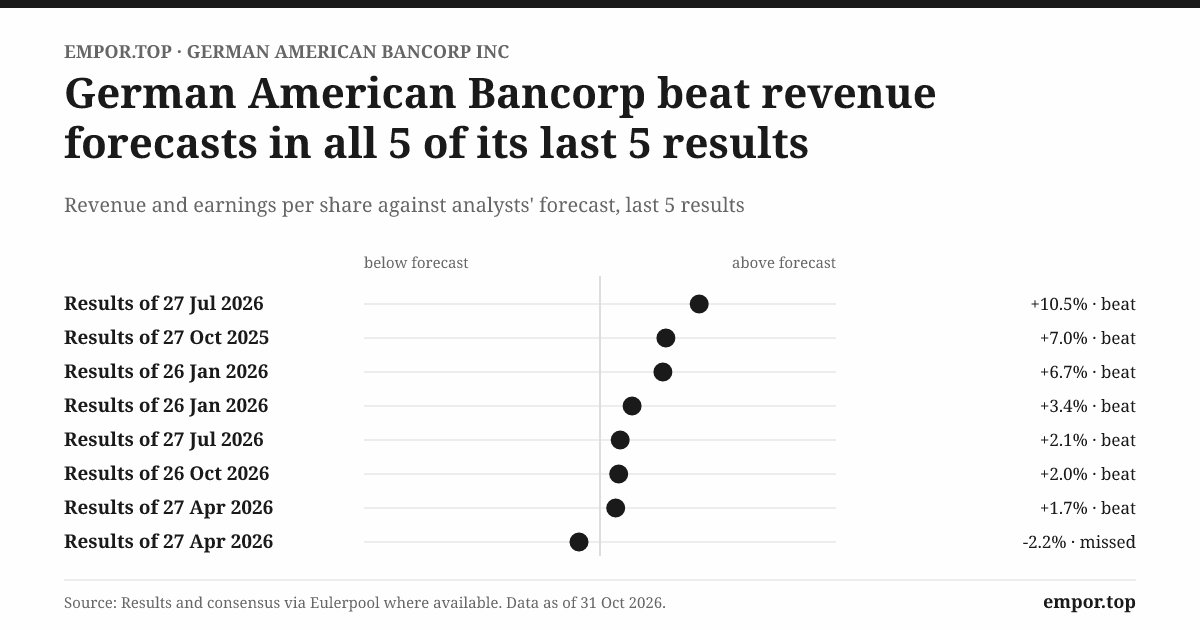
On October 26, 2026, German American reported a record quarter.5 Net income rose about 10% year over year, and diluted earnings per share rose from $0.94 to $1.03.5 Operating profit rose about 11%, and the net interest margin continued to climb.5 Read quickly, it looked like the Heartland bet had been paid in full.
Read carefully, the quarter contains a ticking clock. Of that 4.42% margin, about 16 basis points came from accretion on acquired loans, down from 21 basis points a year earlier.5 Subtract the accretion and the margin is closer to 4.26%. That is still a strong number, and it rose year over year, which means the underlying business improved while the accounting boost faded. But it shows that part of the record is borrowed from the purchase-accounting discount on Heartland's loans, and that part shrinks every quarter.
The sequence of the past two years makes the point vivid. As 2025 showed, net income grew faster than earnings per share after German American issued shares for Heartland.3 The quarterly line tells the same story in miniature: the first quarter of 2025, burdened by merger costs and day-one reserves, earned just $0.28 a share; by the third quarter of 2026, earnings per share had reached $1.03.5 Trailing per-share earnings are the best in the company's history.5 Momentum is real.
Management's own figures help separate core from reported performance. In the second quarter of 2026, the company reported a margin of 4.30% and a core adjusted margin, excluding acquisition accretion, of 4.13%.18 In the first quarter, KBRA noted a margin of 4.12%.12 So the progression is upward on both measures: the core margin was improving as old low-yielding assets rolled off and were replaced at higher yields, and as deposit costs eased. That is the encouraging part. The cautionary part is that roughly 15 to 20 basis points of the reported margin, a few million dollars of quarterly income, is a one-time inheritance that will not be there in a few years.
What can sustain earnings once that inheritance is spent? Five levers. Loan growth adds earning assets: excluding Heartland, loans grew about 6% in 2025, a respectable pace for a bank in slow-growing territory.3 Loan repricing adds yield as older fixed-rate loans mature and are replaced at current rates. Lower deposit costs help if the Federal Reserve continues easing, though competitors will be fighting for the same deposits. Fee growth, especially in wealth management, diversifies. And expense control determines how much of the revenue reaches the bottom line. On that last point, the third quarter carried a signal worth watching: salaries and benefits rose about 11% year over year, attributed to more employees, higher health costs and higher incentive pay.5 That growth rate roughly matched profit growth, which is fine for now, but expenses that grow as fast as revenue do not compound margin. A quieter headwind showed up lower on the income statement. The effective tax rate in the third quarter was about 20.5%, up from about 18.6% a year earlier, as a larger share of income came from fully taxable sources rather than the tax-exempt municipal bonds that once padded community-bank returns.5 Two points of tax rate is not dramatic, but it meant pre-tax profit had to rise about 13% for net income to rise about 10%.
The noninterest-bearing deposit share of about 28% is a genuine help here, because a large block of free funding cushions the bank when rates fall: loan yields drop, but those deposits were costing nothing anyway.5 It is not immune to competition, though. During 2022 and 2023, banks across America watched noninterest-bearing balances drain into interest-bearing accounts and money-market funds as customers woke up to higher rates. A bank's free deposits are free only as long as customers do not bother to move them.
Management's current buildout points to where it thinks the next leg of growth lies. The company says it has been hiring wealth advisors, commercial-and-industrial lenders and treasury-management specialists, with an eye on the metro markets.5 This is a growth effort inside the core bank, not a new business line: German American is trying to turn the Columbus, Cincinnati and Louisville footholds into full-service franchises that sell more than mortgages and real-estate loans. Commercial-and-industrial lending, loans to operating businesses rather than against property, is where relationship banks earn their best deposits, because a company that borrows from you usually runs its payroll through you too. That is the right strategic aim. It is also the part of banking where the big regionals compete hardest.
Investors should resist treating the third quarter as a new earnings floor. One quarter cannot tell you how much margin remains once purchase marks run down, or how the bank will fare if rates move sharply in either direction. The trailing return on equity of about 12.5% is respectable and well above 2025's roughly 9.6%, but it includes the accretion boost and comes after several years in which return on equity fell from about 14.5%.3 The honest reading is that German American's earnings power after Heartland is meaningfully higher than before, and that the precise level, once the accounting boost is gone, remains to be shown.
And there is a second clock running alongside the accretion clock, the one that every acquirer of a loan book watches nervously: the moment when the acquired loans show their true credit quality.
VII. The First Credit Test of the New Ohio Footprint
Credit problems at a bank rarely arrive with a bang. They arrive as a quiet reclassification: a borrower who has always paid on time misses a payment, then another, and a loan officer moves the file from one column to another. At September 30, 2026, German American's columns looked almost pristine. Nonperforming assets, the loans no longer paying as agreed plus any repossessed property, totaled about $24.0 million, or 0.29% of total assets.5 Nonperforming loans were 0.40% of the loan book; loans 30 to 89 days past due, the early-warning bucket, were 0.33%; and annualized net charge-offs, the losses actually written off, were 0.04% of average loans.5 That last number means that for every $10,000 the bank lent, it was losing about four dollars a year. Few banks in America were doing better.
But one detail in that same report changes how the clean picture reads. Of the $24.0 million of nonperforming assets, about $14.5 million came from loans acquired with Heartland.5 Heartland's loans make up roughly a quarter of the combined bank's book at closing, yet they account for about three-fifths of its problem assets. That does not mean Heartland was a badly run lender; acquired portfolios often carry a few troubled credits that the buyer identified in due diligence and marked down at closing. It does mean the Ohio book is where credit risk is concentrated today, and that the credit marks German American took at closing are about to be tested against reality.
To understand the exposure, translate the categories into the bank's actual risk. Commercial real estate is the largest loan category: office buildings, retail strips, warehouses, apartment complexes and the like, financed with loans that depend on rents and property values.3 Commercial operating lines, the revolving credit a business draws on to buy inventory or meet payroll, create direct exposure to the health of local companies. Agricultural lending ties part of the book to crop prices and farmland values. None of these is exotic. All of them can go wrong together in a regional downturn, because a bank whose loans are concentrated in one part of the country cannot diversify away a recession there.
The reserve build shows how the bank prepared. Its allowance for credit losses, the cushion set aside for expected future losses, rose to about $77.7 million at the end of 2025 from about $44.4 million a year earlier, including about $32.7 million that came with Heartland.3 By September 2026 it stood at about $79.3 million, or 1.32% of loans.5 Put differently, the reserve is roughly three times the size of all nonperforming loans, and at the current pace of charge-offs it would take decades to exhaust. That is a strong cushion, and KBRA cited reserve coverage and historically low losses among the reasons for its stable rating.12
What remains unknown is concentration. In the filing for 2024, German American disclosed that its largest single borrower relationship was about $162.2 million, primarily multifamily apartment loans.19 That was a substantial exposure for a bank of its size then, equal to roughly a fifth of its equity. The 2025 filing's loan-risk disclosures do not present an equivalent top-borrower table, so it is impossible to say from the company's own disclosures whether that relationship has grown, shrunk or been joined by large Heartland relationships.3 For a bank that has just added a quarter to its loan book in new markets, the absence of a comparable concentration disclosure is a real gap. It is not evidence of a problem, but it means investors are trusting the aggregate numbers without seeing the shape of the largest bets.
There is also exposure that does not yet appear on the balance sheet. At the end of 2025, German American had about $826 million of unfunded commitments on variable-rate commercial operating lines.3 These are promises to lend: credit lines that businesses have arranged but not fully drawn. In good times they sit unused. In bad times, companies under pressure tend to draw their lines precisely when the bank would least like to lend. They are potential future exposure, not loans today, but they are worth roughly a seventh of the current loan book.
The 2025 filing also reported no loans modified for borrowers in financial difficulty in either 2025 or 2024, a sign that the bank was not quietly extending and pretending on troubled credits during the integration.3 That matters because modifications are often the first place stress hides.
KBRA's view is a useful check rather than a verdict. Its June 2026 affirmation recognized low historical losses and solid reserve coverage, but it explicitly named acquisition-related increases in nonperforming assets as a constraint and identified deterioration in asset quality as a sensitivity that could pressure the rating.12 KBRA followed with a full surveillance report weeks later, keeping the same framing.20 Rating agencies are paid to worry, and their stable outlook means they see nothing alarming yet. It also means the people who look at this bank's credit most closely regard Heartland's book as the live test.
The verdict on credit, then, is strong today with a known pressure point. German American's long record of very low losses is the best evidence that its underwriting culture works in its home markets. Whether that culture extends to loans it did not originate, in markets it is still learning, is the question the next several quarters will answer. The sensible way to watch it is to follow the Heartland problem loans through resolution: do they get worked out, repaid or sold at close to their marked value, or do they migrate to charge-offs larger than the marks anticipated? And that, in turn, puts a spotlight on the people who made the bet.
VIII. Dauby's Scorecard: Growth, Pay, and Dilution
Neil Dauby did not come up through the teller line. He spent sixteen years as a certified public accountant at regional accounting firms in Kentucky before joining German American in 2001, and he earned his degree at Western Kentucky University in Bowling Green, one of the markets German American would later enter by acquisition.10 At the bank he ran commercial lending as chief commercial banking officer and served as president of a subsidiary, the classic path for a relationship banker who learns credit from the borrower's side of the table.10 He became chief executive on January 1, 2022 and chairman in 2023.711 Beside him stands Bradley Rust, the long-time chief financial officer, who added the chief operating officer role in 2022 and the president's title in 2023.711 Together they own the Heartland decision completely. There is no predecessor to blame and no outside acquirer to credit; the plan was theirs from announcement to integration.
The accountant's instinct shows in the way the deal was presented: cost savings modeled precisely, revenue synergies left out, merger charges estimated to the hundred thousand.2 It also shows in the coordinated spring 2024 moves, which looked less like a banker chasing growth than a finance team arranging the balance sheet before a transaction. That is a reasonable portrait of a management style. Whether it adds up to good capital allocation requires a scorecard.
Start with pay. Dauby's total compensation rose from about $1.42 million in 2023 to about $1.66 million in 2024 and about $2.07 million in 2025, while net income moved from about $85.9 million to $83.8 million and then to $112.6 million.21 Rust's pay rose from about $951,000 to about $1.27 million over the same span.21 By the standards of American bank CEOs that is modest pay; executives at banks several times larger earn many multiples of it. The incentive structure is measurable rather than discretionary: short-term incentive payouts for 2025 ranged from about 54% to 78% of salary, and the only discretionary payment to a named executive was a small combined promotion and sign-on payment to another officer.21 The awkward detail is that pay tracked total net income, which rose about 35% in 2025, more closely than per-share earnings, which rose about 6%. A shareholder would rather see executives rewarded for the second number than the first, because the first can be bought with stock.
Ownership is modest too. Directors and executive officers as a group held about 3.2% of the company in March 2026.21 That is meaningful money for the individuals but not the kind of stake that aligns a management team as tightly as a founder's holding would. The biggest outside holders are index giants: BlackRock with about 6.4% and Vanguard with about 6.1%, though the company cautioned that Vanguard's figure had not been cleanly updated.21 There is no controlling shareholder and no concentrated activist on the register to press management on capital allocation.
The board structure reflects the merger. The board identified Dauby and G. Scott McComb, Heartland's former chief executive who joined after the deal, as its non-independent members, and Zachary Bawel serves as lead independent director, a counterweight to a combined chairman and CEO.21 Giving the seller's CEO a board seat is standard in a deal of this size and keeps Heartland's leadership invested in the outcome; it also means the person who sold the bank at 217.5% of tangible book now helps oversee its performance. Insider dealings with the bank are ordinary for a community lender and small in scale. Loans to directors, executives and their related companies ended 2025 at about $33.8 million, slightly lower than a year earlier, made on terms the company says are comparable to those offered to unaffiliated borrowers, while deposits from insiders and affiliates rose to about $106 million from about $64 million.321 There is no outside parent charging fees and no royalty arrangement; the governance risks here are about judgment, not self-dealing.
Then came the vote that will shape the next chapter. At the April 2026 annual meeting, shareholders approved doubling the number of authorized common shares from 45 million to 90 million, by about 29.4 million votes to about 845,000.22 Say-on-pay passed by about 22.75 million votes to about 463,000.22 Those are overwhelming margins. The proxy said there were no definitive plans to issue more shares beyond existing equity-plan reservations.21 With about 37.5 million shares outstanding, the old authorization still left room for some issuance, so the doubling is best read as capacity for a future deal. Authorization is not dilution. But a company does not usually ask for the ability to more than double its share count unless it wants the option to use it.
The skeptic's test is to compare per-share outcomes before and after deals rather than totals. On that measure, the record is respectable but not spectacular: per-share earnings roughly doubled in the decade to 2025, and they have climbed more steeply in the trailing period now that Heartland is fully in the numbers.35 Tangible book value per share took a hit at the Heartland closing from goodwill and from the rate-driven losses in the bond portfolio, and the third-quarter release noted that higher long-term rates had again weighed on tangible book.5 The insurance sale looked like a disciplined portfolio choice. Heartland's verdict will depend on whether per-share earnings and tangible book keep climbing once accretion fades. An activist reviewing this company would not find a governance scandal. They would ask a narrower question: why should shareholders give management a blank check of 52 million additional authorized shares before the last deal has proven itself?
The credibility test also runs through management's words. Over the course of 2026, German American began publishing a core margin that strips out acquisition accretion alongside its reported margin, which is the right disclosure: it lets investors see exactly how much of the margin is inherited.18 Investors who compare the July 2024 deal presentation with the 2026 earnings releases will find the cost-savings promise broadly honored in the expense lines, and the margin running well above where it stood before the deal.25 They should keep listening for three things on future earnings calls, which the company archives with its presentations.23 The first is how candidly management explains the gap between core and reported margin as it narrows, how it describes organic growth in Ohio separately from the acquired base, and how it characterizes the Heartland problem loans. The Citizens Union period in 2022 offers a historical check, when integration costs and rate-driven securities marks hit at the same time and per-share earnings fell before recovering.9
The governance hygiene is clean. Crowe LLP gave unqualified opinions on the 2025 financial statements and on internal controls, reporting no material weakness.3 The 2025 filing reports no legal proceedings beyond routine litigation.3 Neither fact resolves the question that matters most, which is whether this team will allocate capital as well in the next deal as it did in the insurance sale. That question is one the stock market has its own way of answering.
IX. What the Market Is Paying For
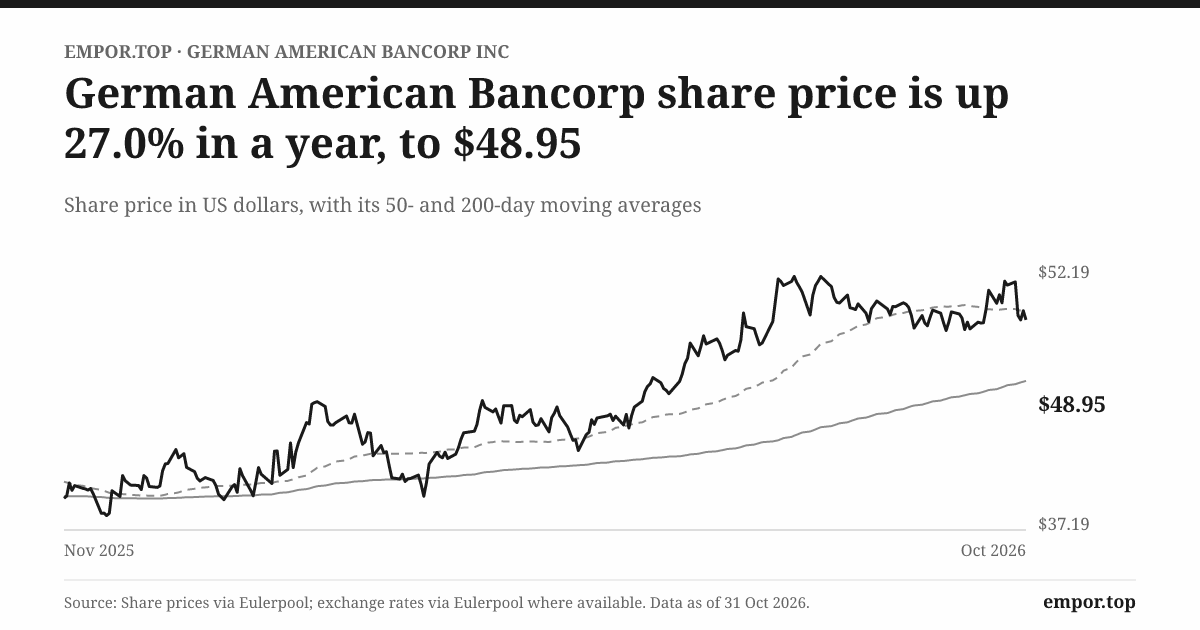
On October 31, 2026, German American's shares closed at $48.95, about 5% below their 52-week high of $51.39 and well above the low of $37.99 set within the past year.24 The market value was about $1.8 billion. On the surface the stock had been rewarded for the Heartland execution. Underneath, its valuation told a more cautious story.
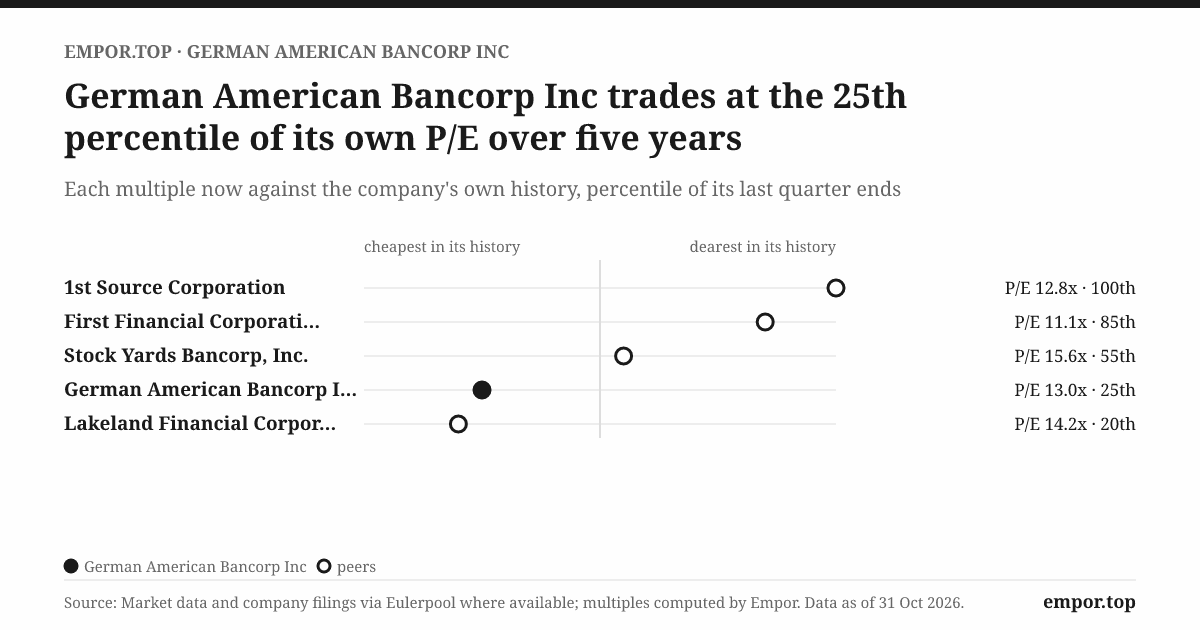
At about 13 times trailing earnings, German American traded below its own five-year median of about 16 times.243 Flip the multiple and the earnings yield is about 7.7%: for every hundred dollars of share price, the company earned about $7.70 over the past year. The stock traded at about 1.6 times book value and yielded about 2.5% in dividends. A comparison service showed Lakeland Financial, the closest Indiana peer, at a slightly higher trailing multiple at the end of October, though different data providers calculate these figures differently and the gap is narrow.24 The market, in short, was paying a little less for each dollar of German American's earnings than it had in recent years, even though those earnings had never been higher.
Why might the market discount German American? Several reasons are visible. Regional banks as a group have carried a valuation scar since the failures of 2023, when investors learned how fast deposits can flee and how much damage bond losses can do to capital. German American's commercial real estate exposure is a second. The Heartland loan book has not yet seasoned. The bond portfolio still carried about $211 million of gross unrealized losses at the end of June 2026, which depresses tangible capital.13 And part of the current earnings comes from the purchase-accounting accretion that will fade. A rational investor might reason that today's record earnings are partly a peak, and price the shares on a lower normalized figure.
The counter-case is just as visible. Deposit costs are well below peers.12 The margin is strong even after stripping out accretion.18 Charge-offs are negligible and the reserve is large.5 Capital is solid: the common-equity tier-one ratio, the regulator's preferred measure of loss-absorbing capital, was about 14.3% at the holding company in September, comfortably above requirements, and tangible common equity was about 9.4% of tangible assets.5 And the stock trades below its own recent valuation history. If the post-Heartland earnings base proves durable, the current multiple discounts more pessimism than the evidence yet supports. If accretion fades without replacement and Ohio credit worsens, the multiple is fair or generous.
Capital returns sit between those cases. German American has paid out between about 26% and 39% of its profits as dividends in every year since 2014, a narrow and conservative band, and dividends paid grew about 17% a year over the decade, faster than net profit.3 The payout ratio crept up toward the top of its range in 2025, reaching about 39%, which reflects both a rising dividend and the year's acquisition-depressed per-share earnings.3 The retained two-thirds of profits are what fund loan growth and rebuild capital after deals. The board has a one-million-share repurchase authorization but reported no buybacks under it, a choice that says the company prefers to keep capital for growth.3 The liability side was tidied in parallel. In September 2025 German American redeemed about $24.3 million of subordinated notes inherited from Heartland, and in December it redeemed $40 million of its own subordinated notes, retiring relatively expensive holding-company debt rather than refinancing it.3 Total borrowings stood at about $268 million in September 2026, almost entirely ordinary bank funding.5 There is no refinancing wall and no covenant pressure disclosed. The capital structure, in other words, is not where the risk lives; the risk lives in the loan book and the bond portfolio's sensitivity to long-term rates.
The valuation puzzle reduces to a few numbers that will decide which side of the argument proves right. The first is the core net interest margin, excluding purchase-accounting accretion; in the second quarter it was about 4.13% against 4.30% reported, and its direction once accretion is gone will reveal the bank's real earning power.18 The second is organic loan and deposit growth; loans grew about 6% excluding Heartland in 2025, while deposits outside the acquisition shrank slightly, and the bank needs both to grow together to keep its funding edge.3 The third is acquired-credit migration against reserves, starting with the roughly $14.5 million of Heartland nonperforming assets.5 Those three readings matter more than any single quarter's earnings.
There is also the skeptical investor's question that hangs over the valuation. If German American uses its newly authorized shares for another acquisition, will it show a credible path to higher per-share earnings and tangible book value? The market's modest multiple may partly reflect exactly this uncertainty: a bank that grows by issuing stock can turn a good franchise into a mediocre per-share investment if it overpays repeatedly. The best evidence against that worry is the trailing per-share earnings growth since Heartland closed. The best evidence for it is that the bank has just asked for permission to issue more shares than it has ever had outstanding. Which is why the lessons of this story are about currency as much as about banking.
X. Playbook: Business & Investing Lessons
Go back to the spring and summer of 2024 and watch the sequence as a single film. German American repositioned its balance sheet, sold a legacy business and bought its way into Ohio. Each move made sense alone. Together they contain most of what this company can teach.
The first lesson is that a deposit franchise is built one relationship at a time, then tested one rate cycle at a time. German American's low-cost funding is evidence that local banking still has an edge over national rivals and fintech apps, but habits are not contracts. The wider lesson for anyone building a relationship business: switching costs that rest on convenience and trust are real, but they must be re-earned whenever the price of loyalty goes up.
The second lesson is that a premium is only cheap when the earnings arrive per share. The deal's currency softened the price, but did not remove the dilution. The fair test is whether each share earns more than it would have without the deal. The early evidence leans positive. The final evidence arrives when the accretion is gone.
The third lesson is that selling well is part of investing well. German American recognized the agency could be worth more inside Hilb, kept a referral arrangement and used the gain to clean up its bond portfolio. The discipline here was to let go at the top of a seller's market. The lesson for founders and investors is that a sale is a capital-allocation decision as consequential as any purchase, and that the right buyer for a business is the one who can do more with it.
The fourth lesson is that bank cash flow is the balance sheet moving. For banks, profit, capital ratios and tangible book per share are better guides to owner earnings than free cash flow. Applying the wrong lens to a lender is how investors end up paying for cash that was never free.
Keep the lessons conditional. Years of acquisitions show German American is strategically consistent: it knows what it is, a relationship bank in mid-sized Midwestern markets, and it keeps buying more of the same. What the record does not yet show is that consistency translates into superior per-share returns over full cycles. The patient roll-up is a real strategy. Whether it is a great one is still being decided in Ohio.
XI. Epilogue
Tonight German American is a bigger, more profitable bank than it has ever been. Its third-quarter earnings were a record, its margin is among the strongest in its peer group, its credit metrics are pristine in aggregate, and its stock trades below its recent historical multiple. It is also a bank in the middle of a test whose answer is not yet in. The next annual report, covering the first full calendar year with Heartland, will be the first document to show Ohio integration across twelve months and a longer run of acquired-credit performance.
The first thing to watch is whether the core margin rises as purchase-accounting accretion fades.185 If it does, through loan repricing and cheaper deposits, then the record earnings are a floor rather than a peak. If the reported margin drifts down toward the core figure, then 2026's earnings were partly a one-time inheritance, and the market's cautious multiple was right.
The second is growth. Loans grew at a solid pace outside Heartland in 2025.3 The tougher test is whether deposits can keep up without a sharp rise in cost, especially in Columbus and Cincinnati, where German American is small and its competitors are among the largest banks in the country. If the bank funds its loan growth with expensive deposits or borrowings, its funding advantage shrinks; if it funds it with new operating accounts from the commercial customers its new hires are courting, the local model has traveled.
The third is credit. The acquired problem loans will follow one of three paths: resolution, workout, or charge-off.5 If they are resolved near their marked values, the due diligence was sound. If they migrate into charge-offs larger than the credit marks anticipated, the premium German American paid will look worse in hindsight. Investors should also look for a return of the top-borrower concentration disclosure, which would show whether the bank's largest relationships have grown since the deal.
The fourth is capital. Higher long-term rates have weighed on tangible book value, management noted.5 The unrealized losses in the bond portfolio will gradually shrink as the bonds approach maturity, a slow but nearly certain rebuild of tangible capital, unless rates rise further. Retained earnings will add to it. That rebuild matters because tangible book per share is the denominator of the deal's success.
The fifth is the authorization. The board has room for substantial new issuance.22 Any new issuance, whether for an acquisition or anything else, should be judged as a fresh capital-allocation decision, measured against per-share earnings and tangible book rather than the size of the resulting bank.
Put these together and the next phase becomes measurable. Continued core growth with stable credit would validate Heartland and the roll-up model that produced it. Fading margin, rising acquired-credit losses, or another stock-funded deal without stronger per-share returns would weaken the case. German American has bought a new map. The next eighteen months will show whether it has also bought the territory.
XII. Outro
Return to Jasper. The courthouse square still has the bank on it, and the bank still describes itself the way it did when it opened in 1910: as a place close enough to its customers to know their business.6 What has changed is the reach of that promise. German American now operates across three states,3 and a meaningful share of its deposits still sits with it for nothing, a quiet vote of confidence from customers who could earn more elsewhere and do not bother.5
That is what makes this bank unlike the giants competing for the same customers. JPMorgan and Fifth Third win on scale, technology and reach. German American is wagering that a community bank can acquire the reach of a regional bank without losing the economics of being local. The $330 million question was never whether it could buy a new map. It was whether the people and deposits on that map would stay. Every quarter from here, Columbus and Cincinnati will answer a little more of it, and each step farther from the courthouse square makes the old advantage a little harder to take for granted.
References
-
German American Bancorp and Heartland BancCorp Announce Definitive Merger Agreement — German American Bancorp, 2024-07-29 ↩↩↩↩↩↩
-
Heartland Merger Investor Presentation — German American Bancorp (SEC), 2024-07-29 ↩↩↩↩↩↩↩↩↩↩↩↩↩↩
-
2025 Annual Report on Form 10-K — German American Bancorp (SEC), 2026-02-27 ↩↩↩↩↩↩↩↩↩↩↩↩↩↩↩↩↩↩↩↩↩↩↩↩↩↩↩↩↩↩↩↩↩↩↩↩↩↩↩↩↩↩↩↩
-
Insurance Sale and Securities Repositioning, Form 8-K — German American Bancorp (SEC), 2024-06-03 ↩↩↩↩↩↩
-
Q3 2026 Earnings Release — German American Bancorp (SEC), 2026-10-26 ↩↩↩↩↩↩↩↩↩↩↩↩↩↩↩↩↩↩↩↩↩↩↩↩↩↩↩↩↩
-
Management Succession Plan, Form 8-K — German American Bancorp (SEC), 2021-06-28 ↩↩↩↩
-
2024 Annual Report on Form 10-K — German American Bancorp (SEC), 2025-03-03 ↩↩↩↩↩↩↩
-
2022 Proxy Statement (Form DEF 14A) — German American Bancorp (SEC), 2022 ↩↩↩
-
German American Announces Chairman of the Board and President Transition — German American Bancorp, 2023 ↩↩↩
-
KBRA Affirms Ratings for German American Bancorp, Inc. — KBRA, 2026-06-12 ↩↩↩↩↩↩
-
Quarterly Report on Form 10-Q for Q2 2026 — German American Bancorp (SEC), 2026-08-06 ↩↩
-
Indiana Banks and Thrifts Pricing — Indiana Bankers Association, 2026-03-31 ↩
-
German American to buy Ohio's Heartland in $330 million deal — Banking Dive, 2024 ↩
-
Indiana Banks and Thrifts Stock Analysis — Indiana Bankers Association, 2024-10-11 ↩↩
-
Joint Proxy Statement/Prospectus for Heartland Merger — German American Bancorp and Heartland BancCorp, 2024-09-24 ↩
-
Q2 2026 Earnings Release — German American Bancorp (SEC), 2026-07-27 ↩↩↩↩↩
-
2024 Annual Report to Shareholders — German American Bancorp (SEC), 2025 ↩
-
KBRA Releases Surveillance Report for German American Bancorp, Inc. — KBRA, 2026-06-30 ↩
-
2026 Proxy Statement — German American Bancorp, 2026-03-18 ↩↩↩↩↩↩↩↩
-
2026 Annual Meeting Voting Results, Form 8-K — German American Bancorp (SEC), 2026-04-29 ↩↩↩
-
GABC–Lakeland Financial Valuation Comparison — USA Equity Research, 2026-10-30 ↩↩↩
 LinkedIn
 WhatsApp
 Reddit
 Hacker News
 Email
 Kindle
 RSS Feed
 Spotify
 Apple Podcasts
 Amazon Music
 Audible
 YouTube