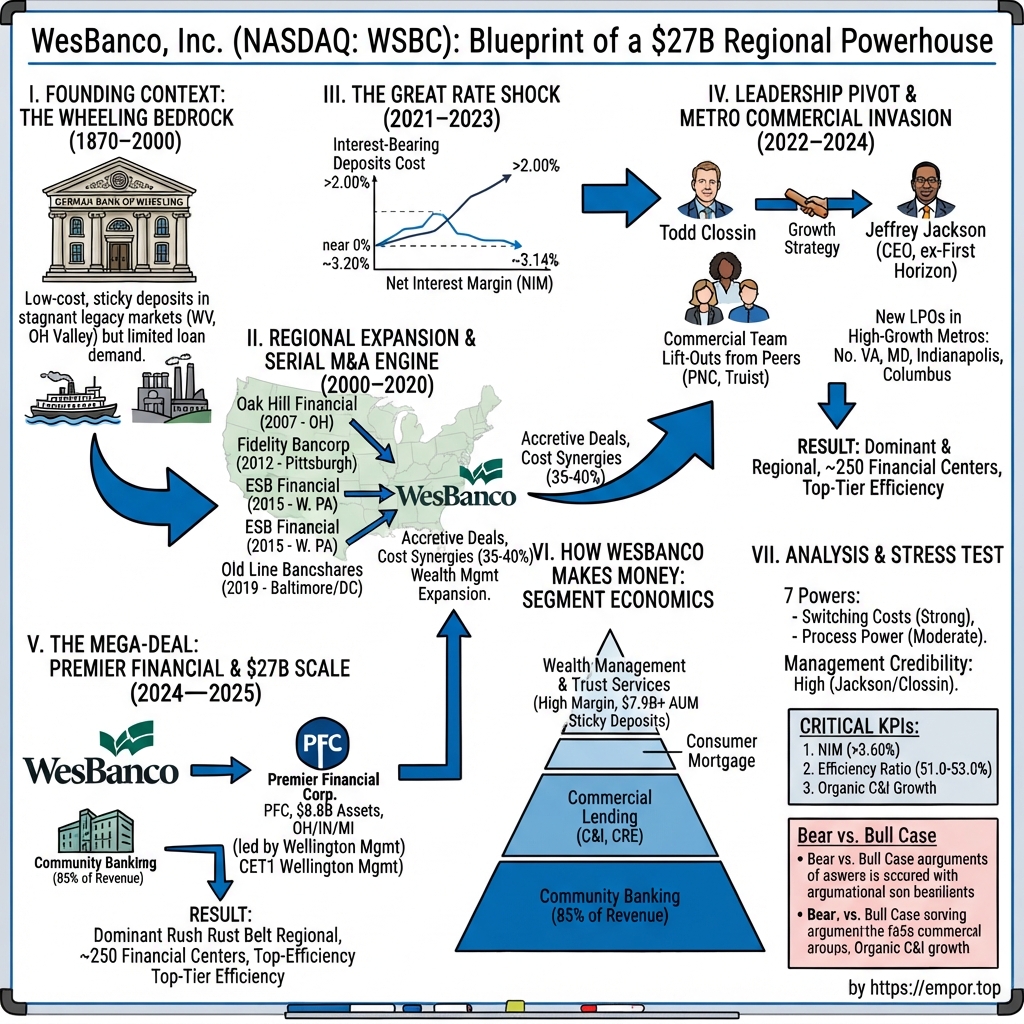
WesBanco, Inc. (NASDAQ: WSBC): The Blueprint of an Appalachian Bank's Metamorphosis into a $27B Regional Powerhouse
I. Introduction & Episode Roadmap (12 min)
There is a building at 1 Bank Plaza in Wheeling, West Virginia — roughly 100,000 square feet, owned outright, sitting in a city whose population peaked before the Second World War. It houses the executive offices of a bank holding company, its community banking segment, its trust operation, and, connected by a skywalk, approximately 90% of an adjacent office building that contains the back office.1 Nothing about the address suggests scale. Wheeling is not a financial center. It is a river town that once produced steel, glass, and cigars, and mostly no longer does.
Yet, as of June 30, 2026, the company headquartered in that building held $27.8 billion in assets, $19.5 billion in loans, and $21.6 billion in deposits, spread across roughly 250 financial centers in nine states from Michigan to Maryland.2 It employs close to 3,000 people.1 Over the past 18 months, it acquired an $8.7 billion Ohio bank, converted its core systems, consolidated dozens of branches, and reported the lowest efficiency ratio in its history.
That is the setup. The critical question is not how did it get big — regional banks expand by acquiring competitors, and this company has done so more than a dozen times. The real question is whether scale has made it a better business or merely a larger one.
The core paradox. WesBanco's modern strategy relies on a funding-and-lending arbitrage that sounds straightforward on paper but is demanding to execute. Deposits in northern West Virginia and the Upper Ohio Valley are low-cost and resilient — backed by long-tenured retail customers, low price sensitivity, and decades-old relationships. However, those legacy markets generate limited economic growth and insufficient loan demand to absorb the funding base. Meanwhile, metropolitan markets like Pittsburgh, Columbus, Cleveland, Indianapolis, Louisville, and the Baltimore–Washington corridor offer abundant commercial loan demand — along with fierce competition from Huntington, Fifth Third, PNC, KeyBank, and Truist bidding for the same deposits and credit facilities. The operational playbook is to gather stable funding in low-growth markets and deploy capital into high-growth ones. Every branch acquisition, loan production office, and commercial lending team hire since 2007 reflects this fundamental trade-off.
The catalytic event. On July 26, 2024, WesBanco announced an all-stock merger with Premier Financial Corp. of Defiance, Ohio — offering 0.80 WesBanco shares for each Premier share, valuing the deal at roughly $959 million, or approximately 142% of Premier's tangible book value.3 Concurrent with the transaction, WesBanco raised $200 million via a private placement of common stock, anchored by a $125 million investment from Wellington Management, alongside participation from Glendon Capital Management and Klaros Capital.3 The transaction closed on February 28, 2025, expanding the combined enterprise past $27 billion in total assets.4
What this analysis will test. Management presents a clear narrative: a disciplined acquirer acquired a strategically adjacent franchise at an attractive valuation, removed overlapping expenses, reduced its efficiency ratio to a record low, expanded net interest margins, and resumed organic growth. While operational metrics validate parts of this narrative, key durability assumptions warrant scrutiny — specifically whether the deposit base constitutes a true economic moat, whether serial M&A is a repeatable core capability, whether conservative underwriting adequately insulates the commercial real estate portfolio, and whether asset growth has enhanced per-share shareholder value.
Filings reveal important counter-evidence on these points. Most notably, as of December 31, 2025, and continuing through June 30, 2026, management and the company's independent auditor both determined that internal control over financial reporting was ineffective due to a material weakness in controls governing the fair value valuation of assets acquired from Premier.15 This deficiency highlights operational risks within the core integration process itself.
Episode structure. The analysis begins in 1870 with a bank established by German immigrants in an Ohio River industrial town, moves through the century of growth that established its core deposit base, and focuses on the pivotal modern period: the acquisition expansion from 2007 to 2019, the interest rate shock that tested its funding model, the executive transition to Jeffrey Jackson, the Premier acquisition, and the resulting financial profile. Subsequent sections evaluate the core playbook, competitive position, key investment risks, and critical financial metrics.
 Subscribe on LinkedIn
II. Founding Context & The Wheeling Bedrock (1870–2000) (18 min)
In January 1870, five years after Appomattox and seven years after West Virginia seceded from Virginia to stay in the Union, a charter was issued in Wheeling to an institution called simply The German Bank. It opened for business that April. The name was literal: Wheeling had absorbed a large German immigrant population, and the bank's early officers were mostly of German descent.6 The Upper Ohio Valley in that decade was an industrial corridor in the making — nail mills, glassworks, coal, and the river traffic that moved all of it. A bank there was, in the most direct sense, infrastructure for a manufacturing boom.
The institution's subsequent name changes read like a compressed history of the twentieth century. In 1918, with American troops fighting Germans in France, The German Bank became the Wheeling Bank & Trust Company.6 In 1923, it absorbed the Bank of the Ohio Valley. In 1933 — during the trough of the banking crisis and the national bank holiday — it merged with Dollar Savings & Trust to form Wheeling Dollar Savings & Trust, then the largest bank in West Virginia with assets north of $19 million.6 Consolidation during a crisis, when the alternative for the weaker party was failure, is a pattern that recurs.
WesBanco itself was incorporated in 1968 and became a registered bank holding company in 1976.6 For most of that era, the structure was federated rather than unified: a collection of affiliated banks, each with its own charter, board, and local identity, sitting under a holding company. West Virginia law was the binding constraint. Branch banking was not legal in the state until 1982, which meant that for over a century the only way to serve an adjacent county was to own a separate bank in it. When the law changed, WesBanco expanded branches rapidly, and by 1991 the affiliated banks had all consolidated under the WesBanco name.6 The final structural simplification came on January 14, 2000, when four regional banks — Charleston, Fairmont, Parkersburg, and Wheeling — merged into a single entity, WesBanco Bank, Inc.6
Why the legacy geography still matters. It is tempting to treat the pre-2000 history as color. It is not, because it produced the one asset WesBanco cannot buy: a funding base assembled over generations in markets where nobody else particularly wants to compete.
The economics of that base are worth stating plainly, because they are the foundation of the entire modern strategy. A deposit is a loan from a customer to the bank. Its cost depends almost entirely on how easily and how quickly that customer will move the money somewhere better. In a dense, affluent, high-competition metro, the answer is: very easily, within days, at the first attractive CD rate. In a small West Virginia or eastern Ohio town where the household has banked at the same branch for thirty years, where the local business's payroll, lockbox, and line of credit all sit in one place, and where the alternative is a fifteen-mile drive, the answer is: slowly, and only if the gap gets wide.
That produces a structurally lower cost of funds and — critically — a lagged one. When market rates rise, the legacy deposits reprice later and less than the market. That lag is worth real money in a rising-rate environment. It is also, as the 2022–2023 period demonstrated, a lag rather than an immunity, a distinction the company's own numbers eventually forced.
The other half of the legacy inheritance is the trust department. A bank that has served the same families since the nineteenth century ends up administering their estates. WesBanco's trust and investment services business is one of only two reportable segments in its financial statements — the other being community banking — which tells you how the company itself thinks about it.1 It is small in revenue terms and always has been, but it is the source of relationships that are measured in decades rather than product cycles.
The trade-off nobody could engineer away. The problem with the bedrock was arithmetic. Northern West Virginia and the Ohio river towns were not adding people, businesses, or GDP at any rate that would absorb a growing deposit base. A bank that gathers cheap money it cannot profitably lend ends up parking it in securities, earning a spread thinner than a loan spread, and watching its returns compress. By the late 1990s, WesBanco was a conservative, trust-heavy community bank with excellent funding, adequate credit, and a structural growth ceiling.
Management could either accept slow terminal decline in a shrinking market, or go find the loan demand somewhere else. Every important decision of the next twenty-five years followed from choosing the second option.
III. The Regional Expansion Playbook & Serial M&A Engine (2000–2020) (30 min)
WesBanco's initial expansion beyond its core regional market began just ahead of the 2008 financial crisis, highlighting both the logic and the execution risks of its M&A strategy.
On November 30, 2007, WesBanco completed its acquisition of Oak Hill Financial, a $1.3 billion bank holding company based in Jackson, Ohio. Management's rationale was to expand the footprint into higher-growth metropolitan and regional markets in Ohio.7 The deal established a foothold in central and southern Ohio on the approach to Columbus, which subsequently became one of the Midwest's fastest-growing metropolitan areas.
However, closing nine months before the 2008 financial crisis exposed the newly acquired loan portfolio to a sharp credit downturn, testing early expansion timing.
Opportunistic deposit acquisition. In January 2009, amidst industry-wide banking distress, WesBanco agreed to purchase five Columbus, Ohio branches from AmTrust Bank. The bank paid a blended deposit premium of 3.5% — approximately $21 million — to acquire about $600 million in deposits, closing the transaction in March 2009.8 AmTrust failed later that year.
The AmTrust transaction illustrated the company's funding arbitrage: leveraging a stable Appalachian deposit base to acquire funding in growth markets at distressed valuations. This established a pattern of acquiring deposits countercyclically when distressed sellers had limited options.
The Pittsburgh entry. On July 19, 2012, WesBanco entered into a merger agreement with Fidelity Bancorp and its subsidiary, Fidelity Savings Bank, marking its entry into the Pittsburgh metropolitan market.9 As a thrift heavily weighted toward residential mortgages rather than commercial banking, Fidelity provided branch infrastructure and a charter footprint in a dense metro area two hours north of Wheeling.
This sequence established WesBanco's market entry pattern: initial small acquisitions secured regulatory presence and branch infrastructure, while subsequent transactions built operational scale.
Building scale in western Pennsylvania. In February 2015, WesBanco completed its acquisition of ESB Financial Corp. for approximately $324 million. The transaction added roughly $1.9 billion in assets, turning the Pittsburgh entry into a significant western Pennsylvania presence and shifting the bank's asset base primarily outside West Virginia.
Expansion into Indiana and Kentucky. In 2016, WesBanco acquired Your Community Bankshares for about $221 million, expanding into southern Indiana and Louisville. In August 2018, it acquired Farmers Capital Bank Corporation for approximately $378 million, adding about $2.3 billion in assets across Frankfort, Lexington, and Louisville. Each transaction adhered to a consistent formula: targeting contiguous markets with stronger demographics at a size management could readily integrate.
Mid-Atlantic expansion. On July 23, 2019, WesBanco announced an agreement to merge with Old Line Bancshares, a Maryland institution with approximately $3.1 billion in assets and 37 branches across Maryland and the Washington, D.C., region. Under the terms, Old Line shareholders received 0.7844 WesBanco shares per Old Line share, valuing the deal at roughly $500 million, or $29.22 per share.10 Upon closing, the transaction increased total assets to approximately $15.6 billion across 236 financial centers in six states.10
The Old Line acquisition stretched the contiguous footprint model into the highly competitive suburban Washington corridor. While offering strong loan demand, it increased exposure to Mid-Atlantic commercial real estate — including suburban office, retail, and multifamily properties — introducing asset classes that experienced structural headwinds after 2020.
Integration and operational synergies. By 2019, WesBanco had institutionalized its integration playbook: acquiring community banks in adjacent growth markets, reducing non-interest expenses through branch and back-office consolidation, converting targets onto a unified core platform, and cross-selling wealth management and treasury services.
Revenue synergies relied on introducing institutional capabilities to acquired customer bases. Smaller community banks often lack the scale to maintain full-service trust departments, interest rate swap desks, or advanced treasury tools. WesBanco amortized these fixed technology and operational costs across a larger asset base — supported by a core banking software contract running through 2033 with a projected minimum annual obligation of $16.6 million.1 This provided a persistent revenue expansion mechanism beyond initial cost cuts.
Balance sheet evolution under Clossin. Todd F. Clossin served as chief executive officer from 2014 until August 1, 2023, standardizing M&A underwriting criteria such as immediate earnings accretion and defined tangible book value earnback periods.11 During his tenure, the loan portfolio shifted from residential mortgages toward commercial lending. By December 31, 2023, commercial real estate loans totaled $6.57 billion, or 56.4% of total loans, while commercial and industrial loans accounted for 14.4% and residential real estate represented 21.0%.12
This portfolio shift increased asset yields and commercial relationship size, but also heightened concentration in asset classes sensitive to interest rates and commercial property valuations. Consequently, WesBanco entered the 2020s with higher earning potential but increased sensitivity to economic downturns and rate volatility.
When the Federal Reserve raised interest rates by 525 basis points between 2022 and 2023, the durability of this expanded balance sheet and funding model faced its first major stress test.
IV. The Great Rate Shock & Deposit Moat Stress Test (2021–2023) (25 min)
In March 2023, three American banks failed within eleven days. Silicon Valley Bank, Signature Bank, and First Republic had distinct customer bases and failure mechanics, but they shared a critical vulnerability: funding long-duration, low-yielding assets with deposits that proved far more mobile than management models anticipated. For regional bank chief financial officers across the country, the spring of 2023 forced an immediate assessment of a single question — how sticky deposit funding truly was.
WesBanco's disclosures provided a nuanced answer: funding proved stickier than most peers', but considerably less immune to rate pressure than the core investment narrative suggested.
The claim. The structural case for WesBanco has long rested on the premise that its legacy Appalachian and Ohio Valley deposits are rate-insensitive — that low switching propensity confers a permanent net interest margin advantage over institutions funded in competitive metropolitan markets. Had that thesis held in its strongest form, the Federal Reserve's 2022–2023 tightening cycle would have yielded only a modest rise in funding costs alongside a widening margin, as asset yields repriced faster than liabilities.
The evidence. Instead, disclosures showed significant margin compression. WesBanco's average rate on interest-bearing deposits went from 0.57% in the fourth quarter of 2022 to 2.34% in the fourth quarter of 2023 — a roughly fourfold increase in twelve months.12 Including non-interest-bearing accounts, total deposit funding cost reached 161 basis points in that quarter.12 Net interest margin, measured on a fully taxable-equivalent basis, fell from 3.20% for full-year 2022 to 3.14% for full-year 2023 — but annual figures understated the downward trajectory. The quarterly path showed the real compression: from 3.49% in the fourth quarter of 2022 to 3.02% in the fourth quarter of 2023.12 That represented 47 basis points of margin compression within a single year, establishing a challenging exit rate heading into 2024.
The efficiency ratio reflected similar pressure on the expense side, deteriorating from 59.53% for 2022 to 63.64% for 2023, and to 66.75% in the fourth quarter alone.12 Diluted earnings per share fell from $3.02 to $2.51.12 Tangible book value per share, which had been $22.61 at the end of 2021, was $19.43 at the end of 2022 and had only recovered to $21.28 by the end of 2023 — the 2022 decline driven largely by unrealized losses on the securities portfolio flowing through accumulated other comprehensive income, an industry-wide phenomenon rather than a WesBanco-specific one.12
What actually happened inside the deposit base. The underlying mechanics reflect standard deposit dynamics across retail banking. A bank's deposit base comprises distinct categories: non-interest-bearing checking accounts that cost nothing, low-rate savings and interest-checking tiers that reprice slowly, and high-yield money market accounts and certificates of deposit that track broader market rates. In a near-zero interest rate environment, these distinctions remain negligible because overall funding costs are minimal. However, when short-term benchmark rates reached 5%, retail and commercial depositors holding idle balances began shifting funds into higher-yielding certificates of deposit to capture market yield.
WesBanco's customer behavior mirrored these broader industry trends. Balances migrated out of non-interest-bearing accounts into rate-bearing products, driving up total funding costs. Simultaneously, the bank was funding 8.7% year-over-year loan growth in 2023 with a deposit base that grew barely at all — total deposits went from $13.13 billion at the end of 2022 to $13.17 billion at the end of 2023, while loans grew from $10.70 billion to $11.64 billion.12 To bridge this funding gap, management relied on wholesale borrowings and brokered deposits, which reprice immediately at market rates with no lag.
The verdict, calibrated. The strongest claim — that WesBanco possesses a rate-immune deposit franchise — is disproved by the financial results. However, a weaker form of the thesis survives: legacy deposits repriced more slowly than those of metro-focused peers, allowing WesBanco to navigate the 2023 regional banking panic without liquidity distress, emergency capital raises, or deposit runs. A funding base that lags market movements on both the upside and downside offers tangible, recurring economic value.
Ultimately, WesBanco operates with a deposit lag rather than an immutable deposit moat. For financial analysis, this distinction is critical: a moat implies a permanent spread advantage across all rate environments, whereas a lag provides an advantage that expands during rate transitions and narrows once interest rates stabilize. Furthermore, this lag functions symmetrically — the slow-repricing deposit base that cushioned net interest margin during rate hikes in 2022 also delayed funding cost relief when market rates began to ease.
The 2023 financial results also underscored a structural reality of the business model. The primary driver behind two decades of bank acquisitions remains unchanged: the core Appalachian market does not generate sufficient organic deposit growth to fund expanding commercial loan demand. This structural deposit scarcity makes each merger as much a funding transaction as a lending expansion.
By late 2023, WesBanco faced a compressed margin, an elevated efficiency ratio, a commercial real estate concentration, and a newly appointed chief executive. What the institution did next determined its operational trajectory.
V. Leadership Succession & The Metro Commercial Invasion (2022–2024) (22 min)
Executive succession at a century-and-a-half-old bank in a small city usually follows a predictable script: a long-tenured internal promotion. WesBanco broke from that pattern in 2022.
On August 15, 2022, Jeffrey H. Jackson joined the institution as senior executive vice president and chief operating officer of the holding company, as well as president and chief operating officer of the bank.11 He had spent fourteen years at First Horizon, serving most recently as executive vice president and chief operating officer of regional banking in Memphis, and previously as regional president for Florida and market president for southeast Tennessee and Atlanta.11 Before entering commercial banking, Jackson worked for fifteen years at IBM.11 He holds a degree from Auburn University and a corporate strategy certificate from Columbia University.11
That background signaled a deliberate strategic shift. Fifteen years in enterprise technology brought a discipline rooted in process and large-scale system deployments, while fourteen years at First Horizon included leading commercial operations in high-growth Sunbelt markets and navigating complex bank integrations. Instead of appointing an Appalachian community banker, WesBanco selected an executive experienced in competitive metropolitan lending and operational integration.
The leadership transition followed a telegraphed twelve-month schedule. Jackson succeeded Todd Clossin as president and chief executive officer on August 1, 2023, with Clossin transitioning to vice chairman.11 This structured handoff provided stability to a company where executive officer tenure averages more than fifteen years and total employee tenure averages roughly ten.1 While long executive tenure can protect credit culture, it can also slow strategic adaptation; bringing in an executive with external integration experience aimed to preserve underwriting discipline while accelerating commercial expansion.
The strategic problem Jackson inherited. When Jackson assumed the chief executive role, the serial acquisition engine that had driven twenty years of expansion was stalled. Bank merger approvals across the industry in 2022 and 2023 faced regulatory delays and political headwinds. More critically, high interest rates disrupted deal mathematics: acquiring a competitor required marking its low-yielding loan and securities portfolios down to fair value, creating tangible book value dilution and extending earnback periods beyond acceptable thresholds for acquiring boards. As industry deal volume slowed, Jackson pursued loan growth organically.
Lift-outs: buying the bankers instead of the bank. Rather than acquiring institutions, WesBanco targeted commercial lending talent. The strategy of recruiting entire commercial lending teams—along with their portable client relationships—from larger regional competitors capitalized on industry disruption. Restructurings, regional consolidations, and merger integrations at institutions like PNC, Truist, Fifth Third, and Huntington left experienced relationship managers open to new platforms.
The unit economics of a lender lift-out differ significantly from bank M&A. Buying a bank requires paying a premium to tangible book value, inheriting an unchosen securities portfolio, acquiring a pre-existing loan book evaluated only in due diligence, and managing full integration risk. By contrast, hiring a middle-market commercial team involves salary guarantees and onboarding expenses, followed by a nine-to-eighteen-month ramp to verify client migration. The upfront capital required is a fraction of a full acquisition, and the risk profile is more manageable: an underperforming merger generates long-term goodwill impairment, whereas an underperforming lift-out manifests quickly as elevated compensation expense.
WesBanco anchored these hires with lightweight physical infrastructure through loan production offices—commercial lending outposts operating without retail branch networks or deposit-gathering facilities. By year-end 2025, the bank operated thirteen leased loan production offices across West Virginia, Ohio, western Pennsylvania, Maryland, Indiana, Tennessee, northern Virginia, and Michigan.1 The expansion into Tennessee and northern Virginia represented pure commercial loan origination in growth markets outside WesBanco's traditional deposit-gathering territory, funded by the balance sheet's broader liquidity base.
Simultaneously, the bank expanded specialized lending verticals, including healthcare finance, asset-based lending, loan syndications, and equipment finance. These lines allowed a mid-sized regional bank to compete on sector expertise and turnaround speed rather than balance sheet scale, helping protect relationship pricing relative to generic commercial real estate lending.
Did it work? The primary measure of this commercial expansion was the commercial loan pipeline. Management reported that the pipeline reached a record level above $2 billion in early 2024 and continued to expand, reaching $1.8 billion at March 31, 2026—up 35% from year-end 2025—and $2.3 billion by June 30, 2026, marking a 40% sequential increase and a 90% expansion above the year-end 2025 level.1314
Commercial loan pipelines are forward-looking indicators subject to variable conversion rates, particularly as aggressive hiring inflates gross pipeline figures. However, conversion into actual balance sheet growth followed: WesBanco generated record loan production of $2.5 billion during the first half of 2026, driving an 8.3% annualized loan growth rate in the second quarter.14 Additionally, a commercial lending team established in South Florida in early 2026 originated approximately $200 million in loans within ninety days and generated roughly 10% of the total corporate pipeline within three months.14
While these results demonstrated initial execution, the model introduces elevated expenses and procyclical risks. Management projected quarterly non-interest expenses of approximately $153 million for the second half of 2026, driven by merit increases, full staffing in South Florida, and roughly $5 million per quarter in marketing investments.14 Because commercial lenders incur compensation and overhead expenses before generating interest income, expanding into competitive growth markets carries upfront cost drag. Crucially, because these new lending teams operate in markets where WesBanco has no long-term historical underwriting track record, the durability of their credit performance has not yet been tested by an economic downturn.
Ultimately, even accelerated organic loan growth could not fully restore the bank's efficiency ratio on its own. Rebuilding operational efficiency required broader scale—and by mid-2024, the broader bank consolidation market began to reopen.
VI. The Mega-Deal: Premier Financial & The $27B Scale Level-Up (2024–2025) (35 min)
Defiance, Ohio, sits at the confluence of the Maumee and Auglaize rivers in northwest Ohio, roughly four hours from Wheeling and far from where a transaction of this scale is typically negotiated. It was the headquarters of Premier Financial Corp., an institution holding approximately $8.7 billion in assets, $6.6 billion in portfolio loans, $7.1 billion in deposits, $1.0 billion in shareholders' equity, and 73 branches concentrated in northern Ohio, southern Michigan, and northeastern Indiana.3
On July 26, 2024, WesBanco and Premier announced a definitive agreement. Under the terms, Premier shareholders received 0.80 WesBanco shares per Premier share, placing aggregate consideration at approximately $959 million — or $26.66 per Premier share against WesBanco's $33.32 closing price on July 24 — representing 142% of Premier's tangible book value and 12.9 times its 2024 earnings.3
The strategic logic. A map of WesBanco's footprint before the deal reveals a clear geographic gap. The institution operated in Pittsburgh and western Pennsylvania, the Ohio Valley, Columbus and central Ohio, Kentucky, southern Indiana, and the Maryland–D.C. corridor. What it lacked was northern Ohio — including Toledo, the Cleveland approaches, the Fort Wayne corridor, and southeastern Michigan. Premier occupied precisely that space, allowing WesBanco to fill in its footprint rather than stretch it outward.
Contiguous fill-in represents an economically favorable transaction structure. Overlapping markets permit branch consolidations with minimal customer attrition because another financial center remains nearby. Adjacent territories mean acquired commercial bankers already understand target regional borrowers. Regulatory approval proceeds more smoothly when transactions avoid excessive concentration in any single market. Furthermore, overhead expenses for compliance, cybersecurity, mobile applications, and treasury management platforms do not escalate linearly when adding $8.7 billion in assets within existing operating states; instead, those fixed costs are amortized across a larger enterprise.
The equity raise, and why it is the most interesting part. Simultaneously with the merger announcement, WesBanco entered subscription agreements for a $200 million private placement of common stock, led by a $125 million commitment from Wellington Management, with Glendon Capital Management LP and Klaros Capital participating; the placement was expected to close on August 1, 2024.3
The pro forma ownership split details the cost of this capital: legacy WesBanco shareholders retained 62%, Premier shareholders received 30%, and the private placement investors held approximately 8%.3 That structure created meaningful dilution for existing shareholders in exchange for capital reserves.
Management pursued the capital raise for three primary reasons.
First, regulatory capital adequacy. A stock-for-stock merger adding $8.7 billion in risk-weighted assets consumes capital reserves. Purchase accounting rules require marking target loan and securities portfolios to fair value, and in mid-2024 — following two years of rising interest rates — those marks were substantially negative, directly reducing pro forma tangible common equity. The capital injection countered that impact, bolstering pro forma common equity Tier 1 ratios for regulatory review.
Second, market signaling. Wellington is among the world's largest institutional asset managers, while Klaros specializes in financial sector strategy and regulation. Their participation provided institutional validation of the deal thesis when broader market sentiment toward regional bank M&A remained cautious.
Third, financial necessity. The transaction could not stand on legacy capital alone. Management accepted roughly 8% shareholder dilution rather than proceeding with a thinner capital cushion. Disclosures leave open whether the choice reflected strict prudence or balance sheet necessity, though notably the acquiring institution — rather than the target — required outside equity to complete the transaction.
The deal math, and what management promised. WesBanco underwrote the transaction expecting greater than 40% earnings per share accretion in 2025, excluding merger charges and provisioning for acquired credit, set against approximately 13% tangible book value dilution at closing and an estimated 2.8-year earnback period using the crossover method.3 Realizing that accretion depended on achieving fully phased-in cost savings.
These figures reflected aggressive targets and an explicit trade-off: management asked shareholders to accept an immediate 13% reduction in tangible book value per share in exchange for a step-up in earnings power, projecting that retained earnings would rebuild book value within roughly three years. The integrity of this standard bank M&A formula hinged entirely on cost-reduction execution and earnings delivery.
Execution. Operational execution largely met expectations. The merger closed on February 28, 2025.4 Premier branches operated under their legacy brand until customer data and core systems converted in mid-May 2025, at which point all locations were rebranded as WesBanco.15 A twelve-week gap between legal closing and core conversion represents a rapid timeline for a transaction of this scale — a critical milestone, as core conversion is where bank integrations face the highest risk of operational friction and client attrition.
Financial results through 2025 and into 2026 confirmed execution on the expense line:
For full-year 2025, WesBanco earned $202.6 million, or $2.23 per diluted share.16 Total assets reached $27.7 billion, up 48.2%; loans $19.2 billion, up 51.9% with organic growth of 5.2%; deposits $21.7 billion, up 53.3% with organic growth of 4.7%.16 Net interest margin rose to 3.53% for the year from 2.96% in 2024 — a 57 basis point improvement.16 The efficiency ratio fell to 52.87% from 63.52%, an improvement of more than ten percentage points in twelve months.16 Fee income grew 30.3% to $166.8 million.16 Premier contributed $6.9 billion of deposits and $5.9 billion of loans, and the year carried $60.0 million of after-tax restructuring and merger expense.16
Management also disclosed that it exceeded its own one-year Premier targets, delivering 49% core earnings per share growth against the 40% underwritten figure.13 Exceeding a published transaction benchmark within twelve months demonstrated operational discipline.
The branch math. Cost synergies in bank acquisitions derive primarily from branch and back-office consolidations. WesBanco closed 27 locations on January 23, 2026, following earlier consolidations, recording $3.5 million of restructuring expense in the fourth quarter of 2025 tied primarily to financial center optimization.16 By the second quarter of 2026, management reported that year-to-date deposit outflow was held to roughly $75 million despite closing 37 branches.14
This metric provides evidence regarding deposit retention dynamics. Branch closures subject retail banking relationships to direct disruption by removing familiar physical locations. Retaining all but $75 million in deposits — less than half a percent of the funding base — across 37 closed branches indicates that customer relationships were anchored by broader product ties or digital banking adoption rather than physical proximity alone. While clients proved willing to move funds for higher yield during 2023, branch consolidations did not trigger widespread relationship loss.
And then the part that did not go according to plan. On March 2, 2026, WesBanco filed its 2025 annual report, disclosing that as of December 31, 2025, internal control over financial reporting was not effective. Management identified a material weakness in the design and operating effectiveness of controls governing the fair value of assets acquired in the Premier transaction, noting insufficient review precision and inadequate evidence of reviews supporting key valuation assumptions.1 Ernst & Young LLP — WesBanco's independent auditor since 1996 — issued an adverse opinion on internal control over financial reporting, while issuing an unqualified opinion on the consolidated financial statements themselves.1
These two audit findings are distinct and significant. The unqualified opinion confirmed that the financial statements were fairly presented without requiring historical restatements.5 However, control oversight failed on the largest set of financial estimates in the company's history.
Fair value marks on acquired loan and securities portfolios carry long-term financial consequences. They determine goodwill recognition, the rate at which purchase discounts accrete into interest income in subsequent quarters, and reported net interest margin. WesBanco's goodwill expanded to $1.6 billion at December 31, 2025, up from $1.1 billion a year earlier, while other intangible assets rose to $141.1 million from $27.3 million.1 In total, roughly $500 million in new goodwill and more than $110 million in core deposit intangibles were created through a valuation process whose control reviews lacked sufficient documentation.
As of June 30, 2026, the material weakness remained un-remediated, with executive officers determining that disclosure controls and procedures were still not effective.5 Under audit committee oversight, management engaged an independent advisor, performed a root cause analysis, and began implementing enhanced control design and documentation for significant fair value estimates.5
From an investment analysis perspective, the primary concern is operational risk rather than immediate accounting restatements. The investment thesis for WesBanco relies heavily on serial M&A functioning as an institutionalized process. A material weakness in purchase accounting for the largest acquisition in corporate history indicates that rapid scale tested existing control infrastructure beyond its design capacity. While not invalidating the deal's strategic logic, it demonstrates that historical integration procedures required adaptation when scaled up to transformational transactions.
VII. Business & Segment Economics: How WesBanco Makes Money (28 min)
Strip away geography and corporate history, and a regional financial institution is fundamentally a spread business with an attached fee engine. WesBanco operates through two reportable segments — community banking and trust and investment services — with community banking generating the overwhelming majority of total revenue and asset value.1
The spread engine. In the second quarter of 2026, WesBanco generated $222.2 million in net interest income, representing a 2.5% increase of $5.4 million from the prior-year period, supported by a net interest margin of 3.63%.2 Total quarterly revenue reached $275.8 million, while net income available to common shareholders totaled $88.4 million, translating to $0.91 per diluted share, or $0.92 per share when excluding merger and restructuring costs.217
Net interest margin serves as the central driver of core bank earnings. In the second quarter, average loan yield reached 6.00%.2 Total deposit costs, incorporating non-interest-bearing accounts, stood at 1.78%, down six basis points from the prior-year quarter.17 The spread between asset yields and liability costs, adjusted for securities holdings and wholesale funding, produces the net margin.
Two distinct dynamics drove margin expansion from 3.14% in 2023 to 3.53% in 2025 and 3.63% by the second quarter of 2026.12162 On the liability side, declining short-term interest rates and maturing high-cost certificates of deposit lowered funding expenses. On the asset side, structural portfolio repricing provided a more durable tailwind. Management disclosed that approximately $250 million in low-yielding securities roll over each quarter from roughly 3.30% to market yields near 5.10%, while about $3.3 billion in fixed-rate commercial loans offer roughly 200 basis points of yield upside upon maturity.14 Chief Financial Officer Dan Weiss cited these scheduled maturities on the second-quarter earnings call as the structural foundation for defending a 3.60% net interest margin.14
This dynamic reflects the systematic replacement of low-yielding loans and bonds originated during the 2020–2021 low-rate environment. As those legacy assets mature, cash flows are reinvested into higher prevailing yields, generating a contractual tailwind independent of immediate central bank policy shifts. However, this repricing tailwind is inherently finite and will diminish once the lower-yielding portfolio vintages fully roll off the balance sheet.
A key constraint sits on the liability side. Management noted during the second-quarter call that deposit funding costs had "likely hit a floor," estimating the marginal cost of funding new asset growth at approximately 3.00%—a blended figure combining money market rates between 3.50% and 3.75% with a 25% non-interest-bearing deposit mix.14 This limitation indicates that further margin expansion relies almost exclusively on asset yield gains rather than liability cost reductions. Furthermore, with the loan-to-deposit ratio climbing to approximately 90%, the bank's capacity to fund additional credit growth without expanding higher-cost wholesale borrowings is narrowing.18
The deposit mix. As of the second quarter of 2026, demand deposits comprised 49% of total deposits, with non-interest-bearing accounts accounting for 24% of the funding base.217 By customer segment, retail consumer accounts represented 51% of deposits, commercial business accounts held 33%, and public funds made up 16%.17 Uninsured deposits totaled 32.5% of total deposits, declining to 22.0% when excluding collateralized municipal balances.17
Uninsured, uncollateralized balances represent the key metric for evaluating deposit flight risk following the 2023 regional banking turmoil. With roughly one-fifth of total deposits exposed to uninsured, uncollateralized status, WesBanco maintains a relatively conservative funding profile, reflecting a deposit base anchored in granular retail households and middle-market commercial relationships rather than volatile corporate treasury concentrations.
The loan book. Portfolio loans reached $19.5 billion as of June 30, 2026, representing a 3.5% increase year over year and an 8.3% annualized sequential growth rate.2 Approximately 51% of the commercial loan portfolio reprices within three months, while 24% carries fixed interest rates, providing significant rate sensitivity across the lending base.17
Reported credit quality remained solid through mid-2026. Annualized net charge-offs stood at 0.02% of average loans in the second quarter, down from 0.09% in the prior-year period.17 The allowance for credit losses totaled $217.8 million, or 1.12% of total loans, offering 211% coverage of non-performing loans.217 Non-performing assets represented 0.53% of total assets.17
However, early-warning credit indicators showed upward movement. Criticized and classified loans rose to 3.74% of total loans in the second quarter, up from 2.91% in the prior quarter.18 Management attributed this increase to administrative timing and stated it anticipated a lower ratio by the end of the third quarter.18 Earlier in the year, first-quarter non-performing loans increased by $53 million sequentially, driven by three commercial real estate relationships acquired from Premier that management characterized as well collateralized and adequately reserved.13
While neither disclosure indicates immediate credit distress, their combination highlights an emerging vulnerability tied to acquired assets. Portfolio seasoning in bank acquisitions typically reveals underwriting discrepancies eighteen to thirty-six months post-closing, placing the Premier portfolio within that historical window of potential credit discovery.
The fee businesses. Non-interest income rose 22.0% year over year to $53.6 million in the second quarter of 2026.17 Primary fee contributors included deposit service charges of $11.5 million, trust fees of $9.8 million, and digital banking revenues of $7.4 million.217
Trust and investment services remain a prominent strategic focus despite contributing a modest portion of total revenue. Trust assets under management reached $8.2 billion as of June 30, 2026, up from $7.9 billion at year-end 2025, complemented by $2.7 billion in broker-dealer securities values.21 For full-year 2025, trust fees totaled $37.1 million, representing a 20.9% year-over-year increase.16
From a revenue standpoint, annualized trust fees of approximately $39 million represent less than 4% of total annualized revenue, which approaches $1.1 billion. The primary economic value of the trust segment lies in relationship retention: wealth management clients tend to maintain operating deposits with the institution, demonstrating lower price sensitivity during rate cycles. While this cross-selling benefit helps anchor retail funding stability, the trust division does not function as an independent earnings driver, and reported assets under management remain highly sensitive to equity market valuations.
Commercial derivative fee income—generated when the bank intermediates interest rate swaps for borrowers seeking fixed rates—was projected by management at $8 million to $10 million for full-year 2026.17 This revenue stream requires minimal regulatory capital but exhibits high cyclicality, fluctuating alongside borrower rate expectations and commercial loan origination volumes.
Costs and efficiency. Operating leverage improved as the efficiency ratio—measuring non-interest expenses against total revenue—reached a record low of 51.17% in the second quarter of 2026, representing a 113 basis point improvement year over year on non-interest expenses of $149.1 million.172 Additional quarterly performance metrics included a pre-tax pre-provision return on assets of 1.86%, a return on average tangible common equity of 17.3%, and a return on average assets of 1.30%.17
To evaluate this 51.17% efficiency ratio against peer benchmarks, Fulton Financial—a regional bank of comparable asset scale in the Mid-Atlantic—reported an efficiency ratio of 57.3% for the same quarter.19 A six-percentage-point efficiency differential on an annualized revenue base exceeding $1 billion equates to approximately $65 million in annual pre-tax earnings power. This operating performance reflects the realization of scale economies, as the integration of $8.7 billion in acquired assets and subsequent branch consolidations allowed overhead costs to be spread across a substantially larger revenue platform.
However, efficiency gains derived from M&A cost reductions represent a step-function adjustment rather than an ongoing trend, as post-merger cost synergies are realized once during integration. Future operating leverage will require organic revenue expansion to outpace expense growth. With management projecting quarterly non-interest expenses to rise to approximately $153 million in the second half of 2026 to support ongoing commercial growth initiatives, the efficiency ratio is positioned to stabilize near current levels rather than sustain a further downward trajectory.14
VIII. Playbook: Business & Investing Lessons (22 min)
Strip WesBanco down to its transferable strategic concepts and four core lessons emerge, each bound by constraints demonstrated in the company's operational history.
Lesson 1: The asymmetric funding arbitrage — and its ceiling. Gather deposits where competition is low and deploy them where loan demand is high. This sits at the heart of the corporate architecture. The model functions because deposit pricing is local while loan pricing is regional and national: a retail certificate of deposit in Wheeling competes against local Ohio Valley banks, whereas a $15 million middle-market commercial line in Columbus is priced against broader regional benchmarks. Controlling lower-cost funding in legacy markets and deploying it into higher-yielding growth centers provides a tangible structural edge.
The boundary condition is capacity. Mature markets with limited population growth do not generate expanding deposit bases. WesBanco has funded metropolitan loan growth primarily by acquiring additional deposit franchises, meaning the arbitrage requires continuous capital deployment rather than operating as a self-sustaining engine. When the loan-to-deposit ratio reaches 90% and marginal funding costs rise to 3.00%, the arbitrage narrows to the incremental spread earned over wholesale borrowing rates—a far tighter business model than simple deposit-gathering implies.
Lesson 2: Serial M&A is a core capability, but capability has scale limits. WesBanco has built a disciplined integration apparatus: standardized core IT conversions, a repeatable cost-reduction framework, rigorous geographic screening, and strict financial hurdle rates prior to signing. The Premier integration—converting core systems within twelve weeks of legal closing and completing 37 branch consolidations with roughly $75 million in net deposit outflows—demonstrates high operational competence.1514
The boundary condition appears in the same regulatory filings that document operational success. Purchase accounting for the Premier transaction resulted in a material weakness in fair value valuation controls that management and Ernst & Young both identified, and which remained unremediated six months later.15 Successfully executing ten acquisitions of $1 billion to $3 billion targets builds expertise for transactions of that scale. It does not automatically translate to a transformational deal that expands total assets by 50%. The broader lesson is that M&A integration capacity is bounded by relative deal size, and organizations often discover that limit only after crossing it.
Lesson 3: Hire commercial teams rather than buying expensive institutions. Targeted commercial lender lift-outs offer an effective strategic response to specific market conditions: elevated interest rates make bank acquisitions expensive, while industry restructurings create a pool of displaced commercial talent at competing regional institutions. Recruiting established teams is less capital-intensive, faster to execute, and easier to adjust. WesBanco's South Florida commercial team—originating approximately $200 million in loans within ninety days of establishment—proves that portable commercial relationships can drive rapid originations.14
The boundary condition is credit risk. A lender lift-out imports an existing client portfolio, but commercial relationships following a banker across institutions do not represent an unbiased sample. Some clients move out of relationship loyalty, while others follow because a new institution offers more permissive terms than the prior lender. WesBanco has expanded commercial teams into markets—such as South Florida, Nashville, and northern Virginia—where it maintains no legacy deposit network, no historical credit track record, and no experience navigating a full economic cycle. Until these portfolios mature through a credit downturn, the growth generated by lender lift-outs carries unproven credit selection risk alongside execution risk.
Lesson 4: Capital structure flexibility requires realistic framing. Utilizing equity as acquisition currency and supplementing transactions with targeted private placements provides strategic flexibility. However, the lesson from the Premier capital raise is more nuanced than simple flexibility. Completing a transformational acquisition required diluting existing shareholders by approximately 8% via outside institutional investors on top of the 30% equity stake issued to the seller.3 Equity functions as attractive currency primarily when shares trade at premium valuations, and company disclosures leave open whether the capital injection reflected essential balance sheet necessity or opportunistic institutional endorsement.
Underpinning all four lessons is a fundamental principle that extends well beyond regional banking: aggregate balance sheet expansion and per-share value creation are distinct metrics that acquisitive companies frequently conflate.
IX. Analysis: 7 Powers, Porter's 5 Forces & Management Audit (25 min)
Here is a useful thought experiment. Suppose a well-capitalized competitor decided tomorrow to build a $27 billion regional bank across the Ohio Valley and the Mid-Atlantic. What, exactly, would it be unable to replicate?
Not the products. Commercial loans, treasury management, mobile banking, and personal trust are commodities in the sense that every competent bank offers functionally identical versions. Not the technology — WesBanco licenses its core banking platform from a third-party vendor under a contract running through 2033, the same way nearly every bank its size does.1 Not the branches, which can be built or bought. Not the people, as WesBanco itself has been demonstrating by hiring competitors' lending teams.
What the competitor could not replicate is the accumulated inertia of 156 years of customer relationships in markets nobody is fighting over. That is the whole of the durable advantage, and it is worth being precise about how much it is and is not worth.
Applying Hamilton Helmer's 7 Powers.
Switching costs — real but narrower than usually claimed. The strongest evidence is the branch-closure result: 37 locations shuttered in the first half of 2026 against roughly $75 million of deposit outflow.14 Customers stayed when the physical anchor disappeared. On the commercial side, treasury management genuinely embeds — a business that has wired its payables, receivables, payroll, and account reconciliation through a bank's platform faces weeks of operational disruption to move. Trust relationships are the stickiest of all, because they involve legal documents, tax history, and often multiple generations of a family.
The counter-evidence is equally clear and appears in the same company's numbers: retail depositors moved billions of dollars within WesBanco from non-interest-bearing accounts into rate-bearing ones the moment rates made it worthwhile. So the switching cost operates on the institution, not on the product. Customers will not leave, but they will reprice. That is a materially less valuable power than one that also confers pricing authority.
Scale economies — the power that actually improved. This is where the Premier deal changed the business. Compliance, cybersecurity, model risk management, internal audit, mobile application development, and executive overhead are largely fixed. Spreading them over $27.8 billion of assets instead of $18.7 billion is the mechanical source of the ten-point efficiency improvement.162 Against a $3 billion community bank in the same county, WesBanco can now afford capabilities the smaller institution cannot. That advantage is real, is measurable in the efficiency ratio, and is durable in a way relationship stickiness is not.
The limit is at the other end. Against Huntington, Fifth Third, PNC, or Truist — institutions three to twenty times its size — WesBanco is the sub-scale party, with a smaller technology budget and a balance sheet that cannot hold the largest credits.
Process power — the claim the record complicates. Two decades of core conversions, cost-takeout playbooks, and geographic screens do constitute institutional knowledge that a first-time acquirer lacks. The twelve-week Premier conversion is evidence of that. But process power means a reliable organizational routine, and the material weakness in the Premier purchase-accounting controls — identified by management, confirmed by an auditor of thirty years' standing, and still unremediated at the half-year mark — is direct evidence that the routine did not hold at the scale attempted.15 The honest characterization is competence at a proven deal size, not a general-purpose integration machine.
Powers WesBanco does not have. There are no network effects in regional banking — a new WesBanco customer does not make the service better for existing ones. There is no cornered resource; every input, including talent, is purchasable, and WesBanco is currently proving that by purchasing it. There is no counter-positioning, since the strategy is a conventional one that larger banks execute the same way. And brand power, in the sense of commanding a price premium, does not exist: no depositor accepts a lower rate or borrower a higher one for the WesBanco name.
Porter's five forces, war-gamed.
Buyer power (high). A middle-market company in Columbus seeking a $20 million facility will solicit four or five banks and take the best combination of rate, structure, and covenant flexibility. In a competitive credit environment, that pressure shows up first in loosened terms and only later in tighter spreads — which is why criticized-loan trends matter more than pricing commentary as a read on discipline.
Supplier power — depositors (moderate to high, and structurally rising). The 2022–2023 experience settled this. Money market funds, Treasury bills purchasable in three clicks, and high-yield digital savings accounts have permanently raised the floor on what a deposit costs when rates are non-zero. Management's own acknowledgment that deposit costs have likely bottomed, with marginal funding around 3%, is the concession that this force binds.14
Threat of new entrants (low). De novo bank formation in the United States remains rare. Charter approval, minimum capital, and compliance infrastructure are genuine barriers. This force is the friendliest to incumbents and has been for fifteen years.
Threat of substitutes (moderate and rising). Private credit funds now compete directly for middle-market commercial lending, without deposit funding costs, branch networks, or bank capital rules — and they have raised extraordinary sums to do it. On the fee side, low-cost registered investment advisors and automated platforms compete for exactly the trust and brokerage assets WesBanco reports as a growth story. Neither substitute has displaced WesBanco's business, but both cap what it can charge.
Rivalry (intense). Every metro market in the expansion strategy is contested by at least three larger institutions. WesBanco's stated edge is speed and local decision-making — that a $15 million credit gets a real answer from someone within a few reporting layers of the chief executive. That is a plausible advantage in the $5–30 million relationship band and essentially irrelevant above it.
Management credibility audit. The most useful test of a management team is not what it says but whether prior statements survived contact with outcomes.
On that standard, Jeffrey Jackson's record is short but concrete. He underwrote Premier at greater than 40% earnings accretion and reported 49% core earnings per share growth against it within a year.313 He said the lift-out strategy would produce loan growth, and record first-half production of $2.5 billion followed.14 He has been specific rather than evasive in guidance, offering quarterly expense run-rates, a defended margin level, and named repricing mechanics rather than directional platitudes.
He has also been consistent about what he is not doing. On the second-quarter call, management stated plainly that it is "not pursuing any M&A at all," prioritizing organic growth and internal deployment.14 For a company whose entire identity is serial acquisition, that is a meaningful and checkable commitment. It is also, conveniently, a commitment made while an unremediated control weakness from the last deal remains open — which is either prudence or necessity, and shareholders will learn which one the next time an attractive target appears.
Incentive alignment is reasonable on paper. The 2026 proxy identifies core earnings per share, pre-tax pre-provision earnings per share, the non-performing asset ratio, the net charge-off ratio, total shareholder return, return on average assets, and return on average tangible common equity as the performance measures.20 Two credit-quality metrics in the scorecard is a genuine positive at a bank with concentrated commercial real estate exposure — it means growth alone does not pay out. Notably absent is any explicit tangible book value per share measure, which is precisely the metric the acquisition record has struggled with.
On capital returns, the record is straightforward. The quarterly dividend rose to $0.38 per share effective January 2026, the nineteenth increase since 2010 and a cumulative 171% rise over that span, for an annualized rate of $1.52.21 Buybacks have been minimal and deliberately so: 0.3 million shares in the second quarter of 2026 at an average of $33.55, with 4.5 million shares remaining authorized, and management explicitly prioritizing funding loan growth while holding common equity tier 1 near the 10.5%–11.0% target range.1714 Choosing organic growth over repurchase at these levels is a defensible allocation judgment, though it also means shareholders are being asked to accept the growth strategy on faith rather than receiving capital back.
X. Historical Falsification Layer & Skeptical Investor Stress Test (25 min)
Every investment case is a set of claims about the future dressed in evidence from the past. The discipline is to inspect the company's own record for evidence that could break each claim, and then evaluate what survives.
Stress Test 1: Does serial acquisition create value per share?
The claim. WesBanco is a disciplined acquirer whose deals build long-term shareholder value.
The disconfirming evidence. Start with the central figure in this analysis: tangible book value per share stood at $21.55 on December 31, 2019.22 By June 30, 2026, it reached $22.98.2 That represents a cumulative increase of roughly 7% over six and a half years—or less than 1% annually.
The trajectory illustrates the underlying dynamic. Tangible book value per share reached $22.61 at year-end 2021, fell to $19.43 at year-end 2022 as rising interest rates drove unrealized bond losses through accumulated other comprehensive income, recovered to $21.28 by late 2023 and $22.83 by late 2024, and then dropped to $22.01 at year-end 2025—the year the Premier transaction closed.231216 Over that same span, total assets expanded from roughly $15.7 billion to $27.8 billion.102 The enterprise nearly doubled in asset size while the underlying tangible equity behind each share remained virtually flat.
Two contextual factors qualify this trend. First, the 2022 decline reflected mark-to-market adjustments on bond holdings rather than credit losses, a drag that has steadily reversed as securities mature; accumulated other comprehensive loss narrowed to $153.2 million at June 30, 2026, from $218.6 million at year-end 2024.5 Second, cash distributions remained consistent. A dividend that has risen nineteen times since 2010 to an annual rate of $1.52 per share provided a substantial cash return.21 Measured on a total-return basis incorporating cumulative dividends, the multi-year performance improves notably.
The verdict. The claim does not hold up in its strongest form. WesBanco's acquisition engine has reliably expanded scale, earnings power, and dividend capacity, but it has not compounded tangible book value per share. Shareholders have received value primarily through earnings and dividends rather than equity accumulation per share—a legitimate operating strategy, but one distinct from the compounding book-value narrative often attributed to serial acquirers.
The structural explanation lies on the balance sheet. Stated book value per share stood at $40.53 as of June 30, 2026, compared to tangible book value of $22.98. That means roughly 43% of stated equity consists of goodwill and intangible assets from acquisitions, including $1.6 billion in goodwill and $141.1 million in other intangibles recorded at year-end 2025.21 Each transaction converts tangible equity into intangible assets that generate no direct yield and must be justified by future operating earnings.
What would confirm or falsify the revised claim. Management guided toward quarterly tangible book value per share growth of roughly $0.70 to $0.80, projecting a low-double-digit annual rate.14 Four to six consecutive quarters at that pace would offer the first sustained evidence in seven years that operational scale is converting into per-share tangible equity. Conversely, a return to flat or declining figures would confirm that deal dilution offsets earnings retention.
Stress Test 2: Is the underwriting genuinely superior, and what is the commercial real estate exposure really?
The claim. Conservative underwriting across credit cycles insulates WesBanco from commercial real estate stresses impacting broader regional banking.
The confirming evidence first, because it is real. Annualized net charge-offs stood at 0.02% of average loans in the second quarter of 2026, remaining near historic lows.17 Full-year 2023 charge-offs—through the peak of the Federal Reserve's tightening cycle—were just 0.04%.12 Non-performing assets have consistently remained at or below 0.50% of total assets.17 Highly leveraged transaction exposure totaled $135.3 million, or 0.8% of total commercial loans, as of December 31, 2025.1 Furthermore, office exposure remains modest, totaling approximately $507 million, or 2.8% of commercial loan exposure, at year-end 2025.1
The disconfirming evidence. Commercial real estate concentration itself poses regulatory and structural risks. Under 2006 interagency guidance, bank regulators increase supervisory focus when second-tier commercial real estate loans—construction, land development, multifamily, and non-owner-occupied commercial properties—exceed 300% of Tier 1 capital plus the allowance, or when a bank's commercial real estate portfolio expands by more than 50% over thirty-six months. As of December 31, 2025, WesBanco's second-tier exposure reached $7.9 billion, representing 300.3% of Tier 1 capital plus allowance, up from 283.8% a year earlier. Total commercial real estate loans expanded by $3.2 billion, or 66.9%, over the preceding three years.1
Crossing both regulatory thresholds simultaneously does not constitute a legal violation, but it triggers heightened examination oversight and restricts management's flexibility to expand commercial real estate lending without adding regulatory capital.
Crucially, part of this concentration resulted from acquiring Premier rather than organic origination. Buying another institution's loan portfolio bypasses internal origination discipline. Early credit friction has already emerged from inherited loans: three acquired commercial real estate relationships drove a $53 million sequential increase in non-performing loans during the first quarter of 2026, while criticized and classified loans rose from 2.91% to 3.74% of total loans in the second quarter.1318
The third piece of evidence, which is not a credit problem at all. Commercial real estate loan payoffs have surged, reaching roughly $345 million in the second quarter of 2026, following $340 million in the first quarter, $415 million in the fourth quarter of 2025, and about $1.3 billion over the trailing twelve months.141613 Management attributed these payoffs to borrowers refinancing or selling properties, noting their geographic dispersion and anticipating third-quarter payoffs to decline to roughly two-thirds of second-quarter levels.14
While loan payoffs represent full principal recovery rather than credit loss, high payoff volumes remove high-yielding earning assets, requiring the bank to originate more than $1 billion annually simply to preserve balance sheet size.
The verdict. Credit performance metrics support management's underwriting track record, evidenced by minimal charge-offs and limited office sector exposure. However, low losses during periods of economic expansion and solid collateral values provide limited guidance for severe downturns. Moreover, conservative underwriting does not mitigate concentration risk, particularly when portfolio growth is accelerated through M&A.
What to watch. The criticized and classified loan ratio serves as a key leading indicator for portfolio health. Management projected this ratio would decline by the end of the third quarter of 2026, making upcoming disclosures a direct test of asset quality trends and internal forecasting precision.18
Stress Test 3: Can a $27 billion bank actually take share from $200 billion competitors?
The claim. WesBanco can out-compete larger regional peers in metropolitan markets like Pittsburgh, Columbus, Cleveland, Baltimore, Nashville, and South Florida.
The disconfirming structure. Larger competitors—including Huntington, Fifth Third, PNC, KeyBank, and Truist—possess significantly larger technology budgets, broader product offerings, internal loan syndication desks, and balance sheets capable of absorbing single credit exposures exceeding WesBanco's total quarterly production. Furthermore, expanding commercial lending teams requires upfront investment, as lenders collect salary guarantees before generating interest income, contributing to projected quarterly expense increases.14
Additionally, expanding into markets like South Florida, Nashville, and northern Virginia decouples lending operations from WesBanco's core deposit base. Operating commercial lending outposts without local deposit networks or long-standing workout infrastructure exposes the bank to cyclical real estate risks in secondary growth markets.
The confirming evidence. Middle-market commercial borrowers frequently prioritize decision speed and direct executive access over balance sheet scale. Early origination metrics reflect initial traction: the bank booked roughly $200 million in loans in South Florida within ninety days, built a $150 million pipeline in Nashville, and expanded specialized healthcare lending.14 Management highlighted long-term potential for South Florida to become a $2 billion market, though this remains an early-stage growth target.17
The verdict. WesBanco can compete effectively for middle-market relationships where responsiveness and senior banker access matter, but it remains constrained in competing for large corporate credits. The long-term durability of credit originated by newly recruited teams in expansion markets remains unproven through a full credit cycle.
The activist's angle.
An activist or skeptical investor evaluating WesBanco's position would highlight four core vulnerabilities:
First, governance and financial reporting controls: internal control over financial reporting remained ineffective across two consecutive reporting periods due to a material weakness in fair value accounting for the Premier transaction, resulting in an adverse internal control opinion from its independent auditor.15
Second, per-share capital efficiency: total assets nearly doubled over seven years without generating meaningful compounding in tangible book value per share.
Third, capital allocation priorities: management maintained minimal share repurchases despite trading above tangible book value, preferring to retain capital to fund commercial loan growth.
Fourth, credit concentration limits: commercial real estate loans touched regulatory oversight thresholds precisely as the bank expanded commercial lending teams into new geographic territories.
These findings highlight areas where corporate disclosures diverge from management's strategic narrative, defining the operational and financial hurdles facing the institution as it navigates its expanded scale.
XI. Bear vs. Bull Case, Critical KPIs, & Final Verdict (18 min)
The case for WesBanco from here.
The strongest bull argument rests on demonstrated operating leverage. Reporting an efficiency ratio of 51.17% is not a forward-looking projection but a recorded result, achieved by absorbing $8.7 billion in acquired Premier assets onto a fixed cost platform while consolidating branches. This efficiency metric sits roughly six percentage points lower—and thus better—than that of a comparable Mid-Atlantic peer.1719 Consequently, every incremental dollar of revenue yields higher operational throughput than it did prior to the merger.
Second, net interest margin expansion retains a mechanical component independent of Federal Reserve policy shifts. Approximately $250 million in low-yielding securities rolling over each quarter from roughly 3.30% to market yields near 5.10%, alongside $3.3 billion in fixed-rate commercial loans offering nearly 200 basis points of repricing upside, represents contractual balance-sheet repricing rather than speculative interest-rate forecasting.14
Third, organic origination is generating tangible balance-sheet expansion rather than unfulfilled pipeline commitments. This is reflected in record first-half loan production, an 8.3% annualized loan growth rate in the second quarter of 2026, and rapid conversion across new market expansions such as South Florida.14
Fourth, the balance sheet provides a defensive buffer to absorb operational friction. With a Common Equity Tier 1 ratio of 10.70%, an allowance covering non-performing loans by 211%, uninsured and uncollateralized deposits representing roughly 22% of the funding base, and annualized net charge-offs near zero, the institution maintains sufficient capital and liquidity to withstand credit stress.17
The case against.
The primary bear argument centers on elevated commercial real estate loan payoffs, which have exceeded $1 billion over the trailing twelve months. Despite record gross loan origination, heavy payoff volume has held net loan growth to mid-single-digit annualized rates. If origination momentum slows before payoff activity subsides, net loan expansion could stagnate.
Second, funding cost relief has largely run its course. With management indicating that deposit costs have likely reached a floor, marginal funding costs sitting near 3.00%, and the loan-to-deposit ratio approaching 90%, funding further credit growth requires either securing deposits in competitive metro markets or expanding wholesale borrowings.1418 Both options risk eroding the net interest margin that loan growth is intended to enhance.
Third, operational and financial reporting risks remain active. An unremediated material weakness in valuation controls for the Premier transaction and an adverse auditor opinion on internal control remain active disclosures, while recent increases in non-performing and criticized loans trace directly to acquired Premier credit.51318
Fourth, structural demographic headwinds persist across core markets. Legacy Appalachian and Ohio Valley territories provide low-cost funding but limited economic growth. Consequently, the bank must continuously deploy capital through acquisitions or lender lift-outs to secure loan demand in metropolitan markets.
Myth versus reality, in three lines. The myth is that WesBanco owns an unassailable low-cost deposit moat; the reality is that it owns a repricing lag that is valuable during rate transitions and shrinks at any plateau, paired with genuine institutional stickiness that survived closing 37 branches. The myth is that serial M&A has compounded shareholder value; the reality is that it has compounded earnings and dividends while tangible book value per share has been roughly flat for six and a half years. The myth is that scale conferred a permanent efficiency advantage; the reality is that the efficiency gain was a one-time step function from the Premier cost takeout, with management already guiding expenses higher to fund growth.
The three numbers that matter.
First, net interest margin alongside the total cost of deposits. These metrics function as the core output and input of the spread business. Net interest margin reached 3.63% in the second quarter of 2026, supported by total deposit costs of 1.78%, with management guiding to approximately 3.60% for the second half of the year.21714 Holding margin near target levels while stabilizing deposit costs validates the asset-repricing thesis; conversely, rising deposit costs required to fund loan growth would compress net interest income.
Second, the criticized and classified loan ratio. As an early indicator of asset quality, this metric moves ahead of non-performing loans and charge-offs. Criticized and classified loans rose to 3.74% of total loans in the second quarter of 2026, up from 2.91% in the prior quarter, though management anticipated a lower ratio by the end of the third quarter.18 For an institution touching regulatory commercial real estate concentration thresholds and integrating acquired loan portfolios, this metric serves as the primary gauge of underwriting discipline.
Third, tangible book value per share. This metric evaluates whether scale translates into per-share equity compounding. Management projected quarterly growth of $0.70 to $0.80 per share.14 Following six and a half years of virtually flat tangible book value per share, sustained execution against this trajectory would indicate that scale is generating per-share value, whereas continued stagnation would confirm that deal dilution continues to offset earnings retention.
Where that leaves the story. In 2026, WesBanco operates with improved efficiency, stronger capital ratios, an expanded net interest margin, and active commercial origination compared to its 2023 baseline. However, the thesis that acquisition-driven scale compounds per-share shareholder value remains unconfirmed by tangible book value metrics, while its largest acquisition resulted in an internal control weakness that remains un-remediated.
These dual realities define the current outlook: operational improvements are documented, but their long-term durability remains a hypothesis. The company's trajectory will depend on observable quarterly metrics—specifically whether criticized loans normalize, whether net interest margins hold as deposit costs stabilize, and whether tangible book value per share achieves sustained growth.
XII. Outro & Links (5 min)
The building at 1 Bank Plaza has not moved. The city around it has roughly a third of the population it held when Wheeling Dollar Savings & Trust was the largest bank in West Virginia. The steel mills and glassworks are gone, and the river carries a fraction of the commercial traffic it once did.
What survived was the deposit base — and the strategic recognition, reached around the turn of the century, that a bank holding low-cost funding in a low-growth market faces two choices: accept gradual decline, or deploy that funding into expanding metropolitan markets. WesBanco chose the second path, executing a twenty-year expansion that moved through Ohio in 2007, Columbus deposits acquired during the 2009 banking crisis, Pittsburgh in 2012 and 2015, Kentucky and Indiana in 2016 and 2018, the Washington suburbs in 2019, northern Ohio and Michigan in 2025, and — when high rates stalled bank M&A — commercial lending teams recruited into Nashville, northern Virginia, and South Florida.
That strategy, sustained across a financial crisis, a pandemic, and the sharpest rate-tightening cycle in four decades, built a regional enterprise spanning nearly 3,000 employees, 251 branches, 266 ATMs, thirteen loan production offices, and an average employee tenure of about a decade.1 Over the past eighteen months, scale economies and post-merger cost integration generated record operational efficiency.
However, operational expansion does not resolve the central investor question. Aggregate asset growth and per-share value creation are distinct outcomes, and WesBanco’s historical record shows that balance sheet expansion has outpaced tangible book value compounding per share. Cash dividends, rather than retained tangible equity growth, have provided the primary return to long-term shareholders.
Altering that assessment will require empirical results rather than strategic messaging: criticized loan ratios trending downward, net interest margins holding firm after contractual asset-repricing tailwinds end, full auditor remediation of the Premier purchase-accounting material weakness, and tangible book value per share compounding near management's projected pace. Each metric is measurable, tracked through quarterly disclosures, and provides a clear test of whether scale can ultimately generate per-share value.
References
-
WesBanco, Inc. Form 10-K for the fiscal year ended December 31, 2025 — SEC EDGAR, 2026-03-02 ↩↩↩↩↩↩↩↩↩↩↩↩↩↩↩↩↩↩↩↩↩
-
WesBanco Announces Second Quarter 2026 Financial Results — WesBanco Investor Relations, 2026-07-22 ↩↩↩↩↩↩↩↩↩↩↩↩↩↩↩↩
-
WesBanco, Inc. Announces Transformative Merger with Premier Financial Corp. — WesBanco Investor Relations, 2024-07-26 ↩↩↩↩↩↩↩↩↩
-
WesBanco, Inc. Completes Acquisition of Premier Financial Corp. and Appoints Directors — WesBanco, 2025-02-28 ↩↩
-
WesBanco, Inc. Form 10-Q for the quarterly period ended June 30, 2026 — SEC EDGAR, 2026-08 ↩↩↩↩↩↩↩↩↩
-
WesBanco, Inc. and Oak Hill Financial, Inc. Announce Merger Approval, New Markets Tax Credit Allocation and Pending Sale of Oak Hill's Bank Loans — WesBanco Investor Relations, 2007 ↩
-
WesBanco, Inc. Form 10-K for the fiscal year ended December 31, 2009 — SEC EDGAR, 2010 ↩
-
WesBanco, Inc. Form 10-K for the fiscal year ended December 31, 2012 — SEC EDGAR, 2013 ↩
-
WesBanco, Inc. Announces Agreement and Plan of Merger with Old Line Bancshares, Inc. — WesBanco Investor Relations, 2019-07-23 ↩↩↩
-
WesBanco Appoints Jeffrey H. Jackson as Chief Operating Officer — PR Newswire, 2022-06-27 ↩↩↩↩↩↩
-
WesBanco Announces Fourth Quarter 2023 Financial Results — WesBanco Investor Relations, 2024-01-24 ↩↩↩↩↩↩↩↩↩↩↩
-
WesBanco (WSBC) Q1 2026 Earnings Call Transcript — The Motley Fool, 2026-04-22 ↩↩↩↩↩↩↩
-
Earnings call transcript: WesBanco tops Q2 2026 estimates on loan growth — Investing.com, 2026-07-22 ↩↩↩↩↩↩↩↩↩↩↩↩↩↩↩↩↩↩↩↩↩↩↩↩↩↩
-
WesBanco, Inc. Expands Regional Presence with Conversion of Premier Financial Corp. — WesBanco, 2025-05-21 ↩↩
-
WesBanco Announces Fourth Quarter 2025 Financial Results — WesBanco Investor Relations, 2026-01 ↩↩↩↩↩↩↩↩↩↩↩↩
-
WesBanco Q2 2026 slides: record efficiency drives strong earnings — Investing.com, 2026-07-22 ↩↩↩↩↩↩↩↩↩↩↩↩↩↩↩↩↩↩↩↩↩
-
Wesbanco Inc (WSBC) Q2 2026 Earnings Call Highlights — GuruFocus, 2026-07-22 ↩↩↩↩↩↩↩↩
-
Fulton Financial Corporation Second Quarter 2026 Earnings Release (Form 8-K Exhibit 99.1) — SEC EDGAR, 2026-07 ↩↩
-
WesBanco, Inc. Definitive Proxy Statement (Form DEF 14A) — SEC EDGAR, 2026-03-13 ↩
-
WesBanco, Inc. Form 8-K announcing quarterly dividend increase (Exhibit 99.1) — SEC EDGAR, 2025-11-19 ↩↩
-
WesBanco Announces Fourth Quarter 2020 Financial Results (Form 8-K Exhibit 99.1) — SEC EDGAR, 2021-01-26 ↩
-
WesBanco Announces First Quarter 2022 Financial Results (Form 8-K Exhibit 99.1) — SEC EDGAR, 2022-04-26 ↩
 LinkedIn
 WhatsApp
 Reddit
 Hacker News
 Email
Email Kindle
 RSS Feed
 Spotify
 Apple Podcasts
 Amazon Music
 Audible
 YouTube