PG&E Corporation: The Utility That Must Earn California’s Trust
I. The $2 Billion Question
On September 2, 2026, PG&E did something utilities almost never do in public. It admitted that its plan no longer worked. The board formed a Strategic Review Committee of four independent directors and gave it a remarkably open brief: evaluate "the full range of regulatory, financial, operational and strategic alternatives reasonably available," including how the company is organized and how it is financed.1 In the same announcement, PG&E said it would defer about $2 billion of planned 2027 investment and still spend roughly $11.4 billion in California that year, which meant the 2027 program shrank from about $13.4 billion.1 It also said it would re-evaluate its long-term earnings growth rate along with its 2028–2030 capital and rate-base outlooks.1 Seven weeks later, on the third-quarter call, Patricia Poppe confirmed what that meant in practice: no guidance beyond 2027 while the review runs.2
Chief Executive Patricia Poppe framed the problem as a policy failure, not a company failure. "Something has to change so that we can better serve our customers," she said, pointing to "California's wildfire liability framework" as the root of the trouble.1 That framing deserves to be tested rather than accepted, and much of this story is the test. But the bare fact of the announcement is striking enough. A regulated monopoly, whose entire business model is to borrow money, build infrastructure, and earn an approved return on it, decided that borrowing more money to build more infrastructure had become too expensive. The deferral, the company said, would cut its debt financing needs by about $2 billion and reduce "higher-cost borrowing."1
Before going further, it helps to be precise about who is who, because the names are nearly identical and the distinction matters. PG&E Corporation is the holding company whose shares trade on the New York Stock Exchange under the ticker PCG. Pacific Gas and Electric Company, which the filings call the Utility, is the regulated electric and gas business that actually owns the poles, wires, pipes and power plants. At the end of 2025, the parent held 96.2% of the Utility's stock, and the Utility makes up nearly all of the consolidated business.3 The parent had about $5.7 billion of its own debt at year-end 2025; the Utility carried about $55.3 billion.3 Those two balance sheets have different credit ratings and different creditors, and the strategic review is, in part, a question about whether they should stay arranged the way they are.
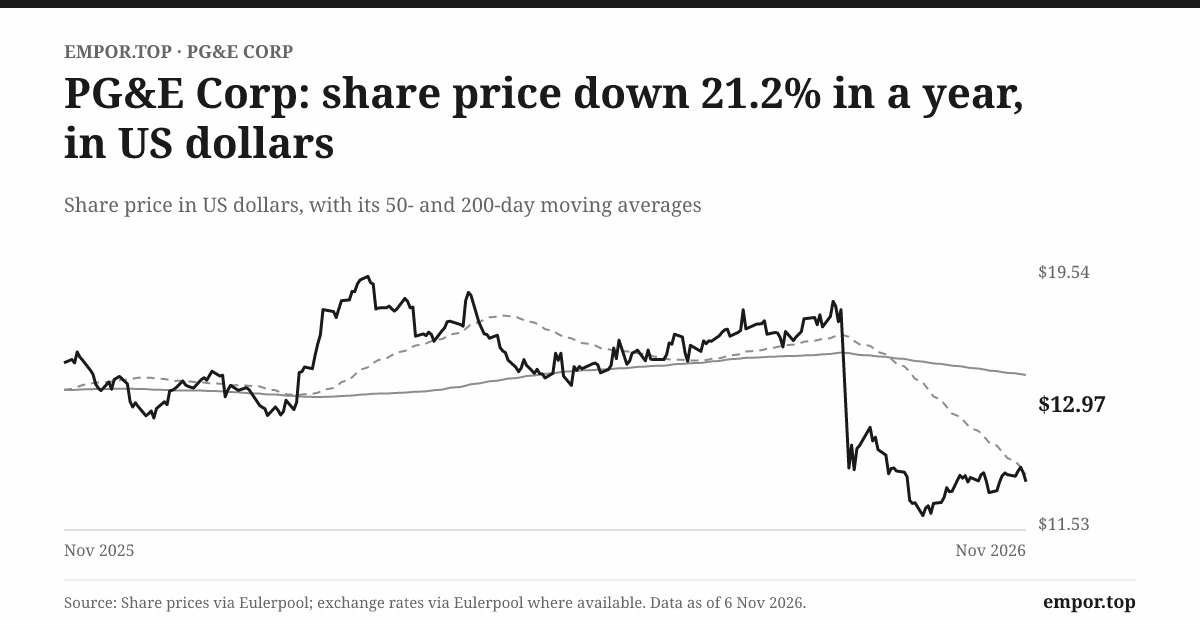
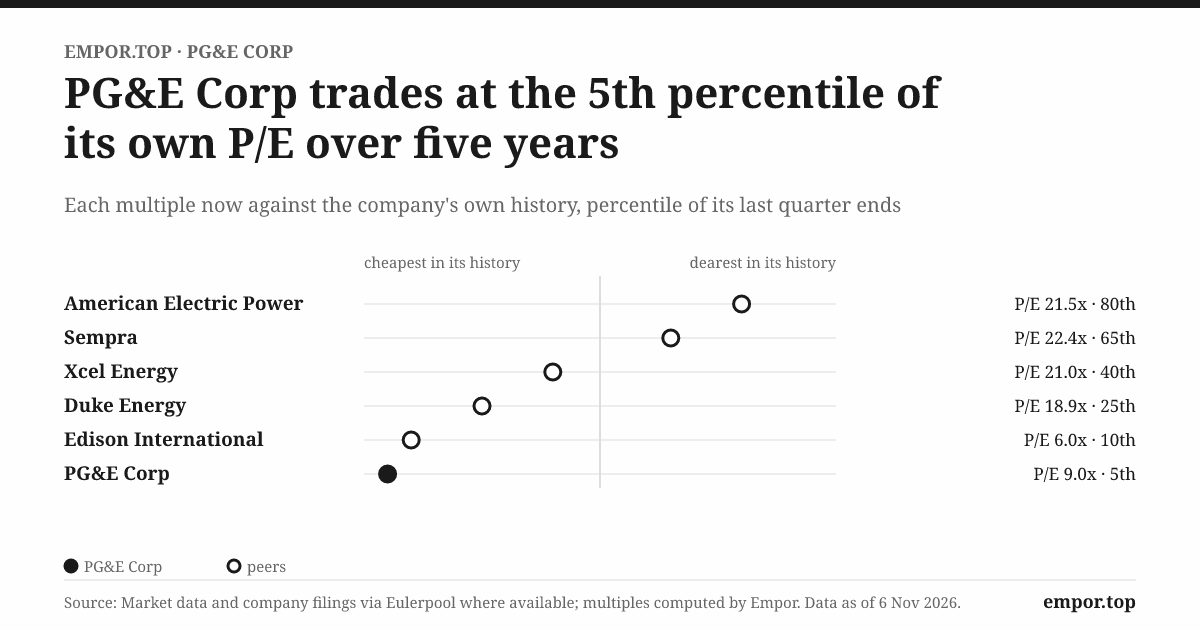
The scale of the obligation is hard to overstate. By September 30, 2026, consolidated long-term debt stood at about $61.3 billion, including roughly $11.5 billion tied to receivables securitization vehicles, against about $5.8 billion of available liquidity.4 The equity market, meanwhile, had grown wary. On November 3, 2026, PCG closed at $13.14, about 31% below its 52-week high of $19.11, for a market value of roughly $29 billion and an enterprise value, once debt is added, of about $94 billion.35 The stock traded at 9.2 times trailing earnings, against a five-year median of 15.7 times, and its free-cash-flow yield was negative 14.7%, because the company spends far more on its system than it brings in from operations.3
Put plainly, the market was paying about 60 cents for each dollar of the multiple it had paid, on average, over the previous five years. Some of that discount is about earnings quality and some is about cash, but most of it is about a single question that hangs over every California utility: what happens the next time a fire starts near company equipment?
That question opens into three others, and they run through everything that follows. First, can a regulated monopoly earn durable returns when the customers who pay those returns already face some of the highest bills in the country, and when the regulator who sets the returns answers to those customers? Second, has the company that emerged from bankruptcy in 2020 actually made its safety improvement durable, or does the record still depend on promises? Third, can current management finance the growth California wants, from wildfire hardening to new data-center connections, without another capital rescue from shareholders, customers, or the state?
The contradiction at the heart of the story is visible on the first page. PG&E is indispensable. Roughly 16 million people in Northern and Central California depend on it for electricity, gas, or both, across a 70,000-square-mile territory.6 No one else is going to string those wires. And yet the company's own strategy and financing plan are under review, its long-term outlook has been pulled, and its CEO describes the policy environment as one in which "the status quo is unacceptable."2 A business that cannot be replaced is also a business that cannot easily explain how it will pay for itself. To understand how it got here, the story has to begin with the wires themselves, and with the bargain that made them a monopoly.
 Subscribe on LinkedIn
II. A Utility Built by Joining the Wires
San Francisco in the second half of the nineteenth century was a boomtown that wanted light. Gas lamps came first, fed by small manufacturers who turned coal into fuel and piped it beneath streets that had been mud a few years earlier. Then came electricity, which arrived the way it arrived everywhere in America: as a jumble of small companies, each with its own generators, its own franchises, and its own idea of how big the market would be. Across Northern California, the same pattern repeated in mining towns, river valleys and farm centers. Hydropower from the Sierra Nevada fed one network; a gas works fed another; a streetcar company might own a third.
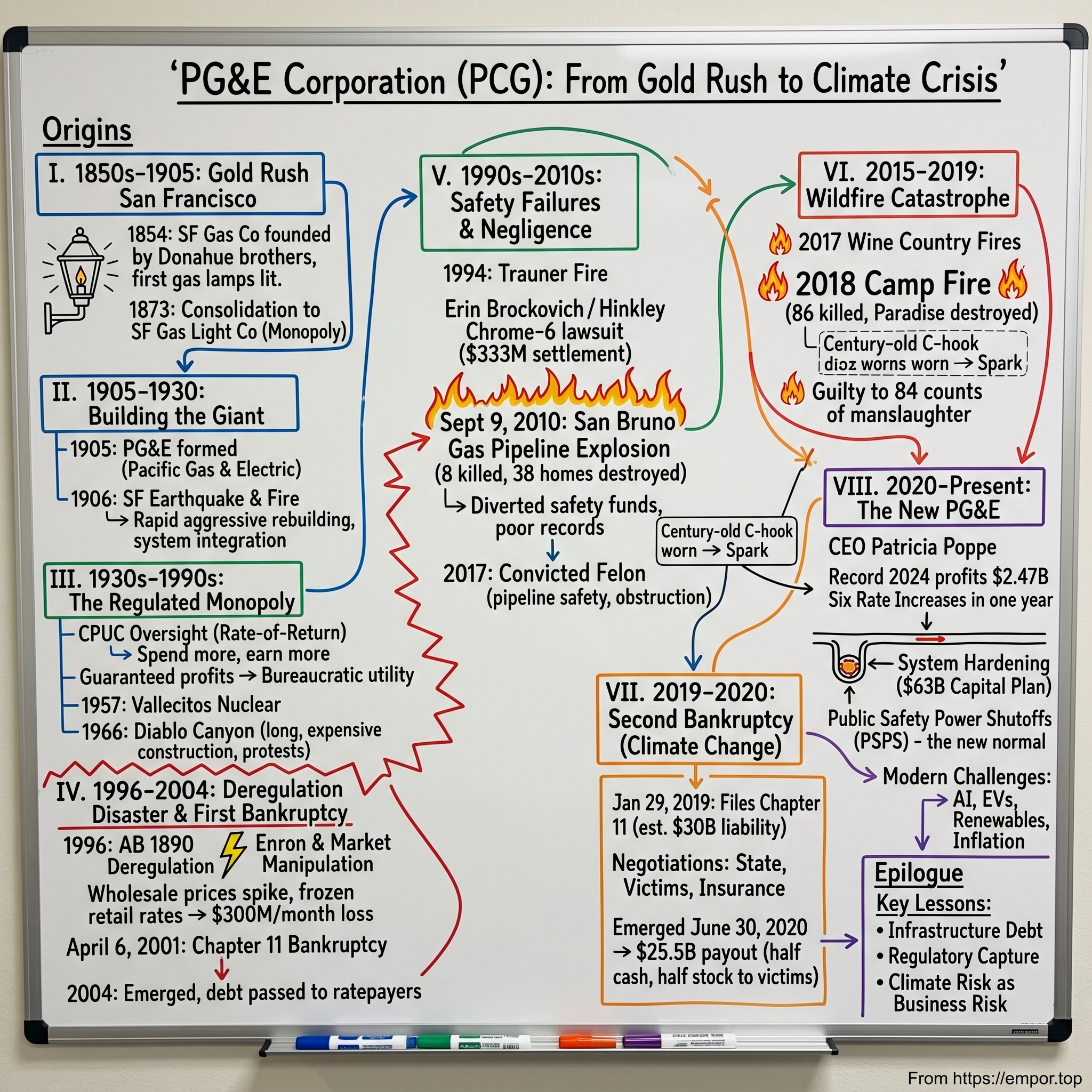
The company that would become PG&E was the product of joining those pieces together. Pacific Gas and Electric Company was incorporated in California in 1905, a consolidation of gas and electric operators that gave one owner control over systems that had grown up separately.6 The logic was the logic of every utility roll-up of that era. Generators were expensive, demand was lumpy, and a single network could share capacity across many towns more cheaply than a dozen small ones could. Bigger systems also needed bigger capital, and a larger company could raise it.
The timing tested the idea almost immediately. In April 1906, the San Francisco earthquake and the fires that followed destroyed much of the city the new company had just consolidated to serve. Rebuilding meant rebuilding gas mains and electric lines alongside everything else, and it taught a lesson the company would relearn more than a century later: in California, the physical environment is not a backdrop to the utility business. It is the business. Earthquakes, droughts, floods and fire define what the network must withstand and what it costs to keep standing.
Over the following decades, consolidation continued. Hydroelectric systems in the mountains were linked to load centers in the Bay Area and the Central Valley. Gas service expanded from manufactured gas to natural gas carried by long-distance pipelines. After the Second World War, California's population exploded, and the utility built to keep up, adding transmission, distribution and generation to serve suburbs, farms and industry. The most famous product of that era was Diablo Canyon, the nuclear plant on the coast near San Luis Obispo that remains part of the Utility's generation fleet.3 Today the system includes about 106,700 circuit miles of electric distribution lines, roughly 18,500 circuit miles of transmission, and more than 48,000 miles of gas distribution and transmission pipelines, serving about 5.5 million electric and 4.5 million gas customer accounts.6
Those numbers describe a moat in the most literal sense. Nobody builds a second set of distribution lines down the same street, because the first set already exists and the economics of duplicating it make no sense. That is why the state granted a monopoly in the first place: rather than let companies compete to build redundant networks, California gave one operator an exclusive territory and in exchange took the right to regulate what it charges and what it earns. The scale that came from joining the wires was real. So was the price of that scale, which was permission.
That bargain is the key to the whole story. A competitive company that builds a great network can charge what customers will pay. A regulated monopoly that builds a great network can charge only what the regulator approves, and earn only the return the regulator allows on the capital it is allowed to count. The wires are a fortress, but the drawbridge is controlled from Sacramento and San Francisco, at the offices of the California Public Utilities Commission. Everything that follows, from the energy crisis to the fires to the 2026 capital cut, is about what happens when that bargain is stretched.
III. The Monopoly That Has to Ask Permission
Picture the most ordinary moment in the utility business. A family in Fresno flips on the lights after dark. A bakery in Oakland fires up its ovens before dawn. A developer in San Jose asks for a new connection so that an apartment building can open on schedule. In each case, PG&E has to deliver, and in each case it does not get to decide what it will be paid. That decision sits elsewhere, in tariffs approved by the CPUC for distribution and most of the business, and by the Federal Energy Regulatory Commission for interstate transmission.3
The basic bargain works like this. The Utility delivers electricity and natural gas under authorized tariffs. Regulators approve a revenue requirement, meaning the amount of money the company may collect to cover its approved operating costs, depreciation, taxes and a return on the capital it has invested in eligible assets, which together form its rate base. Crucially, most of that base revenue is decoupled from how much energy customers actually use.3 If a mild summer means fewer air conditioners run, PG&E does not lose the revenue it was authorized to collect; balancing accounts true it up later. Think of it less like a shop that sells kilowatt-hours and more like a toll road whose owner has been promised a set income for maintaining the road, whatever the traffic.
That decoupling explains why PG&E's revenue does not look like a typical company's. In 2025, the Utility's revenue of about $25.1 billion was spread across its customers rather than concentrated in any of them.3 Electric residential and commercial customers each contributed roughly $7.0 billion. Industrial customers added about $1.9 billion and agricultural customers about $1.8 billion. On the gas side, residential customers contributed about $3.7 billion, commercial customers about $1.1 billion, and transportation service about $1.9 billion.3 The company does not identify any customer that accounts for a material share of revenue, and for a utility serving millions of households and businesses under public tariffs, that is unsurprising: this is not a portfolio of contracts that a big buyer could walk away from.
The industry structure is unusual enough to be worth spelling out. PG&E's wires business has no ordinary rival. Southern California Edison delivers power to about 15 million people across central, coastal and Southern California, and San Diego Gas & Electric serves the far south, but they serve separate territories.7 A homeowner in Sacramento cannot switch to Edison. Community choice aggregators, the local agencies that many California cities have formed to buy electricity on their residents' behalf, can and do take over the job of procuring power supply, but they still rely on PG&E's network to deliver it. They change who buys the electrons, not who owns the road the electrons travel on.
Run the five forces through that structure and the picture is clear, if lopsided. The threat of new entrants into delivery is close to zero, because geographic exclusivity and the sheer scale of the existing network make duplication absurd. The threat of substitutes is real but slow: rooftop solar, batteries and efficiency can reduce how much grid energy a customer buys, but most of those customers still need the grid as a backup and a connection, and decoupling softens the revenue effect. Supplier power matters mainly through procurement of fuel, power and equipment; the filings describe long-term nuclear fuel and power agreements but do not quantify supplier concentration, and much of the commodity cost passes through regulated mechanisms.3 Rivalry among existing players is muted because they do not compete for the same homes.
The force that matters most is buyer power, and here the buyer is not really the customer. It is the regulator acting on the customer's behalf. Customers cannot switch delivery providers, but they can vote, complain, testify, and pressure the CPUC and the legislature. When bills rise, so does that pressure. Technology, meanwhile, is reshaping what the grid must do more than it threatens to replace the grid. Electrification of cars and buildings, and new data centers, could add demand; wildfire risk is forcing the company to reengineer lines; and artificial intelligence, the disruption that haunts so many businesses, has little direct ability to displace physical wires.
So the advantage is real, but it has a hard edge. PG&E's core strength is its regulated territory and its hard-to-replicate network. It is not pricing power. Authorized revenue is not a blank cheque, because every dollar has to be justified to regulators who know that customers are already stretched. Costs the regulator rejects, or costs customers simply cannot bear, come out of shareholders' returns. A monopoly that has to ask permission is only as strong as its last approval.
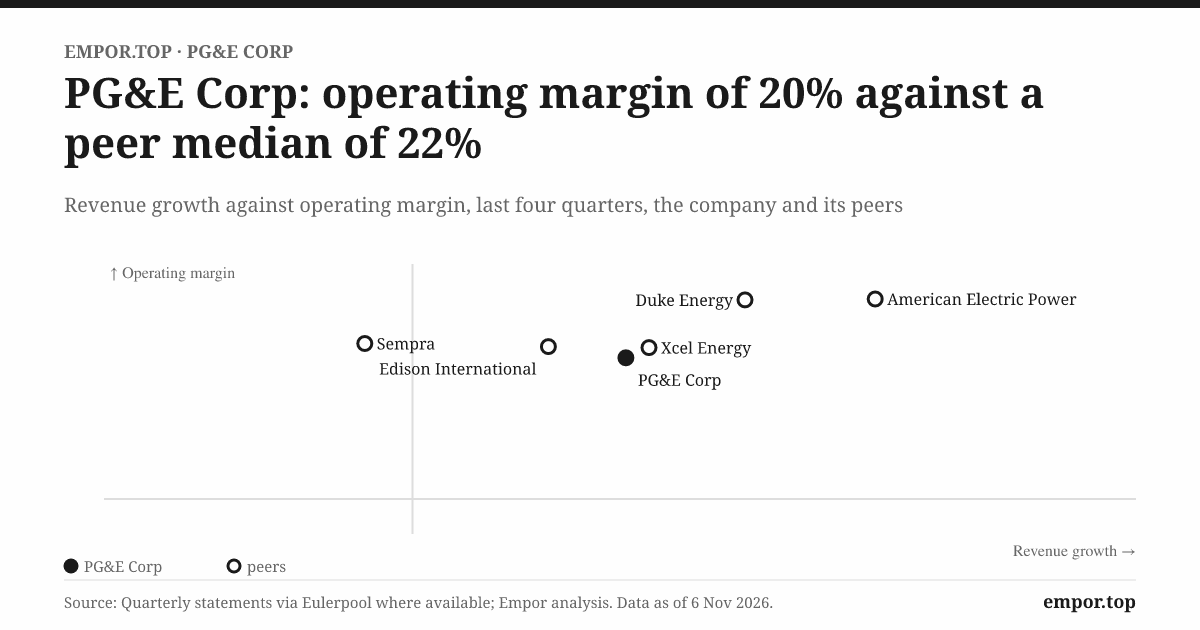
That brings the story to the puzzle that will recur for the rest of this story. In 2025, the Utility spent about $11.8 billion on capital investment, roughly 47 cents for every dollar of revenue.3 For comparison, a typical industrial company might reinvest a few cents per dollar. The company's operating margin, meanwhile, had climbed to about 19.6%, and earnings were rising.3 Yet free cash flow, meaning operating cash flow minus capital spending, was negative about $3.1 billion.3 Profits were up, margins were up, and the company still needed to borrow to fund its own business. That is not necessarily a sign of trouble in a utility; building rate base is how a utility grows. But it is a sign of dependence, on capital markets and on regulators, and PG&E's history shows what happens when either of those turns against it. The first time, it was the market for electricity itself.
IV. When California Unbundled the Power Market
In the summer of 2000, California's electricity market broke. On June 28, day-ahead prices reached $1,099 per megawatt-hour, more than ten times the typical price of the year before.8 Price spikes were not new to American power markets. What made California different was that the prices did not come back down. They stayed high through the fall and into the winter, and then spread across the West.8
PG&E sat squarely in the path of that surge, and the reason was a policy design that looked elegant on paper. In 1996, California passed Assembly Bill 1890, which restructured the state's power markets.9 The idea was to unbundle the old vertically integrated utility: let competitive generators sell power into an open market, let utilities focus on delivery, and let competition lower prices. As part of the transition, the investor-owned utilities sold much of their fossil-fuel generation and, as the State Auditor later put it, the implementation of deregulation initially required them "to sell and purchase on the volatile spot market all of the electricity they needed to serve their customers."9 At the same time, retail rates were frozen.
That combination was the trap. A utility that buys at a floating wholesale price and sells at a frozen retail price is running a business with one-way risk. When wholesale prices are low, the freeze looks generous. When wholesale prices explode, every kilowatt-hour sold loses money, and the losses compound by the day. The State Auditor described the result directly: because of "the legislated freeze on retail rates," the two largest investor-owned utilities could not pass on much of the higher wholesale costs, and "by December 2000, both PG&E and SCE had amassed huge debts and teetered on the verge of bankruptcy."9 San Diego Gas & Electric, by contrast, had been allowed to recover its costs, keeping it solvent, but its customers' bills more than doubled.9 The comparison is the lesson in miniature: either the utility absorbs the cost, or the customer does.
The physical consequences arrived alongside the financial ones. On a June day when San Francisco hit 103 degrees, rolling blackouts affected almost 100,000 PG&E customers.9 By January 2001, both PG&E and Edison had begun defaulting on power bills, and sellers stopped selling to them; the California Department of Water Resources stepped in as the principal buyer of power for their systems.98 On April 6, 2001, Pacific Gas and Electric Company filed a voluntary Chapter 11 petition.10 The holding company did not file; the Utility, which had been buying power it could not resell at cost, did.
The popular version of this story has a single villain: Enron. And Enron did behave badly. A FERC staff investigation concluded in 2003 that many trading strategies employed by Enron and other companies violated the anti-gaming provisions of their tariffs, that Enron "manipulated thinly traded physical markets to profit in financial markets," and that California spot electricity prices were affected by economic withholding and inflated price bidding.11 But the same report made a point that is often dropped from the retelling: "supply-demand imbalance, flawed market design and inconsistent rules made possible significant market manipulation," and "without underlying market dysfunction, attempts to manipulate the market would not be successful."11 FERC's own review of the crisis listed the underlying dysfunction: market rules that failed to signal generators to build new capacity during rapid economic growth, a drought that curtailed hydropower, almost no demand response "partly because of fixed retail rates," and a near-total reliance on the spot market, which FERC said was near 100% in the summer of 2000.8
So was the first bankruptcy a utility failure or a policy failure? The record points mostly to policy. The market design and the price freeze drove the crisis, and manipulation exploited the cracks. But PG&E was not a pure bystander. It operated inside a structure that left it buying nearly everything on the spot market, and when that structure failed, the company had no hedge broad enough to survive. The real lesson was about the regulatory bargain itself. In 2000, it came apart, and within months a century-old company was in court.
The Utility spent three years in bankruptcy. A settlement agreement among the CPUC, the Utility and PG&E Corporation was approved by the commission in December 2003, and on April 12, 2004, the plan of reorganization took effect and the Utility emerged from Chapter 11.10 The company survived, its customers kept their lights on, and the episode entered corporate memory as a cautionary tale about markets and politics. It looked like the kind of crisis a utility suffers once in a century: caused by forces outside its control, resolved by regulators who ultimately needed it to survive.
The next crisis would be different in a way that matters enormously to investors. In 2001, the company's problem was that it could not recover what it spent buying energy. The question the next decade would raise was harder: what happens when the disaster comes not from a broken market, but from the company's own infrastructure?
V. San Bruno Made Safety a Financial Fact
At about 6:11 in the evening on September 9, 2010, a 30-inch natural gas transmission pipeline known as Line 132 ruptured beneath a residential neighborhood in San Bruno, a suburb just south of San Francisco.12 The escaping gas ignited. The fireball that followed killed eight people, injured many more, destroyed 38 homes and damaged 70.12 Among the dead were members of a single family: Sue Bullis lost her husband, her son and her mother-in-law.13 This was not a remote line in the mountains. It was a street of houses, families finishing dinner, in one of the most densely populated parts of the territory.
The National Transportation Safety Board's investigation turned what might have looked like a freak accident into a story about institutional failure. The board found that the probable cause was PG&E's "inadequate quality assurance and quality control in 1956 during its Line 132 relocation project, which allowed the installation of a substandard and poorly welded pipe section," together with an "inadequate pipeline integrity management program, which failed to detect and repair or remove the defective pipe section."12 In plain terms, a bad piece of pipe went into the ground more than half a century earlier, and the company's system for knowing what it had buried, and for checking whether it was safe, never caught it. The board also faulted PG&E's emergency response and its delay in isolating the rupture, and it criticized the regulators: the CPUC and the U.S. Department of Transportation had granted exemptions from pressure testing, and the CPUC had failed to detect the shortcomings in PG&E's integrity program.12
That last point matters because it complicates the simple story. San Bruno was not only a company failure; the regulator charged with watching the company had also missed it. But the federal criminal case that followed made clear that the company's failures went beyond oversight gaps. In August 2016, a federal jury found PG&E guilty of five counts of violating the federal pipeline safety law, findings that turned on knowing and willful conduct, and one count of obstructing the NTSB's investigation.1413 The pipeline-safety counts concerned the company's recordkeeping and its failure to identify and assess threats to its pipelines, which is to say, the core of the integrity program the NTSB had found inadequate.
In January 2017, Judge Thelton Henderson imposed the maximum fine the law allowed, $3 million, along with five years of probation, independent monitoring, 10,000 hours of community service, and an order to run advertisements in newspapers and on television describing its crimes.1314 A fine of $3 million is trivial for a company of PG&E's size, and many of the victims said as much; Sue Bullis called the judgment strong but added, "it's never enough."13 The real penalty was not the fine. It was the record. A criminal conviction for willful safety violations and obstruction means that every future claim by PG&E about its safety culture has to be weighed against a jury's finding that the company had, in the past, knowingly failed to do the work and then tried to mislead investigators about it.
That is why San Bruno belongs in a financial story. Before 2010, an investor could treat safety incidents at a utility as operating events: unfortunate, insured, eventually recovered or absorbed. After San Bruno, safety at PG&E became a question about the company's license to operate, its relationship with regulators, its cost of capital and its legal exposure. The federal monitor installed as part of the probation did not go away quietly. When fires later became the dominant risk, the federal court supervising the probation expanded its attention from pipelines to wildfire prevention.14 A conviction about gas lines became the lens through which a judge, regulators and the public would view the electric business.
San Bruno was also part of a broader pattern of scrutiny that made it harder for the company to argue that each crisis was a one-off. The question it leaves open is the one that matters most for the rest of the story. PG&E's workforce numbers in the tens of thousands, its network stretches across thousands of miles of rugged terrain, and safety work has to be delivered not in a boardroom but on individual circuits and pipeline segments. New governance can change who sits on the board. New incentives can change what executives are paid for. Neither guarantees that the crew on a remote line in the Sierra foothills does the right thing on a windy morning. The next disaster tested exactly that, and its scale made San Bruno look like a prologue.
VI. The Fire That Turned Risk Into Bankruptcy
Early on the morning of November 8, 2018, a PG&E employee saw a fire burning beneath the company's transmission lines near Pulga, a tiny settlement in the Feather River Canyon of Butte County.15 The wind was howling down the canyon, and the vegetation was bone dry after a long drought. A hook on a high-voltage transmission tower that was nearly a century old had failed, allowing a power line to fall against the steel structure; the resulting electrical arcing threw sparks into the brush below.16 Within hours, the fire had raced through Concow and into the town of Paradise, where thousands of people found themselves trying to drive out on a few narrow roads through smoke and flame.15
The Camp Fire killed 84 people directly, destroyed about 18,800 structures and burned 153,336 acres.1516 It was the deadliest and most destructive wildfire in California's history. In June 2020, PG&E pleaded guilty in a Butte County courtroom to 84 counts of involuntary manslaughter and one count of unlawfully causing a fire, as the judge read the name of each person who died.16 Bill Johnson, then PG&E's chief executive, told the court: "Our equipment started that fire."16 The company agreed to pay the maximum fine of about $3.5 million plus $500,000 for the cost of the investigation; no individual went to prison.16
The Camp Fire did not arrive out of nowhere. A year earlier, in October 2017, a series of wildfires had swept through Northern California's wine country and beyond. Precision matters here, because the popular memory tends to pin every one of those fires on PG&E. CAL FIRE investigators did attribute many of the October 2017 fires to PG&E equipment, but in January 2019 they concluded that the Tubbs Fire, which killed 22 people and was the most destructive of the 2017 blazes, had been caused by a private electrical system, not by PG&E's facilities.17 That distinction mattered legally and financially. It did not change the overall picture, which was that a utility already convicted of willful pipeline-safety violations was now linked by investigators to a string of catastrophic fires.
To understand why those fires were financially lethal, rather than merely terrible, an investor has to understand a legal doctrine with an unfortunate name: inverse condemnation. In California, courts have applied the principle that when a utility's equipment causes damage to private property, the utility can be held liable for that damage even if it was not negligent, roughly as though the government had taken the property for public use. The theory is that the utility, like a public agency, can spread the cost across its ratepayers. But that spreading is not automatic. The regulator still decides whether the utility acted prudently enough to recover the costs from customers. A utility can therefore end up strictly liable for the damage, and still be told it cannot pass the bill along. Shareholders are left holding the gap.
Imagine running a business where a single windy morning can create liabilities larger than the value of your entire equity, where you may be liable regardless of fault, and where recovery of those costs depends on a regulator's after-the-fact judgment about whether you did enough. That was PG&E's position at the end of 2018. Claims from the 2017 and 2018 fires ran to tens of billions of dollars, far beyond what insurance covered and far beyond what the company could finance in the open market. On January 29, 2019, PG&E filed for Chapter 11 bankruptcy for the second time in less than two decades.18
The state responded with a partial backstop. Assembly Bill 1054, passed in July 2019, created a wildfire fund and a revised process for deciding when a utility can recover wildfire costs, but it came with conditions.18 To participate, PG&E had to resolve its bankruptcy, and the CPUC had to find, among other things, that the reorganized company's governance was "acceptable in light of PG&E's safety history."18 The fund is a pool of money, contributed by utilities and customers, that can pay eligible wildfire claims so that a single fire does not immediately bankrupt a utility again; utilities may have to reimburse the fund if their conduct is later found imprudent, subject to limits. It was designed to buy time and stability, not to make wildfire risk disappear. A later law, SB 254, added further changes in 2025, including excluding about $2.85 billion of PG&E's fire-risk mitigation capital spending from the equity portion of its rate base, which means shareholders do not earn a return on that slice of investment.32
That framework has been tested since, and it shows that the risk did not end with the bankruptcy. At the end of 2025, PG&E's estimated liabilities for three later fires in which its equipment has been implicated, the 2019 Kincade Fire, the 2021 Dixie Fire and the 2022 Mosquito Fire, totaled about $3.8 billion, and the company noted that these estimates excluded categories of damages that could not yet be reasonably estimated.3 Probable recoveries offset much of that, including about $1.15 billion from the Wildfire Fund for Dixie, but recoveries are estimates too.3 The Mosquito estimate shows how these numbers move: it was $350 million in the 2025 annual report and had risen to $475 million, before recoveries, by the third quarter of 2026.34 Management on the Q3 call said a proposed decision on Kincade and Dixie cost recovery was expected within weeks.2
The Camp Fire, then, was the decisive financial turning point, but not simply because of its scale. It arrived after years of documented safety failures, under a liability regime that put the cost on the utility first, and in a regulatory environment where the company's record made generous cost recovery politically impossible. Insurance and the Wildfire Fund now soften the blow of a future fire. They do not make future losses predictable, and they do not change the fact that the next severe fire linked to PG&E equipment would be judged against the history this section describes. In January 2019, the question was more basic: could the company emerge from court with enough capital, and enough credibility, to satisfy both the people who had lost everything and the customers who would be asked to keep paying?
VII. Bankruptcy Bought a Second Chance, Not a Clean Slate
On July 1, 2020, PG&E walked out of bankruptcy court for the second time.18 It had been in Chapter 11 for seventeen months, a remarkably short stay for a case of that size and complexity, and the speed was not an accident. Under the new wildfire law, the company had to resolve its bankruptcy in time to participate in the Wildfire Fund; missing the deadline would have meant facing the next fire season without the backstop.18 The CPUC approved the reorganization plan on May 28, 2020, with conditions and modifications, and five weeks later the company was out.18
The price of the exit was enormous. The centerpiece was a $13.5 billion settlement for the individual victims of the fires, paid into a newly created Fire Victim Trust.19 Separate settlements resolved claims from the insurance companies that had already paid policyholders and then stepped into their shoes to sue PG&E, and from public entities such as cities and counties that had their own losses.19 It is tempting to read those numbers as the moment the fires were "paid for." They were not, in at least two senses. First, the settlements resolved claims from specific past fires, not the risk of future ones. Second, much of the victims' compensation was paid not in cash, but in stock.
That second point is where the bankruptcy reshaped the company's ownership. At emergence, the Fire Victim Trust received about $5.4 billion of cash, a promise of further deferred cash payments, and 477 million shares of PG&E Corporation, representing 22.19% of the company.19 Victims of a fire caused by the company's equipment became, through their trust, among its largest shareholders. The arrangement tied their recovery to PG&E's share price, which proved a painful bet for many of them as the stock languished. Over the following years, the Trust sold down its position; in 2023, the Corporation issued roughly 146 million shares in connection with share exchanges with the Trust, and in 2024 it issued mandatory convertible preferred stock.3 The Trust was a major holder, not a controlling one, and today there is no controlling shareholder of PG&E Corporation at all. The largest reported holders in the 2026 proxy were index and asset managers: BlackRock at about 8.1%, FMR at 6.0%, MFS at 5.4% and State Street at 5.2%.20
The cash cost of exit shows up starkly in the accounts. In 2020, PG&E's operating cash flow was negative about $19 billion, driven primarily by roughly $18.8 billion paid for wildfire claims that arose before the bankruptcy and about $5.2 billion of contributions to the Wildfire Fund, which included an initial contribution from the Utility of about $4.8 billion.19 Those payments had to be financed, and the company financed them largely with debt. Borrowings rose from about $22 billion at the end of 2018 to about $42.6 billion at the end of 2020.319 Shareholders' equity rebounded on paper, from about $5.1 billion to about $21 billion, because the company issued large amounts of new stock as part of the plan.19 Existing shareholders kept a stake in the company, which is unusual in a bankruptcy, but at the cost of heavy dilution and a much larger debt load.
The other half of the bargain was oversight. To qualify for the Wildfire Fund, PG&E had to accept governance changes, a new board, and a regulatory structure that allowed the CPUC to step up its supervision if the company's safety performance slipped. The commission created an Enhanced Oversight and Enforcement Process with escalating steps, which could ultimately lead, at the most severe end, to the loss of the company's operating license.18 The federal probation from the San Bruno case remained in force, with the judge supervising it taking an increasingly direct interest in wildfire prevention.14 The company that emerged in mid-2020 was solvent, but it was solvent on parole.
That is the right way to think about the reorganization. It resolved a balance-sheet crisis. It restored access to capital markets, which PG&E would need constantly given the scale of its investment program. It gave the state a framework to manage the risk of future fires. But it did not prove that the safety problem had been solved, and it loaded the company with a much larger debt burden, a diluted shareholder base, ongoing contributions to the fund and a regulator with new powers to intervene. A second chance is not a clean slate. The question the company now had to answer was whether it would actually prioritize the highest-risk work, and the first answer came within a year.
VIII. The New CEO Inherits the Old Risk
Patricia Poppe took over as chief executive of PG&E Corporation on January 4, 2021, six months after the company emerged from bankruptcy.21 She came from Michigan, where she had been president and chief executive of CMS Energy and its utility, Consumers Energy, since 2016.21 Her résumé read like an operator's rather than a financier's. She had degrees in industrial engineering from Purdue and a master's in management from Stanford, had spent fifteen years at General Motors and five at DTE Energy before moving to Consumers, where she ran distribution operations, engineering and transmission before becoming CEO.21 Bill Smith, the board member who had served as interim CEO, described her as someone who "knows the operations side of this business."21 For a company whose problems were fundamentally about whether work got done in the field, that was the pitch: a manufacturing-minded leader who believed in systems, measurement and repetition.
Her task was to run one of the most complex physical networks in the country. At the end of 2025, the Utility had about 29,000 regular employees, and PG&E Corporation had 10.3 The safety work they had to deliver is unglamorous and enormous. It includes system hardening, which means replacing bare wires with covered conductors and stronger poles; vegetation management, which means clearing and trimming trees near lines across millions of acres; undergrounding, which means burying lines in the highest-risk areas, an expensive but durable solution; and Public Safety Power Shutoffs, which means deliberately turning off power to entire communities when high winds threaten to make lines spark. That last tool captures the trade-off in the business perfectly. A shutoff reduces the risk of starting a fire, but it leaves customers, including hospitals, schools and people who depend on medical equipment, in the dark. Each shutoff is a safety success and a service failure at the same time.
The early test came quickly. On April 15, 2021, barely three months into Poppe's tenure, the CPUC placed PG&E into the first step of its Enhanced Oversight and Enforcement Process.18 The reason was specific: the company had failed "to sufficiently prioritize clearing vegetation on its highest-risk power lines as part of its wildfire mitigation work in 2020."18 Strictly speaking, the failure predated Poppe's arrival. But it is the most direct piece of evidence available against treating post-bankruptcy rhetoric as proof of execution. The company had just promised regulators, the bankruptcy court and the public that safety came first, and the regulator's first major review found that the company had trimmed trees in the wrong places. Effort was being spent, but not where the risk was greatest. That is the classic failure of a large organization under pressure: it optimizes for activity rather than outcome.
Since then, the investment has unmistakably grown. Utility capital expenditures rose from about $9.7 billion in 2023 to about $11.8 billion in 2025.3 Management has proposed a ten-year plan to underground roughly 5,000 additional miles of lines between 2028 and 2037 at an estimated cost of about $16.6 billion, with approval expected in 2028, and it claims the plan will generate about $117 billion in long-term benefits.25 On the Q3 2026 call, Poppe said the company's weather-normalized ignition rate was down 74% since 2017.2 That is a management figure, not an independently audited one, and the right check is the CPUC's own safety performance metrics, which the commission publishes for PG&E and the other utilities.22 The direction is encouraging, and the investment is real. But fewer ignitions is a means; fewer severe fires, and none of the scale of the Camp Fire, is the outcome that the business's survival depends on.
Incentives tell a more complicated story. The 2026 proxy says wildfire safety metrics made up 35% of the short-term incentive plan and 40% of the long-term plan.20 Poppe owned about 2.3 million PG&E Corporation shares as of March 2026, less than 1% of the voting class, and her reported total compensation for 2025 was about $19.8 million, up from about $15.8 million in 2024.20 In 2025, the company's overall scorecard came in at 1.39, and Poppe's short-term incentive paid out at 139% of target.20 Yet the serious-injury metric on that same scorecard scored zero, after a contractor fatality and a public fatality during the year.20 The design worked as intended in the narrow sense that the safety failure cost the executives something. But the overall payout still came in well above target because strong results on other measures outweighed it. Shareholders can reasonably ask whether a year that included two deaths should produce a bonus 39% above target, and some of them did. Support for the say-on-pay vote fell from 95.7% in 2025 to 90.8% in 2026.23 That is not a revolt, but it is a signal, and it pairs naturally with the scorecard.
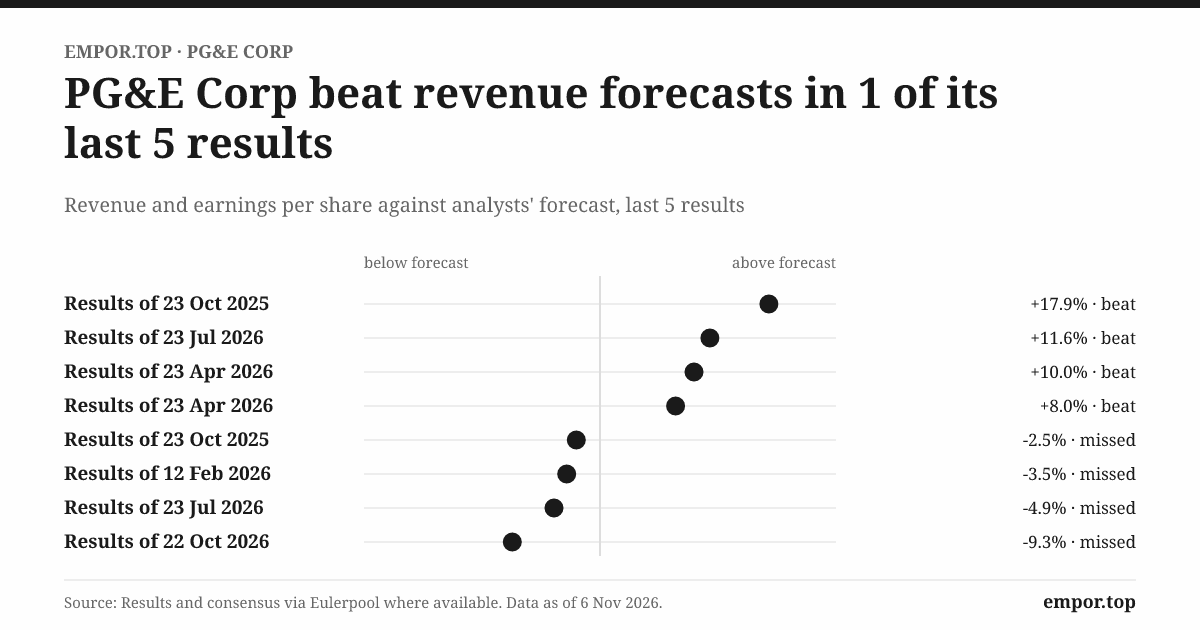
The other credibility test is about promises. In November 2021, at its first investor day under Poppe, PG&E laid out a growth story built on roughly 8.5% annual rate-base growth and 10% long-term growth in core earnings per share.2425 It was a confident pitch: a company that had been through hell would now grow steadily by investing in safety and reliability, with the investment earning a regulated return. Five years later, the long-term outlook has been withdrawn pending the strategic review. To management's credit, the near-term earnings promises have largely held; core EPS guidance for 2026 of $1.64 to $1.66 was reaffirmed again in October 2026.5 But the long-range plan has proved more fragile than the investor-day story suggested, and the reason is the same financing and affordability pressure that the 2021 pitch treated as manageable.
The fair conclusion is narrower than either bulls or bears would like. The operating focus under Poppe is real, the investment is real, and safety is tied to pay in a meaningful way. But the 2021 oversight finding and the 2025 fatalities are evidence that execution remains uneven, and the withdrawal of the long-term plan shows that a credible operating story does not, by itself, solve the financing problem. That problem is the subject of the next part of the story, and it begins with a simple fact: the company spends far more than it generates.
IX. Building the Grid, Borrowing to Do It
At the end of 2025, the Utility owned about $96.8 billion of property, plant and equipment, after spending roughly $11.8 billion on capital investment during the year.3 Six years earlier, at the end of 2019, that figure had been about $63.9 billion.3 The company had added roughly $33 billion of net assets in six years, a little more than 50% growth, while its customer base barely changed. That is what a utility building its system looks like. The question is what that building earns.
Approved assets enter the rate base and earn an authorized return once in service, with their cost recovered through depreciation over time. The catch is that "other things equal" is doing a great deal of work. The return has to be authorized, the investment has to be judged prudent, and the money to build the asset has to be raised before the earnings start arriving. In the meantime, utilities can earn a non-cash return on construction work in progress, known as the allowance for funds used during construction. In 2025, the Utility recorded about $219 million of the equity portion of that allowance, a sign of how much spending was in the pipeline but not yet in service.3
The good news shows up in margins. PG&E's operating margin rose from about 8.7% in 2019 to about 19.6% in 2025, and operating profit grew at about 19.5% a year over five years.3 Some of that improvement reflects the end of the enormous wildfire charges that crushed earnings in 2018 and 2019, and some reflects the growing rate base. Either way, the company today is profitable on a scale it was not five years ago.
Profit, however, is not cash, and in PG&E's case the gap between them runs in both directions. Over the twelve years from 2014 through 2025, PG&E's cumulative net profit was roughly negative $1.2 billion, because the wildfire and bankruptcy losses of 2018 through 2020 wiped out the earnings of the good years.319 Over the same period, operating cash flow totaled about $35.8 billion. That gap is not evidence of hidden earnings power. It reflects accounting losses that were recorded before the cash was paid, large non-cash depreciation charges that are added back to operating cash, and the timing of regulatory balancing accounts. The comparison is a poor test of earnings quality on its own.
The more revealing comparison is between operating cash and capital spending. Over the same twelve years, free cash flow was about negative $55.3 billion.3 Dividends paid totaled only about $4.0 billion, most of it before the 2017 fires; PG&E paid no common dividend from 2018 through 2023, and resumed small payments only in 2024.3 Cash on the balance sheet rose by only about $417 million over the whole period. So the arithmetic is unambiguous: the company did not fund shareholders at the expense of the grid. Capital spending, not dividends, consumed the capital, and the gap was filled with borrowing and new equity. In 2025 alone, the Utility generated about $9.0 billion of operating cash and spent about $11.8 billion on capital.3 That is a structural deficit of almost $3 billion a year before paying anything to shareholders or repaying a single dollar of maturing debt.
There is one more piece of the money trail worth clearing up, if only to rule it out. PG&E Corporation and the Utility exchange administrative and professional services with each other under disclosed formulas: the Utility charges the parent the higher of fully loaded cost plus a small markup or fair market value, and the parent charges the Utility the lower of fully loaded cost or fair market value.3 The 2025 annual report does not quantify those transactions. There is no evidence that they explain the cash deficit, which is fully explained by the capital program. Similarly, the asset managers who own more than 5% of the stock earned about $7.1 million in 2025 for ordinary trust and benefit-plan services, roughly 0.03% of revenue.20 Neither is a hidden fee stream.
Nor is this an acquisition story. PG&E's value creation over the last decade has depended on regulated investment in its own grid, not on buying other companies, and there is no material recent acquisition whose price could be compared with the multiples paid in utility deals. The company grows by pouring concrete, stringing wire and burying cable inside its own territory.
That makes the cost of money central to everything. In 2025, the Utility's interest expense was about $2.7 billion, against pretax income of about $2.9 billion.3 In other words, lenders took almost as much out of the business before taxes as the shareholders earned. PG&E's return on capital employed was only about 3.9% in 2025, low even by utility standards, because a vast asset base earns a regulated return that is partly consumed by interest and partly by the costs of a weakened credit rating.3 The company itself expected that capital spending, debt maturities and dividends to the parent would exceed operating cash flow, which means continued access to credit markets and timely regulatory recovery are not just helpful to the business model. They are part of it. The September 2026 capital cut is what happens when those two dependencies start to pinch at once, and the company's newest growth story, data centers, has collided directly with it.
X. The Data Center Pipeline Meets the Capital Cut
On October 22, 2026, PG&E's executives sat down for the first earnings call since announcing the strategic review. The numbers they reported were respectable but not spectacular. Third-quarter core earnings per share were $0.41, down from $0.50 a year earlier, which the company attributed mainly to a lower authorized return on equity from the CPUC in 2026 and to one-time effects of a tax methodology change implemented in 2025.5 On a nine-month basis, core EPS was up, to $1.24 from $1.14.5 Management reaffirmed 2026 core EPS guidance of $1.64 to $1.66 and 2027 guidance of $1.78 to $1.82, even as it confirmed the $2 billion reduction in 2027 capital spending.25 The quarter also included about $42 million, after tax, of strategic repositioning costs, which covered severance and consulting, legal and financial advisory work related to the review.5
Poppe's prepared remarks laid out what the review is designed to do. Becoming "a financially strong, investment-grade company" is, in the company's words, a "foundational objective."1 The options being considered, she said, range "from corporate ring-fencing to sales and separations."2 She argued that the wildfire discount "burdens all of our assets," including businesses with "little or no" wildfire exposure, and she gave a concrete example: gas customers, who face no wildfire risk from electric lines, still pay the borrowing costs of a company rated below investment grade at the parent.2 That is the logic behind any separation idea. If the gas business, or the transmission business, could be financed on its own merits, it might borrow more cheaply. The company said it expects to share the outcome of the review "no later than next summer."2
Chief Financial Officer Carolyn Burke, who took the job in 2023, walked through the financing math. The deferred 2027 projects, she explained, were mostly not expected to enter service until after 2027, so 2027 rate-base guidance stayed unchanged.2 That is a revealing detail: the cut reduces near-term borrowing without immediately reducing near-term earnings, which is why the EPS guidance could survive it. It also means the cost of the cut is deferred to later years, when that rate base would otherwise have started earning. The 2027 program will be funded by operating cash and about $4 billion to $5 billion of Utility debt financing, including around $1 billion of maturities.2 Burke said the company continues to target funds from operations to debt in the "mid-teens," a measure of how much cash the business generates relative to its debt load.2
The analyst questions pressed on exactly the points where the story is thinnest. Steve Fleishman of Wolfe Research asked about legislative signals on wildfire liability; Poppe answered that "the status quo is unacceptable" and noted that comprehensive reform had not been enacted.2 Nicholas Campanella of Barclays asked whether the review would produce concrete filings before summer; the answer amounted to a restatement of timing and urgency.2 Ross Fowler of Bank of America asked how long it would take to reach investment grade and whether the company could really avoid issuing equity. Here the answers were concrete. Burke said the company would not need new equity through 2030 under the prior plan, and Poppe was blunt: "we would not issue equity at these current stock price, our valuation. That's not an option for us."2 That is a meaningful commitment, but it is also a statement about price, not about need. A company that will not sell stock at $13 has not ruled out selling it at $20.
The data-center questions were the least satisfying. Carly Davenport of Goldman Sachs asked how the capital cut would affect the queue of data-center projects. Poppe said the company had brought about 174 megawatts of data-center load online since 2024, and that the roughly 1.8 gigawatts of projects previously signaled for service by 2030 remained in the plan.2 But she did not say which projects, if any, were at risk from the 2027 cut, and on the same call she acknowledged that the deferred work included customer projects such as clean-energy connections, growth projects and new housing.2 The company's earnings release makes the bull argument for data centers in a single sentence: "every one gigawatt of new data center load could help customers save 1% or more on their monthly electric bill."5 The company's logic is that a large new customer spreads the fixed costs of the grid across more kilowatt-hours, lowering the cost for everyone else.
That claim deserves to be taken seriously, and also to be separated into its parts. A queue of proposed connections is not energized load. Energized load is not booked revenue. And booked revenue is not shareholder return. To know what data centers will mean for PG&E, an investor would need to know which projects have firm commitments, who pays for the transmission and substation upgrades required to serve them, how those costs are allocated between the data-center customer and everyone else, and whether the capital required to connect them competes with safety work. The company does not publish that breakdown. The 174 megawatts already online is real but small relative to a system of this size; the 1.8 gigawatts by 2030 is a plan; and the 1% bill savings is a management estimate that depends on how the costs are allocated.
The deeper problem is that every claim on PG&E's capital is competing with every other. Wildfire mitigation and undergrounding compete with load growth. Load growth competes with reliability work on aging assets. All of them compete with debt service and with the regulator's insistence on affordability. The $2 billion cut is an admission that the company cannot fund all of them at once on its current credit profile.
That credit profile is more fragmented than headlines suggest. As of September 30, 2026, S&P rated PG&E Corporation BB+, just below investment grade, with a stable outlook; Fitch rated it BBB-, the lowest investment-grade notch, but with a negative outlook; and Moody's had a positive outlook, while rating the Utility's issuer credit at Baa3.26 Fitch had affirmed the Corporation and the Utility at BBB- with stable outlooks as recently as April 2026, identifying catastrophic wildfires, depletion of the wildfire fund and deterioration in California's regulatory environment as downside triggers, and sustained leverage below a set threshold, plus safety progress, as conditions for an upgrade.27 By the fall, it had moved the outlook to negative, which Burke acknowledged on the call, calling policy risk "the primary constraint on further ratings improvement."2 S&P's rationale similarly treats wildfire exposure and the durability of the fund as constraints.28 So the parent sits just below investment grade at one agency, the Utility sits just at it at others, and the direction of travel depends less on what PG&E does next quarter than on what California's legislature does next session.
The 2026 call also marked a change from the 2021 investor-day growth story: management reaffirmed near-term guidance and pulled the long-term outlook.2425 That change is not, by itself, proof of discipline or of failure. It is evidence that the constraints changed, or that they were always tighter than the 2021 story allowed. Either way, it sets up the lessons this company's history teaches, and they are lessons that few other utilities have had to learn as painfully.
XI. Playbook: Business & Investing Lessons
Go back to three moments. A summer in 2000, when a utility bought power at more than ten times the usual price and sold it at a price frozen by law. A September evening in 2010, when a pipe that had been badly welded in 1956 tore open under a street in San Bruno. And an April day in 2021, when a regulator told a freshly reorganized company that it had been clearing trees in the wrong places. Between them, those moments explain most of what an investor needs to know about owning essential infrastructure when the public bears the consequences of failure.
The first lesson is that a monopoly protects the wires, not the owner from its own decisions. PG&E's territory has never been seriously contested. No rival came for its customers during the energy crisis, after San Bruno, or after the Camp Fire. And yet the company has been through two Chapter 11 reorganizations and two criminal convictions in a little over two decades.10181316 The San Bruno jury did not find that PG&E lacked a franchise. It found that the company had knowingly failed to manage the pipe inside the franchise. A protected territory and a safe operator are different things, and the market prices the second, not the first. Investors who equate "monopoly" with "moat" are measuring the wrong wall.
The second lesson is that if the regulator sets the price, affordability is part of the product. In 2000, the price freeze was a political promise to customers, and the utility paid for it with its solvency. In 2026, the $2 billion capital cut was, in part, a response to the same force from the other direction: a company that cannot keep raising bills to fund investment without losing the political support that lets it recover the investment at all. A competitive company can raise prices until customers leave. A regulated utility can raise prices only until voters, legislators and commissioners decide it has gone far enough. The ceiling is political, and it moves.
The third lesson is that investment is only valuable when it earns permission to stay in the rate base. PG&E has spent about $55 billion more than it generated from operations over the past twelve years, and its net plant has grown by roughly half since 2019. That investment creates shareholder value only if regulators allow it to earn a return that exceeds the cost of funding it. When a law like SB 254 carves billions of fire-mitigation spending out of the equity rate base, or when a commission lowers the authorized return on equity, as the CPUC did for 2026, the same dollar of capital earns less.35 Capex is a promise to customers. Rate base is the regulator's acceptance of that promise. The two are not the same number, and the difference is where shareholder value lives or dies.
The fourth lesson is that a safety plan is a promise, and a safety metric is a test. The 2021 enhanced-oversight finding was not about whether PG&E had a vegetation plan. It had one. The finding was that the plan's execution did not match the risk.18 That is why the most useful evidence about PG&E's safety turnaround is not its investor-day slides or its undergrounding ambitions but the regulator-tracked measures, such as ignitions in high-risk areas, that the CPUC publishes and that now drive a substantial share of executive pay.2220 When a company tells you its safety has improved, ask which metric moved, who measures it, and what happened to pay when it did not.
The fifth lesson is that bankruptcy can reset the balance sheet, but not the operating history. The 2004 emergence ended the energy-crisis debts, but it did not change the company's exposure to a regulatory bargain that could fail again. The 2020 emergence ended the 2017 and 2018 fire claims, but it did not prove that the next fire would not come, and three subsequent fires have since produced billions of dollars of estimated liability.3 Each restructuring dealt with the claims that had already arrived. Neither dealt with the conditions that produced them. For founders and investors in any business whose failures land on the public, the deepest version of the lesson is this: the franchise is not owned. It is leased, and the rent is paid in trust.
XII. Analysis & Bear vs. Bull Case
On November 3, 2026, PG&E's shares closed at $13.14.3 Put that quote beside the year's revised capital plan, the withdrawn long-term outlook, the strategic review, the negative Fitch outlook and an unresolved wildfire framework, and the low multiple begins to look less like a puzzle and more like a summary. At 9.2 times trailing earnings, PCG trades at roughly 60% of its own five-year median multiple of 15.7 times. Its dividend yield is about 1.5%, its free-cash-flow yield is negative 14.7%, and its return on capital employed in 2025 was only about 3.9%.3 The question this section has to answer is whether that discount is compensation for a solvable recovery or a fair price for structural uncertainty.
Start with what the market is paying for. An earnings yield of nearly 11% on a regulated utility is extraordinarily high; it means investors are willing to buy a dollar of current earnings for about $9. A plain-vanilla utility would usually command more. The market, in effect, is assuming either that current earnings are lower quality than they look, that they will be dented by future fires or adverse regulatory decisions, or that the company will need to raise capital in ways that dilute today's shareholders. The price-to-book ratio of about 0.8 times points in the same direction: the market values the equity at less than its accounting value, which for a utility means doubting that the rate base will earn its authorized return.3
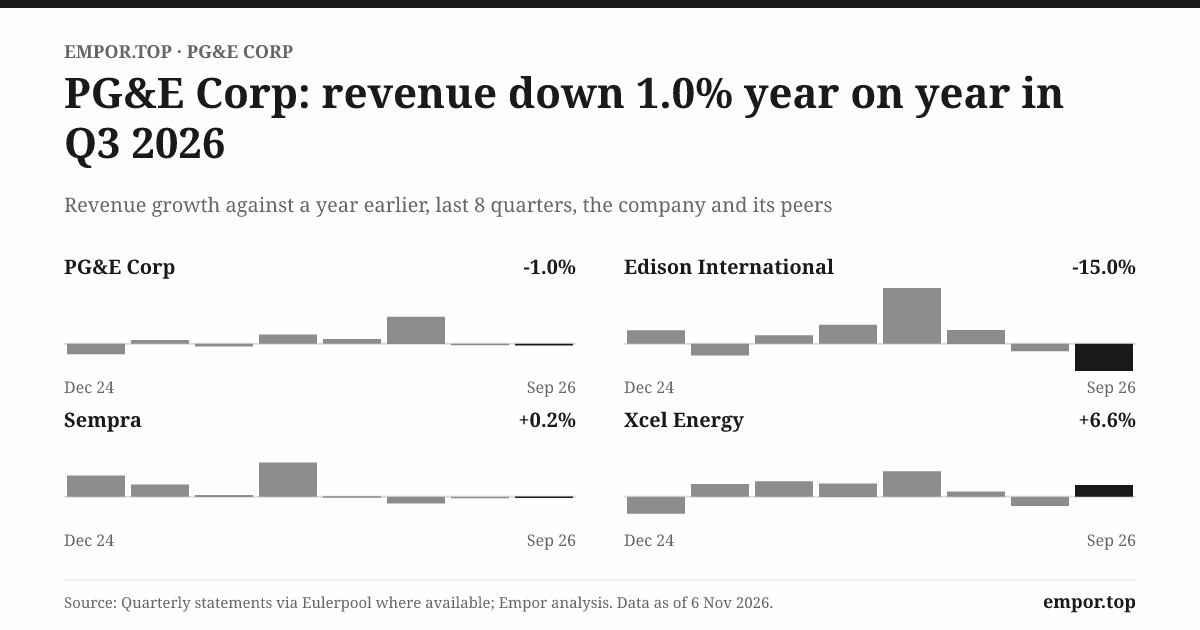
Comparisons with California peers need care. Edison International, the parent of Southern California Edison, traded at about 6.0 times trailing earnings in a late-October observation, while Sempra, the parent of San Diego Gas & Electric with substantial businesses outside California, traded at about 24.7 times.2930 Those multiples are not directly comparable: Edison has its own wildfire-related charges and liability questions, Sempra's earnings mix includes large non-California operations, and the observation dates differ. The useful lesson is that the market applies a steep discount to California wildfire exposure across the board, and that PG&E sits in that discounted group rather than being singled out alone.
The franchise, weighed
The moat argument belongs here, argued once and in full. Through Hamilton Helmer's lens of durable advantages, PG&E's exclusive service territory is its clearest power. Its scale and customers' inability to switch delivery providers stem from the franchise, not the company's skill. Network economies, counter-positioning and brand do not apply in the usual sense; if anything, the brand is a liability, since PG&E's reputation constrains the generosity of regulators. Process power, the advantage that comes from an operating system competitors cannot copy, is exactly what the post-bankruptcy management team is trying to build, and the evidence so far is mixed: lower reported ignition rates on one side, the 2021 oversight finding and 2025 fatalities on the other.21820
In five-forces terms, the decisive force is buyer power, and it sits with the regulator and the electorate rather than with any single customer. The other forces are muted or moderated by the structure of the business. Southern California Edison, which serves about 15 million people, is the closest comparison in scale, but it is a peer in risk and regulation rather than a rival for customers.7
Why might it win from here? Because the delivery network is essential and practically impossible to replicate, because base revenues are largely decoupled from sales volume, and because grid investment can support growing regulated earnings if costs are approved and allowed returns exceed the cost of funding. The near-term evidence is supportive: core EPS guidance has held through a difficult year, operating margins have recovered, and the company has said it does not need new equity through 2030 under its prior plan.52 New load from electrification and data centers could spread fixed costs across more usage and ease the affordability squeeze, the one mechanism that could make growth and lower bills reinforce each other.
Why might it not? Because the investment program has outstripped operating cash flow for more than a decade, so the company is permanently dependent on lenders. Because leverage is high, with debt about 1.9 times equity, and the parent sits below investment grade at S&P.326 Because wildfire liabilities continue to accumulate and estimates continue to rise, and because California's cost-recovery rules are still evolving. And because the political ceiling on bills limits how much of the investment the company can actually recover. Over the past twelve years, the rate base grew enormously, yet the company still recorded cumulative losses, suspended its dividend and heavily diluted shareholders. That record does not reject the thesis outright, but it narrows it to a smaller and more conditional version: rate-base growth creates value only in years without a catastrophic fire and only when regulators allow full recovery.
An activist or a skeptical long-short investor would focus on a handful of issues. The first is capital allocation in a constrained world: if the company cannot fund all its priorities, why was the 2027 plan set at $13.4 billion in the first place, and what process decides which $2 billion gets deferred? The second is the incentive design: a 139% bonus payout in a year with two fatalities invites the question of whether the scorecard weights the right things. The third is complexity: the strategic review's own scope, from ring-fencing to sales and separations, implies that the current structure may be destroying value by forcing low-risk businesses to share the financing costs of high-risk ones. The fourth is disclosure: the company does not break out which data-center projects are firm, how their costs are allocated, or what the 2027 deferral does to the queue, which leaves investors unable to judge the most-cited growth driver. The fifth is accounting judgment. The auditor's opinion was clean, but it identified regulatory accounting as a critical audit matter, because judgments about future rate recovery determine whether billions of dollars of costs sit on the balance sheet as regulatory assets or flow through the income statement.3 That is not a red flag. It is a reminder that a large part of PG&E's reported equity rests on the regulator's future behavior.
What would settle the argument
The bull case is coherent. Safety performance keeps improving, measured by the regulator rather than the company. The wildfire framework is stabilized or strengthened by legislation. Rate recovery proceeds, including on the pending Kincade and Dixie decisions. Disciplined capital cuts lower financing needs, ratings improve, and the cost of debt falls. The strategic review produces a structure that lets lower-risk businesses borrow more cheaply, and the rate base keeps growing without a new equity raise. In that world, a multiple near half the company's five-year median looks excessive.
The bear case is equally coherent. A severe fire linked to PG&E equipment arrives before the framework is reformed. The Wildfire Fund is depleted or weakened by claims from other utilities' fires. Regulators reject recovery on a significant tranche of costs. Another capital reset follows the first, or the review concludes that the cheapest path to investment grade runs through selling assets at unattractive prices or issuing equity after all. The parent stays below investment grade, the funding gap stays wide, and the multiple stays low because it was never too low.
Three measures matter most for telling which story is unfolding. The first is the company's wildfire safety record as tracked by the CPUC, including ignitions in high-risk areas; the latest management reading is a 74% decline in the weather-normalized ignition rate since 2017, and the direction has been favorable, but the regulator's data is the arbiter.222 The second is free cash flow, the gap between operating cash and capital spending, which was about negative $3.1 billion in 2025, narrower than the roughly negative $5 billion to $6 billion of 2021 through 2023 but still deeply negative.3 The third is credit quality, measured by funds from operations to debt against the company's mid-teens target and by the agencies' outlooks; the latest reading is mixed, with a positive outlook at Moody's and a negative one at Fitch.226 Energized data-center load is worth tracking too, but only as it becomes committed and measurable rather than signaled.
Finally, test management's credibility the way it should be tested: by comparing promises with outcomes. The company's near-term EPS guidance has largely been delivered, which is a real point in its favor. Its long-term targets have not survived contact with financing and affordability constraints. The 2021 investor day promised steady growth; the 2026 review withdrew the long-range plan. That reset is evidence that the constraints changed, or were underestimated. It is not, on its own, proof of either discipline or failure. What will settle it is whether the plan that emerges from the review is financeable without another rescue, and whether the company's safety record keeps improving while it is being executed.
XIII. Epilogue
Tonight, as the market closes on November 3, 2026, the Strategic Review Committee is still at work. Four independent directors are weighing options that range from ring-fencing parts of the business to selling or separating them, with the stated aim of producing an investment-grade company that keeps bills affordable and honors its obligations to employees, pensioners and claimants.12 The company has promised an answer no later than next summer.2 Until then, customers, regulators and investors are waiting for something PG&E has not given them in its current form since the review began: a long-term capital plan.
The next moments that will decide the story are already on the calendar. A CPUC decision on the benefit-cost framework for undergrounding could come as early as November 19, and a proposed decision on cost recovery for the Kincade and Dixie fires is expected around now.2 The board will set the 2027 dividend in December, and management has said the increase should be consistent with its prior trajectory.2 The 2027 general rate case is moving toward resolution, with a proposed decision that would authorize interim recovery of about $456 million over twelve months starting in January.2 Each of these is a small test of the same big question: will regulators allow PG&E to recover what it spends, at a pace that customers can bear?
The wildfire framework is the larger test. Poppe has said that comprehensive reform has not been enacted and that legislative action had not materialized this year.2 If California strengthens the framework, the discount on PG&E's equity and the cost of its debt could shrink together. If it does not, and the next fire season produces a severe fire linked to company equipment, the review's options may narrow quickly. The Mosquito Fire estimate, which rose by more than a third in nine months, is a reminder that even the losses already known have not finished moving.4
Watch, too, what the $2 billion deferral actually defers. If the company can show that high-risk safety work was preserved and that customers see measurable bill stability, the cut will look like discipline. If deferred projects include connections that new customers needed, or reliability work that later turns out to have mattered, it will look like a cost of a financing constraint that the company could not escape. And watch the gap between the return regulators authorize and the cost of the debt the company pays. Investment-grade credit is valuable only if it is earned without pushing unsustainable costs onto customers, because those costs are exactly what erodes the political permission to recover them.
The company has about $5.8 billion of liquidity, guidance for core EPS of $1.64 to $1.66 this year and $1.78 to $1.82 next year, and a capital plan that is $2 billion smaller than it was in the summer.45 Those numbers buy time. They do not answer the opening question. Can PG&E build enough of the grid to serve California's future while repairing the trust that grid depends on? The data-center opportunity matters if it brings durable, affordable load. The review matters if it produces a financeable plan. Safety, cost recovery and credit quality have to improve together, and in this company's history, they have rarely done so at the same time.
XIV. Outro
Go back to the canyon near Pulga, before dawn on a November morning in 2018, where an employee looked up and saw fire beneath a transmission tower that had stood for nearly a century. Then picture the same canyon today, and the crews who work lines like that one across a 70,000-square-mile territory, clearing brush, replacing hardware, burying cable, and deciding on windy days whether to switch the power off. Every line they maintain carries electricity to customers across the territory.6 It also carries the weight of every promise PG&E has made about safety since San Bruno.
That is what makes this utility unlike any other. Most monopolies worry about competitors, technology or prices. PG&E's franchise depends on something harder to measure and easier to lose: the public's willingness to keep trusting it with infrastructure that can kill people when it fails. The regulator can grant the territory. Only the company can keep it. PG&E's hardest job is not building the grid. It is earning the right to keep doing it.
References
-
PG&E Launches Strategic Review and Revises Capital Plan — PG&E, 2026-09-02 ↩↩↩↩↩↩↩
-
PG&E Corporation Q3 2026 Earnings Call Transcript — Stock Analysis, 2026-10-22 ↩↩↩↩↩↩↩↩↩↩↩↩↩↩↩↩↩↩↩↩↩↩↩↩↩↩↩↩↩
-
PG&E Corporation and Pacific Gas and Electric Company 2025 Form 10-K — SEC, 2026-02-12 ↩↩↩↩↩↩↩↩↩↩↩↩↩↩↩↩↩↩↩↩↩↩↩↩↩↩↩↩↩↩↩↩↩↩↩↩↩↩↩↩
-
PG&E Corporation and Pacific Gas and Electric Company Q3 2026 Form 10-Q — SEC, 2026-10-22 ↩↩↩↩
-
PG&E Corporation Q3 2026 Earnings Release — SEC, 2026-10-22 ↩↩↩↩↩↩↩↩↩↩↩
-
Western Energy Crisis, Annual Performance Review for FY 2001 — Federal Energy Regulatory Commission ↩↩↩↩
-
California Energy Markets: Pressures Have Eased, but Cost Risks Remain — California State Auditor, 2001-12 ↩↩↩↩↩↩
-
Price Manipulation in Western Markets: Findings at a Glance — Federal Energy Regulatory Commission, 2003-03-26 ↩↩
-
San Bruno Pipeline Rupture Investigation — National Transportation Safety Board ↩↩↩↩
-
PG&E receives maximum sentence for 2010 San Bruno explosion — ABC7 News, 2017-01-27 ↩↩↩↩↩
-
PG&E Criminal Conviction and Sentence — U.S. Department of Justice, 2017-01-26 ↩↩↩↩
-
Camp Fire Public Report: Summary of the Investigation — Butte County District Attorney’s Office ↩↩↩
-
PG&E pleads guilty to 84 counts of manslaughter in devastating Camp Fire — NBC News, 2020-06-16 ↩↩↩↩↩↩
-
Cal Fire: Private equipment, not PG&E, at fault for deadly Tubbs Fire — CNBC, 2019-01-24 ↩
-
PG&E Bankruptcy and Reorganization — California Public Utilities Commission ↩↩↩↩↩↩↩↩↩↩↩↩
-
PG&E Corporation and Pacific Gas and Electric Company 2020 Form 10-K — SEC, 2021-02-25 ↩↩↩↩↩↩↩
-
PG&E Corporation 2026 Joint Proxy Statement — SEC, 2026-04-09 ↩↩↩↩↩↩↩↩
-
PG&E Corporation Appoints Patricia K. Poppe as Chief Executive Officer — SEC, 2020-11-18 ↩↩↩↩
-
PG&E Safety Performance Metrics Reports — California Public Utilities Commission ↩↩↩
-
PG&E Debt Investors and Credit Ratings — PG&E, data as of 2026-09-30 ↩↩↩
-
Research Update: PG&E Corp. Ratings Affirmed — S&P Global Ratings ↩
 LinkedIn
 WhatsApp
 Reddit
 Hacker News
 Email
 Kindle
 RSS Feed
 Spotify
 Apple Podcasts
 Amazon Music
 Audible
 YouTube